EP1887585A1 - Corps à faible magnétostriction et noyau à poudre de fer l utilisant - Google Patents
Corps à faible magnétostriction et noyau à poudre de fer l utilisant Download PDFInfo
- Publication number
- EP1887585A1 EP1887585A1 EP06746757A EP06746757A EP1887585A1 EP 1887585 A1 EP1887585 A1 EP 1887585A1 EP 06746757 A EP06746757 A EP 06746757A EP 06746757 A EP06746757 A EP 06746757A EP 1887585 A1 EP1887585 A1 EP 1887585A1
- Authority
- EP
- European Patent Office
- Prior art keywords
- magnetostriction
- soft magnetic
- magnetic material
- magnetostrictive body
- low magnetostrictive
- Prior art date
- Legal status (The legal status is an assumption and is not a legal conclusion. Google has not performed a legal analysis and makes no representation as to the accuracy of the status listed.)
- Withdrawn
Links
Images


Classifications
-
- H—ELECTRICITY
- H01—ELECTRIC ELEMENTS
- H01F—MAGNETS; INDUCTANCES; TRANSFORMERS; SELECTION OF MATERIALS FOR THEIR MAGNETIC PROPERTIES
- H01F3/00—Cores, Yokes, or armatures
- H01F3/08—Cores, Yokes, or armatures made from powder
-
- C—CHEMISTRY; METALLURGY
- C22—METALLURGY; FERROUS OR NON-FERROUS ALLOYS; TREATMENT OF ALLOYS OR NON-FERROUS METALS
- C22C—ALLOYS
- C22C38/00—Ferrous alloys, e.g. steel alloys
- C22C38/02—Ferrous alloys, e.g. steel alloys containing silicon
-
- H—ELECTRICITY
- H01—ELECTRIC ELEMENTS
- H01F—MAGNETS; INDUCTANCES; TRANSFORMERS; SELECTION OF MATERIALS FOR THEIR MAGNETIC PROPERTIES
- H01F1/00—Magnets or magnetic bodies characterised by the magnetic materials therefor; Selection of materials for their magnetic properties
- H01F1/01—Magnets or magnetic bodies characterised by the magnetic materials therefor; Selection of materials for their magnetic properties of inorganic materials
- H01F1/03—Magnets or magnetic bodies characterised by the magnetic materials therefor; Selection of materials for their magnetic properties of inorganic materials characterised by their coercivity
- H01F1/12—Magnets or magnetic bodies characterised by the magnetic materials therefor; Selection of materials for their magnetic properties of inorganic materials characterised by their coercivity of soft-magnetic materials
- H01F1/14—Magnets or magnetic bodies characterised by the magnetic materials therefor; Selection of materials for their magnetic properties of inorganic materials characterised by their coercivity of soft-magnetic materials metals or alloys
- H01F1/147—Alloys characterised by their composition
- H01F1/14766—Fe-Si based alloys
-
- H—ELECTRICITY
- H01—ELECTRIC ELEMENTS
- H01F—MAGNETS; INDUCTANCES; TRANSFORMERS; SELECTION OF MATERIALS FOR THEIR MAGNETIC PROPERTIES
- H01F1/00—Magnets or magnetic bodies characterised by the magnetic materials therefor; Selection of materials for their magnetic properties
- H01F1/01—Magnets or magnetic bodies characterised by the magnetic materials therefor; Selection of materials for their magnetic properties of inorganic materials
- H01F1/03—Magnets or magnetic bodies characterised by the magnetic materials therefor; Selection of materials for their magnetic properties of inorganic materials characterised by their coercivity
- H01F1/12—Magnets or magnetic bodies characterised by the magnetic materials therefor; Selection of materials for their magnetic properties of inorganic materials characterised by their coercivity of soft-magnetic materials
- H01F1/14—Magnets or magnetic bodies characterised by the magnetic materials therefor; Selection of materials for their magnetic properties of inorganic materials characterised by their coercivity of soft-magnetic materials metals or alloys
- H01F1/20—Magnets or magnetic bodies characterised by the magnetic materials therefor; Selection of materials for their magnetic properties of inorganic materials characterised by their coercivity of soft-magnetic materials metals or alloys in the form of particles, e.g. powder
- H01F1/22—Magnets or magnetic bodies characterised by the magnetic materials therefor; Selection of materials for their magnetic properties of inorganic materials characterised by their coercivity of soft-magnetic materials metals or alloys in the form of particles, e.g. powder pressed, sintered, or bound together
- H01F1/24—Magnets or magnetic bodies characterised by the magnetic materials therefor; Selection of materials for their magnetic properties of inorganic materials characterised by their coercivity of soft-magnetic materials metals or alloys in the form of particles, e.g. powder pressed, sintered, or bound together the particles being insulated
- H01F1/26—Magnets or magnetic bodies characterised by the magnetic materials therefor; Selection of materials for their magnetic properties of inorganic materials characterised by their coercivity of soft-magnetic materials metals or alloys in the form of particles, e.g. powder pressed, sintered, or bound together the particles being insulated by macromolecular organic substances
-
- H—ELECTRICITY
- H01—ELECTRIC ELEMENTS
- H01F—MAGNETS; INDUCTANCES; TRANSFORMERS; SELECTION OF MATERIALS FOR THEIR MAGNETIC PROPERTIES
- H01F41/00—Apparatus or processes specially adapted for manufacturing or assembling magnets, inductances or transformers; Apparatus or processes specially adapted for manufacturing materials characterised by their magnetic properties
- H01F41/02—Apparatus or processes specially adapted for manufacturing or assembling magnets, inductances or transformers; Apparatus or processes specially adapted for manufacturing materials characterised by their magnetic properties for manufacturing cores, coils, or magnets
- H01F41/0206—Manufacturing of magnetic cores by mechanical means
- H01F41/0246—Manufacturing of magnetic circuits by moulding or by pressing powder
-
- H—ELECTRICITY
- H10—SEMICONDUCTOR DEVICES; ELECTRIC SOLID-STATE DEVICES NOT OTHERWISE PROVIDED FOR
- H10N—ELECTRIC SOLID-STATE DEVICES NOT OTHERWISE PROVIDED FOR
- H10N35/00—Magnetostrictive devices
- H10N35/80—Constructional details
- H10N35/85—Magnetostrictive active materials
-
- H—ELECTRICITY
- H01—ELECTRIC ELEMENTS
- H01F—MAGNETS; INDUCTANCES; TRANSFORMERS; SELECTION OF MATERIALS FOR THEIR MAGNETIC PROPERTIES
- H01F1/00—Magnets or magnetic bodies characterised by the magnetic materials therefor; Selection of materials for their magnetic properties
- H01F1/01—Magnets or magnetic bodies characterised by the magnetic materials therefor; Selection of materials for their magnetic properties of inorganic materials
- H01F1/03—Magnets or magnetic bodies characterised by the magnetic materials therefor; Selection of materials for their magnetic properties of inorganic materials characterised by their coercivity
- H01F1/12—Magnets or magnetic bodies characterised by the magnetic materials therefor; Selection of materials for their magnetic properties of inorganic materials characterised by their coercivity of soft-magnetic materials
- H01F1/14—Magnets or magnetic bodies characterised by the magnetic materials therefor; Selection of materials for their magnetic properties of inorganic materials characterised by their coercivity of soft-magnetic materials metals or alloys
- H01F1/147—Alloys characterised by their composition
- H01F1/153—Amorphous metallic alloys, e.g. glassy metals
- H01F1/15358—Making agglomerates therefrom, e.g. by pressing
- H01F1/15366—Making agglomerates therefrom, e.g. by pressing using a binder
- H01F1/15375—Making agglomerates therefrom, e.g. by pressing using a binder using polymers
Definitions
- the present invention relates to a low magnetostrictive body and dust core, more specifically, to a low magnetostrictive body generating markedly low magnetostriction when exposed to an alternating current magnetic field and a dust core using the same.
- a dust core can be obtained by pressing powders composed of a soft magnetic material. It is used as a magnetic core of various electric appliances such as motor, transformer, DC solenoid actuator, inverter, switching device, and noise filter.
- Magnetic properties of a dust core in a high frequency region depend on iron losses and the iron losses are mainly hysteresis loss and eddy current loss.
- hysteresis loss is power loss generated by the domain wall pinning due to crystal defects, inclusions, internal stress or the like. The hysteresis loss must therefore be reduced by the removal of internal stress or the like as much as possible.
- Eddy current loss is power loss generated by the flow of an eddy current within a conductor placed in an alternating current magnetic field in a plane perpendicular to a magnetic flux. The eddy current loss must accordingly be reduced by increasing an electric resistivity of a dust core as much as possible.
- An insulating film formed on the surface of a soft magnetic powder is however broken easily when the powder is pressed or heat treated.
- the insulating film is broken easily when the powder is pressed under high pressure in order to have a high density or the powder is treated at a relatively high temperature in order to remove the residual strain sufficiently.
- Patent Document 1 there is disclosed a dust core obtained by mixing 4.0 wt% of a silicone resin with an Fe-Si alloy having an Si content of from 0.9 to 6.6 wt% and an O content of from 0.32 wt% or less, pressing the resulting mixture under pressure of 13 tonf/cm 2 (1274 MPa), and heat treating the resulting product at 800°C for 1 hour in vacuum. It is described in this document that a dust core having less loss and high magnetic permeability can be obtained by optimizing the composition and form of the powder, and use of a silicone resin as both an insulating material and a binder enables suppression of the reduction of insulation properties during heating to high temperatures.
- Patent Document 2 there is disclosed a dust core obtained by covering the surface of an Fe-9.6 wt% Si-5.4 wt% Al alloy powder with 2 wt% of a silicone resin, covering the resulting surface further with 0.5 wt% of a zinc stearate lubricant, pressing the resulting powder under pressure of 13 tonf/cm 2 (1274 MPa), and heat treating the product for 1 hour at from 500 to 1000°C in vacuum.
- a dust core having a high density and high magnetic permeability is available by the above-described method.
- Patent Document 3 there is disclosed a dust core obtained by adding 3 parts by weight of a silicone resin to an Fe-6.5 wt% Si alloy powder, pressing the resulting mixture under pressure of 1.27 ⁇ 10 3 MPa, impregnating the product with water glass, and heat treating the resulting product at 700°C for 1 hour in vacuum. It is described in this document that impregnation of the product with a liquid insulation material such as water glass restores an electric insulating film which has been broken at the time of pressing, and raises the electric resistivity of the dust core by one or more orders of magnitude.
- Magnetostriction is the phenomenon where a magnetic material changes its shape when it becomes magnetized. It is known that a soft magnetic material showing a magnetostriction phenomenon will be a cause for vibration or noise when it is used for a magnetic core of a transformer or reactor. A decrease in the operating magnetic flux density for reducing noise, on the other hand, results in an increase in the size of the magnetic core. It is therefore preferred to use a material exhibiting low magnetostriction for the magnetic core.
- Fe-Si compositions such as an Fe-6.5% Si composition and Fe-Si-Al (sendust) compositions such as an Fe-9.5% Si-5.7% Al composition are known.
- a magnetic core using an Fe-6.5% Si steel plate has the following drawbacks:
- a problem that the present invention is to solve is to provide a low magnetostrictive body having very low magnetostriction; and a dust core using the same. Another problem that the present invention is to solve is to provide a low magnetostrictive body whose magnetostriction has been reduced alone while maintaining its magnetic properties such as loss and saturation magnetization at desired values; and a dust core using the same. A further problem that the present invention is to solve is to provide a low magnetostrictive body which does not need a special production process and therefore can be produced at a low cost; and a dust core using the same.
- the low magnetostrictive body of the present invention for overcoming the above-described problems is obtained by adding, to a powder composed of a soft magnetic material, an organic compound having an effect of changing the magnetostriction of a soft magnetic material when the organic compound is used in combination with the soft magnetic material; by pressing the resulting mixture and heat treating the green compact in an inert atmosphere; and has an absolute value of the magnetostriction ⁇ O-P (1T/50Hz) not greater than 1.0 ⁇ 10 -6 .
- the dust core according to the present invention comprises the low magnetostrictive body of the present invention.
- the magnetostriction increases/decreases by changing the amount of the organic compound.
- Use of the most suited kind or amount of the organic compound enables to reduce the absolute value of the magnetostriction to substantially zero irrespective of the composition of the soft magnetic powder.
- only a change in the amount of the organic compound enables a decrease in the magnetostriction alone so that a low magnetostrictive body having desired magnetic properties is available at a low cost.
- the low magnetostrictive body according to the present invention can be obtained by adding an organic compound to a powder made of a soft magnetic material, pressing it into a green compact, and then heat treating the resulting green compact under an inert atmosphere.
- the dust core according to the present invention comprises the low magnetostrictive body of the present invention.
- soft magnetic materials having Fe as a principal component have high magnetic properties so that they are suited as the starting raw material.
- soft magnetic materials having Fe as a principal component as used herein means metal materials having an Fe content of 90 wt% or greater.
- soft magnetic materials usable in the present invention include:
- the average particle size of the soft magnetic powder is not limited to the average particle size of the soft magnetic powder and it can be selected freely depending on the intended use.
- the soft magnetic powder has an average particle size of preferably 5 ⁇ m or greater but not greater than 500 ⁇ m, more preferably 20 ⁇ m or greater but not greater than 200 ⁇ m.
- the soft magnetic powder may be a spherical powder such as gas atomized powder or an amorphous powder such as water atomized powder.
- a spherical powder such as gas atomized powder
- an amorphous powder such as water atomized powder.
- a green compact having a high strength is available.
- organic compounds can be roughly classified into:
- organic compound B examples include silicon-based resins and silicon-based surfactants.
- organic compound C examples include polyphenylene sulfide (PPS).
- PPS polyphenylene sulfide
- a silicon-based resin is especially suited as the organic compound for forming a low magnetostrictive body having low eddy current loss because it has an effect of decreasing the magnetostriction and at the same time, an insulating film is formed around the soft magnetic particles as a result of the heat treatment.
- an Fe-Si alloy containing 1 ⁇ 0.2 wt% of Si is a soft magnetic material having positive magnetostriction properties so that the above-described organic compound B is used as the organic compound.
- the amount of the silicon-based resin is set at preferably 0.4 wt% or greater but not greater than 0.8 wt% in order to adjust the absolute value of the magnetostriction ⁇ O-P (1T/50Hz) to 1 ⁇ 10 -6 or less.
- the amount of the silicon-based resin is preferably 0.5 wt% or greater but not greater than 0.7 wt% in order to adjust the absolute value of the magnetostriction ⁇ O-P (1T/50Hz) to 0.5 ⁇ 10 -6 or less.
- an Fe-Si alloy containing 2 ⁇ 0.2 wt% of Si is a soft magnetic material having positive magnetostriction properties so that the above-described organic compound B is used as the organic compound.
- the organic compound B is a silicon-based resin and an Fe-Si alloy powder has an average particle size of 20 ⁇ m or greater but not greater than 200 ⁇ m
- the amount of the silicon-based resin is preferably 0.6 wt% or greater but not greater than 1.1 wt% in order to adjust the absolute value of the magnetostriction ⁇ O-P (1T/50Hz) to 1 ⁇ 10 -6 or less.
- the amount of the silicon-based resin is preferably 0.7 wt% or greater but not greater than 1.0 wt% in order to adjust the absolute value of the magnetostriction ⁇ O-P (1T/50Hz) to 0.5 ⁇ 10 -6 or less.
- an Fe-Si alloy containing 3 ⁇ 0.2 wt% of Si is a soft magnetic material having positive magnetostriction properties so that the above-described organic compound B is used as the organic compound.
- the organic compound B is a silicon-based resin and an Fe-Si alloy powder has an average particle size of 20 ⁇ m or greater but not greater than 200 ⁇ m
- the amount of the silicon-based resin is preferably 0.7 wt% or greater but not greater than 1.3 wt% in order to adjust the absolute value of the magnetostriction ⁇ O-P (1T/50Hz) to 1 ⁇ 10 -6 or less.
- the amount of the silicon-based resin is preferably 0.9 wt% or greater but not greater than 1.2 wt% in order to adjust the absolute value of the magnetostriction ⁇ O-P (1T/50Hz) to 0.5 ⁇ 10 -6 or less.
- the adding method of the organic compound to the soft magnetic material is not particular limited and the most suited one is employed, depending on the kind of the organic compound.
- a method usually employed is to dissolve the organic compound in a proper solvent (such as alcohol), add the soft magnetic powder to the resulting solution, and evaporate the solvent from the mixture.
- the soft magnetic powder added with a predetermined amount of the organic compound is pressed under certain conditions.
- a metal powder such as uniaxial pressing and hydrostatic pressing.
- any method is usable.
- a lubricant is usually employed for reducing powder-powder friction and/or powder-die friction.
- the lubricant may be mixed with the powder (internal addition) or may be applied to the surface of a die (external addition).
- most suited conditions such as pressing temperature and pressing pressure are selected depending on the material of the powder, intended use of the pressed product, demanded properties, or the like.
- die lubrication warm high-pressure forming method is especially suited as a method for manufacturing a high-density green compact.
- die lubrication warm high-pressure forming method means a method of applying a lubricant to the inner surface of a die without adding it to the powder and carrying out uniaxial pressing at a predetermined temperature (warm) at a predetermined pressure (high pressure).
- higher fatty acid lubricants and metal salts thereof are preferred.
- Specific examples of the higher fatty acid include stearic acid, palmitic acid and oleic acid.
- Specific examples of the metal salts of the higher fatty acid include:
- the lubricant is applied to a die by spraying an aqueous solution having the lubricant dispersed therein to the inner surface of a heated die by means of a spray gun, electrostatic gun or the like.
- the amount of the lubricant in the aqueous solution is preferably 0.1 wt% or greater but not greater than 5 wt%. When the amount of the lubricant is less than 0.1 wt%, the lubrication effect is not sufficient. The amount of the lubricant exceeding 5 wt%, on the other hand, is not preferred, because an excess amount of the lubricant remains on the surface of the green compact.
- the amount of the lubricant is more preferably 0.5 wt% or greater but not greater than 2 wt%.
- a surfactant may be added to the aqueous solution having the lubricant dispersed therein. Addition of the surfactant enables more uniform dispersion of the lubricant.
- the surfactant include alkylphenol surfactants, polyoxyethylene nonylphenyl ether (EO) 6, polyoxyethylene nonylphenyl ether (EO) 10, anionic/nonionic surfactants and borate-based Emulbon T-80. Two or more of these surfactants may be used in combination.
- the amount of the surfactant to be added to the aqueous solution is preferably 1.5 vol% or greater but not greater than 15 vol%.
- a defoaming agent for example, silicon-based defoaming agent
- a defoaming agent for example, silicon-based defoaming agent
- Severe foaming of the aqueous solution makes it difficult to form a uniform film on the inner surface of the die.
- the amount of the defoaming agent in the aqueous solution is preferably 0.1 vol% or greater but not greater than 1 vol%.
- the heating temperature of the die may be any temperature insofar as it permits the rapid evaporation of water from the lubricant solution sprayed to the inner surface of the die and the uniform formation of the lubricant film on the inner surface of the die.
- the heating temperature of the die is controlled to be less than the melting point of the lubricant (for example, 220°C when lithium stearate is used as the lubricant).
- the heating temperature of the die is preferably 100°C or greater but not greater than 200°C, more preferably 120°C or greater but not greater than 180°C.
- the powder is filled in the heated die and pressed into a green compact under a predetermined pressure.
- the green compact thus obtained has a higher density. Too high pressure however causes seizure between the inner surface of the die and the green compact or increases the ejection pressure..
- the pressure for obtaining a high density green compact is preferably 600 MPa or greater, more preferably 700 MPa or greater, still more preferably 1000 MPa or greater. Too high pressures decreases the life of the die. Accordingly, the pressure is preferably 2000 MPa or less, more preferably 1500 MPa or less.
- the green compact thus obtained is then heat treated. If the low magnetostrictive material of the present invention is used as a dust core, a residual strain at the time of pressing, if any, causes deterioration of magnetic properties such as increase in the retention force, decrease in magnetic permeability and increase in hysteresis loss. It is therefore preferred to carry out annealing for the removal of the residual strain in order to obtain a dust core excellent in magnetic properties.
- Heat treatment is performed under an inert atmosphere (for example, in an argon or vacuum). Heat treatment in an oxidizing atmosphere is not preferred, because it oxidizes the soft magnetic powder and deteriorates magnetic properties.
- the heat treatment temperature the optimum one is selected depending on the composition of the soft magnetic powder, pressing conditions and the like so as to remove the residual strain in the green compact sufficiently.
- the heat treatment time the optimum one is selected depending on the composition of the soft magnetic powder, heat treating temperature and the like so as to remove the residual strain in the green compact sufficiently. In general, too low heat treatment temperature and/or too short heat treatment time cannot remove the residual strain sufficiently.
- Too high heat treatment temperature and/or too long heat treatment time causes diffusion of component elements, thereby deteriorating the magnetic properties of the green compact.
- the green compact made of an Fe-Si alloy and a silicon-based resin is heat treated at preferably 600°C or greater but not greater than 900°C, more preferably 650°C or greater but not greater than 850°C.
- the heat treatment time is typically from about 0.5 to 4 hours, though depending on the heat treatment temperature.
- ⁇ O-P is the magnetostriction of a low magnetostrictive body under the condition of 1T/50Hz or 0.5T/50Hz
- ⁇ ' O-P is the magnetostriction of a bulk material having the same composition as that of the soft magnetic powder under the condition of 1T/5OHz or 0.5T/50Hz.
- bulk material means a dissolved/cast material or sintered body made of a material having the same composition as that of the soft magnetic material.
- Dust cores are superior in recycling efficiency to magnetic cores obtained by laminating thin plates and in addition, are known to generate vibration or noise less than a board material made of the same material.
- Conventional dust cores have a drawback that they generate a lot of vibration or noise compared with magnetic cores using an alloy having low magnetostriction.
- Use of a material having low magnetostriction as a magnetic powder is therefore preferred in order to obtain a dust core excellent in recycling efficiency and quietness.
- Conventionally known low magnetostrictive alloys have problems such as low saturation magnetization, low formability and high cost. An inexpensive dust core having high magnetic properties cannot therefore be manufactured using such a conventional low magnetostrictive alloy powder.
- the present inventors have found that when the organic compound is added to the soft magnetic material to prepare a green compact, optimization of the kind of the organic compound leads to an increase or decrease of the magnetostriction of the green compact.. It is therefore possible to obtain a low magnetostrictive body having substantially zero magnetostriction by adding, according to the kind of the soft magnetic material, an organic compound having an effect of increasing or decreasing the magnetostriction of the soft magnetic material and optimizing the amount of the organic compound. Details of the reason of such an effect are not known but it is presumed that when a certain organic compound is added to the soft magnetic powder and the green compact thus obtained is heat treated, decomposition products remain in the grain boundary and increase or decrease the magnetostriction.
- the low magnetostrictive body of the present invention can be prepared at a low cost because it does not need an expensive low magnetostrictive alloy as a starting raw material. In addition, it is a green compact so that it is excellent in recycling efficiency. Moreover, since the low magnetostrictive body is low magnetostrictive, if it is used to obtain a dust core, then such dust core that is small in size and excellent in quietness is available. Furthermore, use of a specific low magnetostrictive alloy as a starting raw material is not necessary for attaining low magnetostriction so that the degree of freedom of selecting a material is high. It is therefore possible to accomplish both high magnetic properties (such as high magnetic flux density, high saturation magnetization, and low loss) and low magnetostriction.
- high magnetic properties such as high magnetic flux density, high saturation magnetization, and low loss
- a gas atomized powder or water atomized powder (from -#100 to +#350) of an Fe-Si alloy (Si content: from 1 to 3 wt%) was used.
- a predetermined amount (from 0.1 to 3.0 mass% based on the weight of the powder) of a commercially available silicon-based resin was diluted with ethanol and the soft magnetic powder was then added to it. They were mixed, followed by drying.
- the resulting powder was pressed by the die lubrication warm high-pressure forming method into a test piece used for evaluation of properties. The pressing conditions are as described below. Shape of the test piece: rod-like test piece (refer to FIGS.
- a sintered body was prepared using the gas atomized powder made of an Fe-Si alloy used in Examples 1 to 6. From the resulting sintered body, a rod-like test piece and a ring-shaped test piece having similar shapes to those obtained in Examples 1 to 6 were prepared, respectively.
- a rod-like test piece and a ring-shaped test piece having similar shapes to those obtained in Examples 1 to 6 were prepared, respectively, by use of a laminated steel plate obtained by stacking Fe-6.5% Si steel plates.
- test pieces for evaluation of properties were formed and then heat treated.
- FIGS. 2 shows typical magnetostriction measurement examples ( FIG. 2(a) : magnetic flux density - time curve, FIG. 2(b) : magnetostriction - magnetic flux density curve, FIG. 2(c) : magnetostriction - magnetic flux density curve).
- the Fe-6.5% Si laminated steel plate (Comparative Example 4) showed low magnetostriction and low loss.
- the sintered materials made of an Fe-Si alloy (Comparative Examples 1 to 3) had a high magnetic flux density, but the magnetostriction of each of them under the condition of 1T/SOHz exceeded 1 ⁇ 10 -6 and their loss exceeded 10 times the loss of the Fe-6.5% Si laminated steel plate.
- a considerably large loss of the sintered materials owe to a large eddy current loss.
- the green compacts (Examples 1 to 6, Comparative Examples 5 to 8) obtained by adding the resin to the atomized powder had a magnetic flux density substantially equal to that of the sintered materials and had a loss about 1.3 to 2.1 times the loss of the Fe-6.5% Si laminated steel plate.
- the magnetostriction of the green compact varied with the amount of the resin. It has been understood from Table 1 that a green compact having magnetostriction not greater than that of the Fe-6.5% Si laminated steel plate can be obtained by changing the amount of the resin.
- the magnetostriction of the green compact using the water atomized powder has shifted in the positive direction compared with that using the gas atomized powder. This is because the resin amount is apparently small owing to a large specific surface area of the powder.
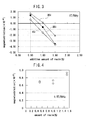
- FIG. 3 shows the relationship between the amount of the resin and magnetostriction.
- the relationship between the amount of the resin x (wt%) and magnetostriction ⁇ O-P in the vicinity of zero magnetostriction under the condition of 1T/50Hz is represented by the following equation (1).
- the magnetostriction ⁇ O-P becomes almost zero when the resin amount x is about 0.6 wt%.
- ⁇ O - P - 4.32 ⁇ 10 - 6 ⁇ x + 2.73 ⁇ 10 - 6
- the low magnetostrictive body according to the present invention and dust core using the same can be used as a magnetic core of various electric appliances such as motor, transformer, DC solenoid actuator, inverter, switching device and noise filter.
Landscapes
- Engineering & Computer Science (AREA)
- Power Engineering (AREA)
- Chemical & Material Sciences (AREA)
- Dispersion Chemistry (AREA)
- Physics & Mathematics (AREA)
- Electromagnetism (AREA)
- Manufacturing & Machinery (AREA)
- Spectroscopy & Molecular Physics (AREA)
- Materials Engineering (AREA)
- Mechanical Engineering (AREA)
- Metallurgy (AREA)
- Organic Chemistry (AREA)
- Soft Magnetic Materials (AREA)
- Powder Metallurgy (AREA)
Applications Claiming Priority (2)
| Application Number | Priority Date | Filing Date | Title |
|---|---|---|---|
| JP2005153808A JP4750471B2 (ja) | 2005-05-26 | 2005-05-26 | 低磁歪体及びこれを用いた圧粉磁芯 |
| PCT/JP2006/310273 WO2006126553A1 (fr) | 2005-05-26 | 2006-05-23 | Corps à faible magnétostriction et noyau à poudre de fer l’utilisant |
Publications (2)
| Publication Number | Publication Date |
|---|---|
| EP1887585A1 true EP1887585A1 (fr) | 2008-02-13 |
| EP1887585A4 EP1887585A4 (fr) | 2010-09-22 |
Family
ID=37451978
Family Applications (1)
| Application Number | Title | Priority Date | Filing Date |
|---|---|---|---|
| EP06746757A Withdrawn EP1887585A4 (fr) | 2005-05-26 | 2006-05-23 | Corps à faible magnétostriction et noyau à poudre de fer l utilisant |
Country Status (6)
| Country | Link |
|---|---|
| US (1) | US20090220372A1 (fr) |
| EP (1) | EP1887585A4 (fr) |
| JP (1) | JP4750471B2 (fr) |
| KR (1) | KR100964731B1 (fr) |
| CN (1) | CN101185144A (fr) |
| WO (1) | WO2006126553A1 (fr) |
Cited By (2)
| Publication number | Priority date | Publication date | Assignee | Title |
|---|---|---|---|---|
| EP2458601A4 (fr) * | 2009-07-23 | 2014-01-01 | Hitachi Powdered Metals | Noyau aggloméré et son procédé de fabrication |
| EP2755215A4 (fr) * | 2011-09-07 | 2015-09-09 | Chang Sung Co | Bloc unitaire elliptique pour la préparation d'un noyau au moyen de poudre de métal magnétique doux, et noyau magnétique pulvérulent préparé à l'aide de ce dernier |
Families Citing this family (4)
| Publication number | Priority date | Publication date | Assignee | Title |
|---|---|---|---|---|
| JP4837700B2 (ja) * | 2008-04-15 | 2011-12-14 | 株式会社豊田中央研究所 | 圧粉磁心並びにその製造方法 |
| JP5410699B2 (ja) * | 2008-07-10 | 2014-02-05 | 日本科学冶金株式会社 | Fe系軟磁性材の製造方法及びFe系軟磁性材並びに圧粉磁芯 |
| JP6071211B2 (ja) | 2011-02-22 | 2017-02-01 | 三菱マテリアル株式会社 | 低磁歪高磁束密度複合軟磁性材とその製造方法 |
| JP6358557B2 (ja) * | 2013-06-17 | 2018-07-18 | 住友電気工業株式会社 | リアクトル、磁性体、コンバータ、および電力変換装置 |
Family Cites Families (11)
| Publication number | Priority date | Publication date | Assignee | Title |
|---|---|---|---|---|
| JPS5825449A (ja) * | 1981-08-05 | 1983-02-15 | Toshiba Corp | 磁気ヘツド用非晶質磁性合金 |
| JP3068155B2 (ja) * | 1989-05-27 | 2000-07-24 | ティーディーケイ株式会社 | 軟磁性合金およびその製造方法 |
| SG78328A1 (en) * | 1997-12-25 | 2001-02-20 | Matsushita Electric Industrial Co Ltd | Magnetic composite article and manufacturing method of the same and soft magnetic powder of fe-al-si system alloy used in the composite article |
| JP3723016B2 (ja) * | 1998-08-28 | 2005-12-07 | アルプス電気株式会社 | Fe基軟磁性合金 |
| US6432159B1 (en) * | 1999-10-04 | 2002-08-13 | Daido Tokushuko Kabushiki Kaisha | Magnetic mixture |
| JP2002110413A (ja) * | 1999-10-04 | 2002-04-12 | Daido Steel Co Ltd | 磁性混合物 |
| JP4178004B2 (ja) * | 2002-06-17 | 2008-11-12 | アルプス電気株式会社 | 磁気素子及びインダクタ及びトランス |
| JP2004146563A (ja) * | 2002-10-24 | 2004-05-20 | Matsushita Electric Ind Co Ltd | 複合磁性材料 |
| AU2003301577A1 (en) * | 2002-10-25 | 2004-05-13 | Showa Denko K.K. | Alloy containing rare earth element, production method thereof, magnetostrictive device, and magnetic refrigerant material |
| JP4289665B2 (ja) * | 2003-07-30 | 2009-07-01 | 株式会社豊田中央研究所 | リアクトル、リアクトル用コアおよびその製造方法 |
| JP4562022B2 (ja) * | 2004-04-22 | 2010-10-13 | アルプス・グリーンデバイス株式会社 | 非晶質軟磁性合金粉末及びそれを用いた圧粉コアと電波吸収体 |
-
2005
- 2005-05-26 JP JP2005153808A patent/JP4750471B2/ja not_active Expired - Lifetime
-
2006
- 2006-05-23 US US11/921,021 patent/US20090220372A1/en not_active Abandoned
- 2006-05-23 KR KR1020077027485A patent/KR100964731B1/ko not_active Expired - Fee Related
- 2006-05-23 WO PCT/JP2006/310273 patent/WO2006126553A1/fr not_active Ceased
- 2006-05-23 EP EP06746757A patent/EP1887585A4/fr not_active Withdrawn
- 2006-05-23 CN CNA2006800184278A patent/CN101185144A/zh active Pending
Cited By (2)
| Publication number | Priority date | Publication date | Assignee | Title |
|---|---|---|---|---|
| EP2458601A4 (fr) * | 2009-07-23 | 2014-01-01 | Hitachi Powdered Metals | Noyau aggloméré et son procédé de fabrication |
| EP2755215A4 (fr) * | 2011-09-07 | 2015-09-09 | Chang Sung Co | Bloc unitaire elliptique pour la préparation d'un noyau au moyen de poudre de métal magnétique doux, et noyau magnétique pulvérulent préparé à l'aide de ce dernier |
Also Published As
| Publication number | Publication date |
|---|---|
| JP2006332328A (ja) | 2006-12-07 |
| KR20080010442A (ko) | 2008-01-30 |
| KR100964731B1 (ko) | 2010-06-21 |
| CN101185144A (zh) | 2008-05-21 |
| US20090220372A1 (en) | 2009-09-03 |
| JP4750471B2 (ja) | 2011-08-17 |
| WO2006126553A1 (fr) | 2006-11-30 |
| EP1887585A4 (fr) | 2010-09-22 |
Similar Documents
| Publication | Publication Date | Title |
|---|---|---|
| EP2518740B1 (fr) | Procédé de production d'un réacteur | |
| US7682695B2 (en) | Dust core with specific relationship between particle diameter and coating thickness, and method for producing same | |
| EP2492031B1 (fr) | Noyau de poudre et son procédé de production | |
| EP2806433A1 (fr) | Noyau agglomere, composant de bobine et procede de production de noyau agglomere | |
| JP5470683B2 (ja) | 圧粉磁心用金属粉末および圧粉磁心の製造方法 | |
| EP2434502A1 (fr) | Corps magnétique composite et procédé pour sa production | |
| EP2472530A1 (fr) | Poudre magnétique douce à base de fer pour noyau à poudre de fer, son procédé de préparation et noyau à poudre de fer | |
| JP2004288983A (ja) | 圧粉磁心およびその製造方法 | |
| Shen et al. | Chemical surface modification for the preparation of MgO cladding to enhance magnetic properties of Fe-Si-Nb-B-Cu nanocrystalline soft magnetic composites | |
| JP6578083B2 (ja) | 低騒音リアクトル、圧粉磁心およびその製造方法 | |
| EP1475808B1 (fr) | Noyau magnetique de poudre et reacteur haute frequence utilisant ce noyau | |
| EP1887585A1 (fr) | Corps à faible magnétostriction et noyau à poudre de fer l utilisant | |
| JP2007012745A (ja) | 圧粉磁心およびその製造方法 | |
| JP2010238930A (ja) | 複合軟磁性材料、複合軟磁性材料の製造方法及び電磁気回路部品 | |
| JP7405659B2 (ja) | 圧粉成形体、圧粉成形体の製造方法及び圧粉磁心の製造方法、 | |
| Lai et al. | Mechanically alloyed ultrafine Fe-Si powders for soft magnetic composites | |
| KR102927257B1 (ko) | 압분 자심, 합금 입자, 전자 소자, 전자 기기, 전동기 및 발전기 | |
| JP2019195068A (ja) | 低騒音リアクトル、圧粉磁心およびその製造方法 | |
| EP4641593A1 (fr) | Particules d'alliage, noyau magnétique en poudre, élément électronique, appareil électronique, moteur électrique et dynamo | |
| JP7377076B2 (ja) | 圧粉磁心の製造方法 | |
| JP2001057307A (ja) | 複合磁性材料 | |
| JP2001015320A (ja) | 複合磁性材料およびその製造方法 | |
| Lee et al. | Magnetic properties and workability of Fe-Si alloy powder cores | |
| Maeda et al. | Advanced Powder Metallurgy: Development of Iron Powder Based Soft Magnetic Core for High Frequency | |
| JP2013016656A (ja) | 圧粉成形体の製造方法、および圧粉成形体 |
Legal Events
| Date | Code | Title | Description |
|---|---|---|---|
| PUAI | Public reference made under article 153(3) epc to a published international application that has entered the european phase |
Free format text: ORIGINAL CODE: 0009012 |
|
| 17P | Request for examination filed |
Effective date: 20071123 |
|
| AK | Designated contracting states |
Kind code of ref document: A1 Designated state(s): DE FR GB |
|
| RBV | Designated contracting states (corrected) |
Designated state(s): DE FR GB |
|
| DAX | Request for extension of the european patent (deleted) | ||
| A4 | Supplementary search report drawn up and despatched |
Effective date: 20100819 |
|
| RIC1 | Information provided on ipc code assigned before grant |
Ipc: C22C 38/00 20060101ALI20100813BHEP Ipc: H01F 1/26 20060101AFI20070112BHEP Ipc: C22C 38/02 20060101ALI20100813BHEP Ipc: H01F 3/08 20060101ALI20100813BHEP Ipc: H01F 41/02 20060101ALI20100813BHEP Ipc: H01F 1/147 20060101ALI20100813BHEP |
|
| STAA | Information on the status of an ep patent application or granted ep patent |
Free format text: STATUS: THE APPLICATION IS DEEMED TO BE WITHDRAWN |
|
| 18D | Application deemed to be withdrawn |
Effective date: 20110318 |