EP1890977B1 - Glasfasern - Google Patents
Glasfasern Download PDFInfo
- Publication number
- EP1890977B1 EP1890977B1 EP06743948A EP06743948A EP1890977B1 EP 1890977 B1 EP1890977 B1 EP 1890977B1 EP 06743948 A EP06743948 A EP 06743948A EP 06743948 A EP06743948 A EP 06743948A EP 1890977 B1 EP1890977 B1 EP 1890977B1
- Authority
- EP
- European Patent Office
- Prior art keywords
- equal
- less
- glass
- metal oxide
- glass fibre
- Prior art date
- Legal status (The legal status is an assumption and is not a legal conclusion. Google has not performed a legal analysis and makes no representation as to the accuracy of the status listed.)
- Expired - Lifetime
Links
Images

Classifications
-
- C—CHEMISTRY; METALLURGY
- C03—GLASS; MINERAL OR SLAG WOOL
- C03C—CHEMICAL COMPOSITION OF GLASSES, GLAZES OR VITREOUS ENAMELS; SURFACE TREATMENT OF GLASS; SURFACE TREATMENT OF FIBRES OR FILAMENTS MADE FROM GLASS, MINERALS OR SLAGS; JOINING GLASS TO GLASS OR OTHER MATERIALS
- C03C3/00—Glass compositions
- C03C3/04—Glass compositions containing silica
- C03C3/076—Glass compositions containing silica with 40% to 90% silica, by weight
-
- C—CHEMISTRY; METALLURGY
- C03—GLASS; MINERAL OR SLAG WOOL
- C03C—CHEMICAL COMPOSITION OF GLASSES, GLAZES OR VITREOUS ENAMELS; SURFACE TREATMENT OF GLASS; SURFACE TREATMENT OF FIBRES OR FILAMENTS MADE FROM GLASS, MINERALS OR SLAGS; JOINING GLASS TO GLASS OR OTHER MATERIALS
- C03C13/00—Fibre or filament compositions
-
- C—CHEMISTRY; METALLURGY
- C03—GLASS; MINERAL OR SLAG WOOL
- C03C—CHEMICAL COMPOSITION OF GLASSES, GLAZES OR VITREOUS ENAMELS; SURFACE TREATMENT OF GLASS; SURFACE TREATMENT OF FIBRES OR FILAMENTS MADE FROM GLASS, MINERALS OR SLAGS; JOINING GLASS TO GLASS OR OTHER MATERIALS
- C03C3/00—Glass compositions
- C03C3/04—Glass compositions containing silica
- C03C3/076—Glass compositions containing silica with 40% to 90% silica, by weight
- C03C3/083—Glass compositions containing silica with 40% to 90% silica, by weight containing aluminium oxide or an iron compound
-
- C—CHEMISTRY; METALLURGY
- C03—GLASS; MINERAL OR SLAG WOOL
- C03C—CHEMICAL COMPOSITION OF GLASSES, GLAZES OR VITREOUS ENAMELS; SURFACE TREATMENT OF GLASS; SURFACE TREATMENT OF FIBRES OR FILAMENTS MADE FROM GLASS, MINERALS OR SLAGS; JOINING GLASS TO GLASS OR OTHER MATERIALS
- C03C2213/00—Glass fibres or filaments
- C03C2213/02—Biodegradable glass fibres
-
- Y—GENERAL TAGGING OF NEW TECHNOLOGICAL DEVELOPMENTS; GENERAL TAGGING OF CROSS-SECTIONAL TECHNOLOGIES SPANNING OVER SEVERAL SECTIONS OF THE IPC; TECHNICAL SUBJECTS COVERED BY FORMER USPC CROSS-REFERENCE ART COLLECTIONS [XRACs] AND DIGESTS
- Y10—TECHNICAL SUBJECTS COVERED BY FORMER USPC
- Y10T—TECHNICAL SUBJECTS COVERED BY FORMER US CLASSIFICATION
- Y10T428/00—Stock material or miscellaneous articles
- Y10T428/26—Web or sheet containing structurally defined element or component, the element or component having a specified physical dimension
-
- Y—GENERAL TAGGING OF NEW TECHNOLOGICAL DEVELOPMENTS; GENERAL TAGGING OF CROSS-SECTIONAL TECHNOLOGIES SPANNING OVER SEVERAL SECTIONS OF THE IPC; TECHNICAL SUBJECTS COVERED BY FORMER USPC CROSS-REFERENCE ART COLLECTIONS [XRACs] AND DIGESTS
- Y10—TECHNICAL SUBJECTS COVERED BY FORMER USPC
- Y10T—TECHNICAL SUBJECTS COVERED BY FORMER US CLASSIFICATION
- Y10T428/00—Stock material or miscellaneous articles
- Y10T428/29—Coated or structually defined flake, particle, cell, strand, strand portion, rod, filament, macroscopic fiber or mass thereof
- Y10T428/2913—Rod, strand, filament or fiber
- Y10T428/298—Physical dimension
Definitions
- This invention relates to glass fibres and is particularly, although not exclusively, applicable to glass fibres for use as thermal insulation.
- Glass fibres are a form of inorganic fibrous material.
- Inorganic fibrous materials are well known and widely used for many purposes (e.g. as thermal or acoustic insulation in bulk, mat, or blanket form, as vacuum formed shapes, as vacuum formed boards and papers, and as ropes, yarns or textiles; as a reinforcing fibre for building materials; as a constituent of brake blocks for vehicles).
- thermal or acoustic insulation in bulk, mat, or blanket form, as vacuum formed shapes, as vacuum formed boards and papers, and as ropes, yarns or textiles; as a reinforcing fibre for building materials; as a constituent of brake blocks for vehicles.
- the properties for which inorganic fibrous materials are used require resistance to heat, and often resistance to aggressive chemical environments.
- Inorganic fibrous materials can be either glassy or crystalline. Asbestos is an inorganic fibrous material one form of which has been strongly implicated in respiratory disease.
- fibres As intercellular fluid is saline in nature the importance of fibre solubility in saline solution has long been recognised. If fibres are soluble in physiological saline solution then, provided the dissolved components are not toxic, the fibres should be safer than fibres which are not so soluble. The shorter the time a fibre is resident in the body the less damage it can do.
- European Patent Application No. 0399320 disclosed glass fibres having a high physiological solubility.
- US 5332698 discloses glass fibres, comprising fibres having a length of from 5 ⁇ to 150 ⁇ m, an average diameter of ⁇ 8 ⁇ m and more than 10% of which have a diameter of ⁇ 3 ⁇ m, and wherein the glasses used for producing the fibres consist essentially of the following compounds in the proportions give in mol %: SiO 2 55-70% B 2 O 3 0-4% Al 2 O 3 0-1 % TiO 2 0-6% Iron oxides 0-2% MgO 0-5% CaO 12-20% Na 2 O 10-20% K 2 O 0-5% Fluoride 0-2%
- EP0412878 discloses glass fibres comprising the following constituents in the proportions by weight: SiO 2 57 to 70% Al 2 O 3 0 to 5% CaO 5 to 9% MgO 0 to 5% Na 2 O + K 2 O 13 to 18% B 2 O 3 4 to 12% F 0 to 1.5% P 2 O 5 0 to 4% Impurities ⁇ 2% and containing more than 0.1% by weight phosphorous pentoxide when the percentage by weight of alumina is equal to or greater than 1%.
- EP1338575 discloses the use of television tubes as cullet for use in the manufacture of glass fibre compositions for use in glass wool mouldings. These materials contain SrO and BaO and these components are used to replace boron oxide that the patent states is expensive.
- EP1338575 states that such compositions should contain both 0.1 to 10% BaO and 0.1 to 25% SrO by weight to replace boron oxide. These components are stated to lower the glass viscosity and the liquid phase temperature. In contrast MgO is stated to raise the viscosity and CaO to raise the liquid phase temperature. EP1338575 states that if the minimum amount of either component BaO or SrO is not present, then neither the glass viscosity nor liquid phase temperatures is lowered.
- US3853569 discloses glass compositions for use in forming glass fibres by centrifugal spinning and comprising 61 to 66.5% by weight SiO 2 ; 2 to 5% Al 2 O 3 ; 0 to 1.5% F; 2 to 5% MgO; 1 to 5% B 2 O 3 ; 0.1 to 2.75% BaO; 14 to 16% Na 2 O + K 2 O; 4 to 7.5% CaO; 0-2.5% ZrO 2 ; 0.2 to 1% Fe 2 O 3 .
- US6227009 discloses glasses having the composition (in mol%) SiO 2 66-69.7; Al 2 O 3 0-2.2; RO 7-18; R 2 O 9-20; and B 2 O 3 0-7.1
- JP63-147843 discloses a glass stated to be of good workability and having excellent chemical durability of composition (in weight percent):- SiO 2 63.0-67.0 B 2 O 3 4.0-4.8 Al 2 O 3 4.0-5.5 TiO 2 0-4.0 MgO 2.5-3.6 CaO 4.7-8.7 BaO 0-5 Na 2 O 7.5-13.9 K 2 O 0-2.0 [Na 2 O+K 2 O 8.0-15.5] Fe 2 O 3 0-1.0 ZrO 2 0-5.0
- alumina in these materials would tend to result in low solubility and it is included to provide improved chemical durability and water resistance.
- WO03/062164 discloses fibres containing SrO and BaO made form waste materials such as TV tubes. These fibres are stated to be of use in forming moulded bound products, but no indication is given of their suitability for forming fine fibres for insulation purposes.
- WO03/076354 claims fibres comprising (in weight percent):- SiO 2 46.0-71.0 Al 2 O 3 9.0-26.0 Na 2 O 0-5.80 K 2 O 0 - 5.70 CaO 0.75 -10.0 MgO 1.80 -10.50 FeO+Fe 2 O 3 4.60 -15.50 TiO 2 0.72 - 3.0 MnO 0 -6.0.
- WO2005/033029 claims fibres comprising (in weight percent):- SiO 2 10.23 - 81.81 Al 2 O 3 2.0 - 25.91 Na 2 O 0 -12.0 K 2 O 0 - 6.0 CaO 3.0 -15.0 MgO 1.80 -10.50 FeO+Fe 2 O 3 1.0 -18.0 TiO 2 0 - 4.0 Li 2 O 0 - 9 B 2 O 3 0 - 9 ZrO 2 0-5.0 MnO 0 - 6.0 P 2 O 5 0 - 4.0 for much the same purposes as WO03/076354 .
- High temperature insulations are generally made by forming a molten stream and forming fibre from that stream by either permitting it to contact a spinning wheel, or by using an air blast. These processes tend to result in the inclusion of "shot” [solidified particles of melt material] which while of use in some applications, tends to lower thermal conductivity. To produce such high performing materials relatively pure raw materials need to be used.
- Glass wool insulations are generally made by forming a melt and forming a fibre from the melt either by a rotary process (in which the melt escapes through apertures in the circumference of a spinning cup and is blasted by hot gases to form the fibre) or by bushing methods (in which the glass is extruded through a fine aperture to form a filament and in which further treatment, e.g. flame attenuation in which the filament is passed through a flame, may be used to produce fine fibres).
- Such materials have little or no shot which results in a low thermal conductivity.
- the glass working characteristics required to form such materials tends to require compositions that have a low maximum continuous use temperature (e.g. less than 550°C). Because of the low maximum continuous use temperature, glass insulations can be made of relatively low cost raw materials and can incorporate many minor constituents dependent upon raw material source.
- the present invention provides a glass fibre formable from a melt by a rotary process and having a diameter less than 5 ⁇ m and comprising in weight percent:- SiO 2 62 to 75 wt% Alkaline earth metal oxide 13 to 25 wt% Alkali metal oxide 8 to 15wt % B 2 O 3 0 to 8 Wt% M 2 O 3 0.5 to 3 wt% in which M is Al, a transition element, a lanthanide, or a mixture thereof with these ingredients comprising greater than or equal to 90wt%, preferably greater than or equal to 95wt%, and less than or equal to 100 wt% of the glass composition.
- the amount of SiO 2 is less than 70wt%, still more preferably less than 67wt% of the fibre composition.
- the amount of SiO 2 is greater than 63wt% of the fibre composition.
- the amount of alkaline earth metal oxide is greater than 13wt%, more preferably less than 20wt%, still more preferably less than 16% of the fibre composition.
- the amount of alkali metal oxide is greater than 9%, more preferably greater than 10wt% and still more preferably less than 13 wt%.
- M 2 O 3 is less than 2 wt%.
- M 2 O 3 comprises a transition metal oxide or lanthanide in an amount 0.25 to 1 wt%.
- Other known glass components may be present, e.g. ZnO, P 2 O 5 F.
- a preferred composition comprises:- SiO 2 62 to 72 mol% Alkaline earth metal oxide 12 to 24 mol% of which SrO >0.5mol% Alkali metal oxide 10 to 15mol % B 2 O 3 3 to 7.5mol% M 2 O 3 0.25 to 1.5 mol% in which M is Al, a transition element, a lanthanide, or a mixture thereof with these ingredients comprising greater than or equal to 90 mol%, preferably greater than or equal to 95mol%, and less than or equal to 100 mol% of the glass composition.
- transition element means an element whose atom has an incomplete d-sub-shell, or which gives rise to a cation or cations with an incomplete d-sub-shell. Such elements fall within groups 3 to 11 of the periodic table.
- the first transition series of elements includes Sc, Ti, V, Cr, Mn, Fe, Co, Ni and Cu; the second and third transition series are similarly derived and include Y, Zr, Nb, Mo, Tc, Ru, Rh, Pd, Ag; La, Hf, Ta, W, Re, Os, Ir, Pt, and Au.
- lanthanide strictly means the 14 elements that follow lanthanum in the periodic table [Ce, Pr, Nd, Pm, Sm, Eu, Gd, Tb, Dy, Ho, Er, Tm, Yb, and Lu] but is habitually used to include lanthanum as well.
- transition element and "lanthanide” is to be taken to be restricted to such elements as can form compounds of the formula M 2 O 3 .
- a typical method of making fibres according to the invention is to use a rotary spinner having 250-300 micron holes in its periphery. Melt is either made in the spinner or passed to the spinner where it passes through the holes to form filaments. Hot gas from a flame draws these filaments down to the fine fibres ( ⁇ 5 ⁇ m, preferably 2-4 ⁇ m diameter) preferred for insulation.
- spinners are of various types [e.g. Saint-Gobain, Johns-Manville, Owens Corning types] as is well known in the art.
- the present invention is not limited to any particular spinner construction.
- SiO 2 is the cheapest component and the primary determinant of the viscosity of the melt.
- Alkaline earth oxides give increased refractoriness in comparison with alkali metal oxides.
- CaO and SrO give increased refractoriness in comparison with MgO, and SrO appears to give higher refractoriness than CaO.
- BaO is assumed to give higher refractoriness still. The cost and difficulty in handling SrO and BaO means that any present should preferably be used in small quantities.
- Solubility is maximised by the high alkaline earth metal oxides. These species create double the amount of non-bonding oxygens (NBOs) in comparison with alkali metal oxides which create single NBOs.
- NBOs non-bonding oxygens
- the alkaline earth metal oxides thus disrupt the glass network more and makes dissolution easier. However they also make the compositions more prone to crystallisation, as the glass is then less stable.
- the alkali metal oxides and B 2 O 3 balance in part the tendency to crystallise at fiberisation and spinner temperatures (950° to 1050°C). However, too much of these components results in low maximum continuous use temperatures.
- M 2 O 3 disrupts the glass network and so helps to reduce crystallisation, without unduly affecting maximum continuous use temperature. However, too much reduces biosolubility.
- the M 2 O 3 comprises some transition metal and/or lanthanide elements as these interact well with the heat of the flame during attenuation of the fibre.
- transition metal and lanthanide elements absorb infrared radiation better than Al 2 O 3 .
- the increased interaction results in the filaments remaining workable for longer and so resulting in improved attenuation and lessened risk of crystallisation.
- any iron present should preferably be in the form of Fe 3+ rather than Fe 2+ and where both are present the Fe 3+ should preferably predominate.
- viscosity should be around 1000 poise between 1050-1100°C. It is between 1070-1080°C for the compositions given below as examples 1 and 2.
- the glass should not crystallise in the rotary spinner. Some compositions can crystallise in a relatively short period (e.g. 2-3 hour) whereas others will last several days at the cup temperature ⁇ 950°C to 1050°C).
- Composition A formed fibres but appeared liable to crystallisation in the spinner.
- Composition B formed fibres and was resistant to crystallisation over four days in the spinner.
- Composition 44 began crystallising around 1-2 days.
- Composition 45 and 46 were similar and lasted 4-6 days.
- Composition 47 proved to be the best of these compositions and lasted 10-12 days.
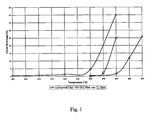
- Fig. 1 shows the percent linear shrinkage of a commercially available insulation blanket v materials as presently claimed.
- Analysed compositions [XRF for all components except B 2 O 3 - B 2 O 3 by inductively coupled plasma atomic absorption] and linear shrinkages of the materials are shown in Table 2.
- Shrinkage was measured by cutting two pieces of blanket, a base piece 15cm x 20cm and a test piece 12cm x 18cm, both with the longest length lying along the direction of the roll of blanket.
- the base piece was placed on a base board of a material determined not to react with the blanket material.
- the base piece was gently pressed flat and then the test piece was placed on and in the middle of the base piece and pressed flat.
- Four platinum pins (0.5mm) were then inserted into the blanket at the four corners of the blanket [separations of 100 mm and 45 mm]
- the longest lengths (L1 & L2) and the diagonals (L3 & L4) were measured to an accuracy of ⁇ 5 ⁇ m using a travelling microscope.
- the samples were placed in a furnace and ramped to a temperature 50°C below the test temperature at 300°C/hour and ramped at 120°C/hour for the last 50°C to test temperature and left for 24 hours at temperature.
- the L1, L2, L3, and L4 values were measured and the shrinkage along each length calculated with the shrinkage being expressed as an average of the 4 measurements.
- the commercially available blanket starts to increase in shrinkage between about 525°C and 550°C, having a shrinkage of 5% at ⁇ 550°C.
- the fibres referred to as TFG and TC commence increasing in shrinkage at higher temperatures.
- TFG commences increasing in shrinkage between 550°C and 575°C, with shrinkage of 5% at ⁇ 580°C.
- TC commences increasing in shrinkage between 575°C and 600°C, with shrinkage of 5% at ⁇ 610°C.
- compositions #956 and #957 indicate that replacing some of the Na 2 O with more Al 2 O 3 and Fe 2 O 3 results in an improved shrinkage at 650°C.
- Composition #958 indicates that replacing CaO with MgO is detrimental to shrinkage at 650°C.
- compositions #960, #959, #957, #961 seem to indicate that levels of SrO in amounts > ⁇ 3wt% give best results for shrinkage.
- composition 47 worked very well with no crystallisation problems.
- Composition 44 did crystallise in the spinner in a short time.
- the alumina and iron oxide additions made a huge difference to the crystallisation properties. Fibre formed could be needled to form blanket very easily.
- compositions comprising SiO 2 62 to 72 mol% Alkaline earth metal oxide 12 to 24 mol% of which SrO >0.5mol% Alkali metal oxide 10 to 15mol % B 2 O 3 3 to 7.5mol% M 2 O 3 0.25 to 1.5 mol% in which M is Al, a transition element, a lanthanide, or a mixture thereof with these ingredients comprising greater than or equal to 90 mol%, preferably greater than or equal to 95mol%, and less than or equal to 100 mol% of the glass composition.
- the materials claimed provide blankets having superior temperature resistance to conventional glass wools, and superior insulating performance (i.e. lower thermal conductivity) than an alkaline earth silicate fibre.
- the fibres concerned have good saline (physiological) solubility.
Landscapes
- Chemical & Material Sciences (AREA)
- Life Sciences & Earth Sciences (AREA)
- Engineering & Computer Science (AREA)
- Chemical Kinetics & Catalysis (AREA)
- General Chemical & Material Sciences (AREA)
- Geochemistry & Mineralogy (AREA)
- Materials Engineering (AREA)
- Organic Chemistry (AREA)
- Glass Compositions (AREA)
- Surface Treatment Of Glass Fibres Or Filaments (AREA)
Claims (25)
- Eine Glasfaser, die durch ein Rotationsverfahren aus einer Schmelze formbar ist und einen Durchmesser von weniger als 5 µm aufweist, enthaltend in Gewichtsprozent62 bis 75 Gew.-% SiO213 bis 25 Gew.-% Erdalkalimetalloxid8 bis 15 Gew.-% Alkalimetalloxid0 bis 8 Gew.-% B2O30,5 bis 3 Gew.-% M2O3, wobei M Al, ein Übergangselement, ein Lanthanid oder eine Mischung davon darstellt,wobei die bezeichneten Bestandteile 90 Gew.-% bis 100 Gew.% der Glaszusammensetzung darstellen.
- Eine Glasfaser gemäß Anspruch 1, wobei die bezeichneten Bestandteile 95 Gew.-% oder mehr der Glaszusammensetzung darstellen.
- Eine Glasfaser gemäß Anspruch 1 oder 2, wobei der Gehalt an SiO2 63 Gew.-% oder mehr beträgt.
- Eine Glasfaser gemäß irgend einem der Ansprüche 1 bis 3, wobei der Gehalt an SiO2 70 Gew.-% oder weniger beträgt.
- Eine Glasfaser gemäß Anspruch 4, wobei der Gehalt an SiO2 67 Gew.-% oder weniger beträgt.
- Eine Glasfaser gemäß irgend einem der Ansprüche 1 bis 5, wobei der Gehalt an Erdalkalimetalloxid 20 Gew.-% oder weniger beträgt.
- Eine Glasfaser gemäß Anspruch 6, wobei der Gehalt an Erdalkalimetalloxid 16 Gew.-% oder weniger beträgt.
- Eine Glasfaser gemäß irgend einem der Ansprüche 1 bis 7, wobei das Erdalkalimetalloxid MgO mit einem Gehalt von weniger als 4 Gew.-% der Glasfaserzusammensetzung enthält.
- Eine Glasfaser gemäß irgend einem der Ansprüche 1 bis 8, wobei das Erdalkalimetalloxid SrO mit einem Gehalt von weniger als 6 Gew.-% der Glasfaserzusammensetzung enthält.
- Eine Glasfaser gemäß irgend einem der Ansprüche 1 bis 9, wobei das Erdalkalimetalloxid SrO mit einem Gehalt von mehr als 0,5 Gew.-% der Glasfaserzusammensetzung enthält.
- Eine Glasfaser gemäß Anspruch 10, wobei das Erdalkalimetalloxid SrO mit einem Gehalt von mehr als 3 Gew.-% der Glasfaserzusammensetzung enthält.
- Eine Glasfaser gemäß irgend einem der Ansprüche 1 bis 11, wobei der Gehalt an Alkalimetalloxid 9 Gew.-% oder mehr beträgt.
- Eine Glasfaser gemäß Anspruch 12, wobei der Gehalt an Alkalimetalloxid 13 Gew.-% oder weniger beträgt.
- Eine Glasfaser gemäß irgend einem der Ansprüche 1 bis 13, wobei M2O3 ein Oxid eines Übergangsmetalls oder ein Oxid eines Lanthanids mit einem Gehalt von 0,25 bis 1 Gew.-% enthält.
- Eine Glasfaser gemäß irgend einem der Ansprüche 1 bis 14, mit der Zusammensetzung in Gew.-%:
SiO2 67 ± 2 MgO <2 CaO 12 ± 1 SrO 4 ± 2 Na2O 10 ± 2 K2O 0-7 Al2O3 0-3 B2O3 5 ± 1 Fe2O3 0-3 - Eine Glasfaser gemäß Anspruch 15, wobei der Gehalt an Al2O3 größer als 0,5 Gew.-% und der Gehalt an Fe2O3 größer als 0,25 Gew.-% ist.
- Eine Glasfaser gemäß irgend einem der Ansprüche 1 bis 16, mit der Zusammensetzung62 bis 75 mol% SiO2;12 bis 24 mol% Erdalkalimetalloxid, wovon SrO größer als 0,5 mol% ist;10 bis 15 mol% Alkalimetalloxid;3 bis 7,5 mol% B2O3;0,25 bis 1,5 mol% M2O3, wobei M Al, ein Übergangselement, ein Lanthanid oder eine Mischung davon darstellt,wobei die bezeichneten Bestandteile 90 mol% oder mehr, vorzugsweise 95 mol% oder mehr und 100 mol% oder weniger der Glaszusammensetzung darstellen.
- Eine Glasfaser gemäß irgend einem vorhergehenden Anspruch für die eine Vakuumvorform wie spezifiziert eine Schrumpfung von weniger als 5% aufweist wenn diese bei einer Temperatur von 600°C für 24 Stunden ausgesetzt wird.
- Eine thermische Isolierung umfassend Glasfasern gemäß irgend einem vorhergehenden Anspruch.
- Eine thermische Isolierung gemäß Anspruch 19, wobei die thermische Isolierung in Form einer Decke vorliegt.
- Eine thermische Isolierung gemäß Anspruch 20, wobei die Decke als genadeltes Vlies vorliegt.
- Eine thermische Isolierung gemäß Anspruch 21, wobei die Decke eine Schrumpfung von weniger als 5% aufweist, wenn diese bei einer Temperatur von 575°C für 24 Stunden ausgesetzt wird.
- Eine thermische Isolierung gemäß Anspruch 22, wobei die Decke eine Schrumpfung von weniger als 5% aufweist, wenn diese bei einer Temperatur von 600°C für 24 Stunden ausgesetzt wird.
- Eine thermische Isolierung gemäß irgend einem der Ansprüche 19 bis 24,
wobei die thermische Isolierung einen Aufbau von in einer Hülle eingeschlossenen Glasfasern umfasst, um einen Verlust von Fasern aus dem Aufbau zu verhindern. - Einen Ofen enthaltend eine thermische Isolierung gemäß irgend einem der Ansprüche 19 bis 24.
Applications Claiming Priority (2)
| Application Number | Priority Date | Filing Date | Title |
|---|---|---|---|
| GB0512112A GB2427191B (en) | 2005-06-14 | 2005-06-14 | Glass fibres |
| PCT/GB2006/001867 WO2006134315A1 (en) | 2005-06-14 | 2006-05-19 | Glass fibres |
Publications (2)
| Publication Number | Publication Date |
|---|---|
| EP1890977A1 EP1890977A1 (de) | 2008-02-27 |
| EP1890977B1 true EP1890977B1 (de) | 2009-07-08 |
Family
ID=34855522
Family Applications (1)
| Application Number | Title | Priority Date | Filing Date |
|---|---|---|---|
| EP06743948A Expired - Lifetime EP1890977B1 (de) | 2005-06-14 | 2006-05-19 | Glasfasern |
Country Status (6)
| Country | Link |
|---|---|
| US (1) | US20090053510A1 (de) |
| EP (1) | EP1890977B1 (de) |
| AT (1) | ATE435840T1 (de) |
| DE (1) | DE602006007704D1 (de) |
| GB (1) | GB2427191B (de) |
| WO (1) | WO2006134315A1 (de) |
Families Citing this family (14)
| Publication number | Priority date | Publication date | Assignee | Title |
|---|---|---|---|---|
| JP2008265874A (ja) * | 2007-03-29 | 2008-11-06 | Nippon Sheet Glass Co Ltd | ガラス繊維梱包体およびガラス繊維梱包方法とそれを用いたガラス繊維製品 |
| KR101206365B1 (ko) * | 2010-02-24 | 2012-11-29 | 주식회사 케이씨씨 | 세라믹 섬유 제조용 조성물 및 그로부터 제조된 고온단열재용 생체용해성 세라믹 섬유 |
| JP5006979B1 (ja) | 2011-03-31 | 2012-08-22 | ニチアス株式会社 | 生体溶解性無機繊維の製造方法 |
| JP5673617B2 (ja) * | 2012-07-12 | 2015-02-18 | パナソニック株式会社 | 真空断熱材 |
| BR112017000909B1 (pt) | 2014-07-16 | 2022-07-12 | Unifrax I Llc | Fibra inorgânica com retratibilidade e resistência aumentadas |
| US10023491B2 (en) | 2014-07-16 | 2018-07-17 | Unifrax I Llc | Inorganic fiber |
| EP3169637B1 (de) | 2014-07-17 | 2020-03-04 | Unifrax I LLC | Anorganische faser mit verbesserter schrumpfung und festigkeit |
| GB201505101D0 (en) * | 2015-03-26 | 2015-05-06 | Pilkington Group Ltd | Glass |
| WO2017127501A1 (en) * | 2016-01-19 | 2017-07-27 | Unifrax I Llc | Inorganic fiber |
| US9919957B2 (en) | 2016-01-19 | 2018-03-20 | Unifrax I Llc | Inorganic fiber |
| US10882779B2 (en) | 2018-05-25 | 2021-01-05 | Unifrax I Llc | Inorganic fiber |
| DE102018004536A1 (de) * | 2018-06-08 | 2019-12-12 | Saint-Gobain Isover G+H Ag | Verfahren zur Bewertung von Mineralwolle |
| DE102018004537A1 (de) * | 2018-06-08 | 2019-12-12 | Saint-Gobain Isover G+H Ag | Verfahren zur Bewertung von Mineralwolle |
| CN113307474B (zh) * | 2021-06-10 | 2023-04-11 | 浙江理工大学 | 连续玻璃纤维及其制备方法 |
Family Cites Families (15)
| Publication number | Priority date | Publication date | Assignee | Title |
|---|---|---|---|---|
| US2308857A (en) * | 1939-12-20 | 1943-01-19 | Owens Corning Fiberglass Corp | Sodium calcium borosilicate glass |
| US3853569A (en) * | 1963-02-07 | 1974-12-10 | Saint Gobain | Silicate glass fiber compositions |
| US4381347A (en) * | 1979-05-09 | 1983-04-26 | Oy Partek Ab | Fibre glass composition |
| US4419471A (en) * | 1981-09-04 | 1983-12-06 | Gaf Corporation | Core-shell polymers |
| US4510252A (en) * | 1983-11-18 | 1985-04-09 | Owens-Corning Fiberglas Corporation | Easily formed chemically resistant glass fibers |
| NZ234718A (en) | 1989-08-11 | 1992-05-26 | Saint Gobain Isover | Decomposable glass fibres |
| GB9111401D0 (en) * | 1991-05-25 | 1991-07-17 | Pilkington Insulation Ltd | Glass composition and use |
| US5616525A (en) * | 1995-05-04 | 1997-04-01 | Owens-Corning Fiberglas Technology, Inc. | Irregularly shaped glass fibers and insulation therefrom |
| US5607758A (en) * | 1995-06-21 | 1997-03-04 | Bgf Industries, Inc. | Smoke containment curtain |
| US5945360A (en) * | 1997-03-28 | 1999-08-31 | Johns Manville International, Inc. | Biosoluble pot and marble-derived fiberglass |
| US6227009B1 (en) * | 1998-12-14 | 2001-05-08 | Michael John Cusick | Method of making long, fine diameter glass fibers and products made with such glass fibers |
| US6277777B1 (en) * | 1999-08-03 | 2001-08-21 | Johns Manville International, Inc. | Boron-free glass composition and filtration media |
| JP2003267753A (ja) | 2000-10-11 | 2003-09-25 | Paramount Glass Kogyo Kk | 無機質繊維製造用硝子組成物及びその成型物 |
| US6998361B2 (en) * | 2002-03-04 | 2006-02-14 | Glass Incorporated | High temperature glass fiber insulation |
| DE20203963U1 (de) * | 2002-03-12 | 2003-07-24 | Thies, Roland, 86911 Dießen | Einrichtung zum Isolieren von Gar-, Back- oder ähnlichen Geräten |
-
2005
- 2005-06-14 GB GB0512112A patent/GB2427191B/en not_active Expired - Fee Related
-
2006
- 2006-05-19 WO PCT/GB2006/001867 patent/WO2006134315A1/en not_active Ceased
- 2006-05-19 DE DE602006007704T patent/DE602006007704D1/de not_active Expired - Lifetime
- 2006-05-19 EP EP06743948A patent/EP1890977B1/de not_active Expired - Lifetime
- 2006-05-19 AT AT06743948T patent/ATE435840T1/de not_active IP Right Cessation
- 2006-05-19 US US11/916,943 patent/US20090053510A1/en not_active Abandoned
Also Published As
| Publication number | Publication date |
|---|---|
| GB2427191A (en) | 2006-12-20 |
| GB2427191B (en) | 2007-06-27 |
| GB0512112D0 (en) | 2005-07-20 |
| DE602006007704D1 (de) | 2009-08-20 |
| ATE435840T1 (de) | 2009-07-15 |
| US20090053510A1 (en) | 2009-02-26 |
| WO2006134315A1 (en) | 2006-12-21 |
| EP1890977A1 (de) | 2008-02-27 |
Similar Documents
| Publication | Publication Date | Title |
|---|---|---|
| AU2002324024C9 (en) | Biosoluble ceramic fiber composition with improved solubility in a physiological saline solution for a high temperature insulation material | |
| CA2255626C (en) | Biosoluble pot and marble-derived fiberglass | |
| JP5230055B2 (ja) | 高温耐性ガラス質無機繊維 | |
| JP6109802B2 (ja) | 塩溶解性セラミック繊維組成物 | |
| JP5208508B2 (ja) | アルカリ土類シリケート繊維の改質 | |
| US20090053510A1 (en) | Glass fibers | |
| US20030015003A1 (en) | Low temperature glass for insulation fiber | |
| ZA200702515B (en) | Modification of alkaline earth silicate fibres | |
| CN112521006A (zh) | 用于制造纤维的玻璃组合物及方法 | |
| JP5851426B2 (ja) | セラミック繊維製造用組成物及びそれから製造される高温断熱材用の生体溶解性セラミック繊維 | |
| KR20130112433A (ko) | 유리 섬유 제조용 조성물 및 그로부터 제조된 생체용해성 유리 섬유 | |
| JP5890515B2 (ja) | 生溶解性ミネラルウール繊維組成物およびミネラルウール繊維 | |
| KR20140119442A (ko) | 세라믹 섬유 제조용 조성물 및 그로부터 제조된 고온단열재용 염용해성 세라믹 섬유 | |
| KR20250172151A (ko) | 세라믹 섬유 조성물 및 이로부터 제조된 세라믹 섬유 | |
| AU2014246689B2 (en) | Ceramic Fiber Composition Which is Soluble in Salt | |
| CA2575900C (en) | Biosoluble pot and marble-derived fiberglass | |
| HK1233612A1 (en) | A composition for preparing ceramic fiber and a biosoluble ceramic fiber prepared therefrom for heat insulating material at high temperature | |
| HK1176345A (en) | A composition for preparing ceramic fiber and a biosoluble ceramic fiber prepared therefrom for heat insulating material at high temperature | |
| HK1097405B (en) | High temperature resistant vitreous inorganic fiber | |
| HK1097405A1 (en) | High temperature resistant vitreous inorganic fiber | |
| CN103058640A (zh) | 750度透辉石耐火纤维 |
Legal Events
| Date | Code | Title | Description |
|---|---|---|---|
| PUAI | Public reference made under article 153(3) epc to a published international application that has entered the european phase |
Free format text: ORIGINAL CODE: 0009012 |
|
| 17P | Request for examination filed |
Effective date: 20071109 |
|
| AK | Designated contracting states |
Kind code of ref document: A1 Designated state(s): AT BE BG CH CY CZ DE DK EE ES FI FR GB GR HU IE IS IT LI LT LU LV MC NL PL PT RO SE SI SK TR |
|
| 17Q | First examination report despatched |
Effective date: 20080811 |
|
| DAX | Request for extension of the european patent (deleted) | ||
| GRAP | Despatch of communication of intention to grant a patent |
Free format text: ORIGINAL CODE: EPIDOSNIGR1 |
|
| GRAS | Grant fee paid |
Free format text: ORIGINAL CODE: EPIDOSNIGR3 |
|
| GRAA | (expected) grant |
Free format text: ORIGINAL CODE: 0009210 |
|
| AK | Designated contracting states |
Kind code of ref document: B1 Designated state(s): AT BE BG CH CY CZ DE DK EE ES FI FR GB GR HU IE IS IT LI LT LU LV MC NL PL PT RO SE SI SK TR |
|
| REG | Reference to a national code |
Ref country code: GB Ref legal event code: FG4D |
|
| REG | Reference to a national code |
Ref country code: CH Ref legal event code: EP |
|
| REG | Reference to a national code |
Ref country code: IE Ref legal event code: FG4D |
|
| REF | Corresponds to: |
Ref document number: 602006007704 Country of ref document: DE Date of ref document: 20090820 Kind code of ref document: P |
|
| PG25 | Lapsed in a contracting state [announced via postgrant information from national office to epo] |
Ref country code: SI Free format text: LAPSE BECAUSE OF FAILURE TO SUBMIT A TRANSLATION OF THE DESCRIPTION OR TO PAY THE FEE WITHIN THE PRESCRIBED TIME-LIMIT Effective date: 20090708 |
|
| NLV1 | Nl: lapsed or annulled due to failure to fulfill the requirements of art. 29p and 29m of the patents act | ||
| PG25 | Lapsed in a contracting state [announced via postgrant information from national office to epo] |
Ref country code: LT Free format text: LAPSE BECAUSE OF FAILURE TO SUBMIT A TRANSLATION OF THE DESCRIPTION OR TO PAY THE FEE WITHIN THE PRESCRIBED TIME-LIMIT Effective date: 20090708 Ref country code: IS Free format text: LAPSE BECAUSE OF FAILURE TO SUBMIT A TRANSLATION OF THE DESCRIPTION OR TO PAY THE FEE WITHIN THE PRESCRIBED TIME-LIMIT Effective date: 20091108 Ref country code: ES Free format text: LAPSE BECAUSE OF FAILURE TO SUBMIT A TRANSLATION OF THE DESCRIPTION OR TO PAY THE FEE WITHIN THE PRESCRIBED TIME-LIMIT Effective date: 20091019 Ref country code: AT Free format text: LAPSE BECAUSE OF FAILURE TO SUBMIT A TRANSLATION OF THE DESCRIPTION OR TO PAY THE FEE WITHIN THE PRESCRIBED TIME-LIMIT Effective date: 20090708 Ref country code: FI Free format text: LAPSE BECAUSE OF FAILURE TO SUBMIT A TRANSLATION OF THE DESCRIPTION OR TO PAY THE FEE WITHIN THE PRESCRIBED TIME-LIMIT Effective date: 20090708 |
|
| PG25 | Lapsed in a contracting state [announced via postgrant information from national office to epo] |
Ref country code: PL Free format text: LAPSE BECAUSE OF FAILURE TO SUBMIT A TRANSLATION OF THE DESCRIPTION OR TO PAY THE FEE WITHIN THE PRESCRIBED TIME-LIMIT Effective date: 20090708 Ref country code: LV Free format text: LAPSE BECAUSE OF FAILURE TO SUBMIT A TRANSLATION OF THE DESCRIPTION OR TO PAY THE FEE WITHIN THE PRESCRIBED TIME-LIMIT Effective date: 20090708 Ref country code: NL Free format text: LAPSE BECAUSE OF FAILURE TO SUBMIT A TRANSLATION OF THE DESCRIPTION OR TO PAY THE FEE WITHIN THE PRESCRIBED TIME-LIMIT Effective date: 20090708 |
|
| PG25 | Lapsed in a contracting state [announced via postgrant information from national office to epo] |
Ref country code: PT Free format text: LAPSE BECAUSE OF FAILURE TO SUBMIT A TRANSLATION OF THE DESCRIPTION OR TO PAY THE FEE WITHIN THE PRESCRIBED TIME-LIMIT Effective date: 20091109 Ref country code: BG Free format text: LAPSE BECAUSE OF FAILURE TO SUBMIT A TRANSLATION OF THE DESCRIPTION OR TO PAY THE FEE WITHIN THE PRESCRIBED TIME-LIMIT Effective date: 20091008 |
|
| PG25 | Lapsed in a contracting state [announced via postgrant information from national office to epo] |
Ref country code: DK Free format text: LAPSE BECAUSE OF FAILURE TO SUBMIT A TRANSLATION OF THE DESCRIPTION OR TO PAY THE FEE WITHIN THE PRESCRIBED TIME-LIMIT Effective date: 20090708 Ref country code: CZ Free format text: LAPSE BECAUSE OF FAILURE TO SUBMIT A TRANSLATION OF THE DESCRIPTION OR TO PAY THE FEE WITHIN THE PRESCRIBED TIME-LIMIT Effective date: 20090708 Ref country code: EE Free format text: LAPSE BECAUSE OF FAILURE TO SUBMIT A TRANSLATION OF THE DESCRIPTION OR TO PAY THE FEE WITHIN THE PRESCRIBED TIME-LIMIT Effective date: 20090708 Ref country code: RO Free format text: LAPSE BECAUSE OF FAILURE TO SUBMIT A TRANSLATION OF THE DESCRIPTION OR TO PAY THE FEE WITHIN THE PRESCRIBED TIME-LIMIT Effective date: 20090708 |
|
| PLBE | No opposition filed within time limit |
Free format text: ORIGINAL CODE: 0009261 |
|
| STAA | Information on the status of an ep patent application or granted ep patent |
Free format text: STATUS: NO OPPOSITION FILED WITHIN TIME LIMIT |
|
| PG25 | Lapsed in a contracting state [announced via postgrant information from national office to epo] |
Ref country code: BE Free format text: LAPSE BECAUSE OF FAILURE TO SUBMIT A TRANSLATION OF THE DESCRIPTION OR TO PAY THE FEE WITHIN THE PRESCRIBED TIME-LIMIT Effective date: 20090708 Ref country code: SK Free format text: LAPSE BECAUSE OF FAILURE TO SUBMIT A TRANSLATION OF THE DESCRIPTION OR TO PAY THE FEE WITHIN THE PRESCRIBED TIME-LIMIT Effective date: 20090708 |
|
| 26N | No opposition filed |
Effective date: 20100409 |
|
| PGFP | Annual fee paid to national office [announced via postgrant information from national office to epo] |
Ref country code: FR Payment date: 20100521 Year of fee payment: 5 |
|
| PGFP | Annual fee paid to national office [announced via postgrant information from national office to epo] |
Ref country code: DE Payment date: 20100503 Year of fee payment: 5 |
|
| PG25 | Lapsed in a contracting state [announced via postgrant information from national office to epo] |
Ref country code: GR Free format text: LAPSE BECAUSE OF FAILURE TO SUBMIT A TRANSLATION OF THE DESCRIPTION OR TO PAY THE FEE WITHIN THE PRESCRIBED TIME-LIMIT Effective date: 20091009 |
|
| PGFP | Annual fee paid to national office [announced via postgrant information from national office to epo] |
Ref country code: GB Payment date: 20100414 Year of fee payment: 5 |
|
| PG25 | Lapsed in a contracting state [announced via postgrant information from national office to epo] |
Ref country code: MC Free format text: LAPSE BECAUSE OF NON-PAYMENT OF DUE FEES Effective date: 20100531 |
|
| REG | Reference to a national code |
Ref country code: CH Ref legal event code: PL |
|
| PG25 | Lapsed in a contracting state [announced via postgrant information from national office to epo] |
Ref country code: LI Free format text: LAPSE BECAUSE OF NON-PAYMENT OF DUE FEES Effective date: 20100531 Ref country code: CH Free format text: LAPSE BECAUSE OF NON-PAYMENT OF DUE FEES Effective date: 20100531 |
|
| PG25 | Lapsed in a contracting state [announced via postgrant information from national office to epo] |
Ref country code: IT Free format text: LAPSE BECAUSE OF FAILURE TO SUBMIT A TRANSLATION OF THE DESCRIPTION OR TO PAY THE FEE WITHIN THE PRESCRIBED TIME-LIMIT Effective date: 20090708 |
|
| PG25 | Lapsed in a contracting state [announced via postgrant information from national office to epo] |
Ref country code: IE Free format text: LAPSE BECAUSE OF NON-PAYMENT OF DUE FEES Effective date: 20100519 |
|
| GBPC | Gb: european patent ceased through non-payment of renewal fee |
Effective date: 20110519 |
|
| REG | Reference to a national code |
Ref country code: FR Ref legal event code: ST Effective date: 20120131 |
|
| REG | Reference to a national code |
Ref country code: DE Ref legal event code: R119 Ref document number: 602006007704 Country of ref document: DE Effective date: 20111201 |
|
| PG25 | Lapsed in a contracting state [announced via postgrant information from national office to epo] |
Ref country code: FR Free format text: LAPSE BECAUSE OF NON-PAYMENT OF DUE FEES Effective date: 20110531 |
|
| PG25 | Lapsed in a contracting state [announced via postgrant information from national office to epo] |
Ref country code: GB Free format text: LAPSE BECAUSE OF NON-PAYMENT OF DUE FEES Effective date: 20110519 |
|
| PG25 | Lapsed in a contracting state [announced via postgrant information from national office to epo] |
Ref country code: CY Free format text: LAPSE BECAUSE OF FAILURE TO SUBMIT A TRANSLATION OF THE DESCRIPTION OR TO PAY THE FEE WITHIN THE PRESCRIBED TIME-LIMIT Effective date: 20090708 |
|
| PG25 | Lapsed in a contracting state [announced via postgrant information from national office to epo] |
Ref country code: LU Free format text: LAPSE BECAUSE OF NON-PAYMENT OF DUE FEES Effective date: 20100519 Ref country code: HU Free format text: LAPSE BECAUSE OF FAILURE TO SUBMIT A TRANSLATION OF THE DESCRIPTION OR TO PAY THE FEE WITHIN THE PRESCRIBED TIME-LIMIT Effective date: 20100109 Ref country code: SE Free format text: LAPSE BECAUSE OF FAILURE TO SUBMIT A TRANSLATION OF THE DESCRIPTION OR TO PAY THE FEE WITHIN THE PRESCRIBED TIME-LIMIT Effective date: 20090708 |
|
| PG25 | Lapsed in a contracting state [announced via postgrant information from national office to epo] |
Ref country code: TR Free format text: LAPSE BECAUSE OF FAILURE TO SUBMIT A TRANSLATION OF THE DESCRIPTION OR TO PAY THE FEE WITHIN THE PRESCRIBED TIME-LIMIT Effective date: 20090708 |
|
| PG25 | Lapsed in a contracting state [announced via postgrant information from national office to epo] |
Ref country code: DE Free format text: LAPSE BECAUSE OF NON-PAYMENT OF DUE FEES Effective date: 20111201 |