EP1892260B1 - Article subissant une deformation en reaction a un stimulus, et partie de vehicule utilisant cet article - Google Patents
Article subissant une deformation en reaction a un stimulus, et partie de vehicule utilisant cet article Download PDFInfo
- Publication number
- EP1892260B1 EP1892260B1 EP06729147.6A EP06729147A EP1892260B1 EP 1892260 B1 EP1892260 B1 EP 1892260B1 EP 06729147 A EP06729147 A EP 06729147A EP 1892260 B1 EP1892260 B1 EP 1892260B1
- Authority
- EP
- European Patent Office
- Prior art keywords
- cell
- skeleton
- liquid crystal
- induced deformation
- deformation
- Prior art date
- Legal status (The legal status is an assumption and is not a legal conclusion. Google has not performed a legal analysis and makes no representation as to the accuracy of the status listed.)
- Ceased
Links
Images








Classifications
-
- B—PERFORMING OPERATIONS; TRANSPORTING
- B60—VEHICLES IN GENERAL
- B60N—SEATS SPECIALLY ADAPTED FOR VEHICLES; VEHICLE PASSENGER ACCOMMODATION NOT OTHERWISE PROVIDED FOR
- B60N2/00—Seats specially adapted for vehicles; Arrangement or mounting of seats in vehicles
- B60N2/64—Back-rests or cushions
- B60N2/646—Back-rests or cushions shape of the cushion
-
- B—PERFORMING OPERATIONS; TRANSPORTING
- B60—VEHICLES IN GENERAL
- B60N—SEATS SPECIALLY ADAPTED FOR VEHICLES; VEHICLE PASSENGER ACCOMMODATION NOT OTHERWISE PROVIDED FOR
- B60N2/00—Seats specially adapted for vehicles; Arrangement or mounting of seats in vehicles
- B60N2/02—Seats specially adapted for vehicles; Arrangement or mounting of seats in vehicles the seat or part thereof being movable, e.g. adjustable
- B60N2/22—Seats specially adapted for vehicles; Arrangement or mounting of seats in vehicles the seat or part thereof being movable, e.g. adjustable the back-rest being adjustable
-
- B—PERFORMING OPERATIONS; TRANSPORTING
- B60—VEHICLES IN GENERAL
- B60N—SEATS SPECIALLY ADAPTED FOR VEHICLES; VEHICLE PASSENGER ACCOMMODATION NOT OTHERWISE PROVIDED FOR
- B60N2/00—Seats specially adapted for vehicles; Arrangement or mounting of seats in vehicles
- B60N2/64—Back-rests or cushions
- B60N2/643—Back-rests or cushions shape of the back-rests
-
- B—PERFORMING OPERATIONS; TRANSPORTING
- B60—VEHICLES IN GENERAL
- B60N—SEATS SPECIALLY ADAPTED FOR VEHICLES; VEHICLE PASSENGER ACCOMMODATION NOT OTHERWISE PROVIDED FOR
- B60N2/00—Seats specially adapted for vehicles; Arrangement or mounting of seats in vehicles
- B60N2/70—Upholstery springs ; Upholstery
-
- C—CHEMISTRY; METALLURGY
- C08—ORGANIC MACROMOLECULAR COMPOUNDS; THEIR PREPARATION OR CHEMICAL WORKING-UP; COMPOSITIONS BASED THEREON
- C08J—WORKING-UP; GENERAL PROCESSES OF COMPOUNDING; AFTER-TREATMENT NOT COVERED BY SUBCLASSES C08B, C08C, C08F, C08G or C08H
- C08J9/00—Working-up of macromolecular substances to porous or cellular articles or materials; After-treatment thereof
- C08J9/0004—Use of compounding ingredients, the chemical constitution of which is unknown, broadly defined, or irrelevant
-
- C—CHEMISTRY; METALLURGY
- C09—DYES; PAINTS; POLISHES; NATURAL RESINS; ADHESIVES; COMPOSITIONS NOT OTHERWISE PROVIDED FOR; APPLICATIONS OF MATERIALS NOT OTHERWISE PROVIDED FOR
- C09K—MATERIALS FOR MISCELLANEOUS APPLICATIONS, NOT PROVIDED FOR ELSEWHERE
- C09K2323/00—Functional layers of liquid crystal optical display excluding electroactive liquid crystal layer characterised by chemical composition
-
- Y—GENERAL TAGGING OF NEW TECHNOLOGICAL DEVELOPMENTS; GENERAL TAGGING OF CROSS-SECTIONAL TECHNOLOGIES SPANNING OVER SEVERAL SECTIONS OF THE IPC; TECHNICAL SUBJECTS COVERED BY FORMER USPC CROSS-REFERENCE ART COLLECTIONS [XRACs] AND DIGESTS
- Y10—TECHNICAL SUBJECTS COVERED BY FORMER USPC
- Y10T—TECHNICAL SUBJECTS COVERED BY FORMER US CLASSIFICATION
- Y10T428/00—Stock material or miscellaneous articles
- Y10T428/249921—Web or sheet containing structurally defined element or component
- Y10T428/249953—Composite having voids in a component [e.g., porous, cellular, etc.]
-
- Y—GENERAL TAGGING OF NEW TECHNOLOGICAL DEVELOPMENTS; GENERAL TAGGING OF CROSS-SECTIONAL TECHNOLOGIES SPANNING OVER SEVERAL SECTIONS OF THE IPC; TECHNICAL SUBJECTS COVERED BY FORMER USPC CROSS-REFERENCE ART COLLECTIONS [XRACs] AND DIGESTS
- Y10—TECHNICAL SUBJECTS COVERED BY FORMER USPC
- Y10T—TECHNICAL SUBJECTS COVERED BY FORMER US CLASSIFICATION
- Y10T428/00—Stock material or miscellaneous articles
- Y10T428/249921—Web or sheet containing structurally defined element or component
- Y10T428/249953—Composite having voids in a component [e.g., porous, cellular, etc.]
- Y10T428/249954—With chemically effective material or specified gas other than air, N, or carbon dioxide in void-containing component
-
- Y—GENERAL TAGGING OF NEW TECHNOLOGICAL DEVELOPMENTS; GENERAL TAGGING OF CROSS-SECTIONAL TECHNOLOGIES SPANNING OVER SEVERAL SECTIONS OF THE IPC; TECHNICAL SUBJECTS COVERED BY FORMER USPC CROSS-REFERENCE ART COLLECTIONS [XRACs] AND DIGESTS
- Y10—TECHNICAL SUBJECTS COVERED BY FORMER USPC
- Y10T—TECHNICAL SUBJECTS COVERED BY FORMER US CLASSIFICATION
- Y10T428/00—Stock material or miscellaneous articles
- Y10T428/249921—Web or sheet containing structurally defined element or component
- Y10T428/249953—Composite having voids in a component [e.g., porous, cellular, etc.]
- Y10T428/249955—Void-containing component partially impregnated with adjacent component
- Y10T428/249958—Void-containing component is synthetic resin or natural rubbers
-
- Y—GENERAL TAGGING OF NEW TECHNOLOGICAL DEVELOPMENTS; GENERAL TAGGING OF CROSS-SECTIONAL TECHNOLOGIES SPANNING OVER SEVERAL SECTIONS OF THE IPC; TECHNICAL SUBJECTS COVERED BY FORMER USPC CROSS-REFERENCE ART COLLECTIONS [XRACs] AND DIGESTS
- Y10—TECHNICAL SUBJECTS COVERED BY FORMER USPC
- Y10T—TECHNICAL SUBJECTS COVERED BY FORMER US CLASSIFICATION
- Y10T428/00—Stock material or miscellaneous articles
- Y10T428/249921—Web or sheet containing structurally defined element or component
- Y10T428/249953—Composite having voids in a component [e.g., porous, cellular, etc.]
- Y10T428/249987—With nonvoid component of specified composition
Definitions
- WO2004054082 describes a combination of a gel and a solvent as an example showing volume change.
- deformation speed is very moderate. Since it aims at driving a gel actuator, which was originally driving in a solvent, in air, it requires to have a solvent tank as a system, and thus has high risk of generating leakage of an electrolyte solution, or performance deterioration caused by electrolysis.
- the present invention relates to an article undergoing stimulus-induced deformation comprising, incorporated in a polymer material having a cell, a liquid crystal as a driving source in a skeleton other than the cell, according to claim 1.
- the article undergoing stimulus-induced deformation relevant to the present invention is characterized by being composed of a polymer and having a liquid crystal serving as a deformation source in a skeleton other than the cell of the porous material, in a porous material having the cell.
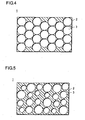
- a general porous cushion material includes, as shown in drawings, one formed by a close cell ( FIG. 1a : a perspective view, FIG. lb: a cross-sectional view cut along an I-I line of FIG. 1a ), one formed by an interconnected cell ( FIG. 2 ); one periodically arranged with a cell ( FIGS. 3 and 4 ); one formed by a cell having non-uniform size ( FIG. 5 ) ; one having deformed cross-sectional shape of non-spherical cell cross-section ( FIG. 6 ). They are used as means for tuning hardness or a spring constant of a cushion. It should be noted that, in the drawings in the present invention, a cell is represented by a circle or an ellipse, but it is only a representative example and the present invention is not limited thereto.
- polyurethane polyvinyl alcohol, polyvinyl chloride, chlorinated polyethylene, polyethylene, polypropylene, ethylene-vinyl acetate copolymer, polyethyl methacrylate, polystyrene, styrene-butadiene-acrylonitrile copolymer, polyvinyl formal, epoxy, phenol, urea and silicone is exemplified.
- polyurethane polyvinyl alcohol, polyvinyl chloride, chlorinated polyethylene, polyethylene, polypropylene, ethylene-vinyl acetate copolymer, polyethyl methacrylate, polystyrene, styrene-butadiene-acrylonitrile copolymer, polyvinyl formal, epoxy, phenol, urea and silicone is exemplified.
- These materials may be used alone or two or more kinds in combination.
- the porous material used in the present invention is defined as one having smaller use amount of a material as compared with apparent volume obtained by the external dimension, and one having smaller apparent density as compared with one having the same dimension composedof the solidmaterial, owing to the cell obtainable by changing to a porous form.
- a foamed matarial such as foamed polystyrene, foamed polypropylene and foamed urethane is included. These materials have smaller density than that obtainable by the exterior dimension, irrespective of the cell being closed or open.
- one composed of polymer gel or elastomer is also suitable.
- the void in these porous materials is defined as a portion containing air for one with an open cell; and a portion containing a foamed gas component or air substituted thereof for one with a closed cell.
- the skeleton is defined as one composed of a polymer other than the cell.
- the size of these cells is not especially limited, and cells prepared in a range of from about several hundreds nm to about several mm are suitable in view of being capable of obtaining easy skeleton deformation.
- the size of a cell is defined, in any of an open or closed cell, as size of every unit of foam. A smaller size or amount of a cell tends to provide a relatively thicker and larger skeleton, and smaller deformation amount in general. Larger size or amount of a cell tends to make maintaining the shape as a cushion body difficult, because of a smaller skeleton. As for expansion ratio, one from several times to about 50 times can be easily obtained, showing tendency to satisfy both a cushion body and deformation amount, but nothing is limited here.
- a cell in the porous material is an open one; this is because a closed cell receives compression by deformation of the inclusion (an evaporated foaming agent or air) in the cell; namely it requires additional force for compression and tends to provide smaller deformation amount.
- An open cell even when a cell part becomes small, is capable of flowing out air contained therein, and in addition, also when that part becomes large, is capable of providing rapid inhalation; this in turn makes deformation amount large, and extremely increases deformation speed.
- the porous material used in the present invention is composed of polymer gel.
- a polyacrylic acid type As an example of the polymer gel, a polyacrylic acid type, a polymethacrylic acid type, a polyacrylamide type, a polyvinyl alcohol type, a polyacrylonitrile type, a polymethyl mehacrylate type, a polyurethane type, a polysulfone type, a polyester type, a polyamide type, a polysiloxane type is included.
- polyacylic acid gel polymethacrylic acid gel, polyacrylamide gel, poly(acrylamide-acrylic acid) copolymer gel, poly(acrylamide-methacrylic acid) copolymer gel, quaternary gel of poly (acrylamide-trimethyl (N-acryloyl-3-aminopropyl)ammonium iodide) copolymer gel, polyacrylamide-2-methylpropanesulfonic acid gel, composite gel of polyvinylalcohol-polyacrylic acid, poly(2-acrylamide-2-methylpropanesulfonic acid-methacrylate -2-hydroxyethyl) copolymer gel, poly(2-acrylamide-2-methylpropanesulfonic acid-acrylonitrile) copolymer gel, alginate gel and collagen gel, is included.
- one composed of a natural product also includes gel such as cornea based on a natural macromolecule such as protein, polysaccharide; crystalline lens, albumen, tofu, konjak and gelatin.
- A(n) (liquid crystal) elastomer suitable to the present invention includes one wherein a mesogenic group, which is a center skeleton of a liquid crystal molecule, fundamentally is bound to a polymer chain as a side chain (in the present specification, a terminal part of a main chain is defined as a side chain), and generates a liquid crystal phase state of elastomer. It is more preferable that polysiloxanes are used as suitable elastomer in view of obtaining large deformation.
- a preferable mesogenic group includes one containing an alkyl group, alkoxy group and/or an oxaalkyl group having, for example, up to 15 chain constituent members, in a longitudinal axis of the mesogen unit.
- the elastomer can be synthesized, in the same manner as in usual polymer synthesis, for example, by a simple random copolymerization, or by an addition reaction similar to a random copolymer with a multi-functional cross-linking agent type molecule; as other method, a method for forming a liquid crystal copolymer by copolymerization of a mesogen monomer with a functional comonomer, followed by converting to a network structure with a cross-linking agent, at a second reaction step, may also be considered.
- the article undergoing stimulus-induced deformation of the present invention is composed of a polymer and characterized by having, in a material having a cell, a liquid crystal serving as a deformation source in a skeleton other than the cell of the material having the cell, or in the skeleton; preferably characterized in that the material having the cell is a porous material; more suitably characterized in that a liquid crystal is impregnated in the skeleton; and further suitably characterized in that the porous material is polymer gel.
- the article undergoing stimulus-induced deformation of the present invention is composed of a polymer, and of a porous material having a cell, characterized by having, in a polymer chain of a material forming a skeleton other than a cell part, a component showing liquid crystallinity serving as a deformation source as a main chain and/or a side chain; more suitably, the porous material is composed of a polymer gel, characterized by having, in a polymer chain forming the gel, a component showing liquid crystallinity serving as a deformation source as a main chain and/or a side chain; and further, the porous material having a cell is characterized in that a liquid crystal may be impregnated in the skeleton.
- Containing a liquid crystal in the skeleton makes the present article undergoing stimulus-induced deformation deform, for example, expand and contract, when temperature stimulus or electric stimulus is applied.
- a liquid crystal used in the present invention is not especially limited, but it is preferable that nematic-isotropic transition temperature (NI point) is selected so as to be in a room temperature region.
- NI point nematic-isotropic transition temperature
- Independent foam can be prepared by a method for using a microcapsule containing volatile components in advance as an inclusion; a method for reducing the amount of a foaming component by using a material forming an open cell.
- the porous material used in the present invention is composed of polymer gel. Since a polymer gel has a functional group in the skeleton, it can be deformed by hydrogen bonding with a functional group of a liquid crystal, or interaction such as static repulsion, and can retain a liquid crystal molecule in a network gel structure. A physical gel not having cross-linking points is also included in the above polymer gel, but a chemical gel having cross-linking points based on chemical bonding is more preferable in view of shape retention.
- a method of having a component showing liquid crystallinity as a deformation source, in a polymer chain of a material forming a skeleton other than the cell of the porous material, as a main chain and/or a side chain is also included.
- This method is an extremely suitable method in view of not only not requiring a mixing or impregnation step, but also being capable of incorporating a liquid crystal molecule necessary for deformation without waste, because a liquid crystal molecule can be structurally incorporated in the porous material.
- liquid crystal elastomer A void is omitted.
- the porous material is polymer gel; it is more suitable because suitable cushion property can be provided and at the same time deformation can be easily made, by containing the above-described polymer gel in the main chain and/or the side chain of a composing polymer.
- the article undergoing stimulus-induced deformation of the present invention deforms under temperature stimulus or electric stimulus.
- FIG. 12 a: a perspective view
- b a cross-sectional view cut along the XII-XII line
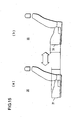
- FIGs 15 and 16 show the appearance when it is used as a seat cushion of a vehicle.
- FIG. 15 (a: a schematic view showing the case of an low seating surface
- b a schematic view showing the case of an elevated seating surface)
- ascending or descending of the seating surface 31 can be executed without using mechanical movement, in response to physical size of a passenger, in the case of the seat 30 for each passenger.
- FIG. 15 (a: a schematic view showing the case of an low seating surface
- b a schematic view showing the case of an elevated seating surface)
- ascending or descending of the seating surface 31 can be executed without using mechanical movement, in response to physical size of a passenger, in the case of the seat 30 for each passenger.
- FIG. 15 (a: a schematic view showing the case of an low seating surface
- b a schematic view showing the case of an elevated seating surface)
- This article undergoing stimulus-induced deformation showed an expanded state at a lower temperature side, and a contracted state at a high temperature side, at the border of around 35°C, which is isotropic phase transition temperature of the liquid crystal. Contraction here was about 0.2 mm, based on the size at the lower temperature side.
- This article undergoing stimulus-induced deformation showed an expanded state at a lower temperature side, and a contracted state at a high temperature side, at the border of around 35°C, which is isotropic phase transition temperature of the liquid crystal. Contraction here was about 0.1 mm, based on the size at the lower temperature side.
- This article undergoing stimulus-induced deformation showed an expanded state at a lower temperature side, and a contracted state at a high temperature side, at the border of around 35°C, which is isotropic phase transition temperature of the liquid crystal. Contraction here was about 0.1 mm, based on the size at the lower temperature side.
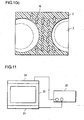
- This material was cut out to a side length of 1 cm, and silver paste was coated as electrodes on a pair of the opposite surfaces thereof, and then a copper wire with a diameter of 0. 05 mm was adhered as an electric wire.
- the article undergoing stimulus-induced deformation of the present invention can be utilized as a vehicle part, for example, a cushion material.
Landscapes
- Engineering & Computer Science (AREA)
- Aviation & Aerospace Engineering (AREA)
- Transportation (AREA)
- Mechanical Engineering (AREA)
- Chemical & Material Sciences (AREA)
- General Chemical & Material Sciences (AREA)
- Materials Engineering (AREA)
- Health & Medical Sciences (AREA)
- Chemical Kinetics & Catalysis (AREA)
- Medicinal Chemistry (AREA)
- Polymers & Plastics (AREA)
- Organic Chemistry (AREA)
- Manufacture Of Porous Articles, And Recovery And Treatment Of Waste Products (AREA)
Claims (8)
- Article subissant une déformation provoquée par stimulus comprenant, incorporé dans un matériau polymère comportant une cellule, un composant présentant une cristallinité liquide servant de source de déformation en tant que chaîne principale et/ou une chaîne latérale, dans la chaîne polymère d'un matériau formant un squelette autre que la cellule, dans lequel au moins une paire d'électrodes sont prévues sur les deux surfaces de l'article subissant une déformation provoquée par stimulus,
dans lequel le matériau polymère comportant la cellule est un matériau poreux,
dans lequel le matériau poreux est un gel polymère,
dans lequel la cellule est une cellule ouverte contenant de l'air ou dans lequel la cellule est une cellule fermée contenant un composant gazeux mousse ou de l'air,
dans lequel le composant présentant une cristallinité liquide est un cristal liquide, et
dans lequel le cristal liquide est sélectionné parmi le groupe constitué de 4-pentyl-4' -cyanobiphényl, 4-hexyl-4' -cyanobiphényl, 4-hexyl-4' - cyanophénylpyridine, 4-hexyl-4' -propylphénylcyclohexane, 4-méthyl-4' - propyldicyclohexane, et 4-hexyl-4' -methoxydicyclohexane. - Article subissant une déformation provoquée par stimulus comprenant, incorporé dans un matériau polymère comportant une cellule, un composant présentant une cristallinité liquide servant de source de déformation en tant que chaîne principale et/ou chaîne latérale, dans la chaîne polymère d'un matériau formant un squelette autre que la cellule, dans lequel au moins une paire d'électrodes sont prévues sur les deux surfaces de l'article subissant une déformation provoquée par stimulus, dans lequel
la cellule est une cellule ouverte contenant de l'air ou dans lequel la cellule est une cellule fermée contenant un composant gazeux mousse ou de l'air, dans lequel
le matériau polymère est un matériau poreux comprenant un poly(méthylhydrogensiloxane) en tant que matériau squelette d'élastomère comportant une molécule de cristal liquide d'acide 4-but-3-enyloxybenzoïque 4-méthoxyphényl ester au niveau de la chaîne latérale et un 1-(4-hydroxy-4'-biphényl)-2-[4-(10-undécényloxy) phényl]butane servant de composant de chaîne principale, le matériau poreux étant composé de 80 % en masse du matériau squelette, 10 % en masse de la chaîne latérale et 10 % en masse de la chaîne principale. - Article subissant une déformation provoquée par stimulus selon la revendication 1, comprenant un cristal liquide dans le squelette autre que la cellule.
- Article subissant une déformation provoquée par stimulus selon la revendication 1, dans lequel la cellule est une cellule ouverte.
- Article subissant une déformation provoquée par stimulus selon la revendication 1, dans lequel le matériau polymère est une mousse.
- Actionneur comprenant l'article subissant une déformation provoquée par stimulus selon la revendication 1.
- Pièce de véhicule utilisant l'article subissant une déformation provoquée par stimulus selon la revendication 1 ou l'actionneur selon la revendication 6.
- Utilisation d'un composant présentant une cristallinité liquide en tant que source d'entraînement en tant que chaîne principale et/ou chaîne latérale dans une chaîne polymère d'un matériau polymère comportant une cellule, la chaîne polymère formant un squelette autre que la cellule dans la fabrication d'un article capable de subir une déformation provoquée par stimulus selon une quelconque des revendications 1 à 5.
Priority Applications (1)
| Application Number | Priority Date | Filing Date | Title |
|---|---|---|---|
| EP20110007361 EP2394845B1 (fr) | 2005-06-16 | 2006-03-15 | Article subissant une déformation en réaction à un stimulus, et partie de véhicule utilisant cet article |
Applications Claiming Priority (2)
| Application Number | Priority Date | Filing Date | Title |
|---|---|---|---|
| JP2005176763 | 2005-06-16 | ||
| PCT/JP2006/305126 WO2006134697A1 (fr) | 2005-06-16 | 2006-03-15 | Article subissant une deformation en reaction a un stimulus, et partie de vehicule utilisant cet article |
Related Child Applications (1)
| Application Number | Title | Priority Date | Filing Date |
|---|---|---|---|
| EP11007361.6 Division-Into | 2011-09-09 |
Publications (3)
| Publication Number | Publication Date |
|---|---|
| EP1892260A1 EP1892260A1 (fr) | 2008-02-27 |
| EP1892260A4 EP1892260A4 (fr) | 2011-05-04 |
| EP1892260B1 true EP1892260B1 (fr) | 2013-06-12 |
Family
ID=37532066
Family Applications (2)
| Application Number | Title | Priority Date | Filing Date |
|---|---|---|---|
| EP06729147.6A Ceased EP1892260B1 (fr) | 2005-06-16 | 2006-03-15 | Article subissant une deformation en reaction a un stimulus, et partie de vehicule utilisant cet article |
| EP20110007361 Ceased EP2394845B1 (fr) | 2005-06-16 | 2006-03-15 | Article subissant une déformation en réaction à un stimulus, et partie de véhicule utilisant cet article |
Family Applications After (1)
| Application Number | Title | Priority Date | Filing Date |
|---|---|---|---|
| EP20110007361 Ceased EP2394845B1 (fr) | 2005-06-16 | 2006-03-15 | Article subissant une déformation en réaction à un stimulus, et partie de véhicule utilisant cet article |
Country Status (4)
| Country | Link |
|---|---|
| US (2) | US8137799B2 (fr) |
| EP (2) | EP1892260B1 (fr) |
| JP (2) | JP5157443B2 (fr) |
| WO (1) | WO2006134697A1 (fr) |
Families Citing this family (4)
| Publication number | Priority date | Publication date | Assignee | Title |
|---|---|---|---|---|
| JP5028342B2 (ja) * | 2008-06-19 | 2012-09-19 | 一般財団法人川村理化学研究所 | 液晶性化合物を包含する有機無機複合体 |
| JP5028343B2 (ja) * | 2008-06-19 | 2012-09-19 | 一般財団法人川村理化学研究所 | 液晶性化合物を包含する有機無機複合体 |
| JP6473242B2 (ja) * | 2015-12-17 | 2019-02-20 | Toyo Tire株式会社 | 熱応答性材料、熱応答性材料の製造方法、及び熱制御装置 |
| RU2699461C1 (ru) * | 2018-08-13 | 2019-09-05 | Федеральное государственное бюджетное учреждение науки Институт машиноведения им. А.А. Благонравова Российской академии наук (ИМАШ РАН) | Способ обратимой адаптации и энергопоглощения кресла транспортного средства и устройство для его осуществления |
Citations (2)
| Publication number | Priority date | Publication date | Assignee | Title |
|---|---|---|---|---|
| EP0523256A1 (fr) * | 1991-02-05 | 1993-01-20 | Sumitomo Electric Industries, Ltd. | Dispositif d'affichage a cristaux liquides, fabrication et utilisation dudit dispositif |
| US5888666A (en) * | 1996-03-05 | 1999-03-30 | Canon Kabushiki Kaisha | Secondary battery |
Family Cites Families (26)
| Publication number | Priority date | Publication date | Assignee | Title |
|---|---|---|---|---|
| DE3382646D1 (de) * | 1982-08-26 | 1993-01-28 | Merck Patent Gmbh | Cyclohexanderivate und ihre verwendung als komponenten fluessigkristalliner-dielektrika. |
| US4745135A (en) * | 1986-06-25 | 1988-05-17 | The Dow Chemical Company | Polyurethanes prepared from liquid crystal-containing polyols |
| CA1309202C (fr) * | 1986-06-25 | 1992-10-20 | Oomman P. Thomas | Polyurethanes preparees a partir de polyols contenant des cristaux liquides |
| JPH02175737A (ja) | 1988-12-22 | 1990-07-09 | Tonen Corp | 液晶薄膜 |
| DE69217693T2 (de) * | 1991-04-17 | 1997-06-12 | Technology Co Ag | Optisches Flüssigkristallelement, Flüssigkristallanzeigeelement und Flüssigkristall-Projektionsanzeigegerät das dieses Element verwendet |
| JPH05194763A (ja) | 1992-01-20 | 1993-08-03 | Bridgestone Corp | 機能性複合材料及びその製造方法 |
| US5451454A (en) | 1991-12-24 | 1995-09-19 | Bridgestone Corporation | High-molecular materials and processes for manufacturing the same |
| JPH07209631A (ja) | 1994-01-18 | 1995-08-11 | Fukoku Co Ltd | 液晶膨潤ゲル |
| JPH09211433A (ja) | 1996-02-02 | 1997-08-15 | Matsushita Electric Ind Co Ltd | 液晶光学素子及びその製造法 |
| JPH11345629A (ja) * | 1998-03-31 | 1999-12-14 | Canon Inc | 二次電池及びその製造方法 |
| JP3147161B2 (ja) | 1998-06-24 | 2001-03-19 | 日本電気株式会社 | 電界効果型トランジスタ及びその製造方法 |
| JP2000117817A (ja) | 1998-10-12 | 2000-04-25 | Sekisui Chem Co Ltd | ブロー発泡成形体の製造方法 |
| JP2000230069A (ja) | 1999-02-15 | 2000-08-22 | Sekisui Chem Co Ltd | 樹脂発泡体シート |
| JP2000318078A (ja) | 1999-03-11 | 2000-11-21 | Sekisui Chem Co Ltd | 液晶ポリマー強化発泡体及びその製造方法 |
| JP2002069813A (ja) | 2000-06-16 | 2002-03-08 | Nissan Motor Co Ltd | 繊維製クッション体及びその製造方法 |
| JP4872147B2 (ja) * | 2000-07-25 | 2012-02-08 | Dic株式会社 | 液晶組成物及び液晶表示素子 |
| WO2002079306A1 (fr) | 2001-03-29 | 2002-10-10 | Toyo Boseki Kabushiki Kaisha | Procede de production de composites a partir d'une solution d'un polymere rigide, et film composite |
| JP2003012851A (ja) | 2001-03-29 | 2003-01-15 | Toyobo Co Ltd | 剛直ポリマー溶液から複合体を製造する方法及び複合膜 |
| JP4245823B2 (ja) | 2001-05-02 | 2009-04-02 | 日本放送協会 | 可変特性高周波伝送路 |
| JP2003096229A (ja) * | 2001-09-20 | 2003-04-03 | Mitsui Chemicals Inc | 多孔質(共)重合体フィルムの製造方法およびそれにより得られる多孔質(共)重合体フィルム |
| KR20040070214A (ko) * | 2001-12-13 | 2004-08-06 | 소니 인터내셔널(유로파) 게엠베하 | 복합 재료 형성 방법 |
| US20060076540A1 (en) | 2002-08-09 | 2006-04-13 | Eamex Corporation | Process for producing conductive polymer |
| JP4268391B2 (ja) | 2002-09-20 | 2009-05-27 | 日本放送協会 | 液晶光変調膜の製造方法 |
| JP4168325B2 (ja) | 2002-12-10 | 2008-10-22 | ソニー株式会社 | 高分子アクチュエータ |
| JP2005176763A (ja) | 2003-12-22 | 2005-07-07 | Kao Corp | 酸性水中油型食用乳化組成物 |
| JP4182221B2 (ja) | 2004-03-31 | 2008-11-19 | 独立行政法人産業技術総合研究所 | 多孔質フィルム及び多孔質フィルム製造方法 |
-
2006
- 2006-03-15 EP EP06729147.6A patent/EP1892260B1/fr not_active Ceased
- 2006-03-15 WO PCT/JP2006/305126 patent/WO2006134697A1/fr not_active Ceased
- 2006-03-15 EP EP20110007361 patent/EP2394845B1/fr not_active Ceased
- 2006-03-15 US US11/913,137 patent/US8137799B2/en not_active Expired - Fee Related
- 2006-03-15 JP JP2007521146A patent/JP5157443B2/ja not_active Expired - Fee Related
-
2011
- 2011-09-26 JP JP2011208708A patent/JP5287960B2/ja not_active Expired - Fee Related
-
2012
- 2012-02-21 US US13/400,949 patent/US8673439B2/en not_active Expired - Fee Related
Patent Citations (2)
| Publication number | Priority date | Publication date | Assignee | Title |
|---|---|---|---|---|
| EP0523256A1 (fr) * | 1991-02-05 | 1993-01-20 | Sumitomo Electric Industries, Ltd. | Dispositif d'affichage a cristaux liquides, fabrication et utilisation dudit dispositif |
| US5888666A (en) * | 1996-03-05 | 1999-03-30 | Canon Kabushiki Kaisha | Secondary battery |
Also Published As
| Publication number | Publication date |
|---|---|
| EP1892260A4 (fr) | 2011-05-04 |
| US8137799B2 (en) | 2012-03-20 |
| US20120148827A1 (en) | 2012-06-14 |
| US20090202811A1 (en) | 2009-08-13 |
| WO2006134697A1 (fr) | 2006-12-21 |
| JPWO2006134697A1 (ja) | 2009-01-08 |
| JP2012017469A (ja) | 2012-01-26 |
| JP5287960B2 (ja) | 2013-09-11 |
| EP1892260A1 (fr) | 2008-02-27 |
| JP5157443B2 (ja) | 2013-03-06 |
| EP2394845A1 (fr) | 2011-12-14 |
| EP2394845B1 (fr) | 2013-08-28 |
| US8673439B2 (en) | 2014-03-18 |
Similar Documents
| Publication | Publication Date | Title |
|---|---|---|
| US8673439B2 (en) | Article undergoing stimulus-responsive deformation and vehicle part using the same | |
| EP3768494B1 (fr) | Production de produits de faible densité par fabrication additive | |
| Shimbo et al. | The viscoelastic behavior of microcellular plastics with varying cell size | |
| Carlson | 6.6 magnetorheological fluid Actuators," | |
| CN101472761B (zh) | 活性材料促动的头枕组件 | |
| Butt et al. | Rupture of molecular thin films observed in atomic force microscopy. I. Theory | |
| Weinstock et al. | Encapsulating an organic phase change material within emulsion-templated poly (urethane urea) s | |
| US10443678B2 (en) | Composite layer material for dampening external load, obtaining process, and uses thereof | |
| JP5538556B2 (ja) | 微小中空球を含有する樹脂発泡体 | |
| US6830793B2 (en) | Composite damping material | |
| CA2801006C (fr) | Procede de formulation de caoutchouc d'eponge de faible gravite pour bandes d'etancheite pour l'automobile | |
| JP2006348085A (ja) | イオン性液体を用いたクッションアクチュエータ、及びそれからなる車両用部品 | |
| EP2014610A1 (fr) | Actionneur pour manipuler un liquide, comportant un polymère électroactif ou un composé de polymère électroactif | |
| JPH0919635A (ja) | 耐熱性と耐溶剤性に優れた熱膨張性マイクロカプセル | |
| Cao et al. | Highly compression-tolerant and durably hydrophobic macroporous silicone sponges synthesized by a one-pot click reaction for rapid oil/water separation | |
| WO2009053946A2 (fr) | Structures présentant une rigidité et un amortissement adaptatifs dans lesquelles sont intégrés des fluides d'épaississement par cisaillement | |
| Braun et al. | Transition from stick-slip to smooth sliding: an earthquakelike model | |
| JP2010017066A (ja) | 液晶エラストマーを用いたアクチュエータおよびそれを用いた車両用部品 | |
| Takigawa et al. | Simultaneous swelling and stress relaxation behavior of uniaxially stretched polymer gels | |
| EP3441439B1 (fr) | Microsphère, composition de résine pouvant former de la mousse par voie thermique, corps moulé en mousse et procédé de fabrication pour ce dernier | |
| Calvert | Electroactive polymer gels | |
| WO2008054356A2 (fr) | Matériaux nanoporeux destinés à être utilisés dans des systèmes intelligents | |
| JPS62171541A (ja) | 共振低減クツシヨン | |
| KR101147909B1 (ko) | 자동차 내장재용 다층 구조물 | |
| JP2007247074A (ja) | 機能性繊維、機能性繊維集合体、及びそれらからなる車両用部品 |
Legal Events
| Date | Code | Title | Description |
|---|---|---|---|
| PUAI | Public reference made under article 153(3) epc to a published international application that has entered the european phase |
Free format text: ORIGINAL CODE: 0009012 |
|
| 17P | Request for examination filed |
Effective date: 20071105 |
|
| AK | Designated contracting states |
Kind code of ref document: A1 Designated state(s): DE FR GB |
|
| RBV | Designated contracting states (corrected) |
Designated state(s): DE FR GB |
|
| DAX | Request for extension of the european patent (deleted) | ||
| A4 | Supplementary search report drawn up and despatched |
Effective date: 20110331 |
|
| 17Q | First examination report despatched |
Effective date: 20111026 |
|
| GRAP | Despatch of communication of intention to grant a patent |
Free format text: ORIGINAL CODE: EPIDOSNIGR1 |
|
| GRAS | Grant fee paid |
Free format text: ORIGINAL CODE: EPIDOSNIGR3 |
|
| GRAA | (expected) grant |
Free format text: ORIGINAL CODE: 0009210 |
|
| AK | Designated contracting states |
Kind code of ref document: B1 Designated state(s): DE FR GB |
|
| REG | Reference to a national code |
Ref country code: GB Ref legal event code: FG4D |
|
| REG | Reference to a national code |
Ref country code: DE Ref legal event code: R096 Ref document number: 602006036756 Country of ref document: DE Effective date: 20130808 |
|
| PLBE | No opposition filed within time limit |
Free format text: ORIGINAL CODE: 0009261 |
|
| STAA | Information on the status of an ep patent application or granted ep patent |
Free format text: STATUS: NO OPPOSITION FILED WITHIN TIME LIMIT |
|
| 26N | No opposition filed |
Effective date: 20140313 |
|
| REG | Reference to a national code |
Ref country code: DE Ref legal event code: R097 Ref document number: 602006036756 Country of ref document: DE Effective date: 20140313 |
|
| REG | Reference to a national code |
Ref country code: FR Ref legal event code: PLFP Year of fee payment: 11 |
|
| REG | Reference to a national code |
Ref country code: FR Ref legal event code: PLFP Year of fee payment: 12 |
|
| REG | Reference to a national code |
Ref country code: FR Ref legal event code: PLFP Year of fee payment: 13 |
|
| PGFP | Annual fee paid to national office [announced via postgrant information from national office to epo] |
Ref country code: DE Payment date: 20180227 Year of fee payment: 13 Ref country code: GB Payment date: 20180314 Year of fee payment: 13 |
|
| PGFP | Annual fee paid to national office [announced via postgrant information from national office to epo] |
Ref country code: FR Payment date: 20180223 Year of fee payment: 13 |
|
| REG | Reference to a national code |
Ref country code: DE Ref legal event code: R119 Ref document number: 602006036756 Country of ref document: DE |
|
| GBPC | Gb: european patent ceased through non-payment of renewal fee |
Effective date: 20190315 |
|
| PG25 | Lapsed in a contracting state [announced via postgrant information from national office to epo] |
Ref country code: DE Free format text: LAPSE BECAUSE OF NON-PAYMENT OF DUE FEES Effective date: 20191001 Ref country code: GB Free format text: LAPSE BECAUSE OF NON-PAYMENT OF DUE FEES Effective date: 20190315 |
|
| PG25 | Lapsed in a contracting state [announced via postgrant information from national office to epo] |
Ref country code: FR Free format text: LAPSE BECAUSE OF NON-PAYMENT OF DUE FEES Effective date: 20190331 |