EP1893546B1 - Verwendung von calciumcarbonatpartikeln in der herstellung von baumaterialien - Google Patents
Verwendung von calciumcarbonatpartikeln in der herstellung von baumaterialien Download PDFInfo
- Publication number
- EP1893546B1 EP1893546B1 EP06777295.4A EP06777295A EP1893546B1 EP 1893546 B1 EP1893546 B1 EP 1893546B1 EP 06777295 A EP06777295 A EP 06777295A EP 1893546 B1 EP1893546 B1 EP 1893546B1
- Authority
- EP
- European Patent Office
- Prior art keywords
- equal
- calcium carbonate
- nano
- particles
- construction material
- Prior art date
- Legal status (The legal status is an assumption and is not a legal conclusion. Google has not performed a legal analysis and makes no representation as to the accuracy of the status listed.)
- Revoked
Links
Images


Classifications
-
- C—CHEMISTRY; METALLURGY
- C04—CEMENTS; CONCRETE; ARTIFICIAL STONE; CERAMICS; REFRACTORIES
- C04B—LIME, MAGNESIA; SLAG; CEMENTS; COMPOSITIONS THEREOF, e.g. MORTARS, CONCRETE OR LIKE BUILDING MATERIALS; ARTIFICIAL STONE; CERAMICS; REFRACTORIES; TREATMENT OF NATURAL STONE
- C04B28/00—Compositions of mortars, concrete or artificial stone, containing inorganic binders or the reaction product of an inorganic and an organic binder, e.g. polycarboxylate cements
- C04B28/02—Compositions of mortars, concrete or artificial stone, containing inorganic binders or the reaction product of an inorganic and an organic binder, e.g. polycarboxylate cements containing hydraulic cements other than calcium sulfates
- C04B28/10—Lime cements or magnesium oxide cements
- C04B28/12—Hydraulic lime
-
- C—CHEMISTRY; METALLURGY
- C04—CEMENTS; CONCRETE; ARTIFICIAL STONE; CERAMICS; REFRACTORIES
- C04B—LIME, MAGNESIA; SLAG; CEMENTS; COMPOSITIONS THEREOF, e.g. MORTARS, CONCRETE OR LIKE BUILDING MATERIALS; ARTIFICIAL STONE; CERAMICS; REFRACTORIES; TREATMENT OF NATURAL STONE
- C04B14/00—Use of inorganic materials as fillers, e.g. pigments, for mortars, concrete or artificial stone; Treatment of inorganic materials specially adapted to enhance their filling properties in mortars, concrete or artificial stone
- C04B14/02—Granular materials, e.g. microballoons
- C04B14/26—Carbonates
- C04B14/28—Carbonates of calcium
-
- C—CHEMISTRY; METALLURGY
- C04—CEMENTS; CONCRETE; ARTIFICIAL STONE; CERAMICS; REFRACTORIES
- C04B—LIME, MAGNESIA; SLAG; CEMENTS; COMPOSITIONS THEREOF, e.g. MORTARS, CONCRETE OR LIKE BUILDING MATERIALS; ARTIFICIAL STONE; CERAMICS; REFRACTORIES; TREATMENT OF NATURAL STONE
- C04B28/00—Compositions of mortars, concrete or artificial stone, containing inorganic binders or the reaction product of an inorganic and an organic binder, e.g. polycarboxylate cements
- C04B28/02—Compositions of mortars, concrete or artificial stone, containing inorganic binders or the reaction product of an inorganic and an organic binder, e.g. polycarboxylate cements containing hydraulic cements other than calcium sulfates
-
- C—CHEMISTRY; METALLURGY
- C04—CEMENTS; CONCRETE; ARTIFICIAL STONE; CERAMICS; REFRACTORIES
- C04B—LIME, MAGNESIA; SLAG; CEMENTS; COMPOSITIONS THEREOF, e.g. MORTARS, CONCRETE OR LIKE BUILDING MATERIALS; ARTIFICIAL STONE; CERAMICS; REFRACTORIES; TREATMENT OF NATURAL STONE
- C04B28/00—Compositions of mortars, concrete or artificial stone, containing inorganic binders or the reaction product of an inorganic and an organic binder, e.g. polycarboxylate cements
- C04B28/14—Compositions of mortars, concrete or artificial stone, containing inorganic binders or the reaction product of an inorganic and an organic binder, e.g. polycarboxylate cements containing calcium sulfate cements
- C04B28/145—Calcium sulfate hemi-hydrate with a specific crystal form
-
- C—CHEMISTRY; METALLURGY
- C04—CEMENTS; CONCRETE; ARTIFICIAL STONE; CERAMICS; REFRACTORIES
- C04B—LIME, MAGNESIA; SLAG; CEMENTS; COMPOSITIONS THEREOF, e.g. MORTARS, CONCRETE OR LIKE BUILDING MATERIALS; ARTIFICIAL STONE; CERAMICS; REFRACTORIES; TREATMENT OF NATURAL STONE
- C04B2111/00—Mortars, concrete or artificial stone or mixtures to prepare them, characterised by specific function, property or use
- C04B2111/00241—Physical properties of the materials not provided for elsewhere in C04B2111/00
- C04B2111/00267—Materials permeable to vapours or gases
-
- C—CHEMISTRY; METALLURGY
- C04—CEMENTS; CONCRETE; ARTIFICIAL STONE; CERAMICS; REFRACTORIES
- C04B—LIME, MAGNESIA; SLAG; CEMENTS; COMPOSITIONS THEREOF, e.g. MORTARS, CONCRETE OR LIKE BUILDING MATERIALS; ARTIFICIAL STONE; CERAMICS; REFRACTORIES; TREATMENT OF NATURAL STONE
- C04B2111/00—Mortars, concrete or artificial stone or mixtures to prepare them, characterised by specific function, property or use
- C04B2111/00241—Physical properties of the materials not provided for elsewhere in C04B2111/00
- C04B2111/0037—Materials containing oriented fillers or elements
-
- C—CHEMISTRY; METALLURGY
- C04—CEMENTS; CONCRETE; ARTIFICIAL STONE; CERAMICS; REFRACTORIES
- C04B—LIME, MAGNESIA; SLAG; CEMENTS; COMPOSITIONS THEREOF, e.g. MORTARS, CONCRETE OR LIKE BUILDING MATERIALS; ARTIFICIAL STONE; CERAMICS; REFRACTORIES; TREATMENT OF NATURAL STONE
- C04B2111/00—Mortars, concrete or artificial stone or mixtures to prepare them, characterised by specific function, property or use
- C04B2111/20—Resistance against chemical, physical or biological attack
- C04B2111/28—Fire resistance, i.e. materials resistant to accidental fires or high temperatures
-
- C—CHEMISTRY; METALLURGY
- C04—CEMENTS; CONCRETE; ARTIFICIAL STONE; CERAMICS; REFRACTORIES
- C04B—LIME, MAGNESIA; SLAG; CEMENTS; COMPOSITIONS THEREOF, e.g. MORTARS, CONCRETE OR LIKE BUILDING MATERIALS; ARTIFICIAL STONE; CERAMICS; REFRACTORIES; TREATMENT OF NATURAL STONE
- C04B2111/00—Mortars, concrete or artificial stone or mixtures to prepare them, characterised by specific function, property or use
- C04B2111/54—Substitutes for natural stone, artistic materials or the like
Definitions
- the invention relates to the production of construction materials, in particular plaster, stucco, cement render, mortar and concrete. More specifically, it relates to the use of particles of calcium carbonate in the production of construction materials.
- Plaster, stucco, cement render, mortar and concrete can be in the form of pasty construction materials that harden on drying and are extensively used in the construction industry i.e. for coating walls, floors, ceilings and partitions, for sticking bricks or for making building parts. They can be used outside and inside buildings.
- Such construction materials usually contain a binder such as cement, lime or gypsum and a mineral aggregate such as sand, gravel or a lightweight mineral aggregate, and water.
- the binder acts as an adhesive between the smaller particles of the mineral aggregates (rock and sand) which coalesce into a solid mass.
- Other additives can be added to such mixtures in order to control properties of fresh or hardened materials : setting and hardening rate, consistence, porosity, corrosion, fungicidal properties, insecticide or germicidal resistance, permeability, pigmentation, etc.
- the hardened materials must exhibit numerous properties like high mechanical resistance (to fissuring and scratch, for instance), high heat resistance, high thermal insulation, high sound insulation, high sound absorption, high anti-humidity effect (anti salts rising), high permeability to water vapor but low permeability to liquid water, good surface aspect, resistance to ultraviolet light, to mention only a few.
- JP H11 92202 A describes calcium carbonate as additive for Portland cement, the calcium carbonate has a particle size of 2-200 micrometer and is coated with a fatty acid.
- the invention relates then to the use of particles of calcium carbonate having a BET specific surface area higher than or equal to 10 m 2 /g in the production of construction materials.
- the lightweight mineral aggregate (which is an inert material) is partially replaced by particles of calcium carbonate with a high surface area, simultaneously high porosity, low specific weight, high abrasion resistance and high sound absorption are obtained for the resulting hardened materials.
- the resulting hardened materials according to the invention present the following advantages. They can be applied directly on substrates or as pre-cast panels. They can be obtained in various colors by using adequate pigments. They are non-flammable and should not emit toxic smokes. They exhibit an improved resistance to mechanical stress. It has also been found that when in classical pasty construction materials, sand or the lightweight mineral aggregate is partially replaced by particles of calcium carbonate with a high surface area, other properties of the resulting hardened materials can also be improved like for instance sound insulation, anti-humidity effect (anti salts rising) and thermal insulation.
- the construction materials where the particles of calcium carbonate having a surface area higher than or equal to 10 m 2 /g have been incorporated can be used for exterior and interior applications.
- the construction materials are defined as materials used in the building of works of civil engineering, of public works or of architecture.
- the construction materials include plaster, stucco, cement render, mortar and concrete, and the resulting hardened materials.
- Such hardened materials can be of any shape like for instance sealants, coatings, blocks, bricks and panels.
- the particles of calcium carbonate used in the invention are precipitated calcium carbonate (PCC) particles.
- Particles of PCC may be manufactured by first preparing a calcium oxide (quick lime) by subjecting limestone to calcination by burning a fuel, such as coke, a petroleum fuel (such as heavy or light oil), natural gas, petroleum gas (LPG) or the like, and then reacting the calcium oxide with water to produce a calcium hydroxide slurry (milk or lime), and reacting the calcium hydroxide slurry with carbon dioxide to obtain the desired particle size and shape PCC (carbonation process).
- a fuel such as coke, a petroleum fuel (such as heavy or light oil), natural gas, petroleum gas (LPG) or the like
- LPG petroleum gas
- Carbon dioxide can be discharged from a calcination furnace for obtaining the calcium oxide from limestone, from gases from power plants or from liquid CO 2 containers for instance. It is preferred to use carbon dioxide discharged from a calcination furnace for obtaining the calcium oxide from limestone.
- Precipitation of calcium carbonate can also be carried out by adding an alkali metal carbonate starting with lime water (caustification method) or by the addition of an alkali metal carbonate starting with solutions containing calcium chloride. PCC particles obtained from the carbonation process are preferred.
- the calcium carbonate can be substantially amorphous or substantially crystalline.
- substantially amorphous or crystalline is understood to mean that more than 50 % by weight, especially more than 75 % by weight, more particularly more than 90% by weight of the calcium carbonate is in the form of amorphous or crystalline material when analyzed by an X-ray diffraction technique.
- Substantially crystalline calcium carbonate is preferred.
- Crystalline calcium carbonate can consist of calcite or aragonite or a mixture of these two crystalline phases. The calcite phase is preferred.
- particles By particles, one intends to denote clusters of primary particles. Crystallites or primary particles are defined as the smallest discrete particles that can be seen by Electron Microscopy analysis.
- the primary particles can be of any shape. They may have the form of needles, scalenohedrons, rhombohedrons, spheres, platelets or prisms. A rhombohedral shape that can be reduced to pseudo-cubes or pseudo-spheres, is preferred.
- the shape of the primary particles can be obtained from Electron Microscopy analysis.
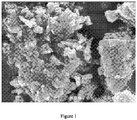
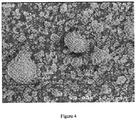
- the clusters of the primary particles of calcium carbonate can exhibit various structures, such as for example those presented in the pictures obtained by Scanning Electron Microscopy in Figures 1 to 4 . They occur as hollow spheres, nano-fibers, nano-sheaves, nano-rosaries, nano-platelets and nano-accordions. Hollow spheres and nano-sheaves are particularly preferred structures.
- Hollow spheres are defined as hollow aggregates of particles having a mean primary particle size dp of less than 100 nm. They can be obtained by spray-drying of coated PCC suspensions.
- the mean primary particles size dp is measured by the Léa -Nurse method (Standard NFX 11-601, 1974).
- the d P value is obtained from the massic area (S M ) derived from the Léa and Nurse method by making the assumptions that all the particles are spherical, non porous and of equal diameter, and by neglecting contact surfaces between the particles.
- Nano-fibers, nano-sheaves, nano-rosaries, nano-platelets and nano-accordions are structures such as those obtained by means of the method described and claimed in patent application WO 03/004414 of SOLVAY (cios Anonyme). Nano-sheaves are called nano-faggots in that patent application. The definitions of nano-fibers, nano-sheaves, nano-rosaries, nanoplatelets and nano-accordions are given in document WO 03/004414 of SOLVAY (cios Anonyme), page 5, line 33 to page 7, line 9 and are incorporated herein by reference.
- the mean diameter of the aggregates of calcium carbonate can vary to a large extent. However, this diameter is generally less than or equal to 20 ⁇ m, preferably less than or equal to 4 ⁇ m. Aggregates with a diameter of less than or equal to 600 nm are especially advantageous, diameters of less than or equal to 100 nm being preferred. Aggregates with a diameter of greater than or equal to 15 nm are highly suitable. Aggregates with a diameter of greater than or equal to 60 nm are particularly well suited.
- the mean diameter of the aggregates is obtained on the basis of the size distribution of the particles determined by the sedimentation method using a Micromeritics SediGraph 5 100 measuring device for sizes ranging from 0.1 to 300 ⁇ m (standard ISO 13317-3) and using a Horiba CAPA 700 measuring device for sizes ranging from 0.01 to 300 ⁇ m (standard ISO 13318-2). It is the diameter of the aggregates of the individual particles for which 50% of the distribution (by weight, measured by the sedimentation technique) is smaller and 50% of the distribution is greater (D 50 ).
- the calcium carbonate particles used in the invention have a BET specific surface area higher than or equal to 10 m 2 /g, preferably higher than or equal to 15 m 2 /g, more preferably higher than or equal to 20 m 2 /g, still more preferably higher than or equal to 40 m 2 /g and in particular higher than or equal to 70 m 2 /g.
- the particles according to the invention have generally a BET specific surface area lower than or equal to 300 m 2 /g preferably lower than or equal to 250 m 2 /g, more preferably lower than or equal to 200 m 2 /g, still more preferably lower than or equal to 150 m 2 /g and in particular lower than or equal to 100 m 2 /g.
- the BET specific surface area is measured according to the standard ISO 9277-1995.
- the calcium carbonate particles have usually a mean primary particle size (d p ) higher than or equal to 5 nm, preferably higher than or equal to 10 nm, more preferably higher than or equal to 30 nm, still more preferably higher than or equal to 50 nm and most preferably higher than or equal to 70 nm.
- the mean primary particle size is generally lower than or equal to 20 ⁇ m, preferably lower than or equal to 10 ⁇ m, more preferably lower than or equal to 1 ⁇ m and most preferably lower than or equal to 0.1 ⁇ m.
- the mean primary particle size (d p ) is measured according to the Standard NFX 11-601, 1974 as described above.
- the calcium carbonate particles used in the invention are coated with at least one coating agent selected from carboxylic acids, carboxylic acid salts, polyacrylic acids, polyacrylic acid salts and mixtures thereof.
- the carboxylic acid may be aliphatic or aromatic. Aliphatic carboxylic acids are preferred.
- the aliphatic carboxylic acid may be any linear or branched or cyclic, substituted or non substituted, saturated or unsaturated, aliphatic carboxylic acid.
- the aliphatic carboxylic acid has usually a number of carbon atoms greater than or equal to 4, preferably greater than or equal to 8, more preferably greater than or equal to 10 and most preferably greater than or equal to 14.
- the aliphatic carboxylic acid has generally a number of carbon atoms lower than or equal to 32, preferably lower than or equal to 28, more preferably lower than or equal to 24 and most preferably lower than or equal to 22.
- the aliphatic carboxylic acid can be selected from the group of substituted, non substituted, saturated and unsaturated fatty acids or mixtures thereof. More preferably it is selected from the group consisting of caproic acid, caprylic acid, capric acid, lauric acid, myristic acid, palmitic acid, stearic acid, iso-stearic acid, hydroxystearic acid, arachidic acid, behenic acid, lignoceric acid, cerotic acid, montanic acid, melissic acid, myristoleic acid, palmitoleic acid, petroselinic acid, petroselaidic acid, oleic acid, elaidic acid, linoleic acid, linolelaidic acid, linolenic acid, linolenelaidic acid, a-eleostaeric acid, b-eleostearic acid, gadoleic acid, arachidonic acid, erucic acid, brassidic acid and clupan
- Mixtures containing mainly palmitic, stearic and oleic acids are more preferred.
- Mixtures called "stearine” which consist of about 30 - 40 wt % stearic acid, of about 40 - 50 wt % palmitic acid and of about 13 - 20 wt % oleic acid are particularly preferred.
- the aliphatic carboxylic acid can be a rosin acid selected from the group consisting of levopimaric acid, neoabietic acid, palustric acid, abietic acid, dehydroabietic acid, mixtures thereof or salts derived therefrom.
- the coating agent is a salt of an aliphatic carboxylic acid
- this may be the calcium salt of the carboxylic acid.
- the coating agent may also be present e.g. in form of the sodium, potassium or ammonium salt of the aliphatic carboxylic acid.
- the coating agent may be applied to the particles by any suitable method.
- the coating agent can be dispersed or emulsified in liquid or solid form, preferably as an emulsion with the dispersed calcium carbonate, for example, during the grinding process or before, during and/or after the precipitation, the coating agent adhering to the surface of the calcium carbonate.
- the treatment of the alkaline earth metal carbonate with the coating agent takes place in emulsified form in an aqueous system.
- the coating agent can be referred to e.g. US 6,342,100 of SOLVAY SODA DEUTSCHLAND GmbH with is fully incorporated by reference herein.
- the calcium carbonate particles can be coated with a polyacrylic acid, a polyacrylic acid salt or with a mixture thereof.
- the molecular weight of the polyacrylic acid is generally higher than or equal to 500 g/mol, preferably higher than or equal to 700 g/mol and most preferably higher than or equal to 1 000 g/mol. That molecular weight is usually lower than or equal to 15 000 g/mol, ideally lower than or equal to 4 000 g/mol and in particular lower than or equal to 2 000 g/mol.
- the coating agent is a salt of a polyacrylic acid
- this may be the calcium salt of the polyacrylic acid.
- the coating agent may also be present e.g. in form of the sodium, potassium or ammonium salt of the polyacrylic acid.
- the sodium salt is preferred.
- the coating agent is a salt of a polyacrylic acid
- it may be the crystallization controller as defined in document WO 03/004414 of SOLVAY (cios Anonyme), page 2, lines 24 to 31 which is incorporated herein by reference.
- the calcium carbonate particles used in the invention are coated with a coating agent the content of which being usually higher than or equal to 0.0001 wt %, preferably higher than or equal to 0.001 wt %, yet preferably higher than or equal to 0.01 wt % and most preferably higher than or equal to 0.05 wt %, based on the total weight of the particles.
- the coating agent content of the particles according to the invention is generally lower than or equal to 60 wt %, preferably lower than or equal to 25 wt %, yet preferably lower than or equal to 10 wt % and most preferably lower than or equal to 6 wt %, based on the total weight of the particles.
- the calcium carbonate particles used in the invention are incorporated in construction materials, or in dry premixes that are to be mixed at least with water for the preparation of construction materials, or also in wet premixes that are to be mixed with at least one binder and at least one foaming agent for the preparation of construction materials.
- the construction materials can be selected typically from plaster, stucco, cement render, mortar and concrete or mixtures thereof.
- the invention therefore also relates to construction materials containing :
- the invention also relates to dry premixes to be mixed at least with water for the preparation of construction materials, consisting of :
- the invention further relates to wet premixes to be mixed with at least one binder and at least one foaming agent for the preparation of construction materials, consisting of :
- the inorganic binder is selected from cement, hydraulic lime, gypsum and mixtures thereof. Cement, hydraulic lime and mixtures thereof are preferred.
- gypsum By gypsum, one intends to designate any composition containing as major components calcium sulfate (CaSO 4 ), calcium sulfate hemihydrate (CaSO 4 .1/2H 2 O) or any mixture thereof, as described in " Wirsching Franz, Gebrüder Knauf West Germany Gipswerke, Iphofen, Federal Republik of Germany, Ullmann's Encyclopedia of Industrial Chemistry, Fifth, Completely Revised Edition, Volume A4, Page 555, Calcium Sulfate .”
- cement By cement, one intends to designate any composition containing as major components calcium silicates (tri- and dicalcium silicates), calcium aluminates and calcium aluminoferrites, calcium oxide and silicon oxide as defined in the standard UNI EN 197-1-2001.
- the various types of cement such as those described in " Siegbert Sprung, Anlagensinstitut der Zementindustrie, Düsseldorf, Federal Republic of Germany, Ullmann's Encyclopedia of Industrial Chemistry, Sixth, Completely Revised Edition, Volume 7, Page 1, Cement and Concrete, Chapter 1 .” can be convenient.
- Standardized Common cements like Portland Cement, Portland composite cement (Portland slag cement, Portland silica fume cement, Portland pozzolanic cement, Portland fly ash cement, Portland shale cement, Portland limestone cement), Blast-furnace cement, Pozzolanic cement and Composite cement and Standardized Special cements like Sulfate-resistant cements, Low-heat cements, Low-alkali cements, calcium aluminate cement and Special cements like Supersulfated cements, Water-repellent cements, Oil-well cements, Regulated set cements, Expanding cements and Masonry cements. Portland type cements are more particularly preferred.
- the cement can be obtained by known processes as such described in " Siegbert Sprung, Klasinstitut der Zementindustrie, Düsseldorf, Federal Republic of Germany, Ullmann's Encyclopedia of Industrial Chemistry, Sixth, Completely Revised Edition, Volume 7, Page 1, Cement and Concrete, Chapter 1 .”
- hydraulic lime By hydraulic lime (HL), one intends to designate any composition containing calcium hydroxide (Ca(OH) 2 ), calcium silicate and aluminates as major components according to the standard UNI EN 459-1. This means that the content of Ca(OH) 2 in weight percent of the HL composition is higher than the weight percent of any other component. It is preferable to use hydraulic lime where the content of Ca(OH) 2 is higher than or equal to 50 wt %, preferably higher than or equal to 75 wt %, more preferably higher than or equal to 90 wt %, still more preferably higher than or equal to 95 wt % and most preferably higher than or equal to 99 wt % of the total weight of the composition.
- Calcium hydroxide (Ca(OH) 2 ) can be obtained by any known method, for instance by making quicklime (CaO) by thermal decomposition of limestone and by further slaking quick lime with water.
- quicklime CaO
- Tony Oates Limetec Consultancy Services, Buxton, Derbyshire, United Kingdom
- Ullmann's Encyclopedia of Industrial Chemistry Fifth, Completely Revised Edition, Volume A 15, Page 317, Lime and Limestone, Chapter 4
- Cement, hydraulic lime and mixture thereof are preferred. Mixtures of cement and hydraulic lime are known as bastard lime (BL).
- the cement content in the mixture of cement and hydraulic lime is usually higher than or equal to 10 wt %, preferably higher than or equal to 20 wt %, more preferably higher than or equal to 30 wt %, still more preferably higher than or equal to 40 wt % and most preferably higher than or equal to 45 wt % of the total weight of the mixture. It is generally lower than or equal to 90 wt %, preferably lower than or equal to 80 wt %, more preferably lower than or equal to 70 wt %, still more preferably lower than or equal to 60 wt % and most preferably lower than or equal to 55 wt % of the total weight of the mixture.
- the calcium hydroxide content in the mixture of cement and hydraulic lime is usually higher than or equal to 10 wt %, preferably higher than or equal to 20 wt %, more preferably higher than or equal to 30 wt %, still more preferably higher than or equal to 40 wt % and most preferably higher than or equal to 45 wt % of the total weight of the mixture. It is generally lower than or equal to 90 wt %, preferably lower than or equal to 80 wt %, more preferably lower than or equal to 70 wt %, still more preferably lower than or equal to 60 wt % and most preferably lower than or equal to 55 wt % of the total weight of the mixture.
- Those compounds can be present in the construction material according to the invention. Those compounds are usually used for the preparation of plaster, cement render, mortar, concrete or other materials for construction. They include but are not limited to sand, lightweight materials, polymeric resins (i.e. polyvinyl acetate), surface-active agents (i.e. polymeric wetting agents, colloids (i.e., methyl cellulose), pigments, dyes, thickener, alkali agent, co-solvents, wetting and dispersing agents, biocide, foaming agent, anti-foaming agent, anti-settling agent, fibers, organic binder and water.
- polymeric resins i.e. polyvinyl acetate
- surface-active agents i.e. polymeric wetting agents
- colloids i.e., methyl cellulose
- pigments i.e., dyes, thickener
- alkali agent alkali agent
- co-solvents i.e., methyl cellulose
- pigments By pigments, one intends to denote a water insoluble coloring organic or inorganic substance.
- Inorganic substances different from the calcium carbonate particle used in the invention are preferred. They can be selected from metal oxides (like iron oxides, chromium oxides, titanium oxide for instance), clays, natural earths, other inorganic compounds (cobalt blues, bismuth vanadate, chrome yellows, molybdate reds for instance).
- Organic pigments are also well known in the construction industry and involve among others: carbon black, monoazo pigments, isoindolinone pigments, naphthalene tetracarboxylic acid pigments, dibromanthanthrone pigments, perylene tetracarboxylic acid pigments, anthraquinone pigments, quinacridone pigments, heterocyclic Ni-complex pigments, dioxazine pigments, indanthrone pigments, phthalocyanines, disazo pigments, isoindoline pigments, azo condensation pigments, manganese salts of monoazo dyes and thiazine pigments.
- dyes one intends to denote a water soluble coloring organic or inorganic substance.
- methane dyes triphenylmethane dyes in particular
- azo dyes nitro dyes, nitroso dyes, phthalein dyes, indigoid dyes, antraquinone dyes, alizarine dyes, aniline dyes, methylene blue and reactive dyes.
- Pigments are preferred. Inorganic pigments are more preferred.
- Sand is a loose material consisting of small mineral particles or rock and mineral particles distinguishable by the naked eye. Grain vary from almost spherical to angular, with diameter range from 1/16 mm to 2 mm. Sand is often the principal component of the mineral aggregate used in the preparation of concrete.
- sand one intends to denote any composition which contains silicon dioxide as the major component.
- the content of silicon dioxide is generally higher than or equal to 50 % by weight, preferably higher than or equal to 75 % and most preferably higher than or equal to 90 %.
- Silicon dioxide is preferably in the form of quartz.
- the quartz content of silicon dioxide is generally higher than or equal to 50 % by weight, preferably higher than or equal to 75 % and most preferably higher than or equal to 90 %.
- Such sand composition is found in inland continental settings and non-tropical coastal settings. Sand can also contain other constituents such as iron, feldspar and gypsum.
- inorganic solid materials with a bulk density lower than or equal to 1 g/cm 3 , preferably lower than or equal to 0.5 g/cm 3 , and most preferably lower than or equal to 0.2 g/cm 3 .
- the definition of the bulk density and the method of measurement is defined in " Rouquerol, J., D. Avnir, C. W. Fairbridge, D. H. Everett, J. H. Haynes, N. Pernicone, J. D. F. Ramsay, K. S. W. Sing, and K. K. Unger, "Recommendations for the Characterization of Porous Solids," Pure Appl. Chem., 66, 1739 (1994) » .
- Such materials are generally porous.
- Example of such materials are pumice, perlite and vermiculite.
- the calcium carbonate content in the construction material according to the invention is usually higher than or equal to 0.15 wt %, preferably higher than or equal to 0.5 wt %, more preferably higher than or equal 1 wt %, yet more preferably higher than or equal to 2 wt %, still more preferably higher than or equal to 4 wt %, in particular more preferably higher than or equal to 5 wt % and most preferably higher than or equal to 6 wt % of the total weight of the construction material excluding water.
- the binder content in the construction material according to the invention is usually higher than or equal to 1 wt %, preferably higher than or equal to 2 wt %, more preferably higher than or equal to 5 wt %, still more preferably higher than or equal to 10 wt % and most preferably higher than or equal to 20 wt % of the total weight of the construction material excluding water. It is generally lower than or equal to 90 wt %, preferably lower than or equal to 70 wt %, more preferably lower than or equal to 50 wt %, still more preferably lower than or equal to 30 wt % and most preferably lower than or equal to 25 wt %.
- the pigment content in the construction material according to the invention is usually higher than or equal to 0.01 wt %, preferably higher than or equal to 1 wt %, more preferably higher than or equal to 10 wt %, still more preferably higher than or equal to 30 wt % and most preferably higher than or equal to 40 wt % of the total weight of the construction material excluding water. It is generally lower than or equal to 90 wt %, preferably lower than or equal to 70 wt %, more preferably lower than or equal to 60 wt %, still more preferably lower than or equal to 50 wt % and most preferably lower than or equal to 45 wt %.
- the construction materials according to the invention generally contain the calcium carbonate particles in an amount higher than or equal to 0.1 wt % and lower than or equal to 50 wt % with respect to the total weight of the construction material.
- the construction materials according to the invention After hardening, the construction materials according to the invention usually have a sound absorption coefficient ( ⁇ n) higher than or equal to 0.05, preferably higher than or equal to 0.2, more preferably higher than or equal to 0.4, still more preferably higher than or equal to 0.5, yet more preferably higher than or equal to 0.75, in particular more preferably higher than or equal to 0.9 and most preferably higher than or equal to 0.95.
- the sound absorption coefficient is generally lower than or equal to 1.
- the construction materials according to the invention usually have an airflow resistance (r) higher than or equal to 0.01 Ns/m 4 and lower than or equal to 1000 Ns/m 4 .
- the dry premixes according to the invention most often contain the calcium carbonate particles in an amount higher than or equal to 0.15 wt % and lower than or equal to 65 wt % with respect to the total weight of the dry premix.
- the wet premixes according to the invention in general contain the calcium carbonate particles in an amount higher than or equal to 0.15 wt % and lower than or equal to 65 wt % with respect to the total weight of the wet premix.
- the construction materials, the dry premixes and the wet premixes of the invention can be obtained by mixing the various components described above in adequate ratios following any sequence of mixing.
- all the compounds can be added simultaneously in a vessel or they can be added sequentially in a vessel, the sequence of addition being of no importance, or some of them can be premixed before being added to the others.
- the construction material or the dry premix or the wet premix is obtained by blending the various components taken separately. The product is then ready to use or to market.
- the construction material is obtained by blending adequate ratios of two mixtures, the first one, mixture A, containing water, the calcium carbonate particles used in the invention, the pigments and other additives and the second one, mixture B, containing the mineral aggregate, the binder and other additives.
- the calcium carbonate particles content of mixture A is usually higher than or equal to 0.1 wt %, preferably higher than or equal to 10 wt % and most preferably higher than or equal to 40 wt % of the total weight of the mixture. It is generally lower than or equal to 90 wt %, preferably lower than or equal to 70 wt %, and most preferably lower than or equal to 50 wt %.
- the pigment content of mixture A is usually higher than or equal to 0.01 wt %, preferably higher than or equal to 1 wt % and most preferably higher than or equal to 40 wt % of the total weight of the mixture. It is generally lower than or equal to 90 wt %, preferably lower than or equal to 70 wt %, and most preferably lower than or equal to 50 wt %.
- the mineral aggregate content of mixture B is usually higher than or equal to 0.1 wt %, preferably higher than or equal to 10 wt % and most preferably higher than or equal to 40 wt % of the total weight of the mixture.
- the binder content of mixture B is usually higher than or equal to 0.1 wt %, preferably higher than or equal to 10 wt % and most preferably higher than or equal to 40 wt % of the total weight of the mixture. It is generally lower than or equal to 90 wt %, preferably lower than or equal to 70 wt %, and most preferably lower than or equal to 50 wt %.
- the construction material resulting from the blend is ready to use.
- This second embodiment allows a better reproducibility of the color of the resulting hardened material.
- the mineral aggregate comprises mainly sand.
- the sand content is of the mineral aggregate is higher than or equal to 10 % by weight, preferably higher than or equal to 25 %, more preferably higher than or equal to 50 % and most preferably higher than or equal to 99 %.
- a sand content of 100 % is particularly suitable. This variant is preferred when the construction material is intended to be used for coatings.
- the mineral aggregate comprises mainly a lightweight inert material.
- the lightweight inert material content of the mineral aggregate is higher than or equal to 10 % by weight, preferably higher than or equal to 25 %, more preferably higher than or equal to 50 % and most preferably higher than or equal to 99 %.
- a lightweight inert material content of 100 % is particularly suitable. This variant is preferred when the construction material is intended to be used for preparing sound absorption materials.
- the construction material according to the invention can be used for coating floors, ceilings, dividing wall, walls, doors, traps, etc.
- the coatings can have a thickness from 0.1 cm to 5 cm. They can be applied by any technique usually used in the construction industry : by hand, by spray-gun, by spattering, etc.
- the construction material can be used as mortar and sticking materials between bricks or for the manufacture of molded concrete compounds.
- the construction material according to the invention After hardening, the construction material according to the invention exhibits an improved resistance to abrasion. That resistance (Taber abrasion test) is measured according to the the standard ISO 7784-2: 1997.
- the construction material according to the invention is applied on a fiber-cement support (area 100 cm 2 ) to give a coating thickness of 0.1 - 5 cm.
- the coating support is dried until constant weight.
- the dried coating is then submitted to abrasion resistance test with a sand paper P60 disk rotating at 60 ⁇ 2 rpm for 50 - 1000 cycles.
- the abrasion resistance is measured by the weight loss of the dried coating.
- the weight loss is usually lower than or equal to 100 wt %, preferably lower than or equal to 70 wt %, more preferably lower than or equal to 50 wt %, still more preferably lower than or equal to 30 wt % and most preferably lower than or equal to 10 wt %.
- the weight loss is usually higher than or equal to 0 wt %, preferably higher than or equal to 1 wt %, more preferably higher than or equal to 2 wt %, still more preferably higher than or equal to 5 wt % and most preferably lower than or equal to 8 wt %.
- the construction material according to the invention exhibits a higher porosity.
- the pore volume, the average pore radius and the porosity are measured by mercury porosimetry using ThermoFinnigan Pascal 140 (pores model: ink bottle; Hg pressure up to 400 KPa) and Pascal 240 (pores model: ink bottle; Hg pressure up to 200 MPa) porosimeters.
- the pore volume is usually higher than or equal to 1 mm 3 /g, preferably higher than or equal to 50 mm 3 /g, more preferably higher than or equal to 100 mm 3 /g, still more preferably higher than or equal to 130 mm 3 /g and most preferably higher than or equal to 140 mm 3 /g.
- the average pore radius is usually higher than or equal to 0.001 ⁇ m, preferably higher than or equal to 0.01 ⁇ m, more preferably higher than or equal to 0.05 ⁇ m, still more preferably higher than or equal to 0.1 ⁇ m and most preferably higher than or equal to 0.4 ⁇ m.
- the construction material according to the invention exhibits an increased permeability to water vapor and a decreased permeability to liquid water. Without wishing to be bound by any theory, it is believed that the permeability properties are related to the porosity of the cured material.
- the permeability to water vapour is obtained by measuring the vapour permeability coefficient according to the standard UNI EN 1015-19:2002.
- the vapour permeability coefficient ( ⁇ ) is usually higher than or equal to 0.01, preferably higher than or equal to 0.1, more preferably higher than or equal to 1, still more preferably higher than or equal to 10 and most preferably higher than or equal to 20. It is generally lower than or equal to 100, preferably lower than or equal to 50, more preferably lower than or equal to 40, still more preferably lower than or equal to 30 and most preferably lower than or equal to 25.
- the permeability to liquid water is measured by the standard UNI EN ISO 1015-18: 2004.
- the permeability is usually higher than or equal to 0.01 kg/(m 2 min 0.5 ), preferably higher than or equal to 0.05 kg/(m 2 min 0.5 ), more preferably higher than or equal to 0.1 kg/(m 2 min 0.5 ), still more preferably higher than or equal to 0.5 kg/ (m 2 min 0.5 ) and most preferably higher than or equal to 1 kg/(m 2 min 0.5 ).
- the construction material according to the invention exhibits a consistence assessed using an internal method.
- the procedure consists of filling the cone with the mixture, lifting the cone immediately, and measuring the extent to which the mixture has subsided after two minutes.
- a higher value of subsidence corresponds to a better consistence.
- the subsidence is usually higher than or equal to 0.1 cm, preferably higher than or equal to 0.5 cm, more preferably higher than or equal to 1 cm, still more preferably higher than or equal to 3 cm and most preferably higher than or equal to 5 cm. It is generally lower than or equal to 15 cm, preferably lower than or equal to 12 cm, more preferably lower than or equal to 10 cm, still more preferably lower than or equal to 7 cm and most preferably lower than or equal to 5 cm.
- the construction material according to the invention exhibits an improved workable life assessed using an internal method.
- the workable life is the time necessary to have a cone subsidence of only 3 cm.
- the improved workable life is obtained without any adverse effect on the hardening time of the construction material.
- the workable life is usually higher than or equal to 0, preferably higher than or equal to 1 minute, more preferably higher than or equal to 1 hour, still more preferably higher than or equal to 10 hours and most preferably higher than or equal to 1 day. It is generally lower than or equal to 10 days, preferably lower than or equal to 5 days, more preferably lower than or equal to 3 days and most preferably lower than or equal to 2 days.
- the construction material according to the invention exhibits a lower surface water absorption.
- the amount of water absorbed was measured by the difference in weight before and after the test.
- the permeability water absorbed is usually higher than or equal to 0.1 cm 3 , preferably higher than or equal to 1 cm 3 , more preferably higher than or equal to 2 cm 3 , still more preferably higher than or equal to 3 cm 3 and most preferably higher than or equal to 5 cm 3 .
- the construction material according to the invention exhibits an improved flexural strength.
- the test was performed on prism-shaped samples of dimension 4x4x16 cm.
- the flexural strength of each mixture was obtained by stressing the sample at three different points. It is supported at two points and a force is applied at the centre. Failure (fracture) occurs when the maximum tensile stress reaches a critical value.
- the force was applied on the sample with a constant speed of 0.7 mm/min. The higher the force needed to damage the sample and the stronger the resistance of the sample.
- the flexural strength is usually higher than or equal to 0.01 N/mm 2 , preferably higher than or equal to 0.05 N/mm 2 , more preferably higher than or equal to 0.1 N/mm 2 , still more preferably higher than or equal to 0.5 N/mm 2 and most preferably higher than or equal to 1 N/mm 2 . It is generally lower than or equal to 50 N/mm 2 , preferably lower than or equal to 20 N/mm 2 , more preferably lower than or equal to 10 N/mm 2 , still more preferably lower than or equal to 5 N/mm 2 and most preferably lower than or equal to 2 N/mm 2 .
- the construction material according to the invention After hardening, the construction material according to the invention exhibits an improved impact resistance.
- the impact resistance is measured by the impact energy according to the following method.
- a guided cylindrical weight of mass p is freely dropped from a height h on a supported sample of the hardened construction material of 1 cm of thickness.
- Each collision has to be made in a zone of the specimen that has not been deformed by the previous collisions.
- After the first breaking sign, it is possible to calculate the impact energy by the following equation : Impact Energy h ⁇ p ⁇ 9,81
- the impact energy is usually higher than or equal to 0.001 J, preferably higher than or equal to 0.1 J, more preferably higher than or equal to 1 J, still more preferably higher than or equal to 10 J and most preferably higher than or equal to 100 J. It is generally lower than or equal to 100000 J, preferably lower than or equal to 50000 J, more preferably lower than or equal to 10000 J, still more preferably lower than or equal to 1000 J and most preferably lower than or equal to 500 J.
- the construction material according to the invention exhibits an improved resistance to ultraviolet light.
- the preliminary work of preparing the sample for this test was performed by adding coloured paste.
- the colored paste added is usually higher than or equal to 0.1 wt %, preferably higher than or equal to 1 wt %, more preferably higher than or equal to 2 wt %, still more preferably higher than or equal to 3 wt % and most preferably higher than or equal to 6 wt %.
- the resistance to ultraviolet light is measured by ⁇ E factor where ⁇ E is ( ⁇ L 2 + ⁇ a *2 + ⁇ b *2 ) 1/2 in C.I.E.La*b* color space system (UNI 8941: 1987).
- ⁇ E is ( ⁇ L 2 + ⁇ a *2 + ⁇ b *2 ) 1/2 in C.I.E.La*b* color space system (UNI 8941: 1987).
- the chromatic change ⁇ E values after 300 and 1500 hours of QUV test are summarized in Table 3.
- the chromatic change ⁇ E value after 1500 hours of QUV test is usually higher than or equal to 0.01, preferably higher than or equal to 0.1, more preferably higher than or equal to 0.2, still more preferably higher than or equal to 0.5 and most preferably higher than or equal to 0.9. It is generally lower than or equal to 10, preferably lower than or equal to 5, more preferably lower than or equal to 3, still more preferably lower than or equal to 2 and most preferably lower than or equal to 1.
- the construction material according to the invention After hardening, the construction material according to the invention exhibits improved sound absorption properties.
- the sound absorption is measured by the standard ISO 10534-2: 1998 (determination of sound absorption coefficient and impedance in impedance tubes. Part 2: transfer-function method), by the standard ISO 13472-1: 2002 (measurement of sound absorption properties of road surfaces in situ. Part 1 : extended surface method) and also by an internal method (measurement of sound absorption of road surfaces in situ using an intensimetric method).
- the sound absorption coefficient ( ⁇ n) is higher than or equal to 0.05, preferably higher than or equal to 0.2, more preferably higher than or equal to 0.4, still more preferably higher than or equal to 0.5, yet more preferably higher than or equal to 0.75, in particular more preferably higher than or equal to 0.9 and most preferably higher than or equal to 0.95.
- the sound absorption coefficient is generally lower than or equal to 1.
- the airflow resistance is measured by the standard UNI-EN 29053: 1994 (materials for acoustical applications: determination of airflow resistance).
- the airflow resistance is usually higher than or equal to 0.1 Ns/m 4 , preferably higher than or equal to 1 Ns/m 4 and most preferably higher than or equal to 10 Ns/m 4 of the total weight of the mixture. It is generally lower than or equal to 1000 Ns/m 4 , preferably lower than or equal to 100 Ns/m 4 , and most preferably lower than or equal to 20 Ns/m 4 .
- the present invention also relates to a first kind of compositions to be used in the preparation of construction materials or dry premixes containing :
- the first kind of compositions can further contain at least one of the following :
- the present invention also relates to a second kind of compositions to be used in the preparation of construction materials or dry premixes or wet premixes, containing:
- compositions can contain at least one of the following:
- the invention further relates to a third kind of compositions to be used in the preparation of construction materials or dry premixes or wet premixes containing :
- compositions can contain at least one of the following:
- the invention relates to a fourth kind of compositions to be used in the preparation of construction materials or dry premixes or wet premixes, containing:
- compositions can contain at least one of the following:
- Nanofibers and nano-sheaves of precipitated calcium carbonate have been obtained according to the procedures described in examples 1 and 5 of patent application WO 03004414 of SOLVAY (cios Anonyme).
- Hollow spheres have been obtained by spray-drying of a suspension of coated PCC.
- Nano-rhombohedrons have been obtained by precipitation of calcium carbonate, followed by coating and drying.
- All the mixture are prepared using a concrete mixer. During the hardening time (28 days), the samples are maintained at temperature in the range of 15 to 30 °C and relative humidity in the range of 30 to 70 %.
- Blend 1 has been prepared by adding 3275 g of sand and 750 g of water to 1055 g of cement (Portland cement 32,5R, type II, B LL).
- Blend 2 has been prepared by adding 3370 g of sand and 850 g of water to 1027 g of hydraulic lime (Calix, Italcementi).
- Blend 3 has been prepared by adding 3370 g of sand and 850 g of water to 513.5 g of cement (Portland cement 32,5R, type II, B LL) and 513.5 g of hydraulic lime (Calix, Italcementi).
- Examples 5, 8, 11 and 17 80 g of the PCC prepared according to examples 1 to 4 have been added to 2400 g of blend 1.
- Examples 6, 9, 12 and 18 150 g of the PCC prepared according to examples 1 to 4 have been added to 2400 g of blend 2.
- Examples 7, 10, 13 and 19 150 g of the PCC prepared according to examples 1 to 4 have been added to 2400 g of blend 3.
- premixes have been prepared by adding 455 g of water, 61.5 g of nano-rhombohedrons, 0.85 g of Ricem fibers, 0.6 g of foaming agent (Sitren 619 Goldschmidt) and 165 g of Perlite (Peralit 20 Perlite Italiana) to 371 g of cement (Portland cement 32.5 R, type II, B-LL), blend 4, to 371 g of hydraulic lime (Calix, Italcementi), blend 5 or to 371 g of bastard lime (50 wt % of cement and 50 wt % of HL), blend 6.
- a ready to use blend (1 "A” + 2 "B") of plaster ready (finish layer of the wall) has been prepared. Key performances were the higher abrasion resistance and lower water absorption in comparison with standard plasters.
- To prepare 100 kg of ready to use plaster we used 3 bags of 25 kg (“B”) and 1 bag of 18 liters (equivalent to 25 kg) ("A"). The blend was used at 5 kg / sq m (3-4 mm thickness).
- a non pigmented sound absorption coating for indoor walls was prepared_: Hydraulic lime 15.80 % Cement 22.40 % Perlite 15.70 % Nano-rhombohedrons 5.85 % Synthetic fibers 0.10 % Foaming agent 0.05 % Water 40.10 % Total 100 % It is possible to replace hydraulic lime with cement to increase the mechanical resistance of the coating.
- a pigmented sound absorption coating for indoor walls was prepared : ⁇ Component A formula: Water 28.10 % AMP 95 0.35 % (alkali agent) Propylene glycol 1.95 % (co-solvent) Byk 180 7.85 % (wetting-dispersing agent) Biopol VR 20 0.15 % (biocide) Pigment 23.50 % Nano-rhombohedrons 38.10 % Total 100 % ⁇ Final product : Hydraulic lime 9.00 % Cement 28.70 % Perlite 14.10 % Component A 15.30 % Synthetic fibers 0.10 % Foaming agent 0.050 % Water 32.75 % Total 100 %
Landscapes
- Chemical & Material Sciences (AREA)
- Engineering & Computer Science (AREA)
- Ceramic Engineering (AREA)
- Materials Engineering (AREA)
- Structural Engineering (AREA)
- Organic Chemistry (AREA)
- Chemical Kinetics & Catalysis (AREA)
- Inorganic Chemistry (AREA)
- Crystallography & Structural Chemistry (AREA)
- Civil Engineering (AREA)
- Curing Cements, Concrete, And Artificial Stone (AREA)
Claims (15)
- Einsatz von Calciumcarbonatpartikeln bei der Herstellung von Baumaterialien, wobei die Partikel eine Oberflächenkennzahl nach Brunauer-Emmett-Teller (BET) von größer oder gleich 10 m2/g aufweisen und wobei die Baumaterialien mindestens ein anorganisches Bindemittel enthalten, ausgewählt aus Zement, hydraulischem Kalk und Gips, wobei die Calciumcarbonatpartikel mit mindestens einem Beschichtungsmittel beschichtet sind, ausgewählt aus Carbonsäuren, Carbonsäuresalzen, Polyacrylsäuren, Polyacrylsäuresalzen und Gemischen davon; wobei es sich bei dem Calciumcarbonat um gefälltes Calciumcarbonat handelt und wobei es sich bei den gefällten Calciumcarbonatpartikeln um Primärteilchen-Cluster handelt, die eine Struktur ausgewählt aus Hohlkugeln, Nanofasern, Nanoscheiben, Nanokränzen, Nanoplättchen oder Z-förmige-Nanostrukturen aufweisen.
- Baumaterialien, die mindestens ein anorganisches Bindemittel enthalten, ausgewählt aus Zement, hydraulischem Kalk oder Gips, wobei die Calciumcarbonatpartikel eine BET-Oberflächenkennzahl von 10 m2/g oder mehr aufweisen und mit mindestens einem Beschichtungsmittel beschichtet sind, ausgewählt aus darin integrierten Carbonsäuren, Carbonsäuresalzen, Polyacrylsäuren, Polyacrylsäuresalzen und Gemischen davon; wobei es sich bei dem Calciumcarbonat um gefälltes Calciumcarbonat handelt und wobei es sich bei den gefällten Calciumcarbonatpartikeln um Primärteilchen-Cluster handelt, die eine Struktur ausgewählt aus Hohlkugeln, Nanofasern, Nanoscheiben, Nanokränzen, Nanoplättchen oder Z-förmige-Nanostrukturen aufweisen.
- Verwendung gemäß Anspruch 1, wobei das Baumaterial Gips, Stuck, Zementputz, Mörtel und Beton oder Gemische davon enthält.
- Baumaterialien gemäß Anspruch 2, wobei das Baumaterial Gips, Stuck, Zementputz, Mörtel, und Beton oder Gemische davon enthält.
- Baumaterialien gemäß Anspruch 2 oder 4, ferner umfassend:• mindestens ein anorganisches Bindemittel, ausgewählt aus Zement, hydraulischem Kalk und Gips,• mindestens einen mineralischen Zuschlagstoff, ausgewählt aus Sand und leichten mineralischen Zuschlagstoffen,• wahlweise mindestens eine Farbverbindung, ausgewählt aus Pigmenten und Farbstoffen,• Wasser und• wahlweise mindestens ein weiteres Zusatzmittel, ausgewählt aus Polymerharzen, oberflächenaktiven Stoffen, Kolloiden, Verdickungsmitteln, Alkalimitteln, Zusatzlösungsmitteln, Benetzungsmitteln und Dispergiermitteln, Bioziden, Schaummitteln, Antischaummitteln, Antiabsetzmitteln, Fasern und organischen Bindemitteln.
- Baumaterial gemäß einem der Ansprüche 2, 4 oder 5, wobei die Calciumcarbonatpartikel - bezogen auf das Gesamtgewicht des Baumaterials, ohne Wasser - in einer Menge von mehr als oder gleich 0,15 Gewichtsprozent und weniger als oder gleich 65 Gewichtsprozent enthalten sind.
- Trockene Vormischung zum Mischen mit mindestens Wasser zur Herstellung von Baustoffen gemäß einem der Ansprüche 2 oder 4 bis 6, bestehend aus:• mindestens einem anorganischen Bindemittel, ausgewählt aus Zement, hydraulischem Kalk und Gips,• mindestens einem mineralischen Zuschlagstoff, ausgewählt aus Sand oder leichten mineralischen Zuschlagstoffen,• wahlweise mindestens einer Farbverbindung, ausgewählt aus Pigmenten und Farbstoffen und• wahlweise mindestens einem weiteren Zusatzmittel, ausgewählt aus Polymerharzen, oberflächenaktiven Stoffen, Kolloiden, Verdickungsmitteln, Alkalimitteln, Zusatzlösungsmitteln, Benetzungsmitteln und Dispergiermitteln, Bioziden, Schaummitteln, Antischaummitteln, Antiabsetzmitteln, Fasern und organischen Bindemitteln.wobei die Calciumcarbonatpartikel eine BET-Oberflächenkennzahl von 10 m2/g oder mehr aufweisen und mit mindestens einem Beschichtungsmittel beschichtet sind, ausgewählt aus darin integrierten Carbonsäuren, Carbonsäuresalzen, Polyacrylsäuren, Polyacrylsäuresalzen und Gemischen davon; wobei es sich bei dem Calciumcarbonat um gefälltes Calciumcarbonat handelt und wobei es sich bei den gefällten Calciumcarbonatpartikeln um Primärteilchen-Cluster handelt, die eine Struktur ausgewählt aus Hohlkugeln, Nanofasern, Nanoscheiben, Nanokränzen, Nanoplättchen oder Z-förmige-Nanostrukturen aufweisen.
- Trockene Vormischung gemäß Anspruch 7, wobei die Calciumcarbonatpartikel - bezogen auf das Gesamtgewicht der trockenen Vormischung - in einer Menge von mehr als oder gleich 0,15 Gewichtsprozent und weniger als oder gleich 65 Gewichtsprozent enthalten sind.
- Feuchte Vormischung zum Mischen mit mindestens einem Bindemittel und mindestens einem Schaummittel zur Herstellung von Baustoffen gemäß einem der Ansprüche 2 oder 4 bis 6, bestehend aus:• mindestens einem mineralischen Zuschlagstoff, ausgewählt aus Sand und leichten mineralischen Zuschlagstoffen,• wahlweise mindestens einer Farbverbindung, ausgewählt aus Pigmenten und Farbstoffen,• wahlweise mindestens einem weiteren Zusatzmittel, ausgewählt aus Polymerharzen, oberflächenaktiven Stoffen, Kolloiden, Verdickungsmitteln, Alkalimitteln, Zusatzlösungsmitteln, Benetzungsmitteln und Dispergiermittel, Bioziden, Antischaummitteln, Antiabsetzmitteln, Fasern, organischen Bindemitteln und• Wasser,wobei die Calciumcarbonatpartikel eine BET-Oberflächenkennzahl von 10 m2/g oder mehr aufweisen und mit mindestens einem Beschichtungsmittel beschichtet sind, ausgewählt aus darin integrierten Carbonsäuren, Carbonsäuresalzen, Polyacrylsäuren, Polyacrylsäuresalzen und Gemischen davon; wobei es sich bei dem Calciumcarbonat um gefälltes Calciumcarbonat handelt und wobei es sich bei den gefällten Calciumcarbonatpartikeln um Primärteilchen-Cluster handelt, die eine Struktur ausgewählt aus Hohlkugeln, Nanofasern, Nanoscheiben, Nanokränzen, Nanoplättchen oder Z-förmige-Nanostrukturen aufweisen.
- Feuchte Vormischung gemäß Anspruch 9, wobei die Calciumcarbonatpartikel - bezogen auf das Gesamtgewicht der feuchten Vormischung - in einer Menge von mehr als oder gleich 0,15 Gewichtsprozent und weniger als oder gleich 65 Gewichtsprozent enthalten sind.
- Zusammensetzung zur Verwendung bei der Herstellung von Baustoffen, trockenen oder feuchten Vormischungen gemäß einem der Ansprüche 2 oder 4 bis 10, wobei diese mindestens enthält:• Calciumcarbonatpartikel mit einer BET-Oberflächenkennzahl von 10 m2/g oder mehr, die mit mindestens einem Beschichtungsmittel beschichtet sind, ausgewählt aus Carbonsäuren, Carbonsäuresalzen, Polyacrylsäuren, Polyacrylsäuresalzen und Gemischen davon; wobei es sich bei dem Calciumcarbonat um gefälltes Calciumcarbonat handelt und wobei es sich bei den gefällten Calciumcarbonatpartikeln um Primärteilchen-Cluster handelt, die eine Struktur ausgewählt aus Hohlkugeln, Nanofasern, Nanoscheiben, Nanokränzen, Nanoplättchen oder Z-förmige-Nanostrukturen aufweisen und mindestens ein anorganisches Bindemittel enthält, ausgewählt aus Zement, hydraulischem Kalk und Gips; und• mindestens eine Verbindung, ausgewählt aus:• mineralischen Zuschlagstoffen, ausgewählt aus Sand und leichten mineralischen Zuschlagstoffen,• Farbverbindungen, ausgewählt aus Pigmenten und Farbstoffen und• weiteren Zusatzmitteln, ausgewählt aus Polymerharzen, oberflächenaktiven Stoffen, Kolloiden, Verdickungsmitteln, Alkalimitteln, Zusatzlösungsmitteln, Benetzungsmitteln und Dispergiermitteln, Bioziden, Schaummitteln, Antischaummitteln, Antiabsetzmitteln, Fasern und organischen Bindemitteln.
- Verwendung gemäß den Ansprüchen 1 und 3, wobei die Calciumcarbonatpartikel eine BET-Oberflächenkennzahl von mehr als oder gleich 15 m2/g, vorzugsweise von mehr als oder gleich 20 m2/g und idealerweise von mehr als oder gleich 40 m2/g aufweisen.
- Baumaterialien, trockene Vormischungen, feuchte Vormischungen oder Zusammensetzungen gemäß den Ansprüchen 2 oder 4 bis 11, wobei die Calciumcarbonatpartikel eine BET-Oberflächenkennzahl von mehr als oder gleich 15 m2/g, vorzugsweise von mehr als oder gleich 20 m2/g und idealerweise von mehr als oder gleich 40 m2/g aufweisen.
- Verwendung von Calciumcarbonatpartikeln, die eine BET-Oberflächenkennzahl von 10 m2/g oder mehr aufweisen und mit mindestens einem Beschichtungsmittel beschichtet sind, ausgewählt aus Carbonsäuren, Carbonsäuresalzen, Polyacrylsäuren, Polyacrylsäuresalzen und Gemischen davon; wobei es sich bei dem Calciumcarbonat um gefälltes Calciumcarbonat handelt und wobei es sich bei den gefällten Calciumcarbonatpartikeln um Primärteilchen-Cluster handelt, die eine Struktur ausgewählt aus Hohlkugeln, Nanofasern, Nanoscheiben, Nanokränzen, Nanoplättchen oder Z-förmige-Nanostrukturen aufweisen, wobei diese Calciumcarbonatpartikel den Sand in Baustoffen und trockenen bzw. feuchten Baustoff-Vormischungen zumindest teilweise ersetzen und mindestens bewirken:• die Abriebfestigkeit des Baustoffs nach dem Aushärten wird verbessert,• die Porosität des Baustoffs nach dem Aushärten wird verbessert,• die Wasserdampf-Durchlässigkeit des Baustoffs nach dem Aushärten wird verbessert,• die Durchlässigkeit des Baustoffs gegenüber flüssigem Wasser nach dem Aushärten wird verbessert,• die Beschaffenheit des Baustoffs vor dem Aushärten wird verbessert,• die Verarbeitbarkeitszeit des Baustoffs vor dem Aushärten wird verbessert,• die Oberflächenwasseraufnahme des Baustoffs nach dem Aushärten wird verbessert,• die Biegefestigkeit des Baustoffs nach dem Aushärten wird verbessert,• die Schlagfestigkeit des Baustoffs nach dem Aushärten wird verbessert bzw.• die UV-Beständigkeit des Baustoffs nach dem Aushärten wird verbessert.
- Verwendung von Calciumcarbonatpartikeln, die eine BET-Oberflächenkennzahl von 10 m2/g oder mehr aufweisen und mit mindestens einem Beschichtungsmittel beschichtet sind, ausgewählt aus Carbonsäuren, Carbonsäuresalzen, Polyacrylsäuren, Polyacrylsäuresalzen und Gemischen davon; wobei es sich bei dem Calciumcarbonat um gefälltes Calciumcarbonat handelt und wobei es sich bei den gefällten Calciumcarbonatpartikel um Primärteilchen-Cluster handelt, die eine Struktur ausgewählt aus Hohlkugeln, Nanofasern, Nanoscheiben, Nanokränzen, Nanoplättchen oder Z-förmige-Nanostrukturen aufweisen, wobei diese Calciumcarbonatpartikel die leichten mineralischen Zuschlagstoffe in Baustoffen und trockenen bzw. feuchten Baustoff-Vormischungen zumindest teilweise ersetzen und mindestens bewirken:• die Schallabsorption des Baustoffs nach dem Aushärten wird verbessert bzw.• die Wärmedämmung des Baustoffs nach dem Aushärten wird verbessert.
Applications Claiming Priority (3)
| Application Number | Priority Date | Filing Date | Title |
|---|---|---|---|
| ITMI20051124 ITMI20051124A1 (it) | 2005-06-15 | 2005-06-15 | Impiego di particelle di carbonato di calcio nella produzione di materiali da costruzione |
| ITMI20060157 ITMI20060157A1 (it) | 2006-01-31 | 2006-01-31 | Impiego di particelle di carbonato di calcio nella produzione di materiali da costruzione |
| PCT/EP2006/063073 WO2006134080A1 (en) | 2005-06-15 | 2006-06-12 | Use of particles of calcium carbonate in the production of construction materials |
Publications (2)
| Publication Number | Publication Date |
|---|---|
| EP1893546A1 EP1893546A1 (de) | 2008-03-05 |
| EP1893546B1 true EP1893546B1 (de) | 2019-12-25 |
Family
ID=36972766
Family Applications (1)
| Application Number | Title | Priority Date | Filing Date |
|---|---|---|---|
| EP06777295.4A Revoked EP1893546B1 (de) | 2005-06-15 | 2006-06-12 | Verwendung von calciumcarbonatpartikeln in der herstellung von baumaterialien |
Country Status (3)
| Country | Link |
|---|---|
| EP (1) | EP1893546B1 (de) |
| AR (1) | AR055061A1 (de) |
| WO (1) | WO2006134080A1 (de) |
Families Citing this family (56)
| Publication number | Priority date | Publication date | Assignee | Title |
|---|---|---|---|---|
| FR2860789B1 (fr) * | 2003-10-13 | 2006-11-24 | Rech S Sur Les Materiaux L E R | Composition a base de liants durcissables a l'eau ou a l'air et son application notamment a l'obtention d'un produit ayant l'aspect et les proprietes d'une pierre naturelle. |
| EP1657278A1 (de) | 2004-11-12 | 2006-05-17 | SOLVAY (Société Anonyme) | Beschichtete Calciumcarbonat-Teilchen mit grosser spezifischer Oberfläche |
| KR20130036350A (ko) | 2004-12-22 | 2013-04-11 | 솔베이(소시에떼아노님) | 알칼리 토금속 카르보네이트의 내산성 입자 |
| FR2881957B1 (fr) | 2005-02-16 | 2008-08-08 | Solvay | Comprimes comprenant une substance biologiquement active et un excipient |
| EP1893546B1 (de) | 2005-06-15 | 2019-12-25 | Imertech Sas | Verwendung von calciumcarbonatpartikeln in der herstellung von baumaterialien |
| EP1958926A1 (de) | 2007-01-24 | 2008-08-20 | Lafarge | Neue Betonzusammensetzung |
| US7735274B2 (en) | 2007-05-24 | 2010-06-15 | Calera Corporation | Hydraulic cements comprising carbonate compound compositions |
| US7753618B2 (en) | 2007-06-28 | 2010-07-13 | Calera Corporation | Rocks and aggregate, and methods of making and using the same |
| JP2010531732A (ja) | 2007-06-28 | 2010-09-30 | カレラ コーポレイション | 炭酸塩化合物の沈殿を含む脱塩方法 |
| US8287639B2 (en) * | 2007-07-31 | 2012-10-16 | Cognis Ip Management Gmbh | Methods and compositions for improving air entrainment in cementitious mixtures |
| US7749476B2 (en) | 2007-12-28 | 2010-07-06 | Calera Corporation | Production of carbonate-containing compositions from material comprising metal silicates |
| JP2012513944A (ja) | 2007-12-28 | 2012-06-21 | カレラ コーポレイション | Co2を捕捉する方法 |
| US20100239467A1 (en) | 2008-06-17 | 2010-09-23 | Brent Constantz | Methods and systems for utilizing waste sources of metal oxides |
| US7754169B2 (en) | 2007-12-28 | 2010-07-13 | Calera Corporation | Methods and systems for utilizing waste sources of metal oxides |
| FR2927623B1 (fr) * | 2008-02-19 | 2012-05-25 | Imerys Tc | Composition de mousse de chaux pour isolation thermique |
| ITRM20080359A1 (it) * | 2008-07-02 | 2010-01-03 | Sergio Delfini | Colorante per decorazione e protezione superficiale di una malta a base cementizia, relativo metodo di applicazione, e malta cementizia da utilizzare in tale metodo. |
| EP2212033A4 (de) | 2008-07-16 | 2013-04-24 | Calera Corp | Vierzelliges elektrochemisches niedrigenergiesystem mit kohlendioxidgas |
| KR20110038691A (ko) | 2008-07-16 | 2011-04-14 | 칼레라 코포레이션 | 전기화학 시스템에서 co2를 사용하는 방법 |
| US7993500B2 (en) | 2008-07-16 | 2011-08-09 | Calera Corporation | Gas diffusion anode and CO2 cathode electrolyte system |
| EP2145868A1 (de) * | 2008-07-18 | 2010-01-20 | Lafarge | Wässrige Formulierungen |
| AU2009287461A1 (en) | 2008-09-11 | 2010-04-08 | Calera Corporation | CO2 commodity trading system and method |
| US7939336B2 (en) | 2008-09-30 | 2011-05-10 | Calera Corporation | Compositions and methods using substances containing carbon |
| TW201026597A (en) | 2008-09-30 | 2010-07-16 | Calera Corp | CO2-sequestering formed building materials |
| US8869477B2 (en) | 2008-09-30 | 2014-10-28 | Calera Corporation | Formed building materials |
| US7815880B2 (en) | 2008-09-30 | 2010-10-19 | Calera Corporation | Reduced-carbon footprint concrete compositions |
| FI123552B (fi) * | 2008-10-01 | 2013-07-15 | Kautar Oy | Strukturoitu sideainekoostumus |
| WO2010051458A1 (en) | 2008-10-31 | 2010-05-06 | Calera Corporation | Non-cementitious compositions comprising co2 sequestering additives |
| US9133581B2 (en) | 2008-10-31 | 2015-09-15 | Calera Corporation | Non-cementitious compositions comprising vaterite and methods thereof |
| BRPI0823394A2 (pt) | 2008-12-23 | 2015-06-16 | Calera Corp | Sistema e método eletroquímico de hidróxido de baixa energia |
| AU2010201005A1 (en) | 2009-02-10 | 2010-08-26 | Calera Corporation | Low-voltage alkaline production using hydrogen and electrocatlytic electrodes |
| CA2694959A1 (en) | 2009-03-02 | 2010-09-02 | Calera Corporation | Gas stream multi-pollutants control systems and methods |
| TW201105406A (en) | 2009-03-10 | 2011-02-16 | Calera Corp | Systems and methods for processing CO2 |
| US7993511B2 (en) | 2009-07-15 | 2011-08-09 | Calera Corporation | Electrochemical production of an alkaline solution using CO2 |
| EP2298709A1 (de) * | 2009-09-18 | 2011-03-23 | Omya Development AG | Betonmix mit Antiausblühungseigenschaften und Verfahren zur Herstellung von Beton unter Verwendung des Betonmix |
| US9199880B2 (en) | 2010-04-27 | 2015-12-01 | Biomason, Inc. | Methods for making construction materials using enzyme producing bacteria |
| US10717674B2 (en) | 2010-04-27 | 2020-07-21 | Biomason, Inc. | Methods for the manufacture of colorfast masonry |
| US20160264463A1 (en) | 2015-03-10 | 2016-09-15 | Biomason, Inc. | Compositions and Methods for Dust Control and for the Manufacture of Construction Materials |
| CN102260059A (zh) * | 2010-05-31 | 2011-11-30 | 北京仁创科技集团有限公司 | 一种高强防渗混凝土 |
| DE102011050134B3 (de) | 2011-05-05 | 2012-07-26 | Thyssenkrupp Polysius Ag | Verfahren und Anlage zur Herstellung eines hydraulischen Bindemittels |
| FR2977889B1 (fr) | 2011-07-13 | 2014-01-10 | Saint Gobain Isover | Materiaux d'isolation thermique hautes performances |
| FR2977888B1 (fr) * | 2011-07-13 | 2014-01-10 | Saint Gobain Isover | Materiaux d'isolation thermique hautes performances. |
| IN2014MN02048A (de) * | 2012-03-23 | 2015-08-14 | Omya Int Ag | |
| DE102013011742B3 (de) | 2013-07-12 | 2014-06-05 | Xella Baustoffe Gmbh | Hydrothermal gehärtetes Poren- oder Schaumbetonmaterial, hydrothermal gehärteter Poren- oder Schaumbetonformkörper, Verfahren zu dessen Herstellung und Verwendung von gefälltem Calciumcarbonat und/oder Calciummagnesiumcarbonat |
| RU2614830C2 (ru) * | 2015-06-17 | 2017-03-29 | Федеральное государственное бюджетное образовательное учреждение высшего профессионального образования "Казанский государственный архитектурно-строительный университет" КГАСУ | Сырьевая смесь для изготовления силикатных прессованных изделий |
| RU2608376C2 (ru) * | 2015-06-17 | 2017-01-18 | Федеральное государственное бюджетное образовательное учреждение высшего профессионального образования "Казанский государственный архитектурно-строительный университет" КГАСУ | Известково-кремнезёмистое вяжущее для производства силикатных цветных прессованных изделий |
| EP3124554A1 (de) * | 2015-07-30 | 2017-02-01 | Imerys SA | Ausgefälltes calciumcarbonat, verfahren zu dessen herstellung und verwendungen davon |
| CN115304297A (zh) | 2016-10-31 | 2022-11-08 | 拜奥梅森股份有限公司 | 微生物加载的集料和制造方法 |
| EP3577088B1 (de) * | 2017-02-01 | 2021-05-19 | Omya International AG | Verbesserte anorganische pigmente enthaltendes erzeugnis auf zementbasis und verfahren zu dessen herstellung |
| FI129109B (en) * | 2017-04-02 | 2021-07-15 | Fp Pigments Oy | Method of improving stain resistance of surfaces |
| US10450695B2 (en) | 2017-04-25 | 2019-10-22 | Biomason, Inc. | Compositions and methods of biologically cemented structures for marine applications |
| CN106985277B (zh) * | 2017-04-29 | 2019-04-02 | 吉林建筑大学 | 一种多孔混凝土预制构件的精确制备方法 |
| AU2018346776C1 (en) | 2017-10-05 | 2022-02-17 | Biomason Inc. | Biocementation method and system |
| BE1026315B1 (nl) * | 2018-11-12 | 2019-12-23 | BOSS paints NV | Bindpasta voor formuleren van poederstuc |
| GB201818580D0 (en) | 2018-11-14 | 2018-12-26 | Carbon Capture Machine Uk Ltd | Additive for blended cement compositions, cement produced therefrom and method of cement manufacture |
| SE544012C2 (en) * | 2020-03-26 | 2021-11-02 | Aercement Ab | Mineralized carbon dioxide |
| EP4116273A1 (de) * | 2021-07-08 | 2023-01-11 | Hilti Aktiengesellschaft | Verwendung von calciumcarbonat hoher reinheit und hoher spezifischer oberfläche in einem anorganischen mörtelsystem auf basis von tonerdeschmelzzement zur erhöhung der lastwerte |
Citations (7)
| Publication number | Priority date | Publication date | Assignee | Title |
|---|---|---|---|---|
| EP0143363A2 (de) | 1983-11-04 | 1985-06-05 | Wacker-Chemie Gmbh | Calcitischer Füllstoff und Verfahren zu seiner Herstellung |
| EP0249408A1 (de) | 1986-06-11 | 1987-12-16 | Pfizer Inc. | Zementprodukte, die oberflächenbehandelte, anorganische Teilchen enthalten |
| JPH1192202A (ja) * | 1997-09-24 | 1999-04-06 | Matsushita Electric Works Ltd | 無機質硬化物成形体の製造方法 |
| DE19905488A1 (de) | 1999-02-10 | 2000-08-17 | Sueddeutsche Kalkstickstoff | Pulverförmige Polymerzusammensetzungen auf der Basis von Polyethercarboxylaten |
| WO2001058994A1 (de) | 2000-02-09 | 2001-08-16 | Skw Polymers Gmbh | Pulverförmige zusammensetzung auf der basis von wasserlöslichen polymeren |
| WO2003004414A1 (fr) * | 2001-07-04 | 2003-01-16 | Solvay (Société Anonyme) | Procede pour l'obtention de particules de carbonate de calcium precipite structurees a l'echelle nanometrique |
| WO2006134080A1 (en) | 2005-06-15 | 2006-12-21 | Solvay (Société Anonyme) | Use of particles of calcium carbonate in the production of construction materials |
Family Cites Families (2)
| Publication number | Priority date | Publication date | Assignee | Title |
|---|---|---|---|---|
| DE19738481C2 (de) * | 1997-09-03 | 1999-08-12 | Solvay Alkali Gmbh | In Wässrigen Systemen mit oberflächenaktiven Stoffen gecoatetes Calciumcarbonat sowie Verfahren zur gesteuerten bimolekularen Beschichtung von Calciumcarbonat - Teichen |
| IT1318642B1 (it) * | 2000-07-25 | 2003-08-27 | Italcementi Spa | Agente coesivizzante inorganico per impasti cementizi autocompattanti. |
-
2006
- 2006-06-12 EP EP06777295.4A patent/EP1893546B1/de not_active Revoked
- 2006-06-12 WO PCT/EP2006/063073 patent/WO2006134080A1/en not_active Ceased
- 2006-06-15 AR ARP060102548A patent/AR055061A1/es unknown
Patent Citations (8)
| Publication number | Priority date | Publication date | Assignee | Title |
|---|---|---|---|---|
| EP0143363A2 (de) | 1983-11-04 | 1985-06-05 | Wacker-Chemie Gmbh | Calcitischer Füllstoff und Verfahren zu seiner Herstellung |
| EP0249408A1 (de) | 1986-06-11 | 1987-12-16 | Pfizer Inc. | Zementprodukte, die oberflächenbehandelte, anorganische Teilchen enthalten |
| JPH1192202A (ja) * | 1997-09-24 | 1999-04-06 | Matsushita Electric Works Ltd | 無機質硬化物成形体の製造方法 |
| DE19905488A1 (de) | 1999-02-10 | 2000-08-17 | Sueddeutsche Kalkstickstoff | Pulverförmige Polymerzusammensetzungen auf der Basis von Polyethercarboxylaten |
| WO2001058994A1 (de) | 2000-02-09 | 2001-08-16 | Skw Polymers Gmbh | Pulverförmige zusammensetzung auf der basis von wasserlöslichen polymeren |
| WO2003004414A1 (fr) * | 2001-07-04 | 2003-01-16 | Solvay (Société Anonyme) | Procede pour l'obtention de particules de carbonate de calcium precipite structurees a l'echelle nanometrique |
| US20040166047A1 (en) | 2001-07-04 | 2004-08-26 | Claude Vogels | Method for obtaining precipitated calcium carbonate particles of nanometric scale structure |
| WO2006134080A1 (en) | 2005-06-15 | 2006-12-21 | Solvay (Société Anonyme) | Use of particles of calcium carbonate in the production of construction materials |
Non-Patent Citations (1)
| Title |
|---|
| ANONYMOUS: "Precipitated Calcium Carbonate", CHU SHIN CHEMICAL CO., LTD., 2013, pages 1 - 2, XP055737713, Retrieved from the Internet <URL:http://www.chu-shin.com/en/products01.html> |
Also Published As
| Publication number | Publication date |
|---|---|
| AR055061A1 (es) | 2007-08-01 |
| WO2006134080A1 (en) | 2006-12-21 |
| EP1893546A1 (de) | 2008-03-05 |
Similar Documents
| Publication | Publication Date | Title |
|---|---|---|
| WO2006134080A1 (en) | Use of particles of calcium carbonate in the production of construction materials | |
| WO2008068322A1 (en) | Coated alkaline-earth metal carbonate particles, use of such particles in the production of construction materials and construction materials compositions containing such particles | |
| JP7366750B2 (ja) | 無機添加物を有する炭酸化性ケイ酸カルシウム系セメントおよびコンクリートならびにその方法 | |
| EP3601197B1 (de) | Porenbetonprodukt und verfahren zu seiner herstellung | |
| EP1458489B1 (de) | Bindemittelmischung, kaolinprodukt und deren herstellung | |
| DK1916227T3 (en) | Powdered acetylene surfactants and compositions containing them | |
| EP2563738B1 (de) | Alkali-aktiviertes alumosilikat-bindemittel enthaltend glasperlen | |
| US12012362B2 (en) | Compositions and method to improve the aesthetics of calcium silicate-based cements and concretes | |
| WO2012035455A1 (en) | Use of compounds containing aluminium oxide and silicon oxide for producing a hydrophilic building product | |
| EP3307693B1 (de) | Verfahren zur herstellung von zementzusatzmaterialien umfassend ausgehobenen sedimenten | |
| US11873262B2 (en) | Inorganic binder system comprising blast furnace slag and solid alkali metal silicate | |
| EP2943445A1 (de) | Wasserbeständiges bindemittel auf basis von calciumsulfat | |
| JP2013519616A (ja) | 水硬性石灰組成物 | |
| WO2019072497A1 (en) | CONSTRUCTION ELEMENTS MANUFACTURED FROM BINDER CURING BY COMBINED HYDRATION AND CARBONATION | |
| KR102014290B1 (ko) | Pla 섬유를 이용한 연속기공을 가지는 플라이애시 기반 지오폴리머 다공체의 제조방법 | |
| Rovnanik | Influence of C 12 A 7 admixture on setting properties of fly ash geopolymer | |
| JP7811981B1 (ja) | カルシウム系炭酸化合物製造用のCaO含有組成物、カルシウム系炭酸化合物の製造方法、カルシウム系炭酸化合物、無機質成形体、及び、無機質成形体のCO2固定化率を上昇させる方法 | |
| JP7811980B1 (ja) | CaO含有組成物、カルシウム系炭酸化合物の製造方法、カルシウム系炭酸化合物、無機質成形体、及び、無機質成形体のCO2固定化率を上昇させる方法 | |
| JP7809239B1 (ja) | カルシウム系炭酸化合物、組成物、成形板、無機質成形体、及び、カルシウム系炭酸化合物の製造方法 | |
| WO2026100221A1 (ja) | カルシウム系炭酸化合物製造用のCaO含有組成物、カルシウム系炭酸化合物の製造方法、カルシウム系炭酸化合物、無機質成形体、及び、無機質成形体のCO2固定化率を上昇させる方法 | |
| JP2026081778A (ja) | カルシウム系炭酸化合物製造用のCaO含有組成物、カルシウム系炭酸化合物の製造方法、カルシウム系炭酸化合物、無機質成形体、及び、無機質成形体のCO2固定化率を上昇させる方法 | |
| WO2026100222A1 (ja) | CaO含有組成物、カルシウム系炭酸化合物の製造方法、カルシウム系炭酸化合物、無機質成形体、及び、無機質成形体のCO2固定化率を上昇させる方法 | |
| JP2026081770A (ja) | CaO含有組成物、カルシウム系炭酸化合物の製造方法、カルシウム系炭酸化合物、無機質成形体、及び、無機質成形体のCO2固定化率を上昇させる方法 | |
| KR102314761B1 (ko) | 질산염을 함유하는 결합재 조성물 및 이의 경화체 | |
| JP2025155890A (ja) | カルシウム系炭酸化合物の製造方法、CaO含有組成物、カルシウム系炭酸化合物及び無機質成形体 |
Legal Events
| Date | Code | Title | Description |
|---|---|---|---|
| PUAI | Public reference made under article 153(3) epc to a published international application that has entered the european phase |
Free format text: ORIGINAL CODE: 0009012 |
|
| 17P | Request for examination filed |
Effective date: 20080115 |
|
| AK | Designated contracting states |
Kind code of ref document: A1 Designated state(s): AT BE BG CH CY CZ DE DK EE ES FI FR GB GR HU IE IS IT LI LT LU LV MC NL PL PT RO SE SI SK TR |
|
| DAX | Request for extension of the european patent (deleted) | ||
| 17Q | First examination report despatched |
Effective date: 20080411 |
|
| DAX | Request for extension of the european patent (deleted) | ||
| RAP1 | Party data changed (applicant data changed or rights of an application transferred) |
Owner name: SOLVAY SA |
|
| RAP1 | Party data changed (applicant data changed or rights of an application transferred) |
Owner name: IMERYS SA |
|
| STAA | Information on the status of an ep patent application or granted ep patent |
Free format text: STATUS: EXAMINATION IS IN PROGRESS |
|
| RAP1 | Party data changed (applicant data changed or rights of an application transferred) |
Owner name: IMERTECH SAS |
|
| GRAP | Despatch of communication of intention to grant a patent |
Free format text: ORIGINAL CODE: EPIDOSNIGR1 |
|
| STAA | Information on the status of an ep patent application or granted ep patent |
Free format text: STATUS: GRANT OF PATENT IS INTENDED |
|
| INTG | Intention to grant announced |
Effective date: 20190703 |
|
| GRAS | Grant fee paid |
Free format text: ORIGINAL CODE: EPIDOSNIGR3 |
|
| GRAA | (expected) grant |
Free format text: ORIGINAL CODE: 0009210 |
|
| STAA | Information on the status of an ep patent application or granted ep patent |
Free format text: STATUS: THE PATENT HAS BEEN GRANTED |
|
| AK | Designated contracting states |
Kind code of ref document: B1 Designated state(s): AT BE BG CH CY CZ DE DK EE ES FI FR GB GR HU IE IS IT LI LT LU LV MC NL PL PT RO SE SI SK TR |
|
| REG | Reference to a national code |
Ref country code: GB Ref legal event code: FG4D |
|
| REG | Reference to a national code |
Ref country code: CH Ref legal event code: EP |
|
| REG | Reference to a national code |
Ref country code: DE Ref legal event code: R096 Ref document number: 602006058986 Country of ref document: DE |
|
| REG | Reference to a national code |
Ref country code: AT Ref legal event code: REF Ref document number: 1216942 Country of ref document: AT Kind code of ref document: T Effective date: 20200115 |
|
| REG | Reference to a national code |
Ref country code: IE Ref legal event code: FG4D |
|
| REG | Reference to a national code |
Ref country code: NL Ref legal event code: MP Effective date: 20191225 |
|
| PG25 | Lapsed in a contracting state [announced via postgrant information from national office to epo] |
Ref country code: BG Free format text: LAPSE BECAUSE OF FAILURE TO SUBMIT A TRANSLATION OF THE DESCRIPTION OR TO PAY THE FEE WITHIN THE PRESCRIBED TIME-LIMIT Effective date: 20200325 Ref country code: GR Free format text: LAPSE BECAUSE OF FAILURE TO SUBMIT A TRANSLATION OF THE DESCRIPTION OR TO PAY THE FEE WITHIN THE PRESCRIBED TIME-LIMIT Effective date: 20200326 Ref country code: LT Free format text: LAPSE BECAUSE OF FAILURE TO SUBMIT A TRANSLATION OF THE DESCRIPTION OR TO PAY THE FEE WITHIN THE PRESCRIBED TIME-LIMIT Effective date: 20191225 Ref country code: SE Free format text: LAPSE BECAUSE OF FAILURE TO SUBMIT A TRANSLATION OF THE DESCRIPTION OR TO PAY THE FEE WITHIN THE PRESCRIBED TIME-LIMIT Effective date: 20191225 Ref country code: LV Free format text: LAPSE BECAUSE OF FAILURE TO SUBMIT A TRANSLATION OF THE DESCRIPTION OR TO PAY THE FEE WITHIN THE PRESCRIBED TIME-LIMIT Effective date: 20191225 Ref country code: FI Free format text: LAPSE BECAUSE OF FAILURE TO SUBMIT A TRANSLATION OF THE DESCRIPTION OR TO PAY THE FEE WITHIN THE PRESCRIBED TIME-LIMIT Effective date: 20191225 |
|
| REG | Reference to a national code |
Ref country code: LT Ref legal event code: MG4D |
|
| PG25 | Lapsed in a contracting state [announced via postgrant information from national office to epo] |
Ref country code: PT Free format text: LAPSE BECAUSE OF FAILURE TO SUBMIT A TRANSLATION OF THE DESCRIPTION OR TO PAY THE FEE WITHIN THE PRESCRIBED TIME-LIMIT Effective date: 20200520 Ref country code: CZ Free format text: LAPSE BECAUSE OF FAILURE TO SUBMIT A TRANSLATION OF THE DESCRIPTION OR TO PAY THE FEE WITHIN THE PRESCRIBED TIME-LIMIT Effective date: 20191225 Ref country code: EE Free format text: LAPSE BECAUSE OF FAILURE TO SUBMIT A TRANSLATION OF THE DESCRIPTION OR TO PAY THE FEE WITHIN THE PRESCRIBED TIME-LIMIT Effective date: 20191225 Ref country code: NL Free format text: LAPSE BECAUSE OF FAILURE TO SUBMIT A TRANSLATION OF THE DESCRIPTION OR TO PAY THE FEE WITHIN THE PRESCRIBED TIME-LIMIT Effective date: 20191225 Ref country code: RO Free format text: LAPSE BECAUSE OF FAILURE TO SUBMIT A TRANSLATION OF THE DESCRIPTION OR TO PAY THE FEE WITHIN THE PRESCRIBED TIME-LIMIT Effective date: 20191225 |
|
| PG25 | Lapsed in a contracting state [announced via postgrant information from national office to epo] |
Ref country code: SK Free format text: LAPSE BECAUSE OF FAILURE TO SUBMIT A TRANSLATION OF THE DESCRIPTION OR TO PAY THE FEE WITHIN THE PRESCRIBED TIME-LIMIT Effective date: 20191225 Ref country code: IS Free format text: LAPSE BECAUSE OF FAILURE TO SUBMIT A TRANSLATION OF THE DESCRIPTION OR TO PAY THE FEE WITHIN THE PRESCRIBED TIME-LIMIT Effective date: 20200425 |
|
| REG | Reference to a national code |
Ref country code: DE Ref legal event code: R026 Ref document number: 602006058986 Country of ref document: DE |
|
| PLBI | Opposition filed |
Free format text: ORIGINAL CODE: 0009260 |
|
| PLAX | Notice of opposition and request to file observation + time limit sent |
Free format text: ORIGINAL CODE: EPIDOSNOBS2 |
|
| 26 | Opposition filed |
Opponent name: OMYA INTERNATIONAL AG Effective date: 20200922 |
|
| PG25 | Lapsed in a contracting state [announced via postgrant information from national office to epo] |
Ref country code: ES Free format text: LAPSE BECAUSE OF FAILURE TO SUBMIT A TRANSLATION OF THE DESCRIPTION OR TO PAY THE FEE WITHIN THE PRESCRIBED TIME-LIMIT Effective date: 20191225 Ref country code: DK Free format text: LAPSE BECAUSE OF FAILURE TO SUBMIT A TRANSLATION OF THE DESCRIPTION OR TO PAY THE FEE WITHIN THE PRESCRIBED TIME-LIMIT Effective date: 20191225 |
|
| REG | Reference to a national code |
Ref country code: AT Ref legal event code: MK05 Ref document number: 1216942 Country of ref document: AT Kind code of ref document: T Effective date: 20191225 |
|
| PG25 | Lapsed in a contracting state [announced via postgrant information from national office to epo] |
Ref country code: SI Free format text: LAPSE BECAUSE OF FAILURE TO SUBMIT A TRANSLATION OF THE DESCRIPTION OR TO PAY THE FEE WITHIN THE PRESCRIBED TIME-LIMIT Effective date: 20191225 |
|
| REG | Reference to a national code |
Ref country code: DE Ref legal event code: R119 Ref document number: 602006058986 Country of ref document: DE |
|
| PG25 | Lapsed in a contracting state [announced via postgrant information from national office to epo] |
Ref country code: MC Free format text: LAPSE BECAUSE OF FAILURE TO SUBMIT A TRANSLATION OF THE DESCRIPTION OR TO PAY THE FEE WITHIN THE PRESCRIBED TIME-LIMIT Effective date: 20191225 Ref country code: IT Free format text: LAPSE BECAUSE OF FAILURE TO SUBMIT A TRANSLATION OF THE DESCRIPTION OR TO PAY THE FEE WITHIN THE PRESCRIBED TIME-LIMIT Effective date: 20191225 Ref country code: AT Free format text: LAPSE BECAUSE OF FAILURE TO SUBMIT A TRANSLATION OF THE DESCRIPTION OR TO PAY THE FEE WITHIN THE PRESCRIBED TIME-LIMIT Effective date: 20191225 |
|
| REG | Reference to a national code |
Ref country code: CH Ref legal event code: PL |
|
| PG25 | Lapsed in a contracting state [announced via postgrant information from national office to epo] |
Ref country code: PL Free format text: LAPSE BECAUSE OF FAILURE TO SUBMIT A TRANSLATION OF THE DESCRIPTION OR TO PAY THE FEE WITHIN THE PRESCRIBED TIME-LIMIT Effective date: 20191225 |
|
| GBPC | Gb: european patent ceased through non-payment of renewal fee |
Effective date: 20200612 |
|
| PG25 | Lapsed in a contracting state [announced via postgrant information from national office to epo] |
Ref country code: LU Free format text: LAPSE BECAUSE OF NON-PAYMENT OF DUE FEES Effective date: 20200612 |
|
| REG | Reference to a national code |
Ref country code: BE Ref legal event code: MM Effective date: 20200630 |
|
| PG25 | Lapsed in a contracting state [announced via postgrant information from national office to epo] |
Ref country code: CH Free format text: LAPSE BECAUSE OF NON-PAYMENT OF DUE FEES Effective date: 20200630 Ref country code: LI Free format text: LAPSE BECAUSE OF NON-PAYMENT OF DUE FEES Effective date: 20200630 Ref country code: IE Free format text: LAPSE BECAUSE OF NON-PAYMENT OF DUE FEES Effective date: 20200612 Ref country code: FR Free format text: LAPSE BECAUSE OF NON-PAYMENT OF DUE FEES Effective date: 20200630 Ref country code: GB Free format text: LAPSE BECAUSE OF NON-PAYMENT OF DUE FEES Effective date: 20200612 |
|
| PG25 | Lapsed in a contracting state [announced via postgrant information from national office to epo] |
Ref country code: DE Free format text: LAPSE BECAUSE OF NON-PAYMENT OF DUE FEES Effective date: 20210101 Ref country code: BE Free format text: LAPSE BECAUSE OF NON-PAYMENT OF DUE FEES Effective date: 20200630 |
|
| RDAF | Communication despatched that patent is revoked |
Free format text: ORIGINAL CODE: EPIDOSNREV1 |
|
| REG | Reference to a national code |
Ref country code: DE Ref legal event code: R103 Ref document number: 602006058986 Country of ref document: DE Ref country code: DE Ref legal event code: R064 Ref document number: 602006058986 Country of ref document: DE |
|
| RDAG | Patent revoked |
Free format text: ORIGINAL CODE: 0009271 |
|
| STAA | Information on the status of an ep patent application or granted ep patent |
Free format text: STATUS: PATENT REVOKED |
|
| REG | Reference to a national code |
Ref country code: CH Ref legal event code: PL |
|
| REG | Reference to a national code |
Ref country code: FI Ref legal event code: MGE |
|
| 27W | Patent revoked |
Effective date: 20210709 |
|
| PG25 | Lapsed in a contracting state [announced via postgrant information from national office to epo] |
Ref country code: TR Free format text: LAPSE BECAUSE OF FAILURE TO SUBMIT A TRANSLATION OF THE DESCRIPTION OR TO PAY THE FEE WITHIN THE PRESCRIBED TIME-LIMIT Effective date: 20191225 Ref country code: CY Free format text: LAPSE BECAUSE OF FAILURE TO SUBMIT A TRANSLATION OF THE DESCRIPTION OR TO PAY THE FEE WITHIN THE PRESCRIBED TIME-LIMIT Effective date: 20191225 |