EP1895018B1 - Procédé et moyen de mise en évidence de papillomavirus humains - Google Patents
Procédé et moyen de mise en évidence de papillomavirus humains Download PDFInfo
- Publication number
- EP1895018B1 EP1895018B1 EP07016602A EP07016602A EP1895018B1 EP 1895018 B1 EP1895018 B1 EP 1895018B1 EP 07016602 A EP07016602 A EP 07016602A EP 07016602 A EP07016602 A EP 07016602A EP 1895018 B1 EP1895018 B1 EP 1895018B1
- Authority
- EP
- European Patent Office
- Prior art keywords
- dna
- hpv
- primers
- risk
- pcr
- Prior art date
- Legal status (The legal status is an assumption and is not a legal conclusion. Google has not performed a legal analysis and makes no representation as to the accuracy of the status listed.)
- Active
Links
Images
Classifications
-
- C—CHEMISTRY; METALLURGY
- C12—BIOCHEMISTRY; BEER; SPIRITS; WINE; VINEGAR; MICROBIOLOGY; ENZYMOLOGY; MUTATION OR GENETIC ENGINEERING
- C12Q—MEASURING OR TESTING PROCESSES INVOLVING ENZYMES, NUCLEIC ACIDS OR MICROORGANISMS; COMPOSITIONS OR TEST PAPERS THEREFOR; PROCESSES OF PREPARING SUCH COMPOSITIONS; CONDITION-RESPONSIVE CONTROL IN MICROBIOLOGICAL OR ENZYMOLOGICAL PROCESSES
- C12Q1/00—Measuring or testing processes involving enzymes, nucleic acids or microorganisms; Compositions therefor; Processes of preparing such compositions
- C12Q1/70—Measuring or testing processes involving enzymes, nucleic acids or microorganisms; Compositions therefor; Processes of preparing such compositions involving virus or bacteriophage
- C12Q1/701—Specific hybridization probes
- C12Q1/708—Specific hybridization probes for papilloma
Definitions
- the present invention relates to a PCR system for the detection of infections with human papillomaviruses (HPV) and a corresponding method. Furthermore, the present invention relates to a kit for the detection of infections with HPV.
- HPV human papillomaviruses
- HPV Human papillomaviruses
- a designation of HPV is numerically continuous, classified according to their deoxyribonucleic acid (DNA) sequence.
- the human papillomaviruses can be divided into three groups: mucocutaneous (wart formation), epidermodysplasia-associated (cutaneous neoplasia) and anogenital HPV (condyloma, anal and cervical carcinoma).
- HPVs have a circular genome; which encodes all viral genes. Subdividing the genes according to their expression phases into early genes, so-called “early genes”, E1 to E8, and late genes, so-called “late genes”, L1 and L2. Among other things, proteins of the early genes have regulatory functions and influence the cell growth of infected human cells. E6 and E7 gene products have transforming properties and are responsible for the oncogenic potency of virus types, particularly the HPV 16 and HPV 18 virus types.
- the infection with the human papillomavirus is a contact infection.
- Active, clinically relevant infections have an increased likelihood of integration of viral DNA into the human genome. This increases the likelihood of tumorous degeneration of cells.
- Other cofactors such as immunosuppression, HIV infection, smoking, chlamydial and herpes infections as well as genetic factors appear to play a role in the suppression or elimination of HPV infection.
- HPV types 6, 11, 30, 42, 43 and 44 and others are classified as low-risk HPV types because of their low oncogenic risk.
- high-risk HPV types particularly HPV types 16, 18, 45 and 56, present a high oncogenic risk ("high risk”).
- the viruses can be detected in mild as well as moderate to severe dysplasias (cervical intraepithelial neoplasia, classified in the classes CIN 1 to 3) and in invasive carcinomas, especially in cervical carcinomas. It is considered
- HPV types 16 and 18 are associated with invasive cervical carcinomas.
- cervical carcinoma Early stages of cervical carcinoma are currently mainly detected by the removal of a cell smear (cervical smear, also referred to as Papanicolaou smear, Pap smear for short) in conjunction with a colposcopy.
- Cervical smear also referred to as Papanicolaou smear, Pap smear for short
- cytological screening programs has led to a decrease in the incidence of cervical cancer, no further significant reduction has been achieved so far.
- Cytological procedures are subject to a relatively large subjective error, are not standardized and can not provide satisfactory results on the development of individual lesions. Breeding and cultural propagation of HPV are technically very complicated and therefore exempt as evidence. Immunohistochemical procedures are not sensitive enough, serological examinations with detection of HPV-specific antibodies have no significance for the diagnosis, since antibodies are detectable even in patients with cervical carcinoma only in half of all cases.
- RNA / DNA hybrids are used in clinical tissue samples.
- detection methods for viral nucleic acids are used in clinical tissue samples.
- methods for distinguishing individual types of low and high risk HPV infections are known as a hybrid capture microplate (HCM) method.
- HCM hybrid capture microplate
- the HCM method uses HPV-specific RNA sequences as hybridization probes.
- the detection of RNA / DNA hybrids is carried out in microplates by means of enzyme-conjugated antibodies in a photometric method.
- some high-risk types can not be detected and cross-reactions can occur between both HPV classes. It is particularly important to consider how important false-negative or false-positive results are for the psyche of patients. Such results should therefore be avoided as much as possible.
- PCR polymerase chain reaction
- the European patent application EP 05009276 the applicant and the PCT application WO 2005/056839 disclose kits and methods with means for detecting various HPV types. Primer and oligonucleotide probes are described in this respect, as a method for the amplification, preferably the PCR is listed.
- HPV genotypes A significant disadvantage of known commercial methods for the detection and typing of HPV genotypes is, above all, that low-conserved HPV DNA regions are used as templates for primers and oligonucleotide probes. This applies in particular to probes and primers from L1 areas. Based on this, detection methods show a high base variability in these areas only a slight specificity of their probes and primers. This may result in false-negative test results.
- the present invention solves the underlying technical problem by providing a PCR system, method and kit as defined in claims 1-10.
- oligonucleotide probes oligonucleotides and gene probes are to be understood.
- PCR polymerase chain reaction
- PCR is a method of selectively amplifying nucleic acids or certain sections of nucleic acids in vitro without using a living organism.
- the PCR is divided into cycles of consecutive denaturation, hybridization and elongation steps.
- denaturation step double-stranded DNA is thermally split into single strands with hydrogen bond splits, which serve as matrices.
- hybridization step the primers are attached to the matrices while the temperature is lowered (annealing).
- DNA polymerases and free nucleotide units a new synthesis of DNA segments.
- primers preferably primer pairs
- the DNA sections to be synthesized are specified.
- concentration of DNA is reached which is suitable for detection.
- electrophoretic separation of an amplificate obtained in this way for HPV detection, for example, a so-called Southern blot hybridization can be carried out by means of virus-type-specific labeled oligonucleotide probes derived from an HPV DNA section to be examined in each case.
- a Sequencing of an amplificate for HPV typing for example, a Sequencing of an amplificate for HPV typing.
- RNA-dependent DNA polymerase a so-called reverse transcriptase
- PCR is to be understood as meaning further PCR variants or PCR-like variants suitable for nucleic acid amplification, in particular a nested PCR, a ligase chain reaction (LCR) ) or in the case of RNA as starting material, a nucleic acid sequence based amplification (NASBA) reaction, a reverse transcriptase (RT) PCR or an inverse PCR.
- LCR ligase chain reaction
- RT reverse transcriptase
- M is A or C
- R is A or G
- W is A or T
- S is C or G
- Y is C or T
- K is G or T.
- V is A or C or G
- H is A or C or T
- D is A or G or T
- B is C or G or T is
- N is G or A or T or C.
- I is synonymous with inosine.
- the amplicons will hybridize to the oligonucleotide probes with at least one of the nucleotide sequences of SEQ ID Nos. 1 to 48 of the attached sequence listing as well as their complementary sequences.
- the oligonucleotide probes are specifically provided for the respective HPV types.
- the amplicons hybridize with the oligonucleotide probes that specifically bind to nucleic acids to which the nucleic acids bind with the nucleotide sequences SEQ ID Nos. 1 to 48 of the attached sequence listing and that complementary sequences of the oligonucleotides are included become.
- oligonucleotides should also be included.
- the oligonucleotides according to the invention can be modified and / or modified, their function preferably being unchanged.
- the nucleotide sequences given within the scope of the description with SEQ ID Nos. 1 to 48 from the enclosed sequence listing and their complementary sequences can have an addition and / or deletion of 1 to 10 nucleotides and / or a substitution of 1 to 3 nucleotides. It is also possible that the sequences are part of a polynucleotide.
- polynucleotide is understood to mean an oligonucleotide having 100 or more nucleotide units. According to the invention, the oligonucleotide probes preferably comprise 24 to 27 nucleotide units.
- the nucleic acids used in the present disclosure are synthetic oligonucleotides termed primers. So-called forward and / or reverse primers (also called backward primers) are used. It is disclosed that the PCR is carried out with primers having at least one of the nucleotide sequences SEQ ID No. 49 to 64 from the attached sequence listing. It is also disclosed to carry out the PCR with primers whose sequences are complementary to SEQ ID Nos. 49 to 64. The primers are specifically provided for respective HPV types. It is also disclosed that the PCR is performed with primers that specifically bind to nucleic acids to which the nucleic acids with nucleotide sequences SEQ ID NOs 49 to 64 from the attached sequence listing bind. It is also disclosed to carry out the PCR with sequences complementary to SEQ ID NOS: 49 to 64. Furthermore, the primers may be modified, in particular degenerate.
- the primers according to the invention can be modified and / or modified by shortening, lengthening, substitution, insertion and / or deletion, their function preferably being unchanged.
- the nucleotide sequences given within the scope of the description with SEQ ID No. 49 to 64 from the attached sequence listing and their complementary sequences can have an addition and / or deletion of 1 to 10 nucleotides and / or a substitution of 1 to 18 nucleotides.
- the primers preferably comprise 24 to 35 nucleotide units.
- HPV infections often involve the integration of the virus into the DNA of human cells. In many cases, deletions occur in the HPV DNA, so that such areas are no longer available for detection. Furthermore, it must be taken into account that only those HPV DNA regions are suitable for amplification with the primers, which are predominantly conserved, so that the primers bind optimally to the HPV DNA, preferably with a maximum number of hydrogen bonds. Frequent variations, particularly in the subject gene regions, would require a variety of primers and / or oligonucleotide probes to detect all desired HPV types, particularly high-risk HPV types.
- nucleotide sequences and / or complementary sequences for target sequences from a particular gene segment of the E1 gene of HPV are particularly advantageous for the detection and even typing of HPV, in particular for the detection and typing of all known high-risk HPV Types, since the E1 gene is affected less frequently by deletions than, for example, the E6 gene.
- mixtures of primers are provided, preferably equimolar mixtures of primers, in particular Mixtures of primers having at least the nucleotide sequences SEQ ID Nos. 49 to 64 of the enclosed sequence listing as well as nucleic acids which bind specifically to nucleic acids to which the nucleic acids bind with the nucleotide sequences SEQ ID Nos. 49 to 64 from the attached sequence listing.
- the mixtures comprise forward and / or reverse primers.
- the mixtures comprise primers having at least the aforementioned nucleotide sequences, wherein at least one nucleotide is substituted by inosine.
- This measure has the advantage that variations in the HPV DNA region are compensated for by using primers which have inosine as a kind of universal nucleotide unit. Inosine is beneficial because it accepts each base in its complementary position as a partner.
- the use of inosine in primers is particularly advantageous if target sequences in the HPV DNA have a high degree of degeneration at certain positions, in particular if all four base types can occur at the respective positions.
- the primers are labeled, in particular with a non-protein compound, preferably with biotin.
- the amplificate synthesized with labeled primers is detected by at least one detection mode can be.
- Labeling of the amplificate can be done using labeled primers and / or labeled nucleotide units.
- Suitable markers are, for example, radioactive substances, in particular radioactive phosphorus and / or radioactive iodine, fluorescent dyes, in particular fluorescein, haptens, antigens, protein-free compounds, in particular prosthetic groups or glycosides, preferably biotin or digoxygenin.
- detection methods include, among others, spectroscopic, photometric and / or suitable enzymatic amplification reactions. According to the invention, it is provided in particular that the primers are labeled with biotin.
- the present invention solves the underlying technical problem in the aforementioned method for the diagnosis of infections, in particular infections with human papillomavirus (HPV), wherein the DNA detection of specific areas of HPV DNA using at least one oligonucleotide probe with one of the nucleotide sequences according to the present invention and primers with at least one of the nucleotide sequences according to the present invention.
- HPV human papillomavirus
- the method according to the present invention is intended for the diagnosis of infections.
- it is used to characterize HPV infections. This is how HPV can be typed.
- high-risk HPV can be distinguished from low-risk HPV.
- the inventive method comprises a quality control of Pap smears, which provide, for example, starting material for carrying out the method.
- it is expedient to remove sufficient material with the smear. If insufficient or too little human cell material, in particular cells or cell fragments, is obtained for further analysis, appropriate pathogens can not be detected, and it comes to false negative diagnoses.
- a corresponding control step is included in the test procedure, so that only if a statement about the HPV infection or the corresponding pathogens is taken if sufficient cell material has been present.
- the method according to the present invention suitably comprises test steps for HPV pathogens of the low-risk type and test steps for HPV pathogens of the high-risk type.
- test steps for HPV pathogens of both types statements can be made as to whether there is any HPV infection.
- the primers are used in groups, preferably in groups for common regions and for adjacent regions of the DNA, in particular the HPV DNA.
- the primers are used in groups with forward and reverse primers, with the forward and reverse primers comprising degenerate nucleotide units.
- At least one primer is used.
- a mixture of a forward and a reverse primer is used, preferably a mixture of a group of forward primers and a group of reverse primers.
- the forward and reverse primers conveniently bind to the HPV DNA and are advantageously extended during the amplification such that the resulting amplicons have a common HPV DNA region, in particular that the resulting amplificates complement each other in a complementary manner.
- at least one further primer is additionally used, advantageously a mixture of at least one forward and at least one reverse primer, so that at least one further adjacent region is amplified to the HPV DNA region.
- PCR or PCR-like methods are carried out in vitro and are very sensitive, so that very small amounts of starting material can be amplified.
- the oligonucleotide probes are used in a reverse hybridization
- the reverse hybridization has the advantage that a sample can be examined simultaneously with a variety of probes with reasonable time and effort. This allows simultaneous study of multiple target sequences, allowing for the simultaneous study of multiple HPV types.
- the reverse hybridization is based on immobilization of the oligonucleotide probes on a support and subsequent hybridization of the amplified and labeled DNA from the sample to be examined. Mismatched hybrids are conveniently removed in a subsequent stringent washing step.
- the oligonucleotide probes thus advantageously bind to complementary nucleotide sequences which were contained in the sample. By marking, the hybrids formed from the amplicons and the probes can be recognized. Thus, conclusions can be drawn on the HPV types contained in the sample.
- Suitable support materials are, for example, nylon, nitrocellulose or polyvinylidene difluoride (PVDF).
- the carriers can be used in the form of membranes, in particular as test strips, microtiter plates or microscope slides (DNA chips).
- fluorescent dyes or haptens and / or radioactively labeled nucleotides can serve as the label.
- Subsequent detection can be carried out with antibody-bound enzymes, so-called conjugates, in conjunction with a chromogenic or luminogenic substrate.
- a subsequent photogenerating reaction especially a color reaction, chemoluminescence or fluorescence, indicates binding of labeled amplicons and thus the presence of certain infectious agents in the material being studied, especially the presence of certain HPV types.
- the HPV DNA is derived from sample materials of biopsies or swabs, in particular pap smears.
- the HPV DNA is isolated from the sample materials and fed to the PCR.
- DNA amplifications from unprocessed sample materials are also possible. Even with such starting materials, amplification of the HPV DNA can be carried out as part of the PCR.
- the method according to the invention has a quality monitoring of the evidence by at least one method step for controlling the quality of the sample materials.
- Quality control of the sample materials is usually done by detection of human DNA, preferably glyceraldehyde-3-phosphate dehydrogenase (GAPDH) DNA.
- GPDH glyceraldehyde-3-phosphate dehydrogenase
- PCR may be suitable with suitable primers. Resulting PCR products can advantageously be detected by means of suitable gene probes. Particularly advantageous is the detection of the DNA of human enzymes, in particular constitutively synthesized enzymes. According to the invention, it is particularly intended to test for glyceraldehyde phosphate dehydrogenase (GAPDH) DNA. Of course, other human DNA sections can be chosen for the evidence. The prerequisite for this is that the DNA can be specifically recognized, in particular amplified, can be. Other ways to control the sample material are, for example, the detection of certain human proteins or the detection of certain enzymatic activities.
- GPDH glyceraldehyde phosphate dehydrogenase
- agents are present which are suitable for the detection of herpes simplex viruses (HSV).
- HSV II pathogen is of particular interest.
- the detection of HSV II and HPV high-risk types is an indication of an increased risk of developing a carcinoma, especially cervical carcinoma.
- the risk group of patients who are more likely to develop carcinomas, especially cervical carcinomas be significantly limited.
- the combined detection of HSV II and HPV high-risk types can therefore provide much more reliable predictions.
- HSV I pathogens are present.
- the herpes simplex virus is a very common virus, with two types in particular being relevant here. Only the second type, HSV II, is associated with an increased risk of developing cancer, especially cervix cancer, in combination with HPV high-risk types. HSV I is considered unproblematic for cervical cancer or its development.
- the detection of HSV I is therefore preferably carried out as a negative control.
- detection agents for pathogens of Chlamydia trachomatis are additionally provided.
- the infection rate with chlamydia is very high in young women. Chlamydia infection often heals without further symptoms. However, chlamydia can cause infertility in both women and men. They are referred to together with HPV and herpes as Sexually Transmitted Diseases (STDs). These three diseases together make up well over 90% of all STDs in developed countries. It is therefore of particular interest to perform detection of chlamydia in combination with herpes and HPV.
- STDs Sexually Transmitted Diseases
- a suitable test for STD screening can be provided. The screening can be performed with the sample materials, such as smears, especially cervical smears, and with one or two controls without much effort.
- detection means are provided which show a further risk factor for the development of a cervical carcinoma.
- p16 INK4a The DNA for p16 INK4a is present in the chromosome set of the human cells even under normal conditions. It encodes a tumor suppressor protein containing cyclin-dependent kinases (CDK), especially the cyclin-dependent ones Kinases (CDK) -4 and (CDK) -6, inhibits. CDK-4 and CDK-6 are capable of inactivating regulatory proteins, such as the regulatory retinoblastoma protein (pRB), by phosphorylation. Unphosphorylated pRB inhibits the expression of p16 INK4a .
- CDK cyclin-dependent kinases
- CDK cyclin-dependent ones Kinases
- pRB regulatory retinoblastoma protein
- pRB and p 16INK4a are in mutual relationship.
- p16 INK4a protects pRB from phosphorylation and therefore from inactivation by the CDK, and pRB inhibits expression of p16 INK4a .
- Integration of HPV into the human cell genome is usually accompanied by disruption of the viral E2 suppressor gene.
- the E2 suppressor gene controls the expression of viral genes E6 and E7. The formation of E6 and E7 gene products is thus induced.
- the E6 and E7 gene products are oncogenes and are important factors for carcinogenesis as they bind and thereby inactivate regulatory proteins such as the tumor suppressor protein p53 and / or the pRB of host cells.
- p16 INK4a The inactivation of pRB by viral E7 therefore leads to an overexpression of p16 INK4a . Since the CDK-4 and CDK-6 continue to regulate the G1 "checkpoint" in the cell cycle, the increased expression of p16 INK4a leads to a misregulation of the CDK and thus to a malregulation of the cell cycle.
- the presence of the p16 INK4a mRNA or protein translated demonstrates the integration of the virus into the genome of human cells and the mismatch of the cell cycle. Such a stage should be regarded as an immediate precursor to carcinomas. In such a case, therefore, there is an absolute acute risk for the development of cervical carcinoma or it may already have developed such.
- the detection of p16 INK4a can be done by a corresponding protein detection. This can be done for example by means of suitable antibodies. However, it is particularly preferred if the mRNA for p 16 INK4a is detected. It is a direct measure of the formed p 16 INK4a protein. Preferably, the detection of mRNA via suitable PCR primers. In this case, it is advantageously utilized that the mRNA is processed during its formation. For example, so-called splicing removes existing introns (splicing). Preferably, therefore, a sequence is selected for the detection of p16 INK4a , which is present only in its spliced form. In this way, it is ensured that the untranscribed DNA present in the genome for p16 INK4a is not amplified. Preferably, a sequence of two exons is amplified across an intron using appropriate primers.
- a control is preferably carried out, which ensures that the result of this detection is meaningful.
- the detection of constitutively produced human mRNA is particularly suitable for this purpose.
- a suitable control sequence should always be produced in a certain amount so as to ensure that cell material is present in the sample in which the transcription processes proceed in a regular manner. If this is not the case, the result that no p16 INK4a mRNA is present in the sample, has no significance. Appropriate control thus ensures that such false-negative statements are avoided.
- a preferred example of a suitable control is the detection of mRNA for ⁇ 2-microglobulin, which is always spliced and constitutively transcribed accordingly.
- use of intron-spanning primer sequences prevents coamplification of genomic DNA.
- the present invention also solves the technical problem on which it is based by providing a kit for diagnosing infections, in particular for carrying out a method according to the present invention, comprising at least one container which has at least one oligonucleotide probe of the sequences SEQ ID NO: 25-48 and a A PCR system according to any one of claims 1-4, as a low risk HPV detecting agent and / or high risk HPV detecting agent.
- the kit is preferably designed to use suitable primers suitable for amplification of the desired nucleic acid sequences by PCR reactions for the various described detections and controls.
- suitable primers suitable for amplification of the desired nucleic acid sequences by PCR reactions for the various described detections and controls.
- the primers are present in the form of mixtures of different primers, so that it can be decided by selecting a particular mixture which evidence is kept.
- the mixtures comprise groups of primers having at least one of the nucleotide sequences SEQ ID Nos. 49 to 56 and / or SEQ ID Nos. 57 to 64 of the attached sequence listing.
- This measure has the advantage of being able to provide primers for all high-risk HPV types in a kit and thus to be able to prove it.
- several mixtures of primers for different HPV DNA regions allow complementary control of results and thus increase the safety of the detection.
- the oligonucleotide probes are immobilized on a carrier, in particular on carrier materials. Suitable support materials are, in particular, nitrocellulose, nylon or PVDF.
- the amplification is characterized by hybridization with the fixed oligonucleotide probes. Following hybridization, stringent washing steps ensure that the Binding of the amplificates with the oligonucleotide probes is only maintained if the sequence of the probe is largely (depending on the sequence to about 80%), preferably 100%, to the sequence of the amplificate complementary.
- the fixed oligonucleotide probes also allow harsh conditions for the washing steps. This ensures that only specifically bound amplified products are detected. Unspecifically bound materials that could falsify the tests are thereby excluded.
- the oligonucleotide probes are included in groups, in particular in groups with the nucleotide sequences SEQ ID Nos. 1 to 28 and / or SEQ ID Nos. 29 to 48.
- an additional detection for the pathogen Chlamydia trachomatis is performed.
- the pathogens Treponema pallidum and / or Neisseria gonorrhea can additionally or alternatively be tested.
- gene probes are contained in the kit according to the invention, which can interact specifically with the sequences to be detected.
- these gene probes are for detection of PCR products which can be used by amplification by means of suitable primers in the manner described.
- these gene probes are fixed on at least one carrier, so that the various proofs can be carried out without much effort.
- the carrier can be designed so that it is a test strip with the correspondingly fixed gene probes.
- This test strip can be wetted, for example, with the PCR reaction mixture, so that the PCR products contained therein are distributed on the test strip, for example by capillary forces, and thus reach the various gene probes and interact here with positive results. These interactions are preferably visualized by appropriate methods. This can be done, for example, by labeling the PCR products during the PCR reaction, so that when interacting, a color reaction or another detectable reaction at the appropriate location of the carrier, in particular of the test strip, occurs.
- PCR primers can be used in combination with a sequencing of the PCR products.
- the sample materials originate from biopsies or smears, in particular cervical smears.
- reagents for isolating DNA and / or mRNA are also present. These are, for example, suitable buffers, stock solutions and / or enzymes. The reagents can of course also be provided by the user.
- reagents for carrying out PCR reactions are contained in the kit according to the invention. These may in turn be suitable buffers, stock solutions and / or enzymes. Furthermore, suitable sample vessels and the like may also be contained in the kit according to the invention.
- kits for the diagnosis of HPV infections can be of modular design and thus a gradual diagnosis of infections is possible. For example, typing of the HPV pathogen and detection of HSV II can be performed without detection of p16 INK4a .
- the modular structure can in particular be realized in such a way that different primer mixtures are offered for the detection of different exciter or control combinations, whereby in each case a particular mixture can be selected.
- the gene probes themselves can advantageously always be present in their entirety on a carrier, for example on a test strip. Only when certain suitable primers are selected will a color reaction or a detectable reaction then be able to occur. This has the advantage that always the same carrier can be used.
- the modular structure is then realized by the different primer mixtures. On the other hand, different carriers with different gene probe stock can be used as modular components with the same primer composition. Here all combinations are possible.
- the kit comprises carriers in the form of test strips, oligonucleotide probes, in particular oligonucleotide probes applied to the carriers, and primers, in particular forward and / or reverse primers, in a set, in particular in a set, which relates to the target sequences to be detected is tuned.
- the disclosed kit comprises all Nucleotide sequences SEQ ID Nos. 1 to 64 from the enclosed sequence listing.
- the different primers can each be provided in a reaction vessel so that the PCR reactions also take place in a mixture.
- the primers should be separated from each other for reactions with mRNA and for reactions with DNA.
- the present disclosure further also relates to test strips comprising oligonucleotide probes with at least one of the nucleotide sequences according to the present application, and also to the use of at least one oligonucleotide probe according to the present application for the production of test strips.
- the present disclosure also relates to the use of at least one of the disclosed nucleotide sequences, for the detection of human papillomavirus (HPV), in particular for discrimination between high-risk HPV and low-risk HPV, and also the use of at least one of the nucleotide sequences according to the present invention, for early detection of carcinoma diseases, in particular of precancers (carcinogenic precursors), preferably of cervical cancer.
- HPV human papillomavirus
- the disclosed primer and / or oligonucleotide probe sequences are particularly useful for the prevention of carcinogenic diseases.
- the example illustrates the detection of human papillomavirus (HPV).
- HPV human papillomavirus
- a PCR with target sequences in the E1 gene region is performed.
- a characterization of obtained PCR products preferably takes place by means of a reverse hybridization.
- amplicons are bound to and detected on support-fixed oligonucleotide probes.
- the support consists of a membrane, in particular a membrane of nitrocellulose, preferably in the form of a test strip. Differentiation into high-risk types and low-risk types can be carried out both by group and by itemization.
- the PCR system 1 comprises 4 PCR primer sets A, B, C and D. Sequences of the primer sets are all in the front E1 gene region from nt 850 to 1750 in the HPV genome (position based on HPV16).
- the PCR system 2 comprises the 4 PCR primer sets E, F, G and H, whose sequences are all in the middle E1 gene range of nt 1750-2000.
- a primer set according to the invention comprises a set of forward primers and a set of reverse primers. However, proofs can also be carried out with individual primers.
- the primer sets A and D or E and H each cover a common area, the sets B and C or F and G a directly adjacent area.
- the A-for, A-rev, B-for, B-rev, C-before, C-rev, D-for, and D-rev sequences correspond to SEQ ID NOs: 49 to 56 of the attached Sequence Listing.
- the E-for, E-rev, F-for, F-rev, G-for, G-rev, H-for, and H-ref sequences correspond to SEQ ID NOs: 57 to 64 of the attached Sequence Listing.
- Other combinations of oligonucleotide probes and / or primers are possible.
- Oligo 1 to 24 correspond to SEQ ID Nos. 1 to 24 from the enclosed sequence listing. Oligo 1 to 3 are suitable for itemization for HPV 16, 18, and 45: Oligo 1: TGATATTAGTGGATGTGTAGACAAT Oligo 2: TTTTATTGATACACAAGGAACATTT Oligo 3: TTTTATTGACACACAATTATCCATT
- Oligo 4 to 7 are suitable for group identification for HPV 31, 33, 35, and 39: Oligo 4: AAGTGATATTAGTAGTTGTGTGGAT Oligo 5: AAGTGCTGCGGAGGACGTTGTTGAT Oligo 6: TAGCAGCGTGAGCTTATGTGTTAAT Oligo 7: CTTTATTGATGATTCCACAGATATT
- Oligo 8 to 13 are suitable for HPV 51, 52, 53, 56, 58 and 59 group detection: Oligo 8: CTTTATAGATAGTGAAACTAGTATT Oligo 9: AAGTGCTGGGCAAGATGGTGTAGAA Oligo 10: GTTTATAGACAATAGTAATATAATA Oligo 11: GATTTATAGACGATTCATATATACA Oligo 12: AAGTGCTGTAGAGGACTGTGTGGAC Oligo 13: TTTTATTGATGATACCACAACAATT
- Oligo 14 to 17 are suitable for HPV 66, 68, 73, and 82 group detection: Oligo 14: ATTTATAGACAATACACTTATAAAC Oligo 15: TTTTATTGATGATTCTACACATATTT Oligo 16: TGAAAAGAGATGAATTCATAGACA Oligo 17: TTTTATAGATACAAGTAATAGTATT Oligo 18 to 24 are suitable for HPV 6, 11, 40, 41, 42, 43 and 44 group detection: Oligo 18: AAACACTATAGCCGAGGCAGTGGAA Oligo 19: AAGCAATGTAGCTAATGCAGTAGAA Oligo 20: ACAATACTCAGAACCGTCTATAGAC Oligo 21: CAGTGGCATAGACAGCACCACAGTG Oligo 22: CAGTGATTCACAGCACAGCATAGAC Oligo 23: ACACTGTTTACAGGAATCTGTAGAC Oligo 24: AAGTAATATTGAGCAGGCAGTGGAG
- oligonucleotide probes will be described for itemization and / or group detection.
- Oligo 25 to 48 correspond to SEQ ID NOS: 25 to 48 from the enclosed sequence listing. Oligo 25 to 27 are suitable for itemization for HPV 16, 18, and 45: Oligo 25: AATGATTGTACATTTGAATTATCACAG Oligo 26: AGTAATGGGAGACACACCTGAGTGGA Oligo 27: AGTAAGTGGAGACACACCTGAGTGGA
- Oligo 28 through 31 are suitable for HPV 31, 33, 35, and 39 group detection: Oligo 28: AATGACACAACATTTGATTTGTCCCAA Oligo 29: AATGATAATATATTTGATTTAAGTGAA Oligo 30: AATGATGCAATATTTGACCTATCTGAA Oligo 31: GGTAACAGGGGATACGCCAGAATGGA
- Oligo 32 to 37 are suitable for HPV 51, 52, 53, 56, 58 and 59 group detection: Oligo 32: ACAACATAGTTTTGAGGATAGTACCT Oligo 33: GACAATAGCATATTCGATTTTGGAGAA Oligo 34: ACAACATAGCTTTGAGGACTGTCAAT Oligo 35: GCAACACAGTTTACAGGATAGTCAAT Oligo 36: AATGATGATATATTTGATTTAAGTGAA Oligo 37: AGTTATAGGGGAAACGCCCGAATGGA
- Oligo 38 to 41 are suitable for HPV 66, 68, 73, and 82 group detection: Oligo 38: GCAACACAGTTTACAAGACAATCAAT Oligo 39: GGTGTGTGGCGACACGCCGGAATGGA Oligo 40: GATGATAGTCAATTTGACCTATCTCAA Oligo 41: ACAGCACAGTTTTGATGATAGCACGT
- Oligo 42 to 48 are suitable for group identification for HPV 6, 11, 40, 41, 42, 43 and 44: Oligo 42: CGTTGCACGTACACTTGCAACGCTAT Oligo 43: CGTGGCACGTACATTAGGTACGTTAT Oligo 44: AGTTGTTAGACAGCTATCCAAAATGT Oligo 45: AGTGTACAATTGGTTCACAGCCAATT Oligo 46: AGTGTCCAAAGGCCTTAGTAAATTAT Oligo 47: AATAGTAAGACAGCTAGCACAAATGT Oligo 48: AGTGGCACGTATGATGGCAACCCGTT
- Swab or biopsy material is delivered in a suitable commercially available transport medium in which DNA and RNA remain intact.
- the DNA or RNA extraction (for p16 INK4a ) is carried out by customary column purification methods .
- the recovered DNA or RNA can be used in the PCR with the respective mixes of different primers in a modular manner.
- the dried strips are then evaluated and stored protected from light.
- the primers By means of the primers there is no differentiation according to HPV types. However, the primers ensure that as much as possible all relevant HPV genotypes are amplified. Reverse hybridization differentiates between high risk (high risk) and low risk (HPV) types.
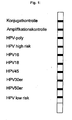
- FIG. 1 Figure 14 shows an example of a possible construction of a test strip according to the present invention with corresponding gene probes on which the processed samples can be applied so that they interact with sequences of the gene probes.
- both the described PCR system 1 and the PCR system 2 can be used.
- the PCR system 1 is described by way of example.
- the explanations are to be transferred to its oligonucleotide probes.
- a total of 9 test areas also referred to as reaction zones, are defined and capable of development.
- a conjugate control documents the efficiency of conjugate binding. It must be appropriate always be developed.
- An amplification control must always be developed. It has a probe for a so-called "housekeeping" gene, which can be found in every human DNA sample. In the present case, the housekeeping gene is glyceraldehyde phosphate dehydrogenase (GAPDH).
- GPDH glyceraldehyde phosphate dehydrogenase
- the reaction zone serves as a control of DNA isolation, DNA amplification and hybridization. If these reaction zones are not developed, there is a false negative reaction. In this case, the test must be repeated.
- HPV-poly all oligo 1 to 24 are applied for all HPV of the PCR system 1 to be detected.
- This reaction zone is designed when the DNA of one or more of the listed HPV genotypes is contained in the sample material.
- HPV high risk contains all oligo 1 1 to 17.
- a positive reaction means that the sample being tested has one or more HPV of the high-risk types HPV16, 18, 31, 33, 35, 39, 45, 51, 52, 53, 56 , 58, 59, 66, 68, 73, 82.
- HPV 16 contains oligo 1
- HPV 18 contains oligo 2
- HPV 45 contains oligo 3.
- HPV 30 contains all oligo 4 to 7 and allows the detection of strains of high-risk types HPV31, 33, 35 and 39.
- HPV 50 contains all oligo 8 to 13. This reaction zone can indicate if the high-risk types 51, 52, 53 , 56 58 or 59 are present.
- HPV low risk contains all oligo 18 to 24 and stands for the low risk types HPV6, 11, 40, 42, 43 and 44. This pattern can be used in combination with other bands on the test strip to optionally detect further pathogens. Optionally, the use of shortened test strips, which lack certain reaction zones, may be useful.
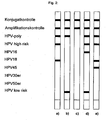
- Fig. 2 shows possible test results for test strips Fig. 1 , In Fig. 2a ), a possible result is shown in which there is an infection with high-risk HPV types. HPV18 could be detected.
- Fig. 2b shows a possible positive test result in the reaction zone HPV-poly in a simultaneous positive reaction with low-risk HPV types. Such a test result would indicate a low risk of cervical carcinoma or its development.
- Fig. 2c shows a negative test result. There are no detectable HPV genotypes.
- Fig. 2d shows a possible test result in concomitant high-risk HPV and low-risk HPV infection.
- Fig. 1 shows possible test results for test strips Fig. 1 , In Fig. 2a ), a possible result is shown in which there is an infection with high-risk HPV types. HPV18 could be detected.
- Fig. 2b shows a possible positive test result in the reaction zone HPV-poly in a simultaneous positive reaction with low-risk HPV types.
Landscapes
- Chemical & Material Sciences (AREA)
- Life Sciences & Earth Sciences (AREA)
- Health & Medical Sciences (AREA)
- Organic Chemistry (AREA)
- Zoology (AREA)
- Engineering & Computer Science (AREA)
- Immunology (AREA)
- Wood Science & Technology (AREA)
- Proteomics, Peptides & Aminoacids (AREA)
- Virology (AREA)
- Biotechnology (AREA)
- Microbiology (AREA)
- Molecular Biology (AREA)
- Physics & Mathematics (AREA)
- Biophysics (AREA)
- Analytical Chemistry (AREA)
- Biochemistry (AREA)
- Bioinformatics & Cheminformatics (AREA)
- General Engineering & Computer Science (AREA)
- General Health & Medical Sciences (AREA)
- Genetics & Genomics (AREA)
- Measuring Or Testing Involving Enzymes Or Micro-Organisms (AREA)
Claims (10)
- Système PCR, comprenant un ensemble d'amorces constitué d'une amorce directe ayant la séquence nucléotidique SEQ ID N° 57 et d'une amorce inverse ayant la séquence nucléotidique SEQ ID N° 58, un ensemble d'amorces constitué d'une amorce directe ayant la séquence nucléotidique SEQ ID N° 59 et d'une amorce inverse ayant la séquence nucléotidique SEQ ID N° 60, un ensemble d'amorces constitué d'une amorce directe ayant la séquence nucléotidique SEQ ID N° 61 et d'une amorce inverse ayant la séquence nucléotidique SEQ ID N° 62, et un ensemble d'amorces constitué d'une amorce directe ayant la séquence nucléotidique SEQ ID N° 63 et d'une amorce inverse ayant la séquence nucléotidique SEQ ID N° 64.
- Système PCR selon la revendication 1, caractérisé en ce que les amorces sont marquées, notamment par de la biotine.
- Système PCR selon la revendication 1 ou 2 pour utilisation lors de la détection de papillomavirus humains (HPV), en particulier pour permettre une discrimination entre les types à haut risque et les types à faible risque de papillomavirus humains (HPV).
- Système PCR selon la revendication 1 ou 2 pour utilisation lors de la détection précoce de maladies cancéreuses, en particulier des précancéroses de ces dernières, notamment du cancer du col de l'utérus.
- Procédé pour le diagnostic d'infections à papillomavirus humains (HPV), qui comprend les étapes suivantes :- détection de l'ADNcaractérisé en ce que la détection de l'ADN est effectuée sur des domaines spécifiques de l'ADN du HPV par utilisation de sondes oligonucléotidiques ayant au moins l'une des séquences nucléotidiques SEQ ID N° 25 à 48, et d'un système PCR selon l'une des revendications 1 à 4.a) par contrôle de la qualité d'échantillons,b) par un essai portant sur le HPV à faible risque,c) par un essai portant sur le HPV à haut risque,
- Procédé selon la revendication 5, caractérisé en ce que les amorces sont utilisées par groupes, de préférence par groupes pour des domaines communs et/ou pour des domaines voisins de l'ADN, en particulier l'ADN du HPV.
- Procédé selon la revendication 5 ou 6, caractérisé en ce qu'on utilise la PCR ou des méthodes analogues à une PCR en tant que procédés d'amplification.
- Procédé selon l'une des revendications 5 à 7, caractérisé en ce que les sondes oligonucléotidiques sont utilisées dans le cadre d'une hybridation inverse.
- Trousse pour le diagnostic d'infections à HPV, en particulier pour la mise en oeuvre d'un procédé selon l'une des revendications 5 à 8, comprenant au moins un récipient, qui comporte au moins une sonde oligonucléotidique ayant au moins l'une des séquences nucléotidiques SEQ ID N° 25 à 48, et un système PCR selon l'une des revendications 1 à 4, en tant que moyen de détection de HPV à faible risque et/ou en tant que moyen de détection de HPV à haut risque.
- Trousse selon la revendication 9, caractérisée en outre en ce que la ou les sondes oligonucléotidiques sont immobilisées sur un support, en particulier une bandelette d'essai.
Priority Applications (1)
| Application Number | Priority Date | Filing Date | Title |
|---|---|---|---|
| CY20121100682T CY1113242T1 (el) | 2006-08-28 | 2012-08-01 | Μεθοδος και μεσα για ανιχνευση ανθρωπινων ιων θηλωματος |
Applications Claiming Priority (1)
| Application Number | Priority Date | Filing Date | Title |
|---|---|---|---|
| DE102006041970A DE102006041970A1 (de) | 2006-08-28 | 2006-08-28 | Verfahren und Mittel zum Nachweis von humanen Papillomaviren |
Publications (3)
| Publication Number | Publication Date |
|---|---|
| EP1895018A2 EP1895018A2 (fr) | 2008-03-05 |
| EP1895018A3 EP1895018A3 (fr) | 2008-04-30 |
| EP1895018B1 true EP1895018B1 (fr) | 2012-05-02 |
Family
ID=38698720
Family Applications (1)
| Application Number | Title | Priority Date | Filing Date |
|---|---|---|---|
| EP07016602A Active EP1895018B1 (fr) | 2006-08-28 | 2007-08-24 | Procédé et moyen de mise en évidence de papillomavirus humains |
Country Status (5)
| Country | Link |
|---|---|
| EP (1) | EP1895018B1 (fr) |
| AT (1) | ATE556150T1 (fr) |
| CY (1) | CY1113242T1 (fr) |
| DE (1) | DE102006041970A1 (fr) |
| ES (1) | ES2384987T3 (fr) |
Families Citing this family (2)
| Publication number | Priority date | Publication date | Assignee | Title |
|---|---|---|---|---|
| CN105385784A (zh) * | 2008-10-31 | 2016-03-09 | 特罗瓦基因公司 | 用于检测人乳头瘤病毒的遗传标记 |
| WO2016141066A1 (fr) * | 2015-03-03 | 2016-09-09 | University Of Miami | Kits et méthodes de détection de pathogènes |
Family Cites Families (10)
| Publication number | Priority date | Publication date | Assignee | Title |
|---|---|---|---|---|
| FR2629458B2 (fr) * | 1987-07-31 | 1991-08-09 | Ire Celltarg Sa | Nouvelles sondes d'acides nucleiques specifiques de differents types de virus de papillome humain |
| US5863717A (en) * | 1989-11-03 | 1999-01-26 | Abbott Laboratories | Use of conserved oligonucleotide primers to amplify human papillomavirus DNA sequences |
| US6458940B2 (en) * | 1995-06-06 | 2002-10-01 | Hybridon, Inc. | HPV-specific oligonucleotides |
| GB9806666D0 (en) * | 1998-03-27 | 1998-05-27 | Stanley Margaret | Antigen preparation and use |
| SE515668C2 (sv) * | 1999-02-22 | 2001-09-17 | Quantovir Ab | Metod och kit för tidig förutsägelse av cancer |
| US20060057561A1 (en) * | 2001-06-14 | 2006-03-16 | Hart Keith W | Virus detection method, primers therefor and screening kit |
| ES2276948T3 (es) * | 2001-08-23 | 2007-07-01 | MERCK & CO., INC. | Ensayos pcr de hp multiplex fluorescente que usan fluoforos multiples. |
| EP1302550A1 (fr) * | 2001-10-10 | 2003-04-16 | King Car Food Industrial Co., Ltd. | Procédé et détecteur pour la détection de virus de type de HPV |
| DE10357677A1 (de) * | 2003-12-10 | 2005-07-14 | Greiner Bio-One Gmbh | Primer und Sonden zum Nachweis genitaler HPV-Genotypen |
| US20060205040A1 (en) * | 2005-03-03 | 2006-09-14 | Rangarajan Sampath | Compositions for use in identification of adventitious viruses |
-
2006
- 2006-08-28 DE DE102006041970A patent/DE102006041970A1/de not_active Withdrawn
-
2007
- 2007-08-24 AT AT07016602T patent/ATE556150T1/de active
- 2007-08-24 EP EP07016602A patent/EP1895018B1/fr active Active
- 2007-08-24 ES ES07016602T patent/ES2384987T3/es active Active
-
2012
- 2012-08-01 CY CY20121100682T patent/CY1113242T1/el unknown
Also Published As
| Publication number | Publication date |
|---|---|
| EP1895018A3 (fr) | 2008-04-30 |
| EP1895018A2 (fr) | 2008-03-05 |
| DE102006041970A1 (de) | 2008-03-06 |
| ES2384987T3 (es) | 2012-07-16 |
| ATE556150T1 (de) | 2012-05-15 |
| CY1113242T1 (el) | 2016-04-13 |
Similar Documents
| Publication | Publication Date | Title |
|---|---|---|
| DE69126027T2 (de) | Verfahren zur diagnose des menschlichen papillome-viruses typ-16 durch "polymerase chain reaction" | |
| DE69119408T2 (de) | Primeren und verfahren zur entdeckung des papillomaviruses durch die polymerasekettenreaktion | |
| DE68926507T2 (de) | Nachweis des humanen papillomavirus unter verwendung der polymerase-kettenreaktion | |
| DE3853678T2 (de) | Verfahren zum nachweis des karzinogenen menschlichen papillomavirus. | |
| DE69015261T2 (de) | Verfahren zum Nachweis des humanen Papillomvirus. | |
| DE69830927T2 (de) | Bewertung von humaner papillomvirus verwandter krankheit | |
| DE69527776T2 (de) | Nachweis humaner papillomviren mit nukleinsäüre amplifikation die generelle primer verwendet | |
| DE69737628T2 (de) | Nukleinsäureprimer und -sonden zur detektion onkogener humaner papillomaviren | |
| DE112013004650T5 (de) | Multiplexpyrosequenzierung unter Verwendung nichtinterferierender, rauschbeendender Polynukleotididentifikationstags | |
| DE60308017T2 (de) | Amplifizierungs-hybridisierungsverfahren zum nachweis und zur typisierung des mes menschlichen papillomavirus | |
| DE69032080T2 (de) | Verwendung von konservierten Oligonukleotid-Primern zur Amplifizierung von menschlichen Papillomavirus-DNS-Sequenzen | |
| DE69933121T2 (de) | Methode, reagent und testsatz zur typisierung des genoms von papillomavirus | |
| DE69226775T2 (de) | Dns-sequenzen von hpv42 papillomavirus :verwendungsmöglichkeit für diagnose | |
| EP1895018B1 (fr) | Procédé et moyen de mise en évidence de papillomavirus humains | |
| EP1694870B1 (fr) | Amorces et sondes pour detecter des genotypes du papillomavirus humain genital | |
| EP1124993A2 (fr) | Nouvelles amorces et sondes destinees a la detection du vih | |
| EP1272675B1 (fr) | Detection de papillomavirus humains | |
| DE60025336T2 (de) | Verfahren und kit zur früherkennung von krebs | |
| WO2016124177A1 (fr) | Procédé et kit de détermination du risque de développer un carcinome du col de l'utérus ou un de ses précurseurs malins | |
| WO2008089519A1 (fr) | Procédé de criblage de papillomavirus humain | |
| DE69314469T2 (de) | An einem festen Träger reversibel gebundene getrocknete Nucleinsäurehybridisierungsprobe, eine solche Probe verwendendes Verfahren und dafür geeigneter Kit | |
| EP0839917A1 (fr) | Amorces et sondes pour la détection de HIV | |
| DE19903056B4 (de) | HPV-Assay | |
| DE19937234C2 (de) | Borna Disease Virus (BDV)- spezifische Nukleinsäuresequenzen - ihre Anwendung in Diagnostik und Therapie | |
| DE102004022350A1 (de) | Diagnose von Infektionserkrankungen |
Legal Events
| Date | Code | Title | Description |
|---|---|---|---|
| PUAI | Public reference made under article 153(3) epc to a published international application that has entered the european phase |
Free format text: ORIGINAL CODE: 0009012 |
|
| AK | Designated contracting states |
Kind code of ref document: A2 Designated state(s): AT BE BG CH CY CZ DE DK EE ES FI FR GB GR HU IE IS IT LI LT LU LV MC MT NL PL PT RO SE SI SK TR |
|
| AX | Request for extension of the european patent |
Extension state: AL BA HR MK YU |
|
| PUAL | Search report despatched |
Free format text: ORIGINAL CODE: 0009013 |
|
| AK | Designated contracting states |
Kind code of ref document: A3 Designated state(s): AT BE BG CH CY CZ DE DK EE ES FI FR GB GR HU IE IS IT LI LT LU LV MC MT NL PL PT RO SE SI SK TR |
|
| AX | Request for extension of the european patent |
Extension state: AL BA HR MK RS |
|
| 17P | Request for examination filed |
Effective date: 20081015 |
|
| 17Q | First examination report despatched |
Effective date: 20081113 |
|
| AKX | Designation fees paid |
Designated state(s): AT BE BG CH CY CZ DE DK EE ES FI FR GB GR HU IE IS IT LI LT LU LV MC MT NL PL PT RO SE SI SK TR |
|
| GRAP | Despatch of communication of intention to grant a patent |
Free format text: ORIGINAL CODE: EPIDOSNIGR1 |
|
| GRAS | Grant fee paid |
Free format text: ORIGINAL CODE: EPIDOSNIGR3 |
|
| GRAA | (expected) grant |
Free format text: ORIGINAL CODE: 0009210 |
|
| AK | Designated contracting states |
Kind code of ref document: B1 Designated state(s): AT BE BG CH CY CZ DE DK EE ES FI FR GB GR HU IE IS IT LI LT LU LV MC MT NL PL PT RO SE SI SK TR |
|
| REG | Reference to a national code |
Ref country code: GB Ref legal event code: FG4D Free format text: NOT ENGLISH |
|
| REG | Reference to a national code |
Ref country code: AT Ref legal event code: REF Ref document number: 556150 Country of ref document: AT Kind code of ref document: T Effective date: 20120515 Ref country code: CH Ref legal event code: EP |
|
| REG | Reference to a national code |
Ref country code: IE Ref legal event code: FG4D Free format text: LANGUAGE OF EP DOCUMENT: GERMAN |
|
| REG | Reference to a national code |
Ref country code: DE Ref legal event code: R096 Ref document number: 502007009801 Country of ref document: DE Effective date: 20120621 |
|
| REG | Reference to a national code |
Ref country code: NL Ref legal event code: T3 |
|
| REG | Reference to a national code |
Ref country code: ES Ref legal event code: FG2A Ref document number: 2384987 Country of ref document: ES Kind code of ref document: T3 Effective date: 20120716 |
|
| REG | Reference to a national code |
Ref country code: LT Ref legal event code: MG4D Effective date: 20120502 |
|
| PG25 | Lapsed in a contracting state [announced via postgrant information from national office to epo] |
Ref country code: FI Free format text: LAPSE BECAUSE OF FAILURE TO SUBMIT A TRANSLATION OF THE DESCRIPTION OR TO PAY THE FEE WITHIN THE PRESCRIBED TIME-LIMIT Effective date: 20120502 Ref country code: PL Free format text: LAPSE BECAUSE OF FAILURE TO SUBMIT A TRANSLATION OF THE DESCRIPTION OR TO PAY THE FEE WITHIN THE PRESCRIBED TIME-LIMIT Effective date: 20120502 Ref country code: LT Free format text: LAPSE BECAUSE OF FAILURE TO SUBMIT A TRANSLATION OF THE DESCRIPTION OR TO PAY THE FEE WITHIN THE PRESCRIBED TIME-LIMIT Effective date: 20120502 Ref country code: IS Free format text: LAPSE BECAUSE OF FAILURE TO SUBMIT A TRANSLATION OF THE DESCRIPTION OR TO PAY THE FEE WITHIN THE PRESCRIBED TIME-LIMIT Effective date: 20120902 Ref country code: SE Free format text: LAPSE BECAUSE OF FAILURE TO SUBMIT A TRANSLATION OF THE DESCRIPTION OR TO PAY THE FEE WITHIN THE PRESCRIBED TIME-LIMIT Effective date: 20120502 |
|
| PG25 | Lapsed in a contracting state [announced via postgrant information from national office to epo] |
Ref country code: PT Free format text: LAPSE BECAUSE OF FAILURE TO SUBMIT A TRANSLATION OF THE DESCRIPTION OR TO PAY THE FEE WITHIN THE PRESCRIBED TIME-LIMIT Effective date: 20120903 Ref country code: LV Free format text: LAPSE BECAUSE OF FAILURE TO SUBMIT A TRANSLATION OF THE DESCRIPTION OR TO PAY THE FEE WITHIN THE PRESCRIBED TIME-LIMIT Effective date: 20120502 Ref country code: GR Free format text: LAPSE BECAUSE OF FAILURE TO SUBMIT A TRANSLATION OF THE DESCRIPTION OR TO PAY THE FEE WITHIN THE PRESCRIBED TIME-LIMIT Effective date: 20120803 Ref country code: SI Free format text: LAPSE BECAUSE OF FAILURE TO SUBMIT A TRANSLATION OF THE DESCRIPTION OR TO PAY THE FEE WITHIN THE PRESCRIBED TIME-LIMIT Effective date: 20120502 |
|
| PG25 | Lapsed in a contracting state [announced via postgrant information from national office to epo] |
Ref country code: SK Free format text: LAPSE BECAUSE OF FAILURE TO SUBMIT A TRANSLATION OF THE DESCRIPTION OR TO PAY THE FEE WITHIN THE PRESCRIBED TIME-LIMIT Effective date: 20120502 Ref country code: RO Free format text: LAPSE BECAUSE OF FAILURE TO SUBMIT A TRANSLATION OF THE DESCRIPTION OR TO PAY THE FEE WITHIN THE PRESCRIBED TIME-LIMIT Effective date: 20120502 Ref country code: DK Free format text: LAPSE BECAUSE OF FAILURE TO SUBMIT A TRANSLATION OF THE DESCRIPTION OR TO PAY THE FEE WITHIN THE PRESCRIBED TIME-LIMIT Effective date: 20120502 Ref country code: EE Free format text: LAPSE BECAUSE OF FAILURE TO SUBMIT A TRANSLATION OF THE DESCRIPTION OR TO PAY THE FEE WITHIN THE PRESCRIBED TIME-LIMIT Effective date: 20120502 |
|
| BERE | Be: lapsed |
Owner name: GENOME IDENTIFICATION DIAGNOSTICS G.M.B.H. Effective date: 20120831 |
|
| PLBE | No opposition filed within time limit |
Free format text: ORIGINAL CODE: 0009261 |
|
| STAA | Information on the status of an ep patent application or granted ep patent |
Free format text: STATUS: NO OPPOSITION FILED WITHIN TIME LIMIT |
|
| REG | Reference to a national code |
Ref country code: CH Ref legal event code: PL |
|
| PG25 | Lapsed in a contracting state [announced via postgrant information from national office to epo] |
Ref country code: MC Free format text: LAPSE BECAUSE OF NON-PAYMENT OF DUE FEES Effective date: 20120831 |
|
| 26N | No opposition filed |
Effective date: 20130205 |
|
| PG25 | Lapsed in a contracting state [announced via postgrant information from national office to epo] |
Ref country code: CH Free format text: LAPSE BECAUSE OF NON-PAYMENT OF DUE FEES Effective date: 20120831 Ref country code: LI Free format text: LAPSE BECAUSE OF NON-PAYMENT OF DUE FEES Effective date: 20120831 |
|
| REG | Reference to a national code |
Ref country code: IE Ref legal event code: MM4A |
|
| REG | Reference to a national code |
Ref country code: DE Ref legal event code: R097 Ref document number: 502007009801 Country of ref document: DE Effective date: 20130205 |
|
| PG25 | Lapsed in a contracting state [announced via postgrant information from national office to epo] |
Ref country code: BE Free format text: LAPSE BECAUSE OF NON-PAYMENT OF DUE FEES Effective date: 20120831 |
|
| PG25 | Lapsed in a contracting state [announced via postgrant information from national office to epo] |
Ref country code: BG Free format text: LAPSE BECAUSE OF FAILURE TO SUBMIT A TRANSLATION OF THE DESCRIPTION OR TO PAY THE FEE WITHIN THE PRESCRIBED TIME-LIMIT Effective date: 20120802 Ref country code: IE Free format text: LAPSE BECAUSE OF NON-PAYMENT OF DUE FEES Effective date: 20120824 |
|
| REG | Reference to a national code |
Ref country code: AT Ref legal event code: MM01 Ref document number: 556150 Country of ref document: AT Kind code of ref document: T Effective date: 20120831 |
|
| PG25 | Lapsed in a contracting state [announced via postgrant information from national office to epo] |
Ref country code: AT Free format text: LAPSE BECAUSE OF NON-PAYMENT OF DUE FEES Effective date: 20120831 |
|
| PG25 | Lapsed in a contracting state [announced via postgrant information from national office to epo] |
Ref country code: MT Free format text: LAPSE BECAUSE OF FAILURE TO SUBMIT A TRANSLATION OF THE DESCRIPTION OR TO PAY THE FEE WITHIN THE PRESCRIBED TIME-LIMIT Effective date: 20120502 |
|
| PG25 | Lapsed in a contracting state [announced via postgrant information from national office to epo] |
Ref country code: LU Free format text: LAPSE BECAUSE OF NON-PAYMENT OF DUE FEES Effective date: 20120824 |
|
| PG25 | Lapsed in a contracting state [announced via postgrant information from national office to epo] |
Ref country code: HU Free format text: LAPSE BECAUSE OF FAILURE TO SUBMIT A TRANSLATION OF THE DESCRIPTION OR TO PAY THE FEE WITHIN THE PRESCRIBED TIME-LIMIT Effective date: 20070824 |
|
| REG | Reference to a national code |
Ref country code: FR Ref legal event code: PLFP Year of fee payment: 10 |
|
| REG | Reference to a national code |
Ref country code: FR Ref legal event code: PLFP Year of fee payment: 11 |
|
| REG | Reference to a national code |
Ref country code: FR Ref legal event code: PLFP Year of fee payment: 12 |
|
| P01 | Opt-out of the competence of the unified patent court (upc) registered |
Effective date: 20230523 |
|
| PGFP | Annual fee paid to national office [announced via postgrant information from national office to epo] |
Ref country code: CY Payment date: 20240813 Year of fee payment: 18 |
|
| PGFP | Annual fee paid to national office [announced via postgrant information from national office to epo] |
Ref country code: NL Payment date: 20250821 Year of fee payment: 19 |
|
| PGFP | Annual fee paid to national office [announced via postgrant information from national office to epo] |
Ref country code: ES Payment date: 20250917 Year of fee payment: 19 |
|
| PGFP | Annual fee paid to national office [announced via postgrant information from national office to epo] |
Ref country code: DE Payment date: 20250819 Year of fee payment: 19 |
|
| PGFP | Annual fee paid to national office [announced via postgrant information from national office to epo] |
Ref country code: TR Payment date: 20250814 Year of fee payment: 19 Ref country code: IT Payment date: 20250829 Year of fee payment: 19 |
|
| PGFP | Annual fee paid to national office [announced via postgrant information from national office to epo] |
Ref country code: GB Payment date: 20250822 Year of fee payment: 19 |
|
| PGFP | Annual fee paid to national office [announced via postgrant information from national office to epo] |
Ref country code: FR Payment date: 20250821 Year of fee payment: 19 |
|
| PGFP | Annual fee paid to national office [announced via postgrant information from national office to epo] |
Ref country code: CZ Payment date: 20250808 Year of fee payment: 19 |
|
| PG25 | Lapsed in a contracting state [announced via postgrant information from national office to epo] |
Ref country code: CY Free format text: LAPSE BECAUSE OF NON-PAYMENT OF DUE FEES Effective date: 20250824 |