EP1897915A1 - Colorant a base de cyanine et support d enregistrement optique - Google Patents
Colorant a base de cyanine et support d enregistrement optique Download PDFInfo
- Publication number
- EP1897915A1 EP1897915A1 EP06746658A EP06746658A EP1897915A1 EP 1897915 A1 EP1897915 A1 EP 1897915A1 EP 06746658 A EP06746658 A EP 06746658A EP 06746658 A EP06746658 A EP 06746658A EP 1897915 A1 EP1897915 A1 EP 1897915A1
- Authority
- EP
- European Patent Office
- Prior art keywords
- recording
- groups
- light
- optical recording
- cyanine dyes
- Prior art date
- Legal status (The legal status is an assumption and is not a legal conclusion. Google has not performed a legal analysis and makes no representation as to the accuracy of the status listed.)
- Withdrawn
Links
- 0 CCN(C([C@@](C(C)=C1C#N)N=Nc(cc(cc2)[N+]([O-])=O)c2O2)O*2(OC2C=C3)OC(N(CC)C(C(C#N)=C4C)=O)=C4/N=N/[C@@]2C=C3[N+]([O-])=O)C1=O Chemical compound CCN(C([C@@](C(C)=C1C#N)N=Nc(cc(cc2)[N+]([O-])=O)c2O2)O*2(OC2C=C3)OC(N(CC)C(C(C#N)=C4C)=O)=C4/N=N/[C@@]2C=C3[N+]([O-])=O)C1=O 0.000 description 2
- XUIPQHFJUXDFSH-RVVMKHKSSA-J CC(C(/N=N/c(cc(cc1)[N+]([O-])=O)c1O1)=C(N(C)C2=O)O[Cu]11OC(N(C)C(C(C#N)=C3C)=O)=C3/N=N/c(cc(cc3)[N+]([O-])=O)c3O1)=C2C#N Chemical compound CC(C(/N=N/c(cc(cc1)[N+]([O-])=O)c1O1)=C(N(C)C2=O)O[Cu]11OC(N(C)C(C(C#N)=C3C)=O)=C3/N=N/c(cc(cc3)[N+]([O-])=O)c3O1)=C2C#N XUIPQHFJUXDFSH-RVVMKHKSSA-J 0.000 description 1
- YZNNPVFFTBULEW-TURZUDJPSA-N CC1(C)c(cccc2)c2N(C)/C1=C/C1=CN(C)c2ccccc2C1(C)Cc1ccccc1 Chemical compound CC1(C)c(cccc2)c2N(C)/C1=C/C1=CN(C)c2ccccc2C1(C)Cc1ccccc1 YZNNPVFFTBULEW-TURZUDJPSA-N 0.000 description 1
- OMDNSFDCHVRKLJ-UHFFFAOYSA-N CC1(C)c(cccc2)c2N(C)/C1=C/C1=[N+](C)c2ccccc2C1(C)Cc1ccc[s]1 Chemical compound CC1(C)c(cccc2)c2N(C)/C1=C/C1=[N+](C)c2ccccc2C1(C)Cc1ccc[s]1 OMDNSFDCHVRKLJ-UHFFFAOYSA-N 0.000 description 1
- AUNGREAGWNDWHB-LNAFRUEWSA-N CCN(CC)c(cc1)cc2c1/N=N/c(cc(cc1)[N+]([O-])=O)c1OOOc(cc(cc1)N(CC)CC)c1/N=N\c1cc([N+]([O-])=O)ccc1O[CH-]O2 Chemical compound CCN(CC)c(cc1)cc2c1/N=N/c(cc(cc1)[N+]([O-])=O)c1OOOc(cc(cc1)N(CC)CC)c1/N=N\c1cc([N+]([O-])=O)ccc1O[CH-]O2 AUNGREAGWNDWHB-LNAFRUEWSA-N 0.000 description 1
Images
Classifications
-
- G—PHYSICS
- G11—INFORMATION STORAGE
- G11B—INFORMATION STORAGE BASED ON RELATIVE MOVEMENT BETWEEN RECORD CARRIER AND TRANSDUCER
- G11B7/00—Recording or reproducing by optical means, e.g. recording using a thermal beam of optical radiation by modifying optical properties or the physical structure, reproducing using an optical beam at lower power by sensing optical properties; Record carriers therefor
- G11B7/24—Record carriers characterised by shape, structure or physical properties, or by the selection of the material
- G11B7/241—Record carriers characterised by shape, structure or physical properties, or by the selection of the material characterised by the selection of the material
- G11B7/242—Record carriers characterised by shape, structure or physical properties, or by the selection of the material characterised by the selection of the material of recording layers
- G11B7/244—Record carriers characterised by shape, structure or physical properties, or by the selection of the material characterised by the selection of the material of recording layers comprising organic materials only
- G11B7/246—Record carriers characterised by shape, structure or physical properties, or by the selection of the material characterised by the selection of the material of recording layers comprising organic materials only containing dyes
- G11B7/247—Record carriers characterised by shape, structure or physical properties, or by the selection of the material characterised by the selection of the material of recording layers comprising organic materials only containing dyes methine or polymethine dyes
- G11B7/2472—Record carriers characterised by shape, structure or physical properties, or by the selection of the material characterised by the selection of the material of recording layers comprising organic materials only containing dyes methine or polymethine dyes cyanine
-
- C—CHEMISTRY; METALLURGY
- C07—ORGANIC CHEMISTRY
- C07D—HETEROCYCLIC COMPOUNDS
- C07D209/00—Heterocyclic compounds containing five-membered rings, condensed with other rings, with one nitrogen atom as the only ring hetero atom
- C07D209/02—Heterocyclic compounds containing five-membered rings, condensed with other rings, with one nitrogen atom as the only ring hetero atom condensed with one carbocyclic ring
- C07D209/04—Indoles; Hydrogenated indoles
- C07D209/10—Indoles; Hydrogenated indoles with substituted hydrocarbon radicals attached to carbon atoms of the hetero ring
- C07D209/14—Radicals substituted by nitrogen atoms, not forming part of a nitro radical
-
- C—CHEMISTRY; METALLURGY
- C09—DYES; PAINTS; POLISHES; NATURAL RESINS; ADHESIVES; COMPOSITIONS NOT OTHERWISE PROVIDED FOR; APPLICATIONS OF MATERIALS NOT OTHERWISE PROVIDED FOR
- C09B—ORGANIC DYES OR CLOSELY-RELATED COMPOUNDS FOR PRODUCING DYES, e.g. PIGMENTS; MORDANTS; LAKES
- C09B23/00—Methine or polymethine dyes, e.g. cyanine dyes
- C09B23/02—Methine or polymethine dyes, e.g. cyanine dyes the polymethine chain containing an odd number of >CH- or >C[alkyl]- groups
- C09B23/04—Methine or polymethine dyes, e.g. cyanine dyes the polymethine chain containing an odd number of >CH- or >C[alkyl]- groups one >CH- group, e.g. cyanines, isocyanines, pseudocyanines
-
- C—CHEMISTRY; METALLURGY
- C09—DYES; PAINTS; POLISHES; NATURAL RESINS; ADHESIVES; COMPOSITIONS NOT OTHERWISE PROVIDED FOR; APPLICATIONS OF MATERIALS NOT OTHERWISE PROVIDED FOR
- C09B—ORGANIC DYES OR CLOSELY-RELATED COMPOUNDS FOR PRODUCING DYES, e.g. PIGMENTS; MORDANTS; LAKES
- C09B69/00—Dyes not provided for by a single group of this subclass
- C09B69/02—Dyestuff salts, e.g. salts of acid dyes with basic dyes
- C09B69/04—Dyestuff salts, e.g. salts of acid dyes with basic dyes of anionic dyes with nitrogen containing compounds
- C09B69/045—Dyestuff salts, e.g. salts of acid dyes with basic dyes of anionic dyes with nitrogen containing compounds of anionic azo dyes
-
- G—PHYSICS
- G11—INFORMATION STORAGE
- G11B—INFORMATION STORAGE BASED ON RELATIVE MOVEMENT BETWEEN RECORD CARRIER AND TRANSDUCER
- G11B7/00—Recording or reproducing by optical means, e.g. recording using a thermal beam of optical radiation by modifying optical properties or the physical structure, reproducing using an optical beam at lower power by sensing optical properties; Record carriers therefor
- G11B7/24—Record carriers characterised by shape, structure or physical properties, or by the selection of the material
- G11B7/241—Record carriers characterised by shape, structure or physical properties, or by the selection of the material characterised by the selection of the material
- G11B7/242—Record carriers characterised by shape, structure or physical properties, or by the selection of the material characterised by the selection of the material of recording layers
- G11B7/244—Record carriers characterised by shape, structure or physical properties, or by the selection of the material characterised by the selection of the material of recording layers comprising organic materials only
- G11B7/246—Record carriers characterised by shape, structure or physical properties, or by the selection of the material characterised by the selection of the material of recording layers comprising organic materials only containing dyes
- G11B7/2463—Record carriers characterised by shape, structure or physical properties, or by the selection of the material characterised by the selection of the material of recording layers comprising organic materials only containing dyes azulene
-
- G—PHYSICS
- G11—INFORMATION STORAGE
- G11B—INFORMATION STORAGE BASED ON RELATIVE MOVEMENT BETWEEN RECORD CARRIER AND TRANSDUCER
- G11B7/00—Recording or reproducing by optical means, e.g. recording using a thermal beam of optical radiation by modifying optical properties or the physical structure, reproducing using an optical beam at lower power by sensing optical properties; Record carriers therefor
- G11B7/24—Record carriers characterised by shape, structure or physical properties, or by the selection of the material
- G11B7/241—Record carriers characterised by shape, structure or physical properties, or by the selection of the material characterised by the selection of the material
- G11B7/242—Record carriers characterised by shape, structure or physical properties, or by the selection of the material characterised by the selection of the material of recording layers
- G11B7/244—Record carriers characterised by shape, structure or physical properties, or by the selection of the material characterised by the selection of the material of recording layers comprising organic materials only
- G11B7/246—Record carriers characterised by shape, structure or physical properties, or by the selection of the material characterised by the selection of the material of recording layers comprising organic materials only containing dyes
- G11B7/2467—Record carriers characterised by shape, structure or physical properties, or by the selection of the material characterised by the selection of the material of recording layers comprising organic materials only containing dyes azo-dyes
-
- G—PHYSICS
- G11—INFORMATION STORAGE
- G11B—INFORMATION STORAGE BASED ON RELATIVE MOVEMENT BETWEEN RECORD CARRIER AND TRANSDUCER
- G11B7/00—Recording or reproducing by optical means, e.g. recording using a thermal beam of optical radiation by modifying optical properties or the physical structure, reproducing using an optical beam at lower power by sensing optical properties; Record carriers therefor
- G11B7/24—Record carriers characterised by shape, structure or physical properties, or by the selection of the material
- G11B7/241—Record carriers characterised by shape, structure or physical properties, or by the selection of the material characterised by the selection of the material
- G11B7/242—Record carriers characterised by shape, structure or physical properties, or by the selection of the material characterised by the selection of the material of recording layers
- G11B7/244—Record carriers characterised by shape, structure or physical properties, or by the selection of the material characterised by the selection of the material of recording layers comprising organic materials only
- G11B7/249—Record carriers characterised by shape, structure or physical properties, or by the selection of the material characterised by the selection of the material of recording layers comprising organic materials only containing organometallic compounds
- G11B7/2495—Record carriers characterised by shape, structure or physical properties, or by the selection of the material characterised by the selection of the material of recording layers comprising organic materials only containing organometallic compounds as anions
-
- G—PHYSICS
- G11—INFORMATION STORAGE
- G11B—INFORMATION STORAGE BASED ON RELATIVE MOVEMENT BETWEEN RECORD CARRIER AND TRANSDUCER
- G11B7/00—Recording or reproducing by optical means, e.g. recording using a thermal beam of optical radiation by modifying optical properties or the physical structure, reproducing using an optical beam at lower power by sensing optical properties; Record carriers therefor
- G11B7/24—Record carriers characterised by shape, structure or physical properties, or by the selection of the material
- G11B7/241—Record carriers characterised by shape, structure or physical properties, or by the selection of the material characterised by the selection of the material
- G11B7/252—Record carriers characterised by shape, structure or physical properties, or by the selection of the material characterised by the selection of the material of layers other than recording layers
- G11B7/253—Record carriers characterised by shape, structure or physical properties, or by the selection of the material characterised by the selection of the material of layers other than recording layers of substrates
- G11B7/2531—Record carriers characterised by shape, structure or physical properties, or by the selection of the material characterised by the selection of the material of layers other than recording layers of substrates comprising glass
-
- G—PHYSICS
- G11—INFORMATION STORAGE
- G11B—INFORMATION STORAGE BASED ON RELATIVE MOVEMENT BETWEEN RECORD CARRIER AND TRANSDUCER
- G11B7/00—Recording or reproducing by optical means, e.g. recording using a thermal beam of optical radiation by modifying optical properties or the physical structure, reproducing using an optical beam at lower power by sensing optical properties; Record carriers therefor
- G11B7/24—Record carriers characterised by shape, structure or physical properties, or by the selection of the material
- G11B7/241—Record carriers characterised by shape, structure or physical properties, or by the selection of the material characterised by the selection of the material
- G11B7/252—Record carriers characterised by shape, structure or physical properties, or by the selection of the material characterised by the selection of the material of layers other than recording layers
- G11B7/253—Record carriers characterised by shape, structure or physical properties, or by the selection of the material characterised by the selection of the material of layers other than recording layers of substrates
- G11B7/2533—Record carriers characterised by shape, structure or physical properties, or by the selection of the material characterised by the selection of the material of layers other than recording layers of substrates comprising resins
-
- G—PHYSICS
- G11—INFORMATION STORAGE
- G11B—INFORMATION STORAGE BASED ON RELATIVE MOVEMENT BETWEEN RECORD CARRIER AND TRANSDUCER
- G11B7/00—Recording or reproducing by optical means, e.g. recording using a thermal beam of optical radiation by modifying optical properties or the physical structure, reproducing using an optical beam at lower power by sensing optical properties; Record carriers therefor
- G11B7/24—Record carriers characterised by shape, structure or physical properties, or by the selection of the material
- G11B7/241—Record carriers characterised by shape, structure or physical properties, or by the selection of the material characterised by the selection of the material
- G11B7/252—Record carriers characterised by shape, structure or physical properties, or by the selection of the material characterised by the selection of the material of layers other than recording layers
- G11B7/253—Record carriers characterised by shape, structure or physical properties, or by the selection of the material characterised by the selection of the material of layers other than recording layers of substrates
- G11B7/2533—Record carriers characterised by shape, structure or physical properties, or by the selection of the material characterised by the selection of the material of layers other than recording layers of substrates comprising resins
- G11B7/2534—Record carriers characterised by shape, structure or physical properties, or by the selection of the material characterised by the selection of the material of layers other than recording layers of substrates comprising resins polycarbonates [PC]
-
- G—PHYSICS
- G11—INFORMATION STORAGE
- G11B—INFORMATION STORAGE BASED ON RELATIVE MOVEMENT BETWEEN RECORD CARRIER AND TRANSDUCER
- G11B7/00—Recording or reproducing by optical means, e.g. recording using a thermal beam of optical radiation by modifying optical properties or the physical structure, reproducing using an optical beam at lower power by sensing optical properties; Record carriers therefor
- G11B7/24—Record carriers characterised by shape, structure or physical properties, or by the selection of the material
- G11B7/241—Record carriers characterised by shape, structure or physical properties, or by the selection of the material characterised by the selection of the material
- G11B7/252—Record carriers characterised by shape, structure or physical properties, or by the selection of the material characterised by the selection of the material of layers other than recording layers
- G11B7/253—Record carriers characterised by shape, structure or physical properties, or by the selection of the material characterised by the selection of the material of layers other than recording layers of substrates
- G11B7/2533—Record carriers characterised by shape, structure or physical properties, or by the selection of the material characterised by the selection of the material of layers other than recording layers of substrates comprising resins
- G11B7/2536—Record carriers characterised by shape, structure or physical properties, or by the selection of the material characterised by the selection of the material of layers other than recording layers of substrates comprising resins polystyrene [PS]
-
- G—PHYSICS
- G11—INFORMATION STORAGE
- G11B—INFORMATION STORAGE BASED ON RELATIVE MOVEMENT BETWEEN RECORD CARRIER AND TRANSDUCER
- G11B7/00—Recording or reproducing by optical means, e.g. recording using a thermal beam of optical radiation by modifying optical properties or the physical structure, reproducing using an optical beam at lower power by sensing optical properties; Record carriers therefor
- G11B7/24—Record carriers characterised by shape, structure or physical properties, or by the selection of the material
- G11B7/241—Record carriers characterised by shape, structure or physical properties, or by the selection of the material characterised by the selection of the material
- G11B7/252—Record carriers characterised by shape, structure or physical properties, or by the selection of the material characterised by the selection of the material of layers other than recording layers
- G11B7/258—Record carriers characterised by shape, structure or physical properties, or by the selection of the material characterised by the selection of the material of layers other than recording layers of reflective layers
- G11B7/259—Record carriers characterised by shape, structure or physical properties, or by the selection of the material characterised by the selection of the material of layers other than recording layers of reflective layers based on silver
Definitions
- the present invention relates to a novel cyanine dye and uses thereof, more particularly, to a monomethine cyanine dye which absorbs short-wavelength visible light and uses thereof.
- organic compounds having been proposed so far include, for example, anthraquinone-, phthalocyanine-, and cyanine-dyes (see, for example, Japanese Patent Kokai Nos. 116611/89 , 2002-20592 , and 2003-167343 ): Among which, anthraquinone dyes are recognized to be undesirable in light absorption property, and phthalocyanine dyes are deemed to be unfavorable in both light absorption property and solubility in solvents. While cyanine dyes have been deemed to have relatively favorable characteristics of both in light absorption property and solubility, but have troublesome in lightfastness and heat characteristics.
- Organic dyes used in organic dye optical recording media that can record and read information by using blu-ray semiconductor lasers, have maximum absorptions in the regions with shorter wavelengths than the wavelengths used for recording and reading information in conventional CD-Rs and DVD-Rs. Since such compounds have maximum absorptions in the ultraviolet region, they should inevitably have light stability against such ultraviolet rays, etc. Dyes, which have maximum absorptions in the ultraviolet region, generally have smaller molecular weights compared with dyes having maximum absorptions in the visible region, and have a restriction in their molecular designing as a problem.
- dyes such as cyanine, styryl, azo dyes, etc.
- Such deformation recording is not favorable in terms of the quality of recording signals, and therefore a recording system without accompanying a larger deformation has been desired.
- optical recording media with "LOW-TO-HIGH” recording mechanism it may cause a problem of decreasing optical absorbance of dyes in unrecorded regions as they are repeatedly subjected to playback, resulting in an increment of reflection percentages and a reduction of signal amplitudes.
- a preferable high recording sensitivity is 10 mW or lower as an index, determined on recording (1x writing speed) according to the HD DVD-R standard by using a laser beam with a wavelength of 405 nm at a numerical aperture (NA) of 0.65 and a line velocity of 6.61 m/s.
- NA numerical aperture
- Recording sensitivity higher than the above level is more preferable, i.e., 9 mW or lower at 1x writing speed, more preferably, 8 mW or lower, and further preferably, 12 mW or lower at 2x writing speed.
- dyes per se should have a higher recording sensitivity.
- an object of the present invention is to widen the applicable range of organic compounds selectable as light-absorbing materials in the above described fields, particularly, in optical recording media by providing novel organic compounds which absorb short-wavelength visible light, have satisfactory lightfastness and solubility in solvents, and have heat characteristics depending upon application to which the organic compounds are applied.
- cyanine dyes which had been regarded as being poor in lightfastness and heat characteristics, leading to the finding that specific monomethine cyanine dyes, which have metal complexes as anions, indolenine rings at both ends of their monomethine chains, and substituents with cyclic structures that bind to the C-3 positioning at least either of their indolenine rings, have satisfactory lightfastness, efficiently absorb the visible light ranging from the ultraviolet to the blue regions, exhibit satisfactory solubility in organic solvents with no problem in actual use, and have satisfactory heat characteristics.
- cyanine dyes can be advantageously used as novel light-absorbing materials, which absorb short-wavelength visible light for shielding it or utilizing its energy, in a variety of fields that require organic compounds with these properties.
- the present inventors found that the use of the above-identified organic compounds according to the present invention provides optical recording media which have both satisfactory playback light tolerance and sensitivity at high speed recording, and thus they accomplished this invention.
- the following three items can be listed as required properties requisite for blu-ray semiconductor laser recording materials; satisfactory recording properties, sufficient playback light tolerance, and recording sensitivity suitable for high speed recording.
- the present invention it was found that the above three required properties are satisfied at the same time by allocating the desired functions to both cationic and anionic components in an appropriate combination.
- the present invention solves the above object by providing the cyanine dyes represented by General Formula 1.
- the present invention also solves the above object by providing optical recording media containing cyanine dyes represented by General Formula 1.
- R 1 through R 4 are the same or different hydrocarbon groups, and at least one of which either binds to a cyclic group that may optionally have a substituent or form a cyclic structure by binding together with other hydrocarbon group that binds to the same carbon atom.
- R 5 and R 6 are the same or different hydrocarbon groups that may have substituents.
- R 7 through R 9 represent hydrogen atoms or appropriate substituents.
- X - represents an anion of metal complex having, as a central atom, a transition element from the 5 to 12 groups in the periodic law table.
- R 1 through R 4 represent the same or different hydrocarbon groups.
- hydrocarbon groups of R 1 through R 4 are those which have straight or branched hydrocarbon groups having six or lower carbon atoms; aliphatic hydrocarbon groups such as methyl, ethyl, propyl, isopropyl, isopropenyl, 1-propenyl, 2-propenyl, 2-propynyl, butyl, isobutyl, sec -butyl, tert -butyl, 2-butenyl, 1,3-butadienyl, pentyl, isopentyl, neopentyl, tert -pentyl, 1-methyl pentyl, 2-methyl pentyl, and 2-pentene-4-inyl groups; and alicyclic hydrocarbon groups such as cyclopropyl, cyclobutyl, cyclopenthyl
- R 1 through R 4 at least one of which either binds to a saturated or unsaturated cyclic group such as azulene, quinoline, cyclopropane, cyclobutane, cyclopentane, cyclohexane, cyclohexene, naphthalene, thiophene, benzene, piperidine, pyridine, pyrolidine, pyrrole, and furan rings; or binds together with other hydrocarbon group that binds to the C-3 in the same indolenine ring to form, for example, a saturated or unsaturated cyclic structure such as cyclobutane, cyclopentane, cyclohexane, cyclohexene, and cycloheptane rings.
- a saturated or unsaturated cyclic group such as azulene, quinoline, cyclopropane, cyclobutane, cyclopentane, cyclohex
- such cyclic groups may have one or more substituents as long as they do not affect the object of the present invention.
- substituents are aliphatic hydrocarbon groups such as methyl, ethyl, propyl, isopropyl, isopropenyl, 1-propenyl, 2-propenyl, 2-propynyl, butyl, isobutyl, sec -butyl, tert -butyl, 2-butenyl, 1,3-butadienyl, pentyl, isopentyl, neopentyl, tert -pentyl, 1-methyl pentyl, 2-methyl pentyl, and 2-pentene-4-inyl groups; alicyclic hydrocarbon groups such as cyclopropyl, cyclobutyl, cyclopenthyl, cyclohexyl, and cyclohexenyl groups; aromatic
- R 5 and R 6 in General Formula 1 represent the same or different hydrocarbon groups which may have one or more substituents.
- hydrocarbon groups are those which have straight or branched hydrocarbon groups having six or lower carbon atoms; aliphatic hydrocarbon groups such as methyl, ethyl, propyl, isopropyl, isopropenyl, 1-propenyl, 2-propenyl, 2-propynyl, butyl, isobutyl, sec -butyl, tert -butyl, 2-butenyl, 1,3-butadienyl, pentyl, isopentyl, neopentyl, tert -pentyl, 1-methyl pentyl, 2-methyl pentyl, and 2-pentene-4-inyl groups; and alicyclic hydrocarbon groups such as cyclopropyl, cyclobutyl, cyclopenthyl, cyclohexyl, and cyclohexenyl groups;
- R 7 through R 9 in General Formula 1 each independently represent hydrogen atoms or appropriate substituents.
- substituents are aliphatic hydrocarbon groups such as methyl, ethyl, propyl, isopropyl, isopropenyl, 1-propenyl, 2-propenyl.
- X - in General Formula 1 represents an anion of metal complex having, as a central atom, a transition element from the 5 to 12 groups in the periodic law table.
- metal complex examples include transient metal chelates such as of acetylacetonato chelate, azo, salicylaldehyde oxime, diimmonium, dithiol, dipyrromethene, squalirium, thiocatechol chelate, thiobisphenolate chelate, bisdithio- ⁇ -diketone chelate, bis phenylene dithiol, and formazan.
- azo transient metal chelates are preferable in view of lightfastness and solubility in solvents of the cyanine dyes as a whole.
- transient elements in the above-identified metal complexes are vanadium, niobium, tantalum, chromium, molybdenum, tungsten, manganese, technetium, rhenium, iron, ruthenium, osmium, cobalt, rhodium, iridium, nickel, palladium, platinum, copper, silver, gold, zinc, cadmium, and mercury.
- vanadium, manganese, cobalt, and copper are preferable from economical viewpoints and influence on living bodies.
- azo metal complexes are, for example, those represented by General Formulae 2 to 5:
- M represents any of the above-mentioned transient elements from the 5 to 12 groups in the periodic law table.
- R 11 , R 12 , R 14 to R 17 , R 19 to R 22 , R 25 and R 26 in General Formulae 2 to 5 represent the same or different hydrocarbon groups within the same molecule.
- hydrocarbons are those which have straight or branched chains having six or lower carbon atoms; aliphatic hydrocarbon groups such as methyl, ethyl, propyl, isopropyl, isopropenyl, 1-propenyl, 2-propenyl, 2-propynyl, butyl, isobutyl, sec -butyl, tert -butyl, 2-butenyl, 1,3-butadienyl, pentyl, isopentyl, neopentyl, tert -pentyl, 1-methyl pentyl, 2-methyl pentyl, and 2-pentene-4-inyl groups; and alicyclic hydrocarbon groups such as cyclopropyl, cyclobutyl, cyclopenthy
- solubility in solvents of the cyanine dyes of the present invention generally increases as the number of carbon atoms in R 11 , R 12 , R 14 to R 17 , R 19 to R 22 , R 25 and R 26 increases.
- R 10 , R 13 , R 18 , R 23 , R 24 and R 27 in General Formulae 2, 4 and 5 represent hydrogen atoms or the same or different substituents within the same molecule, and respective examples of such substituents include aliphatic hydrocarbon groups such as methyl, ethyl, propyl, isopropyl, isopropenyl, 1-propenyl, 2-propenyl, 2-propynyl, butyl, isobutyl, sec- butyl, tert -butyl, 2-butenyl, 1,3-butadienyl, pentyl, isopentyl, neopentyl, tert -pentyl, 1-methyl pentyl, 2-methyl pentyl, and 2-pentene-4-inyl groups; and alicyclic hydrocarbon groups such as cyclopropyl, cyclobutyl, cyclopenthyl, cyclohexyl, and cyclohexeny
- cyanine dyes of the present invention are, for example, those which are represented by Chemical Formulae 1 to 30. All of these compounds have predominant absorption maxima at wavelengths of over 400 nm when in a solution form, usually, in the violet to the blue regions at wavelengths of around 400 to 500 nm, and have molecular absorption coefficients of 5 x 10 4 or higher, usually, 7 x 10 4 or higher at their absorption maxima, meaning that they efficiently absorb the visible right in the violet to the blue regions.
- the cyanine dyes of the present invention can be obtained, for example, through a step of reacting the compounds, represented by General Formula 6 having R 1 , R 2 , R 5 , R 7 and R 9 which correspond to those in General Formula 1, with the compounds represented by General Formula 7 having R 3 , R 4 , R 6 and R 8 which correspond to those in General Formula 1.
- X - in General Formula 7 includes appropriate anions, for example, inorganic acid ions such as fluoro, chloro, bromo, iodo, fluorine, chloric acid, bromic acid, iodic acid, perchloric acid, periodic acid, phosphoric acid, phosphoric acid hexafluoride, antimony hexafluoride, tin acid hexafluoride, fluoroboric acid, and tetrafluoroborate ions; and organic acid ions such as thiocyanic acid, benzenesulfonic acid, naphthalenesulfonic acid, naphthalenedisulfonic acid, benzenecarboxylic acid, alkylcarboxylic acid, trihaloalkylcarboxylic acid, alkylsulfonic acid, trihaloalkylsulfonic acid, nicotinic acid, and tetracyanoquinodimethane ions.
- the compounds represented by General Formulae 6 and 7 are placed in a reaction vessel in an appropriate amount, respectively, and optionally dissolved in an appropriate solvent, and allowed to react at ambient temperature or higher while heating and stirring in such a manner of heat refluxing.
- hydrocarbon solvents such as pentane, hexane, cyclohexane, petroleum ether, octane, petroleum benzine, isooctane, benzene, toluene, and xylene
- halides such as carbon tetrachloride, chloroform, 1,2-dichloroethane, 1,2-dibromoethane, trichloroethylene, tetrachloroethylene, chlorobenzene, bromobenzene, and ⁇ -dichlorobenzene
- alcohols and phenols such as methanol, ethanol, 2,2,2-trifluoroethanol, 1-propanol, 2-propanol, 1-butanol, 2-butanol, isobutylalcohol, isopentylalcohol, cyclohexanol, ethylene glycol, propylene glycol, 2-methoxyethanol, 2-ethoxyethanol, phenol,
- a larger amount of solvent results in a lesser reaction efficiency, while a lesser amount of solvent results in a more difficulty in homogenous heating and stirring and also results in a more liability to side reactions.
- the reaction completes within 10 hours, usually, within five hours, depending on the types of material compounds and reaction conditions.
- the progress of reaction can be monitored by conventional method, for example, thin layer chromatography, gas chromatography, and high-performance liquid chromatography.
- the cyanine dyes thus obtained are in the form of any of salts with anions of organic or inorganic acids other than the specific anions of metal complexes, they are allowed to react with onium salts of the above metal complexes such as those of ammonium salt, pyridinium salt, and quinolinium salt to exchange the organic or inorganic anions with the desired anions of metal complexes.
- the compounds represented by General Formulae 6 and 7 can be obtained in accordance with the method disclosed in, for example, " KANKO-SHIKISO (Photosynthesizing Dyes)", pp. 24-30, published by Sangyo Tosho Publisher, Tokyo, Japan, edited by Masaaki HAYAMI, October 17, 1997 . In the case that commercialized products thereof are available, they can be used after purification, if necessary.
- the cyanine dyes thus obtained can be used intact in a reaction mixture form depending on use, and prior to use, they are usually subjected to conventional methods for purifying related compounds, such as dissolution, separation, decantation, filtration, extraction, concentration, thin layer chromatography, column chromatography, gas chromatography, high-performance liquid chromatography, distillation, sublimation, and crystallization which may be applied in combination, if necessary.
- purifying related compounds such as dissolution, separation, decantation, filtration, extraction, concentration, thin layer chromatography, column chromatography, gas chromatography, high-performance liquid chromatography, distillation, sublimation, and crystallization which may be applied in combination, if necessary.
- purifying related compounds such as dissolution, separation, decantation, filtration, extraction, concentration, thin layer chromatography, column chromatography, gas chromatography, high-performance liquid chromatography, distillation, sublimation, and crystallization which may be applied in combination, if necessary.
- they are desirably
- the cyanine dyes according to the present invention effectively absorb the following visible light because they have predominant absorption maxima at wavelengths of longer than 400 nm, usually, at wavelengths of around 400 to 500 nm in the violet to the blue regions, and have distinctly high molecular absorption coefficients at wavelengths of their absorption maxima (may be designated as " ⁇ ", hereinafter) of least 5 x 10 4 , usually, at least 7 x 10 4 .
- the cyanine dyes of the present invention have satisfactory solubility with no actual hindrance when dissolved in organic solvents such as those of amides, alcohols, ketones, nitriles, and halogens, which are often used in the fields of, for example, information recordings and solar energy generations; and most of which have decomposition points of 250°C or higher.
- organic solvents such as those of amides, alcohols, ketones, nitriles, and halogens
- the decomposition point of organic compounds is recognized as an important index of heat characteristics of organic compounds, and it is said that organic compounds with higher decomposition points have higher thermal stability.
- the cyanine dyes of the present invention are distinctly useful as absorption materials which absorb short-wavelength visible light for shielding it and use the energy of such visible light in various fields including information recordings, solar energy generations, electric machinery apparatuses, electric communicating apparatuses, optical apparatuses, clothes, building/bedding/decorating products, sanitary and health goods, and agricultural materials.
- the decomposition points of organic dye compounds such as cyanine dyes can be determined on, for example, commonly used differential scanning calorimetric analysis (abbreviated as "DSC”, hereinafter).
- the cyanine dyes of the present invention are useful in the field of information recording as photosensitizers or heat exchange agents for promoting polymerization by absorbing short-wavelength visible light and sensitizing polymerizable compounds and polymerization initiators which are used in optical cards, plate makings, thermal transfer recordings, thermal recordings, and hologram recordings.
- photosensitizers for example, in the field of solar energy generations, the cyanine dyes of the present invention increase the sensitivity of semiconductor electrodes against short-wavelength visible light and distinctly improve the photoelectric conversion efficiency of solar cells, when allowed to be supported on semiconductor electrodes of dye-sensitive wet-type solar cells.
- the cyanine dyes of the present invention exert satisfactory lightfastness with no actual hindrance against environmental light such as natural- and artificial-light
- solar cells with the cyanine dyes as photosensitizers have the advantage that they hardly cause reduction in electromotive force inducible by the photosensitizers even when used for a relatively long period of time.
- the cyanine dyes of the present invention have the merits that they can decrease both the noises due to the visible light and the elevation of ambient temperature due to a radiated heat ray, and control the visibility to a desired level when applied to, for example, pickup tubes, semiconductor light-receiving elements, and optical fibers as filter materials.
- the cyanine dyes can control the growth of the following plants by regulating the wavelength distribution of light to be irradiated on useful plants such as decorative-, gardening-, edible-, and medicinal-plants including orchards, crops, vegetables, and flowers by coating onto, for example, a glass plate for greenhouses and plastic base-materials for plastic greenhouses formed in a sheet or film form.
- the cyanine dyes according to the present invention have the merits that, when optionally used in combination with one or more other materials which absorb the light in the regions of ultraviolet rays, visible light and/or infrared rays, they can prevent or reduce troubles and discomforts such as undesirable temperature changing and visible-light-inducible eye strain/senescence of optic nerve/cataract in organisms and products; modify the chromaticity, color tone, tint, and appearance; and maintain or control the reflected or transmitted light through the products to a desired level when used as a light-shading agent, heat-ray shading agent, thermal insulator, and heat reserving and storing agent in clothes in general, particularly, clothes using heat reserving and storing fiber or using fibers having a disguising property against a reconnaissance using ultraviolet rays, visible light, and infrared rays; and products other than clothes including, for example, building/bedding/decorating products such as a casement, shirring, drape, pleat
- the cyanine dyes of the present invention would also be useful as an indelible ink, bar-code ink for falsification, light-absorbing ink, absorption paint, marking agent for locating pictures or films, sorting stain for recycling plastics, preheating assisting agent for fabricating plastic bottles, and active ingredient of drugs for treating tumors in general which may have thermo-sensitivity against visible light.
- the cyanine dyes of the present invention have distinct lightfastness against environmental light such as natural- and artificial-light, when applied to the above-identified uses, the present invention should never exclude embodiments, which optionally use one or more lightfastness improvers, i.e., quenchers in combination to prevent the fading, deterioration, change in property and quality, decomposition, etc., of the cyanine dyes, induced by singlet oxygen which may be generated by irradiation of laser beams, etc.
- one or more lightfastness improvers i.e., quenchers in combination to prevent the fading, deterioration, change in property and quality, decomposition, etc.
- Examples of such lightfastness improvers used in combination with the cyanine dyes of the present invention include, for example, amine compounds, carotenoid compounds, sulfide compounds, and phenolic compounds, as well as inorganic chelate complexes and organic metal complexes, such as of acetylacetonato chelate, salicylaldehyde oxime, diinmonium, dithiol, catechol chelate, thiobisphenolate chelate, bisthio-a-diketone chelate, and formazan, which are disclosed in, for example, Saikohyo Patent Publication No.
- metal complexes of formazan and dithiol are particularly preferable because they distinctly improve the lightfastness of the cyanine dyes of the present invention and realize the formation of satisfactory amorphous solids when in a mixture condition with any of the cyanine dyes.
- the amount of any of the lightfastness improvers used in combination with the cyanine dyes of the present invention is usually increased or decreased within the range of one percent by weight or more, preferably, 3 to 30% to the amount of the cyanine dye(s).
- the cyanine dyes of the present invention are applied to the desired products by previously mixing to homogeneity with the lightfastness improvers into a liquid, semi-solid, or solid composition; or applied to the desired products separately with the lightfastness improver(s) while controlling the composition ratio of the cyanine dye(s) of the present invention and the lightfastness improver(s) by increasing or decreasing the amount of these compounds to form a liquid, semi-solid or solid composition.
- optical recording media useful as applications of the cyanine dyes of the present invention.
- the cyanine dyes are particularly suitable for optical recording media which record/read information using a light with a wavelength of 300 nm or longer but not longer than 500 nm.
- the cyanine dyes are useful for recording/reading information using a light with a wavelength of 400 nm or longer and suitable for optical recording media which record/read information using blu-ray semiconductor lasers. Concretely, they are useful for HD DVD-R.
- the cyanine dyes are also useful for multi-layered recording media whose recording layers are multi-layered.
- the present invention attained simultaneous fulfillment of the above required characteristics by combining cationic and anionic components in the cyanine dyes in such a manner of allocating the required functions to these components, respectively.
- the present inventors further studied a desired combination of the cationic and anionic components and attained the desired high sensitivity by controlling the thermal decomposition points of dyes at around 200 to 350°C in order to obtain a recording sensitivity suitable for high speed recording.
- Examples of the cyanine dyes of the present invention for use in optical recording media can be used by appropriately selecting from among the above-described compounds.
- examples of such cyclic groups are azulene, quinoline, cyclopropane, cyclobutane, cyclopentane, cyclohexane, cyclohexene, naphthalene, thiophene, benzene, piperidine, pyridine, pyrrolidine, pyrrole, and furan rings.
- preferable compounds are those with aromatic rings as cyclic rings, and those with benzene ring are more preferable.
- Compounds, where at least one of R 1 through R 4 is benzyl group are preferable.
- the optical recording media which use the cyanine dyes of the present invention as compounds for recording layers, have a satisfactory recording/reading property, they are high in PRSNR (Partial Response SNR) when conducted in accordance with the HD DVD-R standard, Ver. 1.0, defined by DVD Forum. Concretely, the optical recording media attain a PRSNR level of at least 25, preferably, at least 30, and more preferably, at least 40. Optimum recording power should preferably be low and the optical recording media will attain their maximum PRSNR levels by a laser beam power of not greater than 10 mW, preferably, not greater than 9 mW, and more preferably, not greater than 8 mW.
- PRSNR is an index that can express S/N (signal-to-noise) of reading signals and simultaneously express both the actually reproduced wave form and the theoretical linearity of PR wave form, and it is an index required for estimating bit error rate of disc.
- optical recording media which use the cyanine dyes of the present invention as compounds for recording layers, should never be restricted to have a specific construction, however, they are usually constructed by combining substrates, recording layers, reflection layers, protection layers, and printing layers (layers for label), where conventional constructions and production methods are applicable.
- the substrates usable in the present invention can be conventional ones and are usually processed with appropriate materials, for example, processed into discs, 12 cm in diameter and 0.6 mm or 1.1 mm in thickness, to meet final use by the methods such as compression molding, injection molding, compression-injection molding, photopolymerization method (2P method), thermosetting integral method, and lightsetting integral method.
- Such discs can be used in a single plate or used after appropriately attaching each other with adhesives or adhesive sheets, etc.
- any materials for substrates can be used in the present invention as long as they are substantially transparent and have a transmittance of at least 80%, and preferably at least 90% over the wavelengths ranging from 400 to 500 nm.
- glasses examples include glasses, ceramics, and others such as plastics such as poly(methyl methacrylate), polycarbonate, polystyrene (styrene copolymer), polymethylpenten, polyetherimide, polyethersulfone, polyarylate, polycarbonate/polystyrene alloy, polyestercarbonate, polyphthalateaarbonate, polycarbonateacrylate, non-crystalline polyolefin, methacrylate copolymer, diallylcarbonatediethylene glycol, and epoxy resin, among which polycarbonate is frequently used.
- plastics such as poly(methyl methacrylate), polycarbonate, polystyrene (styrene copolymer), polymethylpenten, polyetherimide, polyethersulfone, polyarylate, polycarbonate/polystyrene alloy, polyestercarbonate, polyphthalateaarbonate, polycarbonateacrylate, non-crystalline polyolefin, methacrylate copolymer, diallylcarbonatediethylene glycol,
- the melting point means a peak top temperature of endothermic peak during temperature increase on DSC analysis
- the decomposition point means an onset temperature of exothermic peak induced by decomposition during temperature increase on DSC analysis.
- the cyanine dye of this Example efficiently absorbs short-wavelength visible light and has satisfactory dissolvability and heat characteristics, it can be advantageously used as a light-absorbing material for shielding the visible light and for utilizing energy of the visible light by absorbing short-wavalength visible light in various fields of, for example, information recordings, solar energy generations, electric machinery apparatuses, electric communicating apparatuses, optical apparatuses, clothes, building/bedding/decorating products, sanitary and health goods, and agricultural materials.
- Example 1 Except for replacing the compounds represented by Chemical Formulae 31 and 32 with the compounds represented by Chemical Formulae 35 and 36, the reaction materials were similarly reacted as in Example 1 to obtain a yellow and orange colored crystal of the compound represented by Chemical Formula 37. Similarly as in Example 1, the compound represented by Chemical Formula 37 and the azo metal complex represented by Chemical Formula 34 were reacted to obtain a brown colored crystal of the cyanine dye of the present invention represented by Chemical Formula 20.
- the cyanine dye of this Example efficiently absorbs short-wavelength visible light and has satisfactory dissolvability and heat characteristics, it can be advantageously used as a light-absorbing material for shielding the visible light and for utilizing energy of the visible light by absorbing short-wavelength visible light in various fields of, for example, information recordings, solar energy generations, electric machinery apparatuses, electric communicating apparatuses, optical apparatuses, clothes, building/bedding/decorating products, sanitary and health goods, and agricultural materials.
- Example 1 Except for replacing the compounds represented by Chemical Formulae 31 and 32 with the compounds represented by Chemical Formulae 38 and 39, the reaction materials were similarly reacted as in Example 1 to obtain a yellow colored crystal of the compound represented by Chemical Formula 40. Similarly as in Example 1, the compound represented by Chemical Formula 40 and the azo metal complex represented by Chemical Formula 34 were reacted to obtain a red and orange colored crystal of the cyanine dye of the present invention represented by Chemical Formula 22.
- the cyanine dye of this Example efficiently absorbs short-wavelength visible light and has satisfactory dissolvability and heat characteristics, it can be advantageously used as a light-absorbing material for shielding the visible light and for utilizing energy of the visible light by absorbing short-wavelength visible light in various fields of, for example, information recordings, solar energy generations, electric machinery apparatuses, electric communicating apparatuses, optical apparatuses, clothes, building/bedding/decorating products, sanitary and health goods, and agricultural materials.
- Example 1 Except for replacing the compounds represented by Chemical Formulae 31 and 32 with the compounds represented by Chemical Formulae 35 and 39, the reaction materials were similarly reacted as in Example 1 to obtain a yellow and orange colored crystal of the compound represented by Chemical Formula 41. Similarly as in Example 1, the compound represented by Chemical Formula 41 and the azo metal complex represented by Chemical Formula 34 were reacted to obtain a red and orange colored crystal of the cyanine dye of the present invention represented by Chemical Formula 21.
- the cyanine dye of this Example efficiently absorbs short-wavelength visible light and has satisfactory dissolvability and heat characteristics, it can be advantageously used as a light-absorbing material for shielding the visible light and for utilizing the energy of the visible light by absorbing short-wavelength visible light in various fields of, for example, information recordings, solar energy generations, electric machinery apparatuses, electric communicating apparatuses, optical apparatuses, clothes, building/bedding/decorating products, sanitary and health goods, and agricultural materials.
- cyanine dyes of the present invention Varying somewhat the production conditions and yields depending on the structures of the cyanine dyes of the present invention, all of the cyanine dyes, which include those represented by Chemical Formulae 1 to 30 other than the above-identified cyanine dyes, can be obtained in a desired amount by the methods in Examples 1 to 4 or in accordance therewith.
- the cyanine dyes were measured for transmittance (T 0 ) at the wavelengths of their absorption maxima (about 450 nm), while a 7.5 W xenon lamp was fixed apart from the glass substrate at a prescribed intervals and irradiated therewith (irradiated energy of 180 W/m 2 when measured on the surface of the substrate) for 5.5 hours while blowing cold air to the substrate. Thereafter, the substrates were immediately measured for transmittance (T) at the wavelengths of absorption maxima of the cyanine dyes and the residual percentages (%) thereof were calculated by assigning the obtained transmittances T and T 0 to the equation 1.
- thin membranes as controls 1 to 4, formed with any one of the compounds represented by Chemical Formulae 33, 37, 40 and 41; thin membranes, as controls 5 to 8, formed with any one of the compounds represented by Chemical Formulae 33, 37, 40 and 41 in combination with the azo metal complex presented by Chemical Formula 34 as a light resistant improver; and thin membranes, as controls 9 to 10, formed with any one of the compounds represented by Chemical Formulae 42 and 43 , and these thin membranes were similarly treated as in the above, and measured for transmittances T and T 0 at wavelengths of their absorption maxima for use as controls. The results are in Table 1.
- Residual percentage % of dye 100 - T 100 - T 0 ⁇ 100 [Table 1] Cyanine dye Lightfastness improver Residual percentage (%) of dye Remarks Chemical Formula 1 Non 99.3 Present invention Chemical Formula 20 Non 99.1 Present invention Chemical Formula 21 Non 99.6 Present invention Chemical Formula 22 Non 99.8 Present invention Chemical Formula 33 Non 29.4 Control 1 Chemical Formula 37 Non 31.2 Control 2 Chemical Formula 40 Non 35.6 Control 3 Chemical Formula 41 Non 33.8 Control 4 Chemical Formula 33 Chemical Formula 34 89.9 Control 5 Chemical Formula 37 Chemical Formula 34 90.3 Control 6 Chemical Formula 40 Chemical Formula 34 91.5 Control 7 Chemical Formula 41 Chemical Formula 34 93.8 Control 8 Chemical Formula 42 Non 15.3 Control 9 Chemical Formula 43 Non 92.8 Control 10
- a solution prepared by mixing the dye represented by Chemical Formula 20 with TFP as a solvent to give a concentration of 1.0% by weight, was applied by spin coating over the surface of a polycarbonate substrate, 0.6 mm in thickness, having trucks with a track pitch of 0.4 ⁇ m and a groove width of 60 nm.
- the substrate thus obtained had an absorbance of 0.32 at a wavelength of 470 nm, where the air was measured as a reference. Thereafter, the substrate was dried at 70°C for 25 min, installed with an AgBi0.2Nd0.5 reflection membrane, 120 nm in thickness, by spattering, and adhered to a back substrate, 0.6 mm in thickness, using an ultraviolet-ray hardening resin to prepare an optical recording medium.
- the optical recording medium was recorded at a line velocity of 6.61 m/s and a minimum mark length of 204 nm. Recording and reading were conducted in accordance with the HD DVD-R standard, Ver. 1.0, specified by DVD Forum and evaluated based on PRSNR (Partial Response SNR) specified in the above standard.
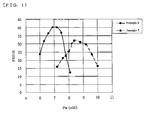
- the optical recording medium showed a highly satisfactory result; it gave an optimum recording power of 7.0 mW and a PRSNR level of 40.0 far exceeding the standard level of 15, as shown in FIG. 1 .
- the optical recording medium was revealed to have "LOW-TO-HIGH" recording mechanism and have a satisfactory recording property because it gave a great difference in reflection rates of 7.4% and 18.0%, corresponding to those before and after recording, respectively.
- Example 6 Except for replacing the dye used in Example 6 with the one represented by Chemical Formula 22, another optical recording medium was prepared similarly as in Example 6 and evaluated by the similar method as in Example 6.
- the optical recording medium showed a satisfactory result; it gave an optimum recording power of 8.4 mW and a PRSNR level of 31.9 far exceeding the standard level of 15, as shown in FIG. 1 .
- the optical recording medium was revealed to have "LOW-TO-HIGH" recording mechanism and have a satisfactory recording property because it gave a great difference in reflection rates of 11.9% and 23.3%, corresponding to those before and after recording information, respectively.
- optical recording media which have satisfactory recording properties of the same or higher optimum recording power, PRSNR, and reflection rates as those of the one in Example 7, can be prepared under the similar conditions as in Example 6.
- the cyanine dyes of the present invention have improved lightfastness, efficiently absorb short-wavelength visible light, exhibit satisfactory solubility in solvents without any actual hindrance, and have improved heat characteristics, they can be quite advantageously used as light absorbing materials for shielding and utilizing short-wavelength visible light by absorbing the light in various fields of, for example, information recordings, solar energy generations, electric machinery apparatuses, electric communicating apparatuses, optical apparatuses, clothes, building/bedding/decorating products, sanitary and health goods, and agricultural materials. Particularly, they can be quite advantageously useful as compounds for recording layers in optical recording media which record information by using blu-ray semiconductor lasers.
Landscapes
- Chemical & Material Sciences (AREA)
- Organic Chemistry (AREA)
- Optical Record Carriers And Manufacture Thereof (AREA)
- Thermal Transfer Or Thermal Recording In General (AREA)
- Indole Compounds (AREA)
Applications Claiming Priority (2)
| Application Number | Priority Date | Filing Date | Title |
|---|---|---|---|
| JP2005147544 | 2005-05-20 | ||
| PCT/JP2006/310051 WO2006123786A1 (fr) | 2005-05-20 | 2006-05-19 | Colorant a base de cyanine et support d’enregistrement optique |
Publications (2)
| Publication Number | Publication Date |
|---|---|
| EP1897915A1 true EP1897915A1 (fr) | 2008-03-12 |
| EP1897915A4 EP1897915A4 (fr) | 2010-06-16 |
Family
ID=37431355
Family Applications (1)
| Application Number | Title | Priority Date | Filing Date |
|---|---|---|---|
| EP06746658A Withdrawn EP1897915A4 (fr) | 2005-05-20 | 2006-05-19 | Colorant a base de cyanine et support d enregistrement optique |
Country Status (6)
| Country | Link |
|---|---|
| US (1) | US20090234122A1 (fr) |
| EP (1) | EP1897915A4 (fr) |
| JP (1) | JPWO2006123786A1 (fr) |
| CN (1) | CN101193985A (fr) |
| TW (1) | TW200710169A (fr) |
| WO (1) | WO2006123786A1 (fr) |
Cited By (1)
| Publication number | Priority date | Publication date | Assignee | Title |
|---|---|---|---|---|
| ITNA20090035A1 (it) * | 2009-06-05 | 2010-12-06 | Antonio Roviello | Composti metallorganici colorati molto stabili, solubili e compatibili con cristalli liquidi per dispositivi elettroottici. |
Families Citing this family (5)
| Publication number | Priority date | Publication date | Assignee | Title |
|---|---|---|---|---|
| JP5078877B2 (ja) * | 2006-03-31 | 2012-11-21 | 株式会社Adeka | シアニン化合物及び光学記録材料 |
| JP5475244B2 (ja) * | 2007-03-30 | 2014-04-16 | 株式会社Adeka | シアニン化合物、該化合物を用いた光学フィルター及び光学記録材料 |
| JP2010012604A (ja) * | 2008-06-30 | 2010-01-21 | Toshiba Corp | 追記型情報記録媒体 |
| KR20120030330A (ko) * | 2009-05-28 | 2012-03-28 | 가부시키가이샤 아데카 | 유기염 화합물, 상기 유기염 화합물을 이용한 광학기록재료 및 광학기록매체 |
| US9301569B2 (en) * | 2010-06-22 | 2016-04-05 | Nike, Inc. | Article of footwear with color change portion and method of changing color |
Family Cites Families (6)
| Publication number | Priority date | Publication date | Assignee | Title |
|---|---|---|---|---|
| US6168843B1 (en) * | 1996-12-27 | 2001-01-02 | Tdk Corporation | Optical recording medium |
| US6071672A (en) * | 1997-02-10 | 2000-06-06 | Tdk Corporation | Photo-stabilized cyanine dyes and optical recording media |
| WO2002050210A1 (fr) * | 2000-12-19 | 2002-06-27 | Kabushiki Kaisha Hayashibara Seibutsu Kagaku Kenkyujo | Agent absorbeur de lumiere |
| TW200600551A (en) * | 2004-02-27 | 2006-01-01 | Hayashibara Biochem Lab | Cyanine dyes |
| TW200531993A (en) * | 2004-03-26 | 2005-10-01 | Hayashibara Biochem Lab | Cyanine dyes |
| JP4482701B2 (ja) * | 2004-04-13 | 2010-06-16 | 株式会社東芝 | 追記型情報記録媒体 |
-
2006
- 2006-05-19 US US11/915,127 patent/US20090234122A1/en not_active Abandoned
- 2006-05-19 WO PCT/JP2006/310051 patent/WO2006123786A1/fr not_active Ceased
- 2006-05-19 TW TW095118058A patent/TW200710169A/zh unknown
- 2006-05-19 CN CNA2006800200872A patent/CN101193985A/zh active Pending
- 2006-05-19 EP EP06746658A patent/EP1897915A4/fr not_active Withdrawn
- 2006-05-19 JP JP2007516355A patent/JPWO2006123786A1/ja not_active Withdrawn
Cited By (1)
| Publication number | Priority date | Publication date | Assignee | Title |
|---|---|---|---|---|
| ITNA20090035A1 (it) * | 2009-06-05 | 2010-12-06 | Antonio Roviello | Composti metallorganici colorati molto stabili, solubili e compatibili con cristalli liquidi per dispositivi elettroottici. |
Also Published As
| Publication number | Publication date |
|---|---|
| TW200710169A (en) | 2007-03-16 |
| JPWO2006123786A1 (ja) | 2008-12-25 |
| WO2006123786A1 (fr) | 2006-11-23 |
| US20090234122A1 (en) | 2009-09-17 |
| CN101193985A (zh) | 2008-06-04 |
| EP1897915A4 (fr) | 2010-06-16 |
Similar Documents
| Publication | Publication Date | Title |
|---|---|---|
| US6683188B1 (en) | Cyanine dye | |
| US20020028918A1 (en) | Styryl dyes | |
| EP1125987A2 (fr) | Colorants cyanines | |
| EP1130063A1 (fr) | Colorant de styryle | |
| US20050240019A1 (en) | Styryl dyes | |
| JPWO2001019923A1 (ja) | スチリル色素 | |
| US6525181B2 (en) | Cyanine dyes | |
| EP1088857A1 (fr) | Colorant de cyanine | |
| US8049018B2 (en) | Methine dyes and uses of the same | |
| JPWO2000061687A1 (ja) | シアニン色素 | |
| US20090234122A1 (en) | Cyanine dye and optical recording medium | |
| EP1103547B1 (fr) | Complexe metallique de formazan | |
| US5145963A (en) | Optical information recording medium and nickel dithiolate complex compounds employed in the same | |
| US4882428A (en) | Azaporphyrin compounds | |
| JP3232512B2 (ja) | シアニン色素 | |
| EP1090961A1 (fr) | Colorants de type cyanine | |
| US5013634A (en) | Optical information recording medium and nickel complex compounds employed in the same | |
| JPH0624146A (ja) | 赤外吸収化合物及びそれを用いた光記録媒体 | |
| JP5426158B2 (ja) | メチン系色素とその用途 | |
| HK1117558A (en) | Cyanine coloring matter and optical recording medium | |
| WO2006103254A1 (fr) | Betaines d'acide squarique pour couches optiques en enregistrement optique de donnees | |
| EP1734085A1 (fr) | Teinture de cyanine | |
| JP2001348500A (ja) | シアニン色素 | |
| JPH0733746A (ja) | 有機金属錯体化合物及び該化合物を用いた光記録媒体 | |
| WO2005052064A1 (fr) | Colorant cyanine |
Legal Events
| Date | Code | Title | Description |
|---|---|---|---|
| PUAI | Public reference made under article 153(3) epc to a published international application that has entered the european phase |
Free format text: ORIGINAL CODE: 0009012 |
|
| 17P | Request for examination filed |
Effective date: 20071219 |
|
| AK | Designated contracting states |
Kind code of ref document: A1 Designated state(s): DE GB |
|
| RAP1 | Party data changed (applicant data changed or rights of an application transferred) |
Owner name: MITSUBISHI KAGAKU MEDIA CO., LTD. Owner name: KABUSHIKI KAISHA HAYASHIBARA SEIBUTSU KAGAKU KENKY |
|
| DAX | Request for extension of the european patent (deleted) | ||
| RBV | Designated contracting states (corrected) |
Designated state(s): DE GB |
|
| RAP1 | Party data changed (applicant data changed or rights of an application transferred) |
Owner name: KABUSHIKI KAISHA HAYASHIBARA SEIBUTSU KAGAKU KENKY Owner name: MITSUBISHI KAGAKU MEDIA CO., LTD. |
|
| RIC1 | Information provided on ipc code assigned before grant |
Ipc: G11B 7/247 20060101ALI20100429BHEP Ipc: C09B 69/04 20060101ALI20100429BHEP Ipc: C09B 23/04 20060101AFI20100429BHEP Ipc: C07D 209/14 20060101ALI20100429BHEP |
|
| A4 | Supplementary search report drawn up and despatched |
Effective date: 20100517 |
|
| STAA | Information on the status of an ep patent application or granted ep patent |
Free format text: STATUS: THE APPLICATION IS DEEMED TO BE WITHDRAWN |
|
| 18D | Application deemed to be withdrawn |
Effective date: 20101201 |