EP1898264A2 - Compositions de toner - Google Patents
Compositions de toner Download PDFInfo
- Publication number
- EP1898264A2 EP1898264A2 EP20070115710 EP07115710A EP1898264A2 EP 1898264 A2 EP1898264 A2 EP 1898264A2 EP 20070115710 EP20070115710 EP 20070115710 EP 07115710 A EP07115710 A EP 07115710A EP 1898264 A2 EP1898264 A2 EP 1898264A2
- Authority
- EP
- European Patent Office
- Prior art keywords
- poly
- latex
- toner
- styrene
- core
- Prior art date
- Legal status (The legal status is an assumption and is not a legal conclusion. Google has not performed a legal analysis and makes no representation as to the accuracy of the status listed.)
- Granted
Links
Images
Classifications
-
- G—PHYSICS
- G03—PHOTOGRAPHY; CINEMATOGRAPHY; ANALOGOUS TECHNIQUES USING WAVES OTHER THAN OPTICAL WAVES; ELECTROGRAPHY; HOLOGRAPHY
- G03G—ELECTROGRAPHY; ELECTROPHOTOGRAPHY; MAGNETOGRAPHY
- G03G9/00—Developers
- G03G9/08—Developers with toner particles
- G03G9/093—Encapsulated toner particles
- G03G9/09392—Preparation thereof
-
- G—PHYSICS
- G03—PHOTOGRAPHY; CINEMATOGRAPHY; ANALOGOUS TECHNIQUES USING WAVES OTHER THAN OPTICAL WAVES; ELECTROGRAPHY; HOLOGRAPHY
- G03G—ELECTROGRAPHY; ELECTROPHOTOGRAPHY; MAGNETOGRAPHY
- G03G9/00—Developers
- G03G9/08—Developers with toner particles
- G03G9/0802—Preparation methods
- G03G9/0804—Preparation methods whereby the components are brought together in a liquid dispersing medium
- G03G9/0806—Preparation methods whereby the components are brought together in a liquid dispersing medium whereby chemical synthesis of at least one of the toner components takes place
-
- G—PHYSICS
- G03—PHOTOGRAPHY; CINEMATOGRAPHY; ANALOGOUS TECHNIQUES USING WAVES OTHER THAN OPTICAL WAVES; ELECTROGRAPHY; HOLOGRAPHY
- G03G—ELECTROGRAPHY; ELECTROPHOTOGRAPHY; MAGNETOGRAPHY
- G03G9/00—Developers
- G03G9/08—Developers with toner particles
- G03G9/087—Binders for toner particles
- G03G9/08702—Binders for toner particles comprising macromolecular compounds obtained by reactions only involving carbon-to-carbon unsaturated bonds
- G03G9/08706—Polymers of alkenyl-aromatic compounds
-
- G—PHYSICS
- G03—PHOTOGRAPHY; CINEMATOGRAPHY; ANALOGOUS TECHNIQUES USING WAVES OTHER THAN OPTICAL WAVES; ELECTROGRAPHY; HOLOGRAPHY
- G03G—ELECTROGRAPHY; ELECTROPHOTOGRAPHY; MAGNETOGRAPHY
- G03G9/00—Developers
- G03G9/08—Developers with toner particles
- G03G9/087—Binders for toner particles
- G03G9/08702—Binders for toner particles comprising macromolecular compounds obtained by reactions only involving carbon-to-carbon unsaturated bonds
- G03G9/08706—Polymers of alkenyl-aromatic compounds
- G03G9/08708—Copolymers of styrene
-
- G—PHYSICS
- G03—PHOTOGRAPHY; CINEMATOGRAPHY; ANALOGOUS TECHNIQUES USING WAVES OTHER THAN OPTICAL WAVES; ELECTROGRAPHY; HOLOGRAPHY
- G03G—ELECTROGRAPHY; ELECTROPHOTOGRAPHY; MAGNETOGRAPHY
- G03G9/00—Developers
- G03G9/08—Developers with toner particles
- G03G9/087—Binders for toner particles
- G03G9/08702—Binders for toner particles comprising macromolecular compounds obtained by reactions only involving carbon-to-carbon unsaturated bonds
- G03G9/08726—Polymers of unsaturated acids or derivatives thereof
-
- G—PHYSICS
- G03—PHOTOGRAPHY; CINEMATOGRAPHY; ANALOGOUS TECHNIQUES USING WAVES OTHER THAN OPTICAL WAVES; ELECTROGRAPHY; HOLOGRAPHY
- G03G—ELECTROGRAPHY; ELECTROPHOTOGRAPHY; MAGNETOGRAPHY
- G03G9/00—Developers
- G03G9/08—Developers with toner particles
- G03G9/087—Binders for toner particles
- G03G9/08702—Binders for toner particles comprising macromolecular compounds obtained by reactions only involving carbon-to-carbon unsaturated bonds
- G03G9/08726—Polymers of unsaturated acids or derivatives thereof
- G03G9/08728—Polymers of esters
-
- G—PHYSICS
- G03—PHOTOGRAPHY; CINEMATOGRAPHY; ANALOGOUS TECHNIQUES USING WAVES OTHER THAN OPTICAL WAVES; ELECTROGRAPHY; HOLOGRAPHY
- G03G—ELECTROGRAPHY; ELECTROPHOTOGRAPHY; MAGNETOGRAPHY
- G03G9/00—Developers
- G03G9/08—Developers with toner particles
- G03G9/087—Binders for toner particles
- G03G9/08702—Binders for toner particles comprising macromolecular compounds obtained by reactions only involving carbon-to-carbon unsaturated bonds
- G03G9/08726—Polymers of unsaturated acids or derivatives thereof
- G03G9/08731—Polymers of nitriles
-
- G—PHYSICS
- G03—PHOTOGRAPHY; CINEMATOGRAPHY; ANALOGOUS TECHNIQUES USING WAVES OTHER THAN OPTICAL WAVES; ELECTROGRAPHY; HOLOGRAPHY
- G03G—ELECTROGRAPHY; ELECTROPHOTOGRAPHY; MAGNETOGRAPHY
- G03G9/00—Developers
- G03G9/08—Developers with toner particles
- G03G9/087—Binders for toner particles
- G03G9/08702—Binders for toner particles comprising macromolecular compounds obtained by reactions only involving carbon-to-carbon unsaturated bonds
- G03G9/08726—Polymers of unsaturated acids or derivatives thereof
- G03G9/08733—Polymers of unsaturated polycarboxylic acids
-
- G—PHYSICS
- G03—PHOTOGRAPHY; CINEMATOGRAPHY; ANALOGOUS TECHNIQUES USING WAVES OTHER THAN OPTICAL WAVES; ELECTROGRAPHY; HOLOGRAPHY
- G03G—ELECTROGRAPHY; ELECTROPHOTOGRAPHY; MAGNETOGRAPHY
- G03G9/00—Developers
- G03G9/08—Developers with toner particles
- G03G9/087—Binders for toner particles
- G03G9/08784—Macromolecular material not specially provided for in a single one of groups G03G9/08702 - G03G9/08775
- G03G9/08791—Macromolecular material not specially provided for in a single one of groups G03G9/08702 - G03G9/08775 characterised by the presence of specified groups or side chains
-
- G—PHYSICS
- G03—PHOTOGRAPHY; CINEMATOGRAPHY; ANALOGOUS TECHNIQUES USING WAVES OTHER THAN OPTICAL WAVES; ELECTROGRAPHY; HOLOGRAPHY
- G03G—ELECTROGRAPHY; ELECTROPHOTOGRAPHY; MAGNETOGRAPHY
- G03G9/00—Developers
- G03G9/08—Developers with toner particles
- G03G9/093—Encapsulated toner particles
- G03G9/09307—Encapsulated toner particles specified by the shell material
- G03G9/09314—Macromolecular compounds
- G03G9/09321—Macromolecular compounds obtained by reactions only involving carbon-to-carbon unsaturated bonds
-
- G—PHYSICS
- G03—PHOTOGRAPHY; CINEMATOGRAPHY; ANALOGOUS TECHNIQUES USING WAVES OTHER THAN OPTICAL WAVES; ELECTROGRAPHY; HOLOGRAPHY
- G03G—ELECTROGRAPHY; ELECTROPHOTOGRAPHY; MAGNETOGRAPHY
- G03G9/00—Developers
- G03G9/08—Developers with toner particles
- G03G9/093—Encapsulated toner particles
- G03G9/09307—Encapsulated toner particles specified by the shell material
- G03G9/09314—Macromolecular compounds
- G03G9/09328—Macromolecular compounds obtained otherwise than by reactions only involving carbon-to-carbon unsaturated bonds
Definitions
- toners Numerous processes are known for the preparation of toners, such as, for example, conventional processes wherein a resin is melt kneaded or extruded with a pigment, micronized and pulverized to provide toner particles.
- Toner can also be produced by emulsion aggregation methods.
- Methods of preparing an emulsion aggregation (EA) type toner are known and toners may be formed by aggregating a colorant with a latex polymer formed by emulsion polymerization.
- EA emulsion aggregation
- U.S. Patent No. 5,853,943 the disclosure of which is hereby incorporated by reference in its entirety, is directed to a semi-continuous emulsion polymerization process for preparing a latex by first forming a seed polymer.
- the '943 patent describes a process including: (i) conducting a pre-reaction monomer emulsification which includes emulsification of the polymerization reagents of monomers, chain transfer agent, a disulfonate surfactant or surfactants, and optionally, but in embodiments, an initiator, wherein the emulsification is accomplished at a low temperature of, for example, from about 5°C to about 40°C; (ii) preparing a seed particle latex by aqueous emulsion polymerization of a mixture including (a) part of the monomer emulsion, from about 0.1 to about 50 percent by weight, or from about 3 to about 25 percent by weight, of the monomer emulsion prepared in (i), and (b) a free radical initiator, from about 0.5 to about 100 percent by weight, or from about 3 to about 100 percent by weight, of the total initiator used to prepare the latex polymer at a temperature of from about 35°C to about 125°C,
- Triboelectric charging may occur either by mixing the toner with larger carrier beads in a two component development system, or by rubbing the toner between a blade and donor roll in a single component system. A stable triboelectric charge is very important to enable good toner performance.
- toner charge to relative humidity has been a consistent problem for developers in general, and for color developers in particular, mainly due to the fact that the surfaces of toner particles may be very sensitive to relative humidity. Sensitivity to relative humidity may give rise to various problems, including toner particle agglomeration and clogging of the apparatus using such toner.
- the process of the present disclosure includes contacting a first latex having a glass transition temperature from about 45°C to about 65°C, an aqueous colorant dispersion, and an optional wax dispersion to form a blend, adding a base to increase the pH to a value of from about 4 to about 7, heating the blend at a temperature below the glass transition temperature of the latex to form an aggregated toner core, adding a second latex having a glass transition temperature from about 45°C to about 70°C to the aggregated toner core, wherein the second latex possesses functional groups and forms a shell over said toner core forming a core-shell toner, heating the core-shell toner at a temperature above the glass transition temperature of the latex, and recovering the toner.
- the core-shell toner may be heated to a temperature above the glass transition temperature of both the latex utilized to form the core and the latex utilized to form the shell.
- a process according to the present disclosure includes contacting a first latex including a poly(styrene-butyl acrylate) having a glass transition temperature from about 45°C to about 65°C, an aqueous colorant dispersion, and an optional wax dispersion to form a blend.
- a base is then added to increase the pH to a value of from about 4 to about 7 and the blend is then heated at a temperature from about 30°C to about 60°C to form an aggregated toner core.
- a second latex including a poly(styrene-butyl acrylate) having a glass transition temperature from about 45°C to about 70°C is added to the aggregated toner core, wherein the second latex possesses functional groups such as silanes, fluoro acrylates, fluoro methacrylates, fluoro styrenes, and combinations thereof and forms a shell over said toner core forming a core-shell toner.
- the core-shell toner may then be heated at a temperature from about 80°C to about 120°C the resulting toner recovered.
- the functional groups of the second latex are selected from the group consisting of (methacryloxymethyl)bis(trimethylsiloxy) methylsilane, (methacryloxymethyl)dimethylethoxysilane, (methacryloxymethyl) phenyldimethylsilane, methacryloxypropyldimethylethoxysilane, methacryloxypropylmethylsiloxane-dimethylsiloxane copolymers, methacryloxypropylsilsesquioxanyl-T8-silsesquioxane, 3-methacryloxypropyldimethylchlorosilane, 2-trimethylsiloxyethylacrylate, (3-acryloxypropyl)methyldichlorosilane, (3-acryloxypropyl)trimethoxysilane, 3-(N-allylamino)propyltrimethoxysilane, allylaminotrimethylsilane, 2,2,3,3,4,4,4-hepta
- heating the blend occurs at a temperature from about 45°C to about 55°C
- heating the core-shell toner occurs at a temperature from about 85°C to about 98°C
- the resulting toner particles have a size from about 1 micron to about 20 microns and a circularity from about 0.9 to about 0.99.
- the present disclosure also provides toners including a core of a first latex having a glass transition temperature from about 45°C to about 65°C, a colorant, and an optional wax, and a shell including a second latex having a glass transition temperature from about 45°C to about 70°C functionalized with monomers such as silanes, fluoro acrylates, fluoro methacrylates, fluoro styrenes, and combinations thereof.
- Toners of the present disclosure may possess particles having a size from about 1 micron to about 20 microns, and a circularity from about 0.9 to about 0.99.
- the toner particles may also possess a ratio of J-Zone charge to B-Zone charge from about 1 to about 2, and a ratio of J-Zone charge to A-Zone charge from about 1.15 to about 2.55.
- first latex and the second latex are the same or different and are selected from the group consisting of styrenes, acrylates, methacrylates, butadienes, isoprenes, acrylic acids, methacrylic acids, acrylonitriles, and combinations thereof.
- first latex and the second latex are the same or different and are selected from the group consisting of poly(styrene-butadiene), poly(methyl methacrylate-butadiene), poly(ethyl methacrylate-butadiene), poly(propyl methacrylate-butadiene), poly(butyl methacrylate-butadiene), poly(methyl acrylate-butadiene), poly(ethyl acrylate-butadiene), poly(propyl acrylate-butadiene), poly(butyl acrylate-butadiene), poly(styrene-isoprene), poly(methylstyrene-isoprene), poly(methyl methacrylate-isoprene), poly(ethyl methacrylate-isoprene), poly(propyl methacrylate-isoprene), poly(butyl methacrylateisoprene), poly(methyl acrylate-isoprene), poly
- the functional groups of the second latex are selected from the group consisting of (methacryloxymethyl)bis(trimethylsiloxy) methylsilane, (methacryloxymethyl)dimethylethoxysilane, (methacryloxymethyl) phenyldimethylsilane, methacryloxypropyldimethylethoxysilane, methacryloxypropylmethylsiloxane-dimethylsiloxane copolymers, methacryloxypropylsilsesquioxanyl-T8-silsesquioxane, 3-methacryloxypropyldimethylchlorosilane, 2-trimethylsiloxyethylacrylate, (3-acryloxypropyl)methyldichlorosilane, (3-acryloxypropyl)trimethoxysilane, 3-(N-allylamino)propyltrimethoxysilane, allylaminotrimethylsilane, 2,2,3,3,4,4,4-hepta
- the first latex comprises a poly(styrene-butyl acrylate)
- the second latex comprises a poly(styrene-butyl acrylate) functionalized with monomer selected from the group consisting of methacryloxypropyl trimethoxylsilane and 2,6-difluorostyrene.
- the toner particles have a size from about 1 micron to about 20 microns, and a circularity from about 0.9 to about 0.99.
- the toner particles possess a ratio of J-Zone charge to B-Zone charge from about 1 to about 2, and a ratio of J-Zone charge to A-Zone charge from about 1.15 to about 2.55.
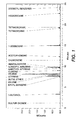
- Figure 1 includes a graph depicting gas chromatography/mass spectroscopy (GC/MS) test results of a conventional toner
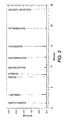
- Figure 2 includes a graph depicting GC/MS test results of a toner of the present disclosure.
- the present disclosure provides processes for the preparation of toner particles having reduced sensitivity to relative humidity.
- the processes include the synthesis of a latex having a core-shell configuration with functional groups in the latex shell which render the shell more hydrophobic and thus less sensitive to relative humidity.
- the present disclosure includes the preparation of toner by blending a colorant and a wax with a latex polymer core, optionally with a flocculant and/or charge additives; and heating the resulting mixture at a temperature below the glass transition temperature (Tg) of the latex polymer to form toner sized aggregates.
- Tg glass transition temperature
- a functionalized latex may then be added as a shell latex, followed by the addition of a base and cooling.
- Toners of the present disclosure may include a latex in combination with a pigment. While the latex may be prepared by any method within the purview of one skilled in the art, in embodiments the latex may be prepared by emulsion polymerization methods and the toner may include emulsion aggregation toners. Emulsion aggregation involves aggregation of both submicron latex and pigment particles into toner size particles, where the growth in particle size is, for example, from submicron, in embodiments from about 3 microns to about 10 microns.
- Any monomer suitable for preparing a latex emulsion can be used in the present processes.
- Suitable monomers useful in forming the latex emulsion, and thus the resulting latex particles in the latex emulsion include, but are not limited to, styrenes, acrylates, methacrylates, butadienes, isoprenes, acrylic acids, methacrylic acids, acrylonitriles, mixtures thereof, and the like.
- the resin of the latex may include at least one polymer. In embodiments, at least one may be from about one to about twenty and, in embodiments, from about three to about ten.
- Exemplary polymers includes styrene acrylates, styrene butadienes, styrene methacrylates, and more specifically, poly(styrene-alkyl acrylate), poly(styrene-1,3-diene), poly(styrene-alkyl methacrylate), poly (styrene-alkyl acrylate-acrylic acid), poly(styrene-1,3-diene-acrylic acid), poly (styrene-alkyl methacrylate-acrylic acid), poly(alkyl methacrylate-alkyl acrylate), poly(alkyl methacrylate-alkyl acrylate), poly(alkyl methacrylate-aryl acrylate), poly(aryl methacrylate-alkyl acrylate),
- the polymer may be block, random, or alternating copolymers.
- polyester resins obtained from the reaction of bisphenol A and propylene oxide or propylene carbonate, and in particular including such polyesters followed by the reaction of the resulting product with fumaric acid (as disclosed in U.S. Patent No. 5,227,460 , the entire disclosure of which is incorporated herein by reference), and branched polyester resins resulting from the reaction of dimethylterephthalate with 1,3-butanediol, 1,2-propanediol, and pentaerythritol may also be used.
- a poly(styrene-butyl acrylate) may be utilized as the latex.
- the glass transition temperature of this first latex which, in embodiments may be used to form the core of a toner of the present disclosure, may be from about 45°C to about 65°C, in embodiments from about 48°C to about 62°C.
- the latex may be prepared in an aqueous phase containing a surfactant or co-surfactant.
- Surfactants which may be utilized in the latex dispersion can be ionic or nonionic surfactants in an amount of from about 0.01 to about 15, and in embodiments of from about 0.01 to about 5 weight percent of the solids.
- Anionic surfactants which may be utilized include sulfates and sulfonates, sodium dodecylsulfate (SDS), sodium dodecylbenzene sulfonate, sodium dodecylnaphthalene sulfate, dialkyl benzenealkyl sulfates and sulfonates, acids such as abietic acid available from Aldrich, NEOGEN RTM, NEOGEN SCTM obtained from Daiichi Kogyo Seiyaku Co., Ltd., mixtures thereof, and the like.
- SDS sodium dodecylsulfate
- SDS sodium dodecylbenzene sulfonate
- sodium dodecylnaphthalene sulfate sodium dodecylnaphthalene sulfate
- dialkyl benzenealkyl sulfates and sulfonates acids such as abietic acid available from Aldrich, NEOGEN R
- cationic surfactants include, but are not limited to, ammoniums, for example, alkylbenzyl dimethyl ammonium chloride, dialkyl benzenealkyl ammonium chloride, lauryl trimethyl ammonium chloride, alkylbenzyl methyl ammonium chloride, alkyl benzyl dimethyl ammonium bromide, benzalkonium chloride, and C12, C15, C17 trimethyl ammonium bromides, mixtures thereof, and the like.
- ammoniums for example, alkylbenzyl dimethyl ammonium chloride, dialkyl benzenealkyl ammonium chloride, lauryl trimethyl ammonium chloride, alkylbenzyl methyl ammonium chloride, alkyl benzyl dimethyl ammonium bromide, benzalkonium chloride, and C12, C15, C17 trimethyl ammonium bromides, mixtures thereof, and the like.
- cationic surfactants include cetyl pyridinium bromide, halide salts of quaternized polyoxyethylalkylamines, dodecylbenzyl triethyl ammonium chloride, MIRAPOL and ALKAQUAT available from Alkaril Chemical Company, SANISOL (benzalkonium chloride), available from Kao Chemicals, and the like, and mixtures thereof.
- a suitable cationic surfactant includes SANISOL B-50 available from Kao Corp., which is primarily a benzyl dimethyl alkonium chloride.
- nonionic surfactants include, but are not limited to alcohols, acids and ethers, for example, polyvinyl alcohol, polyacrylic acid, methalose, methyl cellulose, ethyl cellulose, propyl cellulose, hydroxyl ethyl cellulose, carboxy methyl cellulose, polyoxyethylene cetyl ether, polyoxyethylene lauryl ether, polyoxyethylene octyl ether, polyoxyethylene octylphenyl ether, polyoxyethylene oleyl ether, polyoxyethylene sorbitan monolaurate, polyoxyethylene stearyl ether, polyoxyethylene nonylphenyl ether, dialkylphenoxy poly(ethyleneoxy) ethanol, mixtures thereof, and the like.
- alcohols, acids and ethers for example, polyvinyl alcohol, polyacrylic acid, methalose, methyl cellulose, ethyl cellulose, propyl cellulose, hydroxyl ethyl cellulose, carboxy methyl cellulose,
- Rhone-Poulenc such as IGEPAL CA-210TM, IGEPAL CA-520TM, IGEPAL CA-720TM, IGEPAL CO-890TM, IGEPAL CO-720TM, IGEPAL CO-290TM, IGEPAL CA-210TM, ANTAROX 890TM and ANTAROX 897TM can be selected.
- initiators may be added for formation of the latex.
- examples of initiators include water soluble initiators, such as ammonium persulfate, sodium persulfate and potassium persulfates, and organic soluble initiators including organic peroxides and azo compounds including Vazo peroxides, such as VAZO 64TM, 2-methyl 2-2'-azobis propanenitrile, VAZO 88TM, and 2-2'- azobis isobutyramide dehydrate and mixtures thereof.
- Initiators can be added in suitable amounts, such as from about 0.1 to about 8 weight percent, and in embodiments of from about 0.2 to about 5 weight percent of the monomers.
- chain transfer agents may be utilized including dodecane thiol, octane thiol, carbon tetrabromide, mixtures thereof, and the like, in amounts from about 0.1 to about 10 percent and, in embodiments, from about 0.2 to about 5 percent by weight of monomers, to control the molecular weight properties of the polymer when emulsion polymerization is conducted in accordance with the present disclosure.
- a pH titration agent may be added to control the rate of the emulsion aggregation process.
- the pH titration agent utilized in the processes of the present disclosure can be any acid or base that does not adversely affect the products being produced.
- Suitable bases can include metal hydroxides, such as sodium hydroxide, potassium hydroxide, ammonium hydroxide, and optionally mixtures thereof.
- Suitable acids include nitric acid, sulfuric acid, hydrochloric acid, citric acid, acetic acid, and optionally mixtures thereof.
- the reactants may be added to a suitable reactor, such as a mixing vessel.
- a suitable reactor such as a mixing vessel.
- the appropriate amount of at least two monomers, in embodiments from about two to about ten monomers, stabilizer, surfactant(s), initiator, if any, chain transfer agent, if any, and wax, if any, and the like may be combined in the reactor and the emulsion aggregation process may be allowed to begin.
- Reaction conditions selected for effecting the emulsion polymerization include temperatures of, for example, from about 45° C to about 120° C, in embodiments from about 60° C to about 90° C.
- the polymerization may occur at elevated temperatures within 10 percent of the melting point of any wax present, for example from about 60° C to about 85° C, in embodiments from about 65° C to about 80° C, to permit the wax to soften thereby promoting dispersion and incorporation into the emulsion.
- Nanometer size particles may be formed, from about 50 nm to about 800 nm in volume average diameter, in embodiments from about 100 nm to about 400 nm in volume average diameter as determined, for example, by a Brookhaven nanosize particle analyzer.
- the latex particles may be utilized to form a toner.
- the toners are an emulsion aggregation type toner that are prepared by the aggregation and fusion of the latex particles of the present disclosure with a colorant, and one or more additives such as surfactants, coagulants, waxes, surface additives, and optionally mixtures thereof.
- the latex particles may be added to a colorant dispersion.
- the colorant dispersion may include, for example, submicron colorant particles in a size range of, for example, from about 50 to about 500 nanometers and, in embodiments, of from about 100 to about 400 nanometers in volume average diameter.
- the colorant particles may be suspended in an aqueous water phase containing an anionic surfactant, a nonionic surfactant, or mixtures thereof.
- the surfactant may be ionic and may be from about 1 to about 25 percent by weight, and in embodiments from about 4 to about 15 percent by weight of the colorant.
- Colorants useful in forming toners in accordance with the present disclosure include pigments, dyes, mixtures of pigments and dyes, mixtures of pigments, mixtures of dyes, and the like.
- the colorant may be, for example, carbon black, cyan, yellow, magenta, red, orange, brown, green, blue, violet or mixtures thereof.
- the pigment may be, for example, carbon black, phthalocyanines, quinacridones or RHODAMINE BTM type, red, green, orange, brown, violet, yellow, fluorescent colorants, and the like.
- the colorant may be present in the toner of the disclosure in an amount of from about 1 to about 25 percent by weight of toner, in embodiments in an amount of from about 2 to about 15 percent by weight of the toner.
- Exemplary colorants include carbon black like REGAL 330 ® magnetites; Mobay magnetites including MO8029TM MO8060TM; Columbian magnetites; MAPICO BLACKSTM and surface treated magnetites; Pfizer magnetites including CB4799TM, CB5300TM, CB5600TM, MCX6369TM; Bayer magnetites including, BAYFERROX 8600TM, 8610TM; Northern Pigments magnetites including, NP-604TM, NP-608TM; Magnox magnetites including TMB-100TM, or TMB-104TM, HELIOGEN BLUE L6900TM, D6840TM, D7080TM, D7020TM, PYLAM OIL BLUETM, PYLAM OIL YELLOWTM, PIGMENT BLUE 1TM available from Paul Uhlich and Company, Inc.; PIGMENT VIOLET 1TM, PIGMENT RED 48TM, LEMON CHROME YELLOW DCC 1026TM, E.D.
- TOLUIDINE REDTM and BON RED CTM available from Dominion Color Corporation, Ltd., Toronto, Ontario
- CINQUASIA MAGENTATM available from E.I. DuPont de Nemours and Company.
- colorants include 2,9-dimethyl-substituted quinacridone and anthraquinone dye identified in the Color Index as Cl 60710, Cl Dispersed Red 15, diazo dye identified in the Color Index as Cl 26050, Cl Solvent Red 19, copper tetra(octadecyl sulfonamido) phthalocyanine, x-copper phthalocyanine pigment listed in the Color Index as Cl 74160, Cl Pigment Blue, Anthrathrene Blue identified in the Color Index as Cl 69810, Special Blue X-2137, diarylide yellow 3,3-dichlorobenzidene acetoacetanilides, a monoazo pigment identified in the Color Index as C1 12700, C1 Solvent Yellow 16, a nitrophenyl amine sulfonamide identified in the Color Index as Foron Yellow SE/GLN, Cl Dispersed Yellow 33, 2,5-dimethoxy-4-sulfonanilide phenylazo-4'-chloro-2
- Organic soluble dyes having a high purity for the purpose of color gamut which may be utilized include Neopen Yellow 075, Neopen Yellow 159, Neopen Orange 252, Neopen Red 336, Neopen Red 335, Neopen Red 366, Neopen Blue 808, Neopen Black X53, Neopen Black X55, wherein the dyes are selected in various suitable amounts, for example from about 0.5 to about 20 percent by weight, in embodiments, from about 5 to about 20 weight percent of the toner.
- colorant examples include Pigment Blue 15:3 having a Color Index Constitution Number of 74160, Magenta Pigment Red 81:3 having a Color Index Constitution Number of 45160:3, Yellow 17 having a Color Index Constitution Number of 21105, and known dyes such as food dyes, yellow, blue, green, red, magenta dyes, and the like.
- Wax dispersions may also be added to toners of the present disclosure.
- Suitable waxes include, for example, submicron wax particles in the size range of from about 50 to about 500 nanometers, in embodiments of from about 100 to about 400 nanometers in volume average diameter, suspended in an aqueous phase of water and an ionic surfactant, nonionic surfactant, or mixtures thereof.
- the ionic surfactant or nonionic surfactant may be present in an amount of from about 0.5 to about 10 percent by weight, and in embodiments of from about 1 to about 5 percent by weight of the wax.
- the wax dispersion according to embodiments of the present disclosure may include, for example, a natural vegetable wax, natural animal wax, mineral wax and/or synthetic wax.
- natural vegetable waxes include, for example, carnauba wax, candelilla wax, Japan wax, and bayberry wax.
- natural animal waxes include, for example, beeswax, punic wax, lanolin, lac wax, shellac wax, and spermaceti wax.
- Mineral waxes include, for example, paraffin wax, microcrystalline wax, montan wax, ozokerite wax, ceresin wax, petrolatum wax, and petroleum wax.
- Synthetic waxes of the present disclosure include, for example, Fischer-Tropsch wax, acrylate wax, fatty acid amide wax, silicone wax, polytetrafluoroethylene wax, polyethylene wax, polypropylene wax, and mixtures thereof.
- polypropylene and polyethylene waxes examples include those commercially available from Allied Chemical and Baker Petrolite, wax emulsions available from Michelman Inc. and the Daniels Products Company, EPOLENE N-15 commercially available from Eastman Chemical Products, Inc., Viscol 550-P, a low weight average molecular weight polypropylene available from Sanyo Kasel K.K., and similar materials.
- commercially available polyethylene waxes possess a molecular weight (Mw) of from about 1,000 to about 1,500, and in embodiments of from about 1,250 to about 1,400, while the commercially available polypropylene waxes have a molecular weight of from about 4,000 to about 5,000, and in embodiments of from about 4,250 to about 4,750.
- the waxes may be functionalized.
- groups added to functionalize waxes include amines, amides, imides, esters, quaternary amines, and/or carboxylic acids.
- the functionalized waxes may be acrylic polymer emulsions, for example, Joncryl 74, 89, 130, 537, and 538, all available from Johnson Diversey, Inc, or chlorinated polypropylenes and polyethylenes commercially available from Allied Chemical and Petrolite Corporation and Johnson Diversey, Inc.
- the wax may be present in an amount of from about 1 to about 30 percent by weight, and in embodiments from about 2 to about 20 percent by weight of the toner.
- a coagulant may be added during or prior to aggregating the latex and the aqueous colorant dispersion.
- the coagulant may be added over a period of time from about 1 to about 20 minutes, in embodiments from about 1.25 to about 8 minutes, depending on the processing conditions.
- Suitable coagulants include polyaluminum halides such as polyaluminum chloride (PAC), or the corresponding bromide, fluoride, or iodide, polyaluminum silicates such as polyaluminum sulfo silicate (PASS), and water soluble metal salts including aluminum chloride, aluminum nitrite, aluminum sulfate, potassium aluminum sulfate, calcium acetate, calcium chloride, calcium nitrite, calcium oxylate, calcium sulfate, magnesium acetate, magnesium nitrate, magnesium sulfate, zinc acetate, zinc nitrate, zinc sulfate and the like.
- polyaluminum halides such as polyaluminum chloride (PAC), or the corresponding bromide, fluoride, or iodide
- polyaluminum silicates such as polyaluminum sulfo silicate (PASS)
- water soluble metal salts including aluminum chloride, aluminum nitrite
- PAC PAC
- PAC PAC
- PAC can be prepared by the addition of two moles of a base to one mole of aluminum chloride.
- the species is soluble and stable when dissolved and stored under acidic conditions if the pH is less than about 5.
- the species in solution is believed to be of the formula Al 13 O 4 (OH) 24 (H 2 O) 12 with about 7 positive electrical charges per unit.
- suitable coagulants include a polymetal salt such as, for example, polyaluminum chloride (PAC), polyaluminum bromide, or polyaluminum sulfosilicate.
- the polymetal salt can be in a solution of nitric acid, or other diluted acid solutions such as sulfuric acid, hydrochloric acid, citric acid or acetic acid.
- the coagulant may be added in amounts from about 0.02 to about 2 percent by weight of the toner, and in embodiments from about 0.1 to about 1.5 percent by weight of the toner.
- alkali earth metal or transition metal salts can be utilized as aggregating agents.
- alkali (II) salts can be selected to aggregate sodio sulfonated polyester colloids with a colorant to enable the formation of a toner composite.
- Such salts include, for example, beryllium chloride, beryllium bromide, beryllium iodide, beryllium acetate, beryllium sulfate, magnesium chloride, magnesium bromide, magnesium iodide, magnesium acetate, magnesium sulfate, calcium chloride, calcium bromide, calcium iodide, calcium acetate, calcium sulfate, strontium chloride, strontium bromide, strontium iodide, strontium acetate, strontium sulfate, barium chloride, barium bromide, barium iodide, and optionally mixtures thereof.
- transition metal salts or anions which may be utilized as aggregating agent include acetates of vanadium, niobium, tantalum, chromium, molybdenum, tungsten, manganese, iron, ruthenium, cobalt, nickel, copper, zinc, cadmium or silver; acetoacetates of vanadium, niobium, tantalum, chromium, molybdenum, tungsten, manganese, iron, ruthenium, cobalt, nickel, copper, zinc, cadmium or silver; sulfates of vanadium, niobium, tantalum, chromium, molybdenum, tungsten, manganese, iron, ruthenium, cobalt, nickel, copper, zinc, cadmium or silver; and aluminum salts such as aluminum acetate, aluminum halides such as polyaluminum chloride, mixtures thereof, and the like.
- Stabilizers that may be utilized in the toner formulation processes include bases such as metal hydroxides, including sodium hydroxide, potassium hydroxide, ammonium hydroxide, and optionally mixtures thereof. Also useful as a stabilizer is a composition containing sodium silicate dissolved in sodium hydroxide.
- the resultant blend of latex may then be stirred and heated to a temperature below the Tg of the latex, in embodiments from about 30°C to about 60°C, in embodiments of from about 45°C to about 55°C, for a period of time from about 0.2 hours to about 6 hours, in embodiments from about 1 hour to about 2.5 hours, resulting in toner aggregates of from about 3 microns to about 15 microns in volume average diameter, in embodiments of from about 4 microns to about 8 microns in volume average diameter.
- a shell may then be formed on the aggregated particles.
- Any latex utilized noted above to form the core latex may be utilized to form the shell latex.
- a styrene-n-butyl acrylate copolymer may be utilized to form the shell latex.
- the latex utilized to form the shell may have a glass transition temperature of from about 45°C to about 70°C, in embodiments from about 50°C to about 65°C.
- the shell latex may be functionalized with a group that imports hydrophobicity to the shell latex, thereby providing the shell with excellent sensitivity to relative humidity.
- Suitable functional groups include, for example, silanes such as (methacryloxymethyl)bis(trimethylsiloxy)methylsilane, (methacryloxymethyl)dimethylethoxysilane, (methacryloxymethyl)phenyldimethylsilane, methacryloxypropyldimethylethoxysilane, methacryloxypropylmethylsiloxane-dimethylsiloxane copolymer, methacryloxypropylsilsesquioxanyl-T8-silsesquioxane, 3-methacryloxypropyldimethylchlorosilane, 2-trimethylsiloxyethylacrylate, (3-acryloxypropyl)methyldichlorosilane, (3-acryloxypropyl)trimethoxysilane, 3-(N-allylamino)
- the shell latex may be applied by any method within the purview of those skilled in the art, including dipping, spraying, and the like.
- the shell latex may be applied until the desired final size of the toner particles is achieved, in embodiments from about 3 microns to about 12 microns, in other embodiments from about 4 microns to about 8 microns.
- the pH of the mixture may be adjusted with a base to a value of from about 5 to about 7, and in embodiments from about 6 to about 6.8.
- the base may include any suitable base such as, for example, alkali metal hydroxides such as, for example, sodium hydroxide, potassium hydroxide, and ammonium hydroxide.
- the alkali metal hydroxide may be added in amounts from about 6 to about 25 percent by weight of the mixture, in embodiments from about 10 to about 20 percent by weight of the mixture.
- Coalescing may include stirring and heating at a temperature of from about 90°C to about 99°C, for a period of from about 0.5 to about 12 hours, and in embodiments from about 2 to about 6 hours. Coalescing may be accelerated by additional stirring.
- the pH of the mixture is then lowered to from about 3.5 to about 6 and in embodiments, to from about 3.7 to about 5.5 with, for example, an acid to coalesce the toner aggregates.
- Suitable acids include, for example, nitric acid, sulfuric acid, hydrochloric acid, citric acid or acetic acid.
- the amount of acid added may be from about 4 to about 30 percent by weight of the mixture, and in embodiments from about 5 to about 15 percent by weight of the mixture.
- Cooling may be at a temperature of from about 20°C to about 40°C, in embodiments from about 22°C to about 30°C over a period time from about 1 hour to about 8 hours, and in embodiments from about 1.5 hours to about 5 hours.
- cooling a coalesced toner slurry includes quenching by adding a cooling media such as, for example, ice, dry ice and the like, to effect rapid cooling to a temperature of from about 20°C to about 40°C, and in embodiments of from about 22°C to about 30°C.
- a cooling media such as, for example, ice, dry ice and the like
- Quenching may be feasible for small quantities of toner, such as, for example, less than about 2 liters, in embodiments from about 0.1 liters to about 1.5 liters.
- rapid cooling of the toner mixture is not feasible nor practical, neither by the introduction of a cooling medium into the toner mixture, nor by the use of jacketed reactor cooling.
- the aggregate suspension may be heated to a temperature at or above the Tg of the first latex used to form the core and the Tg of the second latex used to form the shell to fuse the shell latex with the core latex.
- the aggregate suspension may be heated to a temperature from about 80°C to about 120°C, in embodiments from about 85°C to about 98°C, for a period of time from about 1 hour to about 6 hours, in embodiments from about 2 hours to about 4 hours, to fuse the shell latex with the core latex.
- the toner slurry may then be washed. Washing may be carried out at a pH of from about 7 to about 12, and in embodiments at a pH of from about 9 to about 11. The washing is at a temperature of from about 30°C to about 70°C, and in embodiments from about 40°C to about 60°C.
- the washing may include filtering and reslurrying a filter cake including toner particles in deionized water.
- the filter cake may be washed one or more times by deionized water, or washed by a single deionized water wash at a pH of about 4 wherein the pH of the slurry is adjusted with an acid, and followed optionally by one or more deionized water washes.
- Drying may be carried out at a temperature of from about 35°C to about 75°C, and in embodiments of from about 45°C to about 60°C. The drying may be continued until the moisture level of the particles is below a set target of about 1 % by weight, in embodiments of less than about 0.7% by weight.
- the toner may also include charge additives in effective amounts of, for example, from about 0.1 to about 10 weight percent, in embodiments from about 0.5 to about 7 weight percent.
- Suitable charge additives include alkyl pyridinium halides, bisulfates, the charge control additives of U.S. Patent Nos. 3,944,493 ; 4,007,293 ; 4,079,014 ; 4,394,430 and 4,560,635 , the entire disclosures of each of which are hereby incorporated by reference in their entirety, negative charge enhancing additives like aluminum complexes, any other charge additives, mixtures thereof, and the like.
- Toner in accordance with the present disclosure can be used in a variety of imaging devices including printers, copy machines, and the like.
- the toners generated in accordance with the present disclosure are excellent for imaging processes, especially xerographic processes and are capable of providing high quality colored images with excellent image resolution, acceptable signal-to-noise ratio, and image uniformity. Further, toners of the present disclosure can be selected for electrophotographic imaging and printing processes such as digital imaging systems and processes.
- the resultant toner particles have less sensitivity to relative humidity compared with conventional toners due to their increased surface hydrophobicity from the introduction of the functionalized latex as the shell of the toner.
- Toner particles produced utilizing a latex of the present disclosure may have a size of about 1 micron to about 20 microns, in embodiments about 2 microns to about 15 microns, in embodiments about 3 microns to about 7 microns. Toner particles of the present disclosure may have a circularity of from about 0.9 to about 0.99, in embodiments from about 0.92 to about 0.98.
- Toners of the present disclosure possess excellent humidity resistant toner properties, such as the ratio of J-zone charge to A-zone charge is from about 1.15 to about 2.55, in embodiments from about 1.2 to about 2, and wherein the ratio of J-zone charge to B-zone charge is from about 1 to about 2, in embodiments from about 1.05 to about 1.5, wherein the A-zone is at about 80 percent relative humidity, the B-zone is at about 50 percent relative humidity, and the J-zone is at about 10 percent relative humidity.
- Developer compositions can be prepared by mixing the toners obtained with the processes disclosed herein with known carrier particles, including coated carriers, such as steel, ferrites, and the like.
- carrier particles include those disclosed in U.S. Patent Nos. 4,937,166 and 4,935,326 , the entire disclosures of each of which are incorporated herein by reference.
- the carriers may be present from about 2 percent by weight of the toner to about 8 percent by weight of the toner, in embodiments from about 4 percent by weight to about 6 percent by weight of the toner.
- the carrier particles can also include a core with a polymer coating thereover, such as polymethylmethacrylate (PMMA), having dispersed therein a conductive component like conductive carbon black.
- PMMA polymethylmethacrylate
- Carrier coatings include silicone resins such as methyl silsesquioxanes, fluoropolymers such as polyvinylidiene fluoride, mixtures of resins not in close proximity in the triboelectric series such as polyvinylidiene fluoride and acrylics, thermosetting resins such as acrylics, mixtures thereof and other known components.
- silicone resins such as methyl silsesquioxanes
- fluoropolymers such as polyvinylidiene fluoride
- mixtures of resins not in close proximity in the triboelectric series such as polyvinylidiene fluoride and acrylics
- thermosetting resins such as acrylics, mixtures thereof and other known components.
- Development may occur via discharge area development.
- discharge area development the photoreceptor is charged and then the areas to be developed are discharged.
- the development fields and toner charges are such that toner is repelled by the charged areas on the photoreceptor and attracted to the discharged areas. This development process is used in laser scanners.
- Development may be accomplished by the magnetic brush development process disclosed in U.S. Patent No. 2,874,063 , the disclosure of which is hereby incorporated by reference in its entirety.
- This method entails the carrying of a developer material containing toner of the present disclosure and magnetic carrier particles by a magnet.
- the magnetic field of the magnet causes alignment of the magnetic carriers in a brush like configuration, and this "magnetic brush" is brought into contact with the electrostatic image bearing surface of the photoreceptor.
- the toner particles are drawn from the brush to the electrostatic image by electrostatic attraction to the discharged areas of the photoreceptor, and development of the image results.
- the conductive magnetic brush process is used wherein the developer includes conductive carrier particles and is capable of conducting an electric current between the biased magnet through the carrier particles to the photoreceptor.
- Imaging methods are also envisioned with the toners disclosed herein. Such methods include, for example, some of the above patents mentioned above and U.S. Patent Nos. 4,265,990 , 4,584,253 and 4,563,408 , the entire disclosures of each of which are incorporated herein by reference.
- the imaging process includes the generation of an image in an electronic printing magnetic image character recognition apparatus and thereafter developing the image with a toner composition of the present disclosure.
- the formation and development of images on the surface of photoconductive materials by electrostatic means is well known.
- the basic xerographic process involves placing a uniform electrostatic charge on a photoconductive insulating layer, exposing the layer to a light and shadow image to dissipate the charge on the areas of the layer exposed to the light, and developing the resulting latent electrostatic image by depositing on the image a finely-divided electroscopic material, for example, toner.
- the toner will normally be attracted to those areas of the layer, which retain a charge, thereby forming a toner image corresponding to the latent electrostatic image.
- This powder image may then be transferred to a support surface such as paper.
- the transferred image may subsequently be permanently affixed to the support surface by heat.
- latent image formation by uniformly charging the photoconductive layer and then exposing the layer to a light and shadow image, one may form the latent image by directly charging the layer in image configuration. Thereafter, the powder image may be fixed to the photoconductive layer, eliminating the powder image transfer.
- suitable fixing means such as solvent or overcoating treatment may be substituted for the foregoing heat fixing step.
- a core-shell silane-functional latex was prepared by in-situ seeded semi-continuous emulsion copolymerization of styrene and n-butyl acrylate (BA), in which methacryloxypropyl trimethoxylsilane (Aldrich) was used as the functional comonomer for the synthesis of the shell.
- BA n-butyl acrylate
- a monomer emulsion was prepared by agitating a monomer mixture (about 630 grams of styrene, about 140 grams of n-butyl acrylate, and about 5.4 grams of 1-dodecanethiol) with an aqueous solution (about 15.3 grams of Dowfax 2A1, and about 368 grams of deionized water) at about 300 rpm at a temperature from about 21 °C to about 23°C. About 11.9 grams of the resulting emulsion mixture was taken from the monomer emulsion as the seed emulsion and added into the reactor and stirred for about 8 minutes at about 75°C.
- a monomer mixture about 630 grams of styrene, about 140 grams of n-butyl acrylate, and about 5.4 grams of 1-dodecanethiol
- an aqueous solution about 15.3 grams of Dowfax 2A1, and about 368 grams of deionized water
- the emulsion was post-heated at about 75°C for about 3 hours, and then cooled to about 35°C.
- the reaction system was deoxygenated by passing a stream of nitrogen throughout the reaction.
- the resulting core-shell latex had an average particle size of about 190 nm, a Mw of about 35 kg/mole (GPC), and a Tg of about 59°C, with about 41 percent solids. This latex was very stable and sediment-free.
- silane functional monomer was incorporated into the latex shell polymer chains mainly by copolymerization, and possibly also by hydrolysis.
- silane contained at least one carbon-carbon double bond, it could undergo free radical polymerization or a similar polymerization mechanism.
- the silane compound also contained at least one alkoxy group, which could be hydrolyzed with acid or base catalysts. It is believed that most of the hydrolysis of the silane group was completed after polymerization and the aggregation/coalescence process.
- a control toner was prepared as follows. About 11.78 kg of a poly(styrene-co-n-butyl acrylate) latex was produced following the procedures described above in Example 1, except about 23 grams of a functional monomer ( ⁇ -Carboxyethyl acrylate (Beta-CEA)) was added into the initial monomer emulsion, and no methacryloxypropyl trimethoxylsilane was added.
- ⁇ -Carboxyethyl acrylate Beta-CEA
- the slurry was mixed for about 1.2 hours, then about 2.066 kg of about 1 M NaOH was added into the slurry. After mixing for about 15 minutes, the reaction temperature was raised to about 96 °C. The pH of the slurry was adjusted to about 4.17 by the addition of about 0.3 M HNO 3 solution. After the pH adjustment, the slurry was coalesced for about 2.5 hours. The toner particles were collected by filtration, washed, and dried.
- a toner of the present disclosure was then prepared having a silane-functional shell latex. Following the process described above for the control, but before adding shell latex, about 1.2 kg of the control slurry was transferred to a 2-liter reactor pre-heated to about 60° C. Then, about 0.11 kg of the silane-latex prepared above in Example 1 was added into the reactor. The reaction temperature was then raised to about 96 °C. The pH of the slurry was adjusted to about 4.1 by about 1 M NaOH solution. After the pH adjustment, the slurry was coalesced for about 1.5 hours. The toner particles were collected by filtration.
- a second toner of the present disclosure was prepared having a fluoro-functional shell latex.
- the fluoro-functional latex was prepared following the procedure set forth above in Example 1, except about 14 grams of a fluoro monomer, 2,6-difluorostyrene, was added to the latex instead of a silane latex.
- a toner was prepared utilizing a fluoro-latex as the shell.
- about 1.2 kg of the control slurry was transferred to a 2-liter reactor pre-heated to about 60° C.
- about 0.11 kg of the fluoro-latex prepared above was added into the reactor.
- the reaction temperature was then raised to about 96 °C.
- the pH of the slurry was adjusted to about 4.1 by about 1 M NaOH solution. After the pH adjustment, the slurry was coalesced for about 1.5 hours.
- the toner particles were collected by filtration.
- Example 2 After washing and drying, the properties of the control toner particles of Example 2, the toner having a silane-latex shell of Example 2, and the toner having a fluoro-latex shell described above were determined.
- Particle size was determined by a Layson Cell/Coulter LS230. Circularity was determined by a SysMex FPIA 2100.
- Triboelectric charge was determined by a Keithley Model 617 digital electrometer. Temperature and relative humidity settings for the A-zone was about 80°F and about 80%; for the B-Zone was about 70°F and about 50%; and for the J-Zone was about 70°F and about 10%.
- Table 1 The properties of these toners are summarized in Table 1 below.
- FIG. 1 is the GC/MS for the control toner
- Figure 2 is the GC/MS for the toner of the present disclosure having a silane in the shell.
- the molecular weight range of the ions detected by the instrument was from about 50 to about 650.
- the GC/MS results detail the various species/compounds detected in the toner and control toner. With silane in the shell latex, the toner particles were more stable, compared with the control.
Landscapes
- Physics & Mathematics (AREA)
- General Physics & Mathematics (AREA)
- Spectroscopy & Molecular Physics (AREA)
- Chemical & Material Sciences (AREA)
- Chemical Kinetics & Catalysis (AREA)
- Developing Agents For Electrophotography (AREA)
- Graft Or Block Polymers (AREA)
Applications Claiming Priority (1)
| Application Number | Priority Date | Filing Date | Title |
|---|---|---|---|
| US11/515,659 US7794911B2 (en) | 2006-09-05 | 2006-09-05 | Toner compositions |
Publications (3)
| Publication Number | Publication Date |
|---|---|
| EP1898264A2 true EP1898264A2 (fr) | 2008-03-12 |
| EP1898264A3 EP1898264A3 (fr) | 2009-12-23 |
| EP1898264B1 EP1898264B1 (fr) | 2016-04-06 |
Family
ID=38790408
Family Applications (1)
| Application Number | Title | Priority Date | Filing Date |
|---|---|---|---|
| EP07115710.1A Ceased EP1898264B1 (fr) | 2006-09-05 | 2007-09-05 | Compositions de toner |
Country Status (4)
| Country | Link |
|---|---|
| US (2) | US7794911B2 (fr) |
| EP (1) | EP1898264B1 (fr) |
| JP (2) | JP5041927B2 (fr) |
| BR (1) | BRPI0703525A (fr) |
Cited By (2)
| Publication number | Priority date | Publication date | Assignee | Title |
|---|---|---|---|---|
| EP2034366A1 (fr) * | 2007-09-04 | 2009-03-11 | Xerox Corporation | Compositions de toner |
| CN102354088A (zh) * | 2011-07-19 | 2012-02-15 | 湖北鼎龙化学股份有限公司 | 静电荷图像显影用调色剂及其制造方法 |
Families Citing this family (13)
| Publication number | Priority date | Publication date | Assignee | Title |
|---|---|---|---|---|
| US20070218390A1 (en) * | 2006-03-15 | 2007-09-20 | Tsuyoshi Nozaki | Toner for developing electrostatic images, production method thereof; developer, image forming method, image forming apparatus, and process cartridge |
| US20080227011A1 (en) * | 2007-03-15 | 2008-09-18 | Shinichi Kuramoto | Toner, developer, and image forming apparatus |
| JP5241402B2 (ja) * | 2008-09-24 | 2013-07-17 | 株式会社リコー | 樹脂粒子、トナー並びにこれを用いた画像形成方法及びプロセスカートリッジ |
| WO2010042111A1 (fr) * | 2008-10-07 | 2010-04-15 | Hewlett-Packard Development Company, L.P. | Particules de fluoropolymère traité, procédés de fabrication de particules de fluoropolymère traité, compositions de toner et procédés de fabrication de compositions de toner |
| WO2015088932A1 (fr) | 2013-12-09 | 2015-06-18 | 3M Innovative Properties Company | Polymères de silsesquioxane durcissables, compositions, articles et procédés |
| US10370564B2 (en) | 2014-06-20 | 2019-08-06 | 3M Innovative Properties Company | Adhesive compositions comprising a silsesquioxane polymer crosslinker, articles and methods |
| US10392538B2 (en) | 2014-06-20 | 2019-08-27 | 3M Innovative Properties Company | Adhesive compositions comprising a silsesquioxane polymer crosslinker, articles and methods |
| US9957416B2 (en) | 2014-09-22 | 2018-05-01 | 3M Innovative Properties Company | Curable end-capped silsesquioxane polymer comprising reactive groups |
| JP2017528577A (ja) | 2014-09-22 | 2017-09-28 | スリーエム イノベイティブ プロパティズ カンパニー | シルセスキオキサンポリマーコア、シルセスキオキサンポリマー外層、及び反応性基を含む硬化性ポリマー |
| CN105372953B (zh) * | 2015-11-17 | 2019-07-19 | 湖北鼎龙控股股份有限公司 | 苯丙树脂/聚酯树脂复合型静电荷图像调色剂及其制备方法 |
| JP7621769B2 (ja) | 2020-10-23 | 2025-01-27 | キヤノン株式会社 | トナー |
| JP7665311B2 (ja) | 2020-10-23 | 2025-04-21 | キヤノン株式会社 | トナー |
| JP7551449B2 (ja) * | 2020-10-23 | 2024-09-17 | キヤノン株式会社 | トナー及びトナーの製造方法 |
Citations (5)
| Publication number | Priority date | Publication date | Assignee | Title |
|---|---|---|---|---|
| US5213938A (en) | 1992-04-15 | 1993-05-25 | Xerox Corporation | Oxidation of toner compositions |
| US5215855A (en) | 1991-11-12 | 1993-06-01 | Xerox Corporation | Encapsulated toner compositions |
| US20020187415A1 (en) | 2001-06-11 | 2002-12-12 | Xerox Corporation | Toner coagulant processes |
| US20060166121A1 (en) | 2005-01-27 | 2006-07-27 | Xerox Corporation | Hybrid toner processes |
| EP1808733A1 (fr) | 2006-01-16 | 2007-07-18 | Xerox Corporation | Procédés de toner |
Family Cites Families (51)
| Publication number | Priority date | Publication date | Assignee | Title |
|---|---|---|---|---|
| US2874063A (en) * | 1953-03-23 | 1959-02-17 | Rca Corp | Electrostatic printing |
| US3590000A (en) * | 1967-06-05 | 1971-06-29 | Xerox Corp | Solid developer for latent electrostatic images |
| US3720617A (en) * | 1970-05-20 | 1973-03-13 | Xerox Corp | An electrostatic developer containing modified silicon dioxide particles |
| US3983045A (en) * | 1971-10-12 | 1976-09-28 | Xerox Corporation | Three component developer composition |
| US3944493A (en) * | 1974-05-16 | 1976-03-16 | Eastman Kodak Company | Electrographic toner and developer composition |
| US4007293A (en) * | 1976-03-01 | 1977-02-08 | Xerox Corporation | Mechanically viable developer materials |
| US4079014A (en) * | 1976-07-21 | 1978-03-14 | Eastman Kodak Company | Electrographic toner and developer composition containing a 4-aza-1-azoniabicyclo(2.2.2) octane salt as a charge control agent |
| US4265990A (en) * | 1977-05-04 | 1981-05-05 | Xerox Corporation | Imaging system with a diamine charge transport material in a polycarbonate resin |
| US4394430A (en) * | 1981-04-14 | 1983-07-19 | Eastman Kodak Company | Electrophotographic dry toner and developer compositions |
| DE3571355D1 (en) * | 1984-04-17 | 1989-08-10 | Hitachi Chemical Co Ltd | Process for producing toner for electrophotography |
| US4560635A (en) * | 1984-08-30 | 1985-12-24 | Xerox Corporation | Toner compositions with ammonium sulfate charge enhancing additives |
| US4584253A (en) * | 1984-12-24 | 1986-04-22 | Xerox Corporation | Electrophotographic imaging system |
| US4563408A (en) * | 1984-12-24 | 1986-01-07 | Xerox Corporation | Photoconductive imaging member with hydroxyaromatic antioxidant |
| US4935326A (en) * | 1985-10-30 | 1990-06-19 | Xerox Corporation | Electrophotographic carrier particles coated with polymer mixture |
| US4937166A (en) * | 1985-10-30 | 1990-06-26 | Xerox Corporation | Polymer coated carrier particles for electrophotographic developers |
| JPH0740142B2 (ja) * | 1985-11-05 | 1995-05-01 | 日本カーバイド工業株式会社 | 静電荷像現像用トナ− |
| WO1988005930A1 (fr) | 1987-01-29 | 1988-08-11 | Nippon Carbide Kogyo Kabushiki Kaisha | Toner pour developpement electrostatique d'une image chargee |
| US4966127A (en) * | 1988-01-19 | 1990-10-30 | Martinez Jr George | Method and apparatus for saving energy in direct fired boilers |
| US5227460A (en) * | 1991-12-30 | 1993-07-13 | Xerox Corporation | Cross-linked toner resins |
| US5290654A (en) * | 1992-07-29 | 1994-03-01 | Xerox Corporation | Microsuspension processes for toner compositions |
| US5278020A (en) * | 1992-08-28 | 1994-01-11 | Xerox Corporation | Toner composition and processes thereof |
| US5308734A (en) * | 1992-12-14 | 1994-05-03 | Xerox Corporation | Toner processes |
| US5346797A (en) * | 1993-02-25 | 1994-09-13 | Xerox Corporation | Toner processes |
| US5348832A (en) * | 1993-06-01 | 1994-09-20 | Xerox Corporation | Toner compositions |
| US5370963A (en) * | 1993-06-25 | 1994-12-06 | Xerox Corporation | Toner emulsion aggregation processes |
| US5403693A (en) * | 1993-06-25 | 1995-04-04 | Xerox Corporation | Toner aggregation and coalescence processes |
| US5364729A (en) * | 1993-06-25 | 1994-11-15 | Xerox Corporation | Toner aggregation processes |
| US5405728A (en) * | 1993-06-25 | 1995-04-11 | Xerox Corporation | Toner aggregation processes |
| US5418108A (en) * | 1993-06-25 | 1995-05-23 | Xerox Corporation | Toner emulsion aggregation process |
| US5344738A (en) * | 1993-06-25 | 1994-09-06 | Xerox Corporation | Process of making toner compositions |
| US5366841A (en) * | 1993-09-30 | 1994-11-22 | Xerox Corporation | Toner aggregation processes |
| US5501935A (en) * | 1995-01-17 | 1996-03-26 | Xerox Corporation | Toner aggregation processes |
| US5527658A (en) * | 1995-03-13 | 1996-06-18 | Xerox Corporation | Toner aggregation processes using water insoluble transition metal containing powder |
| US5496676A (en) * | 1995-03-27 | 1996-03-05 | Xerox Corporation | Toner aggregation processes |
| US5585215A (en) * | 1996-06-13 | 1996-12-17 | Xerox Corporation | Toner compositions |
| US5650255A (en) * | 1996-09-03 | 1997-07-22 | Xerox Corporation | Low shear toner aggregation processes |
| US5650256A (en) * | 1996-10-02 | 1997-07-22 | Xerox Corporation | Toner processes |
| JP3305998B2 (ja) * | 1997-12-10 | 2002-07-24 | 株式会社沖データ | 熱圧力定着用カプセルトナーとその製造方法 |
| US5853943A (en) * | 1998-01-09 | 1998-12-29 | Xerox Corporation | Toner processes |
| US5928830A (en) * | 1998-02-26 | 1999-07-27 | Xerox Corporation | Latex processes |
| US6190815B1 (en) * | 1998-08-11 | 2001-02-20 | Xerox Corporation | Toner compositions |
| US6004714A (en) * | 1998-08-11 | 1999-12-21 | Xerox Corporation | Toner compositions |
| US6120967A (en) * | 2000-01-19 | 2000-09-19 | Xerox Corporation | Sequenced addition of coagulant in toner aggregation process |
| JP3994686B2 (ja) * | 2001-04-27 | 2007-10-24 | コニカミノルタホールディングス株式会社 | 静電荷像現像用トナー、前記トナーの製造方法、及び前記トナーを用いる画像形成方法 |
| JP4239559B2 (ja) * | 2002-11-12 | 2009-03-18 | 富士ゼロックス株式会社 | 静電潜像現像用トナー、静電潜像現像剤、及び画像形成方法 |
| JP4305019B2 (ja) * | 2003-03-24 | 2009-07-29 | 富士ゼロックス株式会社 | 画像形成方法 |
| JP2004287182A (ja) * | 2003-03-24 | 2004-10-14 | Fuji Xerox Co Ltd | 画像形成方法、画像形成装置およびトナーカートリッジ |
| US20060105263A1 (en) * | 2004-11-16 | 2006-05-18 | Xerox Corporation | Toner composition |
| JP4625386B2 (ja) * | 2005-03-11 | 2011-02-02 | 株式会社リコー | 静電荷像現像用トナー及びその製造方法 |
| US7455943B2 (en) | 2005-10-17 | 2008-11-25 | Xerox Corporation | High gloss emulsion aggregation toner incorporating aluminized silica as a coagulating agent |
| US7553601B2 (en) * | 2006-12-08 | 2009-06-30 | Xerox Corporation | Toner compositions |
-
2006
- 2006-09-05 US US11/515,659 patent/US7794911B2/en active Active
-
2007
- 2007-09-05 EP EP07115710.1A patent/EP1898264B1/fr not_active Ceased
- 2007-09-05 BR BRPI0703525-0A patent/BRPI0703525A/pt not_active Application Discontinuation
- 2007-09-05 JP JP2007230050A patent/JP5041927B2/ja not_active Expired - Fee Related
-
2010
- 2010-08-24 US US12/861,980 patent/US8142970B2/en active Active
-
2012
- 2012-07-10 JP JP2012154211A patent/JP5555285B2/ja not_active Expired - Fee Related
Patent Citations (5)
| Publication number | Priority date | Publication date | Assignee | Title |
|---|---|---|---|---|
| US5215855A (en) | 1991-11-12 | 1993-06-01 | Xerox Corporation | Encapsulated toner compositions |
| US5213938A (en) | 1992-04-15 | 1993-05-25 | Xerox Corporation | Oxidation of toner compositions |
| US20020187415A1 (en) | 2001-06-11 | 2002-12-12 | Xerox Corporation | Toner coagulant processes |
| US20060166121A1 (en) | 2005-01-27 | 2006-07-27 | Xerox Corporation | Hybrid toner processes |
| EP1808733A1 (fr) | 2006-01-16 | 2007-07-18 | Xerox Corporation | Procédés de toner |
Cited By (3)
| Publication number | Priority date | Publication date | Assignee | Title |
|---|---|---|---|---|
| EP2034366A1 (fr) * | 2007-09-04 | 2009-03-11 | Xerox Corporation | Compositions de toner |
| US8080353B2 (en) | 2007-09-04 | 2011-12-20 | Xerox Corporation | Toner compositions |
| CN102354088A (zh) * | 2011-07-19 | 2012-02-15 | 湖北鼎龙化学股份有限公司 | 静电荷图像显影用调色剂及其制造方法 |
Also Published As
| Publication number | Publication date |
|---|---|
| JP2012226367A (ja) | 2012-11-15 |
| JP5555285B2 (ja) | 2014-07-23 |
| EP1898264B1 (fr) | 2016-04-06 |
| US7794911B2 (en) | 2010-09-14 |
| US8142970B2 (en) | 2012-03-27 |
| US20110039199A1 (en) | 2011-02-17 |
| EP1898264A3 (fr) | 2009-12-23 |
| JP2008065330A (ja) | 2008-03-21 |
| BRPI0703525A (pt) | 2008-04-22 |
| JP5041927B2 (ja) | 2012-10-03 |
| US20080057431A1 (en) | 2008-03-06 |
Similar Documents
| Publication | Publication Date | Title |
|---|---|---|
| US8142970B2 (en) | Toner compositions | |
| EP2090936A2 (fr) | Toner et Agents de commande de charge pour compositions de toner | |
| US7507513B2 (en) | Toner composition | |
| US7943283B2 (en) | Toner compositions | |
| US20110086306A1 (en) | Toner compositions | |
| US8691485B2 (en) | Toner compositions | |
| US9804513B2 (en) | Toner compositions | |
| EP2034366B1 (fr) | Compositions de toner | |
| CA2612962C (fr) | Compositions de toner | |
| US8475994B2 (en) | Toner compositions | |
| US7833684B2 (en) | Toner compositions | |
| US8586271B2 (en) | Toner composition having dual wax | |
| US20070207397A1 (en) | Toner compositions | |
| US7553601B2 (en) | Toner compositions | |
| US20070037086A1 (en) | Toner composition | |
| US8221953B2 (en) | Emulsion aggregation process | |
| US7829253B2 (en) | Toner composition | |
| US8900787B2 (en) | Toner compositions | |
| US8785102B2 (en) | Toner compositions | |
| US8778582B2 (en) | Toner compositions | |
| US20080299479A1 (en) | Toner compositions |
Legal Events
| Date | Code | Title | Description |
|---|---|---|---|
| PUAI | Public reference made under article 153(3) epc to a published international application that has entered the european phase |
Free format text: ORIGINAL CODE: 0009012 |
|
| AK | Designated contracting states |
Kind code of ref document: A2 Designated state(s): AT BE BG CH CY CZ DE DK EE ES FI FR GB GR HU IE IS IT LI LT LU LV MC MT NL PL PT RO SE SI SK TR |
|
| AX | Request for extension of the european patent |
Extension state: AL BA HR MK YU |
|
| PUAL | Search report despatched |
Free format text: ORIGINAL CODE: 0009013 |
|
| AK | Designated contracting states |
Kind code of ref document: A3 Designated state(s): AT BE BG CH CY CZ DE DK EE ES FI FR GB GR HU IE IS IT LI LT LU LV MC MT NL PL PT RO SE SI SK TR |
|
| AX | Request for extension of the european patent |
Extension state: AL BA HR MK RS |
|
| RIC1 | Information provided on ipc code assigned before grant |
Ipc: G03G 9/087 20060101ALI20091116BHEP Ipc: G03G 9/08 20060101ALI20091116BHEP Ipc: G03G 9/093 20060101AFI20091116BHEP |
|
| 17P | Request for examination filed |
Effective date: 20100623 |
|
| AKX | Designation fees paid |
Designated state(s): DE FR GB |
|
| 17Q | First examination report despatched |
Effective date: 20100916 |
|
| GRAP | Despatch of communication of intention to grant a patent |
Free format text: ORIGINAL CODE: EPIDOSNIGR1 |
|
| INTG | Intention to grant announced |
Effective date: 20151123 |
|
| GRAS | Grant fee paid |
Free format text: ORIGINAL CODE: EPIDOSNIGR3 |
|
| GRAA | (expected) grant |
Free format text: ORIGINAL CODE: 0009210 |
|
| RAP1 | Party data changed (applicant data changed or rights of an application transferred) |
Owner name: XEROX CORPORATION |
|
| AK | Designated contracting states |
Kind code of ref document: B1 Designated state(s): DE FR GB |
|
| REG | Reference to a national code |
Ref country code: GB Ref legal event code: FG4D |
|
| REG | Reference to a national code |
Ref country code: DE Ref legal event code: R096 Ref document number: 602007045628 Country of ref document: DE |
|
| REG | Reference to a national code |
Ref country code: FR Ref legal event code: PLFP Year of fee payment: 10 |
|
| REG | Reference to a national code |
Ref country code: DE Ref legal event code: R097 Ref document number: 602007045628 Country of ref document: DE |
|
| PLBE | No opposition filed within time limit |
Free format text: ORIGINAL CODE: 0009261 |
|
| STAA | Information on the status of an ep patent application or granted ep patent |
Free format text: STATUS: NO OPPOSITION FILED WITHIN TIME LIMIT |
|
| 26N | No opposition filed |
Effective date: 20170110 |
|
| REG | Reference to a national code |
Ref country code: FR Ref legal event code: PLFP Year of fee payment: 11 |
|
| REG | Reference to a national code |
Ref country code: FR Ref legal event code: PLFP Year of fee payment: 12 |
|
| PGFP | Annual fee paid to national office [announced via postgrant information from national office to epo] |
Ref country code: GB Payment date: 20200819 Year of fee payment: 14 Ref country code: FR Payment date: 20200819 Year of fee payment: 14 |
|
| GBPC | Gb: european patent ceased through non-payment of renewal fee |
Effective date: 20210905 |
|
| PG25 | Lapsed in a contracting state [announced via postgrant information from national office to epo] |
Ref country code: GB Free format text: LAPSE BECAUSE OF NON-PAYMENT OF DUE FEES Effective date: 20210905 Ref country code: FR Free format text: LAPSE BECAUSE OF NON-PAYMENT OF DUE FEES Effective date: 20210930 |
|
| PGFP | Annual fee paid to national office [announced via postgrant information from national office to epo] |
Ref country code: DE Payment date: 20230822 Year of fee payment: 17 |
|
| REG | Reference to a national code |
Ref country code: DE Ref legal event code: R119 Ref document number: 602007045628 Country of ref document: DE |
|
| PG25 | Lapsed in a contracting state [announced via postgrant information from national office to epo] |
Ref country code: DE Free format text: LAPSE BECAUSE OF NON-PAYMENT OF DUE FEES Effective date: 20250401 |