EP1900278A1 - Dispositif de surveillance et procédé de surveillance pour animaux - Google Patents
Dispositif de surveillance et procédé de surveillance pour animaux Download PDFInfo
- Publication number
- EP1900278A1 EP1900278A1 EP07016703A EP07016703A EP1900278A1 EP 1900278 A1 EP1900278 A1 EP 1900278A1 EP 07016703 A EP07016703 A EP 07016703A EP 07016703 A EP07016703 A EP 07016703A EP 1900278 A1 EP1900278 A1 EP 1900278A1
- Authority
- EP
- European Patent Office
- Prior art keywords
- monitoring device
- animal
- image
- monitoring
- image evaluation
- Prior art date
- Legal status (The legal status is an assumption and is not a legal conclusion. Google has not performed a legal analysis and makes no representation as to the accuracy of the status listed.)
- Withdrawn
Links
- 241001465754 Metazoa Species 0.000 title claims abstract description 51
- 238000012806 monitoring device Methods 0.000 title claims abstract description 31
- 238000012544 monitoring process Methods 0.000 title claims abstract description 26
- 238000000034 method Methods 0.000 title claims abstract description 15
- 238000011156 evaluation Methods 0.000 claims abstract description 25
- 230000005693 optoelectronics Effects 0.000 claims abstract description 14
- 238000010191 image analysis Methods 0.000 claims description 15
- 244000144972 livestock Species 0.000 claims description 3
- 238000005259 measurement Methods 0.000 claims description 3
- 230000000007 visual effect Effects 0.000 claims 2
- 208000027418 Wounds and injury Diseases 0.000 description 7
- 230000006378 damage Effects 0.000 description 7
- 208000014674 injury Diseases 0.000 description 7
- 230000008961 swelling Effects 0.000 description 5
- 206010000210 abortion Diseases 0.000 description 4
- 231100000176 abortion Toxicity 0.000 description 4
- 210000003128 head Anatomy 0.000 description 4
- 210000003097 mucus Anatomy 0.000 description 4
- 241000282887 Suidae Species 0.000 description 3
- 238000001514 detection method Methods 0.000 description 3
- 210000001508 eye Anatomy 0.000 description 3
- 238000012545 processing Methods 0.000 description 3
- 210000000436 anus Anatomy 0.000 description 2
- 238000009395 breeding Methods 0.000 description 2
- 230000001488 breeding effect Effects 0.000 description 2
- 230000035606 childbirth Effects 0.000 description 2
- 238000011109 contamination Methods 0.000 description 2
- 238000002845 discoloration Methods 0.000 description 2
- 208000037265 diseases, disorders, signs and symptoms Diseases 0.000 description 2
- 210000005069 ears Anatomy 0.000 description 2
- 230000029142 excretion Effects 0.000 description 2
- 210000001331 nose Anatomy 0.000 description 2
- 230000008447 perception Effects 0.000 description 2
- 230000035935 pregnancy Effects 0.000 description 2
- 230000008569 process Effects 0.000 description 2
- 208000024891 symptom Diseases 0.000 description 2
- 210000003905 vulva Anatomy 0.000 description 2
- 206010057687 Bloody discharge Diseases 0.000 description 1
- 206010060891 General symptom Diseases 0.000 description 1
- 208000016285 Movement disease Diseases 0.000 description 1
- 206010037569 Purulent discharge Diseases 0.000 description 1
- 230000009471 action Effects 0.000 description 1
- 230000001154 acute effect Effects 0.000 description 1
- 230000004075 alteration Effects 0.000 description 1
- 230000003542 behavioural effect Effects 0.000 description 1
- 230000005540 biological transmission Effects 0.000 description 1
- 239000008280 blood Substances 0.000 description 1
- 210000004369 blood Anatomy 0.000 description 1
- 210000001217 buttock Anatomy 0.000 description 1
- 239000003086 colorant Substances 0.000 description 1
- 230000000295 complement effect Effects 0.000 description 1
- 230000003750 conditioning effect Effects 0.000 description 1
- 230000002950 deficient Effects 0.000 description 1
- 201000010099 disease Diseases 0.000 description 1
- 208000035475 disorder Diseases 0.000 description 1
- 230000000694 effects Effects 0.000 description 1
- 210000003608 fece Anatomy 0.000 description 1
- 230000036541 health Effects 0.000 description 1
- 206010025482 malaise Diseases 0.000 description 1
- 239000000463 material Substances 0.000 description 1
- 210000000214 mouth Anatomy 0.000 description 1
- 238000010606 normalization Methods 0.000 description 1
- 238000009304 pastoral farming Methods 0.000 description 1
- 238000004886 process control Methods 0.000 description 1
- 230000000384 rearing effect Effects 0.000 description 1
- 230000009467 reduction Effects 0.000 description 1
- 230000028327 secretion Effects 0.000 description 1
- 238000003307 slaughter Methods 0.000 description 1
- 210000004894 snout Anatomy 0.000 description 1
- 241000894007 species Species 0.000 description 1
- 230000000087 stabilizing effect Effects 0.000 description 1
- 208000002254 stillbirth Diseases 0.000 description 1
- 231100000537 stillbirth Toxicity 0.000 description 1
- 238000009423 ventilation Methods 0.000 description 1
- 238000010626 work up procedure Methods 0.000 description 1
Images

Classifications
-
- A—HUMAN NECESSITIES
- A01—AGRICULTURE; FORESTRY; ANIMAL HUSBANDRY; HUNTING; TRAPPING; FISHING
- A01K—ANIMAL HUSBANDRY; AVICULTURE; APICULTURE; PISCICULTURE; FISHING; REARING OR BREEDING ANIMALS, NOT OTHERWISE PROVIDED FOR; NEW BREEDS OF ANIMALS
- A01K29/00—Other apparatus for animal husbandry
-
- A—HUMAN NECESSITIES
- A61—MEDICAL OR VETERINARY SCIENCE; HYGIENE
- A61D—VETERINARY INSTRUMENTS, IMPLEMENTS, TOOLS, OR METHODS
- A61D17/00—Devices for indicating trouble during labour of animals ; Methods or instruments for detecting pregnancy-related states of animals
- A61D17/008—Devices for indicating trouble during labour of animals ; Methods or instruments for detecting pregnancy-related states of animals for detecting birth of animals, e.g. parturition alarm
Definitions
- the invention relates to a monitoring device according to the preamble of claim 1 and a monitoring method according to the preamble of claim 12.
- a well-known opto-electronic detection in fattening pigs serves, for example, to capture significant circumferential contours or dimensions of the body from above and to assess the need for fattening or slaughtering. Such a method is for example in the DE 102 39 674 A1 described.
- Livestock farming moreover, has a diverse need for surveillance that is by no means limited to pigs.
- Aim at surveillance devices In particular, it seeks to complement and replace the ongoing and time-consuming condition checks of animals by the 'operator's eye' with labor and time-saving monitoring and surveillance procedures.
- Such monitoring devices and methods are of interest, for example, in the rearing and fattening of breeding animals for the assessment of feeding success, for the continuous health control of the animals and, in particular, for the monitoring of the condition of pregnant and reared animals.
- this object is achieved by a monitoring device according to claim 1 and by a monitoring method according to claim 12.
- optoelectronic monitoring should by no means be limited to detecting, for example, the outline of an animal on the basis of predetermined measuring points and then determining the evaluation result for the question of further fattening or a marketing maturity. Rather, it is possible with opto-electronic means to detect the surface or surface areas of the animal and to evaluate based on given surface features.
- Such an evaluation may refer to surface parts of the animals, such as skin of pigs, in which detected deviations from predetermined colors, structures and other features and in the image analysis to the question of deficient condition, illness or injury found and, if necessary displayed, and / or stored for the control of barn equipment.
- striking body parts are suitable for the opto-electronic monitoring of animals.
- the head of an animal with snout, nose, eyes and ears can be reliably and meaningfully monitored opto-electronically with regard to discoloration, swelling, injury, mucous secretions and the like.
- the rear body area of various farm animals with the respective body openings is well suited for opto-electronic monitoring. Swelling of the orifices, redness, excrement or mucus leakage, contamination and the like. Are particularly indicative of the expert and optically well detectable and electronically evaluated. Sickness signs can be automatically obtained and spent in this way. However, it is also of particular interest to the breeder not only to obtain important symptoms of illness or abortion upon delivery, but also to firstly recognize the maternity's ability to conceive in good time and reliably, and to obtain indications of an imminent childbirth at the end of the gestation period. Supervision of this type from the front or back are also good for coat-bearing animals.
- the contours and body openings of the head are suitable for producing a reproducible image.
- the image analysis is thus able to carry out with the image obtained from a single animal a normalization to compensate for differences in distance and viewing angle and to compare characteristic Kenn-, measured or color values with predetermined stored setpoints or limits.
- values obtained during the evaluation such as swelling or widening of orifices or even color changes and injuries, can be recorded.
- An image sequence can serve to provide the image analysis with redundant material and eliminate random influences and disturbances.
- An image sequence can also show behavioral disorders and movement disorders.
- An animal may then be photographed for monitoring by a mobile - motorized or hand-held - or stationary camera, with the animal's position to the camera needing to be in only one basic orientation.
- a mobile - motorized or hand-held - or stationary camera with the animal's position to the camera needing to be in only one basic orientation.
- image processing for image analysis by certain basic distances characteristic features by Magnification or reduction can be adjusted.
- distance measurements between camera and animal surface are suitable to normalize the proportions on the image. This makes it possible to obtain objective measured values in the image evaluation, which are to be compared with given values.
- image processing eliminates changes to previous images that are only shot-related. However, the image analysis can also perceive - if necessary without previous image processing - color changes, dirt, mucus leaks or Abortreste.
- Corresponding evaluation results are then suitable for issuing acute reports which are particularly important for the pet owner in the case of injury, illness or the beginning of a childbirth.
- the measurement results are also suitable for separating an animal, if necessary, or providing it in the context of provided feeding programs with a suitable individual feeding, which can be done automatically by feeding values from the image analysis into a feeding computer.
- an identification of interest In general, and not only in the image analysis by comparison with previous images of the same animal is an identification of interest. In principle, this can also be done in the context of opto-electronic monitoring, in particular if the animals have corresponding identifiers. In this regard, however, any well-established and proven detection systems including markers for electromagnetic detection can be used.
- a designated in the drawing each with 1 sow in a farm makes for effective and healthy animal husbandry and feeding control as well as to control the evidence, for the perception of abortions and the timely perception of farrowing a costly control needed, largely so far the observation by the breeder incumbent.
- an opto-electronic monitoring is set up here, which makes it possible to carry out the monitoring in arbitrarily tight time sequences "around the clock” and thereby largely reduce errors which can occur due to human carelessness and resulting from the monitoring Objectify and document decisions.
- a surveying camera 2 can be used as the DE 102 39 674 A1 , where it is already known, with an image evaluation serving, in particular, for determining the marketability.
- Such a surveying camera with image evaluation of the outer body dimensions and contours provided therefor can also be used for further monitoring of the animal conditions.
- a monitoring device with a camera 3 as opto-electronic monitoring device that detects predetermined surface features.
- surface features may be fundamentally different in nature, as far as they may be of importance for the evaluation.
- skin areas can be monitored for injury or discoloration.
- portions of the head may be monitored, in particular, with prominent orifices such as the mouth, nose and eyes, and head portions such as ears.
- monitoring of sows is used to monitor the bony part of the animal which has orifices. This can be recognized in general symptoms such as feces contamination in the anus or purulent or bloody discharge at the vulva.
- Abortions can be detected in previously pregnant sows on the basis of traces of blood and mucus, which then give rise to a reassignment of the sow. Likewise, on the basis of redness and swelling Umrauscherkontrollen be performed and in particular, the beginning of the farrowing process in pregnant sows can be timely and detected automatically.
- the camera 3 is connected to a programmable image evaluation 4, which processes and evaluates the image data received from the camera.
- a programmable image evaluation 4 processes and evaluates the image data received from the camera.
- aberrations or image changes that are based solely on changing distance or angle of view between camera 3 and sow 1 can be corrected, in order then to give the actual image evaluation predetermined image parts, in particular prominent pixels, through body openings and the Tail are given to capture and evaluate. Soiling or excretions in the area of the body orifices are thus detectable, as well as injuries in this area or on the tail. It is also a monitoring of a color nature in terms of possible redness, moisture-related gloss effects or pollution-related stain areas possible.
- the results of the image evaluation for example, a monitor 5 to be supplied as a monitor, but can also be led to alarms or to a feeding computer for the feeding control.
- the sow 1 is monitored by the camera 2 by this cooperates with a matching, directed to the rear of the sow mirror 6 and over this captures an image portion, which in the embodiment of FIG the camera corresponds to 3 captured image.
- the camera 2 is to be connected with an image evaluation 7, which in turn is connected to various playback devices such as a screen device 8.
- the sow 1 of Fig. 1 and 2 is shown freely movable, which can complicate the recording technique, although the image analysis can also monitor the alignment and the camera distance of the animal and partially correct. Simplifications, however, arise when the animals pass, for example, on the way to the feeding point a lock, a gate or a corridor in a certain orientation and position or a fixed standing or berth in the Take a stable or be found feeding in a recurring position.
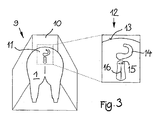
- Fig. 3 the sow 1 is shown in a schematically represented lock 9, which forces a stop of the animal with an end wall 10, wherein this end wall 10 is formed as a gate, then release the further movement of the animal.
- the animal can be monitored opto-electronically and also identified.
- the identification is usually necessary in order to recognize animals in the group housing and to be able to remove them from the group as needed, whether for covering, for farrowing or for separating in diseases.
- the identification can be carried out by conventional means, for example markings, in particular ear markings, which respond to electromagnetic transmission signals.
- FIG. 12 shows a (trimmed) tail 14, an anus 15 and a vulva 16 whose basic distances could still be monitored and corrected if necessary within a lock such as the lock 9 in the image analysis.
- image 12 is already meaningful in terms of swelling, redness, injuries, special excretions such as illness-related excrement, mucus or abortions.
- the image analysis such as the image evaluation 4 in Fig. 1 or the image analysis 7 in Fig. 2 are then able to give ongoing monitoring messages and in particular to signal signs on alarm devices or on a screen device, so necessary action will be taken early.
- Such a monitoring device provides a significant relief of the breeder and provides increased security against neglect in breeding, which can easily occur in large numbers, especially in animal husbandry.
Landscapes
- Life Sciences & Earth Sciences (AREA)
- Health & Medical Sciences (AREA)
- Veterinary Medicine (AREA)
- Animal Husbandry (AREA)
- Environmental Sciences (AREA)
- Wood Science & Technology (AREA)
- Pregnancy & Childbirth (AREA)
- Engineering & Computer Science (AREA)
- Biophysics (AREA)
- Biodiversity & Conservation Biology (AREA)
- Zoology (AREA)
- Animal Behavior & Ethology (AREA)
- General Health & Medical Sciences (AREA)
- Public Health (AREA)
- Measuring And Recording Apparatus For Diagnosis (AREA)
- Measurement Of The Respiration, Hearing Ability, Form, And Blood Characteristics Of Living Organisms (AREA)
- Image Analysis (AREA)
Applications Claiming Priority (1)
| Application Number | Priority Date | Filing Date | Title |
|---|---|---|---|
| DE200610044037 DE102006044037A1 (de) | 2006-09-14 | 2006-09-14 | Überwachungseinrichtung und Überwachungsverfahren für Tiere |
Publications (1)
| Publication Number | Publication Date |
|---|---|
| EP1900278A1 true EP1900278A1 (fr) | 2008-03-19 |
Family
ID=38658020
Family Applications (1)
| Application Number | Title | Priority Date | Filing Date |
|---|---|---|---|
| EP07016703A Withdrawn EP1900278A1 (fr) | 2006-09-14 | 2007-08-25 | Dispositif de surveillance et procédé de surveillance pour animaux |
Country Status (2)
| Country | Link |
|---|---|
| EP (1) | EP1900278A1 (fr) |
| DE (1) | DE102006044037A1 (fr) |
Cited By (5)
| Publication number | Priority date | Publication date | Assignee | Title |
|---|---|---|---|---|
| EP2260699A3 (fr) * | 2009-06-10 | 2012-03-07 | Big Dutchman Pig Equipment GmbH | Dispositif d'orientation d'animaux d'élevage doté d'une assistance optique |
| US9675253B2 (en) | 2011-04-05 | 2017-06-13 | Delaval Holding Ab | Animal handling arrangement and method |
| US9684956B2 (en) | 2008-12-03 | 2017-06-20 | Delaval Holding Ab | Arrangement and method for determining a body condition score of an animal |
| WO2023019348A1 (fr) * | 2021-08-20 | 2023-02-23 | Groupe Ro-Main Inc. | Détection de chaleurs chez des animaux à des fins d'insémination |
| CN117546783A (zh) * | 2023-12-12 | 2024-02-13 | 双胞胎(集团)股份有限公司 | 一种养殖场智能化清洁方法及清洁系统 |
Families Citing this family (1)
| Publication number | Priority date | Publication date | Assignee | Title |
|---|---|---|---|---|
| DE102014017435A1 (de) | 2014-11-25 | 2016-05-25 | FBN - Leibniz-Institut für Nutztierbiologie | Verfahren zur qualitativen Vorhersage von Geburtsterminen bei Nutztieren |
Citations (6)
| Publication number | Priority date | Publication date | Assignee | Title |
|---|---|---|---|---|
| JP2000093042A (ja) * | 1998-09-25 | 2000-04-04 | Fujihira Kogyo Kk | 牛の個体識別方法 |
| EP1057403A1 (fr) * | 1998-12-24 | 2000-12-06 | Surge Miyawaki Co., Ltd. | Systeme de gestion d'enregistrement d'animaux permettant leur identification |
| DE10239674A1 (de) | 2002-08-26 | 2004-03-11 | Hölscher & Leuschner GmbH & Co | Verfahren zur Überwachung von Mastschweinen auf Vermarktungsreife |
| EP1400169A1 (fr) * | 2001-06-01 | 2004-03-24 | Surge Miyawaki Co., Ltd. | Procede de gestion d'images d'animaux et procede d'enregistrement d'images |
| WO2005034618A1 (fr) * | 2003-10-10 | 2005-04-21 | Ab Svenska Mätanalys | Procede et dispositif de surveillance de cochons |
| NL1025874C2 (nl) | 2004-04-02 | 2005-10-05 | Nedap Agri B V | Conditiebepaling voor dieren. |
-
2006
- 2006-09-14 DE DE200610044037 patent/DE102006044037A1/de not_active Withdrawn
-
2007
- 2007-08-25 EP EP07016703A patent/EP1900278A1/fr not_active Withdrawn
Patent Citations (6)
| Publication number | Priority date | Publication date | Assignee | Title |
|---|---|---|---|---|
| JP2000093042A (ja) * | 1998-09-25 | 2000-04-04 | Fujihira Kogyo Kk | 牛の個体識別方法 |
| EP1057403A1 (fr) * | 1998-12-24 | 2000-12-06 | Surge Miyawaki Co., Ltd. | Systeme de gestion d'enregistrement d'animaux permettant leur identification |
| EP1400169A1 (fr) * | 2001-06-01 | 2004-03-24 | Surge Miyawaki Co., Ltd. | Procede de gestion d'images d'animaux et procede d'enregistrement d'images |
| DE10239674A1 (de) | 2002-08-26 | 2004-03-11 | Hölscher & Leuschner GmbH & Co | Verfahren zur Überwachung von Mastschweinen auf Vermarktungsreife |
| WO2005034618A1 (fr) * | 2003-10-10 | 2005-04-21 | Ab Svenska Mätanalys | Procede et dispositif de surveillance de cochons |
| NL1025874C2 (nl) | 2004-04-02 | 2005-10-05 | Nedap Agri B V | Conditiebepaling voor dieren. |
Cited By (9)
| Publication number | Priority date | Publication date | Assignee | Title |
|---|---|---|---|---|
| US9684956B2 (en) | 2008-12-03 | 2017-06-20 | Delaval Holding Ab | Arrangement and method for determining a body condition score of an animal |
| EP2260699A3 (fr) * | 2009-06-10 | 2012-03-07 | Big Dutchman Pig Equipment GmbH | Dispositif d'orientation d'animaux d'élevage doté d'une assistance optique |
| EP2786655A1 (fr) * | 2009-06-10 | 2014-10-08 | Big Dutchman Pig Equipment GmbH | Dispositif d'orientation d'animaux d'élevage doté d'une assistance optique et procédé de surveillance de parturition |
| EP3066918B1 (fr) | 2009-06-10 | 2019-08-07 | Big Dutchman International GmbH | Dispositif d'orientation d'animaux d'élevage doté d'une assistance optique |
| EP3066918B2 (fr) † | 2009-06-10 | 2023-03-29 | Big Dutchman International GmbH | Dispositif d'orientation d'animaux d'elevage dote d'une assistance optique |
| US9675253B2 (en) | 2011-04-05 | 2017-06-13 | Delaval Holding Ab | Animal handling arrangement and method |
| WO2023019348A1 (fr) * | 2021-08-20 | 2023-02-23 | Groupe Ro-Main Inc. | Détection de chaleurs chez des animaux à des fins d'insémination |
| US12219934B2 (en) | 2021-08-20 | 2025-02-11 | Groupe Ro-Main Inc. | Detecting estrus in animals for insemination |
| CN117546783A (zh) * | 2023-12-12 | 2024-02-13 | 双胞胎(集团)股份有限公司 | 一种养殖场智能化清洁方法及清洁系统 |
Also Published As
| Publication number | Publication date |
|---|---|
| DE102006044037A1 (de) | 2008-03-27 |
Similar Documents
| Publication | Publication Date | Title |
|---|---|---|
| EP2879615B1 (fr) | Procédé de détection de la probabilité d'un oestrus | |
| DE69524898T3 (de) | Vorrichtung zum automatischen Melken von Tieren | |
| DE69629869T2 (de) | Messeinrichtung für die Aktivität von Tieren | |
| DE69427015T2 (de) | Informationssystem und Verfahren zum Erhalten von Daten bezüglich Milchvieh | |
| EP2624752B1 (fr) | Procédé et dispositif pour déterminer l'humeur d'un cheval | |
| DE69412896T2 (de) | Verfahren und Vorrichtung zur automatischen Beobachtung des Verhaltens von Tieren | |
| DE102007036294A1 (de) | Vorrichtung und ein Verfahren zum Bereitstellen von Informationen über Tiere beim Durchlaufen eines Tierdurchganges | |
| EP1900278A1 (fr) | Dispositif de surveillance et procédé de surveillance pour animaux | |
| EP2698763A1 (fr) | Procédé destiné à analyser un animal d'élevage vivant | |
| EP4291022B1 (fr) | Procédé et dispositif de suivi des animaux | |
| EP1316253A2 (fr) | Méthode et appareil pour l'élevage du bétail laitier | |
| EP3066918B2 (fr) | Dispositif d'orientation d'animaux d'elevage dote d'une assistance optique | |
| DE10351911A1 (de) | Verfahren und Vorrichtung zur Bereitstellung von Informationen über die Melkplatzbelegung eines Melksystems | |
| DE202017007640U1 (de) | Vorrichtung zum Detektieren der Lahmheit einer Kuh | |
| EP2168430A1 (fr) | Procédé de surveillance de porcs | |
| DE10350844A1 (de) | Verfahren und Vorrichtung zur Durchführung einer tierbezogenen Behandlung | |
| EP1396188B1 (fr) | Méthode pour surveiller des porcs | |
| EP3075348B1 (fr) | Procede et dispositif d'affichage d'une vache laitiere vraisemblablement boiteuse a selectionner a partir d'un troupeau | |
| DE102005031425A1 (de) | Verfahren und Vorrichtung zum Management von milchgebenden Tieren | |
| DE202012005653U1 (de) | Multifunktionseinheit zur Durchführung von Maßnahmen an Nutztieren | |
| DE102013210938B4 (de) | Sauenstall sowie ein Verfahren zum Aufziehen von Nutztieren | |
| DE202007012558U1 (de) | Vorrichtung zum Bereitstellen von Informationen über Tiere beim Durchlaufen eines Tierdurchganges | |
| DE4025404A1 (de) | Frueherkennung von krankheiten in der tierhaltung | |
| AT527308A4 (de) | Reinigungsvorrichtung für eine Tierstallung | |
| DE102017011816A1 (de) | Verfahren zur mobilen Messgrößengewinnung von Geflügeltieren, welches die Messgrößen an ein Messgrößenverarbeitungsgerät weiterleitet. |
Legal Events
| Date | Code | Title | Description |
|---|---|---|---|
| PUAI | Public reference made under article 153(3) epc to a published international application that has entered the european phase |
Free format text: ORIGINAL CODE: 0009012 |
|
| AK | Designated contracting states |
Kind code of ref document: A1 Designated state(s): AT BE BG CH CY CZ DE DK EE ES FI FR GB GR HU IE IS IT LI LT LU LV MC MT NL PL PT RO SE SI SK TR |
|
| AX | Request for extension of the european patent |
Extension state: AL BA HR MK YU |
|
| 17P | Request for examination filed |
Effective date: 20080915 |
|
| 17Q | First examination report despatched |
Effective date: 20081021 |
|
| AKX | Designation fees paid |
Designated state(s): AT BE BG CH CY CZ DE DK EE ES FI FR GB GR HU IE IS IT LI LT LU LV MC MT NL PL PT RO SE SI SK TR |
|
| STAA | Information on the status of an ep patent application or granted ep patent |
Free format text: STATUS: THE APPLICATION HAS BEEN WITHDRAWN |
|
| 18W | Application withdrawn |
Effective date: 20140530 |