EP2168430A1 - Procédé de surveillance de porcs - Google Patents
Procédé de surveillance de porcs Download PDFInfo
- Publication number
- EP2168430A1 EP2168430A1 EP08016957A EP08016957A EP2168430A1 EP 2168430 A1 EP2168430 A1 EP 2168430A1 EP 08016957 A EP08016957 A EP 08016957A EP 08016957 A EP08016957 A EP 08016957A EP 2168430 A1 EP2168430 A1 EP 2168430A1
- Authority
- EP
- European Patent Office
- Prior art keywords
- pig
- typing
- data processing
- monitoring station
- pigs
- Prior art date
- Legal status (The legal status is an assumption and is not a legal conclusion. Google has not performed a legal analysis and makes no representation as to the accuracy of the status listed.)
- Withdrawn
Links
Images
Classifications
-
- A—HUMAN NECESSITIES
- A01—AGRICULTURE; FORESTRY; ANIMAL HUSBANDRY; HUNTING; TRAPPING; FISHING
- A01K—ANIMAL HUSBANDRY; AVICULTURE; APICULTURE; PISCICULTURE; FISHING; REARING OR BREEDING ANIMALS, NOT OTHERWISE PROVIDED FOR; NEW BREEDS OF ANIMALS
- A01K29/00—Other apparatus for animal husbandry
Definitions
- the present invention relates to a method for monitoring pigs with the aid of a monitoring station provided with an optical detection system, in which body measurements of a single pig standing in the monitoring station are detected and forwarded to a data processing in which the detected body measurements are evaluated completely or further.
- pigs are fed ad lib or dosed liquid or dry by live weight or fattening day.
- the feeding management is usually based on a phase feeding with different feed compositions for given weight sections of fattening pigs. Soaring feed prices are putting increasing pressure on pig farmers or breeders.
- the operators At the end of the rearing or fattening period to achieve an optimal marketing result, the operators must precisely weigh the pigs and assess to what extent an optimal marketing result can be achieved or whether an extended fattening is necessary.
- pig typing can be performed such that the pig is assigned to a group of pigs having at least one similar or identical trait, group-specific treat, ie in particular, be able to separate and feed, for example, group-specific.
- a typing animal-specific characteristics such as gender, growth and behavioral properties, lean meat content, fat content or the mass of the pig can be considered in order to make a targeted prediction for the success of a further fattening or marketing. It is therefore initially a grouping of pigs in similar types. Within this type or these type groups or clusters can then optionally be decided on a marketing, or the marketing decision, as for example in the EP 1396188B1 can be made more specific.
- a pig farm only has to rarely be personally checked by the operating personnel, as the subdivision into groups in connection with the targeted control of feed or marketing areas can be automated.
- the optical detection system of the monitoring station takes a recording of the body measurements in a corresponding group and then made a decision regarding feeding by subsequent arrival and Auf Kunststoffn one of several possible outputs of a monitoring station to the pig in a special Pilot feeding station.
- the number of dependent or independently definable characteristics for the definition of a type is open and depends, for example, on the possibilities of being able to treat different groups differently.
- health features such as body temperature or phenomenological parameters such as skin discoloration may be used.
- the simplest typing is typing by gender.
- gender of each animal can be determined from its shape during each passage through the monitoring station via a mathematical analysis method.
- the division into male and female pigs, the former being shorter, broader, with a weaker ham, a broader belly, a broader shoulder and a considerably broader shoulder than female pigs, the longer, narrower, with a stronger back and a considerably narrower belly , Narrow shoulder approach and a narrower shoulder are provided, for example, particularly easy on image-based recognition of the mentioned differences feasible.
- Feed intake and daily gains in weight are higher for Börgen and higher in fat than in females. This results in a longer fattening period of the female animals compared to the Börgen.
- Adapted to the sex adapted feeding, especially with regard to the feed composition and the amount of feed and possibly the quality of the feed already results in an improvement of the biological performance during fattening. In addition, there is an improvement in meat quality and, consequently, a higher slaughtering revenue.
- the sex separation during feeding thus leads to a higher meat quality and / or to reductions in feed costs.
- the typing is not given directly by the biological sex, but refined by the typification on the basis of a subdivision according to the so-called “physiological” sex, which takes into account that the biological sex is "male” or “female".
- This typification under any additional definition of a "neutral” type can also be based on the image recognition or the optical monitoring and the evaluation of the corresponding measurement results, if necessary using additional biological sex information for typing.
- the typing is based on growth parameters.
- groups of vigorous, normal and weak-growth pigs may preferably be maintained over a time-discrete, i. Recurring measurement of individual, especially individualized pigs are detected.
- a type matrix can be created on the basis of which optimal feeding during a fattening can be achieved.
- information about the contour of the pig in the monitoring station is advantageous as the body measurements underlying the clustering.
- the body measurements found are divided into groups. For this a number of characteristic points are defined. These characteristic values can then be assigned to groups of values and thus already used for typing. However, a finite number of these characteristic points can also be extracted from the image analysis and approximated in advance from a contour curve of the pig or from another characteristic curve. The typing then takes place, for example, on the basis of the approximated one Contour curve.
- a normalization of the area imaged by the contour curve in particular using a height information, to make, for example, the necessary for the decision ham, abdominal or normal pig typing regardless of the size of the pig.
- the data processing is provided with a predetermined number of types into which the body measurements or characteristic quantities developed therefrom are fit by means of structure-testing analysis, for example regression or the like.
- this type of typing is a comparatively quickly vorappelliche typing, however, on the one hand preparatory work requires, on the other hand requires that the pig to be monitored falls into the given class or types.
- the data processing is able to independently form types from a plurality of monitored pigs, wherein the recorded body measurements develop their own types or clusters by means of a structure-forming analysis, for example with the aid of cluster analysis or the use of neural networks ,
- clusters can be partially defined by the data processing by preference of certain defined points, but they can also arise independently from the recorded measured values.
- basic data or clustering or typing information found in a pig stock may be transmitted from the data processing to a central server, which matches the clusters found by the individual growers, thus forming a pool of clusters At the same time, this is the starting point for further new data processing.
- a type of modified or newly found cluster can also be made available to already existing data processing by means of an update.
- the data processing can thus be connected via conventional means of communication such as telephone, Internet connections or the like with a preferably central server or other decentralized networks.
- the typing information can preferably be on a on or in the pig arranged information carrier to be transmitted and stored there. This can be done using conventional RFID or other chips.
- the data processing in the monitoring station accesses an information carrier arranged on or in the pig for typing purposes and carries this out at certain times, optionally without additional evaluation of the body measurement information.
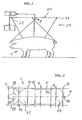
- a pig 1 is shown, which is monitored and recorded with the aid of an optical detection system 2, for example a digital camera, with respect to its body measurements.
- the body measurements are forwarded to a data processor 3 in which the body measurements are evaluated.
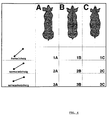
- the pig is typed, ie in one of the example in Fig. 6 groups clustered in order to be able to treat the pig itself on the one hand, and the members of the cluster / type on the other hand, in a group-specific manner.
- the combination between the growth type determined in particular from temporally offset measurements as well as the quality type ham pig (A), normal pig (B) and belly pig (C) (cf. Fig. 5 ) with the vigor results in a differentiated voting possibility for an adapted feeding.
- the ideal feed adaptation is thus no longer carried out according to weight groups or weighted according to a marketing differently evaluated meat parts, but made according to the groups of different combinations of features.
- the decision on a fattening or marketing and thus the date of delivery of the pig is thus primarily dependent on the type found and only at preferably downstream of attainable in a marketing sales proceeds of the individual meat areas.
- the decision already known from the state of the art to market the pig on the basis of a weighting of the body measured values as a function of the sales proceeds of different meat areas thus takes place at least in combination with a preceding typing or within the individual groups.
- the evaluation in the data processing 3 leads to the output of a control signal to an output device 4.
- this is a display device.
- the control signal is connected to the control of an actuating unit which, depending on the evaluation, releases one of several possible outputs from the monitoring station, which is preferably designed as a lock.
- a typed i. for example, sex-matched feeding or pigs may be collected in a bay for marketing.
- the metrological evaluation can thus on the one hand be done by a mobile monitoring station, in which the camera 2, the evaluation 3 and the output device 4 are brought with a chassis on the pig to be monitored, on the other hand, however, it is advantageously to the trained as a lock monitoring station different outputs.
- Fig. 1 is at the level of the camera 2 for this purpose a base 20 indicated for a measuring system, which for a known manner various executable mechanical support structure stands and can also hold the device technology for evaluation 3 and output device 4.
- Distance measuring systems 21 and 22 which may alternatively or additionally also be developed as further optical detection, are permanently installed opposite the camera so as to obtain information about the height of the pig under consideration or three-dimensional information about the shape of the pig or its shape To get surface appearance.
- the height measuring systems 21, 22 monitor the vertical distances, so that based on the information obtained, a normalization of the image measured by means of the optical monitoring system 22 can take place.
- Fig. 2 the contour of a recorded image of the optical monitoring device 2 is shown in outline, wherein the contour line 5 of the pig 1 has already been developed by the data evaluation with a complex mathematical analysis method.
- the data processing can also record only characteristic points which result from the recorded pixel information, for example as a contour line between light and dark image areas.
- characteristic points serve in Fig. 2 For example, intersections of the contour line 5 with the lines 7 to 14.
- a center line 6, a front and a rear boundary line 7,8, and a middle transverse line 9 and therebetween in each middle leg areas existing cross lines 10,11 for a largest width and the intervening Cross-lines 12 to 14 for the thigh approaches and a neck approach are examples of characteristic lines that result in the cutting area with the contour measured values, with which a successful typing can be made.
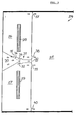
- FIG. 3 In the Fig. 1 shown monitoring station 23 is advantageously integrated in a lock, as they FIG. 3 can be seen.
- Feeding areas 26, 27 arrive.
- the feeding areas 26,27 are provided with feeding devices 28 and 29, respectively, which may be in particular part of an automatic feeding system.
- the pigs can pass through the lock 31 shown in a selection area 30, which is intended for marketing purposes.
- Arrows 42 characterize the different possible paths of the pigs 1.
- the access to the different areas via the lock 31 takes place only in a fixed predetermined direction from the lying area 25 through a gate 32 and thus under compulsory detection of the pig in the monitoring station 23rd
- Paths 33 and 34 are the only outputs from the monitoring station that can not be exited by gate 32.
- the selection region 30, delimited by separating gates, in a gate region adjoining the lock 31 has a pivoting gate 35, which is pivotable into the gate position 36 shown in a broken line. From the feeding areas 26 and 27, the animals can return to the lying area 25 by a path 37, 38, 39 or 40.
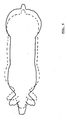
- the contour or body measurement data found by a monitoring station can be assigned to the in Fig. 4 Typing shown in male (dashed) and female (solid) pig types.
- intermediate types can be defined, since the biological sex male or female does not provide a clear criterion as a basis for optimal feeding and marketing. Some of the females behave like males and vice versa.
- physiological sex ie "physiologically male” and “physiologically female” and “neutral” offers.
- physiological sex ie "physiologically male” and “physiologically female” and “neutral” offers.
- This type of typing is particularly using additional information, the extent to which it is a (biological) male or female animal with the help of additional optical detection devices possible.
- a growth- or meat-stressed pig can be identified with the aid of the mathematical evaluation.
- the incremental criteria of low-medium growth, in particular the use of approximated or otherwise determined weight information, are decisive for the subdivision into types.
- a combination between gender type and growth type results in a differentiated matching option for an adapted feeding.
- the ideal feed adaptation according to the amount of feed, the feed composition and the feed allocation during the course of the day is thus no longer guided by weight groups, but also differs in groups of different type and sex combinations.
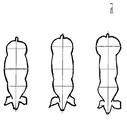
- the in Fig. 5 pigs further preferred examples of regarding marketing criteria such as ham (lower figure of the Fig. 5 ), Average pig (middle picture of the Fig. 5 ) and belly pig (upper picture of the Fig. 5 ) identifiable types. From these three types, which can be discovered and arranged on the basis of the body contour, in connection with the vigor the in Fig. 6 type matrix shown with groups or types 1A, 2A, 3A, 1B, 2B, 3B, 1C, 2C, 3C are created from which then with the help of the type analysis for each pig optimization of a marketing time can be automatically created.
- marketing criteria such as ham (lower figure of the Fig. 5 ), Average pig (middle picture of the Fig. 5 ) and belly pig (upper picture of the Fig. 5 ) identifiable types. From these three types, which can be discovered and arranged on the basis of the body contour, in connection with the vigor the in Fig. 6 type matrix shown with groups or types 1
- the advantageous mixed sexual attitude in the lying area results in a separate sexual feeding and a typed, i. optimal marketing of individual pigs.
Landscapes
- Life Sciences & Earth Sciences (AREA)
- Environmental Sciences (AREA)
- Animal Husbandry (AREA)
- Biodiversity & Conservation Biology (AREA)
- Measurement Of The Respiration, Hearing Ability, Form, And Blood Characteristics Of Living Organisms (AREA)
Priority Applications (1)
| Application Number | Priority Date | Filing Date | Title |
|---|---|---|---|
| EP08016957A EP2168430A1 (fr) | 2008-09-26 | 2008-09-26 | Procédé de surveillance de porcs |
Applications Claiming Priority (1)
| Application Number | Priority Date | Filing Date | Title |
|---|---|---|---|
| EP08016957A EP2168430A1 (fr) | 2008-09-26 | 2008-09-26 | Procédé de surveillance de porcs |
Publications (1)
| Publication Number | Publication Date |
|---|---|
| EP2168430A1 true EP2168430A1 (fr) | 2010-03-31 |
Family
ID=40256528
Family Applications (1)
| Application Number | Title | Priority Date | Filing Date |
|---|---|---|---|
| EP08016957A Withdrawn EP2168430A1 (fr) | 2008-09-26 | 2008-09-26 | Procédé de surveillance de porcs |
Country Status (1)
| Country | Link |
|---|---|
| EP (1) | EP2168430A1 (fr) |
Cited By (8)
| Publication number | Priority date | Publication date | Assignee | Title |
|---|---|---|---|---|
| EP2260699A3 (fr) * | 2009-06-10 | 2012-03-07 | Big Dutchman Pig Equipment GmbH | Dispositif d'orientation d'animaux d'élevage doté d'une assistance optique |
| DE202014005891U1 (de) | 2014-07-22 | 2015-10-27 | Csb-System Ag | Vorrichtung zur optischen Geschlechtserkennung eines Schlachtschweins |
| DE102015005048A1 (de) | 2015-04-21 | 2016-10-27 | Agrar Handelspartner Woldegk GmbH | Elektrodenanordnung zur Messung der Bioimpedanz von Schweinen |
| EP3669644A1 (fr) * | 2018-12-19 | 2020-06-24 | Urban Holding GmbH | Appareil de mesure ainsi que système doté d'une tel appareil de mesure et procédé de détection de masses corporelles assisté par ordinateur |
| CN112906734A (zh) * | 2021-01-13 | 2021-06-04 | 新希望六和股份有限公司 | 牲畜智能选种方法、装置、计算机设备和存储介质 |
| CN113262072A (zh) * | 2021-04-25 | 2021-08-17 | 江苏省农业科学院 | 一种用于喷洒噬菌体生物制剂的智能雾化装置及应用方法 |
| CN114341599A (zh) * | 2019-09-06 | 2022-04-12 | 日本火腿株式会社 | 成长评估装置、成长评估方法和成长评估程序 |
| CN117470060A (zh) * | 2023-12-28 | 2024-01-30 | 济南豪赛良种羊养殖有限公司 | 一种羊体长监控测量装置及方法 |
Citations (4)
| Publication number | Priority date | Publication date | Assignee | Title |
|---|---|---|---|---|
| WO1999044414A2 (fr) * | 1998-03-03 | 1999-09-10 | Kristoffer Larsen Innovation A/S | Systeme d'elevage d'animaux |
| US20010044579A1 (en) * | 1996-11-12 | 2001-11-22 | Pratt William C. | Ruminant tissue analysis at packing plants for electronic cattle management and grading meat |
| US20070204807A1 (en) * | 2006-03-06 | 2007-09-06 | Andy Rausch | Sorter trainer gate assembly |
| EP1396188B1 (fr) | 2002-08-26 | 2008-03-12 | Hölscher & Leuschner GmbH & Co. | Méthode pour surveiller des porcs |
-
2008
- 2008-09-26 EP EP08016957A patent/EP2168430A1/fr not_active Withdrawn
Patent Citations (4)
| Publication number | Priority date | Publication date | Assignee | Title |
|---|---|---|---|---|
| US20010044579A1 (en) * | 1996-11-12 | 2001-11-22 | Pratt William C. | Ruminant tissue analysis at packing plants for electronic cattle management and grading meat |
| WO1999044414A2 (fr) * | 1998-03-03 | 1999-09-10 | Kristoffer Larsen Innovation A/S | Systeme d'elevage d'animaux |
| EP1396188B1 (fr) | 2002-08-26 | 2008-03-12 | Hölscher & Leuschner GmbH & Co. | Méthode pour surveiller des porcs |
| US20070204807A1 (en) * | 2006-03-06 | 2007-09-06 | Andy Rausch | Sorter trainer gate assembly |
Cited By (12)
| Publication number | Priority date | Publication date | Assignee | Title |
|---|---|---|---|---|
| EP2260699A3 (fr) * | 2009-06-10 | 2012-03-07 | Big Dutchman Pig Equipment GmbH | Dispositif d'orientation d'animaux d'élevage doté d'une assistance optique |
| DE202014005891U1 (de) | 2014-07-22 | 2015-10-27 | Csb-System Ag | Vorrichtung zur optischen Geschlechtserkennung eines Schlachtschweins |
| WO2016011992A1 (fr) | 2014-07-22 | 2016-01-28 | Csb-System Ag | Dispositif pour la détection optique du sexe d'un porc de boucherie |
| US10165782B2 (en) | 2014-07-22 | 2019-01-01 | Csb-System Ag | Device for optically identifying the sex of a slaughter pig |
| DE102015005048A1 (de) | 2015-04-21 | 2016-10-27 | Agrar Handelspartner Woldegk GmbH | Elektrodenanordnung zur Messung der Bioimpedanz von Schweinen |
| EP3669644A1 (fr) * | 2018-12-19 | 2020-06-24 | Urban Holding GmbH | Appareil de mesure ainsi que système doté d'une tel appareil de mesure et procédé de détection de masses corporelles assisté par ordinateur |
| CN114341599A (zh) * | 2019-09-06 | 2022-04-12 | 日本火腿株式会社 | 成长评估装置、成长评估方法和成长评估程序 |
| CN112906734A (zh) * | 2021-01-13 | 2021-06-04 | 新希望六和股份有限公司 | 牲畜智能选种方法、装置、计算机设备和存储介质 |
| CN113262072A (zh) * | 2021-04-25 | 2021-08-17 | 江苏省农业科学院 | 一种用于喷洒噬菌体生物制剂的智能雾化装置及应用方法 |
| CN113262072B (zh) * | 2021-04-25 | 2024-05-14 | 江苏省农业科学院 | 一种用于喷洒噬菌体生物制剂的智能雾化装置的应用方法 |
| CN117470060A (zh) * | 2023-12-28 | 2024-01-30 | 济南豪赛良种羊养殖有限公司 | 一种羊体长监控测量装置及方法 |
| CN117470060B (zh) * | 2023-12-28 | 2024-03-26 | 济南豪赛良种羊养殖有限公司 | 一种羊体长监控测量装置及方法 |
Similar Documents
| Publication | Publication Date | Title |
|---|---|---|
| EP2168430A1 (fr) | Procédé de surveillance de porcs | |
| Heikkilä et al. | Costs of clinical mastitis with special reference to premature culling | |
| EP2879615B1 (fr) | Procédé de détection de la probabilité d'un oestrus | |
| Rossing | Animal identification: introduction and history | |
| EP4291022B1 (fr) | Procédé et dispositif de suivi des animaux | |
| DE69434630T2 (de) | Vorrichtung zum automatischen Melken von Tieren | |
| DE202017007640U1 (de) | Vorrichtung zum Detektieren der Lahmheit einer Kuh | |
| EP1396188B1 (fr) | Méthode pour surveiller des porcs | |
| DE10350844A1 (de) | Verfahren und Vorrichtung zur Durchführung einer tierbezogenen Behandlung | |
| Baumung et al. | Feed intake behaviour of different pig breeds during performance testing on station | |
| EP3075348B1 (fr) | Procede et dispositif d'affichage d'une vache laitiere vraisemblablement boiteuse a selectionner a partir d'un troupeau | |
| EP1900278A1 (fr) | Dispositif de surveillance et procédé de surveillance pour animaux | |
| EP1633185A1 (fr) | Procede et dispositif de traite d'animaux | |
| DE112006002458T5 (de) | Verfahren zum Optimieren der Gesundheit und Produktivität von Milch erzeugenden Tieren | |
| Jaeger et al. | Inbreeding and genetic relationships of the endangered dual-purpose Black and White cattle breed based on own genetic breed percentage calculations | |
| CN114065801B (zh) | 基于神经网络模型的土壤监测方法、系统和可读存储介质 | |
| Strabel et al. | The use of test day models with small size of contemporary groups | |
| Hossein-Zadeh et al. | Modeling the growth curves for body weight and some biometric traits in Caspian horses (Equus ferus caballus) using non-linear mixed models | |
| EP3726966A1 (fr) | Procédé d'élevage de porcs | |
| Boumans et al. | Exploring individual variation in gestating sows’ feeding patterns: applying self-organising maps to reveal behavioural types | |
| Moraes et al. | Climatic factors affecting gestational length in mares under subtropical climate | |
| El-Saied et al. | Lifetime traits comparison between annual and accelerated lambing systems for dairy ewes | |
| DE102004042658A1 (de) | Automatische Gemelksabtrennung | |
| Bengtsson et al. | Associations between body weight estimated with three-dimensional cameras and milk yield in Holstein, Jersey, and Red Dairy Cattle | |
| DE202013002292U1 (de) | Anordnung zur tierindividuellen Überwachung einer Gruppe von Mastschweinen in Gruppenhaltungen |
Legal Events
| Date | Code | Title | Description |
|---|---|---|---|
| PUAI | Public reference made under article 153(3) epc to a published international application that has entered the european phase |
Free format text: ORIGINAL CODE: 0009012 |
|
| AK | Designated contracting states |
Kind code of ref document: A1 Designated state(s): AT BE BG CH CY CZ DE DK EE ES FI FR GB GR HR HU IE IS IT LI LT LU LV MC MT NL NO PL PT RO SE SI SK TR |
|
| AX | Request for extension of the european patent |
Extension state: AL BA MK RS |
|
| AKY | No designation fees paid | ||
| STAA | Information on the status of an ep patent application or granted ep patent |
Free format text: STATUS: THE APPLICATION IS DEEMED TO BE WITHDRAWN |
|
| 18D | Application deemed to be withdrawn |
Effective date: 20101001 |
|
| REG | Reference to a national code |
Ref country code: DE Ref legal event code: R108 Effective date: 20110301 Ref country code: DE Ref legal event code: 8566 |