EP1901347A2 - Verfahren zur Kristallisierung einer Halbleiterfolie und durch dieses Verfahren kristallisierte Halbleiterfolie - Google Patents
Verfahren zur Kristallisierung einer Halbleiterfolie und durch dieses Verfahren kristallisierte Halbleiterfolie Download PDFInfo
- Publication number
- EP1901347A2 EP1901347A2 EP07252613A EP07252613A EP1901347A2 EP 1901347 A2 EP1901347 A2 EP 1901347A2 EP 07252613 A EP07252613 A EP 07252613A EP 07252613 A EP07252613 A EP 07252613A EP 1901347 A2 EP1901347 A2 EP 1901347A2
- Authority
- EP
- European Patent Office
- Prior art keywords
- forming
- semiconductor film
- layer
- bottom gate
- active
- Prior art date
- Legal status (The legal status is an assumption and is not a legal conclusion. Google has not performed a legal analysis and makes no representation as to the accuracy of the status listed.)
- Withdrawn
Links
Images



Classifications
-
- H—ELECTRICITY
- H10—SEMICONDUCTOR DEVICES; ELECTRIC SOLID-STATE DEVICES NOT OTHERWISE PROVIDED FOR
- H10P—GENERIC PROCESSES OR APPARATUS FOR THE MANUFACTURE OR TREATMENT OF DEVICES COVERED BY CLASS H10
- H10P14/00—Formation of materials, e.g. in the shape of layers or pillars
- H10P14/20—Formation of materials, e.g. in the shape of layers or pillars of semiconductor materials
- H10P14/38—Formation of materials, e.g. in the shape of layers or pillars of semiconductor materials characterised by treatments done after the formation of the materials
- H10P14/3802—Crystallisation or recrystallisation of non-monocrystalline semiconductor materials, e.g. regrowth
- H10P14/3808—Crystallisation or recrystallisation of non-monocrystalline semiconductor materials, e.g. regrowth using laser beams
- H10P14/3816—Pulsed laser beam
-
- H—ELECTRICITY
- H10—SEMICONDUCTOR DEVICES; ELECTRIC SOLID-STATE DEVICES NOT OTHERWISE PROVIDED FOR
- H10D—INORGANIC ELECTRIC SEMICONDUCTOR DEVICES
- H10D30/00—Field-effect transistors [FET]
- H10D30/01—Manufacture or treatment
- H10D30/021—Manufacture or treatment of FETs having insulated gates [IGFET]
- H10D30/031—Manufacture or treatment of FETs having insulated gates [IGFET] of thin-film transistors [TFT]
- H10D30/0321—Manufacture or treatment of FETs having insulated gates [IGFET] of thin-film transistors [TFT] comprising silicon, e.g. amorphous silicon or polysilicon
-
- H—ELECTRICITY
- H10—SEMICONDUCTOR DEVICES; ELECTRIC SOLID-STATE DEVICES NOT OTHERWISE PROVIDED FOR
- H10D—INORGANIC ELECTRIC SEMICONDUCTOR DEVICES
- H10D30/00—Field-effect transistors [FET]
- H10D30/60—Insulated-gate field-effect transistors [IGFET]
- H10D30/67—Thin-film transistors [TFT]
- H10D30/6729—Thin-film transistors [TFT] characterised by the electrodes
- H10D30/673—Thin-film transistors [TFT] characterised by the electrodes characterised by the shapes, relative sizes or dispositions of the gate electrodes
- H10D30/6733—Multi-gate TFTs
- H10D30/6734—Multi-gate TFTs having gate electrodes arranged on both top and bottom sides of the channel, e.g. dual-gate TFTs
-
- H—ELECTRICITY
- H10—SEMICONDUCTOR DEVICES; ELECTRIC SOLID-STATE DEVICES NOT OTHERWISE PROVIDED FOR
- H10D—INORGANIC ELECTRIC SEMICONDUCTOR DEVICES
- H10D86/00—Integrated devices formed in or on insulating or conducting substrates, e.g. formed in silicon-on-insulator [SOI] substrates or on stainless steel or glass substrates
- H10D86/01—Manufacture or treatment
- H10D86/021—Manufacture or treatment of multiple TFTs
- H10D86/0221—Manufacture or treatment of multiple TFTs comprising manufacture, treatment or patterning of TFT semiconductor bodies
- H10D86/0223—Manufacture or treatment of multiple TFTs comprising manufacture, treatment or patterning of TFT semiconductor bodies comprising crystallisation of amorphous, microcrystalline or polycrystalline semiconductor materials
- H10D86/0227—Manufacture or treatment of multiple TFTs comprising manufacture, treatment or patterning of TFT semiconductor bodies comprising crystallisation of amorphous, microcrystalline or polycrystalline semiconductor materials using structural arrangements to control crystal growth, e.g. placement of grain filters
-
- H—ELECTRICITY
- H10—SEMICONDUCTOR DEVICES; ELECTRIC SOLID-STATE DEVICES NOT OTHERWISE PROVIDED FOR
- H10P—GENERIC PROCESSES OR APPARATUS FOR THE MANUFACTURE OR TREATMENT OF DEVICES COVERED BY CLASS H10
- H10P14/00—Formation of materials, e.g. in the shape of layers or pillars
- H10P14/20—Formation of materials, e.g. in the shape of layers or pillars of semiconductor materials
- H10P14/29—Formation of materials, e.g. in the shape of layers or pillars of semiconductor materials characterised by the substrates
- H10P14/2901—Materials
- H10P14/2921—Materials being crystalline insulating materials
-
- H—ELECTRICITY
- H10—SEMICONDUCTOR DEVICES; ELECTRIC SOLID-STATE DEVICES NOT OTHERWISE PROVIDED FOR
- H10P—GENERIC PROCESSES OR APPARATUS FOR THE MANUFACTURE OR TREATMENT OF DEVICES COVERED BY CLASS H10
- H10P14/00—Formation of materials, e.g. in the shape of layers or pillars
- H10P14/20—Formation of materials, e.g. in the shape of layers or pillars of semiconductor materials
- H10P14/29—Formation of materials, e.g. in the shape of layers or pillars of semiconductor materials characterised by the substrates
- H10P14/2901—Materials
- H10P14/2922—Materials being non-crystalline insulating materials, e.g. glass or polymers
-
- H—ELECTRICITY
- H10—SEMICONDUCTOR DEVICES; ELECTRIC SOLID-STATE DEVICES NOT OTHERWISE PROVIDED FOR
- H10P—GENERIC PROCESSES OR APPARATUS FOR THE MANUFACTURE OR TREATMENT OF DEVICES COVERED BY CLASS H10
- H10P14/00—Formation of materials, e.g. in the shape of layers or pillars
- H10P14/20—Formation of materials, e.g. in the shape of layers or pillars of semiconductor materials
- H10P14/32—Formation of materials, e.g. in the shape of layers or pillars of semiconductor materials characterised by intermediate layers between substrates and deposited layers
- H10P14/3202—Materials thereof
- H10P14/3204—Materials thereof being Group IVA semiconducting materials
- H10P14/3211—Silicon, silicon germanium or germanium
-
- H—ELECTRICITY
- H10—SEMICONDUCTOR DEVICES; ELECTRIC SOLID-STATE DEVICES NOT OTHERWISE PROVIDED FOR
- H10P—GENERIC PROCESSES OR APPARATUS FOR THE MANUFACTURE OR TREATMENT OF DEVICES COVERED BY CLASS H10
- H10P14/00—Formation of materials, e.g. in the shape of layers or pillars
- H10P14/20—Formation of materials, e.g. in the shape of layers or pillars of semiconductor materials
- H10P14/32—Formation of materials, e.g. in the shape of layers or pillars of semiconductor materials characterised by intermediate layers between substrates and deposited layers
- H10P14/3202—Materials thereof
- H10P14/3238—Materials thereof being insulating materials
-
- H—ELECTRICITY
- H10—SEMICONDUCTOR DEVICES; ELECTRIC SOLID-STATE DEVICES NOT OTHERWISE PROVIDED FOR
- H10P—GENERIC PROCESSES OR APPARATUS FOR THE MANUFACTURE OR TREATMENT OF DEVICES COVERED BY CLASS H10
- H10P14/00—Formation of materials, e.g. in the shape of layers or pillars
- H10P14/20—Formation of materials, e.g. in the shape of layers or pillars of semiconductor materials
- H10P14/32—Formation of materials, e.g. in the shape of layers or pillars of semiconductor materials characterised by intermediate layers between substrates and deposited layers
- H10P14/3242—Structure
- H10P14/3244—Layer structure
-
- H—ELECTRICITY
- H10—SEMICONDUCTOR DEVICES; ELECTRIC SOLID-STATE DEVICES NOT OTHERWISE PROVIDED FOR
- H10P—GENERIC PROCESSES OR APPARATUS FOR THE MANUFACTURE OR TREATMENT OF DEVICES COVERED BY CLASS H10
- H10P14/00—Formation of materials, e.g. in the shape of layers or pillars
- H10P14/20—Formation of materials, e.g. in the shape of layers or pillars of semiconductor materials
- H10P14/32—Formation of materials, e.g. in the shape of layers or pillars of semiconductor materials characterised by intermediate layers between substrates and deposited layers
- H10P14/3242—Structure
- H10P14/3244—Layer structure
- H10P14/3248—Layer structure consisting of two layers
-
- H—ELECTRICITY
- H10—SEMICONDUCTOR DEVICES; ELECTRIC SOLID-STATE DEVICES NOT OTHERWISE PROVIDED FOR
- H10P—GENERIC PROCESSES OR APPARATUS FOR THE MANUFACTURE OR TREATMENT OF DEVICES COVERED BY CLASS H10
- H10P14/00—Formation of materials, e.g. in the shape of layers or pillars
- H10P14/20—Formation of materials, e.g. in the shape of layers or pillars of semiconductor materials
- H10P14/34—Deposited materials, e.g. layers
- H10P14/3402—Deposited materials, e.g. layers characterised by the chemical composition
- H10P14/3404—Deposited materials, e.g. layers characterised by the chemical composition being Group IVA materials
- H10P14/3411—Silicon, silicon germanium or germanium
-
- H—ELECTRICITY
- H10—SEMICONDUCTOR DEVICES; ELECTRIC SOLID-STATE DEVICES NOT OTHERWISE PROVIDED FOR
- H10P—GENERIC PROCESSES OR APPARATUS FOR THE MANUFACTURE OR TREATMENT OF DEVICES COVERED BY CLASS H10
- H10P14/00—Formation of materials, e.g. in the shape of layers or pillars
- H10P14/20—Formation of materials, e.g. in the shape of layers or pillars of semiconductor materials
- H10P14/34—Deposited materials, e.g. layers
- H10P14/3451—Structure
- H10P14/3452—Microstructure
- H10P14/3456—Polycrystalline
Definitions
- This invention generally relates to integrated circuit (IC) fabrication and, more particularly, to a dual-gate thin-film transistor (DG-TFT) fabricated process using a buried seed interlevel crystallization method.
- IC integrated circuit
- DG-TFT dual-gate thin-film transistor
- the "1-shot” process is a high-throughput scheme that can provide location control of the grain boundaries in the crystalline film.
- a laser pulse is typical referred to as a "shot", and a 1-shot process uses a single laser pulse to anneal a film.
- shots A laser pulse is typical referred to as a "shot"
- a 1-shot process uses a single laser pulse to anneal a film.
- this seed is placed by first encapsulating the Si layer (either pre-patterned or non-patterned) with a 500 ⁇ SiO 2 cap layer, depositing a sufficiently thick Si layer (approximately 2,000 ⁇ ), and then patterning the Si layer to leave behind dots or lines that will shadow the Excimer laser radiation from the underlying Si active layer.
- the dots or lines have to be large enough to keep a sufficiently wide region of the Si underlayer from being irradiated, in order to account for lateral heat diffusion. Typical widths are on the order of 3-4 microns ( ⁇ m).
- Fig. 1 is a perspective drawing depicting a pre-patterned Si active layer with a shadow Si layer (dot) for a "1-shot" location control crystallization scheme (prior art).
- Fig. 1 shows a 70° tilted sample with a pre-patterned Si island and a cap Si layer to induce lateral growth. Upon irradiation, the seed initiates growth from under the shadow dot and lateral growth then proceeds around the spiral and into the remainder of the Si island.
- the dot must eventually be removed, which can be problematic for subsequent TFT fabrication steps (e.g., implantation, contact hole formation, and planarity). Removal of the dot requires either a controlled dry etch of the Si shadow layer, a wet etch in TMAH, or (for non-patterned Si active layers) an etch in dilute HF to undercut the lines and dots and cause them to lift off.
- a better approach would be to seed the lateral growth via (via contact hole) a means that can be left in place following the crystallization and that will not interfere with subsequent processing steps.
- a "1-shot" location control crystallization scheme can be enhanced if a predetermined region of the Si active layer can be left in contact with an area of solid (i.e., non-melted) Si that can act as a seed for lateral growth.
- solid i.e., non-melted
- the conventional directional solidification approach is no longer sufficient for current designs which utilize the co-integration of various 3D architectures (e.g., back-gate, planar, and dual-gate TFTs).
- the present invention uses the back-gate as a means to seed the lateral growth and control the placement of the grain boundaries relative to the active channel of the TFTs.
- a method for crystallizing a semiconductor film using a buried seed one-shot interlevel crystallization process forms a first semiconductor film having a crystallographic structure, overlying a transparent substrate.
- An insulator layer is formed overlying the first semiconductor film, and an opening is formed in the insulator layer, which exposes a portion of a first semiconductor film top surface.
- a second semiconductor film with an amorphous structure is formed overlying the insulator layer.
- the first and second semiconductor films are Si, and the insulator layer is often an oxide or nitride.
- the second semiconductor film is laser annealed. In one aspect, the annealing is accomplished with a single laser shot. In response to the laser annealing, the second semiconductor film is completely melted and the first semiconductor film is partially melted. Using unmelted first semiconductor film as a seed, the second semiconductor film is crystallized.
- One aspect of the method includes preheating the substrate with at least one laser fluence pulse F (J/cm 2 ⁇ pulse), from a first laser source, prior to melting the second semiconductor film with at least one laser fluence pulse from a second laser source.
- F laser fluence pulse
- the first semiconductor film forms a bottom gate overlying the substrate, the insulator layer forms a bottom gate dielectric, and the second semiconductor layer forms an active Si layer.
- the bottom gate has a first portion and a second portion, and a via (via contact hole) is formed in the gate dielectric overlying the bottom gate first portion.
- the bottom gate first portion is partially melted by the annealing, and the bottom gate second portion is used as the seed for crystallizing the active Si layer.
- a "1-shot" location control crystallization scheme relies a predetermined region of the Si active layer being left in contact with a (non-melted) single-crystal region that acts as a seed for lateral growth.
- the crystallization of 3D structures in back-gate, planar, and dual-gate TFTs architectures is improved with the use of 1-shot laser annealing processes.
- An example is provided, below, of a back-gate that is used to seed the lateral growth and control the placement of the grain boundaries relative to the active channel of the TFTs.
- Figs. 2 through 7 depict steps in the crystallization of a dual-gate TFT (DG-TFT) using a buried seed one-shot laser annealing process.
- a DG-TFT is a transistor with a bottom gate or back-gate, underlying a planar TFT structure, which includes source and drain regions, a channel, and a top gate.
- the back-gate is used to control the threshold voltage of the overlying planar TFT. Additional details of a DG-TFT can be found in a pending application entitled, DUAL-GATE TRANSISTOR DISPLAY, invented by Afentakis et al., Serial No. 11/184,699, filed July 18, 2005 , which is incorporated herein by reference (Docket No. SLA8010).
- Fig. 2 is a plan view of a bottom gate (back-gate) 10.
- the bottom gate 10 is doped, patterned, and then capped with a back-gate insulator 11 as shown in Fig. 4.
- the bottom gate 10 is polycrystalline, or it may even have a single-crystal structure.
- Fig. 3 is the bottom gate 10 of Fig. 2 following the formation of via contact holes (vias) 13, which have been opened through the back-gate insulator 11, to the bottom gate 10.
- An amorphous Si (a-Si) active layer 12 is then deposited over back-gate insulator 11, making contact with the bottom gate 10 through the via contact holes 13.
- Fig. 4 is a partial cross-sectional view of the bottom gate 10 of Fig. 3.
- a majority, if not all, of Excimer fluence (represented by the arrow labeled "XeCl") is absorbed by the active Si layer 12.
- a typical active Si layer 12 may have a thickness on the order of 500 ⁇ .
- Thermal conduction leads to the melt front extending through the via contact holes 13 and partially melting the buried bottom gate electrode 10.
- the thermal mass of the bottom gate electrode 10 may be of the order of four times the active Si layer thickness, resulting in a significant portion of the bottom gate remain solid.
- vertical regrowth of solid material extends through the via contact hole 13, seeding LC (location controlled) lateral growth.
- Fig. 5 is a plan view of the active Si layer 12 following crystallization.
- the crystalline microstructure may be tailored to particular applications, for example, controlling the location of the grain boundaries relative to the active channel region of the TFTs.
- Fig. 5 shows circular regions in the center of crystal grains, where lateral growth has been initiated by seeds left in contact with molten Si. The relative position of bottom gate 10 is shown in cross-hatch.
- Fig. 6 is a plan view depicting the active Si layer 12 after it has been patterned for use as the active channel of a TFT. Crystallization is carried out prior to patterning. Because the buried bottom gate electrode 10 is covered with the active Si layer 12, it is not been melted during irradiation. Patterning the active region breaks the (Si) contact with the active channel and the buried bottom gate electrode.
- Fig. 7 is a plan view showing the final discrete device layout with 4 pads for contact to the source 21, the drain 22, the top gate 23, and the back-gate 24.
- Devices may also be fabricated using the above-described approach without either the top or bottom gates (23, 24), to provide planar or back-gate TFTs, in addition to the dual-gate TFT. More generally, the method is applicable to the crystallization of vertical structures using a "1-shot" non-pre-patterned location control crystallization scheme.
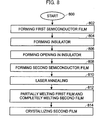
- Fig. 8 is a flowchart illustrating a method for crystallizing a semiconductor film using a buried seed one-shot interlevel crystallization process in accordance with one embodiment of the present invention.
- the method starts at Step 800.
- a first semiconductor film having a crystallographic structure is formed overlying a transparent substrate.
- a transparent substrate for example, glass, plastic, or quartz may be adopted.
- laser annealing processes are commonly associated with these temperature-sensitive materials.
- an insulator layer is formed overlying the first semiconductor film.
- an opening is formed in the insulator layer, exposing a portion of a first semiconductor film top surface.
- a. second semiconductor film of an amorphous structure is formed overlying the insulator layer.
- the laser annealing of the second semiconductor film is carried out. In response to the laser annealing process in Step 810, the second semiconductor film is completely melted, and the first semiconductor film is partially melted in S812. Using unmelted first semiconductor film as a seed, the second semiconductor film is crystallized in S814.
- the process of forming the opening in the insulator layer in Step 804 includes the process of forming an opening in a first location. Then, the crystallization of the second semiconductor film in Step 814 is carried out by controlling the grain boundaries of the crystallized second semiconductor film in response to the position of the first location.
- the crystal grain boundaries formed in the Si active layer 12 are positioned and formed with respect to the locations of the via contact holes 13 in the gate dielectric 10.
- the process of laser annealing the second semiconductor film in Step 810 includes the process of preheating the substrate with at least one laser fluence pulse from a first laser source, prior to melting the second semiconductor film with at least one laser fluence pulse from a second laser source.
- the substrate may be preheated with a carbon dioxide laser (CDL) pulse having a duration in a range of about 10 microseconds to 1 millisecond, and a repetition rate in a range of about 100 Hz to 50 KHz.
- CDL carbon dioxide laser
- the process of melting the second semiconductor film in Step 812 includes the process of laser annealing the second semiconductor film with a single Excimer laser pulse.
- the process of laser annealing the second semiconductor film with the single Excimer laser pulse may be carried out using a pulse duration in a range of about 30 nanoseconds (ns) to 300 ns.
- the CO 2 laser fires first, to preheat the underlying SiO 2 substrate.
- the Excimer laser is fired such that the Si thin film directly above the preheated spot on the substrate is melted.
- These operations permit very localized heating of the material, to temperatures in excess of 900 °C to 1,000 °C. This high local temperature, in turn, permits very long lateral growth lengths, in excess of 30 to 100 ⁇ m depending on the conditions.
- the process is called a "1-shot" process due to its ability to crystallize the entire Si film, which would make up an active portion of a device, in a single shot.
- the seeding structure is arranged to provide an optimal microstructure that is tailored to a particular active channel orientation, size, or other desired characteristic.
- the term "1-shot” only refers to the Excimer laser.
- the CO 2 laser can fire multiple times for each Excimer laser pulse.
- the CDL can operate at frequencies up to 1 0s of kHz, and for some conditions this is the typical operating condition. Additional details of this process can be found in US Patent 7,018,468 , which is incorporated herein by reference.
- Alternate preheating sources include a UV laser, such as an Excimer laser or frequency-tripled solid-state laser, or a visible laser, such as a frequency-doubled solid-state laser, as a laser annealing source.
- a UV laser such as an Excimer laser or frequency-tripled solid-state laser
- a visible laser such as a frequency-doubled solid-state laser
- a XeCl laser at 308 nm or a KrF laser at 243 nm are possible candidates for the Excimer laser.
- Frequency-tripled solid-state lasers such as tripled Nd-YAG lasers or tripled Nd-YVO4 lasers, are also possible candidates for the UV laser.
- Frequency-doubled solid-state lasers such as doubled Nd-YAG lasers operating at 532 nm or doubled Nd-YVO4 lasers, are possible candidates for the visible laser.
- first and second semiconductor films in Steps 802 and 808, respectively includes forming first and second semiconductor films including Si.
- first and second semiconductor films including Si For example, films of (pure) Si and SiGe may be used, although the process likely has application to a broader range of thin-film process materials.
- the insulator layer formed in Step 804 is typically an oxide film, such as silicon dioxide, a nitride film, such as silicon nitride, an oxynitride, or even a high-k dielectric material.
- the process of forming the first semiconductor film in Step 802 includes the process of forming a bottom gate overlying the substrate, followed by the process of forming a bottom gate dielectric in Step 804.
- the process of forming the second semiconductor layer in Step 808 includes the process of forming an active Si layer.
- the active Si layer formed in Step 808 has a thickness in a range of about 500 ⁇ to 1,500 ⁇ .
- the process of forming the bottom gate in Step 802 includes the process of forming a bottom gate with a first portion and a second portion.
- Step 806 a via contact hole is formed in the gate dielectric overlying the bottom gate first portion.
- the process of partially melting the first semiconductor film in Step 812 includes the process of melting the bottom gate first portion.
- the process to be carried out using unmelted first semiconductor film as a seed in Step 814 includes the process to be carried out using the bottom gate second portion as the seed for crystallizing the active Si layer.
- Step 816 the active Si layer is patterned to remove the active Si layer overlying via contact holes in the gate dielectric in Step 816. Then, in Step 818, a top gate is formed overlying the active Si layer, and in Step 820, source/drain (S/D) regions are formed in the active Si layer.
- Step 816 through 820 associated with the DG-TFT fabrication process are not shown in this figure, since Fig. 9 is specifically dedicated to the DG-TFT process.
- the process of crystallizing the second semiconductor film includes the process of laterally growing a crystal grain in the second semiconductor film having a length in the range of about 20 micrometers ( ⁇ m) to 30 ⁇ m.
- the distance from the via contact hole to the unmelted portion of the bottom gate is typically less than the crystal grain length.
- the crystallographic orientation of the laterally grown grains can change or break down after a semi-characteristic length (about 15 ⁇ m for a 50 nm-thick Si film), and any benefits derived from controlling the orientation of the seed (i.e., placement near the via contact hole) are diminished.
- Fig. 9 is a flowchart illustrating a DG-TFT fabrication method for seeding the crystallization of an active Si layer using via contact holes to an underlying bottom gate.
- the method starts at Step 900.
- a Si bottom gate having a polycrystalline structure is formed, overlying a transparent substrate.
- an insulator layer is formed overlying the bottom gate.
- an oxide or nitride insulator can be used.
- an opening is formed in the insulator layer, exposing a portion of a bottom gate top surface.
- an amorphous Si film is formed overlying the insulator layer.
- Step 910 the process of laser annealing of the amorphous Si film is carried out.
- the amorphous Si film is completely melted and the bottom gate is partially melted in S912.
- a polycrystalline Si active layer is formed in S914.
- the substrate is preheated in S910 with at least one laser fluence pulse from a first laser source, prior to melting the amorphous Si film with at least one laser fluence pulse from a second laser source.
- the laser annealing process is carried out in S910 with a single Excimer laser pulse.
- a bottom gate is formed in Step 902 with a first portion and a second portion, and in Step 904, a via contact hole is formed in a gate dielectric overlying the bottom gate first portion. Then, the bottom gate first portion is melted in S914, and in Step 914, the bottom gate second portion is used as the seed for crystallizing the active Si layer.
- the active Si layer is patterned in 5916 to remove the active Si layer overlying via contact holes in the gate dielectric.
- Step 918 a top gate is formed overlying the active Si layer.
- Step 920 source/drain (S/D) regions are formed in the active Si layer.
Landscapes
- Recrystallisation Techniques (AREA)
- Thin Film Transistor (AREA)
Applications Claiming Priority (1)
| Application Number | Priority Date | Filing Date | Title |
|---|---|---|---|
| US11/521,996 US20080070423A1 (en) | 2006-09-15 | 2006-09-15 | Buried seed one-shot interlevel crystallization |
Publications (2)
| Publication Number | Publication Date |
|---|---|
| EP1901347A2 true EP1901347A2 (de) | 2008-03-19 |
| EP1901347A3 EP1901347A3 (de) | 2012-07-18 |
Family
ID=38846897
Family Applications (1)
| Application Number | Title | Priority Date | Filing Date |
|---|---|---|---|
| EP07252613A Withdrawn EP1901347A3 (de) | 2006-09-15 | 2007-06-27 | Verfahren zur Kristallisierung einer Halbleiterfolie und durch dieses Verfahren kristallisierte Halbleiterfolie |
Country Status (4)
| Country | Link |
|---|---|
| US (1) | US20080070423A1 (de) |
| EP (1) | EP1901347A3 (de) |
| KR (1) | KR100915073B1 (de) |
| CN (1) | CN101145517B (de) |
Families Citing this family (6)
| Publication number | Priority date | Publication date | Assignee | Title |
|---|---|---|---|---|
| JP2004087535A (ja) * | 2002-08-22 | 2004-03-18 | Sony Corp | 結晶質半導体材料の製造方法および半導体装置の製造方法 |
| CN102651311B (zh) * | 2011-12-20 | 2014-12-17 | 京东方科技集团股份有限公司 | 一种低温多晶硅薄膜的制备方法及低温多晶硅薄膜 |
| US8754531B2 (en) * | 2012-03-14 | 2014-06-17 | Nanya Technology Corp. | Through-silicon via with a non-continuous dielectric layer |
| EP2899749A1 (de) * | 2014-01-24 | 2015-07-29 | Excico France | Verfahren zur Herstellung von polykristallinem Silizium mittels Laserbestrahlung |
| US9953125B2 (en) * | 2016-06-15 | 2018-04-24 | International Business Machines Corporation | Design/technology co-optimization platform for high-mobility channels CMOS technology |
| US11502197B2 (en) | 2019-10-18 | 2022-11-15 | Taiwan Semiconductor Manufacturing Co., Ltd. | Source and drain epitaxial layers |
Family Cites Families (18)
| Publication number | Priority date | Publication date | Assignee | Title |
|---|---|---|---|---|
| US4630176A (en) * | 1985-11-22 | 1986-12-16 | The Standard Oil Company | Polyoxometalate-modified carbon electrodes and uses therefor |
| US5017983A (en) * | 1989-08-03 | 1991-05-21 | Industrial Technology Research Institute | Amorphous silicon thin film transistor with a depletion gate |
| JPH0824193B2 (ja) * | 1990-10-16 | 1996-03-06 | 工業技術院長 | 平板型光弁駆動用半導体装置の製造方法 |
| JP3213338B2 (ja) * | 1991-05-15 | 2001-10-02 | 株式会社リコー | 薄膜半導体装置の製法 |
| JP3019632B2 (ja) * | 1992-10-16 | 2000-03-13 | カシオ計算機株式会社 | フォトセンサシステム及びその駆動方法 |
| US5391638A (en) * | 1993-12-27 | 1995-02-21 | Dow Corning Corporation | Organosiloxane compounds containing polyoxometalate groups |
| JP3204986B2 (ja) * | 1996-05-28 | 2001-09-04 | ザ トラスティース オブ コロンビア ユニヴァーシティ イン ザ シティ オブ ニューヨーク | 基板上の半導体膜領域の結晶化処理及びこの方法により製造されたデバイス |
| TW466772B (en) * | 1997-12-26 | 2001-12-01 | Seiko Epson Corp | Method for producing silicon oxide film, method for making semiconductor device, semiconductor device, display, and infrared irradiating device |
| US6723349B1 (en) * | 1999-10-12 | 2004-04-20 | Emory University | Polyoxometalate materials, metal-containing materials, and methods of use thereof |
| US6391695B1 (en) * | 2000-08-07 | 2002-05-21 | Advanced Micro Devices, Inc. | Double-gate transistor formed in a thermal process |
| TW452892B (en) * | 2000-08-09 | 2001-09-01 | Lin Jing Wei | Re-crystallization method of polysilicon thin film of thin film transistor |
| JP4744700B2 (ja) * | 2001-01-29 | 2011-08-10 | 株式会社日立製作所 | 薄膜半導体装置及び薄膜半導体装置を含む画像表示装置 |
| US6664408B2 (en) * | 2001-03-29 | 2003-12-16 | The Curators Of The University Of Missouri | Process for preparing organically-substituted polyoxometalates |
| KR100418089B1 (ko) * | 2001-06-21 | 2004-02-11 | 주식회사 하이닉스반도체 | 반도체 소자의 박막 트랜지스터 제조 방법 |
| CN1326205C (zh) * | 2001-07-25 | 2007-07-11 | 精工爱普生株式会社 | 半导体薄膜及半导体装置的制造方法、半导体装置、集成电路、电光学装置及电子机器 |
| US20030027052A1 (en) * | 2001-07-27 | 2003-02-06 | Yuhong Huang | Cationic conductive material |
| US8017178B2 (en) * | 2003-12-16 | 2011-09-13 | Cardiac Pacemakers, Inc. | Coatings for implantable electrodes |
| KR100611061B1 (ko) * | 2004-09-08 | 2006-08-10 | 삼성전자주식회사 | 에피택시얼막 형성 방법과 이를 이용한 박막 형성 방법 및반도체 장치 제조 방법 |
-
2006
- 2006-09-15 US US11/521,996 patent/US20080070423A1/en not_active Abandoned
-
2007
- 2007-06-27 EP EP07252613A patent/EP1901347A3/de not_active Withdrawn
- 2007-07-16 KR KR1020070071053A patent/KR100915073B1/ko not_active Expired - Fee Related
- 2007-07-31 CN CN200710138198XA patent/CN101145517B/zh not_active Expired - Fee Related
Also Published As
| Publication number | Publication date |
|---|---|
| US20080070423A1 (en) | 2008-03-20 |
| KR100915073B1 (ko) | 2009-09-02 |
| CN101145517B (zh) | 2010-09-29 |
| CN101145517A (zh) | 2008-03-19 |
| KR20080025288A (ko) | 2008-03-20 |
| EP1901347A3 (de) | 2012-07-18 |
Similar Documents
| Publication | Publication Date | Title |
|---|---|---|
| KR100510934B1 (ko) | 박막 트랜지스터 및 그 제조 방법 | |
| CN100555570C (zh) | 形成多晶硅薄膜的方法及用该方法制造薄膜晶体管的方法 | |
| KR100785020B1 (ko) | 하부 게이트 박막 트랜지스터 및 그 제조방법 | |
| US6582996B1 (en) | Semiconductor thin film forming method | |
| JP2004311935A (ja) | 単結晶シリコン膜の製造方法 | |
| JP5000609B2 (ja) | 結晶化方法 | |
| US6660085B2 (en) | Polycrystal thin film forming method and forming system | |
| JP4637410B2 (ja) | 半導体基板の製造方法及び半導体装置 | |
| EP1901347A2 (de) | Verfahren zur Kristallisierung einer Halbleiterfolie und durch dieses Verfahren kristallisierte Halbleiterfolie | |
| KR20030069779A (ko) | 박막트랜지스터 및 그 제조방법 | |
| JP4174862B2 (ja) | 薄膜トランジスタの製造方法および半導体装置の製造方法 | |
| JP2008133182A (ja) | 単結晶シリコンロッドの製造方法及び単結晶シリコンロッド構造体 | |
| KR20070071968A (ko) | 다결정 실리콘 필름 제조방법 및 이를 적용한 박막트랜지스터의 제조방법 | |
| JP4642310B2 (ja) | 薄膜半導体装置の製造方法および薄膜半導体装置 | |
| JP2004063478A (ja) | 薄膜トランジスタ及びその製造方法 | |
| KR100785019B1 (ko) | 하부 게이트 박막 트랜지스터 및 그 제조방법 | |
| KR102219343B1 (ko) | 박막 반도체 소자의 제조 방법 | |
| JP2007208180A (ja) | レーザアニール技術、半導体膜、半導体装置、及び電気光学装置 | |
| KR100860007B1 (ko) | 박막트랜지스터, 박막트랜지스터의 제조방법, 이를 구비한유기전계발광표시장치 및 그의 제조방법 | |
| JPH0982639A (ja) | 半導体装置およびその製造方法 | |
| KR100599966B1 (ko) | 다결정실리콘 박막트랜지스터 제조방법 | |
| KR20020012983A (ko) | 액정표시기용 비정질 실리콘 박막의 결정화 방법 | |
| JP2001057435A (ja) | 半導体装置の作製方法 | |
| JP2007129159A (ja) | ポリシリコン薄膜トランジスタ基板の製造方法、ポリシリコン薄膜トランジスタ基板及び液晶表示装置 | |
| JP2007294849A (ja) | 半導体素子、半導体装置およびそれらの製造方法 |
Legal Events
| Date | Code | Title | Description |
|---|---|---|---|
| PUAI | Public reference made under article 153(3) epc to a published international application that has entered the european phase |
Free format text: ORIGINAL CODE: 0009012 |
|
| AK | Designated contracting states |
Kind code of ref document: A2 Designated state(s): AT BE BG CH CY CZ DE DK EE ES FI FR GB GR HU IE IS IT LI LT LU LV MC MT NL PL PT RO SE SI SK TR |
|
| AX | Request for extension of the european patent |
Extension state: AL BA HR MK YU |
|
| PUAL | Search report despatched |
Free format text: ORIGINAL CODE: 0009013 |
|
| AK | Designated contracting states |
Kind code of ref document: A3 Designated state(s): AT BE BG CH CY CZ DE DK EE ES FI FR GB GR HU IE IS IT LI LT LU LV MC MT NL PL PT RO SE SI SK TR |
|
| AX | Request for extension of the european patent |
Extension state: AL BA HR MK RS |
|
| RIC1 | Information provided on ipc code assigned before grant |
Ipc: H01L 29/786 20060101ALI20120612BHEP Ipc: H01L 21/20 20060101AFI20120612BHEP Ipc: H01L 21/336 20060101ALI20120612BHEP |
|
| AKY | No designation fees paid | ||
| REG | Reference to a national code |
Ref country code: DE Ref legal event code: R108 |
|
| REG | Reference to a national code |
Ref country code: DE Ref legal event code: R108 Effective date: 20130327 |
|
| STAA | Information on the status of an ep patent application or granted ep patent |
Free format text: STATUS: THE APPLICATION IS DEEMED TO BE WITHDRAWN |
|
| 18D | Application deemed to be withdrawn |
Effective date: 20130119 |