EP1901565A1 - System, Verfahren und Medium zur Farbkorrektur auf Anzeigebildern - Google Patents
System, Verfahren und Medium zur Farbkorrektur auf Anzeigebildern Download PDFInfo
- Publication number
- EP1901565A1 EP1901565A1 EP07108008A EP07108008A EP1901565A1 EP 1901565 A1 EP1901565 A1 EP 1901565A1 EP 07108008 A EP07108008 A EP 07108008A EP 07108008 A EP07108008 A EP 07108008A EP 1901565 A1 EP1901565 A1 EP 1901565A1
- Authority
- EP
- European Patent Office
- Prior art keywords
- image
- characteristic
- hue
- transform
- saturation
- Prior art date
- Legal status (The legal status is an assumption and is not a legal conclusion. Google has not performed a legal analysis and makes no representation as to the accuracy of the status listed.)
- Ceased
Links
- 238000000034 method Methods 0.000 title claims abstract description 48
- 238000012937 correction Methods 0.000 title claims description 13
- 230000008859 change Effects 0.000 claims abstract description 24
- 238000004364 calculation method Methods 0.000 claims abstract description 19
- 230000001131 transforming effect Effects 0.000 claims abstract description 16
- 230000009466 transformation Effects 0.000 claims abstract description 7
- 239000003086 colorant Substances 0.000 claims description 35
- 230000001419 dependent effect Effects 0.000 claims description 9
- 238000012545 processing Methods 0.000 claims description 9
- 230000006870 function Effects 0.000 description 9
- 239000000976 ink Substances 0.000 description 9
- 230000007423 decrease Effects 0.000 description 6
- 238000004590 computer program Methods 0.000 description 4
- 238000010894 electron beam technology Methods 0.000 description 4
- 230000008569 process Effects 0.000 description 4
- 230000005540 biological transmission Effects 0.000 description 3
- 230000003595 spectral effect Effects 0.000 description 3
- 238000003860 storage Methods 0.000 description 3
- 238000013459 approach Methods 0.000 description 2
- 238000004422 calculation algorithm Methods 0.000 description 2
- 230000004456 color vision Effects 0.000 description 2
- 230000000295 complement effect Effects 0.000 description 2
- 238000010586 diagram Methods 0.000 description 2
- 210000001525 retina Anatomy 0.000 description 2
- 239000000790 retinal pigment Substances 0.000 description 2
- 239000000654 additive Substances 0.000 description 1
- 230000000996 additive effect Effects 0.000 description 1
- 238000003491 array Methods 0.000 description 1
- 230000003247 decreasing effect Effects 0.000 description 1
- 238000009826 distribution Methods 0.000 description 1
- 238000005286 illumination Methods 0.000 description 1
- 239000004973 liquid crystal related substance Substances 0.000 description 1
- 238000004519 manufacturing process Methods 0.000 description 1
- 238000012544 monitoring process Methods 0.000 description 1
- 230000003287 optical effect Effects 0.000 description 1
- 230000035945 sensitivity Effects 0.000 description 1
- 238000001429 visible spectrum Methods 0.000 description 1
Images




Classifications
-
- H—ELECTRICITY
- H04—ELECTRIC COMMUNICATION TECHNIQUE
- H04N—PICTORIAL COMMUNICATION, e.g. TELEVISION
- H04N17/00—Diagnosis, testing or measuring for television systems or their details
- H04N17/02—Diagnosis, testing or measuring for television systems or their details for colour television signals
-
- H—ELECTRICITY
- H04—ELECTRIC COMMUNICATION TECHNIQUE
- H04N—PICTORIAL COMMUNICATION, e.g. TELEVISION
- H04N9/00—Details of colour television systems
- H04N9/64—Circuits for processing colour signals
-
- H—ELECTRICITY
- H04—ELECTRIC COMMUNICATION TECHNIQUE
- H04N—PICTORIAL COMMUNICATION, e.g. TELEVISION
- H04N1/00—Scanning, transmission or reproduction of documents or the like, e.g. facsimile transmission; Details thereof
- H04N1/46—Colour picture communication systems
- H04N1/56—Processing of colour picture signals
- H04N1/60—Colour correction or control
- H04N1/603—Colour correction or control controlled by characteristics of the picture signal generator or the picture reproducer
- H04N1/6052—Matching two or more picture signal generators or two or more picture reproducers
-
- H—ELECTRICITY
- H04—ELECTRIC COMMUNICATION TECHNIQUE
- H04N—PICTORIAL COMMUNICATION, e.g. TELEVISION
- H04N1/00—Scanning, transmission or reproduction of documents or the like, e.g. facsimile transmission; Details thereof
- H04N1/46—Colour picture communication systems
- H04N1/56—Processing of colour picture signals
- H04N1/60—Colour correction or control
- H04N1/62—Retouching, i.e. modification of isolated colours only or in isolated picture areas only
-
- H—ELECTRICITY
- H04—ELECTRIC COMMUNICATION TECHNIQUE
- H04N—PICTORIAL COMMUNICATION, e.g. TELEVISION
- H04N9/00—Details of colour television systems
- H04N9/64—Circuits for processing colour signals
- H04N9/643—Hue control means, e.g. flesh tone control
-
- H—ELECTRICITY
- H04—ELECTRIC COMMUNICATION TECHNIQUE
- H04N—PICTORIAL COMMUNICATION, e.g. TELEVISION
- H04N9/00—Details of colour television systems
- H04N9/77—Circuits for processing the brightness signal and the chrominance signal relative to each other, e.g. adjusting the phase of the brightness signal relative to the colour signal, correcting differential gain or differential phase
Definitions
- One or more embodiments of the present invention relate to a system, method and medium correcting the color of a display image, and more particularly, to a system, method and medium correcting the color of a display image, by which a color similar to a target color is displayed on a conventional display using a simple algorithm, while maintaining maximum brightness and saturation of the currently used display.
- One method of objectively evaluating color may be to measure frequency bands for all colors, express the results as graphs, and use the graphs. However, there are difficulties in putting this method into practice.
- the hue component of an image to be corrected in the HSV space is changed, the brightness of the color in addition to the saturation of the color may be changed, and the color output on a monitor may not be displayed in its true desired color.
- One or more embodiments of the present invention provide a system, method and medium correcting the color of a display image, and providing a natural image to a user, in which a color similar to a target color is displayed on a conventional display, while maintaining maximum brightness and saturation on the conventional display.
- embodiments of the present invention include a system correcting a display image.
- the system includes a parameter calculation module to calculate a plurality of parameters required for a transform of a first image, based on a plurality of characteristic differences between the first image and a second image, into which the first image is to be transformed to visually match the second image, a first characteristic transform module to transform a first characteristic of the first image using the plurality of calculated parameters, the transformation resulting in an unrelated change to a second characteristic of the first image, and a second characteristic restoration module to restore the second characteristic changed by the transforming of the first characteristic.
- embodiments of the present invention include a method correcting a display image.
- the method includes calculating a plurality of parameters required for a transform of a first image, based on a plurality of characteristic differences between the first image and a second image, into which the first image is to be transformed to visually match the second image, transforming a first characteristic of the first image using the plurality of calculated parameters, the transforming of the first characteristic resulting in an unrelated change to a second characteristic of the first image, and restoring the second characteristic changed by the transforming of the first characteristic.
- embodiments of the present invention include a method changing a first image to match a target image.
- the method includes transforming a first characteristic of the first image, to visually match the target image, using a plurality of calculated parameters, the transforming resulting in an unintended change to a second characteristic of the first image, and restoring the second characteristic to a value previously held before the unintended change, based on the transformed first characteristic and the plurality of calculated parameters.
- Representative color models such as CIE, CIELab, RGB (Red, Green and Blue), CYM (Cyan, Magenta and Yellow), CMYK (Cyan, Magenta, Yellow, and blacK), or HSV (Hue, Saturation, and Value for brightness) value models, may be used to describe colors in a specific environment using an objective color evaluating technique. These models may be used for output apparatuses, such as display apparatuses or printers, or used for intuitive color designation by a person. Accordingly, as references thereto will be made in aspects of the present invention, first such color models will be briefly explained.
- the CIE color model was first developed by the International Commission on Illumination (Commission Internationale de l'Eclairage) in 1931 to specify colors in the visible spectrum using three primary colors.
- the CIE color model provides a standard for colors and is convenient for comparing color regions between two difference devices or applications.
- the CIELab color model is designed to reproduce identical colors in different types of monitors or printers or both.
- the CIELab color model was developed in 1976 based on the CIE model.
- the CIELab color model is defined by brightness (Lightness) and two color regions (a and b).
- the "a" color region is distributed from green to red, and the "b” color region is distributed from blue to yellow.
- the region of colors that can be represented by a predetermined color model is referred to as a gamut.
- the CIELab color model has a gamut that includes both the CMYK and RGB models, it is used in an intermediate state when a color model is changed in the popular software PhotoshopTM, for example.
- the RGB color model is a model based on a tri-stimulus principle of color vision, in which a color is sensed with respect to the degree of excitement of three visual pigments at the retina of our eyes (visual pigments, red, green and blue, in the retina of our eyes have a maximum brightness at a 630mm wavelength, a 530mm wavelength, and a 450mm wavelength, respectively).
- RGB color model other colors are represented using references to the three color values, red, green, and blue.
- each value, R, G, and B can be indicated using decimal fractions between 0 and 1, but in most of graphic software programs, values from 0 to 255 are used.
- the entire range of colors can be represented as a cube, and this is illustrated in FIG. 1.
- the cube provides a three-dimensional space wherein each possible color occupies a unique position within the cube. Referring to the cube in FIG. 1, the origin (0,0,0) represents the color black, coordinates (1,1,1) represent the color white, and the other corners represent the basic RGB colors and combined colors.
- gray scale appears on the line connecting (0,0,0) and (1,1,1). That is, if the three values of R, G, and B are the same, the resulting value becomes a gray scale color.
- TVs and computer monitors such as cathode-ray tubes (CRT) and liquid crystal displays (LCD), operate based on the RGB color model.
- CTR cathode-ray tubes
- LCD liquid crystal displays
- Electron beams emitted from these electron guns collide with the fluorescent surface of the insides of color cells of the screen, thereby generating light.
- the color will be seen as white. Conversely, if no electron guns emit electron beams, the corresponding point will be seen as black.
- each electron gun emits electron beams in 256-stepped intensities, and the color of one point is generated when the three electron guns emit R, G, and B colors, respectively, to a color cell. Accordingly, 256 ⁇ 256 ⁇ 256 (i.e., over 16 million) different colors can be theoretically displayed on the screen.
- This number is far beyond the 400,000 different colors that can be recognized by the unaided human eye, and is is generally more than sufficient to represent the world visible to human eyes.
- Adjusting the contrast of an image is one way to correct color in a display apparatus using the RGB color model.
- contrast refers to a difference between gray level values or luminance values in a predetermined area of an image.
- the method of increasing the contrast of an image in the RGB color model may cause distortion of color throughout the entire image.
- the CMY color model has cyan, magenta, and yellow as primary colors, and has a shape obtained by making RGB color models face each other on diagonal lines.
- the above RGB color model is based on an additive process, in which the result is white (1,1,1) if three colors, R, G, and B, are added.
- the CMY color model is based on a subtractive process in which the result is black (1,1,1) if three colors, C, M, and Y, are added.
- CMYK color model is used in which black K is added to the CMY color model. It is typically desirable to use black ink rather than color inks because black ink is much cheaper than color inks.
- the CMY color model is mainly used for output colors of a device, such as a printer, in which ink is used to produce a hard copy.
- the RGB color model and the CMY color model are designed for displays and printing devices, respectively, while the HSV color model is designed to provide a more intuitive color specifying method for a user.
- the HSV color model can represent color (hue), saturation, and brightness (value) that cannot be represented in the RGB color model, and is widely used for color correction for displaying natural colors on a display image.
- FIG. 2 illustrates a system correcting the hue of a display image according to an embodiment of the present invention.
- the system 200 may include, for example, a parameter calculation module 201, a first characteristic transform module 202, a second characteristic restoration module 203, a memory module 204 and a color space transform module 205.
- the parameter calculation module 201 may calculate a plurality of parameters required for a transform or a correction based on a plurality of characteristic differences between a first image currently displayed and a second image, which is a target image of the first image, and may store the calculation result, e.g., in the memory module 204.
- the first characteristic transform module 202 may transform a first characteristic of the first image by using the plurality of calculated parameters.
- the second characteristic restoration module 203 may restore a second characteristic changed due to the transforming of the first characteristic.
- the memory module 205 may store parameters required for a transform, and the color space transform module 205 may transform a color space, noting that alternative embodiments are equally available.
- the first characteristic transform module 202 may include, for example, a hue transform module 202A to perform a hue transform
- the second characteristic restoration module 203 may include, for example, a saturation transform module 203A and a brightness transform module 203B to perform transformation of saturation and brightness, respectively.
- the hue transform module 202A may transform the hue component of the first image, using the parameters calculated in the parameter calculation module 201, and the saturation transform module 203A may increase or decrease the saturation component in a predetermined hue region in the first image, using the transform degree of the hue component and the calculated parameters.
- the brightness transform module 203B may correct a change in brightness caused by the hue component change, using the maximum brightness information for each color, for example.
- the parameter calculation module 201 may calculate a plurality of parameters required for a transform or a correction based on a plurality of characteristic differences between the first image currently displayed and the second image, which is a target image of the first image, and may store the calculation result in, e.g., in memory module 204.
- the plurality of characteristic differences may include one or more of tri-stimulus values of primary colors, red, green and blue, and white, or tone curve characteristics, e.g., gamma characteristics.
- these characteristics may be directly measured by a user using a spectral radiometer or colorimeter, or may be identified using a monitor profile, for example.
- the tri-stimulus value when color and light are represented scientifically, they are represented as three functions of red, green and blue in order to match them with the sensitivity of human eyes, and the tri-stimulus values are determined based on color matching functions x( ⁇ ), y( ⁇ ), and z( ⁇ ) having characteristics x, y, and z, respectively.
- the meaning of the tri-stimulus value is the amount of each of red, green, and blue included in the colors of a light source or body. Below, the amounts are represented by capital letters, X, Y, and Z, respectively, and as set forth in Equation 1 below.
- S( ⁇ ) is the relative spectral distribution of an illuminating light
- x(A), y( ⁇ ), and z( ⁇ ) are color matching functions.
- A( ⁇ ) is 1 for a light source, a reflection rate R( ⁇ ) for a reflected color, and a transmission rate T(A) for a transparent color.
- K is a proportional constant and may be expressed as equation 2 below.
- the measured X value is relatively greater than other values (Y,Z)
- the Y value is relatively greater than other values
- the amount of the green component may be greater
- the Z value is relatively greater, the amount of the blue component may be greater.
- the gamma characteristic may indicate the ratio of the output signal to an input signal when an image signal is converted from a light signal to an electrical signal or from an electrical signal to a light signal, and will be expressed herein as y.
- FIG. 3 illustrates the parameter calculation module 201, such as that illustrated in FIG. 2, according to an embodiment of the present invention.
- the color transform parameter calculation module 201 may calculate the color (H), brightness (J), and saturation (C) of gamut boundary colors, using a plurality of characteristic differences between a first image currently being displayed and a second image, which is a target image of the first image, and a color appearance model such as CIECAM02, for example.
- the color appearance model is a numerical model considering at least some factors related to a change in the surrounding environment of a person, which affect the color perception of the person when conventional 3-dimensional (3D) color data is processed.
- the CIECAM02 is an abbreviation of color appearance model 2002, developed as a CIE publication, and is an appearance model of colors, as published in 2004.
- the CIECAM02 By using the CIECAM02, we can estimate how an object being monitored changes with respect to a monitoring condition such as an illuminating light or brightness. Brightness (Q), lightness (J), hue angle (h), hue component (H), chroma (C), saturation (S) can be identified as the estimation values.
- the parameter calculation module 201 may calculate color expression values, such as hue (H), lightness (J), and chroma (C), by comparing the characteristic differences with the color appearance model such as the CIECAM02.
- the resultant values may be used for calculation of parameters for transforming hue, saturation, and brightness.
- the parameters for performing a hue transform may include, for example, a hue range, the hue angle of a current monitor, and the hue angle of a target monitor, and the parameters for saturation include a hue range and a ratio indicating the degree of increasing saturation.
- the parameters for a brightness transform may include maximum brightness for each color.
- each parameter described above may be stored, e.g., in the memory module 204 by the parameter calculation module 201.
- a hue transform may be performed in a color space including a hue component.
- the hue transform may be performed in a device-dependent space, such as the HSV color model, rather than in a device-independent space, such as CIECAM02 or CIELAB.
- the HSV color model may be used as an example of the device-dependent space, but the device-dependent space is not limited to the HSV color model.
- FIG. 4 illustrates an HSV color model
- the HSV color model is derived from a model in which the origin (0,0,0) of the RGB model illustrated in FIG. 1 is seen from a position of white (1,1,1,).
- a color may be represented by a rotation angle indicating rotation about a vertical axis.
- a color may have a value from 1 to 360 degrees, and the complementary color of a predetermined color is positioned 180 degrees after or at the opposition side of the predetermined color. Accordingly, if 180 degrees are added to a current color value, the complementary value may be obtained.
- Saturation is represented as a value from 0 to 1. As distance from the central axis decreases, the saturation approaches 0, and as the distance to the central axis increases, the saturation approaches 1.
- saturation may be represented as 0 ⁇ 100% in most software programs.
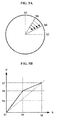
- FIGS. 5A and 5B illustrate a result of a hue transform performed by the hue transform module 202A, such as that illustrated in FIG. 2, according to an embodiment of the present invention.
- the hue transform module 202A may transform the hue component of the first image into a target hue.
- the hue range is h1 (start of the range) and h2 (end of the range)
- the maximum hue component transform of the first image is ho
- the maximum hue component transform of the second image is hd
- an input hue component is h
- an output hue component is h'
- the output as hue component that is, the transform degree of the as hue component, may be calculated as Equation 3 below, and it can be further seen from the graph illustrated in FIG. 5B that the hue component transform is linear.
- FIG. 6 illustrates the result of a saturation transform performed by the saturation transform module 203A, illustrated in FIG. 2, according to an embodiment of the present invention.
- the saturation transform module 203A may increase or decrease a saturation component in a predetermined hue range (area) of the current monitor.
- the hue range is h1 and h2
- the saturation component in the hue range is hs1 and hs2
- the maximum increasing ratio of the saturation component is S_R_Max (default value is 1.5)
- an input saturation component is S
- an output saturation component S' indicating the degree of increase or decrease in the saturation component may be calculated using Equation 4 below.
- FIG. 7 illustrates the result of brightness correction by the brightness transform module 203B, such as illustrated in FIG. 2, according to an embodiment of the present invention.
- the brightness transform module 203B may correct a change in brightness caused by a change in a hue component, using the maximum brightness information for each color hue, for example.
- a correction ratio for correcting a change in brightness caused by a hue component transform is J Ratio
- the maximum brightness in an input hue component is max_J(h)
- the maximum brightness in an output hue component is max_J(h')
- an input brightness is V
- an output brightness is V'
- the output brightness V' obtained by correcting the brightness changed by the hue component transform may be calculated using Equation 5 below.
- the maximum brightness Max_J can be seen in FIG. 7.
- FIG. 8 is a flowchart of a method of correcting the color of a display image, according to an embodiment of the present invention.
- characteristic of a first image currently being displayed and a plurality of characteristics of a second image that is a target image of the first image may be measured by a user using a device such as a spectral radiometer or colorimeter, or using a monitor profile in operation 801.
- a color expression value may be calculated, e.g., by the color transform parameter calculation module 201,using a color appearance model such as the CICCAM02 and the plurality of measured characteristic values.
- the hue component of the first image currently displayed may be compared with the hue component of the second image that is the target image, among the color expression values calculated in operation 802, and it may be determined whether the comparison result is within a basic range in operation 804, e.g., by the parameter calculation module 201.
- hue transformation need not be performed, while if the comparison result is not within the basic range, parameters for hue transformation, saturation transformation and brightness correction may be calculated, e.g., by the parameter calculation module 201, and the calculation result stored, e.g., in the memory module 204, in operation 805.
- the RGB color model may be transformed, e.g., by the color space transform module 205, into a device-dependent space, such as the HSV color model, rather than a device-independent space, such as the CIECAM02 or CIELAB.
- the color transform in the device-dependent space may include a hue component.
- the HSV color model may be used as an example of the device-dependent space, but the device-dependent space is not limited to the HSV color model, and alternative embodiments are equally available.
- the hue component of the first image currently being displayed is transformed, e.g., by the hue transform module 202A, using the stored hue transform parameters, e.g., the parameters stored in the memory module 204.
- the saturation component may be increased or decreased, e.g., by the saturation transform module 203A, in a predetermined hue range of the first image, using the degree of the transformed hue component and the saturation transform parameters such as those stored in the memory module 204 in operation 805.
- a change in brightness caused by the hue component transform may be corrected, e.g., by the brightness transform module 203B using the maximum brightness information for each hue such as those stored in the memory module 204.
- the HSV color model may be transformed to the RGB color model and the final image in which the hue is transformed, that is, the second image may be displayed by, e.g. the color space transform module 205, in operation 810.
- These computer program instructions may also be stored in a computer usable or computer-readable memory that may direct a computer or other programmable data processing apparatus to function in a particular manner, such that the instructions stored in the computer usable or computer-readable memory produce an article of manufacture including instructions that implement the function specified in the flowchart block or blocks.
- the computer program instructions may also be loaded onto a computer or other programmable data processing apparatus to cause a series of operations to be performed on the computer or other programmable apparatus to produce a computer implemented process such that the instructions that execute on the computer or other programmable apparatus implement the functions specified in the flowchart block or blocks.
- each block may represent a module, segment, or portion of code, which include one or more executable instructions for implementing the specified logical function(s).
- the operations noted in the blocks may occur out of order or in different configuration of software and hardware. For example, two blocks shown in succession may in fact be executed substantially concurrently or the blocks may sometimes be executed in reverse order depending upon the functionality involved.
- module' may mean, but is not limited to, a software or hardware component, such as a Field Programmable Gate Array (FPGA) or Application Specific Integrated Circuit (ASIC), which performs certain tasks.
- a module may be configured to reside on the addressable storage medium and configured to execute on one or more processors.
- a module may include, by way of example, components, such as software components, object-oriented software components, class components and task components, processes, functions, attributes, procedures, subroutines, segments of program code, drivers, firmware, microcode, circuitry, data, databases, data structures, tables, arrays, and variables.
- components such as software components, object-oriented software components, class components and task components, processes, functions, attributes, procedures, subroutines, segments of program code, drivers, firmware, microcode, circuitry, data, databases, data structures, tables, arrays, and variables.
- the functionality provided for in the components and modules may be combined into fewer components and modules or further separated into additional components and modules.
- one or more embodiments of the present invention may also be implemented through such software as computer readable code/instructions in/on a medium, e.g., a computer readable medium, to control at least one processing element to implement any above described embodiment.
- a medium e.g., a computer readable medium
- the medium can correspond to any medium/media permitting the storing and/or transmission of the computer readable code.
- the computer readable code may be recorded/transferred on a medium in a variety of ways, with examples of the medium including magnetic storage media (e.g., ROM, floppy disks, hard disks, etc.), optical recording media (e.g., CD-ROMs, or DVDs), and storage/transmission media such as carrier waves, as well as through the Internet, for example.
- the medium may further be a signal, such as a resultant signal or bitstream, according to one or more embodiments of the present invention.
- the media may also be a distributed network, so that the computer readable code is stored/transferred and executed in a distributed fashion.
- the processing element may include a processor or a computer processor, and processing elements may be distributed and/or included in a single device.
- the characteristic of any one or both of the saturation and brightness, and the characteristic of the color may change together.
- the characteristic of any one or both of the hue and saturation, and the characteristic of the brightness may also change together, which leads to an undesired result.
- the characteristic of at least one of the hue, saturation and brightness that is desired to be changed in order to display an image similar to a second image is a first characteristic
- the remaining characteristics of the hue, saturation and brightness, excluding the first characteristic are second characteristics.
- the second characteristic means a characteristic that has been changed undesirably due to the change of the first characteristic
- the one or more embodiments of the present invention provides a system, method and medium restoring the second characteristic
- the second characteristic that should be restored is any one or both of the brightness and saturation changed by the hue change. If the first characteristic is the hue or saturation, the second characteristic to be restored is the brightness.
- the first and second characteristics can vary without limitations with respect to a variety of embodiments, and in the present invention, it is further briefly noted that a case where the first characteristic is the hue, and the second characteristics are the saturation and brightness have been explained for convenience of explanation.
- the system, method and medium correcting the color of a display image as described above have one or more of the following advantages.
- the conventional display may be made to have a hue similar to that of a target display, while maintaining the maximum brightness and saturation of the conventional display. In this way, a natural image can be provided to the user.
Landscapes
- Engineering & Computer Science (AREA)
- Multimedia (AREA)
- Signal Processing (AREA)
- Health & Medical Sciences (AREA)
- Biomedical Technology (AREA)
- General Health & Medical Sciences (AREA)
- Facsimile Image Signal Circuits (AREA)
- Image Processing (AREA)
- Color Image Communication Systems (AREA)
Applications Claiming Priority (1)
| Application Number | Priority Date | Filing Date | Title |
|---|---|---|---|
| KR1020060090274A KR20080025593A (ko) | 2006-09-18 | 2006-09-18 | 디스플레이 영상의 색 보정을 위한 장치 및 방법 |
Publications (1)
| Publication Number | Publication Date |
|---|---|
| EP1901565A1 true EP1901565A1 (de) | 2008-03-19 |
Family
ID=38626985
Family Applications (1)
| Application Number | Title | Priority Date | Filing Date |
|---|---|---|---|
| EP07108008A Ceased EP1901565A1 (de) | 2006-09-18 | 2007-05-11 | System, Verfahren und Medium zur Farbkorrektur auf Anzeigebildern |
Country Status (4)
| Country | Link |
|---|---|
| US (1) | US8953879B2 (de) |
| EP (1) | EP1901565A1 (de) |
| KR (1) | KR20080025593A (de) |
| CN (1) | CN101150654B (de) |
Cited By (3)
| Publication number | Priority date | Publication date | Assignee | Title |
|---|---|---|---|---|
| CN103310404A (zh) * | 2013-05-30 | 2013-09-18 | 新奥特(北京)视频技术有限公司 | 一种粒子颜色计算方法和装置 |
| WO2017127457A2 (en) | 2016-01-18 | 2017-07-27 | Waveshift Llc | Evaluating and reducing myopiagenic effects of electronic displays |
| CN111844530A (zh) * | 2020-07-10 | 2020-10-30 | 苏州普福斯信息科技有限公司 | 可再生资源回收方法 |
Families Citing this family (18)
| Publication number | Priority date | Publication date | Assignee | Title |
|---|---|---|---|---|
| US7898664B2 (en) * | 2007-10-19 | 2011-03-01 | National Central University | Method for measuring chromaticity values by a colorimeter |
| JP5380973B2 (ja) * | 2008-09-25 | 2014-01-08 | 株式会社ニコン | 画像処理装置及び画像処理プログラム |
| KR101509252B1 (ko) * | 2008-10-13 | 2015-04-14 | 엘지전자 주식회사 | Hsv 색 공간에서의 국부적 색역 변환 장치 |
| US20110018892A1 (en) * | 2009-07-24 | 2011-01-27 | Samsung Electronics Co., Ltd. | Method, device, and program for processing image and image display device |
| KR101356370B1 (ko) * | 2009-07-31 | 2014-01-27 | 엘지디스플레이 주식회사 | 데이터 보정방법 및 이를 이용한 액정표시장치 |
| KR101681059B1 (ko) | 2009-09-22 | 2016-12-01 | 삼성전자주식회사 | 밝기 신호와 색차 신호간의 크로스토크를 최소화하는 비디오 신호 생성 장치 및 방법 |
| JP2013101242A (ja) * | 2011-11-09 | 2013-05-23 | Sony Corp | 画像処理装置、表示制御方法及びプログラム |
| CN103248793B (zh) * | 2013-05-14 | 2016-08-10 | 旭曜科技股份有限公司 | 色域转换系统的肤色最佳化方法与装置 |
| KR20150057431A (ko) * | 2013-11-19 | 2015-05-28 | 삼성전자주식회사 | 디스플레이장치 및 그 제어방법 |
| EP3154264A1 (de) * | 2015-10-08 | 2017-04-12 | Thomson Licensing | Verfahren für farbveränderungsübergänge zwischen zwei aufeinanderfolgenden hauptsequenzen eines videoinhalts |
| KR101723755B1 (ko) | 2015-12-30 | 2017-04-06 | 경희대학교 산학협력단 | 컬러바와 다항식 변환을 이용한 향상된 비디오 색 열화 복원 방법 및 장치 |
| CN106412544B (zh) | 2016-09-19 | 2019-02-01 | 深圳Tcl数字技术有限公司 | 色域保持系统和方法 |
| CN106454300B (zh) * | 2016-09-19 | 2018-11-02 | 深圳Tcl数字技术有限公司 | 色域扩展系统和方法 |
| US10635116B2 (en) * | 2017-10-19 | 2020-04-28 | Ford Global Technologies, Llc | Video calibration with illumination invariant image |
| CN108182914B (zh) * | 2017-12-28 | 2019-10-22 | 武汉华星光电半导体显示技术有限公司 | Gamma校正系统及Gamma校正方法 |
| CN109358654B (zh) * | 2018-11-16 | 2022-03-29 | 江苏科技大学 | 一种水空两栖搜救支援无人飞行器系统 |
| CN111506287B (zh) * | 2020-04-08 | 2023-07-04 | 北京百度网讯科技有限公司 | 页面显示方法和装置、电子设备和存储介质 |
| CN115345961B (zh) * | 2022-08-24 | 2023-06-27 | 清华大学 | 基于hsv颜色空间相互运算的浓雾彩色重建方法及装置 |
Citations (3)
| Publication number | Priority date | Publication date | Assignee | Title |
|---|---|---|---|---|
| US5384601A (en) * | 1992-08-25 | 1995-01-24 | Matsushita Electric Industrial Co., Ltd. | Color adjustment apparatus for automatically changing colors |
| EP1301024A2 (de) * | 2001-10-01 | 2003-04-09 | Canon Kabushiki Kaisha | Bildverarbeitungsverfahren und Gerät, Speichermedium und Programm |
| EP1347654A2 (de) * | 2002-03-18 | 2003-09-24 | Victor Company Of Japan, Limited | Videokorrekturvorrichtung und Verfahren, Videokorrekturprogramm und Aufzeichnungsmedium zur Speicherung des Programms |
Family Cites Families (22)
| Publication number | Priority date | Publication date | Assignee | Title |
|---|---|---|---|---|
| US4829455A (en) * | 1986-04-11 | 1989-05-09 | Quantel Limited | Graphics system for video and printed images |
| JP2807030B2 (ja) | 1990-03-07 | 1998-09-30 | 株式会社アドバンテスト | カラー画像信号処理方法 |
| US6434266B1 (en) * | 1993-12-17 | 2002-08-13 | Canon Kabushiki Kaisha | Image processing method and apparatus for converting colors in a color image |
| JP3550177B2 (ja) | 1994-03-18 | 2004-08-04 | 富士通株式会社 | 画像処理装置 |
| US6137903A (en) * | 1997-06-03 | 2000-10-24 | Linotype-Hell Ag | Color transformation system based on target color image |
| GB2328336B (en) * | 1997-08-14 | 2001-10-10 | Quantel Ltd | An image processing system |
| JPH11250222A (ja) * | 1998-02-27 | 1999-09-17 | Canon Inc | 画像処理方法及びその装置 |
| US6631208B1 (en) * | 1998-05-29 | 2003-10-07 | Fuji Photo Film Co., Ltd. | Image processing method |
| TW454424B (en) * | 1999-11-24 | 2001-09-11 | Umax Data Systems Inc | Digital image reader with Rule-base color adjusting function |
| JP2001309399A (ja) | 2000-04-24 | 2001-11-02 | Mitsubishi Electric Corp | 表示装置 |
| KR100406508B1 (ko) | 2000-06-23 | 2003-11-20 | 주식회사 코난테크놀로지 | 컬러영상 처리 시스템 및 그 방법 |
| GB2398715A (en) * | 2003-02-21 | 2004-08-25 | Sony Uk Ltd | Pixel-based colour correction using two or more colour correction processes |
| KR100708111B1 (ko) * | 2003-08-25 | 2007-04-16 | 삼성전자주식회사 | 디스플레이 기기의 색농도 조절 장치 및 방법 |
| JP3931886B2 (ja) * | 2004-03-30 | 2007-06-20 | コニカミノルタビジネステクノロジーズ株式会社 | デバイスリンクプロファイルの作成方法および装置並びに画像処理装置 |
| JP4263131B2 (ja) * | 2004-04-02 | 2009-05-13 | コニカミノルタビジネステクノロジーズ株式会社 | 色変換方法および画像処理装置 |
| JP2005348053A (ja) * | 2004-06-02 | 2005-12-15 | Seiko Epson Corp | 色変換を行う装置、印刷制御装置、方法およびプログラム、色変換データを作成する装置、方法およびプログラム、並びに、色変換データを記録した記録媒体 |
| JP2006013836A (ja) * | 2004-06-25 | 2006-01-12 | Seiko Epson Corp | カラー画像のカラー画像データを処理する画像データ処理 |
| CN1993977A (zh) * | 2004-07-27 | 2007-07-04 | 皇家飞利浦电子股份有限公司 | 饱和度受控的彩色图像中的色调保持 |
| KR20060018637A (ko) | 2004-08-25 | 2006-03-02 | 삼성전자주식회사 | 디스플레이를 위한 컬러 조절 장치 및 방법 |
| JP4677323B2 (ja) | 2004-11-01 | 2011-04-27 | キヤノン株式会社 | 画像処理装置及び画像処理方法 |
| US7595920B2 (en) * | 2005-02-23 | 2009-09-29 | Brother Kogyo Kabushiki Kaisha | Processing apparatus and processing method of color image information |
| WO2007039970A1 (ja) * | 2005-09-30 | 2007-04-12 | Sharp Kabushiki Kaisha | 色度変換装置、タイミングコントローラー、液晶表示装置、及び色度変換方法 |
-
2006
- 2006-09-18 KR KR1020060090274A patent/KR20080025593A/ko not_active Ceased
-
2007
- 2007-04-03 US US11/730,693 patent/US8953879B2/en not_active Expired - Fee Related
- 2007-05-11 EP EP07108008A patent/EP1901565A1/de not_active Ceased
- 2007-05-17 CN CN2007101038576A patent/CN101150654B/zh not_active Expired - Fee Related
Patent Citations (3)
| Publication number | Priority date | Publication date | Assignee | Title |
|---|---|---|---|---|
| US5384601A (en) * | 1992-08-25 | 1995-01-24 | Matsushita Electric Industrial Co., Ltd. | Color adjustment apparatus for automatically changing colors |
| EP1301024A2 (de) * | 2001-10-01 | 2003-04-09 | Canon Kabushiki Kaisha | Bildverarbeitungsverfahren und Gerät, Speichermedium und Programm |
| EP1347654A2 (de) * | 2002-03-18 | 2003-09-24 | Victor Company Of Japan, Limited | Videokorrekturvorrichtung und Verfahren, Videokorrekturprogramm und Aufzeichnungsmedium zur Speicherung des Programms |
Cited By (7)
| Publication number | Priority date | Publication date | Assignee | Title |
|---|---|---|---|---|
| CN103310404A (zh) * | 2013-05-30 | 2013-09-18 | 新奥特(北京)视频技术有限公司 | 一种粒子颜色计算方法和装置 |
| CN103310404B (zh) * | 2013-05-30 | 2018-06-26 | 新奥特(北京)视频技术有限公司 | 一种粒子颜色计算方法和装置 |
| WO2017127457A2 (en) | 2016-01-18 | 2017-07-27 | Waveshift Llc | Evaluating and reducing myopiagenic effects of electronic displays |
| EP3405925A4 (de) * | 2016-01-18 | 2018-11-28 | Waveshift LLC | Bewertung und reduzierung der kurzsichtigkeitserzeugenden effekte von elektronischen anzeigen |
| US10621948B2 (en) | 2016-01-18 | 2020-04-14 | Waveshift Llc | Evaluating and reducing myopiagenic effects of electronic displays |
| US11205398B2 (en) | 2016-01-18 | 2021-12-21 | Waveshift Llc | Evaluating and reducing myopiagenic effects of electronic displays |
| CN111844530A (zh) * | 2020-07-10 | 2020-10-30 | 苏州普福斯信息科技有限公司 | 可再生资源回收方法 |
Also Published As
| Publication number | Publication date |
|---|---|
| US8953879B2 (en) | 2015-02-10 |
| CN101150654B (zh) | 2011-02-02 |
| KR20080025593A (ko) | 2008-03-21 |
| CN101150654A (zh) | 2008-03-26 |
| US20080069439A1 (en) | 2008-03-20 |
Similar Documents
| Publication | Publication Date | Title |
|---|---|---|
| US8953879B2 (en) | System, method and medium performing color correction of display images | |
| US8619132B2 (en) | Wide color gamut anaglyphs | |
| CN101155252B (zh) | 用于执行不同种类的装置之间的域映射的方法和设备 | |
| CN101163193B (zh) | 校准灰度数据的系统、介质和方法 | |
| JP4341495B2 (ja) | 画像に付与する色調の設定 | |
| JP6592312B2 (ja) | 表示装置、表示制御装置及び表示方法 | |
| US8050496B2 (en) | Color gamut mapping/enhancement technique using skin color detection | |
| US20050185200A1 (en) | Systems, methods, and computer program products for converting between color gamuts associated with different image processing devices | |
| EP2323411A1 (de) | Bildanzeigevorrichtung | |
| EP2487892A1 (de) | Verfahren und Vorrichtung zur helligkeitsgesteuernden Bildumwandlung | |
| AU2013381285B9 (en) | Color adjustment device, image display device, and color adjustment method | |
| KR100834766B1 (ko) | 색 관리 장치 및 방법 | |
| JP6539032B2 (ja) | 表示制御装置、表示制御方法、およびプログラム | |
| KR20100061389A (ko) | 색 영역 확대 방법 및 표시 장치 | |
| US20200098146A1 (en) | Color processing program, color processing method, color sense inspection system, output system, color vision correction image processing system, and color vision simulation image processing system | |
| KR20230075484A (ko) | 이미지 변환 시스템 및 방법 | |
| US12462773B1 (en) | Optimization of image perception for color vision deficiencies | |
| CN113940050A (zh) | 颜色匹配 | |
| KR100664958B1 (ko) | 미리 정의된 데이터와 색특성 정보를 이용하여 최적 변환된영상을 출력하는 방법 및 프린터 | |
| US7312799B2 (en) | Visual determination of gamma for softcopy display | |
| JP4595771B2 (ja) | 色変換装置 | |
| JP2005057570A (ja) | 印刷制御装置、色変換装置、印刷制御方法、色変換方法、印刷制御プログラム、色変換プログラム、色変換テーブル作成方法、色変換テーブル作成装置、色変換テーブル作成プログラム、色変換テーブルおよび色変換テーブルのデータを記録した媒体 | |
| WO2025173242A1 (ja) | 等色関数決定方法、等色関数決定プログラムおよび等色関数決定装置 | |
| KR100866489B1 (ko) | 화질 향상 장치 및 방법 |
Legal Events
| Date | Code | Title | Description |
|---|---|---|---|
| PUAI | Public reference made under article 153(3) epc to a published international application that has entered the european phase |
Free format text: ORIGINAL CODE: 0009012 |
|
| 17P | Request for examination filed |
Effective date: 20070511 |
|
| AK | Designated contracting states |
Kind code of ref document: A1 Designated state(s): AT BE BG CH CY CZ DE DK EE ES FI FR GB GR HU IE IS IT LI LT LU LV MC MT NL PL PT RO SE SI SK TR |
|
| AX | Request for extension of the european patent |
Extension state: AL BA HR MK YU |
|
| 17Q | First examination report despatched |
Effective date: 20081015 |
|
| AKX | Designation fees paid |
Designated state(s): DE FR GB |
|
| STAA | Information on the status of an ep patent application or granted ep patent |
Free format text: STATUS: THE APPLICATION HAS BEEN REFUSED |
|
| 18R | Application refused |
Effective date: 20101111 |