EP1901632B1 - Verfahren zur herstellung von bürsten - Google Patents
Verfahren zur herstellung von bürsten Download PDFInfo
- Publication number
- EP1901632B1 EP1901632B1 EP07701587A EP07701587A EP1901632B1 EP 1901632 B1 EP1901632 B1 EP 1901632B1 EP 07701587 A EP07701587 A EP 07701587A EP 07701587 A EP07701587 A EP 07701587A EP 1901632 B1 EP1901632 B1 EP 1901632B1
- Authority
- EP
- European Patent Office
- Prior art keywords
- support
- fibres
- fibre
- fibre bundles
- holder
- Prior art date
- Legal status (The legal status is an assumption and is not a legal conclusion. Google has not performed a legal analysis and makes no representation as to the accuracy of the status listed.)
- Active
Links
- 238000000034 method Methods 0.000 title claims abstract description 42
- 238000004519 manufacturing process Methods 0.000 title claims abstract description 12
- 239000000835 fiber Substances 0.000 claims abstract description 103
- 238000001746 injection moulding Methods 0.000 claims description 7
- 210000004209 hair Anatomy 0.000 claims description 3
- 238000007669 thermal treatment Methods 0.000 claims description 3
- 239000004952 Polyamide Substances 0.000 claims description 2
- 238000005520 cutting process Methods 0.000 claims description 2
- 229920002647 polyamide Polymers 0.000 claims description 2
- 229920000728 polyester Polymers 0.000 claims 1
- 238000004026 adhesive bonding Methods 0.000 description 2
- 230000000295 complement effect Effects 0.000 description 2
- 239000000126 substance Substances 0.000 description 2
- 239000004033 plastic Substances 0.000 description 1
- 229920006149 polyester-amide block copolymer Polymers 0.000 description 1
- 238000003466 welding Methods 0.000 description 1
Images


Classifications
-
- A—HUMAN NECESSITIES
- A46—BRUSHWARE
- A46B—BRUSHES
- A46B3/00—Brushes characterised by the way in which the bristles are fixed or joined in or on the brush body or carrier
- A46B3/04—Brushes characterised by the way in which the bristles are fixed or joined in or on the brush body or carrier by mouldable materials, e.g. metals, cellulose derivatives, plastics
-
- A—HUMAN NECESSITIES
- A46—BRUSHWARE
- A46D—MANUFACTURE OF BRUSHES
- A46D3/00—Preparing, i.e. Manufacturing brush bodies
- A46D3/005—Preparing, i.e. Manufacturing brush bodies by moulding or casting a body around bristles or tufts of bristles
-
- A—HUMAN NECESSITIES
- A46—BRUSHWARE
- A46D—MANUFACTURE OF BRUSHES
- A46D3/00—Preparing, i.e. Manufacturing brush bodies
- A46D3/04—Machines for inserting or fixing bristles in bodies
- A46D3/045—Machines for inserting or fixing bristles in bodies for fixing bristles by fusing or gluing to a body
-
- A—HUMAN NECESSITIES
- A46—BRUSHWARE
- A46B—BRUSHES
- A46B2200/00—Brushes characterized by their functions, uses or applications
- A46B2200/10—For human or animal care
- A46B2200/1066—Toothbrush for cleaning the teeth or dentures
Definitions
- the present invention concerns a method for manufacturing brushes.
- this method consists of the combination of at least four steps, namely laterally separating fibre bundles from a number of loose fibres by means of a fibre bundle remover which is provided with a recess in which fibres can be gathered when the recess passes a , fibre magazine; gradually providing the above-mentioned fibre bundles in the above-mentioned support in a mechanical manner; transferring, by means of the support, the fibre bundles provided therein to a holder by means of a mutual positioning between each respective fibre bundle and the opening in which it has to be provided, and by subsequently pushing the separate fibre bundles in the longitudinal direction in the above-mentioned openings; and fixing the fibre bundles in the brush body, or at least in a part of the brush body, by means of this holder.
- This known method is very suitable for applying fibre bundles in a brush body, and it enables us to manufacture brushes in a simple manner in many varieties as far as thickness of the fibre bundles, colour of the fibres, etc. are concerned.
- a disadvantage of this method is that it is not suitable for manufacturing brushes with fibres having a pointed head.
- the method is only applied to fibres having a total length of 8 to 13 mm, whereby the pointed heads may be 4 to 8 mm long.
- the present invention aims to remedy the above-mentioned and other disadvantages.
- the invention concerns a method for manufacturing brushes according to the steps as claimed in claim 1.
- An advantage of this method according to the invention is that, when fibre bundles are applied in the support, as well as when transferring the fibre bundles from the support to a holder, one always pushes in the same direction, namely on one far end of the fibres, which makes the method suitable for manufacturing brushes with sharp brush hairs.
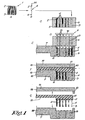
- FIG 1 schematically represents the method according to the invention for manufacturing brushes, whereby the method comprises the following steps:
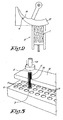
- the fibre bundle remover 12 is preferably some 0.5 to 2 mm thick, and the fibres 1 are 20 to 22 mm long, such that the cylindrical part of the fibres 1 is sufficiently long to hold the fibres 1.
- the fibres 1 can for example be made of polyester or polyamide.
- Figure 3 schematically represents how the separated fibre bundles 4 are provided in the openings 5 of the support 6 by appropriately positioning these fibre bundles 4 opposite the openings 5 concerned and by subsequently pushing these fibre bundles 4 axially in the openings 5 concerned, for example by means of a punch 14.
- the above-mentioned punch 14 exerts its pressure force on the fibre bundles 4 at the base end 2 of the fibres 1.
- the openings 5 in the support 6 continue from one side of the support 6 to the other side.
- Figures 4 to 6 schematically represent an embodiment whereby a support 6 filled with fibre bundles 4 is provided up to a holder 7 by means of transfer means which are not represented in the figures, and whereby on the other side of the support 2 is provided a device 9 designed to transfer the fibre bundles 4 from the support 6 into the holder 7.
- said device 9 consists of push-out pins 15, fixed on a common support 16 according to a pattern which corresponds to the pattern of the openings 5 in the support 6.
- a fibre guide 17 is provided in the given example of figures 4 to 6 between the support 6 and the holder 7 which makes it possible, for example, to join certain fibre bundles 4 or to move them in a diagonal direction.
- such a fibre guide 17 could also be used to guide the fibre bundles 4 in such a manner that they end up in the brush body 10 at a certain angle.
- one and the same support 6 can be used for manufacturing brushes with all sorts of different fibre patterns.
- a subsequent step F of the method then consists of connecting the fibre bundles 4 to a brush body 10.
- fibre bundles 4 protruding from the holder with their base ends 2 in the course of a thermal treatment, by fusing them together for example, or by welding them in a base 30, as will be further discussed.
- the fibre bundles 4 can be removed from the holder 7 to be possibly worked into a brush body 10 at a later stage, for example also by means of injection-moulding or simply by means of gluing or the like.
- Figures 8 to 15 represent the successive steps of an alternative method according to the invention for manufacturing a brush.
- the first steps of this alternative method are analogous to the above-described method, whereby fibre bundles 4 are separated from an amount of loose fibres 1 and are provided in the openings 5 of a support 6 by exerting a pushing force, for example by means of a punch 14, on the base ends 2 of the fibres 1.
- a device 24 consisting of a series of push-out pins 25 provided on a support 26 whereby the tips 27 of the push-out pins 25 are aligned in relation to each other according to the above-mentioned profiling.
- the fibre bundles 4 can be simultaneously pushed out of the first support 6 into the second support 22, whereby the fibre bundles 4 still protrude out of the second support 22 over a certain length 28 with their base ends 22, as a function of the profiling of the push-out pins 25, as is represented in figure 11 .
- a subsequent step then consists, as is represented in figures 11 and 12 , of cutting off the parts 28 of the fibre bundles 4 protruding from the second support 22 by means of a knife 29.
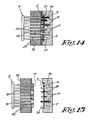
- step E whereby the fibre bundles 4 are pushed out of a support, in this case the second support 22, into a holder 7, as is represented in figures 13 to 15 .
- the fibre bundles 4 can then be fixed to the above-mentioned base 30, for example in the course of a thermal treatment, after which the base 30 and fibre bundles 4 can be worked in a brush body 10 as a whole.
- fibre bundles 4 it is also possible to keep the fibre bundles 4 together by forming a base in a mould by means of injection-moulding, whereby the fibre bundles are embedded in this base during the injection-moulding.
- this base with the fibre bundles can then be worked in a brush body 10, for example also by means of injection-moulding, gluing or the like.
Landscapes
- Engineering & Computer Science (AREA)
- Manufacturing & Machinery (AREA)
- Chemical & Material Sciences (AREA)
- Materials Engineering (AREA)
- Brushes (AREA)
Claims (13)
- Verfahren zur Herstellung einer Bürste, das darin besteht, (A) eine Quantität loser Fasern (1) vorzusehen, die mit einem Basisende (2) und einer spitz zulaufenden Spitze (3) versehen sind und die alle in der gleichen Richtung orientiert sind; (B) aus dieser losen Quantität von Fasern (1) Faserbündel (4) zusammenzustellen; (C) die Faserbündel (4), mittels einer Drückbewegung auf das Basisende (2) der Fasern (1) gemäß der Längsrichtung, eines nach dem anderen in Öffnungen (5) eines Trägers (6) zu drücken; (D) eine Halterung (7) an dem Träger (6) anzubringen, die mit Öffnungen (5) versehen ist, die dem Fasermuster entsprechen, das in der Bürste verwirklicht werden muss; (E) die Faserbündel (4) aus dem Träger (6) in die Öffnungen (5) der Halterung (7) zu schieben, indem eine Andrückkraft auf dasselbe vorgenannte Basisende (2) der Fasern (1) in der gleichen Richtung wie die vorgenannte Drückbewegung ausgeübt wird, wobei dafür gesorgt wird, dass die Faserbündel (4) mit den Basisenden (2) der Fasern (1) teilweise aus der Halterung (7) ragen; (F) die Basisenden (2) der einzelnen Fasern (1) innerhalb eines Faserbündels (4) miteinander zu verbinden und die Basisenden (2) der Fasern der Faserbündel (4) miteinander oder mit einem Bürstenkörper (10) zu verbinden, und (G) die Halterung (7) wieder zu entfernen.
- Verfahren nach Anspruch 1, dadurch gekennzeichnet, dass die Fasern an einem Ende eine spitz zulaufende Spitze (3) aufweisen, wobei die vorgenannten Andrückkräfte auf das andere Ende (2) ausgeübt werden, insbesondere auf das Basisende (2) der Fasern (1).
- Verfahren nach Anspruch 2, dadurch gekennzeichnet, dass der Bürstenkörper mittels Spritzgießen in einem Formwerkzeug (18) geformt wird, wobei die vorgenannte Halterung (7) als eine Hälfte des Formwerkzeugs (18) dient und die Basisenden (2) der Fasern in dem Bürstenkörper (10) eingebettet werden.
- Verfahren nach einem der vorgenannten Ansprüche, dadurch gekennzeichnet, dass die losen Fasern (1) anfänglich 20 bis 22 mm lang sind.
- Verfahren nach einem der vorgenannten Ansprüche, dadurch gekennzeichnet, dass die losen Fasern (1) aus Polyester hergestellt sind.
- Verfahren nach einem der Ansprüche 1 bis 5, dadurch gekennzeichnet, dass die losen Fasern (1) aus Polyamid hergestellt sind.
- Verfahren nach einem der vorgenannten Ansprüche, dadurch gekennzeichnet, dass die Faserenden der einzelnen Fasern (1) innerhalb eines Faserbündels (4) miteinander verbunden werden und/oder die Faserbündel (4) im Verlauf einer thermischen Behandlung miteinander verbunden werden.
- Verfahren nach einem der vorgenannten Ansprüche, dadurch gekennzeichnet, dass, um eine gewisse Profilierung der Bürstenborsten (1) zu erhalten, außer dem Anbringen der Faserbündel (4) in dem Träger (6) zusätzliche Schritte ausgeführt werden, die darin bestehen, einen zweiten Träger (22) bis gegen diesen ersten Träger (6) anzubringen, worin Öffnungen (23) entsprechend dem ersten Träger (6) angebracht worden sind; darin, die Faserbündel (4) gleichzeitig aus dem ersten Träger (6) in den zweiten Träger (22) zu drücken, unter Verwendung einer Serie von Ausdrückstiften (25), deren Enden (27) in Bezug zueinander gemäß der vorgenannten Profilierung ausgerichtet sind, wobei die Faserbündel (4) mit ihren Basisenden (2) über eine gewisse Länge aus dem zweiten Träger (22) ragen, in Funktion der Profilierung der Ausdrückstifte (25); darin, die aus dem zweiten Träger ragenden Teile der Faserbündel abzuschneiden und weiter das Verfahren von Anspruch 1 ab Schritt (E) anzuwenden, wobei die Faserbündel (4) aus einem Träger (6), in diesem Fall dem zweiten Träger (22), in die Halterung gedrückt werden.
- Verfahren nach einem der vorgenannten Ansprüche, dadurch gekennzeichnet, dass, um die Faserbündel (4) aus einem Träger (6) in einer Halterung (7) anzubringen, zusätzlich eine Faserführung (17) zwischen dem Träger (6) und der Halterung (7) plaziert wird, um die Faserbündel (4) von dem Träger (6) zu bestimmten Öffnungen (8) oder Positionen in der Halterung (7) zu führen oder um die Fasern (1) in Bezug auf den Bürstenkörper (10) unter einen bestimmten Winkel zu setzen.
- Verfahren nach einem der vorgenannten Ansprüche, dadurch gekennzeichnet, dass, bevor die Faserbündel (4) auf die vorgenannte Halterung plaziert werden, ein Basisteil (30) auf der Halterung positioniert wird, mit Öffnungen (31), die den Öffnungen (8) in der Halterung entsprechen.
- Verfahren nach Anspruch 9, dadurch gekennzeichnet, dass die Faserbündel (4) auf dem vorgenannten Basisteil (30) befestigt werden, wonach das Basisteil (30) und die Faserbündel (31) als Ganzes in einen Bürstenkörper (10) eingearbeitet werden.
- Verfahren nach einem der vorgenannten Ansprüche, dadurch gekennzeichnet, dass die Faserbündel zusammengestellt werden durch das seitliche Abscheiden von Faserbündeln (4) aus dem Fasermagazin (11) mittels mindestens eines Faserbündelabnehmers (12), der mit einer Aussparung (13) versehen ist, worin Fasern (1) gesammelt werden können, wenn die Aussparung (13) das Fasermagazin (11) passiert.
- Verfahren nach einem der vorgenannten Ansprüche, dadurch gekennzeichnet, dass die Aussparung (13) in dem Faserbündelabnehmer (12) etwa 1 bis 2 mm breit ist.
Applications Claiming Priority (3)
| Application Number | Priority Date | Filing Date | Title |
|---|---|---|---|
| BE2006/0068A BE1016974A3 (nl) | 2006-02-02 | 2006-02-02 | Werkwijze voor het vervaardigen van borstels. |
| BE2006/0118A BE1017018A3 (nl) | 2006-02-02 | 2006-02-23 | Werkwijze voor het vervaardigen van borstels. |
| PCT/BE2007/000012 WO2007087694A1 (en) | 2006-02-02 | 2007-01-18 | Method for manufacturing brushes |
Publications (2)
| Publication Number | Publication Date |
|---|---|
| EP1901632A1 EP1901632A1 (de) | 2008-03-26 |
| EP1901632B1 true EP1901632B1 (de) | 2010-11-10 |
Family
ID=37963917
Family Applications (1)
| Application Number | Title | Priority Date | Filing Date |
|---|---|---|---|
| EP07701587A Active EP1901632B1 (de) | 2006-02-02 | 2007-01-18 | Verfahren zur herstellung von bürsten |
Country Status (6)
| Country | Link |
|---|---|
| EP (1) | EP1901632B1 (de) |
| JP (1) | JP4958917B2 (de) |
| KR (1) | KR101020688B1 (de) |
| BE (1) | BE1017018A3 (de) |
| DE (1) | DE602007010392D1 (de) |
| WO (1) | WO2007087694A1 (de) |
Cited By (1)
| Publication number | Priority date | Publication date | Assignee | Title |
|---|---|---|---|---|
| CN103298370A (zh) * | 2010-12-22 | 2013-09-11 | Gb保捷利公众有限公司 | 用于运行刷毛簇分离设备的方法以及刷毛簇分离设备 |
Families Citing this family (6)
| Publication number | Priority date | Publication date | Assignee | Title |
|---|---|---|---|---|
| EP2377425B1 (de) * | 2010-04-13 | 2013-10-23 | GB Boucherie NV | Verfahren und Vorrichtung zum Herstellen von Bürsten |
| DE102011013621B4 (de) * | 2011-03-11 | 2018-02-22 | Gb Boucherie Nv | Verfahren und Vorrichtung zum Herstellen von Bürsten |
| EP2763567B1 (de) * | 2011-10-06 | 2020-04-01 | GB Boucherie NV | Verfahren und vorrichtung zum herstellen von bürsten sowie bürste |
| DE102017125046A1 (de) * | 2017-10-26 | 2019-05-02 | Zahoransky Ag | Verfahren und Vorrichtung zur Herstellung von Borstenfeldern für Bürsten sowie Borstenherstellungsmaschine |
| US12114768B2 (en) * | 2018-10-22 | 2024-10-15 | Zahoransky Ag | Apparatus and method for forming bristle bundles, brush manufacturing machine, use of an apparatus for forming bristle bundles, brush, computer program and computer-readable medium |
| DE102024111249B3 (de) * | 2024-04-22 | 2025-09-18 | Gb Boucherie Nv | Verfahren zum Herstellen von Bürsten und Bürstenherstellungsmaschine |
Family Cites Families (12)
| Publication number | Priority date | Publication date | Assignee | Title |
|---|---|---|---|---|
| DE3820372C2 (de) * | 1988-06-15 | 1997-07-24 | Coronet Werke Gmbh | Verfahren und Vorrichtung zur Herstellung von Borstenwaren |
| JPH08256838A (ja) * | 1995-03-28 | 1996-10-08 | Toyo Eng Corp | 植毛方法および植毛機 |
| DE19542393A1 (de) * | 1995-11-14 | 1997-05-15 | Zahoransky Anton Gmbh & Co | Verfahren zum Herstellen von Bürsten sowie Bürstenherstellungsmaschine |
| JPH1156478A (ja) * | 1997-08-22 | 1999-03-02 | Lion Corp | ブラシの製造方法 |
| JPH1156487A (ja) * | 1997-08-27 | 1999-03-02 | Oki Electric Ind Co Ltd | デスクサイド型電子機器装置 |
| ES2200491T3 (es) | 1998-07-14 | 2004-03-01 | Firma G.B. Boucherie, Naamloze Vennootschap | Metodo para la fabricacion de cepillos y maquina para la fabricacion de cepillos aplicando dicho metodo. |
| JP4132744B2 (ja) * | 2000-08-23 | 2008-08-13 | 花王株式会社 | ブラシの製造方法及び装置 |
| JP4862242B2 (ja) * | 2001-09-28 | 2012-01-25 | サンスター株式会社 | 歯ブラシの製造方法 |
| JP4173749B2 (ja) * | 2002-02-25 | 2008-10-29 | 花王株式会社 | ブラシの製造方法 |
| WO2004049860A1 (en) | 2002-12-03 | 2004-06-17 | Young-Jun Kwon | Toothbrush having needle-shaped bristle tapered at one end and manufacturing method thereof |
| KR100573898B1 (ko) * | 2003-06-09 | 2006-04-26 | 권영준 | 칫솔의 제조방법 |
| JP2006167027A (ja) * | 2004-12-14 | 2006-06-29 | Lion Corp | 歯ブラシ製造方法 |
-
2006
- 2006-02-23 BE BE2006/0118A patent/BE1017018A3/nl not_active IP Right Cessation
-
2007
- 2007-01-18 JP JP2008552650A patent/JP4958917B2/ja not_active Expired - Fee Related
- 2007-01-18 WO PCT/BE2007/000012 patent/WO2007087694A1/en not_active Ceased
- 2007-01-18 KR KR20087001119A patent/KR101020688B1/ko not_active Expired - Fee Related
- 2007-01-18 DE DE602007010392T patent/DE602007010392D1/de active Active
- 2007-01-18 EP EP07701587A patent/EP1901632B1/de active Active
Cited By (2)
| Publication number | Priority date | Publication date | Assignee | Title |
|---|---|---|---|---|
| CN103298370A (zh) * | 2010-12-22 | 2013-09-11 | Gb保捷利公众有限公司 | 用于运行刷毛簇分离设备的方法以及刷毛簇分离设备 |
| CN103298370B (zh) * | 2010-12-22 | 2015-09-16 | Gb保捷利公众有限公司 | 用于运行刷毛簇分离设备的方法以及刷毛簇分离设备 |
Also Published As
| Publication number | Publication date |
|---|---|
| JP4958917B2 (ja) | 2012-06-20 |
| BE1017018A3 (nl) | 2007-12-04 |
| JP2009525081A (ja) | 2009-07-09 |
| EP1901632A1 (de) | 2008-03-26 |
| KR101020688B1 (ko) | 2011-03-11 |
| DE602007010392D1 (de) | 2010-12-23 |
| KR20090006048A (ko) | 2009-01-14 |
| WO2007087694A1 (en) | 2007-08-09 |
Similar Documents
| Publication | Publication Date | Title |
|---|---|---|
| EP1901632A1 (de) | Verfahren zur herstellung von bürsten | |
| RU2770726C2 (ru) | Способ изготовления головки щетки с использованием формованного держателя пучков и опорной пластины, а также головка щетки | |
| AU659943B2 (en) | Method of producing toothbrushes | |
| US6641764B2 (en) | Method for producing a toothbrush | |
| EP0972465B1 (de) | Verfahren zum Herstellen von Bürsten sowie Bürstenherstellungsmaschine zur Durchführung dieses Verfahrens | |
| EP1864588B1 (de) | Zahnbürste und Verfahren zu deren Herstellung | |
| EP1603429B1 (de) | Verfahren und vorrichtung zur herstellung einer bürste | |
| DE2920931C2 (de) | Mit Stiftborsten versehender Borstenträger für eine Bürste, insbesondere Haarbürste, sowie Verfahren und Formwerkzeug zur Herstellung desselben | |
| AU2138495A (en) | A molding machine for injection molding of tooth brushes | |
| EP2587959B1 (de) | Verfahren und vorrichtung zum herstellen von bürsten | |
| US20100117440A1 (en) | Brush manufacturing machine | |
| EP2683271B1 (de) | Verfahren und vorrichtung zum herstellen von bürsten | |
| EP2377424B1 (de) | Verfahren und Vorrichtung zum Herstellen von Bürsten | |
| EP1878355B1 (de) | Verfahren zur Herstellung von Bürsten und dabei verwendete Vorrichtung | |
| US7108496B2 (en) | Stack mould assembly | |
| KR20120056311A (ko) | 칫솔 제조 방법 및 이 방법으로 제조된 칫솔 | |
| KR102143860B1 (ko) | 칫솔헤드 킷트를 활용한 칫솔 제조방법 | |
| BE1016974A3 (nl) | Werkwijze voor het vervaardigen van borstels. | |
| JP2007508967A (ja) | 歯ブラシの製造方法 | |
| TW202344204A (zh) | 刷毛束壓緊裝置、刷具製造機及刷毛束壓緊方法 | |
| EP2305067B1 (de) | Verfahren und Maschine zur Herstellung von Bürsten | |
| KR20200030203A (ko) | 칫솔 제조방법 |
Legal Events
| Date | Code | Title | Description |
|---|---|---|---|
| PUAI | Public reference made under article 153(3) epc to a published international application that has entered the european phase |
Free format text: ORIGINAL CODE: 0009012 |
|
| 17P | Request for examination filed |
Effective date: 20071205 |
|
| AK | Designated contracting states |
Kind code of ref document: A1 Designated state(s): BE CH DE IT LI |
|
| DAX | Request for extension of the european patent (deleted) | ||
| RBV | Designated contracting states (corrected) |
Designated state(s): BE CH DE IT LI |
|
| 17Q | First examination report despatched |
Effective date: 20090902 |
|
| GRAP | Despatch of communication of intention to grant a patent |
Free format text: ORIGINAL CODE: EPIDOSNIGR1 |
|
| DAX | Request for extension of the european patent (deleted) | ||
| RAP1 | Party data changed (applicant data changed or rights of an application transferred) |
Owner name: GB BOUCHERIE |
|
| GRAS | Grant fee paid |
Free format text: ORIGINAL CODE: EPIDOSNIGR3 |
|
| GRAA | (expected) grant |
Free format text: ORIGINAL CODE: 0009210 |
|
| RAP1 | Party data changed (applicant data changed or rights of an application transferred) |
Owner name: GB BOUCHERIE, NAAMLOZE VENNOOTSCHAP |
|
| AK | Designated contracting states |
Kind code of ref document: B1 Designated state(s): BE CH DE IT LI |
|
| REG | Reference to a national code |
Ref country code: CH Ref legal event code: EP |
|
| REF | Corresponds to: |
Ref document number: 602007010392 Country of ref document: DE Date of ref document: 20101223 Kind code of ref document: P |
|
| REG | Reference to a national code |
Ref country code: CH Ref legal event code: NV Representative=s name: N&G PATENT SERVICES SA |
|
| PLBE | No opposition filed within time limit |
Free format text: ORIGINAL CODE: 0009261 |
|
| STAA | Information on the status of an ep patent application or granted ep patent |
Free format text: STATUS: NO OPPOSITION FILED WITHIN TIME LIMIT |
|
| 26N | No opposition filed |
Effective date: 20110811 |
|
| REG | Reference to a national code |
Ref country code: DE Ref legal event code: R097 Ref document number: 602007010392 Country of ref document: DE Effective date: 20110811 |
|
| PGFP | Annual fee paid to national office [announced via postgrant information from national office to epo] |
Ref country code: CH Payment date: 20160120 Year of fee payment: 10 |
|
| REG | Reference to a national code |
Ref country code: CH Ref legal event code: PL |
|
| PG25 | Lapsed in a contracting state [announced via postgrant information from national office to epo] |
Ref country code: CH Free format text: LAPSE BECAUSE OF NON-PAYMENT OF DUE FEES Effective date: 20170131 Ref country code: LI Free format text: LAPSE BECAUSE OF NON-PAYMENT OF DUE FEES Effective date: 20170131 |
|
| PGFP | Annual fee paid to national office [announced via postgrant information from national office to epo] |
Ref country code: IT Payment date: 20190102 Year of fee payment: 15 |
|
| PGFP | Annual fee paid to national office [announced via postgrant information from national office to epo] |
Ref country code: BE Payment date: 20190121 Year of fee payment: 13 |
|
| REG | Reference to a national code |
Ref country code: BE Ref legal event code: MM Effective date: 20200131 |
|
| PG25 | Lapsed in a contracting state [announced via postgrant information from national office to epo] |
Ref country code: BE Free format text: LAPSE BECAUSE OF NON-PAYMENT OF DUE FEES Effective date: 20200131 |
|
| PG25 | Lapsed in a contracting state [announced via postgrant information from national office to epo] |
Ref country code: IT Free format text: LAPSE BECAUSE OF NON-PAYMENT OF DUE FEES Effective date: 20200118 |
|
| PGFP | Annual fee paid to national office [announced via postgrant information from national office to epo] |
Ref country code: DE Payment date: 20250128 Year of fee payment: 19 |