EP1903105A1 - Procédé pour la production de protéines par fermentation - Google Patents
Procédé pour la production de protéines par fermentation Download PDFInfo
- Publication number
- EP1903105A1 EP1903105A1 EP06121090A EP06121090A EP1903105A1 EP 1903105 A1 EP1903105 A1 EP 1903105A1 EP 06121090 A EP06121090 A EP 06121090A EP 06121090 A EP06121090 A EP 06121090A EP 1903105 A1 EP1903105 A1 EP 1903105A1
- Authority
- EP
- European Patent Office
- Prior art keywords
- protein
- gene
- lpp
- fermentation
- proteins
- Prior art date
- Legal status (The legal status is an assumption and is not a legal conclusion. Google has not performed a legal analysis and makes no representation as to the accuracy of the status listed.)
- Granted
Links
Images


Classifications
-
- C—CHEMISTRY; METALLURGY
- C12—BIOCHEMISTRY; BEER; SPIRITS; WINE; VINEGAR; MICROBIOLOGY; ENZYMOLOGY; MUTATION OR GENETIC ENGINEERING
- C12N—MICROORGANISMS OR ENZYMES; COMPOSITIONS THEREOF; PROPAGATING, PRESERVING, OR MAINTAINING MICROORGANISMS; MUTATION OR GENETIC ENGINEERING; CULTURE MEDIA
- C12N1/00—Microorganisms; Compositions thereof; Processes of propagating, maintaining or preserving microorganisms or compositions thereof; Processes of preparing or isolating a composition containing a microorganism; Culture media therefor
- C12N1/20—Bacteria; Culture media therefor
-
- C—CHEMISTRY; METALLURGY
- C07—ORGANIC CHEMISTRY
- C07K—PEPTIDES
- C07K14/00—Peptides having more than 20 amino acids; Gastrins; Somatostatins; Melanotropins; Derivatives thereof
- C07K14/195—Peptides having more than 20 amino acids; Gastrins; Somatostatins; Melanotropins; Derivatives thereof from bacteria
- C07K14/24—Peptides having more than 20 amino acids; Gastrins; Somatostatins; Melanotropins; Derivatives thereof from bacteria from Enterobacteriaceae (F), e.g. Citrobacter, Serratia, Proteus, Providencia, Morganella, Yersinia
- C07K14/245—Escherichia (G)
-
- C—CHEMISTRY; METALLURGY
- C07—ORGANIC CHEMISTRY
- C07K—PEPTIDES
- C07K2319/00—Fusion polypeptide
- C07K2319/01—Fusion polypeptide containing a localisation/targetting motif
- C07K2319/02—Fusion polypeptide containing a localisation/targetting motif containing a signal sequence
Definitions
- the invention relates to a process for the fermentative production of heterologous proteins using an Escherichia coli strain with a lipoprotein mutation.
- Protein pharmaceuticals are eukaryotic proteins, especially mammalian proteins and human proteins.
- important pharmaceutical proteins are cytokines, growth factors, protein kinases, protein and peptide hormones as well as antibodies and antibody fragments. Due to the still very high production costs for pharmaceutical proteins, there is a constant search for more efficient and thus more cost-effective processes and systems for their production.
- the accumulation of the target protein in the periplasm has several advantages over intracellular production: 1) the N-terminal amino acid residue of the secreted target protein must be not necessarily be methionine, but may be identical to the natural starting amino acid of the product, 2) the protease activity in the periplasm or fermentation medium is significantly lower than in the cytoplasm, 3) the formation of any necessary disulfide bridges under the oxidative conditions and by allows the chaperones of the periplasm.
- E. coli has different systems to transport proteins through the cytoplasmic membrane into the periplasm.
- the Sec system is most frequently used.
- the gene of the desired protein is functionally linked to a signal sequence of such proteins that are normally exported from E. coli using the Sec apparatus (eg PhoA, OmpA, OmpF, StII, Lpp, MalE).
- the Sec apparatus eg PhoA, OmpA, OmpF, StII, Lpp, MalE
- it can also be heterologous signal sequences, such.
- As an ⁇ -CGTase signal sequence can be used, which are also recognized by the Sec apparatus of E. coli ( EP0448093 ).
- the proteins are transported in the unfolded state through the cytoplasmic membrane and then folded in the periplasm.
- the production process of the recombinant protein is always divided into two parts.
- the first part is the fermentation, which leads to the crude product.
- the crude product in this case is the fermentation result, which contains the recombinant protein and, in addition, contaminating host-specific proteins.
- the second part of the production process involves the purification of the recombinant protein from the crude product.
- production methods for recombinant proteins in E. coli are particularly preferred, in which the target protein is secreted directly into the fermentation medium in high yield and in the correct folding.
- the literature discloses a number of E. coli strains and processes with E. coli strains, by which a secretion of recombinant proteins into the fermentation medium is achieved (Review s. Shokri et al., Appl. Microbiol. Biotechnol. 60 (2003), 654-664 ; Mergulhao et al., Biotechnology Advances 23 (2005), 177-202 . Choi and Lee, Appl. Microbiol. Biotechnol. 64 (2004), 625-635 ).
- EP 0338410 and EP 0448093 discloses the production and use of a "secretor mutant" of E. coli which has massive protein secretion into the fermentation medium.
- cells having a minA and / or minB mutation eg DS410
- cells mutated in one protein or in a plurality of outer membrane proteins for example, DS410
- a mutagenesis procedure e.g. By treatment with N-methyl-N'-nitro-N-nitrosoguanidine. Then then z.
- ⁇ CGTase starch-degrading enzyme ⁇ -cyclodextrin-glycosyl -Transferase
- B. an ⁇ CGTase or a hirudin derivative with extracellular yields of 240 mg / l or of 2.63 g / l are produced.
- a major disadvantage of these secretor mutants lies in the complex production procedure by means of mutagenesis and screening.
- the preparation involves an undirected mutagenesis step which, in addition to the desired mutation, can lead to undesired mutations.
- EP 0497757 describes the production of E. coli strains which secrete biologically active, ie correctly folded heterologous proteins into the growth medium, characterized in that E. coli strains are treated with mutagenic agents, resistance to the bacteriophage T7 is sought for mutants which alterations in the outer membrane and these are tested for the property "protein secretion into the medium".
- the protein yields achieved in the medium with such strains are very low ( ⁇ 5 mg / l). Again, there is another disadvantage in the complex and poorly reproducible production of such strains.
- leaky strains are mutants of E. coli or Salmonella to understand that have a defect in the outer membrane and therefore release periplasmic proteins partially in the fermentation medium. It is a nonspecific mechanism ( Lazzaroni and Portalier, 1981, J. Bact. 145, 1351-58 ).
- An example of such "leaky” mutants are strains with altered lipoprotein moieties in the outer membrane (eg lpp mutants) ( Hirota et al., 1977, Proc. Natl. Acad. Sci. USA 74, 1417-20 ; Yem and Wu, 1978, J. Bact. 133, 1419-26 ; Suzuki et al., 1978, Mol. Genet. 167, 1 - 9 ).
- lpp mutants have cell-specific periplasmic proteins, such as. As the alkaline phosphatase PhoA or RNase I, released into the fermentation medium.
- Such strains are extremely sensitive to EDTA, various detergents and dyes ( Fung et al., 1978, J. Bact. 133, 1467-71 ; Suzuki et al., 1978, Mol. Genet. 167, 1 - 9 ; Hirota et al., 1977, Proc. Natl. Acad. Sci. USA 74, 1417-20 ).
- an E. coli lpp deletion mutant has been used as a tool to detect potential virulence genes from pathogenic species due to their ability to partially release periplasmic proteins into the fermentation medium Identify microorganisms that code for exported proteins with cleavable signal peptides through a homing screen ( Giladi et al., 1993, J. Bact. 175, 4129-36 ). The heterologous target proteins were thereby produced as fusion proteins with E. coli's own periplasmic alkaline phosphatase and secreted as fusion proteins into the fermentation medium.
- a fusion protein consisting of the maltose binding protein of E. coli (MBP) and the bacteriocin Pediocin AcH (PapA) from Pediococcus acidilactici using an lpp insertion mutant of E. coli has been described ( Miller et al., 1998, Appl. Environ. Microbiol. 64, 14 - 20 ). Again, the heterologous target protein was secreted as a fusion protein with a cell-own protein in the fermentation medium.
- MBP maltose binding protein of E. coli
- PapA bacteriocin Pediocin AcH
- the object of the present invention is to provide a process for the production of a heterologous protein on an industrial scale by means of an E. coli strain in a fermentation medium in which the protein is secreted in high yield in the fermentation medium, and the heterologous protein directly without further treatment can be purified from the fermentation medium.
- an E. coli strain which has a mutation in the lpp gene or in the promoter region of the lpp gene and a gene coding for a heterologous protein coding with a signal sequence is operably linked to a signal peptide contains, on an industrial scale in a fermentation medium containing Ca 2+ ions in a concentration greater than 4 mg / l or fermented Mg 2+ ions in a concentration greater than 48 mg / l, wherein the E. coli strain excretes the heterologous protein into the fermentation medium and the protein from the fermentation medium is separated.
- high yields are preferably protein concentrations in the fermentation medium of preferably greater than 500 mg / l at the end of the cultivation to understand, or in such proteins that can be produced already with good yield, yields of more than 110% of what, after can be produced in the current state of the art.
- E. coli strains which have a mutation in the lpp gene are described in the literature ( Hirota et al., 1977, Proc. Natl. Acad. Sci. USA 74, 1417-20 ; Yem and Wu, 1978, J. Bact. 133, 1419-26 ).
- lpp alleles are usually first generated in vitro for simplicity and then introduced into the chromosome of the cell, thereby replacing the originally present lpp wild-type gene and thus producing an lpp mutant.
- Alleles of the lpp gene can be produced, for example, by non-specific or targeted mutagenesis with the DNA of the lpp wild-type gene as starting material.
- Unspecific mutations within the lpp gene or the promoter region of the lpp gene may e.g. By chemical agents such as nitrosoguanidine, ethylmethanesulfonic acid, and the like.
- Methods for introducing mutations at specific positions within a DNA fragment are known.
- the replacement of one or more bases in a DNA fragment comprising the lpp gene and its promoter region can be carried out by PCR using suitable oligonucleotides as primers.
- the lpp alleles generated in vitro by the described methods can be introduced into the chromosome of a host cell instead of the lpp wild-type gene / promoter by simple standard methods. This can be done, for example, by means of in Link et al. (1997, J. Bacteriol. 179: 6228-37 ) to introduce chromosomal mutations into a gene via the mechanism of homologous recombination.
- the introduction of a chromosomal deletion of the entire lpp gene or a part thereof for example, by means of the ⁇ -Red recombinase system according to the Datsenko and Wanner (2000, Proc Natl Acad Sci USA 97: 6640-5 ) method described.
- the DNA sequence of the E. coli lpp gene (SEQ ID No. 1) codes for an Lpp protein with the sequence SEQ ID no. 2.
- the first 60 nucleotides encode the signal peptide, which controls the secretion of the Lpp protein into the periplasm and which is cleaved off again during this translocation process.
- the promoter region of the lpp gene is in Inouye and Inouye (1985, Nuclic Acids Res. 13, 3101-10 ) Are defined.
- the mutation in the lpp gene is preferably a substitution, a deletion or an insertion of one or more nucleotides in the lpp gene or in the promoter region of the lpp gene, which leads to the fact that the lpp gene is no longer or only reduced expressed, or the to an altered amino acid sequence of the Lpp protein, which is associated with a reduction in the functionality of the Lpp protein.
- a reduced expression of the lpp gene due to a mutation occurs when only a maximum of 80% of the Lpp protein quantity can be detected in the cells in comparison to cells of the wild-type strain W3110 (ATTC: 27325). This can be z.
- a reduction in the Lpp functionality in a cell according to the invention is preferably given when at least 10% of the total activity of the cell-specific periplasmic protein "alkaline phosphatase" during the fermentation of .alpha. Due to a mutation in the lpp gene or in the promoter region of the lpp gene the cell is released into the fermentation medium or when the resistance of the cells to globomycin is increased by at least a factor of 2 compared to the lpp wild-type strain W3110.
- mutations in the lpp gene which result in an exchange of the arginine residue at position 77 of SEQ ID no. 2 against a cysteine residue (lpp1 mutants) and those resulting in an exchange of the glycine residue at position 14 of SEQ ID NO. 2 against an aspartic acid residue (lpp3 mutants) lead.
- Increased leakage is to be understood as meaning that the cells after fermentation have a higher concentration of periplasmic proteins, e.g. As the alkaline phosphatase, in the nutrient medium, as the strain E. coli W3110 (ATCC 27325).
- heterologous proteins proteins that can be produced in lpp mutants are heterologous proteins.
- heterologous proteins proteins that are not proteomic, i. of the total natural protein endowment, of an E. coli K12 strain. All naturally present in E. coli K12 strains proteins can be derived from the known genome sequence of E. coli K12 (Genbank Accession No. NC_000913).
- heterologous protein in the sense of the present invention does not include fusion proteins with an E. coli protein.
- heterologous proteins have more than 50%, preferably more than 70%, particularly preferably more than 90% of the specific activity or its action (function), which is characteristic of the particular heterologous protein.
- eukaryotic proteins are antibodies and their fragments, cytokines, growth factors, protein kinases and protein hormones.
- heterologous proteins which are present in their functional form as dimers or multimers, i. have a quaternary structure and are made up of several identical (homologous) or non-identical (heterologous) subunits in high yields in the correct active dimer or multimer structure from the fermentation medium when its monomeric protein chains are linked to signal peptides for secretion and be transported by means of the Sec system in the periplasm.
- proteins which are composed of several different protein chains ie represent hetero-dimers or hetero-multimers.
- the individual protein chains must first be transported independently of one another into the periplasm by means of the Sec system, where they are usually folded into the correct secondary, tertiary and quaternary structure with the assistance of periplasmic enzymes and chaperones. to be assembled.
- the skilled person has assumed that the release of the proteins into the fermentation medium interferes with such complex folding and assembly processes, and that secretion of such proteins in functional form is therefore particularly difficult.
- a particularly important class of proteins consisting of several protein subunits are antibodies.
- Antibodies are widely used in research, diagnostics and therapeutics, requiring particularly efficient and technically feasible production processes.
- Full-length antibodies consist of four protein chains, two identical heavy chains and two identical light chains. The different chains are linked by disulfide bridges. Each heavy chain is made up of a variable region (V H ) and a constant region comprising the three domains CH1, CH2 and CH3. The heavy chain region comprising the domains CH2 and CH3, also referred to as the Fc region, is not involved in antigen binding, but has other functions such as, for example, B. the activation of the complement system. Each light chain is made up of a variable region (V L ) and a constant region comprising the domain C L.
- antibodies Depending on the heavy chain amino acid sequence, antibodies (immunoglobulins) are classified into five classes: IgA, IgD, IgE, IgG and IgM.
- the term full-length antibody is understood as meaning all antibodies in which the light chains each comprise the domains V L and C L and the heavy chains are composed essentially of the domains V H -CH 1 -CH 2 -CH 3 and the antibody thus belongs to the Being able to bind a specific antigen is also capable of performing other functions (eg activation of the complement system).
- antibody fragments consist of only a portion of a full-length antibody, usually from the portion comprising the antigen-binding site.
- antibody fragments include i) Fab fragments in which the light chains each comprise the domains V L and C L and the heavy chains each comprise the domains V H and CH1, ii) Fab 'fragments which in principle are Fab fragments but carry one or more cysteine residues at the C-terminus of the CH1 domain or iii) F (ab ') 2 fragments in which two Fab' fragments are attached by means of the cysteine residues at the C-terminus of the CH1 domain. Domain are linked together via disulfide bridges.
- E. coli For the production of antibody fragments, E. coli was already used, but production took place either in the cytoplasm or in the periplasm. In both cases need The E. coli cells are digested and the antibody fragments are separated from the remaining E. coli proteins.
- Preferred antibody fragments are Fab, Fab 'and F (ab') 2 fragments, particularly preferably Fab fragments.
- full-length antibodies are antibodies of the IgG and IgM class, in particular of the IgG class.
- the genes of all signal sequences are suitable for this, which enable a translocation of the target protein in E. coli with the aid of the Sec apparatus.
- Various signal sequences are described in the prior art, such.
- the signal sequences of the phoA and ompA gene of E. coli particularly preferred is the signal sequence for a cyclodextrin glycosyltransferase (CGTase) from Klebsiella pneumoniae M5a1 with the sequence SEQ ID NO. 3 ( EP0448093 ).
- the production of the DNA molecule which comprises at least one fusion of a signal sequence and the gene of the recombinant target protein is carried out by methods known to the person skilled in the art.
- the gene of the target protein can first be amplified by PCR using oligonucleotides as a primer and then linked by standard molecular biology techniques with the DNA molecule comprising the sequence of a signal peptide and generated in an analogous manner as the gene of the target protein that an in-frame merger, ie a continuous reading frame comprising the signal sequence and the gene of the target protein is produced.
- the entire DNA molecule comprising both of the above-mentioned functional sections can also be prepared by gene synthesis.
- This signal sequence-recombinant gene fusion can then be converted into either a vector, e.g. As a plasmid, are introduced, or integrated directly by known methods in the chromosome of the host cell.
- the signal sequence-recombinant gene fusion is introduced into plasmids.
- the linkage with different signal sequences is the linkage of a subunit with the signal sequence of the phoA or ompA gene of E. coli and the linkage of the second subunit with the signal sequence for a cyclodextrin glycosyltransferase (CGTase) from Klebsiella pneumoniae with the sequence SEQ ID no. 3 ( EP0448093 ).
- CGTase cyclodextrin glycosyltransferase
- the signal sequence target gene fusions of the individual subunits can then be converted into either a vector, e.g. As a plasmid, are introduced, or integrated directly by known methods in the chromosome of the host cell.
- the signal sequence target gene fusions of the individual subunits may be cloned on separate but compatible plasmids or they may be cloned on a plasmid.
- the gene fusions can be summarized in an operon or they can be expressed in separate cistrons. Preferred here is a summary in an operon.
- the two gene constructs can be combined in an operon or integrated in separate cistrons into the chromosome of the host cell.
- a summarization in an operon is preferred.
- the DNA expression construct from a signal sequence and a recombinant gene encoding the protein to be secreted is provided with expression signals which are functional in E. coli (promoter, transcription, translation start, ribosome binding site, terminator).
- Suitable promoters are all promoters known to the skilled person, such as, for example, inducible promoters such as the lac, tac, trc, lambda PL, ara or tet promoter or sequences derived therefrom.
- inducible promoters such as the lac, tac, trc, lambda PL, ara or tet promoter or sequences derived therefrom.
- a permanent expression can be done by using a constitutive Promoter, such as. B. the GAPDH promoter.
- a constitutive Promoter such as. B. the GAPDH promoter.
- This expression construct for the protein to be produced is then introduced into the cells with lpp mutation using methods known to those skilled in the art.
- a plasmid such as a derivative of known expression vectors such as pJF118EH, pKK223-3, pUC18, pBR322, pACYC184, pASK-IBA3 or pET.
- Suitable selection markers for plasmids are genes which are resistant to z. As ampicillin, tetracycline, chloramphenicol, kanamycin or other antibiotics encode.
- an E. coli strain in which the recombinant gene is functionally linked to a signal sequence coding for an E. coli-active signal peptide, preferably also expression signals which are functional in E. coli, preferably a promoter, a transcriptional, translational start , a ribosome binding site, and a terminator. These are preferably the expression signals already mentioned above.
- the cultivation (fermentation) of the cells transformed with an expression plasmid is carried out on an industrial scale by conventional fermentation processes known to those skilled in a bioreactor (fermenter).
- the fermentation preferably takes place in a conventional bioreactor, for example a stirred tank, a bubble column fermenter or an airlift fermenter. Particularly preferred is a stirred tank fermentor.
- a stirred tank fermentor By industrial scale is meant a fermenter size which is sufficient for the production of pharmaceutical proteins in an amount suitable for clinical testing or for use in patients after authorization the drug containing the pharmaceutical protein is sufficient. Preference is therefore given to fermenters having a volume of more than 5 l, particularly preferably fermenters having a volume of> 50 l.
- the cells of the protein production strain are cultured in a liquid medium over a period of 16-150 h, with various parameters such.
- the nutrient supply As the nutrient supply, the oxygen partial pressure, the pH and the temperature of the culture are constantly monitored and controlled precisely.
- the period of cultivation is preferably 24-72 h.
- Suitable fermentation media are, in principle, all customary media known to those skilled in the art for the cultivation of microorganisms.
- complex media or minimal salt media to which a certain proportion of complex components, such as. As peptone, tryptone, yeast extract, molasses or Corn Steep liquor is added, be used.
- Particularly preferred are media that Ca 2+ - and Mg 2+ ions contained in the stated concentrations.
- Preferred for the production of pharmaceutical proteins are chemically defined salt media, ie media which, in contrast to the full medium, have a precisely defined substrate composition. It is known that sensitive microorganisms do not grow or slow down in such media. It was therefore unexpected and surprising that an E. coli strain containing an lpp mutation and a gene encoding a heterologous protein which is linked in frame with a signal sequence encoding a signal peptide functional in E. coli, in a defined salt medium, containing Ca 2+ and Mg 2+ ions, grows and secretes large quantities of the heterologous protein into the salt medium.
- the E. coli strain containing an lpp mutation and a gene encoding a heterologous protein joined in frame with a signal sequence coding for a signal peptide functional in E. coli grow in one to a strain without lpp mutation short fermentation time to comparatively high cell densities and thereby secretes large amounts of the heterologous protein in the salt medium.
- salts media Ca to a maximum of 5000 mg / l, more preferably to 5000 mg / l, very particularly preferably 40 2+ ions in a concentration greater than 4 mg / l 10 mg / l - containing 5000 mg / l, or Mg 2+ ions in a concentration greater than 48 mg / l to a maximum of 5000 mg / l.
- Particular preference is given to salt media containing Ca 2+ and Mg 2+ ions in the stated concentrations.
- all of the cells usable sugar, sugar alcohols or organic acids or their salts can be used as primary carbon source for the fermentation.
- glucose, lactose or glycerol are used.
- glucose and lactose are used.
- a combined feeding of several different carbon sources is possible.
- the carbon source can be completely introduced into the fermentation medium or nothing or only part of the carbon source is initially introduced and the carbon source is fed in over the course of the fermentation.
- Particularly preferred is an embodiment in which a part of the carbon source is introduced and a part is fed.
- the carbon source is introduced in a concentration of 10 to 30 g / l, the feeding started when the concentration has dropped to less than 5 g / l and designed so that the concentration is kept below 5 g / l.
- the oxygen partial pressure (pO 2 ) in the culture is preferably between 10 and 70% saturation. Preference is given to pO 2 is between 30 and 60%, more preferably the pO 2 is between 45 and 55% saturation.
- the pH of the culture is preferably between pH 6 and pH 8.
- a pH is adjusted between 6.5 and 7.5, more preferably the pH of the culture is maintained between 6.8 and 7.2.
- the temperature of the culture is preferably between 15 and 45 ° C.
- a temperature range between 20 and 40 ° C, more preferably a temperature range between 25 and 35 ° C, most preferably 30 ° C.
- E. coli strains containing a lpp mutation and a gene encoding a heterologous protein linked in frame with a signal sequence coding for a signal peptide functional in E. coli grow in a short production-scale fermentation time, i. in a fermenter with a working volume of> 5 1, close to normal cell densities and thereby secrete large amounts of heterologous proteins in the fermentation medium.
- the purification of the secreted protein from the crude product can be carried out by customary purification methods known to those skilled in the art, as known in the art.
- separation methods such as centrifugation or filtration
- the cells are separated from the secreted target protein.
- the target protein can then z. B. be concentrated by ultrafiltration and is then further purified by standard methods such as precipitation, chromatography or ultrafiltration.
- Particularly preferred are methods such as affinity chromatography, in which the already correctly folded native conformation of the protein is utilized.
- Fig. 1 shows the vector pK03-lppl from Ex. 2.
- FIG. 2 shows the vector pK03-lpp3 from Example 3.
- Example 7 shows the Fab expression plasmid pFab-anti-lysozyme from Example 7.
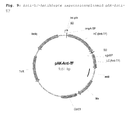
- Fig. 9 shows the anti-TF antibody expression plasmid pAK-anti-TF of Example 8.
- the strain W3110 was first transformed with the plasmid pKD46 (CGSC: 7739). Competent cells of the thus obtained strain W3110 pKD46, which had been prepared according to the data of Datsenko and Wanner, were transformed with the PCR-generated linear DNA fragment. Selection for integration of the chloramphenicol resistance cassette into the chromosome of W3110 at the position of the lpp gene was on LB agar plates containing 20 mg / L chloramphenicol.
- Example 2 Generation of a chromosomal lpp 1 mutant from an E. coli wild-type strain
- Example 4 Fermentative production of a cyclodextrin glycosyltransferase with lpp mutants on a 10 liter scale
- CCTase Klebsiella pneumoniae M5a1 cyclodextrin glycosyltransferase
- pJF118ut is a derivative of the known expression vector pKK223-3 (Amersham Pharmacia Biotech) and, in addition to the ⁇ -lactamase gene and the tetracycline resistance gene, also contains the tac promoter which is produced by the LacIq gene product whose gene is also present on the plasmid. is repressed and by an inductor, such. As D-lactose or isopropyl- ⁇ -D-thiogalactopyranoside (IPTG), can be turned on.
- IPTG isopropyl- ⁇ -D-thiogalactopyranoside
- the vector DNA molecule prepared in this way was ligated with the CGTase-comprising DNA fragment (SEQ ID No. 10) using T4 ligase.
- the strain DH5 ⁇ was transformed with the ligation mixture according to the CaCl 2 method, whereby ampicillin (100 mg / l) was used to select for plasmid-containing cells. From ampicillin-resistant transformants, the plasmid was re-isolated and checked by restriction analysis.
- the plasmid thus produced in which the expression of the CGTase gene is under the control of the tac promoter, was designated pCGT ( Figure 4).
- the strains W3110 ⁇ lpp, W3110lpp1 and W3110lpp3 were each transformed with the plasmid pCGT by means of the CaCl 2 method.
- the selection for plasmid-containing cells was carried out by means of ampicillin (100 mg / l).
- the production was carried out in 10 l stirred tank fermenters.
- FM4 (1.5 g / l KH 2 PO 4 ; 5 g / l (NH 4 ) 2 SO 4 ; 0.5 g / l MgSO 4 .7H 2 O; 0.15 g / l CaCl 2 x 2 H 2 O, 0.075 g / l FeSO 4 x 7 H 2 O, 1 g / l Na 3 citrate x 2 H 2 O, 0.5 g / l NaCl, 1 ml / l trace element solution (0, 15 g / l Na 2 MoO 4 ⁇ 2 H 2 O; 2.5 g / l Na 3 BO 3 ; 0.7 7 g / l CoCl 2 ⁇ 6 H 2 O; 0.25 g / l CuSO 4 ⁇ 5 H 2 O, 1.6 g / l MnCl 2 ⁇ 4 H 2 O, 0.3 g / l Z
- Table 1 shows the respective achieved cyclodextrin glycosyltransferase yields.
- Table 1 shows the respective achieved cyclodextrin glycosyltransferase yields.
- Example 5 Fermentative production of a hirudin derivative with lpp mutants on a 10 liter scale
- Hirudin is a polypeptide of 65 amino acids and was originally isolated from the leech Hirudo medicinalis .
- the fermentative production of a hirudin derivative having the N-terminal amino acid sequence Ala-Thr-Tyr-Thr-Asp is described.
- the strains W3110 ⁇ lpp, W3110lpp1 and W3110lpp3 were each first transformed with the plasmid pCMT203 by means of the CaCl 2 method.
- the selection for plasmid-containing cells was carried out by means of ampicillin (100 mg / l).
- the plasmid pCMT203 contains, in addition to the gene for the resistance to ampicillin, among others, the structural gene of the hirudin derivative, which is fused in frame to the 3 'end of a CGTase signal sequence.
- the expression of the CGTase signal sequence-hirudin fusion is under the control of the tac promoter.
- the plasmid pCMT203 is in EP0448093B1 described.
- the production of the hirudin derivative in the 10 1 scale was carried out analogously to the method described in Example 4 with the strains W3110 ⁇ lpp / pCMT203, W3110lpp1 / pCMT203 and W3110lpp3 / pCMT203. After fermentation for 72 h, samples were taken, then the cells were separated from the fermentation medium by centrifugation and the hirudin content in the fermentation supernatant was determined by means of a thrombin inactivation test as described in US Pat Chang (1991, J. Biol. Chem. 266, 10839-43 ). 16,000 antithrombin (AT) units / ml of hirudin activity correspond to about 1 g / l of hirudin protein.
- AT antithrombin
- Table 2 shows the respective achieved hirudin yields in the fermentation supernatant.
- Table 2 shows the respective achieved hirudin yields in the fermentation supernatant.
- Table 2 shows the respective achieved hirudin yields in the fermentation supernatant.
- Table 2 shows the respective achieved hirudin yields in the fermentation supernatant.
- Table 2 shows the respective achieved hirudin yields in the fermentation supernatant.
- Table 2 shows the respective achieved hirudin yields in the fermentation supernatant.
- Table 2 shows the respective achieved hirudin yields in the fermentation supernatant.
- Table 2 shows the respective achieved hirudin yields in the fermentation supernatant.
- Table 2 shows the respective achieved hirudin yields in the fermentation supernatant.
- Table 2 shows the respective achieved hirudin yields in the fermentation supernatant.
- Table 2 shows the respective achieved hirudin yields in the fermentation supernatant.
- Table 2 shows the respective achieved hirudin yields
- Example 6 Fermentative production of interferon ⁇ 2b with lpp mutants on a 10 l scale
- interferon ⁇ 2b Another pharmaceutically interesting protein that can be produced with the aid of an lpp mutant from E. coli can be made extracellularly, is the interferon ⁇ 2b.
- the production of the expression vector for the interferon ⁇ 2b gene was as follows: A DNA fragment with SEQ ID no. 11, which contains a gene fusion consisting of the in EP 0220714 described CGTase signal sequence (SEQ ID No. 3) and the gene for Interferon ⁇ 2b was prepared by gene synthesis. This DNA fragment was cut with the restriction enzymes EcoRI and PstI and ligated with the expression vector pJF118ut cut with the same restriction enzymes. The resulting from this cloning plasmid, in The expression of the interferon ⁇ 2b gene under the control of the tac promoter was designated pIFN ( Figure 5).
- the strains W3110 ⁇ lpp, W3110lpp1 and W3110lpp3 were each transformed with the plasmid pIFN according to the CaCl 2 method.
- the selection for plasmid-containing cells was carried out by means of ampicillin (100 mg / l).
- Lumi-Light Western Blotting Substrates (Roche, Cat. No .: 2015200): Mix Lumi-Light Luminol / Enhancer Solution and Lumi-Light Stable Peroxide Solution in a 1: 1 ratio: 3 ml / NC membrane. Blot 5 min at RT with Lumi-Light Western Blotting, allow to run off excess, cover membrane with cling film and immediately apply X-Ray film (Kodak, X-OMAT), expose, develop and fix for 2 min. at weak signals, the exposure is repeated over a longer period of time.
- Prehybridization buffer 5% skimmed milk powder in 1x PBS 10x PBS: 100 mM NaH 2 PO 4 , 1.5 M NaCl, pH 7.5 with NaOH, 0.5% Triton 100 1x PBS: Dilute 10x PBS with deionized water 1:10
- Example 7 Fermentative production of Fab antibody fragments with lpp mutants on a 10 l scale
- Functional Fab antibody fragments can also be produced extracellularly using an E. coli lpp mutant.
- the cell must simultaneously synthesize the corresponding light chain fragments comprising domains V L and C L and the heavy chain comprising domains V H and CH1, and then secrete into the periplasm and finally into the fermentation medium. Outside the cytoplasm then the assembly of the two chains to the functional Fab fragment takes place.
- the present example describes the production of a Fab fragment of the well-characterized anti-lysozyme antibody D1.3.
- the starting vector for the cloning and expression of the genes of the anti-lysozyme Fab fragment was the plasmid pJF118ut.
- the two heavy chain (V H -C H 1) and the light chain (V L -C L domains) of the anti-lysozyme Fab fragment were respectively included in two consecutive steps a signal sequence cloned.
- the procedure was as follows: The DNA fragment with the SEQ ID no. 12 (heavy chain) was prepared by gene synthesis and comprises a gene fusion consisting of the signal sequence of the E.
- the DNA fragment with the SEQ ID no. 13 was also prepared by gene synthesis and comprises a gene fusion consisting of the signal sequence of a CGTase (SEQ ID No. 3) and the light chain reading frame (V L -C L ) of the Fab fragment.
- This DNA fragment was first cut with the restriction enzyme PstI and then ligated with the vector pHC-anti-lysozyme which had been cut with the same restriction enzyme.
- the resulting plasmid was designated pFab anti-lysozyme ( Figure 7). In this way, an artificial operon consisting of the respective heavy and light chain reading frames, which is under the control of the tac promoter, was generated.
- the strains W3110 ⁇ lpp, W3110lpp1 and W3110lpp3 were each transformed with the plasmid pFab-anti-lysozyme with the CaCl 2 method.
- the selection for plasmid-containing cells was carried out by means of ampicillin (100 mg / l).
- the production of the 10 l-scale anti-lysozyme Fab fragment was carried out analogously to the method described in Example 4 with the strains W3110 ⁇ lpp / pFab-anti-lysozyme, W3110lpp1 / pFab-anti-lysozyme and W3110lpp3 / pFab-anti-lysozyme. After 72 h of fermentation samples were taken and then the cells separated by centrifugation from the fermentation medium.
- the quantification and the determination of the activity of the purified anti-lysozyme Fab fragment was carried out by means of an ELISA test with lysozyme as antigen ( Skerra, 1994, Gene 141, 79-84 ).
- Example 8 Fermentative production of full-length antibodies with 10 ppm lpp mutants
- Functional full-length antibodies can also be produced extracellularly using an E. coli lpp mutant. Analogously to the production of the Fab fragments, the cell must simultaneously synthesize the light and heavy chains of the antibody and then secrete into the periplasm and finally into the fermentation medium. Outside of the cytoplasm then the assembly of the two chains takes place to the functional full-length antibody.
- the present example describes the production of the anti-tissue factor ( ⁇ TF) IgG1 antibody.
- the starting vector for the cloning and expression of the genes of the anti- ⁇ TF antibody was the plasmid pJF118ut.
- the two heavy chain or light chain reading frames of the anti- ⁇ TF antibody, each including a signal sequence were cloned in two sequential steps.
- the procedure was as follows: The DNA fragment with the SEQ ID no. 14 (heavy chain) was prepared by gene synthesis and comprises a gene fusion consisting of the signal sequence of the ompA gene of E. coli and the reading frame for the heavy chain of the anti- ⁇ TF antibody. This DNA fragment was first cut with the restriction enzymes EcoRI and PstI and ligated with the expression vector pJF118ut cut with the same restriction enzymes.
- the DNA fragment with the SEQ ID no. 15 was also prepared by gene synthesis and comprises a gene fusion consisting of the signal sequence of a CGTase (SEQ ID No. 3) and the light chain reading frame of the anti- ⁇ TF antibody.
- This DNA fragment was first cut with the restriction enzyme PstI and then ligated with the vector pHC-anti-TF, which had been cut with the same restriction enzyme.
- the resulting plasmid was designated pAK-anti-TF ( Figure 9).
- an artificial operon consisting of the respective heavy and light chain reading frames, which is under the control of the tac promoter, was generated.
- an inducer eg IPTG
- the strains W3110 ⁇ lpp, W31101pp1 and W31101pp3 were each transformed with the plasmid pAK-anti-TF with the CaCl 2 method.
- the selection for plasmid-containing cells was carried out by means of ampicillin (100 mg / l).
- the production of the anti- ⁇ TF antibody in the 10 1 scale was carried out analogously to the method described in Example 4 with the strains W3110 ⁇ lpp / pAK-anti-TF, W3110lpp1 / pAK-anti-TF and W3110lpp3 / pAK-anti-TF. After 72 h of fermentation samples were taken and then the cells separated by centrifugation from the fermentation medium.
- the quantification of the secreted into the fermentation medium anti- ⁇ TF antibody was determined by an activity determination with an ELISA test with soluble tissue factor as an antigen (coating) and a peroxidase-conjugated goat anti-human F (ab ') 2 fragment as secondary antibody as in Simmons et al. (2002, J. Immunol., Methods 263, 133-47 ).
- Table 5 lists the thus obtained yields of functional anti- ⁇ TF antibody.
- Table 5 ⁇ / b> Anti- ⁇ TF antibody yields in the fermentation supernatant after 72 hours of fermentation tribe Anti- ⁇ TF antibody [mg / 1] W3110 ⁇ lpp / pAK anti-TF 580 W3110lpp1 / pAK anti-TF 600 W3110lpp3 / pAK anti-TF 650
Landscapes
- Chemical & Material Sciences (AREA)
- Health & Medical Sciences (AREA)
- Life Sciences & Earth Sciences (AREA)
- Organic Chemistry (AREA)
- Engineering & Computer Science (AREA)
- Genetics & Genomics (AREA)
- Medicinal Chemistry (AREA)
- Biotechnology (AREA)
- Zoology (AREA)
- Bioinformatics & Cheminformatics (AREA)
- General Health & Medical Sciences (AREA)
- Biochemistry (AREA)
- Wood Science & Technology (AREA)
- Tropical Medicine & Parasitology (AREA)
- Microbiology (AREA)
- General Engineering & Computer Science (AREA)
- Biomedical Technology (AREA)
- Virology (AREA)
- Gastroenterology & Hepatology (AREA)
- Biophysics (AREA)
- Molecular Biology (AREA)
- Proteomics, Peptides & Aminoacids (AREA)
- Preparation Of Compounds By Using Micro-Organisms (AREA)
- Enzymes And Modification Thereof (AREA)
- Micro-Organisms Or Cultivation Processes Thereof (AREA)
Priority Applications (6)
| Application Number | Priority Date | Filing Date | Title |
|---|---|---|---|
| AT06121090T ATE465241T1 (de) | 2006-09-22 | 2006-09-22 | Verfahren zur fermentativen herstellung von proteinen |
| DK06121090.2T DK1903105T3 (da) | 2006-09-22 | 2006-09-22 | Fremgangsmåde til fermentativ fremstilling af proteiner |
| EP06121090A EP1903105B1 (fr) | 2006-09-22 | 2006-09-22 | Procédé pour la production de protéines par fermentation |
| DE502006006800T DE502006006800D1 (de) | 2006-09-22 | 2006-09-22 | Verfahren zur fermentativen Herstellung von Proteinen |
| US11/859,616 US20080254511A1 (en) | 2006-09-22 | 2007-09-21 | Process for the fermentative production of proteins |
| JP2007248136A JP4751374B2 (ja) | 2006-09-22 | 2007-09-25 | 異種タンパク質の製造方法並びにタンパク質の分泌方法 |
Applications Claiming Priority (1)
| Application Number | Priority Date | Filing Date | Title |
|---|---|---|---|
| EP06121090A EP1903105B1 (fr) | 2006-09-22 | 2006-09-22 | Procédé pour la production de protéines par fermentation |
Publications (2)
| Publication Number | Publication Date |
|---|---|
| EP1903105A1 true EP1903105A1 (fr) | 2008-03-26 |
| EP1903105B1 EP1903105B1 (fr) | 2010-04-21 |
Family
ID=37467448
Family Applications (1)
| Application Number | Title | Priority Date | Filing Date |
|---|---|---|---|
| EP06121090A Active EP1903105B1 (fr) | 2006-09-22 | 2006-09-22 | Procédé pour la production de protéines par fermentation |
Country Status (6)
| Country | Link |
|---|---|
| US (1) | US20080254511A1 (fr) |
| EP (1) | EP1903105B1 (fr) |
| JP (1) | JP4751374B2 (fr) |
| AT (1) | ATE465241T1 (fr) |
| DE (1) | DE502006006800D1 (fr) |
| DK (1) | DK1903105T3 (fr) |
Families Citing this family (24)
| Publication number | Priority date | Publication date | Assignee | Title |
|---|---|---|---|---|
| DE102006004871A1 (de) | 2006-02-02 | 2007-08-09 | Wacker Chemie Ag | Mikroorganismenstamm zur Produktion von rekombinanten Proteinen |
| ATE501266T1 (de) * | 2006-09-22 | 2011-03-15 | Wacker Chemie Ag | Verfahren zur fermentativen herstellung von antikörpern |
| ATE493503T1 (de) * | 2006-09-22 | 2011-01-15 | Wacker Chemie Ag | Verfahren zur fermentativen herstellung von proteinen |
| DE102008063900A1 (de) | 2008-12-19 | 2010-06-24 | Wacker Chemie Ag | Verfahren zur fermentativen Herstellung von heterologen Proteinen mittels Escherichia coli |
| EP2670847B1 (fr) * | 2011-02-03 | 2016-10-05 | XOMA Technology Ltd. | Procédés et matériaux pour améliorer l'expression d'une protéine fonctionnelle dans des bactéries |
| RU2746407C1 (ru) | 2012-02-23 | 2021-04-13 | Стейдж Селл Терапеутикс Гмбх | Хроматографическое выделение клеток и других сложных биологических материалов |
| CN102827904B (zh) * | 2012-08-13 | 2014-06-04 | 安徽大学 | 一种大肠杆菌胞外生产外源蛋白的集成化方法 |
| US9616114B1 (en) | 2014-09-18 | 2017-04-11 | David Gordon Bermudes | Modified bacteria having improved pharmacokinetics and tumor colonization enhancing antitumor activity |
| US10676723B2 (en) | 2015-05-11 | 2020-06-09 | David Gordon Bermudes | Chimeric protein toxins for expression by therapeutic bacteria |
| US11248238B2 (en) | 2015-10-22 | 2022-02-15 | Juno Therapeutics Gmbh | Methods, kits, agents and apparatuses for transduction |
| JP7194020B2 (ja) | 2015-10-22 | 2022-12-21 | ジュノ セラピューティクス ゲーエムベーハー | 細胞の培養方法ならびにそのためのキットおよび装置 |
| ES2855992T3 (es) | 2015-12-11 | 2021-09-27 | Wacker Chemie Ag | Cepa de microorganismos y procedimiento para la producción fermentativa exenta de antibióticos de sustancias y proteínas de bajo peso molecular |
| US11180535B1 (en) | 2016-12-07 | 2021-11-23 | David Gordon Bermudes | Saccharide binding, tumor penetration, and cytotoxic antitumor chimeric peptides from therapeutic bacteria |
| US11129906B1 (en) | 2016-12-07 | 2021-09-28 | David Gordon Bermudes | Chimeric protein toxins for expression by therapeutic bacteria |
| JP7339160B2 (ja) | 2017-04-27 | 2023-09-05 | ジュノ セラピューティクス ゲーエムベーハー | オリゴマー粒子試薬およびその使用方法 |
| EP3818073B1 (fr) | 2018-07-06 | 2025-12-03 | Wacker Chemie AG | Souche bactérienne pour libérer une protéine recombinante dans un procédé de fermentation |
| JP7242829B2 (ja) * | 2018-07-24 | 2023-03-20 | ワッカー ケミー アクチエンゲゼルシャフト | 新規細菌lpp突然変異体及び組換えタンパク質の分泌産生のためのその使用 |
| EP3874024A1 (fr) | 2018-10-31 | 2021-09-08 | Juno Therapeutics GmbH | Procédés de sélection et de stimulation de cellules et appareil associé |
| US11471497B1 (en) | 2019-03-13 | 2022-10-18 | David Gordon Bermudes | Copper chelation therapeutics |
| KR102718712B1 (ko) | 2019-08-05 | 2024-10-17 | 와커 헤미 아게 | 발효 방법에서 재조합 단백질 방출용 박테리아 균주 |
| US10973908B1 (en) | 2020-05-14 | 2021-04-13 | David Gordon Bermudes | Expression of SARS-CoV-2 spike protein receptor binding domain in attenuated salmonella as a vaccine |
| US12537071B1 (en) | 2020-07-22 | 2026-01-27 | David Gordon Bermudes | Bacteria having boolean control pathways expressing therapeutic proteins including immunotherapeutic cytotoxins |
| CN115029404B (zh) * | 2021-03-04 | 2024-05-14 | 珠海联邦制药股份有限公司 | 用于lpp单基因敲除或突变的大肠杆菌分泌表达短肽类蛋白的发酵培养基及应用 |
| WO2024261777A1 (fr) * | 2023-06-19 | 2024-12-26 | Biological E Limited | Cassettes d'expression pour l'expression de protéines, procédé(s) et application(s) associés |
Citations (3)
| Publication number | Priority date | Publication date | Assignee | Title |
|---|---|---|---|---|
| EP0338410A2 (fr) * | 1988-04-19 | 1989-10-25 | Consortium für elektrochemische Industrie GmbH | Mutants secrétants d'escherichia coli |
| EP0448093A2 (fr) * | 1990-03-22 | 1991-09-25 | Consortium für elektrochemische Industrie GmbH | Sécrétion des dérivés de hirudine |
| US5223482A (en) * | 1986-11-17 | 1993-06-29 | Scios Nova Inc. | Recombinant Alzheimer's protease inhibitory amyloid protein and method of use |
Family Cites Families (8)
| Publication number | Priority date | Publication date | Assignee | Title |
|---|---|---|---|---|
| US3891508A (en) * | 1973-06-01 | 1975-06-24 | Joseph M Merrick | Method of rapid identification of gram-negative bacteria |
| US4643969A (en) * | 1983-07-25 | 1987-02-17 | The Research Foundation Of State University Of New York | Novel cloning vehicles for polypeptide expression in microbial hosts |
| DE3538433A1 (de) * | 1985-10-29 | 1987-05-14 | Consortium Elektrochem Ind | Dna-fragment mit dem cyclodextrin-glycosyl-transferase-strukturgen, expressionsvektor, mikroorganismen zur expression und herstellungsverfahren |
| US5618920A (en) * | 1985-11-01 | 1997-04-08 | Xoma Corporation | Modular assembly of antibody genes, antibodies prepared thereby and use |
| US5521084A (en) * | 1992-11-10 | 1996-05-28 | Biostar, Inc. | Bovine heat shock promoter and uses thereof |
| WO2002061090A2 (fr) * | 2000-12-14 | 2002-08-08 | Genentech, Inc. | Anticorps produits de maniere procaryote et utilisations de ceux-ci |
| ATE493503T1 (de) * | 2006-09-22 | 2011-01-15 | Wacker Chemie Ag | Verfahren zur fermentativen herstellung von proteinen |
| ATE501266T1 (de) * | 2006-09-22 | 2011-03-15 | Wacker Chemie Ag | Verfahren zur fermentativen herstellung von antikörpern |
-
2006
- 2006-09-22 DE DE502006006800T patent/DE502006006800D1/de active Active
- 2006-09-22 DK DK06121090.2T patent/DK1903105T3/da active
- 2006-09-22 AT AT06121090T patent/ATE465241T1/de active
- 2006-09-22 EP EP06121090A patent/EP1903105B1/fr active Active
-
2007
- 2007-09-21 US US11/859,616 patent/US20080254511A1/en not_active Abandoned
- 2007-09-25 JP JP2007248136A patent/JP4751374B2/ja active Active
Patent Citations (3)
| Publication number | Priority date | Publication date | Assignee | Title |
|---|---|---|---|---|
| US5223482A (en) * | 1986-11-17 | 1993-06-29 | Scios Nova Inc. | Recombinant Alzheimer's protease inhibitory amyloid protein and method of use |
| EP0338410A2 (fr) * | 1988-04-19 | 1989-10-25 | Consortium für elektrochemische Industrie GmbH | Mutants secrétants d'escherichia coli |
| EP0448093A2 (fr) * | 1990-03-22 | 1991-09-25 | Consortium für elektrochemische Industrie GmbH | Sécrétion des dérivés de hirudine |
Non-Patent Citations (5)
| Title |
|---|
| GAUCHERON FRÉDÉRIC: "The minerals of milk.", REPRODUCTION, NUTRITION, DEVELOPMENT. 2005 JUL-AUG, vol. 45, no. 4, July 2005 (2005-07-01), pages 473 - 483, XP002411682, ISSN: 0926-5287 * |
| KANAMORI T ET AL: "Expression and excretion of human pancreatic secretory trypsin inhibitor in lipoprotein-deletion mutant of Escherichia coli.", GENE. 30 JUN 1988, vol. 66, no. 2, 30 June 1988 (1988-06-30), pages 295 - 300, XP002411679, ISSN: 0378-1119 * |
| KENZO NAKAMURA ET AL: "DNA SEQUENCE OF THE GENE FOR THE OUTER MEMBRANE LIPOPROTEIN OF E. COLI: AN EXTREMELY AT-RICH PROMOTER", CELL, MIT PRESS, CAMBRIDGE, MA,, US, vol. 18, no. 4, 1 December 1979 (1979-12-01), pages 1109 - 1117, XP000603528, ISSN: 0092-8674 * |
| MORISHITA HIDEAKI ET AL: "Novel factor Xa and plasma kallikrein inhibitory-activities of the second Kunitz-type inhibitory domain of urinary trypsin inhibitor", THROMBOSIS RESEARCH, vol. 73, no. 3-4, 1994, pages 193 - 204, XP002411680, ISSN: 0049-3848 * |
| ZHANG W Y ET AL: "Alterations of the carboxyl-terminal amino acid residues of Escherichia coli lipoprotein affect the formation of murein-bound lipoprotein.", THE JOURNAL OF BIOLOGICAL CHEMISTRY. 25 SEP 1992, vol. 267, no. 27, 25 September 1992 (1992-09-25), pages 19560 - 19564, XP002411681, ISSN: 0021-9258 * |
Also Published As
| Publication number | Publication date |
|---|---|
| DE502006006800D1 (de) | 2010-06-02 |
| JP4751374B2 (ja) | 2011-08-17 |
| ATE465241T1 (de) | 2010-05-15 |
| EP1903105B1 (fr) | 2010-04-21 |
| US20080254511A1 (en) | 2008-10-16 |
| DK1903105T3 (da) | 2010-06-28 |
| JP2008073046A (ja) | 2008-04-03 |
Similar Documents
| Publication | Publication Date | Title |
|---|---|---|
| EP1903105B1 (fr) | Procédé pour la production de protéines par fermentation | |
| EP1905835B1 (fr) | Peptide signal pour la production de protéines recombinantes | |
| DE60117601T2 (de) | Bakterielle wirtstämme | |
| US20080076158A1 (en) | Process for the fermentative production of proteins | |
| DE69228705T2 (de) | Methode zur rückfaltung von igf-i in eine aktive konformation | |
| DE60310385T2 (de) | Sekretion von proteinen mit mehreren disulfidbindungen in bakterien und verwendungen davon | |
| DE3781765T2 (de) | Verfahren zur herstellung eines polypeptides. | |
| DE102008063900A1 (de) | Verfahren zur fermentativen Herstellung von heterologen Proteinen mittels Escherichia coli | |
| DE69333145T2 (de) | Methode zur kontrollierten herstellung von polypeptiden in bakterien | |
| EP1903115B1 (fr) | Procédé pour la production des anticorps par fermentation | |
| EP0866876A1 (fr) | Procede de production de proteines recombinees dans e.coli par fermentation a haute densite cellulaire | |
| EP3387111B1 (fr) | Souche de micro-organisme et procédé de préparation par fermentation sans antibiotique de substances et protéines à bas poids moléculaire | |
| EP1916305B1 (fr) | Construction d'ADN et procédé pour la production par fermentation de protéines de fusion | |
| EP2418276B1 (fr) | Procédé destiné à la fabrication d'une broche | |
| EP0023882A2 (fr) | Plasmides vecteurs, plasmides contenant des gènes pour phosphatases alcalines, et bactéries contenant ces derniers, leur préparation et application | |
| EP3818073A1 (fr) | Souche bactérienne pour libérer une protéine recombinante dans un procédé de fermentation | |
| EP3827085B1 (fr) | Nouveau mutant lpp bactérien et son utilisation dans la production secrétrique de protéines recombinantes | |
| DE68916444T2 (de) | Sekretorische e-coli-stämme. | |
| WO2001066776A2 (fr) | Nouvelle souche bacterienne de forme l, leur procede de production et leur utilisation pour la production de produits geniques | |
| US7029876B2 (en) | Process for production of polypeptides | |
| EP4010500B1 (fr) | Souche bactérienne pour la libération d'une protéine recombinante dans un procédé de fermentation | |
| AU2002306547A1 (en) | Process for production of polypeptides | |
| DE10011358A1 (de) | Neuartige L-Form-Bakterienstämme, Verfahren zu deren Herstellung sowie deren Verwendung zur Herstellung von Genprodukten | |
| EP2739643A1 (fr) | Utilisation de protéines fluorescentes liant le fmn (fbfp) comme nouveau marqueur de sécrétion |
Legal Events
| Date | Code | Title | Description |
|---|---|---|---|
| PUAI | Public reference made under article 153(3) epc to a published international application that has entered the european phase |
Free format text: ORIGINAL CODE: 0009012 |
|
| 17P | Request for examination filed |
Effective date: 20060922 |
|
| AK | Designated contracting states |
Kind code of ref document: A1 Designated state(s): AT BE BG CH CY CZ DE DK EE ES FI FR GB GR HU IE IS IT LI LT LU LV MC NL PL PT RO SE SI SK TR |
|
| AX | Request for extension of the european patent |
Extension state: AL BA HR MK YU |
|
| AKX | Designation fees paid |
Designated state(s): AT BE BG CH CY CZ DE DK EE ES FI FR GB GR HU IE IS IT LI LT LU LV MC NL PL PT RO SE SI SK TR |
|
| GRAP | Despatch of communication of intention to grant a patent |
Free format text: ORIGINAL CODE: EPIDOSNIGR1 |
|
| GRAS | Grant fee paid |
Free format text: ORIGINAL CODE: EPIDOSNIGR3 |
|
| GRAA | (expected) grant |
Free format text: ORIGINAL CODE: 0009210 |
|
| AK | Designated contracting states |
Kind code of ref document: B1 Designated state(s): AT BE BG CH CY CZ DE DK EE ES FI FR GB GR HU IE IS IT LI LT LU LV MC NL PL PT RO SE SI SK TR |
|
| REG | Reference to a national code |
Ref country code: GB Ref legal event code: FG4D Free format text: NOT ENGLISH |
|
| REG | Reference to a national code |
Ref country code: CH Ref legal event code: EP |
|
| REG | Reference to a national code |
Ref country code: IE Ref legal event code: FG4D Free format text: LANGUAGE OF EP DOCUMENT: GERMAN |
|
| REF | Corresponds to: |
Ref document number: 502006006800 Country of ref document: DE Date of ref document: 20100602 Kind code of ref document: P |
|
| REG | Reference to a national code |
Ref country code: NL Ref legal event code: T3 |
|
| REG | Reference to a national code |
Ref country code: DK Ref legal event code: T3 |
|
| REG | Reference to a national code |
Ref country code: SE Ref legal event code: TRGR |
|
| LTIE | Lt: invalidation of european patent or patent extension |
Effective date: 20100421 |
|
| PG25 | Lapsed in a contracting state [announced via postgrant information from national office to epo] |
Ref country code: ES Free format text: LAPSE BECAUSE OF FAILURE TO SUBMIT A TRANSLATION OF THE DESCRIPTION OR TO PAY THE FEE WITHIN THE PRESCRIBED TIME-LIMIT Effective date: 20100801 Ref country code: LT Free format text: LAPSE BECAUSE OF FAILURE TO SUBMIT A TRANSLATION OF THE DESCRIPTION OR TO PAY THE FEE WITHIN THE PRESCRIBED TIME-LIMIT Effective date: 20100421 |
|
| REG | Reference to a national code |
Ref country code: IE Ref legal event code: FD4D |
|
| PG25 | Lapsed in a contracting state [announced via postgrant information from national office to epo] |
Ref country code: LV Free format text: LAPSE BECAUSE OF FAILURE TO SUBMIT A TRANSLATION OF THE DESCRIPTION OR TO PAY THE FEE WITHIN THE PRESCRIBED TIME-LIMIT Effective date: 20100421 Ref country code: IS Free format text: LAPSE BECAUSE OF FAILURE TO SUBMIT A TRANSLATION OF THE DESCRIPTION OR TO PAY THE FEE WITHIN THE PRESCRIBED TIME-LIMIT Effective date: 20100821 Ref country code: FI Free format text: LAPSE BECAUSE OF FAILURE TO SUBMIT A TRANSLATION OF THE DESCRIPTION OR TO PAY THE FEE WITHIN THE PRESCRIBED TIME-LIMIT Effective date: 20100421 Ref country code: SI Free format text: LAPSE BECAUSE OF FAILURE TO SUBMIT A TRANSLATION OF THE DESCRIPTION OR TO PAY THE FEE WITHIN THE PRESCRIBED TIME-LIMIT Effective date: 20100421 |
|
| PG25 | Lapsed in a contracting state [announced via postgrant information from national office to epo] |
Ref country code: PL Free format text: LAPSE BECAUSE OF FAILURE TO SUBMIT A TRANSLATION OF THE DESCRIPTION OR TO PAY THE FEE WITHIN THE PRESCRIBED TIME-LIMIT Effective date: 20100421 Ref country code: CY Free format text: LAPSE BECAUSE OF FAILURE TO SUBMIT A TRANSLATION OF THE DESCRIPTION OR TO PAY THE FEE WITHIN THE PRESCRIBED TIME-LIMIT Effective date: 20100526 Ref country code: GR Free format text: LAPSE BECAUSE OF FAILURE TO SUBMIT A TRANSLATION OF THE DESCRIPTION OR TO PAY THE FEE WITHIN THE PRESCRIBED TIME-LIMIT Effective date: 20100722 |
|
| PLBI | Opposition filed |
Free format text: ORIGINAL CODE: 0009260 |
|
| PG25 | Lapsed in a contracting state [announced via postgrant information from national office to epo] |
Ref country code: PT Free format text: LAPSE BECAUSE OF FAILURE TO SUBMIT A TRANSLATION OF THE DESCRIPTION OR TO PAY THE FEE WITHIN THE PRESCRIBED TIME-LIMIT Effective date: 20100823 Ref country code: IE Free format text: LAPSE BECAUSE OF FAILURE TO SUBMIT A TRANSLATION OF THE DESCRIPTION OR TO PAY THE FEE WITHIN THE PRESCRIBED TIME-LIMIT Effective date: 20100421 Ref country code: EE Free format text: LAPSE BECAUSE OF FAILURE TO SUBMIT A TRANSLATION OF THE DESCRIPTION OR TO PAY THE FEE WITHIN THE PRESCRIBED TIME-LIMIT Effective date: 20100421 |
|
| PG25 | Lapsed in a contracting state [announced via postgrant information from national office to epo] |
Ref country code: SK Free format text: LAPSE BECAUSE OF FAILURE TO SUBMIT A TRANSLATION OF THE DESCRIPTION OR TO PAY THE FEE WITHIN THE PRESCRIBED TIME-LIMIT Effective date: 20100421 Ref country code: RO Free format text: LAPSE BECAUSE OF FAILURE TO SUBMIT A TRANSLATION OF THE DESCRIPTION OR TO PAY THE FEE WITHIN THE PRESCRIBED TIME-LIMIT Effective date: 20100421 Ref country code: CZ Free format text: LAPSE BECAUSE OF FAILURE TO SUBMIT A TRANSLATION OF THE DESCRIPTION OR TO PAY THE FEE WITHIN THE PRESCRIBED TIME-LIMIT Effective date: 20100421 |
|
| 26 | Opposition filed |
Opponent name: LONZA AG Effective date: 20110121 |
|
| PLAX | Notice of opposition and request to file observation + time limit sent |
Free format text: ORIGINAL CODE: EPIDOSNOBS2 |
|
| PG25 | Lapsed in a contracting state [announced via postgrant information from national office to epo] |
Ref country code: MC Free format text: LAPSE BECAUSE OF NON-PAYMENT OF DUE FEES Effective date: 20100930 |
|
| PLBB | Reply of patent proprietor to notice(s) of opposition received |
Free format text: ORIGINAL CODE: EPIDOSNOBS3 |
|
| PLAB | Opposition data, opponent's data or that of the opponent's representative modified |
Free format text: ORIGINAL CODE: 0009299OPPO |
|
| R26 | Opposition filed (corrected) |
Opponent name: LONZA AG Effective date: 20110121 |
|
| PG25 | Lapsed in a contracting state [announced via postgrant information from national office to epo] |
Ref country code: BG Free format text: LAPSE BECAUSE OF FAILURE TO SUBMIT A TRANSLATION OF THE DESCRIPTION OR TO PAY THE FEE WITHIN THE PRESCRIBED TIME-LIMIT Effective date: 20100421 Ref country code: HU Free format text: LAPSE BECAUSE OF FAILURE TO SUBMIT A TRANSLATION OF THE DESCRIPTION OR TO PAY THE FEE WITHIN THE PRESCRIBED TIME-LIMIT Effective date: 20101022 Ref country code: LU Free format text: LAPSE BECAUSE OF NON-PAYMENT OF DUE FEES Effective date: 20100922 |
|
| PG25 | Lapsed in a contracting state [announced via postgrant information from national office to epo] |
Ref country code: TR Free format text: LAPSE BECAUSE OF FAILURE TO SUBMIT A TRANSLATION OF THE DESCRIPTION OR TO PAY THE FEE WITHIN THE PRESCRIBED TIME-LIMIT Effective date: 20100421 |
|
| PLCK | Communication despatched that opposition was rejected |
Free format text: ORIGINAL CODE: EPIDOSNREJ1 |
|
| REG | Reference to a national code |
Ref country code: AT Ref legal event code: MM01 Ref document number: 465241 Country of ref document: AT Kind code of ref document: T Effective date: 20110922 |
|
| APBM | Appeal reference recorded |
Free format text: ORIGINAL CODE: EPIDOSNREFNO |
|
| APBP | Date of receipt of notice of appeal recorded |
Free format text: ORIGINAL CODE: EPIDOSNNOA2O |
|
| APAH | Appeal reference modified |
Free format text: ORIGINAL CODE: EPIDOSCREFNO |
|
| APAJ | Date of receipt of notice of appeal modified |
Free format text: ORIGINAL CODE: EPIDOSCNOA2O |
|
| PG25 | Lapsed in a contracting state [announced via postgrant information from national office to epo] |
Ref country code: AT Free format text: LAPSE BECAUSE OF NON-PAYMENT OF DUE FEES Effective date: 20110922 |
|
| APBQ | Date of receipt of statement of grounds of appeal recorded |
Free format text: ORIGINAL CODE: EPIDOSNNOA3O |
|
| PG25 | Lapsed in a contracting state [announced via postgrant information from national office to epo] |
Ref country code: BG Free format text: LAPSE BECAUSE OF FAILURE TO SUBMIT A TRANSLATION OF THE DESCRIPTION OR TO PAY THE FEE WITHIN THE PRESCRIBED TIME-LIMIT Effective date: 20100721 |
|
| PLAB | Opposition data, opponent's data or that of the opponent's representative modified |
Free format text: ORIGINAL CODE: 0009299OPPO |
|
| R26 | Opposition filed (corrected) |
Opponent name: LONZA AG Effective date: 20110121 |
|
| PGFP | Annual fee paid to national office [announced via postgrant information from national office to epo] |
Ref country code: SE Payment date: 20140918 Year of fee payment: 9 |
|
| REG | Reference to a national code |
Ref country code: DE Ref legal event code: R100 Ref document number: 502006006800 Country of ref document: DE |
|
| REG | Reference to a national code |
Ref country code: SE Ref legal event code: EUG |
|
| PG25 | Lapsed in a contracting state [announced via postgrant information from national office to epo] |
Ref country code: SE Free format text: LAPSE BECAUSE OF NON-PAYMENT OF DUE FEES Effective date: 20150923 |
|
| APBU | Appeal procedure closed |
Free format text: ORIGINAL CODE: EPIDOSNNOA9O |
|
| REG | Reference to a national code |
Ref country code: FR Ref legal event code: PLFP Year of fee payment: 11 |
|
| PLAE | Information related to rejection of opposition modified |
Free format text: ORIGINAL CODE: 0009299REJO |
|
| PLBN | Opposition rejected |
Free format text: ORIGINAL CODE: 0009273 |
|
| STAA | Information on the status of an ep patent application or granted ep patent |
Free format text: STATUS: OPPOSITION REJECTED |
|
| R27O | Information related to the rejection of opposition modified: opposition rejected |
Effective date: 20160308 |
|
| REG | Reference to a national code |
Ref country code: FR Ref legal event code: PLFP Year of fee payment: 12 |
|
| REG | Reference to a national code |
Ref country code: FR Ref legal event code: PLFP Year of fee payment: 13 |
|
| P01 | Opt-out of the competence of the unified patent court (upc) registered |
Effective date: 20230510 |
|
| REG | Reference to a national code |
Ref country code: DE Ref legal event code: R081 Ref document number: 502006006800 Country of ref document: DE Owner name: WACKER CHEMIE AG, DE Free format text: FORMER OWNER: WACKER CHEMIE AG, 81737 MUENCHEN, DE |
|
| REG | Reference to a national code |
Ref country code: CH Ref legal event code: U11 Free format text: ST27 STATUS EVENT CODE: U-0-0-U10-U11 (AS PROVIDED BY THE NATIONAL OFFICE) Effective date: 20251001 |
|
| PGFP | Annual fee paid to national office [announced via postgrant information from national office to epo] |
Ref country code: DK Payment date: 20250923 Year of fee payment: 20 Ref country code: DE Payment date: 20250919 Year of fee payment: 20 |
|
| PGFP | Annual fee paid to national office [announced via postgrant information from national office to epo] |
Ref country code: NL Payment date: 20250918 Year of fee payment: 20 Ref country code: IT Payment date: 20250923 Year of fee payment: 20 |
|
| PGFP | Annual fee paid to national office [announced via postgrant information from national office to epo] |
Ref country code: BE Payment date: 20250918 Year of fee payment: 20 Ref country code: GB Payment date: 20250918 Year of fee payment: 20 |
|
| PGFP | Annual fee paid to national office [announced via postgrant information from national office to epo] |
Ref country code: FR Payment date: 20250919 Year of fee payment: 20 |
|
| PGFP | Annual fee paid to national office [announced via postgrant information from national office to epo] |
Ref country code: CH Payment date: 20251001 Year of fee payment: 20 |