EP1903573A1 - Dispositif d'enregistrement d'information et méthode d'enregistrement d'information - Google Patents
Dispositif d'enregistrement d'information et méthode d'enregistrement d'information Download PDFInfo
- Publication number
- EP1903573A1 EP1903573A1 EP06768090A EP06768090A EP1903573A1 EP 1903573 A1 EP1903573 A1 EP 1903573A1 EP 06768090 A EP06768090 A EP 06768090A EP 06768090 A EP06768090 A EP 06768090A EP 1903573 A1 EP1903573 A1 EP 1903573A1
- Authority
- EP
- European Patent Office
- Prior art keywords
- recording
- data portion
- bit rate
- changed
- recording medium
- Prior art date
- Legal status (The legal status is an assumption and is not a legal conclusion. Google has not performed a legal analysis and makes no representation as to the accuracy of the status listed.)
- Withdrawn
Links
Images



Classifications
-
- G—PHYSICS
- G11—INFORMATION STORAGE
- G11B—INFORMATION STORAGE BASED ON RELATIVE MOVEMENT BETWEEN RECORD CARRIER AND TRANSDUCER
- G11B27/00—Editing; Indexing; Addressing; Timing or synchronising; Monitoring; Measuring tape travel
- G11B27/02—Editing, e.g. varying the order of information signals recorded on, or reproduced from, record carriers
- G11B27/031—Electronic editing of digitised analogue information signals, e.g. audio or video signals
- G11B27/034—Electronic editing of digitised analogue information signals, e.g. audio or video signals on discs
-
- G—PHYSICS
- G11—INFORMATION STORAGE
- G11B—INFORMATION STORAGE BASED ON RELATIVE MOVEMENT BETWEEN RECORD CARRIER AND TRANSDUCER
- G11B20/00—Signal processing not specific to the method of recording or reproducing; Circuits therefor
- G11B20/00007—Time or data compression or expansion
-
- G—PHYSICS
- G11—INFORMATION STORAGE
- G11B—INFORMATION STORAGE BASED ON RELATIVE MOVEMENT BETWEEN RECORD CARRIER AND TRANSDUCER
- G11B20/00—Signal processing not specific to the method of recording or reproducing; Circuits therefor
- G11B20/10—Digital recording or reproducing
-
- G—PHYSICS
- G11—INFORMATION STORAGE
- G11B—INFORMATION STORAGE BASED ON RELATIVE MOVEMENT BETWEEN RECORD CARRIER AND TRANSDUCER
- G11B20/00—Signal processing not specific to the method of recording or reproducing; Circuits therefor
- G11B20/10—Digital recording or reproducing
- G11B20/12—Formatting, e.g. arrangement of data block or words on the record carriers
- G11B20/1262—Formatting, e.g. arrangement of data block or words on the record carriers with more than one format/standard, e.g. conversion from CD-audio format to R-DAT format
-
- G—PHYSICS
- G11—INFORMATION STORAGE
- G11B—INFORMATION STORAGE BASED ON RELATIVE MOVEMENT BETWEEN RECORD CARRIER AND TRANSDUCER
- G11B27/00—Editing; Indexing; Addressing; Timing or synchronising; Monitoring; Measuring tape travel
- G11B27/36—Monitoring, i.e. supervising the progress of recording or reproducing
-
- H—ELECTRICITY
- H04—ELECTRIC COMMUNICATION TECHNIQUE
- H04N—PICTORIAL COMMUNICATION, e.g. TELEVISION
- H04N5/00—Details of television systems
- H04N5/76—Television signal recording
- H04N5/765—Interface circuits between an apparatus for recording and another apparatus
-
- G—PHYSICS
- G11—INFORMATION STORAGE
- G11B—INFORMATION STORAGE BASED ON RELATIVE MOVEMENT BETWEEN RECORD CARRIER AND TRANSDUCER
- G11B20/00—Signal processing not specific to the method of recording or reproducing; Circuits therefor
- G11B20/00007—Time or data compression or expansion
- G11B2020/00079—Time or data compression or expansion the compression ratio or quality level being adapted to circumstances, e.g. to the available recording space
-
- G—PHYSICS
- G11—INFORMATION STORAGE
- G11B—INFORMATION STORAGE BASED ON RELATIVE MOVEMENT BETWEEN RECORD CARRIER AND TRANSDUCER
- G11B20/00—Signal processing not specific to the method of recording or reproducing; Circuits therefor
- G11B20/10—Digital recording or reproducing
- G11B2020/10833—Copying or moving data from one record carrier to another
-
- G—PHYSICS
- G11—INFORMATION STORAGE
- G11B—INFORMATION STORAGE BASED ON RELATIVE MOVEMENT BETWEEN RECORD CARRIER AND TRANSDUCER
- G11B20/00—Signal processing not specific to the method of recording or reproducing; Circuits therefor
- G11B20/10—Digital recording or reproducing
- G11B2020/10833—Copying or moving data from one record carrier to another
- G11B2020/10842—Copying or moving data from one record carrier to another wherein not all recorded data are copied or moved
-
- G—PHYSICS
- G11—INFORMATION STORAGE
- G11B—INFORMATION STORAGE BASED ON RELATIVE MOVEMENT BETWEEN RECORD CARRIER AND TRANSDUCER
- G11B20/00—Signal processing not specific to the method of recording or reproducing; Circuits therefor
- G11B20/10—Digital recording or reproducing
- G11B2020/10935—Digital recording or reproducing wherein a time constraint must be met
- G11B2020/10981—Recording or reproducing data when the data rate or the relative speed between record carrier and transducer is variable
-
- G—PHYSICS
- G11—INFORMATION STORAGE
- G11B—INFORMATION STORAGE BASED ON RELATIVE MOVEMENT BETWEEN RECORD CARRIER AND TRANSDUCER
- G11B2220/00—Record carriers by type
- G11B2220/40—Combinations of multiple record carriers
- G11B2220/45—Hierarchical combination of record carriers, e.g. HDD for fast access, optical discs for long term storage or tapes for backup
- G11B2220/455—Hierarchical combination of record carriers, e.g. HDD for fast access, optical discs for long term storage or tapes for backup said record carriers being in one device and being used as primary and secondary/backup media, e.g. HDD-DVD combo device, or as source and target media, e.g. PC and portable player
-
- H—ELECTRICITY
- H04—ELECTRIC COMMUNICATION TECHNIQUE
- H04N—PICTORIAL COMMUNICATION, e.g. TELEVISION
- H04N5/00—Details of television systems
- H04N5/76—Television signal recording
- H04N5/78—Television signal recording using magnetic recording
- H04N5/781—Television signal recording using magnetic recording on disks or drums
-
- H—ELECTRICITY
- H04—ELECTRIC COMMUNICATION TECHNIQUE
- H04N—PICTORIAL COMMUNICATION, e.g. TELEVISION
- H04N5/00—Details of television systems
- H04N5/76—Television signal recording
- H04N5/84—Television signal recording using optical recording
- H04N5/85—Television signal recording using optical recording on discs or drums
-
- H—ELECTRICITY
- H04—ELECTRIC COMMUNICATION TECHNIQUE
- H04N—PICTORIAL COMMUNICATION, e.g. TELEVISION
- H04N9/00—Details of colour television systems
- H04N9/79—Processing of colour television signals in connection with recording
- H04N9/7921—Processing of colour television signals in connection with recording for more than one processing mode
-
- H—ELECTRICITY
- H04—ELECTRIC COMMUNICATION TECHNIQUE
- H04N—PICTORIAL COMMUNICATION, e.g. TELEVISION
- H04N9/00—Details of colour television systems
- H04N9/79—Processing of colour television signals in connection with recording
- H04N9/80—Transformation of the television signal for recording, e.g. modulation, frequency changing; Inverse transformation for playback
- H04N9/804—Transformation of the television signal for recording, e.g. modulation, frequency changing; Inverse transformation for playback involving pulse code modulation of the colour picture signal components
- H04N9/8042—Transformation of the television signal for recording, e.g. modulation, frequency changing; Inverse transformation for playback involving pulse code modulation of the colour picture signal components involving data reduction
Definitions
- the present invention relates to an information recording apparatus for and an information recording method of recording content data, such as a video work and a musical work, onto an optical disc.
- Various recording media are popular as recording media on which the content data, such as a video work and a musical work, can be recorded.
- Such recording media can be classified, if focusing on the recording capacity, mainly into: large-capacity recording media with a recording capacity of several tens gigabytes to several hundred gigabytes>; and middle/small-capacity recording media with a recording capacity of several hundred megabytes to several gigabytes.
- the large-capacity recording media are represented by a hard disk.
- the middle/small-capacity recording media are represented by an optical disc, such as a Blu-ray, a HD-DVD, a DVD, and a CD (Compact Disc).
- an information recording apparatus provided with a hard disk drive apparatus an and optical disc drive apparatus has been popular, recently.
- Such an information recording apparatus is presented by a hard disk drive built-in DVD recorder.
- a user uses the hard disk drive built-in DVD recorder to record a video work, such as a television program, onto a hard disk or a DVD.
- a video work such as a television program
- the user firstly records the television program onto the hard disk.
- the user wants to reproduce the television program recorded on the hard disk on another reproducing apparatus, when the user wants to take the record data of the television program outside or when the user wants to store the record data of the television program for a long time, the user dubs or copies the record data of the television program recorded on the hard disk.
- Most of the hard disk drive built-in DVD recorders employ two types of dubbing methods. That is, high-speed dubbing and constant-speed dubbing.
- the high-speed dubbing is a method of copying video data encoded (or compressed) by MPEG-2 (Moving Picture Experts Group phase 2) or audio data encoded by AC-3 (Audio Code number 3), in the encoded state from the hard disk to the DVD.
- MPEG-2 Motion Picture Experts Group phase 2
- AC-3 Audio Code number 3
- the video data or the audio data is read from the hard disk and is recorded onto the DVD as it is, so that the dubbing or copy can be performed at high-speed in a short time.
- the video data or the audio data is copied in the encoded state from the hard disk to the DVD at an already determined recording bit rate, so that it is hardly possible to change the recording bit rate of the vide data or the audio data in the dubbing procedure. As a result, it is hardly possible to change the size of the video data or the audio data in the dubbing.
- the constant-speed dubbing is a method of decoding (decompressing) video data encoded by MPEG-2 or audio data encoded by AC-3, changing the recording bit rate, encoding the data again, and recording the video data or the audio data encoded at the changed recording bit rate onto the DVD.
- the video data or the audio data is decoded once for the dubbing.
- the dubbing requires the same time as in the reproduction of the video data or the audio data to watch them. That is, the constant-dubbing has a slower dubbing speed and needs a longer time than those of the high-speed dubbing.
- the constant-speed dubbing it is possible to change the recording bit rate of the video data or the audio data in the dubbing procedure. As a result, it is possible to change the size of the video data or the audio data in the dubbing.
- the currently spread hard disk drive built-in DVD recorder performs the constant-speed dubbing on the entire content data.
- the hard disk drive built-in DVD recorder selects not the high-speed dubbing but the constant-speed dubbing, and performs the constant-speed dubbing on the entire content data.
- most of the currently spread hard disk drive built-in DVD recorders display a message which indicates to select the constant-speed dubbing, on a small display or the like mounted on the recorders, to thereby propose to the user to select the constant-speed dubbing. Then, if the user agrees about the proposition and inputs an instruction to perform the constant-speed dubbing to the recorder, the constant-speed dubbing is performed on the entire content data.
- the constant-speed dubbing has a slow dubbing speed and needs a longer time.
- the content data to be copied is one movie work, with the total reproduction time of about 2 hours, recorded on the hard disk at a high recording bit rate (e.g. about 10Mbps).
- this content data is copied onto a dual-layer DVD-R (with a recording capacity of 8.54 gigabytes) with an entire recording area unrecorded.
- the hard disk drive built-in DVD recorder selects the constant-speed dubbing.
- the constant-speed dubbing it requires the same time as in the reproduction of the content data to watch it. If so, the dubbing time will be 2 hours. It is inconvenient to take such a long time for the dubbing.
- an object of the present invention to provide an information recording apparatus, an information recording method, and a computer program, which enable the entire content data to be copied in a short time even if the size of the content data is greater than the recording capacity of the unrecorded portion of the recording medium which is a dubbing destination.
- a first information recording apparatus having a function of reading content data recorded on a first recording medium and of recording the content data onto a second recording medium
- the information recording apparatus provided with: a reading device for reading the content data, which is encoded at a first recording bit rate and which is recorded on the first recording medium, from the first recording medium; a dividing device for dividing the content data into an unchanged data portion and a changed data portion; a recording bit rate changing device for changing a recording bit rate of the changed data portion from the first recording bit rate to a second recording bit rate which is lower than the first recording bit rate; and a recording device for recording the unchanged data portion and the changed data portion in which the recording bit rate is changed by the recording bit rate changing device, onto the second recording medium.
- a second information recording apparatus having a function of reading content data, including video data, recorded on a first recording medium and of recording the content data onto a second recording medium
- the information recording apparatus provided with: a reading device for reading the content data in which first video resolution is set, from the first recording medium; a dividing device for dividing the content data into an unchanged data portion and a changed data portion; a video resolution changing device for changing video resolution of the changed data portion from the first video resolution to second video resolution which is lower than the first video resolution; and a recording device for recording the unchanged data portion and the changed data portion in which the video resolution is changed by the video resolution changing device, onto the second recording medium.
- the above object of the present invention can be also achieved by a first information recording method of reading content data recorded on a first recording medium and of recording the content data onto a second recording medium, the information recording method provided with: a dividing process of dividing the content data, which is encoded at a first recording bit rate, into an unchanged data portion and a changed data portion; a reading process of reading the changed data portion from the first recording medium; a recording bit rate changing process of changing a recording bit rate of the changed data portion read in the reading process, from the first recording bit rate to a second recording bit rate which is lower than the first recording bit rate; and a recording process of reading the unchanged data portion from the first recording medium, of recording the unchanged data portion onto the second recording medium, and of recording the changed data portion in which the recording bit rate is changed in the recording bit rate changing process, onto the second recording medium.
- the above object of the present invention can be also achieved by a second information recording method of reading content data recorded on a first recording medium and of recording the content data onto a second recording medium, the information recording method provided with: a dividing process of dividing the content data in which first video resolution is set, into an unchanged data portion and a changed data portion; a reading process of reading the changed data portion from the first recording medium; a video resolution changing process of changing video resolution of the changed data portion read in the reading process, from the first video resolution to second video resolution which is lower than the first video resolution; and a recording process of reading the unchanged data portion from the first recording medium, of recording the unchanged data portion onto the second recording medium, and of recording the changed data portion in which the video resolution is changed in the video resolution changing process, onto the second recording medium.
- the above object of the present invention can be also achieved by a computer program for making a computer function as the first or second information recording apparatus of the present invention (including its various aspects).
- the above object of the present invention can be also achieved by a computer program product in a computer-readable medium for tangibly embodying a program of instructions executable by a computer, the computer program product making the computer function as the first or second information recording apparatus of the present invention (including its various aspects).
- the aforementioned first or second information recording apparatus of the present invention can be embodied relatively readily, by loading the computer program product from a recording medium for storing the computer program product, such as a ROM (Read Only Memory), a CD-ROM (Compact Disc - Read Only Memory), a DVD-ROM (DVD Read Only Memory), a hard disk or the like, into the computer, or by downloading the computer program product, which may be a carrier wave, into the computer via a communication device.
- the computer program product may include computer readable codes to cause the computer (or may comprise computer readable instructions for causing the computer) to function as the aforementioned first or second information recording apparatus of the present invention.
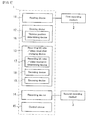
- FIG. 1 shows an embodiment of the information recording apparatus of the present invention.
- An information recording apparatus 1 in FIG. 1 has a function of reading content data recorded on a first recording medium 2 and of recording it onto a second recording medium 3. By virtue of the function, the content data recorded on the first recording medium 2 can be copied to the second recording medium 3.
- the first recording medium is desirably a large-capacity recording medium with a recording capacity of several tens gigabytes or more, mainly.
- the first recording medium is desirably, for example, a hard disk.
- the second recording medium is desirably a middle/small-capacity recording medium with a recording capacity of several hundred megabytes to several gigabytes.
- the first recording medium is desirably, for example, an optical disc, such as a Blu-ray, a HD-DVD, a DVD, and a CD (Compact Disc).
- the optical disc may be a single layer type or dual layer type, or a recordable (or write-once) type or rewritable type.
- the information recording apparatus 1 is desirably provided with a control apparatus, such as a hard disk drive apparatus, for controlling the reading and recording of the information / data with respect to the large-capacity recording medium. Moreover, the information recording apparatus 1 is also provided desirably with a control apparatus, such as an optical disc drive apparatus (a CD drive, a DVD drive, or the like), for controlling the reading and recording of the information / data with respect to the middle/small-capacity recording medium.
- the information recording apparatus 1 can be applied to e.g. a hard disk drive built-in DVD recorder.
- the content data is data of a video work, a musical work, a television program, or the like.
- the content data mainly includes video data and audio data; however, like the content data of the musical work, the content data includes only the audio data in some cases. That is, the type of the data included in the content data varies depending on the form of the work.
- the content data is recorded on the first recording medium 2.
- a hard disk drive built-in DVD recorder which is generally spread, has a function of recording a television program broadcasted from a television broadcast station, as the content data, onto a hard disk. By using such a function in the past, the content data is already recorded on the first recording medium 2.
- the content data recorded on the first recording medium 2 is encoded at a first recording bit rate. That is, the content data is recorded on the first recording medium 2 in the encoded state at the first recording bet rate. Moreover, the content data recorded on the first recording medium 2 includes the video data, and first video resolution is set to the video data.
- an encoding method employed for the encoding of the content data is an encoding method at a variable bit rate.
- it is MPEG 2 for the video data
- it is AC-3 for the audio data.
- the encoding method employed for the encoding of the content data is an encoding method in which the video resolution can be variably set.
- MPEG 2 can variably set the video resolution.
- Most of the hard disk drive built-in DVD recorders which are generally spread have a function of selecting and setting image quality (image quality mode) for the reproduction of the recorded content data when recording the content data, such as a television program.
- image quality mode e.g. XP mode, fine mode, or the like
- the content data transmitted from a television broadcast station is encoded at a high recording bit rate of e.g. about 10Mbps (bits per second) and is recorded onto the hard disk.
- high video resolution is set, such as FD1 (Full D1 720 ⁇ 48). If the high recording bit rate or the high video resolution is set, the size (or length) per unit reproduction time for the content data increases.
- the content data transmitted from a television broadcast station is encoded at a low recording bit rate of e.g. about 5 or 2.5Mbps and is recorded onto the hard disk.
- a low recording bit rate e.g. about 5 or 2.5Mbps
- low video resolution is set, such as HD1 8Half D1 352 ⁇ 480), for the content data in the encoding. If the low recording bit rate or the low video resolution is set, the size (or length) per unit reproduction time for the content data reduces.
- the information recording apparatus 1 can copy or dub such content data from the first recording medium 1, such as a hard disk, to the second recording medium 3, such as a DVD.
- the information recording apparatus 1 compares the size of the content data recorded on the first recording medium 2 with the capacity of an unrecorded area of the second recording medium 2. If the size of the content data is greater than the capacity of the unrecorded area of the second recording medium 2, the information recording apparatus 1 divides the content data into an unchanged data portion and a changed data portion. Then, the information recording apparatus 1 changes, in only the changed data portion, the recording bit rate from the first recording bit rate to a second recording bit rate, which is lower than the first recording bit rate.
- the information recording apparatus 1 changes, in only the changed data portion, the video resolution from the first video resolution to second video resolution, which is lower than the first video resolution. Incidentally, it simultaneously changes the recording bit rate and the video resolution in some cases. Then, the information recording apparatus 1 records the unchanged data portion and the changed data portion in which the recording bit rate or the video resolution (i.e. either one or both of the recording bit rate and the video resolution) is changed, onto the second recording medium 3.
- the recording bit rate or the video resolution i.e. either one or both of the recording bit rate and the video resolution
- the execution order is determined in view of processing efficiency or the like.
- the size of the changed data portion is reduced. Therefore, the size of the entire content data obtained by adding the unchanged data portion and the changed data portion after the video resolution or the recording bit rate is reduced, becomes equal to or less than the capacity of the unrecorded area of the second recording medium 3. As a result, it is possible to record the entire content data onto the second recording medium 3.
- the first video resolution is set for the unchanged data portion. Then, the unchanged data portion is read from the first recording medium 2 in the encoded state at the first recording bit rate, and is recorded onto the second recording medium 3 immediately as it is.
- the high-speed dubbing such as 4-time speed, 8-time speed, and 16-time speed.
- the video resolution is changed from the first video resolution to the second video resolution, and the recording bit rate is changed from the first recording bit rate to the second recording bit rate. After that, the changed data portion is recorded onto the second recording medium 3.
- the dubbing in the changed data portion is slower than the dubbing in the unchanged data portion.
- the dubbing in the changed data portion requires the same time as in the reproduction of the content data to watch it.
- the dubbing process of the information recording apparatus 1 when the size of the content data is greater than the recording capacity of the unrecorded area of the second recording medium 3, the content data is divided into the unchanged data portion and the changed data portion, and the video resolution or the recording bit rate is changed only in the changed data portion. Therefore, the dubbing can be performed at high speed in a short time in the unchanged data portion. By this, it is possible to reduce the dubbing time. That is, it is only one portion of the content data, i.e. the data changed portion, that the dubbing speed is reduced. Therefore, as compared to the case that the recording bit rate is changed for the entire content data and thus low-speed dubbing is performed on the entire content data, it is possible to increase the overall (or average) dubbing speed and to reduce the time required to copy the entire content data.
- the information recording apparatus 1 is provided with: a reading device 11; a dividing device 12; a recording bit rate / video resolution changing device 13 (hereinafter referred to as a "rate resolution changing device"); a recording device 14; and a control device 15.
- the reading device 11 reads the content data in which the first video resolution is set, which is encoded at the first recording bit rate, and which is recorded on the first recording medium 2, from the first recording medium 2. If the first recording medium 2 is a hard disk, the reading device 11 can be provided with: a hard disk drive apparatus; a central processing unit or the like for controlling the hard disk drive apparatus; and the like.
- the dividing device 12 divides the content data into the unchanged data portion and the changed data portion.
- the dividing device 12 can be provided with: a data processing circuit with a data processing function; a central processing unit or a multi processing unit; and the like.
- the rate resolution changing device 13 changes the video resolution in the changed data portion from the first video resolution to the second video resolution, which is lower than the first video resolution. Moreover, the rate resolution changing device 13 changes the recording bit rate in the changed data portion from the first recording bit rate to the second recording bit rate, which is lower than the first recording bit rate.
- the rate resolution changing device 13 can be provided with: a data processing circuit with a data processing function; a central processing unit or a multi processing unit; and the like.
- the recording device 14 records the unchanged data portion and the changed data portion in which the video resolution or the recording bit rate is changed by the rate resolution changing device 13, onto the second recording medium 3.
- the recording device can be provided with: a DVD drive apparatus; and a central processing unit or the like for controlling the DVD drive apparatus; and the like.
- the control device 15 controls the reading device 11, the dividing device 12, the rate resolution changing device 13, and the recording device.
- the control device 15 can be provided with a central processing unit or a multi processing unit and the like.
- the dividing device 12 is desirably provided with a division position determining device 16.
- the division position determining device 16 determines the division position of the changed data portion and the unchanged data portion when the content data is divided, such that the sum of the size of the unchanged data portion and the size of the changed data portion after the video resolution or the recording bit rate is changed is equal to or less than the capacity of the unrecorded area of the second recording medium 3.
- the division position determining device 16 desirably determines the division position such that the sum of the size of the unchanged data portion and the size of the changed data portion after the video resolution or the recording bit rate is changed is maximal in a range of the capacity of the unrecorded area of the second recording medium 3.
- the rate resolution changing device 13 is desirably provided with: a recording bit rate / video resolution determining device 17 (hereinafter referred to as a "rate resolution determining device 17"); a decoding device 18; and an encoding device 19.
- the rate resolution determining device 17 determines the second recording bit rate such that the sum of the size of the unchanged data portion and the size of the changed data portion after the video resolution or the recording bit rate is changed is equal to or less than the capacity of the unrecorded area of the second recording medium 3.
- the decoding device 18 decodes the changed data portion.
- the encoding device 19 encodes the change data portion decoded by the decoding device 18, at the second recording bit rate.
- the rate resolution determining device 17 desirably determines the second recording bit rate such that the sum of the size of the unchanged data portion and the size of the changed data portion after the video resolution or the recording bit rate is changed is maximal in a range of the capacity of the unrecorded area of the second recording medium 3.
- the rate resolution changing device 13 preferentially reduces the recording bit rate of the audio data included in the changed data portion, rather than the recording bit rate of the video data included in the changed data portion. By this, it is possible to reduce the dubbing time while preventing a reduction in the image quality.
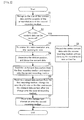
- FIG. 2 shows a first dubbing operation of the information recording apparatus 1.
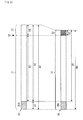
- FIG. 3 shows the content data recorded on the first recording medium 2 (in the upper part in FIG .3 ) and the content data recorded on the second recording medium 3 by the first dubbing operation (in the lower part in FIG. 3 ).
- the information recording apparatus 1 Before the dubbing operation is started, the information recording apparatus 1 is in the following state. That is, as shown in the upper part of FIG. 3 , the first video resolution is set and content data 20 encoded at the first recording bit rate is recorded on the first recording medium 2. Moreover, it is ready for the recording device 14 to record the data onto the second recording medium 3 in the dubbing operation. For example, a DVD is loaded on a DVD drive apparatus.
- the information recording apparatus 1 starts the dubbing operation.
- the specification of the content data 20 to be copied and the input of the instruction to start the dubbing are performed by the user operating an operation switch (not illustrated) mounted on a remote controller or the information recording apparatus 1, for example.
- the control device 15 of the information recording apparatus 1 firstly recognizes a size A0 of the content data 20 recorded on the first recording medium 2 and a capacity B0 of the unrecorded area of the second recording medium 3 (step S1).
- the recognition of the size A0 of the content data 20 can be performed by reading management information 20A included in the content data 20 by using the reading device 11 and by referring to the management information 20A.
- the recognition of the capacity B0 of the unrecorded area of the second recording medium 3 can be performed by reading and referring to management information recorded on the second recording medium 3.
- the control device 15 compares the size A0 of the content data 20 with the capacity B0 of the unrecorded area of the second recording medium 3. Then, the control device 15 judges whether or not the entire content data 20 can be recorded onto the second recording medium 3 (step S2). If the size A0 of the content data 20 is equal to or less than the capacity B0 of the unrecorded area of the second recording medium 3, the control device 15 judges that the entire content data 20 can be recorded onto the second recording medium 3. On the other hand, if the size A0 of the content data 20 is greater than the capacity B0 of the unrecorded area of the second recording medium 3, the control device 15 judges that the entire content data 20 cannot be recorded onto the second recording medium 3.
- the information recording apparatus 1 divides the content data 20 into an unchanged data portion 21 and a changed data portion 22 in a step S4 and a step S6 later, and changes the video resolution or the recording bit rate of the changed data portion 22.
- the rate resolution determining device 17 determines the video resolution after the change in the changed data portion 22, i.e. the second video resolution, and the recording bit rate after the change in the changed data portion 22, i.e. the second recording bit rate (step S3).
- the change in the changed data portion 22 is mainly intended to reduce the size of the changed data portion 22.
- the way to reduce the size of the changed data portion 22 includes: (i) a method of reducing the video resolution of the changed data portion 22; (ii) a method of reducing the recording bit rate of the changed data portion 22; and (iii) a method of reducing both the video resolution and the recording bit rate of the changed data portion.
- the recording bit rate is reduced when the video resolution of the changed data portion 22 is reduced.
- the recording bit rate is further reduced beyond the extent of the reduction in the recording bit rate caused by that the video resolution of the changed data portion 22 is reduced.
- the dubbing time can be reduced.
- the dubbing time can be significantly reduced.
- the rate resolution determining device 17 firstly selects one of the aforementioned methods of (i) to (iii).
- the user may be entrusted with the selection of any of the methods (i) to (iii).
- a dubbing mode which gives preference to the image quality of the changed data portion 32 after the dubbing is set to a "mode A”
- a dubbing mode which gives preference to the reduction in the dubbing time over the image quality of the changed data portion 32 is set to a "mode B”.
- the aforementioned method of (i) or (ii) is assigned to the mode A
- the aforementioned method of (iii) is assigned to the mode B.
- a message to induce the selection of the dubbing modes is displayed on a small display apparatus (not illustrated) mounted on the information recording apparatus 1.
- the message may be displayed on a TV screen (not illustrated) connected to the information recording apparatus 1.
- the user When the user sees the message, the user operates an operation switch (not illustrated) mounted on a remote controller or the information recording apparatus 1 to input the instruction to select the dubbing mode to the information recording apparatus 1.
- the user may be not entrusted with the selection of any of the aforementioned methods of (i) to (iii), but the rate resolution determining device 17 or the control device 15 or the like may automatically select any of the aforementioned methods of (i) to (iii). For example, if the size A0 of the content data 20 is significantly greater than the capacity B0 of the unrecorded area of the second recording medium, the method of (iii) is selected in order to increase a ratio of the reduction in the dubbing time.
- the rate resolution determining device 17 determines the second video resolution and the second recording bit rate in accordance with any of the methods of (i) to (iii).
- the rate resolution determining device 17 reduces the video resolution of the changed data portion 22 (e.g. changing from FD1 to HD1). That is, the rate resolution determining device 17 sets the second video resolution which is lower than the first video resolution.
- the recording bit rate is also reduced in accordance with the reduction in the video resolution.
- the second video resolution which is lower than the first video resolution is set.
- the rate resolution determining device 17 reduces the recording bit rate of the changed data portion 22 (e.g. changing from about 10Mbps to about 5Mbps). That is, the rate resolution determining device 17 sets the second recording bit rate which is lower than the first recording bit rate. In this case, the video resolution is maintained. As a result, the second video resolution which is equal to the first video resolution is set.
- the rate resolution determining device 17 reduces both the video resolution and the recording bit rate of the changed data portion 22. That is, the rate resolution determining device 17 sets the second video resolution which is lower than the first video resolution and further sets the second recording bit rate which is lower than the first recording bit rate.
- the division position determining device 16 determines a division position DP of the content data 20 and divides the content data 20 into the unchanged data portion 21 and the changed data portion 22 at the division position DP (step S4).
- the division position determining device 16 determines the division position as follows.
- a size A1 of management information 20A is subtracted from the size A0 of the entire content data 20 to be copied.
- a size A2 of a portion other than the management information 20A of the content data 20 is obtained.
- the reason to obtain the size A2 of the portion other than the management information 20A of the content data 20 is that the management information 20A is not a change target of the recording bit rate or the video resolution according to the nature of the information.
- FIG. 3 exemplifies the case that the entire recording area of the second recording medium 3 is unrecorded before the dubbing operation. If, however, another data is already recorded in one portion of the recording area of the second recording medium 3 before the dubbing operation, the same processes as the aforementioned and following processes are performed on the remaining unrecorded area.
- the content data 20 recorded on the first recording medium 2 is 2-hour video data encoded at the recording bit rate 10Mbps.
- the second recording medium is an unused dual-layer DVD-R (dual-layer DVD-Recordable) in which the entire recording area is unrecorded and that the capacity B0 of the unrecorded area is 8.54 gigabytes. Comparing the size A0 of the content data 20 with the capacity B0 of the unrecorded area of the second recording medium 3, the size of the content data 20 is greater.
- the content data 20 is divided into the unchanged data portion 21 and the changed data portion 22, and for example, with the video resolution of the changed data portion 22 maintained, the recording bit rate of the changed data portion 22 is changed from 10Mbps to 5Mbps. That is, in this example, a first recording bit rate R1 is 10Mbps, and a second recording bit rate R2 is 5Mbps.
- the size of the management information 20A included in the content data 20 is 0.025 gigabytes
- A3 is 8.055 gigabytes
- A4 is 0.92 gigabytes. Since the size A0 of the entire content data 20 and the size A1 of the management information 20A are already known, the division position DP (e.g. address number) can be calculated from those values and the value of A3 or A4.
- the reading device 11 reads the unchanged data portion 21 from the first recording medium 2, and records it into the unrecorded area of the second recording medium 3 in the encoded state at the first video resolution and the first recording bit rate (step S5 in FIG. 2 ).
- the size A3 of the unchanged data portion 21 is 8.515 gigabytes
- the time required for the dubbing of the unchanged data portion 21 is about 24 minutes by performing 4-time speed dubbing.
- a calculation formula to obtain this is as follows.
- the rate resolution changing device 13 changes the video resolution or the recording bit rate of the changed data portion 22. Specifically, firstly, the reading device 11 reads the changed data portion 22 from the first recording medium 2. Then, the decoding device 18 decodes the read changed data portion 22. Then, the encoding device 19 encodes the decoded changed data portion 22 at the second video resolution and the second recording bit rate. By this, the changed data portion 22 reduces in size and becomes the changed data portion32. Then, the recording device 14 records the change data portion 32 into the unrecorded area of the second recording medium 3 (step S6).
- the time required for the dubbing of the changed data portion 22 is about 12 minutes.
- a calculation formula to obtain this is as follows.
- control device 15 generates the management information 30A of the changed data portion 32 and an unchanged data portion 31 recorded on the second recording medium 3, and records it onto the second recording medium 3 (step S7).
- content data 30 is recorded, as shown in the lower part of FIG. 3 , onto the second recording medium 3.
- the unchanged data portion 31 has the same size and the same video resolution and the same recording bit rate as those of the unchanged data portion 21 of the content data 20 in the upper part of FIG. 3 .
- the changed data portion 32 of the content data 30 has the size and the video resolution or the recording bit rate lower than those of the changed data portion 22 of the content data 20.
- the changed data portion 32 has higher data compressibility because of the reduction in the video resolution or the recording bit rate, resulting in a reduction in size; however, the content matter is the same as that of the changed data portion 22.
- the size of the management information 30A is 0.025 gigabytes
- the size of the unchanged data portion is 8.055 gigabytes
- the size B2 of the changed data portion 32 is 0.46 gigabytes.
- the size of the content data 30 is 8.54 gigabytes. This is the same as the capacity B0 of the unrecorded area of the second recording medium 3 (dual-layer DVD-R).
- the reading device 11 sequentially reads the entire content data 20 from the first recording medium 2 and sequentially records it onto the second recording medium 3 in the encoded state at the first video resolution and the first recording bit rate (step S8).
- the content data 20 is divided into the unchanged data portion 21 and the changed data portion 22, and the video resolution of the recording bit rate is changed only in the changed data portion 22. Therefore, the dubbing can be performed at high speed in a short time in the unchanged data portion 21, which enables the dubbing time to be reduced. That is, it is only one portion of the content data 20, i.e. the data changed portion 22 that the dubbing speed is low-speed. Therefore, as compared to the case that the recording bit rate is changed for the entire content data and thus low-speed dubbing is performed on the entire content data, it is possible to increase the overall (or average) dubbing speed and to reduce the time required to copy the entire content data 20.
- the dubbing time is 120 minutes.
- the dubbing time is about 37 minutes from the aforementioned calculation formulas (3) and (4).
- the size A4 of the changed data portion 22 is calculated by using the equations (1) and (2), and the calculation result is used as it is.
- the size A4 of the changed data portion 22 is desirably set to be greater than the calculation result obtained by the equations (1) and (2) so that the content data 30 after the dubbing is included in the unrecorded area of the second recording medium 3 with area to spare.
- the aforementioned dubbing operation exemplifies the case that the unchanged data portion is read and recorded, then the changed data portion is read and the rate / resolution is changed and recorded, and then the management information is generated and recorded.
- the management information, the unchanged data portion, and the changed data portion may be recorded onto the second recording medium 3 at a time.
- the change in the rate / resolution of the changed data portion and the generation of the management information are performed on the first recording medium 2.
- the management information, the unchanged data portion, and the changed data portion are read from the first recording medium 2 in the order to record them onto the second recording medium 3, and these are sequentially recorded onto the second recording medium 3.
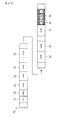
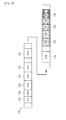
- FIG. 4 shows one example of the content data recorded on the second recording medium 3 by the first dubbing operation of the information recording apparatus 1.
- the second recording medium 3 is a dual-layer DVD-R, and the format of the content data is a DVD video format.
- a file system (FS) 41, a video manager (VMG) 42, and a video title set information (VTSI) 43 all correspond to the management information.
- a plurality of video objects (VOBs) 44 constitute the unchanged data portion.
- a plurality of video objects (VOBs) 45 constitute the changed data portion.
- the video objects 44 are recorded on the second recording medium 3 in the encoded state at the first video resolution and the first recording bit rate.
- the video objects 45 are recorded with the video resolution changed to the second video resolution and with the recording bit rate changed to the second recording bit rate.
- the size of the video object 45 is averagely substantially the same as the size of the video object 44; however, after the dubbing, the size of the video object 45 is averagely smaller than the size of the video object 44.
- the division position is determined such that the division position of the content data matches the boundary between the video object and the video object in the dubbing operation.
- the video resolution is not changed in the middle of the video object, and the standard of the DVD video format is not violated.
- one video object can be divided into two video objects.
- the division position may be determined so as to match the boundary of two video objects after one video object can be divided into the two video objects.
- an image corresponding to the division position in the content data may be temporarily displayed on a display (TV screen or the like), and after that the division position may be adjusted by the user.
- the user operates an operation switch mounted on a remote controller or the information recording apparatus 1 and controls such that the division position matches the boundary of the video objects, as described above, if needed when determining the division position desired by the user.
- the user operates an operation switch mounted on a remote controller or the information recording apparatus 1 and controls such that the division position matches the boundary of the video objects, as described above, if needed when determining the division position desired by the user.
- FIG. 5 shows another example of the content data recorded on the second recording medium 3 by the first dubbing operation of the information recording apparatus 1.
- the second recording medium 3 is a dual-layer DVD-R
- the content data is a VR (Video Recording) format.
- a file system (FS) 51 and a video manager (VMG) 52 all correspond to the management information.
- a plurality of video objects (VOBs) 53 constitute the unchanged data portion.
- a plurality of video objects (VOBs) 54 constitute the changed data portion.
- FIG. 6 shows the content data recorded on the first recording medium 2 (in the upper part in FIG. 6 ) and the content data recorded on the second recording medium 3 by a second dubbing operation (in the lower part in FIG. 6 ).
- the information recording apparatus 1 may perform the second dubbing operation instead of the first dubbing operation.
- the division position DP is determined so as to match the boundary of the data group 61 and the data group 61.
- the second dubbing operation is substantially the same as the first dubbing operation, except for the method of determining the division position DP.
- the division position determining device 16 determines the division position DP as follows. Firstly, the size of management information 60A is subtracted from a size A10 of the entire content data 60 to be copied. As shown in FIG. 6 , if the management information 60A exists in each of the data groups 61, the sum of the size of the management information 60A in all the data groups 61 included in the content data 20 (A11+A12+...+A16) is calculated, and this sum value is subtracted from the size A10 of the entire content data. By this, the size of a portion other than the management information 60A of the content data 60 (A21+A22+...+A26) is obtained.
- the size of the management information 50A (the sum value of the size of the all the management information 60A if the plurality of management information 60 A exist as shown in FIG. 6 ) is subtracted from the capacity B0 of the unrecorded area of the second recording medium 3. By this, it is possible to obtain the capacity of the unrecorded area of the second recording medium 3 where the portion other than the management information 60A of the content data 60 can be recorded.
- the size of an unchanged data portion 62 and the size of a changed data portion 63 are determined. Firstly, on the basis of the aforementioned equations (1) and (2), the theoretical minimum size of the changed data portion 63 and the size of the unchanged data portion 62 at this time are calculated. Then, on the basis of the calculated size of the unchanged data portion 62 or the calculated size of the changed data portion 63, a temporary division position is determined. The method of determining this temporary division position is the same as the method of determining the division position in the first dubbing operation.
- the boundary of the data group and the data group is found out, wherein the boundary is located on the head side of the content data 60 from the temporary division position and is located closest to the temporary division position. Then, the official division position DP is set at the found boundary.
- an unchanged data portion 72 has the same size and the same video resolution and recording bit rate as those of the unchanged data portion 62 of the content data 60 in the upper part in FIG. 6 .
- the unchanged data portion 72 is also the same as the unchanged data portion 62 in that the unchanged data portion 72 is divided into a plurality of data groups 71 and in that management information 70A exists in each of the data groups.
- the content matter is also the same.
- the changed data portion 73 of the content data 70 has the video resolution or the recording bit rate lower than those of the changed data portion 63 of the content data 60, and the size of the portion other than the management information 70A (B1+B2) is also lower.
- the changed data portion 73 has higher data compressibility because of the reduction in the video resolution or the recording bit rate, resulting in a reduction in size in the portion other than the management information 70A; however, the changed data portion 73 is the same as the changed data portion 63 in that it is divided into the plurality of data groups 71, and its content matter is the same as that of the changed data portion 63.
- the division position DP is determined so as to match the boundary of the data group 61 and the data group 61.
- the content data is assigned to the changed data portion by a data unit.
- the reduction in the image quality because of the change in the video resolution or the recording bit rate is also performed by the data unit. Therefore, if the content data recorded on the second recording medium 3 after the dubbing is reproduced, the image quality changes at the time of changing the data group.
- the change in the image quality becomes less obvious, or the user feels less uncomfortable about the change in the image quality.
- the second dubbing operation it is possible to obscure the change in the image quality.
- FIG. 7 shows one example of the content data recorded on the second recording medium 3 by the second dubbing operation.
- the second recording medium 3 is a dual-layer DVD-R and the format of the content data is the DVD video format.
- a file system (FS) 81, a video manager (VMG) 82, and a plurality of video title set information (VTSI) 83 all correspond to the management information.
- the content data 80 is divided into a plurality of titles, and the video title set information 83 exists in each of the titles.
- a plurality of video objects (VOBs) 84 constitute the unchanged data portion.
- a plurality of video objects (VOBs) 85 constitute the changed data portion.
- the second dubbing operation can be applied.
- the division position DP is determined so as to match the boundary of the content data and the content data.
- FIG. 8 shows the content data recorded on the first recording medium 2 (in the upper part in FIG. 8 ) and the content data recorded on the second recording medium 3 by a third dubbing operation (in the lower part in FIG. 8 ).
- the information recording apparatus 1 may perform the third dubbing operation instead of the first or second dubbing operation.
- the third dubbing operation a part or all of the data unit encoded at the highest recording bit rate from among the data groups 91A, 91B, and 91C in the content data 90 is assigned to the changed data portion, and the division position DP is determined so as to realize the assignment.
- the third dubbing operation is substantially the same as the first dubbing operation, except for the method of determining the division position DP.
- the division position determining device 16 determines the division position DP such that one portion of the data unit 91C is assigned to a changed data portion 93. As a result, the division position DP is set to any position in the data unit 91C.
- the division position determining device 16 determines the division position DP as follows. Firstly, the sum value of the size of a plurality of management information 90A (A31+A32+A33) is subtracted from a size A30 of the entire content data 90 to be copied. By this, the size of a portion other than the management information 90A of the content data 90 (A41+A42+A43+A44) is obtained.
- the sum value of the size of the management information 90A is subtracted from the capacity B0 of the unrecorded area of the second recording medium 3. By this, it is possible to obtain the capacity of the unrecorded area of the second recording medium 3 where the portion other than the management information 90A of the content data 90 can be recorded.
- the size of an unchanged data portion 92 and the size of the changed data portion 93 are determined.
- the division position DP is determined on the basis of the calculated size of the unchanged data portion 92 and the calculated size of the changed data portion 93.
- the division position DP is determined such that one portion of the data unit 91C having the highest recording bit rate is assigned to the changed data portion 93.
- an unchanged data portion 102 has the same size and the same video resolution and the same recording bit rate as those of the unchanged data portion 92 of the content data 90 in the upper part of FIG. 8 .
- the unchanged data portion 102 is also the same as the unchanged data 92 in that the unchanged data portion 102 is divided into a plurality of data groups 101A, 101B, and 101C.
- the content matter is also the same.
- a changed data portion 103 of the content data 100 has the size and the video resolution or the recording bit rate lower than those of the changed data portion 93 of the content data 90.
- the changed data portion 103 has higher data compressibility because of the reduction in the video resolution or the recording bit rate, resulting in a reduction in size; however, the content matter is the same as that of the changed data portion 93.
- the entire data unit 91C having the highest recording bit rate may be assigned to the changed data portion 93.
- the division position DP is set to the boundary of the data unit 91B and the data unit 91C.
- the division position determining device 16 assigns a part or all of the data unit 91A to the changed data portion.
- the division position DP is set to any position in the data unit 91A or the boundary of the data unit 91A and the data unit 91B
- the third dubbing operation a part or all of the data unit encoded at the highest recording bit rate is assigned to the changed data portion.
- the dubbing time That is, before the process of changing the recording bit rate, if there are two content data with the same size but different recording bit rates, the content data with the higher recording bit of the two data has the shorter reproduction time.
- the content data with the higher recording bit of the two data allows the faster process of changing the recording bit rate. That is, as the recording bit rate increases, the process of changing the recording bit rate becomes faster. Therefore, by assigning a part or all of the of the data unit encoded at the highest recording bit rate to the changed data portion, it is possible to speed up the process of changing the recording bit rate, to thereby reduce the dubbing time.
- the third dubbing operation can be applied.
- a part or all of the data unit encoded at the highest recording bit rate is assigned to the changed data portion.
- FIG. 9 shows the content data recorded on the first recording medium 2 (in the upper part in FIG. 9 ) and the content data recorded on the second recording medium 3 by a fourth dubbing operation (in the lower part in FIG. 9 ).
- the information recording apparatus 1 may perform the fourth dubbing operation instead of the first to third dubbing operations.
- content data 110 recorded on the first recording medium 2 is divided into an unchanged data portion 111 and a changed data portion 112 at the division position DP, and the video resolution is gradually reduced from the head to the tail of the changed data portion 112.
- the video resolution of the changed data portion 112 is reduced at three steps.
- a changed data portion 122 of content data 120 recorded on the second recording medium 3 by this dubbing operation is provided, as shown in FIG.
- the video resolution of the data portion 122A is lower than that of an unchanged data portion 121, and the video resolution of the data portion 122B is lower than that of the data portion 122A, and the video resolution of the data portion 122C is lower than that of the data portion 122B.
- FIG. 10 shows one example of the content data recorded on the second recording medium 3 by the fourth dubbing operation.
- the second recording medium 3 is a dual-layer DVD-R
- the content data is the VR format.
- a file system (FS) 131 and a video manager (VMG) 132 correspond to the management information.
- a plurality of video objects (VOBs) 133 constitute the unchanged data portion.
- a plurality of video objects (VOBs) 134, 135, and 136 constitute the changed data portion.
- the video resolution of the video objects 133, 134, 135, and 136 are gradually reduced.
- the video resolution of the video object 134 is lower than that of the video object 133, and the video resolution of the video object 135 is lower than that of the video object 134, and the video resolution of the video object 136 is lower than that of the video object 135.
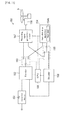
- FIG. 11 shows one example of the case that the present invention is applied to a hard disk drive built-in DVD recorder.
- a hard disk drive built-in DVD recorder 150 is provided with: a TV reception circuit 151; an encoder 152; a selector switch 153; a hard disk drive apparatus 154; a selector switch 155; a decoder 156; a recording signal generation circuit 157; an optical pickup 158; and a central processing unit (CPU) 159.
- the hard disk drive apparatus 154 contains a hard disk 154A.
- the DVD recorder 150 has a function of recording a television program transmitted from a television broadcast station, onto the hard disk 154A.
- the DVD recorder 150 operates as follows. Firstly, the CPU 159 controls the selector switch 153 to connect the encoder 152 and the hard disk drive apparatus 154. Then, the CPU 159 controls the encoder 152, sets the video resolution in an encoding process to the first video resolution, and further sets the recording bit rate in the encoding process to the first recording bit rate.
- the TV reception circuit 151 receives the television program from the television broadcast station. This television program is supplied as the content data to the encoder 152.
- the encoder 152 encodes the content data at the first video resolution and the first recording bit rate. Then, the hard disk drive apparatus 154 records the encoded content data onto the hard disk 154A.
- the DVD recorder 150 has a function of copying or dubbing the content data recorded on the hard disk 154A to a dual-layer DVD-R5.
- the DVD recorder 150 operation as follows. Firstly, the CPU 159 compares the size of the content data to be copied, which is recorded on the hard disk 154A, with the capacity of an unrecorded area of the dual-layer DVD-R5. Then, if the size of the content data is greater than the capacity of the unrecorded area of the dual-layer DVD-R5, the CPU 159 determines the second video resolution and the second recording bit rate in accordance with the procedure shown in FIG. 2 .
- the second recording bit rate is lower than the first recording bit rate.
- the second video resolution is equal to or lower than the first video resolution.
- the CPU 159 determines the division position of the content data, and divides the content data into the unchanged data portion and the changed data portion at the division position. Then, the CPU 159 controls the selector switch 155 to connect the hard disk drive apparatus 154 and the recording signal generation circuit 157. Then, the CPU 159 reads the unchanged data portion from the hard disk 154A and supplies it to the recording signal generation circuit 157.
- the recording signal generation circuit 157 converts the unchanged data portion to a recording pulse signal and supplies it to the optical pickup 158.
- the optical pickup 158 records the recording pulse signal onto the dual-layer DVD-R5.
- the unchanged data portion is recorded onto the dual-layer DVD-R5.
- the CPU 159 controls the selector switch 155 to connect the hard disk drive apparatus 154 and the decoder 156. Then, the CPU 159 controls the selector switch 153 to connect the encoder 152 and the recording signal generation circuit 157. Then, the CPU 159 controls the encoder 152, sets the video resolution in the encoding process to the second video resolution, and further sets the recording bit rate in the encoding process to the second recording bit rate. Then, the CPU 159 reads the changed data portion from the hard disk 154A and supplies it to the decoder 156.
- the decoder 156 decodes the changed data portion and supplies the decoded changed data portion to the encoder 152.
- the encoder 152 encodes the decoded changed data portion at the second video resolution and the second recording bit rate.
- the encoded changed data portion is supplied to the recording signal generation circuit 157.
- the recording signal generation circuit 157 converts the changed data portion to the recording pulse signal and supplies it to the optical pickup 158.
- the optical pickup 158 records the recording pulse signal onto the dual-layer DVD-R5. By this, the changed data portion is recorded onto the dual-layer DVD-R5.
- the CPU 159 generates the management information or the like and records it onto the dual-layer DVD-R5 through the recording signal generation circuit 157.
- the hard disk drive built-in DVD recorder 150 divides the content data into the unchanged data portion and the changed data portion and changes the video resolution or the recording bit rate only in the changed data portion.
- the dubbing can be performed at high speed (e.g. 4-time speed dubbing) in a short time in the unchanged data portion. By this, it is possible to reduce the dubbing time.
- the aforementioned embodiment exemplifies the case that the information recording apparatus of the present invention is realized as a hardware product like the hard disk drive built-in DVD recorder 150.
- the present invention is not limited to this.
- the information recording apparatus of the present invention can be realized on a computer by making the computer read a program.
- the computer program is prepared to make the computer function as the reading device 11, the dividing device 12, the rate resolution changing device 13, the recording device 14, and the control device 15.
- the reading device 11 is a specific example of the reading device
- the dividing device 12 is a specific example of the dividing device
- the rate resolution changing device 13 is a specific example of the recording bit rate changing device and the video resolution changing device
- the recording device 14 is a specific example of the recording device.
- the division position determining device 16 is a specific example of the division position determining device
- the rate resolution determining device 17 is a specific example of the recording bit rate determining device and the video resolution determining device
- the decoding device 18 is a specific example of the decoding device
- the encoding device 19 is a specific example of the encoding device.
- the step S4 is a specific example of the dividing process
- the step S5 is a specific example of the recording process
- the step S6 is a specific example of the reading process, the recording bit rate changing process, the video resolution changing process, and the recording process.
- the information recording apparatus and the information recording method according to the present invention can be applied to an information recording apparatus, such as a DVD recorder. Moreover, they can be applied to an information recording apparatus or the like which is mounted on various computer equipment for consumer use or for commercial use, or which can be connected to various computer equipment.
Landscapes
- Engineering & Computer Science (AREA)
- Signal Processing (AREA)
- Multimedia (AREA)
- Signal Processing For Digital Recording And Reproducing (AREA)
- Television Signal Processing For Recording (AREA)
- Management Or Editing Of Information On Record Carriers (AREA)
Applications Claiming Priority (2)
| Application Number | Priority Date | Filing Date | Title |
|---|---|---|---|
| JP2005201625 | 2005-07-11 | ||
| PCT/JP2006/313777 WO2007007759A1 (fr) | 2005-07-11 | 2006-07-11 | Dispositif d’enregistrement d’information et méthode d’enregistrement d’information |
Publications (2)
| Publication Number | Publication Date |
|---|---|
| EP1903573A1 true EP1903573A1 (fr) | 2008-03-26 |
| EP1903573A4 EP1903573A4 (fr) | 2009-08-05 |
Family
ID=37637150
Family Applications (1)
| Application Number | Title | Priority Date | Filing Date |
|---|---|---|---|
| EP06768090A Withdrawn EP1903573A4 (fr) | 2005-07-11 | 2006-07-11 | Dispositif d'enregistrement d'information et méthode d'enregistrement d'information |
Country Status (4)
| Country | Link |
|---|---|
| US (1) | US20090274450A1 (fr) |
| EP (1) | EP1903573A4 (fr) |
| JP (1) | JP4315259B2 (fr) |
| WO (1) | WO2007007759A1 (fr) |
Cited By (1)
| Publication number | Priority date | Publication date | Assignee | Title |
|---|---|---|---|---|
| EP2290654A4 (fr) * | 2008-05-16 | 2011-10-12 | Sharp Kk | Appareil d'enregistrement |
Families Citing this family (4)
| Publication number | Priority date | Publication date | Assignee | Title |
|---|---|---|---|---|
| JP5142968B2 (ja) * | 2008-12-15 | 2013-02-13 | キヤノン株式会社 | 記録装置及びその制御方法 |
| WO2010073363A1 (fr) * | 2008-12-26 | 2010-07-01 | 富士通株式会社 | Dispositif de changement de résolution, procédé de changement de résolution et programme de changement de résolution |
| US10679070B1 (en) * | 2018-02-23 | 2020-06-09 | Facebook, Inc. | Systems and methods for a video understanding platform |
| US11943501B2 (en) * | 2022-01-07 | 2024-03-26 | Qualcomm Incorporated | Dynamic resolution change hints for adaptive streaming |
Family Cites Families (12)
| Publication number | Priority date | Publication date | Assignee | Title |
|---|---|---|---|---|
| JP2000333169A (ja) * | 1999-05-24 | 2000-11-30 | Mitsubishi Electric Corp | 動画像符号化装置 |
| JP4091293B2 (ja) * | 2000-11-17 | 2008-05-28 | 松下電器産業株式会社 | 記録再生方法及び記録再生装置 |
| US7415188B2 (en) * | 2000-11-17 | 2008-08-19 | Matsushita Electric Industrial Co., Ltd. | Method and apparatus for recording/reproduction |
| FR2831379A1 (fr) * | 2001-10-23 | 2003-04-25 | Koninkl Philips Electronics Nv | Procede de copie de donnees numeriques compressees |
| WO2003046914A2 (fr) * | 2001-11-29 | 2003-06-05 | Matsushita Electric Industrial Co., Ltd. | Appareil d'enregistrement, programme d'enregistrement et procede d'enregistrement |
| JP4786117B2 (ja) * | 2002-09-06 | 2011-10-05 | ソニー株式会社 | 情報処理装置および方法、並びに、プログラム |
| JP4423843B2 (ja) * | 2002-09-06 | 2010-03-03 | ソニー株式会社 | 情報処理装置、およびプログラム |
| KR100988257B1 (ko) * | 2002-09-06 | 2010-10-18 | 소니 주식회사 | 정보 처리 장치 및 프로그램이 기록된 컴퓨터로 판독 가능한 기록매체 |
| JP2005033622A (ja) * | 2003-07-08 | 2005-02-03 | Matsushita Electric Ind Co Ltd | 映像信号記録装置および映像信号記録方法 |
| JP2005050396A (ja) * | 2003-07-29 | 2005-02-24 | Pioneer Electronic Corp | 記録レート設定装置、情報記録装置、記録レート設定方法、記録レート設定プログラム及び記録レート設定プログラムを記録した情報記録媒体 |
| JP3866729B2 (ja) * | 2004-03-29 | 2007-01-10 | Necパーソナルプロダクツ株式会社 | コンテンツ容量削減方法、コンテンツ容量削減装置及びコンテンツ容量削減プログラム |
| JP2006157553A (ja) * | 2004-11-30 | 2006-06-15 | Sanyo Electric Co Ltd | コンテンツのダビング用記録方法及びダビング方法及び映像記録再生装置 |
-
2006
- 2006-07-11 JP JP2007524661A patent/JP4315259B2/ja not_active Expired - Fee Related
- 2006-07-11 US US11/995,327 patent/US20090274450A1/en not_active Abandoned
- 2006-07-11 WO PCT/JP2006/313777 patent/WO2007007759A1/fr not_active Ceased
- 2006-07-11 EP EP06768090A patent/EP1903573A4/fr not_active Withdrawn
Cited By (1)
| Publication number | Priority date | Publication date | Assignee | Title |
|---|---|---|---|---|
| EP2290654A4 (fr) * | 2008-05-16 | 2011-10-12 | Sharp Kk | Appareil d'enregistrement |
Also Published As
| Publication number | Publication date |
|---|---|
| US20090274450A1 (en) | 2009-11-05 |
| JP4315259B2 (ja) | 2009-08-19 |
| EP1903573A4 (fr) | 2009-08-05 |
| JPWO2007007759A1 (ja) | 2009-01-29 |
| WO2007007759A1 (fr) | 2007-01-18 |
Similar Documents
| Publication | Publication Date | Title |
|---|---|---|
| KR100710012B1 (ko) | 기록가능한 dvd 매체에서 dvd-rom 역호환성 결함섹터 관리 | |
| JP2003514453A (ja) | Dvd再生装置のためのミキシング機能 | |
| KR20040053381A (ko) | 기록장치, 기록프로그램 및 기록방법 | |
| US8032011B2 (en) | Recording medium having recording program recorded therein and recording apparatus and method | |
| US7224888B2 (en) | Digital recording/reproducing apparatus | |
| JP4674784B2 (ja) | 書き換え可能なディジタル・プログラム・ディスク用のデータ・バッファ管理方法 | |
| EP1424694B1 (fr) | Procédé d'enregistrement et/ou de reproduction d'un signal d'information | |
| US7233736B2 (en) | Recording method and apparatus, and recording medium | |
| EP1213927B1 (fr) | Appareil d'enregistrement et reproduction numérique avec support d'enregistrement d'informations intégrées | |
| EP1903573A1 (fr) | Dispositif d'enregistrement d'information et méthode d'enregistrement d'information | |
| US20030210896A1 (en) | Recording medium having recording program recorded therein and recording apparatus and method | |
| JP2002230948A (ja) | 光ディスク、記録装置、再生装置、プログラム、コンピュータ読み取り可能な記録媒体及び方法。 | |
| US20070003225A1 (en) | Method and apparatus for recording information and playback information | |
| EP1713072B1 (fr) | Dispositif de prise d'images et procede d'enregistrement de contenu video et d'images fixes sur un support d'enregistrement optique | |
| US20090074388A1 (en) | Recording apparatus and recording method for dual-layer recording disk | |
| US20060285828A1 (en) | Video recording apparatus and video recording method | |
| KR20030013854A (ko) | 광 기록 매체에 기록된 데이터의 저장 방법 | |
| JP4817280B2 (ja) | 書き換え可能なディスクのプリセスト・レコーディング | |
| JP4039299B2 (ja) | 記録装置及び方法 | |
| JPWO2006080108A1 (ja) | 記録方法ならびに記録装置、再生方法ならびに再生装置、および記録媒体 | |
| JP5024983B2 (ja) | データ管理方法及びデータ管理装置 | |
| JP2007080507A (ja) | データ記録方法、データ記録装置及び撮像装置 | |
| JP2004253113A (ja) | 情報信号再生方法、情報信号記録方法、情報信号記録再生方法、情報信号再生プログラム、情報信号記録プログラム、情報信号記録再生プログラム、情報記録媒体、情報信号再生装置、情報信号記録装置、情報信号記録再生装置 | |
| HK1051740B (en) | Dvd-rom backwards compatible defective sector management in recordable dvd media |
Legal Events
| Date | Code | Title | Description |
|---|---|---|---|
| PUAI | Public reference made under article 153(3) epc to a published international application that has entered the european phase |
Free format text: ORIGINAL CODE: 0009012 |
|
| 17P | Request for examination filed |
Effective date: 20080108 |
|
| AK | Designated contracting states |
Kind code of ref document: A1 Designated state(s): GB |
|
| DAX | Request for extension of the european patent (deleted) | ||
| DAX | Request for extension of the european patent (deleted) | ||
| RBV | Designated contracting states (corrected) |
Designated state(s): GB |
|
| A4 | Supplementary search report drawn up and despatched |
Effective date: 20090706 |
|
| RIC1 | Information provided on ipc code assigned before grant |
Ipc: H04N 5/765 20060101ALI20090630BHEP Ipc: G11B 20/00 20060101ALI20090630BHEP Ipc: G11B 27/034 20060101AFI20070313BHEP Ipc: G11B 20/10 20060101ALI20090630BHEP |
|
| STAA | Information on the status of an ep patent application or granted ep patent |
Free format text: STATUS: THE APPLICATION IS DEEMED TO BE WITHDRAWN |
|
| 18D | Application deemed to be withdrawn |
Effective date: 20091003 |