EP1903774A2 - Farbumwandlungsverfahren und -system - Google Patents
Farbumwandlungsverfahren und -system Download PDFInfo
- Publication number
- EP1903774A2 EP1903774A2 EP07018364A EP07018364A EP1903774A2 EP 1903774 A2 EP1903774 A2 EP 1903774A2 EP 07018364 A EP07018364 A EP 07018364A EP 07018364 A EP07018364 A EP 07018364A EP 1903774 A2 EP1903774 A2 EP 1903774A2
- Authority
- EP
- European Patent Office
- Prior art keywords
- data
- printing
- color
- processing
- Prior art date
- Legal status (The legal status is an assumption and is not a legal conclusion. Google has not performed a legal analysis and makes no representation as to the accuracy of the status listed.)
- Withdrawn
Links
- 238000000034 method Methods 0.000 title claims abstract description 123
- 238000006243 chemical reaction Methods 0.000 title claims description 53
- 238000007639 printing Methods 0.000 claims abstract description 125
- 239000003086 colorant Substances 0.000 claims abstract description 87
- 238000012545 processing Methods 0.000 claims abstract description 74
- 230000009466 transformation Effects 0.000 claims description 48
- 230000008569 process Effects 0.000 claims description 41
- 238000000926 separation method Methods 0.000 claims description 37
- 238000003860 storage Methods 0.000 claims description 18
- 238000004590 computer program Methods 0.000 claims description 8
- 239000000976 ink Substances 0.000 abstract description 22
- 230000008901 benefit Effects 0.000 description 14
- 239000011159 matrix material Substances 0.000 description 13
- 238000013459 approach Methods 0.000 description 11
- 230000006978 adaptation Effects 0.000 description 10
- 238000006467 substitution reaction Methods 0.000 description 8
- 238000004519 manufacturing process Methods 0.000 description 7
- 230000001419 dependent effect Effects 0.000 description 5
- 230000006870 function Effects 0.000 description 5
- 238000002360 preparation method Methods 0.000 description 5
- 238000000844 transformation Methods 0.000 description 5
- 238000005516 engineering process Methods 0.000 description 4
- 239000000203 mixture Substances 0.000 description 4
- 238000009877 rendering Methods 0.000 description 4
- 238000012216 screening Methods 0.000 description 4
- 230000005540 biological transmission Effects 0.000 description 3
- 238000013461 design Methods 0.000 description 3
- 230000008447 perception Effects 0.000 description 3
- 241000282412 Homo Species 0.000 description 2
- 238000003491 array Methods 0.000 description 2
- 230000008859 change Effects 0.000 description 2
- 238000005352 clarification Methods 0.000 description 2
- 230000004456 color vision Effects 0.000 description 2
- 238000004891 communication Methods 0.000 description 2
- 230000003287 optical effect Effects 0.000 description 2
- 238000012805 post-processing Methods 0.000 description 2
- 238000001228 spectrum Methods 0.000 description 2
- 238000013519 translation Methods 0.000 description 2
- RYGMFSIKBFXOCR-UHFFFAOYSA-N Copper Chemical compound [Cu] RYGMFSIKBFXOCR-UHFFFAOYSA-N 0.000 description 1
- 102100022419 RPA-interacting protein Human genes 0.000 description 1
- 238000004458 analytical method Methods 0.000 description 1
- 230000006399 behavior Effects 0.000 description 1
- 239000000872 buffer Substances 0.000 description 1
- 239000002131 composite material Substances 0.000 description 1
- 238000007906 compression Methods 0.000 description 1
- 230000006835 compression Effects 0.000 description 1
- 238000010276 construction Methods 0.000 description 1
- 238000012937 correction Methods 0.000 description 1
- 238000004042 decolorization Methods 0.000 description 1
- 230000001934 delay Effects 0.000 description 1
- 238000011161 development Methods 0.000 description 1
- 230000018109 developmental process Effects 0.000 description 1
- 238000010586 diagram Methods 0.000 description 1
- 238000002474 experimental method Methods 0.000 description 1
- 239000000835 fiber Substances 0.000 description 1
- 238000009472 formulation Methods 0.000 description 1
- 238000003384 imaging method Methods 0.000 description 1
- 230000003993 interaction Effects 0.000 description 1
- 239000000463 material Substances 0.000 description 1
- 238000005259 measurement Methods 0.000 description 1
- 238000000691 measurement method Methods 0.000 description 1
- 230000007246 mechanism Effects 0.000 description 1
- 238000002156 mixing Methods 0.000 description 1
- 238000012986 modification Methods 0.000 description 1
- 230000004048 modification Effects 0.000 description 1
- 230000007935 neutral effect Effects 0.000 description 1
- 238000007645 offset printing Methods 0.000 description 1
- 238000005457 optimization Methods 0.000 description 1
- 230000019612 pigmentation Effects 0.000 description 1
- 238000004886 process control Methods 0.000 description 1
- 230000009467 reduction Effects 0.000 description 1
- 238000002473 ribonucleic acid immunoprecipitation Methods 0.000 description 1
- 239000007787 solid Substances 0.000 description 1
- 238000012360 testing method Methods 0.000 description 1
- 238000012546 transfer Methods 0.000 description 1
Images






Classifications
-
- H—ELECTRICITY
- H04—ELECTRIC COMMUNICATION TECHNIQUE
- H04N—PICTORIAL COMMUNICATION, e.g. TELEVISION
- H04N1/00—Scanning, transmission or reproduction of documents or the like, e.g. facsimile transmission; Details thereof
- H04N1/46—Colour picture communication systems
- H04N1/56—Processing of colour picture signals
- H04N1/60—Colour correction or control
- H04N1/603—Colour correction or control controlled by characteristics of the picture signal generator or the picture reproducer
- H04N1/6052—Matching two or more picture signal generators or two or more picture reproducers
Definitions
- the present invention is related to digital color printing and finds particular application to a system and method of printing a digital color image and will be described with particular reference thereto. Of course, it is to be appreciated that the invention is also applicable to other environments and applications.
- Color printing is normally carried out using three or more ink or toner colors in what is called a subtractive imaging scheme.
- process colors usually four printing inks or toners known as the "process colors" are used (cyan, magenta, yellow and black or, CMYK).
- SWOP Specific for Web Offset Publication
- CGATS Commission of Graphics Arts Technology Standards
- Euroscale evolved into ISO 12647: Process control for the manufacture of half-tone color separations, proof and production prints 12647-1 parameters and measurement methods 12647-2 Offset Lithographic processes
- black colors can be generated by overprinting the prescribed amounts of C, M and Y ink or toner (often called process black), deeper shadows, better neutral greys, enhanced detail rendition can result from intelligent use of the additional black (K) ink or toner.
- K black ink or toner
- use of black ink or toner can have the additional benefit of reducing the total amount of ink/toner needed.
- CIEL*a*b* pronounced C Lab
- L*a*b* This color space is based on XYZ of the color referenced to XYZ of the light source or paper. Most specifications such as the SWOP standard are specified in terms of XYZ and L*a*b* under a light source such as daylight D50. It is a three component color space with each color specified in terms of L*, a*, and b*. L* specifies the lightness; and the hue and saturation can be determined from the values of a* and b*.
- Using device link profiles in the language of the ICC can be thought of as a sequence of two profiles (from the input device to something and from something to the output device) and could be generated as a sequence of the direct transform of a first profile and the reverse transform of a the second profile, but, more generally provide a dedicated transformation from one device space to another.
- a direct device link transformation is useful in situations where such a transformation is used frequently or an optimization is required to achieve specific objectives.
- L*a*b* is used to characterize the printed output of the primary colorants and overprints of the colorants according to the device input.
- the flexible method of supplying a new output profile for the "changed" press or press setting that is automatically selected as the new output profile acting on the device independent data of the PCS can be implemented in principle as a setting of the Raster Image Processing (RIP) system that can be selected as a late binding at the actual conversion of the pages that make up a job.
- RIP Raster Image Processing
- a digital printer front end processes or decomposes the PDL file into contone separations of 8 bits per pixel or a byte maps. Then, the contone separations are sent to a print engine containing a half toner or screen generator.
- the half toner renders a raster image (or dot mask) for each of the print colors cyan, magenta, yellow and black (CMYK).
- CMYK cyan, magenta, yellow and black
- Each raster image is composed of pixel data of 1 bit/pixel although multilevel presses implement generalized screening methods that output screened data of multiple bit per pixel. In the 1bit/pixel case , each bit is simply an instruction whether or not to place a dot of color at a particular point on an output page.
- Vendors of Raster Image Processing (RIP) software will generally allow attachment of an output profile for execution at run-time when the files with the page description having their variable objects are translated into device dependent raster formats.
- This run-time approach is opposed to a composition-time approach where a designer handles color attributes and rendering intents of the elements in page from within a page composition application.
- Digital printing with advanced Digital Front Ends like the Xeikon5000 toner based printing press equipped with the X800 digital Front end have near unlimited capabilities to print complex jobs merging variable data in multipage documents in sophisticated impositions schemes.
- the art of composing a job includes an aspect of dynamic text flow around variable page elements, merging image elements from all kinds of sources managing the color of logos images overlays.
- EP 1,111,545 A1 entitled “ Page composing method using stored page elements and apparatus for using the same", which is incorporated in here by reference in its entirety describes the preferred approach to deal with the conversion of jobs into an example of what in a more general sense is defined as a "print ready format".
- print ready formats can be stored on storage media like hard-disks or similar storage device managed by dedicated storage servers on dedicated high speed networks.
- the print ready files may be ready to print bitmap formats, optionally stored using compressed formats.
- a preferred compression method used for part of the image elements is disclosed in US20010024293A1 .
- the print ready format separates the end of graphic design stage and the introduction of a printing job into the press room.
- the ripping typically does not happen on the same machine as the one steering the printer.
- the ripping happens at an "off-line" front-end, where the streaming to the printer happens at an "on-line” front-end.
- the on-line front-ends have typically a one-to-one link with a print engine.
- Fig 1 shows a possible configuration for a digital print set-up combing three presses 3, 5, 7 and a centralized department 8 for job preparation.
- an off-line master RIP station 2 collaborates optionally with slave RIP stations 4, 6 to generate intermediate files in a printer ready raster format for temporary storage on a fast storage server 1.
- the print presses 3,5, 7 and the RIP stations 2, 4, 6 are preferably linked together by a communication network such as a shared resource network, e.g. a Local Area Network 10.
- a ready-to-print format is an image format that is designed to print at the nominal speed of the print device such as 3, 5, or 7.
- the print device should only need to do limited processing on the ready-to-print format.
- the print device has a processing engine, e.g. indicated by 11, 13, 15 in Fig. 1.
- Limited processing can include: decompressing, positioning in a larger image, clipping, rotating over a multiple of 90 degrees, mirroring, scaling up or down with a factor that is a power of 2, merging image elements using transparency information in the image element itself or in another image element, replacing every value using a 1-dimensional lookup table and screening.
- a ready-to-print bitmap format is a format consisting of one or multiple compressed or uncompressed raster images that is designed to print at the nominal speed of the print device.
- the present invention also includes the production of multilevel generalizations of bitmaps as explained in EP634862 or US5654808 for example.
- the print device should only need to do limited processing on the ready-to-print format.
- Limited processing can include: decompressing, positioning in a larger raster format, clipping, rotating over a multiple of 90 degrees, mirroring, scaling up or down with a factor that is a power of 2, merging with other raster formats using transparency information in the raster format itself or in another raster format, replacing every value using a 1-dimensional lookup table and screening.
- the fast storage device 1 is the interface between 2 worlds.
- the prepress department 8 controls the preparation of the print jobs for the next production run.
- the press manager has the responsibility to keep the presses 3, 5, 7 running and to make sure the production volume is achieved on time and within quality standards even in the event that one of the presses would go down.
- the press manager has the freedom to redirect certain runs to a different press without any issue.
- Fig 2 shows an exemplary configuration of a more complex but often a more practical print room set-up.
- Printing presses from different manufactures or using different technologies or of different sizes or capacities can provide more interesting capabilities and more efficient job completions.
- Fig. 2 shows a digital print set-up combining four presses 3, 5, 7, 9, e.g. from three different vendors and a centralized department 8 for job preparation. If the presses 3, 5, 7, 9 differ in their characteristics or if one of the presses is equipped with a different type of toner, print ready files made for one press can generally not be used for one of the other presses or even cannot be used on any of the other presses.
- the pressroom-manager will generally have to involve the prepress department to re-generate at least part of the jobs to be printed so that a print job originally adapted to be printed on one of the presses is now to be targeted for a different device.
- prepress may be a single shift operation. Hence, before the prepress department is active again, additional delays can be expected.
- US 6584903 recognizes the issue with retargeting device-specific raster images (i.e. as obtained after the raster image process adapted for a first device) to a different device without providing a complete solution.
- a stored copy of the final rasterized page image fully rendered for one printer should ideally be used at the second device. Unfortunately, doing so would involve a loss of image quality. Firstly, a conversion from one printer's color space to another's color space is an inherently lossy process. Secondly, in generating the initial raster image, any available rendering hints would have been applied and hence would no longer be available.
- Embodiments of the present invention provides a printing system with the ability to apply color management to a RIPed print job to thereby adapt a print job to a different printer or toner set, without having to send the job back to another person in a different department, such as a graphic artist or layout/color correction specialist, too. This has the advantage of avoiding re-ripping.
- Embodiments of the present invention provides a method and system for converting to a new device-specific print data optionally at printer speeds. This results in improved productivity and reduced cycle time.
- a digital image printing method and apparatus which adjusts image characteristics of print data.
- the present invention proposes a printer process and system which improves the situation with respect to prior art printing methods and systems.
- the present invention provides a system and method of preparing print ready data.
- First device-specific print data that has been generated by or in a raster image process for printing a multicolored print job comprising multiple image source elements is obtained, e.g. by conventional means.
- the first print data has been colorimetrically adapted to a first printing device - hence it is device specific. For example color management has been applied during the process for obtaining the device-specific print data to adapt the print data to print on the first device using the colorants used in that device.
- Any of the print data may be a set of print files including variable data sets as in EP 1,111,545 A1 .
- the first print data is then processed to generate print ready data colorimetrically adapted to a second printing device.
- the processing is performed at a speed equal to or faster than a printing speed of the second printing device.
- An advantage of this procedure is that print data that has been colorimetrically adapted for a first device may be run on a second device with high quality color standards after a conversion that is less complex and time consuming than returning the print job to the prepress department.
- the processing can be carried out at the press and does not need the prepress department to be available.
- the present invention also provides a method and system of preparing print ready data comprising, obtaining first print data by or in a raster image process for printing a multicolored print job comprising multiple image source elements, the first print data being colorimetrically adapted for printing with a first set of colorants, processing the first print data to generate print ready data colorimetrically adapted for printing with a second set of colorants, there being at least one different colorant in the second set compared to the first set.
- the processing is performed at a speed equal to or faster than a printing speed of the second printing device.
- print data that has been colorimetrically adapted for a first set of colorants on one print press may be run with a second set of colorants on the same device or on a second device with high quality color standards after a conversion that is less complex and time consuming than returning the print job to the prepress department.
- the processing can be carried out at the press and does not need the prepress department to be available.
- Any of the print data may be a set of print files including variable data sets as in EP 1,111,545 A1 .
- systems may be obtained that are able to operate in a more continuous way, i.e. with less halting, even when print jobs are switched between different printing devices. It is an advantage of embodiments according to the present invention that systems may be obtained wherein the processing can be done sufficiently fast so that the printing speed of the printer is the job-time determining factor at printing speed or faster.
- These methods further may comprise streaming said print ready data for printing with the second set of colorants or for printing with said second print device.
- the processing of the first print data to generate print ready data may use at least one previously stored colour conversion table. It is an advantage that a previously stored colour conversion table can be used as this increases the processing speed for the colour conversion, thus aiding in obtaining streaming print ready data.
- Previously stored may refer to storage before the start of the corresponding print job.
- the processing of the first print data to generate print ready data may use a color conversion algorithm whereby the conversion is performed without transformation to a device independent color space.
- the device independent color space may be based on a human perception of color.
- the device independent color space may be the CIE XYZ colour coordinate system as determined by the CIE, or a related color space, such as determined by CIEL*a*b.
- the first print data may be obtained during a RIP process.
- the processing may be RIP-less processing.
- the first print data may be print ready data, e.g. they may have been stored in a digital storage device such as a server.
- the first print data is the result of a RIP process.
- the ripped print data may be piped directly to the print device or may be stored in a digital storage device such as a server.
- Any of the print ready data may be a set of print ready print files including variable data sets as in EP 1,111,545 A1 .
- the first print data may be a set of print files including variable data sets. The latter is advantages as it provides a more efficient conversion method. The conversion does not need to be performed on finished pages but can be performed by processing on the variable objects, e.g.
- variable objects by caching the variable objects and performing further processing steps on the variable objects. These can be converted on the fly as they are generated or assembled. The latter results in efficient methods and systems as it is not necessary to generate full print-ready bitmaps of all the pages of a variable data job of significant size.
- the first print data and/or the print ready data may be multicolored multipage print data for printing a multicolored, multipage print job.
- Any of the print ready data may be a set of print ready print files including variable data sets as in EP 1,111,545 A1 .
- the variable data set is used at print time to modify the input per sheet, page or signature.
- the modified output can be texts or images or any graphical representation that can be derived from the data set.
- the print data for the multicolored print job may have a first number of color separations. These color separations are related to the colorants for use on the first print device or the second print device.
- an image processing station processes an input image and generates a device specific contone image therefrom.
- the image processing station can include a raster-image processor for decomposing a representation of the input image, e.g. in page description language, into the contone image.
- a screener or half-toner can be provided for converting the modified contone image into a further print ready raster image.
- Any of the print ready data may be a set of print ready print files including variable data sets as in EP 1,111,545 A1 .
- a digital printer can also be provided for printing the raster image.
- a print controller allows color management of the contone image, e.g. to adapt in a true colorimetric way the contone image to be device specific for another print device than was originally intended or for a different set of toners.
- the colorimetric adaptation of the print data to a specific device includes generating the print data to make use of a specific color space, e.g. of the print device.
- the print device may also be a standard print device. In this case, it is possible that none of the print presses in the print room are actually standard devices.
- the first colorimetric adaption is to a standard or ideal or "virtual device" followed by the processing step to adapt the print data to an actual device.
- the "first print device” should be construed broadly to include also standard, ideal or “virtual devices”.
- Colorimetrically adapted can include application of color management. Color management can involve adjustment of colors by manipulating print data across two or more color separations. Hence, colorimetric adaptation should be distinguished from other processes such as decompressing, positioning in a larger raster format, clipping, rotating over a multiple of 90 degrees, mirroring, scaling up or down with a factor that is a power of 2, merging with other raster formats using transparency information in the raster format itself or in another raster format, replacing every value using a 1-dimensional lookup table or screening.
- the step of colorimetrically adapting to the second printing device may include at least one of matrix multiplication, use of a multidimensional look up table, or interpolation.
- the method may further comprise the step of applying at least one one-dimensional look up table.
- the color conversion algorithm may comprise a direct color conversion from a color space for the first printing device or for the printing with a first set of colorants to a color space for the second printing device or for the printing with a second set of colorants.
- a direct color conversion from a color space for the first printing device or for the printing with a first set of colorants to a color space for the second printing device or for the printing with a second set of colorants may comprise a direct color conversion from a color space for the first printing device or for the printing with a first set of colorants to a color space for the second printing device or for the printing with a second set of colorants.
- an intermediate format such as a format in one of the existing standardized CMYK formats
- a format in a device independent format or a format in a device specific CMYK for a press that differs form the actual press to be useful as a "printer ready" format for a specific press
- it is preferred that the color transformation to the specific device-dependent ink-values can
- the first print data may have a first number of color separations
- the print ready data has a second number of color separations and the second number of color separations is larger than the first number of color separations.
- the print data may be adapted colorimetrically to print on a standard print device.
- Processing the first print data to generate print ready data colorimetrically adapted to the second print device may include adjustment of colors by manipulating print data across two or more color separations.
- one embodiment includes a separate RIP-less (i.e. post-RIP) translation step, optionally initiated from the on-line front end that does the streaming, that automatically collects the print-ready files of a job and generates a corresponding collection of new print-ready files specific for the actual targeted print device for subsequent streaming.
- a separate RIP-less (i.e. post-RIP) translation step optionally initiated from the on-line front end that does the streaming, that automatically collects the print-ready files of a job and generates a corresponding collection of new print-ready files specific for the actual targeted print device for subsequent streaming.
- the present invention also includes in some embodiments a mid-RIP translation step that automatically collects the print data within the RIP process of a print job and generates a corresponding collection of print-ready files specific for the actual targeted print device for subsequent streaming.
- the present invention also relates to a system of preparing print ready data, comprising means for obtaining first device-specific print data for printing a multicolored print job comprising multiple image source elements, the first print data having being generated by or in a raster image process and being colorimetrically adapted to a first printing device, and means for processing the first print data to generate print ready data colorimetrically adapted to a second print device at a speed equal to or faster than a printing speed of the second print device.
- the present invention also relates to a system of preparing print ready data comprising, means for obtaining first print data by or in a raster image process for printing a multicolored print job comprising multiple image source elements, the first print data being colorimetrically adapted for printing with a first set of colorants, and means for processing the first print data to generate print ready data colorimetrically adapted for printing with a second set of colorants, there being at least one different colorant in the second set compared to the first set at a speed equal to or faster than a printing speed of the printing with the second set of colorants.
- Any of the systems as described above, further may comprise a means for streaming print ready data for printing with a second set of colorants or for printing with a second print device.
- the system may comprise a memory for storing a previously determined colour conversion table and wherein said processing means is adapted to use said previously determined colour conversion table.
- the means for processing may be adapted for using a color conversion algorithm whereby the conversion is performed without transformation to a device independent color space.
- the means for processing may be adapted for performing a direct color conversion from a color space for the first printing device or for the printing with a first set of colorants to a color space for the second printing device or for the printing with a second set of colorants.
- the first print data may be a set of print files including variable data sets.
- the first print data may be print ready data.
- the first print data may be a device specific contone image.
- the first print data and/or the print ready data may be multicolored multipage print data for printing a multicolored, multipage print job.
- the means for processing may comprise means for carrying out at least one of matrix multiplication, use of a multidimensional look up table, or interpolation.
- the means for processing may further comprises means for applying at least one one-dimensional look up table.
- the first print data may have a first number of color separations
- the print ready data has a second number of color separations
- the processor may be adapted for conversion between these data.
- the print data may be adapted colorimetrically to print on a standard print device.
- the means for processing the first print data to generate print ready data colorimetrically adapted to the second print device may include means for adjustment of colors by manipulating print data across two or more color separations.
- the system may be a control system associated with a print device.
- the system may be implemented as an accelerator.
- the present invention also relates to a method of preparing print ready data comprising, obtaining first device-specific print data for printing a multicolored print job comprising multiple image source elements, the first print data being generated using a raster image process and being colorimetrically adapted to a first printing device, and processing the first print data to generate print ready data colorimetrically adapted to a second print device, wherein the processing is performed in a RIP-less process.
- the processing may comprise obtaining first print data during a RIP process.
- the present invention also relates to an image printed by the methods for preparing print ready data on a print medium as described above.
- the present invention furthermore relates to transmitting print ready data, generated by any of the methods as described above, over a network.
- the present invention also relates to a computer program comprising code which executes any of the methods for preparing print ready data when executed on a processing device.
- the present invention also relates to a machine readable storage device storing a computer program product as described above.
- an element described herein of an apparatus embodiment is an example of a means for carrying out the function performed by the element for the purpose of carrying out the invention.
- stream or “streaming”
- streaming there is meant a technique for transferring data in real time such that it can be processed as a steady and continuous stream.
- streaming the print system is provided with real time data.
- the output gamut of a printing system can be defined as solid in a color space, consisting of all those colors that are capable of being created using a particular output device and/or medium. It is mainly determined by the position in L*a*b* of the primary colorants and the properties of color mixing of the inks or toners. Table 1 shows the typical L*a*b* values for colorants used in example print systems that could be used with the present invention. For clarification the outer contour of a projection of the gamut along the L* axis into the a*b* plane is used for graphical clarification in Fig. 3 and Fig. 4. Fig. 3 and Fig. 4 show possible comparisons of the devices A and C and A and D, respectively, for the example of a system as illustrated in Fig. 2.
- the main difference between the gamuts of the devices is to be related to the position in L*a*b* of the Magenta colorant.
- System D has the more violet magenta
- System C has a more reddish Magenta
- System A is closest to the ISO 12647-2.
- Table 1 D L* a* b* C- dev A 1.4 54.6 -24.2 -50.9 M -dev A 1.4 50.4 63.4 -6.99 Y-dev A 1.4 88.3 -10.2 83.1 K-dev A 1.8 25.6 -0.31 -1.98 M- dev D 1.4 47.8 66.2 -16.2 Red 1.6 53.6 66.3 38.4 C-dev C 1.4 54.9 -27.6 -51.5 M-dev C 1.4 49.6 68.8 3.98 Y-dev C 1.4 89.2 -5.42 86.3 K-dev C 1.8 23.47 0.42 0.02
- Fig. 5 represents a known color transformation as provided for in RIP color conversion using the terminology of PostScript as can be found in the PostScript Level 2 reference manual (third edition, Addison Wesley, 1999 ).
- Input- and output- profiles 12 such as ICC profiles that comply with the specifications of the ICC are converted to Color Space Arrays (CSA) 14 for input profiles.
- CSA Color Space Arrays
- the 3-component profile connection space (PCS) 16 derived from models of tri-chromatic color vision by humans can be CIE XYZ for example (or L*a*b* as the Profile Connection Space (PCS) in the ICC-profile based color management).
- the PCS is a device independent color space.
- Color Rendering Dictionaries (CRD) 18 are used to adapt the print data for output profiles, i.e. to generate device specific print data 20.
- the device specific print data 20 can be in the form of a device specific contone that is then halftoned or screened to form a binary or multilevel screened image.
- Fig. 6 An embodiment of the present invention is shown schematically in Fig. 6.
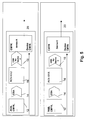
- the RIP processing is carried out for the intended printing device A to generate print data 20 colorimetrically adapted to device A (CMYK(dev A)) as has been described for Fig. 5.
- pint data 20 is in the form of a device specific contone image.
- Such post processing may be performed in a fast way, e.g. equally fast or faster than the printing speed of the device to be used.
- the latter may allow streaming of the processed print ready data to device C, such that the processing may be performed simultaneously with the print task.
- the processing thereby may make use of a stored colour conversion algorithm, e.g. a stored colour conversion table or function for switching from one colour to another.
- a stored colour conversion algorithm e.g. a stored colour conversion table or function for switching from one colour to another.
- the latter may be advantageous as it may assist in fast processing and result in reducing or avoiding halting between subsequent jobs as the colour conversion can be done simultaneously. In this way, halting and/or restarting of the print engine may be avoided, which otherwise would cause loss of productivity or causes generation of excess pages and thus an additional cost and optionally interference in later finishing steps.
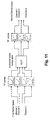
- a scheme for the devicelink transformation 22 in accordance with an embodiment of the present invention which is colorimetrically better than the operation of one dimensional look up tables can be a modified version of the one proposed in the ICC Specification ICC.1:2004-10 (Profile version 4.2.0.0) as shown schematically in Fig. 11 for transformation between a first and second device (A,B).
- This process can include matrix operations using pixel data from more than one of the color separations, and/or use of multidimensional look up tables and/or use of an interpolator to interpolate between values.
- a variety of methods can be used to complete the transform.
- the transform algorithm or corresponding data for performing the transformation may be previously stored, such that no overhead is induced by generation of colour conversion tables or by loading input and output profiles for the different devices at job time.
- the process can include a first adaptation using one dimensional look up tables (LUT) followed by a matrix operation applied to all the separations followed by a further adaptation using one dimensional look up tables.
- LUT dimensional look up tables
- One aspect of the matrix multiplications is to provide intermediate values between known values by interpolation. Hence interpolation may be applied at any stage of this procedure to increase the number of values or to provide an new intermediate value.
- C ⁇ ⁇ M ⁇ ⁇ Y ⁇ ⁇ K ⁇ ⁇ X LUT ⁇ C ⁇ M ⁇ Y ⁇ K ⁇ C ⁇ M ⁇ Y ⁇ K ⁇ X ⁇ ⁇ C ⁇ ⁇ M ⁇ ⁇ Y ⁇ ⁇ K using the mulitdimensional LUT C'M'Y'K' ⁇ C"M"Y"K"X (see Fig. 11) if the transformation is from the space CMYK to the space CMYKX where X is an extra-quaternary toner.
- the matrix coefficients or the values in the look up tables can be obtained by proof printing the two printers and constructing the relevant values by optometric measurements and/or human test persons being used to examine and compare the results of printing on the two devices.
- the CMYK to C'M'Y'K' transformation can be optimized as a devicelink profile taking into account preferred black generation as intended by a designer that is familiar with how to work with device A.
- Using a relative colorimetric approach for the devicelink process 22 will allow the pressroom manager to match the results that customers expect from device A when using device C.
- some colors will have to be mapped into the gamut of device C, e.g. if C is slightly smaller in the blue tones, or some of the red capabilities of device C will not be used.
- the devicelink transformation 22 as shown schematically in Fig 6 is implemented as a separate and independent RIP-less step (e.g. post-RIP step) after completion of the RIP process.
- RIP-less refers to the fact that all vector-based graphics have already been rendered to a raster format to generate the first print data 20 that is adapted colorimetrically to device A.
- the operations allowed in the RIP-less step are those allowed on the print data, e.g. in a print-ready format, complemented by one or more specific devicelink transformations.
- the devicelink transformation 22 as in Fig 6 is implemented as a separate step that acts on a printer ready format.
- the printer ready format can be already stored, e.g. in permanent storage, in a computer system that streams the real time print data to the print engine of print device C.
- the devicelink transformation 22 of Fig. 6 acts on print data, e.g. in a print-ready format, at the same speed or higher than the print speed of device C, i.e. in a real time streaming process that keeps up with the print speed of the print engine of print device C.
- the printing system can include a graphics processing department 8 and a pressroom with printing devices 3, 5, 7, 9 each having a control system 11, 13, 15, 17, respectively.
- the control system can be a programmable microprocessor system.
- An operator creates print ready print data in the graphics processing department. Any of the print data may be a set of print files including variable data sets as in EP 1,111,545 A1 .
- This print ready data is then processed in the control system where color management to adjust the print job to a different print device is carried out, and then the relevant print device prints.
- variable data sets the conversion can be performed on the variable sets only, by caching them and further processing them such that these can be converted on the fly as they are assembled or generated.
- the print job can contain objects such as color images, graphics and/or text, e.g. from scanned images, computer programs, or other generation means to create a composite image.
- the resulting contone image or native file can be converted into a page description language (PDL), e.g. Postscript.
- PDL page description language
- the PDL file can include contone data (for images), text data, and graphic data.
- the image is then raster image processed and can be stored in memory, e.g. on a hard disk.
- RIP-ing can be done with a RIP processor which decomposes or RIPs the PDL file into a contone separations, i.e., a byte maps.
- the print job is then transferred to the print room and is input to a specific print device, e.g.
- contone print data may be modified post-RIP so that it can be printed on another device or with another set of toners than was originally planned in a colorimetrically true manner.
- Conventional post-RIP processing can also be carried out which is to be appreciated by those skilled in the art.
- the print engine of the print device can include a half-toner or screen generator which decomposes the color managed post-RIP contone print data into screened images for printing.
- each screened separation is a bit map image or series of on and off instructions to tell the printer where to place an ink or toner dot of a particular process color or spot color on a printing medium.
- the present invention also includes multilevel generalizations of bitmaps as explained in EP634862 or US5654808 .
- the printing is extra-quaternary printing.
- extra-trinary printing or “extra-quaternary printing” can be used to describe printing with more than 3 or 4 subtractive colorants (toner, inks), respectively.
- Extra-quaternary printing comprises printing methods that are referred to as hi-fi color printing. In most cases the additional colorants are chosen in an attempt to extent the achievable color gamut.
- the present invention in one aspect relates to printing with 5 or more toners or inks.
- the degrees of freedom of adding black to CMY leads to the concept of black substitution and grey component replacement (GCR) or under color removal
- the addition of one or more R, G, B -like toners or inks can be looked upon as additional (secondary) chromatic toners or inks adding additional degrees of freedom in color separation that allow replacement certain combinations of primary (C,M,Y) inks by ink combinations including the secondary colorants.
- the present invention provides an improved method and system for solving problem 1) by generalizing the model in allowing that the secondary colorant is to be chosen such that a full layer of the secondary colorant replaces an overlay of the optionally partial layers of two of the primary colorants (e.g. 100% Red replaces 90% Y + 80% M). This flexibility allows the substitution to be adapted to the actual toner formulation chosen for the fifth colorant.
- the present invention provides a RIP solution that allows to create multi-separation profiles with N separations, e.g. four color profiles such as CMYK output profiles for a printing system that converts the multi-separation profiles to profiles N + 1, e.g. CMYK to CMYKX. Conversion from N separations to N+2, N+3 is also possible.
- the present invention in one aspect exploits the power of an N to N+M colorants conversion, where M can be one or more, e.g. any of the conversions 4C-5C, 4C-6C, 4C-7C, 4C-8C as a tool to simulate different presses and or standards in a relative colorimetric manner.
- M can be one or more, e.g. any of the conversions 4C-5C, 4C-6C, 4C-7C, 4C-8C as a tool to simulate different presses and or standards in a relative colorimetric manner.
- magenta colorant can differ between toner versions for a given machine as well as between digital presses from different vendors that can co-exist in a pressroom.
- Study of 5C (five color) printing using a fifth colorant such as red has shown that if the red of table 1 is combined with a special choice for a non-standard magenta that is shifted away towards the violet from the proposed standards such as ISO 12647 (M-D for device D in table 1), a color gamut is obtained that comes close to being capable of relative colorimetrically correct rendering of the device CMYK gamut of devices A, D, C as well as the relevant standards.
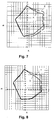
- Fig. 7 shows how the gamut of Device A is comprised within the gamut of the New Device E that is based on 5 colorants.
- Fig. 8 shows the gamut of device E in comparison to the gamut achieved with device D which corresponds to Device E with the 5th print station disabled and utilizing the special Magenta.
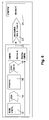
- Fig. 9 and Fig. 10 shows how the extra-quaternary Device E can process files generated for Device A, Device D, Device C as well as SWOP by a separate process based on a devicelink transformation from 4C to DeviceN.
- the devicelink transformation can act, for example, on a 4 channel CMYK input and results in an N channel output where N is different from 4.
- the devicelink transformation can act on a 4 channel CMYK input and results in an N channel output where N is larger than 4, i.e. N > 4.
- the present invention includes a printing method using a deviceN printing system that supports a print mode in which it accepts already ripped or partly ripped image data as provided in device-specific CMYK or a standard CMYK print data wherein the conversion of the print data into a deviceN image is according to one of a set of pre-loaded 4C-NC conversion algorithms and is implemented as a separate step in or after the raster process.
- the devicelink transformation 22 as in Fig 6, 9 or 10 is implemented as a separate step after completion of the RIP process.
- the devicelink transformation 22 as in Fig 6, 9 or 10 is implemented as a separate step that acts on a print-ready format.
- the devicelink transformation 22 as in Fig 6, 9 or 10 is implemented as a separate step that acts on a print-ready format that is pulled from permanent storage by a computer system that streams the real time print data to the print engine of a print device.
- FIG. 12 shows one configuration of processing system 150 that includes at least one programmable processor 153 coupled to a memory subsystem 155 that includes at least one form of memory, e.g., RAM, ROM, and so forth.
- a storage subsystem 157 may be included that has at least one disk drive and/or CD-ROM drive and/or DVD drive.
- a display system, a keyboard, and a pointing device may be included as part of a user interface subsystem 159 to provide for a user to manually input information or control data for steering the adaption of the print data received by the processing system to the alternative print device or set of toners. Ports for inputting and outputting data also may be included. More elements such as network connections, interfaces to various devices especially print devices, and so forth, may be included, but are not illustrated in Fig. 12. The various elements of the processing system 150 may be coupled in various ways, including via a bus subsystem 163 shown in Fig. 12 for simplicity as a single bus, but will be understood to those in the art to include a system of at least one bus.
- the memory of the memory subsystem 155 may at some time hold part or all (in either case shown as 161) of a set of instructions that when executed on the processing system 150 implement the step(s) of any of the method embodiments described herein.
- a processing system 150 such as shown in Fig. 12 is prior art
- a system that includes the instructions to implement novel aspects of the present invention is not prior art, and therefore Fig. 12 is not labelled as prior art.
- processor 153 or processors may be a general purpose, or a special purpose processor, and may be for inclusion in a device, e.g., a chip that has other components that perform other functions, for example it may be an embedded processor.
- aspects of the present invention can be implemented in digital electronic circuitry, or in computer hardware, firmware, software, or in combinations of them.
- aspects of the invention can be implemented in a computer program product tangibly embodied in a carrier medium carrying machine-readable code for execution by a programmable processor. Method steps of aspects of the invention may be performed by a programmable processor executing instructions to perform functions of those aspects of the invention, e.g., by operating on input data and generating output data.
- Non-volatile media includes, for example, optical or magnetic disks, such as a storage device which is part of mass storage. Volatile media includes mass storage. Volatile media includes dynamic memory such as RAM.
- Common forms of computer readable media include, for example a floppy disk, a flexible disk, a hard disk, magnetic tape, or any other magnetic medium, a CD-ROM, any other optical medium, punch cards, paper tapes, any other physical medium with patterns of holes, a RAM, a PROM, an EPROM, a FLASH-EPROM, any other memory chip or cartridge, a carrier wave as described hereafter, or any other medium from which a computer can read.
- Various forms of computer readable media may be involved in carrying one or more sequences of one or more instructions to a processor for execution.
- the instructions may initially be carried on a magnetic disk of a remote computer.
- the remote computer can load the instructions into its dynamic memory and send the instructions over a telephone line using a modem.
- a modem local to the computer system can receive the data on the telephone line and use an infrared transmitter to convert the data to an infrared signal.
- An infrared detector coupled to a bus can receive the data carried in the infrared signal and place the data on the bus.
- the bus carries data to main memory, from which a processor retrieves and executes the instructions.
- the instructions received by main memory may optionally be stored on a storage device either before or after execution by a processor.
- the instructions can also be transmitted via a carrier wave in a network, such as a LAN, a WAN or the Internet.
- Transmission media can take the form of acoustic or light waves, such as those generated during radio wave and infrared data communications. Transmission media include coaxial cables, copper wire and fibre optics, including the wires that comprise a bus within a computer.
- FPGA Field Programmable Gate
- the accelerator 40 may be constructed as a VLSI chip around an embedded microprocessor 30 such as an ARM7TDMI core designed by ARM Ltd., UK which may be synthesized onto a single chip with the other components shown.
- a zero wait state SRAM memory 22 may be provided on-chip as well as a cache memory 24.
- One or various I/O (input/output) interfaces 25, 26, 27 may be provided, e.g. UART, USB, I 2 C bus interface as well as an I/O selector 28. These interfaces can connect to the Local Area Network 10 and to the print device with which the accelerator works.
- FIFO buffers 32 may be used to decouple the processor 30 from data transfer through these interfaces, e.g.
- a counter/timer block 34 may be provided as well as an interrupt controller 36.
- the devicelink transformation 22 of Fig. 6, 9 or 10 is provided by block 42 which can handle the matrix manipulations of the data. Block 42 may be configured around an FPGA and cooperates with the processor 30 for processing the print data.
- Software programs may be stored in an internal ROM (read only memory) 46. Access to an external memory may be provided an external bus interface 38 with address, data and control busses.
- the various blocks of accelerator 40 are linked by suitable busses 31.
- Control mechanisms of the present invention to control the printing of print data may be implemented as software to run on processor 30.
- the procedures described above may be written as computer programs in a suitable computer language such as C and then compiled for the specific processor in the embedded design.
- the software may be written in C and then compiled using the ARM C compiler and the ARM assembler.
Landscapes
- Engineering & Computer Science (AREA)
- Multimedia (AREA)
- Signal Processing (AREA)
- Facsimile Image Signal Circuits (AREA)
- Image Processing (AREA)
- Color Image Communication Systems (AREA)
Applications Claiming Priority (2)
| Application Number | Priority Date | Filing Date | Title |
|---|---|---|---|
| US84550406P | 2006-09-19 | 2006-09-19 | |
| GBGB0618412.1A GB0618412D0 (en) | 2006-09-19 | 2006-09-19 | Near press 4-color N-color conversion method and system for late binding of press details in a RIP-less color conversion or documented CMYK workflow |
Publications (2)
| Publication Number | Publication Date |
|---|---|
| EP1903774A2 true EP1903774A2 (de) | 2008-03-26 |
| EP1903774A3 EP1903774A3 (de) | 2010-09-15 |
Family
ID=37421226
Family Applications (1)
| Application Number | Title | Priority Date | Filing Date |
|---|---|---|---|
| EP07018364A Withdrawn EP1903774A3 (de) | 2006-09-19 | 2007-09-19 | Farbumwandlungsverfahren und -system |
Country Status (3)
| Country | Link |
|---|---|
| US (1) | US20080068663A1 (de) |
| EP (1) | EP1903774A3 (de) |
| GB (1) | GB0618412D0 (de) |
Cited By (2)
| Publication number | Priority date | Publication date | Assignee | Title |
|---|---|---|---|---|
| DE102009017516A1 (de) * | 2009-04-20 | 2010-10-28 | OCé PRINTING SYSTEMS GMBH | Verfahren zum Drucken eines Vollfarbobjektes als Highlight-Color-Objekt |
| WO2016131933A1 (en) * | 2015-02-19 | 2016-08-25 | Oce-Technologies B.V. | Method for colour matching printers |
Families Citing this family (4)
| Publication number | Priority date | Publication date | Assignee | Title |
|---|---|---|---|---|
| US8213051B2 (en) * | 2009-07-16 | 2012-07-03 | Infoprint Solutions Company Llc | Color management workflow for transitioning offset printing using custom inks to digital printing |
| EP2872947B1 (de) * | 2012-07-13 | 2020-02-05 | Sun Chemical Corporation | Erweiterte farbskala |
| JP5835286B2 (ja) * | 2013-08-14 | 2015-12-24 | コニカミノルタ株式会社 | 画像形成方法、画像形成システム用プログラム、画像形成システム用プログラムを記録した記録媒体、および画像形成システム |
| US11170274B2 (en) * | 2017-08-31 | 2021-11-09 | Hp Indigo B.V. | Generating rasterized modified images from a rasterized seed image |
Family Cites Families (13)
| Publication number | Priority date | Publication date | Assignee | Title |
|---|---|---|---|---|
| US5608549A (en) * | 1991-06-11 | 1997-03-04 | Canon Kabushiki Kaisha | Apparatus and method for processing a color image |
| BE1007264A4 (nl) * | 1993-07-12 | 1995-05-02 | Agfa Gevaert Nv | Rastermethode voor een schrijfsysteem met beperkte densiteitsresolutie. |
| US5594557A (en) * | 1994-10-03 | 1997-01-14 | Xerox Corporation | Color printer calibration correcting for local printer non-linearities |
| US6061501A (en) * | 1997-03-25 | 2000-05-09 | International Business Machines Corporation | System, method and program for converting an externally defined four colorant (CMYK) into an equivalent four dimensional colorant defined in terms of the four inks (C'M'Y'K') that are associated with a given printer |
| US6115031A (en) * | 1999-04-23 | 2000-09-05 | Lexmark International, Inc. | Method of converting color values |
| US6532081B1 (en) * | 1999-07-23 | 2003-03-11 | Xerox Corporation | Weight calculation for blending color transformation lookup tables |
| DE10056723A1 (de) * | 1999-12-15 | 2001-06-21 | Heidelberger Druckmasch Ag | Verfahren zur Erzeugung eines an einen realen Prozeß angepaßten zweiten Bilddatensatzes aus einem ersten Bilddatensatz und Colour-Management-Verfahren |
| EP1111545A1 (de) * | 1999-12-24 | 2001-06-27 | Agfa-Gevaert naamloze vennootschap | Verfahren und Gerät zur Seitengestaltung mit gespeicherten Seitenelementen |
| GB0004427D0 (en) * | 2000-02-24 | 2000-04-12 | Xeikon Nv | Cleaning device |
| JP4532790B2 (ja) * | 2000-08-08 | 2010-08-25 | キヤノン株式会社 | カラー画像処理方法、装置およびプログラム |
| US6967746B1 (en) * | 2000-08-30 | 2005-11-22 | Eastman Kodak Company | System for combining device color profiles |
| US6584903B2 (en) * | 2000-12-12 | 2003-07-01 | Xerox Corporation | Color digital front end decomposer output to multiple color spaces with actual output optionally being determined by input color spaces |
| DE102004003300B4 (de) * | 2004-01-22 | 2014-03-06 | Heidelberger Druckmaschinen Ag | Verfahren zur Herstellung eines Prüfdrucks für einen Druckprozess mit mehr als vier Druckfarben |
-
2006
- 2006-09-19 GB GBGB0618412.1A patent/GB0618412D0/en not_active Ceased
-
2007
- 2007-09-19 EP EP07018364A patent/EP1903774A3/de not_active Withdrawn
- 2007-09-19 US US11/902,094 patent/US20080068663A1/en not_active Abandoned
Cited By (2)
| Publication number | Priority date | Publication date | Assignee | Title |
|---|---|---|---|---|
| DE102009017516A1 (de) * | 2009-04-20 | 2010-10-28 | OCé PRINTING SYSTEMS GMBH | Verfahren zum Drucken eines Vollfarbobjektes als Highlight-Color-Objekt |
| WO2016131933A1 (en) * | 2015-02-19 | 2016-08-25 | Oce-Technologies B.V. | Method for colour matching printers |
Also Published As
| Publication number | Publication date |
|---|---|
| EP1903774A3 (de) | 2010-09-15 |
| US20080068663A1 (en) | 2008-03-20 |
| GB0618412D0 (en) | 2006-11-01 |
Similar Documents
| Publication | Publication Date | Title |
|---|---|---|
| US7423780B1 (en) | Dynamic selection of rendering intent for color proofing transforms | |
| US7796299B1 (en) | Composite rendering intent for color proofing applications | |
| EP1156668B1 (de) | Schwarzerzeugung für ein Farbverwaltungssystem | |
| US7612926B2 (en) | Representations of spot colors | |
| JP7524681B2 (ja) | 画像処理装置、画像処理方法およびプログラム | |
| EP1903774A2 (de) | Farbumwandlungsverfahren und -system | |
| CN102905053A (zh) | 图像处理装置 | |
| US7506584B2 (en) | Method for producing a proof for a printing process having more than four printing inks | |
| JP4207609B2 (ja) | 画像処理装置 | |
| JP4804044B2 (ja) | 画像処理装置及び画像処理方法 | |
| US7312893B2 (en) | Method for the printing-process transformation of the color print for black/white images | |
| JP7643067B2 (ja) | 画像処理装置、画像処理方法およびプログラム | |
| JP2004112470A (ja) | 色調補正方法、画像処理システム、画像処理装置、プログラム、記憶媒体 | |
| JP2007081747A (ja) | 画像処理装置 | |
| US7163269B2 (en) | Methods and systems for maintaining color consistency in a print-on-demand workflow | |
| US6275302B1 (en) | Color printing yielding a background dependent neutral gray image (i.e. intelligent gray) | |
| EP1079606A2 (de) | Farbraumanpassung für mehrere unterschiedliche Untergründe | |
| EP1513097B1 (de) | Datenstrom zur Ausgabe von Farbbildern | |
| US7583837B2 (en) | Method and system for preparing grayscale image files for highlight printing on a four color printer | |
| US7616345B2 (en) | Method for transforming a digital image from a first to a second colorant space | |
| US7190828B2 (en) | Color rendering | |
| JP2008118447A (ja) | 画像形成装置及び画像形成方法ならびにそのプログラム | |
| JP2008061069A (ja) | 画像処理装置、画像出力装置、端末装置および画像形成システムならびにプログラム | |
| US20060227146A1 (en) | Systems and methods for media production color management | |
| Plaisted et al. | Construction features of color output device profiles |
Legal Events
| Date | Code | Title | Description |
|---|---|---|---|
| PUAI | Public reference made under article 153(3) epc to a published international application that has entered the european phase |
Free format text: ORIGINAL CODE: 0009012 |
|
| AK | Designated contracting states |
Kind code of ref document: A2 Designated state(s): AT BE BG CH CY CZ DE DK EE ES FI FR GB GR HU IE IS IT LI LT LU LV MC MT NL PL PT RO SE SI SK TR |
|
| AX | Request for extension of the european patent |
Extension state: AL BA HR MK YU |
|
| PUAL | Search report despatched |
Free format text: ORIGINAL CODE: 0009013 |
|
| AK | Designated contracting states |
Kind code of ref document: A3 Designated state(s): AT BE BG CH CY CZ DE DK EE ES FI FR GB GR HU IE IS IT LI LT LU LV MC MT NL PL PT RO SE SI SK TR |
|
| AX | Request for extension of the european patent |
Extension state: AL BA HR MK RS |
|
| AKY | No designation fees paid | ||
| REG | Reference to a national code |
Ref country code: DE Ref legal event code: R108 Effective date: 20110419 |
|
| STAA | Information on the status of an ep patent application or granted ep patent |
Free format text: STATUS: THE APPLICATION IS DEEMED TO BE WITHDRAWN |
|
| 18D | Application deemed to be withdrawn |
Effective date: 20110316 |