EP1905977A2 - Thermostat-Wärmetauscher-Anordnung, insbesondere für einen Wärmetauscher eines Kraftfahrzeugs - Google Patents
Thermostat-Wärmetauscher-Anordnung, insbesondere für einen Wärmetauscher eines Kraftfahrzeugs Download PDFInfo
- Publication number
- EP1905977A2 EP1905977A2 EP07017071A EP07017071A EP1905977A2 EP 1905977 A2 EP1905977 A2 EP 1905977A2 EP 07017071 A EP07017071 A EP 07017071A EP 07017071 A EP07017071 A EP 07017071A EP 1905977 A2 EP1905977 A2 EP 1905977A2
- Authority
- EP
- European Patent Office
- Prior art keywords
- heat exchanger
- thermostat
- coolant
- arrangement according
- charge air
- Prior art date
- Legal status (The legal status is an assumption and is not a legal conclusion. Google has not performed a legal analysis and makes no representation as to the accuracy of the status listed.)
- Granted
Links
Images

Classifications
-
- F—MECHANICAL ENGINEERING; LIGHTING; HEATING; WEAPONS; BLASTING
- F02—COMBUSTION ENGINES; HOT-GAS OR COMBUSTION-PRODUCT ENGINE PLANTS
- F02B—INTERNAL-COMBUSTION PISTON ENGINES; COMBUSTION ENGINES IN GENERAL
- F02B29/00—Engines characterised by provision for charging or scavenging not provided for in groups F02B25/00, F02B27/00 or F02B33/00 - F02B39/00; Details thereof
- F02B29/04—Cooling of air intake supply
- F02B29/045—Constructional details of the heat exchangers, e.g. pipes, plates, ribs, insulation, materials, or manufacturing and assembly
- F02B29/0475—Constructional details of the heat exchangers, e.g. pipes, plates, ribs, insulation, materials, or manufacturing and assembly the intake air cooler being combined with another device, e.g. heater, valve, compressor, filter or EGR cooler, or being assembled on a special engine location
-
- F—MECHANICAL ENGINEERING; LIGHTING; HEATING; WEAPONS; BLASTING
- F02—COMBUSTION ENGINES; HOT-GAS OR COMBUSTION-PRODUCT ENGINE PLANTS
- F02B—INTERNAL-COMBUSTION PISTON ENGINES; COMBUSTION ENGINES IN GENERAL
- F02B29/00—Engines characterised by provision for charging or scavenging not provided for in groups F02B25/00, F02B27/00 or F02B33/00 - F02B39/00; Details thereof
- F02B29/04—Cooling of air intake supply
- F02B29/045—Constructional details of the heat exchangers, e.g. pipes, plates, ribs, insulation, materials, or manufacturing and assembly
- F02B29/0462—Liquid cooled heat exchangers
-
- F—MECHANICAL ENGINEERING; LIGHTING; HEATING; WEAPONS; BLASTING
- F02—COMBUSTION ENGINES; HOT-GAS OR COMBUSTION-PRODUCT ENGINE PLANTS
- F02B—INTERNAL-COMBUSTION PISTON ENGINES; COMBUSTION ENGINES IN GENERAL
- F02B29/00—Engines characterised by provision for charging or scavenging not provided for in groups F02B25/00, F02B27/00 or F02B33/00 - F02B39/00; Details thereof
- F02B29/04—Cooling of air intake supply
- F02B29/0493—Controlling the air charge temperature
-
- Y—GENERAL TAGGING OF NEW TECHNOLOGICAL DEVELOPMENTS; GENERAL TAGGING OF CROSS-SECTIONAL TECHNOLOGIES SPANNING OVER SEVERAL SECTIONS OF THE IPC; TECHNICAL SUBJECTS COVERED BY FORMER USPC CROSS-REFERENCE ART COLLECTIONS [XRACs] AND DIGESTS
- Y02—TECHNOLOGIES OR APPLICATIONS FOR MITIGATION OR ADAPTATION AGAINST CLIMATE CHANGE
- Y02T—CLIMATE CHANGE MITIGATION TECHNOLOGIES RELATED TO TRANSPORTATION
- Y02T10/00—Road transport of goods or passengers
- Y02T10/10—Internal combustion engine [ICE] based vehicles
- Y02T10/12—Improving ICE efficiencies
Definitions
- the invention relates to a thermostat-heat exchanger arrangement, in particular for a heat exchanger of a motor vehicle according to the preamble of claim 1.
- a hose thermostat also referred to as a hose valve
- a hose valve is often used to control thedemitteistroms.
- This can be arranged, for example, coolant outlet side of a heat exchanger, in particular a charge air cooler, in a low-temperature cooling circuit.
- thermostatic heat exchanger assemblies leave desires in terms of the shortest possible response time open.
- a thermostat-heat exchanger arrangement in particular for a in a secondary coolant circuit of a charge air cooler, with a heat exchanger, a thermostat, which is arranged in the region of an inlet or outlet to or from the heat exchanger and a fluid flow, in particular a coolant flow, regulated as a function of the temperature, provided, wherein the thermostat is built into a wall of the heat exchanger integrated. Due to the integrated design, the housing of the thermostat can be omitted.
- this embodiment in addition to a reduction in the installation space, also enables a shortened reaction time to temperature changes of the coolant, resulting in improved control behavior.
- the wall in which the thermostat is preferably integrated is an outer wall of the heat exchanger. An attachment to this is usually possible without much effort. Likewise, a relative seal is possible.
- the thermostat is preferably arranged in an outlet opening of the heat exchanger.
- the region of the thermostat in which there is a medium with a temperature-dependent volume, preferably extends into the outlet opening.
- the thermostat extends at least partially within the heat exchanger, so that space can be saved to the outside.
- a part of the thermostat preferably also extends slightly outwards.
- the heat exchanger is preferably a disk-type heat exchanger, wherein the thermostat is arranged in an opening in a connection plate or a bottom plate of the heat exchanger and fixed to the same or the same.
- other heat exchangers can be designed accordingly for receiving a thermostat.
- an edge of the thermostat is arranged in a groove and fixed with the interposition of a seal from the outside by means of a yoke or other connection of a connecting line.
- the heat exchanger is particularly preferably a charge air cooler. This is preferably flowed through by a coolant, wherein the coolant circuit may also be connected to the engine coolant circuit.
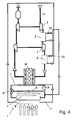
- FIG. 4 shows a basically known two-stage intercooling with associated coolant circuit 1, subdivided into a main coolant circuit 1 '. and a sub-coolant circuit 1 ", wherein the coolant circuit 1, the cooling of a motor M and the cooling of charge air LL is used.
- the air drawn in from the surroundings is compressed by a first turbocharger 2, which heats the air.
- a subsequent low-pressure charge air cooler 3 which will be discussed in more detail later, the hot air is cooled.
- a second turbocharger 4 the cooled, precompressed air is further compressed and then the hot charge air is cooled in a subsequent high-pressure charge air cooler 5 before it reaches the engine M and is burned in the same.
- the exhaust gas thus produced flows through two turbines for energy recovery and passes through a particle filter to the outside.
- the coolant circuit 1 is circulated by a pump P, the circuit dividing directly after the pump P into the main coolant circuit 1 'and the secondary coolant circuit 1 ".
- the coolant first flows through the engine M to a valve 6, which directs the coolant as a function of the temperature and the engine cooling requirement through a first coolant cooler 7 or through a bypass 8.
- the two parallel branches of the main coolant circuit 1 ' are brought together again and the coolant reaches Pump P.
- the entire coolant flowing through it is first passed through a second sub-coolant cooler 9, which is arranged parallel to the first coolant radiator 7. Both coolant coolers 7 and 9 are flowed through by means of a blower of cooling air from the environment
- the cooled coolant of the auxiliary coolant circuit 1 " is distributed downstream of the coolant radiator 9 as a function of the cooling demand on the two charge air coolers 3 and 5 via lines connected in parallel and flows through the same.
- the regulation of the coolant flow through the two charge air coolers 3 and 5 takes place by means of a respective integrated in each of the intercoolers 3 and 5 thermostat 10, which is arranged in the region of the outlet opening 11 of the respective intercooler 3 and 5 respectively.
- the two branches of the auxiliary coolant circuit 1 are brought together again and merge with the main coolant circuit 1 'in a region downstream of the coolant cooler 7 and before the bypass 8 is bypassed.
- thermostat 10 in the intercooler 3
- the configuration of the thermostat-heat exchanger arrangement in the case of the second intercooler 5 is corresponding, so that will not be discussed in more detail below.
- the intercooler 3 is a disc-type intercooler having a plurality of arcuate discs 13 which are assembled and form flow paths for heat transfer therebetween.
- the lowermost disc 13, shown on the left in FIG. 1, is also referred to below as a bottom plate and is somewhat stronger for stiffening.
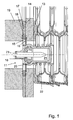
- the thermostat 10 is arranged in the central longitudinal axis of the coolant outlet opening 11, wherein it extends into the intercooler 3 with about half of it into the second pair of disks. The other half of the thermostat 10 projects beyond the outer surface of the floor panel.
- connection plate 14 is attached, soldered in the present case, which has a circular opening in extension of the outlet opening 11.
- the connection plate 14 on the outside an annular groove 15 around the outlet opening 11.
- a flange 16 of the thermostat 10 is arranged.
- a sealing plate 17 arranged, annular, presently formed with two beads sealing element 18 inserted into the groove 14 and in the present past glued along the outer circumference, which extends beyond the outer edge of the flange 16 from the thermostat 10.
- the sealing plate 17 together with the sealing element 18 is pressed from above by a yoke 19 against the connection plate 14, for which holes 17 or other through holes for inserted through the sealing plate 17 and the yoke 19 and screwed into the connection plate 14 screws in the sealing plate.
- a connecting line (not shown) is connected, via which the coolant is fed back to the common part of the coolant circuit 1.
- the function of the thermostat 10 is as follows: starting from the maximum open state of the thermostat 10, cooler coolant flows through a portion 20 of the thermostat 10 which is displaceable between a region adjacent to the flange 16 of the thermostat 10 and a movable part 20 of the thermostat 10 which is displaceable in the longitudinal direction of the central longitudinal axis of the outlet opening 11
- a contained in a chamber 21 in the displaceable part 20 of the thermostat medium thereby changing its volume, preferably reduced, so that supported by the force of a spring 22, a pin 23 can continue to penetrate into the chamber 21, and slidable part 20 approaches the area adjacent to the flange 16 as a function of the temperature.
- the thermostat 10 has according to the present embodiment in its closed position, a leakage current of 100 to 200 I / h, so that even in this state, a sufficiently short reaction time can be guaranteed to temperature changes.
- thermostat does not necessarily have to correspond to the previously described embodiment.
- the thermostat be formed so that it extends only in the interior of the outlet opening and not on the connection plate to the outside.
- connection plate eliminates the connection plate.
- thermostat-heat exchanger arrangement in a cooler as a heat exchanger.
- a heat exchanger in disk construction does not necessarily have to be used as a heat exchanger.
- a corresponding integration of the thermostat in the heat exchanger can also be carried out, for example, in the case of a plate-type heat exchanger, in heat exchangers with box-shaped collectors, etc. In other applications, an inlet-side arrangement is conceivable.
Landscapes
- Engineering & Computer Science (AREA)
- Physics & Mathematics (AREA)
- Thermal Sciences (AREA)
- Chemical & Material Sciences (AREA)
- Combustion & Propulsion (AREA)
- Mechanical Engineering (AREA)
- General Engineering & Computer Science (AREA)
- Heat-Exchange Devices With Radiators And Conduit Assemblies (AREA)
Abstract
Description
- Die Erfindung betrifft eine Thermostat-Wärmetauscher-Anordnung, insbesondere für einen Wärmetauscher eines Kraftfahrzeugs gemäß dem Oberbegriff des Anspruchs 1.
- In Niedertemperatur-Kühlkreisläufen wird zur Regelung des Kühlmitteistroms häufig ein Schlauchthermostat, auch als Schlauchventil bezeichnet, verwendet. Dieses kann beispielsweise kühlmittelausleitungsseitig eines Wärmetauschers, insbesondere eines Ladeluft-Kühlers, in einem Niedertemperatur-Kühlkreislauf angeordnet sein.
- Derartige Thermostat-Wärmetauscher-Anordnungen lassen jedoch Wünsche in Bezug auf eine möglichst geringe Reaktionszeit offen.
- Ausgehend von diesem Stand der Technik ist es Aufgabe der Erfindung, eine verbesserte Anordnung zur Verfügung zu stellen.
- Diese Aufgabe wird gelöst durch eine Anordnung mit den Merkmalen des Anspruchs 1. Vorteilhafte Ausgestaltungen sind Gegenstand der Unteransprüche.
- Erfindungsgemäß ist eine Thermostat-Wärmetauscher-Anordnung, insbesondere für einen in einem Neben-Kühlmittelkreislauf eines Ladeluftkühers, mit einem Wärmetauscher, einem Thermostat, das im Bereich einer Zu- oder Ableitung zum bzw. vom Wärmetauscher angeordnet ist und einen Fluidstrom, insbesondere einen Kühlmittelstrom, in Abhängigkeit der Temperatur regelt, vorgesehen, wobei das Thermostat in eine Wand des Wärmetauschers integriert eingebaut ist. Durch die integrierte Ausgestaltung kann das Gehäuse des Thermostats entfallen. Ferner ermöglicht diese Ausgestaltung neben einer Verringerung des Bauraums auch eine verkürzte Reaktionszeit auf Temperaturänderungen des Kühlmittels, so dass sich ein verbessertes Regelverhalten ergibt.
- Die Wand, in welche das Thermostat bevorzugt integriert ist, ist eine Außenwand des Wärmetauschers. Eine Anbringung hieran ist in der Regel ohne großen Aufwand möglich. Ebenso ist eine relative Abdichtung möglich.
- Das Thermostat ist vorzugsweise in einer Austrittsöffnung des Wärmetauschers angeordnet. Hierbei erstreckt sich bevorzugt der Bereich des Thermostats, in welchem sich ein Medium mit temperaturabhängigem Volumen befindet, in die Austrittsöffnung hinein.
- Besonders bevorzugt erstreckt sich das Thermostat zumindest teilweise innerhalb des Wärmetauschers, so dass Bauraum nach außen gespart werden kann. Ein Teil des Thermostats erstreckt sich vorzugsweise auch etwas nach außen.
- Beim Wärmetauscher handelt es sich vorzugsweise um einen Wärmetauscher in Scheibenbauweise, wobei das Thermostat in einer Öffnung in einer Anschlussplatte oder eines Bodenblechs des Wärmetauschers angeordnet und an der- bzw. demselben fixiert ist. Andere Wärmetauscher können jedoch entsprechend für eine Aufnahme eines Thermostats ausgebildet sein.
- Besonders bevorzugt ist ein Rand des Thermostats in einer Nut angeordnet und unter Zwischenlage einer Dichtung von außen her mittels eines Jochs oder eines anderen Anschlusses einer Anschlussleitung fixiert. Eine derartige Ausgestaltung ermöglicht eine einfache Anbringung und zugleich eine einfache Abdichtung gegenüber der Umgebung.
- Beim Wärmetauscher handelt es sich besonders bevorzugt um einen Ladeluftkühler. Dieser wird vorzugsweise von einem Kühlmittel durchströmt, wobei der Kühlmittelkreislauf auch mit dem Motorkühlmittelkreislauf verbunden sein kann.
- Im Folgenden wird die vorliegende Erfindung anhand eines Ausführungsbeispiels unter Bezugnahme auf die Zeichnung näher erläutert. Es zeigen:
- Fig. 1
- eine perspektivische Ansicht eines Ausschnitts einer erfindungsgemäßen Thermostat-Wärmetauscher-Anordnung im Bereich des Thermostats mit Anschlussleitung,
- Fig. 2
- eine aufgerissene, perspektivische Ansicht durch die Thermostat-Wärmetauscher-Anordnung von Fig. 1,
- Fig. 3
- eine Schnittdarstellung der Anordnung von Fig. 2, und
- Fig. 4
- eine schematische Darstellung einer zweistufigen Ladeluftkühlung mit zwei Ladeluftkühlern mit erfindungsgemäßer Thermostat-Wärmetauscher-Anordnung.
- Fig. 4 zeigt eine im Prinzip bekannte zweistufige Ladeluftkühlung mit zugeordnetem Kühlmittelkreislauf 1, unterteilt in einen Haupt-Kühlmittelkreislauf 1' und einen Neben-Kühlmittelkreislauf 1", wobei der Kühlmittelkreislauf 1 der Kühlung eines Motors M und der Kühlung von Ladeluft LL dient.
- Im Rahmen der Ladeluftkühlung wird die von der Umgebung angesaugte Luft durch einen ersten Turbolader 2 verdichtet, wodurch sich die Luft erwärmt. In einem nachfolgenden Niederdruck-Ladeluftkühler 3, auf den an späterer Stelle näher eingegangen wird, wird die heiße Luft abgekühlt. In einem zweiten Turbolader 4 wird die gekühlte, vorverdichtete Luft weiter verdichtet und anschließend wird die heiße Ladeluft in einem nachfolgenden Hochdruck-Ladeluftkühler 5 gekühlt, bevor sie zum Motor M gelangt und in demselben verbrannt wird. Das so erzeugte Abgas durchströmt zwei Turbinen zur Energierückgewinnung und gelangt durch einen Partikelfilter nach außen.
- Der Kühlmittelkreislauf 1 wird von einer Pumpe P umgewälzt, wobei sich der Kreislauf direkt im Anschluss an die Pumpe P aufteilt in den Haupt-Kühlmittelkreislauf 1' und den Neben-Kühlmittelkreislauf 1". lm Haupt-Kühlmittelkreislauf 1' strömt das Kühlmittel zuerst durch den Motor M zu einem Ventil 6, weiches das Kühlmittel in Abhängigkeit der Temperatur und des Motorkühlbedarts durch einen ersten Kühlmittelkühler 7 oder durch einen Bypass 8 lenkt. Nach dem Kühlmittelkühler 7 werden die beiden parallelen Zweige des Haupt-Kühlmittelkreislaufs 1' wieder zusammengeführt und das Kühlmittel gelangt zur Pumpe P.
- Im Neben-Kühlmittelkreislauf 1" wird das gesamte, denselben durchströmende Kühlmittel zuerst durch einen zweiten Neben-Kühlmittelkühler 9 geleitet, der parallel zum ersten Kühlmittelkühler angeordnet ist. Beide Kühlmittelkühler 7 und 9 werden mit Hilfe eines Gebläses von Kühlluft aus der Umgebung durchströmt, welche die Wärme aus dem Kühlmittel aufnimmt. Das gekühlte Kühlmittel des Neben-Kühlmittelkreislaufs 1" wird im Anschluss an den Kühlmittelkühler 9 in Abhängigkeit des Kühlbedarfs auf die beiden Ladeluftkühler 3 und 5 über parallel geschaltete Leitungen verteilt und durchströmt dieselben. Die Regelung des Kühlmittelstroms durch die beiden Ladeluftkühler 3 und 5 erfolgt mit Hilfe jeweils eines in jeden der Ladeluftkühler 3 und 5 integrierten Thermostats 10, das im Bereich der Austrittsöffnung 11 des jeweiligen Ladeluftkühlers 3 bzw. 5 angeordnet ist. Im Anschluss an die Ladeluftkühler 3 und 5 werden die beiden Zweige des Neben-Kühlmittelkreislaufs 1" wieder zusammengeführt und vereinigen sich mit dem Haupt-Kühlmittelkreislauf 1' in einem Bereich nach dem Kühlmittelkühler 7 und vor dem Einzweigen des Bypasses 8.
- Im Folgenden wird die integrierte Anordnung des Thermostaten 10 in den Ladeluftkühler 3 näher erläutert. Die Ausgestaltung der Thermostat-Wärmetauscher-Anordnung im Falle des zweiten Ladeluftkühlers 5 ist entsprechend, so dass hierauf im Folgenden nicht näher eingegangen wird.
- Der Ladeluftkühler 3 ist ein Ladeluftkühler in Scheibenbauweise mit einer Mehrzahl gebogener Scheiben 13, die zusammengesetzt sind und Strömungswege zur Wärmeübertragung zwischen sich bilden. Die unterste Scheibe 13, in Fig. 1 links dargestellt, wird im Folgenden auch als Bodenblech bezeichnet und ist zur Versteifung etwas stärker ausgebildet. Wie aus Fig. 1 ersichtlich, ist das Thermostat 10 in der Mittellängsachse der Kühlmittel-Austrittsöffnung 11 angeordnet, wobei es sich mit einem etwa der Hälfte bis in das zweite Scheibenpaar hinein in den Ladeluftkühler 3 erstreckt. Die andere Hälfte des Thermostats 10 steht über die Außenfläche des Bodenblechs über.
- Am Bodenblech ist eine Anschlussplatte 14 angebracht, vorliegend angelötet, die eine kreisförmige Öffnung in Verlängerung der Austrittsöffnung 11 aufweist. Zur Aufnahme des Thermostats 10 weist die Anschlussplatte 14 außenseitig eine ringförmige Nut 15 um die Austrittsöffnung 11 auf. In dieser Nut 14 ist ein Flansch 16 des Thermostats 10 angeordnet. Um eine sichere Abdichtung gegenüber der Umgebung zu ermöglichen, ist ein an einer Dichtplatte 17 angeordnetes, ringförmiges, vorliegend mit zwei Wulsten ausgebildetes Dichtelement 18 in die Nut 14 eingelegt und vorliegend entlang des Außenumfangs eingeklebt, das sich bis über den äußeren Rand des Flansches 16 vom Thermostat 10 erstreckt. Die Dichtplatte 17 samt Dichtelement 18 wird von oben durch ein Joch 19 gegen die Anschlussplatte 14 gepresst, wofür in der Dichtplatte 17 Bohrungen oder andere Durchgangsöffnungen für durch die Dichtplatte 17 und das Joch 19 gesteckte und in die Anschlussplatte 14 geschraubte Schrauben aufweist. An das Joch 19 ist eine Anschlussleitung (nicht dargestellt) angeschlossen, über welche das Kühlmittel zurück zum gemeinsamen Teil des Kühlmittelkreislaufs 1 geführt wird.
- Die Funktion des Thermostats 10 ist Folgende: strömt - ausgehend vom maximal geöffneten Zustand des Thermostats 10 - kühleres Kühlmittel durch einen zwischen einem Bereich benachbart des Flansches 16 vom Thermostat 10 und einem beweglichen, in Längsrichtung der Mittellängsachse der Austrittsöffnung 11 verschiebbaren Teils 20 des Thermostats 10, so kühlt sich ein in einer Kammer 21 im verschiebbaren Teil 20 des Thermostats enthaltenes Medium ab, wodurch sich sein Volumen verändert, vorzugsweise verringert, so dass unterstützt durch die Kraft einer Feder 22 ein Stift 23 weiter in die Kammer 21 eindringen kann, und der verschiebbare Teil 20 sich dem Bereich benachbart des Flansches 16 in Abhängigkeit der Temperatur annähert. Bei einer vorgegebenen minimalen Temperatur des Kühlmittels liegen der verschiebbare Teil 20 und der Bereich benachbart des Flansches 16 aneinander an, so dass der Durchfluss an Kühlmittel minimiert ist. Das Thermostat 10 weist gemäß dem vorliegenden Ausführungsbeispiel in seiner geschlossenen Stellung einen Leckagestrom von 100 bis 200 I/h auf, so dass auch in diesem Zustand eine ausreichend geringe Reaktionszeit auf Temperaturänderungen gewährleistet werden kann.
- Die Ausgestaltung des Thermostats muss nicht notwendigerweise der zuvor beschriebenen Ausgestaltung entsprechen. Beispielsweise kann das Thermostat derart ausgebildet sein, dass es sich ausschließlich in das Innere der Austrittsöffnung und nicht über die Anschlussplatte nach außen erstreckt.
- Gemäß einer Variante des Ausführungsbeispiels, die nicht in der Zeichnung dargestellt ist, entfällt die Anschlussplatte. In diesem Fall wird die Funktion der Anschlussplatte durch das Bodenblech, d.h. die unterste Scheibe, übernommen, das etwas dicker ausgebildet ist.
- An Stelle von einer zweistufigen Verdichtung der Ladeluft kann der Wärmetauscher, in den ein Thermostat integriert ist, beispielsweise auch in einem Wärmetauscher, der in einer einstufigen Ladeluftkühlung vorgesehen ist, verwendet werden. Ferner kann er beispielsweise auch nur in einer zweiten Kühlstufe verwendet werden, bspw. bei einer Luftkühlung im Falle der ersten Kühlstufe. Die Verwendung einer erfindungsgemäßen Thermostat-Wärmetauscher-Anordnung muss zudem nicht notwendigerweise bei einem Kühler als Wärmetauscher vorgesehen sein. Eine derartige Anordnung ist auch im Falle eines Heizers möglich. Als Wärmetauscher muss zudem nicht notwendigerweise ein Wärmetauscher in Scheibenbauweise Verwendung finden. Eine entsprechende Integration des Thermostats in den Wärmetauscher kann auch beispielsweise im Falle eines Wärmetauschers in Plattenbauweise, in Wärmetauscher mit kastenförmigen Sammlern usw. erfolgen. In anderen Anwendungsfällen ist auch eine eintrittsseitige Anordnung denkbar.
Claims (9)
- Thermostat-Wärmetauscher-Anordnung, insbesondere für einen in einem Neben-Kühlmittelkreislauf (1") eines Ladeluftkühers (3, 5), mit einem Wärmetauscher, einem Thermostat (10), das im Bereich einer Zu- oder Ableitung zum bzw. vom Wärmetauscher angeordnet ist und einen Fluidstrom, insbesondere einen Kühlmittelstrom, in Abhängigkeit der Temperatur regelt, dadurch gekennzeichnet, dass das Thermostat (10) in eine Wand des Wärmetauschers integriert eingebaut ist.
- Thermostat-Wärmetauscher-Anordnung nach Anspruch 1, dadurch gekennzeichnet, dass die Wand eine Außenwand ist.
- Thermostat-Wärmetauscher-Anordnung nach Anspruch 1 oder 2, dadurch gekennzeichnet, dass das Thermostat (10) in einer Austrittsöffnung (11) des Wärmetauschers angeordnet ist.
- Thermostat-Wärmetauscher-Anordnung nach einem der vorhergehenden Ansprüche, dadurch gekennzeichnet, dass sich das Thermostat (10) zumindest teilweise innerhalb des Wärmetauschers erstreckt.
- Thermostat-Wärmetauscher-Anordnung nach einem der vorhergehenden Ansprüche, dadurch gekennzeichnet, dass sich das Thermostat (10) zumindest teilweise außerhalb des Wärmetauschers erstreckt.
- Thermostat-Wärmetauscher-Anordnung nach einem der vorhergehenden Ansprüche, dadurch gekennzeichnet, dass der Wärmetauscher ein Wärmetauscher in Scheibenbauweise ist, wobei das Thermostat (10) in einer Öffnung in einer Anschlussplatte (14) oder eines Bodenblechs des Wärmetauschers angeordnet und an der- bzw. demselben fixiert ist.
- Thermostat-Wärmetauscher-Anordnung nach einem der vorhergehenden Ansprüche, dadurch gekennzeichnet, dass ein Rand des Thermostats (10) in einer Nut angeordnet ist und unter Zwischenlage einer Dichtung (18) von außen her mittels eines Jochs (19) oder eines anderen Anschlusses einer Anschlussleitung fixiert ist.
- Thermostat-Wärmetauscher-Anordnung nach einem der vorhergehenden Ansprüche, dadurch gekennzeichnet, dass der Wärmetauscher ein Ladeluftkühler (3, 5) ist.
- Ladeluftkühler, gekennzeichnet durch mindestens ein integriert in den Ladeluttkühler (3, 5) entsprechend einer Thermostat-Wärmetauscher-Anordnung gemäß einem der Ansprüche 1 bis 8 angeordnetes Thermostat (10).
Applications Claiming Priority (1)
| Application Number | Priority Date | Filing Date | Title |
|---|---|---|---|
| DE102006044155A DE102006044155A1 (de) | 2006-09-15 | 2006-09-15 | Thermostat-Wärmetauscher-Anordnung, insbesondere für einen Wärmetauscher eines Kraftfahrzeugs |
Publications (3)
| Publication Number | Publication Date |
|---|---|
| EP1905977A2 true EP1905977A2 (de) | 2008-04-02 |
| EP1905977A3 EP1905977A3 (de) | 2009-12-30 |
| EP1905977B1 EP1905977B1 (de) | 2015-07-22 |
Family
ID=39004782
Family Applications (1)
| Application Number | Title | Priority Date | Filing Date |
|---|---|---|---|
| EP07017071.7A Active EP1905977B1 (de) | 2006-09-15 | 2007-08-31 | Thermostat-Wärmetauscher-Anordnung, insbesondere für einen Wärmetauscher eines Kraftfahrzeugs |
Country Status (2)
| Country | Link |
|---|---|
| EP (1) | EP1905977B1 (de) |
| DE (1) | DE102006044155A1 (de) |
Families Citing this family (3)
| Publication number | Priority date | Publication date | Assignee | Title |
|---|---|---|---|---|
| DE102010039810A1 (de) * | 2010-08-26 | 2012-03-01 | Behr Gmbh & Co. Kg | Kühlsystem und Kühlverfahren für ein Fahrzeug |
| DE102011080208A1 (de) * | 2011-08-01 | 2013-02-07 | Behr Gmbh & Co. Kg | Wärmetauschersystem und Verfahren zum Betreiben eines Wärmetauschersystems für ein Fahrzeug |
| JP6201886B2 (ja) * | 2014-01-06 | 2017-09-27 | 株式会社デンソー | 吸気冷却装置 |
Family Cites Families (9)
| Publication number | Priority date | Publication date | Assignee | Title |
|---|---|---|---|---|
| DE4112497A1 (de) * | 1991-04-17 | 1992-10-22 | Daimler Benz Ag | Fluessigkeitskuehlung fuer brennkraftmaschinen |
| DE19540591C2 (de) * | 1995-10-31 | 1999-05-20 | Behr Gmbh & Co | Verfahren zur Regelung der Volumenstromverteilung in einem Kühlmittelkreislauf für Kraftfahrzeuge mit Motor und Vorrichtung zur Durchführung des Verfahrens |
| DE19907267B4 (de) * | 1999-02-20 | 2005-08-04 | Mtu Friedrichshafen Gmbh | Kühlermodul für eine Brennkraftmaschine |
| ES2346051T3 (es) * | 2002-03-08 | 2010-10-08 | BEHR GMBH & CO. KG | Dispositivo para el enfriamiento de aire de admision y procedimiento para el funcionamiento de dicho dispositivo. |
| WO2003098026A1 (de) * | 2002-05-15 | 2003-11-27 | Behr Gmbh & Co. Kg | Schaltbarer abgaswärmetauscher |
| FR2846407B1 (fr) * | 2002-10-28 | 2006-01-06 | Valeo Thermique Moteur Sa | Echangeur de chaleur a regulation de flux, en particulier pour vehicules automobiles |
| BRPI0417665A (pt) * | 2003-12-19 | 2007-04-03 | Behr Gmbh & Co | arranjo de circuito para o resfriamento do ar de carga e processo para a operação de um arranjo de circuito desse tipo |
| DE102005031228A1 (de) * | 2004-07-26 | 2006-02-16 | Behr Gmbh & Co. Kg | Kühlmittelkühler mit in einen der Wasserkästen integriertem Getriebeölkühler |
| DE502005007311D1 (de) * | 2004-10-29 | 2009-07-02 | Behr Gmbh & Co Kg | Klimaanlage mit Kältespeicher |
-
2006
- 2006-09-15 DE DE102006044155A patent/DE102006044155A1/de not_active Withdrawn
-
2007
- 2007-08-31 EP EP07017071.7A patent/EP1905977B1/de active Active
Also Published As
| Publication number | Publication date |
|---|---|
| DE102006044155A1 (de) | 2008-03-27 |
| EP1905977B1 (de) | 2015-07-22 |
| EP1905977A3 (de) | 2009-12-30 |
Similar Documents
| Publication | Publication Date | Title |
|---|---|---|
| DE102004019554C5 (de) | Abgasrückführsystem für eine Verbrennungskraftmaschine | |
| EP1570168B1 (de) | Vorrichtung zur kühlung | |
| DE102019215797B4 (de) | Steuerventil zum Steuern eines Kühlmittelkreislaufs für einen Ladeluftkühler | |
| DE102017124727A1 (de) | Steuerungsventil | |
| DE102014117513A1 (de) | Zylinderförmiger Wärmetauscher | |
| WO2004090303A1 (de) | Kreislaufanordnung zur kühlung von ladeluft und verfahren zum betreiben einer derartigen kreislaufanordnung | |
| DE102011057004A1 (de) | Wärmetauscher für ein Fahrzeug | |
| EP1923549B1 (de) | Kühlsystem für ein Kraftfahrzeug | |
| EP2978948B1 (de) | Saugmodul für eine aufgeladene brennkraftmaschine | |
| EP3648997A1 (de) | Kälteanlage für ein fahrzeug mit einem einen wärmeübertrager aufweisenden kältemittelkreislauf sowie wärmeübertrager für eine solche kälteanlage | |
| DE102019132022A1 (de) | Motorkühlmittelkühlsystem für ein Fahrzeug | |
| DE102015218105A1 (de) | Wärmeübertrager | |
| WO2004097194A2 (de) | Kreislauf zur kühlung von ladeluft und verfahren zum betreiben eines derartigen kreislaufs | |
| WO2009000358A1 (de) | Ladeluftkühler für eine brennkraftmaschine | |
| DE102017006079A1 (de) | Kühleinrichtung für ein Kraftfahrzeug | |
| EP1905977B1 (de) | Thermostat-Wärmetauscher-Anordnung, insbesondere für einen Wärmetauscher eines Kraftfahrzeugs | |
| DE102010033125A1 (de) | Wärmetauschereinrichtung | |
| DE102009032647A1 (de) | Kühlsystem für eine Verbrennungskraftmaschine | |
| DE102018207621B3 (de) | Steuerventil für einen Kühlerkreislauf, Anordnung mit dem Steuerventilund Verfahren zum Steuern eines Flüssigkeitsstroms in der Anordnung | |
| EP2551569A1 (de) | Thermostatventil | |
| EP1673245B1 (de) | Klimaanlage mit wärmepumpe | |
| DE102004024255A1 (de) | Anordnung in einem Kältemittelkreislauf und Arbeitsverfahren | |
| DE102004003788A1 (de) | Klimaanlage | |
| DE102007035443A1 (de) | Vorichtung zur Kühlung von rückgeführtem Abgas eines Verbrennungsmotors | |
| DE102013209965A1 (de) | Thermostatventil |
Legal Events
| Date | Code | Title | Description |
|---|---|---|---|
| PUAI | Public reference made under article 153(3) epc to a published international application that has entered the european phase |
Free format text: ORIGINAL CODE: 0009012 |
|
| AK | Designated contracting states |
Kind code of ref document: A2 Designated state(s): AT BE BG CH CY CZ DE DK EE ES FI FR GB GR HU IE IS IT LI LT LU LV MC MT NL PL PT RO SE SI SK TR |
|
| AX | Request for extension of the european patent |
Extension state: AL BA HR MK YU |
|
| RIN1 | Information on inventor provided before grant (corrected) |
Inventor name: OBERLECHNER, CHRISTIAN Inventor name: WEGNER, JUERGEN, DIPL.-ING. (TU) Inventor name: VON LUETZAU, FRANK |
|
| PUAL | Search report despatched |
Free format text: ORIGINAL CODE: 0009013 |
|
| AK | Designated contracting states |
Kind code of ref document: A3 Designated state(s): AT BE BG CH CY CZ DE DK EE ES FI FR GB GR HU IE IS IT LI LT LU LV MC MT NL PL PT RO SE SI SK TR |
|
| AX | Request for extension of the european patent |
Extension state: AL BA HR MK RS |
|
| 17P | Request for examination filed |
Effective date: 20100630 |
|
| 17Q | First examination report despatched |
Effective date: 20100803 |
|
| AKX | Designation fees paid |
Designated state(s): AT BE BG CH CY CZ DE DK EE ES FI FR GB GR HU IE IS IT LI LT LU LV MC MT NL PL PT RO SE SI SK TR |
|
| GRAJ | Information related to disapproval of communication of intention to grant by the applicant or resumption of examination proceedings by the epo deleted |
Free format text: ORIGINAL CODE: EPIDOSDIGR1 |
|
| GRAP | Despatch of communication of intention to grant a patent |
Free format text: ORIGINAL CODE: EPIDOSNIGR1 |
|
| INTG | Intention to grant announced |
Effective date: 20141024 |
|
| GRAS | Grant fee paid |
Free format text: ORIGINAL CODE: EPIDOSNIGR3 |
|
| RAP1 | Party data changed (applicant data changed or rights of an application transferred) |
Owner name: MAHLE BEHR GMBH & CO. KG |
|
| RIN1 | Information on inventor provided before grant (corrected) |
Inventor name: WEGNER, JUERGEN, DIPL.-ING. (TU) Inventor name: OBERLECHNER, CHRISTIAN Inventor name: VON LUETZAU, FRANK |
|
| GRAP | Despatch of communication of intention to grant a patent |
Free format text: ORIGINAL CODE: EPIDOSNIGR1 |
|
| INTG | Intention to grant announced |
Effective date: 20150507 |
|
| GRAA | (expected) grant |
Free format text: ORIGINAL CODE: 0009210 |
|
| AK | Designated contracting states |
Kind code of ref document: B1 Designated state(s): AT BE BG CH CY CZ DE DK EE ES FI FR GB GR HU IE IS IT LI LT LU LV MC MT NL PL PT RO SE SI SK TR |
|
| REG | Reference to a national code |
Ref country code: GB Ref legal event code: FG4D Free format text: NOT ENGLISH |
|
| REG | Reference to a national code |
Ref country code: CH Ref legal event code: EP |
|
| REG | Reference to a national code |
Ref country code: IE Ref legal event code: FG4D Free format text: LANGUAGE OF EP DOCUMENT: GERMAN |
|
| REG | Reference to a national code |
Ref country code: AT Ref legal event code: REF Ref document number: 738072 Country of ref document: AT Kind code of ref document: T Effective date: 20150815 |
|
| REG | Reference to a national code |
Ref country code: FR Ref legal event code: PLFP Year of fee payment: 9 |
|
| REG | Reference to a national code |
Ref country code: DE Ref legal event code: R096 Ref document number: 502007014074 Country of ref document: DE |
|
| REG | Reference to a national code |
Ref country code: LT Ref legal event code: MG4D |
|
| REG | Reference to a national code |
Ref country code: NL Ref legal event code: MP Effective date: 20150722 |
|
| PG25 | Lapsed in a contracting state [announced via postgrant information from national office to epo] |
Ref country code: FI Free format text: LAPSE BECAUSE OF FAILURE TO SUBMIT A TRANSLATION OF THE DESCRIPTION OR TO PAY THE FEE WITHIN THE PRESCRIBED TIME-LIMIT Effective date: 20150722 Ref country code: GR Free format text: LAPSE BECAUSE OF FAILURE TO SUBMIT A TRANSLATION OF THE DESCRIPTION OR TO PAY THE FEE WITHIN THE PRESCRIBED TIME-LIMIT Effective date: 20151023 Ref country code: LT Free format text: LAPSE BECAUSE OF FAILURE TO SUBMIT A TRANSLATION OF THE DESCRIPTION OR TO PAY THE FEE WITHIN THE PRESCRIBED TIME-LIMIT Effective date: 20150722 Ref country code: LV Free format text: LAPSE BECAUSE OF FAILURE TO SUBMIT A TRANSLATION OF THE DESCRIPTION OR TO PAY THE FEE WITHIN THE PRESCRIBED TIME-LIMIT Effective date: 20150722 |
|
| PG25 | Lapsed in a contracting state [announced via postgrant information from national office to epo] |
Ref country code: ES Free format text: LAPSE BECAUSE OF FAILURE TO SUBMIT A TRANSLATION OF THE DESCRIPTION OR TO PAY THE FEE WITHIN THE PRESCRIBED TIME-LIMIT Effective date: 20150722 Ref country code: SE Free format text: LAPSE BECAUSE OF FAILURE TO SUBMIT A TRANSLATION OF THE DESCRIPTION OR TO PAY THE FEE WITHIN THE PRESCRIBED TIME-LIMIT Effective date: 20150722 Ref country code: PL Free format text: LAPSE BECAUSE OF FAILURE TO SUBMIT A TRANSLATION OF THE DESCRIPTION OR TO PAY THE FEE WITHIN THE PRESCRIBED TIME-LIMIT Effective date: 20150722 Ref country code: IS Free format text: LAPSE BECAUSE OF FAILURE TO SUBMIT A TRANSLATION OF THE DESCRIPTION OR TO PAY THE FEE WITHIN THE PRESCRIBED TIME-LIMIT Effective date: 20151122 Ref country code: PT Free format text: LAPSE BECAUSE OF FAILURE TO SUBMIT A TRANSLATION OF THE DESCRIPTION OR TO PAY THE FEE WITHIN THE PRESCRIBED TIME-LIMIT Effective date: 20151123 |
|
| REG | Reference to a national code |
Ref country code: CH Ref legal event code: PL |
|
| REG | Reference to a national code |
Ref country code: DE Ref legal event code: R097 Ref document number: 502007014074 Country of ref document: DE |
|
| PG25 | Lapsed in a contracting state [announced via postgrant information from national office to epo] |
Ref country code: SK Free format text: LAPSE BECAUSE OF FAILURE TO SUBMIT A TRANSLATION OF THE DESCRIPTION OR TO PAY THE FEE WITHIN THE PRESCRIBED TIME-LIMIT Effective date: 20150722 Ref country code: DK Free format text: LAPSE BECAUSE OF FAILURE TO SUBMIT A TRANSLATION OF THE DESCRIPTION OR TO PAY THE FEE WITHIN THE PRESCRIBED TIME-LIMIT Effective date: 20150722 Ref country code: MC Free format text: LAPSE BECAUSE OF FAILURE TO SUBMIT A TRANSLATION OF THE DESCRIPTION OR TO PAY THE FEE WITHIN THE PRESCRIBED TIME-LIMIT Effective date: 20150722 Ref country code: EE Free format text: LAPSE BECAUSE OF FAILURE TO SUBMIT A TRANSLATION OF THE DESCRIPTION OR TO PAY THE FEE WITHIN THE PRESCRIBED TIME-LIMIT Effective date: 20150722 Ref country code: CZ Free format text: LAPSE BECAUSE OF FAILURE TO SUBMIT A TRANSLATION OF THE DESCRIPTION OR TO PAY THE FEE WITHIN THE PRESCRIBED TIME-LIMIT Effective date: 20150722 Ref country code: IT Free format text: LAPSE BECAUSE OF FAILURE TO SUBMIT A TRANSLATION OF THE DESCRIPTION OR TO PAY THE FEE WITHIN THE PRESCRIBED TIME-LIMIT Effective date: 20150722 Ref country code: CH Free format text: LAPSE BECAUSE OF NON-PAYMENT OF DUE FEES Effective date: 20150831 Ref country code: LI Free format text: LAPSE BECAUSE OF NON-PAYMENT OF DUE FEES Effective date: 20150831 |
|
| PLBE | No opposition filed within time limit |
Free format text: ORIGINAL CODE: 0009261 |
|
| STAA | Information on the status of an ep patent application or granted ep patent |
Free format text: STATUS: NO OPPOSITION FILED WITHIN TIME LIMIT |
|
| PG25 | Lapsed in a contracting state [announced via postgrant information from national office to epo] |
Ref country code: RO Free format text: LAPSE BECAUSE OF FAILURE TO SUBMIT A TRANSLATION OF THE DESCRIPTION OR TO PAY THE FEE WITHIN THE PRESCRIBED TIME-LIMIT Effective date: 20150722 |
|
| REG | Reference to a national code |
Ref country code: IE Ref legal event code: MM4A |
|
| 26N | No opposition filed |
Effective date: 20160425 |
|
| GBPC | Gb: european patent ceased through non-payment of renewal fee |
Effective date: 20151022 |
|
| PG25 | Lapsed in a contracting state [announced via postgrant information from national office to epo] |
Ref country code: GB Free format text: LAPSE BECAUSE OF NON-PAYMENT OF DUE FEES Effective date: 20151022 Ref country code: IE Free format text: LAPSE BECAUSE OF NON-PAYMENT OF DUE FEES Effective date: 20150831 |
|
| REG | Reference to a national code |
Ref country code: FR Ref legal event code: PLFP Year of fee payment: 10 |
|
| PG25 | Lapsed in a contracting state [announced via postgrant information from national office to epo] |
Ref country code: SI Free format text: LAPSE BECAUSE OF FAILURE TO SUBMIT A TRANSLATION OF THE DESCRIPTION OR TO PAY THE FEE WITHIN THE PRESCRIBED TIME-LIMIT Effective date: 20150722 |
|
| REG | Reference to a national code |
Ref country code: AT Ref legal event code: MM01 Ref document number: 738072 Country of ref document: AT Kind code of ref document: T Effective date: 20150831 |
|
| PG25 | Lapsed in a contracting state [announced via postgrant information from national office to epo] |
Ref country code: AT Free format text: LAPSE BECAUSE OF NON-PAYMENT OF DUE FEES Effective date: 20150831 |
|
| PG25 | Lapsed in a contracting state [announced via postgrant information from national office to epo] |
Ref country code: MT Free format text: LAPSE BECAUSE OF FAILURE TO SUBMIT A TRANSLATION OF THE DESCRIPTION OR TO PAY THE FEE WITHIN THE PRESCRIBED TIME-LIMIT Effective date: 20150722 |
|
| PG25 | Lapsed in a contracting state [announced via postgrant information from national office to epo] |
Ref country code: BG Free format text: LAPSE BECAUSE OF FAILURE TO SUBMIT A TRANSLATION OF THE DESCRIPTION OR TO PAY THE FEE WITHIN THE PRESCRIBED TIME-LIMIT Effective date: 20150722 Ref country code: HU Free format text: LAPSE BECAUSE OF FAILURE TO SUBMIT A TRANSLATION OF THE DESCRIPTION OR TO PAY THE FEE WITHIN THE PRESCRIBED TIME-LIMIT; INVALID AB INITIO Effective date: 20070831 |
|
| PG25 | Lapsed in a contracting state [announced via postgrant information from national office to epo] |
Ref country code: NL Free format text: LAPSE BECAUSE OF FAILURE TO SUBMIT A TRANSLATION OF THE DESCRIPTION OR TO PAY THE FEE WITHIN THE PRESCRIBED TIME-LIMIT Effective date: 20150722 Ref country code: CY Free format text: LAPSE BECAUSE OF FAILURE TO SUBMIT A TRANSLATION OF THE DESCRIPTION OR TO PAY THE FEE WITHIN THE PRESCRIBED TIME-LIMIT Effective date: 20150722 |
|
| PG25 | Lapsed in a contracting state [announced via postgrant information from national office to epo] |
Ref country code: BE Free format text: LAPSE BECAUSE OF NON-PAYMENT OF DUE FEES Effective date: 20150831 |
|
| REG | Reference to a national code |
Ref country code: FR Ref legal event code: PLFP Year of fee payment: 11 |
|
| PG25 | Lapsed in a contracting state [announced via postgrant information from national office to epo] |
Ref country code: TR Free format text: LAPSE BECAUSE OF FAILURE TO SUBMIT A TRANSLATION OF THE DESCRIPTION OR TO PAY THE FEE WITHIN THE PRESCRIBED TIME-LIMIT Effective date: 20150722 |
|
| PG25 | Lapsed in a contracting state [announced via postgrant information from national office to epo] |
Ref country code: LU Free format text: LAPSE BECAUSE OF NON-PAYMENT OF DUE FEES Effective date: 20150831 |
|
| REG | Reference to a national code |
Ref country code: FR Ref legal event code: PLFP Year of fee payment: 12 |
|
| PGFP | Annual fee paid to national office [announced via postgrant information from national office to epo] |
Ref country code: DE Payment date: 20211018 Year of fee payment: 15 |
|
| REG | Reference to a national code |
Ref country code: DE Ref legal event code: R119 Ref document number: 502007014074 Country of ref document: DE |
|
| PG25 | Lapsed in a contracting state [announced via postgrant information from national office to epo] |
Ref country code: DE Free format text: LAPSE BECAUSE OF NON-PAYMENT OF DUE FEES Effective date: 20230301 |
|
| P01 | Opt-out of the competence of the unified patent court (upc) registered |
Effective date: 20240521 |
|
| PGFP | Annual fee paid to national office [announced via postgrant information from national office to epo] |
Ref country code: FR Payment date: 20250828 Year of fee payment: 19 |