EP1909009A2 - Magnetbetriebene Ventilvorrichtung zur Sicherstellung von hoher Ansprechempfindlichkeit der Ventiltätigkeit - Google Patents
Magnetbetriebene Ventilvorrichtung zur Sicherstellung von hoher Ansprechempfindlichkeit der Ventiltätigkeit Download PDFInfo
- Publication number
- EP1909009A2 EP1909009A2 EP07117966A EP07117966A EP1909009A2 EP 1909009 A2 EP1909009 A2 EP 1909009A2 EP 07117966 A EP07117966 A EP 07117966A EP 07117966 A EP07117966 A EP 07117966A EP 1909009 A2 EP1909009 A2 EP 1909009A2
- Authority
- EP
- European Patent Office
- Prior art keywords
- valve
- solenoid actuator
- energization mode
- fuel
- solenoid
- Prior art date
- Legal status (The legal status is an assumption and is not a legal conclusion. Google has not performed a legal analysis and makes no representation as to the accuracy of the status listed.)
- Granted
Links
- 230000009471 action Effects 0.000 title claims description 6
- 230000004043 responsiveness Effects 0.000 title claims 2
- 239000000446 fuel Substances 0.000 claims description 117
- 238000002347 injection Methods 0.000 claims description 34
- 239000007924 injection Substances 0.000 claims description 34
- 239000012530 fluid Substances 0.000 claims description 9
- 239000007921 spray Substances 0.000 claims description 8
- 230000000977 initiatory effect Effects 0.000 claims description 7
- 230000004044 response Effects 0.000 description 14
- 239000002828 fuel tank Substances 0.000 description 10
- 230000007423 decrease Effects 0.000 description 7
- 238000005507 spraying Methods 0.000 description 6
- 230000004907 flux Effects 0.000 description 4
- 238000002485 combustion reaction Methods 0.000 description 3
- 230000006866 deterioration Effects 0.000 description 3
- 238000010790 dilution Methods 0.000 description 3
- 239000012895 dilution Substances 0.000 description 3
- 239000010705 motor oil Substances 0.000 description 3
- 238000004904 shortening Methods 0.000 description 3
- 239000003990 capacitor Substances 0.000 description 2
- 230000008859 change Effects 0.000 description 2
- 230000003247 decreasing effect Effects 0.000 description 2
- 238000010586 diagram Methods 0.000 description 2
- 230000006872 improvement Effects 0.000 description 2
- 230000005389 magnetism Effects 0.000 description 2
- 241001481828 Glyptocephalus cynoglossus Species 0.000 description 1
- 230000008901 benefit Effects 0.000 description 1
- 238000009937 brining Methods 0.000 description 1
- 230000008034 disappearance Effects 0.000 description 1
- 239000003502 gasoline Substances 0.000 description 1
- 230000007246 mechanism Effects 0.000 description 1
- 230000004048 modification Effects 0.000 description 1
- 238000012986 modification Methods 0.000 description 1
- 239000003921 oil Substances 0.000 description 1
Images


Classifications
-
- F—MECHANICAL ENGINEERING; LIGHTING; HEATING; WEAPONS; BLASTING
- F16—ENGINEERING ELEMENTS AND UNITS; GENERAL MEASURES FOR PRODUCING AND MAINTAINING EFFECTIVE FUNCTIONING OF MACHINES OR INSTALLATIONS; THERMAL INSULATION IN GENERAL
- F16K—VALVES; TAPS; COCKS; ACTUATING-FLOATS; DEVICES FOR VENTING OR AERATING
- F16K31/00—Actuating devices; Operating means; Releasing devices
- F16K31/02—Actuating devices; Operating means; Releasing devices electric; magnetic
- F16K31/06—Actuating devices; Operating means; Releasing devices electric; magnetic using a magnet, e.g. diaphragm valves, cutting off by means of a liquid
- F16K31/0675—Electromagnet aspects, e.g. electric supply therefor
-
- F—MECHANICAL ENGINEERING; LIGHTING; HEATING; WEAPONS; BLASTING
- F02—COMBUSTION ENGINES; HOT-GAS OR COMBUSTION-PRODUCT ENGINE PLANTS
- F02D—CONTROLLING COMBUSTION ENGINES
- F02D41/00—Electrical control of supply of combustible mixture or its constituents
- F02D41/20—Output circuits, e.g. for controlling currents in command coils
-
- F—MECHANICAL ENGINEERING; LIGHTING; HEATING; WEAPONS; BLASTING
- F02—COMBUSTION ENGINES; HOT-GAS OR COMBUSTION-PRODUCT ENGINE PLANTS
- F02D—CONTROLLING COMBUSTION ENGINES
- F02D41/00—Electrical control of supply of combustible mixture or its constituents
- F02D41/20—Output circuits, e.g. for controlling currents in command coils
- F02D2041/202—Output circuits, e.g. for controlling currents in command coils characterised by the control of the circuit
- F02D2041/2044—Output circuits, e.g. for controlling currents in command coils characterised by the control of the circuit using pre-magnetisation or post-magnetisation of the coils
-
- F—MECHANICAL ENGINEERING; LIGHTING; HEATING; WEAPONS; BLASTING
- F02—COMBUSTION ENGINES; HOT-GAS OR COMBUSTION-PRODUCT ENGINE PLANTS
- F02M—SUPPLYING COMBUSTION ENGINES IN GENERAL WITH COMBUSTIBLE MIXTURES OR CONSTITUENTS THEREOF
- F02M63/00—Other fuel-injection apparatus having pertinent characteristics not provided for in groups F02M39/00 - F02M57/00 or F02M67/00; Details, component parts, or accessories of fuel-injection apparatus, not provided for in, or of interest apart from, the apparatus of groups F02M39/00 - F02M61/00 or F02M67/00; Combination of fuel pump with other devices, e.g. lubricating oil pump
- F02M63/02—Fuel-injection apparatus having several injectors fed by a common pumping element, or having several pumping elements feeding a common injector; Fuel-injection apparatus having provisions for cutting-out pumps, pumping elements, or injectors; Fuel-injection apparatus having provisions for variably interconnecting pumping elements and injectors alternatively
- F02M63/0225—Fuel-injection apparatus having a common rail feeding several injectors ; Means for varying pressure in common rails; Pumps feeding common rails
Definitions
- the present invention relates generally to a solenoid-operated valve device designed to enhance the response speed of a solenoid actuator to move a valve, and a fuel injection system using such a valve device.
- Solenoid-operated valve devices are in wide-spread use which produce magnetic attraction to move a valve to open or close a fluid path.
- the solenoid-operated valve devices are quipped with a solenoid valve which includes an electromagnet working to attract the valve in a given direction when energized.
- the solenoid valve is also equipped with an elastic member such as a spring which urges the valve in a direction reverse to that in which the valve is magnetically attracted. When the electromagnet is deenergized, the valve is held in an initial position by the elastic member.
- This type of solenoid valve has the drawback in that when a cycle in which the valve is open or closed is shortened, the magnetism created in the coil will result in a decrease in response speed at which the valve is closed.
- Japanese Patent First Publication No. 2000-265920 discloses a solenoid-operated valve device which uses a valve-opening coil and a valve-closing coil to enhance the response speed at which the valve is opened and closed.
- Japanese Patent First Publication No. 2001-59462 also teaches controlling the valve-opening coil and the valve-closing coil to facilitate the disappearance of magnetism remaining in one of the coils.
- fuel injection systems for diesel engines such as common rail injection systems have been required to increase the pressure at which fuel is injected into the engine and enhance the accuracy in controlling a small quantity of fuel to be injected into the engine.
- some of the fuel injection systems employ fuel injectors which are designed to use high-pressure of fuel in assisting in moving a valve of the fuel injector or a hydraulic mechanism working to amplify a stroke of a piezoelectric device hydraulically to improve the response speed of the fuel injectors.
- the fuel injectors equipped with such a piezoelectric device are designed not to drain the fuel statically for spraying the fuel, which is made to use the negative pressure of fuel in moving the valve in conventional fuel injectors.
- the solenoid-operated devices are useful for improvement the response speed of the valve, but however, use the two coils and thus require driver circuit one for each of the coils, thus resulting in an increase in component parts and complexity of the structure thereof. Additionally, when the voltage to be applied to the solenoid-operated valve is increased in order to enhance the speed of valve action thereof, it requires, for example, large-capacity capacitors, thus resulting in an increase in component parts and complexity of the structure of the solenoid-operated valve devices.
- a solenoid-operated valve device which may be employed in, for instance, common rail fuel injection systems for automotive diesel engines to drain fuel from a common rail to reduce the pressure therein.
- the solenoid-operated valve device comprises: (a) a valve disposed to be movable; (b) a solenoid actuator designed to be supplied with electric power from a battery to operate on voltage substantially identical with that outputted from the battery to move the valve; and (c) a controller working to energize the solenoid actuator in a selected one of a pre-energization mode and a main energization mode.
- the controller supplies an amount of the electric power to the solenoid actuator to energize the solenoid actuator to a degree which keeps the valve from moving.
- the controller supplies the electric power to the solenoid actuator to energize the solenoid actuator to a degree which moves the valve.
- the controller enters the pre-energization mode prior to the main energization mode to enhance action of the solenoid actuator in the main energization mode.
- pre-energization of the solenoid actuator in the pre-energization mode will produce the magnetic field therein which usually remains for some period of time after termination of the pre-energization.
- the solenoid actuator usually develops a counter-electromotive force oriented to obstruct the attenuation of the magnetic field according to the Lenz's law.
- the direction of flow of electric current, as produced by the counter-electromotive force is identical with that of flow of electric current through the solenoid actuator in the main energization mode to lift up the valve.
- the main energization mode when the main energization mode is entered before the counter-electromotive force disappears fully, it will cause the current, as created by the counter-electromotive force, to serve to assist in bringing the current flowing through the solenoid actuator in the main energization mode to a value quickly which is required to move or open the valve.
- the pre-energization of the solenoid actuator results in a decrease in time lag between the start of the main energization of the solenoid actuator and the start of movement of the valve and an increase in speed at which the valve moves in the main energization mode.
- a solenoid-operated valve device which comprises: (a) a valve disposed to be movable; (b) a solenoid actuator designed to be supplied with electric power from a battery to operate on voltage substantially identical with that outputted from the battery to move the valve; and (c) a controller working to supply an amount of the electric power to the solenoid actuator to create a flow of a high current through the solenoid actuator to a degree which moves the valve in a main energization mode.
- the controller also works in a sub-energization mode to continue to supply an amount of the electric power to the solenoid actuator to create a flow of a low current through the solenoid actuator to a degree which keeps the valve from moving at least until initiation of the main energization mode.
- the controller supplies the low current to the solenoid actuator, so that it flows therethrough in the same direction as that in the main energization mode, thereby resulting in a quick rise in the current flowing through the solenoid actuator and advance in time at which the valve starts to move in the main energization mode, which shortens the time until the start of movement of the valve and the time until the stroke of the valve is maximized to open or close a fluid path fully.
- a solenoid-operated valve device which comprises: (a) a valve which is movable to open and close a fluid path selectively; (b) a solenoid actuator designed to be supplied with electric power from a battery to operate on voltage substantially identical with that outputted from the battery to move the valve; (c) an auxiliary coil connected to the solenoid actuator; and (d) a controller working to energize the solenoid actuator to move the valve.
- the controller supplies the electric power to the solenoid actuator through the auxiliary coil to step-up voltage to be applied initially to the solenoid actuator, thereby resulting in a quick rise in the current flowing through the solenoid actuator and advance in time at which the valve starts to move in the main energization mode, which shortens the time until the start of movement of the valve and the time until the stroke of the valve is maximized to open or close a fluid path fully.
- a fuel injection system which comprise: (a) a common rail storing therein fuel at a controlled pressure; (b) a fuel injector working to spray the fuel, as stored in the common rail; (c) a valve which is movable to control pressure of the fuel in the common rail; (d) a solenoid actuator designed to be supplied with electric power from a battery to operate on voltage substantially identical with that outputted from the battery to move the valve; and (e) a controller working to energize the solenoid actuator in a selected one of a pre-energization mode and a main energization mode.
- the controller supplies an amount of the electric power to the solenoid actuator to energize the solenoid actuator to a degree which keeps the valve from moving.
- the controller supplies the electric power to the solenoid actuator to energize the solenoid actuator to a degree which moves the valve.
- the controller enters the pre-energization mode prior to the main energization mode, thereby resulting in an enhanced response speed at which the pressure of fuel in the common rail is controlled, thus minimizing the combustion noise, dilution of engine oil, or deterioration of exhaust emissions.
- a fuel injection system which comprises: (a) a common rail storing therein fuel at a controlled pressure; (b) a fuel injector working to spray the fuel, as stored in the common rail; (c) a valve which is movable to control pressure of the fuel in the common rail; (d) a solenoid actuator designed to be supplied with electric power from a battery to operate on voltage substantially identical with that outputted from the battery to move the valve; and (e) a controller working to supply an amount of the electric power to the solenoid actuator to create a flow of a high current through the solenoid actuator to a degree which moves the valve in a main energization mode, the controller also working in a sub-energization mode to continue to supply an amount of the electric power to the solenoid actuator to create a flow of a low current through the solenoid actuator to a degree which keeps the valve from moving at least until initiation of the main energization mode.
- a fuel injection system which comprises: (a) a common rail storing therein fuel at a controlled pressure; (b) a fuel injector working to spray the fuel, as stored in the common rail; (c) a valve which is movable to control pressure of the fuel in the common rail; (e) a solenoid actuator designed to be supplied with electric power from a battery to operate on voltage substantially identical with that outputted from the battery to move the valve; (f) an auxiliary coil connected to the solenoid actuator; and (g) a controller working to energize the solenoid actuator to move the valve, when it is required to move the valve, the controller supplying the electric power to the solenoid actuator through the auxiliary coil to step-up voltage to be applied initially to the solenoid actuator.
- a fuel injection system 10 for diesel engines according to the first embodiment of the invention.
- the fuel injection system 10 works to inject fuel (i.e., light oil) into an diesel engine 11 and includes generally a common rail 20, injectors 30, a fuel injection pump 40, a flow rate control valve 41, and an electronic control unit (ECU) 50.
- the common rail 20 is made of a hollow cylinder and, as illustrated in Fig. 2, has an accumulator chamber 21 defined therein.
- the injectors 30 are, as clearly illustrated in Fig. 1, joined to the common rail 20.
- Each of the injectors 30 are joined to one of cylinders 12 of the diesel engine 11.
- Each of the injectors 30 is equipped with a solenoid valve 31 which is responsive to an electric signal from the ECU 50 to be opened or closed to spray the fuel into the cylinder 12 of the diesel engine 11 or stop the spray.
- the fuel injection pump 40 works to suck the fuel from a fuel tank 42 and pressurize and feed it to the common rail 20.
- the common rail 20 stores therein the fuel fed from the fuel injection pump 40 and keep the pressure thereof as it is.
- the fuel injection pump 40 is equipped with the flow rate control valve 41 (also called a suction control valve) which controls the flow rate of fuel sucked from the fuel tank 42 into the fuel injection pump 40.
- the flow rate control valve 41 is responsive to a control signal from the ECU 50 to change a sectional area of a fuel path 43 extending from the fuel tank 42 to the fuel injection pump 40, thereby controlling the flow rate of fuel sucked into the fuel injection pump 40 to keep the pressure of fuel in the common rail 20 at a selected level.
- the common rail 20 has a pressure sensor 22 and a pressure control valve 60 installed therein.
- the pressure sensor 22 works to measure the pressure of fuel in the common rail 20 (i.e., the accumulator chamber 21) to output an electric signal indicative thereof to the ECU 50
- the pressure control valve 60 is opened in response to an open signal, as outputted from the ECU 50 when the pressure in the common rail 20 has exceeded a target value selected as a function of operating conditions of the diesel engine 11.
- a target value selected as a function of operating conditions of the diesel engine 11 When the pressure control valve 60 is opened, a portion of the fuel in the common rail 20 is returned back to the fuel tank 42 to decrease the pressure in the common rail 20.
- the pressure control valve 60 serves as a solenoid-operated valve device along with the ECU 50.
- the pressure control valve 60 is, as illustrated in Fig. 2, equipped with a solenoid-operated actuator 62.
- the solenoid-operated device is controlled in operation by the ECU 50.
- the common rail 20 has formed at an end thereof an extension 23 which defines therein a drain path 24 from which an excess of the fuel is drained from the common rail 20.
- the drain path 24 connects between the accumulator chamber 21 and the fuel tank 42.
- the pressure control valve 60 includes a valve member 61 (i.e., a needle) which is to be placed on a seat 25 formed on an inner wall of the extension 23 to close the drain path 24.
- the solenoid-operated actuator 62 includes a coil 62, a stationary core 64, and a coil spring 65.
- the coil 63 is connected to the ECU 50 and supplied with electric power.
- the stationary core 64 covers the periphery of the coil 63 to form a magnetic circuit between itself and the valve member 61 when subjected to magnetic field, as produced by the coil 63.
- the coil 62 when the coil 62 is excited, it will cause magnetic attraction to be produced between the stationary core 64 and the valve member 61, so that the valve member 61 is moved toward the stationary core 64.
- the spring 65 urges the valve member 61 toward the seat 25.
- the valve member 61 When the coil 63 is deenergized, the valve member 61 is placed by the spring 65 in constant abutment with the seat 25.
- the ECU 50 is implemented by a microcomputer made up of a CPU, a ROM, and a RAM.
- the ECU 50 works to execute computer-implemented programs, as stored in the ROM, to control the fuel injection system 10 and the diesel engine 11.
- the ECU 50 as can be seen from Fig. 1, works to establish or block the supply of electric power from a battery 13 to component parts of the fuel injection system 10 and is designed to supply a drive voltage substantially identical in level with the output voltage of the battery 13 to the pressure control valve 60.
- the ECU 50 When the ECU 50 energizes the coil 63, it will cause, as described above, the valve member 61 to be moved away from the seat 25 to open the drain path 24 to establish fluid communication between the common rail 20 and the fuel tank 42. Alternatively, when the ECU 50 deenergizes the coil 63, it will cause the valve member 61 is placed on the seat 25 to close the drain path 24 to block the fluid communication between the common rail 20 and the fuel tank 42.
- the ECU 50 samples, for example, the speed and temperature of the diesel engine 11 and the position of an accelerator pedal (not shown) to determine operating conditions of the diesel engine 11.
- the ECU 50 determines a target quantity of fuel to be sprayed from the injectors 30 and a target pressure of fuel in the common rail 20 based on the operating conditions of the diesel engine 11 and outputs a control signal to the flow rate control valve 41 to control the flow rate of fuel to be supplied from the fuel injection pump 40 to the common rail 20 to bring the pressure in the common rail 20 into agreement with the target pressure.
- the ECU 50 also samples an output from the pressure sensor 22 to determine an actual pressure of fuel in the common rail 20.
- the spraying of fuel from the injectors 30 will result in a drop in pressure of fuel in the common rail 20.
- the fuel injection pump 40 supplies the pressurized fuel to the common rail 20 cyclically, so that the pressure of fuel in the common rail 20 will continue to oscillate within a given range. For example, when the vehicle driver releases the accelerator pedal suddenly, the ECU 50 changes the target pressure of fuel in the common rail 20 to one corresponding to the position of the accelerator pedal and stops the spraying of fuel from the injectors 30 or decreases the target quantity of fuel to be sprayed from the injectors 30.
- the pressure in the common rail 20 is greatly above the target level, it will cause the fuel to be sprayed from the injectors 30 at excessive pressures, which leads to a drop in quality of the operating conditions of the diesel engine 11 such as an increase in the combustion noise, dilution of engine oil, or deterioration of exhaust emissions.
- the ECU 50 works to open the pressure control valve 60 to drain the excess of the fuel from the common rail 20 to the fuel tank 42 when the pressure in the common rail 20, as measured by the pressure sensor 22, has exceeded the target level by a given value.
- the time lag in opening the pressure control valve 60 may cause the pressure in the common rail 20 to exceed an allowable upper limit. It is, thus, essential to return the fuel from the common rail 20 to the fuel tank 42 through the pressure control valve 60.
- the ECU 50 is designed, as illustrated in Fig. 3, to output a pre-energization pulse signal to an EDU (Electronic Driver Unit) not shown to shape the wave of electric current to be applied to the coil 63 to pre-energize the pressure control valve 60 prior to initiation of a main energization mode to open it.
- the pre-energization is to energize the pressure control valve 60 for a period of time shorter than that required by the coil 63 to produce the magnetic attraction to move the valve member 61.
- the spring 65 is designed to produce the elastic pressure which is great enough to bring the valve member 61 into contact with the seat 25 against an increased pressure of fuel in the common rail 20.
- the degree of the pre-energization of the coil 63 is selected to produce magnetic attraction through the magnetic circuit formed by the valve member 61 and the stationary core 64 embracing the coil 63 which is low enough not to attract the valve member 61 against the pressure exerted by the spring 65, that is, to place the valve member 61 on the seat 25 to keep the drain path 24 closed.
- the pre-energization of the coil 63 of the pressure control valve 60 develops the magnetic field at the coil 63 and forms the magnetic circuit to create through the stationary core 64 a flow of magnetic flux of the degree not moving the valve member 61.
- the pre-energization is stopped, it will cause the coil 63 to be placed in a deenergized state, but the magnetic field, as developed by the coil 63, does not disappear immediately, so that the magnetic flux stays in the stationary core 64.
- the coil 63 continues to be deenergized, the magnetic flux fades away.
- the coil 63 usually develops a counter-electromotive force oriented to obstruct the attenuation of the magnetic field.
- the coil 63 produces the counter-electromotive force Vr, as given by an equation below, according to the Lenz's law.
- the direction of the flow of electric current, as produced by the counter-electromotive force, is identical with that of the flow of electric current through the coil 63 in the main energization mode to lift the valve member 61 away from the seat 25.
- Vr - N ⁇ ⁇ ⁇ B ⁇ S / ⁇ ⁇ t
- N is the number of turns of the coil 63
- ⁇ B is an amount of change in the magnetic flux
- S is a sectional area of the coil 63 in which the magnetic field is developed.
- the ECU 50 is designed to enter the main energization mode to output a main energization pulse signal to the EDU to energize the pressure control valve 60 fully in the presence of the counter-electromotive force after the stop of the pre-energization of the pressure control valve 60, that is, a falling edge of the pre-energization pulse signal.
- the ECU 50 continues to energize the coil 63 for a period of time long enough to produce the magnetic attraction between the stationary core 64 and the valve member 61 to lift up the valve member 61. This causes the valve member 61 to be moved away from the seat 25 against the pressure, as produced by the spring 65, to open the drain path 24, thereby draining the fuel from the common rail 20 to the fuel tank 42.
- the ECU 50 enters the main energization mode before the counter-electromotive force disappears fully, thereby causing the current, as created by the counter-electromotive force, to assist in bringing the current flowing through the coil 63 in the main energization mode to a value quickly which is required to move or open the valve member 61.
- This results in a quick rise in the current flowing through the coil 63 and advance in time at which the valve member 61 starts to move away from the seat 25 in the main energization mode as compared with the case where the pre-energization mode is not executed, thereby shortening, as can be seen from Fig.
- the time until the start of movement of the valve member 61 and the time until the stroke of the valve member 61 is maximized to open the drain path 24 fully regardless of the pressure of fuel in the common rail 20.
- the pre-energization of the pressure control valve 60 results in a decrease in time lag between the start of the main energization of the coil 63 and the start of movement of the valve member 61 and an increase in speed at which the valve member 61 moves in the main energization mode.
- the ECU 50 enters the pre-energization mode and starts to output the pre-energization pulse signal, in sequence, at a given time interval
- the time interval between consecutive two of the pre-energization pulse signal is preferably selected to be the length of time the counter-electromotive force does not disappear fully.
- the ECU 50 enters the main energization mode to output the main energization pulse signal to open the pressure control valve 60.
- the ECU 50 is designed to enter the pre-energization mode to energize the coil 63 of the pressure control valve 60 for a given short time prior to the main energization mode to use the residual field to accelerate the rise in current flowing through the coil 63 upon initiation of the main energization mode.
- This results in quick opening of the pressure control valve 60 even using the output voltage of the battery 13 in energizing the coil 63, which leads to the improvement of response time for opening the valve member 61 of the pressure control valve 60 to control the pressure in the common rail 20 quickly.
- the ECU 50 is, as described above, designed to drive the pressure control valve 60 using the output voltage of the battery 13, thereby eliminating the need for a driver circuit for the pressure control valve 60 which includes, for example, capacitors. This results in an enhanced response rate of the movement of the pressure control valve 60 without increasing the number of component parts and complexifying the structure of the fuel injection system 10.
- the quick control of the pressure in the common rail 20 minimizes the spraying of an excessive quantity of fuel from the injectors 30, thus curbing the combustion noise, the dilution of engine oil, or the deterioration of exhaust emissions and improving the drivability of the diesel engine 11.
- the fuel injection system 10 of the second embodiment will be described below with reference to Fig. 6 which is different from the first embodiment only in the manner to control the pressure control valve 60 through the ECU 50.
- Other arrangements are identical, and explanation thereof in detail will be omitted here.
- the ECU 50 is designed to have a low-current supply circuit and enters a sub-energization mode upon turning on of the fuel injection system 10, immediately after start-up of the diesel engine, or when the pressure in the common rail 20, as measured by the pressure sensor 22, has reached a preselected value (e.g., 40Mpa) which is lower than a target pressure (e.g., 50Mpa) of the common rail 20.
- a preselected value e.g. 40Mpa
- a target pressure e.g., 50Mpa
- the ECU 50 selects the amount of the low current to be low, like in the pre-energization mode of the first embodiment, enough not to attract the valve member 61 against the pressure exerted by the spring 65.
- the lifting of the valve member 61 depends upon a physical balance among the pressure exerted by the spring 65 on the valve member 61, the magnetic attraction exerted by the energization of the coil 62 on the valve member 61, and the pressure of fuel in the common rail 20 acting on the valve member 61.
- the ECU 50 is, therefore, preferably designed to regulate the level of the low current as a function of the pressure in the common rail 20.
- the ECU 50 enters the main energization mode to output the main energization pulse signal to open the pressure control valve 60.
- the ECU 50 may be designed to continue, as illustrated in Fig. 6, to supply the low current to the coil 63 during the main energization mode or stop such supply upon entering the main energization mode.
- the ECU 50 of this embodiment works to output the main energization pulse signal to open the pressure control valve 60 while the low current is supplied to the coil 63 of the pressure control valve 60, thereby causing the low current to assist in bringing the current flowing through the coil 63 in the main energization mode quickly to the value which is required to move or open the valve member 61.
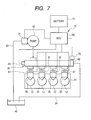
- Fig. 7 illustrates the fuel injection system 10 for diesel engines according to the third embodiment of the invention.
- the fuel injection system 10 includes an auxiliary coil 70 which works as a secondary coil to step up the voltage of power supplied from the battery 13 to the pressure control valve 60 temporarily.
- the ECU 50 When the pressure in the common rail 20, as measured by the pressure sensor 22, reaches a preselected value, the ECU 50 outputs a main energization pulse signal to open the pressure control valve 60. Specifically, the ECU 50 enters the main energization mode to energize the coil 63 of the pressure control valve 60 through the auxiliary coil 70, thereby causing the voltage to be applied to the coil 63 to rise temporarily to enhance a rise in current flowing through the coil 63.
- the current flowing out of the auxiliary coil 70 is used in assisting in energizing the coil 63 quickly, thereby resulting in a decrease in time lag between the start of the energization of the coil 63 and the start of movement of the valve member 61 and an increase in speed at which the valve member 61 moves away from the valve seat 25.
- the solenoid-operated device in each of the first to third embodiments may be employed in controlling an opening operation of each of the injectors 30 to inject the fuel, as supplied from the common rail 20, into one of the cylinders of the diesel engine 11 in order to enhance the response time of the injectors 30.
- the solenoid-operated valve device may also be employed in fuel injection systems for gasoline engines or valve control systems designed to electromagnetically control on-off operations of valves for decreasing the response time thereof without raising the complexity of the structure of the valves.
- the solenoid-operated valve device may be used for normally-open type solenoid valves designed to be energized to close a fluid path.
- a solenoid-operated valve device which includes a valve, a solenoid actuator designed to be supplied with electric power from a battery to operate on voltage substantially identical with that outputted from the battery to move the valve, and a controller working to energize said solenoid actuator.
- the controller Prior to entering a main energization mode to energize the solenoid actuator to open or close the valve, the controller works to supply a low current to the solenoid actuator to create magnetic field therein to assist in energizing the solenoid actuator in the main energization mode quickly at a high speed.
- the controller may alternatively be designed to step-up the voltage to be applied to the solenoid actuator initially prior to entering the main energization mode.
Landscapes
- Engineering & Computer Science (AREA)
- General Engineering & Computer Science (AREA)
- Mechanical Engineering (AREA)
- Physics & Mathematics (AREA)
- Electromagnetism (AREA)
- Chemical & Material Sciences (AREA)
- Combustion & Propulsion (AREA)
- Fuel-Injection Apparatus (AREA)
- Magnetically Actuated Valves (AREA)
- Electrical Control Of Air Or Fuel Supplied To Internal-Combustion Engine (AREA)
- Electromagnets (AREA)
Applications Claiming Priority (1)
| Application Number | Priority Date | Filing Date | Title |
|---|---|---|---|
| JP2006275056A JP2008095521A (ja) | 2006-10-06 | 2006-10-06 | 電磁弁装置およびそれを用いた燃料噴射システム |
Publications (3)
| Publication Number | Publication Date |
|---|---|
| EP1909009A2 true EP1909009A2 (de) | 2008-04-09 |
| EP1909009A3 EP1909009A3 (de) | 2013-06-05 |
| EP1909009B1 EP1909009B1 (de) | 2015-01-28 |
Family
ID=38925515
Family Applications (1)
| Application Number | Title | Priority Date | Filing Date |
|---|---|---|---|
| EP07117966.7A Ceased EP1909009B1 (de) | 2006-10-06 | 2007-10-05 | Magnetbetriebene Ventilvorrichtung zur Sicherstellung von hoher Ansprechempfindlichkeit der Ventiltätigkeit |
Country Status (4)
| Country | Link |
|---|---|
| US (1) | US7559311B2 (de) |
| EP (1) | EP1909009B1 (de) |
| JP (1) | JP2008095521A (de) |
| CN (1) | CN100570182C (de) |
Cited By (3)
| Publication number | Priority date | Publication date | Assignee | Title |
|---|---|---|---|---|
| EP2492479A1 (de) * | 2011-02-25 | 2012-08-29 | Hitachi Automotive Systems, Ltd. | Antriebsvorrichtung für elektromagnetische Kraftstoffeinspritzdüse |
| WO2017190883A1 (de) * | 2016-05-03 | 2017-11-09 | Continental Automotive Gmbh | VERFAHREN ZUM ÖFFNEN UND SCHLIEßEN EINES SCHALTVENTILS |
| DE102010016900B4 (de) | 2009-05-12 | 2018-12-13 | Denso Corporation | Kraftstoffzuführvorrichtung und Verfahren zum Betreiben einer Kraftstoffzuführvorrichtung |
Families Citing this family (23)
| Publication number | Priority date | Publication date | Assignee | Title |
|---|---|---|---|---|
| PL2345355T3 (pl) * | 2006-12-06 | 2013-10-31 | Rheavendors Services Spa | Sposób i maszyna do wytwarzania i dozowania napojów |
| DE102007023898A1 (de) * | 2007-05-23 | 2008-11-27 | Robert Bosch Gmbh | Verfahren zum Ansteuern eines Einspritzventils |
| JP2009074373A (ja) * | 2007-09-19 | 2009-04-09 | Hitachi Ltd | 内燃機関の燃料噴射制御装置 |
| US7788015B2 (en) * | 2007-12-20 | 2010-08-31 | Cummins Inc. | System for monitoring injected fuel quantities |
| DE102008054513A1 (de) * | 2008-12-11 | 2010-06-17 | Robert Bosch Gmbh | Verfahren zum Betreiben eines Kraftstoffeinspritzsystems einer Brennkraftmaschine |
| US7866301B2 (en) * | 2009-01-26 | 2011-01-11 | Caterpillar Inc. | Self-guided armature in single pole solenoid actuator assembly and fuel injector using same |
| US8943808B2 (en) * | 2010-09-27 | 2015-02-03 | Caterpillar Inc. | Reductant dosing system |
| DE102012206419B4 (de) * | 2012-04-19 | 2021-08-12 | Magna Pt B.V. & Co. Kg | Steuerung für ein Druckregelventil |
| JP2014055571A (ja) * | 2012-09-13 | 2014-03-27 | Denso Corp | 燃料噴射制御装置 |
| DE102012218370B4 (de) * | 2012-10-09 | 2015-04-02 | Continental Automotive Gmbh | Verfahren und Vorrichtung zum Steuern eines Ventils |
| EP3072138A4 (de) * | 2013-11-20 | 2017-06-21 | Eaton Corporation | Magnetspule und zugehöriges steuerungsverfahren |
| DE102014203364B4 (de) * | 2014-02-25 | 2023-03-23 | Vitesco Technologies GmbH | Verfahren und Vorrichtung zum Betrieb eines Ventils, insbesondere für ein Speichereinspritzsystem |
| JP6245060B2 (ja) * | 2014-05-07 | 2017-12-13 | 株式会社デンソー | 燃料噴射制御装置及び制御方法 |
| DE102015206729B4 (de) * | 2015-04-15 | 2025-09-11 | Schaeffler Technologies AG & Co. KG | Verfahren zum Steuern eines Kraftstoffeinspritz-Magnetventils und entsprechendes Motorsteuergerät |
| DE102015209566B3 (de) * | 2015-05-26 | 2016-06-16 | Continental Automotive Gmbh | Ansteuerung von Kraftstoffinjektoren bei Mehrfacheinspritzungen |
| JP6631456B2 (ja) * | 2016-09-27 | 2020-01-15 | 株式会社デンソー | 減圧弁制御装置 |
| JP6965614B2 (ja) * | 2017-07-21 | 2021-11-10 | トヨタ自動車株式会社 | 内燃機関の制御装置 |
| CN109965685B (zh) * | 2017-12-28 | 2022-01-07 | 佛山市顺德区美的电热电器制造有限公司 | 烹饪器具的控制方法及系统 |
| US11497179B2 (en) * | 2018-07-18 | 2022-11-15 | Jesse Lafian | Long-range remote solenoid-valve actuator |
| JP6968773B2 (ja) * | 2018-09-21 | 2021-11-17 | 日立Astemo株式会社 | 弁機構 |
| JP7344012B2 (ja) * | 2019-06-07 | 2023-09-13 | 株式会社堀場エステック | 流体制御バルブ、流量制御装置、及び、駆動回路 |
| KR20210104317A (ko) * | 2020-02-17 | 2021-08-25 | 현대자동차주식회사 | 인젝터 열림 시간 편차 개선을 위한 연료 분사 제어 장치 및 방법 |
| KR20210104316A (ko) * | 2020-02-17 | 2021-08-25 | 현대자동차주식회사 | 인젝터 열림 시간 편차 개선을 위한 연료 분사 제어 장치 및 방법 |
Citations (3)
| Publication number | Priority date | Publication date | Assignee | Title |
|---|---|---|---|---|
| US6332454B1 (en) | 1999-08-06 | 2001-12-25 | Denso Corporation | Electromagnetic valve driving apparatus having current limit switching function |
| US6457457B1 (en) | 1997-09-20 | 2002-10-01 | Delphi Technologies, Inc. | Control method |
| US20030140898A1 (en) | 2002-01-31 | 2003-07-31 | Min Xu | Pre-charging strategy for fuel injector fast opening |
Family Cites Families (23)
| Publication number | Priority date | Publication date | Assignee | Title |
|---|---|---|---|---|
| FR2345595A1 (fr) * | 1976-03-26 | 1977-10-21 | Bosch Gmbh Robert | Installation pour la commande, avec un courant regle, d'organes de manoeuvre electromagnetiques |
| US4176387A (en) * | 1978-02-27 | 1979-11-27 | The Bendix Corporation | Inductive drive circuit for setting three different levels of load current including a downshift delay |
| US4238813A (en) * | 1979-05-21 | 1980-12-09 | The Bendix Corporation | Compensated dual injector driver |
| JPS5851233A (ja) * | 1981-09-21 | 1983-03-25 | Hitachi Ltd | 燃料噴射弁駆動回路 |
| JPS61212645A (ja) * | 1985-03-15 | 1986-09-20 | Aisan Ind Co Ltd | 電磁式燃料噴射装置の制御方法 |
| US4922878A (en) * | 1988-09-15 | 1990-05-08 | Caterpillar Inc. | Method and apparatus for controlling a solenoid operated fuel injector |
| US5488340A (en) * | 1994-05-20 | 1996-01-30 | Caterpillar Inc. | Hard magnetic valve actuator adapted for a fuel injector |
| GB9420617D0 (en) * | 1994-10-13 | 1994-11-30 | Lucas Ind Plc | Drive circuit |
| US5720261A (en) * | 1994-12-01 | 1998-02-24 | Oded E. Sturman | Valve controller systems and methods and fuel injection systems utilizing the same |
| JPH11107882A (ja) * | 1997-09-30 | 1999-04-20 | Unisia Jecs Corp | 燃料噴射弁の駆動装置 |
| US5986871A (en) * | 1997-11-04 | 1999-11-16 | Caterpillar Inc. | Method of operating a fuel injector |
| US6036120A (en) * | 1998-03-27 | 2000-03-14 | General Motors Corporation | Fuel injector and method |
| US6128175A (en) * | 1998-12-17 | 2000-10-03 | Siemens Automotive Corporation | Apparatus and method for electronically reducing the impact of an armature in a fuel injector |
| GB9900070D0 (en) * | 1999-01-05 | 1999-02-24 | Lucas Franc | Control method |
| JP2000265920A (ja) | 1999-03-16 | 2000-09-26 | Hitachi Ltd | 電磁式燃料噴射装置 |
| JP4206563B2 (ja) * | 1999-06-18 | 2009-01-14 | 株式会社デンソー | 燃料噴射装置 |
| JP3539294B2 (ja) | 1999-08-20 | 2004-07-07 | トヨタ自動車株式会社 | 内燃機関用燃料噴射弁 |
| DE10004961B4 (de) * | 2000-02-04 | 2013-08-22 | Robert Bosch Gmbh | Brennstoffeinspritzventil und Verfahren zu dessen Betrieb |
| US6392865B1 (en) * | 2000-03-31 | 2002-05-21 | Siemens Automotive Corporation | High-speed dual-coil electromagnetic valve and method |
| US6684854B2 (en) * | 2001-12-14 | 2004-02-03 | Caterpillar Inc | Auxiliary systems for an engine having two electrical actuators on a single circuit |
| JP3885652B2 (ja) * | 2002-04-26 | 2007-02-21 | 株式会社デンソー | 蓄圧式燃料噴射装置 |
| US6799559B2 (en) * | 2002-08-30 | 2004-10-05 | Delphi Technologies, Inc. | Method and apparatus for controlling a dual coil fuel injector |
| JP2004190628A (ja) * | 2002-12-13 | 2004-07-08 | Isuzu Motors Ltd | コモンレール式燃料噴射制御装置 |
-
2006
- 2006-10-06 JP JP2006275056A patent/JP2008095521A/ja active Pending
-
2007
- 2007-09-28 CN CNB2007101531489A patent/CN100570182C/zh not_active Expired - Fee Related
- 2007-10-04 US US11/905,860 patent/US7559311B2/en active Active
- 2007-10-05 EP EP07117966.7A patent/EP1909009B1/de not_active Ceased
Patent Citations (3)
| Publication number | Priority date | Publication date | Assignee | Title |
|---|---|---|---|---|
| US6457457B1 (en) | 1997-09-20 | 2002-10-01 | Delphi Technologies, Inc. | Control method |
| US6332454B1 (en) | 1999-08-06 | 2001-12-25 | Denso Corporation | Electromagnetic valve driving apparatus having current limit switching function |
| US20030140898A1 (en) | 2002-01-31 | 2003-07-31 | Min Xu | Pre-charging strategy for fuel injector fast opening |
Cited By (4)
| Publication number | Priority date | Publication date | Assignee | Title |
|---|---|---|---|---|
| DE102010016900B4 (de) | 2009-05-12 | 2018-12-13 | Denso Corporation | Kraftstoffzuführvorrichtung und Verfahren zum Betreiben einer Kraftstoffzuführvorrichtung |
| EP2492479A1 (de) * | 2011-02-25 | 2012-08-29 | Hitachi Automotive Systems, Ltd. | Antriebsvorrichtung für elektromagnetische Kraftstoffeinspritzdüse |
| US8960157B2 (en) | 2011-02-25 | 2015-02-24 | Hitachi Automotive Systems, Ltd. | Drive device for electromagnetic fuel injection valve |
| WO2017190883A1 (de) * | 2016-05-03 | 2017-11-09 | Continental Automotive Gmbh | VERFAHREN ZUM ÖFFNEN UND SCHLIEßEN EINES SCHALTVENTILS |
Also Published As
| Publication number | Publication date |
|---|---|
| US20080087254A1 (en) | 2008-04-17 |
| CN101158408A (zh) | 2008-04-09 |
| JP2008095521A (ja) | 2008-04-24 |
| EP1909009B1 (de) | 2015-01-28 |
| CN100570182C (zh) | 2009-12-16 |
| US7559311B2 (en) | 2009-07-14 |
| EP1909009A3 (de) | 2013-06-05 |
Similar Documents
| Publication | Publication Date | Title |
|---|---|---|
| US7559311B2 (en) | Solenoid operated valve device designed to ensure high responsiveness of valve action | |
| JP3707210B2 (ja) | 燃料噴射制御装置 | |
| US7305971B2 (en) | Fuel injection system ensuring operation in event of unusual condition | |
| JP6461203B2 (ja) | 内燃機関の高圧燃料供給装置 | |
| US10655614B2 (en) | Device for controlling high-pressure pump | |
| JP2019210933A (ja) | 電磁式燃料噴射器の閉じ時点を決定する方法 | |
| JP6569542B2 (ja) | 高圧ポンプ制御装置 | |
| CN116263140A (zh) | 用于激励燃料喷射器阀中的螺线管致动器的减少能量波形 | |
| JP2007255394A (ja) | ポンプ故障診断装置 | |
| JP2019206966A (ja) | 電磁式燃料噴射器の立ち上がり時間を決定する方法 | |
| EP1607593B1 (de) | Ausslassventilantrieb Steuerungsverfahren und Vorrichtung | |
| US20220099040A1 (en) | Control Device for Fuel Injection Device | |
| JP5737233B2 (ja) | 燃料噴射装置 | |
| JP2012102657A (ja) | 内燃機関の燃料噴射制御装置 | |
| US7814890B2 (en) | Injection means for a combustion engine | |
| CN113544378A (zh) | 高压泵的控制装置 | |
| JP2001132579A (ja) | 内燃機関のユニットインジェクタ及び燃料噴射制御装置 | |
| JP4321495B2 (ja) | 蓄圧式燃料噴射装置 | |
| JPH08177583A (ja) | 電磁弁駆動装置 | |
| JP2007077967A (ja) | 燃料噴射装置 | |
| JP2002242747A (ja) | エンジンの燃料噴射系騒音検出装置 | |
| JPH02169862A (ja) | 電磁弁 | |
| JP2008088897A (ja) | 噴射量制御装置および噴射量制御方法 | |
| JPH05256224A (ja) | 増圧式ユニットインジェクターの制御方法 |
Legal Events
| Date | Code | Title | Description |
|---|---|---|---|
| PUAI | Public reference made under article 153(3) epc to a published international application that has entered the european phase |
Free format text: ORIGINAL CODE: 0009012 |
|
| AK | Designated contracting states |
Kind code of ref document: A2 Designated state(s): AT BE BG CH CY CZ DE DK EE ES FI FR GB GR HU IE IS IT LI LT LU LV MC MT NL PL PT RO SE SI SK TR |
|
| AX | Request for extension of the european patent |
Extension state: AL BA HR MK RS |
|
| PUAL | Search report despatched |
Free format text: ORIGINAL CODE: 0009013 |
|
| AK | Designated contracting states |
Kind code of ref document: A3 Designated state(s): AT BE BG CH CY CZ DE DK EE ES FI FR GB GR HU IE IS IT LI LT LU LV MC MT NL PL PT RO SE SI SK TR |
|
| AX | Request for extension of the european patent |
Extension state: AL BA HR MK RS |
|
| RIC1 | Information provided on ipc code assigned before grant |
Ipc: F16K 31/06 20060101AFI20130429BHEP |
|
| RIC1 | Information provided on ipc code assigned before grant |
Ipc: F16K 31/06 20060101AFI20130510BHEP |
|
| 17P | Request for examination filed |
Effective date: 20130705 |
|
| 17Q | First examination report despatched |
Effective date: 20131015 |
|
| AKX | Designation fees paid |
Designated state(s): DE FR IT |
|
| GRAP | Despatch of communication of intention to grant a patent |
Free format text: ORIGINAL CODE: EPIDOSNIGR1 |
|
| INTG | Intention to grant announced |
Effective date: 20140825 |
|
| GRAS | Grant fee paid |
Free format text: ORIGINAL CODE: EPIDOSNIGR3 |
|
| GRAA | (expected) grant |
Free format text: ORIGINAL CODE: 0009210 |
|
| AK | Designated contracting states |
Kind code of ref document: B1 Designated state(s): DE FR IT |
|
| REG | Reference to a national code |
Ref country code: DE Ref legal event code: R096 Ref document number: 602007040172 Country of ref document: DE Effective date: 20150319 |
|
| REG | Reference to a national code |
Ref country code: DE Ref legal event code: R084 Ref document number: 602007040172 Country of ref document: DE |
|
| REG | Reference to a national code |
Ref country code: FR Ref legal event code: PLFP Year of fee payment: 9 |
|
| REG | Reference to a national code |
Ref country code: DE Ref legal event code: R097 Ref document number: 602007040172 Country of ref document: DE |
|
| PLBE | No opposition filed within time limit |
Free format text: ORIGINAL CODE: 0009261 |
|
| STAA | Information on the status of an ep patent application or granted ep patent |
Free format text: STATUS: NO OPPOSITION FILED WITHIN TIME LIMIT |
|
| 26N | No opposition filed |
Effective date: 20151029 |
|
| REG | Reference to a national code |
Ref country code: FR Ref legal event code: PLFP Year of fee payment: 10 |
|
| REG | Reference to a national code |
Ref country code: FR Ref legal event code: PLFP Year of fee payment: 11 |
|
| REG | Reference to a national code |
Ref country code: FR Ref legal event code: PLFP Year of fee payment: 12 |
|
| PGFP | Annual fee paid to national office [announced via postgrant information from national office to epo] |
Ref country code: DE Payment date: 20181019 Year of fee payment: 12 |
|
| PGFP | Annual fee paid to national office [announced via postgrant information from national office to epo] |
Ref country code: IT Payment date: 20181024 Year of fee payment: 12 Ref country code: FR Payment date: 20181022 Year of fee payment: 12 |
|
| REG | Reference to a national code |
Ref country code: DE Ref legal event code: R119 Ref document number: 602007040172 Country of ref document: DE |
|
| PG25 | Lapsed in a contracting state [announced via postgrant information from national office to epo] |
Ref country code: DE Free format text: LAPSE BECAUSE OF NON-PAYMENT OF DUE FEES Effective date: 20200501 |
|
| PG25 | Lapsed in a contracting state [announced via postgrant information from national office to epo] |
Ref country code: FR Free format text: LAPSE BECAUSE OF NON-PAYMENT OF DUE FEES Effective date: 20191031 Ref country code: IT Free format text: LAPSE BECAUSE OF NON-PAYMENT OF DUE FEES Effective date: 20191005 |