EP1909227A1 - Verfahren und Vorrichtung zur Minimierung von Überschwingungsartefakten in einem Eingangsbild - Google Patents
Verfahren und Vorrichtung zur Minimierung von Überschwingungsartefakten in einem Eingangsbild Download PDFInfo
- Publication number
- EP1909227A1 EP1909227A1 EP06255795A EP06255795A EP1909227A1 EP 1909227 A1 EP1909227 A1 EP 1909227A1 EP 06255795 A EP06255795 A EP 06255795A EP 06255795 A EP06255795 A EP 06255795A EP 1909227 A1 EP1909227 A1 EP 1909227A1
- Authority
- EP
- European Patent Office
- Prior art keywords
- pixel
- edge
- likelihood
- image
- input image
- Prior art date
- Legal status (The legal status is an assumption and is not a legal conclusion. Google has not performed a legal analysis and makes no representation as to the accuracy of the status listed.)
- Granted
Links
Images


Classifications
-
- G—PHYSICS
- G06—COMPUTING OR CALCULATING; COUNTING
- G06T—IMAGE DATA PROCESSING OR GENERATION, IN GENERAL
- G06T5/00—Image enhancement or restoration
- G06T5/70—Denoising; Smoothing
-
- G—PHYSICS
- G06—COMPUTING OR CALCULATING; COUNTING
- G06T—IMAGE DATA PROCESSING OR GENERATION, IN GENERAL
- G06T5/00—Image enhancement or restoration
- G06T5/20—Image enhancement or restoration using local operators
-
- G—PHYSICS
- G06—COMPUTING OR CALCULATING; COUNTING
- G06T—IMAGE DATA PROCESSING OR GENERATION, IN GENERAL
- G06T5/00—Image enhancement or restoration
- G06T5/90—Dynamic range modification of images or parts thereof
- G06T5/94—Dynamic range modification of images or parts thereof based on local image properties, e.g. for local contrast enhancement
-
- H—ELECTRICITY
- H04—ELECTRIC COMMUNICATION TECHNIQUE
- H04N—PICTORIAL COMMUNICATION, e.g. TELEVISION
- H04N19/00—Methods or arrangements for coding, decoding, compressing or decompressing digital video signals
- H04N19/10—Methods or arrangements for coding, decoding, compressing or decompressing digital video signals using adaptive coding
- H04N19/102—Methods or arrangements for coding, decoding, compressing or decompressing digital video signals using adaptive coding characterised by the element, parameter or selection affected or controlled by the adaptive coding
- H04N19/117—Filters, e.g. for pre-processing or post-processing
-
- H—ELECTRICITY
- H04—ELECTRIC COMMUNICATION TECHNIQUE
- H04N—PICTORIAL COMMUNICATION, e.g. TELEVISION
- H04N19/00—Methods or arrangements for coding, decoding, compressing or decompressing digital video signals
- H04N19/10—Methods or arrangements for coding, decoding, compressing or decompressing digital video signals using adaptive coding
- H04N19/134—Methods or arrangements for coding, decoding, compressing or decompressing digital video signals using adaptive coding characterised by the element, parameter or criterion affecting or controlling the adaptive coding
- H04N19/136—Incoming video signal characteristics or properties
- H04N19/14—Coding unit complexity, e.g. amount of activity or edge presence estimation
-
- H—ELECTRICITY
- H04—ELECTRIC COMMUNICATION TECHNIQUE
- H04N—PICTORIAL COMMUNICATION, e.g. TELEVISION
- H04N19/00—Methods or arrangements for coding, decoding, compressing or decompressing digital video signals
- H04N19/10—Methods or arrangements for coding, decoding, compressing or decompressing digital video signals using adaptive coding
- H04N19/169—Methods or arrangements for coding, decoding, compressing or decompressing digital video signals using adaptive coding characterised by the coding unit, i.e. the structural portion or semantic portion of the video signal being the object or the subject of the adaptive coding
- H04N19/182—Methods or arrangements for coding, decoding, compressing or decompressing digital video signals using adaptive coding characterised by the coding unit, i.e. the structural portion or semantic portion of the video signal being the object or the subject of the adaptive coding the unit being a pixel
-
- H—ELECTRICITY
- H04—ELECTRIC COMMUNICATION TECHNIQUE
- H04N—PICTORIAL COMMUNICATION, e.g. TELEVISION
- H04N19/00—Methods or arrangements for coding, decoding, compressing or decompressing digital video signals
- H04N19/85—Methods or arrangements for coding, decoding, compressing or decompressing digital video signals using pre-processing or post-processing specially adapted for video compression
- H04N19/86—Methods or arrangements for coding, decoding, compressing or decompressing digital video signals using pre-processing or post-processing specially adapted for video compression involving reduction of coding artifacts, e.g. of blockiness
-
- G—PHYSICS
- G06—COMPUTING OR CALCULATING; COUNTING
- G06T—IMAGE DATA PROCESSING OR GENERATION, IN GENERAL
- G06T2207/00—Indexing scheme for image analysis or image enhancement
- G06T2207/20—Special algorithmic details
- G06T2207/20004—Adaptive image processing
- G06T2207/20012—Locally adaptive
-
- G—PHYSICS
- G06—COMPUTING OR CALCULATING; COUNTING
- G06T—IMAGE DATA PROCESSING OR GENERATION, IN GENERAL
- G06T2207/00—Indexing scheme for image analysis or image enhancement
- G06T2207/20—Special algorithmic details
- G06T2207/20172—Image enhancement details
- G06T2207/20192—Edge enhancement; Edge preservation
Definitions
- the present invention relates to method of and apparatus for adjusting the contrast of an input image.
- the present invention has particular application in minimising so-called "ringing" artefacts that can arise in digital images when displayed.
- Contrast adjustment or enhancement of images, particularly digital images is used in many fields, including enhancing the contrast of a digital image for display by a television receiver or other display device, for printing by a printer, in digital cameras, etc., etc. Contrast enhancement is used to improve the contrast in medical and other images. A number of techniques are known for attempting to remove or minimise the ringing noise in particular.
- a disadvantage of this prior art is the use of thresholds on the local variance.
- the local variance and, therefore, thresholds depend on the contrast level, which includes the lightning conditions of the source environment when the image is taken. This results in misclassification as it is not possible to adjust the thresholds optimally.
- Another disadvantage of this prior art is that the fuzzy identity filter uses order-statistical information, which is a complex operation and is therefore expensive to implement and in any event may create artefacts such as local flickering since order-statistical information is not linear and may exhibit jumps.
- the filter retrieved from the look-up table is used to filter the pixels in that neighbourhood and obtain the new output pixel corresponding to the current pixel.
- the filter for each class is computed using a training procedure.
- Original, artefact-free images are compressed using a block-based compression algorithm, such as JPEG 2000. Then the compressed image is decoded to obtain the degraded image in which artefacts have been introduced.
- Each pixel in the decoded image is classified using ADRC and the filter coefficients are computed using a linear least squares estimation technique.
- a method of adjusting the contrast of an input image formed of pixels in which each pixel has an input brightness level to produce an output image in which at least some of the pixels have an output brightness level that is different from their input brightness level comprising:
- a blurred image is obtained which is then added to the input image in manner that depends on the ring likelihoods at each or at least some of the pixels in the input image, thereby reducing the ringing artefacts around edges whilst preserving edges and without affecting other parts of the image (such as smooth regions and texture regions).
- the blurred image may be obtained by filtering the brightness levels of the input image with at least one recursive spatially-adaptive edge-preserving filter.
- the filter preserves the edges and blurs both sides of the edges by not mixing pixels on one side of the edge with pixels on the other side of the edge.
- the filter preferably has recursion coefficients that are adaptive to edge information in the input image.
- the corresponding recursion coefficient is reduced accordingly depending on the relative strength of the edge.
- another function can be used that decreases with decreasing edge strength, such as an exponentional function.
- the ring likelihood for a pixel is the product of (i) the likelihood that said pixel is a non-edge pixel and (ii) the likelihood of the strongest edge in the neighbourhood of said pixel, wherein said edge likelihoods are obtained from said recursion coefficients.
- the edge likelihoods are obtained from said recursion coefficients.
- the recursion coefficients already contain edge information and have already been calculated in this preferred embodiment, and thus this provides an accurate and yet computationally efficient way of obtaining the ring likelihoods.
- the blurred image is obtained by filtering the brightness levels of the input image with a first recursive spatially-adaptive edge-preserving filter that operates in a first direction across the pixels of the input image, filtering the brightness levels of the input image with a second recursive spatially-adaptive edge-preserving filter that operates in a second direction across the pixels of the input image that is opposite the first direction, and obtaining the brightness levels of the blurred image by taking an average of the output of the first and second recursive spatially-adaptive edge-preserving filters.
- the filters which may be "forward” and “backward” filters that operate respectively in a forward and a backward direction across the image, preserve the edges and blur both sides of the edges by not mixing pixels on one side of the edge with pixels on the other side of the edge.
- a filter of this type can give rise to an unwanted phase delay.
- At least one of the filters preferably has recursion coefficients that are adaptive to edge information in the input image. More preferably, both of the filters have recursion coefficients that are adaptive to edge information in the input image. Again, in a preferred embodiment, where there is an edge, the corresponding recursion coefficient is reduced accordingly depending on the relative strength of the edge.
- the ring likelihood for a pixel is the product of (i) the likelihood that said pixel is a non-edge pixel and (ii) the likelihood of the strongest edge in the neighbourhood of said pixel, wherein said edge likelihoods are obtained from said recursion coefficients.
- the recursion coefficients already contain edge information and have already been calculated in this preferred embodiment, and thus this provides an accurate and yet efficient way of obtaining the ring likelihoods.
- said recursion coefficients decrease with decreasing edge strength.
- the ring likelihood for a pixel is the product of (i) the likelihood that said pixel is a non-edge pixel and (ii) the likelihood of the strongest edge in the neighbourhood of said pixel.
- Said neighbourhood may be a block of j x k pixels centred on the respective pixel, where j and k are positive integers.
- the neighbourhood is a block of 8x8 pixels, which corresponds to the blocks of 8x8 pixels used in many block-based compression techniques. Neighbourhoods of pixels of other sizes may of course be used, particularly if the original compression that produced the input image used blocks of a different size.
- the sum of the brightness levels in the input image and the blurred image is a weighted sum, the weight of the brightness levels of the blurred image that are summed with the brightness levels of the input image at any particular pixel depending on the ring likelihood for that pixel.
- a pixel is less likely to be a ringing artefact pixel, then less weight is given to the blurred image such that the input image pixels are substantially preserved for artefact-free pixels.
- a pixel is more likely to be a ringing artefact pixel, then more weight is given to the blurred image such that the ringing artefact is reduced in this region of the output image.
- apparatus for adjusting the contrast of an input image formed of pixels in which each pixel has an input brightness level to produce an output image in which at least some of the pixels have an output brightness level that is different from their input brightness level, the apparatus comprising:
- the preferred apparatus and/or method may be incorporated into any apparatus and/or method that is used to enhance the resolution of a digital image, including for example an image processor used in a television set or the like, printers, digital cameras, television broadcast capture cards, digital image processing software which may be used in many applications, etc., etc.
- the methods described herein may be carried out by appropriate software running on appropriate computer equipment.
- the software may be embedded in an integrated circuit, the integrated circuit being adapted for performing, or for use in the performance of, the relevant processes. Many of the processing steps may be carried out using software, dedicated hardware (such as ASICs), or a combination.
- an example of an embodiment of the present invention operates as follows.
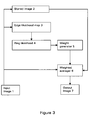
- An input image 1 is blurred to obtain a blurred image 2.
- an edge likelihood map 3 of the input image 1 is obtained to provide, for each pixel in the input image 1, the likelihood that that particular pixel is an edge pixel in the input image 1.
- the ring likelihood 4 for each pixel is then obtained.
- the ring likelihood for a particular pixel provides a measure of how likely it is that the current pixel is a non-edge pixel in the neighbourhood of a strong edge pixel.
- the ring likelihoods 4 are used to generate weights 5 which are provided to a summer 6.
- the input image 1 is added to a weighted version of the blurred image 2 to provide the output image 7.
- brightness levels for pixels in the input image 1 are added to weighted versions of brightness levels of the pixels in the blurred image 2, the weights used in the addition depending on the ring likelihoods for the pixels concerned, in order to provide the brightness levels for the pixels in the output image 7.
- Figure 4 shows schematically the obtaining of the blurred image 2 of the preferred embodiment.
- the input image 1 is blurred using a recursive spatially adaptive edge-preserving filter.
- a "recursive" filter is one that uses recursion, i.e. the present value of the output signal is dependent on at least one previously calculated value of the output signal.
- the preferred recursive filter preserves the edges and blurs both sides of the edges by not mixing the pixels on one side of an edge with the pixels on the other side of the edge. The blurring of the image around the edges inevitably removes ringing artefacts around the edges.
- a filter 10 can introduce a phase shift in the filtered output. Accordingly, it is more preferred to use two filters, namely a forward filter 10 and a backward filter 11, each of which is an edge-preserving spatially adaptive recursive filter.
- the forward filter 10 progresses in the direction of the forward raster-scan direction, namely starting from the top left corner of the image and ending with the bottom right corner, and carries out recursion on previous filtered outputs.
- all of the recursion coefficients are non-negative and that their sum is less than or equal to 1 (i.e. (c1+c2+c3+c4) ⁇ 1).
- each previous recursion output is used to determine the edge strength between the current input pixel and the input pixel which is co-located with that previous recursion output. If there is an edge, then the recursion coefficient is decreased and the corresponding previous recursion output contributes less to the current recursion output.
- the backward filter 11 is similar to the forward filter 10 but it progresses in the backward raster-scan style starting from the bottom-right corner of the image and ending with the top-left corner.
- the computational complexity can be reduced by setting some recursion coefficients to zero such that the recursion progresses on less number of previous outputs.
- the recursion coefficients can be found using another function that decreases with edge strength, such as an exponential.
- the averager 12 averages the two outputs of the forward and backward filters 10,11 to produce the brightness levels (M[m,n]) of the pixels of the blurred image 2:
- M [ m , n ] F [ m , n ] + B [ m , n ] / 2
- the ring likelihood is then calculated for each pixel in the input image 1.
- the ring likelihood provides a measure of how likely it is that the current pixel is a non-edge pixel in the neighbourhood of a strong edge pixel.
- the "neighbourhood" of the pixel is a defined block of pixels around the current pixel.
- An 8x8 block for the neighbourhood is preferred because it is the typical block size used in common compression algorithms.
- the 8x8 neighbourhood for each pixel is defined as the block with the top-left pixel coordinate:
- the ring likelihood is obtained by multiplying the likelihood that the current pixel is a non-edge with the strongest likelihood of an edge in the 8x8 neighbourhood (i.e. the edge likelihood for the pixel in the block that is most likely to be an edge).
- edge methods of obtaining the edge likelihoods 20 may be used, such as using the output of a Laplacian filter.
- edge information from the recursion coefficients is used in the preferred embodiment since it has already been obtained in the recursive filter computation process.
- the ring likelihoods 22 are then used to generate weights 23 which are used to determine the degree of mixing of the input image 1 with the blurred image 2 at each pixel.
- weights 23 are used to determine the degree of mixing of the input image 1 with the blurred image 2 at each pixel.
- a pixel's ring likelihood is high, then more weight is given to the brightness levels of the pixels of the blurred image 2 in order to remove or at least reduce the ringing artefact.
- a pixel's ring likelihood is low, then less weight is given to the brightness levels of the pixels of the blurred image 2 in order to preserve detail that is present in the input image 1, particularly in the smooth pixel areas and the texture pixel areas.
- the ring likelihood at each pixel is used as the weight in the weighted averager 6.
- other methods or functions for obtaining the weights may be used, provided they meet the requirement that the weight is higher when the pixel's ring likelihood is higher and vice versa.
- O [ m , n ] RL * M [ m , n ] + 1 - RL * I [ m , n ]
- O[m,n] are the brightness levels of the output image pixels
- M[m,n] are the brightness levels of the pixels of the blurred image 2
- I[m,n] are the brightness levels of the input image pixels
- RL is the ring likelihoods of the respective pixels.
- ring likelihoods may be used, such as non-linearly transformed ring likelihoods, provided that they always map ring likelihoods in the range [0-1] to the range [0-1].
- the preferred embodiment provides for reduction of the ringing artefact in digital images.
- the preferred embodiment avoids the classification-based approach of the prior art mentioned above and preserves edges without affecting other parts of the image (such as smooth regions and texture regions).
- the preferred embodiment is not computationally intensive and can be operated cost-effectively even in domestic equipment, such as a television set.
Landscapes
- Engineering & Computer Science (AREA)
- Multimedia (AREA)
- Signal Processing (AREA)
- Physics & Mathematics (AREA)
- General Physics & Mathematics (AREA)
- Theoretical Computer Science (AREA)
- Image Processing (AREA)
- Apparatus For Radiation Diagnosis (AREA)
Applications Claiming Priority (1)
| Application Number | Priority Date | Filing Date | Title |
|---|---|---|---|
| US82791506P | 2006-10-03 | 2006-10-03 |
Publications (2)
| Publication Number | Publication Date |
|---|---|
| EP1909227A1 true EP1909227A1 (de) | 2008-04-09 |
| EP1909227B1 EP1909227B1 (de) | 2018-06-27 |
Family
ID=37499537
Family Applications (1)
| Application Number | Title | Priority Date | Filing Date |
|---|---|---|---|
| EP06255795.4A Active EP1909227B1 (de) | 2006-10-03 | 2006-11-13 | Verfahren und Vorrichtung zur Minimierung von Überschwingungsartefakten in einem Eingangsbild |
Country Status (3)
| Country | Link |
|---|---|
| US (1) | US8131104B2 (de) |
| EP (1) | EP1909227B1 (de) |
| TR (1) | TR201810171T4 (de) |
Cited By (2)
| Publication number | Priority date | Publication date | Assignee | Title |
|---|---|---|---|---|
| JP2017107366A (ja) * | 2015-12-09 | 2017-06-15 | Eizo株式会社 | 画像処理装置及びプログラム |
| EP3460747A1 (de) | 2017-09-25 | 2019-03-27 | Vestel Elektronik Sanayi ve Ticaret A.S. | Verfahren, verarbeitungssystem und computerprogramm zur verarbeitung eines bildes |
Families Citing this family (12)
| Publication number | Priority date | Publication date | Assignee | Title |
|---|---|---|---|---|
| KR101469543B1 (ko) * | 2008-08-06 | 2014-12-12 | 삼성전자주식회사 | 손 떨림 보정을 행하는 디지털 영상 신호 처리 장치의 제어방법, 상기 제어 방법을 수행하는 디지털 영상 신호 처리장치 및 상기 제어 방법을 기록한 기록 매체 |
| JP4703759B2 (ja) * | 2009-11-27 | 2011-06-15 | 株式会社東芝 | 画像処理装置および同装置における画像処理方法 |
| KR101294735B1 (ko) * | 2010-03-31 | 2013-08-08 | 삼성전자주식회사 | 이미지 처리 방법 및 이를 이용한 촬영 장치 |
| CN101859441B (zh) * | 2010-05-25 | 2011-12-21 | 中国人民解放军第四军医大学 | 基于影像的无创监测肿瘤浸润周围组织程度的计算机辅助分析方法 |
| US20120128244A1 (en) * | 2010-11-19 | 2012-05-24 | Raka Singh | Divide-and-conquer filter for low-light noise reduction |
| US8755625B2 (en) | 2010-11-19 | 2014-06-17 | Analog Devices, Inc. | Component filtering for low-light noise reduction |
| US10708588B2 (en) | 2013-06-19 | 2020-07-07 | Apple Inc. | Sample adaptive offset control |
| KR102146560B1 (ko) * | 2014-02-17 | 2020-08-20 | 삼성전자주식회사 | 영상 보정 방법 및 장치 |
| JP5990217B2 (ja) * | 2014-05-21 | 2016-09-07 | キヤノン株式会社 | 画像処理装置、画像形成装置、およびそれらの制御方法 |
| GB2541179B (en) * | 2015-07-31 | 2019-10-30 | Imagination Tech Ltd | Denoising filter |
| WO2017132766A1 (en) * | 2016-02-03 | 2017-08-10 | Sportlogiq Inc. | Systems and methods for automated camera calibration |
| CN106846270B (zh) * | 2017-01-05 | 2020-02-14 | 浙江大华技术股份有限公司 | 一种图像边缘增强方法及装置 |
Citations (5)
| Publication number | Priority date | Publication date | Assignee | Title |
|---|---|---|---|---|
| US20020159096A1 (en) * | 2001-03-29 | 2002-10-31 | Sharp Laboratories Of America, Inc. | Adaptive image filtering based on a distance transform |
| US20030016742A1 (en) * | 2001-07-17 | 2003-01-23 | Yoshimitsu Asahina | Digital filter |
| US20050100241A1 (en) | 2003-11-07 | 2005-05-12 | Hao-Song Kong | System and method for reducing ringing artifacts in images |
| EP1553778A1 (de) * | 2004-01-06 | 2005-07-13 | Sharp Kabushiki Kaisha | Filterung von Überschwingungsstörungen |
| EP1659799A1 (de) | 2004-11-23 | 2006-05-24 | STMicroelectronics Asia Pacific Pte Ltd. | Kantenadaptives Filterungssystem und -verfahren zur Verminderung Blockartefakte |
Family Cites Families (30)
| Publication number | Priority date | Publication date | Assignee | Title |
|---|---|---|---|---|
| US4912557A (en) * | 1988-05-16 | 1990-03-27 | Faroudja Y C | Control method for television ghost reduction system |
| US5119195A (en) * | 1991-01-31 | 1992-06-02 | Thomson Consumer Electronics, Inc. | Video noise reduction system employing plural frequency bands |
| US5799111A (en) * | 1991-06-14 | 1998-08-25 | D.V.P. Technologies, Ltd. | Apparatus and methods for smoothing images |
| US5526446A (en) * | 1991-09-24 | 1996-06-11 | Massachusetts Institute Of Technology | Noise reduction system |
| SE9302433D0 (sv) * | 1993-07-16 | 1993-07-16 | Siemens-Elema Ab | Anordning foer eliminering av ringningar hos filtrerade ekg-signaler |
| US5715335A (en) * | 1993-12-02 | 1998-02-03 | U.S. Philips Corporation | Noise reduction |
| US5790692A (en) * | 1994-09-07 | 1998-08-04 | Jeffrey H. Price | Method and means of least squares designed filters for image segmentation in scanning cytometry |
| US5852475A (en) * | 1995-06-06 | 1998-12-22 | Compression Labs, Inc. | Transform artifact reduction process |
| JP3353604B2 (ja) * | 1995-08-09 | 2002-12-03 | ソニー株式会社 | 動画像符号化方法及び装置、並びに信号記録媒体 |
| US5940536A (en) * | 1995-09-05 | 1999-08-17 | Matsushita Electric Industrial Co., Ltd. | Ringing detector and filter |
| US5819035A (en) * | 1995-10-20 | 1998-10-06 | Matsushita Electric Industrial Co., Ltd. | Post-filter for removing ringing artifacts of DCT coding |
| US6041145A (en) * | 1995-11-02 | 2000-03-21 | Matsushita Electric Industrial Co., Ltd. | Device and method for smoothing picture signal, device and method for encoding picture and device and method for decoding picture |
| KR19990087775A (ko) * | 1996-03-13 | 1999-12-27 | 토비 에취. 쿠스머 | 컴퓨터 단층촬영 링 억제필터 |
| US6774943B1 (en) * | 1998-09-01 | 2004-08-10 | Ess Technology, Inc. | Method and apparatus for edge enhancement in digital images |
| US6330371B1 (en) * | 1998-10-19 | 2001-12-11 | Raytheon Company | Adaptive non-uniformity compensation using feedforward shunting and min-mean filter |
| DE19927782A1 (de) * | 1999-06-18 | 2000-12-21 | Thomson Brandt Gmbh | Schaltung zur Korrektur von Ablenkfehlern in einem Fernsehgerät |
| US6728416B1 (en) * | 1999-12-08 | 2004-04-27 | Eastman Kodak Company | Adjusting the contrast of a digital image with an adaptive recursive filter |
| US6707952B1 (en) * | 2000-05-30 | 2004-03-16 | Sharp Laboratories Of America, Inc. | Method for removing ringing artifacts from locations near dominant edges of an image reconstructed after compression |
| US6873741B2 (en) * | 2002-01-10 | 2005-03-29 | Sharp Laboratories Of America | Nonlinear edge-enhancement filter |
| JP4045422B2 (ja) * | 2002-07-23 | 2008-02-13 | 株式会社日立メディコ | 画像処理装置 |
| WO2004049243A1 (en) * | 2002-11-25 | 2004-06-10 | Sarnoff Corporation | Method and apparatus for measuring quality of compressed video sequences without references |
| US7359572B2 (en) * | 2003-03-26 | 2008-04-15 | Microsoft Corporation | Automatic analysis and adjustment of digital images with exposure problems |
| US7339601B2 (en) * | 2003-07-10 | 2008-03-04 | Samsung Electronics Co., Ltd. | Methods of suppressing ringing artifact of decompressed images |
| WO2006010276A1 (en) * | 2004-07-30 | 2006-02-02 | Algolith Inc | Apparatus and method for adaptive 3d artifact reducing for encoded image signal |
| JP2006129236A (ja) * | 2004-10-29 | 2006-05-18 | Sanyo Electric Co Ltd | リンギング除去装置およびリンギング除去プログラムを記録したコンピュータ読み取り可能な記録媒体 |
| US7526142B2 (en) * | 2005-02-22 | 2009-04-28 | Sheraizin Vitaly S | Enhancement of decompressed video |
| TWI280046B (en) * | 2005-09-20 | 2007-04-21 | Novatek Microelectronics Corp | Device and method for sharpening image signal |
| US7548660B2 (en) * | 2005-09-30 | 2009-06-16 | Intel Corporation | System and method of spatio-temporal edge-preserved filtering techniques to reduce ringing and mosquito noise of digital pictures |
| US7602447B2 (en) * | 2006-01-26 | 2009-10-13 | Vestel Elecktronik Sanayi Ve | Method and apparatus for adjusting the contrast of an image |
| US20070183684A1 (en) * | 2006-02-08 | 2007-08-09 | Bhattacharjya Anoop K | Systems and methods for contrast adjustment |
-
2006
- 2006-11-13 EP EP06255795.4A patent/EP1909227B1/de active Active
- 2006-11-13 TR TR2018/10171T patent/TR201810171T4/tr unknown
-
2007
- 2007-10-02 US US11/866,246 patent/US8131104B2/en active Active
Patent Citations (5)
| Publication number | Priority date | Publication date | Assignee | Title |
|---|---|---|---|---|
| US20020159096A1 (en) * | 2001-03-29 | 2002-10-31 | Sharp Laboratories Of America, Inc. | Adaptive image filtering based on a distance transform |
| US20030016742A1 (en) * | 2001-07-17 | 2003-01-23 | Yoshimitsu Asahina | Digital filter |
| US20050100241A1 (en) | 2003-11-07 | 2005-05-12 | Hao-Song Kong | System and method for reducing ringing artifacts in images |
| EP1553778A1 (de) * | 2004-01-06 | 2005-07-13 | Sharp Kabushiki Kaisha | Filterung von Überschwingungsstörungen |
| EP1659799A1 (de) | 2004-11-23 | 2006-05-24 | STMicroelectronics Asia Pacific Pte Ltd. | Kantenadaptives Filterungssystem und -verfahren zur Verminderung Blockartefakte |
Non-Patent Citations (4)
| Title |
|---|
| ANDREA POLESEL ET AL: "Image Enhancement via Adaptive Unsharp Masking", IEEE TRANSACTIONS ON IMAGE PROCESSING, IEEE SERVICE CENTER, PISCATAWAY, NJ, US, vol. 9, no. 3, March 2000 (2000-03-01), XP011025550, ISSN: 1057-7149 * |
| HAO SONG KONG ET AL.: "Coding Artefact Reduction Using Edge Map Guided Adaptive and Fuzzy Filter", MITSUBISHI ELECTRIC RESEARCH LABORATORY, 2004 |
| RANK K ET AL: "AN ADAPTIVE RECURSIVE 2-D FILTER FOR REMOVAL OF GAUSSIAN NOISE IN IMAGES", IEEE TRANSACTIONS ON IMAGE PROCESSING, IEEE SERVICE CENTER, PISCATAWAY, NJ, US, vol. 1, no. 3, 1 July 1992 (1992-07-01), pages 431 - 436, XP000367721, ISSN: 1057-7149 * |
| TU-CHIH TSAI ET AL: "Nonlinear recursive filters and applications to image processing", MULTIDIMENSIONAL SIGNAL PROCESSING. NEW YORK, APR. 11 - 14, 1988, INTERNATIONAL CONFERENCE ON ACOUSTICS, SPEECH & SIGNAL PROCESSING. ICASSP, NEW YORK, IEEE, US, vol. VOL. 2 CONF. 13, 11 April 1988 (1988-04-11), pages 828 - 831, XP010072877 * |
Cited By (7)
| Publication number | Priority date | Publication date | Assignee | Title |
|---|---|---|---|---|
| JP2017107366A (ja) * | 2015-12-09 | 2017-06-15 | Eizo株式会社 | 画像処理装置及びプログラム |
| CN108475418A (zh) * | 2015-12-09 | 2018-08-31 | Eizo株式会社 | 图像处理装置及程序 |
| EP3385902A4 (de) * | 2015-12-09 | 2019-03-06 | EIZO Corporation | Bildverarbeitungsvorrichtung und programm |
| AU2016368003B2 (en) * | 2015-12-09 | 2019-08-15 | Eizo Corporation | Image processing apparatus and program |
| US10664956B2 (en) | 2015-12-09 | 2020-05-26 | Eizo Corporation | Image processing apparatus and program |
| EP3460747A1 (de) | 2017-09-25 | 2019-03-27 | Vestel Elektronik Sanayi ve Ticaret A.S. | Verfahren, verarbeitungssystem und computerprogramm zur verarbeitung eines bildes |
| WO2019057320A1 (en) | 2017-09-25 | 2019-03-28 | Vestel Elektronik Sanayi Ve Ticaret A.S. | METHOD, PROCESSING SYSTEM AND COMPUTER PROGRAM FOR PROCESSING IMAGE |
Also Published As
| Publication number | Publication date |
|---|---|
| TR201810171T4 (tr) | 2018-08-27 |
| US8131104B2 (en) | 2012-03-06 |
| EP1909227B1 (de) | 2018-06-27 |
| US20080085061A1 (en) | 2008-04-10 |
Similar Documents
| Publication | Publication Date | Title |
|---|---|---|
| US8131104B2 (en) | Method and apparatus for adjusting the contrast of an input image | |
| US8542944B2 (en) | Method and apparatus for multi-scale based dynamic range compression and noise suppression | |
| US8406547B2 (en) | Visual processing device, visual processing method, program, display device, and integrated circuit | |
| EP1242975B1 (de) | Digitales bilderzeugungsverfahren | |
| JP4175461B2 (ja) | 歪みのない画像のコントラストの増加 | |
| KR101112139B1 (ko) | 부호화된 영상의 확대비 및 노이즈 강도 추정장치 및 방법 | |
| EP0961224A1 (de) | Nichtlineares Bildfilter zur filterung von Rausch | |
| EP2202684A1 (de) | Vorrichtung und programm zur bildverarbeitung | |
| CN109743473A (zh) | 视频图像3d降噪方法、计算机装置及计算机可读存储介质 | |
| JPH08186714A (ja) | 画像データのノイズ除去方法及びその装置 | |
| WO2002093935A1 (en) | Image processing apparatus | |
| US20020159096A1 (en) | Adaptive image filtering based on a distance transform | |
| US20080181495A1 (en) | Reduction of color bleeding effects in a digitally processed image | |
| WO2021069557A1 (en) | Method and apparatus for noise reduction | |
| CN100512376C (zh) | 用于图像信号的内容自适应降噪滤波 | |
| CN111383190B (zh) | 图像处理设备和方法 | |
| Hossain et al. | Medical image enhancement based on nonlinear technique and logarithmic transform coefficient histogram matching | |
| KR101101434B1 (ko) | 이미지 선명도 향상 장치 | |
| EP2052350B1 (de) | Verfahren und system zur verringerung von moskitorauschen in einem digitalbild | |
| CN118485580B (zh) | 基于双边滤波的图像增强方法及装置、设备、存储介质 | |
| US20030185451A1 (en) | Method of processing digital images for low-bit rate applications | |
| Pham et al. | Blocking artifacts removal by a hybrid filter method | |
| Sadaka et al. | Efficient perceptual attentive super-resolution | |
| Mu et al. | Color image enhancement method based on weighted image guided filtering | |
| Ghazal et al. | A fast directional sigma filter for noise reduction in digital TV signals |
Legal Events
| Date | Code | Title | Description |
|---|---|---|---|
| PUAI | Public reference made under article 153(3) epc to a published international application that has entered the european phase |
Free format text: ORIGINAL CODE: 0009012 |
|
| AK | Designated contracting states |
Kind code of ref document: A1 Designated state(s): AT BE BG CH CY CZ DE DK EE ES FI FR GB GR HU IE IS IT LI LT LU LV MC NL PL PT RO SE SI SK TR |
|
| AX | Request for extension of the european patent |
Extension state: AL BA HR MK RS |
|
| 17P | Request for examination filed |
Effective date: 20080916 |
|
| 17Q | First examination report despatched |
Effective date: 20081111 |
|
| AKX | Designation fees paid |
Designated state(s): AT BE BG CH CY CZ DE DK EE ES FI FR GB GR HU IE IS IT LI LT LU LV MC NL PL PT RO SE SI SK TR |
|
| RIC1 | Information provided on ipc code assigned before grant |
Ipc: H04N 19/86 20140101ALI20180209BHEP Ipc: H04N 19/14 20140101ALI20180209BHEP Ipc: G06T 5/20 20060101ALI20180209BHEP Ipc: H04N 19/117 20140101ALI20180209BHEP Ipc: H04N 19/182 20140101ALI20180209BHEP Ipc: G06T 5/00 20060101AFI20180209BHEP |
|
| GRAP | Despatch of communication of intention to grant a patent |
Free format text: ORIGINAL CODE: EPIDOSNIGR1 |
|
| INTG | Intention to grant announced |
Effective date: 20180327 |
|
| GRAS | Grant fee paid |
Free format text: ORIGINAL CODE: EPIDOSNIGR3 |
|
| GRAA | (expected) grant |
Free format text: ORIGINAL CODE: 0009210 |
|
| AK | Designated contracting states |
Kind code of ref document: B1 Designated state(s): AT BE BG CH CY CZ DE DK EE ES FI FR GB GR HU IE IS IT LI LT LU LV MC NL PL PT RO SE SI SK TR |
|
| REG | Reference to a national code |
Ref country code: GB Ref legal event code: FG4D |
|
| REG | Reference to a national code |
Ref country code: AT Ref legal event code: REF Ref document number: 1012967 Country of ref document: AT Kind code of ref document: T Effective date: 20180715 |
|
| REG | Reference to a national code |
Ref country code: IE Ref legal event code: FG4D |
|
| REG | Reference to a national code |
Ref country code: DE Ref legal event code: R096 Ref document number: 602006055685 Country of ref document: DE |
|
| PG25 | Lapsed in a contracting state [announced via postgrant information from national office to epo] |
Ref country code: SE Free format text: LAPSE BECAUSE OF FAILURE TO SUBMIT A TRANSLATION OF THE DESCRIPTION OR TO PAY THE FEE WITHIN THE PRESCRIBED TIME-LIMIT Effective date: 20180627 Ref country code: LT Free format text: LAPSE BECAUSE OF FAILURE TO SUBMIT A TRANSLATION OF THE DESCRIPTION OR TO PAY THE FEE WITHIN THE PRESCRIBED TIME-LIMIT Effective date: 20180627 Ref country code: FI Free format text: LAPSE BECAUSE OF FAILURE TO SUBMIT A TRANSLATION OF THE DESCRIPTION OR TO PAY THE FEE WITHIN THE PRESCRIBED TIME-LIMIT Effective date: 20180627 Ref country code: BG Free format text: LAPSE BECAUSE OF FAILURE TO SUBMIT A TRANSLATION OF THE DESCRIPTION OR TO PAY THE FEE WITHIN THE PRESCRIBED TIME-LIMIT Effective date: 20180927 |
|
| REG | Reference to a national code |
Ref country code: NL Ref legal event code: MP Effective date: 20180627 |
|
| REG | Reference to a national code |
Ref country code: LT Ref legal event code: MG4D |
|
| PG25 | Lapsed in a contracting state [announced via postgrant information from national office to epo] |
Ref country code: GR Free format text: LAPSE BECAUSE OF FAILURE TO SUBMIT A TRANSLATION OF THE DESCRIPTION OR TO PAY THE FEE WITHIN THE PRESCRIBED TIME-LIMIT Effective date: 20180928 Ref country code: LV Free format text: LAPSE BECAUSE OF FAILURE TO SUBMIT A TRANSLATION OF THE DESCRIPTION OR TO PAY THE FEE WITHIN THE PRESCRIBED TIME-LIMIT Effective date: 20180627 |
|
| REG | Reference to a national code |
Ref country code: AT Ref legal event code: MK05 Ref document number: 1012967 Country of ref document: AT Kind code of ref document: T Effective date: 20180627 |
|
| PG25 | Lapsed in a contracting state [announced via postgrant information from national office to epo] |
Ref country code: NL Free format text: LAPSE BECAUSE OF FAILURE TO SUBMIT A TRANSLATION OF THE DESCRIPTION OR TO PAY THE FEE WITHIN THE PRESCRIBED TIME-LIMIT Effective date: 20180627 |
|
| PG25 | Lapsed in a contracting state [announced via postgrant information from national office to epo] |
Ref country code: CZ Free format text: LAPSE BECAUSE OF FAILURE TO SUBMIT A TRANSLATION OF THE DESCRIPTION OR TO PAY THE FEE WITHIN THE PRESCRIBED TIME-LIMIT Effective date: 20180627 Ref country code: SK Free format text: LAPSE BECAUSE OF FAILURE TO SUBMIT A TRANSLATION OF THE DESCRIPTION OR TO PAY THE FEE WITHIN THE PRESCRIBED TIME-LIMIT Effective date: 20180627 Ref country code: IS Free format text: LAPSE BECAUSE OF FAILURE TO SUBMIT A TRANSLATION OF THE DESCRIPTION OR TO PAY THE FEE WITHIN THE PRESCRIBED TIME-LIMIT Effective date: 20181027 Ref country code: AT Free format text: LAPSE BECAUSE OF FAILURE TO SUBMIT A TRANSLATION OF THE DESCRIPTION OR TO PAY THE FEE WITHIN THE PRESCRIBED TIME-LIMIT Effective date: 20180627 Ref country code: EE Free format text: LAPSE BECAUSE OF FAILURE TO SUBMIT A TRANSLATION OF THE DESCRIPTION OR TO PAY THE FEE WITHIN THE PRESCRIBED TIME-LIMIT Effective date: 20180627 Ref country code: PL Free format text: LAPSE BECAUSE OF FAILURE TO SUBMIT A TRANSLATION OF THE DESCRIPTION OR TO PAY THE FEE WITHIN THE PRESCRIBED TIME-LIMIT Effective date: 20180627 Ref country code: RO Free format text: LAPSE BECAUSE OF FAILURE TO SUBMIT A TRANSLATION OF THE DESCRIPTION OR TO PAY THE FEE WITHIN THE PRESCRIBED TIME-LIMIT Effective date: 20180627 |
|
| PG25 | Lapsed in a contracting state [announced via postgrant information from national office to epo] |
Ref country code: ES Free format text: LAPSE BECAUSE OF FAILURE TO SUBMIT A TRANSLATION OF THE DESCRIPTION OR TO PAY THE FEE WITHIN THE PRESCRIBED TIME-LIMIT Effective date: 20180627 Ref country code: IT Free format text: LAPSE BECAUSE OF FAILURE TO SUBMIT A TRANSLATION OF THE DESCRIPTION OR TO PAY THE FEE WITHIN THE PRESCRIBED TIME-LIMIT Effective date: 20180627 |
|
| REG | Reference to a national code |
Ref country code: DE Ref legal event code: R097 Ref document number: 602006055685 Country of ref document: DE |
|
| PLBE | No opposition filed within time limit |
Free format text: ORIGINAL CODE: 0009261 |
|
| STAA | Information on the status of an ep patent application or granted ep patent |
Free format text: STATUS: NO OPPOSITION FILED WITHIN TIME LIMIT |
|
| PG25 | Lapsed in a contracting state [announced via postgrant information from national office to epo] |
Ref country code: DK Free format text: LAPSE BECAUSE OF FAILURE TO SUBMIT A TRANSLATION OF THE DESCRIPTION OR TO PAY THE FEE WITHIN THE PRESCRIBED TIME-LIMIT Effective date: 20180627 |
|
| 26N | No opposition filed |
Effective date: 20190328 |
|
| REG | Reference to a national code |
Ref country code: CH Ref legal event code: PL |
|
| PG25 | Lapsed in a contracting state [announced via postgrant information from national office to epo] |
Ref country code: MC Free format text: LAPSE BECAUSE OF FAILURE TO SUBMIT A TRANSLATION OF THE DESCRIPTION OR TO PAY THE FEE WITHIN THE PRESCRIBED TIME-LIMIT Effective date: 20180627 Ref country code: LU Free format text: LAPSE BECAUSE OF NON-PAYMENT OF DUE FEES Effective date: 20181113 |
|
| REG | Reference to a national code |
Ref country code: BE Ref legal event code: MM Effective date: 20181130 |
|
| REG | Reference to a national code |
Ref country code: IE Ref legal event code: MM4A |
|
| PG25 | Lapsed in a contracting state [announced via postgrant information from national office to epo] |
Ref country code: SI Free format text: LAPSE BECAUSE OF FAILURE TO SUBMIT A TRANSLATION OF THE DESCRIPTION OR TO PAY THE FEE WITHIN THE PRESCRIBED TIME-LIMIT Effective date: 20180627 Ref country code: CH Free format text: LAPSE BECAUSE OF NON-PAYMENT OF DUE FEES Effective date: 20181130 Ref country code: LI Free format text: LAPSE BECAUSE OF NON-PAYMENT OF DUE FEES Effective date: 20181130 |
|
| PG25 | Lapsed in a contracting state [announced via postgrant information from national office to epo] |
Ref country code: FR Free format text: LAPSE BECAUSE OF NON-PAYMENT OF DUE FEES Effective date: 20181130 Ref country code: IE Free format text: LAPSE BECAUSE OF NON-PAYMENT OF DUE FEES Effective date: 20181113 |
|
| PG25 | Lapsed in a contracting state [announced via postgrant information from national office to epo] |
Ref country code: BE Free format text: LAPSE BECAUSE OF NON-PAYMENT OF DUE FEES Effective date: 20181130 |
|
| PG25 | Lapsed in a contracting state [announced via postgrant information from national office to epo] |
Ref country code: PT Free format text: LAPSE BECAUSE OF FAILURE TO SUBMIT A TRANSLATION OF THE DESCRIPTION OR TO PAY THE FEE WITHIN THE PRESCRIBED TIME-LIMIT Effective date: 20180627 |
|
| PG25 | Lapsed in a contracting state [announced via postgrant information from national office to epo] |
Ref country code: CY Free format text: LAPSE BECAUSE OF FAILURE TO SUBMIT A TRANSLATION OF THE DESCRIPTION OR TO PAY THE FEE WITHIN THE PRESCRIBED TIME-LIMIT Effective date: 20180627 Ref country code: HU Free format text: LAPSE BECAUSE OF FAILURE TO SUBMIT A TRANSLATION OF THE DESCRIPTION OR TO PAY THE FEE WITHIN THE PRESCRIBED TIME-LIMIT; INVALID AB INITIO Effective date: 20061113 |
|
| PGFP | Annual fee paid to national office [announced via postgrant information from national office to epo] |
Ref country code: DE Payment date: 20241121 Year of fee payment: 19 |
|
| PGFP | Annual fee paid to national office [announced via postgrant information from national office to epo] |
Ref country code: GB Payment date: 20241120 Year of fee payment: 19 |
|
| PGFP | Annual fee paid to national office [announced via postgrant information from national office to epo] |
Ref country code: TR Payment date: 20251112 Year of fee payment: 20 |