EP1909535B1 - Appareil auditif avec canaux d'entrée controlés et procédé correspondant - Google Patents
Appareil auditif avec canaux d'entrée controlés et procédé correspondant Download PDFInfo
- Publication number
- EP1909535B1 EP1909535B1 EP07114999.1A EP07114999A EP1909535B1 EP 1909535 B1 EP1909535 B1 EP 1909535B1 EP 07114999 A EP07114999 A EP 07114999A EP 1909535 B1 EP1909535 B1 EP 1909535B1
- Authority
- EP
- European Patent Office
- Prior art keywords
- signal
- input
- channel
- inn
- input channels
- Prior art date
- Legal status (The legal status is an assumption and is not a legal conclusion. Google has not performed a legal analysis and makes no representation as to the accuracy of the status listed.)
- Not-in-force
Links
Images


Classifications
-
- H—ELECTRICITY
- H04—ELECTRIC COMMUNICATION TECHNIQUE
- H04R—LOUDSPEAKERS, MICROPHONES, GRAMOPHONE PICK-UPS OR LIKE ACOUSTIC ELECTROMECHANICAL TRANSDUCERS; ELECTRIC HEARING AIDS; PUBLIC ADDRESS SYSTEMS
- H04R25/00—Electric hearing aids
- H04R25/43—Electronic input selection or mixing based on input signal analysis, e.g. mixing or selection between microphone and telecoil or between microphones with different directivity characteristics
-
- H—ELECTRICITY
- H04—ELECTRIC COMMUNICATION TECHNIQUE
- H04R—LOUDSPEAKERS, MICROPHONES, GRAMOPHONE PICK-UPS OR LIKE ACOUSTIC ELECTROMECHANICAL TRANSDUCERS; ELECTRIC HEARING AIDS; PUBLIC ADDRESS SYSTEMS
- H04R25/00—Electric hearing aids
- H04R25/50—Customised settings for obtaining desired overall acoustical characteristics
- H04R25/505—Customised settings for obtaining desired overall acoustical characteristics using digital signal processing
-
- H—ELECTRICITY
- H04—ELECTRIC COMMUNICATION TECHNIQUE
- H04R—LOUDSPEAKERS, MICROPHONES, GRAMOPHONE PICK-UPS OR LIKE ACOUSTIC ELECTROMECHANICAL TRANSDUCERS; ELECTRIC HEARING AIDS; PUBLIC ADDRESS SYSTEMS
- H04R2225/00—Details of deaf aids covered by H04R25/00, not provided for in any of its subgroups
- H04R2225/41—Detection or adaptation of hearing aid parameters or programs to listening situation, e.g. pub, forest
Definitions
- the present invention relates to a hearing apparatus having a plurality of input channel devices each for receiving and preprocessing an input signal and outputting a respective channel signal and a central processing unit for processing a plurality of channel signals of the input channel devices. Moreover, the present invention relates to a corresponding method for controlling a hearing device having a plurality of input channels.
- hearing device is understood in particular to mean a hearing device. In addition, the term also includes other portable and non-portable acoustic devices with multiple input channels.
- Hearing aids are portable hearing aids that are used to care for the hearing impaired.
- different types of hearing aids such as behind-the-ear hearing aids (BTE), in-the-ear hearing aids (IDO), Concha hearing aids, etc. are provided.
- BTE behind-the-ear hearing aids
- IDO in-the-ear hearing aids
- Concha hearing aids etc.
- the hearing aids listed by way of example are worn on the outer ear or in the ear canal.
- bone conduction hearing aids, implantable or vibrotactile hearing aids are also available on the market. The stimulation of the damaged hearing takes place either mechanically or electrically.
- Hearing aids have in principle as essential components an input transducer, an amplifier and an output transducer.
- the input transducer is usually a sound receiver, z. As a microphone, and / or an electromagnetic receiver, for. B. an induction coil.
- the output transducer is usually used as an electroacoustic transducer, z. As miniature speaker, or as an electromechanical transducer, z. B. bone conduction, realized.
- the amplifier is standard integrated into a signal processing unit. This basic structure is in FIG. 1 shown using the example of a behind-the-ear hearing aid. In a hearing aid housing 1 for carrying behind the ear, one or more microphones 2 for receiving the sound from the environment are installed.
- a signal processing unit 3 which is also integrated in the hearing aid housing 1, processes the microphone signals and amplifies them.
- the output signal of the signal processing unit 3 is transmitted to a loudspeaker or earpiece 4, which outputs an acoustic signal.
- the sound is optionally transmitted via a sound tube, which is fixed with an earmold in the ear canal, to the eardrum of the device carrier.
- the power supply of the hearing device and in particular of the signal processing unit 3 is carried out by a likewise integrated into the hearing aid housing 1 battery. 5
- Modern hearing aids usually have several input channels.
- input channels may be provided via a microphone, a telecoil, a directional microphone, an audio shoe and a digital input.
- additional input channels for example for Bluetooth, wireless communication between hearing aids, etc., will be added. Which of these input channels is optimal depends on the situation. If, for example, an induction loop is present in the environment in which the hearing aid wearer is located, then optimally the telecoil should be selected as the input channel.
- the respective input channel usually had to be set manually. This is often a major problem, especially for older and very young hearing aid users.
- An improvement of this situation is a special mechanical solution in which an audio shoe is plugged into the hearing aid. Once plugged in, it will also be chosen as the input channel.
- Another example of automation is the automatic switching on of a telecoil by means of a reed relay as soon as a magnetic near field of the telephone acts on the reed relay.
- EP 1 484 942 A2 an automatic switching between a telecoil and a microphone using a signal classification described.
- the patent discloses EP 0 989 775 B1 a hearing aid with a device for signal quality monitoring.
- the monitoring device determines the signal quality of the respective audio signal, for example, by comparison with a reference value that is specific for the relevant audio signal.
- the possibility is enumerated to insert into the artificially generated inductive, infrared, radio signals, etc., an identifier that can be detected by the monitoring device with little technical effort and that indicates that the signal in question has a suitable signal quality.
- the signal quality is determined in each case from the signal itself.
- the document describes DE 102 11 364 A1 the switching off of signal processing devices of a hearing aid.
- the hearing device has an internal or external hearing device signal source with a signal line for transmitting a signal to a hearing aid amplifier and a control device for switching on and off the hearing aid signal source.
- a monitoring logic is used to monitor the signal line and provide a switching signal to the control device so that the hearing aid signal source can be switched on and off on the basis of the switching signal. Auto-off occurs by reducing the termination resistance.
- EP 0 219 025 B1 a hearing aid with sound recording microphone assembly and handset, between an arrangement of a plurality of Pubfrequenzselektierkanälen is turned on, which allows that come in a multi-channel system by continuous and mutual influence of control signals of adjacent channels only the strongest channels to fruition.
- the weaker ones are completely suppressed.
- an inhibition circuit is provided, by means of which, taking into account the signal strengths in the adjacent channels, strong channels are emphasized and weaker ones are suppressed.
- the publication DE 10 2004 013 952 A1 further discloses a circuit arrangement comprising a plurality of filter stages of a filter bank, as well as a plurality of resonator circuits. Further, the circuit arrangement includes a resonator control circuit for controlling the quality of the resonator circuits. Each three of the resonator circuits are connected in series along a respective channel of the matrix-shaped arrangement, so that a respective output of an upstream resonator circuit is coupled to a respective input of a downstream resonator circuit. The resonator control circuit is in communication with all the resonator circuits.
- the quality of each of the resonator circuits is adjustable by means of the control circuit, the control circuit being arranged to adjust the quality of the resonator circuits in dependence on the amplitude of an output signal of the last resonator circuit of a respective channel.
- the EP 1 443 803 A2 describes a hearing apparatus in which an input input channel is detected and automatically selected. Here, the input signals are checked to see if they contain a relevant signal. Depending on this check, at least one input signal is selected and processed further.
- the WO 2005/018279 A1 describes a hearing device with two audio sources for generating a first and a second Audio signal, wherein the second audio signal is transmitted from an external transmitter.
- the first or the second audio signal can be selected. If the second audio signal is selected, depending on the analysis of the second audio signal, an automatic switching to the first audio signal can take place.
- the object of the present invention is therefore to automatically better adjust the signal quality with multiple input channels.
- this object is achieved by a hearing device with a plurality of input channel devices, from the group of a microphone, a telecoil, a directional microphone, an audio shoe or a digital input, respectively for recording and preprocessing a separate input signal and for outputting a respective channel signal and a central computing device for processing a plurality of channel signals of the input channel devices, wherein at least one of the plurality of input channel devices is controllable by the central computing device as a function of a sum signal of at least two of the plurality of channel signals summed with a summation device.
- a method of controlling a multi-input channel hearing aid from the group of a microphone, telecoil, directional microphone, audio shoe or digital input, by recording and preprocessing a separate input signal in each of the plurality of input channels and outputting one respective channel signal from each of the plurality of input channels, and varying at least one of the channel signals of the plurality of input channels in response to a sum signal summed with a summation device of at least two of the plurality of channel signals of the plurality of input channels.
- At least one input channel device or at least one component thereof can be switched off by the central computing device as a function of the plurality of channel signals. In this way, it can be achieved that only those components of the input channels are switched on and consume power that makes a significant contribution to the useful signal.
- each channel signal is weighted by the central computing device in response to the plurality of channel signals.
- a frequency and time-specific weighting of the input channels taking into account the interaction of the individual channels with each other.
- the quality of each of the channel signals or of each of the plurality of input channel devices can be a quality of the respective channel signal from the central computing device be determined so that the grades can be used to control the at least one input channel device.
- classifier results, signal-to-noise ratios, speaker verifications, modulation spectra, etc. can be included in the control of the input channels via a corresponding quality value.
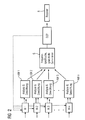
- FIG. 2 reproduced basic block diagram of a hearing aid shows several input channels IN1, IN2, IN3, ..., INn. Connected thereto is in each case a corresponding preprocessing unit AW1, AW2, AW3,..., AWn for analyzing and weighting the output signals of the input channels IN1, IN2, IN3,..., INn.
- the corresponding audio signals are drawn with solid lines or arrows.
- the output signals of the preprocessing units AW1 to AWn are summed in a subsequent summation device S frequency-specific and weighted.
- the resulting sum signal is analyzed in a digital signal processor DSP and further processed.
- Output signal of the digital signal processor DSP is an audio signal which is sent to the receiver or receiver R. From the sum signal the digital signal processor DSP continues to receive control signals which are fed back to the input channel devices IN1 to INn and the pre-processing units AW1 to AWn, respectively.
- the feedback control signals which are shown dotted, are first sent to the corresponding input channel device IN1 to INn and from there to the associated preprocessing unit AW1 to AWn.
- the input channel device IN consists according to this example of an AD converter ADC, which optionally includes a further signal preprocessing.
- the input channel device IN has a control logic SL which, for example, drives the AD converter ADC to switch off.
- the audio signal as in FIG. 3 via an analysis and weighting unit AW to the summing circuit S and on to the digital signal processor DSP.
- the digital signal processor DSP returns a control signal to the control logic SL of the input channel device IN. Since the control logic SL also controls the analysis and weighting unit AW in the selected example, it is possible to switch off these two units ADC and / or AW as a function of the summation signal by the digital signal processor DSP.
- the control logic of the analysis and weighting unit AW in response to the feedback signal to send a weighting signal or a corresponding control signal.
- control logic SL has an additional input, via which a control signal, which is contained for example in the input audio signal, can be recorded. This makes it possible, for example, to "wake up" the control logic SL or the components ADC and / or AW switched off by it.
- a frequency and time-specific weighting of the input channels is carried out with the help of on the one hand the information that is present only in the DSP (not on the input channel) and on the other hand a linking of information about individual channels.
- This way of determining weights as a function of multiple input channels and central information is in contrast to determining weights solely on the basis of threshold logic that can only evaluate information from the particular single input channel.
- each frequency band and input channel a time-varying measure of the quality of the input channel is calculated. Depending on its quality, each input channel is time-weighted and “mixed” (added) with the other input channels. Optionally, by comparing the grades of the different channels, the "best channel" can be determined.
- the centrally evaluated information for calculating the quality includes, for example, a classifier result.
- a classifier result As a result, the same input channels are always used in certain situations. Thus, for example, in the listening situation "music" the use of a directional microphone or a telecoil is unlikely.
- Further information on the calculation of the quality can be provided by the signal-to-noise ratio (SNR). The smaller this is, the lower the quality.
- SNR signal-to-noise ratio
- a speaker verification can also be used to determine the quality. If a preferred speaker is recognized, which is individually trainable, this increases the quality. Furthermore, information from the modulation spectrum can contribute to the calculation of the quality. The stronger the modulations, the higher the respective quality.
- a time-dependent weighting is calculated centrally in the digital signal processor DSP.
- the central decisions are linked to the peripheral (eg threshold criteria).
- the primary goal, especially for hearing aids, is to save energy. This can be achieved, for example, by determining the channel-specific information listed above by means of a broadband signal analysis. Thus, it is possible to dispense with a filter bank which consumes considerable power.
- Another way of saving power is to turn off input channels or components thereof that do not contribute significantly to the payload. For example, a channel or a component can be switched off if a predefined threshold is not exceeded. Otherwise, if the threshold is exceeded, the corresponding signal is simply passed through.
- Switching off unneeded components such as AD converter, signal analysis unit, demodulation unit, etc. can be realized according to the present example by the control logic SL.
- a mechanical logic can be used, which can be realized for example in the insertion of an audio shoe.
- the control logic may comprise analog threshold logic with which it is possible to activate only those channels whose signals exceed a certain amplitude.
- control logic for turning off certain components may also include a classifier control. This makes it possible to always use the same input channels in certain situations.
- Channels or components thereof can only be switched off to the extent that a reactivation is always possible.
- an activation code (wake-up bit) can be used in the audio signal or in the control signal from the DSP.
- the time-dependent weighting avoids abrupt switching and instead blends along the time or frequency axis between the various channels.
- the fade-over may be limited to only one frequency band, in which frequency band from a first source, i. H. from a first input channel to a second source, d. H. a second input channel is blended.
- an optimal sound and / or an optimized speech understanding thus results at any time and fully automatically through the selection of the input channels according to the invention.
- full compatibility with future external signal sources can be established.
- Another advantage is the low power consumption, which can be achieved by the automatic shutdown of components.
Landscapes
- Health & Medical Sciences (AREA)
- General Health & Medical Sciences (AREA)
- Neurosurgery (AREA)
- Otolaryngology (AREA)
- Physics & Mathematics (AREA)
- Engineering & Computer Science (AREA)
- Acoustics & Sound (AREA)
- Signal Processing (AREA)
- Circuit For Audible Band Transducer (AREA)
- Amplifiers (AREA)
- Selective Calling Equipment (AREA)
Claims (8)
- Prothèse auditive comprenant- plusieurs dispositifs (IN, IN1, IN2, IN3, INn), à canaux d'entrée choisis dans le groupe d'un microphone, d'une bobine de téléphone, d'un microphone directionnel, d'un sabot audio, d'une entrée numérique, respectivement pour la réception et le traitement préalable d'un signal d'entrée distinct, ainsi que pour l'émission d'un signal respectif de canal et- un dispositif (DSP) d'ordinateur central pour le traitement de plusieurs signaux de canal des dispositifs (IN, IN1, IN2, IN3, INn) à canal d'entrée,caractérisé en ce que- au moins l'un des plusieurs dispositifs (IN, IN1, IN2, IN3, INn) à canal d'entrée est commandé par le dispositif (DSP) d'ordinateur central, en fonction d'un signal de somme, sommé par un dispositif (S) de sommation, d'au moins deux des plusieurs signaux de canaux.
- Prothèse auditive suivant la revendication 1, dans laquelle au moins un dispositif (IN, IN1, IN2, IN3, INn) à canal d'entrée ou au moins l'un de leurs composants peut être interrompu par le dispositif (DSP) d'ordinateur central en fonction des plusieurs signaux de canal.
- Prothèse auditive suivant l'une des revendications 1 ou 2, dans laquelle chaque signal de canal est pondéré par le dispositif (DSP) d'ordinateur central en fonction des plusieurs signaux de canal.
- Prothèse auditive suivant l'une des revendications précédentes, dans laquelle il peut être déterminé, par le dispositif (DSP) d'ordinateur central, une qualité de chacun des signaux de canal ou, par chacun des plusieurs dispositifs (IN, IN1, IN2, IN3, INn) de signal d'entrée, une qualité du signal de canal respectif, et les qualités sont utilisées pour commander le au moins un dispositif (IN, IN1, IN2, IN3, INn) à canal d'entrée.
- Procédé de commande d'une prothèse auditive ayant plusieurs canaux (IN, IN1, IN2, IN3, INn) d'entrée choisis dans le groupe d'un microphone, d'une bobine de téléphone, d'un microphone directionnel, d'un sabot audio et d'une entrée numérique, par- réception et traitement préalable d'un signal d'entrée distinct dans chacun des plusieurs canaux (IN, IN1, IN2, IN3, INn) d'entrée et- émission d'un signal de canal respectif par chacun des plusieurs canaux (IN, IN1, IN2, IN3, INn) d'entrée,caractérisé par- variation d'au moins l'un des signaux de canal des plusieurs canaux (IN, IN1, IN2, IN3, INn) d'entrée en fonction d'un signal de somme, sommé par un dispositif (S) de sommation, d'au moins deux des plusieurs signaux de canal des plusieurs canaux (IN, IN1, IN2, IN3, INn) d'entrée.
- Procédé suivant la revendication 5, dans lequel au moins l'un des plusieurs canaux (IN, IN1, IN2, IN3, INn) d'entrée est interrompu en fonction des plusieurs signaux de canal.
- Procédé suivant l'une des revendications 5 ou 6, dans lequel chaque signal de canal est pondéré en fonction des plusieurs signaux de canal.
- Procédé suivant l'une des revendications 5 à 7, dans lequel on détermine une qualité de chaque signal de canal et on utilise des qualités pour faire varier le au moins un signal de canal.
Applications Claiming Priority (1)
| Application Number | Priority Date | Filing Date | Title |
|---|---|---|---|
| DE102006046703A DE102006046703A1 (de) | 2006-10-02 | 2006-10-02 | Hörvorrichtung mit gesteuerten Eingangskanälen und entsprechendes Verfahren |
Publications (3)
| Publication Number | Publication Date |
|---|---|
| EP1909535A2 EP1909535A2 (fr) | 2008-04-09 |
| EP1909535A3 EP1909535A3 (fr) | 2011-05-18 |
| EP1909535B1 true EP1909535B1 (fr) | 2013-10-16 |
Family
ID=38871773
Family Applications (1)
| Application Number | Title | Priority Date | Filing Date |
|---|---|---|---|
| EP07114999.1A Not-in-force EP1909535B1 (fr) | 2006-10-02 | 2007-08-27 | Appareil auditif avec canaux d'entrée controlés et procédé correspondant |
Country Status (4)
| Country | Link |
|---|---|
| US (1) | US8139799B2 (fr) |
| EP (1) | EP1909535B1 (fr) |
| DE (1) | DE102006046703A1 (fr) |
| DK (1) | DK1909535T3 (fr) |
Families Citing this family (2)
| Publication number | Priority date | Publication date | Assignee | Title |
|---|---|---|---|---|
| US8352855B2 (en) * | 2009-01-02 | 2013-01-08 | Apple Inc. | Selection of text in an unstructured document |
| EP3041270B1 (fr) * | 2014-12-30 | 2019-05-15 | GN Hearing A/S | Procédé de superposition de repères sonores spatiaux sur des signaux de microphone captés à l'extérieur |
Family Cites Families (13)
| Publication number | Priority date | Publication date | Assignee | Title |
|---|---|---|---|---|
| ATE53735T1 (de) * | 1985-10-16 | 1990-06-15 | Siemens Ag | Hoergeraet. |
| DE29517266U1 (de) * | 1995-10-31 | 1995-12-21 | Lux-Wellenhof, Gabriele, 65830 Kriftel | Hörgerät |
| EP0989775B1 (fr) * | 1995-10-31 | 2004-03-31 | Lux-Wellenhof, Gabriele | Prothèse auditive avec dispositif de contrôle de la qualité d'un signal |
| US6154552A (en) * | 1997-05-15 | 2000-11-28 | Planning Systems Inc. | Hybrid adaptive beamformer |
| US7027607B2 (en) * | 2000-09-22 | 2006-04-11 | Gn Resound A/S | Hearing aid with adaptive microphone matching |
| DE10146886B4 (de) * | 2001-09-24 | 2007-11-08 | Siemens Audiologische Technik Gmbh | Hörgerät mit automatischer Umschaltung auf Hörspulenbetrieb |
| DE10211364B4 (de) * | 2002-03-14 | 2004-02-05 | Siemens Audiologische Technik Gmbh | Abschalten von Signalverarbeitungsvorrichtungen eines Hörgeräts |
| US7151838B2 (en) * | 2002-08-21 | 2006-12-19 | Galler Bernard A | Digital hearing aid battery conservation method and apparatus |
| US7010132B2 (en) * | 2003-06-03 | 2006-03-07 | Unitron Hearing Ltd. | Automatic magnetic detection in hearing aids |
| DE10331956C5 (de) * | 2003-07-16 | 2010-11-18 | Siemens Audiologische Technik Gmbh | Hörhilfegerät sowie Verfahren zum Betrieb eines Hörhilfegerätes mit einem Mikrofonsystem, bei dem unterschiedliche Richtcharakteistiken einstellbar sind |
| WO2005018279A1 (fr) * | 2003-08-05 | 2005-02-24 | Oticon A/S | Systeme de prothese auditive a dispositif de commutation |
| DK1443803T3 (en) * | 2004-03-16 | 2014-02-24 | Phonak Ag | Hearing aid and method for detecting and automatically selecting an input signal |
| DE102004013952A1 (de) * | 2004-03-22 | 2005-10-20 | Infineon Technologies Ag | Schaltkreis-Anordnung und Signalverarbeitungs-Vorrichtung |
-
2006
- 2006-10-02 DE DE102006046703A patent/DE102006046703A1/de not_active Ceased
-
2007
- 2007-08-27 DK DK07114999.1T patent/DK1909535T3/da active
- 2007-08-27 EP EP07114999.1A patent/EP1909535B1/fr not_active Not-in-force
- 2007-10-02 US US11/906,468 patent/US8139799B2/en active Active
Also Published As
| Publication number | Publication date |
|---|---|
| US8139799B2 (en) | 2012-03-20 |
| EP1909535A2 (fr) | 2008-04-09 |
| DE102006046703A1 (de) | 2008-04-17 |
| US20080101636A1 (en) | 2008-05-01 |
| DK1909535T3 (da) | 2014-01-20 |
| EP1909535A3 (fr) | 2011-05-18 |
Similar Documents
| Publication | Publication Date | Title |
|---|---|---|
| DE10146886B4 (de) | Hörgerät mit automatischer Umschaltung auf Hörspulenbetrieb | |
| EP1379102B1 (fr) | Localisation du son avec des prothèses auditives binauriculaires | |
| DE102007046437B4 (de) | Vollautomatisches Ein-/Ausschalten bei Hörhilfegeräten | |
| EP2991379B1 (fr) | Procede et dispositif de perception amelioree de sa propre voix | |
| DE102007017761A1 (de) | Verfahren zur Anpassung eines binauralen Hörgerätesystems | |
| EP2070384B1 (fr) | Appareil de correction auditive commandé par un modèle perceptif et procédé correspondant | |
| EP2182741B1 (fr) | Dispositif auditif doté d'une unité de reconnaissance de situation spéciale et procédé de fonctionnement d'un dispositif auditif | |
| DE102009012166A1 (de) | Hörvorrichtung und Verfahren zum Reduzieren eines Störgeräuschs für eine Hörvorrichtung | |
| DE102007035171A1 (de) | Verfahren zum Anpassen eines Hörgeräts mit Hilfe eines perzeptiven Modells | |
| EP2373062A2 (fr) | Procédé de réglage double pour un système auditif | |
| EP2200345A1 (fr) | Procédé de sélection d'une direction préférentiel d'un microphone directionnel et dispositif auditif correspondant | |
| EP2200341A1 (fr) | Procédé de fonctionnement d'un appareil d'aide auditive et appareil d'aide auditive doté d'un dispositif de séparation de sources | |
| DE102008046040A1 (de) | Verfahren zum Betrieb einer Hörvorrichtung mit Richtwirkung und zugehörige Hörvorrichtung | |
| EP2822300B1 (fr) | Reconnaissance de situations d'écoute à l'aide de différentes sources de signal | |
| EP1926087A1 (fr) | Adaptation d'un dispositif auditif à un signal vocal | |
| EP1909535A2 (fr) | Appareil auditif avec canaux d'entrée controlés et procédé correspondant | |
| DE102009004185B3 (de) | Verfahren zur Signalverarbeitung einer Hörvorrichtung und entsprechende Hörvorrichtung | |
| EP2658289B1 (fr) | Procédé de commande d'une caractéristique de guidage et système auditif | |
| DE102007035173A1 (de) | Verfahren zum Einstellen eines Hörsystems mit einem perzeptiven Modell für binaurales Hören und entsprechendes Hörsystem | |
| DE102010041435A1 (de) | Verfahren zum Rekonstruieren eines Sprachsignals und Hörvorrichtung | |
| DE102009014053B4 (de) | Verfahren zum Einstellen einer Richtcharakteristik und Hörvorrichtungen | |
| EP2590437B1 (fr) | Adaptation périodique d'un dispositif de suppression de l'effet Larsen | |
| EP4311269B1 (fr) | Procédé de fonctionnement d'un appareil auditif binaural, appareil auditif binaural et logiciel | |
| EP3048813B1 (fr) | Procédé et dispositif de suppression du bruit basée sur l'inter-corrélation de bandes secondaires | |
| DE102007030067B4 (de) | Hörgerät mit passiver, eingangspegelabhängiger Geräuschreduktion und Verfahren |
Legal Events
| Date | Code | Title | Description |
|---|---|---|---|
| PUAI | Public reference made under article 153(3) epc to a published international application that has entered the european phase |
Free format text: ORIGINAL CODE: 0009012 |
|
| AK | Designated contracting states |
Kind code of ref document: A2 Designated state(s): AT BE BG CH CY CZ DE DK EE ES FI FR GB GR HU IE IS IT LI LT LU LV MC MT NL PL PT RO SE SI SK TR |
|
| AX | Request for extension of the european patent |
Extension state: AL BA HR MK RS |
|
| PUAL | Search report despatched |
Free format text: ORIGINAL CODE: 0009013 |
|
| AK | Designated contracting states |
Kind code of ref document: A3 Designated state(s): AT BE BG CH CY CZ DE DK EE ES FI FR GB GR HU IE IS IT LI LT LU LV MC MT NL PL PT RO SE SI SK TR |
|
| AX | Request for extension of the european patent |
Extension state: AL BA HR MK RS |
|
| 17P | Request for examination filed |
Effective date: 20111107 |
|
| AKX | Designation fees paid |
Designated state(s): AT BE BG CH CY CZ DE DK EE ES FI FR GB GR HU IE IS IT LI LT LU LV MC MT NL PL PT RO SE SI SK TR |
|
| 17Q | First examination report despatched |
Effective date: 20120120 |
|
| GRAP | Despatch of communication of intention to grant a patent |
Free format text: ORIGINAL CODE: EPIDOSNIGR1 |
|
| INTG | Intention to grant announced |
Effective date: 20130508 |
|
| GRAS | Grant fee paid |
Free format text: ORIGINAL CODE: EPIDOSNIGR3 |
|
| GRAA | (expected) grant |
Free format text: ORIGINAL CODE: 0009210 |
|
| AK | Designated contracting states |
Kind code of ref document: B1 Designated state(s): AT BE BG CH CY CZ DE DK EE ES FI FR GB GR HU IE IS IT LI LT LU LV MC MT NL PL PT RO SE SI SK TR |
|
| REG | Reference to a national code |
Ref country code: GB Ref legal event code: FG4D Free format text: NOT ENGLISH |
|
| REG | Reference to a national code |
Ref country code: CH Ref legal event code: NV Representative=s name: SIEMENS SCHWEIZ AG, CH Ref country code: CH Ref legal event code: EP |
|
| REG | Reference to a national code |
Ref country code: IE Ref legal event code: FG4D Free format text: LANGUAGE OF EP DOCUMENT: GERMAN |
|
| REG | Reference to a national code |
Ref country code: AT Ref legal event code: REF Ref document number: 636979 Country of ref document: AT Kind code of ref document: T Effective date: 20131115 |
|
| REG | Reference to a national code |
Ref country code: DE Ref legal event code: R096 Ref document number: 502007012385 Country of ref document: DE Effective date: 20131212 |
|
| REG | Reference to a national code |
Ref country code: DK Ref legal event code: T3 Effective date: 20140116 |
|
| REG | Reference to a national code |
Ref country code: NL Ref legal event code: VDEP Effective date: 20131016 |
|
| REG | Reference to a national code |
Ref country code: LT Ref legal event code: MG4D |
|
| PG25 | Lapsed in a contracting state [announced via postgrant information from national office to epo] |
Ref country code: FI Free format text: LAPSE BECAUSE OF FAILURE TO SUBMIT A TRANSLATION OF THE DESCRIPTION OR TO PAY THE FEE WITHIN THE PRESCRIBED TIME-LIMIT Effective date: 20131016 Ref country code: LT Free format text: LAPSE BECAUSE OF FAILURE TO SUBMIT A TRANSLATION OF THE DESCRIPTION OR TO PAY THE FEE WITHIN THE PRESCRIBED TIME-LIMIT Effective date: 20131016 Ref country code: NL Free format text: LAPSE BECAUSE OF FAILURE TO SUBMIT A TRANSLATION OF THE DESCRIPTION OR TO PAY THE FEE WITHIN THE PRESCRIBED TIME-LIMIT Effective date: 20131016 Ref country code: SE Free format text: LAPSE BECAUSE OF FAILURE TO SUBMIT A TRANSLATION OF THE DESCRIPTION OR TO PAY THE FEE WITHIN THE PRESCRIBED TIME-LIMIT Effective date: 20131016 Ref country code: IS Free format text: LAPSE BECAUSE OF FAILURE TO SUBMIT A TRANSLATION OF THE DESCRIPTION OR TO PAY THE FEE WITHIN THE PRESCRIBED TIME-LIMIT Effective date: 20140216 |
|
| PG25 | Lapsed in a contracting state [announced via postgrant information from national office to epo] |
Ref country code: LV Free format text: LAPSE BECAUSE OF FAILURE TO SUBMIT A TRANSLATION OF THE DESCRIPTION OR TO PAY THE FEE WITHIN THE PRESCRIBED TIME-LIMIT Effective date: 20131016 Ref country code: ES Free format text: LAPSE BECAUSE OF FAILURE TO SUBMIT A TRANSLATION OF THE DESCRIPTION OR TO PAY THE FEE WITHIN THE PRESCRIBED TIME-LIMIT Effective date: 20131016 Ref country code: CY Free format text: LAPSE BECAUSE OF FAILURE TO SUBMIT A TRANSLATION OF THE DESCRIPTION OR TO PAY THE FEE WITHIN THE PRESCRIBED TIME-LIMIT Effective date: 20131016 |
|
| PG25 | Lapsed in a contracting state [announced via postgrant information from national office to epo] |
Ref country code: PT Free format text: LAPSE BECAUSE OF FAILURE TO SUBMIT A TRANSLATION OF THE DESCRIPTION OR TO PAY THE FEE WITHIN THE PRESCRIBED TIME-LIMIT Effective date: 20140217 |
|
| REG | Reference to a national code |
Ref country code: DE Ref legal event code: R097 Ref document number: 502007012385 Country of ref document: DE |
|
| PG25 | Lapsed in a contracting state [announced via postgrant information from national office to epo] |
Ref country code: EE Free format text: LAPSE BECAUSE OF FAILURE TO SUBMIT A TRANSLATION OF THE DESCRIPTION OR TO PAY THE FEE WITHIN THE PRESCRIBED TIME-LIMIT Effective date: 20131016 |
|
| PLBE | No opposition filed within time limit |
Free format text: ORIGINAL CODE: 0009261 |
|
| STAA | Information on the status of an ep patent application or granted ep patent |
Free format text: STATUS: NO OPPOSITION FILED WITHIN TIME LIMIT |
|
| PG25 | Lapsed in a contracting state [announced via postgrant information from national office to epo] |
Ref country code: SK Free format text: LAPSE BECAUSE OF FAILURE TO SUBMIT A TRANSLATION OF THE DESCRIPTION OR TO PAY THE FEE WITHIN THE PRESCRIBED TIME-LIMIT Effective date: 20131016 Ref country code: IT Free format text: LAPSE BECAUSE OF FAILURE TO SUBMIT A TRANSLATION OF THE DESCRIPTION OR TO PAY THE FEE WITHIN THE PRESCRIBED TIME-LIMIT Effective date: 20131016 Ref country code: RO Free format text: LAPSE BECAUSE OF FAILURE TO SUBMIT A TRANSLATION OF THE DESCRIPTION OR TO PAY THE FEE WITHIN THE PRESCRIBED TIME-LIMIT Effective date: 20131016 Ref country code: PL Free format text: LAPSE BECAUSE OF FAILURE TO SUBMIT A TRANSLATION OF THE DESCRIPTION OR TO PAY THE FEE WITHIN THE PRESCRIBED TIME-LIMIT Effective date: 20131016 Ref country code: CZ Free format text: LAPSE BECAUSE OF FAILURE TO SUBMIT A TRANSLATION OF THE DESCRIPTION OR TO PAY THE FEE WITHIN THE PRESCRIBED TIME-LIMIT Effective date: 20131016 |
|
| 26N | No opposition filed |
Effective date: 20140717 |
|
| REG | Reference to a national code |
Ref country code: DE Ref legal event code: R097 Ref document number: 502007012385 Country of ref document: DE Effective date: 20140717 |
|
| PG25 | Lapsed in a contracting state [announced via postgrant information from national office to epo] |
Ref country code: SI Free format text: LAPSE BECAUSE OF FAILURE TO SUBMIT A TRANSLATION OF THE DESCRIPTION OR TO PAY THE FEE WITHIN THE PRESCRIBED TIME-LIMIT Effective date: 20131016 |
|
| PG25 | Lapsed in a contracting state [announced via postgrant information from national office to epo] |
Ref country code: MC Free format text: LAPSE BECAUSE OF FAILURE TO SUBMIT A TRANSLATION OF THE DESCRIPTION OR TO PAY THE FEE WITHIN THE PRESCRIBED TIME-LIMIT Effective date: 20131016 Ref country code: LU Free format text: LAPSE BECAUSE OF FAILURE TO SUBMIT A TRANSLATION OF THE DESCRIPTION OR TO PAY THE FEE WITHIN THE PRESCRIBED TIME-LIMIT Effective date: 20140827 |
|
| REG | Reference to a national code |
Ref country code: DE Ref legal event code: R082 Ref document number: 502007012385 Country of ref document: DE Representative=s name: FDST PATENTANWAELTE FREIER DOERR STAMMLER TSCH, DE |
|
| PG25 | Lapsed in a contracting state [announced via postgrant information from national office to epo] |
Ref country code: BE Free format text: LAPSE BECAUSE OF NON-PAYMENT OF DUE FEES Effective date: 20140831 |
|
| REG | Reference to a national code |
Ref country code: IE Ref legal event code: MM4A |
|
| PG25 | Lapsed in a contracting state [announced via postgrant information from national office to epo] |
Ref country code: IE Free format text: LAPSE BECAUSE OF NON-PAYMENT OF DUE FEES Effective date: 20140827 |
|
| REG | Reference to a national code |
Ref country code: AT Ref legal event code: MM01 Ref document number: 636979 Country of ref document: AT Kind code of ref document: T Effective date: 20140827 |
|
| REG | Reference to a national code |
Ref country code: DE Ref legal event code: R082 Ref document number: 502007012385 Country of ref document: DE Representative=s name: FDST PATENTANWAELTE FREIER DOERR STAMMLER TSCH, DE Ref country code: DE Ref legal event code: R081 Ref document number: 502007012385 Country of ref document: DE Owner name: SIVANTOS GMBH, DE Free format text: FORMER OWNER: SIEMENS AUDIOLOGISCHE TECHNIK GMBH, 91058 ERLANGEN, DE |
|
| PG25 | Lapsed in a contracting state [announced via postgrant information from national office to epo] |
Ref country code: AT Free format text: LAPSE BECAUSE OF NON-PAYMENT OF DUE FEES Effective date: 20140827 |
|
| PG25 | Lapsed in a contracting state [announced via postgrant information from national office to epo] |
Ref country code: BG Free format text: LAPSE BECAUSE OF FAILURE TO SUBMIT A TRANSLATION OF THE DESCRIPTION OR TO PAY THE FEE WITHIN THE PRESCRIBED TIME-LIMIT Effective date: 20131016 |
|
| PG25 | Lapsed in a contracting state [announced via postgrant information from national office to epo] |
Ref country code: GR Free format text: LAPSE BECAUSE OF FAILURE TO SUBMIT A TRANSLATION OF THE DESCRIPTION OR TO PAY THE FEE WITHIN THE PRESCRIBED TIME-LIMIT Effective date: 20140117 Ref country code: MT Free format text: LAPSE BECAUSE OF FAILURE TO SUBMIT A TRANSLATION OF THE DESCRIPTION OR TO PAY THE FEE WITHIN THE PRESCRIBED TIME-LIMIT Effective date: 20131016 |
|
| PG25 | Lapsed in a contracting state [announced via postgrant information from national office to epo] |
Ref country code: HU Free format text: LAPSE BECAUSE OF FAILURE TO SUBMIT A TRANSLATION OF THE DESCRIPTION OR TO PAY THE FEE WITHIN THE PRESCRIBED TIME-LIMIT; INVALID AB INITIO Effective date: 20070827 Ref country code: TR Free format text: LAPSE BECAUSE OF FAILURE TO SUBMIT A TRANSLATION OF THE DESCRIPTION OR TO PAY THE FEE WITHIN THE PRESCRIBED TIME-LIMIT Effective date: 20131016 |
|
| REG | Reference to a national code |
Ref country code: FR Ref legal event code: PLFP Year of fee payment: 10 |
|
| REG | Reference to a national code |
Ref country code: FR Ref legal event code: PLFP Year of fee payment: 11 |
|
| REG | Reference to a national code |
Ref country code: FR Ref legal event code: PLFP Year of fee payment: 12 |
|
| PGFP | Annual fee paid to national office [announced via postgrant information from national office to epo] |
Ref country code: FR Payment date: 20190822 Year of fee payment: 13 Ref country code: DE Payment date: 20190822 Year of fee payment: 13 Ref country code: DK Payment date: 20190822 Year of fee payment: 13 |
|
| PGFP | Annual fee paid to national office [announced via postgrant information from national office to epo] |
Ref country code: GB Payment date: 20190827 Year of fee payment: 13 |
|
| PGFP | Annual fee paid to national office [announced via postgrant information from national office to epo] |
Ref country code: CH Payment date: 20190826 Year of fee payment: 13 |
|
| REG | Reference to a national code |
Ref country code: DE Ref legal event code: R119 Ref document number: 502007012385 Country of ref document: DE |
|
| REG | Reference to a national code |
Ref country code: DK Ref legal event code: EBP Effective date: 20200831 |
|
| REG | Reference to a national code |
Ref country code: CH Ref legal event code: PL |
|
| GBPC | Gb: european patent ceased through non-payment of renewal fee |
Effective date: 20200827 |
|
| PG25 | Lapsed in a contracting state [announced via postgrant information from national office to epo] |
Ref country code: CH Free format text: LAPSE BECAUSE OF NON-PAYMENT OF DUE FEES Effective date: 20200831 Ref country code: LI Free format text: LAPSE BECAUSE OF NON-PAYMENT OF DUE FEES Effective date: 20200831 |
|
| PG25 | Lapsed in a contracting state [announced via postgrant information from national office to epo] |
Ref country code: FR Free format text: LAPSE BECAUSE OF NON-PAYMENT OF DUE FEES Effective date: 20200831 Ref country code: DE Free format text: LAPSE BECAUSE OF NON-PAYMENT OF DUE FEES Effective date: 20210302 |
|
| PG25 | Lapsed in a contracting state [announced via postgrant information from national office to epo] |
Ref country code: DK Free format text: LAPSE BECAUSE OF NON-PAYMENT OF DUE FEES Effective date: 20200831 Ref country code: GB Free format text: LAPSE BECAUSE OF NON-PAYMENT OF DUE FEES Effective date: 20200827 |