EP1914196B1 - Groupes quantiques atomiques stables et procédé d'obtention et d'utilisation de ceux-ci - Google Patents
Groupes quantiques atomiques stables et procédé d'obtention et d'utilisation de ceux-ci Download PDFInfo
- Publication number
- EP1914196B1 EP1914196B1 EP06778474.4A EP06778474A EP1914196B1 EP 1914196 B1 EP1914196 B1 EP 1914196B1 EP 06778474 A EP06778474 A EP 06778474A EP 1914196 B1 EP1914196 B1 EP 1914196B1
- Authority
- EP
- European Patent Office
- Prior art keywords
- aqcs
- clusters
- process according
- metal
- reduction
- Prior art date
- Legal status (The legal status is an assumption and is not a legal conclusion. Google has not performed a legal analysis and makes no representation as to the accuracy of the status listed.)
- Active
Links
Images




Classifications
-
- B—PERFORMING OPERATIONS; TRANSPORTING
- B22—CASTING; POWDER METALLURGY
- B22F—WORKING METALLIC POWDER; MANUFACTURE OF ARTICLES FROM METALLIC POWDER; MAKING METALLIC POWDER; APPARATUS OR DEVICES SPECIALLY ADAPTED FOR METALLIC POWDER
- B22F1/00—Metallic powder; Treatment of metallic powder, e.g. to facilitate working or to improve properties
- B22F1/07—Metallic powder characterised by particles having a nanoscale microstructure
-
- A—HUMAN NECESSITIES
- A61—MEDICAL OR VETERINARY SCIENCE; HYGIENE
- A61K—PREPARATIONS FOR MEDICAL, DENTAL OR TOILETRY PURPOSES
- A61K33/00—Medicinal preparations containing inorganic active ingredients
- A61K33/24—Heavy metals; Compounds thereof
-
- B—PERFORMING OPERATIONS; TRANSPORTING
- B82—NANOTECHNOLOGY
- B82B—NANOSTRUCTURES FORMED BY MANIPULATION OF INDIVIDUAL ATOMS, MOLECULES, OR LIMITED COLLECTIONS OF ATOMS OR MOLECULES AS DISCRETE UNITS; MANUFACTURE OR TREATMENT THEREOF
- B82B1/00—Nanostructures formed by manipulation of individual atoms or molecules, or limited collections of atoms or molecules as discrete units
-
- A—HUMAN NECESSITIES
- A61—MEDICAL OR VETERINARY SCIENCE; HYGIENE
- A61K—PREPARATIONS FOR MEDICAL, DENTAL OR TOILETRY PURPOSES
- A61K33/00—Medicinal preparations containing inorganic active ingredients
- A61K33/24—Heavy metals; Compounds thereof
- A61K33/26—Iron; Compounds thereof
-
- A—HUMAN NECESSITIES
- A61—MEDICAL OR VETERINARY SCIENCE; HYGIENE
- A61K—PREPARATIONS FOR MEDICAL, DENTAL OR TOILETRY PURPOSES
- A61K33/00—Medicinal preparations containing inorganic active ingredients
- A61K33/24—Heavy metals; Compounds thereof
- A61K33/28—Mercury; Compounds thereof
-
- A—HUMAN NECESSITIES
- A61—MEDICAL OR VETERINARY SCIENCE; HYGIENE
- A61K—PREPARATIONS FOR MEDICAL, DENTAL OR TOILETRY PURPOSES
- A61K33/00—Medicinal preparations containing inorganic active ingredients
- A61K33/24—Heavy metals; Compounds thereof
- A61K33/30—Zinc; Compounds thereof
-
- A—HUMAN NECESSITIES
- A61—MEDICAL OR VETERINARY SCIENCE; HYGIENE
- A61K—PREPARATIONS FOR MEDICAL, DENTAL OR TOILETRY PURPOSES
- A61K33/00—Medicinal preparations containing inorganic active ingredients
- A61K33/24—Heavy metals; Compounds thereof
- A61K33/34—Copper; Compounds thereof
-
- A—HUMAN NECESSITIES
- A61—MEDICAL OR VETERINARY SCIENCE; HYGIENE
- A61P—SPECIFIC THERAPEUTIC ACTIVITY OF CHEMICAL COMPOUNDS OR MEDICINAL PREPARATIONS
- A61P35/00—Antineoplastic agents
-
- B—PERFORMING OPERATIONS; TRANSPORTING
- B22—CASTING; POWDER METALLURGY
- B22F—WORKING METALLIC POWDER; MANUFACTURE OF ARTICLES FROM METALLIC POWDER; MAKING METALLIC POWDER; APPARATUS OR DEVICES SPECIALLY ADAPTED FOR METALLIC POWDER
- B22F1/00—Metallic powder; Treatment of metallic powder, e.g. to facilitate working or to improve properties
-
- B—PERFORMING OPERATIONS; TRANSPORTING
- B22—CASTING; POWDER METALLURGY
- B22F—WORKING METALLIC POWDER; MANUFACTURE OF ARTICLES FROM METALLIC POWDER; MAKING METALLIC POWDER; APPARATUS OR DEVICES SPECIALLY ADAPTED FOR METALLIC POWDER
- B22F1/00—Metallic powder; Treatment of metallic powder, e.g. to facilitate working or to improve properties
- B22F1/05—Metallic powder characterised by the size or surface area of the particles
- B22F1/054—Nanosized particles
- B22F1/0545—Dispersions or suspensions of nanosized particles
-
- B—PERFORMING OPERATIONS; TRANSPORTING
- B22—CASTING; POWDER METALLURGY
- B22F—WORKING METALLIC POWDER; MANUFACTURE OF ARTICLES FROM METALLIC POWDER; MAKING METALLIC POWDER; APPARATUS OR DEVICES SPECIALLY ADAPTED FOR METALLIC POWDER
- B22F9/00—Making metallic powder or suspensions thereof
- B22F9/16—Making metallic powder or suspensions thereof using chemical processes
- B22F9/18—Making metallic powder or suspensions thereof using chemical processes with reduction of metal compounds
- B22F9/24—Making metallic powder or suspensions thereof using chemical processes with reduction of metal compounds starting from liquid metal compounds, e.g. solutions
-
- B—PERFORMING OPERATIONS; TRANSPORTING
- B82—NANOTECHNOLOGY
- B82B—NANOSTRUCTURES FORMED BY MANIPULATION OF INDIVIDUAL ATOMS, MOLECULES, OR LIMITED COLLECTIONS OF ATOMS OR MOLECULES AS DISCRETE UNITS; MANUFACTURE OR TREATMENT THEREOF
- B82B3/00—Manufacture or treatment of nanostructures by manipulation of individual atoms or molecules, or limited collections of atoms or molecules as discrete units
-
- B—PERFORMING OPERATIONS; TRANSPORTING
- B82—NANOTECHNOLOGY
- B82Y—SPECIFIC USES OR APPLICATIONS OF NANOSTRUCTURES; MEASUREMENT OR ANALYSIS OF NANOSTRUCTURES; MANUFACTURE OR TREATMENT OF NANOSTRUCTURES
- B82Y15/00—Nanotechnology for interacting, sensing or actuating, e.g. quantum dots as markers in protein assays or molecular motors
-
- B—PERFORMING OPERATIONS; TRANSPORTING
- B82—NANOTECHNOLOGY
- B82Y—SPECIFIC USES OR APPLICATIONS OF NANOSTRUCTURES; MEASUREMENT OR ANALYSIS OF NANOSTRUCTURES; MANUFACTURE OR TREATMENT OF NANOSTRUCTURES
- B82Y30/00—Nanotechnology for materials or surface science, e.g. nanocomposites
-
- C—CHEMISTRY; METALLURGY
- C25—ELECTROLYTIC OR ELECTROPHORETIC PROCESSES; APPARATUS THEREFOR
- C25C—PROCESSES FOR THE ELECTROLYTIC PRODUCTION, RECOVERY OR REFINING OF METALS; APPARATUS THEREFOR
- C25C1/00—Electrolytic production, recovery or refining of metals by electrolysis of solutions
- C25C1/12—Electrolytic production, recovery or refining of metals by electrolysis of solutions of copper
-
- C—CHEMISTRY; METALLURGY
- C25—ELECTROLYTIC OR ELECTROPHORETIC PROCESSES; APPARATUS THEREFOR
- C25C—PROCESSES FOR THE ELECTROLYTIC PRODUCTION, RECOVERY OR REFINING OF METALS; APPARATUS THEREFOR
- C25C1/00—Electrolytic production, recovery or refining of metals by electrolysis of solutions
- C25C1/20—Electrolytic production, recovery or refining of metals by electrolysis of solutions of noble metals
-
- C—CHEMISTRY; METALLURGY
- C25—ELECTROLYTIC OR ELECTROPHORETIC PROCESSES; APPARATUS THEREFOR
- C25C—PROCESSES FOR THE ELECTROLYTIC PRODUCTION, RECOVERY OR REFINING OF METALS; APPARATUS THEREFOR
- C25C5/00—Electrolytic production, recovery or refining of metal powders or porous metal masses
- C25C5/02—Electrolytic production, recovery or refining of metal powders or porous metal masses from solutions
-
- A—HUMAN NECESSITIES
- A61—MEDICAL OR VETERINARY SCIENCE; HYGIENE
- A61K—PREPARATIONS FOR MEDICAL, DENTAL OR TOILETRY PURPOSES
- A61K33/00—Medicinal preparations containing inorganic active ingredients
- A61K33/24—Heavy metals; Compounds thereof
- A61K33/241—Lead; Compounds thereof
-
- A—HUMAN NECESSITIES
- A61—MEDICAL OR VETERINARY SCIENCE; HYGIENE
- A61K—PREPARATIONS FOR MEDICAL, DENTAL OR TOILETRY PURPOSES
- A61K33/00—Medicinal preparations containing inorganic active ingredients
- A61K33/24—Heavy metals; Compounds thereof
- A61K33/242—Gold; Compounds thereof
-
- A—HUMAN NECESSITIES
- A61—MEDICAL OR VETERINARY SCIENCE; HYGIENE
- A61K—PREPARATIONS FOR MEDICAL, DENTAL OR TOILETRY PURPOSES
- A61K33/00—Medicinal preparations containing inorganic active ingredients
- A61K33/24—Heavy metals; Compounds thereof
- A61K33/243—Platinum; Compounds thereof
-
- B—PERFORMING OPERATIONS; TRANSPORTING
- B22—CASTING; POWDER METALLURGY
- B22F—WORKING METALLIC POWDER; MANUFACTURE OF ARTICLES FROM METALLIC POWDER; MAKING METALLIC POWDER; APPARATUS OR DEVICES SPECIALLY ADAPTED FOR METALLIC POWDER
- B22F2998/00—Supplementary information concerning processes or compositions relating to powder metallurgy
Definitions
- the present invention relates to novel atomic quantum clusters (AQCs) of metal elements, characterized in that they are stable in liquid solution, for hours, even days, without the need of an external stabilizer, a process for their production by the kinetic control of the reaction and the uses of said AQCs as sensors (fluorescent, magnetic or chemical), electrocatalysts and as cytostatics and/or cytotoxics.
- AQCs novel atomic quantum clusters
- Silver particles with a mean size of 7 nm are produced in water-in-oil microemulsions by reducing silver nitrate with sodium hypophospite ( Pavlyukhina, L.A.; Zaikova, T.O.; Odegova, G.V.; Savintseva, S.A.; Boldyrev, V.V. Inorganic Materials, 1998, 34, 2, 109-113 ).
- nucleation-growth is a classic thermodynamic theory which is based on the fact that the formation of a new phase (solid in this case) within a liquid (the starting solution with the reagents) always entails the appearance of an interface and, therefore, requires an additional interfacial energy (called Laplace energy), given by the product of interfacial tension of the solid which is formed by the formed interfacial area.
- Laplace energy an additional interfacial energy
- This energy means the particles which are smaller in size than the critical one are not stable and redissolve in the reaction medium. In accordance with this theory only the particles with a size over the critical one are capable of creating and forming the solid particles finally produced.
- thermodynamic reasoning is valid in certain circumstances, fundamentally for the preparation of metal particles with sizes over 1-5 nm, nevertheless, that approach is not suitable for the preparation of AQCs or atomic clusters, since in this case it does not make sense to talk of classical thermodynamic concepts such as: Laplace pressure, critical nucleus, etc., thus not making sense to speak of cluster resolutions with sizes less that the critical one.
- US 2005/064618 A1 discloses nanocables comprising clusters, Rabin, I. et al., Chemical Physics Letters, 2000, 59-64 discloses Ag 3 clusters. Belloni, J. et al, New Journal of Chemistry, 1998, 22, no. 11, 1239-1255 reports on silver clusters.
- the process object of the present invention has the purpose of the easy and quantitative production of AQCs (atomic quantum clusters of metal elements), stable, functionalized and of controlled sizes, so that it is easy and possible to scale the industrial production of this type of nano/subnano-materials.
- AQCs atomic quantum clusters of metal elements
- M n the nano/subnanometric particles formed by metal elements, M n , wherein M represents any metal, with n less than ( ⁇ ) 500 atoms, i.e. with a size less than 2 nm, as atomic quantum clusters and we will represent them by the acronym AQC.
- stable atomic quantum clusters are provided, characterized in that they consist of between 2 and less than 27 metal atoms (between approximately 0.4nm and 0.9nm in size) and even more preferably AQCs formed by between 2 and 5 metal atoms and more particularly of 2 or 3 atoms (which corresponds with a size between 0.4 and 0.5 nm), further characterized in that they are stable in liquid solution for hours, even days, without an external stabilizer, obtainable by the process of the invention.
- stable AQCs are understood as those groupings of atoms which conserve the number of atoms and, therefore, their properties, over time, so that they can be isolated and manipulated like any other chemical compound.
- the metals wherefrom those AQCs are formed are selected from Au, Ag, Co, Cu, Pt, Fe, Cr, Pd, Ni, Rh, Pb or their bi and multimetal combinations.
- the metals of the AQCs are selected from Au and Ag or their bimetal combinations, due to the spectacular properties presented by some specific clusters of these metals, among which we can cite: catalysis, cytostatic properties, etc. which reference will later be made to.
- the process of the present invention consists of the reduction of the metal salt or ion (or metal salts or ions), and it is characterized in that it has a kinetic control whereby the reduction of the metal salt or ion (metal salts or ions) is slowly produced, simultaneously maintaining a small rate constant and a low concentration of reagents.
- low concentration and small rate constant are understood as those values which lead the system through the minimum potential energy of the corresponding reaction coordinate.
- low concentrations are understood as concentrations of the metal ion and/or reducer lower than a concentration of 10 -3 M; and by small rate constants to those corresponding to semi-reaction life times over 1 second.
- thermodynamic theory of nucleation-growth has had great success in explaining the preparation of monodisperse particles of micro and sub-micrometric sizes, nevertheless, the question is raised of up to what point the formation of an atomic quantum cluster of 3 or 4 atoms by chemical reaction in solution (for example, by reduction of a salt of the corresponding metal ion to be reduced) can be considered as a new phase.
- the formation of a metal cluster of a few atoms by chemical reaction in solution is more similar to the innumerable examples that exist of formation of inorganic/organometallic chemical complexes (or also to the formation of polymers) from their reagents and, nevertheless, in all those cases the inorganic complex (or the polymer, provided that its molecular weight is not too high) is not associated with the formation of a new thermodynamic phase, but with the formation of a new "molecular" chemical compound to which, therefore, a superficial Laplace energy can be associated.
- the formation of the new compound is determined by the kinetics of the production process. And it is precisely the base on which the process proposed in the present invention is grounded: the use of kinetic control for the production of AQCs (atomic quantum clusters) of controlled size.
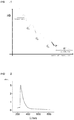
- Figure 1 shows a scheme representative of the variation in free energy which is placed in play throughout a reaction of metal formation in solution, from their metal ions.
- the reagents represent any metal ion in the presence of a reducer (or of a cathode where the reduction of the corresponding metal ion takes place).
- the reaction starts with the formation of an AQC of 1 atom (Mi), then two (M 2 ), etc. until, finally, solid particles of the reduced metal material (P) are produced.
- the figure represents the fact that as the AQC increases and approximates the size of a particle, P, (it is considered particle when the number of atoms of the atomic cluster is high, in the order of n greater than approximately 500 atoms (n > approx. 500 atoms), i.e.
- the present invention is based on the idea that the kinetics plays a decisive role in the formation of AQCs (atomic quantum clusters) and that, suitably controlling (slowing down) that kinetics the formation of specific AQCs can be controlled.
- AQCs atomic quantum clusters
- clusters is not limited to the type of metal element synthesized or the electrochemical method, for which purpose any other chemical method of reduction of metal salts in solution can be used for the production of these atomic clusters, provided that the reaction slows down sufficiently -as will be specified later- such as to observe the evolution of the AQCs and stop the reaction (e.g. by cooling, dilution and/or fixation/separation of the clusters of the reaction medium) at the time that an AQC of a determined size is of interest.
- the initial introduction in the reaction medium of stabilizing agents can vary the minimum of the potential trough of some AQCs.
- Their initial introduction can be carried out to favour a determined type of AQCs and also to have greater time for the manipulation of the AQC before its definitive stabilization and functionalization. In any case, its introduction is not essential for the method proposed herein and which we will continue to describe below.
- a mild reducer which is selected from among the group which comprises sodium hypophosphite, amines, sugars, organic acids, polymers (such as polyvinylpyrrolidone), UV-V IS radiation, ultrasounds or electric current.
- reaction medium is single or two-phase.
- the preferred form of proceeding is to generate the metal ion "in situ" in very low concentrations by the anodic solution (preferably a constant current) of an electrode of the corresponding metal.
- the second option is to use a two-phase system (water/organic compound) wherein the metal salt dissolves in the water and a reducer is chosen which only dissolves in the organic compound (for example, but without being limited to, an amine, a thiol or an acid, of long chain hydrocarbon), so that the reaction only occurs in the interface and, therefore, with a very small local concentration of reagents.
- a reducer for example, but without being limited to, an amine, a thiol or an acid, of long chain hydrocarbon
- cyclic, linear or branched saturated and unsaturated hydrocarbons are used as organic compounds, such as for example, but without being limited to, hexane, heptane, isooctane, cyclohexane; as well as also benzene or toluene.
- the water-organic compound interface in order to increase the reaction output can be increased, using for this microemulsions formed by water, organic compound and a detergent which also permit maintaining the local concentration of reagents very low within the nanodrops which form the microemulsion.
- a detergent it is possible to use anionic detergents, such as aliphatic or aromatic sultanates, for example, the derivatives of sulfocarboxylic acids; cationic detergents such as, for example, alkylammonium acetates or bromides; or non-ionic detergents such as, for example, polyoxyethylene derivatives.
- a stabilizing agent which consists of a molecule which contains organic groups (such as thiols, sulfides, amines, acids, thioethers, phosphines or amino acids, etc.) in accordance with the metal wherefrom one wants to produce the cluster.
- the separation of the cluster from the reaction medium can be done by precipitation, decreasing the temperature and/or adding a solvent incompatible with the cluster making use of the different solubility properties of the AQCs according to their size, as well as also by fixation, making use of their different affinity for said stabilizing groups.
- the functionalized AQC could be produced.
- the stabilizing agent has to be a molecule which must have, at least, two ends with different chemical groups: one end with one of the aforementioned groups to bond to the AQC and another with any other organic group (among which we can cite: double and triple bonds, alcoholic groups, acid groups or amine groups) for their subsequent interaction or bonding to other molecules or atoms for specific applications.
- functionalized AQCs can be prepared by adding dodecanethiol dissolved in pentane, observing the transfer of the clusters of the acetonitrile phase to the pentane phase.
- a water-soluble thiol or thioether such as for example, glutathione, thioglycol, thioacetic, etc. also permits their functionalization and transfer to water, it being possible to then use an additional reaction to bond the AQCs thus functionalized to any another molecule, ion or substrate for the final applications required of the AQCs.
- the different properties of solubility and affinity can furthermore be used for the stabilizing groups the AQCs have according to their size -as just mentioned-, also the different optical, fluorescent, vibrational, redox, electrical and magnetic properties which these clusters have.
- these AQCs have fluorescent properties.
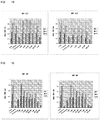
- the fluorescence range varies between ultraviolet (for the smaller clusters, of 2-3 atoms), visible (for clusters between 4-1 0 atoms) and near infrared (for clusters over 10 atoms). It has also been observed that the fluorescence bands are very narrow, as shown in figure 17 .
- magnetic properties have been observed in these clusters.
- Figure 18 shows an example of said properties.
- Another aspect of the present invention discloses the use of the aforementioned AQCs as reducer chemical agents.
- the Au clusters are capable of reducing the methylene blue causing the disappearance of the band characteristic of the oxidised form (655nm).
- Another aspect of the present invention discloses the use of the aforementioned AQCs as electrocatalysts.
- These clusters are very stable electrochemically so that the range of working potentials with dispersions of these clusters is limited by the values of the reduction and oxidation potentials of the medium wherein they are dispersed.
- the stability of the Ag clusters in TBAAc has been verified in the range (-3.V to +1.8V).
- Their high electrochemical stability makes them suitable for applications in various types of electrocatalysis reactions.
- the AQCs makes their electrocatalytic activity in reduction reactions, which comprises among others the reduction of the oxygen and/or hydrogen peroxide.
- the great electronic affinity of the clusters produces strong interactions with the electrons of other atoms even of the more electronegative ones such as, for example, halogens or oxygen, weakening the covalent bonds these atoms form in stable molecules.
- the silver and gold clusters are capable of absorbing oxygen gas contributing to the dissociation of the molecules and, in consequence, lowering the necessary energy for their electroreduction. This fact is widely proven in example 3.
- the AQCs have their electrocatalytic activity in alcoholic oxidation reactions.
- Another aspect of the present invention provides the use of the aforementioned AQCs for the preparation of anti-cancer drugs for their cytostatic and cytotoxic properties.
- the AQCs initially produced of brown colour (AQCs of 1-2 atoms, as will be seen below) were transferred to an erlenmeyer, observing that after 2 hours they took on a yellow colour, a precipitate appearing deposited in the bottom. The precipitation of the AQCs occurred due to the limited solubility thereof in the reaction medium.
- the clusters can be functionalized.
- functionalized AQCs were prepared by adding dodecanethiol dissolved in pentane, observing the transfer of the clusters of the acetronitrile phase (which became transparent) to the pentane phase (which turned yellow).
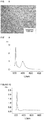
- Figure 2 shows the characteristic spectrum of the Au AQCs produced by precipitation and stabilized with dodecanethiol.
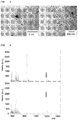
- Figure 3 shows an electronic transmission microscopy of groupings of the Au AQCs synthesized. It should be highlighted that the sizes observed in the microscopy (very polydisperse and over approx. 1-2 nm) do not actually correspond to Au particles but to AQCs groupings. The small size thereof makes their direct observation by electronic microscopy not possible and their presence can only be observed by the appearance of a blackish cloud as background of the microscope grille, together with the formation of groupings (clusters) of these AQCs of very different sizes, which were observed as blacker areas in the grille.
- this cluster is Au 3 indicates that the clusters initially produced (of brown colour), precursors of the present 3-atom AQC, are formed by 2 atoms. It is observed that, even without protecting, those 2-atom clusters (Au 2 ) are stable in the reaction medium during approximately 2 hours. That time would be sufficient for their precipitation, isolation and subsequent protection and/or functionalization.
- the unprotected Au AQCs 3 (in absence of thiol) were stable in those conditions during several months. After 5 months, the evolution of those AQCs towards the formation of other AQCs of greater size was observed, easily observable by the change in colour from yellow to red at simple sight. Those new AQCs of greater size precipitated (due to their lower solubility, since it decreases as the size of the AQC increases, due to the reduction in entropy of the mixture). Precipitation can also be favoured by decreasing the temperature. Thus, for example, the formation of an appreciable red precipitate was observed after one aliquot of the AQC solution on placing it at 0°C.
- Figure 5 shows the UV-V IS spectrum of these last AQCs of greater size, both of those initially dispersed in the reaction liquid, and those produced by precipitation, protected by dodecanethiol, and again redispersed in chloroform.
- the new bands which appear at 410 nm and 520 nm are indicative of the existence of mixtures of Au 12 and Au 21 AQCs, which are formed by bonding of 4 and 7 Au 3 clusters, respectively.
- Figure 6 shows an electronic microscopy of these AQCs. Again, due to the small size thereof, only a black background is observed, as well as darker stains in some parts of different sizes from the formation of denser groupings of these AQCs.
- the synthesis was carried out by mixing two microemulsions, one with the reducer and another with the silver salt.
- the silver salt microemulsion was prepared by addition of 0.54 mL of the aqueous solution of AgNO 3 to that of AOT in isooctane, whilst that of the reducer was produced by adding 0.54 mL of the aqueous solution of the sodium hypophospite reducer to that of AOT in isooctane.
- FIG. 7 shows the UV-V IS spectrum of the Ag AQCs synthesized. The presence of a single band situated around 220 nm indicates that the size of these clusters is 2 atoms.
- Figure 8 shows an electronic microscopy photograph of the Ag AQCs. The same occurs again with the Au AQCs: only a greyish stain is observed whereon some groupings of said AQCs are superimposed.
- the AQCs thus produced evolved after several hours with the formation of a new cluster of 4 atoms associated with the presence of a band situated around 260 nm.
- Figure 1 1 shows a photograph of these last AQCs which, as can be observed, continue to be smaller than 1 nm, whereby only a grey stain is observed on the grille whereon they were deposited.
- the Au AQCs if they did not stabilize and/or separated (e.g. by precipitation) the AQCs continued growing, reaching successively greater sizes.
- the size of nanoparticles was reached, clusters greater than approx. 500 atoms, finally observing the appearance of the plasmonic band which indicates to us the disappearance of the quantum effects of size and the formation of particle sizes over approx. 1 - 2 nm.
- clusters are produced formed by bi or multimetal combinations depending on the number and concentration of metal ions used.
- Electrocatalytic activity of metal clusters in oxygen reduction is Electrocatalytic activity of metal clusters in oxygen reduction.
- Electrocatalytic activity of metal clusters in alcohol oxidation Electrocatalytic activity of metal clusters in alcohol oxidation.
- the electrocatalytic activity of metal clusters was observed in alcohol oxidation, and more specifically the use of Ag clusters in methanol oxidation. Said oxidation is produced in the range of 0V to +1V.
Landscapes
- Chemical & Material Sciences (AREA)
- Health & Medical Sciences (AREA)
- Engineering & Computer Science (AREA)
- Nanotechnology (AREA)
- Inorganic Chemistry (AREA)
- General Health & Medical Sciences (AREA)
- Life Sciences & Earth Sciences (AREA)
- Veterinary Medicine (AREA)
- Medicinal Chemistry (AREA)
- Pharmacology & Pharmacy (AREA)
- Animal Behavior & Ethology (AREA)
- Public Health (AREA)
- Crystallography & Structural Chemistry (AREA)
- Epidemiology (AREA)
- Chemical Kinetics & Catalysis (AREA)
- Materials Engineering (AREA)
- Organic Chemistry (AREA)
- Dispersion Chemistry (AREA)
- General Chemical & Material Sciences (AREA)
- Electrochemistry (AREA)
- Metallurgy (AREA)
- Manufacturing & Machinery (AREA)
- Molecular Biology (AREA)
- General Physics & Mathematics (AREA)
- Physics & Mathematics (AREA)
- Composite Materials (AREA)
- Condensed Matter Physics & Semiconductors (AREA)
- Nuclear Medicine, Radiotherapy & Molecular Imaging (AREA)
- Manufacture Of Metal Powder And Suspensions Thereof (AREA)
- Catalysts (AREA)
- Powder Metallurgy (AREA)
- Pharmaceuticals Containing Other Organic And Inorganic Compounds (AREA)
Claims (28)
- Groupes quantiques atomiques stables, en abrégé AQC, constitués de 2 à moins de 27 atomes de métal, caractérisés en ce qu'ils sont stables en solution liquide pendant des heures, voire des jours, sans stabilisateur externe,
aptes à être obtenus par réduction du sel ou de l'ion métallique, ou des sels ou des ions métalliques, ladite réduction étant caractérisée en ce qu'ellea. possède un contrôle cinétique pour une réduction, dans laquelle des réducteurs doux choisis dans le groupe constitué par l'hypophosphate de sodium, les amines, les sucres, les thiols, les acides organiques, les polymères, le rayonnement UV-visuel, les ultrasons et le courant électrique sont utilisés pour produire le contrôle cinétique, etb. maintient une concentration de réactifs inférieure à 10-3 M dans le milieu réactionnel. - AQC selon la revendication 1, caractérisés en ce qu'ils sont constitués de 2 à 5 atomes de métal.
- AQC selon la revendication 1 ou la revendication 2, dans lesquels le métal est choisi dans la liste qui comprend Au, Ag, Cu, Pt, Fe, Cr, Pd, Ni, Rh, Pb ou l'une quelconque de leurs combinaisons bi- ou multi-métal.
- AQC selon l'une quelconque des revendications 1 à 3, le métal étant Au, Ag ou l'une quelconque de leurs combinaisons bimétalliques.
- Procédé pour la production des AQC selon les revendications 1 à 4, par réduction du sel ou de l'ion métallique, ou des sels ou des ions métalliques, caractérisé en ce qu'il :a. possède un contrôle cinétique pour une réduction dans laquelle des réducteurs doux choisis dans le groupe constitué par l'hypophosphate de sodium, les amines, les sucres, les thiols, les acides organiques, les polymères, le rayonnement UV-visuel, les ultrasons et le courant électrique sont utilisés pour produire le contrôle cinétique, etb. maintient une concentration de réactifs inférieure à 10-3 M dans le milieu réactionnel.
- Procédé selon la revendication 5, dans lequel le réducteur doux est le courant électrique.
- Procédé selon la revendication 6, dans lequel, pour maintenir la concentration de réactifs, le milieu de réaction comprend des milieux monophasés ou biphasés.
- Procédé selon la revendication 7, dans lequel les systèmes biphasiques sont formés par de l'eau, dans laquelle le sel métallique est dissous, et un composé organique, dans lequel le réducteur est dissous.
- Procédé selon la revendication 8, dans lequel les composés organiques sont choisis dans le groupe qui comprend les hydrocarbures cycliques, linéaires ou ramifiés, saturés et insaturés, ainsi que le benzène ou le toluène.
- Procédé selon la revendication 8 ou la revendication 9, qui comprend un détergent en addition à l'eau et un composé organique.
- Procédé selon la revendication 10, dans lequel le détergent est choisi dans un groupe qui comprend les détergents anioniques, cationiques ou non ioniques.
- Procédé selon l'une quelconque des revendications 5 à 11, qui comprend la séparation des AQC synthétisés par leur précipitation sélective, une fois que la taille souhaitée du groupe est atteinte.
- Procédé selon les revendications 5 à 12, dans lequel des agents stabilisants sont ajoutés au milieu réactionnel.
- Procédé selon la revendication 13, dans lequel les agents stabilisants sont choisis parmi les molécules qui ont des groupes qui sont aptes à se lier aux AQC.
- Procédé selon la revendication 14, dans lequel les agents stabilisants sont choisis dans le groupe comprenant les thiols, les sulfures, les amines, les acides thioéthers, les phosphines ou les acides aminés.
- Procédé selon la revendication 15, dans lequel les agents stabilisants ont, au moins, deux extrémités avec des groupes chimiques différents : une pour la liaison avec les AQC et une autre avec un groupe fonctionnel organique.
- Procédé selon la revendication 16, dans lequel le groupe fonctionnel organique est choisi dans le groupe qui comprend les alcools, les acides, les amines, les alcènes ou les alcynes.
- Utilisation des AQC selon les revendications 1 à 4, en tant que capteurs fluorescents et biocapteurs.
- Utilisation des AQC selon les revendications 1 à 4 en tant que capteurs magnétiques et biocapteurs.
- Utilisation des AQC selon les revendications 1 à 4 en tant qu'agents d'oxydoréduction.
- Utilisation des AQC selon les revendications 1 à 4 en tant qu'électrocatalyseurs.
- Utilisation selon la revendication 20, dans laquelle les AQC agissent en tant que catalyseur dans une réaction de réduction.
- Utilisation selon la revendication 22, dans laquelle les AQC agissent comme catalyseur dans la réduction de l'oxygène ou du peroxyde d'hydrogène.
- Utilisation selon la revendication 20, dans laquelle les AQC agissent en tant que catalyseur dans une réaction d'oxydation.
- Utilisation selon la revendication 24, dans lequel les AQC agissent en tant que catalyseur dans l'oxydation de l'alcool.
- AQC selon l'une quelconque des revendications 1 à 4, pour leur utilisation comme cytostatiques ou cytotoxiques.
- Utilisation des AQC selon les revendications 1 à 4, dans la préparation d'un médicament pour le traitement du cancer.
- AQC selon l'une quelconque des revendications 1 à 4, pour leur utilisation dans le traitement du cancer.
Applications Claiming Priority (2)
| Application Number | Priority Date | Filing Date | Title |
|---|---|---|---|
| ES200502041A ES2277531B2 (es) | 2005-08-03 | 2005-08-03 | Procedimiento para la obtencion de clusteres cuanticos atomicos. |
| PCT/ES2006/070121 WO2007017550A1 (fr) | 2005-08-03 | 2006-07-28 | Groupes quantiques atomiques stables et procede d'obtention et d'utilisation de ceux-ci |
Publications (3)
| Publication Number | Publication Date |
|---|---|
| EP1914196A1 EP1914196A1 (fr) | 2008-04-23 |
| EP1914196A4 EP1914196A4 (fr) | 2010-12-29 |
| EP1914196B1 true EP1914196B1 (fr) | 2020-05-06 |
Family
ID=37727104
Family Applications (1)
| Application Number | Title | Priority Date | Filing Date |
|---|---|---|---|
| EP06778474.4A Active EP1914196B1 (fr) | 2005-08-03 | 2006-07-28 | Groupes quantiques atomiques stables et procédé d'obtention et d'utilisation de ceux-ci |
Country Status (7)
| Country | Link |
|---|---|
| US (1) | US9421610B2 (fr) |
| EP (1) | EP1914196B1 (fr) |
| JP (3) | JP6186103B2 (fr) |
| KR (2) | KR101424943B1 (fr) |
| CN (1) | CN101248003A (fr) |
| ES (2) | ES2277531B2 (fr) |
| WO (1) | WO2007017550A1 (fr) |
Families Citing this family (28)
| Publication number | Priority date | Publication date | Assignee | Title |
|---|---|---|---|---|
| ES2319064B1 (es) * | 2007-10-05 | 2010-02-15 | Universidad De Santiago De Compostela | Uso de clusteres cuanticos atomicos (aqcs) como antimicrobianos y biocidas. |
| ES2360649B2 (es) | 2009-11-25 | 2011-10-17 | Universidade De Santiago De Compostela | Tintas conductoras obtenidas por combinación de aqcs y nanopartículas metálicas. |
| ES2365313B2 (es) | 2010-03-18 | 2012-01-19 | Universidad De Santiago De Compostela | PROCEDIMIENTO PARA LA PREPARACIÓN DE NANOPARTÍCULAS METÁLICAS ANISOTRÓPICAS MEDIANTE CATÁLISIS POR AQCs. |
| EP2457572A1 (fr) | 2010-11-05 | 2012-05-30 | Universidade De Santiago De Compostela | Utilisation de clusters atomiques quantiques (AQC) dans la prévention des troubles prolifératifs de cellules, infections virales et maladies auto-immunes |
| WO2012090034A1 (fr) | 2010-12-30 | 2012-07-05 | Indian Institute Of Technology Madras | Agrégats quantiques d'or et d'argent et leurs procédés de préparation et d'utilisation |
| EP2535390A1 (fr) * | 2011-06-15 | 2012-12-19 | Universidade De Santiago De Compostela | Nanosystèmes luminescents |
| EP2721414B1 (fr) | 2011-06-15 | 2017-08-23 | Fábrica Nacional de Moneda Y Timbre - Real Casa de la Moneda | Utilisation de systemes luminescent nano d'authentification de documents de securite |
| WO2013079669A1 (fr) | 2011-12-02 | 2013-06-06 | Universidade De Santiago De Compostela | Photoconversion de lumière dans des agrégats atomiques quantiques à support métallique |
| EP2743695A1 (fr) * | 2012-12-12 | 2014-06-18 | Nanogap Sub NM Powder, S.A. | Procédés et réactifs pour la détection de biomolécules au moyen de luminescence |
| KR102162581B1 (ko) * | 2012-12-12 | 2020-10-08 | 나노갭 서브-엔엠-파우더, 쏘시에다드 아노니마 | 발광 나노화합물 |
| EP2743329A1 (fr) | 2012-12-12 | 2014-06-18 | Fábrica Nacional de Moneda Y Timbre - Real Casa de la Moneda | Utilisation de nano-composés luminescents pour authentifier des documents sécurisés |
| CN103215032B (zh) * | 2013-04-24 | 2015-02-11 | 安徽大学 | 一种生物相容性强荧光金银混合团簇及其制备方法 |
| ES2529377B2 (es) * | 2013-06-07 | 2015-11-12 | Universidad Complutense De Madrid | Método para la producción de clústeres atómicos metálicos utilizando porfirinas y su inmovilización en la superficie de nanopartículas de óxidos metálicos y en sistemas núcleo@corteza. |
| CN105170997A (zh) * | 2015-10-13 | 2015-12-23 | 东南大学 | 双还原剂纳米金量子点的室温快速合成方法 |
| EP3398679A1 (fr) * | 2015-12-28 | 2018-11-07 | Toyota Jidosha Kabushiki Kaisha | Catalyseur de soutien de groupe et son procédé de production |
| JP6226341B2 (ja) * | 2016-03-18 | 2017-11-08 | 公立大学法人首都大学東京 | 金クラスター触媒 |
| CN105903978B (zh) * | 2016-04-20 | 2017-12-15 | 中国科学院新疆理化技术研究所 | 一种硅烷稳定的荧光铜团簇的制备方法与用途 |
| CN105965028A (zh) * | 2016-05-20 | 2016-09-28 | 中国科学院新疆理化技术研究所 | 制备水溶性发光金属铂、金、银、铜团簇的方法及用途 |
| JP6683571B2 (ja) * | 2016-08-10 | 2020-04-22 | トヨタ自動車株式会社 | 排ガス浄化触媒 |
| US11149209B2 (en) * | 2017-07-21 | 2021-10-19 | Universidade De Santiago De Compostela | Process for oxidation of organosulfur compounds |
| JP7372511B2 (ja) | 2018-01-24 | 2023-11-01 | ナノガップ スブ-エネエメ-パウダー ソシエダッド アノニマ | 原子量子クラスターの生成方法 |
| JP2019199555A (ja) * | 2018-05-17 | 2019-11-21 | 中原大學 | 高い量子収量を有する複合蛍光金ナノクラスターおよびその製造方法 |
| WO2019238995A1 (fr) | 2018-06-12 | 2019-12-19 | Nanogap Sub-Nm-Powder, S.A. | Procédé de préparation d'amas quantiques d'atomes purifiés |
| WO2020065115A2 (fr) * | 2018-09-26 | 2020-04-02 | Nanogap Sub-Nm-Powder, S.A. | Utilisations thérapeutiques de grappes quantiques d'atomes |
| WO2020094700A1 (fr) | 2018-11-07 | 2020-05-14 | Universidade De Santiago De Compostela | Composites polymères stables |
| CN111496265B (zh) * | 2019-01-31 | 2022-09-27 | 中国科学院大连化学物理研究所 | 一种在溶液中稳定的还原态贵金属孤原子材料和制备方法 |
| CN115283688B (zh) * | 2022-07-04 | 2024-03-26 | 电子科技大学 | 一种用固相动力学控制法制备金纳米团簇的方法 |
| EP4514744A1 (fr) | 2022-07-12 | 2025-03-05 | Nanogap Sub NM Powder, S.A. | Catalyseurs à agrégats quantiques atomiques (aqc) supportés par un oxyde métallique en tant que porteurs d'oxygène pour des procédés en boucle chimique |
Citations (1)
| Publication number | Priority date | Publication date | Assignee | Title |
|---|---|---|---|---|
| US20050064618A1 (en) * | 2001-08-20 | 2005-03-24 | Brown Simon Anthony | Nanoscale electronic devices & frabrication methods |
Family Cites Families (19)
| Publication number | Priority date | Publication date | Assignee | Title |
|---|---|---|---|---|
| AU670029B2 (en) * | 1991-08-05 | 1996-07-04 | Mallinckrodt Medical, Inc. | Heavy metal clusters for use as imaging agents |
| US5814370A (en) * | 1996-06-11 | 1998-09-29 | Sandia Corporation | Encapsulation of nanoclusters in dried gel materials via an inverse micelle/sol gel synthesis |
| AU7697998A (en) * | 1997-05-27 | 1998-12-30 | State of Oregon Acting By and Through The State Board of Higher Education On Behalf of The Unive, The | Scaffold-organized metal, alloy, semiconductor and/or magnetic clusters and electronic devices made using such clusters |
| JPH11140436A (ja) * | 1997-11-07 | 1999-05-25 | Matsushita Electric Ind Co Ltd | 感熱発色材料およびその製造方法 |
| DE19753464A1 (de) * | 1997-12-02 | 1999-06-10 | Basf Ag | Palladium-Cluster und ihre Verwendung als Katalysatoren |
| JP3005683B1 (ja) | 1999-03-05 | 2000-01-31 | 大阪大学長 | 超微粒子の製造方法及び超微粒子 |
| US6494932B1 (en) * | 2000-06-06 | 2002-12-17 | Birch Mountain Resources, Ltd. | Recovery of natural nanoclusters and the nanoclusters isolated thereby |
| JP2002088406A (ja) * | 2000-09-12 | 2002-03-27 | Sekisui Chem Co Ltd | 金属コロイド溶液の製造方法及びその方法によって得られた金属コロイド溶液 |
| US20020146748A1 (en) | 2001-01-22 | 2002-10-10 | L. David Sibley | Immunological detection of neosporosis using a recombinant antigen |
| JP2003342605A (ja) | 2002-05-21 | 2003-12-03 | Akio Komatsu | 超微粒子、超微粒子結晶膜及び超微粒子結晶の製造方法 |
| DE60334112D1 (de) | 2002-06-27 | 2010-10-21 | Georgia Tech Res Inst | Optische fluoreszenzmarkierungen im nanomassstab und verwendungen davon |
| DE10235602B4 (de) | 2002-08-02 | 2010-01-14 | Universität Duisburg-Essen | Metallcluster-Nanoverbindungen zur Behandlung von Tumorerkrankungen |
| JP2004107728A (ja) | 2002-09-18 | 2004-04-08 | Ebara Corp | 接合材料及び接合方法 |
| JP2004292947A (ja) | 2003-03-05 | 2004-10-21 | Fuji Photo Film Co Ltd | 磁性粒子の製造方法及び磁性粒子並びに磁気記録媒体 |
| JP2004358583A (ja) * | 2003-06-03 | 2004-12-24 | Toyota Motor Corp | 白金ナノ構造体の製造方法 |
| JP2005199267A (ja) | 2003-12-15 | 2005-07-28 | Nippon Sheet Glass Co Ltd | 金属担持体の製造方法及び金属担持体 |
| JPWO2005082561A1 (ja) | 2004-02-27 | 2007-10-25 | 有限会社サンサーラコーポレーション | コロイダル金属 |
| JP2005290498A (ja) | 2004-04-01 | 2005-10-20 | Mitsubishi Materials Corp | 低温燒結性に優れた銀粘土用銀粉末およびこの銀粉末を含む銀粘土 |
| DE102004061559A1 (de) * | 2004-12-21 | 2006-06-29 | Brueninghaus Hydromatik Gmbh | Hydraulischer Antrieb |
-
2005
- 2005-08-03 ES ES200502041A patent/ES2277531B2/es not_active Expired - Fee Related
-
2006
- 2006-07-28 KR KR1020137030859A patent/KR101424943B1/ko not_active Expired - Fee Related
- 2006-07-28 WO PCT/ES2006/070121 patent/WO2007017550A1/fr not_active Ceased
- 2006-07-28 CN CNA2006800287791A patent/CN101248003A/zh active Pending
- 2006-07-28 EP EP06778474.4A patent/EP1914196B1/fr active Active
- 2006-07-28 JP JP2008524535A patent/JP6186103B2/ja not_active Expired - Fee Related
- 2006-07-28 KR KR1020087005221A patent/KR101361266B1/ko not_active Expired - Fee Related
- 2006-07-28 US US11/997,859 patent/US9421610B2/en active Active
- 2006-07-28 ES ES06778474T patent/ES2799308T3/es active Active
-
2014
- 2014-10-30 JP JP2014220913A patent/JP6364319B2/ja active Active
-
2018
- 2018-03-13 JP JP2018045461A patent/JP7190818B2/ja active Active
Patent Citations (1)
| Publication number | Priority date | Publication date | Assignee | Title |
|---|---|---|---|---|
| US20050064618A1 (en) * | 2001-08-20 | 2005-03-24 | Brown Simon Anthony | Nanoscale electronic devices & frabrication methods |
Non-Patent Citations (2)
| Title |
|---|
| I RABIN ET AL: "Absorption and fluorescence spectra of Ar-matrix-isolated Ag 3 clusters", CHEMICAL PHYSICS LETTERS, 1 January 2000 (2000-01-01), pages 59 - 64, XP055121443, Retrieved from the Internet <URL:http://www.sciencedirect.com/science/article/pii/S0009261400002116> [retrieved on 20140101], DOI: 10.1016/S0009-2614(00)00211-6 * |
| JACQUELINE BELLONI ET AL: "Radiation-induced synthesis of mono- and multi-metallic clusters and nanocolloids", NEW JOURNAL OF CHEMISTRY, vol. 22, no. 11, 1 January 1998 (1998-01-01), pages 1239 - 1255, XP055121461, ISSN: 1144-0546, DOI: 10.1039/a801445k * |
Also Published As
| Publication number | Publication date |
|---|---|
| JP2018111885A (ja) | 2018-07-19 |
| US9421610B2 (en) | 2016-08-23 |
| WO2007017550A1 (fr) | 2007-02-15 |
| JP7190818B2 (ja) | 2022-12-16 |
| CN101248003A (zh) | 2008-08-20 |
| KR101424943B1 (ko) | 2014-08-01 |
| KR20130140212A (ko) | 2013-12-23 |
| ES2277531A1 (es) | 2007-07-01 |
| ES2799308T3 (es) | 2020-12-16 |
| EP1914196A4 (fr) | 2010-12-29 |
| JP6186103B2 (ja) | 2017-08-23 |
| KR20080039467A (ko) | 2008-05-07 |
| KR101361266B1 (ko) | 2014-02-11 |
| JP2015063759A (ja) | 2015-04-09 |
| JP2009507996A (ja) | 2009-02-26 |
| EP1914196A1 (fr) | 2008-04-23 |
| JP6364319B2 (ja) | 2018-07-25 |
| ES2277531B2 (es) | 2008-07-16 |
| US20090035852A1 (en) | 2009-02-05 |
Similar Documents
| Publication | Publication Date | Title |
|---|---|---|
| US9421610B2 (en) | Stable atomic quantum clusters, production method thereof and use of same | |
| JP2015063759A5 (fr) | ||
| JP2018111885A5 (fr) | ||
| JP2009507996A5 (fr) | ||
| Selvakannan et al. | Synthesis of aqueous Au core− Ag shell nanoparticles using tyrosine as a pH-dependent reducing agent and assembling phase-transferred silver nanoparticles at the air− water interface | |
| Guo et al. | One-step synthesis of hollow porous gold nanoparticles with tunable particle size for the reduction of 4-nitrophenol | |
| Corain et al. | Metal nanoclusters in catalysis and materials science: the issue of size control | |
| Merkoçi et al. | Understanding galvanic replacement reactions: the case of Pt and Ag | |
| Han et al. | Photochemical synthesis in formamide and room-temperature coulomb staircase behavior of size-controlled gold nanoparticles | |
| Xie et al. | Synthesis and characterization of Pd@ MxCu1− x (M= Au, Pd, and Pt) nanocages with porous walls and a yolk–shell structure through galvanic replacement reactions | |
| HUE028073T2 (en) | Method for preparing pure nanoparticles using a continuous flow system | |
| Tominaga et al. | Composition–activity relationships of carbon electrode-supported bimetallic gold–silver nanoparticles in electrocatalytic oxidation of glucose | |
| Dobre et al. | Electrochemical synthesis of silver nanoparticles in aqueous electrolytes | |
| Zhu et al. | Pt/Ag solid solution alloy nanoparticles in miscibility gaps synthesized by cosputtering onto liquid polymers | |
| Zhai et al. | Temperature-dependent synthesis of CoPt hollow nanoparticles: from “nanochain” to “nanoring” | |
| Zhan | Synthetic architecture of integrated nanocatalysts with controlled spatial distribution of metal nanoparticles | |
| EP1818123A1 (fr) | Nanoparticule inorganique stabilisee, nanoparticules inorganiques stabilisees, procede pour la production de nanoparticule inorganique stabilisee, et procede d'utilisation de nanoparticule inorganique stabilisee | |
| Liu et al. | Synthesis of nanometer-sized poly (methyl methacrylate) polymer network by gold nanoparticle template | |
| Ahn et al. | Suppressing Nanocrystal Growth with Cysteine: A Quenching Strategy for Monitoring the Evolution of Nanocrystals | |
| Jana et al. | Achievement of silver-directed enhanced photophysical properties of gold nanoclusters | |
| Lee et al. | Preparation and characterization of Pd/Ag and Pd/Ag/Au nanosponges with network nanowires and their high electroactivities toward oxygen reduction | |
| Šloufová et al. | Controlled Tuning of the Size of Ag-Hydrosol Nanoparticles by Nonstabilized THF and Detection of Peroxides in THF | |
| Kar | Nanoparticle Conversion Chemistry: A Toolbox for Multimetallic Nanostructures | |
| Pandey et al. | 2-(3, 4-epoxycyclohexyl) ethyltrimethoxysilane intervened synthesis of functional PdNPs and heterometallic nanocrystallites; deployed into catalysis | |
| Sun et al. | Visualizing Formation of High Entropy Alloy Nanoparticles by Aggregation of Amorphous Metal Cluster Intermediates |
Legal Events
| Date | Code | Title | Description |
|---|---|---|---|
| PUAI | Public reference made under article 153(3) epc to a published international application that has entered the european phase |
Free format text: ORIGINAL CODE: 0009012 |
|
| 17P | Request for examination filed |
Effective date: 20080303 |
|
| AK | Designated contracting states |
Kind code of ref document: A1 Designated state(s): AT BE BG CH CY CZ DE DK EE ES FI FR GB GR HU IE IS IT LI LT LU LV MC NL PL PT RO SE SI SK TR |
|
| A4 | Supplementary search report drawn up and despatched |
Effective date: 20101125 |
|
| DAX | Request for extension of the european patent (deleted) | ||
| 17Q | First examination report despatched |
Effective date: 20140617 |
|
| STAA | Information on the status of an ep patent application or granted ep patent |
Free format text: STATUS: EXAMINATION IS IN PROGRESS |
|
| REG | Reference to a national code |
Ref country code: DE Ref legal event code: R079 Ref document number: 602006059387 Country of ref document: DE Free format text: PREVIOUS MAIN CLASS: B82B0003000000 Ipc: B22F0001000000 |
|
| GRAP | Despatch of communication of intention to grant a patent |
Free format text: ORIGINAL CODE: EPIDOSNIGR1 |
|
| STAA | Information on the status of an ep patent application or granted ep patent |
Free format text: STATUS: GRANT OF PATENT IS INTENDED |
|
| RIC1 | Information provided on ipc code assigned before grant |
Ipc: B82Y 15/00 20110101ALI20190918BHEP Ipc: B22F 1/00 20060101AFI20190918BHEP Ipc: A61K 33/26 20060101ALI20190918BHEP Ipc: B22F 9/24 20060101ALI20190918BHEP Ipc: A61K 33/24 20190101ALI20190918BHEP Ipc: A61K 33/34 20060101ALI20190918BHEP Ipc: A61K 33/30 20060101ALI20190918BHEP Ipc: A61K 33/28 20060101ALI20190918BHEP Ipc: B82Y 30/00 20110101ALI20190918BHEP |
|
| INTG | Intention to grant announced |
Effective date: 20191009 |
|
| GRAS | Grant fee paid |
Free format text: ORIGINAL CODE: EPIDOSNIGR3 |
|
| GRAJ | Information related to disapproval of communication of intention to grant by the applicant or resumption of examination proceedings by the epo deleted |
Free format text: ORIGINAL CODE: EPIDOSDIGR1 |
|
| GRAL | Information related to payment of fee for publishing/printing deleted |
Free format text: ORIGINAL CODE: EPIDOSDIGR3 |
|
| STAA | Information on the status of an ep patent application or granted ep patent |
Free format text: STATUS: EXAMINATION IS IN PROGRESS |
|
| INTC | Intention to grant announced (deleted) | ||
| GRAR | Information related to intention to grant a patent recorded |
Free format text: ORIGINAL CODE: EPIDOSNIGR71 |
|
| STAA | Information on the status of an ep patent application or granted ep patent |
Free format text: STATUS: GRANT OF PATENT IS INTENDED |
|
| GRAA | (expected) grant |
Free format text: ORIGINAL CODE: 0009210 |
|
| STAA | Information on the status of an ep patent application or granted ep patent |
Free format text: STATUS: THE PATENT HAS BEEN GRANTED |
|
| AK | Designated contracting states |
Kind code of ref document: B1 Designated state(s): AT BE BG CH CY CZ DE DK EE ES FI FR GB GR HU IE IS IT LI LT LU LV MC NL PL PT RO SE SI SK TR |
|
| INTG | Intention to grant announced |
Effective date: 20200327 |
|
| REG | Reference to a national code |
Ref country code: GB Ref legal event code: FG4D |
|
| REG | Reference to a national code |
Ref country code: CH Ref legal event code: EP Ref country code: AT Ref legal event code: REF Ref document number: 1265977 Country of ref document: AT Kind code of ref document: T Effective date: 20200515 |
|
| REG | Reference to a national code |
Ref country code: DE Ref legal event code: R096 Ref document number: 602006059387 Country of ref document: DE |
|
| REG | Reference to a national code |
Ref country code: IE Ref legal event code: FG4D |
|
| REG | Reference to a national code |
Ref country code: LT Ref legal event code: MG4D |
|
| REG | Reference to a national code |
Ref country code: NL Ref legal event code: MP Effective date: 20200506 |
|
| PG25 | Lapsed in a contracting state [announced via postgrant information from national office to epo] |
Ref country code: IS Free format text: LAPSE BECAUSE OF FAILURE TO SUBMIT A TRANSLATION OF THE DESCRIPTION OR TO PAY THE FEE WITHIN THE PRESCRIBED TIME-LIMIT Effective date: 20200906 Ref country code: SE Free format text: LAPSE BECAUSE OF FAILURE TO SUBMIT A TRANSLATION OF THE DESCRIPTION OR TO PAY THE FEE WITHIN THE PRESCRIBED TIME-LIMIT Effective date: 20200506 Ref country code: FI Free format text: LAPSE BECAUSE OF FAILURE TO SUBMIT A TRANSLATION OF THE DESCRIPTION OR TO PAY THE FEE WITHIN THE PRESCRIBED TIME-LIMIT Effective date: 20200506 Ref country code: GR Free format text: LAPSE BECAUSE OF FAILURE TO SUBMIT A TRANSLATION OF THE DESCRIPTION OR TO PAY THE FEE WITHIN THE PRESCRIBED TIME-LIMIT Effective date: 20200807 Ref country code: PT Free format text: LAPSE BECAUSE OF FAILURE TO SUBMIT A TRANSLATION OF THE DESCRIPTION OR TO PAY THE FEE WITHIN THE PRESCRIBED TIME-LIMIT Effective date: 20200907 Ref country code: LT Free format text: LAPSE BECAUSE OF FAILURE TO SUBMIT A TRANSLATION OF THE DESCRIPTION OR TO PAY THE FEE WITHIN THE PRESCRIBED TIME-LIMIT Effective date: 20200506 |
|
| PG25 | Lapsed in a contracting state [announced via postgrant information from national office to epo] |
Ref country code: LV Free format text: LAPSE BECAUSE OF FAILURE TO SUBMIT A TRANSLATION OF THE DESCRIPTION OR TO PAY THE FEE WITHIN THE PRESCRIBED TIME-LIMIT Effective date: 20200506 Ref country code: BG Free format text: LAPSE BECAUSE OF FAILURE TO SUBMIT A TRANSLATION OF THE DESCRIPTION OR TO PAY THE FEE WITHIN THE PRESCRIBED TIME-LIMIT Effective date: 20200806 |
|
| REG | Reference to a national code |
Ref country code: AT Ref legal event code: MK05 Ref document number: 1265977 Country of ref document: AT Kind code of ref document: T Effective date: 20200506 |
|
| REG | Reference to a national code |
Ref country code: ES Ref legal event code: FG2A Ref document number: 2799308 Country of ref document: ES Kind code of ref document: T3 Effective date: 20201216 |
|
| PG25 | Lapsed in a contracting state [announced via postgrant information from national office to epo] |
Ref country code: NL Free format text: LAPSE BECAUSE OF FAILURE TO SUBMIT A TRANSLATION OF THE DESCRIPTION OR TO PAY THE FEE WITHIN THE PRESCRIBED TIME-LIMIT Effective date: 20200506 |
|
| PG25 | Lapsed in a contracting state [announced via postgrant information from national office to epo] |
Ref country code: EE Free format text: LAPSE BECAUSE OF FAILURE TO SUBMIT A TRANSLATION OF THE DESCRIPTION OR TO PAY THE FEE WITHIN THE PRESCRIBED TIME-LIMIT Effective date: 20200506 Ref country code: DK Free format text: LAPSE BECAUSE OF FAILURE TO SUBMIT A TRANSLATION OF THE DESCRIPTION OR TO PAY THE FEE WITHIN THE PRESCRIBED TIME-LIMIT Effective date: 20200506 Ref country code: AT Free format text: LAPSE BECAUSE OF FAILURE TO SUBMIT A TRANSLATION OF THE DESCRIPTION OR TO PAY THE FEE WITHIN THE PRESCRIBED TIME-LIMIT Effective date: 20200506 Ref country code: RO Free format text: LAPSE BECAUSE OF FAILURE TO SUBMIT A TRANSLATION OF THE DESCRIPTION OR TO PAY THE FEE WITHIN THE PRESCRIBED TIME-LIMIT Effective date: 20200506 Ref country code: CZ Free format text: LAPSE BECAUSE OF FAILURE TO SUBMIT A TRANSLATION OF THE DESCRIPTION OR TO PAY THE FEE WITHIN THE PRESCRIBED TIME-LIMIT Effective date: 20200506 |
|
| REG | Reference to a national code |
Ref country code: DE Ref legal event code: R097 Ref document number: 602006059387 Country of ref document: DE |
|
| PG25 | Lapsed in a contracting state [announced via postgrant information from national office to epo] |
Ref country code: PL Free format text: LAPSE BECAUSE OF FAILURE TO SUBMIT A TRANSLATION OF THE DESCRIPTION OR TO PAY THE FEE WITHIN THE PRESCRIBED TIME-LIMIT Effective date: 20200506 Ref country code: SK Free format text: LAPSE BECAUSE OF FAILURE TO SUBMIT A TRANSLATION OF THE DESCRIPTION OR TO PAY THE FEE WITHIN THE PRESCRIBED TIME-LIMIT Effective date: 20200506 Ref country code: MC Free format text: LAPSE BECAUSE OF FAILURE TO SUBMIT A TRANSLATION OF THE DESCRIPTION OR TO PAY THE FEE WITHIN THE PRESCRIBED TIME-LIMIT Effective date: 20200506 |
|
| REG | Reference to a national code |
Ref country code: CH Ref legal event code: PL |
|
| PLBE | No opposition filed within time limit |
Free format text: ORIGINAL CODE: 0009261 |
|
| STAA | Information on the status of an ep patent application or granted ep patent |
Free format text: STATUS: NO OPPOSITION FILED WITHIN TIME LIMIT |
|
| 26N | No opposition filed |
Effective date: 20210209 |
|
| REG | Reference to a national code |
Ref country code: BE Ref legal event code: MM Effective date: 20200731 |
|
| PG25 | Lapsed in a contracting state [announced via postgrant information from national office to epo] |
Ref country code: CH Free format text: LAPSE BECAUSE OF NON-PAYMENT OF DUE FEES Effective date: 20200731 Ref country code: LI Free format text: LAPSE BECAUSE OF NON-PAYMENT OF DUE FEES Effective date: 20200731 Ref country code: LU Free format text: LAPSE BECAUSE OF NON-PAYMENT OF DUE FEES Effective date: 20200728 |
|
| PG25 | Lapsed in a contracting state [announced via postgrant information from national office to epo] |
Ref country code: BE Free format text: LAPSE BECAUSE OF NON-PAYMENT OF DUE FEES Effective date: 20200731 Ref country code: SI Free format text: LAPSE BECAUSE OF FAILURE TO SUBMIT A TRANSLATION OF THE DESCRIPTION OR TO PAY THE FEE WITHIN THE PRESCRIBED TIME-LIMIT Effective date: 20200506 |
|
| PG25 | Lapsed in a contracting state [announced via postgrant information from national office to epo] |
Ref country code: IE Free format text: LAPSE BECAUSE OF NON-PAYMENT OF DUE FEES Effective date: 20200728 |
|
| PG25 | Lapsed in a contracting state [announced via postgrant information from national office to epo] |
Ref country code: TR Free format text: LAPSE BECAUSE OF FAILURE TO SUBMIT A TRANSLATION OF THE DESCRIPTION OR TO PAY THE FEE WITHIN THE PRESCRIBED TIME-LIMIT Effective date: 20200506 Ref country code: CY Free format text: LAPSE BECAUSE OF FAILURE TO SUBMIT A TRANSLATION OF THE DESCRIPTION OR TO PAY THE FEE WITHIN THE PRESCRIBED TIME-LIMIT Effective date: 20200506 |
|
| PGFP | Annual fee paid to national office [announced via postgrant information from national office to epo] |
Ref country code: ES Payment date: 20250731 Year of fee payment: 20 |
|
| PGFP | Annual fee paid to national office [announced via postgrant information from national office to epo] |
Ref country code: DE Payment date: 20250729 Year of fee payment: 20 |
|
| PGFP | Annual fee paid to national office [announced via postgrant information from national office to epo] |
Ref country code: IT Payment date: 20250721 Year of fee payment: 20 |
|
| PGFP | Annual fee paid to national office [announced via postgrant information from national office to epo] |
Ref country code: GB Payment date: 20250728 Year of fee payment: 20 |
|
| PGFP | Annual fee paid to national office [announced via postgrant information from national office to epo] |
Ref country code: FR Payment date: 20250728 Year of fee payment: 20 |