EP1914911B1 - Innenraumkommunikationssystem und Verfahren mit optischer Verteilung - Google Patents
Innenraumkommunikationssystem und Verfahren mit optischer Verteilung Download PDFInfo
- Publication number
- EP1914911B1 EP1914911B1 EP06301069A EP06301069A EP1914911B1 EP 1914911 B1 EP1914911 B1 EP 1914911B1 EP 06301069 A EP06301069 A EP 06301069A EP 06301069 A EP06301069 A EP 06301069A EP 1914911 B1 EP1914911 B1 EP 1914911B1
- Authority
- EP
- European Patent Office
- Prior art keywords
- signal
- optical
- signals
- sub
- mobile station
- Prior art date
- Legal status (The legal status is an assumption and is not a legal conclusion. Google has not performed a legal analysis and makes no representation as to the accuracy of the status listed.)
- Active
Links
- 230000003287 optical effect Effects 0.000 title claims abstract description 120
- 238000004891 communication Methods 0.000 title claims abstract description 35
- 238000000034 method Methods 0.000 title claims abstract description 14
- 230000005540 biological transmission Effects 0.000 claims abstract description 28
- 230000001934 delay Effects 0.000 claims abstract description 11
- 230000000694 effects Effects 0.000 description 10
- 238000001228 spectrum Methods 0.000 description 4
- 230000008901 benefit Effects 0.000 description 3
- 238000012360 testing method Methods 0.000 description 3
- 239000000969 carrier Substances 0.000 description 2
- 230000003111 delayed effect Effects 0.000 description 2
- 239000013307 optical fiber Substances 0.000 description 2
- 230000004913 activation Effects 0.000 description 1
- 230000002238 attenuated effect Effects 0.000 description 1
- 230000001413 cellular effect Effects 0.000 description 1
- 238000005516 engineering process Methods 0.000 description 1
- 238000005562 fading Methods 0.000 description 1
- 230000000644 propagated effect Effects 0.000 description 1
- 230000008054 signal transmission Effects 0.000 description 1
Images


Classifications
-
- H—ELECTRICITY
- H04—ELECTRIC COMMUNICATION TECHNIQUE
- H04B—TRANSMISSION
- H04B1/00—Details of transmission systems, not covered by a single one of groups H04B3/00 - H04B13/00; Details of transmission systems not characterised by the medium used for transmission
- H04B1/69—Spread spectrum techniques
- H04B1/707—Spread spectrum techniques using direct sequence modulation
- H04B1/7097—Interference-related aspects
- H04B1/711—Interference-related aspects the interference being multi-path interference
- H04B1/7115—Constructive combining of multi-path signals, i.e. RAKE receivers
-
- H—ELECTRICITY
- H04—ELECTRIC COMMUNICATION TECHNIQUE
- H04B—TRANSMISSION
- H04B10/00—Transmission systems employing electromagnetic waves other than radio-waves, e.g. infrared, visible or ultraviolet light, or employing corpuscular radiation, e.g. quantum communication
- H04B10/50—Transmitters
Definitions
- the present invention relates to indoor communication systems, particularly inside buildings and tunnels, comprising an optical distribution network.
- Wireless communications systems are becoming an increasingly widespread phenomenon of modern communications. Since many users place an increasing number of cellular calls within buildings or other confined structures, there is a need to achieve high quality indoor coverage.
- a conventional configuration to extend a wireless communication service e.g. GSM or UMTS, from an outdoor environment to an indoor area is shown in Figure 1 and is characterized by the utilization of a repeater R that is typically located within a building B to retransmit within the building a wireless signal Ws received at an external antenna A1 or retransmit outside the building the wireless signals Ws of mobile stations Ms, e.g. mobile phones, handheld computers and the like, located inside the building B.
- a repeater R that is typically located within a building B to retransmit within the building a wireless signal Ws received at an external antenna A1 or retransmit outside the building the wireless signals Ws of mobile stations Ms, e.g. mobile phones, handheld computers and the like, located inside the building B.
- the outdoor wireless signals are passed along a first connection C1 to the repeater R which forwards the signal along a second connection C2 to a plurality of inter-connected amplifiers Am, the amplifiers amplify the signals which are then transmitted over the in-building antennas A2 to A4.
- the repeater R receives said signals along connection C2 and transmits them along connection C1 to the external antenna A1.
- repeater R of the indoor communications structure is replaced by a base station connected to a communications core network along connection C1.
- Connections C1 and C2 may be a radio frequency (RF) connection or network, e.g. using coaxial cable, an optical connection or network, e.g. using optical fiber, or a high-speed data distribution network such as an Ethernet network, e.g. using a Category 5 cable.
- RF radio frequency
- the in-building antennas A2 to A4 may also be implemented as RF radiating cables, e.g. this is typically the case when the wireless signals shall be propagated in tunnels.
- an arrangement for canceling interference jamming in digital radio transmission where severe multi-path fading causes problems by utilizing coded multiplexing with spread spectrum, while maintaining a diversity effect.
- this arrangement does not use a plurality of antennae for canceling interference, even for interference waves having relatively low level providing positive desired to undesired power ratio.
- the arrangement can provide a diversity gain.
- the arrangement also splits an incoming signal into at least two sub-signals, applies different time delays to the sub-signals, individually spreads the spectrum of the sub-signals and combines the sub-signals with different time delays. Spreading the spectrum of the respective transmitted signals is performed with independent spreading codes in order to reduce bandwidth since jamming can be eliminated by diversity.
- the apparatus comprises first and second diversity branches.
- the first branch includes a first quadrature modulator connected to a signal source.
- the signal is mapped onto a set of complex signals which are respectively modulated onto quadrature carriers at intermediate frequency by means of an in-phase mixer and a quadrature mixer and combined together by a summer to produce a quadrature modulated information-bearing symbol data.
- the output of the modulator of the first diversity branch is fed into a first scrambler where it is with a first spreading code of pseudorandom sequence to produce a first code division component signal.
- the second branch is similar to the first branch with the exception that it includes a delay element for providing a predetermined amount of delay to the symbol data.
- the delayed symbol is modulated onto the intermediate frequency quadrature carriers by a second modulator and spread with a second spreading code in a second scrambler to produce a second code division component signal.
- the outputs of the first and second scrambler are combined together to produce a code division multiplex signal.
- the object of the present is to provide a method and a system for indoor communications which improves the quality of the wireless indoor service coverage.
- the object is achieved by a method for indoor communications according to claim 1 and/or 2, a multi-path arrangement according to claim 3, a transmitting or receiving unit according to claim 6, an optical network according to claim 7 and an indoor communications system according to claim 8.
- the basic idea behind the invention arises from the observation that in indoor or confined environments the multi-path time delay of the radio signals reaching or transmitted by a mobile station is shorter than the minimum needed for a rake receiver of a mobile station or a base station to work properly i.e. at least one chip length (e.g. 260 ns for UMTS). In such cases then there is no benefit from the technical advantages of the rake receivers, already present in the mobile stations and base stations, in order to achieve improved reception i.e. a rake receiver shows a higher Signal to Noise Ratio (SNR) in a multi-path environment than in an environment without multi-path effects.
- SNR Signal to Noise Ratio
- the method and system for indoor communications according to the invention allows the generation of signals having multi-path time delays of at least one chip length. According to the invention, combining a plurality of substantially identical sub-signals showing different time delays between them of at least one chip length, generates a new signal showing a behavior similar to a radio signal in an outdoor multi-path environment.
- the solution can be applicable for indoor downlink or uplink transmission or both for indoor downlink and uplink transmission.
- signal uplink direction that is from mobile station to the base station
- the rake receiver of the base station receives signals with multi-path delays greater than 1 chip length
- signal downlink direction that is from the base station to the mobile station
- the rake receiver of the mobile station receives signals with multi-path delays greater than 1 chip length
- the solution is preferably adapted for transmission of signals to and from a mobile station located in a confined area, such as a building or a tunnel, using at least an optical transmission network.
- the system for indoor communications comprises an optical network for distribution of signals between a base station and an optical remote unit which provides the signals to an indoor antenna or a radiating cable.
- the optical remote units comprise electro-optical and opto-electrical transmitting or receiving means for transmitting or receiving the optical signals along the optical distribution network.
- the optical network according to the invention is used advantageously to improve the service performance for radio communications into buildings and tunnels which do not provide system conditions sufficient to benefit from the rake receivers of mobile stations or base stations using, for example, CDMA or UMTS communication technology.
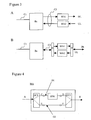
- Figure 1 shows a conventional indoor communications system structure.
- Figure 2 shows an example structure of an indoor communications system according to the invention.
- FIGS 3 A, B show exemplary details of an indoor communications system according to the invention.
- Figure 4 shows a multi-path arrangement according to the invention.
- FIG. 2 An example of an indoor communications system structure according to the invention, located in a building B, is shown in Figure 2 , comprising a base station Bs, a master unit Mu, a multi-path arrangement MA, interface connections I1 and i2, an optical network C2, three optical remote units RU and three in-building antennas A2 to A4.
- the base station Bs is connected to a core network CN along a first connection network C1 and the indoor antennas A2 to A4 send and receive radio signals Ws to/from a mobile station Ms.
- communications core network CN signals intended for the mobile station Ms are received by the base station Bs along connection C1. Said signals are then passed through a first connection interface i1, e.g. an RF or digital interface, to the master unit Mu in charge of adapting the signals received from the base station Bs to optical form and forward them through a second connection interface i2 to the optical network C2 for distribution.
- the optical network comprises the multi-path arrangement MA where the optical signals are split into at least two substantially identical optical sub-signals, a different time delay is applied to each individual optical sub-signal so that the at least two substantially identical optical sub-signals have a time delay difference of at least 1 chip length, and subsequently the optical sub-signals are combined.
- Said combined signals at the output of the multi-path arrangement MA are distributed to the optical remote units RU, which adapt the received optical signal, e.g. with the use of an opto-electrical converter and/or an opto-electrical amplifier, for transmission through the in-building antennas A2 to A4. Since the in-building antennas transmit this new radio signal showing multi-path effects, the performance of rake receivers within the mobile stations of the building is optimized and the quality of reception in such an environment is improved.
- radio signals Ws transmitted by the mobile station Ms located inside the building B are received by the in-building antenna A2 and passed to the optical remote unit RU, which adapts the signals, e.g. with the use of an electro-optical converter and/or an electro-optical amplifier, for transmission through the optical connection C2 to the multi-path arrangement MA.
- said optical signals are split into at least two substantially identical optical sub-signals, a different time delay is applied to each individual optical sub-signal so that the at least two substantially identical optical sub-signals have a time delay difference of at least 1 chip length, and subsequently the optical sub-signals are combined.
- Said combined signals at the output of the multi-path arrangement MA are passed through the second connection interface i2 to the master unit Mu in charge of adapting the signals received from the optical network C2 for transmission through the first connection interface, e.g. RF or digital interface, to the base station Bs.
- the base station provides said signals, in appropriate form, to a rake receiver within the base station which is in charge of processing the multi-path signal components and obtain the transmitted mobile station signal.
- Said signal is then forwarded to the communications core network CN.
- Figure 3A shows a first exemplary detail of an indoor communications system according to the invention comprising a first connections network C1, a base station Bs, an optical network C2 and two multi-path arrangements MA1 and MA2, the first used for downlink transmission DL and the second used for uplink transmission UL.
- Figure 3B shows also another way of using two multi-path arrangements MA1 and MA2 with only one optical line for both downlink DL and uplink transmission UL.
- WDMA wavelength multiplex access
- Figure 4 shows an example of a multi-path arrangement MA according to the invention for an optical network, comprising an optical signal input port A, an optical signal output port B, two optical transmission lines O1 and O2, two optical couplers OC1 and OC2, nodes C,D, E and F, and an optical delay unit ODU.
- the optical signal input A is connected to the first optical coupler OC1 which splits an incoming optical signal in two substantially identical optical sub-signals and outputs them in nodes C and E.
- a first optical transmission line O1 is connected between output node C of the first optical coupler OC1 and input node D of the second optical coupler OC2.
- a second optical transmission line O2 is connected between output node E of the first optical coupler OC1 and input node F of the second optical coupler OC2.
- An optical delay unit ODU is arranged in the first optical transmission line O1.
- the second optical coupler OC2 combines the two incoming optical sub-signals into a single optical signal at output port B.
- the first optical coupler OC1 splits an incoming optical signal that is fed in input port A into two substantially identical sub-signals. Those two optical sub-signals take two different signal paths ACDB and AEFB.
- the signal path ACDB introduces a time delay of at least one chip length, e.g. at least 260 ns for UMTS, to that optical sub-signal.
- the second optical coupler OC2 combines the two sub-signals after passing through their individual signal paths ACDB and AEFB to a new optical output signal showing a behavior similar to a signal in a multi-path environment.
- An incoming signal is then split into a number "n+1" of substantially identical optical sub-signals equal to the number of signal paths. After the sub-signals have passed through their individual signal paths they are combined to a new signal at output port B showing multi-path effects, that is showing a behavior similar to a radio signal received in an outdoor multi-path environment.
- the new combined signal comprises the necessary characteristics needed for the rake receivers present in mobile stations and base stations to demodulate this signal. This enables the activation of the so-called rake effect providing a higher SNR in receivers of node base stations and mobile phones.
- the optical delay unit ODU preferably is an optical fiber of appropriate physical length. It is also possible that the optical delay unit ODU is implemented as being the first optical transmission line O1 with the appropriate physical length.
- the optical delay unit ODU can also be implemented by any other known means and providing a variable and adjustable time delay.
- the multi-path arrangement MA is a reciprocal passive device, its transmission characteristics are identical in both port directions AB - BA. It is also understood that although presented in the figures as a standalone arrangement of the optical transmission network of the indoor communications system said functionality can also be implemented inside the optical repeater or the master unit of the indoor communications system.
Landscapes
- Engineering & Computer Science (AREA)
- Computer Networks & Wireless Communication (AREA)
- Signal Processing (AREA)
- Physics & Mathematics (AREA)
- Electromagnetism (AREA)
- Mobile Radio Communication Systems (AREA)
- Optical Communication System (AREA)
Claims (3)
- Verfahren für Innenraumkommunikation, wobei das Verfahren die folgenden Schritte umfasst:Eine Basisstation (Bs) empfängt ein für eine sich innerhalb einer geschlossenen Umgebung (B) befindliche Mobilstation (Ms) bestimmtes Signal,die Basisstation leitet das besagte Signal an eine Master-Einheit (Mu) weiter, welche das Signal für die Übertragung über ein optisches Netzwerk (C2) in ein optisches Signal umwandelt,das optische Netzwerk (C2) verteilt das besagte optische Signal an mindestens eine entfernte optische Einheit (RU), welche das optische Signal für die Übertragung über drahtlose Übertragungsmittel (A2 bis A4) in ein elektrisches Signal umwandelt,die Mobilstation (Ms) empfängt das von den drahtlosen Übertragungsmitteln (A2 bis A4) übertragene Signal und stellt das besagte Signal für einen Rake-Empfänger innerhalb der Mobil station (Ms) bereit,wobei das Verfahren gekennzeichnet ist durch,
innerhalb des optischen Netzwerks (C2),
in einer Mehrpfad-Anordnung (MA). Splitten des optischen Signals in mindestens zwei identische optische Teilsignale unter Anwendung einer verschiedenen Zeitverzögerung auf jedes individuelle optische Teilsignal, so dass die Zeitverzögerungsdifferenz zwischen den optischen Teilsignalen mindestens eine Chiplänge beträgt, und Kombinieren der mindestens zwei optischen Teilsignale mit verschiedenen Zeitverzögerungen. - Verfahren für Innenraumkommunikation, wobei das Verfahren die folgenden Schritte umfasst:Ein drahtloses Empfangsmittel (A2 bis A4) empfängt ein Funksignal von einer Mobilstation (Ms), welche sich innerhalb einer geschlossenen Umgebung (B) befindet,das drahtlose Empfangsmittel leitet das empfangene Funksignal an eine entfernte optische Einheit (RU) weiter, welche das Funksignal für die Übertragung über ein optisches Netzwerk (C2) in ein optisches Signal umwandelt,das optische Netzwerk (C2) leitet das besagte optische Signal an eine Master-Einheit (Mu) weiter, welche das Signal für den Empfang an einer Basisstation (Bs) anpasst,Bereitstellen des empfangenen Signals für einen Rake-Empfänger innerhalb der Basisstation (Bs),
wobei das Verfahren gekennzeichnet ist durch,
innerhalb des optischen Netzwerks (C2),in einer Mehrpfad-Anordnung (MA), Splitten des optischen Signals in mindestens zwei identische optische Teilsignale unter Anwendung einer verschiedenen Zeitverzögerung auf jedes individuelle optische Teilsignal, so dass die Zeitverzögerungsdifferenz zwischen den optischen Teilsignalen mindestens eine Chiplänge beträgt, und Kombinieren der mindestens zwei optischen Teilsignale mit verschiedenen Zeitverzögerungen. - Kommunikationssystem, welches drahtlose Verbindungen von einer Außenraum-Umgebung in eine geschlossene Innenraum-Umgebung (B) ausdehnt, wobei das Kommunikationssystem umfasst:In der Downlink-Richtung,- Mittel (Bs) zum Empfangen eines für eine sich innerhalb einer geschlossenen umgebung (B) befindliche Mobilstation (Ms) bestimmten Signals,- Mittel zum Weiterleiten des besagten Signals von der besagten Basisstation (Bs) an eine Master-Einheit (Mu) und zum Umwandeln des Signals in ein optisches Signal für die Übertragung über ein optisches Netzwerk (C2),- Mittel zum Verteilen des besagten optischen Signals durch das optische Netzwerk an mindestens eine entfernt optische (RU), welche fähig ist, das optische Signal für die Übertragung über ein drahtloses Übertragungsmittel (A2 bis A4) in ein elektrisches Signal umzuwandeln.- Mittel zum Empfangen des von dem drahtlosen Übertragungsmittel (A2 bis A4) übertragenen Signals an der Mobilstation (Ms) und zum Bereitstellen des besagten Signal an einen Rake-Empfänger innerhalb der Mobilstation (Ms): undin der Uplink-Richtung,- ein drahtloses Empfangsmittel (A2 bis A4) zum Empfangen eines Funksignals von einer Mobilstation (Ms),- Mittel zum Weiterleiten des besagten empfangenen Funksignals von dem besagten drahtlosen Empfangsmittel (A2 bis A4) an mindestens eine entfernte optische Einheit (RU), und zum Umwandeln des Signals in ein optisches Signals für die Übertragung über ein optisches Netzwerk (CS).- Mittel zum Weiterleiten des besagten optischen Signals durch das optische Netzwerk an eine Master-Einheit (Mu), und zum Anpassen des optischen Signals für den Empfang an einer Basisstation (Bs), undMittel zum Bereitstellen des besagten angepassten Signals an einen Rake-Empfanger innerhalb der Basisstation (Bs),wobei das Kommunikationssystem gekennzeichnet ist durch, innerhalb des optischen Netzwerks (C2):- Mittel (MA, OC1, OC2) zum Splitten des optische Signals in mindestens zwei identische optische Teilsignale,- Mittel (MA, O1, O2, ODU) zum Anwenden einer verschiedenen Zeitverzögerung auf jedes individuelle optische Teilsignal, so dass die Zeitvezögorungsdifferenz zwischen den optischen Teilsignalen mindestens eine Chiplänge beträgt, und- Mittel (MA, OC2, OC1) zum Kombinieren der mindestens zwei optischen Teilsignale mit verschiedenen Zeitveizögerungen, um ein optisches Signal mit Mehrpfad-Attributen zu erzeugen und so die drahtlose Innenraumkommunikation mit einer Basis- und/oder Mobilstation (Ms), welche einen Rake-Empfänger umfassen, zu verbessern.
Priority Applications (3)
| Application Number | Priority Date | Filing Date | Title |
|---|---|---|---|
| AT06301069T ATE438966T1 (de) | 2006-10-20 | 2006-10-20 | Innenraumkommunikationssystem und verfahren mit optischer verteilung |
| DE602006008315T DE602006008315D1 (de) | 2006-10-20 | 2006-10-20 | Innenraumkommunikationssystem und Verfahren mit optischer Verteilung |
| EP06301069A EP1914911B1 (de) | 2006-10-20 | 2006-10-20 | Innenraumkommunikationssystem und Verfahren mit optischer Verteilung |
Applications Claiming Priority (1)
| Application Number | Priority Date | Filing Date | Title |
|---|---|---|---|
| EP06301069A EP1914911B1 (de) | 2006-10-20 | 2006-10-20 | Innenraumkommunikationssystem und Verfahren mit optischer Verteilung |
Publications (2)
| Publication Number | Publication Date |
|---|---|
| EP1914911A1 EP1914911A1 (de) | 2008-04-23 |
| EP1914911B1 true EP1914911B1 (de) | 2009-08-05 |
Family
ID=37831436
Family Applications (1)
| Application Number | Title | Priority Date | Filing Date |
|---|---|---|---|
| EP06301069A Active EP1914911B1 (de) | 2006-10-20 | 2006-10-20 | Innenraumkommunikationssystem und Verfahren mit optischer Verteilung |
Country Status (3)
| Country | Link |
|---|---|
| EP (1) | EP1914911B1 (de) |
| AT (1) | ATE438966T1 (de) |
| DE (1) | DE602006008315D1 (de) |
Families Citing this family (1)
| Publication number | Priority date | Publication date | Assignee | Title |
|---|---|---|---|---|
| CN107968936B (zh) * | 2017-12-29 | 2023-09-29 | 长江勘测规划设计研究有限责任公司 | 应用于水电站地下厂房的网络传输设备 |
Family Cites Families (5)
| Publication number | Priority date | Publication date | Assignee | Title |
|---|---|---|---|---|
| JP2705623B2 (ja) * | 1995-03-22 | 1998-01-28 | 日本電気株式会社 | ダイバーシチ送受信方法及び送受信機 |
| JP3338747B2 (ja) * | 1995-12-28 | 2002-10-28 | 日本電気株式会社 | 干渉波除去装置 |
| US7020112B2 (en) * | 2000-12-28 | 2006-03-28 | Samsung Electronics Co., Ltd. | System and method for combining signals at multiple base station receivers |
| US20040240888A1 (en) * | 2003-05-30 | 2004-12-02 | Juerg Leuthold | System and method for alternate mark inversion and duobinary optical transmission |
| US7693082B2 (en) * | 2005-04-12 | 2010-04-06 | Azimuth Systems, Inc. | Latency measurement apparatus and method |
-
2006
- 2006-10-20 EP EP06301069A patent/EP1914911B1/de active Active
- 2006-10-20 DE DE602006008315T patent/DE602006008315D1/de active Active
- 2006-10-20 AT AT06301069T patent/ATE438966T1/de not_active IP Right Cessation
Also Published As
| Publication number | Publication date |
|---|---|
| EP1914911A1 (de) | 2008-04-23 |
| DE602006008315D1 (de) | 2009-09-17 |
| ATE438966T1 (de) | 2009-08-15 |
Similar Documents
| Publication | Publication Date | Title |
|---|---|---|
| US11695467B2 (en) | Reconfigurable and modular active repeater device | |
| JP5575230B2 (ja) | Cdmaビーコンパイロットを分散型リモートアンテナノードの出力に挿入する方法 | |
| CN109905886B (zh) | 增强型客户驻地设备 | |
| CN102362448B (zh) | 用于中继多输入多输出信号的单输入单输出中继器 | |
| US9686007B2 (en) | Wireless communication network using frequency conversion of MIMO signals | |
| US11206599B2 (en) | Main unit and distributed antenna system including the same | |
| US20070019679A1 (en) | Mobile communications network with multiple radio units | |
| JP7739054B2 (ja) | 通信中継システムおよび無線装置 | |
| JP3968590B2 (ja) | 無線基地局装置 | |
| KR20170081455A (ko) | 가시경로 상에서 다중입력 다중출력 시스템의 성능 향상 방법 | |
| EP1914911B1 (de) | Innenraumkommunikationssystem und Verfahren mit optischer Verteilung | |
| EP1914903B1 (de) | Verfahren und System für ein Innenraum-Funkkommunikationssystems mit Verteilung von Hochfrequenzsignalen | |
| EP1914902B1 (de) | Verfahren und System für ein Innenraum-Funkkommunikationssystems mit digitaler Verteilung | |
| CN108282165A (zh) | 一种无线通信系统架构 | |
| EP1916780A2 (de) | Anordnung und Verfahren zur Emulierung einer Mehrwegumgebung in einem Funknetz, das sich in einer mehrwegeffektfreien Umgebung befindet oder in diese hineinreicht | |
| Kunisawa et al. | High-Speed Uplink Data Wireless Transmission via a Frequency Conversion Relay Device from the Terahertz to the Millimeter-Wave Toward Beyond 5G Mobile Communication | |
| JPH05268658A (ja) | Cdma通信方式 | |
| Akahori et al. | Implementation of millimeter wave band DDD radio system | |
| US20110216754A1 (en) | Time delay transmit diversity radiofrequency device | |
| KR102250111B1 (ko) | 분산 안테나 시스템의 헤드엔드 장치 및 이의 동작 방법 | |
| KR20190095413A (ko) | 브랜칭 타워-탑재 증폭기 및 안테나 급전 시스템 | |
| KR100257187B1 (ko) | 디지탈 이동통신에 있어서 다중 경로 상호간섭 제거장치 | |
| KR20060124459A (ko) | 디지털 지연기를 내장한 휴대 인터넷 시스템의 기지국 | |
| Kelechi et al. | A Space-Diversity Technique for Mitigating Signal Fading in Radio Transmission | |
| KR20060047360A (ko) | 시분할이원화 시스템에서 기지국과 중계기간의 신호 지연처리 장치 및 그 방법 |
Legal Events
| Date | Code | Title | Description |
|---|---|---|---|
| PUAI | Public reference made under article 153(3) epc to a published international application that has entered the european phase |
Free format text: ORIGINAL CODE: 0009012 |
|
| AK | Designated contracting states |
Kind code of ref document: A1 Designated state(s): AT BE BG CH CY CZ DE DK EE ES FI FR GB GR HU IE IS IT LI LT LU LV MC NL PL PT RO SE SI SK TR |
|
| AX | Request for extension of the european patent |
Extension state: AL BA HR MK RS |
|
| 17P | Request for examination filed |
Effective date: 20070713 |
|
| AKX | Designation fees paid |
Designated state(s): AT BE BG CH CY CZ DE DK EE ES FI FR GB GR HU IE IS IT LI LT LU LV MC NL PL PT RO SE SI SK TR |
|
| AXX | Extension fees paid |
Extension state: MK Payment date: 20081023 Extension state: HR Payment date: 20081023 Extension state: AL Payment date: 20081023 Extension state: RS Payment date: 20081023 Extension state: BA Payment date: 20081023 |
|
| GRAP | Despatch of communication of intention to grant a patent |
Free format text: ORIGINAL CODE: EPIDOSNIGR1 |
|
| GRAS | Grant fee paid |
Free format text: ORIGINAL CODE: EPIDOSNIGR3 |
|
| GRAA | (expected) grant |
Free format text: ORIGINAL CODE: 0009210 |
|
| AK | Designated contracting states |
Kind code of ref document: B1 Designated state(s): AT BE BG CH CY CZ DE DK EE ES FI FR GB GR HU IE IS IT LI LT LU LV MC NL PL PT RO SE SI SK TR |
|
| AX | Request for extension of the european patent |
Extension state: AL BA HR MK RS |
|
| REG | Reference to a national code |
Ref country code: GB Ref legal event code: FG4D |
|
| REG | Reference to a national code |
Ref country code: CH Ref legal event code: EP |
|
| REG | Reference to a national code |
Ref country code: IE Ref legal event code: FG4D |
|
| REF | Corresponds to: |
Ref document number: 602006008315 Country of ref document: DE Date of ref document: 20090917 Kind code of ref document: P |
|
| LTIE | Lt: invalidation of european patent or patent extension |
Effective date: 20090805 |
|
| PG25 | Lapsed in a contracting state [announced via postgrant information from national office to epo] |
Ref country code: LT Free format text: LAPSE BECAUSE OF FAILURE TO SUBMIT A TRANSLATION OF THE DESCRIPTION OR TO PAY THE FEE WITHIN THE PRESCRIBED TIME-LIMIT Effective date: 20090805 Ref country code: IS Free format text: LAPSE BECAUSE OF FAILURE TO SUBMIT A TRANSLATION OF THE DESCRIPTION OR TO PAY THE FEE WITHIN THE PRESCRIBED TIME-LIMIT Effective date: 20091205 Ref country code: AT Free format text: LAPSE BECAUSE OF FAILURE TO SUBMIT A TRANSLATION OF THE DESCRIPTION OR TO PAY THE FEE WITHIN THE PRESCRIBED TIME-LIMIT Effective date: 20090805 Ref country code: FI Free format text: LAPSE BECAUSE OF FAILURE TO SUBMIT A TRANSLATION OF THE DESCRIPTION OR TO PAY THE FEE WITHIN THE PRESCRIBED TIME-LIMIT Effective date: 20090805 Ref country code: ES Free format text: LAPSE BECAUSE OF FAILURE TO SUBMIT A TRANSLATION OF THE DESCRIPTION OR TO PAY THE FEE WITHIN THE PRESCRIBED TIME-LIMIT Effective date: 20091116 Ref country code: SE Free format text: LAPSE BECAUSE OF FAILURE TO SUBMIT A TRANSLATION OF THE DESCRIPTION OR TO PAY THE FEE WITHIN THE PRESCRIBED TIME-LIMIT Effective date: 20090805 |
|
| NLV1 | Nl: lapsed or annulled due to failure to fulfill the requirements of art. 29p and 29m of the patents act | ||
| PG25 | Lapsed in a contracting state [announced via postgrant information from national office to epo] |
Ref country code: PL Free format text: LAPSE BECAUSE OF FAILURE TO SUBMIT A TRANSLATION OF THE DESCRIPTION OR TO PAY THE FEE WITHIN THE PRESCRIBED TIME-LIMIT Effective date: 20090805 Ref country code: SI Free format text: LAPSE BECAUSE OF FAILURE TO SUBMIT A TRANSLATION OF THE DESCRIPTION OR TO PAY THE FEE WITHIN THE PRESCRIBED TIME-LIMIT Effective date: 20090805 Ref country code: LV Free format text: LAPSE BECAUSE OF FAILURE TO SUBMIT A TRANSLATION OF THE DESCRIPTION OR TO PAY THE FEE WITHIN THE PRESCRIBED TIME-LIMIT Effective date: 20090805 Ref country code: NL Free format text: LAPSE BECAUSE OF FAILURE TO SUBMIT A TRANSLATION OF THE DESCRIPTION OR TO PAY THE FEE WITHIN THE PRESCRIBED TIME-LIMIT Effective date: 20090805 |
|
| PG25 | Lapsed in a contracting state [announced via postgrant information from national office to epo] |
Ref country code: PT Free format text: LAPSE BECAUSE OF FAILURE TO SUBMIT A TRANSLATION OF THE DESCRIPTION OR TO PAY THE FEE WITHIN THE PRESCRIBED TIME-LIMIT Effective date: 20091205 Ref country code: BG Free format text: LAPSE BECAUSE OF FAILURE TO SUBMIT A TRANSLATION OF THE DESCRIPTION OR TO PAY THE FEE WITHIN THE PRESCRIBED TIME-LIMIT Effective date: 20091105 |
|
| PG25 | Lapsed in a contracting state [announced via postgrant information from national office to epo] |
Ref country code: DK Free format text: LAPSE BECAUSE OF FAILURE TO SUBMIT A TRANSLATION OF THE DESCRIPTION OR TO PAY THE FEE WITHIN THE PRESCRIBED TIME-LIMIT Effective date: 20090805 Ref country code: RO Free format text: LAPSE BECAUSE OF FAILURE TO SUBMIT A TRANSLATION OF THE DESCRIPTION OR TO PAY THE FEE WITHIN THE PRESCRIBED TIME-LIMIT Effective date: 20090805 Ref country code: CZ Free format text: LAPSE BECAUSE OF FAILURE TO SUBMIT A TRANSLATION OF THE DESCRIPTION OR TO PAY THE FEE WITHIN THE PRESCRIBED TIME-LIMIT Effective date: 20090805 Ref country code: EE Free format text: LAPSE BECAUSE OF FAILURE TO SUBMIT A TRANSLATION OF THE DESCRIPTION OR TO PAY THE FEE WITHIN THE PRESCRIBED TIME-LIMIT Effective date: 20090805 |
|
| PG25 | Lapsed in a contracting state [announced via postgrant information from national office to epo] |
Ref country code: SK Free format text: LAPSE BECAUSE OF FAILURE TO SUBMIT A TRANSLATION OF THE DESCRIPTION OR TO PAY THE FEE WITHIN THE PRESCRIBED TIME-LIMIT Effective date: 20090805 Ref country code: MC Free format text: LAPSE BECAUSE OF NON-PAYMENT OF DUE FEES Effective date: 20091031 |
|
| PLBE | No opposition filed within time limit |
Free format text: ORIGINAL CODE: 0009261 |
|
| STAA | Information on the status of an ep patent application or granted ep patent |
Free format text: STATUS: NO OPPOSITION FILED WITHIN TIME LIMIT |
|
| PG25 | Lapsed in a contracting state [announced via postgrant information from national office to epo] |
Ref country code: BE Free format text: LAPSE BECAUSE OF FAILURE TO SUBMIT A TRANSLATION OF THE DESCRIPTION OR TO PAY THE FEE WITHIN THE PRESCRIBED TIME-LIMIT Effective date: 20090805 |
|
| 26N | No opposition filed |
Effective date: 20100507 |
|
| PG25 | Lapsed in a contracting state [announced via postgrant information from national office to epo] |
Ref country code: IE Free format text: LAPSE BECAUSE OF NON-PAYMENT OF DUE FEES Effective date: 20091020 Ref country code: GR Free format text: LAPSE BECAUSE OF FAILURE TO SUBMIT A TRANSLATION OF THE DESCRIPTION OR TO PAY THE FEE WITHIN THE PRESCRIBED TIME-LIMIT Effective date: 20091106 |
|
| PGFP | Annual fee paid to national office [announced via postgrant information from national office to epo] |
Ref country code: IT Payment date: 20101022 Year of fee payment: 5 |
|
| PG25 | Lapsed in a contracting state [announced via postgrant information from national office to epo] |
Ref country code: LU Free format text: LAPSE BECAUSE OF NON-PAYMENT OF DUE FEES Effective date: 20091020 |
|
| REG | Reference to a national code |
Ref country code: CH Ref legal event code: PL |
|
| PG25 | Lapsed in a contracting state [announced via postgrant information from national office to epo] |
Ref country code: HU Free format text: LAPSE BECAUSE OF FAILURE TO SUBMIT A TRANSLATION OF THE DESCRIPTION OR TO PAY THE FEE WITHIN THE PRESCRIBED TIME-LIMIT Effective date: 20100206 |
|
| PG25 | Lapsed in a contracting state [announced via postgrant information from national office to epo] |
Ref country code: LI Free format text: LAPSE BECAUSE OF NON-PAYMENT OF DUE FEES Effective date: 20101031 Ref country code: CH Free format text: LAPSE BECAUSE OF NON-PAYMENT OF DUE FEES Effective date: 20101031 |
|
| PG25 | Lapsed in a contracting state [announced via postgrant information from national office to epo] |
Ref country code: TR Free format text: LAPSE BECAUSE OF FAILURE TO SUBMIT A TRANSLATION OF THE DESCRIPTION OR TO PAY THE FEE WITHIN THE PRESCRIBED TIME-LIMIT Effective date: 20090805 |
|
| PG25 | Lapsed in a contracting state [announced via postgrant information from national office to epo] |
Ref country code: CY Free format text: LAPSE BECAUSE OF FAILURE TO SUBMIT A TRANSLATION OF THE DESCRIPTION OR TO PAY THE FEE WITHIN THE PRESCRIBED TIME-LIMIT Effective date: 20090805 |
|
| PG25 | Lapsed in a contracting state [announced via postgrant information from national office to epo] |
Ref country code: IT Free format text: LAPSE BECAUSE OF NON-PAYMENT OF DUE FEES Effective date: 20111020 |
|
| REG | Reference to a national code |
Ref country code: FR Ref legal event code: GC Effective date: 20131018 |
|
| REG | Reference to a national code |
Ref country code: FR Ref legal event code: RG Effective date: 20141016 |
|
| REG | Reference to a national code |
Ref country code: FR Ref legal event code: CA Effective date: 20150521 |
|
| REG | Reference to a national code |
Ref country code: FR Ref legal event code: CA Effective date: 20150521 |
|
| REG | Reference to a national code |
Ref country code: FR Ref legal event code: PLFP Year of fee payment: 10 |
|
| REG | Reference to a national code |
Ref country code: FR Ref legal event code: PLFP Year of fee payment: 11 |
|
| REG | Reference to a national code |
Ref country code: FR Ref legal event code: PLFP Year of fee payment: 12 |
|
| PGFP | Annual fee paid to national office [announced via postgrant information from national office to epo] |
Ref country code: FR Payment date: 20171024 Year of fee payment: 12 |
|
| REG | Reference to a national code |
Ref country code: GB Ref legal event code: 732E Free format text: REGISTERED BETWEEN 20190429 AND 20190502 |
|
| REG | Reference to a national code |
Ref country code: DE Ref legal event code: R082 Ref document number: 602006008315 Country of ref document: DE Representative=s name: MENZIETTI WETZEL, DE Ref country code: DE Ref legal event code: R081 Ref document number: 602006008315 Country of ref document: DE Owner name: PROVENANCE ASSET GROUP LLC, PITTSFORD, US Free format text: FORMER OWNER: ALCATEL LUCENT, PARIS, FR |
|
| PG25 | Lapsed in a contracting state [announced via postgrant information from national office to epo] |
Ref country code: FR Free format text: LAPSE BECAUSE OF NON-PAYMENT OF DUE FEES Effective date: 20181031 |
|
| PGFP | Annual fee paid to national office [announced via postgrant information from national office to epo] |
Ref country code: GB Payment date: 20201029 Year of fee payment: 15 Ref country code: DE Payment date: 20201027 Year of fee payment: 15 |
|
| REG | Reference to a national code |
Ref country code: DE Ref legal event code: R119 Ref document number: 602006008315 Country of ref document: DE |
|
| GBPC | Gb: european patent ceased through non-payment of renewal fee |
Effective date: 20211020 |
|
| PG25 | Lapsed in a contracting state [announced via postgrant information from national office to epo] |
Ref country code: GB Free format text: LAPSE BECAUSE OF NON-PAYMENT OF DUE FEES Effective date: 20211020 Ref country code: DE Free format text: LAPSE BECAUSE OF NON-PAYMENT OF DUE FEES Effective date: 20220503 |