EP1916518A2 - Appareil de détection de marqueur et procédé de détection de marqueur - Google Patents
Appareil de détection de marqueur et procédé de détection de marqueur Download PDFInfo
- Publication number
- EP1916518A2 EP1916518A2 EP07254180A EP07254180A EP1916518A2 EP 1916518 A2 EP1916518 A2 EP 1916518A2 EP 07254180 A EP07254180 A EP 07254180A EP 07254180 A EP07254180 A EP 07254180A EP 1916518 A2 EP1916518 A2 EP 1916518A2
- Authority
- EP
- European Patent Office
- Prior art keywords
- quasi
- marker
- sample flow
- electric field
- electrostatic field
- Prior art date
- Legal status (The legal status is an assumption and is not a legal conclusion. Google has not performed a legal analysis and makes no representation as to the accuracy of the status listed.)
- Granted
Links
Images








Classifications
-
- G—PHYSICS
- G01—MEASURING; TESTING
- G01N—INVESTIGATING OR ANALYSING MATERIALS BY DETERMINING THEIR CHEMICAL OR PHYSICAL PROPERTIES
- G01N29/00—Investigating or analysing materials by the use of ultrasonic, sonic or infrasonic waves; Visualisation of the interior of objects by transmitting ultrasonic or sonic waves through the object
- G01N29/22—Details, e.g. general constructional or apparatus details
- G01N29/222—Constructional or flow details for analysing fluids
-
- G—PHYSICS
- G01—MEASURING; TESTING
- G01N—INVESTIGATING OR ANALYSING MATERIALS BY DETERMINING THEIR CHEMICAL OR PHYSICAL PROPERTIES
- G01N15/00—Investigating characteristics of particles; Investigating permeability, pore-volume or surface-area of porous materials
- G01N15/10—Investigating individual particles
- G01N15/1031—Investigating individual particles by measuring electrical or magnetic effects
-
- G—PHYSICS
- G01—MEASURING; TESTING
- G01N—INVESTIGATING OR ANALYSING MATERIALS BY DETERMINING THEIR CHEMICAL OR PHYSICAL PROPERTIES
- G01N29/00—Investigating or analysing materials by the use of ultrasonic, sonic or infrasonic waves; Visualisation of the interior of objects by transmitting ultrasonic or sonic waves through the object
- G01N29/02—Analysing fluids
- G01N29/036—Analysing fluids by measuring frequency or resonance of acoustic waves
-
- G—PHYSICS
- G01—MEASURING; TESTING
- G01N—INVESTIGATING OR ANALYSING MATERIALS BY DETERMINING THEIR CHEMICAL OR PHYSICAL PROPERTIES
- G01N33/00—Investigating or analysing materials by specific methods not covered by groups G01N1/00 - G01N31/00
- G01N33/48—Biological material, e.g. blood, urine; Haemocytometers
- G01N33/50—Chemical analysis of biological material, e.g. blood, urine; Testing involving biospecific ligand binding methods; Immunological testing
- G01N33/53—Immunoassay; Biospecific binding assay; Materials therefor
- G01N33/543—Immunoassay; Biospecific binding assay; Materials therefor with an insoluble carrier for immobilising immunochemicals
- G01N33/54313—Immunoassay; Biospecific binding assay; Materials therefor with an insoluble carrier for immobilising immunochemicals the carrier being characterised by its particulate form
-
- G—PHYSICS
- G01—MEASURING; TESTING
- G01N—INVESTIGATING OR ANALYSING MATERIALS BY DETERMINING THEIR CHEMICAL OR PHYSICAL PROPERTIES
- G01N2291/00—Indexing codes associated with group G01N29/00
- G01N2291/02—Indexing codes associated with the analysed material
- G01N2291/025—Change of phase or condition
- G01N2291/0255—(Bio)chemical reactions, e.g. on biosensors
-
- G—PHYSICS
- G01—MEASURING; TESTING
- G01N—INVESTIGATING OR ANALYSING MATERIALS BY DETERMINING THEIR CHEMICAL OR PHYSICAL PROPERTIES
- G01N2291/00—Indexing codes associated with group G01N29/00
- G01N2291/02—Indexing codes associated with the analysed material
- G01N2291/025—Change of phase or condition
- G01N2291/0256—Adsorption, desorption, surface mass change, e.g. on biosensors
-
- G—PHYSICS
- G01—MEASURING; TESTING
- G01N—INVESTIGATING OR ANALYSING MATERIALS BY DETERMINING THEIR CHEMICAL OR PHYSICAL PROPERTIES
- G01N2291/00—Indexing codes associated with group G01N29/00
- G01N2291/04—Wave modes and trajectories
- G01N2291/042—Wave modes
- G01N2291/0423—Surface waves, e.g. Rayleigh waves, Love waves
-
- G—PHYSICS
- G01—MEASURING; TESTING
- G01N—INVESTIGATING OR ANALYSING MATERIALS BY DETERMINING THEIR CHEMICAL OR PHYSICAL PROPERTIES
- G01N2291/00—Indexing codes associated with group G01N29/00
- G01N2291/04—Wave modes and trajectories
- G01N2291/042—Wave modes
- G01N2291/0426—Bulk waves, e.g. quartz crystal microbalance, torsional waves
-
- G—PHYSICS
- G01—MEASURING; TESTING
- G01N—INVESTIGATING OR ANALYSING MATERIALS BY DETERMINING THEIR CHEMICAL OR PHYSICAL PROPERTIES
- G01N2291/00—Indexing codes associated with group G01N29/00
- G01N2291/04—Wave modes and trajectories
- G01N2291/042—Wave modes
- G01N2291/0427—Flexural waves, plate waves, e.g. Lamb waves, tuning fork, cantilever
Definitions
- the present invention contains subject matter related to Japanese Patent Application JP2006-287898 filed in the Japanese Patent Office on Oct. 23, 2006, the entire contents of which being incorporated herein by reference.
- the present invention relates to a marker detection apparatus and marker detection method, and is preferably applied to a flow cytometry technique, for example.
- Flow cytometry uses a flow or stream: the target samples, labeled by fluorescent substances or a marker under a certain condition, are put into the flow one by one.
- a laser beam is directed onto the droplets of the flow at a right angle.
- the above flow cytometer has limitation in detecting the small markers, which is determined by the wavelength of the laser beam. This means that the flow cytometer may not be able to detect the markers smaller than around 340 nm to 633 nm. Accordingly, the flow cytometer may need some adjustment or calibration of the optical components to precisely detect those small markers.
- the present invention has been made in view of the above points and is intended to provide a marker detection apparatus and marker detection method that can accurately detect a marker.
- a marker detection apparatus detects a marker attached to a target sample from samples flowing in a sample flow, including: an electric field formation section that forms a quasi-electrostatic field in a path of the sample flow; and a detection section that detects, when the target sample labeled by the marker that is a particle made from a piezoelectric or electrostrictive substance of a unique vibration frequency gets into the quasi-electrostatic field, the vibration of the particle.
- the apparatus can detect the vibration of the particle, which is caused by the inverse piezoelectric effect, by using the quasi-electrostatic field generated in a limited space without depending on the wavelength.
- the apparatus can detect the smaller markers than the typical laser-type apparatus can.
- the apparatus since the apparatus generates the quasi-electrostatic field in an area including the sample flow, the apparatus can detect the markers behind the direction of the emitted laser beam, while the typical laser-type apparatus, which is designed to emit the straight laser beam in a direction perpendicular to the layer flow, may not be able to detect.
- a marker detection apparatus detects a marker attached to a target sample from samples flowing in a sample flow, including: an elastic wave applying section that applies an elastic wave to a path of the sample flow; and a detection section that detects, when the target sample labeled by the marker that is a particle made from a piezoelectric or electrostrictive substance of a unique vibration frequency flows in the sample flow, a quasi-electrostatic field that is generated on the particle due to the piezoelectric or electrostrictive effect of the particle as a result of applying the elastic wave.
- the apparatus can detect the vibration of the particle, which is caused by the piezoelectric effect, by using the quasi-electrostatic field generated in a limited space without depending on the wavelength.
- the apparatus can detect the smaller markers than the typical laser-type apparatus can.
- the apparatus can detect the markers behind the direction of the emitted laser beam, while the typical laser-type apparatus, which is designed to emit the straight laser beam in a direction perpendicular to the layer flow, may not be able to detect.
- the marker detection apparatus detects the vibration of the particle (piezoelectric or electrostrictive substance), which is caused by the inverse piezoelectric effect or the piezoelectric effect, by using the quasi-electrostatic field.
- the marker detection apparatus and marker detection method according to an embodiment of the present invention can accurately detect a marker.
- a quasi-electrostatic field is used to detect a target sample labeled or marked by a marker.
- Various aspects of the electric field will be described, followed by description of the present embodiment for identifying the samples.
- the electric field intensity E is represented as a polar coordinate (r, ⁇ , ⁇ ).
- the electric fields Er and E ⁇ are generated as the combination of: a radiated electric field (the third element of the equation of E ⁇ ), which linearly and inversely varies according to the distance from the electric field source; an induction field (the second element of the equations of Er and E ⁇ ), which is inversely proportional to the square of the distance from the electric field source; and a quasi-electrostatic field (the first element of the equations of Er and E ⁇ ), which is inversely proportional to the cube of the distance from the electric field source.
- the electric field is classified into the radiated electric field, the induction field and the quasi-electrostatic field.
- T Ql cos ⁇ 2 ⁇ ⁇ ⁇ r 3 ⁇ exp - jkr
- the quasi-electrostatic field has higher resolution to the distance than the radiated electric field and the induction field.
- the electric field source produces the radiated electric field, the induction field and the quasi-electrostatic field. And if the intensity of the target quasi-electrostatic field is stronger than that of the radiated electric field and the induction field, it is possible to assume that the radiated electric field and the induction field are not there. Thus, the quasi-electrostatic field can be detected.
- FIG. 1 is a graph illustrating correlation of relative intensities between the radiated electric field, the induction field and the quasi-electrostatic field and the distance.
- FIG. 1 uses exponents to describe the correlation between the relative intensities of the electric fields (1 MHz) and the distance.
- the radiated electric field is predominant (over the induction field and the quasi-electrostatic field) in an area beyond the intensity boundary while the quasi-electrostatic field is predominant (over the induction field and the radiated electric field) inside the intensity boundary.
- the frequency is important when the space of the quasi-electrostatic field, whose intensity is stronger than the radiated electric field and the induction field, is widened.
- the space of the quasi-electrostatic field, whose intensity is stronger than the radiated electric field and the induction field is also referred to as a "quasi-electrostatic field dominant space".
- the boundary of the quasi-electrostatic field dominant space is 0.675 m when the frequency is 10 MHz.
- FIG. 2 illustrates the intensities and distances regarding the radiated electric field, the induction field and the quasi-electrostatic field when the frequency is 10 MHz.
- the intensity of the quasi-electrostatic field is 18.2 dB stronger than that of the induction field at 0.01 m away from the electric field source. Accordingly, the effect of the radiated electric field and the induction field can be ignored at this point.
- the quasi-electrostatic field is predominant over the radiated electric field and the induction field around the electric field source and the space of the quasi-electrostatic field becomes larger.
- the intensity of the target quasi-electrostatic field is stronger than that of the out-of-target radiated electric field and induction field around the electric field source. Therefore, the quasi-electrostatic field is detected to accurately identify samples.
- Fig. 3 illustrates a flow cytometer according to an embodiment of the present invention.
- the flow cytometer 1 includes a water flow unit 2, a detection unit 3, a data processing unit 4 and a sorting/retrieval unit 5
- the water flow unit 2 includes a sheath flow generation section 2A that gives a predetermined sheath pressure to produce a sheath flow, which is then supplied via a sheath tube to an interflow chamber 2X.
- the water flow unit 2 also includes a sample flow generation section 2B that gives a predetermined sample pressure to generate a sample flow, which is then supplied via a sample tube to the interflow chamber 2X.
- the combined stream or layer flow LF spouts out from an outlet OP of a nozzle of the interflow chamber 2X, the sample flow being in the center of the combined stream while the sheath flow in the rim of the stream.
- the water flow unit 2 is designed to control the layer flow FL: The sample flow does not mixed up with the sheath flow covering the sample flow and each sample flows separately in the sample flow.
- the layer flow LF is turbulent when R > 1000.
- the layer flow LF is stable when R ⁇ 1000.
- Such a state of the layer flow LF with R ⁇ 1000 is known as laminar flow. Since fluid viscosity largely depends on temperature, the sheath flow generation section 2A appropriately controls temperature for the sheath flow.
- the detection unit 3 is placed in the path of the layer flow. By using a quasi-electrostatic field, the detection unit 3 electrically detects a marker (label substance) attached to target samples, each of which separately exists in the sample flow. The detection unit 3 subsequently supplies resulting detection data to the data processing unit 4.
- a marker label substance
- the data processing unit 4 is a computer to identify the type of the target sample from the detection data. After identifying the type, the data processing unit 4 decides how much charge voltage it will apply to the target sample.
- the sorting/retrieval unit 5 applies the charge voltage, determined by the data processing unit 4, to the sample flow when the layer flow LF breaks into droplets (break off point).
- the flow cytometer 1 identifies and sorts out the target sample.
- the following describes the marker attached to the target samples.
- the marker is used to identify the sample.
- the marker used in this embodiment is a piezoelectric substance of a certain vibration frequency, including a piezoelectric crystal, a piezoelectric ceramics, a piezoelectric thin film, a piezoelectric polymer substance and a ferrodielectric substance (also known as relaxor).
- the piezoelectric substance can be: crystal (SiO 2 ), lithium niobate (LiNbO 3 ), barium titanate (BaTiO 3 ) lead titanate (PbTiO 3 ), lead zirconate titanate (PZN), lead metaniobate (PbNb 2 O 6 ), polyvinylidene fluoride (PVDF) and zinc oxide (ZnO).
- the piezoelectric substance also can be: lithium tantalite (LiTaO 3 ), potassium niobate (K 4 NbO 3 ), lithium tetraborate (Li 2 B 4 O 7 ), langasite (La 3 Ga 5 SiO 14 ), aluminum nitride (A1N) and tourmaline.
- the method of attaching the marker (i.e. piezoelectric substance) to a target sample is: attaching the piezoelectric substance to a probe that is specific to a distinctive part of the target sample and then attaching the probe with the piezoelectric substance to the distinctive part of the target sample.
- the probe can be an antibody. This kind of probe is used to detect a certain cell because an antibody is attached to the corresponding antigen by the primary antibody method, the secondary antibody method or affinity of avidin/biotin.
- the probe may also include Annexin V, and MHC class I - peptide tetramer and the like. They are a high molecular weight protein of the immunoglobulin superfamily, used for detecting apoptotic cells or antigen-specific CD8 + T cells.
- probes such as DNA oligomer or RNA oligomer, which utilizes characteristic of complementary binding of DNA and RNA. Those probes are used to detect the sequences of DNA or RNA because they attach to a specific sequence by hybridization.
- the piezoelectric substance to the probes there are methods to attach the piezoelectric substance to the probes.
- One of the methods is directly attaching the piezoelectric substance to the probes.
- the other is attaching the piezoelectric substance to the probes through organic polymeric materials such as dextran, albumin, starch, polyacrylamide and polyethylene glycol (refer to: Inada Yuji, protein hybridization Vol. 3, Kyoritsu Shuppan Co., Ltd. 1990 ).
- each of them may be a piezoelectric substance of a different vibration frequency to be attached to the target cell.
- the piezoelectric substances (A and B), each of which has a different vibration frequency are attached to the antigens through corresponding antibodies or probes. In this manner, one or more unique piezoelectric substances are attached to the target sample.
- FIG. 5 illustrates the configuration of the detection unit 3.
- the detection unit 3 includes a layer flow tube 10 and a plurality of marker detection sections 20 1 to 20 n .
- the layer flow tube 10 is connected to the interflow chamber 2X of the water flow unit 2.
- the layer flow tube 10 is placed such that the inner wall of the layer flow tube 10 surrounds or covers the outer layer of the layer flow LF emerging from the outlet OP of the nozzle of the interflow chamber 2X.
- the marker detection sections 20 1 to 20 n includes parallel plane electrodes 21 1 to 21 n , sine wave signal output sections 22 1 to 22 n and elastic wave detection sections 23 1 to 23 n .
- the parallel plane electrodes 21 1 to 21 n placed between the outer and inner walls of the layer flow tube 10, are provided along the layer flow at certain intervals so that a pair of the parallel plane electrodes faces each other. Accordingly, when the nozzle's outlet OP spouts out the layer flow FL, the samples in the sample flow SF2 flows through between the parallel plane electrodes 21 1 to 21 n .
- FIG. 5 shows the connection lines that look like passing through the layer flow tube 10. However, in fact, those lines are passing through a predetermined path.
- the sine wave signal output sections 22 1 to 22 n outputs the sine-wave alternating voltage whose frequencies are the same as the vibration frequencies (f 1 to f n ) of the piezoelectric substance that is selected as a target out of the piezoelectric substances of different unique vibration frequencies.
- Those frequencies (f 1 to f n ) are determined such that, in an area from a reference position to a target position (which is also referred to as a "detection target area”), the intensity of the quasi-electrostatic field (which is in inverse proportion to the cube of the distance from the reference position) is stronger than the intensity of the induction field (which is in inverse proportion to the square of the distance from the reference position).
- the detection target area is determined based on a distance from the parallel plane electrodes 21 1 to 21 n to the sample flow SF2 and a distance between the parallel plane electrodes facing each other. For example, when the detection target area extends 1 cm from the parallel plane electrodes, "r" of the above equation (11) is 0.01 m and therefore the frequency is 4.7 GHz.
- the intensity of the generated quasi-electrostatic field is larger than that of the radiated electric field and the induction field if the frequency is lower than 4.7 GHz.
- FIGS. 7 and 8 illustrate the quasi-electrostatic field generated from the parallel plane electrodes.
- FIG. 7 is a cross sectional view of the layer flow tube in the horizontal direction (or a direction perpendicular to the layer flow) while FIG. 8 is a cross sectional view of the layer flow tube in the vertical direction (or a direction parallel to the layer flow).
- the simulation runs under the condition that: the frequency of a feeding wave is 10 MHz; the amplitude of the feeding wave is 1 V ; the outer diameter of the layer flow tube is 280 ⁇ m; the inner diameter of the layer flow tube is 200 ⁇ m; the relative permittivity of the layer flow tube is 2; the electric conductivity of the layer flow tube is 0 S/m; the relative permittivity of the normal saline solution that passes through the layer flow tube is 80; and the electric conductivity of the solution is 2 S/m.
- the attached reference drawing 1 uses several colors to illustrate the distribution pattern of the electric field intensity (also shown in FIG. 7) while the attached reference drawing 2 uses several colors to illustrate the distribution pattern of the electric field intensity (also shown in FIG. 8).
- the intensity of the quasi-electrostatic field is strong around the parallel plane electrodes.
- the intensity of the quasi-electrostatic field becomes weaker with distance from the parallel plane electrodes.
- the quasi-electrostatic field does not expand so much through the normal saline solution.
- the quasi-electrostatic field is generated only around the parallel plane electrodes.
- the sine wave signal output sections 22 1 to 22 n supplies to the corresponding parallel plane electrodes a plurality of levels of sine-wave alternating voltage, whose frequencies are the same as the corresponding piezoelectric substances' vibration frequencies and are also lower than a certain frequency at which the intensities of the radiated electric field, the induction field and the quasi-electrostatic field become equal to one another in the detection target area.
- the quasi-electrostatic field dominant space is generated around the parallel plane electrodes.
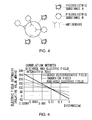
- the target sample labeled by two piezoelectric substances of different vibration frequencies may flow in the sample flow SF as shown in FIG. 4.
- the piezoelectric substance begins to vibrate in its unique vibration frequency (i.e. the inverse piezoelectric effect). Therefore, the corresponding elastic wave detection section 23 detects its vibration distortion as elastic wave.
- the elastic waves do not interfere with the charge voltage, which is applied to the sample flow by the sorting/retrieval unit 5, because the frequency of the elastic waves is different from that of the charge voltage.
- each of the elastic wave detection sections 23 1 to 23 n includes a piezoelectric plate 31 on which an Inter Digital Transducer (IDT) 32 is placed.
- the piezoelectric plate 31 will be in sympathetic vibration with the elastic waves from the target sample to generate a surface wave (i.e. the piezoelectric effect).
- the IDT 32 includes two comb-shaped conductors facing each other as if being interlocked, serving as a filter to extract a certain signal component.
- the IDT 32 of the elastic wave detection sections uses a certain material for the piezoelectric plate with a certain interval regarding the teeth of the comb-like conductors such that they are suitable for the frequencies (f 1 to f n ) of the sine wave alternating voltage from the corresponding sine wave signal output sections 22 1 to 22 n (FIG. 5). Accordingly, the IDT 32 of the elastic wave detection sections 23 1 to 23 n retrieves a wave of the same frequency as the corresponding piezoelectric substance from the surface waves generated around the piezoelectric plate 31 and then supplies a resulting detection signal S1 to the data processing unit 4 (FIG. 3).
- the parallel plane electrodes 21 1 to 21 n (which are spaced, along the layer flow, a certain distance from each other) of the detection unit 3 (FIG. 5) generate the quasi-electrostatic field dominant spaces of different frequencies (f 1 to f n ).
- the piezoelectric substance attached to the target sample passes through between the parallel plane electrodes 21 1 to 21 n , the piezoelectric substance vibrates in the quasi-electrostatic field whose frequency is the same as that of the piezoelectric substance.
- the elastic wave detection sections 23 1 to 23 n therefore generate the detection signal S1 representing the fact that the piezoelectric substance of a specific frequency has been detected, and then supplies the detection signal S1 to the data processing unit 4 (FIG. 3).
- the data processing unit 4 includes a Central Processing Unit (CPU) 41 connected to a Read Only Memory (ROM) 42, which stores various programs, a Random Access Memory (RAM) 43, which serves as a work memory for the CPU, a signal input section 44 and a storage section 45.
- CPU Central Processing Unit
- ROM Read Only Memory
- RAM Random Access Memory
- the signal input section 44 amplifies the detection signal S1, supplied from the IDT 32 (FIG. 9) of the elastic wave detection sections 23 1 to 23 n , and then performs an Analog-to-Digital (A/D) conversion process.
- the signal input section 44 subsequently supplies resultant detection data D1 to the CPU 41.
- the storage section 45 stores a database (also referred to as a "sample identification table") in which the types of the target samples, the condition of the markers (or piezoelectric substances) for the target samples and the values of the charge voltages applied to the target samples are associated with one another.
- a database also referred to as a "sample identification table” in which the types of the target samples, the condition of the markers (or piezoelectric substances) for the target samples and the values of the charge voltages applied to the target samples are associated with one another.
- the CPU 41 executes a program stored in the ROM 42 and then identifies the type of the target sample in the sheath flow, based on the sample identification table and the detection data D1 from the signal input section 44. In addition, the CPU 41 determines how much charge voltage it will apply to the target sample.
- FIG. 12 is a flowchart illustrating the process of the CPU 41.
- the CPU 41 starts running the water flow unit 2, the detection unit 3 and the sorting/retrieval unit 5, and then proceeds to step SP1.
- the CPU 41 waits until it receives the detection signal S1 from the elastic wave detection sections 23 1 to 23 n .
- the CPU 41 After receiving the detection signal S1 from the elastic wave detection sections 23 1 to 23 n , the CPU 41 proceeds to step SP2. At step SP2, the CPU 41 identifies the type of the target sample that has passed through the elastic wave detection sections 23 1 to 23 n , based on the detection signal S1 and the sample identification table (FIG. 11) stored in the storage section 45. In addition, the CPU 41 determines how much charge voltage it will apply to the target sample.
- the CPU 41 at step SP3 notifies the sorting/retrieval unit 5 of the charge voltage level determined at step SP2 and then returns to step SP1.
- the sorting/retrieval unit 5 will apply that level of the charge voltage to the sample flow when the droplets break off the flow (break off point).
- the charged droplet including the target sample is broken off from the flow by the deflection plate 5A or 5B, flowing into one of collection tubes CT 1 to CT m .
- the data processing unit 4 analyzes the target samples based on the detection result of the detection unit 3. In addition, the data processing unit 4 controls the sorting/retrieval unit 5 such that each collection tube CT collects a corresponding target sample.
- the flow cytometer 1 includes the parallel plane electrodes 21 (adjacent to the layer flow LF) to generate the quasi-electrostatic field along the path of the layer flow LF.
- the elastic wave detection sections 23 detect vibration of the piezoelectric substance (or the elastic wave) when the piezoelectric substance attached to the target sample gets into the quasi-electrostatic field.
- the flow cytometer 1 utilizes the quasi-electrostatic field, which is generated within a limited space area without depending on the wavelength. This enables the flow cytometer 1 to detect the vibration (elastic wave) arising from the inverse piezoelectric effect of the piezoelectric substance. Accordingly, the flow cytometer 1 can detect the smaller markers than a typical laser type apparatus can detect (the typical laser type apparatus may not be able to detect the markers smaller than the wavelength of its laser beam).
- the quasi-electrostatic field is generated in a space area including the cut plane of the sample flow SF2. This enables the flow cytometer 1 to detect the markers behind the direction of the emitted laser beam, while the typical laser type apparatus, which uses the straight laser beam traveling in a direction perpendicular to the layer flow LF, may not be able to detect them.
- the sine wave signal output sections 22 outputs a signal of a certain frequency such that the intensity of the quasi-electrostatic field becomes stronger than that of the induction field.
- the quasi-electrostatic field generated from the parallel plane electrodes 21 is predominant over the radiated electric field and induction field generated from the parallel plane electrodes 21 around the elastic wave detection sections 23. Accordingly, the elastic wave detection sections 23 can detect the piezoelectric substance attached to the target sample in the sample flow SF2.
- the flow cytometer 1 includes a plurality of parallel plane electrodes 21 and elastic wave detection sections 23 to detect a plurality of vibration particles (piezoelectric substances or electrostrictive substances) of different vibration frequencies:
- One detection unit is a pair of a parallel plane electrode 21 and an elastic wave detection section 23. Those detection units are spaced a predetermined distance away from each other so as to prevent the quasi-electrostatic fields from the parallel plane electrodes 21 from affecting each other.
- each detection unit detects a piezoelectric substance of a certain vibration frequency from the layer flow. This enables the flow cytometer 1 to precisely detect the piezoelectric substances of different vibration frequencies even if there are various piezoelectric substances attached to the target sample.
- the flow cytometer 1 according to the present embodiment can be downsized, compared to a typical laser-type flow cytometer that includes complex optical components for sorting out various types of scattered beams into corresponding detectors in order to detect the target samples labeled by various fluorescent markers.
- the flow cytometer 1 has the layer flow tube 10 that carries the layer flow LF as if it surrounds the surface of the layer flow LF. Between the inner and outer walls of the layer flow tube 10 are placed the parallel plane electrodes 21 and the elastic wave detection sections 23 to make the parallel plane electrodes 21 and the elastic wave detection sections 23 close to the sample flow SF2. This allows the flow cytometer 1 to produce the small quasi-electrostatic fields. That also eliminates the effect of noise for precise detection.
- the flow cytometer 1 detects the vibration caused by the inverse piezoelectric effect regarding the piezoelectric or electrostrictive substances.
- the flow cytometer 1 can precisely detect the target samples.
- the piezoelectric substances are used as the markers.
- the markers may include electrostrictive materials.
- the electrostrictive materials represents: When an electric field is applied to the crystal, the resulting strain will be proportional to the square of the polarization.
- the electrostrictive materials may be useful because there is no need for polarizing process for the electrostrictive materials (while the piezoelectric substance may need the polarizing process) and they have a symmetrical appearance.
- the sine wave signal output sections 22 1 to 22 n are connected to the corresponding parallel plane electrodes 21 1 to 21 n .
- the present invention is not limited to this.
- a sine wave signal output section may be connected to the parallel plane electrodes 21 1 to 21 n through a constant voltage variable frequency control section that adjusts the sine wave alternating voltage from the sine wave signal output section to supply a plurality of frequencies of alternating voltage to the parallel plane electrodes.
- the parallel plane electrodes 21 1 to 21 n between the outer and inner walls of the layer flow tube 10 are spaced, along the layer flow, a certain distance from each other.
- the present invention is not limited to this.
- the parallel plane electrodes 21 1 to 21 n may be placed outside the layer flow tube 10. Otherwise, the flow cytometer 1 may not have the layer flow tube 10.
- the flow cytometer 1 includes, as an electric field formation means, the parallel plane electrodes 21 1 to 21 n (which are placed between the outer and inner walls of the layer flow tube 10 and are spaced, along the layer flow, a certain distance from each other) and the sine wave signal output sections 22 1 to 22 n (which apply the sine wave alternating voltage whose frequency is set such that the intensity of the quasi-electrostatic field becomes stronger in the detection target area).
- the flow cytometer 1 also includes, as a detection means, the detection unit 3 including the elastic wave detection sections 23 1 to 23 n .
- the present invention is not limited to this.
- the flow cytometer may be configured in a different way.
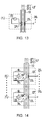
- the flow cytometer may have a detection unit as shown in FIG. 13 (the parts of FIG. 13 are represented by the same reference numerals and symbols as the corresponding parts of FIG. 5).
- FIG. 13 only illustrates the marker detection sections 20 1
- FIG. 5 illustrates the marker detection sections 20 1 to 20 n .
- the detection unit (FIG. 13) includes an infinitesimal dipole DP 1 as the electric field source, which faces the elastic wave detection section 23 1 on the outer wall of the layer flow tube. This also presents the same effect as the above-noted embodiment.
- the flow cytometer may include a detection unit as shown in FIG. 14 (the parts of FIG. 14 are designated by the same reference numerals and symbols as the corresponding parts of FIG. 5).
- the electric field formation means of the detection unit (FIG. 14) generates a near field as the quasi-electrostatic field.
- the layer flow tube 10 has a plurality of pass-through holes TH 1 to TH n at certain intervals along the layer flow. Facing the pass-through holes TH 1 to TH n , the elastic wave detection sections 23 1 to 23 n are provided between the outer and inner walls of the layer flow tube 10.
- This detection unit also includes shields SL 1 to SL n on the outer wall of the layer flow tube 10, covering the pass-through holes TH 1 to TH n .
- a space also referred to as a "shield interior space" between the inner wall of the shield and the outer wall of the layer flow tube, there are the sine wave signal output section 22 and the infinitesimal dipole DP connected to the sine wave signal output section.
- the quasi-electrostatic field dominant space (or the quasi-electrostatic field, which is dominant over the radiated electric field and the induction field) expands inside the shield interior space.
- part of the quasi-electrostatic field goes outside from the pass-through holes TH 1 to TH n , producing a near field EF.
- the thickness of the quasi-electrostatic field (near field) EF is substantially the same as the radius of the pass-through holes TH 1 to TH n , even when the following condition is not satisfied for the frequency of the sine wave alternating voltage: in the detection target area, the intensity of the quasi-electrostatic field (which is in inverse proportion to the cube of the distance from the reference position) is stronger than the intensity of the induction field (which is in inverse proportion to the square of the distance from the reference position).
- FIG. 15 shows the result of simulation for one of the quasi-electrostatic fields (electrostatic field) generated around the marker detection sections 20 1 to 20 n .
- FIG. 15 is a cross sectional view of the layer flow tube in the horizontal direction (or a direction perpendicular to the layer flow). The condition of the simulation is the same as that of FIGS. 7 and 8. It is evident from FIG. 15 that the thickness of the generated quasi-electrostatic fields (electrostatic field) is substantially the same as the radius of the pass-through holes TH 1 to TH n .
- the attached reference drawing 3 uses several colors to illustrate the distribution pattern of the electric field intensity of FIG. 15.
- the detection unit may be more useful than the detection unit 3 (FIG. 5) because it is easy to select the frequency of the sine wave alternating voltage.
- the frequency of the sine wave alternating voltage should be the same as the vibration frequency of the piezoelectric substance attached to the target sample and that the frequency (wavelength) of the sine wave alternating voltage should be longer than the pass-through holes.
- a corresponding elastic wave detection section should be inside the quasi-electrostatic field (near field) generated from the pass-through holes.
- FIG. 16 a detection section
- the parts of FIG. 16 have been designated by the same reference numerals and symbols as the corresponding parts of FIG. 14).
- the configuration of detection section (FIG. 16) is almost the same as the detection unit (FIG. 14) except that:
- the detection section (FIG. 16) has one pass-through hole TH, one shield SL and one infinitesimal dipole DP; and the detection section (FIG. 16) has a plurality of elastic wave detection sections 23 1 to 23 n facing the pass-through hole TH.
- the detection unit (FIG. 16) includes a voltage source VO that applies a voltage whose waveform is differential Gaussian pulse including various frequency components (FIG. 17).
- the detection unit when the voltage source VO applies the voltage of differential Gaussian pulse to the infinitesimal dipole DP, the quasi-electrostatic field is generated in the shield interior space and getting into the layer flow tube 10 through the pass-through hole TH, creating the electrostatic field (near field) EF.
- the piezoelectric substances vibrates in their unique vibration frequencies (due to the inverse piezoelectric effect) and the elastic wave detection sections 23 1 to 23 n therefore detect the vibration as elastic wave.
- the corresponding IDT 32 (FIG. 9) of the elastic wave detection section extracts that elastic wave.
- the detection unit (FIG. 16) may be more useful than the detection unit (FIG. 14) because it has less number of the shields SL and infinitesimal dipole DP than the detection unit (FIG. 14) and the layer flow tube 10 does not take much space. Note that the elastic wave detection sections 23 1 to 23 n should be inside the quasi-electrostatic field (near field) generated from the pass-through holes TH.
- the detection unit may use, as the various frequencies components of wave, surface transverse waves (STW), Rayleigh waves (Surface Acoustic Wave (SAW)), SH surface waves (BGS wave: Bleustein-Gulyaev-Simizu wave), Lamb waves, Surface-Skimming waves, Shear Horizontal (SH) bulk waves and the like.
- STW surface transverse waves
- SAW Surface Acoustic Wave
- SH SH surface waves
- Lamb waves Surface-Skimming waves
- SH Shear Horizontal
- FIG. 18 a detection section
- the parts of FIG. 18 have been designated by the same reference numerals and symbols as the corresponding parts of FIG. 16).
- detection section (FIG. 18) is almost the same as the detection unit (FIG. 16) except that it generates, instead of the electrostatic field (near field), an evanescent field inside the layer flow tube 10.
- the detection unit includes an electromagnetic wave emission source RWO that emits the electromagnetic wave including various frequency components to the outer wall of the layer flow tube 10 at a predetermined angle such that it is totally internally reflected from the outer wall.
- the electromagnetic wave, emitted by the electromagnetic wave emission source RWO is totally reflected from the outer wall of the layer flow tube 10, the evanescent light, whose thickness is substantially the same as the wavelength of the electromagnetic wave, is generated and is getting into the layer flow tube 10, creating the evanescent field.
- the detection unit (FIG. 18) may be more useful than the detection unit (FIG.. 16) because it has less number of components than the detection unit (FIG. 16) and the layer flow tube 10 does not take much space. Note that the elastic wave detection sections 23 1 to 23 n should be inside the evanescent field.
- FIG. 19 a detection section (FIG. 19) can be applied (The parts of FIG. 19 have been designated by the same reference numerals and symbols as the corresponding parts of FIG. 5).
- the detection unit (FIG. 19) detects the piezoelectric substance attached to the target sample inside a droplet broken off from the layer flow, while the detection unit 3 (FIG. 5) detects the piezoelectric substance attached to the target sample flowing in the sample flow (part of the layer flow). Accordingly, the detection unit (FIG. 19) can be downsized because it does not have the layer flow tube 10.
- FIG. 19 illustrates the connection lines passing through the path of the droplets. However, in fact, those connection lines are placed at a predetermined position.
- FIG. 20 a detection section
- the parts of FIG. 20 have been designated by the same reference numerals and symbols as the corresponding parts of FIG. 19).
- the detection unit (FIG. 20) is almost the same as the detection unit (FIG. 19) except that a detection means detects the change of impedance to detect the vibration of the piezoelectric substance attached to the target sample.
- the detection unit includes: a plurality of parallel plane electrodes 21 1 to 21 n , which are spaced, along the layer flow, a certain distance from each other; sine wave signal output sections 22 1 to 22 n , connected to the parallel plane electrodes 21 1 to 21 n ; ammeters ECM 1 to ECM n , connected to the corresponding sine wave alternating voltage source and parallel plane electrode by lines; and impedance detection sections IF 1 to IF n , connected to the ammeters ECM 1 to ECM n .
- FIG. 20 illustrates the connection lines passing through the path of the droplets. However, in fact, those connection lines are placed at a predetermined position.
- each parallel plane electrode 21 is generating the quasi-electrostatic field.
- the ammeters ECM 1 to ECM n therefore detect the change of current between the corresponding parallel plane electrodes.
- the impedance detection sections IF 1 to IF n detect the change of impedance based on the measurement result of the ammeters ECM 1 to ECM n and a fixed voltage, generating a detection signal S1 to notify the data processing unit 4 of the fact that the a specific frequency of piezoelectric substance has been detected.
- the detection unit (FIG. 20) detects the change of impedance to identify the piezoelectric substance attached to the target sample.
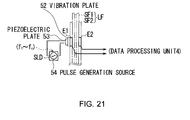
- a detection unit (FIG. 21) can be applied.
- the detection unit (FIG. 21) utilizes the piezoelectric effect to detect the piezoelectric substance attached to the target sample, while the detection unit 3 (FIG. 5) utilizes the inverse piezoelectric effect.
- the detection unit includes: a pair of detection electrodes E1 and E2, which are placed between the outer and inner walls of the layer flow tube 10 and facing each other; a vibration plate 52, which is facing one of the detection electrodes E1 and E2 (the detection electrode E1, in this case) through the outer wall of the layer flow tube 10; an piezoelectric plate 53, attached to the vibration plate 52; and a pulse generation source 54, connected to the piezoelectric plate 53.
- the pulse generation source 54 covered by a shield SLD, generates a mixed wave of different frequency components, such as differential Gaussian pulse.
- a mixed wave of different frequency components such as differential Gaussian pulse.
- the piezoelectric substance attached to the target sample vibrates sympathetically with the vibration wave from the vibration plate 52, producing the quasi-electrostatic field (surface wave) due to the piezoelectric effect.
- the detection electrodes E1 and E2 detect this electric field and then generate a detection signal S2.
- the detection signal S2 may represent a plurality of surface waves corresponding to the plurality of piezoelectric substances of different vibration frequencies.
- the data processing unit 4 of the detection unit includes a signal processing section 44 that performs, after amplifying the detection signal S2, a Band Pass Filter (BPF) process to extract a surface wave corresponding to the vibration frequency of the attached piezoelectric substance and then performs an A/D conversion process.
- BPF Band Pass Filter
- the detection unit presents the same effect as the above detection unit 3.
- the detection units may include components to cancel the expanding of the quasi-electrostatic field from the parallel plane electrodes 21 1 to 21 n or the infinitesimal dipoles DP 1 to DPn.
- the cancel electrodes CE are to cancel the quasi-electrostatic field generated from the parallel plane electrodes 21x.
- the cancel electrodes CE are connected to an anti-phase voltage source ZX that applies a sine wave alternating voltage of predetermined amplitude, whose phase is opposite to the sine wave alternating voltage applied to the parallel plane electrodes 21x.
- the coupling capacitance between the voltage-applied parallel plane electrodes 21x and the cancel electrodes CE is inversely proportional to the distance between the parallel plane electrodes 21x and the cancel electrodes CE and is proportional to the relative permittivity of the material of the layer flow tube 10 and the frequency of the quasi-electrostatic field.
- the amplitude of the sine wave alternating voltage that the anti-phase voltage source ZX applies is determined such that the coupling capacitance C1 becomes equal to C2.
- the quasi-electrostatic fields generated from the cancel electrodes CE appropriately control the quasi-electrostatic fields generated from the parallel plane electrodes 21x.
- FIGS. 23 and 24 show the result of the simulation regarding the quasi-electrostatic fields under the same condition as that of FIGS. 7 and 8:
- the detection unit (FIG. 5) has the cancel electrodes CE, which are spaced 120 ⁇ m from the parallel plane electrodes 21 1 to 21 n .
- FIG. 23 is a cross sectional view of the layer flow tube in the horizontal direction (or a direction perpendicular to the layer flow).
- FIG. 24 is a cross sectional view of the layer flow tube in the vertical direction (or a direction parallel to the layer flow).
- FIG. 25 is a graph illustrating the correlation between the distance from the center of the layer flow tube 10 and the electric field intensity when using and not using the cancel electrodes CE. It is evident from FIGS. 23 to 25 that: the area of the quasi-electrostatic field is limited around the parallel plane electrode 21x; the quasi-electrostatic field is formed only around the parallel plane electrode 21x. In this simulation, the amplitude of the sine wave alternating voltage applied to the cancel electrodes CE is 0.2 times that of the sine wave alternating voltage applied to the parallel plane electrode 21x.
- the elastic wave detection sections 23 are used as detection means for detecting vibration of particles (such as piezoelectric or electrostrictive substances).
- the detection section may include a piezoelectric plate and a band pass filter connected to the plate, as a Surface Acoustic Wave (SAW) device to detect a specific elastic wave or the vibration of the particle.
- SAW Surface Acoustic Wave
- the flow cytometer 1 applies electric charge (for a certain type of sample) to the sample flow and then the charged droplet including the target sample are broken off from the flow by the deflection plates 5A and 5B with predetermined positive and negative voltages at the break off point.
- the present invention is not limited to this.
- a predetermined charge voltage may be applied to the sample flow while the voltage applied to the deflection plates 5A and 5B changes according to the type of the target samples so as to retrieve each sample.
- the method according to an embodiment of the present invention can be applied to medicine production.
Landscapes
- Health & Medical Sciences (AREA)
- Immunology (AREA)
- Life Sciences & Earth Sciences (AREA)
- Physics & Mathematics (AREA)
- Chemical & Material Sciences (AREA)
- General Physics & Mathematics (AREA)
- Pathology (AREA)
- Biochemistry (AREA)
- General Health & Medical Sciences (AREA)
- Analytical Chemistry (AREA)
- Engineering & Computer Science (AREA)
- Acoustics & Sound (AREA)
- Hematology (AREA)
- Molecular Biology (AREA)
- Urology & Nephrology (AREA)
- Biomedical Technology (AREA)
- Cell Biology (AREA)
- Medicinal Chemistry (AREA)
- Food Science & Technology (AREA)
- Microbiology (AREA)
- Dispersion Chemistry (AREA)
- Biotechnology (AREA)
- Investigating Or Analysing Biological Materials (AREA)
- Investigating Or Analysing Materials By Optical Means (AREA)
- Investigating Or Analyzing Materials By The Use Of Electric Means (AREA)
- Investigating Or Analyzing Materials By The Use Of Ultrasonic Waves (AREA)
Applications Claiming Priority (1)
| Application Number | Priority Date | Filing Date | Title |
|---|---|---|---|
| JP2006287898A JP4304633B2 (ja) | 2006-10-23 | 2006-10-23 | 標識検出装置及び標識検出方法 |
Publications (3)
| Publication Number | Publication Date |
|---|---|
| EP1916518A2 true EP1916518A2 (fr) | 2008-04-30 |
| EP1916518A3 EP1916518A3 (fr) | 2010-01-13 |
| EP1916518B1 EP1916518B1 (fr) | 2011-04-20 |
Family
ID=38977231
Family Applications (1)
| Application Number | Title | Priority Date | Filing Date |
|---|---|---|---|
| EP07254180A Not-in-force EP1916518B1 (fr) | 2006-10-23 | 2007-10-22 | Appareil de détection de marqueur et procédé de détection de marqueur |
Country Status (4)
| Country | Link |
|---|---|
| US (1) | US8028582B2 (fr) |
| EP (1) | EP1916518B1 (fr) |
| JP (1) | JP4304633B2 (fr) |
| DE (1) | DE602007013987D1 (fr) |
Families Citing this family (7)
| Publication number | Priority date | Publication date | Assignee | Title |
|---|---|---|---|---|
| GB2484683A (en) * | 2010-10-19 | 2012-04-25 | Amendis Ltd | piezoacoustic characterisation of materials avoiding false negatives |
| CN103918247B (zh) | 2011-09-23 | 2016-08-24 | 数字标记公司 | 基于背景环境的智能手机传感器逻辑 |
| JP6047692B2 (ja) * | 2012-03-23 | 2016-12-21 | 株式会社メガチップス | 水分検出装置、電気伝導度検出装置、センサネットワークシステム、プログラム、水分検出方法および電気伝導度検出方法 |
| US9311639B2 (en) | 2014-02-11 | 2016-04-12 | Digimarc Corporation | Methods, apparatus and arrangements for device to device communication |
| US9897531B2 (en) * | 2014-06-03 | 2018-02-20 | Intellicyt | Flow cytometry sample separation methods and apparatus |
| US20230000981A1 (en) * | 2015-12-21 | 2023-01-05 | Gholam A. Peyman | Cancer Treatment Methods Using Thermotherapy And/Or Enhanced Immunotherapy |
| CN119223851B (zh) * | 2024-11-12 | 2025-03-28 | 郑州大学 | 一种智能微血栓检测分析系统及分析仪器 |
Citations (2)
| Publication number | Priority date | Publication date | Assignee | Title |
|---|---|---|---|---|
| JPH09508703A (ja) | 1994-08-01 | 1997-09-02 | アボツト・ラボラトリーズ | フローサイトメトリック血液細胞分析器用の擬似テレセントリック光学設計 |
| JP2006287898A (ja) | 2005-03-09 | 2006-10-19 | Sanyo Electric Co Ltd | 携帯情報端末 |
Family Cites Families (5)
| Publication number | Priority date | Publication date | Assignee | Title |
|---|---|---|---|---|
| US4673288A (en) * | 1981-05-15 | 1987-06-16 | Ratcom, Inc. | Flow cytometry |
| US5641457A (en) | 1995-04-25 | 1997-06-24 | Systemix | Sterile flow cytometer and sorter with mechanical isolation between flow chamber and sterile enclosure |
| US7340957B2 (en) | 2004-07-29 | 2008-03-11 | Los Alamos National Security, Llc | Ultrasonic analyte concentration and application in flow cytometry |
| JP4304634B2 (ja) * | 2006-10-23 | 2009-07-29 | ソニー株式会社 | 標識検出装置及び標識検出方法 |
| US8263407B2 (en) * | 2007-10-24 | 2012-09-11 | Los Alamos National Security, Llc | Method for non-contact particle manipulation and control of particle spacing along an axis |
-
2006
- 2006-10-23 JP JP2006287898A patent/JP4304633B2/ja not_active Expired - Fee Related
-
2007
- 2007-10-19 US US11/875,380 patent/US8028582B2/en not_active Expired - Fee Related
- 2007-10-22 EP EP07254180A patent/EP1916518B1/fr not_active Not-in-force
- 2007-10-22 DE DE602007013987T patent/DE602007013987D1/de active Active
Patent Citations (2)
| Publication number | Priority date | Publication date | Assignee | Title |
|---|---|---|---|---|
| JPH09508703A (ja) | 1994-08-01 | 1997-09-02 | アボツト・ラボラトリーズ | フローサイトメトリック血液細胞分析器用の擬似テレセントリック光学設計 |
| JP2006287898A (ja) | 2005-03-09 | 2006-10-19 | Sanyo Electric Co Ltd | 携帯情報端末 |
Non-Patent Citations (1)
| Title |
|---|
| TOWE, BRUCE C: "Use of Piezoelectric Materials as Markers in Ultrasound Imaging", ANNUAL INTERNATIONAL CONFERENCE OF THE IEEE ENGINEERING IN MEDICINE AND BIOLOGY - PROCEEDINGS 1999 IEEE, vol. 2, 1999, pages 1063 |
Also Published As
| Publication number | Publication date |
|---|---|
| US8028582B2 (en) | 2011-10-04 |
| DE602007013987D1 (de) | 2011-06-01 |
| US20090031814A1 (en) | 2009-02-05 |
| JP4304633B2 (ja) | 2009-07-29 |
| EP1916518A3 (fr) | 2010-01-13 |
| JP2008107109A (ja) | 2008-05-08 |
| EP1916518B1 (fr) | 2011-04-20 |
Similar Documents
| Publication | Publication Date | Title |
|---|---|---|
| EP1916518B1 (fr) | Appareil de détection de marqueur et procédé de détection de marqueur | |
| US7797999B2 (en) | Marker detection apparatus and marker detection method | |
| Xu et al. | Single mode tuning effects on Lamb wave time reversal with piezoelectric wafer active sensors for structural health monitoring | |
| US5932806A (en) | Contaminant detection system | |
| AU684706B2 (en) | A device for determining the size and charge of colloidal particles | |
| US9239286B2 (en) | Methods and apparatus for identifying and sorting materials using terahertz waves | |
| US20180334697A1 (en) | Method for isothermal dna detection using a modified crispr/cas system and the apparatus for detection by surface acoustic waves for gene editing | |
| WO2018190930A2 (fr) | Système à base de fréquence acoustique doté d'un module de transducteur à cristallin et d'un comparateur de masse pour la détection non invasive d'explosifs et d'objets de contrebande | |
| CN104142326A (zh) | 一种衰减系数检测方法 | |
| EP3953679B1 (fr) | Caractérisation multimodale d'un fluide à l'aide d'une seule gouttelette | |
| US7281413B2 (en) | Acoustic method for determining the viscosity and/or surface tension of a liquid | |
| Ismail et al. | Lamb wave actuation techniques for SHM system-a review | |
| Athanassiadis et al. | Broadband leaky Lamb waves excited by optical breakdown in water | |
| WO2008010658A1 (fr) | Appareil et procédé permettant de détecter des caractéristiques de mouvement de particules dans un canal d'écoulement | |
| CN109642892A (zh) | 用于补偿超声波测试中的耦合不均匀性的方法和装置 | |
| Moll et al. | Guided Electromagnetic Waves for Damage Localization in a Structural Health Monitoring Framework | |
| Pullin et al. | Experimental validation of dispersion curves in plates for acoustic emission | |
| Liebeton et al. | Practical Experiences to Know Making Acoustic Emission-Based SHM Successful | |
| Philtron et al. | Guided wave phased array sensor tuning for improved defect detection and characterization | |
| Benjamin | Silence of the lamb waves | |
| JP2004271320A (ja) | 流速制御装置 | |
| HK40058493A (zh) | 用於通过声波分析流体的传感装置 | |
| Singh et al. | Real time acquisition and frequency domain analysis of acoustic patterns of fluids for applications in the field of homeland security | |
| Acciani et al. | 3D-3 Classification of Defects for Guided Waves Inspected Pipes by a Neural Network Approach | |
| Hayashi et al. | The generation and detection of fundamental Lamb modes in plastic plates by air-coupled transducers |
Legal Events
| Date | Code | Title | Description |
|---|---|---|---|
| PUAI | Public reference made under article 153(3) epc to a published international application that has entered the european phase |
Free format text: ORIGINAL CODE: 0009012 |
|
| 17P | Request for examination filed |
Effective date: 20071102 |
|
| AK | Designated contracting states |
Kind code of ref document: A2 Designated state(s): AT BE BG CH CY CZ DE DK EE ES FI FR GB GR HU IE IS IT LI LT LU LV MC MT NL PL PT RO SE SI SK TR |
|
| AX | Request for extension of the european patent |
Extension state: AL BA HR MK RS |
|
| PUAL | Search report despatched |
Free format text: ORIGINAL CODE: 0009013 |
|
| AK | Designated contracting states |
Kind code of ref document: A3 Designated state(s): AT BE BG CH CY CZ DE DK EE ES FI FR GB GR HU IE IS IT LI LT LU LV MC MT NL PL PT RO SE SI SK TR |
|
| AX | Request for extension of the european patent |
Extension state: AL BA HR MK RS |
|
| 17Q | First examination report despatched |
Effective date: 20100129 |
|
| AKX | Designation fees paid |
Designated state(s): DE FR GB |
|
| GRAP | Despatch of communication of intention to grant a patent |
Free format text: ORIGINAL CODE: EPIDOSNIGR1 |
|
| RIC1 | Information provided on ipc code assigned before grant |
Ipc: G01N 27/00 20060101AFI20101007BHEP Ipc: G01N 33/543 20060101ALI20101007BHEP |
|
| GRAS | Grant fee paid |
Free format text: ORIGINAL CODE: EPIDOSNIGR3 |
|
| GRAA | (expected) grant |
Free format text: ORIGINAL CODE: 0009210 |
|
| AK | Designated contracting states |
Kind code of ref document: B1 Designated state(s): DE FR GB |
|
| REG | Reference to a national code |
Ref country code: GB Ref legal event code: FG4D |
|
| REF | Corresponds to: |
Ref document number: 602007013987 Country of ref document: DE Date of ref document: 20110601 Kind code of ref document: P |
|
| REG | Reference to a national code |
Ref country code: DE Ref legal event code: R096 Ref document number: 602007013987 Country of ref document: DE Effective date: 20110601 |
|
| PLBE | No opposition filed within time limit |
Free format text: ORIGINAL CODE: 0009261 |
|
| STAA | Information on the status of an ep patent application or granted ep patent |
Free format text: STATUS: NO OPPOSITION FILED WITHIN TIME LIMIT |
|
| 26N | No opposition filed |
Effective date: 20120123 |
|
| REG | Reference to a national code |
Ref country code: DE Ref legal event code: R097 Ref document number: 602007013987 Country of ref document: DE Effective date: 20120123 |
|
| REG | Reference to a national code |
Ref country code: GB Ref legal event code: 746 Effective date: 20120703 |
|
| REG | Reference to a national code |
Ref country code: DE Ref legal event code: R084 Ref document number: 602007013987 Country of ref document: DE Effective date: 20120614 |
|
| PGFP | Annual fee paid to national office [announced via postgrant information from national office to epo] |
Ref country code: FR Payment date: 20121031 Year of fee payment: 6 |
|
| PGFP | Annual fee paid to national office [announced via postgrant information from national office to epo] |
Ref country code: GB Payment date: 20121019 Year of fee payment: 6 |
|
| GBPC | Gb: european patent ceased through non-payment of renewal fee |
Effective date: 20131022 |
|
| PG25 | Lapsed in a contracting state [announced via postgrant information from national office to epo] |
Ref country code: GB Free format text: LAPSE BECAUSE OF NON-PAYMENT OF DUE FEES Effective date: 20131022 |
|
| REG | Reference to a national code |
Ref country code: FR Ref legal event code: ST Effective date: 20140630 |
|
| PG25 | Lapsed in a contracting state [announced via postgrant information from national office to epo] |
Ref country code: FR Free format text: LAPSE BECAUSE OF NON-PAYMENT OF DUE FEES Effective date: 20131031 |
|
| PGFP | Annual fee paid to national office [announced via postgrant information from national office to epo] |
Ref country code: DE Payment date: 20171019 Year of fee payment: 11 |
|
| REG | Reference to a national code |
Ref country code: DE Ref legal event code: R119 Ref document number: 602007013987 Country of ref document: DE |
|
| PG25 | Lapsed in a contracting state [announced via postgrant information from national office to epo] |
Ref country code: DE Free format text: LAPSE BECAUSE OF NON-PAYMENT OF DUE FEES Effective date: 20190501 |