EP1918986A2 - Dispositif MOS résistant aux radiations d'ions et son procédé de fabrication - Google Patents
Dispositif MOS résistant aux radiations d'ions et son procédé de fabrication Download PDFInfo
- Publication number
- EP1918986A2 EP1918986A2 EP07119878A EP07119878A EP1918986A2 EP 1918986 A2 EP1918986 A2 EP 1918986A2 EP 07119878 A EP07119878 A EP 07119878A EP 07119878 A EP07119878 A EP 07119878A EP 1918986 A2 EP1918986 A2 EP 1918986A2
- Authority
- EP
- European Patent Office
- Prior art keywords
- region
- semiconductor layer
- forming
- dielectric
- surface semiconductor
- Prior art date
- Legal status (The legal status is an assumption and is not a legal conclusion. Google has not performed a legal analysis and makes no representation as to the accuracy of the status listed.)
- Ceased
Links
Images


Classifications
-
- H—ELECTRICITY
- H10—SEMICONDUCTOR DEVICES; ELECTRIC SOLID-STATE DEVICES NOT OTHERWISE PROVIDED FOR
- H10D—INORGANIC ELECTRIC SEMICONDUCTOR DEVICES
- H10D30/00—Field-effect transistors [FET]
- H10D30/60—Insulated-gate field-effect transistors [IGFET]
- H10D30/64—Double-diffused metal-oxide semiconductor [DMOS] FETs
- H10D30/66—Vertical DMOS [VDMOS] FETs
-
- H—ELECTRICITY
- H10—SEMICONDUCTOR DEVICES; ELECTRIC SOLID-STATE DEVICES NOT OTHERWISE PROVIDED FOR
- H10D—INORGANIC ELECTRIC SEMICONDUCTOR DEVICES
- H10D30/00—Field-effect transistors [FET]
- H10D30/01—Manufacture or treatment
- H10D30/021—Manufacture or treatment of FETs having insulated gates [IGFET]
- H10D30/028—Manufacture or treatment of FETs having insulated gates [IGFET] of double-diffused metal oxide semiconductor [DMOS] FETs
- H10D30/0291—Manufacture or treatment of FETs having insulated gates [IGFET] of double-diffused metal oxide semiconductor [DMOS] FETs of vertical DMOS [VDMOS] FETs
-
- H—ELECTRICITY
- H10—SEMICONDUCTOR DEVICES; ELECTRIC SOLID-STATE DEVICES NOT OTHERWISE PROVIDED FOR
- H10D—INORGANIC ELECTRIC SEMICONDUCTOR DEVICES
- H10D62/00—Semiconductor bodies, or regions thereof, of devices having potential barriers
- H10D62/10—Shapes, relative sizes or dispositions of the regions of the semiconductor bodies; Shapes of the semiconductor bodies
- H10D62/13—Semiconductor regions connected to electrodes carrying current to be rectified, amplified or switched, e.g. source or drain regions
- H10D62/149—Source or drain regions of field-effect devices
- H10D62/151—Source or drain regions of field-effect devices of IGFETs
- H10D62/156—Drain regions of DMOS transistors
- H10D62/157—Impurity concentrations or distributions
-
- H—ELECTRICITY
- H10—SEMICONDUCTOR DEVICES; ELECTRIC SOLID-STATE DEVICES NOT OTHERWISE PROVIDED FOR
- H10D—INORGANIC ELECTRIC SEMICONDUCTOR DEVICES
- H10D64/00—Electrodes of devices having potential barriers
- H10D64/20—Electrodes characterised by their shapes, relative sizes or dispositions
- H10D64/27—Electrodes not carrying the current to be rectified, amplified, oscillated or switched, e.g. gates
- H10D64/311—Gate electrodes for field-effect devices
- H10D64/411—Gate electrodes for field-effect devices for FETs
- H10D64/511—Gate electrodes for field-effect devices for FETs for IGFETs
- H10D64/514—Gate electrodes for field-effect devices for FETs for IGFETs characterised by the insulating layers
- H10D64/516—Gate electrodes for field-effect devices for FETs for IGFETs characterised by the insulating layers the thicknesses being non-uniform
Definitions
- the present invention relates to a MOS device resistant to ionizing radiation, in particular to a power VDMOS (Vertical Double-Diffused Metal Oxide Semiconductor) device, to which the following description will make explicit reference without this implying any loss in generality.
- VDMOS Very Double-Diffused Metal Oxide Semiconductor
- discrete power semiconductor devices used in a space environment must intrinsically have a high reliability.
- these devices must be resistant to space ionizing radiation, such as electromagnetic radiation of extremely high energy and penetrative power (gamma rays), beams of protons or electrons with energies even much higher than one MeV, cosmic rays constituted by more or less heavy ions having energies even higher than one TeV, or secondary irradiation by electromagnetic beams or beams of particles generated within the same space systems due to interactions with the cosmic radiation.
- space ionizing radiation such as electromagnetic radiation of extremely high energy and penetrative power (gamma rays), beams of protons or electrons with energies even much higher than one MeV, cosmic rays constituted by more or less heavy ions having energies even higher than one TeV, or secondary irradiation by electromagnetic beams or beams of particles generated within the same space systems due to interactions with the cosmic radiation.
- the interaction between the above sources of radiation or particles and the semiconductor device during operation can trigger mechanisms of electrical
- the above mechanisms are accompanied by an equally harmful degradation (at least in part cumulative) of gate dielectric on the active channel, caused by a drain overcurrent occurring in a transient way due to the interaction between a heavy ion and the active area of the device in the OFF state.
- an anomalous and intense current of carriers moves in a surface portion of the drain region towards the gate dielectric, and is in part driven by the electrical field towards the channel of the device.
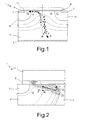
- a VDMOS device comprising in a known manner: a substrate 2 of semiconductor material; an epitaxial surface layer 3, also of semiconductor material, having the same type of conductivity (for example, of an N type) as the substrate 2 and overlying the same substrate 2; a plurality of cells formed in a surface portion of the epitaxial surface layer 3, each comprising a body well 6 having conductivity opposite to that of the epitaxial surface layer 3 (in the example, of a P type), and a source region 7, set within the body well 6, and having the same type of conductivity as the substrate 2; an insulated gate structure 8, constituted by a dielectric gate region 9, formed above the intercell region comprised between adjacent body wells 6 (a surface portion of which is known as neck region, designated by 10) and partially overlapping the body wells 6 and the source regions 7, and by a gate-electrode region 11, formed on the dielectric gate region 9; as is known, the substrate 2 has the function of drain for the VDMOS device 1.
- an insulated gate structure 8 constituted by a
- the interaction between a heavy ion and the active area of the device generates a flow of electrons (designated by e ) directed towards the substrate 2, and a corresponding flow of holes (designated by p ) directed towards the conduction channel of the device (designated by 12 and defined by the portion of the body wells 6 set directly underneath the insulated gate structure 8, and delimited by the junction between the source region 7 and the body well 6 on one side, and by the junction between the body well 6 and the neck region 10, on the other).
- the surface geometry in the active area has a considerable influence in defining the intensity of the electrical-field transverse component E t (i.e., the component directed orthogonally to the surface of the epitaxial surface layer 3).
- This component together with the electrical-field longitudinal component E l , determines the direction of the resultant electrical field E , which is directed as a whole towards the gate dielectric on the conduction channel 12.
- a current I directed towards the dielectric gate region 9, or also injected into it, is thus originated, which can entail a progressive charging of the dielectric.
- This phenomenon can be increased by the effect of current amplification due to the interaction between the charge generated by ionization by the ion and the electrical drain field, and also by triggering of surface conduction of the parasitic bipolar transistor formed by the source region 7, the body region 6, and the drain region (epitaxial surface layer 3).
- the aim of the present invention is to provide a MOS device that will enable a solution to the aforesaid problems and disadvantages, and in particular will have a higher resistance to ionizing radiation.
- MOS device resistant to ionizing radiation and a corresponding manufacturing process are thus provided, as defined in claim 1 and 11, respectively.
- a first aspect of the present invention envisages increasing the depth of the MOS device active area via the formation, between the substrate and the epitaxial surface layer, of a further epitaxial layer, having appropriate thickness and resistivity.
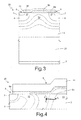
- an epitaxial sublayer 21 is set between a substrate 2 and an epitaxial surface layer 3 in which device cells are provided (each comprising, as illustrated previously, a body well 6 and a source region 7).
- the type of conductivity of the epitaxial sublayer 21 is the same as that of the epitaxial surface layer 3, and its thickness is comparable with that of the epitaxial surface layer 3 (for example, it is comprised between approximately one half and twice the thickness of the epitaxial surface layer).
- the values of thickness and, mainly, of resistivity of the epitaxial sublayer 21 are chosen so as to maximize the effect of ohmic drop during the ionization transient, when the epitaxial sublayer 21 is traversed by a dense flow of electrons, which are generated by the impact of a heavy ion and by dynamic amplification mechanisms (principally, the aforesaid pre-triggering of the parasitic bipolar transistor) and are forced by the electrical field towards the drain termination.
- the presence of the epitaxial sublayer 21 leads to a double advantage: on the one hand, the active region involved in the drain electrical field E widens downwards, and hence the drain electrical field E decreases at the surface during the ionization transient; on the other hand, the gain of the parasitic bipolar transistor in conditions of strong injection is reduced due to the widening of the effective drain region (collector of the parasitic transistor), with consequent reduction in the current density of surface holes flowing towards the source region 7 and the dielectric gate region 9 during the transient.
- the resistivity of the epitaxial sublayer 21 is generally comprised between 10% and 50% of the resistivity of the epitaxial surface layer 3. In one embodiment the resistivity of the epitaxial sublayer 21 does not exceed 50% of the resistivity of the epitaxial surface layer 3.
- a second aspect of the present invention which is independent of the first aspect described previously but which contributes therewith to increasing the MOS device resistance to ionizing radiation, envisages providing a thicker layer of gate dielectric, exclusively at the neck region 10.
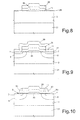
- the dielectric gate region 9 comprises in this case: first portions 9a, set laterally above the source region 7, the conduction channel 12, and side portions of the neck region 10, and having a first thickness (for example, smaller than 100 nm); and a second portion 9b, joined to the first portions 9a, set centrally above just the neck region 10 (in particular, above a central portion thereof) and having a second thickness, greater than the first thickness (by approximately one order of magnitude, for example comprised between 100 nm and 1500 nm).
- the second portion 9b has a stripe conformation and extends longitudinally and substantially coaxially with respect to an overlying gate-electrode region 11 (which also has a stripe conformation).
- lateral surfaces of the second portion 9b that are connected to the first portions 9a can be orthogonal to the surface of the epitaxial surface layer 3, or else inclined with respect to the orthogonal direction, for example by an angle of 45°, according to the manufacturing process (as will be clarified hereinafter).
- the presence of a thicker region of intercell dielectric on the neck region 10 enables a reduction of the transverse component of the electrical field E t (in particular, between gate and drain) on the neck region 10. Furthermore, the same thick intercell region induces indirectly a distortion of the distribution of surface field, which is such as to "smooth" the field lines on the surface and to reduce the transverse electrical field (in particular, between gate and source) on the conduction channel 12. Furthermore, advantageously, thanks to the maintenance of a reduced dielectric thickness on the channel region 12, the problem associated to the degradation of tolerance to TID mechanism is strongly limited, at least as regards channel parameters, such as the gate-source threshold voltage (Vgs th ).
- Vgs th gate-source threshold voltage
- the lateral and vertical dimensions of the thick intercell dielectric stripe determine how much both the characteristics of breakdown of the MOS device 20 and the resistance to SEE of the same device are modified.
- the thickness of the second portion 9b of the dielectric gate region 9 is chosen so as not to lead to an excessive reduction in the breakdown voltage BVdss of the device; for example, this thickness is comprised between 100 nm and 1500 nm and is also a function of the technology used, the voltage class, and the required levels of tolerance to radiation.
- the width of the second portion 9b is chosen so as to maximize the "planarizing" effect on the surface drain electrical field: the second portion 9b approaches as much as possible the end of the conduction channel 12, but does not non-overlap with the same channel.
- the overlying gate-electrode region 11 which also has a stripe conformation
- the second portion 9b is, for example, 3.7 ⁇ m wide, thus leaving an adequate safety margin from the end of the conduction channel 12, of 0.5 ⁇ m on each side.
- the manufacturing process of the MOS device 20 envisages first providing a wafer of semiconductor material comprising a substrate 2, and then forming the epitaxial sublayer 21 by epitaxial growth starting from the substrate 2, and forming the epitaxial surface layer 3 by epitaxial growth starting from the epitaxial sublayer 21 ( Figure 5).
- the epitaxial growth steps are executed prior to any phototechnique or other surface process.
- formation of the edge termination, opening of the active area, and cleaning of the surface of the wafer are carried out in a known way and hence not described in detail herein.
- a first variant envisages dielectric formation via CVD.
- an optional step of growth of a thin film (not illustrated) of thermal oxide is first carried out before deposition of the thick gate dielectric, and then a CVD deposition of a thick dielectric layer 25 is carried out.
- the thick dielectric layer 25 can be SG (Silicon Glass) or preferably USG (Undoped Silicon Glass), with thicknesses of from 100 nm to 1500 nm, and the technique of deposition may be PECVD, LPCVD or APCVD; also possible is the use of dielectric multilayers.
- An (optional) thermal process of dielectric densification is then performed.
- a second variant envisages, instead, formation of the thick dielectric layer 25 via thermal growth of a dielectric film (silicon oxide, or a compound of oxynitride and silicon oxide) with a thickness of from 100 nm to 500 nm, above the epitaxial surface layer 3.
- a dielectric film silicon oxide, or a compound of oxynitride and silicon oxide
- the first variant is hence advantageous when it is necessary to provide large thicknesses of the dielectric stripe.
- an appropriate phototechnique is carried out for definition of the stripe of intercell-gate dielectric, having a longitudinal extension ( Figures 6a, 6b).
- a unidirectional dry etch, or an isotropic wet etch, of the thick dielectric layer 25 can be performed, so as to obtain the second portion 9b of the dielectric gate region 9 on the epitaxial surface layer 3.
- the dry etch leads to formation of side walls for the stripe that are orthogonal to the surface of the wafer, and is advantageous in markedly scaled devices, for containment of lateral dimensions.
- Wet etching is preferable when the spacing between contiguous cells is not excessively small, and the thickness of the stripe is not excessive (between approximately 100 nm and 200 nm).
- the final inclination of the side walls of the stripe is preferably approximately 45°. It is also possible to envisage a sequential wet/dry etch.
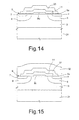
- a further step of cleaning of the surface of the wafer is then carried out, followed by the formation, by means of thermal oxidation, of a thin dielectric layer 26 ( Figure 7) laterally with respect to the stripe of gate dielectric.
- the dielectric can be, for example, oxynitride, or a multilayer of oxide, nitride, and oxide, with a thickness of less than 100 nm.
- a gate-electrode layer 27 is then deposited above the wafer of semiconductor material; the gate-electrode layer 27 is for example formed by doped polysilicon or by a double layer of doped polysilicon and metal silicide having a thickness of between 100 nm and 600 nm.
- a CVD deposition of a first dielectric layer made of USG, PSG, TEOS, or some other dielectric or dielectric multilayer, is carried out.
- a suitable phototechnique for defining the gate electrode 11 Figure 8
- a unidirectional etch of the first dielectric layer is first performed, with end-point on the gate-electrode layer 27, so as to form a first dielectric region 28, and then a unidirectional etch of the gate-electrode layer 27, for a given time or with end-point on the thin dielectric layer 26, is carried out.
- Figure 9 in a known way that is not described in detail, a first process of ion implantation and diffusion, for formation of the body wells 6, and then (by means of an appropriate masking) a second process of ion implantation and diffusion for formation of the source regions 7 within the body wells 6 are performed.
- the body wells 6 extend underneath the gate structure, but not underneath the second portion 9b of the dielectric gate region 9.
- the second dielectric layer 29 can be made of USG, PSG, TEOS, or some other dielectric or dielectric multilayer with low conformability, and its thickness depends directly on the planar geometry of the wafer.
- a unidirectional etch is performed of the second dielectric layer 29 to form spacers 30 at the sides of the gate structure, and hence of the first dielectric region 28 and of the gate-electrode region 11 ( Figure 10).
- the etch removes also part of the thin dielectric layer 26, exposing the underlying source regions 7, and defining the first portions 9a of the dielectric gate region 9.
- the process terminates with metallization of the front of the wafer, which leads to formation of a metal layer 32 ( Figure 11), constituted, for example, by an aluminium alloy, and with "patterning" of the same metal layer.
- a metal layer 32 Figure 11
- deposition and photolithography of the final passivation according to known techniques, and preparation and metallization of the back of the wafer (drain contact of the device).
- a second embodiment of the manufacturing process envisages provision of the lateral insulation of the source contacts (in particular from the gate electrode 11) not via spacers as described previously (so-called self-aligned technique), but via the use of a photolithographic technique.
- the dielectric can once again be USG, PSG, TEOS, or some other dielectric or dielectric multilayer.
- a photomasking is carried out for opening the contacts, and in particular a dry etch or composite (dry/wet) etch of the intermediate dielectric layer 33.
- the etch removes also part of the thin dielectric layer 26, exposing the underlying source regions 7 and defining the first portions 9a of the dielectric gate region 9 ( Figure 14).
- the MOS device 20 has a high resistance to ionizing radiation and to electrical/physical degradation resulting therefrom in so far as it meets the dual need of: reducing the current density of holes flowing towards the gate and source regions during the transient (by means of the epitaxial sublayer 21); and of reducing the transverse component of the electrical field E t between the gate and the drain on the neck region 10 and between the gate and the source on the conduction channel 12 (by means of the stripe of thick gate dielectric).
- the composite structure of the dielectric gate region 9 on the elementary cell leads to further advantages in the performance of the MOS device 20, apart from the reliability effects. Amongst these, the most evident is the reduction in the gate capacitance, which leads to a sensible increase in the switching rate of the MOS device 20.
- the geometrical parameters of the device can vary according to the required functions, the design technology, and the characteristics required of the device.
- the second portion 9b of the dielectric region 9 may even have a width equal to the width of the neck region 10, also in this case not overlapping with respect to the conduction channel 12.
- the MOS device of 20 FIG. 3 may be disposed on an integrated circuit (IC) such as a processor or memory, which may be disposed within a system such as a computer system.
- IC integrated circuit
Landscapes
- Insulated Gate Type Field-Effect Transistor (AREA)
- Thin Film Transistor (AREA)
Applications Claiming Priority (1)
| Application Number | Priority Date | Filing Date | Title |
|---|---|---|---|
| IT000785A ITTO20060785A1 (it) | 2006-11-02 | 2006-11-02 | Dispositivo mos resistente alla radiazione ionizzante |
Publications (3)
| Publication Number | Publication Date |
|---|---|
| EP1918986A2 true EP1918986A2 (fr) | 2008-05-07 |
| EP1918986A3 EP1918986A3 (fr) | 2009-03-18 |
| EP1918986A9 EP1918986A9 (fr) | 2009-05-13 |
Family
ID=38966711
Family Applications (1)
| Application Number | Title | Priority Date | Filing Date |
|---|---|---|---|
| EP07119878A Ceased EP1918986A3 (fr) | 2006-11-02 | 2007-11-02 | Dispositif MOS résistant aux radiations d'ions et son procédé de fabrication |
Country Status (4)
| Country | Link |
|---|---|
| US (3) | US7791147B2 (fr) |
| EP (1) | EP1918986A3 (fr) |
| JP (1) | JP2008182191A (fr) |
| IT (1) | ITTO20060785A1 (fr) |
Cited By (5)
| Publication number | Priority date | Publication date | Assignee | Title |
|---|---|---|---|---|
| CN102544104A (zh) * | 2012-01-12 | 2012-07-04 | 清华大学 | 一种耐高压的隧穿晶体管及其制备方法 |
| WO2014092936A1 (fr) * | 2012-12-12 | 2014-06-19 | General Electric Company | Dispositif à transistor à effet de champ à grille isolée et son procédé de fabrication |
| CN104600121A (zh) * | 2015-01-15 | 2015-05-06 | 东南大学 | 一种高可靠性p型碳化硅纵向金属氧化物半导体管 |
| CN104617144A (zh) * | 2015-01-15 | 2015-05-13 | 东南大学 | 一种高可靠性n型碳化硅纵向金属氧化物半导体管 |
| CN109192659A (zh) * | 2018-08-31 | 2019-01-11 | 江苏丽隽功率半导体有限公司 | 一种耗尽型场效应管的制作方法 |
Families Citing this family (14)
| Publication number | Priority date | Publication date | Assignee | Title |
|---|---|---|---|---|
| US20090159927A1 (en) * | 2007-12-21 | 2009-06-25 | Infineon Technologies Austria Ag | Integrated circuit device and method for its production |
| JP4935789B2 (ja) * | 2008-10-06 | 2012-05-23 | トヨタ自動車株式会社 | 半導体装置の放射線照射試験方法 |
| WO2010073991A1 (fr) * | 2008-12-23 | 2010-07-01 | 三菱電機株式会社 | Dispositif semi-conducteur et son procédé de fabrication |
| US20100314695A1 (en) * | 2009-06-10 | 2010-12-16 | International Rectifier Corporation | Self-aligned vertical group III-V transistor and method for fabricated same |
| US8952458B2 (en) | 2011-04-14 | 2015-02-10 | Taiwan Semiconductor Manufacturing Company, Ltd. | Gate dielectric layer having interfacial layer and high-K dielectric over the interfacial layer |
| CN102339867A (zh) * | 2011-10-28 | 2012-02-01 | 上海宏力半导体制造有限公司 | 一种vdmos器件及其的形成方法 |
| CN104299944B (zh) * | 2013-07-16 | 2018-07-10 | 中芯国际集成电路制造(上海)有限公司 | 快闪存储器及其形成方法 |
| CN104392932A (zh) * | 2014-12-10 | 2015-03-04 | 中国电子科技集团公司第四十七研究所 | 一种vdmos器件及其制造方法 |
| CN105870009A (zh) * | 2015-01-21 | 2016-08-17 | 北大方正集团有限公司 | 功率器件的制备方法和功率器件 |
| US9842912B2 (en) | 2015-08-19 | 2017-12-12 | Fuji Electric Co., Ltd. | Semiconductor device and method of manufacturing semiconductor device |
| US10957791B2 (en) * | 2019-03-08 | 2021-03-23 | Infineon Technologies Americas Corp. | Power device with low gate charge and low figure of merit |
| CN112510080B (zh) * | 2020-11-30 | 2023-06-06 | 西安微电子技术研究所 | 一种抗单粒子高压mos场效应晶体管的辐射加固结构和制备方法 |
| CN114597251B (zh) * | 2022-03-03 | 2023-05-26 | 电子科技大学 | 一种抗总剂量辐射加固的屏蔽栅vdmos |
| CN115832025A (zh) * | 2022-11-21 | 2023-03-21 | 电子科技大学 | 一种具有二阶氧化层的SiC MOSFET结构 |
Citations (3)
| Publication number | Priority date | Publication date | Assignee | Title |
|---|---|---|---|---|
| US5674766A (en) | 1994-12-30 | 1997-10-07 | Siliconix Incorporated | Method of making a trench MOSFET with multi-resistivity drain to provide low on-resistance by varying dopant concentration in epitaxial layer |
| US6048759A (en) | 1998-02-11 | 2000-04-11 | Magepower Semiconductor Corporation | Gate/drain capacitance reduction for double gate-oxide DMOS without degrading avalanche breakdown |
| EP1503423A1 (fr) * | 2003-07-31 | 2005-02-02 | STMicroelectronics S.r.l. | Dispositif semi-conducteur MIS de puissance et sa méthode de fabrication |
Family Cites Families (26)
| Publication number | Priority date | Publication date | Assignee | Title |
|---|---|---|---|---|
| US4974059A (en) * | 1982-12-21 | 1990-11-27 | International Rectifier Corporation | Semiconductor high-power mosfet device |
| US4587713A (en) * | 1984-02-22 | 1986-05-13 | Rca Corporation | Method for making vertical MOSFET with reduced bipolar effects |
| EP0308612B1 (fr) | 1987-09-24 | 1994-10-12 | Mitsubishi Denki Kabushiki Kaisha | Transistor à effet de champ et procédé pour sa fabrication |
| US5355007A (en) * | 1990-11-23 | 1994-10-11 | Texas Instruments Incorporated | Devices for non-volatile memory, systems and methods |
| US5296393A (en) * | 1990-11-23 | 1994-03-22 | Texas Instruments Incorporated | Process for the simultaneous fabrication of high-and-low-voltage semiconductor devices, integrated circuit containing the same, systems and methods |
| US5204541A (en) * | 1991-06-28 | 1993-04-20 | Texas Instruments Incorporated | Gated thyristor and process for its simultaneous fabrication with high- and low-voltage semiconductor devices |
| US5273922A (en) * | 1992-09-11 | 1993-12-28 | Motorola, Inc. | High speed, low gate/drain capacitance DMOS device |
| US5498554A (en) * | 1994-04-08 | 1996-03-12 | Texas Instruments Incorporated | Method of making extended drain resurf lateral DMOS devices |
| EP0718893A3 (fr) | 1994-11-25 | 1999-07-14 | Fuji Electric Co., Ltd. | Thyristor à contrÔle MOS ayant deux grilles et procédé de fabrication |
| US5973367A (en) * | 1995-10-13 | 1999-10-26 | Siliconix Incorporated | Multiple gated MOSFET for use in DC-DC converter |
| US6084268A (en) * | 1996-03-05 | 2000-07-04 | Semiconductor Components Industries, Llc | Power MOSFET device having low on-resistance and method |
| US5973368A (en) * | 1996-06-05 | 1999-10-26 | Pearce; Lawrence G. | Monolithic class D amplifier |
| US6252278B1 (en) * | 1998-05-18 | 2001-06-26 | Monolithic Power Systems, Inc. | Self-aligned lateral DMOS with spacer drift region |
| JP3602751B2 (ja) * | 1999-09-28 | 2004-12-15 | 株式会社東芝 | 高耐圧半導体装置 |
| US6407591B1 (en) * | 2000-06-30 | 2002-06-18 | Intel Corporation | Self-configurable clock input buffer compatible with high-voltage single-ended and low-voltage differential clock signals |
| KR100377130B1 (ko) * | 2000-11-22 | 2003-03-19 | 페어차일드코리아반도체 주식회사 | 반도체 소자 및 그 제조 방법 |
| US6486034B1 (en) * | 2001-07-20 | 2002-11-26 | Taiwan Semiconductor Manufacturing Company | Method of forming LDMOS device with double N-layering |
| EP1421612B1 (fr) * | 2001-08-17 | 2009-04-22 | IHP GmbH-Innovations for High Performance Microelectronics/Institut für innovative Mikroelektronik | Transistor LDMOS et son procédé de fabrication |
| US6734493B2 (en) * | 2002-02-08 | 2004-05-11 | Taiwan Semiconductor Manufacturing Co., Ltd. | Lateral double diffused metal oxide semiconductor (LDMOS) device with aligned buried layer isolation layer |
| KR100442881B1 (ko) * | 2002-07-24 | 2004-08-02 | 삼성전자주식회사 | 고전압 종형 디모스 트랜지스터 및 그 제조방법 |
| US20040164346A1 (en) * | 2003-02-20 | 2004-08-26 | Semiconductor Components Industries, Llc. | Power switching transistor with low drain to gate capacitance |
| US6900101B2 (en) * | 2003-06-13 | 2005-05-31 | Texas Instruments Incorporated | LDMOS transistors and methods for making the same |
| US6825531B1 (en) * | 2003-07-11 | 2004-11-30 | Micrel, Incorporated | Lateral DMOS transistor with a self-aligned drain region |
| US7285822B2 (en) * | 2005-02-11 | 2007-10-23 | Alpha & Omega Semiconductor, Inc. | Power MOS device |
| DE102005042827A1 (de) * | 2005-09-09 | 2007-03-22 | Atmel Germany Gmbh | Hochvolt-Feldeffekttransistor und Verfahren zur Herstellung eines Hochvolt-Feldeffekttransistors |
| JP5307973B2 (ja) * | 2006-02-24 | 2013-10-02 | セミコンダクター・コンポーネンツ・インダストリーズ・リミテッド・ライアビリティ・カンパニー | 半導体装置 |
-
2006
- 2006-11-02 IT IT000785A patent/ITTO20060785A1/it unknown
-
2007
- 2007-10-31 US US11/982,442 patent/US7791147B2/en active Active
- 2007-11-01 JP JP2007285476A patent/JP2008182191A/ja not_active Withdrawn
- 2007-11-02 EP EP07119878A patent/EP1918986A3/fr not_active Ceased
-
2010
- 2010-02-22 US US12/709,789 patent/US8471330B2/en active Active
- 2010-02-23 US US12/710,609 patent/US8187943B2/en active Active
Patent Citations (3)
| Publication number | Priority date | Publication date | Assignee | Title |
|---|---|---|---|---|
| US5674766A (en) | 1994-12-30 | 1997-10-07 | Siliconix Incorporated | Method of making a trench MOSFET with multi-resistivity drain to provide low on-resistance by varying dopant concentration in epitaxial layer |
| US6048759A (en) | 1998-02-11 | 2000-04-11 | Magepower Semiconductor Corporation | Gate/drain capacitance reduction for double gate-oxide DMOS without degrading avalanche breakdown |
| EP1503423A1 (fr) * | 2003-07-31 | 2005-02-02 | STMicroelectronics S.r.l. | Dispositif semi-conducteur MIS de puissance et sa méthode de fabrication |
Non-Patent Citations (2)
| Title |
|---|
| MICKEVICIUS R V ET AL: "Simulation study of single-event gate rupture using radiation-hardened stripe cell power mosfet structures", IEEE TRANSACTIONS ON NUCLEAR SCIENCE, IEEE SERVICE CENTER, NEW YORK, NY, US, vol. 50, no. 6, 1 December 2003 (2003-12-01), pages 2256 - 2264, XP011106535, ISSN: 0018-9499, DOI: 10.1109/TNS.2003.821584 * |
| TITUS J L ET AL: "See characterization of vertical dmosfets: an updated test protocol", IEEE TRANSACTIONS ON NUCLEAR SCIENCE, IEEE SERVICE CENTER, NEW YORK, NY, US, vol. 50, no. 6, 1 December 2003 (2003-12-01), pages 2341 - 2351, XP011106549, ISSN: 0018-9499, DOI: 10.1109/TNS.2003.820733 * |
Cited By (8)
| Publication number | Priority date | Publication date | Assignee | Title |
|---|---|---|---|---|
| CN102544104A (zh) * | 2012-01-12 | 2012-07-04 | 清华大学 | 一种耐高压的隧穿晶体管及其制备方法 |
| WO2014092936A1 (fr) * | 2012-12-12 | 2014-06-19 | General Electric Company | Dispositif à transistor à effet de champ à grille isolée et son procédé de fabrication |
| US9123798B2 (en) | 2012-12-12 | 2015-09-01 | General Electric Company | Insulating gate field effect transistor device and method for providing the same |
| EP4243080A3 (fr) * | 2012-12-12 | 2023-11-08 | General Electric Company | Dispositif à transistor à effet de champ et à grille isolée et sa méthode de fabrication |
| CN104600121A (zh) * | 2015-01-15 | 2015-05-06 | 东南大学 | 一种高可靠性p型碳化硅纵向金属氧化物半导体管 |
| CN104617144A (zh) * | 2015-01-15 | 2015-05-13 | 东南大学 | 一种高可靠性n型碳化硅纵向金属氧化物半导体管 |
| CN109192659A (zh) * | 2018-08-31 | 2019-01-11 | 江苏丽隽功率半导体有限公司 | 一种耗尽型场效应管的制作方法 |
| CN109192659B (zh) * | 2018-08-31 | 2020-08-11 | 江苏丽隽功率半导体有限公司 | 一种耗尽型场效应管的制作方法 |
Also Published As
| Publication number | Publication date |
|---|---|
| ITTO20060785A1 (it) | 2008-05-03 |
| US20100151647A1 (en) | 2010-06-17 |
| US8187943B2 (en) | 2012-05-29 |
| US8471330B2 (en) | 2013-06-25 |
| EP1918986A3 (fr) | 2009-03-18 |
| US20080135928A1 (en) | 2008-06-12 |
| US7791147B2 (en) | 2010-09-07 |
| JP2008182191A (ja) | 2008-08-07 |
| US20110042739A1 (en) | 2011-02-24 |
| EP1918986A9 (fr) | 2009-05-13 |
Similar Documents
| Publication | Publication Date | Title |
|---|---|---|
| US8471330B2 (en) | MOS device resistant to ionizing radiation | |
| US8692324B2 (en) | Semiconductor devices having charge balanced structure | |
| US11081554B2 (en) | Insulated gate semiconductor device having trench termination structure and method | |
| US7592228B2 (en) | Recessed clamping diode fabrication in trench devices | |
| US7777278B2 (en) | Lateral semiconductor component with a drift zone having at least one field electrode | |
| TWI500114B (zh) | 半導體組件及製造方法 | |
| KR101254835B1 (ko) | 트랜치-게이트 전계 효과 트랜지스터 및 그 형성 방법 | |
| US7589378B2 (en) | Power LDMOS transistor | |
| US20070267672A1 (en) | Semiconductor device and method for manufacturing same | |
| US20080017920A1 (en) | Structure and method for improving shielded gate field effect transistors | |
| US20100301411A1 (en) | Semiconductor device | |
| CN101107718A (zh) | 功率金氧半导体组件 | |
| KR100566599B1 (ko) | 깊은 주입 접합부를 구비한 파워 mosfet | |
| US11482616B2 (en) | Methods and structures for contacting shield conductor in a semiconductor device | |
| EP1761953A4 (fr) | Transistor mos a tranches comprenant une diode de blocage | |
| US10593793B2 (en) | Semiconductor device | |
| US20090026533A1 (en) | Trench MOSFET with multiple P-bodies for ruggedness and on-resistance improvements | |
| JP7721982B2 (ja) | 半導体装置 | |
| US6255696B1 (en) | Retrograde ESD protection apparatus | |
| JP2023103365A (ja) | 半導体装置 | |
| TWI470796B (zh) | 功率橫向擴散金屬氧化物半導體電晶體 | |
| KR100868542B1 (ko) | 리세스된 클램핑 다이오드를 구비한 트렌치 mosfet | |
| KR20260064623A (ko) | 쉴딩층을 포함한 트렌치 mosfet 및 그 제조방법 | |
| JPH0338748B2 (fr) |
Legal Events
| Date | Code | Title | Description |
|---|---|---|---|
| PUAI | Public reference made under article 153(3) epc to a published international application that has entered the european phase |
Free format text: ORIGINAL CODE: 0009012 |
|
| AK | Designated contracting states |
Kind code of ref document: A2 Designated state(s): AT BE BG CH CY CZ DE DK EE ES FI FR GB GR HU IE IS IT LI LT LU LV MC MT NL PL PT RO SE SI SK TR |
|
| AX | Request for extension of the european patent |
Extension state: AL BA HR MK RS |
|
| RIN1 | Information on inventor provided before grant (corrected) |
Inventor name: CURRO', GIUSEPPE Inventor name: CASCIO, ALESSANDRA |
|
| PUAL | Search report despatched |
Free format text: ORIGINAL CODE: 0009013 |
|
| AK | Designated contracting states |
Kind code of ref document: A3 Designated state(s): AT BE BG CH CY CZ DE DK EE ES FI FR GB GR HU IE IS IT LI LT LU LV MC MT NL PL PT RO SE SI SK TR |
|
| AX | Request for extension of the european patent |
Extension state: AL BA HR MK RS |
|
| 17P | Request for examination filed |
Effective date: 20090318 |
|
| RTI1 | Title (correction) |
Free format text: MOS DEVICE RESISTANT TO IONIZING RADIATIION AND METHOD OF MANUFACTURING THE SAME |
|
| RTI1 | Title (correction) |
Free format text: MOS DEVICE RESISTANT TO IONIZING RADIATION AND METHOD OF MANUFACTURING THE SAME |
|
| 17Q | First examination report despatched |
Effective date: 20090513 |
|
| AKX | Designation fees paid |
Designated state(s): DE FR GB IT |
|
| RAP1 | Party data changed (applicant data changed or rights of an application transferred) |
Owner name: STMICROELECTRONICS SRL |
|
| RAP1 | Party data changed (applicant data changed or rights of an application transferred) |
Owner name: STMICROELECTRONICS SRL |
|
| STAA | Information on the status of an ep patent application or granted ep patent |
Free format text: STATUS: THE APPLICATION HAS BEEN REFUSED |
|
| 18R | Application refused |
Effective date: 20140620 |