EP1919960B1 - Promoteurs de résistance terminés par des groupes amino, leurs produits réactionnels et leurs utilisations - Google Patents
Promoteurs de résistance terminés par des groupes amino, leurs produits réactionnels et leurs utilisations Download PDFInfo
- Publication number
- EP1919960B1 EP1919960B1 EP06792829A EP06792829A EP1919960B1 EP 1919960 B1 EP1919960 B1 EP 1919960B1 EP 06792829 A EP06792829 A EP 06792829A EP 06792829 A EP06792829 A EP 06792829A EP 1919960 B1 EP1919960 B1 EP 1919960B1
- Authority
- EP
- European Patent Office
- Prior art keywords
- formula
- compound
- radical
- diamine
- groups
- Prior art date
- Legal status (The legal status is an assumption and is not a legal conclusion. Google has not performed a legal analysis and makes no representation as to the accuracy of the status listed.)
- Not-in-force
Links
- 125000002924 primary amino group Chemical group [H]N([H])* 0.000 title claims description 18
- 150000001875 compounds Chemical class 0.000 claims abstract description 106
- KAKZBPTYRLMSJV-UHFFFAOYSA-N butadiene group Chemical group C=CC=C KAKZBPTYRLMSJV-UHFFFAOYSA-N 0.000 claims abstract description 64
- 239000000203 mixture Substances 0.000 claims abstract description 44
- 238000006243 chemical reaction Methods 0.000 claims abstract description 36
- -1 3-isocyanato-1,5,5-trimethylcyclohexylmethylcarbamoyl Chemical group 0.000 claims abstract description 31
- 229920001577 copolymer Polymers 0.000 claims abstract description 29
- NIMLQBUJDJZYEJ-UHFFFAOYSA-N isophorone diisocyanate Chemical compound CC1(C)CC(N=C=O)CC(C)(CN=C=O)C1 NIMLQBUJDJZYEJ-UHFFFAOYSA-N 0.000 claims abstract description 23
- 239000005056 polyisocyanate Substances 0.000 claims abstract description 14
- 229920001228 polyisocyanate Polymers 0.000 claims abstract description 14
- 239000005058 Isophorone diisocyanate Substances 0.000 claims abstract description 12
- 125000003178 carboxy group Chemical group [H]OC(*)=O 0.000 claims abstract description 12
- 125000003118 aryl group Chemical group 0.000 claims abstract description 11
- 150000002009 diols Chemical class 0.000 claims abstract description 10
- 229920005862 polyol Polymers 0.000 claims abstract description 7
- 229920001730 Moisture cure polyurethane Polymers 0.000 claims abstract description 6
- 150000003077 polyols Chemical class 0.000 claims abstract description 6
- 239000004850 liquid epoxy resins (LERs) Substances 0.000 claims abstract description 5
- 150000003254 radicals Chemical class 0.000 claims description 33
- 239000000853 adhesive Substances 0.000 claims description 31
- 230000001070 adhesive effect Effects 0.000 claims description 31
- 229920000647 polyepoxide Polymers 0.000 claims description 29
- 239000003822 epoxy resin Substances 0.000 claims description 28
- 125000001424 substituent group Chemical group 0.000 claims description 28
- 125000003055 glycidyl group Chemical group C(C1CO1)* 0.000 claims description 17
- 238000000034 method Methods 0.000 claims description 15
- 238000001723 curing Methods 0.000 claims description 13
- VZCYOOQTPOCHFL-UHFFFAOYSA-N trans-butenedioic acid Natural products OC(=O)C=CC(O)=O VZCYOOQTPOCHFL-UHFFFAOYSA-N 0.000 claims description 11
- 230000015572 biosynthetic process Effects 0.000 claims description 10
- LNEPOXFFQSENCJ-UHFFFAOYSA-N haloperidol Chemical compound C1CC(O)(C=2C=CC(Cl)=CC=2)CCN1CCCC(=O)C1=CC=C(F)C=C1 LNEPOXFFQSENCJ-UHFFFAOYSA-N 0.000 claims description 10
- 238000006845 Michael addition reaction Methods 0.000 claims description 9
- OFOBLEOULBTSOW-UHFFFAOYSA-N Propanedioic acid Natural products OC(=O)CC(O)=O OFOBLEOULBTSOW-UHFFFAOYSA-N 0.000 claims description 8
- 125000003277 amino group Chemical group 0.000 claims description 8
- VZCYOOQTPOCHFL-UPHRSURJSA-N maleic acid Chemical compound OC(=O)\C=C/C(O)=O VZCYOOQTPOCHFL-UPHRSURJSA-N 0.000 claims description 8
- 239000011976 maleic acid Substances 0.000 claims description 8
- SSJXIUAHEKJCMH-UHFFFAOYSA-N cyclohexane-1,2-diamine Chemical group NC1CCCCC1N SSJXIUAHEKJCMH-UHFFFAOYSA-N 0.000 claims description 7
- IQPQWNKOIGAROB-UHFFFAOYSA-N isocyanate group Chemical group [N-]=C=O IQPQWNKOIGAROB-UHFFFAOYSA-N 0.000 claims description 7
- XSQUKJJJFZCRTK-UHFFFAOYSA-N urea group Chemical group NC(=O)N XSQUKJJJFZCRTK-UHFFFAOYSA-N 0.000 claims description 7
- 125000004432 carbon atom Chemical group C* 0.000 claims description 6
- 239000003795 chemical substances by application Substances 0.000 claims description 6
- 150000002148 esters Chemical class 0.000 claims description 6
- 238000004519 manufacturing process Methods 0.000 claims description 6
- 239000004721 Polyphenylene oxide Substances 0.000 claims description 5
- ZPOLOEWJWXZUSP-WAYWQWQTSA-N bis(prop-2-enyl) (z)-but-2-enedioate Chemical compound C=CCOC(=O)\C=C/C(=O)OCC=C ZPOLOEWJWXZUSP-WAYWQWQTSA-N 0.000 claims description 5
- 229920000570 polyether Polymers 0.000 claims description 5
- RMRFFCXPLWYOOY-UHFFFAOYSA-N allyl radical Chemical compound [CH2]C=C RMRFFCXPLWYOOY-UHFFFAOYSA-N 0.000 claims description 4
- 125000003368 amide group Chemical group 0.000 claims description 4
- 238000013007 heat curing Methods 0.000 claims description 4
- 239000004615 ingredient Substances 0.000 claims description 4
- NLHHRLWOUZZQLW-UHFFFAOYSA-N Acrylonitrile Chemical compound C=CC#N NLHHRLWOUZZQLW-UHFFFAOYSA-N 0.000 claims description 3
- 125000000524 functional group Chemical group 0.000 claims description 3
- 125000004433 nitrogen atom Chemical group N* 0.000 claims description 3
- 239000004609 Impact Modifier Substances 0.000 claims description 2
- 125000002496 methyl group Chemical group [H]C([H])([H])* 0.000 claims description 2
- 125000000999 tert-butyl group Chemical group [H]C([H])([H])C(*)(C([H])([H])[H])C([H])([H])[H] 0.000 claims 1
- GYZLOYUZLJXAJU-UHFFFAOYSA-N diglycidyl ether Chemical class C1OC1COCC1CO1 GYZLOYUZLJXAJU-UHFFFAOYSA-N 0.000 abstract description 4
- 125000003903 2-propenyl group Chemical group [H]C([*])([H])C([H])=C([H])[H] 0.000 abstract description 2
- 125000002723 alicyclic group Chemical group 0.000 abstract 3
- 125000000217 alkyl group Chemical group 0.000 abstract 2
- 125000002947 alkylene group Chemical group 0.000 abstract 1
- 125000000962 organic group Chemical group 0.000 abstract 1
- YCIMNLLNPGFGHC-UHFFFAOYSA-N catechol Chemical compound OC1=CC=CC=C1O YCIMNLLNPGFGHC-UHFFFAOYSA-N 0.000 description 19
- 239000000047 product Substances 0.000 description 19
- IISBACLAFKSPIT-UHFFFAOYSA-N bisphenol A Chemical compound C=1C=C(O)C=CC=1C(C)(C)C1=CC=C(O)C=C1 IISBACLAFKSPIT-UHFFFAOYSA-N 0.000 description 14
- PXKLMJQFEQBVLD-UHFFFAOYSA-N bisphenol F Chemical compound C1=CC(O)=CC=C1CC1=CC=C(O)C=C1 PXKLMJQFEQBVLD-UHFFFAOYSA-N 0.000 description 14
- 239000007788 liquid Substances 0.000 description 13
- FAPWRFPIFSIZLT-UHFFFAOYSA-M Sodium chloride Chemical compound [Na+].[Cl-] FAPWRFPIFSIZLT-UHFFFAOYSA-M 0.000 description 12
- 229920013646 Hycar Polymers 0.000 description 11
- 150000002118 epoxides Chemical group 0.000 description 10
- 239000007787 solid Substances 0.000 description 10
- 229920001971 elastomer Polymers 0.000 description 9
- 229920005989 resin Polymers 0.000 description 9
- 239000011347 resin Substances 0.000 description 9
- 239000005060 rubber Substances 0.000 description 9
- 238000003860 storage Methods 0.000 description 9
- 239000004593 Epoxy Substances 0.000 description 8
- 238000002360 preparation method Methods 0.000 description 8
- 229940106691 bisphenol a Drugs 0.000 description 7
- XLYOFNOQVPJJNP-UHFFFAOYSA-N water Substances O XLYOFNOQVPJJNP-UHFFFAOYSA-N 0.000 description 7
- 239000001257 hydrogen Substances 0.000 description 6
- 229910052739 hydrogen Inorganic materials 0.000 description 6
- 239000004848 polyfunctional curative Substances 0.000 description 6
- 239000011780 sodium chloride Substances 0.000 description 6
- BRLQWZUYTZBJKN-UHFFFAOYSA-N Epichlorohydrin Chemical compound ClCC1CO1 BRLQWZUYTZBJKN-UHFFFAOYSA-N 0.000 description 5
- 239000000945 filler Substances 0.000 description 5
- 239000000463 material Substances 0.000 description 5
- 238000012360 testing method Methods 0.000 description 5
- BJEMXPVDXFSROA-UHFFFAOYSA-N 3-butylbenzene-1,2-diol Chemical compound CCCCC1=CC=CC(O)=C1O BJEMXPVDXFSROA-UHFFFAOYSA-N 0.000 description 4
- UFHFLCQGNIYNRP-UHFFFAOYSA-N Hydrogen Chemical compound [H][H] UFHFLCQGNIYNRP-UHFFFAOYSA-N 0.000 description 4
- 229910000831 Steel Inorganic materials 0.000 description 4
- 150000001408 amides Chemical group 0.000 description 4
- 238000004132 cross linking Methods 0.000 description 4
- QGBSISYHAICWAH-UHFFFAOYSA-N dicyandiamide Chemical compound NC(N)=NC#N QGBSISYHAICWAH-UHFFFAOYSA-N 0.000 description 4
- 125000002887 hydroxy group Chemical group [H]O* 0.000 description 4
- 239000012948 isocyanate Substances 0.000 description 4
- 150000002513 isocyanates Chemical class 0.000 description 4
- 229910052751 metal Inorganic materials 0.000 description 4
- 239000002184 metal Substances 0.000 description 4
- VYPSYNLAJGMNEJ-UHFFFAOYSA-N silicon dioxide Inorganic materials O=[Si]=O VYPSYNLAJGMNEJ-UHFFFAOYSA-N 0.000 description 4
- 239000010959 steel Substances 0.000 description 4
- DSROZUMNVRXZNO-UHFFFAOYSA-K tris[(1-naphthalen-1-yl-3-phenylnaphthalen-2-yl)oxy]alumane Chemical compound C=1C=CC=CC=1C=1C=C2C=CC=CC2=C(C=2C3=CC=CC=C3C=CC=2)C=1O[Al](OC=1C(=C2C=CC=CC2=CC=1C=1C=CC=CC=1)C=1C2=CC=CC=C2C=CC=1)OC(C(=C1C=CC=CC1=C1)C=2C3=CC=CC=C3C=CC=2)=C1C1=CC=CC=C1 DSROZUMNVRXZNO-UHFFFAOYSA-K 0.000 description 4
- KUBDPQJOLOUJRM-UHFFFAOYSA-N 2-(chloromethyl)oxirane;4-[2-(4-hydroxyphenyl)propan-2-yl]phenol Chemical compound ClCC1CO1.C=1C=C(O)C=CC=1C(C)(C)C1=CC=C(O)C=C1 KUBDPQJOLOUJRM-UHFFFAOYSA-N 0.000 description 3
- MECNWXGGNCJFQJ-UHFFFAOYSA-N 3-piperidin-1-ylpropane-1,2-diol Chemical compound OCC(O)CN1CCCCC1 MECNWXGGNCJFQJ-UHFFFAOYSA-N 0.000 description 3
- JIGUICYYOYEXFS-UHFFFAOYSA-N 3-tert-butylbenzene-1,2-diol Chemical compound CC(C)(C)C1=CC=CC(O)=C1O JIGUICYYOYEXFS-UHFFFAOYSA-N 0.000 description 3
- 229920003319 Araldite® Polymers 0.000 description 3
- 0 CC(C[C@](*(C)CC=CC*(C)CC(*(C)C(C)(C)*C(NC(CCCC1)C1N(C(CC(O*)=O)C(O*)=O)C(NC1CC(C)(CN=C=O)CC(C)(C)C1)=O)=O)C=C)C=NC)*C(NC(CCCC1)C1N(C(CC(O*)=O)C(O*)=O)C(NC1CC(C)(CN=C=O)CC(C)(C)C1)=O)=O Chemical compound CC(C[C@](*(C)CC=CC*(C)CC(*(C)C(C)(C)*C(NC(CCCC1)C1N(C(CC(O*)=O)C(O*)=O)C(NC1CC(C)(CN=C=O)CC(C)(C)C1)=O)=O)C=C)C=NC)*C(NC(CCCC1)C1N(C(CC(O*)=O)C(O*)=O)C(NC1CC(C)(CN=C=O)CC(C)(C)C1)=O)=O 0.000 description 3
- HEMHJVSKTPXQMS-UHFFFAOYSA-M Sodium hydroxide Chemical compound [OH-].[Na+] HEMHJVSKTPXQMS-UHFFFAOYSA-M 0.000 description 3
- 150000001412 amines Chemical class 0.000 description 3
- 239000012267 brine Substances 0.000 description 3
- 239000000470 constituent Substances 0.000 description 3
- 150000002739 metals Chemical class 0.000 description 3
- 239000000049 pigment Substances 0.000 description 3
- HPALAKNZSZLMCH-UHFFFAOYSA-M sodium;chloride;hydrate Chemical compound O.[Na+].[Cl-] HPALAKNZSZLMCH-UHFFFAOYSA-M 0.000 description 3
- 239000007858 starting material Substances 0.000 description 3
- 229920001187 thermosetting polymer Polymers 0.000 description 3
- 229910052882 wollastonite Inorganic materials 0.000 description 3
- 239000010456 wollastonite Substances 0.000 description 3
- JTINZFQXZLCHNS-UHFFFAOYSA-N 2,2-bis(oxiran-2-ylmethoxymethyl)butan-1-ol Chemical compound C1OC1COCC(CO)(CC)COCC1CO1 JTINZFQXZLCHNS-UHFFFAOYSA-N 0.000 description 2
- RGUZWBOJHNWZOK-UHFFFAOYSA-N 3,6-dimethylbenzene-1,2-diol Chemical compound CC1=CC=C(C)C(O)=C1O RGUZWBOJHNWZOK-UHFFFAOYSA-N 0.000 description 2
- XMTQQYYKAHVGBJ-UHFFFAOYSA-N 3-(3,4-DICHLOROPHENYL)-1,1-DIMETHYLUREA Chemical compound CN(C)C(=O)NC1=CC=C(Cl)C(Cl)=C1 XMTQQYYKAHVGBJ-UHFFFAOYSA-N 0.000 description 2
- ZBCATMYQYDCTIZ-UHFFFAOYSA-N 4-methylcatechol Chemical compound CC1=CC=C(O)C(O)=C1 ZBCATMYQYDCTIZ-UHFFFAOYSA-N 0.000 description 2
- CSCPPACGZOOCGX-UHFFFAOYSA-N Acetone Chemical compound CC(C)=O CSCPPACGZOOCGX-UHFFFAOYSA-N 0.000 description 2
- 229910002012 Aerosil® Inorganic materials 0.000 description 2
- 229920003327 Araldite® GT 7071 Polymers 0.000 description 2
- LCFVJGUPQDGYKZ-UHFFFAOYSA-N Bisphenol A diglycidyl ether Chemical compound C=1C=C(OCC2OC2)C=CC=1C(C)(C)C(C=C1)=CC=C1OCC1CO1 LCFVJGUPQDGYKZ-UHFFFAOYSA-N 0.000 description 2
- VTYYLEPIZMXCLO-UHFFFAOYSA-L Calcium carbonate Chemical compound [Ca+2].[O-]C([O-])=O VTYYLEPIZMXCLO-UHFFFAOYSA-L 0.000 description 2
- 229910001335 Galvanized steel Inorganic materials 0.000 description 2
- ZJCCRDAZUWHFQH-UHFFFAOYSA-N Trimethylolpropane Chemical compound CCC(CO)(CO)CO ZJCCRDAZUWHFQH-UHFFFAOYSA-N 0.000 description 2
- 235000013877 carbamide Nutrition 0.000 description 2
- 239000003054 catalyst Substances 0.000 description 2
- 150000004985 diamines Chemical class 0.000 description 2
- XXOYNJXVWVNOOJ-UHFFFAOYSA-N fenuron Chemical compound CN(C)C(=O)NC1=CC=CC=C1 XXOYNJXVWVNOOJ-UHFFFAOYSA-N 0.000 description 2
- 239000008397 galvanized steel Substances 0.000 description 2
- 150000002431 hydrogen Chemical class 0.000 description 2
- HLJDOURGTRAFHE-UHFFFAOYSA-N isocyanic acid;3,5,5-trimethylcyclohex-2-en-1-one Chemical compound N=C=O.N=C=O.CC1=CC(=O)CC(C)(C)C1 HLJDOURGTRAFHE-UHFFFAOYSA-N 0.000 description 2
- 239000011159 matrix material Substances 0.000 description 2
- BMLIZLVNXIYGCK-UHFFFAOYSA-N monuron Chemical compound CN(C)C(=O)NC1=CC=C(Cl)C=C1 BMLIZLVNXIYGCK-UHFFFAOYSA-N 0.000 description 2
- WTSXICLFTPPDTL-UHFFFAOYSA-N pentane-1,3-diamine Chemical compound CCC(N)CCN WTSXICLFTPPDTL-UHFFFAOYSA-N 0.000 description 2
- 229920002587 poly(1,3-butadiene) polymer Polymers 0.000 description 2
- 229920000909 polytetrahydrofuran Polymers 0.000 description 2
- 235000012239 silicon dioxide Nutrition 0.000 description 2
- 239000002904 solvent Substances 0.000 description 2
- 239000000126 substance Substances 0.000 description 2
- 239000012745 toughening agent Substances 0.000 description 2
- 125000000391 vinyl group Chemical group [H]C([*])=C([H])[H] 0.000 description 2
- 229920002554 vinyl polymer Chemical group 0.000 description 2
- GAFWRUXZGSUTHS-UHFFFAOYSA-N (3-chloro-4-methylphenyl)urea Chemical compound CC1=CC=C(NC(N)=O)C=C1Cl GAFWRUXZGSUTHS-UHFFFAOYSA-N 0.000 description 1
- IVIDDMGBRCPGLJ-UHFFFAOYSA-N 2,3-bis(oxiran-2-ylmethoxy)propan-1-ol Chemical compound C1OC1COC(CO)COCC1CO1 IVIDDMGBRCPGLJ-UHFFFAOYSA-N 0.000 description 1
- SYEWHONLFGZGLK-UHFFFAOYSA-N 2-[1,3-bis(oxiran-2-ylmethoxy)propan-2-yloxymethyl]oxirane Chemical compound C1OC1COCC(OCC1OC1)COCC1CO1 SYEWHONLFGZGLK-UHFFFAOYSA-N 0.000 description 1
- PLDLPVSQYMQDBL-UHFFFAOYSA-N 2-[[3-(oxiran-2-ylmethoxy)-2,2-bis(oxiran-2-ylmethoxymethyl)propoxy]methyl]oxirane Chemical compound C1OC1COCC(COCC1OC1)(COCC1OC1)COCC1CO1 PLDLPVSQYMQDBL-UHFFFAOYSA-N 0.000 description 1
- VTPXYFSCMLIIFK-UHFFFAOYSA-N 3-(oxiran-2-ylmethoxy)-2,2-bis(oxiran-2-ylmethoxymethyl)propan-1-ol Chemical compound C1OC1COCC(COCC1OC1)(CO)COCC1CO1 VTPXYFSCMLIIFK-UHFFFAOYSA-N 0.000 description 1
- FVPPLRDSFQDFLX-UHFFFAOYSA-N 3-aminopentanenitrile Chemical compound CCC(N)CC#N FVPPLRDSFQDFLX-UHFFFAOYSA-N 0.000 description 1
- NIXOWILDQLNWCW-UHFFFAOYSA-M Acrylate Chemical compound [O-]C(=O)C=C NIXOWILDQLNWCW-UHFFFAOYSA-M 0.000 description 1
- 239000005995 Aluminium silicate Substances 0.000 description 1
- OKTJSMMVPCPJKN-UHFFFAOYSA-N Carbon Chemical compound [C] OKTJSMMVPCPJKN-UHFFFAOYSA-N 0.000 description 1
- 239000005494 Chlorotoluron Substances 0.000 description 1
- 239000005510 Diuron Substances 0.000 description 1
- CTKINSOISVBQLD-UHFFFAOYSA-N Glycidol Chemical compound OCC1CO1 CTKINSOISVBQLD-UHFFFAOYSA-N 0.000 description 1
- 238000006957 Michael reaction Methods 0.000 description 1
- OKIZCWYLBDKLSU-UHFFFAOYSA-M N,N,N-Trimethylmethanaminium chloride Chemical compound [Cl-].C[N+](C)(C)C OKIZCWYLBDKLSU-UHFFFAOYSA-M 0.000 description 1
- 239000004952 Polyamide Substances 0.000 description 1
- UKLDJPRMSDWDSL-UHFFFAOYSA-L [dibutyl(dodecanoyloxy)stannyl] dodecanoate Chemical compound CCCCCCCCCCCC(=O)O[Sn](CCCC)(CCCC)OC(=O)CCCCCCCCCCC UKLDJPRMSDWDSL-UHFFFAOYSA-L 0.000 description 1
- 238000010521 absorption reaction Methods 0.000 description 1
- 150000001252 acrylic acid derivatives Chemical class 0.000 description 1
- 229920000122 acrylonitrile butadiene styrene Polymers 0.000 description 1
- 239000000654 additive Substances 0.000 description 1
- 230000000996 additive effect Effects 0.000 description 1
- 150000001298 alcohols Chemical class 0.000 description 1
- 229910052782 aluminium Inorganic materials 0.000 description 1
- XAGFODPZIPBFFR-UHFFFAOYSA-N aluminium Chemical compound [Al] XAGFODPZIPBFFR-UHFFFAOYSA-N 0.000 description 1
- WNROFYMDJYEPJX-UHFFFAOYSA-K aluminium hydroxide Chemical compound [OH-].[OH-].[OH-].[Al+3] WNROFYMDJYEPJX-UHFFFAOYSA-K 0.000 description 1
- 235000012211 aluminium silicate Nutrition 0.000 description 1
- 230000009435 amidation Effects 0.000 description 1
- 238000007112 amidation reaction Methods 0.000 description 1
- HAMNKKUPIHEESI-UHFFFAOYSA-N aminoguanidine Chemical class NNC(N)=N HAMNKKUPIHEESI-UHFFFAOYSA-N 0.000 description 1
- 239000000440 bentonite Substances 0.000 description 1
- 229910000278 bentonite Inorganic materials 0.000 description 1
- SVPXDRXYRYOSEX-UHFFFAOYSA-N bentoquatam Chemical compound O.O=[Si]=O.O=[Al]O[Al]=O SVPXDRXYRYOSEX-UHFFFAOYSA-N 0.000 description 1
- ZLTCBZHEZDACTK-UHFFFAOYSA-N benzene-1,2-diol;3,4-dimethylbenzene-1,2-diol Chemical compound OC1=CC=CC=C1O.CC1=CC=C(O)C(O)=C1C ZLTCBZHEZDACTK-UHFFFAOYSA-N 0.000 description 1
- FPCJKVGGYOAWIZ-UHFFFAOYSA-N butan-1-ol;titanium Chemical compound [Ti].CCCCO.CCCCO.CCCCO.CCCCO FPCJKVGGYOAWIZ-UHFFFAOYSA-N 0.000 description 1
- 125000000484 butyl group Chemical group [H]C([*])([H])C([H])([H])C([H])([H])C([H])([H])[H] 0.000 description 1
- 239000006227 byproduct Substances 0.000 description 1
- 229910000019 calcium carbonate Inorganic materials 0.000 description 1
- BRPQOXSCLDDYGP-UHFFFAOYSA-N calcium oxide Chemical compound [O-2].[Ca+2] BRPQOXSCLDDYGP-UHFFFAOYSA-N 0.000 description 1
- 239000000292 calcium oxide Substances 0.000 description 1
- ODINCKMPIJJUCX-UHFFFAOYSA-N calcium oxide Inorganic materials [Ca]=O ODINCKMPIJJUCX-UHFFFAOYSA-N 0.000 description 1
- QXJJQWWVWRCVQT-UHFFFAOYSA-K calcium;sodium;phosphate Chemical compound [Na+].[Ca+2].[O-]P([O-])([O-])=O QXJJQWWVWRCVQT-UHFFFAOYSA-K 0.000 description 1
- 239000004202 carbamide Substances 0.000 description 1
- 150000001735 carboxylic acids Chemical class 0.000 description 1
- 239000000919 ceramic Substances 0.000 description 1
- 229910001919 chlorite Inorganic materials 0.000 description 1
- 229910052619 chlorite group Inorganic materials 0.000 description 1
- JXCGFZXSOMJFOA-UHFFFAOYSA-N chlorotoluron Chemical compound CN(C)C(=O)NC1=CC=C(C)C(Cl)=C1 JXCGFZXSOMJFOA-UHFFFAOYSA-N 0.000 description 1
- QBWCMBCROVPCKQ-UHFFFAOYSA-N chlorous acid Chemical compound OCl=O QBWCMBCROVPCKQ-UHFFFAOYSA-N 0.000 description 1
- 230000000052 comparative effect Effects 0.000 description 1
- 239000002131 composite material Substances 0.000 description 1
- 238000001816 cooling Methods 0.000 description 1
- 229910052906 cristobalite Inorganic materials 0.000 description 1
- 230000006735 deficit Effects 0.000 description 1
- GUJOJGAPFQRJSV-UHFFFAOYSA-N dialuminum;dioxosilane;oxygen(2-);hydrate Chemical compound O.[O-2].[O-2].[O-2].[Al+3].[Al+3].O=[Si]=O.O=[Si]=O.O=[Si]=O.O=[Si]=O GUJOJGAPFQRJSV-UHFFFAOYSA-N 0.000 description 1
- 239000012975 dibutyltin dilaurate Substances 0.000 description 1
- 239000003085 diluting agent Substances 0.000 description 1
- 238000004821 distillation Methods 0.000 description 1
- 229910000514 dolomite Inorganic materials 0.000 description 1
- 239000010459 dolomite Substances 0.000 description 1
- 239000000975 dye Substances 0.000 description 1
- 238000002474 experimental method Methods 0.000 description 1
- 239000010433 feldspar Substances 0.000 description 1
- 229910021485 fumed silica Inorganic materials 0.000 description 1
- 238000001879 gelation Methods 0.000 description 1
- 239000011521 glass Substances 0.000 description 1
- 230000009477 glass transition Effects 0.000 description 1
- 150000002357 guanidines Chemical class 0.000 description 1
- 239000012760 heat stabilizer Substances 0.000 description 1
- 238000010438 heat treatment Methods 0.000 description 1
- 238000000589 high-performance liquid chromatography-mass spectrometry Methods 0.000 description 1
- 150000002460 imidazoles Chemical class 0.000 description 1
- NLYAJNPCOHFWQQ-UHFFFAOYSA-N kaolin Chemical compound O.O.O=[Al]O[Si](=O)O[Si](=O)O[Al]=O NLYAJNPCOHFWQQ-UHFFFAOYSA-N 0.000 description 1
- 239000004611 light stabiliser Substances 0.000 description 1
- 239000000395 magnesium oxide Substances 0.000 description 1
- CPLXHLVBOLITMK-UHFFFAOYSA-N magnesium oxide Inorganic materials [Mg]=O CPLXHLVBOLITMK-UHFFFAOYSA-N 0.000 description 1
- AXZKOIWUVFPNLO-UHFFFAOYSA-N magnesium;oxygen(2-) Chemical compound [O-2].[Mg+2] AXZKOIWUVFPNLO-UHFFFAOYSA-N 0.000 description 1
- FPYJFEHAWHCUMM-UHFFFAOYSA-N maleic anhydride Chemical compound O=C1OC(=O)C=C1 FPYJFEHAWHCUMM-UHFFFAOYSA-N 0.000 description 1
- 238000005259 measurement Methods 0.000 description 1
- 238000002844 melting Methods 0.000 description 1
- 230000008018 melting Effects 0.000 description 1
- WSFSSNUMVMOOMR-NJFSPNSNSA-N methanone Chemical compound O=[14CH2] WSFSSNUMVMOOMR-NJFSPNSNSA-N 0.000 description 1
- 239000010445 mica Substances 0.000 description 1
- 229910052618 mica group Inorganic materials 0.000 description 1
- 238000013008 moisture curing Methods 0.000 description 1
- 229910052901 montmorillonite Inorganic materials 0.000 description 1
- 239000012038 nucleophile Substances 0.000 description 1
- 235000011837 pasties Nutrition 0.000 description 1
- 238000009527 percussion Methods 0.000 description 1
- ISWSIDIOOBJBQZ-UHFFFAOYSA-N phenol group Chemical group C1(=CC=CC=C1)O ISWSIDIOOBJBQZ-UHFFFAOYSA-N 0.000 description 1
- 150000002989 phenols Chemical class 0.000 description 1
- 229920003023 plastic Polymers 0.000 description 1
- 239000004033 plastic Substances 0.000 description 1
- 239000004014 plasticizer Substances 0.000 description 1
- 229920002239 polyacrylonitrile Polymers 0.000 description 1
- 229920002647 polyamide Polymers 0.000 description 1
- 229920001955 polyphenylene ether Polymers 0.000 description 1
- 230000002028 premature Effects 0.000 description 1
- 238000012545 processing Methods 0.000 description 1
- 230000001698 pyrogenic effect Effects 0.000 description 1
- 239000010453 quartz Substances 0.000 description 1
- 239000000376 reactant Substances 0.000 description 1
- 239000000565 sealant Substances 0.000 description 1
- 238000000926 separation method Methods 0.000 description 1
- 125000005624 silicic acid group Chemical class 0.000 description 1
- 238000001228 spectrum Methods 0.000 description 1
- 239000000454 talc Substances 0.000 description 1
- 229910052623 talc Inorganic materials 0.000 description 1
- 125000001302 tertiary amino group Chemical group 0.000 description 1
- 238000010998 test method Methods 0.000 description 1
- 150000003573 thiols Chemical class 0.000 description 1
- 239000013008 thixotropic agent Substances 0.000 description 1
- 230000001988 toxicity Effects 0.000 description 1
- 231100000419 toxicity Toxicity 0.000 description 1
- 229920000428 triblock copolymer Polymers 0.000 description 1
- 229920006305 unsaturated polyester Polymers 0.000 description 1
- 150000003672 ureas Chemical class 0.000 description 1
Classifications
-
- C—CHEMISTRY; METALLURGY
- C08—ORGANIC MACROMOLECULAR COMPOUNDS; THEIR PREPARATION OR CHEMICAL WORKING-UP; COMPOSITIONS BASED THEREON
- C08L—COMPOSITIONS OF MACROMOLECULAR COMPOUNDS
- C08L19/00—Compositions of rubbers not provided for in groups C08L7/00 - C08L17/00
- C08L19/006—Rubber characterised by functional groups, e.g. telechelic diene polymers
-
- C—CHEMISTRY; METALLURGY
- C08—ORGANIC MACROMOLECULAR COMPOUNDS; THEIR PREPARATION OR CHEMICAL WORKING-UP; COMPOSITIONS BASED THEREON
- C08C—TREATMENT OR CHEMICAL MODIFICATION OF RUBBERS
- C08C19/00—Chemical modification of rubber
- C08C19/30—Addition of a reagent which reacts with a hetero atom or a group containing hetero atoms of the macromolecule
- C08C19/34—Addition of a reagent which reacts with a hetero atom or a group containing hetero atoms of the macromolecule reacting with oxygen or oxygen-containing groups
- C08C19/36—Addition of a reagent which reacts with a hetero atom or a group containing hetero atoms of the macromolecule reacting with oxygen or oxygen-containing groups with carboxy radicals
-
- C—CHEMISTRY; METALLURGY
- C08—ORGANIC MACROMOLECULAR COMPOUNDS; THEIR PREPARATION OR CHEMICAL WORKING-UP; COMPOSITIONS BASED THEREON
- C08F—MACROMOLECULAR COMPOUNDS OBTAINED BY REACTIONS ONLY INVOLVING CARBON-TO-CARBON UNSATURATED BONDS
- C08F8/00—Chemical modification by after-treatment
- C08F8/30—Introducing nitrogen atoms or nitrogen-containing groups
- C08F8/32—Introducing nitrogen atoms or nitrogen-containing groups by reaction with amines
-
- C—CHEMISTRY; METALLURGY
- C08—ORGANIC MACROMOLECULAR COMPOUNDS; THEIR PREPARATION OR CHEMICAL WORKING-UP; COMPOSITIONS BASED THEREON
- C08G—MACROMOLECULAR COMPOUNDS OBTAINED OTHERWISE THAN BY REACTIONS ONLY INVOLVING UNSATURATED CARBON-TO-CARBON BONDS
- C08G18/00—Polymeric products of isocyanates or isothiocyanates
- C08G18/06—Polymeric products of isocyanates or isothiocyanates with compounds having active hydrogen
- C08G18/28—Polymeric products of isocyanates or isothiocyanates with compounds having active hydrogen characterised by the compounds used containing active hydrogen
- C08G18/67—Unsaturated compounds having active hydrogen
- C08G18/69—Polymers of conjugated dienes
-
- C—CHEMISTRY; METALLURGY
- C08—ORGANIC MACROMOLECULAR COMPOUNDS; THEIR PREPARATION OR CHEMICAL WORKING-UP; COMPOSITIONS BASED THEREON
- C08G—MACROMOLECULAR COMPOUNDS OBTAINED OTHERWISE THAN BY REACTIONS ONLY INVOLVING UNSATURATED CARBON-TO-CARBON BONDS
- C08G18/00—Polymeric products of isocyanates or isothiocyanates
- C08G18/06—Polymeric products of isocyanates or isothiocyanates with compounds having active hydrogen
- C08G18/28—Polymeric products of isocyanates or isothiocyanates with compounds having active hydrogen characterised by the compounds used containing active hydrogen
- C08G18/67—Unsaturated compounds having active hydrogen
- C08G18/69—Polymers of conjugated dienes
- C08G18/696—Polymers of conjugated dienes containing heteroatoms other than oxygen and other than the heteroatoms of copolymerised vinyl monomers
-
- C—CHEMISTRY; METALLURGY
- C09—DYES; PAINTS; POLISHES; NATURAL RESINS; ADHESIVES; COMPOSITIONS NOT OTHERWISE PROVIDED FOR; APPLICATIONS OF MATERIALS NOT OTHERWISE PROVIDED FOR
- C09J—ADHESIVES; NON-MECHANICAL ASPECTS OF ADHESIVE PROCESSES IN GENERAL; ADHESIVE PROCESSES NOT PROVIDED FOR ELSEWHERE; USE OF MATERIALS AS ADHESIVES
- C09J113/00—Adhesives based on rubbers containing carboxyl groups
Definitions
- the present invention relates to the field of tougheners, their derivatives and their uses.
- Liquid rubbers have long been known and are used in particular for increasing the toughness.
- chemically reactive groups such as hydroxyl, carboxyl, vinyl or amino groups
- such liquid rubbers are chemically incorporated into the matrix.
- reactive liquid rubbers with a butadiene / acrylonitrile polymer backbone available from B.F. Goodrich, or Noveon, under the trade name Hycar® be offered.
- Such known amino group-terminated liquid rubbers such as those which are commercially available under the Hycar® ATBN products series, are used in particular for epoxy resins as a hardening component for increasing the impact resistance.
- these known amino-terminated liquid rubbers have amino groups, which are easily accessible due to the structure and therefore very reactive and sometimes have tertiary amino groups. If such amino group-terminated liquid rubbers are used for the preparation of compounds or prepolymers containing isocyanate or epoxide groups, no storage-stable compositions are possible owing to undesired crosslinking reactions.
- EP-B-617 728 describes maleic anhydride / butadiene polymers crosslinked with ortho-diamines.
- the object of the present invention is therefore to provide novel amino-terminated tougheners, in particular amino-terminated liquid rubbers, from which it is possible to prepare storage-stable compounds or prepolymers containing isocyanate or epoxide groups.
- amino-terminated compounds of claim 1 are such tougheners which overcome these disadvantages of the prior art.
- amino-terminated compounds With these amino-terminated compounds, further derivatives can be formed which achieve an increase in the toughness, in particular the impact strength, of the compositions formulated and cured therewith.
- isophorone diisocyanate polyisocyanates, or polyurethane prepolymers can be prepared, which are storage-stable and can be used for the preparation of glycidyl-terminated compounds.
- impact-resistant epoxy resin adhesives in particular impact-hardening one-component epoxy resin adhesives, can be produced with the aid of the amino-group-terminated tougheners or with the glycidyl-terminated compounds prepared therefrom.
- the present invention relates to compounds which are amino group-terminated tougheners, their derivatives and their uses.
- the toughening agents according to the invention are compounds of the formula (I)
- R 1 is a divalent radical of a carboxyl group-terminated butadiene / acrylonitrile copolymer after removal of the terminal carboxyl groups.
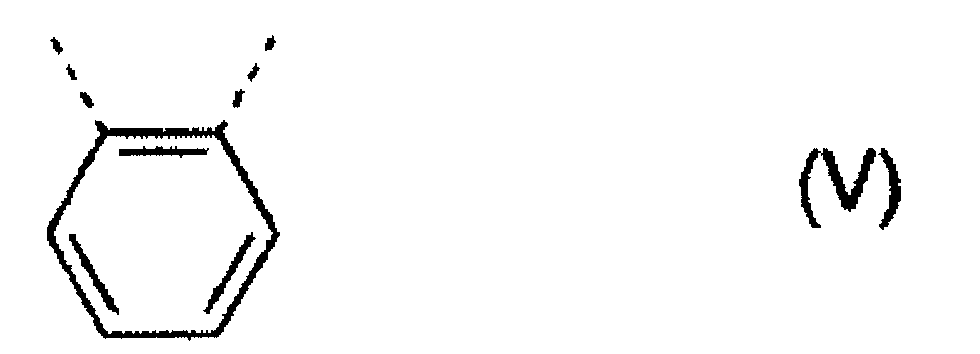
- radical R 2 is a divalent radical of a cycloaliphatic 1,2-diamine or of an aromatic o-diamine after removal of the two primary amino groups.
- R 3 and R 4 independently of one another are H or a radical of the formula (II).
- R 5 and R 6 are both H or both are a radical of the formula (III).
- radical R 2 in particular the radicals of the formula (IV) or (V) are preferred, wherein the dashed lines represent the attachment sites to the two nitrogen atoms corresponding in formula (I).
- the structural element resulting from the cycloaliphatic 1,2-diamine, or from the aromatic o-diamine an essential element of the invention.
- the fact that the compounds according to the invention are distinguished by good storage stability is ascribed in particular to this structural element, in particular in combination with the structural element derived from isophorone diisocyanate or maleic acid diester. Namely, the amide protons and the possibly present urea protons are protected from attack by reactive compounds, which can give rise to crosslinking reaction.
- R 1 is a radical as obtained by formal removal of the carboxyl groups of a carboxyl group-terminated butadiene / acrylonitrile copolymer commercially available under the name Hycar® CTBN from Noveon.
- the radical R 1 preferably has the formula (VI).
- the dashed lines represent the attachment sites of the two carboxyl groups of the carboxyl group-terminated butadiene / acrylonitrile copolymer.
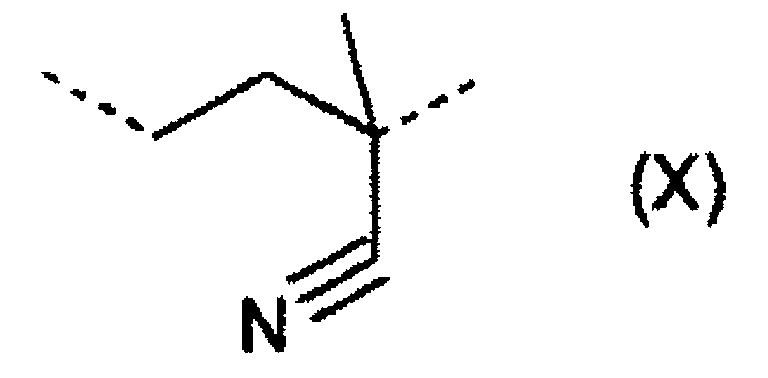
- the substituent R here stands for a linear or branched alkylene radical having 1 to 6 C atoms, in particular having 4 C atoms, which is optionally substituted by unsaturated groups.
- the substituent R represents a substituent of the formula (X), the dashed lines representing the attachment sites here as well
- the index q stands for a value between 40 and 70, in particular between 50 and 70.
- the designations a and b represent the structural elements which originate from butadiene and a the structural element which originates from acrylonitrile.
- the indices n, m , and p in turn represent values describing the relationship of the structural elements a, b and c to each other.
- the index n stands for values of 0.05 - 0.3
- the index m for values of 0.5 - 0.8
- the index p for values of 0.1 - 0.2 with the assumption that the sum of n, m and p is equal to 1.
- the substituents R 3 , R 4 , R 5 and R 6 each represent a hydrogen.
- This embodiment of the formula (I) is an amino group-terminated liquid rubber. From this embodiment, all embodiments of the compound according to the formula (I) and their secondary products of the present invention can be prepared. As a particularly preferred embodiment of the formula (I), such an amino group-terminated compound has the structure of the formula (VII).
- the compound of formula (I) has the structure of formula (VIII).
- the substituent R 3 is a hydrogen
- R 4 is a substituent of the formula (II)
- R 5 and R 6 are each a substituent of the formula (III).
- the compound of the formula ( I) the structure of the formula (IX).
- the compounds of the formula (I) can be prepared from carboxyl-terminated butadiene / acrylonitrile copolymers and the formula HOOC-R 1 -COOH and cycloaliphatic 1,2-diamine or an aromatic o-diamine. This production takes place in a manner known in principle for amide production. In order to prevent or greatly reduce crosslinking reactions, this amidation is carried out in a strong stoichiometric excess of the diamine and optionally in a suitable solvent. The excess diamine can be separated by distillation if necessary.
- they can be prepared from a carboxyl group-terminated butadiene / acrylonitrile copolymer of the type commercialized as Hycar® CTBN.
- these compounds can be prepared from carboxyl-terminated butadiene / acrylonitrile copolymers of the type commercialized as Hycar® CTBN and 1,2-diaminocyclohexane.
- compounds of the formula (VIII) can be prepared from compounds of the formula (VII) and maleic acid dialkyl esters or maleic acid diallyl esters.
- a Michael reaction of the primary amino group of the compound of the formula (VII) is added to the double bond of Maleinklaredialkylesters or Maleinklaiallylesters.
- the person skilled in the art knows the conditions for this reaction as well as the fact that by varying the stoichiometric ratio the yield can be optimized to form the compound of formula (VIII).
- step i) The conditions which lead to the formation of amide groups in step i) or which lead to Michael addition in step ii) for the formation of urea groups or in step i ') are well known to the person skilled in the art.
- Carboxyl-terminated butadiene / acrylonitrile copolymers are, in particular, carboxyl-terminated butadiene / acrylonitrile copolymers of the formula (XIII) wherein the substituents and indices have the meanings and preferred embodiments already described above.
- carboxyl-terminated butadiene / acrylonitrile copolymers such as are commercially available under the trade name Hycar® CTBN from Noveon.
- cycloaliphatic 1,2-diamines are preferred.
- the most preferred cycloaliphatic 1,2-diamine is 1,2-diaminocyclohexane.
- step I The conditions which lead to the formation of amide groups in step I) or which lead to the formation of urea in step III) or to Michael addition in step I ') are well known to the person skilled in the art.
- Carboxyl-terminated butadiene / acrylonitrile copolymers are, in particular, carboxyl-terminated butadiene / acrylonitrile copolymers of the formula (XIII) wherein the substituents and indices have the meanings and preferred embodiments already described above.
- carboxyl-terminated butadiene / acrylonitrile copolymers such as are commercially available under the trade name Hycar® CTBN from Noveon.
- cycloaliphatic 1,2-diamines are preferred.
- the most preferred cycloaliphatic 1,2-diamine is 1,2-diaminocyclohexane.
- polyether diol in particular polyoxyalkylenediols are suitable.
- a particularly preferred polyether diol is poly (oxy-1,4-butanediyl) - ⁇ -hydro- ⁇ -hydroxyl, which is also known to the person skilled in the art as poly-THF or polytetramethylene ether glycol.
- poly-THF are commercially available as a product series under the name Terathane® from DuPont or Poly-THF® from BASF Corp.
- the molar ratio of carboxyl-terminated butadiene / acrylonitrile copolymer to diol which has a value of 1.5 ⁇ xy / x ⁇ 0.75, has proven to be particularly suitable.
- the viscosity of the compounds or their secondary products is also high. It is therefore of advantage if the compounds of the formula (I), or their secondary products, have such a viscosity which allows processing by means used in the customary context for viscous to pasty substances.
- For the function as toughness improver is of particular advantage, if they have a viscosity, as is usual in liquid rubbers.
- the viscosity of the compounds (I) is not more than three times that of the carboxyl-terminated butadiene / acrylonitrile copolymers used.
- amino-group-terminated tougheners in particular those of the formula (VII)
- such compounds can be governed by compounds which have functional groups which are reactive with amino groups.
- Such secondary products in particular adducts, can in turn continue to react.
- epoxy group-terminated tougheners can be prepared from the amino group-terminated tougheners using di- or polyepoxides.
- Particularly interesting secondary products of amino-group-terminated tougheners are toughness improvers having isocyanate groups, especially those of the formula (I) having substituents of the formula (III) for R 5 and R 6 which are selected from amino-group-terminated tougheners and Polyisocyanates can be prepared.
- isocyanate-group-terminated toughness improvers are very interesting compounds insofar as a large number of reactive tougheners with a wide variety of chemical functionalities and prepolymers can be prepared from them by further reactions.
- (meth) acrylate, vinyl, allyl, epoxy, hydroxy, mercapto or alkoxysilane groups terminated tougheners or prepolymers can be realized.
- These prepolymers may be cured by themselves or as part of a resin, or act as a hardener.
- the compounds of the formula (I), in particular the toughening agents having amine groups and / or their secondary products, are especially well suited as hardeners.
- compounds of the formula (I) in which at least the radicals R 5 and R 6 , in particular the radicals R 3 , R 4 , R 5 and R 6 are H, hardener or curing component for compounds having two or more amine reactive functional groups.
- they are suitable as curing agent or curing component for epoxy resins or epoxy resin compositions or polyurethane prepolymers having polyisocyanates or isocyanate groups.
- compositions preferably contain at least one compound of formula (I) in which the substituents R 5 and R 6 both represent a radical of formula (III), at least one NCO-group-containing polyurethane prepolymer prepared from the reaction of at least one polyol and at least a polyisocyanate.
- a specific embodiment of the invention are glycidyl-containing compounds of the formula (XIV). wherein the terms, indices and substituents have the meanings and preferred embodiments already mentioned.
- R 8 stands for a (t + 1) -valid organic radical, where t in turn stands for a value of 1, 2, 3 or 4.
- R 9 is the formula (XV) or formula (XVI) or a radical of a primary monoamine after removal of an H of the amino group, in particular the radical of the formula (XVII).
- R 10 here is H or an alkyl radical, in particular methyl or tert. Butyl.
- R 11 here is H or an alkyl radical.
- a particularly preferred radical R 8 is the trivalent radical of the formula (XVIII).
- a particularly preferred radical R 8 is the trivalent radical of the formula (XVIII).
- the glycidyl-containing compounds of the formula (XIV) represents a glycidyl-containing compounds of the formula (XIX). wherein the terms, indices and substituents have the meanings and preferred embodiments already mentioned.
- Such glycidyl-containing compounds of the formula (XIV) or of the formula (XIX) are obtainable from the reaction of a compound of the formula (IX) or of the formula (X) or of the formula (XII) with at least one mono -Hydroxy-glycidyl compound of the formula (XX), in particular of the formula (XXI) and optionally a catechol, an alkylcatechol or dialkylcatechol, in particular tert-butyl catechol, or a primary monoamine.
- 4-methylcatechol and tert-butyl catechol are particularly suitable as alkyl catechol as dialkyl catechol 3,4-dimethylcatechol and 3,6-dimethylcatechol. 4-tert.
- Butyl catechol is particularly preferred because it has a deep. Having melting point and advantageous toxicity.
- the use of catechol, alkyl catechol or dialkyl catechol has proven to be particularly advantageous for epoxy resin compositions because the remaining phenolic group causes accelerated curing.
- Such monohydroxyl glycidyl compounds can be produced, for example, by reacting polyols with epichlorohydrin. Depending on the reaction, the corresponding monohydroxyl-glycidyl compounds are formed in different concentrations in the reaction of polyfunctional alcohols with epichlorohydrin as by-products. These can be isolated by conventional separation operations. In general, however, it is sufficient to use the product mixture obtained in the glycidylation reaction of polyols from completely and partially reacted to the glycidyl ether polyol.
- hydroxyl-containing epoxides examples include trimethylolpropane diglycidyl ethers (contained as a mixture in trimethylolpropane triglycidyl ether), Glycerol diglycidyl ether (contained as a mixture in glycerol triglycidyl ether), pentaerythritol triglycidyl ether (as a mixture contained in pentaerythritol tetraglycidyl ether).
- trimethylolpropane diglycidyl ether which occurs at a relatively high level in commonly prepared trimethylolpropane triglycidyl ether, is used.
- Such species are also present in low concentration in commercial solid resins.
- epoxides with a ⁇ -hydroxy ether group prepared by the reaction of (poly) epoxides with a deficit of monovalent nucleophiles such as carboxylic acids, phenols, thiols or sec-amines, can be used.
- the free primary or secondary OH functionality of the monohydroxyl epoxy compound of the formula (XX) permits efficient reaction with compounds containing isocyanate groups without having to use disproportionate excesses of the epoxide component of the formula (XX).
- the monoamine of the formula (XXIII) has proved to be particularly advantageous as the primary monoamine.
- the compounds of the formula (IX), (X) or (XII) are first reacted at most with catechol, alkylcatechol or dialkylcatechol or the primary monoamine to form an adduct. It is preferred here if a stoichiometry of about 1 mol of the formula (IX), (X) or (XII) is used at 0.2 to 0.5 mol, in particular 0.2 to 0.3 mol, of the catechol, alkylcatechol or dialkylcatechol, which leads to mixtures of adducts and compounds of the formula (IX), (X) or (XII). Subsequently, a reaction with at least one mono-hydroxyl glycidyl compound of the formula (XX) is carried out in an amount such that all the isocyanate groups have reacted.
- the compound of formula (IX) with catechol, an alkylcatechol or dialkylcatechol, in particular with tert is an alkylcatechol or dialkylcatechol, in particular with tert.
- Butyl catechol implemented, in particular in the molar conditions of formula (IX) to catechol, alkyl catechol or dialkyl catechol, in particular to tert.
- Liquid epoxy resins are known in the art.
- Preferred epoxide liquid resins include diglycidyl ethers of bisphenol-A (DGEBA), bisphenol-F and bisphenol-A / F (The term 'A / F' refers to a mixture of bisphenol-A and bisphenol-F, which is known as Starting material is used in its preparation).
- DGEBA diglycidyl ethers of bisphenol-A
- bisphenol-F bisphenol-F
- the term 'A / F' refers to a mixture of bisphenol-A and bisphenol-F, which is known as Starting material is used in its preparation.
- Such liquid resins are, for example available as Araldite® GY 250, Araldite® PY 304, Araldite® GY 282 (Huntsman) or DER 331 (Dow) or Epikote 828 (Resolution).
- Solid epoxy resins are known in the art.
- Preferred epoxy solid resins are higher diglycidyl ethers of bisphenol A (DGEBA), of bisphenol F and of bisphenol A / F (The term 'A / F' refers here to a mixture of acetone with formaldehyde, which is used as starting material in its Production is used).
- DGEBA diglycidyl ethers of bisphenol A
- 'A / F' refers here to a mixture of acetone with formaldehyde, which is used as starting material in its Production is used).
- Preferred solid epoxy resins have the formula (XXIV)
- the substituents R 'and R "independently of one another are either H or CH 3.
- the index s has a value of> 1.5, in particular from 2 to 12.
- Such solid epoxy resins are commercially available, for example from Dow or Huntsman or Resolution.
- Such glycidyl-containing compounds are particularly well suited as an epoxy resin adhesive or as an additive in epoxy resin adhesives. In a particularly preferred embodiment, they are used as epoxy resin adhesives or in thermosetting epoxy resin adhesives. Such thermosetting adhesives are one-component.
- the content of glycidyl-containing compounds of the formula (XIV), in particular of the formula (XIX), is preferably between 2 and 50% by weight, based on the epoxy resin adhesive composition.
- heat-curing epoxy resin adhesives contain, in addition to at least one glycidyl-containing compounds of the formula (XIV), in particular of the formula (XIX), at least one liquid epoxy resin and at least one activatable by elevated temperature hardener.
- solid epoxy resins and fillers are constituents which can be used to advantage.
- a hardener which can be activated by elevated temperature is preferably a hardener which is selected from the group dicyandiamide, guanamines, guanidines, aminoguanidines and derivatives thereof.
- catalytically active substituted ureas such as 3-chloro-4-methylphenylurea (chlorotoluron), or phenyl-dimethylureas, in particular p-chlorophenyl-N, N-dimethylurea (monuron), 3-phenyl-1,1-dimethylurea (fenuron) or 3,4-dichlorophenyl-N, N-dimethylurea (diuron).
- compounds of the class of imidazoles and amine complexes can be used. Particularly preferred is dicyandiamide.
- the total amount of the curing agent is 1 - 10% by weight, preferably 2 - 8% by weight, based on the weight of the total adhesive composition.
- the adhesive composition contains at least one filler.
- these are preferably mica, talc, kaolin, wollastonite, feldspar, chlorite, bentonite, montmorillonite, calcium carbonate (precipitated or ground), dolomite, quartz, silicic acids (pyrogenic or precipitated), cristobalite, calcium oxide, aluminum hydroxide, magnesium oxide, ceramic hollow spheres, Glass hollow spheres, organic hollow spheres, glass spheres, color pigments.
- Filler means both the organic coated and the uncoated commercially available and known in the art forms.
- Particularly preferred fillers are wollastonite and fumed silica, as are commercially available, for example, under the trade name Aerosil® from Degussa.
- the total content of the total filler is 3 to 30% by weight, preferably 5 to 25% by weight, based on the weight of the total adhesive composition.
- epoxide group-bearing reactive diluents may also be used as further constituents of the adhesive, in particular in an amount of 1 to 7% by weight, preferably 2 to 6% by weight, based on the weight of the total adhesive composition.
- composition may further comprise other ingredients, especially catalysts, heat and / or light stabilizers, thixotropic agents, plasticizers, solvents, dyes and pigments.
- Such an adhesive is first contacted with the materials to be bonded at a temperature of between 10 ° C and 80 ° C, in particular between 10 ° C and 60 ° C, and later cured at a temperature of typically 100-220 ° C, preferably 120 - 200 ° C.
- Heat-stable materials are materials which are dimensionally stable at a curing temperature of 100-220 ° C., preferably 120-200 ° C., at least during the curing time.
- these are metals and plastics such as ABS, polyamide, polyphenylene ethers, composite materials such as SMC, unsaturated polyester GRP, epoxy or acrylate composites.
- Preferred is the application in which at least one material is a metal.
- Particularly preferred use is the bonding of the same or different metals, especially in the shell in the automotive industry.
- the preferred metals are above all steel, in particular electrolytically galvanized, hot-dip galvanized, oiled steel, Bonazink-coated steel, and subsequently phosphated steel, and aluminum, in particular in the variants typically occurring in the automotive industry.
- the compounds of the formula (I), or their secondary products furthermore have a good absorption capacity of oil.
- All the compounds, compositions and adhesives according to the invention are storage-stable, ie they do not crosslink during the storage period, which is typically at least one month, preferably at least three months, if they are stored in the absence of moisture at temperatures below 50 ° C.
- the use of the compounds of the formula (I), or their secondary products improves the toughness, in particular also at low temperatures, ie in particular also at temperatures below 0 ° C. It has been observed that the impact strength of adhesives, both at higher temperatures and above all at low temperatures, in particular between 0 ° C to -40 ° C can be realized. It was possible to produce heat-curing epoxy resin adhesives with the aid of the compounds according to the invention or their secondary products which, after curing by heat, have fracture energies measured in accordance with DIN 11343 of more than 10.0 J at 23 ° C. and more than 5.0 J at -40 ° C.
- compositions which have fracture energies of more than 12 J at 23 ° C and more than 7.0 J at -40 ° C.
- Particularly advantageous compositions had fracture energies of more than 14.0 J at 23 ° C and more than 8 J at -40 ° C.
- Trimethylolpropane glycidyl ether was prepared according to the method in patent US 5,668,227 Example 1 from trimethylolpropane and epichlorohydrin prepared with tetramethylammonium chloride and sodium hydroxide. A yellowish product having an epoxide number of 7.5 eq / kg and a hydroxyl group content of 1.8 eq / kg is obtained. It can be concluded from the HPLC-MS spectrum that essentially a mixture of trimethylolpropane diglycidyl ether and trimethylolpropane triglycidyl ether is present.
- the carboxyl-terminated butadiene / acrylonitrile copolymer was introduced together with 1,2-diaminocyclohexane or 1,3-diaminopentane and butyl titanate as catalyst and heated to a temperature of about 180 ° C. After distillative removal of the water was cooled.
- the isocyanate-containing compounds in Examples B3 to B11 was then the monoamine or tert. Butylcatechol added, reacted at a temperature of about 80 °. Subsequently, these other products with the mono-hydroxyl glycidyl compound and then mixed with the liquid resin and optionally finally with the solid resin and stirred at 90 ° C until the solid resin has completely dissolved.
- Thermosetting epoxy resin adhesives were prepared with compositions B3 to B11 .
- the ingredients were mixed according to Table 3 in a Schramoid mixer.
- the content of the curing agent dicyandiamide was used at the same epoxy content.
- test specimens were used to determine the tensile strength and elongation at break according to DIN EN ISO 527 at a tensile speed of 2 mm / min.
- ZSF Tensile shear strength
- test specimens were produced from the described example compositions and with electrolytically galvanized steel (eloZn) with the dimensions 100 ⁇ 25 ⁇ 0.8 mm, the bond area being 25 ⁇ 10 mm and a layer thickness of 0.3 mm. Hardened for 30 min. At 180 ° C. The pulling speed was 10mm / min.
- electrolytically galvanized steel eloZn
- the specimens were produced from the described example compositions and with electrolytically galvanized steel (eloZn) with the dimensions 90 ⁇ 20 ⁇ 0.8 mm, while the adhesive surface was 20 ⁇ 30 mm with a layer thickness of 0.3 mm. Hardened for 30 min. At 180 ° C. The pulling speed was 2 m / s. The fracture energy in joules is the area under the measurement curve (from 25% to 90%, according to DIN 11343). Table 3. Adhesive compositions and properties.
Landscapes
- Chemical & Material Sciences (AREA)
- Organic Chemistry (AREA)
- Health & Medical Sciences (AREA)
- Chemical Kinetics & Catalysis (AREA)
- Medicinal Chemistry (AREA)
- Polymers & Plastics (AREA)
- General Chemical & Material Sciences (AREA)
- Epoxy Resins (AREA)
- Adhesives Or Adhesive Processes (AREA)
- Polyurethanes Or Polyureas (AREA)
- Addition Polymer Or Copolymer, Post-Treatments, Or Chemical Modifications (AREA)
- Organic Low-Molecular-Weight Compounds And Preparation Thereof (AREA)
Claims (30)
- Composé de formule (I)
 dans laquelle R1 représente un reste divalent d'un copolymère butadiène/acrylonitrile terminé par des groupes carboxy, après élimination des groupes carboxy ; etR2 représente un reste divalent d'une 1,2-diamine cycloaliphatique ou d'une o-diamine aromatique après élimination des deux groupes amino primaires ;R3 et R4 représentent, indépendamment l'un de l'autre, H ou un radical de formule (II), où R7 représente un radical alkyle ou un radical allyle,
 R5 et R6 représentent l'un et l'autre H ou l'un et l'autre un radical de formule (III)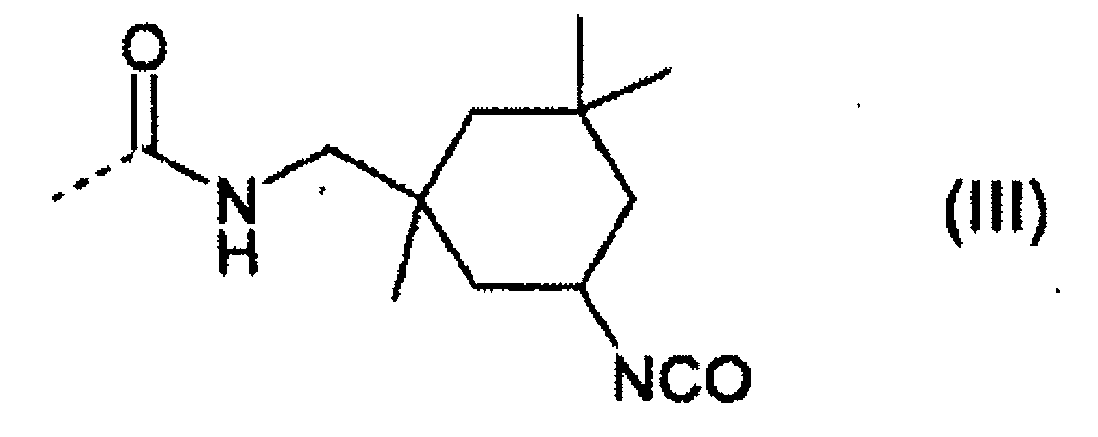
- Composé selon la revendication 1, caractérisé en ce que R2 correspond à la formule (IV)

- Composé selon la revendication 1, caractérisé en ce que R2 correspond à la formule (V)
- Composé selon l'une quelconque des revendications 1 à 3, caractérisé en ce que R1 correspond à la formule (VI)
 les traits interrompus représentant les positions de fixation des deux groupes carboxy ;b et c représentant les éléments structuraux qui proviennent du butadiène et a l'élément structural qui provient de l'acrylonitrile ;R représente un radical alkylène linéaire ou ramifié ayant de 1 à 6 atomes de carbone, en particulier 4 atomes de carbone, qui est éventuellement substitué par des groupes insaturés ;q représente une valeur comprise entre 40 et 70, en particulier entre 50 et 70 ;n = 0,05-0,3, m = 0,5-0,8, p = 0,1-0,2 ;avec la condition que n+m+p = 1.
 - Composé selon l'une quelconque des revendications précédentes, caractérisé en ce que le composé correspond à la formule (VII)

- Composé selon l'une quelconque des revendications précédentes, caractérisé en ce que le composé correspond à la formule (VIII)

- Composé selon l'une quelconque des revendications précédentes, caractérisé en ce que le composé correspond à la formule (IX)

- Composé selon l'une quelconque des revendications précédentes, caractérisé en ce que le radical R7 est un radical allyle -CH2-CH=CH2.
- Composé selon l'une quelconque des revendications précédentes, caractérisé en ce que le radical R correspond à la formule (X)

- Procédé pour la préparation d'un composé polyisocyanate, comprenant les étapesi) mise en réaction de x moles d'un copolymère butadiène/acrylonitrile, terminé par des groupes carboxy, avec y moles d'une 1,2-diamine cycloaliphatique ou d'une o-diamine aromatique comportant deux groupes amino primaires en le rapport de quantités y/x ≥ 2, dans des conditions conduisant à la formation de groupes amido ;ii) mise en réaction avec z moles d'isophorone-diisocyanate dans le rapport z/x+ ≥ 2, avec formation de groupes urée.
- Procédé selon la revendication 10, caractérisé en ce qu'après l'étape de réaction i) et avant l'étape de réaction ii) on effectue une étape i')i') réaction de xx moles de maléate de dialkyle ou de maléate de diallyle en le rapport de quantités xx/x ≥ 0,6, dans des conditions qui permettent une addition de Michael des groupes amino primaires sur la double liaison de l'ester d'acide maléique.
- Procédé selon la revendication 10 ou 11, caractérisé en ce que la 1,2-diamine cycloaliphatique est le 1,2-diaminocyclohexane.
- Procédé pour la préparation d'un mélange de composés polyisocyanate, comprenant les étapesI) mise en réaction de x moles d'un copolymère butadiène/acrylonitrile, terminé par des groupes carboxy, avec y moles d'une 1,2-diamine cycloaliphatique ou d'une o-diamine aromatique, comportant deux groupes amino primaires, en le rapport de quantités y/x ≥ 2, dans des conditions qui conduisent à la formation de groupes amido ;II) addition de xy moles d'un diol, en particulier d'un polyétherdiol ;III) mise en réaction avec 2 moles d'isophorone-diisocyanate en le rapport z/(x+xy) ≥ 2, avec formation de groupes urée.
- Procédé selon la revendication 13, caractérisé en ce qu'après l'étape de réaction I) et avant l'étape de réaction III) on effectue une étape I')I') réaction de xx moles de maléate de dialkyle ou de maléate de diallyle en le rapport de quantités xx/x ≥ 0,6, dans des conditions qui permettent une addition de Michael des groupes amino primaires sur la double liaison de l'ester d'acide maléique.
- Procédé selon la revendication 13 ou 14, caractérisé en ce que le polyétherdiol est le poly(oxy-1,4-butanediyl)-α-hydro-ω-hydroxyle.
- Procédé selon l'une quelconque des revendications 13 à 15, caractérisé en ce que le rapport est 1,5 ≥ xy/x ≥ 0,75.
- Procédé selon l'une quelconque des revendications 13 à 16, caractérisé en ce que la 1,2-diamine cycloaliphatique est le 1,2-diaminocyclohexane.
- Composé comportant des groupes glycidyle, de formule (XIV)
 dans laquelle b et c représentent les éléments structuraux qui proviennent du butadiène et a représente l'élément structural qui provient de l'acrylonitrile ;R représente un radical alkylène linéaire ou ramifié ayant de 1 à 6 atomes de carbone, en particulier ayant 4 atomes de carbone, qui est éventuellement substitué par des groupes insaturés ;q représente une valeur comprise entre 40 et 70, en particulier entre 50 et 70 ;n = 0,05-0,3, m = 0,5-0,8, p = 0,1-0,2 ; la somme n+m+p étant égale à 1 ;R3 et R4 représentent, indépendamment l'un de l'autre, H ou un radical de formule (II), où R7 représente un radical alkyle ou le radical allyle,
 R8 représente un radical organique (t+1)-valent,t représente une valeur de 1, 2, 3 ou 4,R9 représente un groupe de formule (XV) ou de formule (XVI) ou un reste d'une monoamine primaire après élimination d'un atome d'hydrogène du groupe amino, en particulier le radical de formule (XVII),

 R10 représentant H ou un radical alkyle, en particulier méthyle ou tert-butyle et R11 représente H ou un radical alkyle.
 - Composé comportant des groupes glycidyle selon la revendication 18, caractérisé en ce que t = 2 et le radical R8 correspond à la formule (XVIII)

- Composé comportant des groupes glycidyle selon la revendication 18 ou 19, caractérisé en ce que le radical R correspond à la formule (X)
- Utilisation d'un composé selon l'une quelconque des revendications 1 à 9, les radicaux R5 et R6 représentant H, en tant que durcisseur pour des composés à deux ou plus de deux groupes fonctionnels réactifs avec des amines.
- Utilisation selon la revendication 21, en tant que durcisseur pour des résines époxy.
- Utilisation selon la revendication 21, en tant que durcisseur pour des polyisocyanates ou des prépolymères polyuréthanne comportant des groupes isocyanate.
- Utilisation d'un composé comportant des groupes glycidyle selon l'une quelconque des revendications 18 à 20, en tant qu'adhésif à base de résine époxy ou en tant que composant d'un adhésif à base de résine époxy.
- Utilisation selon la revendication 24, en tant qu'adhésif à base de résine époxy thermodurcissable ou en tant que composant d'un adhésif à base de résine époxy thermodurcissable.
- Utilisation d'un composé selon l'une quelconque des revendications 1 à 9 ou d'un composé préparé conformément à un procédé selon l'une quelconque des revendications 10 à 17, ou d'un composé selon l'une quelconque des revendications 18 à 20, comportant des groupes glycidyle, en tant que modificateur réactif de résistance au choc.
- Composition comprenant un composé selon l'une quelconque des revendications 1 à 9, ou un composé préparé conformément à un procédé selon l'une quelconque des revendications 10 à 17, ou un composé comportant des groupes glycidyle selon l'une quelconque des revendications 18 à 20.
- Composition selon la revendication 27, caractérisé en ce que la composition contient au moins un composé comportant des groupes glycidyle selon l'une quelconque des revendications 18 à 20 ainsi qu'au moins une résine époxy liquide.
- Composition selon la revendication 27,
caractérisé en ce que la composition contient au moins un composé de formule (I), dans lequel les substituants R5 et R6 représentent l'un et l'autre un radical de formule (III), au moins un prépolymère polyuréthanne comportant des groupes NCO, préparé par la réaction d'au moins un polyol et d'au moins un polyisocyanate. - Composition durcie obtenue par la réaction d'un composé qui est réactif avec un composé selon l'une quelconque des revendications 1 à 9 ou un composé préparé conformément à un procédé selon l'une quelconque des revendications 10 à 17, ou un composé comportant des groupes glycidyle selon l'une quelconque des revendications 18 à 20.
Priority Applications (1)
| Application Number | Priority Date | Filing Date | Title |
|---|---|---|---|
| EP06792829A EP1919960B1 (fr) | 2005-08-16 | 2006-08-16 | Promoteurs de résistance terminés par des groupes amino, leurs produits réactionnels et leurs utilisations |
Applications Claiming Priority (3)
| Application Number | Priority Date | Filing Date | Title |
|---|---|---|---|
| EP05107523A EP1754721A1 (fr) | 2005-08-16 | 2005-08-16 | Agents résistants aux chocs terminés par des groupes d'amine, leurs dérivés et leur utilisation. |
| EP06792829A EP1919960B1 (fr) | 2005-08-16 | 2006-08-16 | Promoteurs de résistance terminés par des groupes amino, leurs produits réactionnels et leurs utilisations |
| PCT/EP2006/065342 WO2007020266A1 (fr) | 2005-08-16 | 2006-08-16 | Promoteurs de résistance terminés par des groupes amino, leurs produits réactionnels et leurs utilisations |
Publications (2)
| Publication Number | Publication Date |
|---|---|
| EP1919960A1 EP1919960A1 (fr) | 2008-05-14 |
| EP1919960B1 true EP1919960B1 (fr) | 2009-05-27 |
Family
ID=35610137
Family Applications (2)
| Application Number | Title | Priority Date | Filing Date |
|---|---|---|---|
| EP05107523A Withdrawn EP1754721A1 (fr) | 2005-08-16 | 2005-08-16 | Agents résistants aux chocs terminés par des groupes d'amine, leurs dérivés et leur utilisation. |
| EP06792829A Not-in-force EP1919960B1 (fr) | 2005-08-16 | 2006-08-16 | Promoteurs de résistance terminés par des groupes amino, leurs produits réactionnels et leurs utilisations |
Family Applications Before (1)
| Application Number | Title | Priority Date | Filing Date |
|---|---|---|---|
| EP05107523A Withdrawn EP1754721A1 (fr) | 2005-08-16 | 2005-08-16 | Agents résistants aux chocs terminés par des groupes d'amine, leurs dérivés et leur utilisation. |
Country Status (10)
| Country | Link |
|---|---|
| US (1) | US7897688B2 (fr) |
| EP (2) | EP1754721A1 (fr) |
| JP (1) | JP2009504863A (fr) |
| KR (1) | KR20080036226A (fr) |
| CN (1) | CN101282998B (fr) |
| AT (1) | ATE432294T1 (fr) |
| CA (1) | CA2623716A1 (fr) |
| DE (1) | DE502006003836D1 (fr) |
| MX (1) | MX2008002127A (fr) |
| WO (1) | WO2007020266A1 (fr) |
Families Citing this family (14)
| Publication number | Priority date | Publication date | Assignee | Title |
|---|---|---|---|---|
| EP1972646A1 (fr) | 2007-03-20 | 2008-09-24 | Sika Technology AG | Polymères terminés par des groupes époxy, leur préparation et leur utilisation comme modificateurs résistants aux chocs |
| EP2110397A1 (fr) | 2008-04-16 | 2009-10-21 | Sika Technology AG | Polymère de polyuréthane basé sur des blocs de copolymères amphiphiles et leur utilisation comme modificateur de résistance aux chocs |
| EP2113525A1 (fr) | 2008-04-30 | 2009-11-04 | Sika Technology AG | Activateur pour compositions de résine époxyde |
| JP5687187B2 (ja) | 2008-04-30 | 2015-03-18 | シーカ・テクノロジー・アーゲー | エポキシ樹脂組成物のための活性剤 |
| EP2128182A1 (fr) | 2008-05-28 | 2009-12-02 | Sika Technology AG | Composition en réside d'époxy durcissant à la chaleur et contenant un accélérateur doté d'atomes hétéroclites |
| DE502008000478D1 (de) | 2008-07-17 | 2010-05-06 | Sika Technology Ag | Haftvermittlerverbindungen für beölten Stahl |
| EP2145924A1 (fr) | 2008-07-18 | 2010-01-20 | Sika Technology AG | Produits de réaction à base de copolymères bloc amphiphiles et leur utilisation en tant que modificateur de la résistance à l'impact |
| ATE468344T1 (de) | 2008-08-27 | 2010-06-15 | Sika Technology Ag | Silan-/harnstoff-verbindung als hitzeaktivierbarer härter für epoxidharzzusammensetzungen |
| EP2182025B1 (fr) | 2008-10-31 | 2010-10-06 | Sika Technology AG | Composition de résine époxy durcissant à la chaleur appropriée comme adhésive de carrosserie |
| WO2011056357A1 (fr) | 2009-11-05 | 2011-05-12 | Dow Global Technologies Llc | Adhésifs de résine époxy structuraux contenant des durcisseurs élastomères coiffés avec des cétoximes |
| EP2436712A1 (fr) | 2010-10-01 | 2012-04-04 | Sika Technology AG | Modificateurs de la résilience pour compositions de résine époxyde |
| EP2655516B1 (fr) | 2010-12-26 | 2018-12-26 | Dow Global Technologies LLC | Colles d'assemblage à base de résine époxy, contenant des durcisseurs élastomères à chaînes allongées et coiffés par des composés de phénol, de polyphénol ou d'aminophénol |
| CN109942794B (zh) * | 2019-03-28 | 2021-10-15 | 安徽亚井雨水利用科技有限公司 | 一种环氧树脂固化剂、其制备方法及复合材料 |
| CN119613305A (zh) * | 2024-12-09 | 2025-03-14 | 哈尔滨工业大学 | 一种含邻苯二酚基团环氧树脂韧性固化剂及其制备方法 |
Family Cites Families (13)
| Publication number | Priority date | Publication date | Assignee | Title |
|---|---|---|---|---|
| US4088708A (en) * | 1975-06-13 | 1978-05-09 | The B. F. Goodrich Company | Thermoplastic, thermosetting elastomeric compositions and methods for making the same |
| JPS555933A (en) * | 1978-06-27 | 1980-01-17 | Nippon Soda Co Ltd | Cation electrodeposition coating composition |
| US4320047A (en) * | 1980-11-13 | 1982-03-16 | The B. F. Goodrich Company | Curable thixotropic epoxy/amine terminated liquid polymer compositions |
| JPH0623369B2 (ja) * | 1986-04-08 | 1994-03-30 | 宇部興産株式会社 | エポキシ樹脂系接着剤組成物 |
| NZ230314A (en) * | 1988-09-09 | 1991-02-26 | Ici Plc | Polyisocyanate composition obtained from the reaction product of uretonimine and/or carbodiimide-modified polyisocyanate with a carboxylic acid |
| JPH03220206A (ja) * | 1989-10-26 | 1991-09-27 | Asahi Chem Ind Co Ltd | テレケリック液状水素化ニトリルゴムおよびその製造方法 |
| DE69111576T2 (de) * | 1990-11-29 | 1996-02-01 | Ciba Geigy Ag | Hochleistungsepoxydharzklebstoff. |
| JPH04332784A (ja) * | 1991-05-09 | 1992-11-19 | Tomoegawa Paper Co Ltd | 封止用エポキシ樹脂組成物接着シート |
| EP0617728B1 (fr) * | 1992-08-17 | 1997-12-29 | Ciba SC Holding AG | Substances reticulables a temperature ambiante, leur procede de fabrication et leur utilisation |
| TW289763B (fr) | 1992-11-11 | 1996-11-01 | Ciba Geigy Ag | |
| US6057014A (en) * | 1995-07-26 | 2000-05-02 | E. I. Du Pont De Nemours And Company | Laminates of composition for improving adhesion of elastomers to polymer compositions |
| JP3835090B2 (ja) * | 1999-12-09 | 2006-10-18 | 日本メクトロン株式会社 | フレキシブル印刷配線板用接着剤 |
| EP1498441A1 (fr) * | 2003-07-16 | 2005-01-19 | Sika Technology AG | Compositions réticulables à la chaleur comprenant un modificateur de résistance au choc à basse température |
-
2005
- 2005-08-16 EP EP05107523A patent/EP1754721A1/fr not_active Withdrawn
-
2006
- 2006-08-16 KR KR1020087006481A patent/KR20080036226A/ko not_active Withdrawn
- 2006-08-16 WO PCT/EP2006/065342 patent/WO2007020266A1/fr not_active Ceased
- 2006-08-16 AT AT06792829T patent/ATE432294T1/de not_active IP Right Cessation
- 2006-08-16 EP EP06792829A patent/EP1919960B1/fr not_active Not-in-force
- 2006-08-16 MX MX2008002127A patent/MX2008002127A/es unknown
- 2006-08-16 CN CN2006800377340A patent/CN101282998B/zh not_active Expired - Fee Related
- 2006-08-16 US US11/990,337 patent/US7897688B2/en not_active Expired - Fee Related
- 2006-08-16 JP JP2008526495A patent/JP2009504863A/ja active Pending
- 2006-08-16 CA CA002623716A patent/CA2623716A1/fr not_active Abandoned
- 2006-08-16 DE DE502006003836T patent/DE502006003836D1/de active Active
Also Published As
| Publication number | Publication date |
|---|---|
| KR20080036226A (ko) | 2008-04-25 |
| ATE432294T1 (de) | 2009-06-15 |
| US20090247708A1 (en) | 2009-10-01 |
| DE502006003836D1 (de) | 2009-07-09 |
| CN101282998A (zh) | 2008-10-08 |
| WO2007020266A1 (fr) | 2007-02-22 |
| EP1754721A1 (fr) | 2007-02-21 |
| JP2009504863A (ja) | 2009-02-05 |
| CN101282998B (zh) | 2010-10-20 |
| MX2008002127A (es) | 2008-04-29 |
| EP1919960A1 (fr) | 2008-05-14 |
| US7897688B2 (en) | 2011-03-01 |
| CA2623716A1 (fr) | 2007-02-22 |
Similar Documents
| Publication | Publication Date | Title |
|---|---|---|
| EP1648950B1 (fr) | Compositions thermodurcissables comprenant des modificateurs de resistance aux chocs agissant a basses temperatures | |
| EP1957554B1 (fr) | Composition de resine epoxy durcissant a la chaleur et resiliante a basse temperature, contenant des resines solides epoxy | |
| EP2084199B1 (fr) | Prépolymères de polyuréthane blocqués et compositions de résines d'epoxy thermodurcissables | |
| EP2917255B1 (fr) | Nouveaux modificateurs de résilience pour des adhésifs à base d'époxy | |
| EP2084203B1 (fr) | Compositions d'epoxy thermodurcissables contenant des prépolymères de polyuréthane blocqués | |
| EP1578838B1 (fr) | Composition de resine epoxy thermodurcissable presentant une meilleure resistance aux chocs a basse temperature | |
| EP2060592B1 (fr) | Composition de résine époxy durcissant à la chaleur contenant des urées non aromatiques en tant qu'accélérateurs | |
| EP2137226B1 (fr) | Polymères terminés par des groupes époxy, leur préparation et leur utilisation comme modificateurs résistants aux chocs | |
| DE2152606C3 (de) | Härtbare Kunststoffmischungen | |
| EP3265499B1 (fr) | Résistance aux chocs à haute température dans des modificateurs de résistance aux chocs en polyuréthane à base de ptmeg | |
| EP1916272A1 (fr) | Compositions d'epoxy contenant des prépolymères de polyuréthane blocqués et terminés par époxy. | |
| EP2917254B1 (fr) | Caoutchoucs liquides réactifs en prépolymères isocyanate-terminés bloqués avec collecteur de glycol | |
| EP2110397A1 (fr) | Polymère de polyuréthane basé sur des blocs de copolymères amphiphiles et leur utilisation comme modificateur de résistance aux chocs | |
| EP2145924A1 (fr) | Produits de réaction à base de copolymères bloc amphiphiles et leur utilisation en tant que modificateur de la résistance à l'impact | |
| DE19627469A1 (de) | Epoxidharzvernetzungsmittel und Ein-Komponenten-Epoxidharzzusammensetzung | |
| EP1754721A1 (fr) | Agents résistants aux chocs terminés par des groupes d'amine, leurs dérivés et leur utilisation. | |
| EP3390562A1 (fr) | Article adhésif autoporteur pour collages structuraux | |
| EP3281982A1 (fr) | Modificateurs de la resilience de polyurethane sequence destines a ameliorer la resilience d'adhesifs epoxy a un composant, a durcissement cryogenique | |
| DE19549029A1 (de) | Cyclische Amidin- sowie Uretdiongruppen enthaltende Verbindungen, ein Verfahren zu ihrer Herstellung sowie deren Verwendung | |
| EP1876194A1 (fr) | Composition thermodurcissable adaptée au collage de substrats revêtus | |
| EP0566822B1 (fr) | Durcisseur flexible |
Legal Events
| Date | Code | Title | Description |
|---|---|---|---|
| PUAI | Public reference made under article 153(3) epc to a published international application that has entered the european phase |
Free format text: ORIGINAL CODE: 0009012 |
|
| 17P | Request for examination filed |
Effective date: 20080317 |
|
| AK | Designated contracting states |
Kind code of ref document: A1 Designated state(s): AT BE BG CH CY CZ DE DK EE ES FI FR GB GR HU IE IS IT LI LT LU LV MC NL PL PT RO SE SI SK TR |
|
| GRAP | Despatch of communication of intention to grant a patent |
Free format text: ORIGINAL CODE: EPIDOSNIGR1 |
|
| DAX | Request for extension of the european patent (deleted) | ||
| GRAS | Grant fee paid |
Free format text: ORIGINAL CODE: EPIDOSNIGR3 |
|
| GRAA | (expected) grant |
Free format text: ORIGINAL CODE: 0009210 |
|
| AK | Designated contracting states |
Kind code of ref document: B1 Designated state(s): AT BE BG CH CY CZ DE DK EE ES FI FR GB GR HU IE IS IT LI LT LU LV MC NL PL PT RO SE SI SK TR |
|
| REG | Reference to a national code |
Ref country code: GB Ref legal event code: FG4D Free format text: NOT ENGLISH |
|
| REG | Reference to a national code |
Ref country code: CH Ref legal event code: EP |
|
| REG | Reference to a national code |
Ref country code: IE Ref legal event code: FG4D Free format text: LANGUAGE OF EP DOCUMENT: GERMAN |
|
| REF | Corresponds to: |
Ref document number: 502006003836 Country of ref document: DE Date of ref document: 20090709 Kind code of ref document: P |
|
| PG25 | Lapsed in a contracting state [announced via postgrant information from national office to epo] |
Ref country code: LT Free format text: LAPSE BECAUSE OF FAILURE TO SUBMIT A TRANSLATION OF THE DESCRIPTION OR TO PAY THE FEE WITHIN THE PRESCRIBED TIME-LIMIT Effective date: 20090527 Ref country code: PT Free format text: LAPSE BECAUSE OF FAILURE TO SUBMIT A TRANSLATION OF THE DESCRIPTION OR TO PAY THE FEE WITHIN THE PRESCRIBED TIME-LIMIT Effective date: 20090927 Ref country code: FI Free format text: LAPSE BECAUSE OF FAILURE TO SUBMIT A TRANSLATION OF THE DESCRIPTION OR TO PAY THE FEE WITHIN THE PRESCRIBED TIME-LIMIT Effective date: 20090527 |
|
| NLV1 | Nl: lapsed or annulled due to failure to fulfill the requirements of art. 29p and 29m of the patents act | ||
| PG25 | Lapsed in a contracting state [announced via postgrant information from national office to epo] |
Ref country code: LV Free format text: LAPSE BECAUSE OF FAILURE TO SUBMIT A TRANSLATION OF THE DESCRIPTION OR TO PAY THE FEE WITHIN THE PRESCRIBED TIME-LIMIT Effective date: 20090527 Ref country code: SE Free format text: LAPSE BECAUSE OF FAILURE TO SUBMIT A TRANSLATION OF THE DESCRIPTION OR TO PAY THE FEE WITHIN THE PRESCRIBED TIME-LIMIT Effective date: 20090827 Ref country code: PL Free format text: LAPSE BECAUSE OF FAILURE TO SUBMIT A TRANSLATION OF THE DESCRIPTION OR TO PAY THE FEE WITHIN THE PRESCRIBED TIME-LIMIT Effective date: 20090527 Ref country code: SI Free format text: LAPSE BECAUSE OF FAILURE TO SUBMIT A TRANSLATION OF THE DESCRIPTION OR TO PAY THE FEE WITHIN THE PRESCRIBED TIME-LIMIT Effective date: 20090527 Ref country code: NL Free format text: LAPSE BECAUSE OF FAILURE TO SUBMIT A TRANSLATION OF THE DESCRIPTION OR TO PAY THE FEE WITHIN THE PRESCRIBED TIME-LIMIT Effective date: 20090527 Ref country code: IS Free format text: LAPSE BECAUSE OF FAILURE TO SUBMIT A TRANSLATION OF THE DESCRIPTION OR TO PAY THE FEE WITHIN THE PRESCRIBED TIME-LIMIT Effective date: 20090927 |
|
| REG | Reference to a national code |
Ref country code: IE Ref legal event code: FD4D |
|
| PG25 | Lapsed in a contracting state [announced via postgrant information from national office to epo] |
Ref country code: ES Free format text: LAPSE BECAUSE OF FAILURE TO SUBMIT A TRANSLATION OF THE DESCRIPTION OR TO PAY THE FEE WITHIN THE PRESCRIBED TIME-LIMIT Effective date: 20090907 Ref country code: CZ Free format text: LAPSE BECAUSE OF FAILURE TO SUBMIT A TRANSLATION OF THE DESCRIPTION OR TO PAY THE FEE WITHIN THE PRESCRIBED TIME-LIMIT Effective date: 20090527 Ref country code: EE Free format text: LAPSE BECAUSE OF FAILURE TO SUBMIT A TRANSLATION OF THE DESCRIPTION OR TO PAY THE FEE WITHIN THE PRESCRIBED TIME-LIMIT Effective date: 20090527 Ref country code: DK Free format text: LAPSE BECAUSE OF FAILURE TO SUBMIT A TRANSLATION OF THE DESCRIPTION OR TO PAY THE FEE WITHIN THE PRESCRIBED TIME-LIMIT Effective date: 20090527 Ref country code: IE Free format text: LAPSE BECAUSE OF FAILURE TO SUBMIT A TRANSLATION OF THE DESCRIPTION OR TO PAY THE FEE WITHIN THE PRESCRIBED TIME-LIMIT Effective date: 20090527 Ref country code: RO Free format text: LAPSE BECAUSE OF FAILURE TO SUBMIT A TRANSLATION OF THE DESCRIPTION OR TO PAY THE FEE WITHIN THE PRESCRIBED TIME-LIMIT Effective date: 20090527 |
|
| PG25 | Lapsed in a contracting state [announced via postgrant information from national office to epo] |
Ref country code: SK Free format text: LAPSE BECAUSE OF FAILURE TO SUBMIT A TRANSLATION OF THE DESCRIPTION OR TO PAY THE FEE WITHIN THE PRESCRIBED TIME-LIMIT Effective date: 20090527 |
|
| BERE | Be: lapsed |
Owner name: SIKA TECHNOLOGY A.G. Effective date: 20090831 |
|
| PG25 | Lapsed in a contracting state [announced via postgrant information from national office to epo] |
Ref country code: BG Free format text: LAPSE BECAUSE OF FAILURE TO SUBMIT A TRANSLATION OF THE DESCRIPTION OR TO PAY THE FEE WITHIN THE PRESCRIBED TIME-LIMIT Effective date: 20090827 Ref country code: MC Free format text: LAPSE BECAUSE OF NON-PAYMENT OF DUE FEES Effective date: 20090831 |
|
| PLBE | No opposition filed within time limit |
Free format text: ORIGINAL CODE: 0009261 |
|
| STAA | Information on the status of an ep patent application or granted ep patent |
Free format text: STATUS: NO OPPOSITION FILED WITHIN TIME LIMIT |
|
| 26N | No opposition filed |
Effective date: 20100302 |
|
| PG25 | Lapsed in a contracting state [announced via postgrant information from national office to epo] |
Ref country code: BE Free format text: LAPSE BECAUSE OF NON-PAYMENT OF DUE FEES Effective date: 20090831 |
|
| PG25 | Lapsed in a contracting state [announced via postgrant information from national office to epo] |
Ref country code: GR Free format text: LAPSE BECAUSE OF FAILURE TO SUBMIT A TRANSLATION OF THE DESCRIPTION OR TO PAY THE FEE WITHIN THE PRESCRIBED TIME-LIMIT Effective date: 20090828 |
|
| PG25 | Lapsed in a contracting state [announced via postgrant information from national office to epo] |
Ref country code: AT Free format text: LAPSE BECAUSE OF NON-PAYMENT OF DUE FEES Effective date: 20090816 |
|
| PG25 | Lapsed in a contracting state [announced via postgrant information from national office to epo] |
Ref country code: IT Free format text: LAPSE BECAUSE OF FAILURE TO SUBMIT A TRANSLATION OF THE DESCRIPTION OR TO PAY THE FEE WITHIN THE PRESCRIBED TIME-LIMIT Effective date: 20090527 |
|
| REG | Reference to a national code |
Ref country code: CH Ref legal event code: PL |
|
| GBPC | Gb: european patent ceased through non-payment of renewal fee |
Effective date: 20100816 |
|
| PG25 | Lapsed in a contracting state [announced via postgrant information from national office to epo] |
Ref country code: LU Free format text: LAPSE BECAUSE OF NON-PAYMENT OF DUE FEES Effective date: 20090816 Ref country code: LI Free format text: LAPSE BECAUSE OF NON-PAYMENT OF DUE FEES Effective date: 20100831 Ref country code: CH Free format text: LAPSE BECAUSE OF NON-PAYMENT OF DUE FEES Effective date: 20100831 |
|
| PG25 | Lapsed in a contracting state [announced via postgrant information from national office to epo] |
Ref country code: HU Free format text: LAPSE BECAUSE OF FAILURE TO SUBMIT A TRANSLATION OF THE DESCRIPTION OR TO PAY THE FEE WITHIN THE PRESCRIBED TIME-LIMIT Effective date: 20091128 |
|
| PG25 | Lapsed in a contracting state [announced via postgrant information from national office to epo] |
Ref country code: TR Free format text: LAPSE BECAUSE OF FAILURE TO SUBMIT A TRANSLATION OF THE DESCRIPTION OR TO PAY THE FEE WITHIN THE PRESCRIBED TIME-LIMIT Effective date: 20090527 Ref country code: GB Free format text: LAPSE BECAUSE OF NON-PAYMENT OF DUE FEES Effective date: 20100816 |
|
| PG25 | Lapsed in a contracting state [announced via postgrant information from national office to epo] |
Ref country code: CY Free format text: LAPSE BECAUSE OF FAILURE TO SUBMIT A TRANSLATION OF THE DESCRIPTION OR TO PAY THE FEE WITHIN THE PRESCRIBED TIME-LIMIT Effective date: 20090527 |
|
| REG | Reference to a national code |
Ref country code: FR Ref legal event code: PLFP Year of fee payment: 10 |
|
| PGFP | Annual fee paid to national office [announced via postgrant information from national office to epo] |
Ref country code: FR Payment date: 20150831 Year of fee payment: 10 |
|
| PGFP | Annual fee paid to national office [announced via postgrant information from national office to epo] |
Ref country code: DE Payment date: 20151029 Year of fee payment: 10 |
|
| REG | Reference to a national code |
Ref country code: DE Ref legal event code: R119 Ref document number: 502006003836 Country of ref document: DE |
|
| REG | Reference to a national code |
Ref country code: FR Ref legal event code: ST Effective date: 20170428 |
|
| PG25 | Lapsed in a contracting state [announced via postgrant information from national office to epo] |
Ref country code: FR Free format text: LAPSE BECAUSE OF NON-PAYMENT OF DUE FEES Effective date: 20160831 Ref country code: DE Free format text: LAPSE BECAUSE OF NON-PAYMENT OF DUE FEES Effective date: 20170301 |