EP1920666A1 - Verfahren zur herstellung von sojasauce mit verringertem geruch aufgrund mikrobieller infektionen - Google Patents
Verfahren zur herstellung von sojasauce mit verringertem geruch aufgrund mikrobieller infektionen Download PDFInfo
- Publication number
- EP1920666A1 EP1920666A1 EP05781526A EP05781526A EP1920666A1 EP 1920666 A1 EP1920666 A1 EP 1920666A1 EP 05781526 A EP05781526 A EP 05781526A EP 05781526 A EP05781526 A EP 05781526A EP 1920666 A1 EP1920666 A1 EP 1920666A1
- Authority
- EP
- European Patent Office
- Prior art keywords
- koji
- making
- soy sauce
- isobutyric acid
- produces
- Prior art date
- Legal status (The legal status is an assumption and is not a legal conclusion. Google has not performed a legal analysis and makes no representation as to the accuracy of the status listed.)
- Withdrawn
Links
Images
Classifications
-
- A—HUMAN NECESSITIES
- A23—FOODS OR FOODSTUFFS; TREATMENT THEREOF, NOT COVERED BY OTHER CLASSES
- A23L—FOODS, FOODSTUFFS OR NON-ALCOHOLIC BEVERAGES, NOT OTHERWISE PROVIDED FOR; PREPARATION OR TREATMENT THEREOF
- A23L27/00—Spices; Flavouring agents or condiments; Artificial sweetening agents; Table salts; Dietetic salt substitutes; Preparation or treatment thereof
- A23L27/50—Soya sauce
-
- A—HUMAN NECESSITIES
- A23—FOODS OR FOODSTUFFS; TREATMENT THEREOF, NOT COVERED BY OTHER CLASSES
- A23L—FOODS, FOODSTUFFS OR NON-ALCOHOLIC BEVERAGES, NOT OTHERWISE PROVIDED FOR; PREPARATION OR TREATMENT THEREOF
- A23L27/00—Spices; Flavouring agents or condiments; Artificial sweetening agents; Table salts; Dietetic salt substitutes; Preparation or treatment thereof
- A23L27/20—Synthetic spices, flavouring agents or condiments
- A23L27/24—Synthetic spices, flavouring agents or condiments prepared by fermentation
Definitions
- the present invention relates to a process for producing a soy sauce koji having a reduced Busho-shu which is one of the unpleasant smells of soy sauce, and a soy sauce koji having a reduced Busho-shu obtained by this production process.
- the present invention also relates to a process for producing a soy sauce having a reduced Busho-shu and a soy sauce obtained by this production process.
- soy sauce In the production of soy sauce, firstly steam-cooked soybeans (or defatted soybeans) and roasted and milled wheat in approximate quarters are mixed to obtain a raw material of soy sauce koji, which is then added and mixed with a seed koji mold belonging to the genus Aspergillus (such as Aspergillus oryzae and Aspergillus sojae ). The mixture is cultured for 3 to 4 days under a controlled temperature in a koji -making room to obtain a soy sauce koji. Next, this soy sauce koji and a salt water are mixed to obtain a soy sauce moromi mash, which is then placed in a tank for incubation.
- a seed koji mold belonging to the genus Aspergillus (such as Aspergillus oryzae and Aspergillus sojae ).
- the mixture is cultured for 3 to 4 days under a controlled temperature in a koji -making room to obtain
- This soy sauce moromi mash is occasionally stirred to effect fermentation and aging to obtain an aged moromi mash.
- This aged moromi mash is wrapped in a nylon filter cloth and press-filtered by a squeezer to obtain a raw soy sauce (a filtrate of aged mash).
- This raw soy sauce is subjected to pasteurization, clarification, and sediment-removal to obtain a soy sauce ( Hakko Handobukku (Fermentation Handbook), edited by Shinrokuro TOCHIKURA et al., Kyoritsu Shuppan Co. Ltd, 2001, pp. 588-592 ).
- a soy sauce is produced by the action of many microorganisms such as koji molds ( Aspergillus oryzae and Aspergillus sojae ), salt tolerant lactic acid bacteria ( Tetragenococcus halophilus ), salt tolerant main fermentation yeast ( Zygosaccharomyces rouxii ), and salt tolerant after-ripening yeast ( Candida versatilis and Candida etchellsii ) ( Hakko Handobukku (Fermentation Handbook), edited by Shinrokuro TOCHIKUR A et al., as mentioned above).
- soy sauce aroma is very complex and delicately different depending on the formula of raw material, koji mold, management of koji -making, lactic acid bacterium and yeast related to fermentation, intensity of fermentation, and the like. It is also known that the taste is differently felt depending on this aroma ( Nobuo SAITO, Jokyo, Vol. 89, No. 7, pp. 498-500 (1994 )).
- soy sauce is a seasoning based on the umami taste of amino acid, it is important in the production of soy sauce to increase the production amount of amino acid and the production amount of glutamic acid by increasing the utilization rate of nitrogen. Therefore, it is very important in the production of soy sauce to breed, search, and use koji molds that are capable of yielding strong protease and glutaminase and capable of producing a highly digestible koji. Conventionally, by such reasons, it has been considered to produce a soy sauce koji (hereunder, also referred to as " koji- making”) by using a specific koji mold which secretes a strong protease for a soy sauce koji.
- soy sauce koji hereunder, also referred to as " koji- making
- koji molds which produce a strong protease and provide a highly digestible koji have been developed.
- the use of such koji molds involves a risk in which a high concentration of a component for Busho-shu which is one of the unpleasant smells of soy sauce, namely isobutyric acid, accumulates in the raw material of soy sauce koji after 20 to 30 hours from the start of koji -making.
- This component for Busho-shu is generally metabolized (degraded) during the koji -making and hardly remains in the incubated koji (de-koji).
- this component may not be sufficiently metabolized during the koji -making and remains as it is in the incubated koji ( de-koji ), resulting in that the smell is subsequently transferred to soy sauce products and negatively affects the soy sauce quality, in particular the aroma thereof.
- the inventors of the present invention have conducted intensive studies to solve the above problems. As a result, they have found that, in the koji -making by the inoculation of a koji mold having a high isobutyric acid productivity which belongs to the genus Aspergillus and a koji mold having a low isobutyric acid productivity which belongs to the genus Aspergillus into a same raw material of soy sauce koji, the koji mold having a low isobutyric acid productivity metabolizes isobutyric acid that has been produced and accumulated by the koji mold having a high isobutyric acid productivity, so as to provide a soy sauce koji having less Busho-shu. Also, they have found that the production of a soy sauce using this soy sauce koji provides a soy sauce having less Busho-shu. These findings have led to the completion of the present invention.
- the present invention relates to a process for producing a soy sauce koji having a reduced Busho-shu, wherein koji -making is performed by inoculating a seed koji mold belonging to the genus Aspergillus which produces a high concentration of isobutyric acid during the koji -making and a seed koji mold belonging to the genus Aspergillus which does not produce, or produces a low concentration of isobutyric acid during the koji -making, into a same raw material of soy sauce koji.
- the koji mold belonging to the genus Aspergillus which produces a high concentration of isobutyric acid during koji -making is preferably a koji mold which produces isobutyric acid at a double amount or more after 24 or 30 hours from the start of koji -making, as compared with the amount of isobutyric acid produced after 20 hours from the start of the koji -making.
- the koji mold belonging to the genus Aspergillus which produces a high concentration of isobutyric acid during koji -making is a koji mold which produces 40 ppm or more of isobutyric acid after 24 or 30 hours from the start of the koji -making, when koji -making is performed under the following condition (A):
- 26 g of defatted soybeans is sprayed with 135 W/W% water.
- 28 g of wheat is roasted and milled, and the resultant is mixed with the thus obtained soybeans.
- the mixture is then put into a 2 liter Fernbach flask, followed by sterilization under pressure and heating at 121°C for 50 minutes.
- the resultant product is cooled down to a room temperature, and inoculated with 100 mg of bran seed koji.
- the flask is cotton-plugged and then is incubated in a thermostatic chamber at a room temperature of 30°C to start koji -making.
- the Fernbach flask is shaken so as to remove the heat generated in the koji (mixing process called "Teire"), and then is transferred into a thermostatic chamber at a room temperature of 25°C.
- the "Teire” is performed again to remove the heat generated in the koji, and then is transferred into a thermostatic chamber at a room temperature of 20°C.
- the koji -making is performed for 42 hours in total to obtain a koji.
- the koji mold belonging to the genus Aspergillus which does not produce, or produces a low concentration of isobutyric acid during koji -making is preferably a koji mold which produces isobutyric acid at a reduced amount, or no isobutyric acid at all, after 24 or 30 hours from the start of koji -making, as compared with the amount of isobutyric acid produced after 20 hours from the start of the koji -making.
- the koji mold belonging to the genus Aspergillus which does not produce, or produces a low concentration of isobutyric acid during koji -making is a koji mold which produces 20 ppm or less of isobutyric acid after 24 or 30 hours from the start of the koji -making, when a koji -making is performed under said condition (A).
- the present invention relates to a soy sauce koji produced by any one of abovementioned processes and having a reduced Busho-shu.
- the present invention relates to a process for producing a soy sauce having a reduced Busho-shu, wherein a soy sauce koji produced by any one of abovementioned processes is mixed with a salt water to produce a soy sauce moromi mash, followed by fermentation and aging.
- the present invention also relates to a soy sauce produced by the abovementioned process and having a reduced Busho-shu.
- a soy sauce koji and a soy sauce having reduced Busho-shu can be reliably produced. Moreover, a soy sauce having an extremely high content of glutamic acid and an excellent aroma can be produced at a high nitrogen utilization rate.
- the present invention relates to a process for producing a soy sauce koji and a soy sauce having reduced Busho-shu.
- soybeans are used as a protein raw material and wheat is used as a starch raw material.
- the production thereof is carried out by mixing soaked and steam-cooked soybeans, roasted and milled wheat, and a seed koji, followed by koji -making.
- the present invention is characterized by using koji molds having different isobutyric acid productivities as a seed koji in the course of koji -making so that the isobutyric acid content in the soy sauce koji is reduced so as to reduce a Busho-shu in the koji.
- a koji mold belonging to the genus Aspergillus which produces a high concentration of isobutyric acid during koji -making (hereunder, also referred to as "koji mold having a high isobutyric acid productivity”) and a koji mold belonging to the genus Aspergillus which does not produce, or produces a low concentration of isobutyric acid (hereunder, also referred to as " koji mold having a low isobutyric acid productivity”) are used as a seed koji in the course of koji -making.
- the term "koji mold having a high isobutyric acid productivity" refers to a koji mold which produces isobutyric acid at a high concentration to a degree that a Busho-shu is detectable from a soy sauce koji when produced using this koji mold. Specifically, it refers to a koji mold which produces isobutyric acid at a double amount or more, and more preferably a triple amount or more, after 24 or 30 hours from the start of koji -making, as compared with the amount of isobutyric acid produced after about 20 hours from the start of the koji -making. More specifically, it is a koji mold which produces 40 ppm or more of isobutyric acid within about 24 to 42 hours from the start of koji -making, for example, after 24 or 30 hours therefrom.
- 26 g of defatted soybeans is sprayed with 135 W/W% water.
- 28 g of wheat is roasted and milled, and the resultant is mixed with the thus obtained soybeans.
- the mixture is then put into a 2 liter Fernbach flask, followed by sterilization under pressure and heating at 121 °C for 50 minutes.
- the resultant product is cooled down to a room temperature, and inoculated with 100 mg of bran seed koji.
- the flask is cotton-plugged and then is incubated in a thermostatic chamber at a room temperature of 30°C to start koji -making.
- the Fernbach flask is shaken so as to remove the heat generated in the koji (mixing process called "Teire"), and then is transferred into a thermostatic chamber at a room temperature of 25°C.
- the "Teire” is performed again shaken to remove the heat generated in the koji, and then is transferred into a thermostatic chamber at a room temperature of 20°C.
- the koji -making is performed for 42 hours in total to obtain a koji.
- bran 20 g of bran is sprayed with 80 W/W% water.
- 5 g of the above product is put into a 150 ml conical flask, followed by sterilization under pressure and heating at 121°C for 50 minutes.
- the resultant product is cooled down to a room temperature, and inoculated with 2 to 3 scoops of a platinum loop with a koji mold which has been previously pure-cultured and isolated.
- the flask is incubated in a thermostatic chamber at a temperature of 30°C for 72 hours.
- the term " koji mold having a low isobutyric acid productivity" refers to a koji mold which does not produce, or produces isobutyric acid at a low concentration to a degree that a Busho-shu is undetectable from a soy sauce koji when produced using this koji mold. Specifically, it refers to a koji mold which produces isobutyric acid at a reduced amount after 24 or 30 hours from the start of koji -making, as compared with the amount of isobutyric acid produced after about 20 hours from the start of the koji -making, or a koji mold which does not produce isobutyric acid at all in the course of koji -making. More specifically, it is a koji mold which produces 20 ppm or less of isobutyric acid within about 24 to 42 hours from the start of koji -making, for example, after 24 or 30 hours therefrom.
- Koji molds having the abovementioned properties can be readily obtained by preparing koji molds belonging to the genus Aspergillus, followed by koji -making according to a normal koji -making condition, preferably the above koji -making condition (A), measuring the amount of isobutyric acid in the koji, and selecting a strain which produces a large or small amount of isobutyric acid.
- a normal koji -making condition preferably the above koji -making condition (A)
- Koji molds belonging to the genus Aspergillus to be prepared are not specifically limited, although Aspergillus oryzae or Aspergillus sojae is preferred considering that these molds are used for the production of soy sauce koji.
- the isobutyric acid content in koji or soy sauce can be measured by using any publicly known method. For example, 25g of soy sauce koji is added with 40 ml of saturated salt water, which is well shaken and left at a room temperature for 24 hours. Then, the resultant product is filtered with a filter paper. Thus obtained filtrate (soy sauce koji extract) is extracted with methyl acetate, and is subjected to the analysis by gas chromatography (GC) method without a concentration process.
- GC gas chromatography
- soy sauce is directly extracted as it is with methyl acetate, and is subjected to the analysis by gas chromatography (GC) method without a concentration process (see " Analysis of Aroma Components by Gas Chromatography” edited and written by THE JAPAN SOY SAUCE INSPECTION INSTITUTE, Association of Experimental Method for Soy Sauce, issued on Mar 1, 1985, pp. 177 to 179 ).
- GC gas chromatography
- Aspergillus sojae strain preferably Aspergillus sojae strain ATCC 46250 which has been confirmed to produce 60 ppm or more of isobutyric acid during koji -making when the koji -making is performed under the abovementioned condition (A)
- This strain ATCC 46250 is deposited to the American Type Culture Collection, and is readily available.
- this Aspergillus sojae strain ATCC 46250 is capable of producing a highly digestible soy sauce koji having a high protease activity and a high glutamic acid content, which is thus particularly preferably used in the present invention.
- the koji mold having a low isobutyric acid productivity for example, Aspergillus oryzae strain, preferably Aspergillus oryzae strain ATCC 22787 which has been confirmed to produce 10 ppm or less of isobutyric acid during koji -making when the koji -making is performed under the abovementioned condition (A), can be used.
- This strain ATCC 22787 is also deposited to the American Type Culture Collection, and is readily available.
- a plurality of types of koji molds can be employed so long as a koji mold having a high isobutyric acid productivity and a koji mold having a low isobutyric acid productivity are used.
- a koji mold having a high isobutyric acid productivity and a koji mold having a low isobutyric acid productivity may be employed.
- Two types or more of koji molds having high isobutyric acid productivities and one type of koji mold having a low isobutyric acid productivity may also be employed.
- one type of koji mold having a high isobutyric acid productivity and two types or more of koji molds having low isobutyric acid productivities may be employed.
- the amounts of koji mold having a high isobutyric acid productivity and koji mold having a low isobutyric acid productivity to be used for koji -making are not specifically limited.
- the koji mold having a high isobutyric acid productivity and the koji mold having a low isobutyric acid productivity are mixed at a ratio of 20 to 80 : 80 to 20, preferably 40 to 60 : 60 to 40, and more preferably 45 to 55 : 55 to 45.
- the above koji mold having a high isobutyric acid productivity and koji mold having a low isobutyric acid productivity are used in accordance with a normal process for producing a soy sauce koji.
- the seed koji as mentioned above may be inoculated in a normal raw material of koji, for example a raw material of soy sauce koji which is obtained by mixing water-sprayed and steam-cooked soybean raw material with roasted and milled wheat raw material, followed by koji -making (culturing) at about 25°C to 35°C for an appropriate period of time.
- the koji mold having a high isobutyric acid productivity and the koji mold having a low isobutyric acid productivity can be inoculated in a same raw material of soy sauce koji, either concurrently or after a fixed interval.
- Other koji -making conditions such as the amount of koji mold to be used, the temperature, humidity, and time for culture, the mode of culture (such as continuous type or batch type), the aeration-ventilation condition, and the number of times and duration of stirring ( Teire ) are not specifically limited, and an appropriate and publicly known condition in the art can be selected.
- the soy sauce koji obtained as mentioned above has a reduced content of isobutyric acid, which is thus a soy sauce koji having a reduced Busho-shu.
- the amount of isobutyric acid contained in a koji is reduced to about 50% or less, and preferably about 30% or less, as compared to a soy sauce koji obtained by a conventional production process.
- a soy sauce koji obtained by the present invention is highly digestible, high in the glutamic acid content, and capable of producing a soy sauce having a high ratio (Glu/TN) of glutamic acid to the total nitrogen (TN).
- a soy sauce koji obtained by the present invention can be used for producing a soy sauce having a reduced Busho-shu.
- a soy sauce can be produced using a soy sauce koji produced as mentioned above, through a moromi mash fermentation process and a press-filtration process according to a usual method. Specifically, a soy sauce koji is incubated with an appropriate concentration of salt water at a normal ratio for incubation, followed by fermentation and aging for 3 to 6 months with appropriate stirring by a usual method, to obtain an aged moromi mash. Next, the aged moromi mash is wrapped in a nylon filter cloth and press-filtered by a squeezer to obtain a raw soy sauce.
- This raw soy sauce is subjected to pasteurization, clarification, and sediment-removal to obtain a soy sauce.
- lactic acid bacterium and yeast to be used for the moromi mash fermentation process, and any appropriate and publicly known ones in the art may be employed.
- soy sauce koji for the production of a soy sauce koji, with use of a koji mold which produces a strong protease and provides a highly digestible koji, it is possible to avoid a risk in which a high concentration of a component for Busho-shu which is one of the unpleasant smells of soy sauce, namely isobutyric acid, accumulates in the koji during the koji -making, and to reliably obtain a soy sauce having a reduced Busho-shu.
- a component for Busho-shu which is one of the unpleasant smells of soy sauce, namely isobutyric acid
- such a Busho-shu which has been so far considered as unavoidable, can be reliably kept from being generated and accumulated during the koji -making, and the amount of isobutyric acid contained in the soy sauce is reduced to about 60% or less, for example, about 50%. Therefore, according to the present invention, a soy sauce having a reduced Busho-shu can be obtained.
- the process of the present invention enables to produce a soy sauce having a high glutamic acid content and an excellent aroma.
- Example 1 Process for producing soy sauce koji with use of mixed seed koji and measurement of isobutyric acid content
- 26 g of defatted soybeans is sprayed with 135 W/W% water.
- 28 g of wheat is roasted and milled, and the resultant is mixed with the thus obtained soybeans.
- the mixture is then put into a 2 liter Fernbach flask, followed by sterilization under pressure and heating at 121°C for 50 minutes.
- the resultant product was cooled down to a room temperature, and inoculated with 200 mg of mixed seed koji containing 100 mg of seed koji of Aspergillus sojae strain ATCC 46250 and 100 mg of seed koji of Aspergillus oryzae strain ATCC 22787.
- the flask was cotton-plugged and then was incubated in a thermostatic chamber at a room temperature of 30°C to start koji -making. After 16 hours, the Fernbach flask was shaken so as to remove the heat generated in the koji (mixing process called "Teire"), and then was transferred into a thermostatic chamber at a room temperature of 25°C. After 8 hours, the " Teire " was performed again to remove the heat generated in the koji, and then was transferred into a thermostatic chamber at a room temperature of 20°C. The koji -making was performed for 42 hours in total to obtain a soy sauce koji of the mixed seed koji.
- the seed koji used herein was prepared by the following manner. 20 g of bran was sprayed with 80 W/W% water. 5 g of the above product was put into a 150 ml conical flask, followed by sterilization under pressure and heating at 121°C for 50 minutes. The resultant product was cooled down to a room temperature, and inoculated with 2 to 3 scoops of a platinum loop with a koji mold which had been previously pure-cultured and isolated. The flask was incubated in a thermostatic chamber at a temperature of 30°C for 72 hours (hereunder, the same manner was performed in comparative example and control example).
- a soy sauce koji of comparative example was obtained in the exactly same manner as that of the above process for producing soy sauce koji (1), except for that "100 mg of seed koji of Aspergillus sojae strain ATCC 46250" was used instead of the "mixed seed koji containing 100 mg of seed koji of Aspergillus sojae strain ATCC 46250 and 100 mg of seed koji of Aspergillus oryzae strain ATCC 22787".
- a soy sauce koji of control example was obtained in the exactly same manner as that of the above process for producing soy sauce koji (1), except for that "100 mg of seed koji of Aspergillus oryzae strain ATCC 22787" was used instead of the "mixed seed koji containing 100 mg of seed koji of Aspergillus sojae strain ATCC 46250 and 100 mg of seed koji of Aspergillus oryzae strain ATCC 22787".
- soy sauce koji (1) to (3) the ups and downs of isobutyric acid contents in these koji were measured over time.
- the isobutyric acid content was measured by the following manner. 25g of soy sauce koji was added with 40 ml of saturated salt water, which was well shaken and left at a room temperature for 24 hours. Then, the resultant product was filtered with a filter paper. Thus obtained filtrate (soy sauce koji extract) was extracted with methyl acetate, and was subjected to the analysis by gas chromatography (GC) method without a concentration process.
- GC gas chromatography
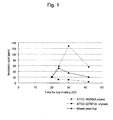
- Fig. 1 The results are shown in Fig. 1 , wherein the X axis indicates the time (hours) elapsed from the start of koji -making, and the Y axis indicates the isobutyric acid content (ppm) in soy sauce koji.
- Fig. 1 show that Aspergillus sojae strain ATCC 46250 (comparative example) produced 40 ppm or more of isobutyric acid in koji after 24 hours from the start of koji -making, and accumulated 130 ppm thereof at maximum. Moreover, it is also found that isobutyric acid was contained at a high concentration of 60 ppm after 42 hours ( Fig. 1 , a broken line with rhomboids).
- Aspergillus oryzae strain ATCC 22787 (control example) produced a low concentration of the component for Busho-shu (isobutyric acid) at 10 ppm after 24 hours from the start of koji -making, and showed approximately zero value after 42 hours, which indicates the disappearance thereof ( Fig. 1 , a two-dot chain line with squares).
- the digestibility and Glu/TN were measured by the methods described below.
- the Glu/TN was calculated by dividing the glutamic acid concentration in the filtrate of the above koji digest liquid by the nitrogen concentration.
- soy sauce koji of the comparative example lot using A. sojae alone has advantages of being very high in the protease activity, high in the ratio (Glu/TN) of glutamic acid (Glu) to the total nitrogen (TN), and high in the digestibility, while it conversely has a disadvantage of being very high in the concentration of isobutyric acid which is a causative component for Busho-shu.
- soy sauce koji of the control example lot using A. oryzae alone is very low in the concentration of isobutyric acid which is a causative component for Busho-shu, while it has disadvantages of being low in both the protease activity and the ratio (Glu/TN) of glutamic acid (Glu) to the total nitrogen (TN).
- soy sauce koji of the mixed seed koji lot using a mixture of A. sojae and A. oryzae has characteristics of being high in all of the protease activity, the ratio (Glu/TN) of glutamic acid (Glu) to the total nitrogen (TN), and the digestibility, being low in the isobutyric acid content which is the most important factor, and thus having less Busho-shu, and that such a koji is therefore very useful for brewing a soy sauce.
- 300 g of defatted soybeans is sprayed with 150 W/W% water.
- 300 g of wheat is roasted and milled, and the resultant is mixed with the thus obtained soybeans.
- the mixture is then subjected to sterilization under pressure and heating at 121°C for 50 minutes.
- the resultant product was cooled down to a room temperature, and inoculated with 2 g of mixed seed koji containing 1 g of seed koji of Aspergillus sojae strain ATCC 46250 and 1 g of seed koji of Aspergillus oryzae strain ATCC 22787.
- the product was filled in a flat wooden koji cover having a length of 58 cm, a width of 30 cm, and a depth of 6 cm.
- This cover was placed in a thermostatic chamber at a room temperature of 30°C to start koji -making.
- the production of the seed koji was carried out in the same manner as that of the Example 1 (1).
- the product was agitated by hand (“Teire") so as to remove the heat generated in the koji , and then was transferred into a thermostatic chamber at a room temperature of 25°C.
- Teire was performed again to remove the heat generated in the koji, and then was transferred into a thermostatic chamber at a room temperature of 20°C.
- the koji -making was performed for 30 hours in total to obtain a soy sauce koji of the mixed seed koji.
- soy sauce koji 0.9 kg was added with 1.4 liter of salt water.
- the mixture was placed in a small tank for incubation targeting a salt concentration of about 16 %, followed by controlling of the moromi mash for 5 months in accordance with a normal process for producing a soy sauce koji, and thereby an aged soy sauce moromi mash was obtained.
- a lactic acid bacterium Tetragenococcus halophilus isolated from the soy sauce moromi mash was added at 1 ⁇ 10 5 c.f.u./g of moromi mash on 14th day of the incubation
- a yeast Zygosaccahromyces rouxii isolated from the soy sauce moromi mash was added at 1 ⁇ 10 5 c.f.u./g of moromi mash on 35th day of the incubation.
- This aged soy sauce moromi mash was press-filtered by a small squeezer to obtain a raw soy sauce.
- This soy sauce was pasteurized at 80°C for 30 minutes and cooled down to a room temperature.
- the resultant soy sauce was left still for 2 days, and sediments were removed therefrom to obtain a clear soy sauce with less Busho-shu.
- a soy sauce of comparative example lot was obtained in the exactly same manner as that of the above process for producing soy sauce in (1), except for that "1 g of seed koji of Aspergillus sojae strain ATCC 46250" was used instead of "2 g of the mixed seed koji containing 1 g of seed koji of Aspergillus sojae strain ATCC 46250 and 1 g of seed koji of Aspergillus oryzae strain ATCC 22787".
- a soy sauce of control example lot was obtained in the exactly same manner as that of the above process for producing soy sauce in (1), except for that "1 g of seed koji of Aspergillus oryzae strain ATCC 22787" was used instead of "2 g seed koji containing 1 g of seed koji of Aspergillus sojae strain ATCC 46250 and 1 g of seed koji of Aspergillus oryzae strain ATCC 22787".
- Each soy sauce of the mixed seed koji lot, the comparative example lot, and the control example lot produced in the above (1) to (3) was subjected to component analysis of raw soy sauce, followed by sensory evaluation of flavor of pasteurized and aged soy sauce.
- soy sauce The component analysis of soy sauce, that is to say, the measurement of NaCl, TN (total nitrogen), Glu (glutamic acid), Glu/TN, RS (direct reducing sugar), Alc (alcohol), Lac (lactic acid), pH, and Col (color number) in a soy sauce was in accordance with the "Experimental Method for Soy Sauce” (THE JAPAN SOY SAUCE INSPECTION INSTITUTE). Greater color numbers mean lighter colors.
- the digestibility was obtained by the following manner. 10 g of moromi mash was filtered with a filter paper, and then calculation was performed by dividing the "nitrogen concentration in the filtrate" by the "total nitrogen amount in the filtrate and the residual material on the filter paper".
- the isobutyric acid content was obtained by the following manner.
- the soy sauce was directly extracted as it was with methyl acetate, and was subjected to the analysis by gas chromatography (GC) method without a concentration process (see " Analysis of Aroma Components by Gas Chromatography” edited and written by THE JAPAN SOY SAUCE INSPECTION INSTITUTE, Association of Experimental Method for Soy Sauce, issued on Mar 1, 1985, pp. 177 to 179 ).
- the discrimination test and the preference test were performed by the method of three-point discrimination and preference test (referred to as triangle test) (see “ Method of Sensory Evaluation” edited and written by THE JAPAN SOY SAUCE INSPECTION INSTITUTE, Association of Experimental Method for Soy Sauce, issued on Mar 1, 1985, pp. 117 to 118 ).
- This method enables to perform both discrimination test and preference test in a single examination.
- a set consisting of three samples was prepared by selecting two samples from one type of sample, and one sample from another type of sample.
- one sample (different type from other two samples) was selected among three samples, followed by the preference test where comparison was performed between one selected sample and other two samples in terms of preference.
- Table 2 shows the analytical values of the raw soy sauce components.
- Table 3 shows the results of the sensory evaluation.
- Table 4 shows the results of discrimination and preference tests.
- [Table 2] Analytical values of raw soy sauce components Lot Characteristic NaCl [%] TN [%] Glu [%] Glu/TN RS [%] Alc [%] Lac [%] pH Col Digestibility [%] Comparative example lot A. sojae ATCC 46250 16.25 1.81 1.10 0.61 2.72 3.85 0.79 4.88 31 81.4 Control example lot A. oryzae ATCC 22787 16.85 1.91 1.00 0.53 3.43 3.01 1.29 4.71 20 79.2 Mixed seed koji lot Mixed koji mold of A. sojae and A.
- a soy sauce koji and a soy sauce having reduced Busho-shu can be reliably produced. Moreover, a soy sauce having a high digestibility of koji, and a high content of glutamic acid can be produced, and thus a soy sauce having excellent soy sauce components and an excellent aroma can be produced.
Landscapes
- Life Sciences & Earth Sciences (AREA)
- Engineering & Computer Science (AREA)
- Health & Medical Sciences (AREA)
- Nutrition Science (AREA)
- Chemical & Material Sciences (AREA)
- Food Science & Technology (AREA)
- Polymers & Plastics (AREA)
- Biotechnology (AREA)
- Soy Sauces And Products Related Thereto (AREA)
Applications Claiming Priority (1)
| Application Number | Priority Date | Filing Date | Title |
|---|---|---|---|
| PCT/JP2005/015925 WO2007026427A1 (ja) | 2005-08-31 | 2005-08-31 | 不精臭が低減した醤油の製造方法 |
Publications (2)
| Publication Number | Publication Date |
|---|---|
| EP1920666A1 true EP1920666A1 (de) | 2008-05-14 |
| EP1920666A4 EP1920666A4 (de) | 2009-08-12 |
Family
ID=37808531
Family Applications (1)
| Application Number | Title | Priority Date | Filing Date |
|---|---|---|---|
| EP05781526A Withdrawn EP1920666A4 (de) | 2005-08-31 | 2005-08-31 | Verfahren zur herstellung von sojasauce mit verringertem geruch aufgrund mikrobieller infektionen |
Country Status (5)
| Country | Link |
|---|---|
| US (1) | US20090162479A1 (de) |
| EP (1) | EP1920666A4 (de) |
| JP (1) | JP4828539B2 (de) |
| CN (1) | CN101257803B (de) |
| WO (1) | WO2007026427A1 (de) |
Families Citing this family (5)
| Publication number | Priority date | Publication date | Assignee | Title |
|---|---|---|---|---|
| JP5101727B2 (ja) * | 2011-02-25 | 2012-12-19 | キッコーマン株式会社 | 醤油様調味料 |
| WO2013073249A1 (ja) * | 2011-11-18 | 2013-05-23 | キッコーマン株式会社 | 醤油様調味料 |
| CN103907801B (zh) * | 2014-04-02 | 2015-08-19 | 江南大学 | 一种降低酱油中氨基甲酸乙酯前体物质的方法 |
| EP3207808B1 (de) * | 2014-10-14 | 2018-05-09 | Kikkoman Corporation | Sojasauce mit niedrigem ph-wert |
| JP6207026B2 (ja) * | 2015-05-26 | 2017-10-04 | ヤマサ醤油株式会社 | 香味の優れた醤油 |
Family Cites Families (7)
| Publication number | Priority date | Publication date | Assignee | Title |
|---|---|---|---|---|
| US1332448A (en) * | 1917-05-05 | 1920-03-02 | Satow Sadakichi | Sauce and process of making the same |
| JPS5356394A (en) * | 1976-10-28 | 1978-05-22 | Fukushima Hiroo | Liquid flavoring and process for preparing same |
| JPH0648978B2 (ja) * | 1987-09-08 | 1994-06-29 | ヤマサ醤油株式会社 | 麹の製造法 |
| CH679544A5 (de) * | 1989-09-12 | 1992-03-13 | Nestle Sa | |
| JPH0698716A (ja) * | 1992-09-18 | 1994-04-12 | Fukuoka Pref Gov Shoyu Jozo Kyodo Kumiai | 麹の製造法 |
| EP1428440B1 (de) * | 2002-12-10 | 2006-08-23 | Ajinomoto Co., Inc. | Gewürzmittel und Verfahren zu seiner Herstellung |
| CN1227993C (zh) * | 2002-12-30 | 2005-11-23 | 绿益康生物科技实业股份有限公司 | 酱油及其制造方法 |
-
2005
- 2005-08-31 CN CN2005800514659A patent/CN101257803B/zh not_active Expired - Fee Related
- 2005-08-31 JP JP2007533098A patent/JP4828539B2/ja not_active Expired - Fee Related
- 2005-08-31 EP EP05781526A patent/EP1920666A4/de not_active Withdrawn
- 2005-08-31 WO PCT/JP2005/015925 patent/WO2007026427A1/ja not_active Ceased
- 2005-08-31 US US12/065,192 patent/US20090162479A1/en not_active Abandoned
Also Published As
| Publication number | Publication date |
|---|---|
| EP1920666A4 (de) | 2009-08-12 |
| CN101257803A (zh) | 2008-09-03 |
| WO2007026427A1 (ja) | 2007-03-08 |
| US20090162479A1 (en) | 2009-06-25 |
| JPWO2007026427A1 (ja) | 2009-03-05 |
| JP4828539B2 (ja) | 2011-11-30 |
| CN101257803B (zh) | 2011-09-28 |
Similar Documents
| Publication | Publication Date | Title |
|---|---|---|
| US9107437B2 (en) | Low common salt soy sauce and method for producing the same | |
| US20200329748A1 (en) | Novel Aspergillus oryzae CJ 1354 isolated from the Korean traditional meju, manufacturing method of a rice hot pepper paste using the same and the rice hot pepper paste prepared by the method | |
| US7056543B2 (en) | Method of brewing soy sauce | |
| JP4577706B2 (ja) | 液体麹の製造方法及びその利用 | |
| JP5836466B1 (ja) | 醤油様調味液およびその製造方法 | |
| KR102255983B1 (ko) | 유산균을 이용한 묵은지 제조방법 및 그로부터 제조된 묵은지 | |
| KR20040050858A (ko) | 조미료 및 이의 제조방법 | |
| US8173185B2 (en) | Fermented soy sauce with less soy sauce flavor and process for producing the same | |
| Kanauchi | SAKE alcoholic beverage production in Japanese food industry | |
| WO2017109922A1 (ja) | 醤油様調味液およびその製造方法 | |
| US20070128314A1 (en) | Method for producing rapid fermented type Miso-like food material with favorable taste and flavor | |
| JP2009521242A (ja) | γ‐アミノ酪酸(γ−Aminobutyricacid:GABA)の含量が増加された大豆の発酵物の製造方法 | |
| KR101147146B1 (ko) | 참깨간장의 제조방법 | |
| EP1920666A1 (de) | Verfahren zur herstellung von sojasauce mit verringertem geruch aufgrund mikrobieller infektionen | |
| WO2022158140A1 (ja) | 特定の香気成分を含有する食品およびその製造方法 | |
| JP3027352B2 (ja) | 発酵調味料の製造法 | |
| EP3207808B1 (de) | Sojasauce mit niedrigem ph-wert | |
| CN117660197A (zh) | 一种米曲霉及其应用 | |
| KR100457354B1 (ko) | 저장성과 향미가 우수한 된장 및 이의 제조방법 | |
| JP6883865B2 (ja) | 糸状菌の前培養菌体を用いた短時間製麹方法 | |
| KR20120129710A (ko) | 신규한 균주를 이용한 간장 제조방법 | |
| JP3065694B2 (ja) | 低塩醤油様調味液の製造法 | |
| Li et al. | A new two-step rapid fermentation method for shrimp paste based on strain fortification and analysis of flavor quality, Food Sci | |
| CN115340956B (zh) | 一株米曲霉za179及其应用 | |
| US20050260300A1 (en) | Method of the production of novel food material |
Legal Events
| Date | Code | Title | Description |
|---|---|---|---|
| PUAI | Public reference made under article 153(3) epc to a published international application that has entered the european phase |
Free format text: ORIGINAL CODE: 0009012 |
|
| 17P | Request for examination filed |
Effective date: 20080221 |
|
| AK | Designated contracting states |
Kind code of ref document: A1 Designated state(s): DE FR GB NL |
|
| RAP1 | Party data changed (applicant data changed or rights of an application transferred) |
Owner name: KIKKOMAN CORPORATION |
|
| RBV | Designated contracting states (corrected) |
Designated state(s): DE FR GB NL |
|
| A4 | Supplementary search report drawn up and despatched |
Effective date: 20090714 |
|
| RIC1 | Information provided on ipc code assigned before grant |
Ipc: A23L 1/238 20060101AFI20070515BHEP Ipc: A23L 1/23 20060101ALI20090708BHEP |
|
| 17Q | First examination report despatched |
Effective date: 20091029 |
|
| DAX | Request for extension of the european patent (deleted) | ||
| STAA | Information on the status of an ep patent application or granted ep patent |
Free format text: STATUS: THE APPLICATION IS DEEMED TO BE WITHDRAWN |
|
| 18D | Application deemed to be withdrawn |
Effective date: 20120605 |