EP1921056B1 - In ionischen Flüssigkeiten durchgeführte Hydrierungsverfahren - Google Patents
In ionischen Flüssigkeiten durchgeführte Hydrierungsverfahren Download PDFInfo
- Publication number
- EP1921056B1 EP1921056B1 EP20080152133 EP08152133A EP1921056B1 EP 1921056 B1 EP1921056 B1 EP 1921056B1 EP 20080152133 EP20080152133 EP 20080152133 EP 08152133 A EP08152133 A EP 08152133A EP 1921056 B1 EP1921056 B1 EP 1921056B1
- Authority
- EP
- European Patent Office
- Prior art keywords
- process according
- catalyst
- ionic liquid
- straight chain
- alkyl
- Prior art date
- Legal status (The legal status is an assumption and is not a legal conclusion. Google has not performed a legal analysis and makes no representation as to the accuracy of the status listed.)
- Expired - Lifetime
Links
Images




Classifications
-
- C—CHEMISTRY; METALLURGY
- C07—ORGANIC CHEMISTRY
- C07D—HETEROCYCLIC COMPOUNDS
- C07D473/00—Heterocyclic compounds containing purine ring systems
-
- C—CHEMISTRY; METALLURGY
- C07—ORGANIC CHEMISTRY
- C07B—GENERAL METHODS OF ORGANIC CHEMISTRY; APPARATUS THEREFOR
- C07B35/00—Reactions without formation or introduction of functional groups containing hetero atoms, involving a change in the type of bonding between two carbon atoms already directly linked
- C07B35/02—Reduction
-
- C—CHEMISTRY; METALLURGY
- C07—ORGANIC CHEMISTRY
- C07B—GENERAL METHODS OF ORGANIC CHEMISTRY; APPARATUS THEREFOR
- C07B41/00—Formation or introduction of functional groups containing oxygen
- C07B41/02—Formation or introduction of functional groups containing oxygen of hydroxy or O-metal groups
-
- C—CHEMISTRY; METALLURGY
- C07—ORGANIC CHEMISTRY
- C07C—ACYCLIC OR CARBOCYCLIC COMPOUNDS
- C07C29/00—Preparation of compounds having hydroxy or O-metal groups bound to a carbon atom not belonging to a six-membered aromatic ring
- C07C29/132—Preparation of compounds having hydroxy or O-metal groups bound to a carbon atom not belonging to a six-membered aromatic ring by reduction of an oxygen containing functional group
- C07C29/136—Preparation of compounds having hydroxy or O-metal groups bound to a carbon atom not belonging to a six-membered aromatic ring by reduction of an oxygen containing functional group of >C=O containing groups, e.g. —COOH
- C07C29/14—Preparation of compounds having hydroxy or O-metal groups bound to a carbon atom not belonging to a six-membered aromatic ring by reduction of an oxygen containing functional group of >C=O containing groups, e.g. —COOH of a —CHO group
- C07C29/141—Preparation of compounds having hydroxy or O-metal groups bound to a carbon atom not belonging to a six-membered aromatic ring by reduction of an oxygen containing functional group of >C=O containing groups, e.g. —COOH of a —CHO group with hydrogen or hydrogen-containing gases
-
- C—CHEMISTRY; METALLURGY
- C07—ORGANIC CHEMISTRY
- C07C—ACYCLIC OR CARBOCYCLIC COMPOUNDS
- C07C29/00—Preparation of compounds having hydroxy or O-metal groups bound to a carbon atom not belonging to a six-membered aromatic ring
- C07C29/17—Preparation of compounds having hydroxy or O-metal groups bound to a carbon atom not belonging to a six-membered aromatic ring by hydrogenation of carbon-to-carbon double or triple bonds
-
- C—CHEMISTRY; METALLURGY
- C07—ORGANIC CHEMISTRY
- C07C—ACYCLIC OR CARBOCYCLIC COMPOUNDS
- C07C29/00—Preparation of compounds having hydroxy or O-metal groups bound to a carbon atom not belonging to a six-membered aromatic ring
- C07C29/17—Preparation of compounds having hydroxy or O-metal groups bound to a carbon atom not belonging to a six-membered aromatic ring by hydrogenation of carbon-to-carbon double or triple bonds
- C07C29/175—Preparation of compounds having hydroxy or O-metal groups bound to a carbon atom not belonging to a six-membered aromatic ring by hydrogenation of carbon-to-carbon double or triple bonds with simultaneous reduction of an oxo group
-
- C—CHEMISTRY; METALLURGY
- C07—ORGANIC CHEMISTRY
- C07C—ACYCLIC OR CARBOCYCLIC COMPOUNDS
- C07C45/00—Preparation of compounds having >C = O groups bound only to carbon or hydrogen atoms; Preparation of chelates of such compounds
- C07C45/61—Preparation of compounds having >C = O groups bound only to carbon or hydrogen atoms; Preparation of chelates of such compounds by reactions not involving the formation of >C = O groups
- C07C45/62—Preparation of compounds having >C = O groups bound only to carbon or hydrogen atoms; Preparation of chelates of such compounds by reactions not involving the formation of >C = O groups by hydrogenation of carbon-to-carbon double or triple bonds
-
- C—CHEMISTRY; METALLURGY
- C07—ORGANIC CHEMISTRY
- C07C—ACYCLIC OR CARBOCYCLIC COMPOUNDS
- C07C5/00—Preparation of hydrocarbons from hydrocarbons containing the same number of carbon atoms
- C07C5/02—Preparation of hydrocarbons from hydrocarbons containing the same number of carbon atoms by hydrogenation
- C07C5/08—Preparation of hydrocarbons from hydrocarbons containing the same number of carbon atoms by hydrogenation of carbon-to-carbon triple bonds
-
- C—CHEMISTRY; METALLURGY
- C07—ORGANIC CHEMISTRY
- C07C—ACYCLIC OR CARBOCYCLIC COMPOUNDS
- C07C67/00—Preparation of carboxylic acid esters
- C07C67/30—Preparation of carboxylic acid esters by modifying the acid moiety of the ester, such modification not being an introduction of an ester group
- C07C67/303—Preparation of carboxylic acid esters by modifying the acid moiety of the ester, such modification not being an introduction of an ester group by hydrogenation of unsaturated carbon-to-carbon bonds
-
- C—CHEMISTRY; METALLURGY
- C07—ORGANIC CHEMISTRY
- C07C—ACYCLIC OR CARBOCYCLIC COMPOUNDS
- C07C2521/00—Catalysts comprising the elements, oxides or hydroxides of magnesium, boron, aluminium, carbon, silicon, titanium, zirconium or hafnium
- C07C2521/02—Boron or aluminium; Oxides or hydroxides thereof
- C07C2521/04—Alumina
-
- C—CHEMISTRY; METALLURGY
- C07—ORGANIC CHEMISTRY
- C07C—ACYCLIC OR CARBOCYCLIC COMPOUNDS
- C07C2521/00—Catalysts comprising the elements, oxides or hydroxides of magnesium, boron, aluminium, carbon, silicon, titanium, zirconium or hafnium
- C07C2521/06—Silicon, titanium, zirconium or hafnium; Oxides or hydroxides thereof
-
- C—CHEMISTRY; METALLURGY
- C07—ORGANIC CHEMISTRY
- C07C—ACYCLIC OR CARBOCYCLIC COMPOUNDS
- C07C2521/00—Catalysts comprising the elements, oxides or hydroxides of magnesium, boron, aluminium, carbon, silicon, titanium, zirconium or hafnium
- C07C2521/06—Silicon, titanium, zirconium or hafnium; Oxides or hydroxides thereof
- C07C2521/08—Silica
-
- C—CHEMISTRY; METALLURGY
- C07—ORGANIC CHEMISTRY
- C07C—ACYCLIC OR CARBOCYCLIC COMPOUNDS
- C07C2521/00—Catalysts comprising the elements, oxides or hydroxides of magnesium, boron, aluminium, carbon, silicon, titanium, zirconium or hafnium
- C07C2521/12—Silica and alumina
-
- C—CHEMISTRY; METALLURGY
- C07—ORGANIC CHEMISTRY
- C07C—ACYCLIC OR CARBOCYCLIC COMPOUNDS
- C07C2521/00—Catalysts comprising the elements, oxides or hydroxides of magnesium, boron, aluminium, carbon, silicon, titanium, zirconium or hafnium
- C07C2521/18—Carbon
-
- C—CHEMISTRY; METALLURGY
- C07—ORGANIC CHEMISTRY
- C07C—ACYCLIC OR CARBOCYCLIC COMPOUNDS
- C07C2523/00—Catalysts comprising metals or metal oxides or hydroxides, not provided for in group C07C2521/00
- C07C2523/38—Catalysts comprising metals or metal oxides or hydroxides, not provided for in group C07C2521/00 of noble metals
- C07C2523/40—Catalysts comprising metals or metal oxides or hydroxides, not provided for in group C07C2521/00 of noble metals of the platinum group metals
- C07C2523/42—Platinum
-
- C—CHEMISTRY; METALLURGY
- C07—ORGANIC CHEMISTRY
- C07C—ACYCLIC OR CARBOCYCLIC COMPOUNDS
- C07C2523/00—Catalysts comprising metals or metal oxides or hydroxides, not provided for in group C07C2521/00
- C07C2523/38—Catalysts comprising metals or metal oxides or hydroxides, not provided for in group C07C2521/00 of noble metals
- C07C2523/40—Catalysts comprising metals or metal oxides or hydroxides, not provided for in group C07C2521/00 of noble metals of the platinum group metals
- C07C2523/44—Palladium
-
- C—CHEMISTRY; METALLURGY
- C07—ORGANIC CHEMISTRY
- C07C—ACYCLIC OR CARBOCYCLIC COMPOUNDS
- C07C2523/00—Catalysts comprising metals or metal oxides or hydroxides, not provided for in group C07C2521/00
- C07C2523/38—Catalysts comprising metals or metal oxides or hydroxides, not provided for in group C07C2521/00 of noble metals
- C07C2523/40—Catalysts comprising metals or metal oxides or hydroxides, not provided for in group C07C2521/00 of noble metals of the platinum group metals
- C07C2523/46—Ruthenium, rhodium, osmium or iridium
-
- C—CHEMISTRY; METALLURGY
- C07—ORGANIC CHEMISTRY
- C07C—ACYCLIC OR CARBOCYCLIC COMPOUNDS
- C07C2523/00—Catalysts comprising metals or metal oxides or hydroxides, not provided for in group C07C2521/00
- C07C2523/70—Catalysts comprising metals or metal oxides or hydroxides, not provided for in group C07C2521/00 of the iron group metals or copper
- C07C2523/74—Iron group metals
- C07C2523/755—Nickel
-
- C—CHEMISTRY; METALLURGY
- C07—ORGANIC CHEMISTRY
- C07C—ACYCLIC OR CARBOCYCLIC COMPOUNDS
- C07C2527/00—Catalysts comprising the elements or compounds of halogens, sulfur, selenium, tellurium, phosphorus or nitrogen; Catalysts comprising carbon compounds
- C07C2527/02—Sulfur, selenium or tellurium; Compounds thereof
- C07C2527/053—Sulfates or other compounds comprising the anion (SnO3n+1)2-
-
- C—CHEMISTRY; METALLURGY
- C07—ORGANIC CHEMISTRY
- C07C—ACYCLIC OR CARBOCYCLIC COMPOUNDS
- C07C2527/00—Catalysts comprising the elements or compounds of halogens, sulfur, selenium, tellurium, phosphorus or nitrogen; Catalysts comprising carbon compounds
- C07C2527/20—Carbon compounds
- C07C2527/232—Carbonates
-
- C—CHEMISTRY; METALLURGY
- C07—ORGANIC CHEMISTRY
- C07C—ACYCLIC OR CARBOCYCLIC COMPOUNDS
- C07C2601/00—Systems containing only non-condensed rings
- C07C2601/12—Systems containing only non-condensed rings with a six-membered ring
- C07C2601/16—Systems containing only non-condensed rings with a six-membered ring the ring being unsaturated
Definitions
- This invention relates to hydrogenation processes, and their products.
- hydrogenation also includes hydro-dehalogenation.
- the present invention aims to overcome these disadvantages and further, provides novel processes that allow hydrogenation reactions to be performed with better selectivities than hitherto.
- the invention may thus be defined as a heterogeneous process for the hydrogenation of unsaturated aliphatic carbons in a compound, wherein the compound and a hydrogenating agent are admixed in the presence of an ionic liquid.
- More than one ionic liquid or any combination of ionic liquids may be used in the present invention.
- ionic liquid refers to a liquid that is capable of being produced by melting a solid, and when so produced, consists solely of ions.
- Ionic liquids may be derived from organic salts, especially salts of heterocyclic nitrogen-containing compounds, and such ionic liquids are particularly preferred for use in the processes of the present invention.
- An ionic liquid may be formed from a homogeneous substance comprising one species of cation and one species of anion, or can be composed of more than one species of cation and/or anion. Thus, an ionic liquid may be composed of more than one species of cation and one species of anion. An ionic liquid may further be composed of one species of cation, and one or more species of anion.
- ionic liquid may refer to a homogeneous composition consisting of a single salt (one cationic species and one anionic species) or it may refer to a heterogeneous composition containing more than one species of cation and/or more than one species of anion.
- ionic liquid includes compounds having both high melting temperature and compounds having low melting points, e.g. at or below room temperature (i.e. 15-30°C). The latter are often referred to as "room temperature ionic liquids" and are usually derived from organic salts having pyridinium and imidazolium-based cations.
- a feature of ionic liquids is that they have particularly low (essentially zero) vapour pressures.
- Many organic ionic liquids have low melting points (e.g. less than 100°C, particularly less than 100°C, and around room temperature, e.g. 15-30°C. Some have melting points well below 0°C.
- Ionic liquids may be regarded as consisting of two components, which are a positively charged cation and a negatively charged anion.
- any compound that meets the criteria of being a salt (consisting of an anion and cation) and which is fluid at or near the reaction temperature, or exists in a fluid state during any stage of the reaction can be defined as an ionic liquid especially suitable for use in the process of the present invention.
- suitable ionic liquids for use in the present invention include salts of alkylated or polyalkylated heteroaryl compounds, such as salts of alkylated pyridine, pyridazine, pyrimidine, pyrazine, imidazole, pyrazole, oxazole and triazole.
- suitable ionic liquids include those having the following formula: wherein R a is a C 1 to C 40 , (preferably C 1 to C 20 and more preferably C 4 to C 12 ) straight chain or branched alkyl group or a C 3 to C 8 cycloalkyl group, wherein said alkyl or cycloalkyl group which may be substituted by one to three groups selected from: C 1 to C 6 alkoxy, C 6 to C 10 aryl, CN, OH, NO 2 , C 1 to C 30 aralkyl and C 1 to C 30 alkaryl; R b , R c , R a , R e and R f can be the same or different and are each independently selected from H or any of the R a groups as defined above; and
- A represents an anion having a charge n-; wherein n may be 1-3.
- n is 1.
- R a is an unsubstituted alkyl or cycloalkyl group as defined above.
- R b , R c , R d , R e and R f are preferably hydrogen.
- the cation is preferably 1,3-dialkylimidazolium.
- Other cations for this process include other substituted pyridinium or alkyl- or poly-alkylpyridinium, alkyl imidazolium, imidazole, alkyl or poly-alkylimidazolium, alkyl or polyalkylpyrazolium, ammonium, alkyl or polyalkyl ammonium, alkyl or poly-alkyl phosphonium cations.
- the anion for the present processes is preferably a phosphate or amide.
- Other anions include sulfur-containing anions such as sulfate or sulphite, nitrogen-containing anions, such as nitrate, nitrite, alkylsulfate, or a chloride, bromide or other halide, hydrogensulfate, oxoanions of metals, selenium, tellurium, phosphorus, arsenic, antimony, bismuth based anions, and boron halide anions, such as tetrafluoroborate, [BF 4 ].
- ionic liquids are imidazolium, pyridinium or pyrazolium salts.
- ionic liquids useful for the process of the present invention include those based on imidazolium cations having the formula: wherein
- ionic liquids of the above formulae wherein A represents an anion selected from [PF 6 ], [BF 4 ], [OSO 2 CF 3 ], [OSO 2 (CF 2 ) 3 CF 3 ], [OCO 2 CF 3 ], [OCO 2 (CF 2 ) 3 CF 3 ], [OCO 2 CH 3 ], [(CF 3 SO 2 ) 2 N], [B(alkyl) 4 ] wherein each alkyl can be the same or different and can be any straight chain or branched C 1 to C 10 alkyl (preferably C 1 to C 6 alkyl) group, [SbF 6 ] and [AsF 6 ].
- ionic liquids include those wherein the anion is phosphate or an amide.
- the anions [PF 6 ] hexafluorophosphate), [BF 4 ] (tetrafluoroborate) and [(CF 3 SO 2 ) 2 N] ⁇ bis[(trifluoromethyl)sulfonyl]amide or bistriflimide) are particularly preferred, especially for the imidazolium- and pyridinium-cation-based ionic liquids.
- the present invention provides a process for the hydrogenation of a alkenes (including dienes, conjugated dienes, and trienes) which may contain a wide range of other functional groups.
- a alkenes including dienes, conjugated dienes, and trienes
- the use of ionic liquids in the present processes provides high, and at times very high, selectivities in such reactions.
- the processes of the present invention can also be used to hydrogenate compounds containing multiple C ⁇ C bonds (e.g. up to two C ⁇ C bonds).
- suitable substrates include compounds containing from 2 to 50 carbon atoms, preferably from 4 to 25 carbon atoms and more preferably from 6 to 20 carbon atoms.
- aryl-containing e.g. phenyl-containing
- Preferred substrates include alkenes, alkynes, aldehydes, fatty acids and esters thereof, including those containing an ⁇ , ⁇ - unsaturated carbonyl moiety.
- Alkenes which may be hydrogenated using the present process include those having the formula: wherein:
- R 5 , R 6 , R 7 and R 8 are the same or different and each is independently selected from:
- R 5 , R 6 , R 7 and R 8 are the same or different and each is independently selected from:
- R 5 , R 6 , R 7 and R 8 are the same or different and each is independently selected from hydrogen; C 1 to C 20 straight chain or branched alkyl; and C 2 to C 20 straight chain or branched alkenyl.
- alkenes of the above formula wherein R 5 and R 7 each represents hydrogen are particularly preferred.
- Preferred alkene substrates are those wherein R 5 , R 6 and R 7 each represents hydrogen and R 8 is as defined in any preceding passage.
- the hydrogenation process of the present invention may be applied to a wide range of alkenes including those having the formula wherein R 5 , R 6 and R 7 are as defined in any of the preceding passages.
- Especially preferred alkene substrates include those as defined above wherein R 5 , R 6 , R 7 or R 8 represents a C 2 to C 20 straight chain or branched alkenyl.
- the present invention extends to any product obtainable by the processes herein described.
- any suitable heterogeneous hydrogenation catalyst may be used.
- heterogeneous hydrogenation catalysts are those comprising palladium or platinum.
- the heterogeneous hydrogenation catalysts are preferably in the form of a finely divided metal.
- the catalyst is supported on an inert support, such as activated carbon, alumina, silica, silica-alumina, carbon black, graphite, titania, zirconla, calcium carbonate, and barium sulfate.
- an inert support such as activated carbon, alumina, silica, silica-alumina, carbon black, graphite, titania, zirconla, calcium carbonate, and barium sulfate.
- Preferred inert support materials are selected from activated carbon, carbon black, graphite, alumina or silica.
- the hydrogenation catalysts for use in the present invention are heterogeneous, i.e. they do not dissolve in the ionic liquid, but instead remain as a suspension therein.
- the catalyst is preferably non-colloidal, i.e. the catalyst particle size, including support (if any) is greater than 20, preferably greater than 50, and preferably greater than 100 ⁇ m.
- the processes of the present invention preferably employ as catalyst, a platinum or palladium group metal, particularly in supported form, e.g. on carbon, graphite or alumina.
- the hydrogenating agent employed in the present process is typically molecular hydrogen or an organic or inorganic hydrogen transfer agent.
- Hydrogen transfer agents [see e.g. Johnstone et al., Chem. Rev. (1985), 85, 129 and Brieger et al. Chem. Rev. (1974), 74, 567-580 ] are compounds which can release hydrogen and which are themselves oxidised.
- An example of such a hydrogen transfer agent is cyclohexene, which undergoes the following reaction in the presence of e.g. a palladium catalyst and an alkene substrate:
- the alkene is hydrogenated whilst the cyclohexene is oxidised to benzene.
- Suitable hydrogenating agents include molecular deuterium, HD, molecular tritium, HT, DT, or an organic or inorganic hydrogen, deuterium or tritium transfer agent.
- the hydrogenating agent is molecular hydrogen or an organic or inorganic hydrogen transfer agent.
- Molecular hydrogen is especially preferred as the hydrogenating agent.
- the hydrogenation process of the present invention is preferably conducted at temperatures of from 15°C to 200°C, preferably 15°C to 140°C, and more preferably from 20°C to 100°C. Good results are obtained at temperatures of 40°C to 60°C.
- reaction may be conducted at atmospheric pressure.
- the reaction may be conducted at pressures of 101 kPa (i.e. atmospheric pressure) to 8 MPa.
- pressures of 101 kPa i.e. atmospheric pressure
- such reactions are conducted at pressures of from 150 kPa (preferably from 1 MPa) to 5 MPa and more preferably from 2.5 MPa to 4.5 MPa.
- Good results may be obtained using reaction pressures of 3 MPa to 4.2 MPa.
- Hydrogenation reactions represent one of, the largest uses of heterogeneous catalysts in the chemical industry. A range of reactions is possible from dehalogenation to simple reductions of alkene to selective reductions of ⁇ , ⁇ -unsaturated carbonyl containing molecules. Ionic liquids have not been used previously for any heterogeneously catalysed reactions and provide distinct advantages over many conventional organic and aqueous solvents where selectivity may be poor and/or there are problems with product separation and recycle of the catalyst/solvent system.
- ionic liquids for use in the present invention including those employed in the following examples can be made by process such as those disclosed in WO 01/40146 .
- Cinnamaldehyde, 1 can undergo reduction using hydrogen gas over a heterogeneous catalyst to produce three products, cinnamylalcohol, 2, hydrocinnamaldehyde, 3, and 3-phenylpropanol, 4.
- the reactions may proceed in two different pathways 1 to 2 to 4 or 1 to 3 to 4 as shown taelow.
- This reaction has been studied extensively by many workers with an aim to control the selectivity and promote the formation of cinnamylalcohol and hydrocinnamaldehyde without further reduction to 3-phenylpropanol.
- These investigations have concentrated on the effect of promoters on the catalyst such as doping with tin or using zeolite based catalysts.
- the aim of this study was to develop ionic liquids for heterogeneously catalysed reactions and specifically in this case to investigate whether the solvent could act as a promoter without the need to use expensive catalysts.
- the reactions were performed under a hydrogen pressure of 4 MPa and a temperature of 60°C.
- the platinum catalysts were pre-reduced in flowing hydrogen at 350°C for 1h.
- Ionic liquid (2ml), 17.5mg (5wt% Pt catalyst), and cinnamaldehyde 0.5ml (substrate/metal - 800/1) were introduced to the autoclave and purged three times with argon.
- Hydrogen at 4 MPa was introduced and the autoclave heated to the required temperature. The reaction is left to stir for 6h, upon which the reaction is cooled and the pressure released.
- reaction products were extracted using diethyl ether (2x10ml), which removes all the organic products whilst maintaining the catalyst in the ionic liquid.
- Product selectivities and conversions were determined using GC-FID.
- Table 1 summarises the results of an initial screening for the hydrogenation of cinnamaldehyde using 5% Pt/graphite in a range of ionic liquids.
- Table 1 Cinnamaldehyde hydrogenation a variation with ionic liquid type using 5% Pt/graphite catalyst.
- imidazolium ionic liquids achieve the highest yields and selectivity with the trend [NTf 2 ] - > [PF 6 ] - > [BF 4 ] - .
- the best system, emimNTf 2 is hydrophobic enabling chloride removal efficient simply by washing with water. It has very low viscosity, which makes it easy to handle and allow for catalyst dispersion.
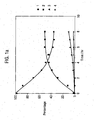
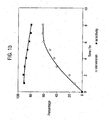
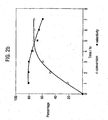
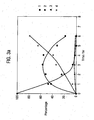
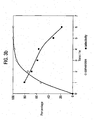
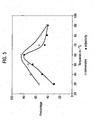
- Figures 1a , 1b , 2a and 2b show the hydrogenation of cinnamaldehyde using Pt/graphite or Pt/alumina in bmimPF 6 .
- the reaction stops after 5-7 hrs with the conversion rate slowing significantly after 3-5 hrs.
- the selectivity is high towards cinnamylalcohol 2 however, with increasing reaction time some hydrocinnamaldehyde 3 and 3-phenylpropanol 4 forms.
- 3 occurs because of isomerisation between 2 and 3 catalysed by the supported catalyst in the ionic liquid.
- Catalyst deactivation is likely to be the cause of the conversion being limited.
- a blank experiment in which the hydrogenation was carried out under normal experimental conditions for 6hrs without any substrate, cooled, the substrate was added and the reaction performed once more. Under these conditions, no reaction was observed indicating that the ionic liquid, and not the substrate/products, was responsible for the catalyst poisoning.
- Poisoning by the ionic liquid could be the result of a number of variables, for example pore blocking, the blocking sites by strongly adsorbed species or halide contamination from the ionic liquid manufacture.
- Experiments were performed in the presence of trace halide from HCl and NaCl to assess the contribution of halide deactivation. No conversion was observed in these reactions showing that firstly the ionic liquids are used were virtually halide free and secondly, absence of halide impurities is important if these reactions are to proceed. The major consequence of this is that unless electrolysis is performed prior to use, these reactions are limited to hydrophobic ionic liquids, which may be washed with water to remove trace chloride.
- Varying the volume of ionic liquid used resulted in little variation in selectivity; however, the conversion was found to vary strongly. Significantly, a maximum in conversion is observed. This occurs at smaller ionic liquid volumes than had been used previously.
- Palladium metal is known to reduce double bonds in preference to carbonyl groups, however, in ⁇ , ⁇ -unsaturated systems there is little or no selectivity in common organic solvents. Cinnamaldehyde hydrogenation carried out in propan-2-ol using Pd/activated carbon yielded the fully saturated compound, 3-phenylpropanol, 4.
- the reactions were performed under a hydrogen pressure of 4 MPa and a temperature of 60°C.
- the palladium catalysts were used as received.
- Ionic liquid (2ml), 5.5mg (10wt% Pd catalyst), and cinnamaldehyde 0.5ml (substrate/metal - 800/1) were introduced to the autoclave and purged three times with argon.
- Hydrogen at 40 x 10 5 Pa was introduced and the autoclave heated to the required temperature. The reaction is left to stir for 6h, upon which the reaction is cooled and the pressure released.
- reaction products were extracted using diethyl ether (2 ⁇ 10ml), which removes all the organic products whilst maintaining the catalyst in the ionic liquid.
- Product selectivities and conversions were determined using GC-FID.
- Table 4 summarizes the results from reduction of cinnamaldehyde using Pd/C in a range of ionic liquids.
- Table 4 Cinnamaldehyde hydrogenation variation with ionic liquid type using 10% wt Pd/activated carbon Ionic liquid %1 %3 %4 brnimPF 6 0 100 0 bmimBF 4 0 100 0 C 6 mimNTf 2 0 46 54 emimNTf 2 0 38 62 C 6 PYBF 4 23 77 0 C 8 pyBF 4 42 46 12 propan-2-ol 0 0 100
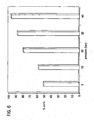
- Figure 6 shows the variation of conversion after 4 h with hydrogen pressure.
- the pressure study showed that, even at low pressures such as 5 x 10 5 Pa there was significant conversion, after 4h of the reaction. After 24 h, 93% conversion to hydrocinnamaldehyde 3 at 5 x 10 5 Pa was observed. At all pressures, only hydrocinnamaldehyde is found.
- the palladium catalysts were used as received. Ionic liquid (2ml), 5.5mg (10wt% Pd catalyst), and methyl oleate 0.5ml (substrate/metal - 800/1) were introduced to the autoclave and purged three times with argon. Hydrogen at 1 MPa was introduced and the autoclave heated to the required temperature. The reaction is left to stir for 4 h, upon which the reaction is cooled and the pressure released.
- reaction products were extracted using diethyl ether (2x10ml), which removes all the organic products whilst maintaining the catalyst in the ionic liquid.
- Product selectivities and conversions were determined using GC-FID.
- Methyl oleate 9 was hydrogenated to methyl stearate 10 with 100 % conversion and selectivity after 4 h reaction at 60 °C in C 8 pyBF 4 , bmimPF 6 and emimNTf 2 ionic liquids. Following extraction the reaction was recycled and achieved the same conversions and selectivity. No cleavage of the ester group was observed and there was no loss of the catalyst to the extractant phase.
- the so-formed product, 10, remains in the upper layer of the reaction mixture, i.e. above the ionic-liquid phase. Consequently, the product can be readily isolated by decantation, thus avoiding the need for extraction procedures.
- the use of ionic liquids in the hydrogenation of fatty acid esters may permit operation on a large scale by a continuous process. Additionally, it is noted that the hydrogenation reactions may be carried out in relatively small quantities of ionic liquid.
- the palladium catalysts were used as received. Ionic liquid (2ml), 5.5mg (10wt% Pd/C), and citral 0.5ml (substrate/metal - 800/1) were introduced to the autoclave and purged three times with argon. Hydrogen at 4 MPa was introduced and the autoclave heated to the required temperature. The reaction is left to stir for 6h, upon which the reaction is cooled and the pressure released.
- reaction products were extracted using diethyl ether (2x10ml), which removes all the organic products whilst maintaining the catalyst in the ionic liquid.
- Product selectivities and conversions were determined using GC-FID.
- Citral has three sites of hydrogenation; the conjugate double bond, the carbonyl group and the isolated double bond.
- the temperature study produced conversion and selectivities analogous to those obtained using cinnamaldehyde 1 as the substrate. From 30°C-60°C, the conversion increases whilst maintaining high selectivity. Above 60°C the formation of the alcohol, citronellol 14, leads to a decrease in selectivity.
- the citral used for the experiment contains -65% (E), 35%(Z) isomers. However, it is interesting to observe that the ratio of E2 isomers of the unreacted citral in these experiments was still 65/35 indicating that the catalytic system did not discriminate between the isomers, even though it was only selective for the reduction of the conjugated double bond.
- Table 9 highlights the use of proline as a modifier on the reaction.
- (R)-proline the unnatural enantiomer, as a chiral modifier again produces similar conversion and chemoselectivity as the natural (S)-enantiomer.
- the use of citronellal as a promoter/modifier on recycle was not observed to increase chemoselectivity or conversion.
- Addition of fresh amounts of proline as well as the use of a proline saturated system shows excellent chemoselectivity and conversion on recycle.
- Table 10 shows the effect of a proline saturated ionic liquid on the recycle of 14 wt% Pd/C catalyst.
- the modified catalyst greatly increases the conversion upon the initial run and successive recycles while still maintaining 100% selectivity. Although the unmodified catalyst also shows 100% selectivity over the three recycles performed, the conversions upon recycle are much lower than modified catalyst.
- Table 10 Catalyst recycle for 10wt% Pd/C modified (sat. Proline) hydrogenation in bmim BF 4 . Run 10% Pd/C unmodified 10%Pd/C modified %conversion %selectivity %conversion %selectivity 1 42 100 79 100 2 16 100 42 100 3 17 100 41 100 4 16 100 43 100
- a salt of proline may remain suspended in the ionic liquid.
- separation of the product can easily be carried out by extraction procedures.
- the palladium on carbon catalysts were used as received used whereas the platinum catalysts and palladium on alumina were pre-reduced in flowing hydrogen at 350°C for 1h, Ionic liquid (2ml), 5.5mg (10wt% Pd on carbon), 11 mg (5wt% palladium on alumina), 19.5 mg (5wt% platinum on alumina), 19.5 mg (5wt% platinum on graphite), and substrate (substrate/metal - 200/1) were introduced to the autoclave and purged three times with argon. Hydrogen at the desired pressure was introduced and the autoclave heated to the required temperature. The reaction is left to stir for the desired time period, upon which the reaction is cooled and the pressure released. The reaction products are extractable using water.
- Table 11 shows the conversion and selectivity for the reaction to 16 over 17.
- Table 11 Hydro-dehalogenation of 6-chloropurine c in bmim BF 4 /PF 6 Catalyst Ionic liquid b Pressure Temperature %Conversion a (Selectivity) a 5wt%Pt/G bmimPF 6 10 60 59 (100) 5wt%Pt/G bmimPF 6 40 60 82 (100) 5wt%Pt/Al 2 O 3 bmimBF 4 40 60 100 (83) 5wt%Pt/Al 2 O 3 bmimPF 6 40 60 100 (69) 5wt%Pd/Al 2 O 3 bmimBF 4 40 60 87 (100) 5wt%Pd/Al 2 O 3 bmimBF 4 10 60 76 (96) 5wt%Pd/Al 2 O 3 bmimPF 6 10 60 66 (92) 5wt%Pd/CaCO 3 bmimBF 4 40
- the palladium catalysts were used as received. Ionic liquid (2ml), 5.5mg (5wt% Pd on calcium carbonate, 10wt% Pd on activated carbon, 5wt%Pd/CaCO 3 lead poisoned), and substrate (substrate/metal - 800/1) were introduced to the autoclave and purged three times with argon. Hydrogen at the desired pressure was introduced and the autoclave heated to the required temperature. The reaction is left to stir for the desired time period, upon which the reaction is cooled and the pressure released.
- reaction products were extracted using organic solvent or distillation, which removes all the organic products whilst maintaining the catalyst in the ionic liquid.
- Product selectivities and conversions were determined using GC-FID.
- Table 14 shows the conversion and selectivity for the reduction of 1-nonyne using 10% Pd/C and 5% Pd/CaCO 3 in a series of different alkyl chain length [Pyfidinium] + [BF 4 ] - ionic liquids
- Table 14 Reduction of 1-nonyne using 5wt% Pd/CaCO 3 and 10wt% Pd/C at 30°C and 3 x 10 5 Pa for 4 hours.
- Table 14 shows that 10wt% Pd/C gives complete reduction to the alkane after four hours.
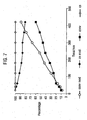
- the kinetic graph in figure 8 shows that 10wt%Pd/C is 100% selective, although only at low conversions.
- the 5wt% Pd/CaCO 3 /C 6 PyBF 4 system shows 100% selectivity towards the alkene up to at least 55% conversion, although the C 4 pyridinium BF 4 shows lower selectivity after 4h under these reaction conditions.
- Table 15 shows the conversion and selectivity for the reduction of three different substrates using the 5wt % Pd/CaCO 3 /C 6 PyBF 4 system.
- Table 15 Reductions of different substrates using 5wt% Pd/CaCO 3 at 30°C & 3 x 10 5 Pa for 4hrs.
- Table 15 shows that high selectivity towards the alkene is achievable for all three substrates.
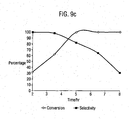
- the conversion and selectivity of phenyl acetylene towards styrene for a series of experiments varying the reaction pressure, temperature and length of reaction time are shown in figures 9a,9b and 9c .
- Figure 9c shows that when the reaction proceeds for longer than three hours, the selectivity drops off dramatically due to further hydrogenation to ethyl benzene, indicating that the only way to achieve maximum selectivity is to keep the reaction time and subsequently the level of conversion low.
- the inverse behaviour of the selectivity with respect to the conversion explains why as of yet there are no conditions found where 100% conversion and 100% selectivity can be achieved.
- Table 16 shows the reduction of phenyl acetylene in a range of ionic liquids using 5wt% Pd/CaCO 3 poisoned with lead (Lindlars catalyst).
- Table 16 Reductions of phenyl acetylene using Lindlars Catalyst at 30°C and 5 x 10 5 Pa for 4 hours.
- Lindlars catalyst maybe used in conjunction with range of ionic liquids to achieve at least 97% conversion with 100% selectivity for the reduction of phenyl acetylene to styrene.
- Ionic liquids provide a medium for heterogeneously catalysed hydrogenations, which competes well with conventional solvents. Using unmodified carbon or oxide based platinum group metal catalysts, good selectivity to a range of products is achievable simply by selecting a particular ionic liquid. In these systems it is believed that the ionic liquid modifies the surface and allows the high selectivity to be achieved. Aside from the high selectivity, the use of ionic liquids for hydrogenation reactions provide other advantages over conventional solvents, such as the ease of extraction of the product molecule from the ionic liquid without the need to filter and reactivate the catalyst. This procedure leads to catalyst loss industrially and is a major safety hazard when used on a large scale.
- the ionic liquid based heterogeneous catalyst systems do deactivate significantly during the reaction compared with organic solvent systems. In these reactions, the ionic liquids cannot be treated as general solvents, as different ionic liquids promote different selectivities, which allows good control over the products without the need to change the catalyst.
Landscapes
- Chemical & Material Sciences (AREA)
- Organic Chemistry (AREA)
- Chemical Kinetics & Catalysis (AREA)
- Organic Low-Molecular-Weight Compounds And Preparation Thereof (AREA)
- Low-Molecular Organic Synthesis Reactions Using Catalysts (AREA)
- Physical Or Chemical Processes And Apparatus (AREA)
- Catalysts (AREA)
- Saccharide Compounds (AREA)
Claims (29)
- Verfahren zur katalytischen selektiven Hydrierung einer Verbindung, die mehrere C=C-Bindungen enthält, wobei das genannte Verfahren das Reagieren der genannten Verbindung mit einem Hydrierungsmittel und einem heterogenen Hydrierungskatalysator in Gegenwart einer ionischen Flüssigkeit umfasst, wobei die Verbindung andere funktionelle Gruppen umfasst, die aus Folgendem ausgewählt werden: Alkene, Alkine, Ester, Ether, Carbonsäuren, Amine, Amide, Alkohole, Nitrile, Aldehyde und Ketone.
- Verfahren nach Anspruch 1, wobei die Verbindung ein Dien oder konjugiertes Dien ist.
- Verfahren nach Anspruch 1, wobei die Verbindung ein Trien ist.
- Verfahren nach einem der Ansprüche 1 bis 3, wobei die Verbindung 2 bis 50 Kohlenstoffatome enthält.
- Verfahren nach einem der Ansprüche 1 bis 4, wobei die Verbindung folgende Formel aufweist:
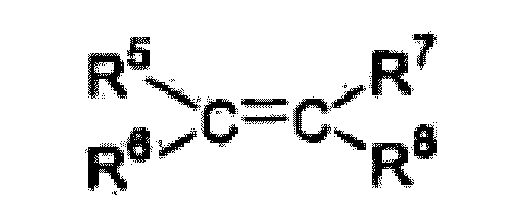 R5, R6, R7 und R8 jeweils unabhängig aus Folgendem ausgewählt sind:- Wasserstoff:- C1 bis C20 geradkettiges oder verzweigtes Alkyl oder C3 bis C6 Cycloalkyl, wobei die genannte Alkyl- oder Cycloalkylgruppe mit 1 bis 3 Substituenten substituiert sein kann, die unabhängig aus Folgendem ausgewählt sind: C2 bis C10-Alkenyl, C5-C8-Cycloalkenyl, C8 bis C10-Aryl, C8-C20-Aralkyl, C8-C20-Alkaryl, C3 bis C8-Cycloalkyl, Hydroxyl, F, CF3, =O, C1 bis C6 Alkylamino, C1 bis C6 Dialkylamino, -CN, COOR3, CONR3 oder OR3, wobei R3 aus Folgendem ausgewählt ist: H, C1 bis C20-Alkyl und C6 bis C10-Aryl;- C2 bis C20 geradkettiges oder verzweigtes Alkenyl;- C5 bis C6-Cyloalkenyl; oder- C6 bis C10-Aryl wobei die genannte Arylgruppe mit 1 bis 3 Substituenten substituiert sein kann, die unabhängig aus Folgendem ausgewählt sind: C1 bis C10-Alkyl, Hydroxyl, F, CF3, CN, COOR4, CONR4 oder OR4 wobei R4 aus H und C1 bis C20-Alkyl ausgewählt ist.
 - Verfahren nach Anspruch 5, wobei
R5, R6, R7 und R8 unabhängig aus Folgendem ausgewählt sind:- Wasserstoff:- C1 bis C20 geradkettiges oder verzweigtes Alkyl oder C3 bis C6 Cycloalkyl, und- C2 bis C20 geradkettiges oder verzweigtes Alkenyl. - Verfahren nach Anspruch 5 oder Anspruch 6, wobei R5 und R7 jeweils Wasserstoff darstellen.
- Verfahren nach einem der Ansprüche 5 bis 7, wobei R6 und R8 jeweils unabhängig aus Folgendem ausgewählt sind: C1 bis C20 geradkettiges oder verzweigtes Alkyl, C3 bis C8-Cycloalkyl und C2 bis C20 geradkettiges oder verzweigtes Alkenyl.
- Verfahren nach Anspruch 8, wobei die Verbindung folgende Formel aufweist:


- Verfahren nach einem der vorhergehenden Ansprüche, wobei die ionische Flüssigkeit ein Imidazolium-, Pyridinium-, Pyridazinium-, Pyrazinium-, Oxazolium-, Triazolium- oder Pyrazolium-Salz ist.
- Verfahren nach Anspruch 10, wobei die ionische Flüssigkeit ein Salz von Folgendem ist: eine alkylierte oder polyalkylierte Verbindung von Pyridin, Pyridazin, Pyrimidin, Pyrazin, Imidazol, Pyrazol, Oxazol oder Triazol.
- Verfahren nach einem der vorhergehenden Ansprüche, wobei die ionische Flüssigkeit folgende Formel aufweist:

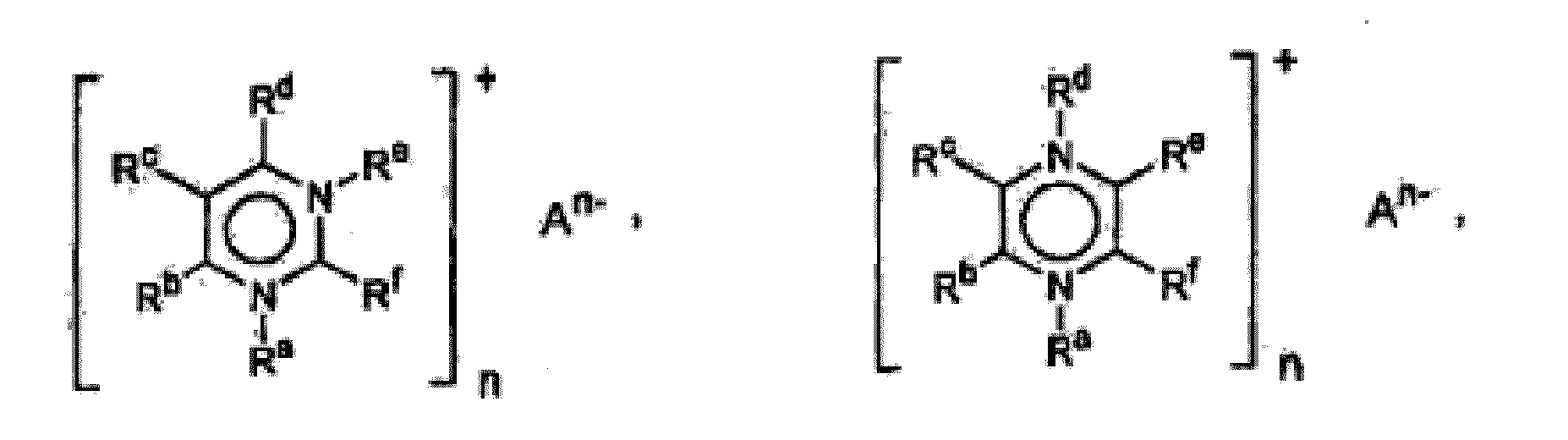
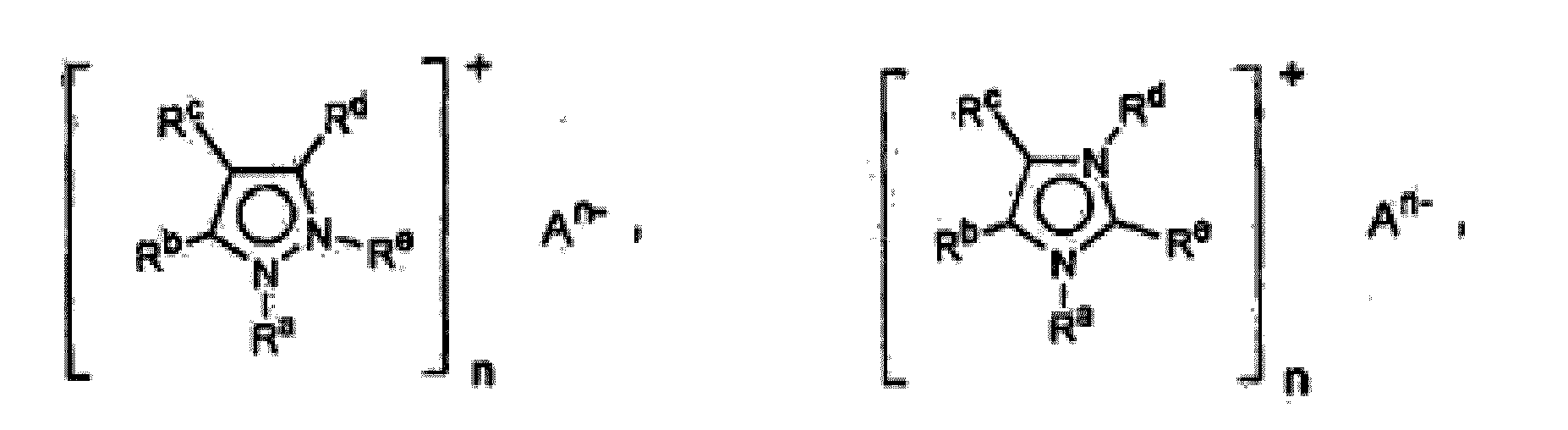

Ra ein C1 bis C40 geradkettiges oder verzweigtes Alkyl oder eine C3 bis C6 Cycloalkylgruppe ist, wobei die genannte Alkyl- oder Cycloalkylgruppe mit einer bis drei Gruppen substituiert sein kann, die aus Folgendem ausgewählt sind: C1 bis C6-Alkoxy, C6 bis C10-Aryl, CN, OH, NO2, C1 bis C30-Aralkyl und C1 bis C30-Alkaryl; Rb, Rc, Rd, Re und Rf gleich oder verschieden sein können und jeweils unabhängig aus Folgendem ausgewählt sind: H oder eine der Ra-Gruppen, wie oben definiert; und A ein Anion mit einer Ladung n- darstellt; wobei n 1 - 3 sein kann. - Verfahren nach Anspruch 12, wobei Ra C4 bis C12 geradkettiges oder verzweigtes Alkyl darstellt.
- Verfahren nach Anspruch 13, wobei Rb, Rc, Rd, Re und Rf Wasserstoff sind.
- Verfahren nach Anspruch 10, wobei die ionische Flüssigkeit folgende Formel aufweist:
 - jedes Ra gleich oder verschieden sein kann und jeweils unabhängig aus Folgendem ausgewählt ist: eine C1 bis C40 geradkettige oder verzweigte Alkylgruppe, die mit einer bis drei Gruppen substituiert sein kann, die aus Folgendem ausgewählt sind: C1 bis C6-Alkoxy, C6 bis C10-Aryl, CN, OH, NO2, C1 bis C30-Aralkyl und C1 bis C30-Alkaryl;- A eine oder mehr Arten von Anionen mit der Ladung n darstellt; und- n 1 - 3 darstellt.
 - Verfahren nach Anspruch 10, wobei die ionische Flüssigkeit folgende Formel aufweist:
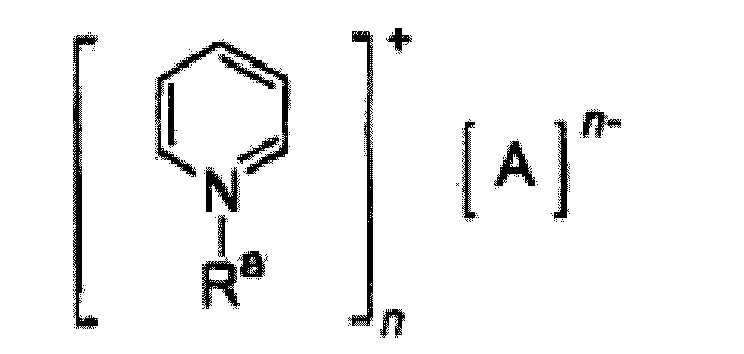 - Ra aus einer C1 bis C40 geradkettigen oder verzweigten Alkylgruppe ausgewählt ist, die mit einer bis drei Gruppen substituiert sein kann, die aus Folgendem ausgewählt sind: C1 bis C6-Alkoxy, C6 bis C10-Aryl, CN, OH, NO2, C1 bis C30-Aralkyl und C1 bis C30-Alkaryl;- A eine oder mehr Arten von Anionen mit der Ladung n darstellt; und- n 1 - 3 darstellt.
 - Verfahren nach Anspruch 15 oder Anspruch 16, wobei Ra unabhängig aus Folgendem ausgewählt ist: C1 bis C40 geradkettiges oder verzweigtes Alkyl.
- Verfahren nach Anspruch 16, wobei Ra aus C4 bis C12 geradkettigem oder verzweigtem Alkyl ausgewählt ist.
- Verfahren nach Anspruch 12 bis 18, wobei A eine einzelne Art von Anion mit der Ladung n darstellt.
- Verfahren nach Anspruch 12 bis 19, wobei n 1 ist.
- Verfahren nach einem der Ansprüche 12 bis 20, wobei A ein Anion darstellt, das aus Folgendem ausgewählt ist: Bor oder Phosphorfluoride, NO3, SO4, HSO4, HCO3, [(CF3SO2)2N], [AsF6], Alkylsulfonate, ein- oder mehrfach fluorierte Alkylsulfonate einschließlich perfluorierte Alkylsulfonate, Carbonsäureanionen, fluorierte Carbonsäureanionen und Metallhalogenide.
- Verfahren nach Anspruch 21, wobei A ein Anion darstellt, das aus [PF6], [BF4] und [(CF3SO2)N] ausgewählt ist.
- Verfahren nach einem der vorhergehenden Ansprüche, wobei der heterogene Hydrierungskatalysator Nickel, Palladium, Ruthenium, Iridium, Rhodium und Platin umfasst.
- Verfahren nach Anspruch 28, wobei der Katalysator auf einem inerten Träger gestützt wird.
- Verfahren nach Anspruch 24, wobei der inerte Träger Folgendes umfasst: Aktivkohle, Aluminiumoxid, Siliciumdioxid, Siliciumdioxid-Aluminiumoxid, Ruß, Graphit, Titanoxid, Zirkoniumoxid, Calciumcarbonat und Bariumsulfat.
- Verfahren nach einem der vorhergehenden Ansprüche, wobei die Teilchengröße des heterogenen Hydrierungskatalysators bis zu 200 Å beträgt.
- Verfahren nach einem der vorhergehenden Ansprüche, wobei die Teilchengröße des Katalysators, einschließlich Träger (falls vorhanden) mehr als 20, vorzugsweise mehr als 50 und vorzugsweise mehr als 100 µm beträgt.
- Verfahren nach einem der vorhergehenden Ansprüche, wobei das Hydrierungsmittel aus Folgendem besteht: ein molekulares Wasserstoff-, molekulares Deuterium-, HD-, molekulares Tritium-, HT-, DT- oder ein organisches oder anorganisches Wasserstoff-, Deuterium- oder Tritiumübertragungsmittel.
- Verfahren nach einem der vorhergehenden Ansprüche, wobei das Hydrierungsmittel aus molekularem Wasserstoff besteht.
Applications Claiming Priority (2)
| Application Number | Priority Date | Filing Date | Title |
|---|---|---|---|
| GBGB0112093.0A GB0112093D0 (en) | 2001-05-18 | 2001-05-18 | Hydrogenation processes |
| EP02735575A EP1387819B1 (de) | 2001-05-18 | 2002-05-17 | Hydrierungsverfahren in gegenwart ionischer flüssigkeiten |
Related Parent Applications (1)
| Application Number | Title | Priority Date | Filing Date |
|---|---|---|---|
| EP02735575A Division EP1387819B1 (de) | 2001-05-18 | 2002-05-17 | Hydrierungsverfahren in gegenwart ionischer flüssigkeiten |
Publications (2)
| Publication Number | Publication Date |
|---|---|
| EP1921056A1 EP1921056A1 (de) | 2008-05-14 |
| EP1921056B1 true EP1921056B1 (de) | 2015-04-22 |
Family
ID=9914830
Family Applications (2)
| Application Number | Title | Priority Date | Filing Date |
|---|---|---|---|
| EP20080152133 Expired - Lifetime EP1921056B1 (de) | 2001-05-18 | 2002-05-17 | In ionischen Flüssigkeiten durchgeführte Hydrierungsverfahren |
| EP02735575A Expired - Lifetime EP1387819B1 (de) | 2001-05-18 | 2002-05-17 | Hydrierungsverfahren in gegenwart ionischer flüssigkeiten |
Family Applications After (1)
| Application Number | Title | Priority Date | Filing Date |
|---|---|---|---|
| EP02735575A Expired - Lifetime EP1387819B1 (de) | 2001-05-18 | 2002-05-17 | Hydrierungsverfahren in gegenwart ionischer flüssigkeiten |
Country Status (12)
| Country | Link |
|---|---|
| US (2) | US7667058B2 (de) |
| EP (2) | EP1921056B1 (de) |
| JP (3) | JP4558276B2 (de) |
| AT (1) | ATE417030T1 (de) |
| AU (1) | AU2002310587A1 (de) |
| CA (1) | CA2446835A1 (de) |
| DE (1) | DE60230259D1 (de) |
| DK (1) | DK1387819T3 (de) |
| ES (1) | ES2318011T3 (de) |
| GB (1) | GB0112093D0 (de) |
| PT (1) | PT1387819E (de) |
| WO (1) | WO2002094740A2 (de) |
Families Citing this family (23)
| Publication number | Priority date | Publication date | Assignee | Title |
|---|---|---|---|---|
| GB0112093D0 (en) * | 2001-05-18 | 2001-07-11 | Univ Belfast | Hydrogenation processes |
| US7586017B2 (en) | 2003-12-18 | 2009-09-08 | Exxonmobil Chemical Patents Inc. | Hydrogenation |
| JP4776547B2 (ja) | 2003-12-18 | 2011-09-21 | エクソンモービル・ケミカル・パテンツ・インク | ヒドロホルミル化の改良 |
| GB0500029D0 (en) * | 2005-01-04 | 2005-02-09 | Univ Belfast | Basic ionic liquids |
| DE102005049568A1 (de) * | 2005-10-17 | 2007-04-19 | Basf Ag | Verfahren zur kontinuierlichen Hydrierung oder hydrierenden Aminierung |
| DE102006019460A1 (de) * | 2006-04-26 | 2007-10-31 | Süd-Chemie AG | Mit einer ionischen Flüssigkeit beschichteter poröser heterogener Katalysator |
| FR2910471A1 (fr) * | 2006-12-26 | 2008-06-27 | Holis Technologies | Procede d'hydrogenation asymetrique d'une enamine,dispositif pour la mise en oeuvre du procede et amine chirale obtenue |
| US7622532B2 (en) * | 2007-02-16 | 2009-11-24 | William Marsh Rice University | Synthesis of radioactive materials and compositions of same |
| TWI333946B (en) * | 2007-04-26 | 2010-12-01 | Cpc Corp Taiwan | Method of selectively hydrogenating 2-methyl-buta-1,3-diene by using supported ionic liquid nano-pd catalyst |
| KR100963402B1 (ko) * | 2007-12-04 | 2010-06-14 | 성균관대학교산학협력단 | 방향족 화합물의 수소화 방법 |
| US8802899B2 (en) * | 2008-06-09 | 2014-08-12 | Solvay Specialty Polymers Italy S.P.A. | Method for manufacturing perfluorovinylethers |
| EP2353714A4 (de) * | 2008-11-27 | 2012-05-16 | Takasago Perfumery Co Ltd | Asymmetrischer hydrierungskatalysator |
| DE102009051462B4 (de) | 2009-10-30 | 2015-02-05 | Clariant International Ag | Verfahren zur Herstellung eines Kompositmaterials, Kompositmaterial und dessen Verwendung |
| EP2646150A4 (de) * | 2010-11-29 | 2014-10-08 | Takasago Perfumery Co Ltd | Katalysator für asymmetrische hydrierung und verfahren zur herstellung einer optisch aktiven carbonylverbindung damit |
| US20130102819A1 (en) | 2011-10-19 | 2013-04-25 | Normen Szesni | Catalyst composition for selective hydrogenation with improved characteristics |
| RU2529033C1 (ru) * | 2013-06-13 | 2014-09-27 | Федеральное государственное бюджетное образовательное учреждение высшего профессионального образования "Волгоградский государственный технический университет" (ВолгГТУ) | СПОСОБ ГИДРИРОВАНИЯ α, β-НЕНАСЫЩЕННЫХ КЕТОНОВ |
| KR101492871B1 (ko) * | 2013-08-07 | 2015-02-13 | 한국과학기술연구원 | 이온성 액체를 이용하여 제조된 탄소에 담지된 팔라듐 촉매 및 이것의 제조방법과, 이를 이용한 수소불화탄소의 수소화 반응 |
| CN104549494B (zh) * | 2013-10-28 | 2017-06-20 | 中国石油化工股份有限公司 | 合成1,4‑环己烷二甲醇的催化剂 |
| CN111504933B (zh) * | 2020-05-12 | 2022-12-06 | 扬州工业职业技术学院 | 一种分析检测抗艾滋病新药的方法 |
| CN114100689B (zh) * | 2021-11-29 | 2023-04-07 | 万华化学集团股份有限公司 | 一种加氢催化剂及其制备方法与应用 |
| CN114653403B (zh) * | 2022-03-18 | 2023-02-03 | 大连理工大学 | 一种用于苯酚加氢制环己酮的双功能催化剂的制备方法及应用 |
| EP4696672A1 (de) | 2024-08-16 | 2026-02-18 | ARLANXEO Deutschland GmbH | Verfahren zur herstellung von 2-chlor-1,3-butadien und 2,3-dichlor-1,3-butadien |
| WO2026037737A1 (en) | 2024-08-16 | 2026-02-19 | Arlanxeo Deutschland Gmbh | Process for the synthesis of 2-chloro-1,3-butadiene and 2,3-dichloro-1,3-butadiene |
Family Cites Families (19)
| Publication number | Priority date | Publication date | Assignee | Title |
|---|---|---|---|---|
| JPS5459233A (en) * | 1977-10-17 | 1979-05-12 | Teijin Ltd | Preparation of aromatic hydrocarbons |
| JPS56133221A (en) * | 1980-03-24 | 1981-10-19 | Hodogaya Chem Co Ltd | Dechlorinating method of chlorinated toluene |
| JPS60218330A (ja) * | 1984-04-16 | 1985-11-01 | Mitsui Toatsu Chem Inc | 脱ハロゲン化方法 |
| JPS63132848A (ja) * | 1986-11-22 | 1988-06-04 | Idemitsu Kosan Co Ltd | 三重結合を有する炭化水素化合物の選択的水素添加方法 |
| JPS63291643A (ja) * | 1987-05-25 | 1988-11-29 | Nippon Kayaku Co Ltd | フエニルアセチレン類の選択水素添加反応用触媒 |
| JPH0377836A (ja) * | 1989-08-17 | 1991-04-03 | Ishihara Sangyo Kaisha Ltd | m―ジフルオロベンゼンの製造方法 |
| JPH03279338A (ja) * | 1990-03-28 | 1991-12-10 | Tokuyama Sekiyu Kagaku Kk | 不飽和アルコールの製造方法 |
| US5490919A (en) * | 1990-08-14 | 1996-02-13 | State Of Isreal, Atomic Energy Commission | Process for the dehalogenation of organic compounds |
| ES2101925T3 (es) * | 1992-11-18 | 1997-07-16 | Hoechst Ag | Procedimiento para la preparacion de 1,3-difluoro-benceno. |
| NL9401708A (nl) * | 1994-10-17 | 1996-06-03 | Dsm Nv | Werkwijze voor de bereiding van 3-fenylpropanal. |
| DE4438547A1 (de) * | 1994-10-28 | 1996-05-02 | Bayer Ag | Verfahren zur Hydrierung ungesättigter Fettsäureester |
| FR2735399B1 (fr) * | 1995-06-16 | 1997-07-25 | Inst Francais Du Petrole | Nouvelle composition catalytique a base de complexes de metaux de transition et procede pour l'hydrogenation des composes insatures |
| JPH09249613A (ja) * | 1996-03-15 | 1997-09-22 | Nissan Chem Ind Ltd | 新規脂環式化合物及びその製造方法 |
| JP4216931B2 (ja) * | 1998-10-22 | 2009-01-28 | 株式会社日本触媒 | 光学活性3−ヒドロキシイソブタン酸エステル類の製造方法 |
| WO2000032572A2 (en) * | 1998-12-04 | 2000-06-08 | Symyx Technologies | Combinatorial discovery and testing of ionic liquids |
| GB9928290D0 (en) | 1999-12-01 | 2000-01-26 | Univ Belfast | Process for preparing ambient temperature ionic liquids |
| GB0024745D0 (en) * | 2000-10-10 | 2000-11-22 | Univ Belfast | Oxidation of alkyl-aromatic compounds |
| GB0112093D0 (en) * | 2001-05-18 | 2001-07-11 | Univ Belfast | Hydrogenation processes |
| JP2008271990A (ja) * | 2006-06-20 | 2008-11-13 | Kyushu Univ | イオン液体中における電解還元による有機ハロゲン化物の脱ハロゲン化方法 |
-
2001
- 2001-05-18 GB GBGB0112093.0A patent/GB0112093D0/en not_active Ceased
-
2002
- 2002-05-17 PT PT02735575T patent/PT1387819E/pt unknown
- 2002-05-17 JP JP2002591415A patent/JP4558276B2/ja not_active Expired - Fee Related
- 2002-05-17 DK DK02735575T patent/DK1387819T3/da active
- 2002-05-17 WO PCT/GB2002/002333 patent/WO2002094740A2/en not_active Ceased
- 2002-05-17 AU AU2002310587A patent/AU2002310587A1/en not_active Abandoned
- 2002-05-17 US US10/478,039 patent/US7667058B2/en not_active Expired - Fee Related
- 2002-05-17 EP EP20080152133 patent/EP1921056B1/de not_active Expired - Lifetime
- 2002-05-17 ES ES02735575T patent/ES2318011T3/es not_active Expired - Lifetime
- 2002-05-17 CA CA002446835A patent/CA2446835A1/en not_active Abandoned
- 2002-05-17 AT AT02735575T patent/ATE417030T1/de not_active IP Right Cessation
- 2002-05-17 DE DE60230259T patent/DE60230259D1/de not_active Expired - Lifetime
- 2002-05-17 EP EP02735575A patent/EP1387819B1/de not_active Expired - Lifetime
-
2009
- 2009-01-15 JP JP2009006295A patent/JP2009102385A/ja active Pending
- 2009-10-14 JP JP2009236832A patent/JP2010006842A/ja active Pending
- 2009-11-04 US US12/612,149 patent/US7803974B2/en not_active Expired - Fee Related
Also Published As
| Publication number | Publication date |
|---|---|
| GB0112093D0 (en) | 2001-07-11 |
| WO2002094740A8 (en) | 2003-05-08 |
| US7667058B2 (en) | 2010-02-23 |
| JP2004533455A (ja) | 2004-11-04 |
| CA2446835A1 (en) | 2002-11-28 |
| JP2010006842A (ja) | 2010-01-14 |
| EP1921056A1 (de) | 2008-05-14 |
| US7803974B2 (en) | 2010-09-28 |
| JP4558276B2 (ja) | 2010-10-06 |
| AU2002310587A1 (en) | 2002-12-03 |
| EP1387819B1 (de) | 2008-12-10 |
| JP2009102385A (ja) | 2009-05-14 |
| WO2002094740A2 (en) | 2002-11-28 |
| ATE417030T1 (de) | 2008-12-15 |
| US20040267034A1 (en) | 2004-12-30 |
| DE60230259D1 (de) | 2009-01-22 |
| PT1387819E (pt) | 2009-03-23 |
| WO2002094740A3 (en) | 2003-03-13 |
| US20100056782A1 (en) | 2010-03-04 |
| ES2318011T3 (es) | 2009-05-01 |
| DK1387819T3 (da) | 2009-04-06 |
| EP1387819A2 (de) | 2004-02-11 |
Similar Documents
| Publication | Publication Date | Title |
|---|---|---|
| US7803974B2 (en) | Hydrogenation processes | |
| US7960593B2 (en) | Process for preparation of menthol by hydrogenation of isopulegol | |
| EP1366004B1 (de) | Katalytisches hydrierungsverfahren | |
| Stevens et al. | The continuous self aldol condensation of propionaldehyde in supercritical carbon dioxide: a highly selective catalytic route to 2-methylpentenal | |
| EP0214530B1 (de) | Verfahren zur Herstellung von Cycloolefinen | |
| US5057631A (en) | Process for continuous production of octa-2,7-dien-1-ol | |
| US7064239B2 (en) | Preparation of 1,6-hexanediol | |
| JP3413608B2 (ja) | d,l−メントールの製造方法 | |
| US6472575B2 (en) | Process for producing adamantane | |
| EP0170915A2 (de) | Verfahren zur Herstellung von Zykloolefinen | |
| EP2269971B1 (de) | Verfahren zur herstellung von 2-alkyl-2-cycloalken-1-one | |
| US4709085A (en) | Cyclopropanation process | |
| NZ201464A (en) | Preparation of glycol aldehyde | |
| EP1433773B2 (de) | Verfahren zur Herstellung von Cycloalkanonderivaten | |
| EP3950653A1 (de) | Verfahren zur herstellung einer halogenierten cycloalkanverbindung | |
| US4720597A (en) | Process for the production of hydroxymethylcyclopropane (cyclopropylmethanol) | |
| HUP0301635A2 (hu) | Folyamatos eljárás optikailag tiszta (S)-béta-hidroxi-gamma-butirolakton előállítására | |
| EP2479163B1 (de) | Verfahren zur herstellung von cyclohexylalkylketonen | |
| JP3522484B2 (ja) | ヒドロキシメチルシクロプロパンの製造方法 | |
| JP2000154157A (ja) | 不飽和アルコール類の製造方法 |
Legal Events
| Date | Code | Title | Description |
|---|---|---|---|
| PUAI | Public reference made under article 153(3) epc to a published international application that has entered the european phase |
Free format text: ORIGINAL CODE: 0009012 |
|
| AC | Divisional application: reference to earlier application |
Ref document number: 1387819 Country of ref document: EP Kind code of ref document: P |
|
| AK | Designated contracting states |
Kind code of ref document: A1 Designated state(s): AT BE CH CY DE DK ES FI FR GB GR IE IT LI LU MC NL PT SE TR |
|
| 17P | Request for examination filed |
Effective date: 20081104 |
|
| AKX | Designation fees paid |
Designated state(s): AT BE CH CY DE DK ES FI FR GB GR IE IT LI LU MC NL PT SE TR |
|
| 17Q | First examination report despatched |
Effective date: 20090319 |
|
| GRAP | Despatch of communication of intention to grant a patent |
Free format text: ORIGINAL CODE: EPIDOSNIGR1 |
|
| INTG | Intention to grant announced |
Effective date: 20141103 |
|
| GRAS | Grant fee paid |
Free format text: ORIGINAL CODE: EPIDOSNIGR3 |
|
| GRAA | (expected) grant |
Free format text: ORIGINAL CODE: 0009210 |
|
| AC | Divisional application: reference to earlier application |
Ref document number: 1387819 Country of ref document: EP Kind code of ref document: P |
|
| AK | Designated contracting states |
Kind code of ref document: B1 Designated state(s): AT BE CH CY DE DK ES FI FR GB GR IE IT LI LU MC NL PT SE TR |
|
| REG | Reference to a national code |
Ref country code: GB Ref legal event code: FG4D |
|
| REG | Reference to a national code |
Ref country code: CH Ref legal event code: EP Ref country code: CH Ref legal event code: NV Representative=s name: SERVOPATENT GMBH, CH |
|
| REG | Reference to a national code |
Ref country code: AT Ref legal event code: REF Ref document number: 723110 Country of ref document: AT Kind code of ref document: T Effective date: 20150515 |
|
| REG | Reference to a national code |
Ref country code: IE Ref legal event code: FG4D |
|
| REG | Reference to a national code |
Ref country code: DE Ref legal event code: R096 Ref document number: 60247141 Country of ref document: DE Effective date: 20150603 |
|
| REG | Reference to a national code |
Ref country code: NL Ref legal event code: VDEP Effective date: 20150422 |
|
| REG | Reference to a national code |
Ref country code: AT Ref legal event code: MK05 Ref document number: 723110 Country of ref document: AT Kind code of ref document: T Effective date: 20150422 |
|
| PG25 | Lapsed in a contracting state [announced via postgrant information from national office to epo] |
Ref country code: NL Free format text: LAPSE BECAUSE OF FAILURE TO SUBMIT A TRANSLATION OF THE DESCRIPTION OR TO PAY THE FEE WITHIN THE PRESCRIBED TIME-LIMIT Effective date: 20150422 |
|
| PG25 | Lapsed in a contracting state [announced via postgrant information from national office to epo] |
Ref country code: PT Free format text: LAPSE BECAUSE OF FAILURE TO SUBMIT A TRANSLATION OF THE DESCRIPTION OR TO PAY THE FEE WITHIN THE PRESCRIBED TIME-LIMIT Effective date: 20150824 Ref country code: FI Free format text: LAPSE BECAUSE OF FAILURE TO SUBMIT A TRANSLATION OF THE DESCRIPTION OR TO PAY THE FEE WITHIN THE PRESCRIBED TIME-LIMIT Effective date: 20150422 Ref country code: ES Free format text: LAPSE BECAUSE OF FAILURE TO SUBMIT A TRANSLATION OF THE DESCRIPTION OR TO PAY THE FEE WITHIN THE PRESCRIBED TIME-LIMIT Effective date: 20150422 |
|
| PG25 | Lapsed in a contracting state [announced via postgrant information from national office to epo] |
Ref country code: AT Free format text: LAPSE BECAUSE OF FAILURE TO SUBMIT A TRANSLATION OF THE DESCRIPTION OR TO PAY THE FEE WITHIN THE PRESCRIBED TIME-LIMIT Effective date: 20150422 Ref country code: GR Free format text: LAPSE BECAUSE OF FAILURE TO SUBMIT A TRANSLATION OF THE DESCRIPTION OR TO PAY THE FEE WITHIN THE PRESCRIBED TIME-LIMIT Effective date: 20150723 |
|
| REG | Reference to a national code |
Ref country code: DE Ref legal event code: R097 Ref document number: 60247141 Country of ref document: DE |
|
| PG25 | Lapsed in a contracting state [announced via postgrant information from national office to epo] |
Ref country code: MC Free format text: LAPSE BECAUSE OF FAILURE TO SUBMIT A TRANSLATION OF THE DESCRIPTION OR TO PAY THE FEE WITHIN THE PRESCRIBED TIME-LIMIT Effective date: 20150422 Ref country code: DK Free format text: LAPSE BECAUSE OF FAILURE TO SUBMIT A TRANSLATION OF THE DESCRIPTION OR TO PAY THE FEE WITHIN THE PRESCRIBED TIME-LIMIT Effective date: 20150422 |
|
| PLBE | No opposition filed within time limit |
Free format text: ORIGINAL CODE: 0009261 |
|
| REG | Reference to a national code |
Ref country code: FR Ref legal event code: ST Effective date: 20160129 |
|
| STAA | Information on the status of an ep patent application or granted ep patent |
Free format text: STATUS: NO OPPOSITION FILED WITHIN TIME LIMIT |
|
| 26N | No opposition filed |
Effective date: 20160125 |
|
| PG25 | Lapsed in a contracting state [announced via postgrant information from national office to epo] |
Ref country code: FR Free format text: LAPSE BECAUSE OF NON-PAYMENT OF DUE FEES Effective date: 20150622 |
|
| PG25 | Lapsed in a contracting state [announced via postgrant information from national office to epo] |
Ref country code: BE Free format text: LAPSE BECAUSE OF FAILURE TO SUBMIT A TRANSLATION OF THE DESCRIPTION OR TO PAY THE FEE WITHIN THE PRESCRIBED TIME-LIMIT Effective date: 20150422 |
|
| PG25 | Lapsed in a contracting state [announced via postgrant information from national office to epo] |
Ref country code: CY Free format text: LAPSE BECAUSE OF FAILURE TO SUBMIT A TRANSLATION OF THE DESCRIPTION OR TO PAY THE FEE WITHIN THE PRESCRIBED TIME-LIMIT Effective date: 20150422 Ref country code: SE Free format text: LAPSE BECAUSE OF FAILURE TO SUBMIT A TRANSLATION OF THE DESCRIPTION OR TO PAY THE FEE WITHIN THE PRESCRIBED TIME-LIMIT Effective date: 20150422 |
|
| PGFP | Annual fee paid to national office [announced via postgrant information from national office to epo] |
Ref country code: IE Payment date: 20170524 Year of fee payment: 16 Ref country code: CH Payment date: 20170510 Year of fee payment: 16 Ref country code: GB Payment date: 20170526 Year of fee payment: 16 Ref country code: DE Payment date: 20170523 Year of fee payment: 16 |
|
| PG25 | Lapsed in a contracting state [announced via postgrant information from national office to epo] |
Ref country code: TR Free format text: LAPSE BECAUSE OF FAILURE TO SUBMIT A TRANSLATION OF THE DESCRIPTION OR TO PAY THE FEE WITHIN THE PRESCRIBED TIME-LIMIT Effective date: 20150422 |
|
| PGFP | Annual fee paid to national office [announced via postgrant information from national office to epo] |
Ref country code: IT Payment date: 20170516 Year of fee payment: 16 |
|
| PG25 | Lapsed in a contracting state [announced via postgrant information from national office to epo] |
Ref country code: LU Free format text: LAPSE BECAUSE OF NON-PAYMENT OF DUE FEES Effective date: 20150517 |
|
| REG | Reference to a national code |
Ref country code: DE Ref legal event code: R119 Ref document number: 60247141 Country of ref document: DE |
|
| REG | Reference to a national code |
Ref country code: CH Ref legal event code: PL |
|
| GBPC | Gb: european patent ceased through non-payment of renewal fee |
Effective date: 20180517 |
|
| REG | Reference to a national code |
Ref country code: IE Ref legal event code: MM4A |
|
| PG25 | Lapsed in a contracting state [announced via postgrant information from national office to epo] |
Ref country code: LI Free format text: LAPSE BECAUSE OF NON-PAYMENT OF DUE FEES Effective date: 20180531 Ref country code: CH Free format text: LAPSE BECAUSE OF NON-PAYMENT OF DUE FEES Effective date: 20180531 |
|
| PG25 | Lapsed in a contracting state [announced via postgrant information from national office to epo] |
Ref country code: IT Free format text: LAPSE BECAUSE OF NON-PAYMENT OF DUE FEES Effective date: 20180517 Ref country code: GB Free format text: LAPSE BECAUSE OF NON-PAYMENT OF DUE FEES Effective date: 20180517 Ref country code: DE Free format text: LAPSE BECAUSE OF NON-PAYMENT OF DUE FEES Effective date: 20181201 Ref country code: IE Free format text: LAPSE BECAUSE OF NON-PAYMENT OF DUE FEES Effective date: 20180517 |