EP1921833B1 - Dispositif de communication électronique et méthode d exploitation d un annuaire du dispositif de communication électronique - Google Patents
Dispositif de communication électronique et méthode d exploitation d un annuaire du dispositif de communication électronique Download PDFInfo
- Publication number
- EP1921833B1 EP1921833B1 EP06796750.5A EP06796750A EP1921833B1 EP 1921833 B1 EP1921833 B1 EP 1921833B1 EP 06796750 A EP06796750 A EP 06796750A EP 1921833 B1 EP1921833 B1 EP 1921833B1
- Authority
- EP
- European Patent Office
- Prior art keywords
- electronic communication
- telephone directory
- directory list
- communication device
- ptt
- Prior art date
- Legal status (The legal status is an assumption and is not a legal conclusion. Google has not performed a legal analysis and makes no representation as to the accuracy of the status listed.)
- Not-in-force
Links
- 238000004891 communication Methods 0.000 title claims description 111
- 238000000034 method Methods 0.000 title claims description 19
- 230000008569 process Effects 0.000 claims description 6
- 238000005266 casting Methods 0.000 claims description 4
- 238000004590 computer program Methods 0.000 claims 2
- 230000008901 benefit Effects 0.000 description 4
- 238000010586 diagram Methods 0.000 description 4
- 230000006870 function Effects 0.000 description 3
- 230000004044 response Effects 0.000 description 3
- 230000000007 visual effect Effects 0.000 description 3
- 238000005516 engineering process Methods 0.000 description 2
- 230000001413 cellular effect Effects 0.000 description 1
- 230000008859 change Effects 0.000 description 1
- 238000012790 confirmation Methods 0.000 description 1
- 230000001419 dependent effect Effects 0.000 description 1
- 230000000977 initiatory effect Effects 0.000 description 1
- 239000004973 liquid crystal related substance Substances 0.000 description 1
- 238000010295 mobile communication Methods 0.000 description 1
- 239000004065 semiconductor Substances 0.000 description 1
Images




Classifications
-
- H—ELECTRICITY
- H04—ELECTRIC COMMUNICATION TECHNIQUE
- H04M—TELEPHONIC COMMUNICATION
- H04M1/00—Substation equipment, e.g. for use by subscribers
- H04M1/26—Devices for calling a subscriber
- H04M1/27—Devices whereby a plurality of signals may be stored simultaneously
- H04M1/274—Devices whereby a plurality of signals may be stored simultaneously with provision for storing more than one subscriber number at a time, e.g. using toothed disc
- H04M1/2745—Devices whereby a plurality of signals may be stored simultaneously with provision for storing more than one subscriber number at a time, e.g. using toothed disc using static electronic memories, e.g. chips
- H04M1/27453—Directories allowing storage of additional subscriber data, e.g. metadata
- H04M1/2746—Sorting, e.g. according to history or frequency of use
-
- H—ELECTRICITY
- H04—ELECTRIC COMMUNICATION TECHNIQUE
- H04M—TELEPHONIC COMMUNICATION
- H04M1/00—Substation equipment, e.g. for use by subscribers
- H04M1/57—Arrangements for indicating or recording the number of the calling subscriber at the called subscriber's set
- H04M1/575—Means for retrieving and displaying personal data about calling party
Definitions
- the invention relates to a method of operating a telephone directory list in an electronic communication device, an electronic communication device, a method of operating a telephone directory list in PTT communication, and a PTT communication system, and more particularly to a method of operating a telephone directory list in an electronic communication device, an electronic communication device, a method of operating a telephone directory list in PTT communication, a PTT communication system, and a program for carrying out the method, in all of which a telephone directory list is re-arranged in accordance with a number of speech in PTT communication.
- PTT communication is a service in which VoIP technology and packet-exchange technology are used to enable multi-casting communication (broadcasting) to a plurality of persons by virtue of half-duplex conversation.
- PTT communication is made as follows.
- a transmitter who is going to start PTT communication has to carry out a step of starting PTT communication with PTT communication members who are in advance registered.
- a transmitter who is going to start PTT communication displays a telephone directory list in a screen of his/her mobile terminal device, and selects members with whom the transmitter is going to make PTT communication, out of the telephone directory list.
- the transmitter can arbitrarily select members with whom the transmitter is going to make PTT communication. For instance, the transmitter can select co-workers or friends of the same generation. In general, when the transmitter selects such members out of a telephone directory list, he/she frequently selects a person who speaks in a great number, that is, a person who frequently makes PTT communication.
- the transmitter actuates a dedicated key (or a key assigned to PTT communication) to thereby transmit a request of transmitting a PTT call, to a server.
- the server On receipt of a request of transmitting a PTT call, the server establishes PTT communication by SIP (Session Initiation Protocol) between the mobile terminal device and the server.
- SIP Session Initiation Protocol
- the server requests mobile terminal devices of members designated by a mobile terminal device of the transmitter, to join PTT communication.
- the mobile terminal devices receiving a request to join PTT communication transmit a response to the server as to whether they join PTT communication.
- the server establishes PTT communication by SIP with the mobile terminal devices which transmit a response that they join PTT communication.
- the mobile terminal device which requested the server to transmit a PTT call can make conversation in PTT communication with each of the mobile terminal devices which transmitted a positive response to the server.
- a user who would like to speak can request a right of speaking to a server by actuating a dedicated key (or a key assigned to PTT communication) of his/her mobile terminal device. If another user has already acquired a right of speaking, he/she cannot have a right of speaking.
- His/her words are transmitted in multi-casting communication to mobile terminal devices of members who join in PTT communication, from a server, and are output to the members.
- a telephone number of a user who is now speaking are transmitted in multi-casting communication to other members. Specifically, both a telephone number of a user who is now speaking and voice data are transmitted to mobile terminal devices of other members, and a telephone number of a user who is now speaking is displayed in a screen of mobile terminal devices of other members. Accordingly, each of the other members can not only listen to voices, but also know a telephone number of a member who is now speaking in a screen of his/her mobile terminal device.
- the above-mentioned conventional step to be carried out for staring PTT communication is accompanied with a problem that it takes much time to find a person (or persons) who speaks (or speak) in a great number out of a telephone directory list equipped in his/her mobile terminal device by turning pages of or scrolling a telephone directory list.
- US-6,628,767-B1 discloses an active talker display for web-based control of conference calls. Participants of a conference call are permitted to see a continuously updated display on their own web browsers identifying the current speaker(s) on the conference call.
- a telecommunications conferencing system which includes a conference bridge having a plurality of ports, voice connections are established between a plurality of conference participants and respective ports of the conference bridge, human readable visual labels are assigned individually to each of the participants and their respective ports, data connections are established between the conference bridge and respective video monitors for at least some of the participants, respective visual labels for the active speakers are displayed at a fixed location on each of the video monitors, the ports being used by the currently active speakers are detected, and the displayed labels are continually updated according to detected ports as the currently active speakers change. Because visual speaker labels are displayed at fixed screen locations, each participant knows where to look at all times and any need to scroll through multiple screens of data is minimized.
- US-2005/143135-A1 discloses a push to talk (PTT) user interface for a wireless communications device utilizes a single all contacts database.
- the database is updated and utilized by the user in either a "PTT contacts" list screen or in an "all contacts” list screen. These screens are used for direct PTT calls, group PTT calls, alert calls, and standard cellular voice calls.
- Push to talk contacts are defined by the user and are stored on the wireless device.
- a direct PTT call allows a user to place a PTT call to another party or to a group with more than one party. The user can create a group "ad hoc" PTT call by selecting multiple contacts from the PTT contacts list screen.
- the PTT contact screen also is utilized to send an "alert" message to an individual with a PTT contact number.
- the alert message is either a brief text message or simply an "Alert" without text.
- the user can view a variety of screens to add another party to the active PTT call and to save or edit participant information.
- the user can join the call late by using a call history list.
- the wireless communications device provides notification of other incoming PTT calls, and allows the user to "answer", i.e., switch, to the new call.
- the present invention provides an advantage that it does not take much time for finding a person (or persons) who speaks (or speak) in a great number out of a telephone directory list in a user's electronic communication device.
- the present invention counts a number of speeches made by each of members in PTT communication in each of electronic communication devices, and uses data indicating a number of counted speeches to thereby re-arrange a telephone directory list in accordance with a number of speeches.
- an electronic communication device in accordance with the present embodiment is comprised of a mobile phone.
- FIG. 1 is a block diagram illustrating a circuitry of a mobile phone in accordance with an embodiment of the present invention.
- the mobile phone 1 in accordance with the present embodiment is comprised of a CPU (central processing unit) 2, a memory 3 for storing data therein, a memory 4 for providing a working area, a non-volatile memory 5, a transceiver section 6, an input section 7, input keys 8, a display controlling section 9, a display 10, a microphone 11, a speaker 12, and a bus 13 for electrically connecting CPU 2 to other parts.
- a CPU central processing unit
- memory 3 for storing data therein
- a memory 4 for providing a working area
- a non-volatile memory 5 for providing a working area
- a transceiver section 6 for providing a working area
- a transceiver section 6 for providing a working area
- a non-volatile memory 5 for providing a working area
- a transceiver section 6 for providing a working area
- a transceiver section 6 for providing a working area
- non-volatile memory 5 for providing a working area
- the memory 3 is comprised of a read only memory (ROM), and stores therein fixed data such as various control programs to be executed by CPU 2.
- ROM read only memory
- the memory 4 is comprised of a random access memory (RAM), and stores therein data temporarily required by CPU 2 to execute programs.
- RAM random access memory
- the non-volatile memory 5 is a semiconductor memory out of which data can be erased or into which data can be written, and which keeps data stored therein even when power is turned off.
- the non-volatile memory 5 can store therein a telephone directory list (a list in which names, telephone numbers, mail addresses, a number of speeches made in PTT communication, and so on are recorded), various fixed values, and user data.
- the transceiver section 6 is comprised of a circuit for transmitting and receiving radio-signals, and making communication or conversation therethrough.
- the input section 7 is comprised of a circuit which detects inputs having been made through the input keys 8. For instance, when a user would like to speak in PTT communication, he/she is required to acquire a right of speaking by actuating a predetermined key (a dedicated key or an off-hook key and so on) among the input keys 8 or keeping such a key actuated.
- a predetermined key a dedicated key or an off-hook key and so on
- the display controlling section 9 is comprised of a circuit for controlling an operation of the display 10.
- the display 10 is mounted on a front surface of the mobile phone in accordance with the present embodiment, and is comprised of a display unit such as a color or black-and-white liquid crystal display device or an organic EL (electronic fluorescence) panel.
- the microphone 11 transmits voices therethrough.
- the speaker 12 emits melody, voices, confirmation sound, and so on.
- FIG. 2 is a block diagram showing functions of CPU 2 and the memory 3 of the mobile phone 1 in accordance with the present embodiment.
- CPU 2 and the memory 3 functionally defines means 20 for receiving data, means 21 for controlling voice output, means 22 for counting up a number of speeches, means 23 for terminating PTT communication, and means 24 for re-arranging a telephone directory list.
- CPU 2 further defines means for controlling mobile communication.
- triangle signs indicate the bus 13.
- the means 20 for receiving data receives voices of a speaker, control data, and so on from a server.
- the means 20 for receiving data is electrically connected to the transceiver section 6 through the bus 13.
- the means 21 for controlling voice output when data received from a server is comprised of voices of a speaker, not only outputs the received voices to the speaker 12, but also retrieves a name of the speaker out of a telephone directory list, based on a telephone number of the speaker included in the received data, and displays the name of the speaker in the display 10.
- the means 21 for controlling voice output is electrically connected to the speaker 12 through the bus 13.
- the means 21 for controlling voice output further starts up the means 22 for counting up a number of speeches.
- the means 22 for counting up a number of speeches counts up a number of speeches made by each of speakers listed in a telephone directory list (a structure thereof is detailed later), and transmits the counted numbers to the means 20 for receiving data.
- the means 23 for terminating PTT communication is started up by the means 20 for receiving data, when data received from a server includes a notification of termination of PTT communication, and carries out a conventional process of terminating PTT communication such as releasing a session having been made between the mobile phone and a server.
- the means 23 for terminating PTT communication further starts up the means 24 for re-arranging a telephone directory list.
- the means 24 for re-arranging a telephone directory list re-arranges an order of persons recorded in a telephone directory list in accordance with a number of speeches.
- the "means for operating a telephone directory list" defined in claims corresponds to the means 24 for re-arranging a telephone directory list.
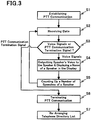
- FIG. 3 is a flow-chart showing an operation of CPU 2 equipped in the mobile phone 1 in accordance with the present embodiment.
- a channel is established between the mobile phone 1 and a PTT server (not illustrated), and PTT communication starts (step S1).
- the mobile phone 1 receives data from a server through the transceiver section 6 (step S2).
- the received data is transmitted to CPU 2.
- the means 20 for receiving data judges whether the received data is comprised of voice signals indicative of voices of a speaker or the received data is comprised of a PTT communication termination signal including an instruction to terminate PTT communication (step S3).
- the means 21 for controlling voice output defined by CPU 2 of the mobile phone 1 outputs voices of a speaker to the speaker 12, and further, identifies a name of the speaker out of a telephone directory list, based on a telephone number of the speaker included in the received data, and controls the display controlling section 9 to display the name of the speaker in the display 10 (step S4).
- the means 22 for counting up a number of speeches counts up a number of speeches made by a speaker among persons recorded in a telephone directory list of the mobile phone 1 (step S5).
- the means 23 for terminating PTT communication carries out a conventional process of terminating PTT communication such as releasing a session having been made between the mobile phone and a server (step S6).
- the means 24 for re-arranging a telephone directory list re-arranges an order of persons recorded in a telephone directory list in accordance with a number of speeches (step S7).
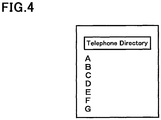
- FIG. 4 illustrates an example of a display screen of the display 10 in which a telephone directory list stored in the non-volatile memory 5 is displayed after PTT communication has been already made.
- FIG. 5 illustrates an example of a number of speeches made by each of persons recorded in a telephone directory list stored in the non-volatile memory 5 when the example illustrated in FIG. 4 is displayed in the display 10.
- a greater number of speeches is made by persons recorded in a telephone directory list in accordance with an alphabetical order. Specifically, a number of speeches made by A is 5, a number of speeches made by B is 3, and a number of speeches made by C, D, E, F and G is 1.
- FIG. 6 shows a number of speeches made by each of the persons recorded in a telephone directory list stored in the non-volatile memory 5 when PTT communication has been made once after the condition illustrated in FIG. 5 .
- A made speeches three times
- D made a speech once
- G made speeches twice.
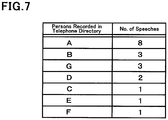
- FIG. 7 illustrates an order of the persons recorded in a telephone directory list stored in the non-volatile memory 5, having been re-arranged by the means 24 for re-arranging a telephone directory list in accordance with a number of speeches.
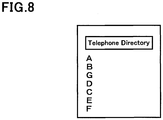
- FIG. 8 illustrates the display 10 in which a telephone directory list stored in the non-volatile memory 5, illustrated in FIG. 7 , is displayed.
- the persons recorded in a telephone directory list are displayed in an order having been re-arranged by the means 24 for re-arranging a telephone directory list in accordance with a number of speeches. Specifically, the persons are displayed in an order of A, B, G, D, C, E and F.
- an electronic communication device is comprised of a mobile phone.
- the present embodiment may be applied to a mobile terminal device such as PHS. That is, it is possible to provide the same advantages as those presented by the above-mentioned embodiment to a mobile terminal device such as PHS, by re-arranging a telephone directory list in accordance with a number of speeches.
- the means 24 for re-arranging a telephone directory list is designed to re-arrange a telephone directory list in accordance with a number of speeches.
- the means 24 for re-arranging a telephone directory list may be designed to re-arrange a telephone directory list in accordance with a period of time of speeches made by persons recorded in a telephone directory list.
- the means 24 for re-arranging a telephone directory list is designed to re-arrange a telephone directory list in accordance with a number of speeches.
- a name of a person who made speeches in a great number may be displayed in a predetermined color (for instance, red) in a telephone directory list.
- the means 24 for re-arranging a telephone directory list is designed to re-arrange a telephone directory list in accordance with a number of speeches.
- a telephone directory list may be designed to be accompanied with an icon and/or an image of a person who made speeches in a great number, and they may be displayed when a user retrieves a telephone directory list.
- the mobile phone may be designed to include means for making a user's decision as to whether the means 24 for re-arranging a telephone directory list re-arranges a telephone directory list in accordance with a number of speeches, in which case, a user can make a decision. For instance, a question "do you re-arrange a telephone directory list in accordance with a number of speeches ?" may be displayed in a screen of the display 10, in which case, a telephone directory list is re-arranged only when a user inputs "YES".
- the mobile phone 1 in accordance with the present embodiment is not designed to display a number of speeches of each of members, the mobile phone 1 may be designed to display a number of speeches or a graphically represented number of speeches together with a name of a speaker in the display 10.
- a telephone directory list may be re-arranged after termination of PTT communication in the above-mentioned embodiment, a telephone directory list may be re-arranged when a function of displaying a telephone directory list is caused to start.
- the means 24 for re-arranging a telephone directory list may be designed to start re-arranging a telephone directory list at a timing defined by predetermined key-input carried out by a user.
Landscapes
- Engineering & Computer Science (AREA)
- Signal Processing (AREA)
- Library & Information Science (AREA)
- Telephonic Communication Services (AREA)
- Mobile Radio Communication Systems (AREA)
- Telephone Function (AREA)
Claims (6)
- Un procédé pour exploiter une liste de contacts téléphoniques dans un dispositif de communication électronique adapté pour établir une communication PTT (Push to Talk) avec d'autres dispositifs de communication électronique par l'intermédiaire d'un réseau et d'un serveur, la liste de contacts téléphoniques stockant les numéros de téléphone des utilisateurs des autres dispositifs de communication électronique dans un ordre, le procédé comprenant :lors de la réception de données vocales dans le dispositif de communication électronique en provenance des autres dispositifs de communication électronique par l'intermédiaire du serveur, le fait de compter un certain nombre de conversations tenues par les utilisateurs des autres dispositifs de communication électronique stockés dans la liste de contacts téléphoniques,le fait de réarranger, lorsque la communication PTT prend fin, l'ordre des numéros de téléphone des utilisateurs des autres dispositifs de communication électronique stockés dans la liste de la liste de contacts téléphoniques de telle sorte qu'un utilisateur qui a eu des conversations en plus grand nombre se trouve dans une position plus élevée dans une liste de contacts téléphoniques réarrangée, etle fait d'afficher, lorsqu'un utilisateur du dispositif de communication électronique va commencer un processus ultérieur de communication PTT, la liste réarrangée des contacts téléphoniques.
- Le procédé selon la revendication 1, dans lequel le dispositif de communication électronique est un téléphone mobile.
- Un dispositif de communication électronique pour établir une communication PTT (Push to Talk) avec d'autres dispositifs de communication électronique par l'intermédiaire d'un réseau et d'un serveur, et comprenant une liste de contacts téléphoniques stockant les numéros de téléphone des utilisateurs des autres dispositifs de communication électronique dans un certain ordre,
le dispositif de communication électronique comprenant :des moyens (20) pour recevoir des données en tant que signal vocal en provenance des autres dispositifs de communication électronique par l'intermédiaire du serveur ;des moyens (22) pour compter un certain nombre de conversations tenues par les utilisateurs des autres dispositifs de communication électronique stockés dans la liste de contacts téléphoniques lors de la réception du signal vocal par le serveur ;des moyens (24) pour réarranger, lorsque la communication PTT est terminée, l'ordre des numéros de téléphone des utilisateurs des autres dispositifs de communication électronique stockés dans la liste de la liste de contacts téléphoniques de telle sorte qu'un utilisateur qui a eu des conversations en plus grand nombre soit dans une position supérieure dans une liste réarrangée de contacts téléphoniques ; etdes moyens (10) pour afficher, lorsqu'un utilisateur du dispositif de communication électronique procède à une communication PTT ultérieure, la liste des annuaires téléphoniques réarrangés. - Le dispositif de communication électronique selon la revendication 3, dans lequel le dispositif de communication électronique est un téléphone mobile.
- Un système de communication PTT dans lequel une pluralité de dispositifs de communication électroniques selon la revendication 3 ou 4, comprenant chacun une liste de contacts téléphoniques stockant en elle les numéros de téléphone des utilisateurs des autres dispositifs de communication électroniques, établissent une communication PTT entre eux via un réseau, comprenant :
un serveur qui reçoit un signal vocal, transmis par un dispositif de communication électronique en tant qu'orateur, et transmet le signal vocal, dans une communication multidiffusion vers des dispositifs de communication électroniques autres que le dispositif de communication électronique en tant qu'orateur. - Un programme d'ordinateur enregistré dans une mémoire d'un dispositif de communication électronique selon les revendications 3 à 4, ledit programme d'ordinateur étant adapté pour mettre en oeuvre les étapes du procédé défini dans les revendications 1 à 2.
Applications Claiming Priority (2)
| Application Number | Priority Date | Filing Date | Title |
|---|---|---|---|
| JP2005248987 | 2005-08-30 | ||
| PCT/JP2006/316637 WO2007026600A1 (fr) | 2005-08-30 | 2006-08-24 | Dispositif de communication électronique et méthode d’exploitation d’un annuaire du dispositif de communication électronique |
Publications (3)
| Publication Number | Publication Date |
|---|---|
| EP1921833A1 EP1921833A1 (fr) | 2008-05-14 |
| EP1921833A4 EP1921833A4 (fr) | 2010-04-14 |
| EP1921833B1 true EP1921833B1 (fr) | 2019-06-12 |
Family
ID=37808694
Family Applications (1)
| Application Number | Title | Priority Date | Filing Date |
|---|---|---|---|
| EP06796750.5A Not-in-force EP1921833B1 (fr) | 2005-08-30 | 2006-08-24 | Dispositif de communication électronique et méthode d exploitation d un annuaire du dispositif de communication électronique |
Country Status (5)
| Country | Link |
|---|---|
| US (1) | US7953429B2 (fr) |
| EP (1) | EP1921833B1 (fr) |
| JP (1) | JPWO2007026600A1 (fr) |
| CN (2) | CN101253753A (fr) |
| WO (1) | WO2007026600A1 (fr) |
Families Citing this family (3)
| Publication number | Priority date | Publication date | Assignee | Title |
|---|---|---|---|---|
| US8401583B2 (en) * | 2008-04-11 | 2013-03-19 | Voxer Ip Llc | Time-shifting for push to talk voice communication systems |
| CN102427497A (zh) * | 2011-12-31 | 2012-04-25 | 深圳市金立通信设备有限公司 | 基于通话频率进行手机通话记录优先排序系统及方法 |
| CN106534446B (zh) * | 2016-11-11 | 2020-03-27 | 努比亚技术有限公司 | 移动终端拨号装置和方法 |
Family Cites Families (11)
| Publication number | Priority date | Publication date | Assignee | Title |
|---|---|---|---|---|
| JPH06334726A (ja) | 1993-05-20 | 1994-12-02 | Casio Comput Co Ltd | 電話機 |
| JPH08274888A (ja) | 1995-03-31 | 1996-10-18 | Hitachi Software Eng Co Ltd | 多地点間会議システムの議事進行制御方法 |
| US6360093B1 (en) | 1999-02-05 | 2002-03-19 | Qualcomm, Incorporated | Wireless push-to-talk internet broadcast |
| US6628767B1 (en) | 1999-05-05 | 2003-09-30 | Spiderphone.Com, Inc. | Active talker display for web-based control of conference calls |
| JP2001036630A (ja) | 1999-07-16 | 2001-02-09 | Matsushita Electric Ind Co Ltd | 携帯電話装置 |
| US20030119540A1 (en) * | 2001-12-21 | 2003-06-26 | Mathis James Earl | Contact list-based group call |
| CN1492705A (zh) * | 2002-10-25 | 2004-04-28 | Ӣҵ�O�ţ��Ϻ������Ӽ�������˾ | 电话号码按照使用频率的排序方法 |
| JP2004252609A (ja) | 2003-02-19 | 2004-09-09 | Ricoh Co Ltd | 電子討論サーバおよび電子討論システム |
| JP2007513592A (ja) | 2003-12-08 | 2007-05-24 | キョウセラ ワイヤレス コープ. | コンタクト管理のためのプッシュツートークユーザインターフェース |
| DE102004010368A1 (de) * | 2004-03-03 | 2005-09-29 | Siemens Ag | Verfahren zum verspäteten Gesprächseinstieg oder Wiedereinstieg mindestens eines Funkkommunikationsgeräts in eine bereits laufende Push-To-Talk-Gruppendiskussion, Funkkommunikationsgerät, Vermittlungseinheit sowie Funkkommunikationsnetz |
| JP4053028B2 (ja) * | 2004-06-30 | 2008-02-27 | 三洋電機株式会社 | Pttシステム、携帯電話機、サーバ |
-
2006
- 2006-08-24 EP EP06796750.5A patent/EP1921833B1/fr not_active Not-in-force
- 2006-08-24 WO PCT/JP2006/316637 patent/WO2007026600A1/fr not_active Ceased
- 2006-08-24 JP JP2007533205A patent/JPWO2007026600A1/ja active Pending
- 2006-08-24 US US12/064,716 patent/US7953429B2/en active Active
- 2006-08-24 CN CNA2006800320766A patent/CN101253753A/zh active Pending
- 2006-08-24 CN CN2013102504111A patent/CN103401977A/zh active Pending
Non-Patent Citations (1)
| Title |
|---|
| None * |
Also Published As
| Publication number | Publication date |
|---|---|
| JPWO2007026600A1 (ja) | 2009-03-05 |
| US20090137216A1 (en) | 2009-05-28 |
| EP1921833A1 (fr) | 2008-05-14 |
| WO2007026600A1 (fr) | 2007-03-08 |
| US7953429B2 (en) | 2011-05-31 |
| EP1921833A4 (fr) | 2010-04-14 |
| CN101253753A (zh) | 2008-08-27 |
| CN103401977A (zh) | 2013-11-20 |
Similar Documents
| Publication | Publication Date | Title |
|---|---|---|
| EP1530352B1 (fr) | Station mobile et méthode pour sa gestion en mode conférence dans un système de communications mobiles. | |
| US7106851B2 (en) | System and method for connecting pending and preset telephone calls to facilitate transitioning to a phone call | |
| US8611947B2 (en) | Systems and methods for augmenting communications protocols | |
| US7756540B2 (en) | Public dispatch chatroom | |
| US7738897B2 (en) | Broadcast dispatch chatroom | |
| CN101848445B (zh) | 一种即时通信方法和装置 | |
| US7877107B2 (en) | Method for transmitting message during PTT call service in mobile communication terminal | |
| EP1921833B1 (fr) | Dispositif de communication électronique et méthode d exploitation d un annuaire du dispositif de communication électronique | |
| US20060160530A1 (en) | Silent radio communications | |
| US7907918B2 (en) | Portable terminal device, display method for list of participants used therein, and program for the same | |
| US20070243898A1 (en) | Multi-handset cordless voice over IP telephony system | |
| EP2224712B1 (fr) | Procédé de fourniture d'informations de message, y compris des informations de sujet de l'appel, au destinataire d'un appel téléphonique | |
| EP1519510A1 (fr) | Système et dispositif pour multidiffusion, et terminal de communication | |
| EP1739937B1 (fr) | Appareil électronique et méthode correspondante pour fournir un rappel dans un système de communications sans-fil | |
| KR100930740B1 (ko) | 이동통신 단말기에서 메시지 전달 기능을 이용한 채팅 방법 | |
| JP2008067083A (ja) | グループ通話制御システム、グループ通話制御方法および移動通信端末 | |
| KR100563964B1 (ko) | 피디에이(pda) 단말기 및 이를 이용한 다자간 통화서비스 제공 방법 | |
| JP2007096869A (ja) | ボタン電話システム | |
| JP2002152384A (ja) | キャラクターデータ配信支援システム、ユーザー端末、ネットワークサービスサーバー及びキャラクターデータ配信方法 | |
| KR20050123318A (ko) | 통화 연결 서비스 제공 시스템 및 그 방법 | |
| KR20030083457A (ko) | 통신 단말기에서 발신자 번호에 따른 선택적 응답 메시지자동 전송 방법 | |
| CA2531831A1 (fr) | Systeme de telephonie voix sur ip sans fil a combines multiples | |
| JP2003333634A (ja) | デジタル構内交換システム | |
| JP2000332879A (ja) | 通信端末装置 |
Legal Events
| Date | Code | Title | Description |
|---|---|---|---|
| PUAI | Public reference made under article 153(3) epc to a published international application that has entered the european phase |
Free format text: ORIGINAL CODE: 0009012 |
|
| 17P | Request for examination filed |
Effective date: 20080215 |
|
| AK | Designated contracting states |
Kind code of ref document: A1 Designated state(s): DE FR GB IT |
|
| DAX | Request for extension of the european patent (deleted) | ||
| RBV | Designated contracting states (corrected) |
Designated state(s): DE FR GB IT |
|
| A4 | Supplementary search report drawn up and despatched |
Effective date: 20100317 |
|
| 17Q | First examination report despatched |
Effective date: 20100330 |
|
| GRAP | Despatch of communication of intention to grant a patent |
Free format text: ORIGINAL CODE: EPIDOSNIGR1 |
|
| RIC1 | Information provided on ipc code assigned before grant |
Ipc: H04M 1/725 20060101ALI20181206BHEP Ipc: G06F 13/00 20060101ALI20181206BHEP Ipc: H04M 1/2745 20060101AFI20181206BHEP Ipc: H04B 7/26 20060101ALI20181206BHEP Ipc: H04W 4/10 20090101ALN20181206BHEP |
|
| RIC1 | Information provided on ipc code assigned before grant |
Ipc: G06F 13/00 20060101ALI20181207BHEP Ipc: H04M 1/725 20060101ALI20181207BHEP Ipc: H04M 1/2745 20060101AFI20181207BHEP Ipc: H04W 4/10 20090101ALN20181207BHEP Ipc: H04B 7/26 20060101ALI20181207BHEP |
|
| INTG | Intention to grant announced |
Effective date: 20190108 |
|
| RIC1 | Information provided on ipc code assigned before grant |
Ipc: H04W 4/10 20090101ALN20181218BHEP Ipc: H04B 7/26 20060101ALI20181218BHEP Ipc: H04M 1/725 20060101ALI20181218BHEP Ipc: G06F 13/00 20060101ALI20181218BHEP Ipc: H04M 1/2745 20060101AFI20181218BHEP |
|
| GRAS | Grant fee paid |
Free format text: ORIGINAL CODE: EPIDOSNIGR3 |
|
| GRAA | (expected) grant |
Free format text: ORIGINAL CODE: 0009210 |
|
| AK | Designated contracting states |
Kind code of ref document: B1 Designated state(s): DE FR GB IT |
|
| REG | Reference to a national code |
Ref country code: GB Ref legal event code: FG4D |
|
| REG | Reference to a national code |
Ref country code: DE Ref legal event code: R096 Ref document number: 602006058138 Country of ref document: DE |
|
| PGFP | Annual fee paid to national office [announced via postgrant information from national office to epo] |
Ref country code: DE Payment date: 20190830 Year of fee payment: 14 |
|
| PGFP | Annual fee paid to national office [announced via postgrant information from national office to epo] |
Ref country code: GB Payment date: 20190829 Year of fee payment: 14 |
|
| PG25 | Lapsed in a contracting state [announced via postgrant information from national office to epo] |
Ref country code: IT Free format text: LAPSE BECAUSE OF FAILURE TO SUBMIT A TRANSLATION OF THE DESCRIPTION OR TO PAY THE FEE WITHIN THE PRESCRIBED TIME-LIMIT Effective date: 20190612 |
|
| REG | Reference to a national code |
Ref country code: DE Ref legal event code: R097 Ref document number: 602006058138 Country of ref document: DE |
|
| PLBE | No opposition filed within time limit |
Free format text: ORIGINAL CODE: 0009261 |
|
| STAA | Information on the status of an ep patent application or granted ep patent |
Free format text: STATUS: NO OPPOSITION FILED WITHIN TIME LIMIT |
|
| 26N | No opposition filed |
Effective date: 20200313 |
|
| PG25 | Lapsed in a contracting state [announced via postgrant information from national office to epo] |
Ref country code: FR Free format text: LAPSE BECAUSE OF NON-PAYMENT OF DUE FEES Effective date: 20190831 |
|
| REG | Reference to a national code |
Ref country code: DE Ref legal event code: R119 Ref document number: 602006058138 Country of ref document: DE |
|
| GBPC | Gb: european patent ceased through non-payment of renewal fee |
Effective date: 20200824 |
|
| PG25 | Lapsed in a contracting state [announced via postgrant information from national office to epo] |
Ref country code: DE Free format text: LAPSE BECAUSE OF NON-PAYMENT OF DUE FEES Effective date: 20210302 |
|
| PG25 | Lapsed in a contracting state [announced via postgrant information from national office to epo] |
Ref country code: GB Free format text: LAPSE BECAUSE OF NON-PAYMENT OF DUE FEES Effective date: 20200824 |