EP1922089B1 - Biomaterialien auf der basis von carboxymethylcellulose in zinksalzform in assoziation mit hyaluronsäurederivaten - Google Patents
Biomaterialien auf der basis von carboxymethylcellulose in zinksalzform in assoziation mit hyaluronsäurederivaten Download PDFInfo
- Publication number
- EP1922089B1 EP1922089B1 EP20060762656 EP06762656A EP1922089B1 EP 1922089 B1 EP1922089 B1 EP 1922089B1 EP 20060762656 EP20060762656 EP 20060762656 EP 06762656 A EP06762656 A EP 06762656A EP 1922089 B1 EP1922089 B1 EP 1922089B1
- Authority
- EP
- European Patent Office
- Prior art keywords
- biomaterials
- hyaluronic acid
- zinc
- carboxy methylcellulose
- cmc
- Prior art date
- Legal status (The legal status is an assumption and is not a legal conclusion. Google has not performed a legal analysis and makes no representation as to the accuracy of the status listed.)
- Active
Links
Images
Classifications
-
- A—HUMAN NECESSITIES
- A61—MEDICAL OR VETERINARY SCIENCE; HYGIENE
- A61L—METHODS OR APPARATUS FOR STERILISING MATERIALS OR OBJECTS IN GENERAL; DISINFECTION, STERILISATION OR DEODORISATION OF AIR; CHEMICAL ASPECTS OF BANDAGES, DRESSINGS, ABSORBENT PADS OR SURGICAL ARTICLES; MATERIALS FOR BANDAGES, DRESSINGS, ABSORBENT PADS OR SURGICAL ARTICLES
- A61L15/00—Chemical aspects of, or use of materials for, bandages, dressings or absorbent pads
- A61L15/16—Bandages, dressings or absorbent pads for physiological fluids such as urine or blood, e.g. sanitary towels, tampons
- A61L15/42—Use of materials characterised by their function or physical properties
- A61L15/46—Deodorants or malodour counteractants, e.g. to inhibit the formation of ammonia or bacteria
-
- A—HUMAN NECESSITIES
- A61—MEDICAL OR VETERINARY SCIENCE; HYGIENE
- A61L—METHODS OR APPARATUS FOR STERILISING MATERIALS OR OBJECTS IN GENERAL; DISINFECTION, STERILISATION OR DEODORISATION OF AIR; CHEMICAL ASPECTS OF BANDAGES, DRESSINGS, ABSORBENT PADS OR SURGICAL ARTICLES; MATERIALS FOR BANDAGES, DRESSINGS, ABSORBENT PADS OR SURGICAL ARTICLES
- A61L15/00—Chemical aspects of, or use of materials for, bandages, dressings or absorbent pads
- A61L15/16—Bandages, dressings or absorbent pads for physiological fluids such as urine or blood, e.g. sanitary towels, tampons
- A61L15/22—Bandages, dressings or absorbent pads for physiological fluids such as urine or blood, e.g. sanitary towels, tampons containing macromolecular materials
-
- A—HUMAN NECESSITIES
- A61—MEDICAL OR VETERINARY SCIENCE; HYGIENE
- A61L—METHODS OR APPARATUS FOR STERILISING MATERIALS OR OBJECTS IN GENERAL; DISINFECTION, STERILISATION OR DEODORISATION OF AIR; CHEMICAL ASPECTS OF BANDAGES, DRESSINGS, ABSORBENT PADS OR SURGICAL ARTICLES; MATERIALS FOR BANDAGES, DRESSINGS, ABSORBENT PADS OR SURGICAL ARTICLES
- A61L15/00—Chemical aspects of, or use of materials for, bandages, dressings or absorbent pads
- A61L15/16—Bandages, dressings or absorbent pads for physiological fluids such as urine or blood, e.g. sanitary towels, tampons
- A61L15/22—Bandages, dressings or absorbent pads for physiological fluids such as urine or blood, e.g. sanitary towels, tampons containing macromolecular materials
- A61L15/225—Mixtures of macromolecular compounds
-
- A—HUMAN NECESSITIES
- A61—MEDICAL OR VETERINARY SCIENCE; HYGIENE
- A61L—METHODS OR APPARATUS FOR STERILISING MATERIALS OR OBJECTS IN GENERAL; DISINFECTION, STERILISATION OR DEODORISATION OF AIR; CHEMICAL ASPECTS OF BANDAGES, DRESSINGS, ABSORBENT PADS OR SURGICAL ARTICLES; MATERIALS FOR BANDAGES, DRESSINGS, ABSORBENT PADS OR SURGICAL ARTICLES
- A61L2300/00—Biologically active materials used in bandages, wound dressings, absorbent pads or medical devices
- A61L2300/10—Biologically active materials used in bandages, wound dressings, absorbent pads or medical devices containing or releasing inorganic materials
- A61L2300/102—Metals or metal compounds, e.g. salts such as bicarbonates, carbonates, oxides, zeolites, silicates
-
- A—HUMAN NECESSITIES
- A61—MEDICAL OR VETERINARY SCIENCE; HYGIENE
- A61L—METHODS OR APPARATUS FOR STERILISING MATERIALS OR OBJECTS IN GENERAL; DISINFECTION, STERILISATION OR DEODORISATION OF AIR; CHEMICAL ASPECTS OF BANDAGES, DRESSINGS, ABSORBENT PADS OR SURGICAL ARTICLES; MATERIALS FOR BANDAGES, DRESSINGS, ABSORBENT PADS OR SURGICAL ARTICLES
- A61L2300/00—Biologically active materials used in bandages, wound dressings, absorbent pads or medical devices
- A61L2300/20—Biologically active materials used in bandages, wound dressings, absorbent pads or medical devices containing or releasing organic materials
- A61L2300/204—Biologically active materials used in bandages, wound dressings, absorbent pads or medical devices containing or releasing organic materials with nitrogen-containing functional groups, e.g. aminoxides, nitriles, guanidines
- A61L2300/208—Quaternary ammonium compounds
-
- A—HUMAN NECESSITIES
- A61—MEDICAL OR VETERINARY SCIENCE; HYGIENE
- A61L—METHODS OR APPARATUS FOR STERILISING MATERIALS OR OBJECTS IN GENERAL; DISINFECTION, STERILISATION OR DEODORISATION OF AIR; CHEMICAL ASPECTS OF BANDAGES, DRESSINGS, ABSORBENT PADS OR SURGICAL ARTICLES; MATERIALS FOR BANDAGES, DRESSINGS, ABSORBENT PADS OR SURGICAL ARTICLES
- A61L2300/00—Biologically active materials used in bandages, wound dressings, absorbent pads or medical devices
- A61L2300/20—Biologically active materials used in bandages, wound dressings, absorbent pads or medical devices containing or releasing organic materials
- A61L2300/23—Carbohydrates
- A61L2300/236—Glycosaminoglycans, e.g. heparin, hyaluronic acid, chondroitin
-
- A—HUMAN NECESSITIES
- A61—MEDICAL OR VETERINARY SCIENCE; HYGIENE
- A61L—METHODS OR APPARATUS FOR STERILISING MATERIALS OR OBJECTS IN GENERAL; DISINFECTION, STERILISATION OR DEODORISATION OF AIR; CHEMICAL ASPECTS OF BANDAGES, DRESSINGS, ABSORBENT PADS OR SURGICAL ARTICLES; MATERIALS FOR BANDAGES, DRESSINGS, ABSORBENT PADS OR SURGICAL ARTICLES
- A61L2300/00—Biologically active materials used in bandages, wound dressings, absorbent pads or medical devices
- A61L2300/40—Biologically active materials used in bandages, wound dressings, absorbent pads or medical devices characterised by a specific therapeutic activity or mode of action
- A61L2300/45—Mixtures of two or more drugs, e.g. synergistic mixtures
-
- Y—GENERAL TAGGING OF NEW TECHNOLOGICAL DEVELOPMENTS; GENERAL TAGGING OF CROSS-SECTIONAL TECHNOLOGIES SPANNING OVER SEVERAL SECTIONS OF THE IPC; TECHNICAL SUBJECTS COVERED BY FORMER USPC CROSS-REFERENCE ART COLLECTIONS [XRACs] AND DIGESTS
- Y10—TECHNICAL SUBJECTS COVERED BY FORMER USPC
- Y10T—TECHNICAL SUBJECTS COVERED BY FORMER US CLASSIFICATION
- Y10T428/00—Stock material or miscellaneous articles
- Y10T428/29—Coated or structually defined flake, particle, cell, strand, strand portion, rod, filament, macroscopic fiber or mass thereof
- Y10T428/2913—Rod, strand, filament or fiber
- Y10T428/2973—Particular cross section
- Y10T428/2976—Longitudinally varying
-
- Y—GENERAL TAGGING OF NEW TECHNOLOGICAL DEVELOPMENTS; GENERAL TAGGING OF CROSS-SECTIONAL TECHNOLOGIES SPANNING OVER SEVERAL SECTIONS OF THE IPC; TECHNICAL SUBJECTS COVERED BY FORMER USPC CROSS-REFERENCE ART COLLECTIONS [XRACs] AND DIGESTS
- Y10—TECHNICAL SUBJECTS COVERED BY FORMER USPC
- Y10T—TECHNICAL SUBJECTS COVERED BY FORMER US CLASSIFICATION
- Y10T442/00—Fabric [woven, knitted, or nonwoven textile or cloth, etc.]
- Y10T442/50—FELT FABRIC
- Y10T442/56—From synthetic organic fiber
Definitions
- the present invention describes new biomaterials in the form of non-woven felts, comprising carboxymethylcellulose salified with zinc associated with hyaluronic derivatives at varying percentages, for use in surgery to treat various kinds of wounds, in particular infected wounds, pressure sores, bums, and in all conditions requiring the association of a wound healing and protective action with an antibacterial and/or antifungal action.
- the present invention also concerns the process for preparing the biomaterials themselves.
- wounds of various degrees of severity characterised by infection or a high risk of infection, be they skin abrasions, bums or ulcers of various kinds (diabetic ulcers, pressure sores, venous or arterial ulcers), is performed by applying a series of medical devices intended to protect the lesion, favour wound healing, prevent necrosis, absorb any exudate that may form, and in particular release substances with antimicrobial/antibacterial/antifungal properties.
- the devices currently on the market substantially contain silver metal as an antibacterial agent and, on the basis of their characteristics, can be subdivided into:
- the devices to be used are chosen according to the requirements to be met and depending both on the type of wound and the quantity of silver to be released into it, that is, the level of infection or risk of infection.
- silver-based dressings as described above is somewhat limited in that silver often gives rise to sensitisation phenomena, (see. Chronic exposure to Silver or Silver salts, Patty's Industrial Hygiene and Toxicology, Vol. 2°, G.D. Clayton, F.E. Clayton, Eds. Wiley-Interscience, New York, 3rd ed.,1981, pp 1881 - 1894 ), especially in cases requiring strong doses of metal to keep bacterial infections at bay, particularly in the case of bacterial and/or fungal strains such as S. Aureus ; E. coli, C. albicans; A. niger and P. aeruginosa.
- biomaterials that are the subject of the present invention obtainable by associating hyaluronic acid derivatives with carboxymethylcellulose (CMC) salified with zinc, prepared by a process providing devices characterised by bioadhesiveness, elasticity, absorbent properties, biodegradability/bioresorbability and broad spectrum antibacterial activity.
- CMC carboxymethylcellulose
- the devices of the present invention remain in situ long enough to allow the tissues on which they are applied to heal and, by absorbing the exudate from the wound without releasing it, they prevent bacterial contamination thanks to the presence of zinc in their fibres.
- the dressings are easy to handle, can be adapted to fit wounds of any shape and size, and they are flexible, and therefore comfortable to wear.
- CMC salified with zinc is successfully associated with hyaluronic acid derivatives by a process that provides medical devices characterised by antimicrobial activity and suitable for the treatment of wounds of various origin.
- Carboxymethyl cellulose is a semisynthetic hydrophilic cellulose derivative (sodium salt of the polycarboxymethyl ether of cellulose) with a high degree of viscosity and a MW that varies between 21,000 and 500,000, which looks like a granular or fibrous powder, white, yellowish or greyish, slightly hygroscopic, odourless and tasteless.
- the polymers contain substituted units of anhydrous glucose with the following general formula:C 6 H 7 O 2 (OR1)(OR2)(OR3) where R1, R2, R3 may be:-H,- CH 2 COONa,- CH 2 COOH.
- Hyaluronic acid has long been known. It is a heteropolysaccharide consisting of alternating residues of D-glucuronic acid and N-acetyl-D-glucosamine. It has a linear chain and a molecular weight ranging between 50,000 and 13 x 10 6 Da, according to the source it was extracted from and/or the method used for its preparation. It is present in nature in the pericellular gels, in the fundamental substance of the connective tissue in vertebrate organisms (of which it is one of the chief components), in the synovial fluid of joints, the vitreous humor and umbilical cord.
- HA is therefore fundamentally important to the biological organism, especially as a mechanical support for the cells of many tissues such as the skin, tendons, muscle and cartilage.
- HA plays a fundamental role in the tissue repair process both from a structural point of view (in the organisation of the extracellular matrix and in regulating its hydration) and in stimulating a wide series of processes in which it intervenes directly and indirectly (clot formation, phagocyte activity, fibroblast proliferation, neovascularisation, reepithelialisation, etc.) ( Weigel P.
- Hyaluronic acid has been chemically modified in various ways, giving polymers that maintain the biological/pharmacological characteristics of the starting polymer, but are easier to process and give a better mechanical performance.
- Particularly suitable for the purposes of the present invention are the hyaluronic acid derivatives obtained by:
- the hyaluronic acid used in the present invention may be obtained from any source, for example by extraction from rooster combs ( EP 13 8572 B1 ), or by fermentation (EP 716688 B1 ), or by technological means, and its molecular weight may vary within a range of 400 to 3x10 6 Da.
- the derivatives described here are associated with CMC zinc salt at suitable percentages and, by means of a wet extrusion process, fibres are obtained therefrom which are used to make the new biocompatible and biodegradable, highly absorbent, elastic, flexible, bioadhesive medical devices, which can be adapted to fit wounds of any shapes and sizes and of various kinds, and have antibacterial and/or antifungal activity.
- the present invention relates to new biomaterials and to the process for their preparation, in the form of non-woven felts, suitable for the preparation of medical devices to be used singly or in association with others, in the treatment of wounds of various kinds (for example, skin abrasions, deep excoriations, cuts) and burns that are infected or at risk of becoming infected.
- the biomaterials of the present invention are completely biocompatible and biodegradable (they do not therefore need to be removed from the application site), bioadhesive, elastic, flexible, adaptable to fit the wound, highly absorbent and able to exercise high antibacterial and/or antifungal activity. These characteristics are due to the polymers that constitute the new biomaterials, that is, CMC salified with zinc and a hyaluronic acid derivative, mixed together at given percentages and processed by wet extrusion as described below.
- CMC is able to form hydrogels when cellulose is carboxylated to a degree of between 15 and 40%; these are the ideal conditions in which to obtain compounds with excellent properties for the absorption of physiological aqueous solutions.
- hyaluronic acid has been chemically modified in various ways to obtain polymers that maintain the biological/pharmacological properties of the starting polymer, but with better mechanical properties (for example, better resistance and easier processing and handling) and with adjustable biodegradability.
- Particularly preferred derivatives of the present invention in that they are easy to hydrate, are those obtained by:
- the hydratability of the hyaluronic acid fraction is fundamental for maintaining a moist environment favouring wound healing and supporting the action of the CMC zinc salt in absorbing exudate, so as to prevent infections, necrosis of the new tissue and abnormal scarring.
- Hyaluronic acid exercises its biological/pharmacological action by intervening on various fronts. It is in fact active in organising the extracellular matrix and in regulating its hydration, and it stimulates a wide series of processes in which it intervenes directly or indirectly (clot formation, phagocyte activity, fibroblast proliferation, neovascularisation, re-epithelialisation). Its prolonged presence in situ due to the slow biodegradability of CMC enhances these combined effects.
- polymers such as alginic acid or salts thereof, gellan and collagen may be added to CMC and hyaluronic acid derivatives.
- the process for the preparation of the biomaterial according to the invention allows an efficient processing of the polymers making them easily adapted to industrial requirements. It also results in medical devices with advantageous features in comparison to the known products currently available.
- the process of the invention comprises the wet-extrusion of a mixture of polymers in suitable conditions.
- the process comprises two separate steps:
- the solution is placed in a tank and fed through a metering pump to a wet extrusion spinneret with 3000 holes each measuring 65 ⁇ in diameter.
- Extrusion takes place in a coagulation bath containing zinc chloride or zinc bromide in a 5-10% alcohol solution (absolute ethanol) .
- the mass of threads coming out from the spinneret is transported by rollers into two successive rinsing baths containing absolute ethanol alone.
- the mass of threads is dried in a hot air stream.
- the fibres thus obtained are carded to obtain a non-woven felt.
- the fibres obtained by said process have a diameter varying between 10 and 60 ⁇ , while the non-woven felt may weigh between 20 and 500 g/m 2 and have a width of between 0.2 and 5 mm.
- the biomaterial can be sterilised in the packaging stage by the normal methods (e.g. ⁇ ray).
- Example 1 Preparation of a non-woven felt composed of a mixture of CMC zinc salt (90%) and HYAFF ® 11 p75 (10%)
- the mass of threads coming out from the spinneret was transported by rollers into two successive rinsing baths containing absolute ethanol, and then dried in a current of hot air.
- the fibres thus obtained were carded to obtain a non-woven felt.
- the final non-woven felt was 2 mm thick and was cut into pieces of 10X10 cm and sterilised by ⁇ ray.
- Example 2 Preparation of a non-woven felt composed of a mixture of CMC zinc salt (95%) and HYAFF ® 11 p75 (5%)
- the mass of threads coming out from the spinneret was transported by rollers into two successive rinsing baths containing absolute ethanol, and then dried in a current of hot air.
- the fibres thus obtained were carded to obtain a non-woven felt.
- the final non-woven felt was 1 mm thick and was cut into pieces of 5X5 cm and sterilised by ⁇ ray.
- Example 3 Preparation of a non-woven felt composed of a mixture of CMC zinc salt (95%) and HYOXX ® (5%)
- the mass of threads coming out from the spinneret was transported by rollers into two successive rinsing baths containing absolute ethanol, and then dried in a hot air stream.
- the fibres thus obtained were carded to obtain a non-woven felt.
- the final non-woven felt was 1 mm thick and was cut into pieces of 5X5 cm and sterilised by ⁇ ray.
- Example 4 Preparation of a non-woven felt composed of a mixture of CMC zinc salt (90%) and HYAFF ® 11 p75 10% and alginic acid (40% on the CMC/HYAFF ® mixture
- the resulting mass was placed in a tank and fed through a metering pump to a wet extrusion spinneret with 3000 holes each measuring 65 ⁇ . Extrusion occurred in a coagulation bath containing zinc chloride in an alcohol solution of 5% absolute ethanol.
- Example 5 Preparation of a non-woven felt composed of a mixture of CMC zinc salt (80%) and HYAFF ® 11 p75 (20%) and gellan (25% on the CMC/HYAFF ® mixture
- the resulting mass was placed in a tank and fed through a metering pump to a wet extrusion spinneret with 3000 holes each measuring 65 ⁇ . Extrusion occurred in a coagulation bath containing zinc chloride in an alcohol solution of 5% absolute ethanol.
- Each of the non-woven felts thus prepared was subjected to specific tests to assess both the quantity of zinc contained and released by the CMC fibres and to demonstrate how effective the zinc is in inhibiting the growth of some bacterial and fungal species.
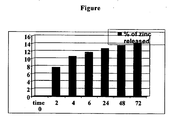
- the non-woven felt obtained as described in Example 2 was tested for the release kinetics of the zinc ion present in the fibre, by treatment with artificial plasma at a temperature of 37°C and at set intervals of 2, 4, 6, 24, 48 and 72 hours.
- 100 mg of non-woven felt were placed in 6 10-ml sterile glass vials and then treated with 5 ml of artificial plasma. All the vials were kept at a temperature of 37°C for the set time intervals. After the period of incubation, each sample was filtered through a 0.2 ⁇ filter, and the solution was freeze-dried. For time 0, artificial plasma alone was filtered through a 0.2 ⁇ filter and freeze-dried.
- Zinc is released from the non-woven felt consistently over the first 2 hours in contact with the artificial plasma (7.6% vs. a total of 14% which is the percent of zinc ions present in the fibres), and then progressively over the next 48-72 hours until all zinc has been released.
- the non-woven felt obtained according to Example 1 was tested for its antibacterial activity against strains of P. aeruginosa; E. coli; S. aureus; C. albicans, A. niger.
- test sample and the negative control were prepared as follows: 0.6 g was dissolved in 9 ml of sterile distilled water to give a mixture of gelatinous consistency. The wells made in the Petri dishes were filled to the brim with aliquots of this mixture (about 100 ⁇ L).
- each microbial strain was tested for fertility of the medium by preparing a Petri dish with a layer of less than 15 ml of specific, incomplete agar medium and a layer of over 5 ml of specific nutrient medium previously inoculated with the test micro-organism, so as to obtain a concentration of about 10 4 UFC/ml in the medium.
- the dishes set up in this way were incubated at 30°C ⁇ 1°C for 48-72 hours.
- the dishes were inspected visually for the presence of any inhibiting haloes around the wells. Moreover, microbial growth was assessed in the dishes prepared to control fertility of the medium.
- the test product proved to have excellent bactericidal activity towards the strains S . aureus and E. coli, more moderate bacteriostatic activity towards P. aeruginosa and fungicide activity towards A . niger and C. albicans .
Landscapes
- Health & Medical Sciences (AREA)
- General Health & Medical Sciences (AREA)
- Veterinary Medicine (AREA)
- Engineering & Computer Science (AREA)
- Materials Engineering (AREA)
- Epidemiology (AREA)
- Life Sciences & Earth Sciences (AREA)
- Chemical & Material Sciences (AREA)
- Animal Behavior & Ethology (AREA)
- Public Health (AREA)
- Hematology (AREA)
- Materials For Medical Uses (AREA)
- Pharmaceuticals Containing Other Organic And Inorganic Compounds (AREA)
- Artificial Filaments (AREA)
- Polysaccharides And Polysaccharide Derivatives (AREA)
- Nonwoven Fabrics (AREA)
- Acyclic And Carbocyclic Compounds In Medicinal Compositions (AREA)
Claims (17)
- Biomaterialien in der Form von nicht gewebtem Filz, zusammengesetzt aus einer Assoziation von Hyaluronsäure-Derivaten mit mit Zink salifizierter Carboxymethylcellulose (CMC).
- Biomaterialien gemäß Anspruch 1, wobei die Hyaluronsäure-Derivate Ester mit Alkoholen sind.
- Biomaterialien gemäß Anspruch 2, wobei die Hyaluronsäure-Derivate Benzylester sind.
- Biomaterialien gemäß Anspruch 2 oder 3 mit einem Veresterungsanteil von 0,1 bis 100%.
- Biomaterialien gemäß Anspruch 4 mit einem Veresterungsanteil von 50 bis 100%.
- Biomaterialien gemäß Anspruch 1, wobei die Hyaluronsäure-Derivate percarboxylierte Derivate der N-Acetylglucosamin-Fraktion sind.
- Biomaterialien gemäß Anspruch 6 mit einem Percarboxylierungsgrad von 25 bis 75%.
- Biomaterialien gemäß einem der Ansprüche 1 bis 7, wobei die Carboxymethylcellulose einen Carboxylierungsgrad von 15 bis 40% aufweist.
- Biomaterialien gemäß einem der Ansprüche 1 bis 8, wobei der Gewichtsanteil von Carboxymethylcellulose 95 bis 5% von dem des Hyaluronsäure-Derivats beträgt.
- Biomaterialien gemäß Anspruch 9, wobei der Gewichtsanteil der Carboxymethylcellulose 90 bis 10% von dem des Hyaluronsäure-Derivats beträgt.
- Biomaterialien gemäß Anspruch 10, wobei der Gewichtsanteil der Carboxymethylcellulose 80 bis 20% von dem des Hyaluronsäure-Derivats beträgt.
- Biomaterialien gemäß einem der Ansprüche 1-11, ferner umfassend ein Polymer, ausgewählt aus Alginsäure oder Salzen davon, Gellan und Kollagen.
- Verfahren zur Herstellung von Biomaterialien nach Ansprüchen 1-12, das beinhaltet:a) Herstellen einer Lösung von Carboxymethylcelluloseammoniumsalzen und dem Hyaluronsäure-Derivat und gegebenenfalls dem weiteren Polymer nach Anspruch 12 in einem aprotischen apolaren Lösungsmittel;b) Nassextrudieren in einer Spinndüse in einem Koagulationsbad, der Zinkchlorid oder Zinkbromid in einer Alkohollösung von 5 bis 10% Ethanol enthält;c) Spülen der durch Extrudieren in Ethanol erhaltenen Fäden;d) Trocknen in einem heißen Luftstrom;e) Kardieren der getrockneten Fäden.
- Verfahren gemäß Anspruch 13, bei dem die Carboxymethylcellulosesalze Tetrabutylammonium- oder Benzalkoniumsalze sind.
- Verfahren gemäß Anspruch 13 oder 14, bei dem das Lösungsmittel Dimethylsulfoxid ist.
- Fäden, erhältlich durch das Verfahren nach Ansprüchen 13 bis 15, die einen Durchmesser aufweisen, der von 10 bis 60 µ variiert.
- Verwendung der Biomaterialien nach Ansprüchen 1-12 zur Herstellung von Instrumenten oder Vorrichtungen zur Behandlung von Wunden verschiedenen Ursprungs und Verbrennungen.
Applications Claiming Priority (2)
| Application Number | Priority Date | Filing Date | Title |
|---|---|---|---|
| ITMI20051415 ITMI20051415A1 (it) | 2005-07-22 | 2005-07-22 | Biomateriali a base di corbossimetilcellulosa salificata con zinco associata a derivati dell'acido ialuronico da impiegarsi come dispositivi medici con attivita' antimicrobica ed antifungina e loro processo di produzione |
| PCT/EP2006/007019 WO2007009728A2 (en) | 2005-07-22 | 2006-07-17 | Biomaterials based on carboxymethylcellulose salified with zinc associated with hyaluronic acid derivatives |
Publications (2)
| Publication Number | Publication Date |
|---|---|
| EP1922089A2 EP1922089A2 (de) | 2008-05-21 |
| EP1922089B1 true EP1922089B1 (de) | 2008-12-24 |
Family
ID=37669160
Family Applications (1)
| Application Number | Title | Priority Date | Filing Date |
|---|---|---|---|
| EP20060762656 Active EP1922089B1 (de) | 2005-07-22 | 2006-07-17 | Biomaterialien auf der basis von carboxymethylcellulose in zinksalzform in assoziation mit hyaluronsäurederivaten |
Country Status (12)
| Country | Link |
|---|---|
| US (1) | US20090233509A1 (de) |
| EP (1) | EP1922089B1 (de) |
| JP (1) | JP2009505687A (de) |
| KR (1) | KR20080036584A (de) |
| AT (1) | ATE418348T1 (de) |
| BR (1) | BRPI0613606A2 (de) |
| CA (1) | CA2616025A1 (de) |
| DE (1) | DE602006004466D1 (de) |
| IT (1) | ITMI20051415A1 (de) |
| MX (1) | MX2008000969A (de) |
| RU (1) | RU2008102250A (de) |
| WO (1) | WO2007009728A2 (de) |
Families Citing this family (20)
| Publication number | Priority date | Publication date | Assignee | Title |
|---|---|---|---|---|
| CZ302503B6 (cs) | 2009-12-11 | 2011-06-22 | Contipro C A.S. | Zpusob prípravy derivátu kyseliny hyaluronové oxidovaného v poloze 6 glukosaminové cásti polysacharidu selektivne na aldehyd a zpusob jeho modifikace |
| CZ302504B6 (cs) | 2009-12-11 | 2011-06-22 | Contipro C A.S. | Derivát kyseliny hyaluronové oxidovaný v poloze 6 glukosaminové cásti polysacharidu selektivne na aldehyd, zpusob jeho prípravy a zpusob jeho modifikace |
| US9308219B2 (en) * | 2011-06-30 | 2016-04-12 | Collagen Matrix, Inc. | Flat self-curling permeable sheet membrane |
| CZ303879B6 (cs) | 2012-02-28 | 2013-06-05 | Contipro Biotech S.R.O. | Deriváty na bázi kyseliny hyaluronové schopné tvorit hydrogely, zpusob jejich prípravy, hydrogely na bázi techto derivátu, zpusob jejich prípravy a pouzití |
| CZ304512B6 (cs) | 2012-08-08 | 2014-06-11 | Contipro Biotech S.R.O. | Derivát kyseliny hyaluronové, způsob jeho přípravy, způsob jeho modifikace a použití |
| CZ304654B6 (cs) | 2012-11-27 | 2014-08-20 | Contipro Biotech S.R.O. | Nanomicelární kompozice na bázi C6-C18-acylovaného hyaluronanu, způsob přípravy C6-C18-acylovaného hyaluronanu, způsob přípravy nanomicelární kompozice a stabilizované nanomicelární kompozice a použití |
| CZ2012841A3 (cs) | 2012-11-27 | 2014-02-19 | Contipro Biotech S.R.O. | Vlákna založená na hydrofobizovaném hyaluronanu, způsob jejich přípravy a použití, textilie na jejich bázi a použití |
| CZ2014150A3 (cs) | 2014-03-11 | 2015-05-20 | Contipro Biotech S.R.O. | Konjugáty oligomeru kyseliny hyaluronové nebo její soli, způsob jejich přípravy a použití |
| CZ2014451A3 (cs) | 2014-06-30 | 2016-01-13 | Contipro Pharma A.S. | Protinádorová kompozice na bázi kyseliny hyaluronové a anorganických nanočástic, způsob její přípravy a použití |
| CZ309295B6 (cs) | 2015-03-09 | 2022-08-10 | Contipro A.S. | Samonosný, biodegradabilní film na bázi hydrofobizované kyseliny hyaluronové, způsob jeho přípravy a použití |
| CZ306479B6 (cs) | 2015-06-15 | 2017-02-08 | Contipro A.S. | Způsob síťování polysacharidů s využitím fotolabilních chránicích skupin |
| CZ306662B6 (cs) | 2015-06-26 | 2017-04-26 | Contipro A.S. | Deriváty sulfatovaných polysacharidů, způsob jejich přípravy, způsob jejich modifikace a použití |
| CZ308106B6 (cs) | 2016-06-27 | 2020-01-08 | Contipro A.S. | Nenasycené deriváty polysacharidů, způsob jejich přípravy a jejich použití |
| WO2019111934A1 (ja) * | 2017-12-07 | 2019-06-13 | 日本製紙株式会社 | カルボキシメチル化セルロース |
| ES3012800T3 (en) | 2017-12-07 | 2025-04-10 | Jujo Paper Co Ltd | Carboxymethylated cellulose nanofibers |
| EP3722328A4 (de) | 2017-12-07 | 2021-11-10 | Nippon Paper Industries Co., Ltd. | Carboxymethylierte cellulose-nanofasern |
| WO2019111928A1 (ja) | 2017-12-07 | 2019-06-13 | 日本製紙株式会社 | カルボキシメチル化セルロースナノファイバーの製造方法 |
| CN108939056A (zh) * | 2018-07-25 | 2018-12-07 | 张河 | 一种生物多糖冲洗胶液及其制备方法 |
| WO2021141748A1 (en) * | 2020-01-08 | 2021-07-15 | Lifescienceplus, Inc. | Compositions and methods for tissue regeneration |
| KR20250098360A (ko) * | 2023-12-22 | 2025-07-01 | (주)메디팁 | 지혈 및 유착방지 효과가 우수한 창상피복재 조성물 및 이의 용도 |
Family Cites Families (6)
| Publication number | Priority date | Publication date | Assignee | Title |
|---|---|---|---|---|
| IT1254704B (it) * | 1991-12-18 | 1995-10-09 | Mini Ricerca Scient Tecnolog | Tessuto non tessuto essenzialmente costituito da derivati dell'acido ialuronico |
| GB9421653D0 (en) * | 1994-10-27 | 1994-12-14 | Innovative Tech Ltd | Wound dressing |
| IT1294797B1 (it) * | 1997-07-28 | 1999-04-15 | Fidia Advanced Biopolymers Srl | Uso dei derivati dell'acido ialuronico nella preparazione di biomateriali aventi attivita' emostatica fisica e tamponante |
| IT1317359B1 (it) * | 2000-08-31 | 2003-06-16 | Fidia Advanced Biopolymers Srl | Polisaccaridi percarbossilati, quali l'acido ialuronico, processo perla loro preparazione e loro impiego in campo farmaceutico e |
| GB0107653D0 (en) * | 2001-03-27 | 2001-05-16 | Bristol Myers Squibb Co | Wound dressing |
| GB0107655D0 (en) * | 2001-03-27 | 2001-05-16 | Bristol Myers Squibb Co | Wound dressing |
-
2005
- 2005-07-22 IT ITMI20051415 patent/ITMI20051415A1/it unknown
-
2006
- 2006-07-17 JP JP2008521865A patent/JP2009505687A/ja not_active Withdrawn
- 2006-07-17 EP EP20060762656 patent/EP1922089B1/de active Active
- 2006-07-17 DE DE200660004466 patent/DE602006004466D1/de active Active
- 2006-07-17 CA CA 2616025 patent/CA2616025A1/en not_active Abandoned
- 2006-07-17 KR KR1020087001631A patent/KR20080036584A/ko not_active Withdrawn
- 2006-07-17 RU RU2008102250/15A patent/RU2008102250A/ru not_active Application Discontinuation
- 2006-07-17 MX MX2008000969A patent/MX2008000969A/es unknown
- 2006-07-17 AT AT06762656T patent/ATE418348T1/de not_active IP Right Cessation
- 2006-07-17 BR BRPI0613606-0A patent/BRPI0613606A2/pt not_active IP Right Cessation
- 2006-07-17 WO PCT/EP2006/007019 patent/WO2007009728A2/en not_active Ceased
- 2006-07-17 US US11/989,224 patent/US20090233509A1/en not_active Abandoned
Also Published As
| Publication number | Publication date |
|---|---|
| DE602006004466D1 (de) | 2009-02-05 |
| US20090233509A1 (en) | 2009-09-17 |
| EP1922089A2 (de) | 2008-05-21 |
| ITMI20051415A1 (it) | 2007-01-23 |
| ATE418348T1 (de) | 2009-01-15 |
| WO2007009728A2 (en) | 2007-01-25 |
| KR20080036584A (ko) | 2008-04-28 |
| WO2007009728A3 (en) | 2007-06-07 |
| BRPI0613606A2 (pt) | 2011-01-18 |
| MX2008000969A (es) | 2008-03-27 |
| JP2009505687A (ja) | 2009-02-12 |
| RU2008102250A (ru) | 2009-07-27 |
| CA2616025A1 (en) | 2007-01-25 |
Similar Documents
| Publication | Publication Date | Title |
|---|---|---|
| EP1922089B1 (de) | Biomaterialien auf der basis von carboxymethylcellulose in zinksalzform in assoziation mit hyaluronsäurederivaten | |
| EP1536845B1 (de) | Wundverbandmaterial mit anionischen polysaccharid-komplexen mit silber | |
| KR101377569B1 (ko) | 항균성 창상 피복재 및 그 제조방법 | |
| Ahamed et al. | Evaluation of biomaterial containing regenerated cellulose and chitosan incorporated with silver nanoparticles | |
| EP2695622B1 (de) | Chitosanwundverband und verfahren zu seiner herstellung | |
| RU149063U1 (ru) | Повязка для заживления ран с противомикробным действием | |
| Pandit et al. | Spongy wound dressing of pectin/carboxymethyl tamarind seed polysaccharide loaded with moxifloxacin beads for effective wound heal | |
| Ngo et al. | Silk fibroin/chitosan/montmorillonite sponge dressing: enhancing hemostasis, antimicrobial activity, and angiogenesis for advanced wound healing applications | |
| HK1246216A (en) | Antimicrobial composition | |
| HK1246216A1 (en) | Antimicrobial composition | |
| EP2203175A1 (de) | Chitosan-glucan enthaltendes präparat zur wundheilung und zur verhinderung des anhaftens von verbänden an der wunde | |
| EP1901786B1 (de) | Biomaterialien in form von fasern zur verwendung als medizinprodukt bei der behandlung von wunden, und ihr herstellungsverfahren | |
| CN106110369B (zh) | 一种医用复合型透明质酸敷料及其制备方法 | |
| CN115770323A (zh) | 一种重组胶原蛋白凝胶敷料及其制备方法和应用 | |
| CN107261195B (zh) | 一种运动创伤康复敷料用抗菌生物质凝胶网的制备方法与用途 | |
| CN1810298A (zh) | 一种抑菌聚电解质多孔材料及其制备方法 | |
| Rathore et al. | Fabrication and characterization of multi-layered coaxial agar-based electrospun biocomposite mat, novel replacement for transdermal patches | |
| CN103893811B (zh) | 一种生物玻璃毡的制备方法及其产品的应用 | |
| CN105999367B (zh) | 一种外科医用敷料及其制备方法 | |
| CN109464701A (zh) | Va@plga-cs-ha复合抗菌缓释微球的制备方法及其在骨修复支架材料中的应用 | |
| CZ2018428A3 (cs) | Kompozice obsahující jodid a derivát kyseliny hyaluronové s oxidačním účinkem, způsob její přípravy a použití | |
| CN115806633A (zh) | 京尼平交联的pdrn-sacran生物聚合物支架 | |
| CN120960491A (zh) | 一种创面治疗用水胶体醋酸纤维敷料及其制备工艺 | |
| CN121714754A (zh) | 一种pH可视化多功能响应性水凝胶敷料的制备方法及其应用 | |
| CN109706744A (zh) | 一种快速止血、抗菌水胶体油纱及其制备方法 |
Legal Events
| Date | Code | Title | Description |
|---|---|---|---|
| PUAI | Public reference made under article 153(3) epc to a published international application that has entered the european phase |
Free format text: ORIGINAL CODE: 0009012 |
|
| 17P | Request for examination filed |
Effective date: 20080115 |
|
| AK | Designated contracting states |
Kind code of ref document: A2 Designated state(s): AT BE BG CH CY CZ DE DK EE ES FI FR GB GR HU IE IS IT LI LT LU LV MC NL PL PT RO SE SI SK TR |
|
| GRAP | Despatch of communication of intention to grant a patent |
Free format text: ORIGINAL CODE: EPIDOSNIGR1 |
|
| DAX | Request for extension of the european patent (deleted) | ||
| GRAS | Grant fee paid |
Free format text: ORIGINAL CODE: EPIDOSNIGR3 |
|
| GRAS | Grant fee paid |
Free format text: ORIGINAL CODE: EPIDOSNIGR3 |
|
| GRAA | (expected) grant |
Free format text: ORIGINAL CODE: 0009210 |
|
| AK | Designated contracting states |
Kind code of ref document: B1 Designated state(s): AT BE BG CH CY CZ DE DK EE ES FI FR GB GR HU IE IS IT LI LT LU LV MC NL PL PT RO SE SI SK TR |
|
| REG | Reference to a national code |
Ref country code: GB Ref legal event code: FG4D |
|
| REG | Reference to a national code |
Ref country code: CH Ref legal event code: EP |
|
| REG | Reference to a national code |
Ref country code: IE Ref legal event code: FG4D |
|
| REF | Corresponds to: |
Ref document number: 602006004466 Country of ref document: DE Date of ref document: 20090205 Kind code of ref document: P |
|
| PG25 | Lapsed in a contracting state [announced via postgrant information from national office to epo] |
Ref country code: LT Free format text: LAPSE BECAUSE OF FAILURE TO SUBMIT A TRANSLATION OF THE DESCRIPTION OR TO PAY THE FEE WITHIN THE PRESCRIBED TIME-LIMIT Effective date: 20081224 |
|
| PG25 | Lapsed in a contracting state [announced via postgrant information from national office to epo] |
Ref country code: SI Free format text: LAPSE BECAUSE OF FAILURE TO SUBMIT A TRANSLATION OF THE DESCRIPTION OR TO PAY THE FEE WITHIN THE PRESCRIBED TIME-LIMIT Effective date: 20081224 Ref country code: NL Free format text: LAPSE BECAUSE OF FAILURE TO SUBMIT A TRANSLATION OF THE DESCRIPTION OR TO PAY THE FEE WITHIN THE PRESCRIBED TIME-LIMIT Effective date: 20081224 Ref country code: PL Free format text: LAPSE BECAUSE OF FAILURE TO SUBMIT A TRANSLATION OF THE DESCRIPTION OR TO PAY THE FEE WITHIN THE PRESCRIBED TIME-LIMIT Effective date: 20081224 Ref country code: LV Free format text: LAPSE BECAUSE OF FAILURE TO SUBMIT A TRANSLATION OF THE DESCRIPTION OR TO PAY THE FEE WITHIN THE PRESCRIBED TIME-LIMIT Effective date: 20081224 Ref country code: FI Free format text: LAPSE BECAUSE OF FAILURE TO SUBMIT A TRANSLATION OF THE DESCRIPTION OR TO PAY THE FEE WITHIN THE PRESCRIBED TIME-LIMIT Effective date: 20081224 |
|
| NLV1 | Nl: lapsed or annulled due to failure to fulfill the requirements of art. 29p and 29m of the patents act | ||
| PG25 | Lapsed in a contracting state [announced via postgrant information from national office to epo] |
Ref country code: EE Free format text: LAPSE BECAUSE OF FAILURE TO SUBMIT A TRANSLATION OF THE DESCRIPTION OR TO PAY THE FEE WITHIN THE PRESCRIBED TIME-LIMIT Effective date: 20081224 Ref country code: ES Free format text: LAPSE BECAUSE OF FAILURE TO SUBMIT A TRANSLATION OF THE DESCRIPTION OR TO PAY THE FEE WITHIN THE PRESCRIBED TIME-LIMIT Effective date: 20090404 Ref country code: BG Free format text: LAPSE BECAUSE OF FAILURE TO SUBMIT A TRANSLATION OF THE DESCRIPTION OR TO PAY THE FEE WITHIN THE PRESCRIBED TIME-LIMIT Effective date: 20090324 Ref country code: BE Free format text: LAPSE BECAUSE OF FAILURE TO SUBMIT A TRANSLATION OF THE DESCRIPTION OR TO PAY THE FEE WITHIN THE PRESCRIBED TIME-LIMIT Effective date: 20081224 Ref country code: RO Free format text: LAPSE BECAUSE OF FAILURE TO SUBMIT A TRANSLATION OF THE DESCRIPTION OR TO PAY THE FEE WITHIN THE PRESCRIBED TIME-LIMIT Effective date: 20081224 |
|
| PG25 | Lapsed in a contracting state [announced via postgrant information from national office to epo] |
Ref country code: SE Free format text: LAPSE BECAUSE OF FAILURE TO SUBMIT A TRANSLATION OF THE DESCRIPTION OR TO PAY THE FEE WITHIN THE PRESCRIBED TIME-LIMIT Effective date: 20090324 Ref country code: AT Free format text: LAPSE BECAUSE OF FAILURE TO SUBMIT A TRANSLATION OF THE DESCRIPTION OR TO PAY THE FEE WITHIN THE PRESCRIBED TIME-LIMIT Effective date: 20081224 Ref country code: IS Free format text: LAPSE BECAUSE OF FAILURE TO SUBMIT A TRANSLATION OF THE DESCRIPTION OR TO PAY THE FEE WITHIN THE PRESCRIBED TIME-LIMIT Effective date: 20090424 Ref country code: PT Free format text: LAPSE BECAUSE OF FAILURE TO SUBMIT A TRANSLATION OF THE DESCRIPTION OR TO PAY THE FEE WITHIN THE PRESCRIBED TIME-LIMIT Effective date: 20090525 Ref country code: CZ Free format text: LAPSE BECAUSE OF FAILURE TO SUBMIT A TRANSLATION OF THE DESCRIPTION OR TO PAY THE FEE WITHIN THE PRESCRIBED TIME-LIMIT Effective date: 20081224 |
|
| PG25 | Lapsed in a contracting state [announced via postgrant information from national office to epo] |
Ref country code: SK Free format text: LAPSE BECAUSE OF FAILURE TO SUBMIT A TRANSLATION OF THE DESCRIPTION OR TO PAY THE FEE WITHIN THE PRESCRIBED TIME-LIMIT Effective date: 20081224 |
|
| PG25 | Lapsed in a contracting state [announced via postgrant information from national office to epo] |
Ref country code: DK Free format text: LAPSE BECAUSE OF FAILURE TO SUBMIT A TRANSLATION OF THE DESCRIPTION OR TO PAY THE FEE WITHIN THE PRESCRIBED TIME-LIMIT Effective date: 20081224 |
|
| PLBE | No opposition filed within time limit |
Free format text: ORIGINAL CODE: 0009261 |
|
| STAA | Information on the status of an ep patent application or granted ep patent |
Free format text: STATUS: NO OPPOSITION FILED WITHIN TIME LIMIT |
|
| 26N | No opposition filed |
Effective date: 20090925 |
|
| PG25 | Lapsed in a contracting state [announced via postgrant information from national office to epo] |
Ref country code: MC Free format text: LAPSE BECAUSE OF NON-PAYMENT OF DUE FEES Effective date: 20090731 |
|
| REG | Reference to a national code |
Ref country code: IE Ref legal event code: MM4A |
|
| PG25 | Lapsed in a contracting state [announced via postgrant information from national office to epo] |
Ref country code: IE Free format text: LAPSE BECAUSE OF NON-PAYMENT OF DUE FEES Effective date: 20090717 |
|
| PG25 | Lapsed in a contracting state [announced via postgrant information from national office to epo] |
Ref country code: GR Free format text: LAPSE BECAUSE OF FAILURE TO SUBMIT A TRANSLATION OF THE DESCRIPTION OR TO PAY THE FEE WITHIN THE PRESCRIBED TIME-LIMIT Effective date: 20090325 |
|
| REG | Reference to a national code |
Ref country code: CH Ref legal event code: PL |
|
| PG25 | Lapsed in a contracting state [announced via postgrant information from national office to epo] |
Ref country code: LU Free format text: LAPSE BECAUSE OF NON-PAYMENT OF DUE FEES Effective date: 20090717 Ref country code: CH Free format text: LAPSE BECAUSE OF NON-PAYMENT OF DUE FEES Effective date: 20100731 Ref country code: LI Free format text: LAPSE BECAUSE OF NON-PAYMENT OF DUE FEES Effective date: 20100731 |
|
| PG25 | Lapsed in a contracting state [announced via postgrant information from national office to epo] |
Ref country code: HU Free format text: LAPSE BECAUSE OF FAILURE TO SUBMIT A TRANSLATION OF THE DESCRIPTION OR TO PAY THE FEE WITHIN THE PRESCRIBED TIME-LIMIT Effective date: 20090625 |
|
| PG25 | Lapsed in a contracting state [announced via postgrant information from national office to epo] |
Ref country code: TR Free format text: LAPSE BECAUSE OF FAILURE TO SUBMIT A TRANSLATION OF THE DESCRIPTION OR TO PAY THE FEE WITHIN THE PRESCRIBED TIME-LIMIT Effective date: 20081224 |
|
| PG25 | Lapsed in a contracting state [announced via postgrant information from national office to epo] |
Ref country code: CY Free format text: LAPSE BECAUSE OF FAILURE TO SUBMIT A TRANSLATION OF THE DESCRIPTION OR TO PAY THE FEE WITHIN THE PRESCRIBED TIME-LIMIT Effective date: 20081224 |
|
| REG | Reference to a national code |
Ref country code: FR Ref legal event code: PLFP Year of fee payment: 11 |
|
| REG | Reference to a national code |
Ref country code: FR Ref legal event code: PLFP Year of fee payment: 12 |
|
| REG | Reference to a national code |
Ref country code: FR Ref legal event code: PLFP Year of fee payment: 13 |
|
| REG | Reference to a national code |
Ref country code: DE Ref legal event code: R082 Ref document number: 602006004466 Country of ref document: DE Representative=s name: ZWICKER SCHNAPPAUF & PARTNER PATENTANWAELTE PA, DE |
|
| PGFP | Annual fee paid to national office [announced via postgrant information from national office to epo] |
Ref country code: DE Payment date: 20250722 Year of fee payment: 20 |
|
| PGFP | Annual fee paid to national office [announced via postgrant information from national office to epo] |
Ref country code: IT Payment date: 20250724 Year of fee payment: 20 |
|
| PGFP | Annual fee paid to national office [announced via postgrant information from national office to epo] |
Ref country code: GB Payment date: 20250722 Year of fee payment: 20 |
|
| PGFP | Annual fee paid to national office [announced via postgrant information from national office to epo] |
Ref country code: FR Payment date: 20250724 Year of fee payment: 20 |