EP1923936A1 - Alkaline-trockenbatterie - Google Patents
Alkaline-trockenbatterie Download PDFInfo
- Publication number
- EP1923936A1 EP1923936A1 EP06782428A EP06782428A EP1923936A1 EP 1923936 A1 EP1923936 A1 EP 1923936A1 EP 06782428 A EP06782428 A EP 06782428A EP 06782428 A EP06782428 A EP 06782428A EP 1923936 A1 EP1923936 A1 EP 1923936A1
- Authority
- EP
- European Patent Office
- Prior art keywords
- nickel oxyhydroxide
- nickel
- positive electrode
- alkaline dry
- battery
- Prior art date
- Legal status (The legal status is an assumption and is not a legal conclusion. Google has not performed a legal analysis and makes no representation as to the accuracy of the status listed.)
- Withdrawn
Links
Images


Classifications
-
- H—ELECTRICITY
- H01—ELECTRIC ELEMENTS
- H01M—PROCESSES OR MEANS, e.g. BATTERIES, FOR THE DIRECT CONVERSION OF CHEMICAL ENERGY INTO ELECTRICAL ENERGY
- H01M4/00—Electrodes
- H01M4/02—Electrodes composed of, or comprising, active material
- H01M4/24—Electrodes for alkaline accumulators
- H01M4/32—Nickel oxide or hydroxide electrodes
-
- H—ELECTRICITY
- H01—ELECTRIC ELEMENTS
- H01M—PROCESSES OR MEANS, e.g. BATTERIES, FOR THE DIRECT CONVERSION OF CHEMICAL ENERGY INTO ELECTRICAL ENERGY
- H01M10/00—Secondary cells; Manufacture thereof
- H01M10/24—Alkaline accumulators
- H01M10/30—Nickel accumulators
-
- H—ELECTRICITY
- H01—ELECTRIC ELEMENTS
- H01M—PROCESSES OR MEANS, e.g. BATTERIES, FOR THE DIRECT CONVERSION OF CHEMICAL ENERGY INTO ELECTRICAL ENERGY
- H01M4/00—Electrodes
- H01M4/02—Electrodes composed of, or comprising, active material
- H01M4/24—Electrodes for alkaline accumulators
- H01M4/244—Zinc electrodes
-
- H—ELECTRICITY
- H01—ELECTRIC ELEMENTS
- H01M—PROCESSES OR MEANS, e.g. BATTERIES, FOR THE DIRECT CONVERSION OF CHEMICAL ENERGY INTO ELECTRICAL ENERGY
- H01M4/00—Electrodes
- H01M4/02—Electrodes composed of, or comprising, active material
- H01M4/36—Selection of substances as active materials, active masses, active liquids
- H01M4/38—Selection of substances as active materials, active masses, active liquids of elements or alloys
- H01M4/42—Alloys based on zinc
-
- H—ELECTRICITY
- H01—ELECTRIC ELEMENTS
- H01M—PROCESSES OR MEANS, e.g. BATTERIES, FOR THE DIRECT CONVERSION OF CHEMICAL ENERGY INTO ELECTRICAL ENERGY
- H01M4/00—Electrodes
- H01M4/02—Electrodes composed of, or comprising, active material
- H01M4/64—Carriers or collectors
-
- H—ELECTRICITY
- H01—ELECTRIC ELEMENTS
- H01M—PROCESSES OR MEANS, e.g. BATTERIES, FOR THE DIRECT CONVERSION OF CHEMICAL ENERGY INTO ELECTRICAL ENERGY
- H01M6/00—Primary cells; Manufacture thereof
- H01M6/04—Cells with aqueous electrolyte
- H01M6/06—Dry cells, i.e. cells wherein the electrolyte is rendered non-fluid
-
- H—ELECTRICITY
- H01—ELECTRIC ELEMENTS
- H01M—PROCESSES OR MEANS, e.g. BATTERIES, FOR THE DIRECT CONVERSION OF CHEMICAL ENERGY INTO ELECTRICAL ENERGY
- H01M6/00—Primary cells; Manufacture thereof
- H01M6/04—Cells with aqueous electrolyte
- H01M6/06—Dry cells, i.e. cells wherein the electrolyte is rendered non-fluid
- H01M6/10—Dry cells, i.e. cells wherein the electrolyte is rendered non-fluid with wound or folded electrodes
-
- H—ELECTRICITY
- H01—ELECTRIC ELEMENTS
- H01M—PROCESSES OR MEANS, e.g. BATTERIES, FOR THE DIRECT CONVERSION OF CHEMICAL ENERGY INTO ELECTRICAL ENERGY
- H01M6/00—Primary cells; Manufacture thereof
- H01M6/04—Cells with aqueous electrolyte
- H01M6/06—Dry cells, i.e. cells wherein the electrolyte is rendered non-fluid
- H01M6/08—Dry cells, i.e. cells wherein the electrolyte is rendered non-fluid with cup-shaped electrodes
-
- Y—GENERAL TAGGING OF NEW TECHNOLOGICAL DEVELOPMENTS; GENERAL TAGGING OF CROSS-SECTIONAL TECHNOLOGIES SPANNING OVER SEVERAL SECTIONS OF THE IPC; TECHNICAL SUBJECTS COVERED BY FORMER USPC CROSS-REFERENCE ART COLLECTIONS [XRACs] AND DIGESTS
- Y02—TECHNOLOGIES OR APPLICATIONS FOR MITIGATION OR ADAPTATION AGAINST CLIMATE CHANGE
- Y02E—REDUCTION OF GREENHOUSE GAS [GHG] EMISSIONS, RELATED TO ENERGY GENERATION, TRANSMISSION OR DISTRIBUTION
- Y02E60/00—Enabling technologies; Technologies with a potential or indirect contribution to GHG emissions mitigation
- Y02E60/10—Energy storage using batteries
Definitions
- the present invention relates to an alkaline dry battery including nickel oxyhydroxide and manganese dioxide as positive electrode active materials.
- Alkaline manganese dry batteries have an inside-out structure.
- a cylindrical positive electrode mixture is placed in a positive electrode case serving as a positive electrode terminal, so as to closely adhere to the positive electrode case.
- a gelled negative electrode is placed in the central cavity of the positive electrode mixture with a separator interposed therebetween.
- Patent Document 1 proposes mixing nickel oxyhydroxide to a positive electrode mixture to produce a battery that is excellent in heavy-load discharge characteristics.
- the battery proposed by Patent Document 1 has recently been put to practical use.
- Alkaline batteries including nickel oxyhydroxide as a positive electrode active material have excellent heavy-load discharge characteristics, compared with conventional alkaline manganese dry batteries. They are thus becoming popular as the main power source for digital devices such as digital cameras.
- digital cameras have various functions such as flashing a strobe light, putting in and out an optical lens, displaying by a liquid crystal display, and writing image data into a medium.
- batteries used as power sources need to instantaneously supply power at heavy load depending on various functions.
- Patent Document 2 proposes the use of a solid solution of nickel oxyhydroxide including zinc as an active material, the addition of a zinc oxide to a positive electrode mixture, and the like.
- Patent Document 1 Japanese Patent No. 3552194
- Patent Document 2 Japanese Laid-Open Patent Publication No. 2002-075354
- the battery proposed by Patent Document 2 exhibits large polarization during heavy-load pulse discharge. Further, when the battery becomes short-circuited, the temperature of the battery rises significantly, thereby posing practical problems such as possible battery explosion.
- an object of the present invention is to provide an alkaline dry battery that maintains excellent heavy-load discharge characteristics, exhibits suppressed polarization during heavy-load pulse discharge to improve the operational stability of digital devices, and has high reliability with respect to safety under short-circuit conditions.
- the alkaline dry battery of the present invention includes: a positive electrode including at least nickel oxyhydroxide and manganese dioxide as positive electrode active materials; a negative electrode including zinc or a zinc alloy as a negative electrode active material; a separator interposed between the positive electrode and the negative electrode; a negative electrode current collector inserted in the negative electrode; and an alkaline electrolyte.
- the nickel oxyhydroxide is a solid solution including at least manganese and cobalt.
- the content of the manganese is 5.2 ⁇ 10 -2 to 7.5 ⁇ 10- 2 moles per mole of the nickel oxyhydroxide, and the content of the cobalt is 0.5 ⁇ 10 -2 to 2.0 ⁇ 10 -2 moles per mole of the nickel oxyhydroxide.
- nickel contained in the nickel oxyhydroxide preferably has a mean valence of 2.95 or more and 3.05 or less.
- the nickel oxyhydroxide preferably has a mean particle size of 8 to 18 ⁇ m.
- the weight ratio of the nickel oxyhydroxide to the manganese dioxide included in the positive electrode is preferably 10:90 to 80:20.
- the nickel oxyhydroxide is a solid solution further including zinc, and the content of the zinc is 0.2 ⁇ 10 -2 to 2.0 ⁇ 10 -2 moles per mole of the nickel oxyhydroxide.
- the content of the zinc is 0.2 ⁇ 10 -2 to 2.0 ⁇ 10 -2 moles per mole of the nickel oxyhydroxide.
- the weight ratio of the nickel oxyhydroxide to the manganese dioxide included in the positive electrode is preferably 20:80 to 60:40. In this case, a battery having excellent heavy-load pulse characteristics and exhibiting a sufficiently suppressed increase in battery temperature upon a battery short-circuit can be obtained in a more reliable manner.
- the present invention can provide a battery that maintains excellent heavy-load discharge characteristics, exhibits suppressed polarization during heavy-load pulse discharge to improve the operational stability of digital devices, and has high reliability with respect to leakage resistance and battery safety under short-circuit conditions.
- the present inventors have conducted diligent research on the kinds and contents of elements that should be included in a solid solution of nickel oxyhydroxide serving as a positive electrode active material, in order to obtain an alkaline dry battery having characteristics suitable for use in digital devices such as digital cameras as well as excellent safety. As a result, they have completed the present invention.
- the present inventors have made various examinations on solid solutions of nickel oxyhydroxide including the same amount of zinc, cobalt, or manganese per mole of the nickel oxyhydroxide. As a result, they have found the followings:
- the present inventors have studied the relation between the combination and contents of additional elements and the characteristics of alkaline dry batteries including a solid solution of nickel oxyhydroxide and manganese dioxide as positive electrode active materials. As a result, they have found that the use of a solid solution of nickel oxyhydroxide containing at least 5.2 ⁇ 10 -2 to 7.5 ⁇ 10 -2 moles of manganese and 0.5 ⁇ 10 2 to 2.0 ⁇ 10 -2 moles of cobalt per mole of nickel oxyhydroxide can provide a battery that maintains excellent heavy-load discharge characteristics, exhibits suppressed polarization during heavy-load pulse discharge to improve the operational stability of digital devices, and has high reliability with respect to safety under short-circuit conditions. In this way, they have completed the present invention.
- the solid solution of nickel oxyhydroxide further containing zinc at a zinc content of 0.2 ⁇ 10 -2 to 2.0 ⁇ 10 -2 moles per mole of nickel oxyhydroxide is preferable since the heavy-load discharge characteristics of the battery after high-temperature storage are improved.
- a solid solution of nickel oxyhydroxide containing Atom M refers to one in which Atom M is included in the crystal of nickel oxyhydroxide. Specifically, it may be either a solid solution in which at least part of the nickel atoms are replaced with Atom M in the crystal of nickel oxyhydroxide or a solid solution in which Atom M is inserted in the crystal of nickel oxyhydroxide. Of course, such a solid solution may contain replaced Atom M and inserted Atom M at the same time.
- the content of elements in a solid solution of nickel oxyhydroxide can be determined by dissolving this solid solution, for example, in a nitric acid aqueous solution and subjecting it to an ICP emission spectrometry.
- a solid solution of nickel oxyhydroxide used as a positive electrode active material can be obtained, for example, by applying a chemical oxidation treatment to a solid solution of nickel hydroxide.
- a method of such chemical oxidation treatment is, for example, placing a solid solution of nickel hydroxide into sodium hydroxide, adding a sodium hypochlorite aqueous solution thereto, and stirring.
- a solid solution of nickel hydroxide used in the above process can be obtained, for example, as follows. Specifically, a nickel sulfate aqueous solution, a manganese sulfate aqueous solution, a cobalt sulfate aqueous solution, a zinc sulfate aqueous solution, a sodium hydroxide aqueous solution, and ammonia water are mixed together to prepare a suspension. From this suspension, the precipitate is separated by decantation, to obtain a solid solution of nickel hydroxide. The content of Atom M in the solid solution obtained is dependent on the concentrations of the manganese sulfate aqueous solution, the cobalt sulfate aqueous solution, and the zinc sulfate aqueous solution.
- the mean valence of nickel in the solid solution of nickel oxyhydroxide of the present invention can be determined, for example, as follows. That is, first, the weight ratio "a" of nickel in the solid solution of nickel oxyhydroxide is determined by a gravimetric method (dimethylglyoxime method). Also, the amount "b" of nickel ions is obtained by dissolving the solid solution of nickel oxyhydroxide, for example, in nitric acid and performing an oxidation-reduction titration. From the weight ratio "a" of nickel and the amount "b” of nickel ions, the mean valence of nickel in the solid solution of nickel oxyhydroxide can be determined.
- the loading property of such a positive electrode mixture degrades significantly and battery performance also degrade, which is not preferable.
- the particle size exceeds 18 ⁇ m, the contact with graphite particles serving as a conductive agent becomes poor. As a result, the heavy-load discharge characteristics in the initial state and high-temperature storage degrade significantly, which is not preferable.
- nickel oxyhydroxide and manganese dioxide 10 to 80 % by weight of nickel oxyhydroxide and 90 to 20 % by weight of manganese dioxide are preferable since the discharge characteristics in the initial state and high-temperature storage are good.
- the positive electrode can be made of conventionally known materials, and can include a positive electrode mixture that contains the above-mentioned mixture of a solid solution of nickel oxyhydroxide and manganese dioxide as positive electrode active materials, e.g., a graphite conductive agent, and an electrolyte.
- a positive electrode mixture that contains the above-mentioned mixture of a solid solution of nickel oxyhydroxide and manganese dioxide as positive electrode active materials, e.g., a graphite conductive agent, and an electrolyte.
- the negative electrode and the separator can also be made of conventionally known materials.
- the negative electrode can be, for example, a gelled negative electrode prepared by mixing a zinc or zinc alloy powder serving as a negative electrode active material, a sodium polyacrylate gelling agent, and an electrolyte.
- the zinc alloy powder can be, for example, a commercial product containing Bi, In, Al, etc.
- the electrolyte can be, for example, a potassium hydroxide aqueous solution.
- the separator can be, for example, non-woven fabric composed of polyvinyl alcohol fiber, rayon fiber, etc.
- FIG. 1 is a partially cross-sectional front view of an alkaline dry battery in one embodiment of the present invention.
- This alkaline dry battery includes positive electrode mixture pellets 3 and a gelled negative electrode 6, which are in contact with each other with a separator 4 interposed therebetween.
- a positive electrode case 1 is made of a nickel-plated steel plate.
- the positive electrode case 1 has a graphite coating film 2 on the inner face thereof.
- the alkaline dry battery as illustrated in FIG. 1 can be produced as follows. That is, first, the positive electrode mixture pellets 3 in the form of a short cylinder are inserted into the positive electrode case 1. The positive electrode mixture pellets 3 are repressed in the positive electrode case 1, so that they closely adhere to the inner face of the positive electrode case 1. Subsequently, the separator 4 and an insulating cap 5 are inserted into the space inside the positive electrode mixture pellets 3, and an electrolyte is injected therein in order to moisten the separator 4 and the positive electrode mixture pellets 3. After the injection of the electrolyte, the gelled negative electrode 6 is filled in the space inside the separator 4.
- a negative electrode current collector 10 which is integrated with a resin sealing plate 7, a bottom plate 8 serving as a negative electrode terminal, and an insulating washer 9, is inserted into the gelled negative electrode 6.
- the open edge of the positive electrode case 1 is crimped onto the circumference of the bottom plate 8 with the edge of the sealing plate 7 interposed therebetween, in order to seal the opening of the positive electrode case 1.
- the outer surface of the positive electrode case 1 is covered with an outer label 11. In this way, an alkaline dry battery can be obtained.
- a solid solution powder of nickel hydroxide was prepared in the following manner. That is, first, 2.5 mol/liter of a nickel sulfate aqueous solution, 0.13 mol/liter of a manganese sulfate aqueous solution, 0.05 mol/liter of a cobalt sulfate aqueous solution, 5 mol/liter of a sodium hydroxide aqueous solution, and 5 mol/liter of ammonia water were supplied to a reactor. The reactor contained stirring blades and the temperature inside the reactor was maintained at 40°C. Each aqueous solution was continuously supplied into the reactor at a flow rate of 0.5 ml/min by using a pump.
- FIG. 2 shows a typical powder X-ray diffraction pattern of the nickel hydroxide particles.
- Measuring apparatus Powder X-ray diffractometer "RINT1400" available from Rigaku Corporation Anticathode: Cu Filter: Ni Tube voltage: 40 kV Tube current: 100 mA Sampling angle: 0.02 deg. Scanning speed: 3.0 deg./min. Divergence slit: 1/2 deg. Scattering slit: 1/2 deg.
- the recorded CuK ⁇ X-ray diffraction pattern confirmed that the nickel hydroxide particles were composed of a single phase of ⁇ -Ni(OH) 2 in the form of a solid solution containing additional elements of manganese and cobalt.
- the nickel hydroxide powder prepared in the above manner was subjected to the following chemical oxidation treatment.
- the powder was placed into 0.5 mol/liter of a sodium hydroxide aqueous solution, and a sodium hypochlorite aqueous solution (effective chlorine concentration: 12 wt%) was added thereto such that the oxidant equivalent was 1.2.
- the resultant solution was stirred at a reaction ambient temperature of 45°C for 3 hours to produce nickel oxyhydroxide particles.
- the particles obtained were fully washed with water and dried at 60°C in a vacuum to obtain a positive electrode active material powder.
- the mean valence of nickel in the nickel oxyhydroxide powder obtained was determined by the following measurements.
- a nitric acid aqueous solution was added to the solid solution powder of nickel oxyhydroxide, which was then heated and completely dissolved.
- the resultant solution was quantified by ICP emission spectrometry (using a VISTA-RL available from VARIAN Inc.). By this quantification, the weight ratios of elements contained in the solid solution of nickel oxyhydroxide were determined. Table 1 shows the amounts of elements contained in the solid solution of nickel oxyhydroxide per mole of nickel oxyhydroxide.
- the nickel oxyhydroxide powder obtained in the above manner, manganese dioxide, graphite, and an electrolyte were blended in a weight ratio of 50:50:6.5:1 and homogeneously stirred and mixed with a mixer to obtain particles with a certain particle size.
- the particles were molded under pressure into a hollow cylindrical shape to obtain positive electrode mixture pellets, which were used as the positive electrode. Also, a 37 wt% potassium hydroxide aqueous solution was used as the electrolyte.
- a gelled negative electrode prepared by mixing a gelling agent, the electrolyte, and a zinc alloy powder was used as the negative electrode.
- a zinc alloy powder zinc was melted by heating to approximately 500°C, and predetermined amounts of Bi, In, and Al were added thereto and melted. The molten material was dropped in the form of narrow streams and atomized (made into a mist) by blowing it with compressed air. In this way, a zinc alloy powder containing 250 ppm of Bi, 250 ppm of In, and 35 ppm of Al was obtained.
- Sodium polyacrylate was used as the gelling agent, and non-woven fabric composed mainly of polyvinyl alcohol fiber and rayon fiber was used as the separator.
- an alkaline dry battery with a structure as illustrated in FIG. 1 was produced.
- a plurality of the positive electrode mixture pellets 3 in the form of a short cylinder were inserted into a positive electrode case 1.
- the positive electrode mixture pellets 3 were repressed in the positive electrode case 1, so that they closely adhered to the inner face thereof.
- the separator 4 and an insulating cap 5 were inserted into the space inside the positive electrode mixture pellets 3, and the electrolyte was injected therein. After the injection of the electrolyte, the gelled negative electrode 6 was filled in the space inside the separator 4.
- a negative electrode current collector 10 which was integrated with a resin sealing plate 7, a bottom plate 8 serving as a negative electrode terminal, and an insulating washer 9, was inserted into the gelled negative electrode 6.
- the open edge of the positive electrode case 1 was crimped onto the circumference of the bottom plate 8 with the edge of the sealing plate 7 interposed therebetween, in order to seal the opening of the positive electrode case 1.
- the outer surface of the positive electrode case 1 was covered with an outer label 11. In this way, an alkaline dry battery No. 10 in this example was produced.
- alkaline dry batteries of Nos. 2 to 9 and 11 to 27 were produced in the same manner as described above, except that in the preparation of a nickel hydroxide powder, the concentrations of aqueous solutions of nickel sulfate, manganese sulfate, cobalt sulfate, and zinc sulfate were adjusted such that the total metal ion concentration of nickel, manganese, cobalt, and zinc in a solid solution of nickel oxyhydroxide included as a positive electrode active material was constant at 2.68 mol/liter and that the contents of manganese, cobalt, and zinc were the values as shown in Table 1. Note that a nickel hydroxide powder prepared in the same manner as described above by using only a nickel sulfate aqueous solution was used for No.1.
- each of the continuous discharge performance and the pulse discharge performance was the average value of 10 batteries which was expressed as an index relative to the duration of each discharge of the battery No. 1 being defined as 100.
- the duration of continuous discharge of the battery No.1 was 65.2 minutes in the initial state and 50.4 minutes after storage, and the number of cycles in pulse discharge was 172 cycles.
- To evaluate battery safety one battery was forcedly short-circuited and the increase in battery temperature was measured with a thermocouple to obtain the highest temperature. Table 1 shows the average value of the highest temperatures of five batteries.
- the heavy-load discharge performance in the initial state was better than that of No. 1, and the index after storage was 113 or more.
- the index of discharge performance in heavy-load pulse discharge was 110 or more.
- the amount of voltage drop in heavy-load pulse discharge was 313 mV or less, compared with 325 mV of No.1.
- the highest battery temperature upon a battery short-circuit was 140°C or less, compared with 148°C of No.1.
- the characteristics of Nos. 21 to 25 indicate that when the active material includes a solid solution of nickel oxyhydroxide further containing 0.2 ⁇ 10 -2 to 2.0 ⁇ 10 -2 moles of zinc, it is possible to improve heavy-load discharge characteristics without increasing battery temperature upon a battery short-circuit.
- the zinc content exceeds 2.0 ⁇ 10 -2 moles, the battery temperature upon a short-circuit rises and the safety decreases. This indicates that the zinc content is preferably 0.2 ⁇ 10 -2 to 0.7 ⁇ 10 -2 moles per mole of nickel oxyhydroxide.
- Alkaline dry batteries No.28 to 34 and 36 to 42 were produced in the same manner as the battery No. 1 in Experimental Example 1, except that the mixing ratio between nickel oxyhydroxide and manganese dioxide was adjusted such that the ratio of the manganese dioxide was 0 to 90 % with respect to the nickel oxyhydroxide powder No.1 or No.10. Also, an alkaline dry battery No.35 was produced in the same manner as described above, except that a positive electrode active material was prepared without using nickel oxyhydroxide such that the ratio of manganese dioxide was 100%.
- FIG. 3 to FIG. 6 show the relation between the ratio of nickel oxyhydroxide in the active material and battery performance.
- FIG. 3 shows the continuous discharge performance in the initial state
- FIG. 4 shows the continuous discharge performance after storage
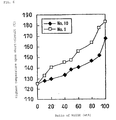
- FIG. 5 shows the discharge performance in heavy-load pulse discharge, each of which is expressed as an index.
- FIG. 6 shows the highest temperature upon a battery short-circuit.
- the heavy-load continuous discharge performance, the pulse discharge performance, the discharge performance after high-temperature storage, and battery temperature upon a battery short-circuit are significantly improved due to the addition of manganese dioxide.
- the batteries No.1 and Nos. 28 to 34 are superior in heavy-load continuous discharge performance and pulse discharge performance, but that the performance gradually lowers when the amount of manganese dioxide added increases.
- the effects obtained by the addition of manganese dioxide are an improvement in heavy-load continuous discharge performance after high-temperature storage and a reduction in the temperature rise upon a battery short-circuit.
- Alkaline dry batteries No.43 to 48 were produced in the same manner as No. 10 of Experimental Example 1, except that the flow rates of the nickel sulfate aqueous solution, manganese sulfate aqueous solution, cobalt sulfate aqueous solution, ammonia water, and sodium hydroxide aqueous solution were changed to adjust the mean particle size of the resultant solid solution of nickel hydroxide.
- the alkaline dry batteries thus produced were evaluated in the same manner as in Experimental Example 1. Table 3 shows the evaluation results.
- Nickel oxyhydroxide powders having different mean valences of nickel were examined.
- the nickel hydroxide powder prepared under the conditions of No. 10 of Experimental Example 1 was used and the oxidant equivalent of the sodium hypochlorite aqueous solution (effective chlorine concentration: 12% by weight) was changed from 0.9 to 1.4. Except for this, in the same manner as in Experimental Example 1, alkaline dry batteries No.49 to 54 were prepared.
- Table 4 shows the mean particle sizes and nickel mean valences of nickel oxyhydroxides used in the alkaline dry batteries No.49 to 54.
- the alkaline dry batteries thus produced were evaluated in the same manner as in Experimental Example 1. Table 4 shows the evaluation results.
- the polarization of alkaline dry batteries particularly during heavy-load pulse discharge can be suppressed.
- the alkaline dry battery of the present invention is useful as the main power source for digital devices such as digital cameras.
Landscapes
- Chemical & Material Sciences (AREA)
- Chemical Kinetics & Catalysis (AREA)
- Electrochemistry (AREA)
- General Chemical & Material Sciences (AREA)
- Engineering & Computer Science (AREA)
- Manufacturing & Machinery (AREA)
- Battery Electrode And Active Subsutance (AREA)
- Primary Cells (AREA)
Applications Claiming Priority (2)
| Application Number | Priority Date | Filing Date | Title |
|---|---|---|---|
| JP2005236289A JP2007052965A (ja) | 2005-08-17 | 2005-08-17 | アルカリ乾電池 |
| PCT/JP2006/315586 WO2007020828A1 (ja) | 2005-08-17 | 2006-08-07 | アルカリ乾電池 |
Publications (1)
| Publication Number | Publication Date |
|---|---|
| EP1923936A1 true EP1923936A1 (de) | 2008-05-21 |
Family
ID=37757490
Family Applications (1)
| Application Number | Title | Priority Date | Filing Date |
|---|---|---|---|
| EP06782428A Withdrawn EP1923936A1 (de) | 2005-08-17 | 2006-08-07 | Alkaline-trockenbatterie |
Country Status (5)
| Country | Link |
|---|---|
| US (1) | US20080193843A1 (de) |
| EP (1) | EP1923936A1 (de) |
| JP (1) | JP2007052965A (de) |
| CN (1) | CN101147280A (de) |
| WO (1) | WO2007020828A1 (de) |
Families Citing this family (1)
| Publication number | Priority date | Publication date | Assignee | Title |
|---|---|---|---|---|
| KR101115416B1 (ko) * | 2009-06-08 | 2012-02-15 | 한양대학교 산학협력단 | 리튬 이차 전지용 양극 활물질, 이의 제조 방법 및 이를 포함하는 리튬 이차 전지 |
Family Cites Families (5)
| Publication number | Priority date | Publication date | Assignee | Title |
|---|---|---|---|---|
| CA2277227C (en) * | 1997-01-30 | 2006-06-06 | Sanyo Electric Co., Ltd. | Enclosed alkali storage battery |
| JP2003234101A (ja) * | 2002-02-07 | 2003-08-22 | Fdk Corp | アルカリ一次電池 |
| CN1303705C (zh) * | 2003-06-09 | 2007-03-07 | 日立麦克赛尔株式会社 | 碱性电池用正极和碱性电池 |
| JP2005071991A (ja) * | 2003-08-06 | 2005-03-17 | Matsushita Electric Ind Co Ltd | アルカリ電池 |
| US7718315B2 (en) * | 2003-11-06 | 2010-05-18 | Panasonic Corporation | Alkaline battery and positive electrode material for alkaline battery comprising nickel oxyhydroxide and manganese dioxide |
-
2005
- 2005-08-17 JP JP2005236289A patent/JP2007052965A/ja not_active Withdrawn
-
2006
- 2006-08-07 US US11/883,618 patent/US20080193843A1/en not_active Abandoned
- 2006-08-07 CN CNA2006800090942A patent/CN101147280A/zh active Pending
- 2006-08-07 EP EP06782428A patent/EP1923936A1/de not_active Withdrawn
- 2006-08-07 WO PCT/JP2006/315586 patent/WO2007020828A1/ja not_active Ceased
Non-Patent Citations (1)
| Title |
|---|
| See references of WO2007020828A1 * |
Also Published As
| Publication number | Publication date |
|---|---|
| JP2007052965A (ja) | 2007-03-01 |
| CN101147280A (zh) | 2008-03-19 |
| WO2007020828A1 (ja) | 2007-02-22 |
| US20080193843A1 (en) | 2008-08-14 |
Similar Documents
| Publication | Publication Date | Title |
|---|---|---|
| EP1919012A1 (de) | Alkaline trockenbatterie | |
| EP3128584B1 (de) | Nickel-wasserstoff-sekundärbatterie | |
| EP2665113B1 (de) | Positivelektroden-aktivmaterial für eine alkalische speicherbatterie, herstellungsverfahren für das positivelektroden-aktivmaterial und alkalische speicherbatterie | |
| RU2422948C1 (ru) | Щелочной первичный элемент | |
| EP1892220A1 (de) | Nickelhydroxidpulver, Nickeloxyhydroxidpulver, Verfahren zu deren Herstellung und Alkaline-Trockenbatterie | |
| US7569306B2 (en) | Alkaline battery and manufacturing method of positive electrode material therefor | |
| US8877372B2 (en) | Alkaline secondary battery | |
| US20070077492A1 (en) | Nickel oxyhydroxide, manufacturing method therefor, and alkaline primary battery | |
| EP1923936A1 (de) | Alkaline-trockenbatterie | |
| EP2113956A1 (de) | Alkalibatterie | |
| AU2004302092B2 (en) | Alkaline battery | |
| CN100517824C (zh) | 碱性干电池 | |
| KR100882403B1 (ko) | 알칼리 전지 | |
| EP1837938A1 (de) | Alkaline trockenbatterie | |
| EP2713428B1 (de) | Alkalische Speicherbatterie und Positivelektrodenmaterial für alkalische Speicherbatterie | |
| US20070287066A1 (en) | Alkaline primary battery | |
| JP2007035506A (ja) | アルカリ電池 | |
| JP2007328929A (ja) | アルカリ一次電池およびアルカリ一次電池正極活物質用オキシ水酸化ニッケルの製造方法 |
Legal Events
| Date | Code | Title | Description |
|---|---|---|---|
| PUAI | Public reference made under article 153(3) epc to a published international application that has entered the european phase |
Free format text: ORIGINAL CODE: 0009012 |
|
| 17P | Request for examination filed |
Effective date: 20070731 |
|
| AK | Designated contracting states |
Kind code of ref document: A1 Designated state(s): AT BE BG CH CY CZ DE DK EE ES FI FR GB GR HU IE IS IT LI LT LU LV MC NL PL PT RO SE SI SK TR |
|
| STAA | Information on the status of an ep patent application or granted ep patent |
Free format text: STATUS: THE APPLICATION HAS BEEN WITHDRAWN |
|
| 18W | Application withdrawn |
Effective date: 20080711 |