EP1924725B1 - Procede et dispositif pour produire un fil a partir de proteines de soie - Google Patents
Procede et dispositif pour produire un fil a partir de proteines de soie Download PDFInfo
- Publication number
- EP1924725B1 EP1924725B1 EP06792042A EP06792042A EP1924725B1 EP 1924725 B1 EP1924725 B1 EP 1924725B1 EP 06792042 A EP06792042 A EP 06792042A EP 06792042 A EP06792042 A EP 06792042A EP 1924725 B1 EP1924725 B1 EP 1924725B1
- Authority
- EP
- European Patent Office
- Prior art keywords
- solution
- diffusion unit
- silk
- protein
- thread
- Prior art date
- Legal status (The legal status is an assumption and is not a legal conclusion. Google has not performed a legal analysis and makes no representation as to the accuracy of the status listed.)
- Active
Links
Images




Classifications
-
- D—TEXTILES; PAPER
- D01—NATURAL OR MAN-MADE THREADS OR FIBRES; SPINNING
- D01D—MECHANICAL METHODS OR APPARATUS IN THE MANUFACTURE OF ARTIFICIAL FILAMENTS, THREADS, FIBRES, BRISTLES OR RIBBONS
- D01D5/00—Formation of filaments, threads, or the like
- D01D5/06—Wet spinning methods
-
- D—TEXTILES; PAPER
- D01—NATURAL OR MAN-MADE THREADS OR FIBRES; SPINNING
- D01B—MECHANICAL TREATMENT OF NATURAL FIBROUS OR FILAMENTARY MATERIAL TO OBTAIN FIBRES OF FILAMENTS, e.g. FOR SPINNING
- D01B7/00—Obtaining silk fibres or filaments
-
- D—TEXTILES; PAPER
- D01—NATURAL OR MAN-MADE THREADS OR FIBRES; SPINNING
- D01C—CHEMICAL OR BIOLOGICAL TREATMENT OF NATURAL FILAMENTARY OR FIBROUS MATERIAL TO OBTAIN FILAMENTS OR FIBRES FOR SPINNING; CARBONISING RAGS TO RECOVER ANIMAL FIBRES
- D01C3/00—Treatment of animal material, e.g. chemical scouring of wool
-
- D—TEXTILES; PAPER
- D01—NATURAL OR MAN-MADE THREADS OR FIBRES; SPINNING
- D01F—CHEMICAL FEATURES IN THE MANUFACTURE OF ARTIFICIAL FILAMENTS, THREADS, FIBRES, BRISTLES OR RIBBONS; APPARATUS SPECIALLY ADAPTED FOR THE MANUFACTURE OF CARBON FILAMENTS
- D01F4/00—Monocomponent artificial filaments or the like of proteins; Manufacture thereof
- D01F4/02—Monocomponent artificial filaments or the like of proteins; Manufacture thereof from fibroin
Definitions
- the present invention relates to a method for producing a thread of silk proteins and to a device which is suitable for carrying out the method. Moreover, the invention is directed to threads obtained therefrom and their use.
- Natural silk e.g. Spider silk is an exceptional material that has a very high tensile strength in combination with a high extensibility. Because of these properties has been trying for years to produce this material in larger quantities. Since it is not possible to use animals such as To employ spiders for this purpose, research has focused on the study of methods in which the starting material for the silk (e.g., spider silk proteins) is recombinantly recovered and then spun into a thread.
- the starting material for the silk e.g., spider silk proteins
- Authentic silk proteins (recombinant proteins obtained with the help of authentic silk gene sequences) and synthetic silk proteins (proteins based on synthetic genes whose primary sequence largely corresponds to the natural sequence) are used as raw material.
- the quality of an artificially made yarn is presumably determined by both the raw material used and the spinning process used.
- the artificial silk particles must be converted from a soluble form to an insoluble fibrillar form, the structure of which should be as close as possible to that of the authentic thread.
- the research group of Jelinski developed a micro-spinning apparatus that allowed the spinning of a few milligrams of silk protein into silk threads several meters long (Liivak et al., 1998).
- the starting material used was silk of the spider Nephila clavipes dissolved in hexafluoroisopropanol. The protein thus dissolved was injected through a spinneret into a precipitation bath of acetone.
- Another group developed a spinning method in which a methanol / water mixture was used as a precipitation bath.
- a synthetic silk protein and recombinant MaSpl of the spider Nephila clavipes could be spun into threads from a urea-containing solution.
- US 2003/0201560 relates to an apparatus for spinning filaments from protein solutions. It is stated that the device has a funnel-shaped section through which the protein solution or "dope" is passed, this passage at least partially consisting of a semipermeable and / or porous material.
- WO 2005/017237 concerns inter alia a device for the assembly of proteins.
- the device comprises a tubular passage whose walls are partially permeable or porous. This has the advantage of controlling pH, water content and ionic composition.
- WO 2004/057069 relates to a method and an apparatus for producing objects, in particular also for spinning threads of spider silk proteins.
- This method mainly relates to the sol-gel transition of the protein solution, which is achieved, for example, by the addition of potassium, preferably potassium fluoride.
- the device used to carry out the method has a "transition compartment", which may be semipermeable or porous.
- WO 2003/060099 deals with the production of spider silk fibers or biofilaments.
- an "extrusion unit” is described, through which the spider silk protein solution is passed.
- WO 2003/060099 directed to the introduction of the filaments in a coagulation bath after contact with air.
- an object of the present invention to provide a method and apparatus for producing silk proteins which obviates the need for the precipitation bath and the addition of non-natural, chaotropic or lyotropic agents. It is a further object of the present invention to produce by a method and an apparatus stable silk yarns having mechanical properties which approximate or correspond to natural silk proteins.
- An additional object of the invention is the production of silk yarns in high yield, i. in an amount suitable for large-scale production.
- the previously used methods for spinning spider silk proteins are usually based on the injection of a protein solution into a precipitation bath, wherein for stabilizing the soluble state of the proteins in the spinning solution therein usually chaotropic, lyotropic substances or organic solvents are included.
- the process according to the invention is based exclusively on aqueous solutions without additions of unnatural, chaotropic or lyotropic agents.
- the proteins are presumably in a conformational state that corresponds to the natural state.
- the thread assembly is completed by pulling on the partially assembled high protein phase. From studies on chemical polymers it is known that the stretching of concentrated polymer solutions leads to an orientation of the individual polymer chains and thus an increased stability of a fiber formed therefrom. Therefore, it is to be presumed that the tensile-based spinning method used here is superior to the pressure-based methods.
- the spinning apparatus of the present invention allows high performance synthetic spun silk fibers to be used, which find their uses in many fields of engineering and industry.
- synthetic spider silk could also be used for parachutes, special ropes and nets, sporting goods, textiles, but also for lightweight aircraft components.
- silk proteins as used in this application is in principle not subject to any restriction. The only requirement is the ability of the proteins to assemble into a thread under suitable conditions.
- the silk proteins are characterized by proteins of natural or recombinant origin, ie proteins derived, for example, from arachnids (Arachnida) or insects (Insecta). Examples of the origin of the proteins include the silk moth ( Bombyx mori ), the lacewing ( Chrysoperla carnea ), the spider ( Araneus diadematus ) and the golden silk spider ( Nephila clavipes ).
- the silk proteins used herein can be authentic, i. which are natural sequences, or may be synthetic, i. Synthetic gene-based proteins whose primary sequence largely corresponds to the natural sequence.
- diffusion unit as used herein describes a storage medium that allows for diffusion of constituents out of and into it.
- the diffusion unit of the present invention is not the porous or semi-permeable membrane customary in the prior art, by means of which a one-sided passage of constituents without memory property is to be made possible.
- the diffusion unit of the present invention may be referred to as a matrix in which, on the one hand, the potassium and phosphate ions necessary for the formation of protein rich and poor phases are provided for diffusion and, on the other hand, the low protein phase (not used for thread assembly) Silk protein solution is added.
- the spinning solution provided in a) contains at least 1% -50%, preferably 10-40%, most preferably 10-20% (w / v) of silk protein.
- the pH of the solution has been found to be from 4.0-12.0, preferably from 6.5-8.5, and most preferably 8.0.
- This solution is also called a "dope".
- Dope means a liquid or solution which, in addition to protein monomers, may include protein aggregates, for example dimers, trimers and / or tetramers.
- This protein solution may contain, in addition to the solvents listed below, also additives such as e.g. Preservatives and agents to increase the stability or processability of the solution.
- the solution preferably comprises a polar solvent selected from water, alcohols and mixtures thereof.
- alcohols include methanol, ethanol, propanol, isopropanol or polyhydric alcohols such as glycerol or propylene glycol.
- the latter solvents can be used in addition to their solvent properties as a means for adjusting the viscosity and / or as a preservative.
- the step of obtaining the silk thread includes contacting the protein rich phase with a gas or a liquid.
- the gas will be an oxygen-containing gas, i. then, if u.a. an oxidation effect is desired.
- the gas may also be an inert gas such as e.g. Nitrogen, argon, helium, etc. Also suitable are mixtures of these gases.
- contacting with liquids may also be considered, examples being methanol, ethanol, propanol, isopropanol, acetone, acetonitrile, preferably methanol.
- the diffusion unit of the present invention is formed in a particularly preferred embodiment of a gel material.
- the gel material used is preferably a hydrogel, in particular a hydrogel comprising polyacrylamide, cellulose derivatives, polyvinyl methyl ether (PVME), polystyrene polybutadiene (PS-PB), stearyl acrylate, polyethylene (PE), polystyrene (PS), Polyvinyl alcohol (PVA), polyacrylic acid, poly (N-vinylpyrrolidone) - (PVP), polyethylene terephthalate (PET), polyisopropyleneacrylamide, polyethersulfonic acid and / or silicone hydrogels.
- PVME polyvinyl methyl ether
- PS-PB polystyrene polybutadiene
- PVA Polyvinyl alcohol
- PVP polyacrylic acid
- PVP poly (N-vinylpyrrolidone) -
- PET polyethylene terephthalate
- the diffusion unit may be formed of a ceramic.
- the first device is designed as a syringe coupled to a controllable pump.
- a controller such as a microcontroller, controls the controllable pump.
- the control device further comprises a memory in which a sequence program for the control of the controllable pump can be stored.
- the first device is designed as a controllable pumping system, which spends the solution in a continuous process in the diffusion unit.
- the control program described above is designed such that it controls and thus ensures the continuous process for the introduction of the solution into the diffusion unit.
- the diffusion unit has at the outlet of its channel a taper or a nozzle, by means of which the escape of the solution from the diffusion unit is controllable.
- the nozzle or taper is constructed so that their cross-sectional areas decrease towards the outside.
- the second device is designed as a roller or roller driven by a drive device, which pulls the silk thread from a drop which forms at the exit of the diffusion unit from the protein-rich phase of the solution.
- the drive device is also coupled to the control device, so that the sequence program stored in the memory of the control device also controls the drive device, so that in particular the continuous process for pulling the thread is ensured.
- the roller or roller pulls the spider silk thread by means of a tensile force necessary for the protein assembly.
- the diffusion unit is designed as an exchangeable cartridge.
- the channel of the diffusion unit for the passage of the solution has a substantially constant inner diameter.
- tubular portion is shown here in all embodiments as a funnel. It is expressly understood that the molecular orientation in a fiber can be improved when using a nozzle with a convergent geometry. The present invention preferably does not follow this approach.
- the diffusion unit has a third device, by means of which the low-protein phase can be removed from the diffusion unit.
- the third device is designed as a vacuum pump.
- the present invention relates to a thread which can be produced by the method according to one or more of claims 1-10.
- This thread is preferably used in engineering and industry for ballistic applications, such as the development of bullet-proof equipment, for the manufacture of parachutes, special ropes and nets, sports articles, textiles, medical technology, but also for lightweight components of aircraft.
- FIG. 1 shows a schematic block diagram of a preferred exemplary embodiment of the device 1 according to the invention.
- the inventive device 1 for carrying out the method according to the invention for producing a silk thread 7 made of silk proteins has a first device 2, a diffusion unit 4 and a second device 6.
- the first device 2 spends the solution 3 of silk proteins into the diffusion unit 4.
- the first device 2 is designed as a syringe 22 coupled to a controllable pump 21.
- a reservoir 23 for the solution 3 is arranged between the pump 21 and the syringe 22.
- the reference symbol F denotes the flow direction of the solution 3 into the reservoir 23.
- the first device 2 can be designed as a controllable pumping system which keeps the solution 3 in a continuous flow Syringe 22 is formed.
- a reservoir 23 for the solution 3 is arranged between the pump 21 and the syringe 22.
- the reference symbol F denotes the flow direction of the solution 3 into the reservoir 23.
- the first device 2 can be designed as a controllable pumping system which spends the solution 3 into the diffusion unit 4 in a continuous process.
- the pumping system preferably has at least one peristaltic pump.
- the first device 2 is connected to the diffusion unit 4 by means of a cannula 8.
- the diffusion unit 4 has a channel 41 for the passage of the solution 3.
- the channel 41 is surrounded by a composition 42 containing potassium and phosphate ions.
- the solution 3 comes into contact with the potassium and phosphate ions diffusing out of the diffusion unit 4, so that the diffusion unit 4 at the exit 43 of its channel 41 provides the solution 3 separated into a silk-protein-rich phase 5 and a low-silk phase.
- the diffusion unit 4 at the outlet 43 of its channel 41 a taper or nozzle 44, by means of which the leakage of the solution 3 from the diffusion unit 4, in particular by means of its geometric configuration is controllable.
- the device 1 according to the invention has the second device 6, which generates the silk thread 7 from the protein-rich phase 5 of the solution 3 by train.
- the second device 6 is designed as a roller or roller driven by a drive device, which pulls the silk thread 7 from a drop which forms at the outlet 43 of the diffusion unit 4 from the protein-rich phase 5 of the solution 3.
- the roller 6 pulls the spider silk thread 7 by means of a tensile force necessary for the protein assembly.
- the drive device that drives the roller 6 has an engine and / or a transmission.
- Figure 2 shows a particularly preferred embodiment of the diffusion unit 4 shown in Figure 1.
- the inner diameter d of the channel 41, which serves to carry out the solution 3 substantially constant.
- the diffusion unit 4 is preferably designed as a replaceable cartridge, so that the diffusion unit 4 can be replaced, in particular, when it is saturated with a protein-poor phase of the solution 3.
- the diffusion unit 4 has a third device by means of which the low-protein phase can be removed from the diffusion unit 4.
- this third device is designed as a vacuum pump.
- the unit represented by the reference numeral 45 in Figure 2 designates a buffer reservoir.
- the invention described here integrates these processes in a spinning process which allows the mechanical production of mechanically loadable protein threads.
- FIG. 1 shows a schematic representation of the spinning process of the invention with reference to an embodiment.
- This process essentially comprises four components.
- An adjustable motor / gear unit ensures that the spinning solution is continuously fed into a diffusion unit via a syringe.
- this unit consisting of a gel, potassium and phosphate ions diffuse into the spinning solution, which leads to a phase separation.
- High-protein and low-energy phases are transported further to the exit of the diffusion unit where they come in contact with air. This contact is essential for the spinning process and presumably leads to the reduction of the aqueous phase by drying processes.
- FIG. 2 shows elements of the diffusion unit according to an embodiment of the invention.
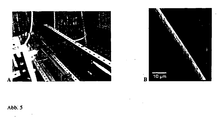
- FIG.3 The functionality of the presented method could be demonstrated by the construction of a prototype (Fig.3).
- the engine and transmission unit as well as the framework of the prototype were constructed from elements of a metal construction kit (Compakttechnik GmbH, Schriesheim, Germany).
- a 25 .mu.l Protein thread is wound up by a 4 cm diameter Teflon roller rotating at approx. 60 rpm.
- Figure 4 is an overview of the diffusion unit.
Landscapes
- Engineering & Computer Science (AREA)
- Textile Engineering (AREA)
- Chemical & Material Sciences (AREA)
- General Chemical & Material Sciences (AREA)
- Chemical Kinetics & Catalysis (AREA)
- Mechanical Engineering (AREA)
- Life Sciences & Earth Sciences (AREA)
- Health & Medical Sciences (AREA)
- Animal Husbandry (AREA)
- Molecular Biology (AREA)
- Wood Science & Technology (AREA)
- Zoology (AREA)
- Peptides Or Proteins (AREA)
- Artificial Filaments (AREA)
- Spinning Methods And Devices For Manufacturing Artificial Fibers (AREA)
- Materials For Medical Uses (AREA)
Claims (23)
- Procédé pour la préparation d'un fil à partir de protéines de soie, qui comprend les étapes suivantes:a) fourniture d'une solution de protéines de soie,b) transfert de la solution dans une unité de diffusion, qui présente une composition contenant des ions potassium et phosphate;c) passage de la solution à travers l'unité de diffusion, ce par quoi la solution vient en contact avec les ions potassium et phosphate qui diffusent à partir de l'unité de diffusion;d) séparation de la solution en une phase riche et une phase pauvre en protéines de soie;e) obtention du fil de soie à partir de la phase riche en protéines.
- Procédé selon la revendication 1, dans lequel la solution à filer contient au moins 1%-50%, de préférence 10-40%, tout particulièrement préférablement 10-20% (en poids/volume) de protéine de soie.
- Procédé selon la revendication 1 ou 2, dans lequel le pH de la solution vaut 4,0-12,0, de préférence 6,5-8,5, et particulièrement préférablement 8,0.
- Procédé selon l'une ou plusieurs des revendications précédentes, dans lequel la solution comporte des protéines de soie naturelles ou synthétiques.
- Procédé selon la revendication 4, dans lequel les protéines de soie sont obtenues à partir des espèces Bombyx mori, Araneus diadematus et/ou Nephila clavipes.
- Procédé selon l'une ou plusieurs des revendications précédentes, dans lequel la solution comporte un solvant polaire, qui est choisi de préférence parmi l'eau, les alcools et leurs mélanges.
- Procédé selon l'une ou plusieurs des revendications précédentes, dans lequel l'obtention du fil de soie comporte une mise en contact de la phase riche en protéines avec un gaz ou un liquide.
- Procédé selon la revendication 7, dans lequel le gaz est choisi parmi O2, des gaz inertes ou leurs mélanges.
- Procédé selon l'une ou plusieurs des revendications précédentes, dans lequel l'unité de diffusion est formée en un matériau en gel ou une céramique.
- Procédé selon la revendication 9, dans lequel le matériau en gel est choisi parmi les hydrogels, en particulier en polyacrylamide, dérivés de cellulose, poly(éther de méthyle et de vinyle) (PVME), polystyrène-polybutadiène (PS-PB), acrylate de stéaryle, polyéthylène (PE), polystyrène (PS), poly(alcool vinylique) (PVA), poly(acide acrylique), poly(pyrrolidone de N-vinyle) (PVP), poly(téréphtalate d'éthylène) (PET), poly(acrylamide d'isopropylène), poly(acide éthersulfonique), hydrogels de silicone.
- Dispositif (1) pour la mise en oeuvre du procédé selon l'une ou plusieurs des revendications précédentes, comportant:un premier appareillage (2) qui achemine une solution (3) de protéines de soie dans l'unité de diffusion (4);l'unité de diffusion (4), qui présente un canal (41) pour faire passer la solution (3), qui est entouré par une composition (42) contenant des ions potassium et phosphate, tandis que la solution (3) vient en contact avec les ions potassium et phosphate qui diffusent à partir de l'unité de diffusion (4), de telle sorte que l'unité de diffusion (4) à la sortie (43) de son canal (41) procure la solution (3) séparée entre une phase riche et une phase pauvre en protéines de soie (5) ; etun deuxième appareillage (6) qui génère le fil de soie (7) à partir de la phase riche en protéines (5) de la solution (3).
- Dispositif selon la revendication 11, dans lequel le premier dispositif (2) a la forme d'un pulvérisateur (22) couplé avec une pompe (21) pouvant être commandée.
- Dispositif selon la revendication 11, dans lequel le premier dispositif (2) a la forme d'un système de pompes pouvant être commandées, qui amène la solution (3) dans un processus en continu dans l'unité de diffusion (4).
- Dispositif selon l'une ou plusieurs des revendications 11 à 13, dans lequel l'unité de diffusion (4) présente à la sortie (43) de son canal (41) un rétrécissement ou une buse (44), au moyen duquel (de laquelle) l'évacuation de la solution (3) hors de l'unité de diffusion (4) peut être commandée.
- Dispositif selon l'une ou plusieurs des revendications 11 à 14, dans lequel le deuxième dispositif (6) est configuré comme un cylindre ou un rouleau actionné au moyen d'un dispositif d'actionnement, qui étire le fil de soie (7) à partir d'une goutte qui se forme à la sortie (43) de l'unité de diffusion (4) à partir de la phase riche en protéines (5) de la solution (3).
- Dispositif selon la revendication 15, dans lequel la cylindre ou le rouleau (6) étire le fil de soie filé (7) au moyen d'une force de traction nécessaire pour l'assemblage des protéines.
- Dispositif selon l'une ou plusieurs des revendications 11 à 16, dans lequel l'unité de diffusion (4) a la configuration d'une cartouche remplaçable.
- Dispositif selon l'une ou plusieurs des revendications 11 à 17, dans lequel le dispositif d'actionnement comporte un moteur et/ou une transmission.
- Dispositif selon l'une ou plusieurs des revendications 11 à 18, dans lequel le canal (41) de l'unité de diffusion (4) présente pour la traversée de la solution (3) un diamètre intérieur (d) essentiellement constant.
- Dispositif selon l'une ou plusieurs des revendications 11 à 19, dans lequel l'unité de diffusion (4) comporte un troisième dispositif au moyen duquel la phase pauvre en protéines peut être évacuée hors de l'unité de diffusion (4).
- Dispositif selon l'une ou plusieurs des revendications 11 à 20, dans lequel le troisième dispositif a la configuration d'une pompe à vide.
- Fil, qui peut être préparé par le procédé selon l'une ou plusieurs des revendications 1-10.
- Utilisation du fil selon la revendication 22 dans la technique et l'industrie pour des applications balistiques, comme le développement d'équipements pare-balles plus sûrs, pour la fabrication de parachutes, de câbles et de filets spéciaux, d'articles de sport, de textiles, de techniques médicales et pour des composants structuraux légers d'aéronefs.
Applications Claiming Priority (2)
| Application Number | Priority Date | Filing Date | Title |
|---|---|---|---|
| DE102005043609A DE102005043609A1 (de) | 2005-09-13 | 2005-09-13 | Verfahren und Vorrichtung zur Herstellung eines Fadens aus Seidenproteinen |
| PCT/EP2006/008924 WO2007031301A2 (fr) | 2005-09-13 | 2006-09-13 | Procede et dispositif pour produire un fil a partir de proteines de soie |
Publications (2)
| Publication Number | Publication Date |
|---|---|
| EP1924725A2 EP1924725A2 (fr) | 2008-05-28 |
| EP1924725B1 true EP1924725B1 (fr) | 2012-11-14 |
Family
ID=37775697
Family Applications (1)
| Application Number | Title | Priority Date | Filing Date |
|---|---|---|---|
| EP06792042A Active EP1924725B1 (fr) | 2005-09-13 | 2006-09-13 | Procede et dispositif pour produire un fil a partir de proteines de soie |
Country Status (8)
| Country | Link |
|---|---|
| US (2) | US7868146B2 (fr) |
| EP (1) | EP1924725B1 (fr) |
| JP (1) | JP4929283B2 (fr) |
| KR (1) | KR101255403B1 (fr) |
| CN (1) | CN101297068B (fr) |
| CA (1) | CA2622496C (fr) |
| DE (1) | DE102005043609A1 (fr) |
| WO (1) | WO2007031301A2 (fr) |
Families Citing this family (19)
| Publication number | Priority date | Publication date | Assignee | Title |
|---|---|---|---|---|
| WO2007141131A1 (fr) * | 2006-06-08 | 2007-12-13 | Technische Universitaet Muenchen | Dispositif microfluidique pour une agrégation contrôlée de soie d'araignée |
| CN101855239B (zh) * | 2007-06-20 | 2013-11-06 | 巴斯夫欧洲公司 | 合成的重复蛋白及其生产和用途 |
| GB2464348A (en) * | 2008-10-17 | 2010-04-21 | Spintec Engineering Gmbh | Applying a liquid protein onto a permeable surface, and silk mono-filament having specific properties |
| DE102009013861B4 (de) | 2009-03-18 | 2014-08-28 | TAKATA Aktiengesellschaft | Textiles Flächengebilde |
| EP2483199B1 (fr) | 2009-09-29 | 2017-04-26 | Trustees Of Tufts College | Nanosphères et microsphères de soie et leurs procédés de fabrication |
| FR2950816B1 (fr) * | 2009-10-01 | 2012-04-13 | Babolat Vs | Ame pour corde de raquette, corde pour raquette comprenant une telle ame et procede de fabrication correspondant |
| WO2011069643A2 (fr) | 2009-12-08 | 2011-06-16 | Amsilk Gmbh | Revêtements à base de protéine de soie |
| CN101899718B (zh) * | 2010-07-29 | 2012-11-07 | 福建锦江科技有限公司 | 一种下料方法及其装置 |
| GB201018269D0 (en) * | 2010-10-29 | 2010-12-15 | Oxford Biomaterials Ltd | A method for demineralizing wild silk cocoons to facilitate reeling |
| EP3046585B1 (fr) | 2013-09-17 | 2021-08-25 | Bolt Threads, Inc. | Procédés et compositions pour synthétiser des fibres de soie améliorées |
| US10532548B2 (en) | 2013-10-21 | 2020-01-14 | The North Face Apparel Corp. | Functional biomaterial coatings for textiles and other substrates |
| WO2015159440A1 (fr) * | 2014-04-14 | 2015-10-22 | スパイバー株式会社 | Matériel de sport |
| EA035551B1 (ru) | 2014-12-02 | 2020-07-06 | Силк Терапьютикс, Инк. | Изделие |
| AU2016294611B2 (en) | 2015-07-14 | 2022-08-11 | Evolved By Nature, Inc. | Silk performance apparel and products and methods of preparing the same |
| EP3181738A1 (fr) * | 2015-12-18 | 2017-06-21 | Universidad Politécnica De Madrid | Procédé de production de structures allongées telles que des fibres à partir de solutions polymères par filage d'écoulement d'égouttage |
| EP3512871A4 (fr) | 2016-09-14 | 2020-07-29 | Bolt Threads, Inc. | Fibres de protéines recombinantes uniformes longues |
| DE102016222480B4 (de) | 2016-11-16 | 2020-02-13 | Adidas Ag | Bekleidungsstück, das Spinnenseide aufweist oder Schuh, der Spinnenseide aufweist, und ein entsprechendes Herstellungsverfahren |
| WO2019067745A1 (fr) | 2017-09-27 | 2019-04-04 | Silk, Inc. | Tissus revêtus de soie, produits et procédés de préparation associés |
| CN112806664B (zh) * | 2021-01-26 | 2022-09-06 | 贵州怡家人生态科技有限公司 | 适用于纺织业的大蚕帽撕块设备 |
Family Cites Families (12)
| Publication number | Priority date | Publication date | Assignee | Title |
|---|---|---|---|---|
| US2450457A (en) * | 1945-11-09 | 1948-10-05 | Gen Tire & Rubber Co | Process and apparatus for coagulating a coagulable fluid |
| US4154856A (en) * | 1978-03-20 | 1979-05-15 | Standard Oil Company (Indiana) | Method for stretching a coagulable extrudate |
| CN1141422C (zh) * | 1998-06-22 | 2004-03-10 | 巴马格股份公司 | 用于纺合成长丝的纺丝装置 |
| GB9927950D0 (en) | 1999-11-27 | 2000-01-26 | Knight David P | Apparatus and method for forming materials |
| US20040086591A1 (en) * | 1999-11-27 | 2004-05-06 | Vollrath Friedrich W. L. | Multiple passage extrusion apparatus |
| WO2003060099A2 (fr) * | 2002-01-11 | 2003-07-24 | Nexia Biotechnologies, Inc. | Procedes et appareils de filage d'une proteine de soie d'araignee |
| GB0226576D0 (en) * | 2002-11-14 | 2002-12-18 | Spinox Ltd | Apparatus and method for forming materials |
| AU2003293982A1 (en) | 2002-12-23 | 2004-07-14 | Oxford Biomaterials Limited | Method and apparatus for forming objects |
| GB0306557D0 (en) * | 2003-03-21 | 2003-04-23 | Spinox Ltd | Apparatus and method for forming materials |
| CA2562415C (fr) * | 2003-04-10 | 2015-10-27 | Tufts University | Solution aqueuse concentree de fibroine |
| GB0319174D0 (en) | 2003-08-15 | 2003-09-17 | Spinox Ltd | Apparatus and method for the selective assembly of protein |
| EP1609801A1 (fr) * | 2004-06-25 | 2005-12-28 | Technische Universität München | Protéines d'origine naturelle et produits obtenus |
-
2005
- 2005-09-13 DE DE102005043609A patent/DE102005043609A1/de not_active Withdrawn
-
2006
- 2006-09-13 KR KR1020087007665A patent/KR101255403B1/ko not_active Expired - Fee Related
- 2006-09-13 WO PCT/EP2006/008924 patent/WO2007031301A2/fr not_active Ceased
- 2006-09-13 JP JP2008529567A patent/JP4929283B2/ja not_active Expired - Fee Related
- 2006-09-13 CA CA2622496A patent/CA2622496C/fr active Active
- 2006-09-13 EP EP06792042A patent/EP1924725B1/fr active Active
- 2006-09-13 CN CN2006800399246A patent/CN101297068B/zh active Active
- 2006-09-13 US US11/991,916 patent/US7868146B2/en active Active
-
2011
- 2011-01-07 US US12/986,662 patent/US20110201783A1/en not_active Abandoned
Also Published As
| Publication number | Publication date |
|---|---|
| US20090137781A1 (en) | 2009-05-28 |
| EP1924725A2 (fr) | 2008-05-28 |
| CA2622496A1 (fr) | 2007-03-22 |
| CN101297068B (zh) | 2012-09-05 |
| WO2007031301A2 (fr) | 2007-03-22 |
| US7868146B2 (en) | 2011-01-11 |
| WO2007031301A3 (fr) | 2007-07-19 |
| KR101255403B1 (ko) | 2013-04-17 |
| US20110201783A1 (en) | 2011-08-18 |
| JP2009508012A (ja) | 2009-02-26 |
| KR20080044890A (ko) | 2008-05-21 |
| CA2622496C (fr) | 2014-07-08 |
| DE102005043609A1 (de) | 2007-03-22 |
| CN101297068A (zh) | 2008-10-29 |
| JP4929283B2 (ja) | 2012-05-09 |
Similar Documents
| Publication | Publication Date | Title |
|---|---|---|
| EP1924725B1 (fr) | Procede et dispositif pour produire un fil a partir de proteines de soie | |
| EP0494852B1 (fr) | Procédé pour la fabrication d'objets cellulosiques | |
| DE60010128T2 (de) | Vorrichtung und verfahren zum spinnen von materialien | |
| DE69229232T2 (de) | Kollagenprodukte | |
| DE2606244C3 (fr) | ||
| DE69633675T2 (de) | Verfahren zum spinnen von hohlen polymerfasern | |
| WO2006089522A1 (fr) | Procede de fabrication de nanofibres et mesofibres par electrofilage de dispersions colloidales | |
| DE69223932T2 (de) | Kapselextrusionssysteme | |
| EP0848643B1 (fr) | Procede de production de membranes polymeres a fibres creuses | |
| DE3022313A1 (de) | Semipermeable mehrfach-hohlfaser, verfahren zu deren herstellung und dabei verwendbare spinnduese | |
| US7682539B1 (en) | Regeneration of silk and silk-like fibers from ionic liquid spin dopes | |
| EP2839060B1 (fr) | Procédé de réalisation de corps moulés | |
| EP0608744A1 (fr) | Filaments d'acétate de cellulose, solution de filage optiquement isotrope à cet effet et son utilisation pour la fabrication des filaments | |
| AT405531B (de) | Verfahren zur herstellung cellulosischer fasern | |
| WO2017137284A1 (fr) | Procédé pour produire des fibres polymères à partir de polymères dissouts dans des liquides ioniques au moyen d'un procédé de filage avec espace d'air | |
| DE1286684B (de) | Verfahren zur Herstellung von Faeden, Fasern oder Folien durch Nass- oder Trockenverspinnen einer Acrylnitrilpolymerisatmischung | |
| DE69803610T2 (de) | Hochorientierte Polymerfaser und Verfahren zu ihrer Herstellung | |
| DE102014209606B4 (de) | Fäden mit variierendem Fadendurchmesser sowie Herstellungsverfahren für solche Fäden | |
| DE10203093A1 (de) | Verfahren zur Herstellung nicht fibrillierender Cellulosefasern | |
| DE102006001773B3 (de) | Verfahren zur Herstellung von Formkörpern aus Proteinen | |
| WO2013011133A1 (fr) | Fibres de carbone ultrafines | |
| DE2219656A1 (de) | Mikrokapselförmige Körper mit fadenförmigem Aufbau | |
| AT155306B (de) | Verfahren zur Herstellung von Fäden oder Filmen aus Celluloseacetat. | |
| DD281821A5 (de) | Verfahren und vorrichtung zur herstellung eines fadens grosser elementarfadenzahl bei kord- oder stapelfasrspinnprozessen | |
| DD281823A5 (de) | Verfahren und vorrichtung zur herstellung eines fadens grosser elementarfadenzahl mit hoher orientierungsgleichmaessigkeit |
Legal Events
| Date | Code | Title | Description |
|---|---|---|---|
| PUAI | Public reference made under article 153(3) epc to a published international application that has entered the european phase |
Free format text: ORIGINAL CODE: 0009012 |
|
| 17P | Request for examination filed |
Effective date: 20080328 |
|
| AK | Designated contracting states |
Kind code of ref document: A2 Designated state(s): AT BE BG CH CY CZ DE DK EE ES FI FR GB GR HU IE IS IT LI LT LU LV MC NL PL PT RO SE SI SK TR |
|
| RIN1 | Information on inventor provided before grant (corrected) |
Inventor name: SCHEIBEL, THOMAS Inventor name: HUEMMERICH, DANIEL |
|
| 17Q | First examination report despatched |
Effective date: 20090821 |
|
| RAP1 | Party data changed (applicant data changed or rights of an application transferred) |
Owner name: AMSILK GMBH |
|
| GRAP | Despatch of communication of intention to grant a patent |
Free format text: ORIGINAL CODE: EPIDOSNIGR1 |
|
| DAX | Request for extension of the european patent (deleted) | ||
| GRAS | Grant fee paid |
Free format text: ORIGINAL CODE: EPIDOSNIGR3 |
|
| GRAA | (expected) grant |
Free format text: ORIGINAL CODE: 0009210 |
|
| AK | Designated contracting states |
Kind code of ref document: B1 Designated state(s): AT BE BG CH CY CZ DE DK EE ES FI FR GB GR HU IE IS IT LI LT LU LV MC NL PL PT RO SE SI SK TR |
|
| REG | Reference to a national code |
Ref country code: GB Ref legal event code: FG4D Free format text: NOT ENGLISH |
|
| REG | Reference to a national code |
Ref country code: CH Ref legal event code: EP Ref country code: AT Ref legal event code: REF Ref document number: 584075 Country of ref document: AT Kind code of ref document: T Effective date: 20121115 |
|
| REG | Reference to a national code |
Ref country code: IE Ref legal event code: FG4D Free format text: LANGUAGE OF EP DOCUMENT: GERMAN |
|
| REG | Reference to a national code |
Ref country code: DE Ref legal event code: R096 Ref document number: 502006012219 Country of ref document: DE Effective date: 20130103 |
|
| REG | Reference to a national code |
Ref country code: NL Ref legal event code: VDEP Effective date: 20121114 |
|
| REG | Reference to a national code |
Ref country code: LT Ref legal event code: MG4D |
|
| PG25 | Lapsed in a contracting state [announced via postgrant information from national office to epo] |
Ref country code: ES Free format text: LAPSE BECAUSE OF FAILURE TO SUBMIT A TRANSLATION OF THE DESCRIPTION OR TO PAY THE FEE WITHIN THE PRESCRIBED TIME-LIMIT Effective date: 20130225 Ref country code: FI Free format text: LAPSE BECAUSE OF FAILURE TO SUBMIT A TRANSLATION OF THE DESCRIPTION OR TO PAY THE FEE WITHIN THE PRESCRIBED TIME-LIMIT Effective date: 20121114 Ref country code: SE Free format text: LAPSE BECAUSE OF FAILURE TO SUBMIT A TRANSLATION OF THE DESCRIPTION OR TO PAY THE FEE WITHIN THE PRESCRIBED TIME-LIMIT Effective date: 20121114 Ref country code: LT Free format text: LAPSE BECAUSE OF FAILURE TO SUBMIT A TRANSLATION OF THE DESCRIPTION OR TO PAY THE FEE WITHIN THE PRESCRIBED TIME-LIMIT Effective date: 20121114 |
|
| PG25 | Lapsed in a contracting state [announced via postgrant information from national office to epo] |
Ref country code: SI Free format text: LAPSE BECAUSE OF FAILURE TO SUBMIT A TRANSLATION OF THE DESCRIPTION OR TO PAY THE FEE WITHIN THE PRESCRIBED TIME-LIMIT Effective date: 20121114 Ref country code: GR Free format text: LAPSE BECAUSE OF FAILURE TO SUBMIT A TRANSLATION OF THE DESCRIPTION OR TO PAY THE FEE WITHIN THE PRESCRIBED TIME-LIMIT Effective date: 20130215 Ref country code: CY Free format text: LAPSE BECAUSE OF FAILURE TO SUBMIT A TRANSLATION OF THE DESCRIPTION OR TO PAY THE FEE WITHIN THE PRESCRIBED TIME-LIMIT Effective date: 20121114 Ref country code: PT Free format text: LAPSE BECAUSE OF FAILURE TO SUBMIT A TRANSLATION OF THE DESCRIPTION OR TO PAY THE FEE WITHIN THE PRESCRIBED TIME-LIMIT Effective date: 20130314 Ref country code: LV Free format text: LAPSE BECAUSE OF FAILURE TO SUBMIT A TRANSLATION OF THE DESCRIPTION OR TO PAY THE FEE WITHIN THE PRESCRIBED TIME-LIMIT Effective date: 20121114 Ref country code: PL Free format text: LAPSE BECAUSE OF FAILURE TO SUBMIT A TRANSLATION OF THE DESCRIPTION OR TO PAY THE FEE WITHIN THE PRESCRIBED TIME-LIMIT Effective date: 20121114 |
|
| PG25 | Lapsed in a contracting state [announced via postgrant information from national office to epo] |
Ref country code: EE Free format text: LAPSE BECAUSE OF FAILURE TO SUBMIT A TRANSLATION OF THE DESCRIPTION OR TO PAY THE FEE WITHIN THE PRESCRIBED TIME-LIMIT Effective date: 20121114 Ref country code: BG Free format text: LAPSE BECAUSE OF FAILURE TO SUBMIT A TRANSLATION OF THE DESCRIPTION OR TO PAY THE FEE WITHIN THE PRESCRIBED TIME-LIMIT Effective date: 20130214 Ref country code: CZ Free format text: LAPSE BECAUSE OF FAILURE TO SUBMIT A TRANSLATION OF THE DESCRIPTION OR TO PAY THE FEE WITHIN THE PRESCRIBED TIME-LIMIT Effective date: 20121114 Ref country code: SK Free format text: LAPSE BECAUSE OF FAILURE TO SUBMIT A TRANSLATION OF THE DESCRIPTION OR TO PAY THE FEE WITHIN THE PRESCRIBED TIME-LIMIT Effective date: 20121114 Ref country code: DK Free format text: LAPSE BECAUSE OF FAILURE TO SUBMIT A TRANSLATION OF THE DESCRIPTION OR TO PAY THE FEE WITHIN THE PRESCRIBED TIME-LIMIT Effective date: 20121114 |
|
| PG25 | Lapsed in a contracting state [announced via postgrant information from national office to epo] |
Ref country code: NL Free format text: LAPSE BECAUSE OF FAILURE TO SUBMIT A TRANSLATION OF THE DESCRIPTION OR TO PAY THE FEE WITHIN THE PRESCRIBED TIME-LIMIT Effective date: 20121114 Ref country code: RO Free format text: LAPSE BECAUSE OF FAILURE TO SUBMIT A TRANSLATION OF THE DESCRIPTION OR TO PAY THE FEE WITHIN THE PRESCRIBED TIME-LIMIT Effective date: 20121114 Ref country code: IT Free format text: LAPSE BECAUSE OF FAILURE TO SUBMIT A TRANSLATION OF THE DESCRIPTION OR TO PAY THE FEE WITHIN THE PRESCRIBED TIME-LIMIT Effective date: 20121114 |
|
| PLBE | No opposition filed within time limit |
Free format text: ORIGINAL CODE: 0009261 |
|
| STAA | Information on the status of an ep patent application or granted ep patent |
Free format text: STATUS: NO OPPOSITION FILED WITHIN TIME LIMIT |
|
| 26N | No opposition filed |
Effective date: 20130815 |
|
| REG | Reference to a national code |
Ref country code: DE Ref legal event code: R097 Ref document number: 502006012219 Country of ref document: DE Effective date: 20130815 |
|
| BERE | Be: lapsed |
Owner name: AMSILK G.M.B.H. Effective date: 20130930 |
|
| PG25 | Lapsed in a contracting state [announced via postgrant information from national office to epo] |
Ref country code: MC Free format text: LAPSE BECAUSE OF FAILURE TO SUBMIT A TRANSLATION OF THE DESCRIPTION OR TO PAY THE FEE WITHIN THE PRESCRIBED TIME-LIMIT Effective date: 20121114 |
|
| REG | Reference to a national code |
Ref country code: CH Ref legal event code: PL |
|
| REG | Reference to a national code |
Ref country code: IE Ref legal event code: MM4A |
|
| PG25 | Lapsed in a contracting state [announced via postgrant information from national office to epo] |
Ref country code: LI Free format text: LAPSE BECAUSE OF NON-PAYMENT OF DUE FEES Effective date: 20130930 Ref country code: CH Free format text: LAPSE BECAUSE OF NON-PAYMENT OF DUE FEES Effective date: 20130930 Ref country code: BE Free format text: LAPSE BECAUSE OF NON-PAYMENT OF DUE FEES Effective date: 20130930 Ref country code: IE Free format text: LAPSE BECAUSE OF NON-PAYMENT OF DUE FEES Effective date: 20130913 |
|
| REG | Reference to a national code |
Ref country code: AT Ref legal event code: MM01 Ref document number: 584075 Country of ref document: AT Kind code of ref document: T Effective date: 20130913 |
|
| PG25 | Lapsed in a contracting state [announced via postgrant information from national office to epo] |
Ref country code: AT Free format text: LAPSE BECAUSE OF NON-PAYMENT OF DUE FEES Effective date: 20130913 |
|
| PG25 | Lapsed in a contracting state [announced via postgrant information from national office to epo] |
Ref country code: TR Free format text: LAPSE BECAUSE OF FAILURE TO SUBMIT A TRANSLATION OF THE DESCRIPTION OR TO PAY THE FEE WITHIN THE PRESCRIBED TIME-LIMIT Effective date: 20121114 |
|
| PG25 | Lapsed in a contracting state [announced via postgrant information from national office to epo] |
Ref country code: HU Free format text: LAPSE BECAUSE OF FAILURE TO SUBMIT A TRANSLATION OF THE DESCRIPTION OR TO PAY THE FEE WITHIN THE PRESCRIBED TIME-LIMIT; INVALID AB INITIO Effective date: 20060913 Ref country code: LU Free format text: LAPSE BECAUSE OF NON-PAYMENT OF DUE FEES Effective date: 20130913 |
|
| REG | Reference to a national code |
Ref country code: FR Ref legal event code: PLFP Year of fee payment: 10 |
|
| PG25 | Lapsed in a contracting state [announced via postgrant information from national office to epo] |
Ref country code: IS Free format text: LAPSE BECAUSE OF FAILURE TO SUBMIT A TRANSLATION OF THE DESCRIPTION OR TO PAY THE FEE WITHIN THE PRESCRIBED TIME-LIMIT Effective date: 20121114 |
|
| REG | Reference to a national code |
Ref country code: FR Ref legal event code: PLFP Year of fee payment: 11 |
|
| REG | Reference to a national code |
Ref country code: FR Ref legal event code: PLFP Year of fee payment: 12 |
|
| REG | Reference to a national code |
Ref country code: FR Ref legal event code: PLFP Year of fee payment: 13 |
|
| REG | Reference to a national code |
Ref country code: DE Ref legal event code: R082 Ref document number: 502006012219 Country of ref document: DE Representative=s name: ZWICKER SCHNAPPAUF & PARTNER PATENTANWAELTE PA, DE |
|
| PGFP | Annual fee paid to national office [announced via postgrant information from national office to epo] |
Ref country code: DE Payment date: 20240919 Year of fee payment: 19 |
|
| PGFP | Annual fee paid to national office [announced via postgrant information from national office to epo] |
Ref country code: GB Payment date: 20240923 Year of fee payment: 19 |
|
| PGFP | Annual fee paid to national office [announced via postgrant information from national office to epo] |
Ref country code: FR Payment date: 20240924 Year of fee payment: 19 |