EP1927098B1 - Dispositif illumine a del blanche et feuille de diffusion - Google Patents
Dispositif illumine a del blanche et feuille de diffusion Download PDFInfo
- Publication number
- EP1927098B1 EP1927098B1 EP06742563.7A EP06742563A EP1927098B1 EP 1927098 B1 EP1927098 B1 EP 1927098B1 EP 06742563 A EP06742563 A EP 06742563A EP 1927098 B1 EP1927098 B1 EP 1927098B1
- Authority
- EP
- European Patent Office
- Prior art keywords
- particles
- luminous device
- hydroxyphenyl
- bis
- transparent plastic
- Prior art date
- Legal status (The legal status is an assumption and is not a legal conclusion. Google has not performed a legal analysis and makes no representation as to the accuracy of the status listed.)
- Expired - Lifetime
Links
Images


Classifications
-
- C—CHEMISTRY; METALLURGY
- C08—ORGANIC MACROMOLECULAR COMPOUNDS; THEIR PREPARATION OR CHEMICAL WORKING-UP; COMPOSITIONS BASED THEREON
- C08F—MACROMOLECULAR COMPOUNDS OBTAINED BY REACTIONS ONLY INVOLVING CARBON-TO-CARBON UNSATURATED BONDS
- C08F265/00—Macromolecular compounds obtained by polymerising monomers on to polymers of unsaturated monocarboxylic acids or derivatives thereof as defined in group C08F20/00
- C08F265/04—Macromolecular compounds obtained by polymerising monomers on to polymers of unsaturated monocarboxylic acids or derivatives thereof as defined in group C08F20/00 on to polymers of esters
- C08F265/06—Polymerisation of acrylate or methacrylate esters on to polymers thereof
-
- B—PERFORMING OPERATIONS; TRANSPORTING
- B60—VEHICLES IN GENERAL
- B60R—VEHICLES, VEHICLE FITTINGS, OR VEHICLE PARTS, NOT OTHERWISE PROVIDED FOR
- B60R13/00—Elements for body-finishing, identifying, or decorating; Arrangements or adaptations for advertising purposes
-
- B—PERFORMING OPERATIONS; TRANSPORTING
- B60—VEHICLES IN GENERAL
- B60R—VEHICLES, VEHICLE FITTINGS, OR VEHICLE PARTS, NOT OTHERWISE PROVIDED FOR
- B60R13/00—Elements for body-finishing, identifying, or decorating; Arrangements or adaptations for advertising purposes
- B60R13/005—Manufacturers' emblems, name plates, bonnet ornaments, mascots or the like; Mounting means therefor
-
- C—CHEMISTRY; METALLURGY
- C08—ORGANIC MACROMOLECULAR COMPOUNDS; THEIR PREPARATION OR CHEMICAL WORKING-UP; COMPOSITIONS BASED THEREON
- C08F—MACROMOLECULAR COMPOUNDS OBTAINED BY REACTIONS ONLY INVOLVING CARBON-TO-CARBON UNSATURATED BONDS
- C08F279/00—Macromolecular compounds obtained by polymerising monomers on to polymers of monomers having two or more carbon-to-carbon double bonds as defined in group C08F36/00
- C08F279/02—Macromolecular compounds obtained by polymerising monomers on to polymers of monomers having two or more carbon-to-carbon double bonds as defined in group C08F36/00 on to polymers of conjugated dienes
-
- C—CHEMISTRY; METALLURGY
- C08—ORGANIC MACROMOLECULAR COMPOUNDS; THEIR PREPARATION OR CHEMICAL WORKING-UP; COMPOSITIONS BASED THEREON
- C08F—MACROMOLECULAR COMPOUNDS OBTAINED BY REACTIONS ONLY INVOLVING CARBON-TO-CARBON UNSATURATED BONDS
- C08F279/00—Macromolecular compounds obtained by polymerising monomers on to polymers of monomers having two or more carbon-to-carbon double bonds as defined in group C08F36/00
- C08F279/02—Macromolecular compounds obtained by polymerising monomers on to polymers of monomers having two or more carbon-to-carbon double bonds as defined in group C08F36/00 on to polymers of conjugated dienes
- C08F279/04—Vinyl aromatic monomers and nitriles as the only monomers
-
- C—CHEMISTRY; METALLURGY
- C08—ORGANIC MACROMOLECULAR COMPOUNDS; THEIR PREPARATION OR CHEMICAL WORKING-UP; COMPOSITIONS BASED THEREON
- C08L—COMPOSITIONS OF MACROMOLECULAR COMPOUNDS
- C08L33/00—Compositions of homopolymers or copolymers of compounds having one or more unsaturated aliphatic radicals, each having only one carbon-to-carbon double bond, and only one being terminated by only one carboxyl radical, or of salts, anhydrides, esters, amides, imides or nitriles thereof; Compositions of derivatives of such polymers
- C08L33/04—Homopolymers or copolymers of esters
-
- C—CHEMISTRY; METALLURGY
- C08—ORGANIC MACROMOLECULAR COMPOUNDS; THEIR PREPARATION OR CHEMICAL WORKING-UP; COMPOSITIONS BASED THEREON
- C08L—COMPOSITIONS OF MACROMOLECULAR COMPOUNDS
- C08L51/00—Compositions of graft polymers in which the grafted component is obtained by reactions only involving carbon-to-carbon unsaturated bonds; Compositions of derivatives of such polymers
- C08L51/003—Compositions of graft polymers in which the grafted component is obtained by reactions only involving carbon-to-carbon unsaturated bonds; Compositions of derivatives of such polymers grafted on to macromolecular compounds obtained by reactions only involving unsaturated carbon-to-carbon bonds
-
- C—CHEMISTRY; METALLURGY
- C08—ORGANIC MACROMOLECULAR COMPOUNDS; THEIR PREPARATION OR CHEMICAL WORKING-UP; COMPOSITIONS BASED THEREON
- C08L—COMPOSITIONS OF MACROMOLECULAR COMPOUNDS
- C08L51/00—Compositions of graft polymers in which the grafted component is obtained by reactions only involving carbon-to-carbon unsaturated bonds; Compositions of derivatives of such polymers
- C08L51/04—Compositions of graft polymers in which the grafted component is obtained by reactions only involving carbon-to-carbon unsaturated bonds; Compositions of derivatives of such polymers grafted on to rubbers
-
- C—CHEMISTRY; METALLURGY
- C08—ORGANIC MACROMOLECULAR COMPOUNDS; THEIR PREPARATION OR CHEMICAL WORKING-UP; COMPOSITIONS BASED THEREON
- C08L—COMPOSITIONS OF MACROMOLECULAR COMPOUNDS
- C08L55/00—Compositions of homopolymers or copolymers, obtained by polymerisation reactions only involving carbon-to-carbon unsaturated bonds, not provided for in groups C08L23/00 - C08L53/00
- C08L55/02—ABS [Acrylonitrile-Butadiene-Styrene] polymers
-
- G—PHYSICS
- G02—OPTICS
- G02B—OPTICAL ELEMENTS, SYSTEMS OR APPARATUS
- G02B1/00—Optical elements characterised by the material of which they are made; Optical coatings for optical elements
- G02B1/04—Optical elements characterised by the material of which they are made; Optical coatings for optical elements made of organic materials, e.g. plastics
-
- G—PHYSICS
- G02—OPTICS
- G02B—OPTICAL ELEMENTS, SYSTEMS OR APPARATUS
- G02B5/00—Optical elements other than lenses
- G02B5/02—Diffusing elements; Afocal elements
- G02B5/0205—Diffusing elements; Afocal elements characterised by the diffusing properties
- G02B5/0236—Diffusing elements; Afocal elements characterised by the diffusing properties the diffusion taking place within the volume of the element
- G02B5/0242—Diffusing elements; Afocal elements characterised by the diffusing properties the diffusion taking place within the volume of the element by means of dispersed particles
-
- G—PHYSICS
- G02—OPTICS
- G02B—OPTICAL ELEMENTS, SYSTEMS OR APPARATUS
- G02B5/00—Optical elements other than lenses
- G02B5/02—Diffusing elements; Afocal elements
- G02B5/0273—Diffusing elements; Afocal elements characterized by the use
- G02B5/0278—Diffusing elements; Afocal elements characterized by the use used in transmission
-
- G—PHYSICS
- G09—EDUCATION; CRYPTOGRAPHY; DISPLAY; ADVERTISING; SEALS
- G09F—DISPLAYING; ADVERTISING; SIGNS; LABELS OR NAME-PLATES; SEALS
- G09F13/00—Illuminated signs; Luminous advertising
- G09F13/04—Signs, boards or panels, illuminated from behind the insignia
-
- C—CHEMISTRY; METALLURGY
- C08—ORGANIC MACROMOLECULAR COMPOUNDS; THEIR PREPARATION OR CHEMICAL WORKING-UP; COMPOSITIONS BASED THEREON
- C08L—COMPOSITIONS OF MACROMOLECULAR COMPOUNDS
- C08L2205/00—Polymer mixtures characterised by other features
- C08L2205/02—Polymer mixtures characterised by other features containing two or more polymers of the same C08L -group
-
- C—CHEMISTRY; METALLURGY
- C08—ORGANIC MACROMOLECULAR COMPOUNDS; THEIR PREPARATION OR CHEMICAL WORKING-UP; COMPOSITIONS BASED THEREON
- C08L—COMPOSITIONS OF MACROMOLECULAR COMPOUNDS
- C08L2205/00—Polymer mixtures characterised by other features
- C08L2205/14—Polymer mixtures characterised by other features containing polymeric additives characterised by shape
- C08L2205/18—Spheres
-
- C—CHEMISTRY; METALLURGY
- C08—ORGANIC MACROMOLECULAR COMPOUNDS; THEIR PREPARATION OR CHEMICAL WORKING-UP; COMPOSITIONS BASED THEREON
- C08L—COMPOSITIONS OF MACROMOLECULAR COMPOUNDS
- C08L2205/00—Polymer mixtures characterised by other features
- C08L2205/22—Mixtures comprising a continuous polymer matrix in which are dispersed crosslinked particles of another polymer
-
- F—MECHANICAL ENGINEERING; LIGHTING; HEATING; WEAPONS; BLASTING
- F21—LIGHTING
- F21V—FUNCTIONAL FEATURES OR DETAILS OF LIGHTING DEVICES OR SYSTEMS THEREOF; STRUCTURAL COMBINATIONS OF LIGHTING DEVICES WITH OTHER ARTICLES, NOT OTHERWISE PROVIDED FOR
- F21V3/00—Globes; Bowls; Cover glasses
- F21V3/04—Globes; Bowls; Cover glasses characterised by materials, surface treatments or coatings
-
- F—MECHANICAL ENGINEERING; LIGHTING; HEATING; WEAPONS; BLASTING
- F21—LIGHTING
- F21Y—INDEXING SCHEME ASSOCIATED WITH SUBCLASSES F21K, F21L, F21S and F21V, RELATING TO THE FORM OR THE KIND OF THE LIGHT SOURCES OR OF THE COLOUR OF THE LIGHT EMITTED
- F21Y2115/00—Light-generating elements of semiconductor light sources
- F21Y2115/10—Light-emitting diodes [LED]
-
- H—ELECTRICITY
- H10—SEMICONDUCTOR DEVICES; ELECTRIC SOLID-STATE DEVICES NOT OTHERWISE PROVIDED FOR
- H10W—GENERIC PACKAGES, INTERCONNECTIONS, CONNECTORS OR OTHER CONSTRUCTIONAL DETAILS OF DEVICES COVERED BY CLASS H10
- H10W74/00—Encapsulations, e.g. protective coatings
-
- H—ELECTRICITY
- H10—SEMICONDUCTOR DEVICES; ELECTRIC SOLID-STATE DEVICES NOT OTHERWISE PROVIDED FOR
- H10W—GENERIC PACKAGES, INTERCONNECTIONS, CONNECTORS OR OTHER CONSTRUCTIONAL DETAILS OF DEVICES COVERED BY CLASS H10
- H10W90/00—Package configurations
- H10W90/701—Package configurations characterised by the relative positions of pads or connectors relative to package parts
- H10W90/751—Package configurations characterised by the relative positions of pads or connectors relative to package parts of bond wires
- H10W90/756—Package configurations characterised by the relative positions of pads or connectors relative to package parts of bond wires between a chip and a stacked lead frame, conducting package substrate or heat sink
Definitions
- the present invention relates to a luminous device, in particular an illuminated sign, comprising at least one white light-emitting diode and at least one cover made of a transparent plastic in which particles that scatter the light emitted by the light-emitting diode are dispersed.
- Light-emitting diodes or LEDs are increasingly used in everyday life. They allow conventional artificial light sources, such as incandescent lamps and neon tubes, to be effectively replaced as they consume less electrical power and can operate at low voltages (12 V for example). Furthermore, they are more compact and have very long lifetimes, which may range up to 100 000 hours of operation. Although the discovery of red LEDs goes back to the 1960s, many years had to elapse before the appearance of LEDs having sufficient illumination and before the development of LEDs of different colours. At the present time, there are LEDs that emit in the red, the green or the blue, white LEDs, and LEDs that emit in the ultraviolet or infrared spectrum. Extensive research has also allowed the light power emitted by LEDs to be significantly increased. LEDs having a light flux in excess of 3-5 lumens (Lm) have already been marketed and certain recent developments suggest that this may reach 100 lumens.
- Lm 3-5 lumens
- Light devices that integrate one more LEDs are, for example, motor vehicle illumination devices (at the front or rear), indicating panels, luminous displays, spotlights, street lighting, illuminated signs, etc.
- an illuminated sign With regard to an illuminated sign, its role is to capture the attention of customers, users, consumers, passers-by, etc., and therefore it is to be as visible as possible, both during the day and at night. It is therefore necessary for the elements that the sign contains (these may be letters, numbers, symbols, figures, etc.) to be visible in the daytime but also at night, or in half-darkness, when the sign is illuminated. It is therefore necessary for the sign to have a high contrast both in the daytime and at night.
- An illuminated sign consists of a light source and a cover made of a plastic whose function is to mask and protect the light source, while still ensuring good transmission of the light emitted by the light source.
- the cover also has the function of scattering the emitted light so that the illumination is softened and not dazzling.
- the scattering of the light emitted by the light source is achieved by dispersing scattering particles of organic or mineral nature in the plastic.
- the plastic of the cover may be coloured or may have decorative elements or patterns.
- the cover also often takes the form of a letter or any other sign.
- a luminous device comprising at least one LED having a luminous flux of greater than 3 Lm and a cover made of a transparent plastic in which scattering particles with a content of 0.3 to 5% are dispersed, and having, when the LED is off, a luminosity L of less than 40, preferably less than 35, and when the LED is lit, a luminosity L of greater than 55, an a* value of between -7.5 and +7.5 and a b* value of between -7.5 and +7.5.
- US 6 723 772 discloses a scattering composition
- a scattering composition comprising a transparent plastic, based on methyl methacrylate or styrene, and organic or mineral scattering particles.
- the particle content is between 0.1 and 20% by weight, or expressed differently between 1 and 500 g/m 2 .
- US 2004/0191550 discloses a sheet comprising a layer (A) composed of a resin based on methyl methacrylate and one or two layers (B) composed of a blend of a resin based on methyl methacrylate and a resin based on vinylidene fluoride.
- the sheet may contain organic or mineral scattering particles in the layer (A) and be illuminated by a neon lamp or by an LED.
- US 2004/0255497 discloses an illuminated sign in which the letters of the sign are made of a transparent plastic that scatters light. It does not matter what the light source is - LED, neon tube, incandescent lamp, etc.
- EP 1 369 224 discloses a coextruded sheet comprising at least two layers - a layer of a thermoplastic filled with organic scattering particles and a layer of a transparent thermoplastic.
- the sheet may be illuminated by an LED.
- the process for manufacturing the cover that is illuminated by the LED is simpler as the cover is not manufactured by coextrusion but by simple extrusion or else by the casting process in the case of PMMA.
- the cover according to the invention therefore has only a single layer.
- WO 03/052315 discloses a luminous device that combines a cover made of a transparent plastic and a colour LED.
- the transparent plastic contains 1.5 to 2.5% by weight of BaSO 4 or polystyrene particles. In the case of crosslinked plastic particles, the content varies from 0.1 to 10% by weight.
- White LEDs are not described.
- the object of the invention is to ensure that an illuminated sign has the same colour when it is off and when it is lit.
- DE 100 58 348 discloses a lamp body with inner light source and at least a semitransparent cover that id mattified. Not disclosed is a luminous device having a cover made of a transparent plastic that consist of only one layer and that comprises scattering particles.
- US 6 084 250 discloses a with light emmiting diode.
- the white light emitting diode or device may comprises a transparent coating with phosphors.
- a luminous device having a cover made of a transparent plastic that consist of only one layer and that comprises scattering particles.
- DE 103 08 704 discloses a car headlight comprising a (transparent) optical scattering lens (16) after a (transparent) optical focusing lens.
- the scattering lens is an optical lens the scatters the light in a certain cone in direction of the street. The scattering is obtained by means of optical lenses.
- a luminous device having a cover made of a transparent plastic that consist of only one layer and that comprises scattering particles
- a luminous device comprising a white LED of high luminosity, greater than 3 Lm, and a cover made of a transparent plastic in which scattering particles with a content of 0.3 to 5% are dispersed and having, when the LED is off, a luminosity L of less than 40, preferably less than 35, and when the LED is lit, a luminosity L of greater than 55, an a* value of between -7.5 and +7.5 and a b* value of between -7.5 and +7.5.
- the invention relates to a luminous device according to claim 1.
- the invention relates to a luminous device, in particular an illuminated sign, comprising at least one white LED having a luminous flux of greater than 3 Lm, advantageously greater than 5 Lm, preferably greater than 10 Lm and even more preferably greater than 50 Lm, and a cover made of a transparent plastic in which scattering particles with a content of 0.3 to 5%, preferably 0.3 to 4%, are dispersed and having, when the LED is off, a luminosity L of less than 40, preferably less than 35, and when the LED is lit, a luminosity L of greater than 55, an a* value of between -5 and +5 and a b* value of between -5 and +5.
- transparent plastic denotes a plastic of thermoplastic or thermosetting type, having a light transmission in the visible range of at least 50%, preferably at least 70% and even more preferably at least 80% according to the DIN 67-507 standard (this is the light transmission of the transparent plastic with no scattering particle; when the scattering particles are dispersed in the transparent plastic, the transparency decreases).
- the transparent plastic is chosen from crystal polystyrene, polyethylene terephthalate (PET), a transparent, especially clarified, polyolefin, for example clarified polypropylene, PMMA, a transparent polyamide or polycarbonate.
- PMMA and polycarbonate are the two transparent plastics of choice because they are easy to process, are commercially available and have a high transparency.
- these two plastics exhibit excellent thermomechanical strength, allowing compact luminous devices to be produced. This is because, although the energy efficiency of an LED (that is to say the efficiency of converting electrical energy into light energy) is much better than for an incandescent lamp, some of the energy is nevertheless converted into heat. In the case of compact luminous devices, this heat builds up and rapidly raises the temperature inside the device.
- PMMA denotes a methyl methacrylate (MMA) homopolymer or a copolymer comprising from 80 to 99.5% by weight of methyl methacrylate and from 0.5 to 20% by weight of at least one monomer having at least one ethylenic unsaturation that can copolymerize with methyl methacrylate.
- MMA methyl methacrylate
- monomers are well known and mention may be made, in particular, of styrene, alpha-methylstyrene, acrylic and methacrylic acids and alkyl-(meth)acrylates in which the alkyl group has from 2 to 4 carbon atoms.
- this is a methyl methacrylate homopolymer or a copolymer comprising, by weight, 90 to 99.7%, preferably 90 to 99.5%, of methyl methacrylate and 0.3 to 10%, preferably 0.5 to 10%, of at least one monomer having at least one ethylenic unsaturation that can be copolymerized with methyl methacrylate.
- the comonomer is methyl acrylate or ethyl acrylate.
- PMMA is a transparent plastic appreciated in particular because it possesses excellent ageing resistance, especially resistance to ultraviolet radiation, and good scratch resistance.
- the PMMA may contain an impact modifier, which improves the impact resistance thereof.
- the impact modifier is in the form of fine particles having an elastomer core and at least one thermoplastic shell, the size of the particles being in general less than 1 ⁇ m and advantageously between 50 and 300 nm.
- the impact modifier is prepared by emulsion polymerization.
- the impact modifier content in the PMMA is between 0 and 20%, preferably between 0 and 10%, by weight.
- the core may for example consist of:
- the core may also consist of:
- the core may be completely or partly crosslinked. It is sufficient to add at least difunctional monomers during the preparation of the core. These monomers may be chosen from poly(meth)-acrylic esters of polyols, such as butylene di(meth)-acrylate and trimethylolpropane trimethacrylate. Other difunctional monomers may for example be divinylbenzene, trivinylbenzene, vinyl acrylate and vinyl methacrylate.
- the core may also be crosslinked by introducing into it, by grafting or as comonomer during the polymerization, unsaturated functional monomers such as unsaturated carboxylic acid anhydrides, unsaturated carboxylic acids and unsaturated epoxides. As examples, mention may be made of maleic anhydride, (meth)acrylic acid and glycidyl methacrylate.
- the shell or shells are styrene, alkyl styrene or methyl methacrylate homopolymers or copolymers containing at least 70 mol% of one of these monomers mentioned above and at least one comonomer chosen from the other monomers mentioned above, another alkyl-(meth)acrylate, vinyl acetate and acrylonitrile.
- the shell may be functionalized by introducing thereinto, by grafting or as comonomer during polymerization, unsaturated functional monomers such as unsaturated carboxylic acid anhydrides, unsaturated carboxylic acids and unsaturated epoxides.
- unsaturated functional monomers such as unsaturated carboxylic acid anhydrides, unsaturated carboxylic acids and unsaturated epoxides.
- impact modifiers mention may be made of core-shell copolymers having a polystyrene shell and core-shell copolymers having a PMMA shell. There are also core-shell copolymers having two shells, one made of polystyrene and the other on the outside made of PMMA. Examples of impact modifiers and their method of preparation are described in the following patents: US 4 180 494 , US 3 808 180 , US 4 096 202 , US 4 260 693 , US 3 287 443 , US 3 657 391 , US 4 299 928 , US 3 985 704 and US 5 773 520 .
- the core represents 70 to 90% and the shell 30 to 10% by weight of the impact modifier.
- the impact modifier may be of the soft/hard type.
- an impact modifier of the soft/hard type mention may be made of that consisting:
- a soft/hard type impact modifier mention may be made of that having a poly(butyl acrylate) or butyl acrylate/butadiene copolymer core and a PMMA shell.
- the impact modifier may also be of the hard/soft/hard type, that is to say it contains, in this order, a hard core, a soft shell and a hard shell.
- the hard parts may consist of the polymers of the shell of the above soft/hard copolymers and the soft part may consist of the polymers of the core of the above soft/hard copolymers.
- the impact modifier may also be of the hard (core)/soft/semi-hard type.
- the "semi-hard” outer shell consists of two shells, one being the intermediate shell and the other the outer shell.
- the intermediate shell is a copolymer of methyl methacrylate, styrene and at least one monomer chosen from alkyl acrylates, butadiene and isoprene.
- the outer shell is a PMMA homopolymer or copolymer.
- hard/soft/semi-hard impact modifier is that consisting, in this order:
- the PMMA may also contain at least one anti-UV additive that increases the lifetime of the PMMA.
- the PMMA may contain other additives that are well known to those skilled in the art. These may for example be an antistatic agent, a flame retarder, an antioxidant, etc.
- It may be a homopolycarbonate or copolycarbonate based on a diphenol of formula HO-Z-OH for which Z denotes a divalent organic radical possessing from 6 to 30 carbon atoms and containing one or more aromatic group (s).
- the diphenol can be:
- the preferred polycarbonates are the homopolycarbonates based on bisphenol A or 1,1-bis(4-hydroxyphenyl)-3,3,5-trimethylcyclohexane and the copolycarbonates based on bisphenol A and 1,1-bis(4-hydroxyphenyl)-3,3,5-trimethylcyclohexane.
- the polycarbonates are produced by reaction of bisphenol(s) with phosgene in a homogeneous or interfacial process, or of diphenol(s) with a carbonate by transesterification.
- Schnell "Chemistry and Physics of Polycarbonates", Interscience Publishers, 1964 , or alternatively to " Polycarbonates” in Encyclopedia of Polymer Science and Engineering, Volume 11, 2nd edition, 1988, pages 648-718 , and in U. Grigo, K. Kircher and P.R. Muller, "Polycarbonate”, in the work Becker, Braun, Kunststoff-Handbuch, Volume 3/1, Polycarbonate, Polyacetale, Polyester, Cellulose-ester, Carl Hanser Verlag Kunststoff, Vienna 1992, pages 117 to 299 .
- Polycarbonate is a transparent plastic appreciated especially because it possesses excellent impact strength and for its fire-retardant properties.
- An LED is a light source that exploits the physical principle of electroluminescence, that is to say the emission of light by a semiconductor when a potential difference is applied to a junction of the p-n type.
- electroluminescence that is to say the emission of light by a semiconductor when a potential difference is applied to a junction of the p-n type.
- the reader may refer to Ullmann's Encyclopaedia of Industrial Chemistry, Volume A9, 5th edition, “Electroluminescent Materials and Devices", pages 255-264 or to Chapter 7 of the work by S.M. Sze “Modern Semiconductor Device Physics” published by Wiley (ISBN: 0471152374) in 1997 .
- the LED therefore comprises the semiconductor itself and also other elements for the operation and handling of the LED, such as a transparent protective shell, supply contacts (anode/cathode), optionally a dish that reflects the emitted light, etc.
- a transparent protective shell such as a transparent protective shell, supply contacts (anode/cathode), optionally a dish that reflects the emitted light, etc.
- the scattering particles are not dispersed in the transparent protective shell but in the cover.
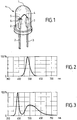
- the emission spectrum of a colour LED is very narrow and has a mid-height width of between 30 and 55 nm, preferably between 30 and 50 nm (as may be seen in Figure 2 ).
- the emission spectrum depends on the nature of the p-n junction, and therefore on the chemical nature of material used for the semiconductor.
- the semiconductor material is gallium arsenide GaAs
- the bandgap is 1.35 eV and the LED emits in the near infrared at around 920 nm.
- Gallium phosphide arsenide GaAsP, gallium phosphide GaP, gallium nitride GaN and gallium indium nitride GaInN are other examples among other intermetallic compounds that can be used for manufacturing an LED.
- the emission of white light by an LED is more problematic as it is necessary to combine the three essential components of white light, namely blue, red and green. It is also necessary to mix these three components so as to obtain a white light having good colour rendition or CRI and a good colour temperature (in kelvin).
- a white light having good colour rendition or CRI and a good colour temperature (in kelvin).
- the emission spectra of white LEDs are broader than those of colour LEDs (as is visible in Figure 3 ).
- the scattering plastic according to the invention makes it possible to eradicate the drawbacks associated with the three technologies, for example the halo phenomenon associated with the first technology or else the imperfect colour mixing of the third technology.
- the scattering plastic according to the invention is therefore well suited to the production of luminous devices incorporating one or more white LEDs.
- White LEDs which have a high luminous flux, of greater than 3 Lm, may be profitably employed as a light source in illuminated signs. Thanks to their long lifetime, the LEDs do not have to be frequently replaced, this being a major advantage, most particulary in the case of illuminated signs that are located high up, for example at the top of towers or buildings. Another advantage is that the LEDs are small light sources, thereby making it possible to manufacture illuminated signs that are more compact, and therefore easier to mount and to dismantle.
- the scattering particles To scatter the light emitted by the LED, the scattering particles must have a mean diameter of between 0.5 and 100 ⁇ m, advantageously between 1 and 80 ⁇ m and preferably between 1 and 70 ⁇ m. It is also necessary for the difference between the refractive indices (measured according to ASTM D 542) of the scattering particles and of the transparent plastic to be greater than 0.02 and preferably between 0.02 and 1.
- the scattering particles may be of organic or mineral type and may advantageously be chosen from the families described below.
- the content of scattering particles is between 0.3 and 5%, preferably between 0.3 and 4%.
- polyamide particles such as those described, for example, in Application EP 0 893 481 .
- polyamide it is possible to use those obtained from lactams, such as for example ⁇ -caprolactam, oenantholactam and undecanolactam, or from amino acids having from 4 to 20 carbon atoms, such as aminocaproic, 7-aminoheptanoic, 11-aminoundecanoic and 12-aminododecanoic acids.
- diamines such as hexamethylenediamine, dodecamethylenediamine, metaxylylenediamine and trimethylhexamethylenediamine
- dicarboxylic acids such as isophthalic, terephthalic, adipic, suberic, azelaic, sebacic, dodecanedioic and dodecanedicarboxylic acids.
- nylon-6 obtained by the polymerization of ⁇ -caprolactam
- nylon-11 obtained by the condensation of 11-aminoundecanoic acid
- nylon-12 obtained by the polycondensation of 12-aminododecanoic acid or dodecanolactam.
- the polyamide particles may be obtained by milling granules or by hot dissolution in suitable solvents followed by precipitation and cooling. It is also possible to obtain polyamide particles directly by anionic polymerization, as taught in documents EP-B1-192 515 or EP-B1-303 530 .
- the polyamide powder obtained by the method described in EP-B1-303 530 is particularly preferred.
- Suitable polyamide particles are for example those sold by Arkema under the names RILSAN or ORGASOL.
- they may be particles of ORGASOL® 2001 EX D NAT 1 (nylon-12 particles with a mean diameter of 10 ⁇ m ⁇ 1.5 ⁇ m), ORGASOL® 2001 UD NAT 1 (nylon-12 particles with a mean diameter of 5 ⁇ m ⁇ 1 ⁇ m) or ORGASOL® 3501 EX D NAT 1 (6/12 copolyamide particles with a mean diameter of 10 ⁇ m ⁇ 3 ⁇ m), and a melting point of 142 ⁇ 2°C).
- PTFE polytetrafluoroethylene
- Suitable PTFE particles are for example those sold by DuPont under the name ZONYL.
- ZONYL ZONYL 1000 (PTFE with a mean diameter of 11 ⁇ m) or ZONYL 1200 (PTFE with a mean diameter of 4 ⁇ m).
- the refractive index of PTFE is 1.376 according to the Polymer Handbook published by Wiley Interscience .
- This may for example be 1,4-butanediol di(meth)acrylate, ethylene glycol di(meth)acrylate, tetraethylene glycol di(meth)-acrylate, propylene glycol di(meth)acrylate, pentaerythritol tetra(meth)acrylate, allyl methacrylate or divinylbenzene.
- the styrene-based crosslinked polymer advantageously comprises 0 to 20% of a comonomer having at least one ethylenic unsaturation copolymerizable with styrene, chosen for example from chlorostyrene, bromostyrene, vinyltoluene, acrylonitrile, alpha-methylstyrene or a C 1 -C 10 alkyl(meth)acrylate such as, for example, methyl (meth)acrylate, ethyl (meth)acrylate, butyl (meth)-acrylate, benzyl (meth)acrylate, 2-hydroxyethyl (meth)-acrylate, phenyl (meth)acrylate, etc.
- Chlorostyrene and bromostyrene are the two monomers of choice for modifying the refractive index of the styrene-based crosslinked particles.
- Crosslinking makes it possible to prevent the particles from deforming when they are incorporated into the transparent plastic.
- the styrene-based scattering particles are advantageously prepared by polymerization in a dispersed medium, such as suspension, emulsion or microsuspension polymerization.
- the styrene-based scattering particles are substantially spherical.
- Suitable styrene-based scattering particles are for example those sold by Sekisui under the name SBX. They may be for example SBX-6, SBX-8, SBX-12 or SBX-17 particles (styrene-based crosslinked particles with a mean diameter of 6, 8, 12 or 17 ⁇ m).
- the refractive index of the SBX particles is 1.59 (according to the information found on the Internet site of the Sekisui group) .
- This may for example be 1,4-butanediol di(meth)acrylate, ethylene glycol di(meth)acrylate, tetraethylene glycol di(meth)acrylate, propylene glycol di(meth)acrylate, pentaerythritol tetra(meth)acrylate, allyl methacrylate or divinylbenzene.
- the crosslinked polymer based on methyl methacrylate advantageously includes from 0 to 20% of a comonomer having at least one ethylenic unsaturation copolymerizable with methyl methacrylate, chosen from styrene, alpha-methylstyrene, acrylonitrile, a C 1 -C 10 alkyl(meth)acrylate, such as for example methyl acrylate, ethyl (meth)acrylate, butyl (meth)acrylate, benzyl (meth)acrylate, 2-hydroxyethyl (meth)acrylate and phenyl (meth)acrylate.
- Styrene, ⁇ -methylstyrene, benzyl methacrylate and phenyl methacrylate are monomers of choice for modifying the refractive index of the methyl-methacrylate-based particles.
- the methyl-methacrylate-based scattering particles are advantageously prepared by polymerization in a dispersed medium, such as suspension polymerization, according to a recipe given for example in the document EP 1 022 115 , US 2002/0123565 or US 2002/0123563 .
- the methyl-methacrylate-based scattering particles are substantially spherical.
- silicone-based particles are obtained by milling a silicone until scattering particles are obtained that have the size sufficient to be dispersed in the transparent plastic and to correctly scatter the light emitted by the LED.
- the silicone is obtained by the hydrolysis and condensation of chlorosilanes, such as dimethyldichlorosilane, diphenyldichlorosilane, phenylmethyldichlorosilane, trimethyltrichlorosilane or phenyltrichlorosilane.
- the silicone will have been crosslinked by means of a free radical generator, such as for example benzoyl peroxide, para-chlorobenzoyl peroxide, tert- butyl peroxide or tert-amyl peroxide.
- a free radical generator such as for example benzoyl peroxide, para-chlorobenzoyl peroxide, tert- butyl peroxide or tert-amyl peroxide.
- Suitable scattering silicone particles are for example those sold by Toray Dow Corning Silicone under the name TORAY-FIL DY33-719. These particles have a refractive index of 1.42 and a mean size of 2 ⁇ m.
- mineral scattering particles examples include BaSO 4 , TiO 2 , ZnO, CaCO 3 , MgO and Al 2 O 3 particles.
- the advantage of mineral scattering particles over organic scattering particles is that it is possible to obtain good light scattering with a smaller amount.
- a content of mineral scattering particles of between 0.3 and 5%, rather between 0.3 and 4% and preferably between 0.3 and 2% is used.
- the mineral scattering particles are preferably colourless.
- mineral scattering particles are associated with their thermal stability. This is because, if the scattering particles are mixed with the transparent plastic in the melt state, it is necessary to reach high values in order to melt the plastic and facilitate homogenization. For example, in the case of PMMA, homogenization is carried out at temperatures between 270 and 300°C. The organic scattering particles are liable to degrade at high temperature and result in yellowing/blackening of the particles. This detracts from the final appearance of the compound.
- BaSO 4 particles (1.64 refractive index n D ) as they scatter the light very well, are very easily dispersed in the transparent plastic and are perfectly colourless.
- BaSO 4 particles are dispersed very well in the composition to be cured and do not aggregate therein.
- Blanc Fixe N particles sold by the German company Sachtleben Chemie may be used.
- Other mineral particles are hollow glass microspheres, as described in International Application WO 03/072645 .
- glass microspheres sold under the name SCOTCHLITE® by 3M (Minnesota Mining and Manufacturing Company) may be suitable. These microspheres are obtained by known methods.
- EP 1 172 341 it is possible to add, for example, an inflammable liquid to a compound containing ingredients suitable for the preparation of glass and a blowing agent, and then to subject the entire composition to wet milling so as to obtain a dispersion of particles having a mean size of 3 ⁇ m. This slurry is then atomized by means of a two-fluid nozzle, at a pressure of between 0.2 and 2 MPa, so as to form droplets.
- ingredients suitable for preparing the glass mention may be made of silica sand, volcanic ash, perlite, obsidian, silica gel, zeolite, bentonite, borax, boric acid, Ca 3 (PO) 4 , Na 2 SO 4 , Mg 4 P 2 O 7 , Al 2 O 3 , a compound deriving from SiO 2 , B 2 O 3 or Na 2 O. It is preferred to use a glass based on borosilicates, especially a soda-lime glass.
- the blowing agent generates gas when the mix of ingredients resulting in the glass undergoes vitrification by heating, and has the effect of producing substantially spherical hollow particles of molten vitrified glass.
- the blowing agent may for example be sodium, potassium, lithium, calcium, magnesium, barium, aluminium or zinc sulphate, carbonate, nitrate or acetate.
- dyes or pigments it is possible to add one or more dyes or pigments to the transparent plastic in order to obtain a coloured or tinted cover.
- a person skilled in the art knows how to choose the dye(s) or pigment(s) needed to obtain a given colour or tint, having a luminosity of less than 40, preferably less than 35.
- dyes and pigments mention may be made of the following: copper phthalocyanine green, copper phthalocyanine blue, ultramarine blue, pyrazolone yellow, diketopyrrolopyrrole red, red iron oxide, ultramarine, chromium-titanium yellow, and dyes of the anthraquinone type.
- At least one of the faces of the cover may have a relatively pronounced surface roughness (producing what is often called a "frosted" effect).
- the surface roughness may be obtained in several ways. According to a 1 st method, in the case of a cast sheet, the glass mould, which forms the sheet, has itself a surface roughness that has been obtained by treating the glass of the mould, for example with hydrofluoric acid. According to a 2 nd method, sandblasting may be used as taught in document WO 03/083564 or US 3 497 981 .
- the surface roughness is expressed in microns and can be measured using a roughness meter (for example of the Talysurf Surtronic 3P brand from Rank-Taylor-Hobson) according to the ISO 4287 and ISO 4288 standards.
- the value of the surface roughness Ra is of the order of a few ⁇ m. This value is between 0.5 and 4 ⁇ m, preferably between 1 and 3 ⁇ m.
- the surface roughness on at least one of the faces of the cover allows the light-scattering effect of the scattering particles to be enhanced, or even allows the quantity of scattering particles to be reduced.
- the faces of the cover according to the invention may also be perfectly smooth and not have any pronounced roughness.
- the value of the surface roughness Ra is less than 400 nm, advantageously less than 300 nm and preferably less than 100 nm.
- the cover may have all kinds of geometries, depending on the nature of the intended application. For example, it may be in the form of a flat, curved or domed sheet, whether rectangular or circular, in the form of a disc, etc. It may also take the form of a letter of the alphabet or of any other similar element in the case of an illuminated sign, as illustrated for example in Figure 5 . Examples are also given in the following documents: US 2004/0255497 and FR 2 857 434 .
- the cover has a thickness of between 0.1 and 15 cm, but is still between 0.1 and 10 cm, advantageously between 0.1 and 7 cm, preferably between 0.1 and 5 cm and even more preferably between 0.2 and 4 cm.
- the scattering particles and optional other additives are mixed with the transparent plastic by means of an extruder or any other mixing tool suitable for thermoplastics as known to those skilled in the art. Recovered at the exit of the extruder are granules that are then formed to the desired shape using a conversion technique for thermoplastics. This may be injection moulding or compression moulding. It is also possible to adapt the extruder in order to produce a sheet. The cover is then obtained after forming the sheet to the desired shape after cutting and/or thermoforming.
- the casting process to manufacture the sheet (then referred to as a cast PMMA sheet).
- This process consists in using a mould formed from two flat plates, for example made of inorganic glass, which are separated by a peripheral seal, generally made of polyvinyl chloride, for sealing between the two plates.
- the mould is closed by clamps placed along the sides.
- the composition to be polymerized i.e. the methyl methacrylate and optionally the comonomer(s)
- a polymerization initiator in sufficient amount has been added, is poured into the mould.
- the composition to be polymerized contains the scattering particles and all the other optional additives (for example demoulding agent, chain transfer agent for controlling the average molecular weight of the final polymer, antioxidant, UV stabilizer, dye(s), etc.).
- the polymerization is carried out or completed, depending on the case, by placing the mould in water (a process called "liquid pool” polymerization) or in an oven at the necessary temperature (40-80°C), and then in an oven (at about 100-130°C) for the post polymerization.
- the thickness of the seal determines the thickness of the polymer sheet obtained.
- the cover has, when the LED is not lit, a luminosity L of less than 40, preferably less 35. This makes it possible to ensure good visibility of the sign during the daytime, when the LED is not lit.
- L denotes the luminosity and extends from 0 (black) to 100 (white).
- the value a* measures the red and green of the colour: the colours tending toward green have a negative a* value while those tending toward the red have a positive a* value.
- the b* value measures the blue and the yellow of the colour: colours tending toward the yellow have a positive b* value while those tending toward the blue have a negative b* value.
- the L, a*, b* values are measured using a colorimeter (especially according to the ASTM E 308 standard).
- the L, a* and b* values are determined by comparing the colour of the cover with a control specimen which has a substantially identical colour and which is itself not lit.
- the colour of the lit cover is substantially identical to that of the unlit control specimen, it is possible to deduce therefrom the L, a* and b* values of the lit cover knowing those of the control specimen.
- the cover When the LED is lit, the cover has a luminosity L of greater than 55, an a* value of between -5 and +5 and a b* value of between -5 and +5.
- the luminosity is greater than 55, the a* value is between -3.5 and +3.5 and the b* value is between -3.5 and +3.5.
- the luminosity is greater than 65, the a* value is between -3.5 and +3.5 and the b* value is between -3.5 and +3.5.
- the luminous device according to the invention comprises at least one white LED, the light flux of which is greater than 3 Lm, advantageously greater than 5 Lm, preferably greater than 10 Lm, more preferably greater than 50 Lm, and at least one cover made of a transparent plastic in which 0.5 to 3% of scattering particles are dispersed.
- the cover makes it possible to:
- the cover is in the form of a single layer and is not obtained by coextrusion of two or more layers as in EP 1369224 A1 .
- the luminous flux is between 3 and 200 Lm, better still between 3 and 100 Lm, preferably between 5 and 100 Lm, even more preferably between 10 and 100 Lm and very preferentially between 50 and 100 Lm.
- the cover appears to be substantially white and has, as L, a*, b* values, a luminosity of greater than 55, an a* value of between -7.5 and +7.5 and a b* value of between - 7.5 and +7.5
- the cover is separated from the LED(s) by a distance of between 1 and 50 cm, better still between 2 and 50 cm, preferably between 2 and 20 cm and even more preferably between 3 and 20 cm.
- the luminous device is distinguished from edge-emitting devices, as described for example in EP 0 893 481 . This is because, in the luminous device according to the invention, it is not the edge of the cover that is illuminated but one of the faces of the cover.
- the luminous device according to the invention has a variety of applications such as, for example:
- the invention also relates to these uses.
Landscapes
- Chemical & Material Sciences (AREA)
- Polymers & Plastics (AREA)
- Organic Chemistry (AREA)
- Health & Medical Sciences (AREA)
- Chemical Kinetics & Catalysis (AREA)
- Medicinal Chemistry (AREA)
- Physics & Mathematics (AREA)
- General Physics & Mathematics (AREA)
- Engineering & Computer Science (AREA)
- Optics & Photonics (AREA)
- Mechanical Engineering (AREA)
- Theoretical Computer Science (AREA)
- Dispersion Chemistry (AREA)
- Compositions Of Macromolecular Compounds (AREA)
- Optical Elements Other Than Lenses (AREA)
Claims (17)
- Dispositif lumineux comprenant au moins une DEL blanche ayant un flux lumineux de plus de 3 lm, et un couvercle fait d'un plastique transparent dans lequel des particules diffusantes avec une teneur de 0,3 à 5 % sont dispersées et ledit couvercle a, quand la DEL est arrêtée, une luminosité L de moins de 40, et quand la DEL est allumée, une luminosité L de plus de 55, une valeur a* comprise entre -5 et +5 et une valeur b* comprise entre -5 et +5, caractérisé en ce que la différence entre les indices de réfraction, mesurés selon la méthode ASTM D-542, des particules diffusantes et du plastique transparent est supérieure à 0,02 et les trois valeurs L, a*, b* sont utilisées pour caractériser la couleur principale dans le système CIELAB et en ce que le couvercle est sous la forme d'une seule couche et en ce que le plastique transparent est choisi parmi le polystyrène cristallin, le téréphtalate de polyéthylène, une polyoléfine transparente, en particulier clarifiée, le polypropylène clarifié, le PMMA, un polyamide transparent ou le polycarbonate et en ce que les particules diffusantes sont choisies parmi des particules de polyamide, des particules de PTFE, des particules à base de styrène réticulé, des particules réticulées à base de méthacrylate de méthyle ou des particules de silicone ou choisies parmi des particules de BaSO4, TiO2, ZnO, CaCO3, MgO ou Al2O3 ou des microsphères de verre creuses.
- Dispositif lumineux selon la revendication 1, caractérisé en ce que le plastique transparent est du type thermoplastique ou thermodurcissable et a une transmission lumineuse dans la gamme visible d'au moins 50 %, selon la norme DIN 67-507.
- Dispositif lumineux selon l'une ou l'autre des revendications 1 et 2, caractérisé en ce que le plastique transparent est choisi entre le PMMA ou le polycarbonate.
- Dispositif lumineux selon l'une ou l'autre des revendications 1 et 2, caractérisé en ce que le plastique transparent est un homopolymère de méthacrylate de méthyle ou un copolymère comprenant de 80 à 99,5 % en poids de méthacrylate de méthyle et de 0,5 à 20 % en poids d'au moins un monomère ayant au moins une insaturation éthylénique qui peut copolymériser avec le méthacrylate de méthyle.
- Dispositif lumineux selon la revendication 4, caractérisé en ce que le plastique transparent est un copolymère comprenant, en poids, 90 à 99,7 %, de préférence 90 à 99,5 %, de méthacrylate de méthyle et 0,3 à 10 %, de préférence 0,5 à 10 %, d'au moins un monomère ayant au moins une insaturation éthylénique qui peut être copolymérisé avec le méthacrylate de méthyle.
- Dispositif lumineux selon l'une ou l'autre des revendications 1 et 2, caractérisé en ce que le plastique transparent est un polyester obtenu par la réaction d'au moins un dérivé d'acide carboxylique avec au moins un diol aromatique ou aliphatique.
- Dispositif lumineux selon la revendication 6, caractérisé en ce que le polyester est un homopolycarbonate ou un copolycarbonate basé sur un bisphénol de formule HO-Z-OH pour laquelle Z désigne un radical organique divalent possédant de 6 à 30 atomes de carbone et contenant un ou plusieurs groupes aromatiques.
- Dispositif lumineux selon la revendication 7, caractérisé en ce que le diphénol est choisi parmi les dihydroxydiphényles, les bis(hydroxyphényl)alcanes, les bis (hydroxyphényl)cycloalcanes, les bisphénols d'indane, les bis(hydroxyphényl)éthers, les bis(hydroxyphényl)-cétones, les bis(hydroxyphényl)sulfones, les bis(hydroxyphényl)sulfoxydes et les α,α'-bis(hydroxyphényl)-diisopropylbenzènes.
- Dispositif lumineux selon une des revendications précédentes, caractérisé en ce que les particules diffusantes ont un diamètre moyen compris entre 0,5 et 100 µm.
- Dispositif lumineux selon une des revendications 1 à 9, caractérisé en ce que les particules diffusantes sont des particules de polyamide, des particules de PTFE, des particules à base de styrène réticulé, des particules réticulées à base de méthacrylate de méthyle ou des particules de silicone.
- Dispositif lumineux selon une des revendications 1 à 9, caractérisé en ce que les particules diffusantes sont des particules de BaSO4, TiO2, ZnO, CaCO3, MgO ou Al2O3 ou des microsphères de verre creuses.
- Dispositif lumineux selon la revendication 11, caractérisé en ce que le diamètre moyen des particules diffusantes minérales se situe entre 0,5 et 15.
- Dispositif lumineux selon l'une ou l'autre des revendications 11 et 12, caractérisé en ce que la teneur en particules diffusantes se situe entre 0,3 et 4 %.
- Dispositif lumineux selon l'une des revendications 1 à 13, caractérisé en ce qu'au moins une des faces du couvercle a une rugosité Ra comprise entre 0,5 et 4 µm.
- Utilisation du dispositif lumineux selon l'une quelconque des revendications 1 à 14 pour :• l'éclairage intérieur ;• les écrans publicitaires ;• l'éclairage de directions ou le marquage d'issues de secours ;• les enseignes lumineuses ;• la signalisation du trafic ; et• l'éclairage automobile.
- Utilisation selon la revendication 15, caractérisée en ce que le couvercle a la forme d'une lettre ou d'un chiffre.
- Utilisation selon la revendication 15, caractérisée en ce que l'éclairage automobile est un phare, un feu de croisement, un indicateur de direction, un feu stop, un phare antibrouillard ou un feu de recul.
Priority Applications (1)
| Application Number | Priority Date | Filing Date | Title |
|---|---|---|---|
| PL06742563T PL1927098T3 (pl) | 2005-03-25 | 2006-03-23 | Urządzenie świetlne łączące białą diodę i warstwę rozpraszającą |
Applications Claiming Priority (3)
| Application Number | Priority Date | Filing Date | Title |
|---|---|---|---|
| FR0502985A FR2883628B1 (fr) | 2005-03-25 | 2005-03-25 | Dispositif lumineux associant une led blanche avec une matiere plastique diffusante |
| US68684105P | 2005-06-02 | 2005-06-02 | |
| PCT/EP2006/003310 WO2006100127A2 (fr) | 2005-03-25 | 2006-03-23 | Dispositif illumine a del blanche et feuille de diffusion |
Publications (2)
| Publication Number | Publication Date |
|---|---|
| EP1927098A2 EP1927098A2 (fr) | 2008-06-04 |
| EP1927098B1 true EP1927098B1 (fr) | 2018-05-23 |
Family
ID=37024191
Family Applications (1)
| Application Number | Title | Priority Date | Filing Date |
|---|---|---|---|
| EP06742563.7A Expired - Lifetime EP1927098B1 (fr) | 2005-03-25 | 2006-03-23 | Dispositif illumine a del blanche et feuille de diffusion |
Country Status (3)
| Country | Link |
|---|---|
| EP (1) | EP1927098B1 (fr) |
| PL (1) | PL1927098T3 (fr) |
| WO (1) | WO2006100127A2 (fr) |
Families Citing this family (10)
| Publication number | Priority date | Publication date | Assignee | Title |
|---|---|---|---|---|
| US8477247B2 (en) | 2008-09-30 | 2013-07-02 | Intel Corporation | Joint enhancement of lightness, color and contrast of images and video |
| TW201139532A (en) | 2010-04-30 | 2011-11-16 | Styron Europe Gmbh | Improved light diffusing composition |
| DE102012205749A1 (de) * | 2012-04-10 | 2013-10-10 | Evonik Industries Ag | Werbeleuchtkasten mit seitlicher Hohlraumhinterleuchtung und spezieller Scheibe zur optimierten Lichtverteilung |
| TWI588199B (zh) * | 2012-05-25 | 2017-06-21 | 羅門哈斯公司 | 光擴散聚合物組成物、製造該光擴散聚合物組成物的方法以及由之製得的物品 |
| TWI583733B (zh) * | 2012-08-10 | 2017-05-21 | 羅門哈斯公司 | 光擴散聚合物組成物、其製造方法,及由其製得之物件 |
| EP2904435B1 (fr) | 2012-10-01 | 2024-11-27 | Trinseo Europe GmbH | Diffuseur optique de lumière |
| FR3087777B1 (fr) * | 2018-10-26 | 2021-10-01 | Arkema France | Composition de polymere comprenant des colorants, son procede de preparation, son utilisation et objet comprenant celle-ci |
| FR3087778B1 (fr) | 2018-10-26 | 2021-07-23 | Arkema France | Composition de polymere adaptee pour moulage par injection comprenant des particules et un colorant, son procede de preparation et son utilisation |
| FR3087776B1 (fr) * | 2018-10-26 | 2021-07-30 | Arkema France | Composition de polymere comprenant des particules et un colorant, son procede de preparation et son utilisation |
| CN111789975A (zh) * | 2020-07-29 | 2020-10-20 | 固安翌光科技有限公司 | 一种车内消毒灭菌装置 |
Family Cites Families (3)
| Publication number | Priority date | Publication date | Assignee | Title |
|---|---|---|---|---|
| JP2000509912A (ja) * | 1997-03-03 | 2000-08-02 | コーニンクレッカ フィリップス エレクトロニクス エヌ ヴィ | 白色光発光ダイオード |
| DE10058348A1 (de) * | 2000-11-23 | 2002-05-29 | Guenter F Epple | Leuchtkörper mit Innenbeleuchtung |
| DE10308704A1 (de) * | 2003-02-28 | 2004-11-11 | Audi Ag | Kraftfahrzeugscheinwerfer |
-
2006
- 2006-03-23 PL PL06742563T patent/PL1927098T3/pl unknown
- 2006-03-23 EP EP06742563.7A patent/EP1927098B1/fr not_active Expired - Lifetime
- 2006-03-23 WO PCT/EP2006/003310 patent/WO2006100127A2/fr not_active Ceased
Non-Patent Citations (1)
| Title |
|---|
| None * |
Also Published As
| Publication number | Publication date |
|---|---|
| PL1927098T3 (pl) | 2018-10-31 |
| EP1927098A2 (fr) | 2008-06-04 |
| WO2006100127A3 (fr) | 2007-01-25 |
| WO2006100127A2 (fr) | 2006-09-28 |
Similar Documents
| Publication | Publication Date | Title |
|---|---|---|
| WO2011134674A1 (fr) | Composition diffusant la lumière améliorée | |
| KR101369661B1 (ko) | 다색 효과를 나타내는 성형품, 이와 관련된 광소자 및 수지 | |
| US6893147B2 (en) | Lamp lens or bezel with visual effect | |
| CN112166467B (zh) | 彩色显示装置、车辆内外饰构件、照明灯用灯、显示用广告牌和车辆 | |
| JP4148899B2 (ja) | 照明可能な装置 | |
| EP1864274A2 (fr) | Dispositif d'eclairage combinant une del et une feuille de diffusion | |
| TWI300091B (en) | Moulding composed of plastic, comprising a fluorescent dye | |
| EP1927098B1 (fr) | Dispositif illumine a del blanche et feuille de diffusion | |
| EA004506B1 (ru) | Усовершенствованный светящийся материал | |
| US10732330B2 (en) | High efficiency diffusion lighting coverings | |
| AU2001262545A1 (en) | Improved luminous materials | |
| CN102144016A (zh) | 发光器件及其制造方法 | |
| US9557445B2 (en) | Optical diffusion blend materials for LED lighting | |
| US9547108B2 (en) | Optical diffusion blend materials for LED lighting | |
| JPH1088031A (ja) | 蓄光性道路標示材 | |
| WO2018005440A1 (fr) | Procédé pour améliorer les propriétés optiques de phosphore à distance dans du polycarbonate | |
| JP6206844B2 (ja) | ランプカバー、及びその製造方法 | |
| ES2683918T3 (es) | Dispositivo de iluminación que combina un led blanco y una lámina difusora | |
| US10345493B2 (en) | Optical diffusion blend materials for LED lighting | |
| US11719411B2 (en) | High efficiency diffusion lighting coverings | |
| JPH1088531A (ja) | 蓄光性道路標示材 | |
| FR2883627A1 (fr) | Dispositif lumineux associant une led avec une matiere plastique diffusante | |
| JPH0357102A (ja) | 自動車ランプ類のレンズ | |
| JP2001329138A (ja) | メタクリル系樹脂成形体およびその製造方法、並びに表示体 |
Legal Events
| Date | Code | Title | Description |
|---|---|---|---|
| PUAI | Public reference made under article 153(3) epc to a published international application that has entered the european phase |
Free format text: ORIGINAL CODE: 0009012 |
|
| 17P | Request for examination filed |
Effective date: 20070911 |
|
| AK | Designated contracting states |
Kind code of ref document: A2 Designated state(s): AT BE BG CH CY CZ DE DK EE ES FI FR GB GR HU IE IS IT LI LT LU LV MC NL PL PT RO SE SI SK TR |
|
| DAX | Request for extension of the european patent (deleted) | ||
| RAP1 | Party data changed (applicant data changed or rights of an application transferred) |
Owner name: ARKEMA FRANCE |
|
| 17Q | First examination report despatched |
Effective date: 20091124 |
|
| STAA | Information on the status of an ep patent application or granted ep patent |
Free format text: STATUS: EXAMINATION IS IN PROGRESS |
|
| RIC1 | Information provided on ipc code assigned before grant |
Ipc: C08L 33/04 20060101ALI20170908BHEP Ipc: F21V 3/04 20060101ALI20170908BHEP Ipc: C08F 265/06 20060101ALI20170908BHEP Ipc: C08F 279/02 20060101ALI20170908BHEP Ipc: G09F 13/04 20060101AFI20170908BHEP Ipc: C08L 51/00 20060101ALI20170908BHEP Ipc: F21Y 115/10 20160101ALI20170908BHEP Ipc: G02B 1/04 20060101ALI20170908BHEP Ipc: B60R 13/00 20060101ALI20170908BHEP Ipc: G02B 5/02 20060101ALI20170908BHEP Ipc: C08L 55/02 20060101ALI20170908BHEP Ipc: C08F 279/04 20060101ALI20170908BHEP Ipc: F21V 7/00 20060101ALI20170908BHEP Ipc: C08L 51/04 20060101ALI20170908BHEP |
|
| GRAP | Despatch of communication of intention to grant a patent |
Free format text: ORIGINAL CODE: EPIDOSNIGR1 |
|
| STAA | Information on the status of an ep patent application or granted ep patent |
Free format text: STATUS: GRANT OF PATENT IS INTENDED |
|
| INTG | Intention to grant announced |
Effective date: 20171215 |
|
| GRAS | Grant fee paid |
Free format text: ORIGINAL CODE: EPIDOSNIGR3 |
|
| GRAA | (expected) grant |
Free format text: ORIGINAL CODE: 0009210 |
|
| STAA | Information on the status of an ep patent application or granted ep patent |
Free format text: STATUS: THE PATENT HAS BEEN GRANTED |
|
| AK | Designated contracting states |
Kind code of ref document: B1 Designated state(s): AT BE BG CH CY CZ DE DK EE ES FI FR GB GR HU IE IS IT LI LT LU LV MC NL PL PT RO SE SI SK TR |
|
| REG | Reference to a national code |
Ref country code: GB Ref legal event code: FG4D |
|
| REG | Reference to a national code |
Ref country code: CH Ref legal event code: EP |
|
| REG | Reference to a national code |
Ref country code: IE Ref legal event code: FG4D |
|
| REG | Reference to a national code |
Ref country code: AT Ref legal event code: REF Ref document number: 1002132 Country of ref document: AT Kind code of ref document: T Effective date: 20180615 |
|
| REG | Reference to a national code |
Ref country code: DE Ref legal event code: R096 Ref document number: 602006055448 Country of ref document: DE |
|
| REG | Reference to a national code |
Ref country code: NL Ref legal event code: MP Effective date: 20180523 |
|
| REG | Reference to a national code |
Ref country code: ES Ref legal event code: FG2A Ref document number: 2683918 Country of ref document: ES Kind code of ref document: T3 Effective date: 20180928 |
|
| REG | Reference to a national code |
Ref country code: LT Ref legal event code: MG4D |
|
| PG25 | Lapsed in a contracting state [announced via postgrant information from national office to epo] |
Ref country code: BG Free format text: LAPSE BECAUSE OF FAILURE TO SUBMIT A TRANSLATION OF THE DESCRIPTION OR TO PAY THE FEE WITHIN THE PRESCRIBED TIME-LIMIT Effective date: 20180823 Ref country code: FI Free format text: LAPSE BECAUSE OF FAILURE TO SUBMIT A TRANSLATION OF THE DESCRIPTION OR TO PAY THE FEE WITHIN THE PRESCRIBED TIME-LIMIT Effective date: 20180523 Ref country code: LT Free format text: LAPSE BECAUSE OF FAILURE TO SUBMIT A TRANSLATION OF THE DESCRIPTION OR TO PAY THE FEE WITHIN THE PRESCRIBED TIME-LIMIT Effective date: 20180523 Ref country code: SE Free format text: LAPSE BECAUSE OF FAILURE TO SUBMIT A TRANSLATION OF THE DESCRIPTION OR TO PAY THE FEE WITHIN THE PRESCRIBED TIME-LIMIT Effective date: 20180523 |
|
| PG25 | Lapsed in a contracting state [announced via postgrant information from national office to epo] |
Ref country code: LV Free format text: LAPSE BECAUSE OF FAILURE TO SUBMIT A TRANSLATION OF THE DESCRIPTION OR TO PAY THE FEE WITHIN THE PRESCRIBED TIME-LIMIT Effective date: 20180523 Ref country code: GR Free format text: LAPSE BECAUSE OF FAILURE TO SUBMIT A TRANSLATION OF THE DESCRIPTION OR TO PAY THE FEE WITHIN THE PRESCRIBED TIME-LIMIT Effective date: 20180824 Ref country code: NL Free format text: LAPSE BECAUSE OF FAILURE TO SUBMIT A TRANSLATION OF THE DESCRIPTION OR TO PAY THE FEE WITHIN THE PRESCRIBED TIME-LIMIT Effective date: 20180523 |
|
| REG | Reference to a national code |
Ref country code: CH Ref legal event code: PK Free format text: BERICHTIGUNGEN |
|
| REG | Reference to a national code |
Ref country code: AT Ref legal event code: MK05 Ref document number: 1002132 Country of ref document: AT Kind code of ref document: T Effective date: 20180523 |
|
| RIC2 | Information provided on ipc code assigned after grant |
Ipc: C08F 265/06 20060101ALI20170908BHEP Ipc: C08F 279/02 20060101ALI20170908BHEP Ipc: B60R 13/00 20060101ALI20170908BHEP Ipc: C08L 55/02 20060101ALI20170908BHEP Ipc: G02B 5/02 20060101ALI20170908BHEP Ipc: F21Y 115/10 20160101ALI20170908BHEP Ipc: C08L 51/04 20060101ALI20170908BHEP Ipc: C08L 33/04 20060101ALI20170908BHEP Ipc: F21V 3/04 20180101ALI20170908BHEP Ipc: C08L 51/00 20060101ALI20170908BHEP Ipc: F21V 7/00 20060101ALI20170908BHEP Ipc: G02B 1/04 20060101ALI20170908BHEP Ipc: G09F 13/04 20060101AFI20170908BHEP Ipc: C08F 279/04 20060101ALI20170908BHEP |
|
| PG25 | Lapsed in a contracting state [announced via postgrant information from national office to epo] |
Ref country code: RO Free format text: LAPSE BECAUSE OF FAILURE TO SUBMIT A TRANSLATION OF THE DESCRIPTION OR TO PAY THE FEE WITHIN THE PRESCRIBED TIME-LIMIT Effective date: 20180523 Ref country code: CZ Free format text: LAPSE BECAUSE OF FAILURE TO SUBMIT A TRANSLATION OF THE DESCRIPTION OR TO PAY THE FEE WITHIN THE PRESCRIBED TIME-LIMIT Effective date: 20180523 Ref country code: SK Free format text: LAPSE BECAUSE OF FAILURE TO SUBMIT A TRANSLATION OF THE DESCRIPTION OR TO PAY THE FEE WITHIN THE PRESCRIBED TIME-LIMIT Effective date: 20180523 Ref country code: AT Free format text: LAPSE BECAUSE OF FAILURE TO SUBMIT A TRANSLATION OF THE DESCRIPTION OR TO PAY THE FEE WITHIN THE PRESCRIBED TIME-LIMIT Effective date: 20180523 Ref country code: EE Free format text: LAPSE BECAUSE OF FAILURE TO SUBMIT A TRANSLATION OF THE DESCRIPTION OR TO PAY THE FEE WITHIN THE PRESCRIBED TIME-LIMIT Effective date: 20180523 Ref country code: DK Free format text: LAPSE BECAUSE OF FAILURE TO SUBMIT A TRANSLATION OF THE DESCRIPTION OR TO PAY THE FEE WITHIN THE PRESCRIBED TIME-LIMIT Effective date: 20180523 |
|
| REG | Reference to a national code |
Ref country code: CH Ref legal event code: PK Free format text: BERICHTIGUNGEN |
|
| RIC2 | Information provided on ipc code assigned after grant |
Ipc: C08L 33/04 20060101ALI20170908BHEP Ipc: G09F 13/04 20060101AFI20170908BHEP Ipc: B60R 13/00 20060101ALI20170908BHEP Ipc: G02B 5/02 20060101ALI20170908BHEP Ipc: G02B 1/04 20060101ALI20170908BHEP Ipc: C08F 265/06 20060101ALI20170908BHEP Ipc: C08L 55/02 20060101ALI20170908BHEP Ipc: C08F 279/04 20060101ALI20170908BHEP Ipc: C08L 51/04 20060101ALI20170908BHEP Ipc: F21V 7/00 20060101ALI20170908BHEP Ipc: F21Y 115/10 20160101ALI20170908BHEP Ipc: C08F 279/02 20060101ALI20170908BHEP Ipc: F21V 3/04 20180101ALI20170908BHEP Ipc: C08L 51/00 20060101ALI20170908BHEP |
|
| REG | Reference to a national code |
Ref country code: DE Ref legal event code: R097 Ref document number: 602006055448 Country of ref document: DE |
|
| PLBE | No opposition filed within time limit |
Free format text: ORIGINAL CODE: 0009261 |
|
| STAA | Information on the status of an ep patent application or granted ep patent |
Free format text: STATUS: NO OPPOSITION FILED WITHIN TIME LIMIT |
|
| 26N | No opposition filed |
Effective date: 20190226 |
|
| PG25 | Lapsed in a contracting state [announced via postgrant information from national office to epo] |
Ref country code: SI Free format text: LAPSE BECAUSE OF FAILURE TO SUBMIT A TRANSLATION OF THE DESCRIPTION OR TO PAY THE FEE WITHIN THE PRESCRIBED TIME-LIMIT Effective date: 20180523 |
|
| PG25 | Lapsed in a contracting state [announced via postgrant information from national office to epo] |
Ref country code: MC Free format text: LAPSE BECAUSE OF FAILURE TO SUBMIT A TRANSLATION OF THE DESCRIPTION OR TO PAY THE FEE WITHIN THE PRESCRIBED TIME-LIMIT Effective date: 20180523 |
|
| REG | Reference to a national code |
Ref country code: CH Ref legal event code: PL |
|
| PG25 | Lapsed in a contracting state [announced via postgrant information from national office to epo] |
Ref country code: LU Free format text: LAPSE BECAUSE OF NON-PAYMENT OF DUE FEES Effective date: 20190323 |
|
| REG | Reference to a national code |
Ref country code: BE Ref legal event code: MM Effective date: 20190331 |
|
| PG25 | Lapsed in a contracting state [announced via postgrant information from national office to epo] |
Ref country code: IE Free format text: LAPSE BECAUSE OF NON-PAYMENT OF DUE FEES Effective date: 20190323 Ref country code: CH Free format text: LAPSE BECAUSE OF NON-PAYMENT OF DUE FEES Effective date: 20190331 Ref country code: LI Free format text: LAPSE BECAUSE OF NON-PAYMENT OF DUE FEES Effective date: 20190331 |
|
| PG25 | Lapsed in a contracting state [announced via postgrant information from national office to epo] |
Ref country code: BE Free format text: LAPSE BECAUSE OF NON-PAYMENT OF DUE FEES Effective date: 20190331 |
|
| PG25 | Lapsed in a contracting state [announced via postgrant information from national office to epo] |
Ref country code: PT Free format text: LAPSE BECAUSE OF FAILURE TO SUBMIT A TRANSLATION OF THE DESCRIPTION OR TO PAY THE FEE WITHIN THE PRESCRIBED TIME-LIMIT Effective date: 20180924 |
|
| PG25 | Lapsed in a contracting state [announced via postgrant information from national office to epo] |
Ref country code: CY Free format text: LAPSE BECAUSE OF FAILURE TO SUBMIT A TRANSLATION OF THE DESCRIPTION OR TO PAY THE FEE WITHIN THE PRESCRIBED TIME-LIMIT Effective date: 20180523 |
|
| PG25 | Lapsed in a contracting state [announced via postgrant information from national office to epo] |
Ref country code: IS Free format text: LAPSE BECAUSE OF FAILURE TO SUBMIT A TRANSLATION OF THE DESCRIPTION OR TO PAY THE FEE WITHIN THE PRESCRIBED TIME-LIMIT Effective date: 20180923 |
|
| PG25 | Lapsed in a contracting state [announced via postgrant information from national office to epo] |
Ref country code: HU Free format text: LAPSE BECAUSE OF FAILURE TO SUBMIT A TRANSLATION OF THE DESCRIPTION OR TO PAY THE FEE WITHIN THE PRESCRIBED TIME-LIMIT; INVALID AB INITIO Effective date: 20060323 |
|
| REG | Reference to a national code |
Ref country code: DE Ref legal event code: R081 Ref document number: 602006055448 Country of ref document: DE Owner name: TRINSEO EUROPE GMBH, CH Free format text: FORMER OWNER: ARKEMA FRANCE, COLOMBES, FR |
|
| REG | Reference to a national code |
Ref country code: ES Ref legal event code: PC2A Owner name: TRINSEO EUROPE GMBH Effective date: 20210902 |
|
| REG | Reference to a national code |
Ref country code: GB Ref legal event code: 732E Free format text: REGISTERED BETWEEN 20210923 AND 20210929 |
|
| PGFP | Annual fee paid to national office [announced via postgrant information from national office to epo] |
Ref country code: DE Payment date: 20240327 Year of fee payment: 19 Ref country code: GB Payment date: 20240327 Year of fee payment: 19 |
|
| PGFP | Annual fee paid to national office [announced via postgrant information from national office to epo] |
Ref country code: TR Payment date: 20240306 Year of fee payment: 19 Ref country code: PL Payment date: 20240307 Year of fee payment: 19 Ref country code: IT Payment date: 20240321 Year of fee payment: 19 Ref country code: FR Payment date: 20240325 Year of fee payment: 19 |
|
| PGFP | Annual fee paid to national office [announced via postgrant information from national office to epo] |
Ref country code: ES Payment date: 20240401 Year of fee payment: 19 |
|
| REG | Reference to a national code |
Ref country code: DE Ref legal event code: R119 Ref document number: 602006055448 Country of ref document: DE |
|
| GBPC | Gb: european patent ceased through non-payment of renewal fee |
Effective date: 20250323 |
|
| PG25 | Lapsed in a contracting state [announced via postgrant information from national office to epo] |
Ref country code: DE Free format text: LAPSE BECAUSE OF NON-PAYMENT OF DUE FEES Effective date: 20251001 |
|
| PG25 | Lapsed in a contracting state [announced via postgrant information from national office to epo] |
Ref country code: GB Free format text: LAPSE BECAUSE OF NON-PAYMENT OF DUE FEES Effective date: 20250323 |
|
| PG25 | Lapsed in a contracting state [announced via postgrant information from national office to epo] |
Ref country code: FR Free format text: LAPSE BECAUSE OF NON-PAYMENT OF DUE FEES Effective date: 20250331 Ref country code: IT Free format text: LAPSE BECAUSE OF NON-PAYMENT OF DUE FEES Effective date: 20250323 |