EP1927780A2 - Druckluftbremszylinder in Kolbenbauweise - Google Patents
Druckluftbremszylinder in Kolbenbauweise Download PDFInfo
- Publication number
- EP1927780A2 EP1927780A2 EP07017822A EP07017822A EP1927780A2 EP 1927780 A2 EP1927780 A2 EP 1927780A2 EP 07017822 A EP07017822 A EP 07017822A EP 07017822 A EP07017822 A EP 07017822A EP 1927780 A2 EP1927780 A2 EP 1927780A2
- Authority
- EP
- European Patent Office
- Prior art keywords
- piston
- brake cylinder
- compressed air
- air brake
- extension
- Prior art date
- Legal status (The legal status is an assumption and is not a legal conclusion. Google has not performed a legal analysis and makes no representation as to the accuracy of the status listed.)
- Granted
Links
Images



Classifications
-
- F—MECHANICAL ENGINEERING; LIGHTING; HEATING; WEAPONS; BLASTING
- F16—ENGINEERING ELEMENTS AND UNITS; GENERAL MEASURES FOR PRODUCING AND MAINTAINING EFFECTIVE FUNCTIONING OF MACHINES OR INSTALLATIONS; THERMAL INSULATION IN GENERAL
- F16D—COUPLINGS FOR TRANSMITTING ROTATION; CLUTCHES; BRAKES
- F16D65/00—Parts or details
- F16D65/14—Actuating mechanisms for brakes; Means for initiating operation at a predetermined position
- F16D65/28—Actuating mechanisms for brakes; Means for initiating operation at a predetermined position arranged apart from the brake
-
- B—PERFORMING OPERATIONS; TRANSPORTING
- B60—VEHICLES IN GENERAL
- B60T—VEHICLE BRAKE CONTROL SYSTEMS OR PARTS THEREOF; BRAKE CONTROL SYSTEMS OR PARTS THEREOF, IN GENERAL; ARRANGEMENT OF BRAKING ELEMENTS ON VEHICLES IN GENERAL; PORTABLE DEVICES FOR PREVENTING UNWANTED MOVEMENT OF VEHICLES; VEHICLE MODIFICATIONS TO FACILITATE COOLING OF BRAKES
- B60T17/00—Component parts, details, or accessories of power brake systems not covered by groups B60T8/00, B60T13/00 or B60T15/00, or presenting other characteristic features
- B60T17/08—Brake cylinders other than ultimate actuators
- B60T17/081—Single service brake actuators
Definitions
- the invention relates to a compressed air brake cylinder in piston construction according to the preamble of patent claim 1.
- a generic air brake cylinder is out of EP 0 949 433 B1 known.
- the generic compressed air brake cylinder is connected to a disc brake, which has a brake lever to a brake lever.
- the application lever Upon actuation of the air brake cylinder, the application lever is pivoted via a piston rod of the air brake cylinder.
- the end of the brake lever describes a curve.
- a transverse force is exerted on the piston rod upon actuation of the application lever.
- the piston of the air brake cylinder may tend to tilt and thereby produce increased friction on the housing walls of the air brake cylinder.
- the invention has for its object to reduce the tilting tendency and thus the friction of the piston.
- the invention has the advantage to improve the response and the controllability of a compressed air brake cylinder in piston design in a simple and cost-effective manner and with little design effort by a friction-induced hysteresis is avoided or at least significantly reduced.
- the invention can be embodied in different embodiments, as explained in the exemplary embodiments described below. Common to these embodiments, that for solving the invention underlying Task of the piston is guided axially on the side facing away from the opening of the housing in a bearing. As a result, a significant reduction in the tendency of tilting of the piston in all operating states of the air brake cylinder, ie even when fully actuated, guaranteed.
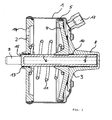
- the air brake cylinder according to Fig. 1 has a housing (1, 2, 3), which has a substantially cylindrical body part (1), a front wall (2) and a rear wall (3).
- a piston (4) which can be displaced longitudinally by the application of compressed air, is arranged, which is sealed relative to the housing part (1) by means of a circumferential seal (5).
- the piston (4) is rigidly connected to a piston rod (6).
- the piston rod (6) protrudes through an opening (15) of the housing (1, 2, 3), namely the opening (15) of the front wall (2).
- the piston rod (6) has an actuating surface which serves to actuate the application lever of a disc brake.
- the air brake cylinder with its front wall (2) by means of bolts (9) attached to the housing of a disc brake.
- the actuating surface comes with the brake lever of the disc brake to the plant.
- the bearing (13) advantageously also has a sealing function.
- the bearing (13) may advantageously be formed as a PUR ring.
- the piston (4) via a compressed air connection (12) can be acted upon with compressed air.
- compressed air is applied - the piston (4) moves against the force of a return spring (11) in the direction of the front wall (2).
- the front wall (2) has an opening (14) for pressure compensation, which is connected to the atmosphere or a compensation volume.
- the piston or a part rigidly connected to the piston is connected to an extension (7) on the side facing away from the opening (15).
- the extension (7) is guided axially in a bearing (10).
- the extension (7) is designed as an extension of the piston rod (6) penetrating the piston (4).
- the extension (7) is at least in certain operating states of the air brake cylinder, for Example in the in Fig. 1 shown unactuated state, in an extension region (8) of the housing (1, 2, 3) added.
- the extension area (8) in the embodiment according to Fig. 1 formed as part of the rear wall (3).
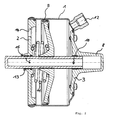
- the Fig. 2 shows the air brake cylinder according to Fig. 1 in the actuated state, that is, when the compressed air is applied to the piston (4) through the compressed air connection (12).
- the extension (7) is at least in certain operating states of the air brake cylinder in the extension area (8) added, for example, in the Fig. 1 apparent unactuated state of the air brake cylinder.
- the extension (7) has migrated substantially from the extension region (8), wherein the extension (7) is of course performed in all operating states of the air brake cylinder through the bearing (10).
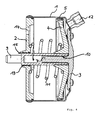
- the Fig. 3 shows an advantageous embodiment of the invention, in which the extension (7) is formed as part of the piston (4).
- the extension (7) can be advantageously connected as a separate part with the piston (4), for example by a threaded screw connection, or advantageously be formed integrally with the piston (4).
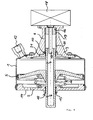
- the Fig. 4 shows a further advantageous embodiment of the air brake cylinder, wherein the extension (7) is rigidly connected to the rear wall (3) and projects into the interior of the piston rod (6).
- the bearing (10) is fixedly connected to the piston rod (6) and moves upon actuation of the piston (4) relative to the extension (7).
- this embodiment has the advantage of being particularly small-sized and in particular to claim little space on the back of the air brake cylinder.
- the bearings (10, 13) can be advantageously designed as an axial bearing.
- the parking brake function advantageously has a unit for the mechanical locking of the piston (4) in its actuated position.
- the elements of the parking brake function have a locking element (16) provided with an external thread (20), a drive bolt (17) and a drive (18).
- the drive (18) is adapted to put the drive pin (17) in a rotational movement.
- the drive bolt (17) which has, for example, an external square profile, transmits the rotational movement to the locking element (16) which, as a result of the rotational movement, performs an axial movement with respect to the drive bolt (17).
- the axial movement is effected by the external thread (20) running in an internal thread (19) provided in the extension area (8).
- Fig. 6 is the embodiment of the air brake cylinder according to Fig. 5 shown, wherein the piston (4) is actuated by compressed air here.
- the parking brake function is shown in the illustration Fig. 6 not activated.
- Fig. 7 is the air brake cylinder according to Fig. 6 shown with operated parking brake function.
- the locking element (16) has been moved axially in the direction of the extension (7) as a result of an actuation of the drive (18) until the locking element (16) rests against the extension (7) and a return movement of the piston (4) therethrough prevented.
- an operation of the brake can be maintained without the compressed air operation of the piston (4) is required.
- the bearing (10) is arranged in an insert (21) for ease of assembly, which is mountable together with the bearing (10).
- the drive (18) may be formed, for example, as an electric motor with gear. Furthermore, those in the patent application DE 10 2005 001 234 A1 specified drives in the present air brake cylinder advantageously used.
Landscapes
- Engineering & Computer Science (AREA)
- General Engineering & Computer Science (AREA)
- Mechanical Engineering (AREA)
- Transportation (AREA)
- Braking Arrangements (AREA)
Abstract
Description
- Die Erfindung betrifft einen Druckluftbremszylinder in Kolbenbauweise gemäß dem Oberbegriff des Patentanspruchs 1.
- Ein gattungsgemäßer Druckluftbremszylinder ist aus der
EP 0 949 433 B1 bekannt. - Der gattungsgemäße Druckluftbremszylinder ist mit einer Scheibenbremse verbunden, die zur Bremsbetätigung einen Zuspannhebel aufweist. Bei einer Betätigung des Druckluftbremszylinders wird über eine Kolbenstange des Druckluftbremszylinders der Zuspannhebel verschwenkt. Dabei beschreibt das Ende des Zuspannhebels eine Kurve. Hierdurch wird bei der Betätigung des Zuspannhebels eine Querkraft auf die Kolbenstange ausgeübt. Insbesondere bei voll betätigtem Druckluftbremszylinder und somit weit ausgefahrener Kolbenstange kann der Kolben des Druckluftbremszylinders zum Verkippen neigen und dadurch eine erhöhte Reibung an den Gehäusewandungen des Druckluftbremszylinders erzeugen.
- Der Erfindung liegt die Aufgabe zugrunde, die Verkippneigung und damit die Reibung des Kolbens zu verringern.
- Diese Aufgabe wird durch die in dem Patentanspruch 1 angegebene Erfindung gelöst. Weiterbildungen und vorteilhafte Ausgestaltungen der Erfindung sind in den Unteransprüchen angegeben.
- Die Erfindung hat den Vorteil, auf einfache und kostengünstige Weise und mit geringen konstruktiven Aufwand das Ansprechverhalten und die Regelbarkeit eines Druckluftbremszylinders in Kolbenbauweise zu verbessern, indem eine reibungsbedingte Hysterese vermieden oder zumindest deutlich verringert wird.
- Die Erfindung kann in unterschiedlichen Ausgestaltungen ausgeführt werden, wie in den nachfolgend beschriebenen Ausführungsbeispielen erläutert. Gemeinsam ist diesen Ausführungsbeispielen, dass zur Lösung der der Erfindung zugrunde liegenden Aufgabe der Kolben auf der der Öffnung des Gehäuses abgewandten Seite in einem Lager axial geführt ist. Hierdurch wird eine deutliche Verringerung der Verkippneigung des Kolbens in allen Betätigungszuständen des Druckluftbremszylinders, d. h. auch bei Vollbetätigung, gewährleistet.
- Die Erfindung wird nachfolgend anhand von Ausführungsbeispielen unter Verwendung von Zeichnungen näher erläutert.
- Es zeigen:
- Fig. 1
- eine erste Ausführungsform des erfindungsgemäßen Druckluftbremszylinders im unbetätigten Zustand in Schnittdarstellung und
- Fig. 2
- den Druckluftbremszylinder gemäß
Fig. 1 im betätigten Zustand und - Fig. 3
- eine zweite Ausführungsform des erfindungsgemäßen Druckluftbremszylinders im unbetätigten Zustand und
- Fig. 4
- eine dritte Ausführungsform des erfindungsgemäßen Druckluftbremszylinders im unbetätigten Zustand und
- Fig. 5
- eine vierte Ausführungsform des erfindungsgemäßen Druckluftbremszylinders mit zusätzlicher Parkbremsfunktion im unbetätigten Zustand und
- Fig. 6
- den Druckluftbremszylinder gemäß
Fig. 5 im betätigten Zustand und - Fig. 7
- den Druckluftbremszylinder gemäß
Fig. 5 mit betätigter Parkbremsfunktion. - In den Figuren werden für einander entsprechende Teile gleiche Bezugszeichen verwendet.
- Der Druckluftbremszylinder gemäß
Fig. 1 weist ein Gehäuse (1, 2, 3) auf, das ein im wesentlichen zylindrisches Korpusteil (1), eine Frontwand (2) sowie eine Rückwand (3) aufweist. Im Inneren des Gehäuses ist ein durch Druckluftbeaufschlagung längsverschieblicher Kolben (4) angeordnet, der gegenüber dem Gehäuseteil (1) mittels einer umlaufenden Dichtung (5) abgedichtet ist. Der Kolben (4) ist starr mit einer Kolbenstange (6) verbunden. Die Kolbenstange (6) ragt durch eine Öffnung (15) des Gehäuses (1, 2, 3), nämlich die Öffnung (15) der Frontwand (2). An seinem Frontwand-seitigen Ende weist die Kolbenstange (6) eine Betätigungsfläche auf, die zur Betätigung des Zuspannhebels einer Scheibenbremse dient. Hierzu wird der Druckluftbremszylinder mit seiner Frontwand (2) mittels Bolzen (9) an dem Gehäuse einer Scheibenbremse befestigt. Dabei kommt die Betätigungsfläche mit dem Zuspannhebel der Scheibenbremse zur Anlage. - Gemäß einer vorteilhaften Ausgestaltung der Erfindung ist die Kolbenstange (6) im Bereich der Öffnung (15) in einem Lager (13) axial gelagert, dass heißt bezüglich der Längsbewegung der Kolbenstange (6). Das Lager (13) weist vorteilhaft auch eine Dichtfunktion auf. Hierfür kann das Lager (13) vorteilhaft als PUR-Ring ausgebildet sein.
- Zur Betätigung des Druckluftbremszylinders kann der Kolben (4) über einen Druckluftanschluss (12) mit Druckluft beaufschlagt werden. Bei Druckluftbeaufschlagung - bewegt sich der Kolben (4) entgegen der Kraft einer Rückstellfeder (11) in Richtung der Frontwand (2). Die Frontwand (2) weist hierzu zum Druckausgleich eine Öffnung (14) auf, die mit der Atmosphäre oder einem Ausgleichsvolumen verbunden ist.
- Gemäß der vorliegenden Erfindung ist der Kolben oder ein mit dem Kolben starr verbundenes Teil auf der der Öffnung (15) abgewandten Seite mit einem Fortsatz (7) verbunden. Der Fortsatz (7) ist in einem Lager (10) axial geführt. In der Ausführungsform gemäß
Fig. 1 ist der Fortsatz (7) dabei als eine den Kolben (4) durchdringende Verlängerung der Kolbenstange (6) ausgebildet. Der Fortsatz (7) ist dabei zumindest in bestimmten Betätigungszuständen des Druckluftbremszylinders, zum Beispiel in dem inFig. 1 dargestellten unbetätigten Zustand, in einem Verlängerungsbereich (8) des Gehäuses (1, 2, 3) aufgenommen. Gemäß einer vorteilhaften Ausgestaltung der Erfindung ist der Verlängerungsbereich (8) in der Ausführungsform gemäßFig. 1 als Teil der Rückwand (3) ausgebildet. - Die
Fig. 2 zeigt den Druckluftbremszylinder gemäßFig. 1 im betätigten Zustand, dass heißt bei einer Druckluftbeaufschlagung des Kolbens (4) durch den Druckluftanschluss (12). - Gemäß einer vorteilhaften Ausgestaltung der Erfindung ist der Fortsatz (7) zumindest in bestimmten Betätigungszuständen des Druckluftbremszylinders in dem Verlängerungsbereich (8) aufgenommen, z.B. in dem aus
Fig. 1 ersichtlichen unbetätigten Zustand des Druckluftbremszylinders. In dem ausFig. 2 ersichtlichen betätigten Zustand des Druckluftbremszylinders ist der Fortsatz (7) im wesentlichen aus dem Verlängerungsbereich (8) herausgewandert, wobei der Fortsatz (7) selbstverständlich in allen Betätigungszuständen des Druckluftbremszylinders durch das Lager (10) geführt wird. - Die
Fig. 3 zeigt eine vorteilhafte Ausführungsform der Erfindung, bei der der Fortsatz (7) als Teil des Kolbens (4) ausgebildet ist. Der Fortsatz (7) kann dabei vorteilhaft als separates Teil mit dem Kolben (4) verbunden sein, zum Beispiel durch eine Gewinde-Schraubverbindung, oder auch vorteilhaft einstückig mit dem Kolben (4) ausgebildet sein. - Die
Fig. 4 zeigt eine weitere vorteilhafte Ausgestaltung des Druckluftbremszylinders, bei dem der Fortsatz (7) starr mit der Rückwand (3) verbunden ist und in das Innere der Kolbenstange (6) hineinragt. Das Lager (10) ist dabei fest mit der Kolbenstange (6) verbunden und bewegt sich bei einer Betätigung des Kolbens (4) relativ zu dem Fortsatz (7). Wie ausFig. 4 erkennbar ist, hat diese Ausführungsform den Vorteil, besonders kleinbauend zu sein und insbesondere an der Rückseite des Druckluftbremszylinder wenig Bauraum zu beanspruchen. - Die Lager (10, 13) können vorteilhaft als Axial-Lager ausgebildet sein.
- In der
Fig. 5 ist eine vorteilhafte Weiterbildung des Druckluftbremszylinders dargestellt, welcher eine Parkbremsfunktion aufweist. Die Parkbremsfunktion weist dabei vorteilhaft eine Einheit zur mechanischen Verriegelung des Kolbens (4) in seiner betätigten Stellung auf. - In dem Ausführungsbeispiel gemäß
Fig. 5 sind die dargestellten Elemente der Parkbremsfunktion an der der Frontwand (2) abgewandten Seite des Druckluftbremszylinders angeordnet. Die Elemente der Parkbremsfunktion weisen ein mit einem Außengewinde (20) versehenes Verriegelungselement (16), einen Antriebsbolzen (17) und einen Antrieb (18) auf. Der Antrieb (18) ist geeignet, den Antriebsbolzen (17) in eine Drehbewegung zu versetzen. Der Antriebsbolzen (17), der beispielsweise ein Außenvierkantprofil aufweist, überträgt die Drehbewegung auf das Verriegelungselement (16), das in Folge der Drehbewegung eine Axialbewegung bezüglich des Antriebsbolzen (17) ausführt. Die Axialbewegung wird dabei durch das Außengewinde (20) bewirkt, das in einem in dem Verlängerungsbereich (8) vorgesehenen Innengewinde (19) läuft. Für die Axialbewegung des Verriegelungselements (16) ist es allerdings erforderlich, dass der Kolben (4) zuvor durch die Druckluft betätigt worden ist. - In der
Fig. 6 ist die Ausführungsform des Druckluftbremszylinders gemäßFig. 5 dargestellt, wobei der Kolben (4) hier durch Druckluft betätigt ist. Die Parkbremsfunktion ist in der Darstellung gemäßFig. 6 nicht betätigt. In derFig. 7 ist der Druckluftbremszylinder gemäßFig. 6 mit betätigter Parkbremsfunktion dargestellt. Hierfür ist das Verriegelungselement (16) in Folge einer Betätigung des Antriebs (18) axial in Richtung des Fortsatzes (7) bewegt worden, bis das Verriegelungselement (16) an dem Fortsatz (7) anliegt und eine zurückgerichtete Bewegung des Kolbens (4) hierdurch verhindert. Hierdurch kann eine Betätigung der Bremse aufrechterhalten werden, ohne dass die Druckluft-Betätigung des Kolbens (4) erforderlich ist. - In den Ausführungen gemäß den
Fig. 5 bis 7 ist das Lager (10) zur Vereinfachung der Montage in einem Einsatz (21) angeordnet, der zusammen mit dem Lager (10) montierbar ist. - Der Antrieb (18) kann beispielsweise als ein Elektromotor mit Getriebe ausgebildet sein. Weiterhin sind auch die in der Patentanmeldung
DE 10 2005 001 234 A1 angegebenen Antriebe bei dem vorliegenden Druckluftbremszylinder vorteilhaft einsetzbar.
Claims (12)
- Druckluftbremszylinder in Kolbenbauweise zur Betätigung einer Scheibenbremse, mit einem Gehäuse (1, 2, 3) und einem in dem Gehäuse (1, 2, 3) beweglichen, mit Druckluft beaufschlagbaren Kolben (4), der zur Betätigung der Scheibenbremse mit einer durch eine Öffnung (15) des Gehäuses (1, 2, 3) geführten Kolbenstange (6) verbunden ist, dadurch gekennzeichnet, dass der Kolben (4) oder ein mit dem Kolben (4) starr verbundenes Teil auf der der Öffnung (15) abgewandten Seite des Kolbens (4) mit einem Fortsatz (7) verbunden ist, der eine axiale Führung des Kolbens (4) bewirkt.
- Druckluftbremszylinder nach Anspruch 1, dadurch gekennzeichnet, dass zur axialen Führung ein Axial-Lager (10) vorgesehen ist.
- Druckluftbremszylinder nach Anspruch 1 oder 2, dadurch gekennzeichnet, dass der Fortsatz (7) mit der Kolbenstange (6) starr verbunden ist.
- Druckluftbremszylinder wenigstens einem der vorhergehenden Ansprüche, dadurch gekennzeichnet, dass der Fortsatz (7) in dem Axial-Lager (10) geführt ist.
- Druckluftbremszylinder nach Anspruch 1 oder 2, dadurch gekennzeichnet, dass der Fortsatz (7) mit der der Öffnung (15) abgewandten Seite (3) des Gehäuses (1, 2, 3) starr verbunden ist.
- Druckluftbremszylinder nach Anspruch 5, dadurch gekennzeichnet, dass der Kolben (4) oder ein mit dem Kolben (4) starr verbundenes Teil gegenüber dem Fortsatz (7) in dem Axial-Lager (10) geführt ist.
- Druckluftbremszylinder nach wenigstens einem der Ansprüche 1 bis 4, dadurch gekennzeichnet, dass der Fortsatz (7) als Verlängerung der Kolbenstange (6) ausgebildet ist.
- Druckluftbremszylinder nach wenigstens einem der vorhergehenden Ansprüche, dadurch gekennzeichnet, dass die Kolbenstange (6) auf der der Öffnung (15) zugewandten Seite des Kolbens (4) in einem weiteren Lager (13) axial geführt ist.
- Druckluftbremszylinder nach wenigstens einem der vorhergehenden Ansprüche, dadurch gekennzeichnet, dass das Gehäuse (1, 2, 3) auf der der Öffnung (15) abgewandten Seite des Kolben (4) einen Verlängerungsbereich (8) aufweist, in dem der Fortsatz (7) zumindest in bestimmten Betätigungszuständen des Druckluftbremszylinders aufgenommen ist.
- Druckluftbremszylinder nach wenigstens einem der vorhergehenden Ansprüche, gekennzeichnet durch eine Parkbremsfunktion.
- Druckluftbremszylinder nach Anspruch 10, dadurch gekennzeichnet, dass die Parkbremsfunktion ein Verriegelungselement (16) aufweist, mittels dessen der Druckluftbremszylinder im betätigten Zustand verriegelbar ist.
- Bremsenzuspannvorrichtung zum Zuspannen einer Scheibenbremse, mit einem auf einen Zuspannmechanismus wirkenden Zuspannhebel sowie mit einem Druckluftbremszylinder nach wenigstens einem der vorhergehenden Ansprüche, wobei die Kolbenstange (6) auf den Zuspannhebel einwirkt.
Applications Claiming Priority (1)
| Application Number | Priority Date | Filing Date | Title |
|---|---|---|---|
| DE200610056710 DE102006056710A1 (de) | 2006-11-30 | 2006-11-30 | Druckluftbremszylinder in Kolbenbauweise |
Publications (3)
| Publication Number | Publication Date |
|---|---|
| EP1927780A2 true EP1927780A2 (de) | 2008-06-04 |
| EP1927780A3 EP1927780A3 (de) | 2009-03-25 |
| EP1927780B1 EP1927780B1 (de) | 2011-02-02 |
Family
ID=39110865
Family Applications (1)
| Application Number | Title | Priority Date | Filing Date |
|---|---|---|---|
| EP20070017822 Not-in-force EP1927780B1 (de) | 2006-11-30 | 2007-09-12 | Druckluftbremszylinder in Kolbenbauweise |
Country Status (2)
| Country | Link |
|---|---|
| EP (1) | EP1927780B1 (de) |
| DE (2) | DE102006056710A1 (de) |
Families Citing this family (2)
| Publication number | Priority date | Publication date | Assignee | Title |
|---|---|---|---|---|
| EP3765340A4 (de) * | 2018-03-15 | 2021-12-01 | Haldex Brake Products Corporation | Zweistufiges bremsbetätigungssystem und verfahren |
| GB2644064A (en) * | 2024-09-13 | 2026-03-18 | Meritor Heavy Vehicle Braking Systems Uk Ltd | Actuator for a heavy vehicle foundation brake |
Family Cites Families (2)
| Publication number | Priority date | Publication date | Assignee | Title |
|---|---|---|---|---|
| DE19815406A1 (de) * | 1998-04-06 | 1999-10-07 | Wabco Perrot Bremsen Gmbh | Bremsenzuspannvorrichtung |
| DE102005001234A1 (de) * | 2005-01-11 | 2006-07-20 | Wabco Gmbh & Co.Ohg | Bremszylinder mit Parkbremsfunktion |
-
2006
- 2006-11-30 DE DE200610056710 patent/DE102006056710A1/de not_active Ceased
-
2007
- 2007-09-12 DE DE200750006416 patent/DE502007006416D1/de active Active
- 2007-09-12 EP EP20070017822 patent/EP1927780B1/de not_active Not-in-force
Also Published As
| Publication number | Publication date |
|---|---|
| EP1927780A3 (de) | 2009-03-25 |
| DE102006056710A1 (de) | 2008-06-05 |
| EP1927780B1 (de) | 2011-02-02 |
| DE502007006416D1 (de) | 2011-03-17 |
Similar Documents
| Publication | Publication Date | Title |
|---|---|---|
| EP0910754B1 (de) | Aktuatorenbaugruppe für eine fahrzeugbremse und fahrzeugbremse mit einer derartigen aktuatorenbaugruppe | |
| EP0544851B1 (de) | Druckgesteuerte nachstellvorrichtung für eine fahrzeugbremse | |
| DE102010000882A1 (de) | Bremssystem von Typ "Brake-by-wire" | |
| DE102008062180A1 (de) | Kombinierte Fahrzeugbremse mit elektromechanisch betätigbarer Feststellbremse | |
| WO2012155884A1 (de) | Hydraulisch betätigter kupplungsausrücker mit mehrteiligem gehäuse | |
| DE102008042778A1 (de) | Ansteuerbare elektromechanische Einrichtung zur Feststellung eines Kolbens in einem Zylinder und damit ausgestattete Fahrzeugbremsanlage | |
| WO2020216492A1 (de) | Elektromechanisch antreibbarer bremsdruckerzeuger für ein hydraulisches bremssystem eines fahrzeugs sowie fahrzeug umfassend einen elektromechanischen bremsdruckerzeuger | |
| EP1838974B1 (de) | Bremszylinder mit parkbremsfunktion | |
| DE102012103638A1 (de) | Fluidischer Fahrzeugtür-Schwenkantrieb | |
| EP1714048B1 (de) | Hydraulische fahrzeugbremse | |
| DE10329694A1 (de) | Hydraulische Fahrzeugbremse | |
| EP1927780B1 (de) | Druckluftbremszylinder in Kolbenbauweise | |
| WO2008128613A1 (de) | Kompakt-kombizylinder mit manueller lösevorrichtung | |
| DE102007010765A1 (de) | Elektromechanischer Kupplungsaktuator | |
| DE102004062810A1 (de) | Hydraulische Fahrzeugbremse | |
| EP1841981B1 (de) | Scheibenbremse | |
| DE102005010211B4 (de) | Parksperrenmechanismus für ein Kraftfahrzeug, welches ein Automatgetriebe oder ein automatisiertes Handschaltgetriebe umfasst | |
| DE102022000597A1 (de) | Parksperrenvorrichtung für eine Antriebsreinrichtung eines Fahrzeugs | |
| EP1778998B1 (de) | Hydraulisch betätigbare fahrzeugbremse mit druckentlastung | |
| DE102006005919B4 (de) | Kugelgewindetrieb | |
| EP2049374B1 (de) | Bremsbetätigungseinheit zur betätigung einer kraftfahrzeugbremsanlage | |
| DE102005023362B4 (de) | Fahrzeugbremse mit integrierter Feststelleinrichtung sowie Verfahren zum Betreiben einer Feststelleinrichtung | |
| DE102013217237A1 (de) | Kombinierte Fahrzeugbremse mit elektromechanischer Feststellbremsbetätigung | |
| DE102019101342A1 (de) | Verschleißnachsteller einer Kompakt-Bremszangeneinheit, und Kompakt-Bremszangeneinheit mit einem solchen Verschleißnachsteller | |
| DE19950657A1 (de) | Kupplungsbetätigungseinrichtung, insbesondere für Kraftfahrzeuge |
Legal Events
| Date | Code | Title | Description |
|---|---|---|---|
| PUAI | Public reference made under article 153(3) epc to a published international application that has entered the european phase |
Free format text: ORIGINAL CODE: 0009012 |
|
| AK | Designated contracting states |
Kind code of ref document: A2 Designated state(s): AT BE BG CH CY CZ DE DK EE ES FI FR GB GR HU IE IS IT LI LT LU LV MC MT NL PL PT RO SE SI SK TR |
|
| AX | Request for extension of the european patent |
Extension state: AL BA HR MK RS |
|
| PUAL | Search report despatched |
Free format text: ORIGINAL CODE: 0009013 |
|
| AK | Designated contracting states |
Kind code of ref document: A3 Designated state(s): AT BE BG CH CY CZ DE DK EE ES FI FR GB GR HU IE IS IT LI LT LU LV MC MT NL PL PT RO SE SI SK TR |
|
| AX | Request for extension of the european patent |
Extension state: AL BA HR MK RS |
|
| 17P | Request for examination filed |
Effective date: 20090925 |
|
| 17Q | First examination report despatched |
Effective date: 20091019 |
|
| AKX | Designation fees paid |
Designated state(s): DE FR GB SE |
|
| GRAP | Despatch of communication of intention to grant a patent |
Free format text: ORIGINAL CODE: EPIDOSNIGR1 |
|
| GRAS | Grant fee paid |
Free format text: ORIGINAL CODE: EPIDOSNIGR3 |
|
| GRAA | (expected) grant |
Free format text: ORIGINAL CODE: 0009210 |
|
| AK | Designated contracting states |
Kind code of ref document: B1 Designated state(s): DE FR GB SE |
|
| REG | Reference to a national code |
Ref country code: GB Ref legal event code: FG4D Free format text: NOT ENGLISH |
|
| REF | Corresponds to: |
Ref document number: 502007006416 Country of ref document: DE Date of ref document: 20110317 Kind code of ref document: P |
|
| REG | Reference to a national code |
Ref country code: DE Ref legal event code: R096 Ref document number: 502007006416 Country of ref document: DE Effective date: 20110317 |
|
| REG | Reference to a national code |
Ref country code: SE Ref legal event code: TRGR |
|
| PLBE | No opposition filed within time limit |
Free format text: ORIGINAL CODE: 0009261 |
|
| STAA | Information on the status of an ep patent application or granted ep patent |
Free format text: STATUS: NO OPPOSITION FILED WITHIN TIME LIMIT |
|
| 26N | No opposition filed |
Effective date: 20111103 |
|
| REG | Reference to a national code |
Ref country code: DE Ref legal event code: R097 Ref document number: 502007006416 Country of ref document: DE Effective date: 20111103 |
|
| REG | Reference to a national code |
Ref country code: DE Ref legal event code: R081 Ref document number: 502007006416 Country of ref document: DE Owner name: WABCO EUROPE BVBA, BE Free format text: FORMER OWNER: WABCO GMBH, 30453 HANNOVER, DE Effective date: 20121214 |
|
| REG | Reference to a national code |
Ref country code: FR Ref legal event code: TP Owner name: WABCO EUROPE BVBA, BE Effective date: 20130717 |
|
| REG | Reference to a national code |
Ref country code: GB Ref legal event code: 732E Free format text: REGISTERED BETWEEN 20131212 AND 20131218 |
|
| REG | Reference to a national code |
Ref country code: FR Ref legal event code: PLFP Year of fee payment: 9 |
|
| REG | Reference to a national code |
Ref country code: FR Ref legal event code: PLFP Year of fee payment: 10 |
|
| REG | Reference to a national code |
Ref country code: FR Ref legal event code: PLFP Year of fee payment: 11 |
|
| REG | Reference to a national code |
Ref country code: FR Ref legal event code: PLFP Year of fee payment: 12 |
|
| PGFP | Annual fee paid to national office [announced via postgrant information from national office to epo] |
Ref country code: SE Payment date: 20190924 Year of fee payment: 13 Ref country code: FR Payment date: 20190924 Year of fee payment: 13 |
|
| PGFP | Annual fee paid to national office [announced via postgrant information from national office to epo] |
Ref country code: GB Payment date: 20190924 Year of fee payment: 13 |
|
| PGFP | Annual fee paid to national office [announced via postgrant information from national office to epo] |
Ref country code: DE Payment date: 20190930 Year of fee payment: 13 |
|
| REG | Reference to a national code |
Ref country code: DE Ref legal event code: R119 Ref document number: 502007006416 Country of ref document: DE |
|
| GBPC | Gb: european patent ceased through non-payment of renewal fee |
Effective date: 20200912 |
|
| PG25 | Lapsed in a contracting state [announced via postgrant information from national office to epo] |
Ref country code: FR Free format text: LAPSE BECAUSE OF NON-PAYMENT OF DUE FEES Effective date: 20200930 Ref country code: DE Free format text: LAPSE BECAUSE OF NON-PAYMENT OF DUE FEES Effective date: 20210401 |
|
| PG25 | Lapsed in a contracting state [announced via postgrant information from national office to epo] |
Ref country code: SE Free format text: LAPSE BECAUSE OF NON-PAYMENT OF DUE FEES Effective date: 20200913 Ref country code: GB Free format text: LAPSE BECAUSE OF NON-PAYMENT OF DUE FEES Effective date: 20200912 |
|
| REG | Reference to a national code |
Ref country code: SE Ref legal event code: EUG |