EP1929687B1 - Verfahren und vorrichtungen zum dynamischen justieren einer datenpaket-fenstergrösse für die datenpaketübertragung in einem drahtlosen kommunikationsnetz - Google Patents
Verfahren und vorrichtungen zum dynamischen justieren einer datenpaket-fenstergrösse für die datenpaketübertragung in einem drahtlosen kommunikationsnetz Download PDFInfo
- Publication number
- EP1929687B1 EP1929687B1 EP06790769A EP06790769A EP1929687B1 EP 1929687 B1 EP1929687 B1 EP 1929687B1 EP 06790769 A EP06790769 A EP 06790769A EP 06790769 A EP06790769 A EP 06790769A EP 1929687 B1 EP1929687 B1 EP 1929687B1
- Authority
- EP
- European Patent Office
- Prior art keywords
- window size
- data packets
- round trip
- trip time
- router system
- Prior art date
- Legal status (The legal status is an assumption and is not a legal conclusion. Google has not performed a legal analysis and makes no representation as to the accuracy of the status listed.)
- Active
Links
Images



Classifications
-
- H—ELECTRICITY
- H04—ELECTRIC COMMUNICATION TECHNIQUE
- H04L—TRANSMISSION OF DIGITAL INFORMATION, e.g. TELEGRAPHIC COMMUNICATION
- H04L1/00—Arrangements for detecting or preventing errors in the information received
- H04L1/12—Arrangements for detecting or preventing errors in the information received by using return channel
- H04L1/16—Arrangements for detecting or preventing errors in the information received by using return channel in which the return channel carries supervisory signals, e.g. repetition request signals
- H04L1/18—Automatic repetition systems, e.g. Van Duuren systems
- H04L1/1867—Arrangements specially adapted for the transmitter end
- H04L1/187—Details of sliding window management
-
- H—ELECTRICITY
- H04—ELECTRIC COMMUNICATION TECHNIQUE
- H04L—TRANSMISSION OF DIGITAL INFORMATION, e.g. TELEGRAPHIC COMMUNICATION
- H04L1/00—Arrangements for detecting or preventing errors in the information received
- H04L1/12—Arrangements for detecting or preventing errors in the information received by using return channel
- H04L1/16—Arrangements for detecting or preventing errors in the information received by using return channel in which the return channel carries supervisory signals, e.g. repetition request signals
- H04L1/18—Automatic repetition systems, e.g. Van Duuren systems
- H04L1/1825—Adaptation of specific ARQ protocol parameters according to transmission conditions
-
- H—ELECTRICITY
- H04—ELECTRIC COMMUNICATION TECHNIQUE
- H04L—TRANSMISSION OF DIGITAL INFORMATION, e.g. TELEGRAPHIC COMMUNICATION
- H04L1/00—Arrangements for detecting or preventing errors in the information received
- H04L1/12—Arrangements for detecting or preventing errors in the information received by using return channel
- H04L1/16—Arrangements for detecting or preventing errors in the information received by using return channel in which the return channel carries supervisory signals, e.g. repetition request signals
- H04L1/18—Automatic repetition systems, e.g. Van Duuren systems
- H04L1/1867—Arrangements specially adapted for the transmitter end
- H04L1/188—Time-out mechanisms
-
- H—ELECTRICITY
- H04—ELECTRIC COMMUNICATION TECHNIQUE
- H04L—TRANSMISSION OF DIGITAL INFORMATION, e.g. TELEGRAPHIC COMMUNICATION
- H04L43/00—Arrangements for monitoring or testing data switching networks
- H04L43/08—Monitoring or testing based on specific metrics, e.g. QoS, energy consumption or environmental parameters
- H04L43/0852—Delays
- H04L43/0864—Round trip delays
-
- H—ELECTRICITY
- H04—ELECTRIC COMMUNICATION TECHNIQUE
- H04L—TRANSMISSION OF DIGITAL INFORMATION, e.g. TELEGRAPHIC COMMUNICATION
- H04L47/00—Traffic control in data switching networks
- H04L47/10—Flow control; Congestion control
- H04L47/25—Flow control; Congestion control with rate being modified by the source upon detecting a change of network conditions
-
- H—ELECTRICITY
- H04—ELECTRIC COMMUNICATION TECHNIQUE
- H04L—TRANSMISSION OF DIGITAL INFORMATION, e.g. TELEGRAPHIC COMMUNICATION
- H04L47/00—Traffic control in data switching networks
- H04L47/10—Flow control; Congestion control
- H04L47/27—Evaluation or update of window size, e.g. using information derived from acknowledged [ACK] packets
-
- H—ELECTRICITY
- H04—ELECTRIC COMMUNICATION TECHNIQUE
- H04L—TRANSMISSION OF DIGITAL INFORMATION, e.g. TELEGRAPHIC COMMUNICATION
- H04L47/00—Traffic control in data switching networks
- H04L47/10—Flow control; Congestion control
- H04L47/28—Flow control; Congestion control in relation to timing considerations
- H04L47/283—Flow control; Congestion control in relation to timing considerations in response to processing delays, e.g. caused by jitter or round trip time [RTT]
-
- H—ELECTRICITY
- H04—ELECTRIC COMMUNICATION TECHNIQUE
- H04L—TRANSMISSION OF DIGITAL INFORMATION, e.g. TELEGRAPHIC COMMUNICATION
- H04L47/00—Traffic control in data switching networks
- H04L47/10—Flow control; Congestion control
- H04L47/29—Flow control; Congestion control using a combination of thresholds
-
- H—ELECTRICITY
- H04—ELECTRIC COMMUNICATION TECHNIQUE
- H04L—TRANSMISSION OF DIGITAL INFORMATION, e.g. TELEGRAPHIC COMMUNICATION
- H04L69/00—Network arrangements, protocols or services independent of the application payload and not provided for in the other groups of this subclass
- H04L69/30—Definitions, standards or architectural aspects of layered protocol stacks
- H04L69/32—Architecture of open systems interconnection [OSI] 7-layer type protocol stacks, e.g. the interfaces between the data link level and the physical level
- H04L69/322—Intralayer communication protocols among peer entities or protocol data unit [PDU] definitions
- H04L69/326—Intralayer communication protocols among peer entities or protocol data unit [PDU] definitions in the transport layer [OSI layer 4]
-
- H—ELECTRICITY
- H04—ELECTRIC COMMUNICATION TECHNIQUE
- H04W—WIRELESS COMMUNICATION NETWORKS
- H04W28/00—Network traffic management; Network resource management
- H04W28/02—Traffic management, e.g. flow control or congestion control
- H04W28/06—Optimizing the usage of the radio link, e.g. header compression, information sizing, discarding information
-
- H—ELECTRICITY
- H04—ELECTRIC COMMUNICATION TECHNIQUE
- H04W—WIRELESS COMMUNICATION NETWORKS
- H04W28/00—Network traffic management; Network resource management
- H04W28/02—Traffic management, e.g. flow control or congestion control
- H04W28/10—Flow control between communication endpoints
-
- H—ELECTRICITY
- H04—ELECTRIC COMMUNICATION TECHNIQUE
- H04W—WIRELESS COMMUNICATION NETWORKS
- H04W8/00—Network data management
- H04W8/02—Processing of mobility data, e.g. registration information at HLR [Home Location Register] or VLR [Visitor Location Register]; Transfer of mobility data, e.g. between HLR, VLR or external networks
- H04W8/04—Registration at HLR or HSS [Home Subscriber Server]
-
- H—ELECTRICITY
- H04—ELECTRIC COMMUNICATION TECHNIQUE
- H04L—TRANSMISSION OF DIGITAL INFORMATION, e.g. TELEGRAPHIC COMMUNICATION
- H04L43/00—Arrangements for monitoring or testing data switching networks
- H04L43/16—Threshold monitoring
-
- H—ELECTRICITY
- H04—ELECTRIC COMMUNICATION TECHNIQUE
- H04W—WIRELESS COMMUNICATION NETWORKS
- H04W24/00—Supervisory, monitoring or testing arrangements
-
- H—ELECTRICITY
- H04—ELECTRIC COMMUNICATION TECHNIQUE
- H04W—WIRELESS COMMUNICATION NETWORKS
- H04W28/00—Network traffic management; Network resource management
- H04W28/16—Central resource management; Negotiation of resources or communication parameters, e.g. negotiating bandwidth or QoS [Quality of Service]
- H04W28/18—Negotiating wireless communication parameters
-
- H—ELECTRICITY
- H04—ELECTRIC COMMUNICATION TECHNIQUE
- H04W—WIRELESS COMMUNICATION NETWORKS
- H04W40/00—Communication routing or communication path finding
Definitions
- the present disclosure generally relates to a wireless communication system, and more specifically to a system and a method for adaptively adjusting window sizing for datagram delivery to a wireless mobile device based upon a round trip time of the datagram in the wireless communication system.
- the rate at which data can be transferred to a wireless mobile communication device (“mobile device”) from a client depends upon various factors such as the quality of the mobile device coverage, the type of network in which the mobile device is currently registered and located, network congestion, and the type of the mobile device.
- Various types of mobile devices with various capabilities may access a common wireless network, or a common wireless transport for web browsing.
- GSM Global System for Mobile Communications
- EDGE Enhanced Data rates for Global Evolution
- GPRS General Packet Radio Service
- CDMA Code Division Multiple Access
- EV-DO EVolution Data Only
- the date rate used for a given wireless transport may be fixed a maximum rate which meets the requirements for the slowest device.
- a rate wastes the capabilities of faster mobile devices and may be perceived as slow web browsing by the users of the faster mobile devices.
- Sending more data to mobile devices at faster rates than they are designed to handle can also create problems for the mobile devices and the network.
- XP010687089 discloses a congestion control scheme for transmission control protocol (TCP).
- TCP transmission control protocol
- XP002412375 discloses a TCP protocol for background transfer.
- a method in a wireless router system for transmitting data packets to a mobile communication device through the wireless communication network based upon a round trip time (RTT) associated with communication of each data packet is provided.
- the round trip time is a time period between the transmission of each data packet and reception of a corresponding acknowledgement signal from the mobile communication device.
- a number of data packets matched for a window size are transmitted to the mobile communication device, and a round trip time associated with communication of each of the transmitted data packets is measured.
- the window size for data packet transmission is re-sized by increasing the window size if the round trip time associated with the communication of each of the transmitted data packets is within a first time threshold, and decreasing the window size if the round trip time associated with the communication of any of the transmitted data packets is more than the first time threshold but less than a second time threshold.
- the window size is also decreased if the round trip time of any of the transmitted data packets is more than the second time threshold, where each such data packet is further marked as a lost a data packet.
- a number of data packets matched for the re-sized window is subsequently transmitted, including a retransmission of any data packets marked as lost.
- the steps of the method are repeated from the measuring step until data packets to be transmitted are exhausted.
- a method in a wireless router system for transmitting data packets to a mobile communication device through the wireless communication network based upon a round trip time (RTT) associated with communication of each data packet is provided.
- the round trip time is a time period between the transmission of each data packet and reception of a corresponding acknowledgment signal from the mobile communication device.
- a number of data packets matched for a window size are transmitted to the mobile communication device, and a round trip time associated with communication of each of the transmitted data packets is measured.
- the window size for data packet transmission is re-sized by increasing the window size if the round trip time associated with the communication of each of the transmitted data packets is within a first time threshold, and decreasing the window size if the round trip time associated with the communication of any of the transmitted data packets is more than the first time threshold but less than a second time threshold.
- the window size is also decreased if the round trip time of any of the transmitted data packets is more than the second time threshold, where each such data packet is further marked as a lost data packet.
- a number of data packets matched for the re-sized window is subsequently transmitted, including a retransmission any data packets marked as lost.
- the steps of the method are repeated from the measuring step until data packets to be transmitted are exhausted.
- the adaptive window techniques of the present disclosure allow newer mobile devices with higher data-rate capabilities, such as EDGE-capable mobile devices, to browse the web quickly while ensuring that older mobile devices with lower data-rate capabilities are not overwhelmed.
- the adaptive window techniques are designed to dynamically adjust the rate of data transfer from a wireless router system to a wireless mobile communication device ("mobile device") based upon an overall network traffic condition, including the quality of the mobile device coverage, the type of network in which the mobile device is currently registered and located, network congestion, and the type of the mobile device.
- a technique which dynamically adjusts the number of data packets transmitted to the mobile device at one time, or the window size, based upon a round trip time (RTT) associated with the data packets.
- the mobile device may transmit an acknowledgment signal for every packet received individually. If the mobile device supports optimized acknowledgments, it does not transmit an acknowledgment signal for each packet, but instead transmits an acknowledgment signal upon receiving a set of data packets.
- the wireless router system measures the round trip time as the time period between the transmission of the data packets and the receipt of the acknowledgment signal. The round trip time is indicative of the overall network traffic condition.
- the wireless router system initially transmits a default number of data packets, matching a default window size, to the mobile device, and measures the round trip times associated with those data packets.
- Adjustment of the window size is made based on the round trip time of the communication of the data packets. If the round trip time is less than a first time threshold for those data packets, then the window size is increased, allowing more data packets to be transmitted. If the round trip time is more than the first time threshold but less than a second time threshold, then the window size is decreased, allowing less data packets to be transmitted to avoid losing data packets: If the round trip time is more than the second time threshold time, then the data packets having such round trip time are considered lost. The window size is decreased, and the lost packets are re-transmitted within the decreased window size.
- the transmission of data packets matching the window size and the re-sizing of the window size based upon the round trip time are repeated until all data packets have been transmitted.
- the window size is increased until a predetermined maximum window size is reached. If a new set of data becomes available for transmission to the same mobile device within a predetermined interval after all previous data packets have been transmitted, the last-used window size is retained for the initial data packet transmission. However, if new set of data becomes available after the predetermined interval after all previous data packets have been transmitted, the default window size is used for the initial data packet transmission.
- an "in-flight" window (rather than a sliding window which may be utilized in some TCP communications) suitable for the present wireless environment and data applications.
- a sliding window approach of the prior art may be useful where a stream of data is being communicated, and a first byte needs to be received before a second byte is useful (e.g. a streaming video).
- the sliding window approach may also be useful where a very large file is being communicated and the receiver does not have sufficient memory available to buffer all of the data (e.g. downloading a new program).
- the permitted window size is three (3), the sender is allowed to send packets 1, 2, 3. If packet 1 is acknowledged, the sender is permitted to send packet 4. However, if packet 2 is acknowledged before packet 1, the sender is not permitted to send any other following packet until packet 1 is acknowledged.
- the sender is permitted to send another packet to the match the number of packets "in-flight".
- several different small independent messages e.g. small incremental changes in data for data-synchronized communication with network applications, e-mail messages/data, calendar appointment message/data
- the mobile device is able receive (and display, for example) a second message before it receives a first message.
- an advantage conferred by using a fixed value for the round trip time is that it helps identify the optimal sending rate more quickly, since a large amount of traffic does not have to be sent first in order to calculate a good estimate of the minimum round trip time.
- the technique is particularly useful when the mobile device is operative to send, over a long period of time, a plurality of relatively short data bursts/messages (e.g. small incremental changes in data for data-synchronized communication with network applications, e-mail messages/data, calendar appointment message/data) with long periods of idle connections between each sending.
- Another advantage of using a fixed value for the optimal round trip time is that more consistent sharing of the bandwidth is gained across different connections.
- the previous window size is retained for a predetermined time period (e.g. several minutes, such as between 1 and 10 minutes) and may be returned to more quickly.
- a predetermined time period e.g. several minutes, such as between 1 and 10 minutes
- the limit in bandwidth is the RF over-the-air portion, which has less to do with other traffic (which may change quickly) and more to do with where the mobile device is located (which does not change too quickly).
- the minimum round trip time would need to be re-learned each time a short message had to be sent.
- the sender of the prior art techniques drops the window size back to one (1) segment as the technique assumes that another device may now be using the network bandwidth. Therefore, the sender is not permitted to quickly start sending data at a fast data rate.
- FIG. 1 is an exemplary wireless communication system 100 in which a wireless router system 102 having the adaptive window feature in accordance with at least one of the preferred embodiments may be practiced.
- the wireless communication system 100 includes a plurality of host services (three shown, 104, 106, and 108), each of which may have a plurality of services such as, but not limited to, e-mail, calendar, Internet web browser, and other applications, available to subscribers.
- the host services 104, 106, and 108 are connected to a communication network 110 such as Internet, which connects to the wireless router system 102 allowing communication between the host services 104, 106, and 108 and the wireless router system 102.
- the wireless router system 102 may also be connected to a host service, such as a local service 112, without the communication network 110.
- the wireless router system 102 of FIG. 1 is also connected to a plurality of wireless networks (three shown, 114, 116, and 118), each of which may support a plurality of mobile devices (one in each wireless network is shown, 120, 122, and 124).
- the wireless networks 114, 116, and 118 may be a cellular telephone network, a two-way paying network, a short range wireless network such as Bluetooth TM and IEEE 802.11 compliant network, and others alike, and the mobile devices 120, 122, and 124 are mobile devices compatible with the corresponding wireless network.
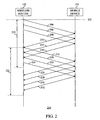
- FIG. 2 is an exemplary timing diagram 200 which reveals an increase in the window size for data packet transmissions between the wireless router system 102 and the mobile device 120 utilizing techniques of at least one of the preferred embodiments.
- the initial window size which is also the minimum window size, is set to three data packets
- the window size increment is set to one data packet
- the maximum window size is set to five data packets
- the mobile device 120 transmits an acknowledgment signal for each packet received.
- the wireless router system 102 begins to transmit the first set of data packets 204, 206, and 208, to the mobile device 120. As soon as the wireless router system 102 receives the first acknowledgment signal 210, which corresponds to data packet 204, it transmits next data packet 212, thereby keeping the number of "packets in flight" equal to three.
- the wireless router system 102 receives acknowledgment signals 214 and 216 corresponding to data packets 206 and 208, and transmits data packets 218 and 220. Because the round trip time for each of the first set of data packets 204, 206, and 208 is less than a first time threshold 222, the window size for the packets in flight is increased to four data packets, and the wireless router system transmits data packet 224 after data packet 220. The wireless router system 102 then receives corresponding acknowledgment signals 226, 228, 230, and 232 within the first time threshold 222. Although not shown in FIG.
- the window size would be increased to five data packets if more data packets were available.
- the wireless router system 102 would have transmitted four data packets in response to receiving each of the acknowledgment signals 226, 228, 230, and 232, and in addition, would have transmitted another data packet.
- FIG. 3 is an exemplary timing diagram 300 which reveals a decrease in the window size for data packet transmissions between the wireless router system 102 and the mobile device 120 when utilizing techniques of at least one of the preferred embodiments. In this example, all the conditions are the same as the example in FIG. 2 .
- the wireless router system 102 has the window size set to four data packets. At time 302, the wireless router system 102 begins to transmit the four data packets 304, 306, 308, and 310, to the mobile device 120. The mobile device 120 then transmits corresponding acknowledgment signal 312, 314, 316, and 318. As described previously, the wireless router system 102 transmits data packet 320, 322, and 324 in response to receiving the acknowledgment signal 312, 314, and 316 within the first time threshold. However, because the round trip time for data packet 310 is greater than the first time threshold 222, the window size is decreased to three data packets.
- a second time threshold is also shown in FIG. 3 as measured against data packet 310 and the corresponding acknowledgment signal 318. Data packets having round trip times longer than the second time threshold are considered to be lost, and are re-transmitted. Instead of actually measuring the time period longer than the second time threshold, the wireless router system 102 may consider a data packet to be lost if it fails to receive an acknowledgement signal corresponding to the data packet within the second time threshold.
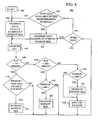
- FIG. 4 is an exemplary flowchart 400 illustrating the process of the adaptive window for data packet transmissions between the wireless router system 102 and the mobile device 120 in accordance with at least one of the preferred embodiments.
- the process begins in block 402 and the number of data packets matched for the default window size, which is also the minimum window size, is transmitted from the wireless router system 102 to the mobile device 120 in block 404.
- a round trip time (RTT) of each of the transmitted data packets is measured.
- the mobile device 120 may transmit an acknowledgment signal for every packet received individually.
- the mobile device 120 if it supports optimized acknowledgments, then it does not transmit an acknowledgment signal for each packet, but instead, transmits an acknowledgment signal upon receiving a set of data packets or upon expiration of a predetermined time period if incomplete set of data packets are received.
- the wireless router system 102 measures the round trip time as the time period between the transmission of the data packet and the receipt of the corresponding acknowledgment signal. The round trip time is indicative of the overall network traffic condition.
- the round trip time is determined to be within the first time threshold for the data packets transmitted within the current window in block 408, indicating the network traffic condition is good, whether the current window size can be increased is checked in block 410. If the current window size is less than the maximum window size and data packets filing the current window size are in flight, then the window size is increased by one data packet in block 412. If the current window size is already at the maximum size, the window size is unchanged. If there are more data to be transmitted in block 414, then the number of data packets matching the window size is transmitted in block 416. The process then repeats from block 406.
- the round trip time for the data packets is determined to be greater than the first time threshold in block 408, then whether the round trip time is within the second time threshold is determined in block 418. If the round trip time is within the second time threshold, but is greater than the first time threshold, then whether the current window size can be decreased is checked in block 420. If the current window size is greater than the minimum window size, then the window size is decreased by one data packet in block 422. If the current window size is already at the minimum size, then the window size is unchanged. If there are more data to be transmitted in block 414, then the number of data packets matching the window size is transmitted in block 416. The process then repeats from block 406.
- the data packets associated with the round trip time greater than the second time threshold are considered to be lost.
- Whether the current window size can be decreased is checked in block 424. If the current window size is greater than the minimum window size, then the window size is decreased by one data packet in block 426. If the current window size is already at the minimum size, then the window size is unchanged.
- the lost data packets are prepared to be re-transmitted in block 428, and whether there are more data to be transmitted in addition to the lost packets is checked in block 414. Then the number of data packets, including lost packets, matching the window size is transmitted in block 416. The process then repeats from block 406.
- the timing of the availability of the new data packets is evaluated in block 430. If the new data packets have become available within a predetermined interval after the initial data is exhausted in block 414, then these new data packets are first transmitted using the last-used window size in block 416. If the new data packets have become available after the predetermined interval, then these new data packets are first transmitted using the default window size in block 404.
- the window size may be increased or decreased by a single data packet (incrementing/decrementing) when appropriate.
- the window size may be increased or decreased with use of a predetermined algorithm different from such incrementing/decrementing (i.e. one where the window size is changed at a faster rate than incrementing/decrementing).
- the predetermined algorithm may be utilized for all such increases and decreases in the window size, or utilized only during or in response to the identification of predetermined events or conditions related to mobile device traffic.
- the window size adjustment according to the predetermined algorithm may be based on, for example, a current round trip time of communications or an elapsed time since previous successful communications have occurred.
- the window size adjustment according to the predetermined algorithm may provide for a doubling of the current window size for each increase in window size.
- a last-used window size may be used for transmitting if more data packets become available for transmitting to the mobile device within a predetermined interval after previous data packets are exhausted, but a default (minimum) window size for transmitting may be used if more data packets become available for transmitting to the mobile device after the predetermined interval.
- a default window size for transmitting may be used if more data packets become available for transmitting to the mobile device after the predetermined interval.
- a second variation of the technique after this first use of the default window size, what may immediately follow is the use of the last-used window size for transmitting if any of the more data packets are successfully delivered.
- the predetermined algorithm e.g. see specific examples above
- the window size is changed at a faster rate than incrementing/decrementing if any of the more data packets are successfully delivered.
- the wireless router system utilizes first and second time thresholds for determining adjustments to the window size.
- the first and the second time thresholds are initialized and set based on traffic conditions of a plurality of mobile communication devices (e.g. all of the mobile communication devices) operating in the wireless communication network through the wireless router system (i.e. not only the single mobile device with which communications are taking place).
- the first and the second time thresholds may be initialized and set based on a round trip time value derived based on round trip times for traffic associated with all of the mobile communication devices operating in the wireless communication network through the wireless router system.
- This round trip time value may be based on an average of all of the round trip times for the mobile communication devices over a period of time.
- the wireless router system operates to regularly or periodically derive the round trip time value based on the round trip times for the traffic and dynamically update the first and the second time thresholds per on-going operation.
- FIG. 5 is an exemplary block diagram of a wireless router system 102 configured to dynamically adjust a window size for data packet transmission to a wireless mobile communication device 120 through a wireless communication network 114.
- the wireless router system 102 has a transmitter 502 configured to transmit a number of data packets matched for a window size, and a receiver 504 configured to receive an acknowledgment signal associated with the number of data packets.
- the mobile device 120 may transmit an acknowledgment signal for every packet received individually. If the mobile device 120 supports optimized acknowledgments, it does not transmit an acknowledgment signal for each packet, but instead, transmits an acknowledgment signal upon receiving a set of data packets or upon expiration of a predetermined time period if incomplete set of data packets are received.
- the wireless router system 102 has a timer 506, which is coupled to the transmitter 502 and the receiver 504.
- the timer 506 is configured to measure the round trip time associated with the number of data packets, and measures the round trip time as the time period between the transmission of the data packets and the receipt of the acknowledgment signal.
- the round trip time is indicative of the overall network traffic condition.
- the wireless router system also has a window size adapter 508, which is coupled to the timer 506 and the transmitter 502, and is configured to adapt the window size based upon the round trip time.
- the window size adapter 508 is configured to increase the window size if the round trip time is within a first time threshold and to decrease the window size if the round trip time is more than the first time threshold.
- the window size adapter 508 is configured to change the window size by a predetermined increment, such as one data packet, and to increase the window size up to a predetermined maximum size and to decrease down to a predetermined minimum size.
- the window size adapter 508 is further configured to use a previous window size if more data packets become available within a predetermined interval after the previous data packets are exhausted. If more data become available after the predetermined interval, the window size adapter 508 uses a default window size.
- the timer 506 is further configured to equate the round trip time to be more than a second time threshold if the receiver 504 fails to receive the acknowledgment signal within the second time threshold.
- the data packets having the round trip time of more than the second time threshold are considered to be lost and are re-transmitted by the transmitter 502.
- an "in-flight" window (rather than a sliding window which may be utilized in some TCP communications) suitable for the present wireless environment and data applications.
- a sliding window approach of the prior art is useful where a stream of data is being communicated, and a first byte needs to be received before a second byte is useful (e.g. a streaming video).
- the sliding window approach is also useful where a very large file is being communicated and the receiver does not have sufficient memory available to buffer all of the data (e.g. downloading a new program).
- the permitted window size is three (3), the sender is permitted to send packets 1, 2, 3. If packet 1 is acknowledged, the sender is permitted to send packet 4. However, if packet 2 is acknowledged before packet 1, the sender is not permitted to send any other following packet until packet 1 is acknowledged.
- the sender is permitted to send another packet to the match the number of packets "in-flight".
- several different small independent messages may be sent at the same time, and the mobile device is able receive (and display, for example) a second message before it receives a first message.
- An advantage conferred by using a fixed value for the optimal round trip time is that it helps identify the optimal sending rate more quickly, since a large amount of traffic does not have to be sent first in order to calculate a good estimate of the minimum round trip time.
- the technique is particularly useful when the mobile device is operative to send, over a long period of time, a plurality of relatively short data bursts/messages (e.g. small incremental changes in data for data-synchronized communication with network applications, e-mail messages/data, calendar appointment message/data) with long periods of idle connections between each sending.
- the minimum round trip time would need to be re-learned each time a short message had to be sent.
- Another advantage of using a fixed value for the optimal round trip time is that more consistent sharing of the bandwidth is gained across different connections.
- the sender when a connection is idle, the sender drops the window size back to one (1) segment as the technique assumes that another device may now be using the network bandwidth. Therefore, the sender is not permitted to quickly start sending data at a fast data rate.
- the previous window size is retained for a predetermined time period (e.g. several minutes, such as between 1 and 10 minutes) and may be returned to more quickly. This technique is driven on the assumption that the limit in bandwidth is the RF over-the-air portion, which has less to do with other traffic (which may change quickly) and more to do with where the mobile device is located (which does not change too quickly).
- a method in a wireless router system for transmitting data packets to a mobile communication device through the wireless communication network based upon a round trip time associated with communication of each data packet is provided.
- the round trip time is a time period between the transmission of each data packet and reception of a corresponding acknowledgment signal from the mobile communication device.
- a number of data packets matched for a window size are transmitted to the mobile communication device, and a round trip time associated with communication of each of the transmitted data packets is measured.
- the window size for data packet transmission is re-sized by increasing the window size if the round trip time associated with the communication of each of the transmitted data packets is within a first time threshold, and decreasing the window size if the round trip time associated with the communication of any of the transmitted data packets is more than the first time threshold but less than a second time threshold.
- the window size is also decreased if the round trip time of any of the transmitted data packets is more than the second time threshold, where each such data packet is further marked as a lost data packet.
- a number of data packets matched for the re-sized window is subsequently transmitted, including a retransmission any data packets marked as lost.
- the steps of the method are repeated from the measuring step until data packets to be transmitted are exhausted.
Landscapes
- Engineering & Computer Science (AREA)
- Computer Networks & Wireless Communication (AREA)
- Signal Processing (AREA)
- Computer Security & Cryptography (AREA)
- Environmental & Geological Engineering (AREA)
- Databases & Information Systems (AREA)
- Data Exchanges In Wide-Area Networks (AREA)
- Mobile Radio Communication Systems (AREA)
- Communication Control (AREA)
Claims (28)
- Verfahren in einem drahtlosen Router-System (102) zur Verwendung bei einem Übertragen von Datenpaketen an eine drahtlose mobile Kommunikationsvorrichtung (120) über ein drahtloses Kommunikationsnetzwerk (114) basierend auf einer Umlaufzeit, die zu einer Kommunikation jedes Datenpakets gehört, wobei die Umlaufzeit die Zeitperiode zwischen der Übertragungjedes Datenpakets und einem Empfang des entsprechenden Bestätigungssignals von der mobilen Vorrichtung (120) ist, wobei das Verfahren aufweist:für eine Vielzahl von Datenpaketen, die von dem drahtlosen Router-System (102) an die mobile Vorrichtung (120) zu übertragen sind:anfängliches Übertragen (404) einer Anzahl von Datenpaketen, angepasst an eine Fenstergröße, die einer Standard-Fenstergröße entspricht;Messen (406) einer Umlaufzeit, die zu einer Kommunikation von jedem der übertragenen Datenpakete gehört;Erhöhen (412) der Fenstergröße, wenn die Umlaufzeit, die zu der Kommunikation von jedem der übertragenen Datenpakete gehört, innerhalb einer ersten Zeitschwelle ist;Verringern (422) der Fenstergröße, wenn die Umlaufzeit, die zu der Kommunikation von einem der übertragenen Datenpakete gehört, größer ist als die erste Zeitschwelle, aber geringer als eine zweite Zeitschwelle ist;wenn die Umlaufzeit, die zu der Kommunikation von einem der übertragenen Datenpakete gehört, größer ist als die zweite Zeitschwelle, Verringern (426) der Fenstergröße und Markieren jedes Datenpakets, dessen Umlaufzeit größer ist als die zweite Zeitschwelle, als ein verlorenes Datenpaket;Übertragen (416) einer Anzahl von Datenpaketen, angepasst an das größenangepasste Fenster, einschließlich erneuten Übertragens von Datenpaketen, die als verloren markiert sind;Wiederholen von dem Messschritt (406) an, bis die zu übertragenden Datenpakete aufgebraucht sind;für einen neuen Satz von Daten, der zu einer Vielzahl von neuen Datenpaketen gehört, die von dem drahtlosen Router-System (102) an dieselbe mobile Vorrichtung (120) zu übertragen sind, nachdem die vorherigen Datenpakete aufgebraucht sind:wenn die neuen Datenpakete verfügbar werden innerhalb eines vorgegebenen Intervalls, nachdem die vorherigen Datenpakete aufgebraucht sind (430): Wiederholen der obigen Schritte für die neuen Datenpakete, wobei die anfängliche Übertragung der Anzahl von neuen Datenpaketen auf eine Fenstergröße abgestimmt ist, die einer zuletzt verwendeten Fenstergröße entspricht (416); undansonsten, wenn die neuen Datenpakete verfügbar werden nach dem vorgegebenen Intervall (430): Wiederholen der obigen Schritte für die neuen Datenpakete, wobei die anfängliche Übertragung der Anzahl von neuen Datenpaketen auf eine Fenstergröße abgestimmt ist, die der Standard-Fenstergröße entspricht (404).
- Verfahren gemäß Anspruch 1, wobei ein Messen der Umlaufzeit von jedem der übertragenen Datenpakete umfasst:Identifizieren der Umlaufzeit eines Datenpakets als größer als die zweite Zeitschwelle bei einem Fehlschlagen eines Empfangens eines entsprechenden Bestätigungssignals innerhalb der zweiten Zeitschwelle.
- Verfahren gemäß Anspruch 1, wobei ein Erhöhen der Fenstergröße umfasst:Erhöhen (412) der Fenstergröße, wenn die Fenstergröße geringer ist als eine maximale Fenstergröße.
- Verfahren gemäß Anspruch 1, wobei ein Verringern der Fenstergröße weiter aufweist:Verringern (422) der Fenstergröße, wenn die Fenstergröße größer ist als eine Minimum-Fenstergröße.
- Verfahren gemäß Anspruch 1, wobei die Standard-Fenstergröße die Minimum-Fenstergröße aufweist.
- Verfahren gemäß Anspruch 1, wobei das Erhöhen der Fenstergröße ein Inkrement von einem Datenpaket aufweist.
- Verfahren gemäß Anspruch 1, wobei das Erhöhen der Fenstergröße eine Erhöhung um mehr als ein Datenpaket aufweist.
- Verfahren gemäß Anspruch 1, wobei das Erhöhen der Fenstergröße auf einem vorgegebenen Algorithmus basiert.
- Verfahren gemäß Anspruch 1, das weiter aufweist:Einstellen zumindest einer der ersten und zweiten Zeitschwellen basierend auf einem Verkehr einer Vielzahl von mobilenKommunikationsvorrichtungen, die in dem drahtlosen Kommunikationsnetzwerk (114) arbeiten, die über das drahtlose Router-System (102) arbeiten.
- Verfahren gemäß Anspruch 1, das weiter aufweist:regelmäßiges Aktualisieren der ersten und zweiten Zeitschwellen basierend auf einem Verkehr einer Vielzahl von mobilenKommunikationsvorrichtungen, die in dem drahtlosen Kommunikationsnetzwerk (114) über das drahtlose Router-System (102) arbeiten.
- Verfahren gemäß Anspruch 1, das weiter aufweist:Ableiten eines Umlaufzeitwerts basierend auf Umlaufzeiten, die zu einer Vielzahl von mobilen Kommunikationsvorrichtungen gehören, die in dem drahtlosen Kommunikationsnetzwerk (114) über das drahtlose Router-System (102) arbeiten; undAktualisieren der ersten und zweiten Zeitschwellen basierend auf dem abgeleiteten Umlaufzeitwert.
- Drahtloses Router-System (102), das konfiguriert ist für eine Datenpaketübertragung an eine drahtlose mobile Kommunikationsvorrichtung (120) über ein drahtloses Kommunikationsnetzwerk (114), wobei das drahtlose Router-System (102) aufweist:einen Sender (502), der konfiguriert ist, für eine Vielzahl von Datenpaketen, die von dem drahtlosen Router-System (102) an die mobile Vorrichtung (120) zu übertragen sind, zum anfänglichen Übertragen einer Anzahl von Datenpaketen, angepasst an eine Fenstergröße, die einer Standard-Fenstergröße entspricht;einen Empfänger (504), der konfiguriert ist zum Empfangen eines Bestätigungssignals, das einen Empfang eines entsprechenden Datenpakets durch die mobile Vorrichtung (120) anzeigt;einen Timer (506), der mit dem Sender und dem Empfänger verbunden ist, wobei der Timer konfiguriert ist zum Messen einer Umlaufzeit, die zu einer Kommunikation von jedem der Datenpakete gehört;einen Fenstergröße-Anpasser (508), der mit dem Timer und dem Sender verbunden ist, wobei der Fenstergröße-Anpasser (508) konfiguriert ist zum Anpassen der Fenstergröße basierend auf der Umlaufzeit, die zu der Kommunikation von jedem der Datenpakete gehört, derart, dass er die Fenstergröße vergrößert, wenn die Umlaufzeit innerhalb einer ersten Zeitschwelle ist, und die Fenstergröße verringert, wenn die Umlaufzeit von einem Datenpaket größer ist als die erste Zeitschwelle;wobei der Fenstergröße-Anpasser (502) weiter konfiguriert ist zum Verringern der Fenstergröße, wenn die Umlaufzeit von einem Datenpaket größer ist als eine zweite Zeitschwelle;wobei der Sender (502) weiter konfiguriert ist zum Übertragen einer Anzahl von Datenpaketen, angepasst an das größenangepasste Fenster,einschließlich erneutes Übertragen von Datenpaketen, deren Umlaufzeit größer ist als die zweite Zeitschwelle;wobei der Sender (502) weiter konfiguriert ist, für einen neuen Satz von Daten, die zu einer Vielzahl von neuen Datenpaketen gehören, die von dem drahtlosen Router-System (102) an dieselbe mobile Vorrichtung (120) zu übertragen sind, nachdem die vorherigen Datenpakete aufgebraucht sind,zum anfänglichen Übertragen einer Anzahl von neuen Datenpaketen,angepasst an eine Fenstergröße, die einer zuletzt verwendeten Fenstergröße entspricht, wenn die neuen Datenpakete verfügbar werden innerhalb eines vorgegebenen Zeitintervalls, nachdem die vorherigen Datenpakete aufgebraucht sind; undwobei der Sender (502) weiter konfiguriert ist, für den neuen Satz von Daten, die zu der neuen Vielzahl von neuen Datenpaketen gehören, die von dem drahtlosen Router-System (102) an dieselbe mobile Vorrichtung (120) zu übertragen sind, nachdem die vorherigen Datenpakete aufgebraucht sind, zum anfänglichen Übertragen einer Anzahl der neuen Datenpakete,angepasst an eine Fenstergröße, die der Standard-Fenstergröße entspricht,wenn die neuen Datenpakete verfügbar werden nach dem vorgegebenen Zeitintervall.
- Drahtloses Router-System (102) gemäß Anspruch 12, wobei die Umlaufzeit eine Zeitperiode zwischen der Übertragungjedes Datenpakets und einem Empfang eines entsprechenden Bestätigungssignals von der mobilen Vorrichtung (120) ist.
- Drahtloses Router-System (102) gemäß Anspruch 12, wobei der Fenstergröße-Anpasser (508) weiter konfiguriert ist zum Vergrößern der Fenstergröße um ein Datenpaket und zum Verringern der Fenstergröße um ein Datenpaket.
- Drahtloses Router-System (102) gemäß Anspruch 12, wobei der Fenstergröße-Anpasser (508) weiter konfiguriert ist zum Vergrößern der Fenstergröße, bis eine vorgegebene maximale Fenstergröße erreicht ist, und zum Verringern der Fenstergröße, bis eine vorgegebene Minimum-Fenstergröße erreicht ist.
- Drahtloses Router-System (102) gemäß Anspruch 12, wobei der Fenstergröße-Anpasser (508) weiter konfiguriert ist zum Einstellen zumindest einer der ersten und zweiten Zeitschwellen basierend auf einem Verkehr einer Vielzahl von mobilen Kommunikationsvorrichtungen, die in dem drahtlosen Kommunikationsnetzwerk (114) arbeiten, die über das drahtlose Router-System (102) arbeiten.
- Drahtloses Router-System (102) gemäß Anspruch 12, wobei der Fenstergröße-Anpasser (508) weiter konfiguriert ist zum regelmäßigen Aktualisieren zumindest einer der ersten und zweiten Zeitschwellen basierend auf einem Verkehr einer Vielzahl von mobilen Kommunikationsvorrichtungen, die in dem drahtlosen Kommunikationsnetzwerk (114) über das drahtlose Router-System (102) arbeiten.
- Drahtloses Router-System (102) gemäß Anspruch 12, wobei der Fenstergröße-Anpasser (508) weiter konfiguriert ist zum Ableiten eines Umlaufzeitwerts basierend auf Umlaufzeiten, die zu einer Vielzahl von mobilen Kommunikationsvorrichtungen gehören, die in dem drahtlosen Kommunikationsnetzwerk (114) über das drahtlose Router-System (102) arbeiten, und zum Aktualisieren der ersten und zweiten Zeitschwellen basierend auf der abgeleiteten Umlaufzeit.
- Drahtloses Router-System (102) gemäß Anspruch 12, wobei der Fenstergröße-Anpasser (508) weiter konfiguriert ist zum Erhöhen der Fenstergröße um mehr als ein Datenpaket.
- Drahtloses Router-System (102) gemäß Anspruch 12, wobei der Fenstergröße-Anpasser (508) weiter konfiguriert ist zum Erhöhen der Fenstergröße basierend auf einem vorgegebenen Algorithmus.
- Computerprogrammprodukt, das aufweist:ein computerlesbares Medium;Computeranweisungen, die in dem computerlesbaren Medium gespeichert sind;wobei die Computeranweisungen von einem oder mehreren Prozessor(en) durchgeführt werden zur Verwendung bei einem Übertragen einer Vielzahl von Datenpaketen an eine drahtlose mobile Kommunikationsvorrichtung (120) über ein drahtloses Kommunikationsnetzwerk (114) durch:anfängliches Veranlassen (404) eines Übertragens einer Anzahl von Datenpaketen, angepasst an eine Fenstergröße, die einer Standard-Fenstergröße entspricht;Messen (406) einer Umlaufzeit, die zu einer Kommunikation von jedem der übertragenen Datenpakete gehört, wobei die Umlaufzeit eine Zeitperiode zwischen der Übertragungjedes Datenpakets und dem Empfang eines entsprechenden Bestätigungssignals ist;Erhöhen (412) der Fenstergröße, wenn die Umlaufzeit, die zu der Kommunikation von jedem der übertragenen Datenpakete gehört, innerhalb einer ersten Zeitschwelle ist;Verringern (422) der Fenstergröße, wenn die Umlaufzeit, die zu der Kommunikation von einem der übertragenen Datenpakete gehört, größer ist als die erste Zeitschwelle, aber geringer als eine zweite Zeitschwelle ist;wenn die Umlaufzeit, die zu der Kommunikation von einem der übertragenen Datenpakete gehört, größer ist als die zweite Zeitschwelle, Verringern (426) der Fenstergröße und Markieren (428) jedes Datenpakets, dessen Umlaufzeit größer ist als die zweite Zeitschwelle, als ein verlorenes Datenpaket;Veranlassen (416) eines Übertragens einer Anzahl von Datenpaketen, angepasst an das größenangepasste Fenster, einschließlich erneutes Übertragen von Datenpaketen, die als verloren markiert sind;Wiederholen von dem Messschritt (416) an, bis die zu übertragenden Datenpakete aufgebraucht sind;wobei die Computeranweisungen von dem einem oder mehreren Prozessor(en) durchgeführt werden zur Verwendung bei einem Übertragen einer Vielzahl von neuen Datenpaketen für einen neuen Satz von Daten an dieselbe mobile Vorrichtung (120) über das drahtlose Kommunikationsnetzwerk (114) durch:wenn die neuen Datenpakete verfügbar werden innerhalb eines vorgegebenen Intervalls, nachdem die vorherigen Datenpakete aufgebraucht sind (430): Wiederholen der obigen Schritte für die neuen Datenpakete, wobei die anfängliche Übertragung der Anzahl von neuen Datenpaketen auf eine Fenstergröße abgestimmt ist, die einer zuletzt verwendeten Fenstergröße entspricht (416); undansonsten, wenn die neuen Datenpakete verfügbar werden nach dem vorgegebenen Intervall (430): Wiederholen der obigen Schritte für die neuen Datenpakete, wobei die anfängliche Übertragung der Anzahl von neuen Datenpaketen auf eine Fenstergröße abgestimmt ist, die der Standard-Fenstergröße entspricht (414).
- Computerprogrammprodukt gemäß Anspruch 21, wobei die Computeranweisungen weiter ausführbar sind zum Messen der Umlaufzeit von jedem der übertragenen Datenpakete durch Identifizieren der Umlaufzeit eines Datenpakets als größer als die zweite Zeitschwelle bei einem Fehlschlagen eines Empfangens eines entsprechenden Bestätigungssignals innerhalb der zweiten Zeitschwelle.
- Computerprogrammprodukt gemäß Anspruch 21, wobei die Computeranweisungen weiter ausführbar sind zum Anpassen der Fenstergröße durch Erhöhen (412) der Fenstergröße durch Erhöhen der Fenstergröße, wenn die Fenstergröße geringer ist als eine maximale Fenstergröße.
- Computerprogrammprodukt gemäß Anspruch 21, wobei die Computeranweisungen weiter ausführbar sind zum Anpassen der Fenstergröße durch Verringern (422) der Fenstergröße durch Verringern der Fenstergröße, wenn die Fenstergröße größer ist als eine Minimum-Fenstergröße.
- Computerprogrammprodukt gemäß Anspruch 21, wobei die Standard-Fenstergröße die Minimum-Fenstergröße ist.
- Computerprogrammprodukt gemäß Anspruch 21, wobei das Erhöhen (412) und Verringern (422) der Fenstergröße ein Inkrement von einem Datenpaket umfasst.
- Computerprogrammprodukt gemäß Anspruch 21, wobei die Computeranweisungen weiter ausführbar sind zum regelmäßigen Aktualisieren der ersten und zweiten Zeitschwellen basierend auf einem Verkehr einer Vielzahl von mobilen Kommunikationsvorrichtungen, die in dem drahtlosen Kommunikationsnetzwerk (114) arbeiten, die über das drahtlose Router-System (102) arbeiten.
- Computerprogrammprodukt gemäß Anspruch 21, wobei die Computeranweisungen weiter ausführbar sind zum Ableiten eines Umlaufzeitwerts basierend auf Umlaufzeiten, die zu einer Vielzahl von mobilen Kommunikationsvorrichtungen gehören, die in dem drahtlosen Kommunikationsnetzwerk (114) über das drahtlose Router-System (102) arbeiten, und zum Aktualisieren der ersten und zweiten Zeitschwellen basierend auf der abgeleiteten Umlaufzeit.
Applications Claiming Priority (2)
| Application Number | Priority Date | Filing Date | Title |
|---|---|---|---|
| US72285205P | 2005-09-30 | 2005-09-30 | |
| PCT/CA2006/001605 WO2007036046A1 (en) | 2005-09-30 | 2006-09-29 | Methods and apparatus for dynamically adjusting a data packet window size for data packet transmission in a wireless communication network |
Publications (3)
| Publication Number | Publication Date |
|---|---|
| EP1929687A1 EP1929687A1 (de) | 2008-06-11 |
| EP1929687A4 EP1929687A4 (de) | 2009-04-15 |
| EP1929687B1 true EP1929687B1 (de) | 2011-05-25 |
Family
ID=37899328
Family Applications (1)
| Application Number | Title | Priority Date | Filing Date |
|---|---|---|---|
| EP06790769A Active EP1929687B1 (de) | 2005-09-30 | 2006-09-29 | Verfahren und vorrichtungen zum dynamischen justieren einer datenpaket-fenstergrösse für die datenpaketübertragung in einem drahtlosen kommunikationsnetz |
Country Status (5)
| Country | Link |
|---|---|
| US (3) | US7869395B2 (de) |
| EP (1) | EP1929687B1 (de) |
| AT (1) | ATE511258T1 (de) |
| CA (1) | CA2624671C (de) |
| WO (1) | WO2007036046A1 (de) |
Cited By (1)
| Publication number | Priority date | Publication date | Assignee | Title |
|---|---|---|---|---|
| US9560405B2 (en) | 2011-02-14 | 2017-01-31 | Microsoft Technology Licensing, Llc | Background transfer service for applications on mobile devices |
Families Citing this family (41)
| Publication number | Priority date | Publication date | Assignee | Title |
|---|---|---|---|---|
| WO2007036046A1 (en) * | 2005-09-30 | 2007-04-05 | Research In Motion Limited | Methods and apparatus for dynamically adjusting a data packet window size for data packet transmission in a wireless communication network |
| US20070091922A1 (en) * | 2005-10-21 | 2007-04-26 | Steven Elliot | Method and apparatus for adaptive bandwidth control with a bandwidth guarantee |
| US7474614B2 (en) * | 2005-10-21 | 2009-01-06 | International Business Machines Corporation | Method and apparatus for adaptive bandwidth control with user settings |
| US7558271B2 (en) * | 2005-10-21 | 2009-07-07 | International Business Machines Corporation | Method and apparatus for adaptive bandwidth control with defined priorities for different networks |
| US8920343B2 (en) | 2006-03-23 | 2014-12-30 | Michael Edward Sabatino | Apparatus for acquiring and processing of physiological auditory signals |
| CA2673778C (en) * | 2006-12-28 | 2015-07-28 | Research In Motion Limited | Methods and apparatus for increasing data throughput by grouping data packets into maximum transmissible units |
| FR2922391B1 (fr) * | 2007-10-15 | 2009-12-04 | Canon Kk | Procede et dispositif de transmission de donnees |
| US7916658B2 (en) * | 2007-11-08 | 2011-03-29 | Siemens Enterprise Communications Gmbh & Co. Kg | Method for congestion detection in packet transmission networks |
| CN101207461B (zh) * | 2007-12-10 | 2011-04-20 | 华为技术有限公司 | 一种门限值自适应调整的方法和装置 |
| US20110158115A1 (en) * | 2009-04-01 | 2011-06-30 | Texas Instruments Inc. | Power Efficiency and Packet Delivery Ratio Through Micro Rate Control at Access Point Functionality Enabled Devices |
| WO2011098134A1 (en) * | 2010-02-12 | 2011-08-18 | Telefonaktiebolaget L M Ericsson (Publ) | Rate adaptation |
| US9019854B2 (en) | 2010-04-26 | 2015-04-28 | Telefonaktiebolaget L M Ericsson (Publ) | Method for setting and adjusting a parameter dependent on a round trip time |
| WO2012005609A1 (en) * | 2010-07-08 | 2012-01-12 | Blade Limited | File transfer system |
| US8477618B2 (en) | 2010-07-16 | 2013-07-02 | Research In Motion Limited | Methods and apparatus for use in communicating data packets within a data packet window having a size that is set based on quality of service (QoS) parameters |
| EP2408152B1 (de) * | 2010-07-16 | 2013-11-27 | BlackBerry Limited | Verfahren und Vorrichtung zur Nutzung bei der Übermittlung von Datenpaketen in einem Datenpakete-Fenster, das eine Größe hat, die basierend auf QOS-Parametern eingestellt ist |
| KR101333908B1 (ko) | 2010-09-24 | 2013-11-27 | 인텔 코오퍼레이션 | 액세스 포인트 혼잡 검출 및 감소를 위한 방법 및 시스템 |
| US9237324B2 (en) * | 2010-10-22 | 2016-01-12 | Phorus, Inc. | Playback synchronization |
| JP5598306B2 (ja) * | 2010-12-20 | 2014-10-01 | 富士通株式会社 | 中継装置および通信方法 |
| US8717916B2 (en) * | 2011-03-28 | 2014-05-06 | Citrix Systems, Inc. | Systems and methods for learning MSS of services |
| US9319330B2 (en) * | 2011-09-23 | 2016-04-19 | Oracle International Corporation | Apparatus and method for avoiding packet losses in a network connection |
| US10292066B2 (en) * | 2011-11-04 | 2019-05-14 | Cisco Technology, Inc. | System and method of modifying congestion control based on mobile system information |
| US9515942B2 (en) | 2012-03-15 | 2016-12-06 | Intel Corporation | Method and system for access point congestion detection and reduction |
| KR102132309B1 (ko) * | 2012-09-14 | 2020-07-09 | 디티에스, 인코포레이티드 | 재생 동기화 |
| CN104813303B (zh) * | 2012-09-14 | 2018-11-16 | Dts(英属维尔京群岛)有限公司 | 回放同步 |
| US10122645B2 (en) | 2012-12-07 | 2018-11-06 | Cisco Technology, Inc. | Output queue latency behavior for input queue based device |
| US20140281018A1 (en) * | 2013-03-13 | 2014-09-18 | Futurewei Technologies, Inc. | Dynamic Optimization of TCP Connections |
| US9628406B2 (en) * | 2013-03-13 | 2017-04-18 | Cisco Technology, Inc. | Intra switch transport protocol |
| US9860185B2 (en) | 2013-03-14 | 2018-01-02 | Cisco Technology, Inc. | Intra switch transport protocol |
| KR101535721B1 (ko) * | 2013-10-30 | 2015-07-10 | 삼성에스디에스 주식회사 | 큐잉 지연 추정 방법 및 장치 |
| HUE042554T2 (hu) * | 2014-02-24 | 2019-07-29 | Intel Ip Corp | Felhasználói készülék, számítógéppel olvasható közeg, valamint eljárás egy felhasználói készülék mobilitásának meghatározására egy Long Term Evolution rendszerû hálózatban |
| US20160323351A1 (en) | 2015-04-29 | 2016-11-03 | Box, Inc. | Low latency and low defect media file transcoding using optimized storage, retrieval, partitioning, and delivery techniques |
| JP6675943B2 (ja) * | 2016-07-06 | 2020-04-08 | アルプスアルパイン株式会社 | 通信装置 |
| CN108023758B (zh) * | 2016-11-04 | 2020-06-02 | 华为技术有限公司 | 一种混合接入网络中处理报文的方法及网络设备 |
| US10417235B2 (en) | 2017-02-03 | 2019-09-17 | International Business Machines Corporation | Window management in a stream computing environment |
| US10929210B2 (en) | 2017-07-07 | 2021-02-23 | Box, Inc. | Collaboration system protocol processing |
| US11470131B2 (en) | 2017-07-07 | 2022-10-11 | Box, Inc. | User device processing of information from a network-accessible collaboration system |
| US10389407B2 (en) * | 2017-11-17 | 2019-08-20 | Texas Instruments Incorporated | Electrical transformer to transmit data and power |
| CN111246421B (zh) * | 2019-12-31 | 2023-03-31 | 航天信息股份有限公司 | 传输数据的方法、装置、存储介质以及电子设备 |
| CN119892749A (zh) * | 2020-04-30 | 2025-04-25 | 中兴通讯股份有限公司 | 信元流特征值调整方法、装置、系统和存储介质 |
| US11811877B2 (en) | 2021-05-13 | 2023-11-07 | Agora Lab, Inc. | Universal transport framework for heterogeneous data streams |
| US12206737B2 (en) * | 2021-05-13 | 2025-01-21 | Agora Lab, Inc. | Universal transport framework for heterogeneous data streams |
Family Cites Families (28)
| Publication number | Priority date | Publication date | Assignee | Title |
|---|---|---|---|---|
| US5193151A (en) * | 1989-08-30 | 1993-03-09 | Digital Equipment Corporation | Delay-based congestion avoidance in computer networks |
| US5553083B1 (en) | 1995-01-19 | 2000-05-16 | Starburst Comm Corp | Method for quickly and reliably transmitting frames of data over communications links |
| US6646987B1 (en) | 1998-10-05 | 2003-11-11 | Nortel Networks Limited | Method and system for transmission control protocol (TCP) packet loss recovery over a wireless link |
| EP1077559A1 (de) * | 1999-08-17 | 2001-02-21 | Telefonaktiebolaget Lm Ericsson | Verfahren und Einrichtung zur Bestimmung eines Zeit-Parameters |
| KR100547851B1 (ko) | 1999-12-29 | 2006-02-01 | 삼성전자주식회사 | 부호분할 다중접속 시스템에서 데이터 전송 방법 |
| CN1200368C (zh) * | 2000-08-18 | 2005-05-04 | 清华大学 | 一种将tcp用于不可靠传输网络的局域重传方法 |
| AU2001288589A1 (en) * | 2000-08-31 | 2002-03-13 | The Regents Of The University Of California | Method for improving tcp performance over wireless links |
| US6707869B1 (en) * | 2000-12-28 | 2004-03-16 | Nortel Networks Limited | Signal-processing apparatus with a filter of flexible window design |
| JP4691804B2 (ja) | 2001-03-02 | 2011-06-01 | ソニー株式会社 | 無線伝送装置及び無線伝送方法 |
| US20030092392A1 (en) * | 2001-11-09 | 2003-05-15 | Sridhar Komandur | Weighted wireless early detection |
| US7154868B1 (en) * | 2002-01-08 | 2006-12-26 | Utstarcom, Inc. | Smooth handoff via state exchange in wireless networks |
| EP1383281A1 (de) * | 2002-07-19 | 2004-01-21 | TELEFONAKTIEBOLAGET LM ERICSSON (publ) | Verfahren zur Berechnung von Übertragungsfenstergrösse |
| US7382749B2 (en) * | 2002-11-26 | 2008-06-03 | Sony Corporation | Systems, methods, and apparatus with a common wireless communications protocol |
| US7583594B2 (en) * | 2003-01-31 | 2009-09-01 | Texas Instruments Incorporated | Adaptive transmit window control mechanism for packet transport in a universal port or multi-channel environment |
| JP3810421B2 (ja) | 2003-04-04 | 2006-08-16 | 富士通株式会社 | 無線アクセスシステムにおける移動端末と無線アクセスポイント |
| SE0301053D0 (sv) | 2003-04-07 | 2003-04-07 | Ericsson Telefon Ab L M | Method and system in a communications network |
| US7075890B2 (en) * | 2003-06-06 | 2006-07-11 | Meshnetworks, Inc. | System and method to provide fairness and service differentation in ad-hoc networks |
| GB2403378B (en) * | 2003-06-27 | 2007-05-30 | Ipwireless Inc | Method and arrangement for TCP flow control |
| JP4235506B2 (ja) * | 2003-08-14 | 2009-03-11 | 株式会社エヌ・ティ・ティ・ドコモ | 送信装置、中継装置およびプログラム |
| US7376143B2 (en) * | 2003-09-30 | 2008-05-20 | Intel Corporation | Systems and methods for contention control in wireless networks |
| JP4417733B2 (ja) * | 2004-01-15 | 2010-02-17 | ソニー・エリクソン・モバイルコミュニケーションズ株式会社 | 伝送方法及び装置 |
| US8125910B2 (en) * | 2004-06-25 | 2012-02-28 | Nec Corporation | Communication system |
| JP2008519533A (ja) * | 2004-11-05 | 2008-06-05 | メッシュネットワークス インコーポレイテッド | 多重ホッピング・ネットワークにおける、ノード間の経路選択用の輻輳があるルーティング・メトリックを提供するためのシステム及び方法 |
| US20060133281A1 (en) * | 2004-12-20 | 2006-06-22 | Motorola, Inc. | System for managing round trip time of a transmission control protocol and supporting method and apparatus |
| EP1878295A1 (de) | 2005-05-03 | 2008-01-16 | Nokia Corporation | Parameter der signalisierungs-dienstgüte (qos) für eine multimedia-sitzung |
| WO2007036046A1 (en) | 2005-09-30 | 2007-04-05 | Research In Motion Limited | Methods and apparatus for dynamically adjusting a data packet window size for data packet transmission in a wireless communication network |
| US8477614B2 (en) * | 2006-06-30 | 2013-07-02 | Centurylink Intellectual Property Llc | System and method for routing calls if potential call paths are impaired or congested |
| US7684332B2 (en) * | 2006-08-22 | 2010-03-23 | Embarq Holdings Company, Llc | System and method for adjusting the window size of a TCP packet through network elements |
-
2006
- 2006-09-29 WO PCT/CA2006/001605 patent/WO2007036046A1/en not_active Ceased
- 2006-09-29 CA CA2624671A patent/CA2624671C/en active Active
- 2006-09-29 US US11/536,874 patent/US7869395B2/en active Active
- 2006-09-29 EP EP06790769A patent/EP1929687B1/de active Active
- 2006-09-29 AT AT06790769T patent/ATE511258T1/de not_active IP Right Cessation
-
2010
- 2010-11-04 US US12/939,711 patent/US8233438B2/en active Active
-
2012
- 2012-07-06 US US13/542,972 patent/US8457053B2/en active Active
Cited By (2)
| Publication number | Priority date | Publication date | Assignee | Title |
|---|---|---|---|---|
| US9560405B2 (en) | 2011-02-14 | 2017-01-31 | Microsoft Technology Licensing, Llc | Background transfer service for applications on mobile devices |
| US10009850B2 (en) | 2011-02-14 | 2018-06-26 | Microsoft Technology Licensing, Llc | Background transfer service for applications on mobile devices |
Also Published As
| Publication number | Publication date |
|---|---|
| CA2624671A1 (en) | 2007-04-05 |
| US20120275336A1 (en) | 2012-11-01 |
| US20070076626A1 (en) | 2007-04-05 |
| ATE511258T1 (de) | 2011-06-15 |
| EP1929687A4 (de) | 2009-04-15 |
| CA2624671C (en) | 2012-01-03 |
| WO2007036046A1 (en) | 2007-04-05 |
| US20110051637A1 (en) | 2011-03-03 |
| EP1929687A1 (de) | 2008-06-11 |
| US8233438B2 (en) | 2012-07-31 |
| US8457053B2 (en) | 2013-06-04 |
| US7869395B2 (en) | 2011-01-11 |
Similar Documents
| Publication | Publication Date | Title |
|---|---|---|
| EP1929687B1 (de) | Verfahren und vorrichtungen zum dynamischen justieren einer datenpaket-fenstergrösse für die datenpaketübertragung in einem drahtlosen kommunikationsnetz | |
| US8930569B2 (en) | Methods and apparatus for optimum file transfers in a time-varying network emvironment | |
| US7898958B2 (en) | Communication system | |
| EP2109954B1 (de) | Ack-priorisierung in drahtlosen netzen | |
| KR100671002B1 (ko) | 전송창 크기 변경 과정을 조정하기 위한 무선 통신 시스템의 수신기 및 송신기 제어 방법 | |
| JP4898822B2 (ja) | 通信システム、通信装置、通信方法 | |
| EP2015500A1 (de) | Verfahren und einrichtung zur drahtlosen kommunikation | |
| CN102404187A (zh) | 拥塞控制方法和系统以及网络设备 | |
| US20080101290A1 (en) | Apparatus for Arq Controlling in Wireless Portable Internet System and Method Thereof | |
| WO2000027140A1 (en) | Method and apparatus for starting an acknowledgment timer | |
| WO2001078036A1 (en) | Joint range reject automatic repeat request protocol | |
| US8811500B2 (en) | Data transmission | |
| CN109905206A (zh) | 无线通信方法和设备 | |
| KR100895182B1 (ko) | 무선통신 시스템의 전송 제어 방법 | |
| US7609639B2 (en) | Negative acknowledgment (NAK) suppression | |
| KR100612654B1 (ko) | 자동 재송신 요청을 위한 프레임 생성 장치 및 방법 | |
| CN109151904B (zh) | 一种Lora报文重装及重传方法、发送端及接收端 | |
| US7154850B1 (en) | Wireless data transmission using time out control | |
| WO2004112407A1 (en) | A method of controlling radio link layer send window | |
| CN111200843A (zh) | 一种基于5g移动网络的跨层拥塞控制方法 |
Legal Events
| Date | Code | Title | Description |
|---|---|---|---|
| PUAI | Public reference made under article 153(3) epc to a published international application that has entered the european phase |
Free format text: ORIGINAL CODE: 0009012 |
|
| 17P | Request for examination filed |
Effective date: 20080331 |
|
| AK | Designated contracting states |
Kind code of ref document: A1 Designated state(s): AT BE BG CH CY CZ DE DK EE ES FI FR GB GR HU IE IS IT LI LT LU LV MC NL PL PT RO SE SI SK TR |
|
| AX | Request for extension of the european patent |
Extension state: AL BA HR MK RS |
|
| A4 | Supplementary search report drawn up and despatched |
Effective date: 20090313 |
|
| GRAP | Despatch of communication of intention to grant a patent |
Free format text: ORIGINAL CODE: EPIDOSNIGR1 |
|
| GRAS | Grant fee paid |
Free format text: ORIGINAL CODE: EPIDOSNIGR3 |
|
| GRAA | (expected) grant |
Free format text: ORIGINAL CODE: 0009210 |
|
| AK | Designated contracting states |
Kind code of ref document: B1 Designated state(s): AT BE BG CH CY CZ DE DK EE ES FI FR GB GR HU IE IS IT LI LT LU LV MC NL PL PT RO SE SI SK TR |
|
| AX | Request for extension of the european patent |
Extension state: AL BA HR MK RS |
|
| REG | Reference to a national code |
Ref country code: GB Ref legal event code: FG4D |
|
| REG | Reference to a national code |
Ref country code: CH Ref legal event code: EP |
|
| REG | Reference to a national code |
Ref country code: IE Ref legal event code: FG4D |
|
| REG | Reference to a national code |
Ref country code: DE Ref legal event code: R096 Ref document number: 602006022209 Country of ref document: DE Effective date: 20110707 |
|
| REG | Reference to a national code |
Ref country code: NL Ref legal event code: VDEP Effective date: 20110525 |
|
| PG25 | Lapsed in a contracting state [announced via postgrant information from national office to epo] |
Ref country code: LT Free format text: LAPSE BECAUSE OF FAILURE TO SUBMIT A TRANSLATION OF THE DESCRIPTION OR TO PAY THE FEE WITHIN THE PRESCRIBED TIME-LIMIT Effective date: 20110525 Ref country code: PT Free format text: LAPSE BECAUSE OF FAILURE TO SUBMIT A TRANSLATION OF THE DESCRIPTION OR TO PAY THE FEE WITHIN THE PRESCRIBED TIME-LIMIT Effective date: 20110926 Ref country code: SE Free format text: LAPSE BECAUSE OF FAILURE TO SUBMIT A TRANSLATION OF THE DESCRIPTION OR TO PAY THE FEE WITHIN THE PRESCRIBED TIME-LIMIT Effective date: 20110525 |
|
| PG25 | Lapsed in a contracting state [announced via postgrant information from national office to epo] |
Ref country code: FI Free format text: LAPSE BECAUSE OF FAILURE TO SUBMIT A TRANSLATION OF THE DESCRIPTION OR TO PAY THE FEE WITHIN THE PRESCRIBED TIME-LIMIT Effective date: 20110525 Ref country code: GR Free format text: LAPSE BECAUSE OF FAILURE TO SUBMIT A TRANSLATION OF THE DESCRIPTION OR TO PAY THE FEE WITHIN THE PRESCRIBED TIME-LIMIT Effective date: 20110826 Ref country code: LV Free format text: LAPSE BECAUSE OF FAILURE TO SUBMIT A TRANSLATION OF THE DESCRIPTION OR TO PAY THE FEE WITHIN THE PRESCRIBED TIME-LIMIT Effective date: 20110525 Ref country code: AT Free format text: LAPSE BECAUSE OF FAILURE TO SUBMIT A TRANSLATION OF THE DESCRIPTION OR TO PAY THE FEE WITHIN THE PRESCRIBED TIME-LIMIT Effective date: 20110525 Ref country code: CY Free format text: LAPSE BECAUSE OF FAILURE TO SUBMIT A TRANSLATION OF THE DESCRIPTION OR TO PAY THE FEE WITHIN THE PRESCRIBED TIME-LIMIT Effective date: 20110525 Ref country code: SI Free format text: LAPSE BECAUSE OF FAILURE TO SUBMIT A TRANSLATION OF THE DESCRIPTION OR TO PAY THE FEE WITHIN THE PRESCRIBED TIME-LIMIT Effective date: 20110525 Ref country code: BE Free format text: LAPSE BECAUSE OF FAILURE TO SUBMIT A TRANSLATION OF THE DESCRIPTION OR TO PAY THE FEE WITHIN THE PRESCRIBED TIME-LIMIT Effective date: 20110525 Ref country code: IS Free format text: LAPSE BECAUSE OF FAILURE TO SUBMIT A TRANSLATION OF THE DESCRIPTION OR TO PAY THE FEE WITHIN THE PRESCRIBED TIME-LIMIT Effective date: 20110925 Ref country code: ES Free format text: LAPSE BECAUSE OF FAILURE TO SUBMIT A TRANSLATION OF THE DESCRIPTION OR TO PAY THE FEE WITHIN THE PRESCRIBED TIME-LIMIT Effective date: 20110905 |
|
| PG25 | Lapsed in a contracting state [announced via postgrant information from national office to epo] |
Ref country code: NL Free format text: LAPSE BECAUSE OF FAILURE TO SUBMIT A TRANSLATION OF THE DESCRIPTION OR TO PAY THE FEE WITHIN THE PRESCRIBED TIME-LIMIT Effective date: 20110525 |
|
| PG25 | Lapsed in a contracting state [announced via postgrant information from national office to epo] |
Ref country code: EE Free format text: LAPSE BECAUSE OF FAILURE TO SUBMIT A TRANSLATION OF THE DESCRIPTION OR TO PAY THE FEE WITHIN THE PRESCRIBED TIME-LIMIT Effective date: 20110525 Ref country code: CZ Free format text: LAPSE BECAUSE OF FAILURE TO SUBMIT A TRANSLATION OF THE DESCRIPTION OR TO PAY THE FEE WITHIN THE PRESCRIBED TIME-LIMIT Effective date: 20110525 |
|
| PG25 | Lapsed in a contracting state [announced via postgrant information from national office to epo] |
Ref country code: SK Free format text: LAPSE BECAUSE OF FAILURE TO SUBMIT A TRANSLATION OF THE DESCRIPTION OR TO PAY THE FEE WITHIN THE PRESCRIBED TIME-LIMIT Effective date: 20110525 Ref country code: DK Free format text: LAPSE BECAUSE OF FAILURE TO SUBMIT A TRANSLATION OF THE DESCRIPTION OR TO PAY THE FEE WITHIN THE PRESCRIBED TIME-LIMIT Effective date: 20110525 Ref country code: PL Free format text: LAPSE BECAUSE OF FAILURE TO SUBMIT A TRANSLATION OF THE DESCRIPTION OR TO PAY THE FEE WITHIN THE PRESCRIBED TIME-LIMIT Effective date: 20110525 Ref country code: RO Free format text: LAPSE BECAUSE OF FAILURE TO SUBMIT A TRANSLATION OF THE DESCRIPTION OR TO PAY THE FEE WITHIN THE PRESCRIBED TIME-LIMIT Effective date: 20110525 |
|
| PLBE | No opposition filed within time limit |
Free format text: ORIGINAL CODE: 0009261 |
|
| STAA | Information on the status of an ep patent application or granted ep patent |
Free format text: STATUS: NO OPPOSITION FILED WITHIN TIME LIMIT |
|
| PG25 | Lapsed in a contracting state [announced via postgrant information from national office to epo] |
Ref country code: MC Free format text: LAPSE BECAUSE OF NON-PAYMENT OF DUE FEES Effective date: 20110930 |
|
| REG | Reference to a national code |
Ref country code: CH Ref legal event code: PL |
|
| 26N | No opposition filed |
Effective date: 20120228 |
|
| PG25 | Lapsed in a contracting state [announced via postgrant information from national office to epo] |
Ref country code: IT Free format text: LAPSE BECAUSE OF FAILURE TO SUBMIT A TRANSLATION OF THE DESCRIPTION OR TO PAY THE FEE WITHIN THE PRESCRIBED TIME-LIMIT Effective date: 20110525 |
|
| REG | Reference to a national code |
Ref country code: IE Ref legal event code: MM4A |
|
| REG | Reference to a national code |
Ref country code: DE Ref legal event code: R097 Ref document number: 602006022209 Country of ref document: DE Effective date: 20120228 |
|
| PG25 | Lapsed in a contracting state [announced via postgrant information from national office to epo] |
Ref country code: IE Free format text: LAPSE BECAUSE OF NON-PAYMENT OF DUE FEES Effective date: 20110929 Ref country code: LI Free format text: LAPSE BECAUSE OF NON-PAYMENT OF DUE FEES Effective date: 20110930 Ref country code: CH Free format text: LAPSE BECAUSE OF NON-PAYMENT OF DUE FEES Effective date: 20110930 |
|
| PG25 | Lapsed in a contracting state [announced via postgrant information from national office to epo] |
Ref country code: LU Free format text: LAPSE BECAUSE OF NON-PAYMENT OF DUE FEES Effective date: 20110929 |
|
| PG25 | Lapsed in a contracting state [announced via postgrant information from national office to epo] |
Ref country code: BG Free format text: LAPSE BECAUSE OF FAILURE TO SUBMIT A TRANSLATION OF THE DESCRIPTION OR TO PAY THE FEE WITHIN THE PRESCRIBED TIME-LIMIT Effective date: 20110825 |
|
| PG25 | Lapsed in a contracting state [announced via postgrant information from national office to epo] |
Ref country code: TR Free format text: LAPSE BECAUSE OF FAILURE TO SUBMIT A TRANSLATION OF THE DESCRIPTION OR TO PAY THE FEE WITHIN THE PRESCRIBED TIME-LIMIT Effective date: 20110525 |
|
| PG25 | Lapsed in a contracting state [announced via postgrant information from national office to epo] |
Ref country code: HU Free format text: LAPSE BECAUSE OF FAILURE TO SUBMIT A TRANSLATION OF THE DESCRIPTION OR TO PAY THE FEE WITHIN THE PRESCRIBED TIME-LIMIT Effective date: 20110525 |
|
| REG | Reference to a national code |
Ref country code: DE Ref legal event code: R082 Ref document number: 602006022209 Country of ref document: DE Representative=s name: MERH-IP MATIAS ERNY REICHL HOFFMANN, DE |
|
| REG | Reference to a national code |
Ref country code: DE Ref legal event code: R081 Ref document number: 602006022209 Country of ref document: DE Owner name: BLACKBERRY LIMITED, WATERLOO, CA Free format text: FORMER OWNER: RESEARCH IN MOTION LTD., WATERLOO, ONTARIO, CA Effective date: 20140925 Ref country code: DE Ref legal event code: R082 Ref document number: 602006022209 Country of ref document: DE Representative=s name: MERH-IP MATIAS ERNY REICHL HOFFMANN, DE Effective date: 20140925 Ref country code: DE Ref legal event code: R082 Ref document number: 602006022209 Country of ref document: DE Representative=s name: MERH-IP MATIAS ERNY REICHL HOFFMANN PATENTANWA, DE Effective date: 20140925 |
|
| REG | Reference to a national code |
Ref country code: FR Ref legal event code: PLFP Year of fee payment: 11 |
|
| REG | Reference to a national code |
Ref country code: FR Ref legal event code: PLFP Year of fee payment: 12 |
|
| REG | Reference to a national code |
Ref country code: FR Ref legal event code: PLFP Year of fee payment: 13 |
|
| REG | Reference to a national code |
Ref country code: DE Ref legal event code: R082 Ref document number: 602006022209 Country of ref document: DE Ref country code: DE Ref legal event code: R081 Ref document number: 602006022209 Country of ref document: DE Owner name: MALIKIE INNOVATIONS LTD., IE Free format text: FORMER OWNER: BLACKBERRY LIMITED, WATERLOO, ONTARIO, CA |
|
| PGFP | Annual fee paid to national office [announced via postgrant information from national office to epo] |
Ref country code: DE Payment date: 20250926 Year of fee payment: 20 |
|
| PGFP | Annual fee paid to national office [announced via postgrant information from national office to epo] |
Ref country code: GB Payment date: 20250923 Year of fee payment: 20 |
|
| PGFP | Annual fee paid to national office [announced via postgrant information from national office to epo] |
Ref country code: FR Payment date: 20250925 Year of fee payment: 20 |