EP1930233A2 - Contrôleur de suspension et véhicule - Google Patents
Contrôleur de suspension et véhicule Download PDFInfo
- Publication number
- EP1930233A2 EP1930233A2 EP20070254695 EP07254695A EP1930233A2 EP 1930233 A2 EP1930233 A2 EP 1930233A2 EP 20070254695 EP20070254695 EP 20070254695 EP 07254695 A EP07254695 A EP 07254695A EP 1930233 A2 EP1930233 A2 EP 1930233A2
- Authority
- EP
- European Patent Office
- Prior art keywords
- damping force
- suspension system
- speed
- threshold
- vehicle
- Prior art date
- Legal status (The legal status is an assumption and is not a legal conclusion. Google has not performed a legal analysis and makes no representation as to the accuracy of the status listed.)
- Granted
Links
Images







Classifications
-
- B—PERFORMING OPERATIONS; TRANSPORTING
- B62—LAND VEHICLES FOR TRAVELLING OTHERWISE THAN ON RAILS
- B62K—CYCLES; CYCLE FRAMES; CYCLE STEERING DEVICES; RIDER-OPERATED TERMINAL CONTROLS SPECIALLY ADAPTED FOR CYCLES; CYCLE AXLE SUSPENSIONS; CYCLE SIDECARS, FORECARS, OR THE LIKE
- B62K25/00—Axle suspensions
- B62K25/04—Axle suspensions for mounting axles resiliently on cycle frame or fork
-
- B—PERFORMING OPERATIONS; TRANSPORTING
- B60—VEHICLES IN GENERAL
- B60G—VEHICLE SUSPENSION ARRANGEMENTS
- B60G17/00—Resilient suspensions having means for adjusting the spring or vibration-damper characteristics, for regulating the distance between a supporting surface and a sprung part of vehicle or for locking suspension during use to meet varying vehicular or surface conditions, e.g. due to speed or load
- B60G17/015—Resilient suspensions having means for adjusting the spring or vibration-damper characteristics, for regulating the distance between a supporting surface and a sprung part of vehicle or for locking suspension during use to meet varying vehicular or surface conditions, e.g. due to speed or load the regulating means comprising electric or electronic elements
- B60G17/016—Resilient suspensions having means for adjusting the spring or vibration-damper characteristics, for regulating the distance between a supporting surface and a sprung part of vehicle or for locking suspension during use to meet varying vehicular or surface conditions, e.g. due to speed or load the regulating means comprising electric or electronic elements characterised by their responsiveness, when the vehicle is travelling, to specific motion, a specific condition, or driver input
- B60G17/0164—Resilient suspensions having means for adjusting the spring or vibration-damper characteristics, for regulating the distance between a supporting surface and a sprung part of vehicle or for locking suspension during use to meet varying vehicular or surface conditions, e.g. due to speed or load the regulating means comprising electric or electronic elements characterised by their responsiveness, when the vehicle is travelling, to specific motion, a specific condition, or driver input mainly during accelerating or braking
-
- B—PERFORMING OPERATIONS; TRANSPORTING
- B60—VEHICLES IN GENERAL
- B60G—VEHICLE SUSPENSION ARRANGEMENTS
- B60G17/00—Resilient suspensions having means for adjusting the spring or vibration-damper characteristics, for regulating the distance between a supporting surface and a sprung part of vehicle or for locking suspension during use to meet varying vehicular or surface conditions, e.g. due to speed or load
- B60G17/06—Characteristics of dampers, e.g. mechanical dampers
- B60G17/08—Characteristics of fluid dampers
-
- B—PERFORMING OPERATIONS; TRANSPORTING
- B60—VEHICLES IN GENERAL
- B60G—VEHICLE SUSPENSION ARRANGEMENTS
- B60G2400/00—Indexing codes relating to detected, measured or calculated conditions or factors
- B60G2400/20—Speed
- B60G2400/204—Vehicle speed
-
- B—PERFORMING OPERATIONS; TRANSPORTING
- B60—VEHICLES IN GENERAL
- B60G—VEHICLE SUSPENSION ARRANGEMENTS
- B60G2400/00—Indexing codes relating to detected, measured or calculated conditions or factors
- B60G2400/25—Stroke; Height; Displacement
- B60G2400/252—Stroke; Height; Displacement vertical
-
- B—PERFORMING OPERATIONS; TRANSPORTING
- B60—VEHICLES IN GENERAL
- B60G—VEHICLE SUSPENSION ARRANGEMENTS
- B60G2400/00—Indexing codes relating to detected, measured or calculated conditions or factors
- B60G2400/30—Propulsion unit conditions
- B60G2400/33—Throttle position
-
- B—PERFORMING OPERATIONS; TRANSPORTING
- B60—VEHICLES IN GENERAL
- B60G—VEHICLE SUSPENSION ARRANGEMENTS
- B60G2800/00—Indexing codes relating to the type of movement or to the condition of the vehicle and to the end result to be achieved by the control action
- B60G2800/16—Running
- B60G2800/164—Heaving; Squatting
-
- B—PERFORMING OPERATIONS; TRANSPORTING
- B62—LAND VEHICLES FOR TRAVELLING OTHERWISE THAN ON RAILS
- B62K—CYCLES; CYCLE FRAMES; CYCLE STEERING DEVICES; RIDER-OPERATED TERMINAL CONTROLS SPECIALLY ADAPTED FOR CYCLES; CYCLE AXLE SUSPENSIONS; CYCLE SIDECARS, FORECARS, OR THE LIKE
- B62K25/00—Axle suspensions
- B62K25/04—Axle suspensions for mounting axles resiliently on cycle frame or fork
- B62K2025/044—Suspensions with automatic adjustment
Definitions
- the present invention relates to a suspension controller and a vehicle.
- a vehicle can suppress a squat (a downward deflection) of the vehicle body during acceleration by controlling a damping force of a suspension system (for example, refer to JP-B Hei 2-14206 ).
- a squat a downward deflection
- Such a vehicle has a facility for detecting that the opening speed of a throttle valve is equal to or higher than a predefined value and that the throttle valve is being opened suddenly. When the throttle valve is opened suddenly, the damping force of the suspension system is changed to suppress the squat.
- An object of an embodiment of the present invention in view of such situation described above, is to provide a suspension controller for improving ride comfort and driving stability and a vehicle provided with such a suspension controller.
- the suspension controller according to a first aspect of the invention is adapted to be mounted on a vehicle having:
- the suspension controller according to a second aspect of the invention is adapted to be mounted on a vehicle having:
- the suspension controller is mounted on a vehicle having an engine, a throttle valve for adjusting the amount of an air intake of the engine, a throttle angle detection apparatus for detecting an angle of the throttle valve, a vehicle speed sensor for detecting a vehicle speed, a front wheel, a rear wheel, a front wheel side suspension system for absorbing an impact on the front wheel, and a rear wheel side suspension system for absorbing the impact on the rear wheel in order to control each of damping forces on an expansion side and on a contraction side in the front wheel side suspension system and in the rear wheel side suspension system, having an opening speed calculation device for calculating an opening speed of the throttle valve on the basis of a detection result of the throttle angle detection apparatus, a squat suppression device for setting either or both of the damping force on the expansion side of the front wheel side suspension system and the damping force on the contraction side of the rear wheel suspension device higher than the damping force of a time when the opening speed is less than a first threshold, and a first threshold setting device for setting the first
- the squat suppression control for suppressing a squat of the vehicle is executed. Either or both of the damping force on the expansion side of the front wheel side suspension system and the damping force on the contraction side of the rear wheel side suspension system are set high in the squat suppression control.
- the first threshold is set corresponding to the vehicle speed in the suspension controller. In this constitution, the opening speed of the throttle valve while the squat suppression control is executed can be set according to the vehicle speed. As a result, it is possible to improve ride comfort and driving stability.
- the suspension controller is mounted on a vehicle having an engine, a throttle valve for adjusting the amount of an air intake of the engine, a throttle angle detection apparatus for detecting the angle of the throttle valve, a vehicle speed sensor for detecting a vehicle speed, a front wheel, a rear wheel, a front wheel side suspension system for absorbing an impact on the front wheel, and a rear wheel side suspension system for absorbing an impact on the rear wheel in order to control each of damping forces on an expansion side and on a contraction side in the front wheel side suspension system and in the rear wheel side suspension system, having a shutting speed calculation device for calculating a shutting speed of the throttle valve on the basis of a detection result of the throttle angle detection apparatus, a diving suppression device for setting either or both of the damping force on the contraction side of the front wheel side suspension system and the damping force on the expansion side of the rear wheel suspension device higher than the damping force of a time when the shutting speed is less than a third threshold while the shutting speed calculated by the shutting
- the diving suppression control is executed to suppress the diving described above. Either or both of the damping force on the contraction side of the front wheel side suspension system and the damping force on the expansion side of the rear wheel side suspension system are set high in the diving suppression control.
- the third threshold is set corresponding to the vehicle speed in the suspension controller. In this constitution, when the diving suppression control is executed, the shutting speed of the throttle valve can be set according to the vehicle speed. As a result, it is possible to improve ride comfort and driving stability.
- a method of controlling the front wheel suspension system and the rear wheel suspension system of a vehicle comprising increasing one or both of the damping force on expansion of the front wheel suspension system and the damping force on contraction of the rear wheel suspension system when the opening speed of the vehicle engine throttle is equal to or higher than a first threshold; and setting the first threshold corresponding to the vehicle speed.
- a method of controlling the front wheel suspension system and the rear wheel suspension system of a vehicle comprising increasing one or both of the damping force on contraction of the front wheel suspension system and the damping force on expansion of the rear wheel suspension system when the shutting speed of the vehicle engine throttle is equal to or higher than a third threshold; and setting the third threshold corresponding to the vehicle speed.
- squat and diving may be suppressed optimally. Moreover, it is possible to improve ride comfort and driving stability.
- a vehicle according to an embodiment of the present invention is a motorcycle 10.
- the motorcycle 10 has a body frame 11 forming a framework and a seat 16 on which a rider sits.
- the rider seated on the seat 16 drives the vehicle, straddling the body frame 11.
- the type of vehicle of the present invention is not limited to the type shown in FIG. 1 , and a so-called moped type vehicle can be used.
- the maximum speed, the displacement, the size of the vehicle, and so forth are not limited either.
- the vehicle is not limited to a motorcycle but can be another vehicle such as a four-wheel buggy.
- horizontal positions such as the front, the rear, the left, and the right refer to positions viewed by the rider sitting on the seat 16.
- the body frame 11 has a steering head pipe 12, a main frame 13 extending downward and rearward from the steering head pipe 12, and seat rails 14 on the left and right sides extending upward and rearward from a middle part of the main frame 13.
- a front wheel 19 is supported by the steering head pipe 12 via a front wheel suspension system 150.
- the front wheel suspension system 150 is a system for absorbing an impact applied to the front wheel 19 from a road or the like.
- the front wheel suspension system 150 has a hydraulic buffer 151 (refer to FIG. 3 ) and a contraction coil spring (not shown in the drawing) . This contraction coil spring absorbs an impact on the front wheel 19.
- the hydraulic buffer 151 generates the damping force on expansion and on contraction of the front wheel side suspension system 150.
- a fuel tank 20 and the seat 16 are supported on the seat rails 14.
- the seat 16 extends behind the fuel tank 20 in the direction of the rear ends of the seat rails 14.
- a pair of rear arm brackets 24 on the left and right sides are provided to the rear end of the main frame 13.
- the rear arm brackets 24 and others provided to the main frame 13 are parts of the body frame 11.
- the rear arm brackets 24 extend downward from the rear end of the main frame 13.
- a pivot shaft 38 is provided on the rear arm brackets 24.
- the front end of a rear arm 25 is swingably supported by the pivot shaft 38.
- a rear wheel 26 is supported by the rear end of the rear arm 25.
- the rear arm 25 is supported by the body frame 11 via a link mechanism 27 and a rear wheel suspension system 180.
- the rear wheel suspension system 180 is a system for absorbing an impact applied to the rear wheel 26 from a road or the like.
- the rear wheel suspension system 180 has the hydraulic buffer 151 (refer to FIG. 3 ) and a contraction coil spring (not shown in the drawing) . This contraction coil spring absorbs an impact on the rear wheel 26.
- the hydraulic buffer 151 generates the damping force on expansion and on contraction of the rear wheel side suspension system 180.
- An engine unit 28 for driving the rear wheel 26 is supported by the body frame 11.
- a crankcase 35 is suspendedly supported by the main frame 13.
- the engine unit 28 has a gasoline engine (not shown in the drawing).
- the engine of the engine unit 28 is not limited to an internal combustion engine such as a gasoline engine but can be an electric or other motor.
- the engine can be an engine provided by a combination of a gasoline engine and an electric motor. Accordingly, references herein to throttle valves, throttle valve angles, throttle opening settings and speeds and the like are intended to encompass the corresponding controls provided on an engine or motor which does not include a throttle or throttle valve, includes an alternative form of engine or intake control, or includes an alternate engine or motor speed control mechanism.
- the motorcycle 10 has a front cowl 33 and leg shields 34 on the left and right sides.
- the leg shields 34 are members for covering front sides of the feet of the rider.
- a brake pedal is provided to the lower part on the right side of the motorcycle 10 though not shown in the drawing.
- the brake pedal is for stopping the rear wheel 26.
- the front wheel 19 is stopped by operating a brake lever 103 (refer to FIG. 2 ) provided in the vicinity of a right grip 41R (an accelerator grip) on a handlebar 41.
- a clutch lever 104 is provided in the vicinity of a left grip 41L on the handlebar 41.
- a clutch 54 (refer to FIG. 2 ) is disengaged by operating the clutch lever 104.
- a shift pedal 115 is provided to the lower part on the left side of the motorcycle 10.
- a gear of a transmission 80 (refer to FIG. 2 ) is shifted by operating the shift pedal 115.
- FIG. 2 illustrates the constitution of the driveline system of the motorcycle 10 shown in FIG. 1 .
- the right grip 41R on the handlebar 41 constitutes the accelerator grip.
- An accelerator input sensor 42 is mounted on the accelerator grip.
- the accelerator input sensor 42 detects the amount of the operation on the right grip 41R (the amount of the operation of the accelerator) by the rider.
- An indicator 45 for displaying a current gear position is provided to the middle part of the handlebar 41.
- a shift position can be changed to a higher position or to a lower position between the neutral and the sixth gear, the highest gear, by an operation of the shift pedal 115 (refer to FIG. 1 ) in this embodiment.
- a throttle valve 46 is mounted on a throttle 47 constituting an intake air passage.
- a throttle drive actuator 49 is provided to the right end of a valve stem 48 of the throttle valve 46, and a throttle angle sensor 50 is provided to the left end.
- the throttle angle sensor 50 detects an angle of the throttle valve 46 (a throttle angle).
- This throttle angle sensor 50 is one embodiment of the throttle setting detection apparatus of the present invention. It is also within the scope of the present invention that the throttle angle is indirectly detected by the amount of operation of the accelerator detected with the accelerator input sensor 42. In a case like this, the accelerator input sensor 42 functions as the throttle setting detection apparatus of the present invention.
- An electronically controlled throttle device 51 is constituted with the right grip 41R as the accelerator grip, the throttle 47, the throttle drive actuator 49, and the throttle angle sensor 50.
- An engine speed sensor 53 is provided on the right side of the right end of a crankshaft 52 of the engine unit 28.
- the crankshaft 52 is connected to a main shaft 55 via the clutch 54 of a wet multiple disc type.
- the clutch 54 has a clutch housing 54a and a clutch boss 54b.
- a multiplicity of friction plates 54c is mounted in the clutch housing 54a.
- a multiplicity of clutch plates 54d is mounted on the clutch boss 54b.
- Each of the clutch plates 54d is disposed between adjacent friction plates 54c. The distances between the friction plates 54c and the clutch plates 54d vary by operating the clutch lever 104, so that the clutch 54 is engaged or disengaged.
- each of the shift gears 57 mounted on the main shaft 55 meshes with each of shift gears 59 mounted on a drive shaft 58.
- the drive shaft 58 is disposed in parallel with the main shaft 55.
- the shift gears 57 and the shift gears 59 are separately illustrated in FIG. 2 for convenience of description.
- the shift gears 57 and the shift gears 59 are mounted so that gears other than a selected gear rotate freely in relation to either or both of the main shaft 55 and the drive shaft 58. Accordingly, the drive force from the main shaft 55 to the drive shaft 58 is transmitted only via one selected pair of shift gears.
- the state in which one pair of the shift gears 57 and 59 meshes to transmit the drive force from the main shaft 55 to the drive shaft 58 is a gear-in state.
- An operation for shifting a gear by selecting the shift gears 57 and the shift gears 59 is made by using a shift cam 79.
- a plurality of cam grooves 60 (three in FIG. 2 ) is formed in the shift cam 79.
- Shift forks 61 are mounted in each of the cam grooves 60.
- Each of the shift forks 61 engages with a predefined gear in the shift gears 57 and 59 on the main shaft 55 and the drive shaft 58.
- a predefined gear in the shift gears 57 and 59 fitted in the main shaft 55 and the drive shaft 58 by a spline moves axially, being linked with the movement of the shift forks 61. Consequently, as the shift gears 57 and 59 having axially moved engage with some other shift gears 57 and 59 rotating freely in relation to the main shaft 55 and the drive shaft 58, gears are shifted.
- the transmission 80 is constituted with the shift gears 57 and 59 and the shift cam 79.
- a vehicle speed sensor 69 is provided to the drive shaft 58.
- a gear position sensor 70 for detecting the gear position is linked to the shift cam 79.
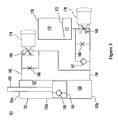
- FIG. 3 is a drawing for illustrating a simplified view of the constitution of the hydraulic buffer 151 provided to the front wheel suspension system 150 shown in FIG. 1 . Since the constitution of the hydraulic buffer 151 provided to the rear wheel suspension system 180 is generally similar to the constitution of the hydraulic buffer 151 of the front wheel suspension system 150, its description is omitted.
- the hydraulic buffer 151 has a hydraulic cylinder 153 and a piston 154 movably fitted together by insertion into the hydraulic cylinder 153.
- the hydraulic cylinder 153 has a tube 153a generally in a cylindrical shape. The lower end of the tube 153a is shut by a head cover 153b, and its upper end is shut by a rod cover 153c.
- the inside of the hydraulic cylinder 153 is filled with hydraulic fluid.
- the piston 154 is fitted together by insertion into the tube 153a.
- the inside of the hydraulic cylinder 153 is divided into a rod side oil chamber 157 and a head side oil chamber 158.
- the piston 154 moves to the side of the rod cover 153c (to the upper side in the drawing)
- the total length of the hydraulic buffer 151 expands. This process is referred to as an expansion process.
- the piston 154 moves to the side of the head cover 153b (to the lower side in the drawing)
- the total length of the hydraulic buffer 151 contracts. This process is referred to as a contraction process.
- a check valve 159 is provided to the piston 154.
- the check valve 159 passes hydraulic fluid from the head side oil chamber 158 only to the rod side oil chamber 157.
- a first oil passage 163 is connected to the rod side oil chamber 157 in the hydraulic cylinder 153.
- An expansion side damping force control valve 165 described below and a fixed throttle 166 for generating the damping force are parallely provided to the first oil passage 163.
- a second oil passage 164 is connected to the head side oil chamber 158 in the hydraulic cylinder 153.
- a check valve 167, a fixed throttle 168 for generating the damping force, and a contraction side damping force control valve 169 described below are parallely provided to the second oil passage 164.
- the first oil passage 163 is connected to a part between the head side oil chamber 158 and the check valve 167 in the second oil passage 164.
- An accumulator 170 is connected to the second oil passage 164.
- the accumulator 170 has a gas chamber 173 filled with high pressure gas, an oil chamber 171 filled with hydraulic fluid, and a movable partition 172 for separating the gas chamber 173 and the oil chamber 171.
- the second oil passage 164 is connected to the oil chamber 171 of the accumulator 170.
- This accumulator 170 urges the hydraulic fluid in the oil chamber 171 by the pressure of the high pressure gas in the gas chamber 173.
- the check valve 167 is connected so that the hydraulic fluid flows from the side of the accumulator 170 only to the head side oil chamber 158.
- the fixed throttles 166 and 168 are constituted with an orifice and a tabular valve.
- the fixed throttle 166 provided to the first oil passage 163 generates the damping force by the flow of the hydraulic fluid from the upper side to the lower side when the hydraulic buffer 151 is in an expansion process.
- the fixed throttle 168 provided to the second oil passage 164 generates the damping force by the flow of the hydraulic fluid from the lower side to the upper side when the hydraulic buffer 151 is in a contraction process.
- the expansion side damping force control valve 165 and the contraction side damping force control valve 169 pass the hydraulic fluid to the side of the accumulator 170 (to the side of a low pressure) when the oil pressure on the side of the hydraulic cylinder 153 (on the side of a high pressure) exceeds a predefined release pressure.
- the release pressure is increased or decreased by linear solenoids 174 and 178 provided in the expansion side damping force control valve 165 and in the contraction side damping force control valve 169 respectively.
- the expansion side damping force control valve 165 changes the damping force generated when a piston rod 155 is in the expansion process (the damping force of the expansion side) .
- the contraction side damping force control valve changes the damping force generated when the piston rod 155 is in the contraction process (the damping force of the contraction side).
- the linear solenoids 174 and 178 described above are operated and controlled by a suspension controller 100 shown in FIG. 4 .
- FIG. 4 is a block diagram illustrating a simplified view of the constitution of the suspension controller 100.
- Stroke sensors 160 and 190, the throttle angle sensor 50, and the vehicle speed sensor 69 are provided as apparatuses for providing signals to the suspension controller 100.
- the stroke sensor 160 detects the amount of the stroke of the front wheel suspension system 150.
- the stroke sensor 190 detects the amount of the stroke of the rear wheel suspension system 180.
- the amounts of the strokes calculated by the stroke sensors 160 and 190 are input to a stroke speed calculation module 101 provided to the suspension controller 100 respectively.
- the stroke speed calculation module 101 calculates a stroke speed change of the front wheel suspension system 150 and the rear wheel side suspension system 180 on the basis of the input amounts of the strokes.
- the stroke speed change calculated in the stroke speed calculation module 101 is input to a standard damping force setting module 102 provided to the suspension controller 100.
- the standard damping force setting module 102 sets a standard damping force on the basis of the input stroke speed change.
- the standard damping force is one element for determining the damping force finally generated in the front wheel suspension system 150 and in the rear wheel suspension system 180 (a final damping force). Specifically, the sum of the standard damping force, an additional damping force described below, and a fixed damping force described below is the final damping force.
- a damping force determination module 111 connected to the standard damping force setting module 102 determines the final damping force.
- the throttle angle detected by the throttle angle sensor 50 is input to each of a throttle speed change calculation module 112 and a threshold comparison module 109 of the suspension controller 100 .
- the throttle speed change calculation module 112 calculates the speed change of the throttle angle on the basis of the input throttle angle.
- the speed change is referred to as an opening speed.
- the speed change is referred to as a shutting speed.
- the threshold comparison module 109 compares the speed change input from the throttle speed change calculation module 112 (the opening speed or the shutting speed) with the threshold in relation to the opening speed or the shutting speed set by an opening/shutting speed threshold setting module 108 described below (an opening speed threshold or a shutting speed threshold) .
- the threshold comparison module 109 compares the throttle angle input from the throttle angle sensor 50 with the threshold in relation to the throttle angle set by an opening threshold setting module described below (an angle threshold).
- a comparison result by the threshold comparison module 109 is input to an additional damping force setting module 110 of the suspension controller 100.
- the additional damping force setting module 110 determines whether an additional damping force is to be set or not on the basis of the comparison result.
- the additional damping force setting module 110 sets an additional damping force on the basis of a damping force map selected by a damping force map selection module 105 described below when having determined that an additional damping force is to be set.
- the additional damping force set by the additional damping force setting module 110 and the standard damping force set by the standard damping force setting module 102 are input to the damping force determination module 111 respectively.
- the damping force determination module 111 calculates the sum of the standard damping force, the additional damping force, and the fixed damping force input respectively. As mentioned above, the sum is the final damping force to be generated by the front wheel suspension system 150 and the rear wheel suspension system 180.
- the damping force determination module 111 provides the calculated damping force to the front wheel suspension system 150 and to the rear wheel side suspension system 180.
- the vehicle speed detected by the vehicle speed sensor 69 is input to each of the damping force map selection module 105, an angle threshold setting module 107, and the opening/shutting speed threshold setting module 108.
- the damping force map selection module 105, the angle threshold setting module 107, and the opening/shutting speed threshold setting module 108 are provided in the suspension controller 100.
- the damping force map selection module 105 selects a damping force map to be adopted from a plurality of types of damping force maps stored in a damping force map storage module 106 on the basis of the vehicle speed input from the vehicle speed sensor 69.
- a damping force map is a map for regulating the relation between the speed change of the throttle angle and the additional damping force as described below in detail.
- a multiplicity of types of damping force maps containing different relations between the speed change and the additional damping force is stored in the damping force map storage module 106.
- the angle threshold setting module 107 sets the angle threshold on the basis of the input vehicle speed.
- the angle threshold having been set is input to the threshold comparison module 109.
- This angle threshold having been input is the angle threshold to be compared with the throttle angle by the threshold comparison module 109.
- the opening/shutting speed threshold setting module 108 sets the opening speed threshold or the shutting speed threshold on the basis of the input vehicle speed.
- the opening/shutting speed threshold having been set is input to the threshold comparison module 109.
- the opening/shutting speed threshold having been input is the opening/shutting speed threshold to be compared with the speed change of the throttle angle by the threshold comparison module 109.
- FIG. 5 is a flow chart illustrating the flow of a damping force control processing.
- a step S50 determines whether the throttle valve 46 is being opened or shut.
- the suspension controller 100 determines whether the throttle angle is changing in the direction for opening the throttle valve 46 or in the direction for shutting the throttle valve 46.
- a squat suppression processing is executed in a step S100.
- a diving suppression processing is executed in a step S400. The squat suppression processing and the diving suppression processing will be described below in detail.
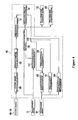
- FIG. 6 and FIG. 7 are flow charts illustrating the flow of the squat suppression processing called and executed in the step S100 of the flow chart shown in FIG. 5 .
- the squat suppression processing determines whether the condition for generating a squat is met or not on the basis of the opening speed and the throttle angle of the throttle valve 46. If the squat suppression processing determines that the condition is met, each of the front wheel suspension system 150 and the rear wheel suspension system 180 is controlled in order to suppress the squat.
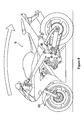
- a squat of the motorcycle 10 will be described with reference to FIG. 8 hereinafter.
- a squat occurs with the rear part of the vehicle body deflecting downward and the front part of the vehicle body deflecting upward when the accelerator is opened suddenly.
- the damping force control of the front wheel suspension system 150 and the rear wheel suspension system 180 is executed in order to suppress the squat when the condition for generating such a squat is met.
- a throttle angle is input from the throttle angle sensor 50 in a step S110 in FIG. 6 .
- a vehicle speed is input from the vehicle speed sensor 69 in a step S120.
- the amount of a stroke of the front wheel suspension system 150 and the amount of a stroke of the rear wheel suspension system 180 are input from the stroke sensors 160 and 190 respectively in a step S130.
- the opening speed of the throttle valve 46 is calculated in a step S140.
- the throttle speed change calculation module 112 of the suspension controller 100 calculates the opening speed of the throttle valve 46 on the basis of the throttle angle input from the processing in the step S110. Specifically, for example, the opening speed is calculated from the throttle angle input by the processing in the step S110 at an immediately previous time and the throttle angle input by the processing in the step S110 at a predefined time earlier than the immediately previous time.
- the throttle speed change calculation module 112 of the suspension controller 100 functions as an opening speed calculation or determination device of the present invention.
- the stroke speed is calculated in a step S150.
- the stroke speed calculation module 101 of the suspension controller 100 calculates each of the stroke speed of the front wheel suspension system 150 and the stroke speed of the rear wheel suspension system 180 on the basis of the amounts of the strokes of the front wheel suspension system 150 and the rear wheel suspension system 180 input from the processing in the step S130.
- a standard damping force is set in a step S160.
- the standard damping force setting module 102 of the suspension controller 100 sets the standard damping force of the front wheel suspension system 150 and the rear wheel suspension system 180 on the basis of the stroke speed calculated in the processing in the step S150. For example, when the calculated stroke speed is the speed in the direction of the expansion of a suspension system (the front wheel suspension system 150 or the rear wheel suspension system 180), a higher standard damping force of the expansion side is set as the stroke speed becomes higher. On the other hand, when the calculated stroke speed is the speed in the direction of the contraction of a suspension system, a higher standard damping force of the contraction side is set as the stroke speed becomes higher.
- the opening speed threshold is set in a step S170.
- the opening speed threshold is a threshold used for determining whether the squat suppression is executed or not in the processing in a step S190 described below.
- the opening/shutting speed threshold setting module 108 of the suspension controller 100 sets the opening speed threshold on the basis of the vehicle speed input from the processing in the step S120.
- the opening/shutting speed threshold setting module 108 of the suspension controller 100 functions as a first threshold setting device of the present invention for setting the first threshold (the opening speed threshold).
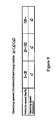
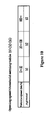
- An opening speed threshold setting table shown in FIG. 9 is referenced in the processing in the step S170.
- an opening speed threshold a1 is set if the vehicle speed is 0 (km/h) or higher and less than 30 (km/h).
- An opening speed threshold a2 (>al) is set if the vehicle speed is 30 (km/h) or higher and less than 100 (km/h) .
- An opening speed threshold a3 (>a2) is set if the vehicle speed is 100 (km/h) or higher. In other words, as the vehicle speed becomes lower, the lower opening speed threshold is set.
- the calculated opening speed and the opening speed threshold are compared in the processing in the step S190 described below.
- the squat suppression is executed if the condition in relation to a step S200 described below is met.
- the lower opening speed threshold is set as illustrated in FIG. 9 . Therefore, when the vehicle speed is low, the squat suppression is executed even if the calculated opening speed is relatively low in the embodiment.
- the squat suppression is not executed unless the calculated opening speed is relatively high.
- the squat suppression is executed in accordance with the relation between the vehicle speed and the opening speed for generating a squat in the embodiment. Consequently, it is possible to improve ride comfort and driving stability.
- an angle threshold is set in a step S180.
- the angle threshold is a threshold used for determining whether the squat suppression is to be executed or not in the processing in the step S200 described below.
- the squat suppression is executed in the embodiment.
- the angle threshold setting module 107 of the suspension controller 100 sets the angle threshold on the basis of the vehicle speed input from the processing in the step S120.
- the angle threshold setting module 107 of the suspension controller 100 functions as a second threshold setting device of the present invention for setting the second threshold (the angle threshold) .
- An angle threshold setting table shown in FIG. 10 is referenced in the processing in the step S180.
- an angle threshold b1 is set if the vehicle speed is 0 (km/h) or higher and less than 30 (km/h).
- An angle threshold b2 (>b1) is set if the vehicle speed is 30 (km/h) or higher and less than 100 (km/h).
- An angle threshold b3 (>b2) is set if the vehicle speed is 100 (km/h) or higher. In other words, as the vehicle speed becomes lower, a lower (angle) threshold is set.
- the squat described above occurs even if an accelerator is opened at a time when the throttle angle is relatively small.
- the vehicle speed is relatively high, such a squat does not occur unless an accelerator is opened at a time when the throttle angle is relatively large.
- the squat described above occurs even if an accelerator is opened at a time when the throttle angle is smaller.
- the input throttle angle and the angle threshold are compared in the processing in the step S200 described below.
- the squat suppression is executed.
- the lower angle threshold is set as illustrated in FIG. 10 . Therefore, when the vehicle speed is low, the squat suppression is executed even if the accelerator is opened at a time when the throttle angle is relatively small in the embodiment.
- the squat suppression is not executed unless the accelerator is opened at a time when the throttle angle is relatively large.
- the squat suppression is executed in accordance with the relation between the vehicle speed and the throttle angle for generating a squat by the operation of the accelerator in the embodiment. Consequently, it is possible to improve ride comfort and driving stability.
- the step S190 in FIG. 7 determines whether the opening speed is equal to or higher than the opening speed threshold or not.
- the threshold comparison module 109 of the suspension controller 100 determines whether the opening speed calculated in the processing in the step S140 is equal to or higher than the opening speed threshold or not.
- step S200 determines whether the throttle angle is equal to or larger than the angle threshold or not.
- the threshold comparison module 109 of the suspension controller 100 determines whether or not the throttle angle input from the processing in the step S110 is equal to or larger than the angle threshold set by the processing in the step S180.
- a first damping force map is selected in a step S210.
- the damping force map selection module 105 of the suspension controller 100 selects a first damping force map to be adopted from a plurality of types of the first damping force maps stored in the damping force map storage module 106 on the basis of the vehicle speed input from the processing in the step S120.
- the damping force map selection module 105 of the suspension controller 100 functions as a selection device of the present invention.
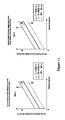
- FIG. 11 is a drawing illustrating the characteristic of a plurality of types of the first damping force maps stored in the damping force map storage module 106.
- the first damping force maps consist of a map A for regulating the relation between the opening speed and the additional damping force on the expansion side (on the expansion side of the front wheel) of the front wheel suspension system 150 (first additional damping forces D1) and a map B for regulating the relation between the opening speed and the additional damping force on the contraction side (on the contraction side of the rear wheel) of the rear wheel suspension system 180 (second additional damping forces D2).
- the map A1 is the map selected when the vehicle speed is equal to or higher than 0 (km/h) and less than 30 (km/h).
- the map A2 is the map selected when the vehicle speed is equal to or higher than 30 (km/h) and less than 100 (km/h).
- the map A3 is the map selected when the vehicle speed is equal to or higher than 100 (km/h).
- the map B1 is the map selected when the vehicle speed is equal to or higher than 0 (km/h) and less than 30 (km/h).
- the map B2 is the map selected when the vehicle speed is equal to or higher than 30 (km/h) and less than 100 (km/h).
- the map B3 is the map selected when the vehicle speed is equal to or higher than 100 (km/h).
- the three types of first damping force maps consisting of a first damping force map consisting of the map A1 and the map B1, a first damping force map consisting of the map A2 and the map B2, and a first damping force map consisting of the map A3 and the map 3 are stored in the damping force map storage module 106.
- the first damping force map consisting of the map A1 and the map B1 is selected, for example, when the input vehicle speed is 25 (km/h).
- the amount of the deflection of the squat is different between the case in which the vehicle speed is low and the case in which the vehicle speed is high. Specifically, when the vehicle speed is low, even if the speed of the operation for opening the accelerator is the same, the amount of the deflection is larger than that of the time when the vehicle speed is high.
- the first additional damping forces D1 set for the same opening speed gradually become larger in the order of the maps A3, A2, and A1.
- the second additional damping forces D2 set for same opening speed gradually become larger in the order of the maps B3, B2, and B1. Therefore, as the vehicle speed becomes lower, a first damping force map containing larger values to be set as a first additional damping force D1 and a second additional damping force D2 is selected. As described above, even if a squat generating a large deflection is generated by the operation for opening the accelerator at a time when the vehicle speed is low, a squat suppression strong enough to offset the deflection is executed in the embodiment.
- an additional damping force is set in a step S220.
- the additional damping force setting module 110 of the suspension controller 100 sets a first additional damping force D1 and a second additional damping force D2 on the basis of the opening speed calculated in the processing in the step S140.
- the first damping force map selected in the processing in the step S210 is referenced in the processing in the step S220.
- the values of the first additional damping forces D1 and the second additional damping forces D2 characteristically become larger in proportion to the opening speed in the three types of the first additional damping force maps.
- the deflection of the squat becomes larger.
- the values to be set as a first additional damping force D1 and a second additional damping force D2 become larger in proportion to the opening speed as illustrated in FIG. 11 .
- a stronger squat suppression is executed. Consequently, a squat suppression of appropriate strength can be executed corresponding to the amount of the deflection of a squat. As a result, it is possible to improve ride comfort and driving stability.
- a final damping force is determined in a step S230.
- the damping force determination module 111 of the suspension controller 100 calculates the sum of the standard damping force, the additional damping force, and a predefined fixed damping force DC as the final damping force.
- the final damping force of the front wheel suspension system 150 is calculated as the sum of the standard damping force set in the processing in the step S160, the first additional damping force D1 set in the processing in the step S220, and the predefined fixed damping force DC.
- the final damping force of the rear wheel suspension system 180 is calculated as the sum of the standard damping force set in the processing in the step S160, the second additional damping force D2 set in the processing in the step S220, and the predefined fixed damping force DC.
- the fixed damping force DC added to the standard damping force of the front wheel suspension system 150 and the fixed damping force DC added to the standard damping force of the rear wheel suspension system 180 can be the same value or can be different values.
- the first additional damping force D1 and the second additional damping force D2 in proportion to the opening speed are set as illustrated in FIG. 11 . Accordingly, when the opening speed is very low (when the operation for opening the accelerator is very slow), the first additional damping force D1 and the second additional damping force D2 to be added are also very small. In a case like this, the squat suppression force is extremely small. Consequently, the squat may not be optimally suppressed.
- the fixed damping force DC is added together with the first additional damping force D1 and the second additional damping force D2. Therefore, even when the opening speed is very low, the squat suppression force of a certain amount can be maintained, so that the squat is suppressed optimally. As a result, it is possible to improve ride comfort and driving stability.
- the procedure proceeds to a step S240. Specifically, if the step S190 determines that the opening speed is not equal to or higher than the opening speed threshold (less than the opening speed threshold) or if the step S200 determines that the throttle angle is not equal to or larger than the angle threshold (less than the angle threshold), the procedure proceeds to the step S240.
- the damping force determination module 111 of the suspension controller 100 determines the standard damping force set by the processing in the step S160 as the final damping force.
- the final damping forces of the front wheel suspension system 150 and the rear wheel suspension system 180 are set to the standard damping force.
- neither the additional damping force nor the fixed damping force DC is added.
- a suspension control is executed in a step S250.
- an operation control of the front wheel suspension system 150 and the rear wheel suspension system 180 (specifically, the operation control of the linear solenoids 174 and 178) is executed in order to generate the final damping force determined by the processing in the step S230 or in the step S240.
- the first additional damping force D1 and the fixed damping force DC are added to the standard damping force of the front wheel expansion side, and the second additional damping force D2 and the fixed damping force DC are added to the standard damping force of the rear wheel contraction side.
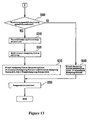
- FIG. 12 and FIG. 13 are flow charts illustrating the flow of the diving suppression processing called and executed in the step S400 of the flow chart shown in FIG. 5 .
- the diving suppression processing determines whether the condition for generating diving is met or not. When the diving suppression processing determines that the condition is met, each of the front wheel suspension system 150 and the rear wheel suspension system 180 is controlled in order to suppress diving.
- the diving suppression processing illustrated in FIG. 12 and in FIG. 13 have many steps similar to those of the squat suppression processing illustrated in FIG. 6 and in FIG. 7 .
- the description of the diving suppression processing will be mainly concentrated on differences from the squat suppression processing.
- steps S410, S420, and S430 are executed as illustrated in FIG. 12 .
- the processings are similar to the processings in the steps S110, S120, and S130 in FIG. 6 . Therefore, their description is omitted.
- the shutting speed of the throttle valve 46 is calculated in a step S440.
- the throttle speed change calculation module 112 of the suspension controller 100 calculates the shutting speed of the throttle valve 46 on the basis of the throttle angle input from the processing in the step S410. Specifically, for example, the shutting speed is calculated from the throttle angle input by the processing in the step S410 at an immediately previous time and the throttle angle input by the processing in the step S410 at a predefined time earlier than the immediately previous time.
- steps S450 and S460 are executed in sequence.
- the processings in the steps S450 and S460 are similar to the processings in the steps S150 and S160 in FIG. 6 . Therefore, their description is omitted.
- the shutting speed threshold is set in a step S470.
- the shutting speed threshold is a threshold used for determining whether the diving suppression is to be executed or not in the processing in a step S490 described below.
- the opening/shutting speed threshold setting module 108 of the suspension controller 100 sets the shutting speed threshold on the basis of the vehicle speed input from the processing in the step S420.
- a shutting speed threshold setting table shown in FIG. 15 is referenced in the processing in the step 5470.
- a shutting speed threshold c1 is set if the vehicle speed is 0 (km/h) or higher and less than 30 (km/h).
- a shutting speed threshold c2 (>c1) is set if the vehicle speed is 30 (km/h) or higher and less than 100 (km/h).
- a shutting speed threshold c3 (>c2) is set if the vehicle speed is 100 (km/h) or higher. In other words, as the vehicle speed becomes lower, the lower the shutting speed threshold is set.
- the calculated shutting speed and the shutting speed threshold are compared in the processing in the step S490 described below.
- the shutting speed is equal to or higher than the shutting speed threshold
- the diving suppression is executed.
- the lower shutting speed threshold is set as illustrated in FIG. 15 . Therefore, when the vehicle speed is low, the diving suppression is executed even if the calculated shutting speed is relatively low.
- the diving suppression is not executed unless the calculated shutting speed is relatively high.
- diving suppression is executed in accordance with the relation between the vehicle speed and the shutting speed for generating diving. Consequently, it is possible to improve ride comfort and driving stability.
- the step S490 in FIG. 13 determines whether the shutting speed is equal to or higher than the shutting speed threshold or not.
- the threshold comparison module 109 of the suspension controller 100 determines whether or not the shutting speed calculated in the processing in the step S440 is equal to or higher than the shutting speed threshold set by the processing in the step S470.
- a second damping force map is selected in a step S510.
- the damping force map selection module 105 of the suspension controller 100 selects a second damping force map to be adopted from a plurality of types of second damping force maps stored in the damping force map storage module 106 on the basis of the vehicle speed input from the processing in the step S420.
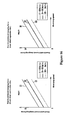
- FIG. 16 is a drawing illustrating the characteristics of a plurality of types of the second damping force maps stored in the damping force map storage module 106.
- the second damping force maps consist of a map C for regulating the relation between the shutting speed and the additional damping force on the contraction side of the front wheel suspension system 150 (third additional damping forces D3) and a map D for regulating the relation between the opening speed and the additional damping force on the expansion side of the rear wheel suspension system 180 (fourth additional damping forces D4).
- the map C1 is the map selected when the vehicle speed is equal to or higher than 0 (km/h) and less than 30 (km/h).
- the map C2 is the map selected when the vehicle speed is equal to or higher than 30 (km/h) and less than 100 (km/h).
- the map C3 is the map selected when the vehicle speed is equal to or higher than 100 (km/h).
- the map D1 is the map selected when the vehicle speed is equal to or higher than 0 (km/h) and less than 30 (km/h).
- the map D2 is the map selected when the vehicle speed is equal to or higher than 30 (km/h) and less than 100 (km/h).
- the map D3 is the map selected when the vehicle speed is equal to or higher than 100 (km/h).
- the three types of second damping force maps consisting of a second damping force map consisting of the map C1 and the map D1, a second damping force map consisting of the map C2 and the map D2, and a second damping force map consisting of the map C3 and the map D3 are stored in the damping force map storage module 106.
- the second damping force map consisting of the map C1 and the map B1 is selected, for example, when the input vehicle speed is 25 (km/h).
- the amount of the deflection of diving is different between the case in which the vehicle speed is low and the case in which the vehicle speed is high. Specifically, when the vehicle speed is low, even if the speed of the operation for shutting the accelerator is the same, the amount of the deflection is larger than that of the time when the vehicle speed is high.
- the third additional damping forces D3 set for the same shutting speed gradually becomes larger in the order of the maps C3, C2, and A1.
- the fourth additional damping forces D4 set for the same shutting speed gradually become larger in the order of the maps D3, D2, and D1. Therefore, as the vehicle speed becomes lower, a second damping force map containing larger values to be set as a third additional damping force D3 and a fourth additional damping force D4 is selected.
- a diving suppression strong enough to offset the deflection is executed in the embodiment.
- a diving suppression is softly executed. As a result, it is possible to improve ride comfort and driving stability.
- an additional damping force is set in a step S520.
- the additional damping force setting module 110 of the suspension controller 100 sets a third additional damping force D3 and a fourth additional damping force D4 on the basis of the shutting speed calculated in the processing in the step S440.
- the second damping force map selected in the processing in the step S510 is referenced in the processing in the step S520.
- the values of the third additional damping force D3 and the fourth additional damping force D4 characteristically become larger in proportion to the shutting speed in the three types of the second damping force maps.
- the deflection of the diving becomes larger.
- the values to be set as a third additional damping force D3 and a fourth additional damping force D4 become larger in proportion to the shutting speed as illustrated in FIG. 16 .
- the stronger diving suppression is executed. Consequently, a diving suppression of appropriate strength can be executed corresponding to the amount of the deflection of a diving. As a result, it is possible to improve ride comfort and driving stability.
- a final damping force is determined in a step S530.
- the damping force determination module 111 of the suspension controller 100 calculates the final damping force of the front wheel suspension system 150 as the sum of the standard damping force set in the processing in the step S460, the third additional damping force D3 set in the processing in the step S520, and the predefined fixed damping force DC.
- the final damping force of the rear wheel suspension system 180 is calculated as the sum of the standard damping force set in the processing in the step S460, the fourth additional damping force D4 set in the processing in the step S520, and the predefined fixed damping force DC.
- the fixed damping force DC added to the standard damping force of the front wheel suspension system 150 and the fixed damping force DC added to the standard damping force of the rear wheel suspension system 180 can be the same value or can be different values.
- the damping force determination module 111 of the suspension controller 100 functions as a diving suppression device of the present invention.
- the third additional damping force D3 and the fourth additional damping force D4 in proportion to the shutting speed are set as illustrated in FIG. 16 . Accordingly, when the shutting speed is very low (when the operation of shutting the accelerator is very slow), the third additional damping force D3 and the fourth additional damping force D4 to be added are also very small. In a case like this, the diving suppression force is extremely small. Consequently, the diving may not be optimally suppressed.
- the fixed damping force DC is added together with the third additional damping force D3 and the fourth additional damping force D4. Therefore, even when the shutting speed is very low, the diving suppression force of a certain amount can be maintained, so that the diving is suppressed optimally. As a result, it is possible to improve ride comfort and driving stability.
- the damping force determination module 111 of the suspension controller 100 determines the standard damping force set by the processing in the step S460 as the final damping force.
- the final damping forces of the front wheel side suspension system 150 and the rear wheel side suspension system 180 are set to the standard damping force. Therefore, addition of an additional damping force (the third additional damping force D3 and the fourth additional damping force D4) and the fixed damping force DC is not executed.
- a suspension control is executed in the step S550.
- an operation control of the front wheel suspension system 150 and the rear wheel suspension system 180 is executed in order to generate the final damping force determined by the processing in the step S530 or in the step S540.
- the diving suppression is executed.
- a high damping force on the contraction side of the front wheel suspension system 150 and a high damping force on the expansion side of the rear wheel suspension system 180) are set in the diving suppression.
- the third additional damping force D3 and the fixed damping force DC are added to the standard damping force of the front wheel contraction side
- the fourth additional damping force D4 and the fixed damping force DC are added to the standard damping force of the rear wheel expansion side.
- the squat suppression is executed on the basis of one condition that the opening speed of the throttle valve 46 is equal to or higher than the opening speed threshold as described above.
- a high damping force on the expansion side of the front wheel side suspension system 150 and a high damping force on the contraction side of the rear wheel side suspension system 180 are set in the squat suppression.
- the opening speed threshold is set according to the vehicle speed detected by the vehicle speed sensor 69. As the opening speed at a time when a squat is generated varies according to the vehicle speed, it is possible to execute the squat suppression corresponding to the relation between the opening speed and the vehicle speed in the constitution described above. As a result, it is possible to improve ride comfort and driving stability.
- the diving suppression is executed on the basis of one condition that the shutting speed of the throttle valve 46 is equal to or higher than the shutting speed threshold.
- a high damping force on the contraction side of the front wheel suspension system 150 and a high damping force on the expansion side of the rear wheel suspension system 180 are set in the diving suppression.
- the shutting speed threshold is set according to the vehicle speed detected by the vehicle speed sensor 69. As the shutting speed at a time when a diving is generated varies according to the vehicle speed, as is the case of the squat, it is possible to execute diving suppression corresponding to the relation between the shutting speed and the vehicle speed in the constitution described above. As a result, it is possible to improve ride comfort and driving stability.
- the lower opening speed threshold is set.
- the opening speed for generating a squat characteristically becomes lower in the motorcycle 10. Therefore, it is possible to execute the squat suppression in accordance with the relation between the vehicle speed and the opening speed for generating a squat in the constitution described above. As a result, it is possible to improve ride comfort and driving stability.
- the lower shutting speed threshold is set.
- the squat suppression is executed on the basis of one condition that the throttle angle is equal to or larger than the angle threshold.
- the operation for opening the accelerator is executed with a relatively small throttle angle change, even if the throttle opening speed is more than the threshold, a squat may not be generated (or is not easily generated). Therefore, it is assumed that a squat is easily generated by the operation for opening the accelerator if the throttle angle is equal to or larger than a predefined level while the throttle opening speed of the operation for opening the accelerator is equal to or higher than the threshold. Therefore, the throttle angle at a time when a squat is generated by the operation for opening the throttle is set as the opening threshold in the embodiment.
- the squat suppression is executed. Consequently, only when the throttle angle is equal to or larger than the angle capable of generating a squat, the squat suppression can be executed. As a result, a suitable squat suppression can be provided.
- the lower opening speed threshold is set as the angle threshold during the squat suppression.
- the squat suppression can be executed in accordance with the relation between the vehicle speed and the throttle angle for generating a squat by the operation of opening the accelerator in the constitution described above. As a result, it is possible to improve ride comfort and driving stability.
- the first additional damping force D1 corresponding to the opening speed is added to the standard damping force on the expansion side of the front wheel suspension system 150, and the second additional damping force D2 corresponding to the opening speed is added to the standard damping force on the contraction side of the rear wheel suspension system 180.
- the first additional damping force D1 corresponding to the opening speed is added to the standard damping force on the expansion side of the front wheel suspension system 150
- the second additional damping force D2 corresponding to the opening speed is added to the standard damping force on the contraction side of the rear wheel suspension system 180.
- the third additional damping force D3 corresponding to the shutting speed is added to the standard damping force on the contraction side of the front wheel suspension system 150, and the fourth additional damping force D4 corresponding to the shutting speed is added to the standard damping force on the expansion side of the rear wheel suspension system 180.
- the fourth additional damping force D4 corresponding to the shutting speed is added to the standard damping force on the expansion side of the rear wheel suspension system 180.
- the values of the first additional damping force D1 and the second additional damping force D2 become larger generally in proportion to the opening speed.
- the deflection change of the squat characteristically becomes larger in the motorcycle 10.
- the deflection change becomes larger generally in proportion to the opening speed. Consequently, it is possible to execute the squat suppression of appropriate strength corresponding to the amount of the deflection change of the squat in the constitution described above. As a result, it is possible to improve ride comfort and driving stability.
- the third additional damping force D3 and the fourth additional damping force D4 become larger generally in proportion to the shutting speed in the motorcycle 10.
- the deflection change of the diving characteristic becomes larger in the motorcycle 10.
- the deflection change becomes larger generally in proportion to the shutting speed. Consequently, it is possible to execute the diving suppression of appropriate strength corresponding to the amount of the deflection change of the diving in the constitution described above. As a result, it is possible to improve ride comfort and driving stability.
- the predefined fixed damping force DC is added with the first additional damping force D1 and the second additional damping force D2. Consequently, even when the opening speed is very low, the squat suppression force of a certain amount can be maintained. As a result, a squat is suppressed optimally, and it is possible to improve ride comfort and driving stability.
- the predefined fixed damping force DC is added with the third additional damping force D3 and the fourth additional damping force D4. Therefore, even when the shutting speed is very low, the diving suppression force of a certain amount can be maintained. As a result, diving may be optimally suppressed, and it is possible to improve ride comfort and driving stability.
- a multiplicity of types of the first damping force maps for regulating the relation between the opening speed and the first additional damping force D1 and the relation between the opening speed and the second additional damping force are stored in the damping force map storage module 106.
- one of the first damping force maps corresponding to the vehicle speed detected by the vehicle speed sensor 69 is selected from a multiplicity of types of the first damping force maps. Consequently, the first additional damping force D1 and the second additional damping force D2 are set on the basis of the selected first damping force map. Even when the speed of the operation for opening the accelerator is the same, as the vehicle speed is different, the amount of the deflection of a squat varies. Consequently, it is possible to select the first damping force map corresponding to the amount of the deflection of the squat in the constitution described above. As a result, it is possible to improve ride comfort and driving stability.
- a multiplicity of types of the second damping force maps for regulating the relation between the shutting speed and the third additional damping force D3 and the relation between the shutting speed and the fourth additional damping D4 is stored in the damping force map storage module 106 in the motorcycle 10.
- one of the second damping force maps corresponding to the vehicle speed detected by the vehicle speed sensor 69 is selected from a multiplicity of types of the second damping force map. Consequently, the third additional damping force D3 and the fourth additional damping force D4 are set on the basis of the selected second damping force map. Even when the speed of the operation for shutting the accelerator is the same, as the vehicle speed is different, the amount of the deflection of diving varies as same in the case of the squat suppression. Consequently, it is possible to select the second damping force map corresponding to the amount of the deflection of the diving in the constitution described above. As a result, it is possible to improve ride comfort and driving stability.
- the squat suppression processing ( FIG. 6 and FIG. 7 ) is executed.
- the diving suppression processing ( FIG. 12 and FIG. 13 ) is executed. In other words, both of the squat suppression processing and the diving suppression processing are executed. However, only either one of the squat suppression processing or the diving suppression processing may be executed in the present invention.
- a high damping force on the expansion side of the front wheel suspension system 150 and a high damping force on the contraction side of the rear wheel suspension system 180 are set in the squat suppression processing in the embodiment.
- a high damping force on the contraction side of the front wheel suspension system 150 and a high damping force on the expansion side of the rear wheel suspension system 180 are set in the diving suppression processing.
- a high damping force on the contraction side of the front wheel suspension system 150 may be set or only a high damping force on the expansion side of the rear wheel suspension system 180 may be set in the diving suppression processing.
Landscapes
- Engineering & Computer Science (AREA)
- Mechanical Engineering (AREA)
- Vehicle Body Suspensions (AREA)
- Axle Suspensions And Sidecars For Cycles (AREA)
Applications Claiming Priority (1)
| Application Number | Priority Date | Filing Date | Title |
|---|---|---|---|
| JP2006327855A JP5335188B2 (ja) | 2006-12-05 | 2006-12-05 | サスペンション制御装置および自動二輪車 |
Publications (3)
| Publication Number | Publication Date |
|---|---|
| EP1930233A2 true EP1930233A2 (fr) | 2008-06-11 |
| EP1930233A3 EP1930233A3 (fr) | 2010-09-29 |
| EP1930233B1 EP1930233B1 (fr) | 2015-08-05 |
Family
ID=39133817
Family Applications (1)
| Application Number | Title | Priority Date | Filing Date |
|---|---|---|---|
| EP07254695.5A Active EP1930233B1 (fr) | 2006-12-05 | 2007-12-04 | Contrôleur de suspension et véhicule |
Country Status (2)
| Country | Link |
|---|---|
| EP (1) | EP1930233B1 (fr) |
| JP (1) | JP5335188B2 (fr) |
Cited By (6)
| Publication number | Priority date | Publication date | Assignee | Title |
|---|---|---|---|---|
| EP2216191A1 (fr) * | 2009-02-09 | 2010-08-11 | Yamaha Hatsudoki Kabushiki Kaisha | Motocyclette |
| US8560173B2 (en) | 2011-07-28 | 2013-10-15 | Kawasaki Jukogyo Kabushiki Kaisha | System and method for controlling straddle-type vehicle |
| EP2708458A4 (fr) * | 2011-05-10 | 2014-05-21 | Yamaha Motor Co Ltd | Dispositif de commande d'amortisseur de direction et véhicule à fourche équipé d'un tel dispositif |
| WO2020212831A1 (fr) * | 2019-04-15 | 2020-10-22 | ロベルト・ボッシュ・ゲゼルシャフト・ミト・ベシュレンクテル・ハフツング | Système de commande et procédé de commande |
| US11339846B2 (en) | 2017-07-11 | 2022-05-24 | Hitachi Astemo, Ltd. | Suspension apparatus and recording medium |
| US12391086B2 (en) | 2022-02-01 | 2025-08-19 | Honda Motor Co., Ltd. | Control device, vehicle, estimation method, and storage medium |
Families Citing this family (2)
| Publication number | Priority date | Publication date | Assignee | Title |
|---|---|---|---|---|
| JP5798682B2 (ja) * | 2012-05-09 | 2015-10-21 | ヤマハ発動機株式会社 | ステアリングダンパおよびそれを備えた鞍乗型車両 |
| US12097735B2 (en) * | 2022-05-13 | 2024-09-24 | Ford Global Technologies, Llc | Suspension system with dynamic weight balancing control |
Citations (2)
| Publication number | Priority date | Publication date | Assignee | Title |
|---|---|---|---|---|
| JPH0214206B2 (fr) | 1981-07-23 | 1990-04-06 | Toyota Motor Co Ltd | |
| EP1391332A2 (fr) | 2002-08-21 | 2004-02-25 | Mando Corporation | Amortisseur semi-actif pour suspension de véhicule |
Family Cites Families (15)
| Publication number | Priority date | Publication date | Assignee | Title |
|---|---|---|---|---|
| JPS61176090U (fr) | 1985-04-23 | 1986-11-01 | ||
| JPS632788A (ja) * | 1986-06-24 | 1988-01-07 | スズキ株式会社 | 自動二輪車の可変サスペンシヨン装置 |
| JPH01212686A (ja) | 1988-02-19 | 1989-08-25 | Honda Motor Co Ltd | 電子制御サスペンション装置 |
| JP2770026B2 (ja) | 1988-06-30 | 1998-06-25 | ダイハツ工業株式会社 | ショックアブソーバの減衰力制御方法 |
| JPH0281784A (ja) * | 1988-09-16 | 1990-03-22 | Honda Motor Co Ltd | 自動二輪車等車両における車高調整方法 |
| JPH037611A (ja) | 1989-06-05 | 1991-01-14 | Honda Motor Co Ltd | 車両用減衰力可変ダンパの減衰力制御方法 |
| JPH04310413A (ja) | 1991-04-10 | 1992-11-02 | Omron Corp | 車両の走行状態推定装置及びサスペンション制御装置 |
| JPH06106941A (ja) * | 1992-09-28 | 1994-04-19 | Toyota Motor Corp | 車両のサスペンション特性制御装置 |
| JPH06297929A (ja) * | 1993-04-15 | 1994-10-25 | Suzuki Motor Corp | 車両用サスペンション制御装置 |
| JPH06297930A (ja) * | 1993-04-16 | 1994-10-25 | Suzuki Motor Corp | 車両用サスペンション制御装置 |
| JPH08142628A (ja) | 1994-11-24 | 1996-06-04 | Toyota Motor Corp | サスペンション制御装置 |
| JPH0986131A (ja) | 1995-07-20 | 1997-03-31 | Toyota Motor Corp | サスペンション制御装置 |
| JPH10299890A (ja) * | 1997-04-24 | 1998-11-13 | Aqueous Res:Kk | 車両制御装置 |
| KR19990057521A (ko) * | 1997-12-30 | 1999-07-15 | 오상수 | 적응형 전자제어 현가장치의 동작 제어방법 및그 장치 |
| JP2006161912A (ja) * | 2004-12-06 | 2006-06-22 | Yamaha Motor Co Ltd | 車両の懸架装置 |
-
2006
- 2006-12-05 JP JP2006327855A patent/JP5335188B2/ja active Active
-
2007
- 2007-12-04 EP EP07254695.5A patent/EP1930233B1/fr active Active
Patent Citations (2)
| Publication number | Priority date | Publication date | Assignee | Title |
|---|---|---|---|---|
| JPH0214206B2 (fr) | 1981-07-23 | 1990-04-06 | Toyota Motor Co Ltd | |
| EP1391332A2 (fr) | 2002-08-21 | 2004-02-25 | Mando Corporation | Amortisseur semi-actif pour suspension de véhicule |
Cited By (9)
| Publication number | Priority date | Publication date | Assignee | Title |
|---|---|---|---|---|
| EP2216191A1 (fr) * | 2009-02-09 | 2010-08-11 | Yamaha Hatsudoki Kabushiki Kaisha | Motocyclette |
| EP2708458A4 (fr) * | 2011-05-10 | 2014-05-21 | Yamaha Motor Co Ltd | Dispositif de commande d'amortisseur de direction et véhicule à fourche équipé d'un tel dispositif |
| US9120527B2 (en) | 2011-05-10 | 2015-09-01 | Yamaha Hatsudoki Kabushiki Kaisha | Steering damper control apparatus, and a saddle riding type vehicle having the same |
| US8560173B2 (en) | 2011-07-28 | 2013-10-15 | Kawasaki Jukogyo Kabushiki Kaisha | System and method for controlling straddle-type vehicle |
| US11339846B2 (en) | 2017-07-11 | 2022-05-24 | Hitachi Astemo, Ltd. | Suspension apparatus and recording medium |
| WO2020212831A1 (fr) * | 2019-04-15 | 2020-10-22 | ロベルト・ボッシュ・ゲゼルシャフト・ミト・ベシュレンクテル・ハフツング | Système de commande et procédé de commande |
| US20220194352A1 (en) * | 2019-04-15 | 2022-06-23 | Robert Bosch Gmbh | Control system and control method |
| US12077145B2 (en) | 2019-04-15 | 2024-09-03 | Robert Bosch Gmbh | Control system and control method |
| US12391086B2 (en) | 2022-02-01 | 2025-08-19 | Honda Motor Co., Ltd. | Control device, vehicle, estimation method, and storage medium |
Also Published As
| Publication number | Publication date |
|---|---|
| EP1930233A3 (fr) | 2010-09-29 |
| JP2008137573A (ja) | 2008-06-19 |
| JP5335188B2 (ja) | 2013-11-06 |
| EP1930233B1 (fr) | 2015-08-05 |
Similar Documents
| Publication | Publication Date | Title |
|---|---|---|
| EP1930233B1 (fr) | Contrôleur de suspension et véhicule | |
| US8271170B2 (en) | Clutch control system for vehicle | |
| US20080182720A1 (en) | Clutch control device | |
| JP5121159B2 (ja) | 自動変速制御装置および車両 | |
| JP2009012530A (ja) | 車両のステアリング緩衝方法、並びに車両のステアリング緩衝装置 | |
| JP4873542B2 (ja) | 自動変速制御装置および車両 | |
| US8798883B2 (en) | Automatic transmission apparatus and straddle-type vehicle equipped with the apparatus | |
| EP2696108B1 (fr) | Appareil de transmission automatique et véhicule de type à selle équipé de l'appareil | |
| US7881847B2 (en) | Clutch control device and vehicle | |
| EP2695787A2 (fr) | Véhicule comprenant un dispositif de contrôle de patinage | |
| JP4842672B2 (ja) | 自動二輪車 | |
| JP4873543B2 (ja) | 自動変速制御装置および車両 | |
| EP2048401B1 (fr) | Procédé de changement de vitesses dans une unité de transmission manuelle automatique et transmission automatique pour véhicule | |
| EP1826442B1 (fr) | Procédé et dispositif de commande d'une transmission automatique | |
| EP3901021B1 (fr) | Véhicule à inclinaison | |
| JP4911995B2 (ja) | 自動二輪車 | |
| EP1826439B1 (fr) | Méthode et système de commande d'embrayage | |
| US20260097823A1 (en) | Leaning vehicle | |
| JP5214769B2 (ja) | 自動変速制御装置および車両 | |
| EP2696113B1 (fr) | Appareil de transmission automatique et véhicule de type à selle équipé de l'appareil | |
| EP2055978B1 (fr) | Dispositif d'embrayage automatique | |
| JP7474178B2 (ja) | サスペンションシステム及びその制御方法 | |
| JP2014034378A (ja) | 自動変速装置およびそれを備えた鞍乗型車両 | |
| JPS6229408A (ja) | 車両のサスペンシヨン制御装置 | |
| JP2009121626A (ja) | クラッチ装置 |
Legal Events
| Date | Code | Title | Description |
|---|---|---|---|
| PUAI | Public reference made under article 153(3) epc to a published international application that has entered the european phase |
Free format text: ORIGINAL CODE: 0009012 |
|
| 17P | Request for examination filed |
Effective date: 20080102 |
|
| AK | Designated contracting states |
Kind code of ref document: A2 Designated state(s): AT BE BG CH CY CZ DE DK EE ES FI FR GB GR HU IE IS IT LI LT LU LV MC MT NL PL PT RO SE SI SK TR |
|
| AX | Request for extension of the european patent |
Extension state: AL BA HR MK RS |
|
| PUAL | Search report despatched |
Free format text: ORIGINAL CODE: 0009013 |
|
| AK | Designated contracting states |
Kind code of ref document: A3 Designated state(s): AT BE BG CH CY CZ DE DK EE ES FI FR GB GR HU IE IS IT LI LT LU LV MC MT NL PL PT RO SE SI SK TR |
|
| AX | Request for extension of the european patent |
Extension state: AL BA HR MK RS |
|
| RIC1 | Information provided on ipc code assigned before grant |
Ipc: B60G 17/016 20060101ALI20100820BHEP Ipc: B62K 25/04 20060101AFI20080310BHEP |
|
| AKX | Designation fees paid |
Designated state(s): AT BE BG CH CY CZ DE DK EE ES FI FR GB GR HU IE IS IT LI LT LU LV MC MT NL PL PT RO SE SI SK TR |
|
| 17Q | First examination report despatched |
Effective date: 20111212 |
|
| GRAP | Despatch of communication of intention to grant a patent |
Free format text: ORIGINAL CODE: EPIDOSNIGR1 |
|
| INTG | Intention to grant announced |
Effective date: 20150413 |
|
| GRAS | Grant fee paid |
Free format text: ORIGINAL CODE: EPIDOSNIGR3 |
|
| GRAA | (expected) grant |
Free format text: ORIGINAL CODE: 0009210 |
|
| AK | Designated contracting states |
Kind code of ref document: B1 Designated state(s): AT BE BG CH CY CZ DE DK EE ES FI FR GB GR HU IE IS IT LI LT LU LV MC MT NL PL PT RO SE SI SK TR |
|
| REG | Reference to a national code |
Ref country code: GB Ref legal event code: FG4D |
|
| REG | Reference to a national code |
Ref country code: CH Ref legal event code: EP |
|
| REG | Reference to a national code |
Ref country code: AT Ref legal event code: REF Ref document number: 740528 Country of ref document: AT Kind code of ref document: T Effective date: 20150815 |
|
| REG | Reference to a national code |
Ref country code: IE Ref legal event code: FG4D |
|
| REG | Reference to a national code |
Ref country code: DE Ref legal event code: R096 Ref document number: 602007042425 Country of ref document: DE |
|
| REG | Reference to a national code |
Ref country code: AT Ref legal event code: MK05 Ref document number: 740528 Country of ref document: AT Kind code of ref document: T Effective date: 20150805 |
|
| REG | Reference to a national code |
Ref country code: FR Ref legal event code: PLFP Year of fee payment: 9 |
|
| REG | Reference to a national code |
Ref country code: LT Ref legal event code: MG4D |
|
| REG | Reference to a national code |
Ref country code: NL Ref legal event code: MP Effective date: 20150805 |
|
| PG25 | Lapsed in a contracting state [announced via postgrant information from national office to epo] |
Ref country code: LV Free format text: LAPSE BECAUSE OF FAILURE TO SUBMIT A TRANSLATION OF THE DESCRIPTION OR TO PAY THE FEE WITHIN THE PRESCRIBED TIME-LIMIT Effective date: 20150805 Ref country code: LT Free format text: LAPSE BECAUSE OF FAILURE TO SUBMIT A TRANSLATION OF THE DESCRIPTION OR TO PAY THE FEE WITHIN THE PRESCRIBED TIME-LIMIT Effective date: 20150805 Ref country code: FI Free format text: LAPSE BECAUSE OF FAILURE TO SUBMIT A TRANSLATION OF THE DESCRIPTION OR TO PAY THE FEE WITHIN THE PRESCRIBED TIME-LIMIT Effective date: 20150805 Ref country code: GR Free format text: LAPSE BECAUSE OF FAILURE TO SUBMIT A TRANSLATION OF THE DESCRIPTION OR TO PAY THE FEE WITHIN THE PRESCRIBED TIME-LIMIT Effective date: 20151106 |
|
| PG25 | Lapsed in a contracting state [announced via postgrant information from national office to epo] |
Ref country code: ES Free format text: LAPSE BECAUSE OF FAILURE TO SUBMIT A TRANSLATION OF THE DESCRIPTION OR TO PAY THE FEE WITHIN THE PRESCRIBED TIME-LIMIT Effective date: 20150805 Ref country code: IS Free format text: LAPSE BECAUSE OF FAILURE TO SUBMIT A TRANSLATION OF THE DESCRIPTION OR TO PAY THE FEE WITHIN THE PRESCRIBED TIME-LIMIT Effective date: 20151205 Ref country code: PT Free format text: LAPSE BECAUSE OF FAILURE TO SUBMIT A TRANSLATION OF THE DESCRIPTION OR TO PAY THE FEE WITHIN THE PRESCRIBED TIME-LIMIT Effective date: 20151207 Ref country code: AT Free format text: LAPSE BECAUSE OF FAILURE TO SUBMIT A TRANSLATION OF THE DESCRIPTION OR TO PAY THE FEE WITHIN THE PRESCRIBED TIME-LIMIT Effective date: 20150805 Ref country code: PL Free format text: LAPSE BECAUSE OF FAILURE TO SUBMIT A TRANSLATION OF THE DESCRIPTION OR TO PAY THE FEE WITHIN THE PRESCRIBED TIME-LIMIT Effective date: 20150805 Ref country code: SE Free format text: LAPSE BECAUSE OF FAILURE TO SUBMIT A TRANSLATION OF THE DESCRIPTION OR TO PAY THE FEE WITHIN THE PRESCRIBED TIME-LIMIT Effective date: 20150805 |
|
| PG25 | Lapsed in a contracting state [announced via postgrant information from national office to epo] |
Ref country code: NL Free format text: LAPSE BECAUSE OF FAILURE TO SUBMIT A TRANSLATION OF THE DESCRIPTION OR TO PAY THE FEE WITHIN THE PRESCRIBED TIME-LIMIT Effective date: 20150805 |
|
| PG25 | Lapsed in a contracting state [announced via postgrant information from national office to epo] |
Ref country code: EE Free format text: LAPSE BECAUSE OF FAILURE TO SUBMIT A TRANSLATION OF THE DESCRIPTION OR TO PAY THE FEE WITHIN THE PRESCRIBED TIME-LIMIT Effective date: 20150805 Ref country code: SK Free format text: LAPSE BECAUSE OF FAILURE TO SUBMIT A TRANSLATION OF THE DESCRIPTION OR TO PAY THE FEE WITHIN THE PRESCRIBED TIME-LIMIT Effective date: 20150805 Ref country code: CZ Free format text: LAPSE BECAUSE OF FAILURE TO SUBMIT A TRANSLATION OF THE DESCRIPTION OR TO PAY THE FEE WITHIN THE PRESCRIBED TIME-LIMIT Effective date: 20150805 Ref country code: DK Free format text: LAPSE BECAUSE OF FAILURE TO SUBMIT A TRANSLATION OF THE DESCRIPTION OR TO PAY THE FEE WITHIN THE PRESCRIBED TIME-LIMIT Effective date: 20150805 |
|
| REG | Reference to a national code |
Ref country code: DE Ref legal event code: R097 Ref document number: 602007042425 Country of ref document: DE |
|
| PG25 | Lapsed in a contracting state [announced via postgrant information from national office to epo] |
Ref country code: BE Free format text: LAPSE BECAUSE OF NON-PAYMENT OF DUE FEES Effective date: 20151231 Ref country code: RO Free format text: LAPSE BECAUSE OF FAILURE TO SUBMIT A TRANSLATION OF THE DESCRIPTION OR TO PAY THE FEE WITHIN THE PRESCRIBED TIME-LIMIT Effective date: 20150805 |
|
| PLBE | No opposition filed within time limit |
Free format text: ORIGINAL CODE: 0009261 |
|
| STAA | Information on the status of an ep patent application or granted ep patent |
Free format text: STATUS: NO OPPOSITION FILED WITHIN TIME LIMIT |
|
| 26N | No opposition filed |
Effective date: 20160509 |
|
| PG25 | Lapsed in a contracting state [announced via postgrant information from national office to epo] |
Ref country code: LU Free format text: LAPSE BECAUSE OF FAILURE TO SUBMIT A TRANSLATION OF THE DESCRIPTION OR TO PAY THE FEE WITHIN THE PRESCRIBED TIME-LIMIT Effective date: 20151204 Ref country code: MC Free format text: LAPSE BECAUSE OF FAILURE TO SUBMIT A TRANSLATION OF THE DESCRIPTION OR TO PAY THE FEE WITHIN THE PRESCRIBED TIME-LIMIT Effective date: 20150805 |
|
| REG | Reference to a national code |
Ref country code: CH Ref legal event code: PL |
|
| PG25 | Lapsed in a contracting state [announced via postgrant information from national office to epo] |
Ref country code: SI Free format text: LAPSE BECAUSE OF FAILURE TO SUBMIT A TRANSLATION OF THE DESCRIPTION OR TO PAY THE FEE WITHIN THE PRESCRIBED TIME-LIMIT Effective date: 20150805 |
|
| REG | Reference to a national code |
Ref country code: IE Ref legal event code: MM4A |
|
| PG25 | Lapsed in a contracting state [announced via postgrant information from national office to epo] |
Ref country code: LI Free format text: LAPSE BECAUSE OF NON-PAYMENT OF DUE FEES Effective date: 20151231 Ref country code: CH Free format text: LAPSE BECAUSE OF NON-PAYMENT OF DUE FEES Effective date: 20151231 Ref country code: IE Free format text: LAPSE BECAUSE OF NON-PAYMENT OF DUE FEES Effective date: 20151204 |
|
| REG | Reference to a national code |
Ref country code: FR Ref legal event code: PLFP Year of fee payment: 10 |
|
| PG25 | Lapsed in a contracting state [announced via postgrant information from national office to epo] |
Ref country code: BE Free format text: LAPSE BECAUSE OF FAILURE TO SUBMIT A TRANSLATION OF THE DESCRIPTION OR TO PAY THE FEE WITHIN THE PRESCRIBED TIME-LIMIT Effective date: 20150805 |
|
| PG25 | Lapsed in a contracting state [announced via postgrant information from national office to epo] |
Ref country code: HU Free format text: LAPSE BECAUSE OF FAILURE TO SUBMIT A TRANSLATION OF THE DESCRIPTION OR TO PAY THE FEE WITHIN THE PRESCRIBED TIME-LIMIT; INVALID AB INITIO Effective date: 20071204 Ref country code: BG Free format text: LAPSE BECAUSE OF FAILURE TO SUBMIT A TRANSLATION OF THE DESCRIPTION OR TO PAY THE FEE WITHIN THE PRESCRIBED TIME-LIMIT Effective date: 20150805 |
|
| PG25 | Lapsed in a contracting state [announced via postgrant information from national office to epo] |
Ref country code: CY Free format text: LAPSE BECAUSE OF FAILURE TO SUBMIT A TRANSLATION OF THE DESCRIPTION OR TO PAY THE FEE WITHIN THE PRESCRIBED TIME-LIMIT Effective date: 20150805 |
|
| PG25 | Lapsed in a contracting state [announced via postgrant information from national office to epo] |
Ref country code: TR Free format text: LAPSE BECAUSE OF FAILURE TO SUBMIT A TRANSLATION OF THE DESCRIPTION OR TO PAY THE FEE WITHIN THE PRESCRIBED TIME-LIMIT Effective date: 20150805 Ref country code: MT Free format text: LAPSE BECAUSE OF FAILURE TO SUBMIT A TRANSLATION OF THE DESCRIPTION OR TO PAY THE FEE WITHIN THE PRESCRIBED TIME-LIMIT Effective date: 20150805 |
|
| REG | Reference to a national code |
Ref country code: FR Ref legal event code: PLFP Year of fee payment: 11 |
|
| P01 | Opt-out of the competence of the unified patent court (upc) registered |
Effective date: 20230527 |
|
| PGFP | Annual fee paid to national office [announced via postgrant information from national office to epo] |
Ref country code: DE Payment date: 20251211 Year of fee payment: 19 |
|
| PGFP | Annual fee paid to national office [announced via postgrant information from national office to epo] |
Ref country code: GB Payment date: 20251219 Year of fee payment: 19 |
|
| PGFP | Annual fee paid to national office [announced via postgrant information from national office to epo] |
Ref country code: IT Payment date: 20251223 Year of fee payment: 19 |
|
| PGFP | Annual fee paid to national office [announced via postgrant information from national office to epo] |
Ref country code: FR Payment date: 20251222 Year of fee payment: 19 |