EP1931083A1 - Dispositif générique et méthode de décodage pour analyser des protocoles de communication - Google Patents
Dispositif générique et méthode de décodage pour analyser des protocoles de communication Download PDFInfo
- Publication number
- EP1931083A1 EP1931083A1 EP06025234A EP06025234A EP1931083A1 EP 1931083 A1 EP1931083 A1 EP 1931083A1 EP 06025234 A EP06025234 A EP 06025234A EP 06025234 A EP06025234 A EP 06025234A EP 1931083 A1 EP1931083 A1 EP 1931083A1
- Authority
- EP
- European Patent Office
- Prior art keywords
- protocol
- generic
- context
- decoding device
- context memory
- Prior art date
- Legal status (The legal status is an assumption and is not a legal conclusion. Google has not performed a legal analysis and makes no representation as to the accuracy of the status listed.)
- Granted
Links
- 238000004891 communication Methods 0.000 title claims abstract description 22
- 238000000034 method Methods 0.000 title claims abstract description 15
- 230000001960 triggered effect Effects 0.000 claims 1
- 238000007726 management method Methods 0.000 description 22
- 230000006870 function Effects 0.000 description 7
- 230000001419 dependent effect Effects 0.000 description 3
- 230000008676 import Effects 0.000 description 2
- 238000012544 monitoring process Methods 0.000 description 2
- 230000008520 organization Effects 0.000 description 2
- 238000012545 processing Methods 0.000 description 2
- 238000012360 testing method Methods 0.000 description 2
- 230000006978 adaptation Effects 0.000 description 1
- 238000004458 analytical method Methods 0.000 description 1
- 238000013459 approach Methods 0.000 description 1
- 238000005352 clarification Methods 0.000 description 1
- 238000011161 development Methods 0.000 description 1
- 230000018109 developmental process Effects 0.000 description 1
- 230000000694 effects Effects 0.000 description 1
- 238000005516 engineering process Methods 0.000 description 1
- 239000011229 interlayer Substances 0.000 description 1
- 239000010410 layer Substances 0.000 description 1
- 230000007257 malfunction Effects 0.000 description 1
- 230000008569 process Effects 0.000 description 1
- 238000010972 statistical evaluation Methods 0.000 description 1
- 238000013024 troubleshooting Methods 0.000 description 1
Images



Classifications
-
- H—ELECTRICITY
- H04—ELECTRIC COMMUNICATION TECHNIQUE
- H04L—TRANSMISSION OF DIGITAL INFORMATION, e.g. TELEGRAPHIC COMMUNICATION
- H04L43/00—Arrangements for monitoring or testing data switching networks
- H04L43/18—Protocol analysers
-
- H—ELECTRICITY
- H04—ELECTRIC COMMUNICATION TECHNIQUE
- H04L—TRANSMISSION OF DIGITAL INFORMATION, e.g. TELEGRAPHIC COMMUNICATION
- H04L69/00—Network arrangements, protocols or services independent of the application payload and not provided for in the other groups of this subclass
- H04L69/03—Protocol definition or specification
Definitions
- the present invention relates to a decoding apparatus for the analysis of communication protocols comprising a generic decoding apparatus into which at least one protocol description of a communication protocol is loadable, wherein the at least one protocol description is formulated in a generic protocol description language that is interpretable by the generic decoding apparatus. It further relates to a method for analyzing communication protocols with a generic decoding device in which at least one protocol description of a communication protocol is loaded, wherein the at least one protocol description is formulated in a generic protocol description language that is interpretable by the generic decoding device. Finally, it concerns a generic protocol description language.
- communication protocols ie for the communication certain rules are agreed to which the communication devices participating in the communication must adhere.
- protocol tester tests for testing of communication networks after replacement of a communication device or extension of the network to further communication devices to prevent malfunctions, of course, carried out before commissioning using so-called protocol tester tests, which are to ensure the functioning of the communication or to assist in troubleshooting.
- Such protocol testers therefore require a decoding device which enables them to apply the respectively agreed communication rules to the data listened in or received as a terminal in order to decode them for further processing.
- decoding devices Due to the frequently changing protocols to be analyzed, in particular with regard to devices or manufacturers of specific or proprietary protocols, such decoding devices must be made as flexible as possible and are therefore usually implemented in software.
- Such a decoding software is particularly flexible if it is generic, ie suitably programmed for many protocols, in which case the protocol description just required is then loaded into the generic decoding software with regard to the specific application.
- the protocol description is formulated in a generic protocol description language. In a known, in Fig. 1 At least one of the protocols A through X is loaded into a generic decoding device 62. Subsequently, decoded data are supplied at the input 64, and decoded data are provided at the output 66 for further processing.
- a generic decoding device into which protocol descriptions formulated using a generic protocol description language can be loaded is comparable to a processor that, while not specifically targeted for any application, can handle anything but slowly.
- a specific decoder is to be compared with a processor that is suitable for the Special application was designed, ie the program to be executed is poured into hardware.
- Generic decoding devices are known, for example from the EP 1 168 712 A1 and the US 2006/0146726 ,
- the object of the present invention is to provide an apparatus and a method with which a protocol decoding depending on connection states and protocol elements lying outside the current message packet is made possible less cumbersome and time consuming than the known from the prior art approach.
- the present invention further comprises a generic protocol description language having the features of claim 12, which are adapted for use in a decoding apparatus or apparatus according to the invention in a method according to the invention, in comparison to the protocol description language known from the prior art, in particular comprising an extended instruction set with at least one further instruction.
- the present invention is based on the finding that the above object can be achieved by a clever extension on the basis of a generic decoding device.
- This extension first provides a context memory that stores at least one decoded value of a protocol element under one specifiable address is used.
- a generic context management device is provided to enable storage and retrieval from the context memory by the generic decoding device.
- a decoding device based on a generic decoding device can now store the decoded values of any protocol elements and resort to them again if necessary.
- the generic context management device the generic decoding device can now access information already decoded in previous messages necessary for decoding the current message.
- the generic context management device has access to the context memory containing the stored message contents of already decoded message packets and to the decoded information of the message packet currently to be decoded stored in the decoder output memory.
- the generic protocol description language comprises a second instruction designed to cause the generic context management device to read out the decoded value of at least one protocol element stored in the context memory at a presettable address.
- the generic protocol description language is extended by an instruction designed to form at least the decoded value of at least one protocol element the predefinable address for the context memory, wherein the generic context management device is configured, at this address the decoded value of at least one protocol element store.
- identification of the respective context in particular in the case of several parallel connections, is particularly easy if connection identifier - depending on the protocol, one or more parameters -, For example, CID, IMSI, IP-ADDRESS, for generating the address in the context memory, ie as an index parameter used.
- the generic context management device is designed to store the context elements as well as the values of the decoded protocol elements in the decoder output memory.
- the so-called context d. H. a collection of all decoded values of protocol elements that resulted from the decoding of a current message packet or that are required for this, attached to the corresponding message packet as a trailer.
- the generic context management device and the context memory are designed, in particular limited by an appropriately timed or operator-triggerable reset operation, to read out the decoded value of at least one protocol element from the context memory transmitted in a message sent earlier than the message currently being decoded by the generic decoder.
- the step of storing preferably comprises the step of forming an address at which the decoded value of the protocol element is stored, at least from the decoded value of at least one protocol element.
- the step of storing further preferably comprises the step of registering in the context memory of the protocol elements to be stored in the context memory. This is preferably carried out automatically as a function of the protocol description loaded into the generic decoding device, specifically in particular at the time of loading the protocol description into the generic decoding device.
- the decoded values of protocol elements are stored in the context memory, which are identified in the protocol description with a first instruction.
- the decoded values of protocol elements are preferably read from the context memory, which are identified in the protocol description with a second instruction.
- the generic protocol description language preferably comprises a first instruction designed to cause a generic context management device to store a decoded value of at least one protocol element under a predefinable address in a context memory.
- Preferred further developments of the generic protocol description language include at least the second statement already mentioned, which relates to the readout of the decoded value of at least one protocol element from the context memory, and the third instruction which is designed, at least from the decoded value of at least one protocol element, the predefinable address for the context memory form under which the decoded value of at least one protocol element is to be stored.
- Fig. 3 It shows a protocol loading device 12 which is designed to read a protocol description which is formulated in a generic protocol description language from a storage medium, for example a hard disk, and to convert it into a machine-readable form.
- a protocol description of a first protocol is loaded according to the arrow 14 into a first memory area 16a of a generic decoding device 18. Additional memory areas 16b, 16c may be provided for further protocol descriptions.
- the generic decoding device 18 reads in accordance with the arrow 22 data, in particular frame by frame for a message packet.
- the decoder output memory 28 like the data source 20, is packet-organized, ie, provides decoded data with respect to a single message packet. If the decoding of the current message packet by the generic decoding device 18 requires the decoded values of protocol elements transmitted in the current message packet, then the generic decoding device 18 may read these from the decoder output memory 28 as indicated by the arrow 30.
- the decoded values stored in the decoder output memory 28 can be read by applications 34a, 34b, 34c according to the arrow 32, the applications in particular comprising the functions of call tracking, statistical evaluation and monitoring.
- illustrated embodiment of a decoding device 10 according to the invention also has a block 36 which includes a generic context management device 38 and a context memory 40.
- the context memory 40 stores the decoded values of the protocol elements specified in a registration process, not messages packet by packet, but across a plurality of message packets, ie, for example, for all message packets to be decoded.
- the log loader 12 is designed, as indicated by the arrow 42, to register so-called context elements via the generic context management device 38 in the context memory 40 at the time of loading the at least one protocol description into a memory area 16a to c, ie it creates a structure which is tuned to the required or to-be-deposited context elements, for example the number of decoded values of a parameter element to be stored for the respective context.
- the respective protocol description has been supplemented by an instruction (CONTEXT_KEY) which will be discussed in more detail later.
- CONTEXT_KEY an instruction
- Context elements in the context of the present invention are understood to be the protocol elements whose decoded value, which was determined on the basis of the decoding of a first message packet, is to be stored in the context memory 40 in order to decode a second message packet transmitted after the first message packet. to be available.
- the registration further comprises informing the generic context management device 38 of the protocol elements whose decoded values are used to generate an address under which the decoded values of the protocol elements are to be stored in the context memory 40.
- the generic decoding device 18 now has the option of storing at least one decoded value of a protocol element in the context memory via two further instructions that were included in the generic protocol description language according to the present invention and are therefore reflected in the protocol description 40 via the generic context management device 38 to initiate (CONTEXT_SET) or the readout of a stored in the context memory 40 a decoded value of a protocol element via the generic context management device 38, the arrow 46, the decoder output memory 28 and the arrow 30 (CONTEXT_GET).
- the arrow 48 is intended to express that in order to determine the address of the value to be read from the context memory 40, the decoded values required for determining the address must first be read from the decoder output memory 28.
- the arrow 50 is intended to express that means are provided, for example automatically by appropriate time dimensioning or by an operator access, to delete the registration made in the context memory with the statement "CONTEXT_KEY", thereby triggering a RESET.
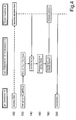
- Fig. 4 To explain the mode of operation when decoding a message packet which has to access the value of a protocol element of a previously decoded message packet 40 stored in the context memory 40, is in Fig. 4 In a schematic representation, the flow is shown, referring to the activities of the three elements generic decoding device 18, generic context management device 38 / context memory 40 and decoder output memory 28, as in the first line of FIG Fig. 4 presented, is received.
- the generic decoding device 18 decodes data according to the at least one protocol description loaded into the memory 16a of the generic decoding device 18.
- the decoded values are stored in the decoder output memory 28.
- step 120 if the generic decoder 18 needs to access at least one decoded value of a previously decoded message packet to decode a current message packet, it calls the function CONTEXT_GET (key, y).
- key indicates the decoded values of which protocol elements are to be linked in order to determine the address at which the decoded value of the protocol element y is stored in the context memory 40.
- the generic context management device 38 determines how to use the decoded values of which protocol elements for determining the address at which the decoded value of the protocol element y is stored.
- the decoded values the so-called key values used to determine the address under which the decoded value of the element y is stored in the context memory 40, are read from the decoder output memory 28 in step 140. This step corresponds to the arrow 48 of FIG Fig. 3 ,
- step 160 the context memory 40 is instructed with the address formed from the key values.
- step 180 the decoded value of the element y is read out at the address of the context memory 40 determined by the key values and stored in the decoder output memory 28.
- the term "element y" in Fig. 4 of course means the decoded value of the element y and was formulated so only due to the few space available for clarity.
- Step 180 corresponds to the arrow 46 of FIG Fig. 3
- step 200 the decoded value of the element y is read from the generic decoder 18 from the decoder output memory 28. This corresponds to the arrow 30 of Fig. 3 ,
- CONTEXT_SET which serves to store the decoded value of a protocol element of a current message packet for the decoding of subsequent message packets in the context memory 40. It also includes first the determination of the address from already stored in the decoder output memory 28 decoded values of protocol elements at which the decoded value of the protocol element is to be stored and then the storage of the decoded value of the protocol element, this time with reference to Fig. 3 the storage takes place via the path indicated by the arrows 26 and 44.
- Fig. 5a shows a command sequence of an embodiment of a protocol description in which the statement CONTEXT_KEY is used.
- the instruction "CON-TEXT_KEY” defines an artificial protocol element comprising as argument at least one protocol element which may be supplemented by further protocol elements or constants whose decoded values identify a particular connection, thereby enabling a connection-related organization of the context memory 40.
- the argument of the statement "CON-TEXT_KEY” therefore serves as the address or index parameter of the context memory 40.
- the protocol elements defined in the argument can be defined both in the same protocol and in other protocols. Log items defined in other logs are described as imported log items.
- the protocol elements specified in the argument of the statement "CONTEXT_KEY” are registered with the generic context management function 36, in particular at the time of loading the protocol description into one of the memory areas 16a, 16b, 16c.
- protocol elements are assigned an internal ID (identification code).
- ID code identification code
- protocol descriptions for the generic protocol decoder are text files. Parameters and protocol elements are described by name.
- each parameter is assigned an internal ID, for example an integer number.
- the key, ie the address, in the present case consists only of the decoded value of k1.
- the protocol element k1 may be, for example, an IP4 address (4 bytes) or a telephone number.
- Fig. 5b shows a command sequence of an embodiment of a protocol description in which the instruction "CONTEXT_SET” is used.
- CONTEXT_SET defines the writing of a decoded value of a protocol element into the context memory 40 under a predeterminable address defined with reference to the statement "CONTEXT_KEY”.
- Log elements described with the instruction "CONTEXT_SET” are also registered in the registration step in the generic context management device 38.
- the protocol description describes the dependency on a so-called context element similar to that on a protocol element located in the same message , This dependency description is identified by the keyword CONTEXT_SET.
- the protocol elements marked CONTEXT_SET are now passed to the generic context management device, which stores them in the context memory under the specified address
- the decoded value is stored in the context memory 40 at the address "k1".
- the decoded value of the protocol element b2, however, is not stored in the context memory 40.
- Fig. 5c shows a command sequence of an embodiment of a protocol description in which the statement "CONTEXT_GET” is used.
- the protocol description describes the dependency on a so-called context element similar to that in the same message lying log element. This dependency description is identified by the keyword CONTEXT_GET.
- Log elements described with the instruction "CONTEXT_GET” are also registered in the registration step in the generic context management device 38.
- the instruction "CON-TEXT_GET” defines the reading of a decoded value of a protocol element stored in the context memory 40 at a given address. It thus serves to invoke the generic context management device 38 to initiate read out of the decoded value of a protocol element at the given address from the context memory 40 and provide it to the generic decoding device 18 to enable context-dependent decoding.
- the parameter A is defined in a protocol Y.
- the context memory 40 is queried with the address "KEY” for the decoded value of the protocol element CTX.
- the decoding of the protocol element a2 depends on this requested value.
- the value "CTX" in the protocol Y is set equal to the value "b1" of the protocol X, the value "KEY” of the protocol Y to the value "k1" of the protocol X.
- the address "KEY” and the context parameter are in the protocol X are defined and imported into the log description of log Y by the import function shown. Parameter a1 does not require access to the context memory.
- the address Key_X is created, which is composed of the decoded values of the protocol elements with the IDs ID_A, ID_B and ID_C. If access is now made to the context memory 40, the decoder output memory 28 is queried via these registered IDs and the current value of the address, ie the current value for the parameter Key_X, is determined. This value is usually determined only once per message and now serves to address the context memory 40, under which, for example, with regard to the in Fig. 5e command sequence is written the decoded value of the protocol element with the ID ID_P.
- Fig. 5f are for clarification again already with reference to Fig. 4 Repeatedly: First, the registered address, the decoded values the parameters ID_A, ID_B, and ID_C are used to create them. Subsequently, the decoded values of these parameters are read from the decoder output memory 28. From these read values (Value_A, Value_B, Value_C) an address is formed. This may be done, for example, by concatenating the values and passing this newly created value to a hash function which then provides a memory address in the context memory 40. The decoded value of the parameter ID_P is stored or read out at this address (ID_X).
- protocol elements of the current protocol or from other protocols can be used. The latter are then imported protocol elements.
Landscapes
- Engineering & Computer Science (AREA)
- Computer Networks & Wireless Communication (AREA)
- Signal Processing (AREA)
- Computer Security & Cryptography (AREA)
- Communication Control (AREA)
Priority Applications (1)
| Application Number | Priority Date | Filing Date | Title |
|---|---|---|---|
| EP20060025234 EP1931083B1 (fr) | 2006-12-06 | 2006-12-06 | Système comprenant un dispositif de dècodage et un langage de description de protocole et mèthode d` analyse des protocoles de communication par un appareil gènèrique de dècodage. |
Applications Claiming Priority (1)
| Application Number | Priority Date | Filing Date | Title |
|---|---|---|---|
| EP20060025234 EP1931083B1 (fr) | 2006-12-06 | 2006-12-06 | Système comprenant un dispositif de dècodage et un langage de description de protocole et mèthode d` analyse des protocoles de communication par un appareil gènèrique de dècodage. |
Publications (2)
| Publication Number | Publication Date |
|---|---|
| EP1931083A1 true EP1931083A1 (fr) | 2008-06-11 |
| EP1931083B1 EP1931083B1 (fr) | 2012-02-01 |
Family
ID=37887961
Family Applications (1)
| Application Number | Title | Priority Date | Filing Date |
|---|---|---|---|
| EP20060025234 Not-in-force EP1931083B1 (fr) | 2006-12-06 | 2006-12-06 | Système comprenant un dispositif de dècodage et un langage de description de protocole et mèthode d` analyse des protocoles de communication par un appareil gènèrique de dècodage. |
Country Status (1)
| Country | Link |
|---|---|
| EP (1) | EP1931083B1 (fr) |
Citations (5)
| Publication number | Priority date | Publication date | Assignee | Title |
|---|---|---|---|---|
| EP1168712A1 (fr) | 2000-06-19 | 2002-01-02 | Tektronix, Inc. | Dispositif de décodage pour l'analyse de protocoles de communication |
| US20020004829A1 (en) | 2000-06-09 | 2002-01-10 | Ando Electric Co., Ltd. | Protocol analyzer, protocol analyzing method, storage medium, data signal and computer program |
| US6651099B1 (en) | 1999-06-30 | 2003-11-18 | Hi/Fn, Inc. | Method and apparatus for monitoring traffic in a network |
| US6850852B1 (en) * | 2000-07-14 | 2005-02-01 | Agilent Technologies, Inc. | System and method for configuring a logic analyzer to trigger on data communications packets and protocols |
| US20060146726A1 (en) | 2004-12-30 | 2006-07-06 | Honeywell International Inc. | Multiple protocol decoder |
-
2006
- 2006-12-06 EP EP20060025234 patent/EP1931083B1/fr not_active Not-in-force
Patent Citations (5)
| Publication number | Priority date | Publication date | Assignee | Title |
|---|---|---|---|---|
| US6651099B1 (en) | 1999-06-30 | 2003-11-18 | Hi/Fn, Inc. | Method and apparatus for monitoring traffic in a network |
| US20020004829A1 (en) | 2000-06-09 | 2002-01-10 | Ando Electric Co., Ltd. | Protocol analyzer, protocol analyzing method, storage medium, data signal and computer program |
| EP1168712A1 (fr) | 2000-06-19 | 2002-01-02 | Tektronix, Inc. | Dispositif de décodage pour l'analyse de protocoles de communication |
| US6850852B1 (en) * | 2000-07-14 | 2005-02-01 | Agilent Technologies, Inc. | System and method for configuring a logic analyzer to trigger on data communications packets and protocols |
| US20060146726A1 (en) | 2004-12-30 | 2006-07-06 | Honeywell International Inc. | Multiple protocol decoder |
Non-Patent Citations (1)
| Title |
|---|
| SYLVAIN MARQUIS ET AL., 1 January 2005 (2005-01-01), Kingston, Canada, pages 1 - 11, XP002427367, Retrieved from the Internet <URL:http://post.queensu.ca/~trd/research/papers/marquisParse.pdf> [retrieved on 20070329] * |
Also Published As
| Publication number | Publication date |
|---|---|
| EP1931083B1 (fr) | 2012-02-01 |
Similar Documents
| Publication | Publication Date | Title |
|---|---|---|
| EP2490393B1 (fr) | Procédé et dispositif destinés à l'analyse de paquets de données | |
| DE102009020807B4 (de) | Verfahren zur effizienten Komprimierung für Messdaten | |
| DE4040927C2 (de) | Verfahren und Vorrichtung zur Fehlerspeicherung in einer Steuereinrichtung eines Kraftfahrzeugs | |
| EP1472819A1 (fr) | Dispositif d'analyse de messages et procede d'affichage de messages | |
| EP1347599B1 (fr) | Analyseur de protocole et methode de decodage de donnees a base d'une description de protocole | |
| EP1035707A2 (fr) | Procédé, module de génération, serveur, module de commande, et support de stockage pour la création de règles de vérification | |
| DE69618007T2 (de) | Fehlerdatenerfassung beim wiederanlauf eines rechners | |
| EP1005216B1 (fr) | Procédé et système pour validation des données de configuration pour systèmes de télécommunication | |
| EP1931083B1 (fr) | Système comprenant un dispositif de dècodage et un langage de description de protocole et mèthode d` analyse des protocoles de communication par un appareil gènèrique de dècodage. | |
| EP4505328B1 (fr) | Procédé de traitement de fichiers journaux, système de traitement de données et véhicule | |
| DE102022113112A1 (de) | Verfahren und System zum Sammeln von Daten für Fahrzeuge | |
| EP2302554A2 (fr) | Procédé de caractérisation d'une section de programme informatique compris dans un système de stockage informatique | |
| DE102022113104A1 (de) | Eindeutige Identitätskennung für Lognachrichtenquellen in Fahrzeugen | |
| EP1676214B1 (fr) | Procede de traitement d'informations cdr | |
| AT522281A1 (de) | Verfahren zur Charakterisierung des Betriebszustands eines Computersystems | |
| AT523948B1 (de) | Verfahren zur Detektion von anomalen Betriebszuständen eines Computersystems | |
| WO2021043956A1 (fr) | Procédé de mise en correspondance de données d'une page web | |
| DE10134093C2 (de) | Verfahren und Anordnung zum Entfernen von Verbindungen aus einem Netzwerk mit Knoten und Verbindungen | |
| DE10313589A1 (de) | Verfahren und Vorrichtung zum Modifizieren von modular aufgebauten Nachrichten | |
| EP1593036A2 (fr) | Procede et dispositif pour modifier des messages modulaires | |
| DE19804603A1 (de) | Verfahren zum Ermitteln von Wörtern in einem Sprachsignal | |
| WO2022161683A1 (fr) | Susceptibilité aux erreurs d'un pipeline de construction | |
| DE102020104059A1 (de) | Verfahren und Vorrichtung zur rechnergestützten Überwachung des Betriebs eines Fahrzeugdienstes | |
| DE102022113103A1 (de) | Übertragen einer Lognachricht mit Datenschutzkennung in einem Datensystem für Fahrzeuge | |
| DE102022113111A1 (de) | Übertragen einer Lognachricht mit Sicherheitskennung in einem Datensystem für Fahrzeuge |
Legal Events
| Date | Code | Title | Description |
|---|---|---|---|
| PUAI | Public reference made under article 153(3) epc to a published international application that has entered the european phase |
Free format text: ORIGINAL CODE: 0009012 |
|
| 17P | Request for examination filed |
Effective date: 20080303 |
|
| AK | Designated contracting states |
Kind code of ref document: A1 Designated state(s): AT BE BG CH CY CZ DE DK EE ES FI FR GB GR HU IE IS IT LI LT LU LV MC NL PL PT RO SE SI SK TR |
|
| AX | Request for extension of the european patent |
Extension state: AL BA HR MK RS |
|
| AKX | Designation fees paid |
Designated state(s): DE FR GB IT |
|
| 17Q | First examination report despatched |
Effective date: 20100608 |
|
| GRAP | Despatch of communication of intention to grant a patent |
Free format text: ORIGINAL CODE: EPIDOSNIGR1 |
|
| GRAS | Grant fee paid |
Free format text: ORIGINAL CODE: EPIDOSNIGR3 |
|
| RTI1 | Title (correction) |
Free format text: SYSTEM COMPRISING A DECODING APPARATUS AND A PROTOCOL DESCRIPTION LANGUAGE AND METHOD FOR ANALYZING COMMUNICATION PROTOCOLS WITH A GENERIC DECODING APPARATUS. |
|
| GRAA | (expected) grant |
Free format text: ORIGINAL CODE: 0009210 |
|
| AK | Designated contracting states |
Kind code of ref document: B1 Designated state(s): DE FR GB IT |
|
| REG | Reference to a national code |
Ref country code: GB Ref legal event code: FG4D Free format text: NOT ENGLISH |
|
| REG | Reference to a national code |
Ref country code: DE Ref legal event code: R096 Ref document number: 502006010939 Country of ref document: DE Effective date: 20120322 |
|
| PLBE | No opposition filed within time limit |
Free format text: ORIGINAL CODE: 0009261 |
|
| STAA | Information on the status of an ep patent application or granted ep patent |
Free format text: STATUS: NO OPPOSITION FILED WITHIN TIME LIMIT |
|
| 26N | No opposition filed |
Effective date: 20121105 |
|
| REG | Reference to a national code |
Ref country code: DE Ref legal event code: R097 Ref document number: 502006010939 Country of ref document: DE Effective date: 20121105 |
|
| PG25 | Lapsed in a contracting state [announced via postgrant information from national office to epo] |
Ref country code: IT Free format text: LAPSE BECAUSE OF NON-PAYMENT OF DUE FEES Effective date: 20121206 |
|
| PGFP | Annual fee paid to national office [announced via postgrant information from national office to epo] |
Ref country code: DE Payment date: 20131230 Year of fee payment: 8 Ref country code: GB Payment date: 20131227 Year of fee payment: 8 |
|
| PGFP | Annual fee paid to national office [announced via postgrant information from national office to epo] |
Ref country code: FR Payment date: 20131217 Year of fee payment: 8 |
|
| REG | Reference to a national code |
Ref country code: DE Ref legal event code: R119 Ref document number: 502006010939 Country of ref document: DE |
|
| GBPC | Gb: european patent ceased through non-payment of renewal fee |
Effective date: 20141206 |
|
| REG | Reference to a national code |
Ref country code: FR Ref legal event code: ST Effective date: 20150831 |
|
| PG25 | Lapsed in a contracting state [announced via postgrant information from national office to epo] |
Ref country code: GB Free format text: LAPSE BECAUSE OF NON-PAYMENT OF DUE FEES Effective date: 20141206 Ref country code: DE Free format text: LAPSE BECAUSE OF NON-PAYMENT OF DUE FEES Effective date: 20150701 |
|
| PG25 | Lapsed in a contracting state [announced via postgrant information from national office to epo] |
Ref country code: FR Free format text: LAPSE BECAUSE OF NON-PAYMENT OF DUE FEES Effective date: 20141231 |