EP1932637A2 - Procédé et appareil pour appliquer un bord de protection et panneau - Google Patents
Procédé et appareil pour appliquer un bord de protection et panneau Download PDFInfo
- Publication number
- EP1932637A2 EP1932637A2 EP07122716A EP07122716A EP1932637A2 EP 1932637 A2 EP1932637 A2 EP 1932637A2 EP 07122716 A EP07122716 A EP 07122716A EP 07122716 A EP07122716 A EP 07122716A EP 1932637 A2 EP1932637 A2 EP 1932637A2
- Authority
- EP
- European Patent Office
- Prior art keywords
- panel
- layer
- edge
- supporting element
- supporting
- Prior art date
- Legal status (The legal status is an assumption and is not a legal conclusion. Google has not performed a legal analysis and makes no representation as to the accuracy of the status listed.)
- Withdrawn
Links
- 238000000034 method Methods 0.000 title claims abstract description 42
- 239000000463 material Substances 0.000 claims abstract description 31
- 239000002023 wood Substances 0.000 claims abstract description 23
- 238000003801 milling Methods 0.000 claims abstract description 22
- 238000003825 pressing Methods 0.000 claims description 24
- 238000004026 adhesive bonding Methods 0.000 claims description 18
- 230000003213 activating effect Effects 0.000 claims description 8
- 238000005520 cutting process Methods 0.000 claims description 7
- 239000000853 adhesive Substances 0.000 claims description 6
- 230000001070 adhesive effect Effects 0.000 claims description 6
- 239000000126 substance Substances 0.000 claims description 6
- 238000011144 upstream manufacturing Methods 0.000 claims description 3
- 239000003292 glue Substances 0.000 description 19
- 238000000227 grinding Methods 0.000 description 7
- 239000002131 composite material Substances 0.000 description 4
- 239000004033 plastic Substances 0.000 description 2
- 229920003023 plastic Polymers 0.000 description 2
- 230000003014 reinforcing effect Effects 0.000 description 2
- 238000005728 strengthening Methods 0.000 description 2
- 238000007688 edging Methods 0.000 description 1
- 238000003754 machining Methods 0.000 description 1
- 238000012423 maintenance Methods 0.000 description 1
- 230000002459 sustained effect Effects 0.000 description 1
- 238000009966 trimming Methods 0.000 description 1
Images


Classifications
-
- B—PERFORMING OPERATIONS; TRANSPORTING
- B27—WORKING OR PRESERVING WOOD OR SIMILAR MATERIAL; NAILING OR STAPLING MACHINES IN GENERAL
- B27D—WORKING VENEER OR PLYWOOD
- B27D5/00—Other working of veneer or plywood specially adapted to veneer or plywood
- B27D5/003—Other working of veneer or plywood specially adapted to veneer or plywood securing a veneer strip to a panel edge
-
- B—PERFORMING OPERATIONS; TRANSPORTING
- B29—WORKING OF PLASTICS; WORKING OF SUBSTANCES IN A PLASTIC STATE IN GENERAL
- B29C—SHAPING OR JOINING OF PLASTICS; SHAPING OF MATERIAL IN A PLASTIC STATE, NOT OTHERWISE PROVIDED FOR; AFTER-TREATMENT OF THE SHAPED PRODUCTS, e.g. REPAIRING
- B29C63/00—Lining or sheathing, i.e. applying preformed layers or sheathings of plastics; Apparatus therefor
- B29C63/0026—Lining or sheathing, i.e. applying preformed layers or sheathings of plastics; Apparatus therefor an edge face with strip material, e.g. a panel edge
- B29C63/003—Lining or sheathing, i.e. applying preformed layers or sheathings of plastics; Apparatus therefor an edge face with strip material, e.g. a panel edge continuously
-
- E—FIXED CONSTRUCTIONS
- E04—BUILDING
- E04C—STRUCTURAL ELEMENTS; BUILDING MATERIALS
- E04C2/00—Building elements of relatively thin form for the construction of parts of buildings, e.g. sheet materials, slabs, or panels
- E04C2/30—Building elements of relatively thin form for the construction of parts of buildings, e.g. sheet materials, slabs, or panels characterised by the shape or structure
- E04C2/34—Building elements of relatively thin form for the construction of parts of buildings, e.g. sheet materials, slabs, or panels characterised by the shape or structure composed of two or more spaced sheet-like parts
- E04C2/36—Building elements of relatively thin form for the construction of parts of buildings, e.g. sheet materials, slabs, or panels characterised by the shape or structure composed of two or more spaced sheet-like parts spaced apart by transversely-placed strip material, e.g. honeycomb panels
- E04C2/365—Building elements of relatively thin form for the construction of parts of buildings, e.g. sheet materials, slabs, or panels characterised by the shape or structure composed of two or more spaced sheet-like parts spaced apart by transversely-placed strip material, e.g. honeycomb panels by honeycomb structures
Definitions
- the invention relates to methods for edgebanding panels, in particular composite panels, an edgebanding apparatus and a panel so obtained.
- the invention further relates to a supporting element usable in the aforesaid panels for supporting an edge element.
- Composite panels are known, for example used for making furniture, shelving, shelves, doors and the like, provided with a layered or "sandwich" structure.
- This structure comprises an intermediate layer interposed between a first external layer and a second external layer, that are substantially flat and mutually opposite, and are made of wood or similar materials.
- the intermediate layer is made of a filling material, made of wood or similar materials, such as, for example, sheets of cardboard having a honeycomb structure that is lighter and less resistant than the material used for making the first and the second external layer.
- These panels are further provided, at the edge portions thereof, with a longitudinal groove, for example -having a trapezoidal or rectangular-shaped cross section, obtained by suitably milling the edge portions, in particular by milling the intermediate layer, the first external layer and the second external layer.
- This groove extends from the intermediate layer up to the first and the second external layer, on the internal sides of which notches are formed that are opposite one another.
- Such notches are arranged, in use, to act as stop seats for a supporting element, or list, arranged for being received in the aforesaid groove.
- the supporting element made of wood or similar materials, has a cross section with the same shape as that of the groove and is arranged for reinforcing and strengthening the edge portions of the panel and for supporting an edge element.
- the supporting element may have a thickness that is more or less thick depending on whether in external surfaces of the first external layer and/or of the second external layer, at a certain distance from the aforesaid edge portions, holes and/or millings have to be made.
- pins can engage the holes, which pins project from the aforesaid external surfaces and are arranged for supporting for example a shelf, or fixing means, for example screws, arranged for fixing to such panels elements such as hinges.
- millings may act as a guide for further panels, for example panels with a thin thickness arranged for acting as a bottom wall for a piece of furniture.
- a drawback of the supporting elements with a great thickness is that they may be used only for panels having a rectilinear and not a curvilinear profile, inasmuch as owing to the great thickness they could easily break.
- the aforesaid edge element is made of plastics or similar materials.
- the edge element in use, is supported and abuts on an abutting surface of the panel defined by a first face of the supporting element, opposite a second face of the supporting element facing a bottom wall of the aforesaid groove, and is supported by respective head surfaces of the first and of the second external layer, the first face and the head surfaces facing the edge element.
- edge portions of the panel are milled by means of a second milling apparatus to obtain the aforesaid groove, after which is provided to insert and glue the supporting element in the groove by a first edgebanding apparatus.
- This first edgebanding apparatus comprises a first glue distributing element arranged for distributing a first layer of glue on respective side surfaces of the aforesaid supporting element and a first pressing roller that presses and inserts the supporting element into the groove.
- grinding the abutting surface by a grinding apparatus is provided after which gluing the edge element to the abutting surface by a second edgebanding apparatus is provided.
- This second edgebanding apparatus comprises a second glue distributing element arranged for distributing a second layer of glue on an active surface of the edge element facing the aforesaid abutting surface, and a second pressing roller that presses the edge element on the abutting surface.
- edge element that exceed the abutting surface by means of a trimming apparatus, making, by means of an edging apparatus, a radius between the edge element applied to the abutting surface of the panel and the respective external surfaces of the first and of the second external layer, and finally rounding, by means of a rounding/profiling apparatus, the profile of the edge element after this edge element has been applied to the panel.
- a drawback of this method is that it is extremely slow and laborious to actuate, which entails low productivity and consequent loss of money.
- a further drawback of this method is that it requires at least two edgebanding apparatuses to be made, in addition to a grinding apparatus, which increases the expenses to be sustained that are connected therewith, such as the purchase and maintenance costs thereof.
- An object of the invention is to improve the methods for edgebanding panels made of wood or similar materials.
- a further object is to provide a method for edgebanding panels that is faster and simpler to actuate than are known methods.
- Another object is to improve edgebanding apparatuses arranged for edgebanding panels made of wood or similar materials.
- a another further object is to improve panels, in particular composite panels.
- Still another object is to improve supporting elements arranged for supporting the edge elements.
- a still other object is to provide supporting elements, in particular supporting elements with great thickness, that are usable in panels having a curvilinear profile.
- a method for edgebanding panels made of wood or similar materials comprising milling an edge portion of said panels to obtain seat means, inserting into said seat means a supporting element and fixing on said supporting element an edge element, characterised in that before said inserting there is provided said fixing.
- said supporting element is fixed on said edge element before being inserted into said seat means.
- a method for obtaining seat means in edge portions of a panel made of wood or similar materials provided with an intermediate layer interposed between a first layer and a second layer comprising milling said first layer, said second layer and said intermediate layer, such that a bottom wall of said seat means consists of an end wall of said intermediate layer.
- an edgebanding apparatus for fixing an edge element to an edge portion of a panel made of wood or similar materials comprising fixing means for fixing on said edge element a supporting element arranged for supporting said edge element.
- an edgebanding apparatus that both enables said edge element to be fixed to said supporting element and said edge element and said supporting element to be fixed to said edge portion.
- a supporting element for supporting an edge element of a panel made of wood or similar materials characterised in that it comprises notch means.
- a panel made of wood or similar materials, provided with an intermediate layer interposed between a first layer and a second layer, and with an edge portion, in which there is obtained a seat having a substantially trapezoidal cross section and comprising a bottom wall, characterised in that said bottom wall consists of an end wall of said intermediate layer.
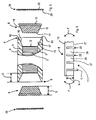
- a panel 1 usable for making furniture, shelving, shelves, doors and the like, comprising a layered or "sandwich" structure 2.
- the structure 2 comprises an intermediate layer 3 interposed between a first external layer 4 and a second external layer 5 that are substantially flat and mutually opposite, made of wood or similar materials.
- the intermediate layer 3 is made of a filling material, made of wood or similar materials, such as, for example, sheets of cardboard having a honeycomb structure, which is lighter and less resistant than the material used to make the first layer 4 and the second layer 5.
- the panel 1 is further provided, at edge portions 6 thereof, with a seat 7, extending substantially longitudinally ( Figure 2 ).
- the seat 7 has a substantially trapezoidal cross section, and is obtained, as disclosed better below, by suitably milling the edge portions 6.
- the seat 7 comprises a bottom wall 12, a first side wall 16 and a second side wall 17.
- the first side wall 16 and the second side wall 17 are obtained by respectively milling a first end portion 18 and a second end portion 19 respectively of the first layer 4 and of the second layer 5, whilst the bottom wall 12 is obtained by milling a third end portion 20 of the intermediate layer 3 ( Figure 1 ).
- the bottom wall 12, the first side wall 16 and the second side wall 17 consist respectively of an end wall 44 of the intermediate layer 3, of a first tilted wall 45 of the first layer 4 and of a second tilted wall 46 of the second layer 5.
- the seat 7 is arranged, in use, for receiving a supporting element 8, in the form of a slat or strip, made of wood or similar materials, having a cross section with a shape that is substantially the same as that of the seat 7 and arranged for reinforcing and strengthening the edge portions 6 of the panel 1 ( Figure 5 ) for supporting an edge element 28.
- a supporting element 8 in the form of a slat or strip, made of wood or similar materials, having a cross section with a shape that is substantially the same as that of the seat 7 and arranged for reinforcing and strengthening the edge portions 6 of the panel 1 ( Figure 5 ) for supporting an edge element 28.
- the supporting element 8 comprises a side 11 facing, and arranged for contacting, in use, the bottom wall 12, a further side 13 opposite the side 11, a first side surface 14 and a second side surface 15, which are mutually opposite, facing, in use, respectively the first side wall 16 and the second side wall 17 of the seat 7.
- first side surface 14 and the second side surface 15 and respectively the first side wall 16 and the second side wall 17 there are defined, in use, respective gaps, which are not shown, arranged for receiving an adhesive substance, arranged for gluing the supporting element 8 to the seat 7.
- the supporting element 8 further has a thickness S that is more or less great according to whether in a first external surface 9 and/or a second external surface 10 respectively of the first layer 4 and of the second layer 5, within a certain distance D from the edge portions 6, holes and/or millings that are not shown have to be executed.
- pins can engage these holes, which pins are not shown, which pins project from the first external surface 9 and/or from the second external surface 10 and are arranged for supporting, for example, a shelf, or fixing means, which are not shown, which are arranged for fixing to the panel 1 elements such as hinges.
- these millings are made to act as a guide for further panels, which are not shown, for example panels with a thin thickness arranged for acting as a bottom wall for a piece of furniture.
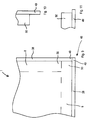
- the supporting element 8 further comprises a plurality of notches 22, for example mutually equidistant, obtained in the side 11, for example having a parallelepipedon shape, and defining a plurality of elongated elements 26, which comprise respective ends 27 that may move towards or away from one another in function of a curvature radius of a profile portion 25 of the panel 1 contacted by the supporting element 8 ( Figures 6 and 8 ).
- the notches 22 have a width L and a height H defining a minimum curvature radius for the supporting element 8.
- the supporting element 8 is devoid of the notches 22.
- edge element 28 which is made of plastics or similar materials, comprises a first face 29 facing and arranged for contacting the further side 13 of the supporting element 8 and a second face 30 opposite the first face 29.
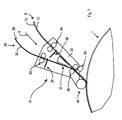
- an edgebanding apparatus 31 arranged for fixing the supporting element 8 on the edge element 28 and subsequently fixing the supporting element 8 and the edge element 28 on the panel 1.
- the edgebanding apparatus 31 comprises a support 32 on which a first pair of rollers 33 and a second pair of rollers 34 are mounted.
- the first pair of rollers 33 and the second pair of rollers 34 are arranged for unwinding from respective reels, which are not shown, respectively the edge element 28 and the supporting element 8.
- first pair of rollers 33 contacts the first face 29 and the second face 30 of the edge element 28, whilst the second pair of rollers 34 contacts the side 11 and the further side 13 of the supporting element 8.
- the edgebanding apparatus 31 comprises further a first blade 35 and a second blade 36, arranged respectively for cutting to a desired length the edge element 28 and the supporting element 8.
- first blade 35 and the second blade 36 suitably controlled by a control and management system that is not shown, enable the edge element 28 and the supporting element 8 to be cut to different lengths.
- respective end parts 49, 50 of the edge element 28 and of the supporting element 8 have lengths that are different from one another each time, in function of the position thereof on the panel 1.
- the first blade 35 and the second blade 36 are positioned respectively upstream of the first pair of rollers 34 and of the second pair of rollers 35 with respect to an advancing direction A of the edge element 28 and of the supporting element 8.
- the edgebanding apparatus 31 further comprises a glue distributor 37, for example comprising a gluing roller, which is not shown, arranged for distributing a desired quantity of glue on the further side 13 of the supporting element 8.
- a glue distributor 37 for example comprising a gluing roller, which is not shown, arranged for distributing a desired quantity of glue on the further side 13 of the supporting element 8.
- the glue distributor 37 is positioned downstream of the first blade 35 and of the second blade 36 with respect to the advancing direction A.
- the edgebanding apparatus 31 further comprises a pair of pressing rollers 38 positioned downstream of the glue distributor 37 with respect to the advancing direction A.
- the pressing rollers 38 act respectively on the second face 30 and on the side 11 and are arranged for pressing the edge element 28 against the supporting element 8, so as to fix the edge element 28 on the supporting element 8.
- the edgebanding apparatus 31 further comprises glue distributing means 39 positioned downstream of the pressing rollers 38 with respect to the advancing direction A.
- the glue distributing means 39 for example comprising a pair of glue injectors, is arranged for distributing a desired quantity of glue on the first side surface 14 and on the second side surface 15 of the supporting element 8, and on a first active portion 40 and on a second active portion 41 ( Figure 3 ) of the first face 29 of the edge element 28, the first active portion 40 and the second active portion 41 exceeding in height and facing the further side 13 of the supporting element 8.
- first active portion 40 and the second active portion 41 are arranged for being fixed respectively to a first head surface 42 and to a second head surface 43 respectively of the first layer 4 and of the second layer 5.
- the edgebanding apparatus 31 further comprises a further pressing roller 44 positioned downstream of the glue distributing means 39 with, respect to the advancing direction A.
- the further pressing roller 44 is arranged for contacting the second face 30 of the edge element 28 and for fixing the edge element 28, supported by the supporting element 8, to the panel 1.
- the further pressing roller 44 inserts the supporting element 8 into the seat 7 and presses the first active portion 40 and the second active portion 41 respectively against the first head surface 42 and the second head surface 43, which act as an abutment.
- an activating element for example a hair dryer or a lamp, arranged for activating a glue located on the further side 13.
- the glue distributor 37 or the activating element, distribute, or activate, a glue on the first face 29 of the edge element 28.
- This method first of all comprises cutting to size a panel 1, which has been suitably assembled previously.
- This milling enables the first head surface 42 and first tilted wall 46 to be defined in the first layer 4, and the second head surface 43 and the second tilted wall 47 to be defined in the second layer 5, and the end wall 45 to be defined in the intermediate layer 3.
- the edgebanding apparatus 31 glues the supporting element 8 to the edge element 28 and subsequently fixes the thus assembled supporting element 8 and edge element 28 to the panel 1.
- This fixing comprises inserting the supporting element 8 into the seat 7 and pressing the first active portion 40 and the second active portion 41 respectively against the first head surface 42 and the second head surface 43.
- edgebanding method disclosed above is particularly easy and fast to apply.
- the supporting element 8 is fixed onto the edge element 28 before being inserted into the seat 7
Landscapes
- Engineering & Computer Science (AREA)
- Architecture (AREA)
- Life Sciences & Earth Sciences (AREA)
- Manufacturing & Machinery (AREA)
- Civil Engineering (AREA)
- Structural Engineering (AREA)
- Mechanical Engineering (AREA)
- Wood Science & Technology (AREA)
- Forests & Forestry (AREA)
- Finishing Walls (AREA)
Applications Claiming Priority (1)
| Application Number | Priority Date | Filing Date | Title |
|---|---|---|---|
| ITMO20060402 ITMO20060402A1 (it) | 2006-12-11 | 2006-12-11 | Metodi e apparato di bordatura e pannello cosi' ottenuto |
Publications (2)
| Publication Number | Publication Date |
|---|---|
| EP1932637A2 true EP1932637A2 (fr) | 2008-06-18 |
| EP1932637A3 EP1932637A3 (fr) | 2009-02-18 |
Family
ID=39183141
Family Applications (1)
| Application Number | Title | Priority Date | Filing Date |
|---|---|---|---|
| EP07122716A Withdrawn EP1932637A3 (fr) | 2006-12-11 | 2007-12-10 | Procédé et appareil pour appliquer un bord de protection et panneau |
Country Status (2)
| Country | Link |
|---|---|
| EP (1) | EP1932637A3 (fr) |
| IT (1) | ITMO20060402A1 (fr) |
Cited By (4)
| Publication number | Priority date | Publication date | Assignee | Title |
|---|---|---|---|---|
| CH699797A1 (de) * | 2008-10-28 | 2010-04-30 | Woodwelding Ag | Verfahren zum befestigen einer kante an einem leichtbauelement. |
| EP2243619A1 (fr) * | 2009-04-22 | 2010-10-27 | Homag Holzbearbeitungssysteme AG | Dispositif et procédé destinés au revêtement de pièces à usiner |
| ITMO20090235A1 (it) * | 2009-09-22 | 2011-03-23 | Scm Group Spa | Metodo e apparato per preparare alla bordatura un pannello |
| US10059076B2 (en) | 2008-10-28 | 2018-08-28 | Woodwelding Ag | Method of fastening an edge structure to a construction element |
Family Cites Families (9)
| Publication number | Priority date | Publication date | Assignee | Title |
|---|---|---|---|---|
| FR1530769A (fr) * | 1967-06-16 | 1968-06-28 | Tecora | Procédé de fabrication de plateaux et panneaux recouverts de plaques en matière plastique stratifiée lamifiée |
| DE3713773C2 (de) * | 1987-04-24 | 1993-11-11 | Homag Maschinenbau Ag | Verfahren und Vorrichtung zum kontinuierlichen Anleimen von Furnierstreifen auf Kanten von plattenförmigen Werkstücken |
| US4971849A (en) * | 1989-08-14 | 1990-11-20 | Extrusions Division | Readily bendable extruded elastomeric trim strip |
| ES2134965T3 (es) * | 1995-02-24 | 1999-10-16 | Homag Maschinenbau Ag | Dispositivo para realizar una secuencia de operaciones sobre piezas a mecanizar en forma de planchas. |
| US6214148B1 (en) * | 1997-02-12 | 2001-04-10 | David A. Hill | System for applying a wood veneer across a corner of an elongate core |
| DE19955575B4 (de) * | 1999-11-18 | 2010-04-08 | Brandt Kantentechnik Gmbh | Verfahren und Vorrichtung zum Anhaften eines Deckmaterials an Werkstückoberflächen von fortlaufend bewegten oder stationär angeordneten platten- oder leistenförmigen Werkstücken |
| DE102004046849A1 (de) * | 2004-09-27 | 2006-03-30 | Homag Holzbearbeitungssysteme Ag | Verfahren zum Anleimen von Kantenmaterial an Leichtbauplatten |
| DE102005010565C5 (de) * | 2005-03-04 | 2015-03-12 | Rehau Ag + Co. | Leichtbauplatte und Verfahren zu ihrer Herstellung |
| ITBO20050397A1 (it) * | 2005-06-10 | 2006-12-11 | Biesse Spa | Pannello di legno o simili e relativi metodo e macchina di produzione |
-
2006
- 2006-12-11 IT ITMO20060402 patent/ITMO20060402A1/it unknown
-
2007
- 2007-12-10 EP EP07122716A patent/EP1932637A3/fr not_active Withdrawn
Non-Patent Citations (1)
| Title |
|---|
| None |
Cited By (10)
| Publication number | Priority date | Publication date | Assignee | Title |
|---|---|---|---|---|
| CH699797A1 (de) * | 2008-10-28 | 2010-04-30 | Woodwelding Ag | Verfahren zum befestigen einer kante an einem leichtbauelement. |
| WO2010048735A1 (fr) * | 2008-10-28 | 2010-05-06 | Woodwelding Ag | Procédé de fabrication d'un élément léger de construction et élément de soutien |
| US8597446B2 (en) | 2008-10-28 | 2013-12-03 | Woodwelding Ag | Method for producing a lightweight component, and support element |
| US9205627B2 (en) | 2008-10-28 | 2015-12-08 | Woodwelding Ag | Method for producing a lightweight component, and support element |
| US10059076B2 (en) | 2008-10-28 | 2018-08-28 | Woodwelding Ag | Method of fastening an edge structure to a construction element |
| US10336029B2 (en) | 2008-10-28 | 2019-07-02 | Woodwelding Ag | Method of fastening an object to a construction element |
| EP2243619A1 (fr) * | 2009-04-22 | 2010-10-27 | Homag Holzbearbeitungssysteme AG | Dispositif et procédé destinés au revêtement de pièces à usiner |
| EP2243619B2 (fr) † | 2009-04-22 | 2022-03-16 | Homag Holzbearbeitungssysteme AG | Dispositif et procédé destinés au revêtement de pièces à usiner |
| ITMO20090235A1 (it) * | 2009-09-22 | 2011-03-23 | Scm Group Spa | Metodo e apparato per preparare alla bordatura un pannello |
| EP2298517A1 (fr) * | 2009-09-22 | 2011-03-23 | SCM Group S.p.A. | Dispositif pour préparer un panneau pour l'application d'un bord de protection |
Also Published As
| Publication number | Publication date |
|---|---|
| ITMO20060402A1 (it) | 2008-06-12 |
| EP1932637A3 (fr) | 2009-02-18 |
Similar Documents
| Publication | Publication Date | Title |
|---|---|---|
| EP2052822B1 (fr) | Procédé et appareil d'emboîture | |
| CN101802323B (zh) | 板材及相关制造系统和制造方法 | |
| US9656451B2 (en) | Method and apparatus for making double panels | |
| EP2062706A1 (fr) | Procédé d'emboîture d'un panneau et panneau ainsi obtenu | |
| EP2298517B1 (fr) | Dispositif pour préparer un panneau pour l'application d'un bord de protection | |
| EP2133184B1 (fr) | Panneau de bois ou similaire, et procédé et machine pour la fabrication de celui-ci | |
| WO2010049418A1 (fr) | Planche stratifiée et procédé d’obtention de ladite planche stratifiée | |
| US6214148B1 (en) | System for applying a wood veneer across a corner of an elongate core | |
| EP2809489B1 (fr) | Un paneau de construction comprenant une âme lamellée | |
| EP0910500B1 (fr) | Procede et presse de production de blocs colles | |
| CZ344296A3 (en) | Board, particularly hard fiberboard, process of its manufacture and apparatus for making the same | |
| US5453142A (en) | Method and apparatus for securing sheets to slats and in spaces therebetween for forming a composite structure | |
| EP1961535A1 (fr) | Procédé et dispositif de collage de matériaux de rebord sur des panneaux de construction légers | |
| JP2014515321A (ja) | 繊維材料ブロック、特に木のブロックからの無端バンドの作製のための方法と装置、及び無端バンドと繊維材料ブロック | |
| US7877953B2 (en) | Process for sticking edging material onto lightweight building boards and a lightweight building board produced by means of said process | |
| EP1880838B1 (fr) | Dispositif et procede pour la fabrication d'un corps stratifié | |
| CN102187039A (zh) | 建筑板的制造方法 | |
| DE60308848T2 (de) | Hohles sandwichpaneel | |
| JP2011152640A (ja) | 木質化粧ボードの端面加工方法 | |
| WO2009109302A1 (fr) | Procédé et appareil destiné à fabriquer des éléments profilés revêtus | |
| ITMO20080106A1 (it) | Metodo e macchina per preparare alla bordatura un pannello | |
| EP3147091A1 (fr) | Procede d'application d'un element d'emboiture sur un panneau leger | |
| JP4268529B2 (ja) | 木質積層マットの搬送方法、木質系複合材の製造方法及び木質積層マット搬送用のサイドガイド | |
| PL234446B1 (pl) | Sposób wielkoseryjnego wytwarzania warstwowo klejonych paneli drewnianych z użyciem fornirów na warstwę dolną i środkową rdzeniową oraz urządzenie do wytwarzania warstwowych paneli drewnianych | |
| EP3159166B1 (fr) | Laminé décoratif comprenant du papier imprégné de resine et sa méthode de fabrication |
Legal Events
| Date | Code | Title | Description |
|---|---|---|---|
| PUAI | Public reference made under article 153(3) epc to a published international application that has entered the european phase |
Free format text: ORIGINAL CODE: 0009012 |
|
| AK | Designated contracting states |
Kind code of ref document: A2 Designated state(s): AT BE BG CH CY CZ DE DK EE ES FI FR GB GR HU IE IS IT LI LT LU LV MC MT NL PL PT RO SE SI SK TR |
|
| AX | Request for extension of the european patent |
Extension state: AL BA HR MK RS |
|
| PUAL | Search report despatched |
Free format text: ORIGINAL CODE: 0009013 |
|
| AK | Designated contracting states |
Kind code of ref document: A3 Designated state(s): AT BE BG CH CY CZ DE DK EE ES FI FR GB GR HU IE IS IT LI LT LU LV MC MT NL PL PT RO SE SI SK TR |
|
| AX | Request for extension of the european patent |
Extension state: AL BA HR MK RS |
|
| 17P | Request for examination filed |
Effective date: 20090723 |
|
| 17Q | First examination report despatched |
Effective date: 20090909 |
|
| AKX | Designation fees paid |
Designated state(s): DE ES IT |
|
| GRAP | Despatch of communication of intention to grant a patent |
Free format text: ORIGINAL CODE: EPIDOSNIGR1 |
|
| RTI1 | Title (correction) |
Free format text: EDGEBANDING METHOD |
|
| STAA | Information on the status of an ep patent application or granted ep patent |
Free format text: STATUS: THE APPLICATION IS DEEMED TO BE WITHDRAWN |
|
| 18D | Application deemed to be withdrawn |
Effective date: 20110212 |