EP1933322A2 - Aufzeichnung von Informationen auf ein Aufzeichnungsmedium mit temporärer Reservezone - Google Patents
Aufzeichnung von Informationen auf ein Aufzeichnungsmedium mit temporärer Reservezone Download PDFInfo
- Publication number
- EP1933322A2 EP1933322A2 EP08001091A EP08001091A EP1933322A2 EP 1933322 A2 EP1933322 A2 EP 1933322A2 EP 08001091 A EP08001091 A EP 08001091A EP 08001091 A EP08001091 A EP 08001091A EP 1933322 A2 EP1933322 A2 EP 1933322A2
- Authority
- EP
- European Patent Office
- Prior art keywords
- data
- area
- spare area
- formatting
- recording
- Prior art date
- Legal status (The legal status is an assumption and is not a legal conclusion. Google has not performed a legal analysis and makes no representation as to the accuracy of the status listed.)
- Ceased
Links
- 230000007547 defect Effects 0.000 claims abstract description 53
- 230000008859 change Effects 0.000 claims abstract description 31
- 230000004044 response Effects 0.000 claims abstract description 31
- 239000000725 suspension Substances 0.000 claims abstract description 23
- 238000000034 method Methods 0.000 claims description 18
- 238000001514 detection method Methods 0.000 claims description 5
- 230000003287 optical effect Effects 0.000 description 60
- 238000012545 processing Methods 0.000 description 14
- 230000008569 process Effects 0.000 description 13
- 238000010276 construction Methods 0.000 description 2
- 230000006870 function Effects 0.000 description 2
- 230000003760 hair shine Effects 0.000 description 2
- 238000012544 monitoring process Methods 0.000 description 2
- 238000006243 chemical reaction Methods 0.000 description 1
- 230000002950 deficient Effects 0.000 description 1
- 238000003780 insertion Methods 0.000 description 1
- 230000037431 insertion Effects 0.000 description 1
- 238000012986 modification Methods 0.000 description 1
- 230000004048 modification Effects 0.000 description 1
- 238000004904 shortening Methods 0.000 description 1
Images



Classifications
-
- G—PHYSICS
- G11—INFORMATION STORAGE
- G11B—INFORMATION STORAGE BASED ON RELATIVE MOVEMENT BETWEEN RECORD CARRIER AND TRANSDUCER
- G11B20/00—Signal processing not specific to the method of recording or reproducing; Circuits therefor
- G11B20/10—Digital recording or reproducing
- G11B20/18—Error detection or correction; Testing, e.g. of drop-outs
- G11B20/1883—Methods for assignment of alternate areas for defective areas
-
- G—PHYSICS
- G11—INFORMATION STORAGE
- G11B—INFORMATION STORAGE BASED ON RELATIVE MOVEMENT BETWEEN RECORD CARRIER AND TRANSDUCER
- G11B20/00—Signal processing not specific to the method of recording or reproducing; Circuits therefor
- G11B20/10—Digital recording or reproducing
- G11B20/12—Formatting, e.g. arrangement of data block or words on the record carriers
- G11B20/1217—Formatting, e.g. arrangement of data block or words on the record carriers on discs
-
- G—PHYSICS
- G11—INFORMATION STORAGE
- G11B—INFORMATION STORAGE BASED ON RELATIVE MOVEMENT BETWEEN RECORD CARRIER AND TRANSDUCER
- G11B2220/00—Record carriers by type
- G11B2220/20—Disc-shaped record carriers
Definitions
- the invention relates an information recording apparatus which records information on a recording medium having a user data area and a spare area, and also relates to an information recording method, a program for recording information, a memory medium having the information recording program stored thereon, and an information recording system.
- the Mt. Rainier standard has been proposed as a format which adds a defect management function to the rewritable CD disk or the DVD disk.
- the Mt. Rainier standard offers a format which provides compatibility with the original record format of the CD-RW disk and the DVD+RW disk that are rerecordable while newly adding a defective management function..
- the Mt. Rainier standard is characterized in that a defect management area and a spare area are positioned within the user data area of the conventional format.
- the defect management area resides both in a main table area (hereinafter referred to as an MTA) within the lead-in zone and in a secondary table area (hereinafter referred to as an STA) provided in the user data area of the conventional format.
- MTA main table area
- STA secondary table area
- Reallocated data are recorded on the spare area (hereinafter referred to as an SA) provided in the user data area of the conventional format.
- a DVD+MRW disk which is a DVD+RW disk recorded by the Mt. Rainier format
- the conventional drive detects the insertion of the DVD+RW disk, and reports this to a user.
- a MRW driver reads a predetermined address in the disk to find that a DVD+MRW disk is actually inserted. This is because the Mt. Rainier standard prescribes that information indicative of the Mt. Rainier disk be recorded at the predetermined address in the user data area.
- the MRW driver reads the defect management area recorded at a predetermined position within the user data area, thereby obtaining information about spare sectors.
- the spare area also resides in the user data area.
- the MRW driver In response to a data-read request from the user, the MRW driver identifies a relevant spare area based on the defect management information if the data-read request includes a request for access to a defect area, and requests the conventional drive to read the relevant spare area. In this manner, the conventional drive can properly read the DVD+MRW disk that contains spare sectors.. If the drive supports the DVD+MRW format (such a drive will hereinafter be referred to as an MRW drive), it can properly read spare sectors without the use of such MRW driver as described above.
- DVD+MRW which is the Mt. Rainier standard for CD-RW
- Both CD-MRW and DVD+MRW have their spare areas in the user data area. While CD-MRW has its spare areas dispersed in the user data area, DVD+MRW has its spare areas concentrated in the innermost circumference and the outermost circumference of the user data area.
- An SA in the innermost circumference of the user data area is referred to as an SA1, and an SA in the outermost circumference is referred to as an SA2.
- Another feature of the Mt. Rainier standard is background formatting.
- a user making a formatting request is notified of a formatting completion message after recording only a portion of the lead-in zone. The remaining portions are recorded with dummy data when there is no access from the user.
- the user can record or reproduce data on a random-access basis with respect to all the user data area on the disk.
- a DVD+MRW disk, for which reallocation to the SA2 is made after a defect is found during the formatting operation, may be taken out.
- a temporary SA2 (hereinafter referred to as a TSA2) is set aside from the LWA, and spared data is then copied to the SA2, followed by recording the TSTA and the TLO. This is done for the purpose of shortening a time required for the ejection of the disk. That is, since the SA2 in DVD+MRW is located at the outermost circumference of the user data area, the process of inserting dummy data into the unrecorded areas up to the SA2 is omitted for the purpose of time saving.
- the TSA2 is a temporary spare area for use by the conventional drive to read the reallocated data.
- the size of the TSA2 is a. sum of all the areas used for the spare purpose in the SA2.
- Figs. 7A and 7B are illustrative drawings showing the recording format of CD-MRW and DVD+MRW.
- Fig. 7A illustrates the recording format of CD-MRW
- Fig. 7B is the recording format of DVD+MRW.
- Both CD-MRW and DVD+MRW are divided into a lead-in zone, a data zone, and a lead-out zone.
- An MTA main table area is provided in the lead-in zone.
- a GAA general application area
- an SA separe area
- a DA data area
- an STA secondary table area
- defect management information and information about the formatting status are recorded on the MTA and STA.
- the STA is a copy of what is stored in the MTA, and is situated in the data zone.
- User data is recorded on the DA. If a defect is found in the DA during the recording of data, reallocation to the SA is carried out.
- the GAA stores information for use by an MRW driver to identify a MRW disk when a MRW disk is inserted into a conventional drive.
- MRW arranges an STA as a defect management area and an SA as a spare area in the data zone which is accessible by a conventional drive, thereby providing for the conventional drive to read the spare area.
- CD-MRW disperses the SAs and the DAs sparsely as shown in Fig. 7A
- DVD+MRW arranges the SA1 at the innermost circumference of the data zone and the SA2 at the outermost circumference as shown in Fig. 7B .
- the DAs which record user data are contiguous.
- Figs. 8A and 8B are illustrative drawings showing the way CD-MRW and DVD+MRW are partially formatted.
- Fig. 8A illustrates the recording format of CD-MRW
- Fig. 8B is the recording format of DVD+MRW.
- a TSTA temporary secondary table area
- TLO temporary lead-out
- MTA information is copied to the TSTA, storing defect management information and information about formatting status.
- An MRW driver refers to the TSTA to acquire spare information. Since SAs are sparsely dispersed in CD-MRW, a defect that is detected in an i-th DA area during the background formatting is generally replaced by an i-th SA area.
- “De-iced” represents areas where data is recorded. That is, “iced” indicates unrecorded areas, and “De-iced” means eliminating unrecorded areas.
- Japanese Patent Application Publication No. 10-021552 discloses an information recording apparatus that records spared data on the user data area. This information recording apparatus sets aside a portion of.the user data area as a spare area if a large number of defect areas may exist depending on the conditions of the disk. The set-aside portion of the user data area will then be used as a spare area.
- FIGs. 9A through 9D are illustrative drawings for explaining problems that occur in DVD+MRW.
- Figs. 9A through 9D illustrate a case in which the updating of a TSA2 becomes necessary in DVD+MRW.
- Fig. 9A shows a partially formatted DVD+MRW.
- data spared by (i.e., reallocated to) the SA2 is copied to a TSA2 following the formatted area, followed by the recorded TSTA and TLO.
- the TSA2 Since the TSA2 resides in the user data area, as illustrated in Fig. 9B , there may be a case in which the TSA2 is overwritten by user data.
- a drive is configured to resume background formatting if the TSTA and the TLO, which exist in the user data area, are similarly overwritten by user data.
- a TSA2 a TSTA, and a TLO will again be recorded from the new LWA at the time of disk discharge. This prevents these areas from being destroyed by the overwriting user data.
- a TSA2 may be overwritten by user data.
- the TSA2 will not be rerecorded by the resumed background formatting or the like. Because of this, if a TSA2 is overwritten by user data as illustrated in Fig. 9B , the TSA2 will be left overwritten.
- the drive gives incorrect spare data to the user. Namely, when a TSA2 is overwritten by user data during the process of adding user data to a partially formatted disk, the TSA2 will no longer correctly represent the information of the SA2. If such a disk is inserted in a conventional drive, incorrect information will be given to a user.
- an MRW drive accesses the SA2 to record data on the SA2.
- the SA2 and the TSA2 end up storing different data.
- the SA2 may be updated during the process of adding user data to a partially formatted disk, resulting in a situation where the TSA2 does not correctly reflect data in the SA2. If such a disk is inserted into a conventional drive, incorrect information will be given to a user.
- a problem may also arise when a new defect is found during the recording of user data.
- the size of a TSA2 is only as big as a sum of all the areas actually used for replacement in the SA2. As shown in Fig.9D , thus, a problem may be encountered in that there are no more areas for recording data that are newly found to be spared.
- a temporary spare area e.g., a TSA2
- the spare area e.g., the SA2
- a recording medium such as a partially formatted DVD+MRW.
- a temporary spare area e.g., a TSA2
- the spare area e.g., the SA2
- a recording medium such as a partially formatted DVD+MRW.
- an apparatus for recording information includes an information recording unit which records data on a recording medium having a user data area for recording of user requested data and having a predetermined spare area for reallocating a defect present in the user data area, a data reallocating unit which reallocates data to the predetermined spare area, a temporary spare area recording unit which generates a temporary spare area in a portion of the user data area by copying the reallocated data from the predetermined spare area to the portion of the user data area, and an updating unit which updates the temporary spare area by copying the reallocated data from the predetermined spare area to another portion of the user data area in response to a data change in one of the temporary spare area and the predetermined spare area.
- the reallocated data of the predetermined spare area is newly copied to a portion of the user data area when a data change occurs in the temporary spare area or in the predetermined spare area. This makes it possible to update the temporary spare area such that the temporary spare area always stores the correct reallocated data.
- the updating unit includes a first updating unit which updates the temporary spare area when the data change is caused by overwriting of the temporary spare area by user data.
- the reallocated data of the predetermined spare area is newly copied to a portion of the user data area when the temporary spare area is overwritten by user data. This makes it possible to update the temporary spare area such that the temporary spare area always stores the correct reallocated data.
- the updating unit includes a second updating unit which updates the temporary spare area when the data change is caused by recording on the predetermined spare area to which a recording area requested by a user has been reallocated.
- the reallocated data of the predetermined spare area is newly copied to a portion of the user data area when the predetermined spare area is updated by recording on the predetermined spare area. This makes it possible to update the temporary spare area such that the temporary spare area always stores the correct reallocated data.
- the updating' unit includes a second updating unit which updates the temporary spare area when the data change is caused by recording on the predetermined spare area in response to a detection of a defect in the user data area.
- the reallocated data of the predetermined spare area is newly copied to a portion of the user data area when the predetermined spare area is updated in response to a detection of a defect in the user data area.
- This makes it possible to update the temporary spare area such that the temporary spare area always stores the correct reallocated data.
- the recording medium is one that complies with a DVD+MRW standard, the predetermined spare area being a Spare Area 2 and the temporary spare area being a Temporary Spare Area 2, wherein the updating unit newly records the Temporary Spare Area 2 following a last written address in response to the data change in the Temporary Spare Area 2, followed by recording a Temporary Secondary Table Area and a Temporary Lead Out.
- the invention is applied to an information recording medium complying with the DVD+MRW standard.
- the recording medium is one that complies with a DVD+MRW standard, the predetermined spare area being a Spare Area 2 and the temporary spare area being a Temporary Spare Area 2, wherein the updating unit newly records the Temporary Spare Area 2 following a last written address in response to the data change in the Spare Area 2, followed by recording a Temporary Secondary Table Area and a Temporary Lead Out.
- the invention is applied to an information recording medium complying with the DVD+MRW standard.
- the updating unit updates the temporary spare area in response to a user request for ejection of the recording medium.
- the temporary spare area is updated only when the recording-medium is to be ejected, thereby preventing the updating of the temporary spare area from lowering the performance of a user request for data recording. Further, the ejected recording medium has the data of the temporary spare area that is correctly recorded. This insures that a conventional drive can properly read the reallocated data.
- the updating unit updates the temporary spare area in response to a user request for formatting suspension.
- the temporary spare area is updated only when a user request for formatting suspension is issued, thereby preventing the updating of the temporary spare area from lowering the performance of a user request for data recording. Further, the ejected recording medium has the data of the temporary spare area that is correctly recorded. This insures that a conventional drive can properly read the reallocated data.
- an apparatus for recording information includes an information recording unit which records data on a recording medium having a user data area for recording of user requested data and having a predetermined spare area for reallocating a defect present in the user data area, a background formatting unit which carries out formatting of the recording medium in a background, a background formatting resumption unit which resumes the background formatting when the recording medium is partially formatted, a data reallocating unit which reallocates data to the predetermined spare area, a temporary spare area recording unit which generates a temporary spare area in a portion of the user data area by copying the reallocated data from the predetermined spare area to the portion of the user data area, and a resuming unit which resumes the formatting in response to a data change in one of the temporary spare area and the predetermined spare area.
- the power of the information recording apparatus is shutdown without ejecting the recording medium (optical disk) after the temporary spare area (TSA2) is overwritten by user data or after the predetermined spare area (SA2) is updated.
- the temporary spare area (TSA2) fails to be updated, leaving the reallocated data incorrectly recorded.
- background formatting is resumed when the updating of the temporary spare area (TSA2) becomes necessary.
- the host apparatus monitoring formatting status is supposed to suspend background formatting if a user request for disk ejection or a request for PC power shutdown is made during the background formatting.
- the host apparatus needs to monitor a user request for disk ejection or a request for PC power shutdown, thereby issuing a request for formatting suspension to the information recording apparatus (drive) as such a need arises. Accordingly, it suffices for the information recording apparatus (drive) to update the temporary spare area (TSA2) at the timing the request for formatting suspension is received. If there is no request for formatting suspension, data will be recorded up to the position of the predetermined spare area (SA2), which insures that the recording medium (optical disk) is ejected with correct reallocated data. In this manner, the invention resumes background formatting when the updating of the temporary spare area or the predetermined spare area becomes necessary, thereby preventing the recording medium from having incorrect reallocated data recorded in the temporary spare area due to the power down of the drive without updating the temporary spare area.
- SA2 predetermined spare area
- the resuming unit includes a first resuming unit which resumes the formatting when the data change.is caused by overwriting of the temporary spare area by user data.
- the resuming unit includes a second resuming unit which resumes the formatting when the data change is caused by recording on the predetermined spare area to which a recording area requested by a user has been reallocated.
- the resuming unit includes a second resuming unit which resumes the formatting when the data change is caused by recording on the predetermined spare area in response to a detection of a defect in the user data area.
- the recording medium is one that complies with a DVD+MRW standard, the predetermined spare area being a Spare Area 2 and the temporary spare area being a Temporary Spare Area 2, wherein the resuming unit resumes the formatting in response to the data change in the Temporary Spare Area 2.
- the invention is applied to an information recording medium complying with the DVD+MRW standard.
- the recording medium is one that complies with a DVD+MRW standard, the predetermined spare area being a Spare Area 2 and the temporary spare area being a Temporary Spare Area 2, wherein the resuming unit resumes the formatting in response to the data change in the Spare Area 2.
- the invention is applied to an information recording medium complying with the DVD+MRW standard.
- a method of recording information includes an information recording step of recording data on a recording medium having a user data area for recording of user requested data and having a predetermined spare area for reallocating a defect present in the user data area, a data reallocating step of reallocating data to the predetermined spare area, a temporary spare area recording step of generating a temporary spare area in a portion of the user data area by copying the reallocated data from the predetermined spare area to the portion of the user data area, and an updating step of updating the temporary spare area by copying the reallocated data from the predetermined spare area to another portion of the user data area in response to a data change in one of the temporary spare area and the predetermined spare area.
- the reallocated data of the predetermined spare area is newly copied to a portion of the user data area when a data change occurs in the temporary spare area or in the predetermined spare area. This makes it possible to update the temporary spare area such that the temporary spare area always stores the correct reallocated data.
- a method of recording information includes an information recording step of recording data on a recording medium having a user data area for recording of user requested data and having a predetermined spare area for reallocating a defect present in the user data area, a. background formatting step of carrying out formatting of the recording medium in a background, a background formatting resumption step of resuming the background formatting when the recording medium is partially formatted, a data reallocating step of reallocating data to the predetermined spare area, a temporary spare area recording step of generating a temporary spare area in a portion of the user data area by copying the reallocated data from the predetermined spare area to the portion of the user data area, and a resuming step of resuming the formatting in response to a data change in one of the temporary spare area and the predetermined spare area.
- the power of the information recording apparatus is shutdown without ejecting the recording medium (optical disk) after the temporary spare area (TSA2) is overwritten by user data or after the predetermined spare area (SA2) is updated.
- the temporary spare area (TSA2) fails to be updated, leaving the reallocated data incorrectly recorded.
- background formatting is resumed when the updating of the temporary spare' area (TSA2) becomes necessary.
- the host apparatus monitoring formatting status is supposed to suspend background formatting if a user request for disk ejection or a request for PC power shutdown is made during the background formatting.
- the host apparatus needs to monitor a user request for disk ejection or a request for PC power shutdown, thereby issuing a request for formatting suspension to the information recording apparatus (drive) as such a need arises. Accordingly, it suffices for the information recording apparatus (drive) to update the temporary spare area (TSA2) at the timing the request for formatting suspension is received. If there is no request for formatting suspension, data will be recorded up to the position of the predetermined spare area (SA2), which insures that the recording medium (optical disk) is ejected with correct reallocated data. In this manner, the invention resumes background formatting when the updating of the temporary spare area or the predetermined spare area becomes necessary, thereby preventing the recording medium from having incorrect reallocated data recorded in the temporary spare area due to the power down of the drive without updating the temporary spare area.
- SA2 predetermined spare area
- a computer-readable record medium having a program embodied therein for causing a computer to record information
- the program comprising an information recording unit which records data on a recording medium having a user data area for recording of user requested data and having a predetermined spare area for reallocating a defect present in the user data area, a data reallocating unit which reallocates data to the predetermined spare area, a temporary spare area recording unit which generates a temporary spare area in a portion of the user data area by copying the reallocated data from the predetermined spare area to the portion of the user data area, and an updating unit which updates the temporary spare area by copying the reallocated data from the predetermined spare area to another portion of the user data area in response to a data change in one of the temporary spare area and the predetermined spare area.
- a computer-readable record medium having a program embodied therein for causing a computer to record information
- the program comprising an information recording unit which records data on a recording medium having a user data area for recording of user requested data and having a predetermined spare area for reallocating a defect present in the user data area, a background formatting unit which carries out formatting of the recording medium in a background, a background formatting resumption unit which resumes the background formatting when the recording medium is partially formatted, a data reallocating unit which reallocates data to the predetermined spare area, a temporary spare area recording unit which generates a temporary spare area in a portion of the user data area by copying the reallocated data from the predetermined spare area to the portion of the user data area, and a resuming unit which resumes the formatting in response to a data change in one of the temporary spare area and the predetermined spare area.
- a system for recording information includes an information recording apparatus which records data on a recording medium having a user data area for recording of user requested data and having a predetermined spare area for reallocating a defect present in the user data area, and a host apparatus which instructs the information recording apparatus to record data on the recording medium, wherein the information recording apparatus and the host apparatus together include an information recording unit which records data on the recording medium, a data reallocating unit which reallocates data to the predetermined spare area, a temporary spare area recording unit which generates a temporary spare area in a portion of the user data area by copying the reallocated data from the predetermined spare area to the portion of the user data area, and an updating unit which updates the temporary spare area by copying the reallocated data from the predetermined spare area to another portion of the user data area in response to a data change in one of the temporary spare area and the predetermined spare area.
- a system for recording information includes an information recording apparatus which records data on a recording medium having a user data area for recording of user requested data and having a predetermined spare area for reallocating a defect present in the user data area, and a host apparatus which instructs the information recording apparatus to record data on the recording medium, wherein the information recording apparatus and the host apparatus together include an information recording unit which records data on the recording medium, a background formatting unit which carries out formatting of the recording medium in a background, a background formatting resumption unit which resumes the background formatting when the recording medium is partially formatted, a data reallocating unit which reallocates data to the predetermined spare area, a temporary spare area recording unit which generates a temporary spare area in a portion of the user data area by copying the reallocated data from the predetermined spare area to the portion of the user data area, and a resuming unit which resumes the formatting in response to a data change in one of the temporary spare area and the predetermined spare area.
- a program for causing a computer to record information includes an information recording unit which records data on a recording medium having a user data area for recording of user requested data and having a predetermined spare area for reallocating a defect present in the user data area, a data reallocating unit which reallocates data to the predetermined spare area, a temporary spare area recording unit which generates a temporary spare area in a portion of the user data area by copying the reallocated data from the predetermined spare area to the portion of the user data area, and an updating unit which updates the temporary spare area by copying the reallocated data from the predetermined spare area to another portion of the user data area in response to a data change in one of the temporary spare area and the predetermined spare area.
- a program for causing a computer to record information includes an information recording unit which records data on a recording medium having a user data area for recording of user requested data and having a predetermined spare area for reallocating a defect present in the user data area, a background formatting unit which carries out formatting of the recording medium in a background, a background formatting resumption unit which resumes the background formatting when the recording medium is partially formatted, a data reallocating unit which reallocates data to the predetermined spare area, a temporary spare area recording unit which generates a temporary spare area in a portion of the user data area by copying the reallocated data from the predetermined spare area to the portion of the user data area, and a resuming unit which resumes the formatting in response to a data change in one of the temporary spare area and the predetermined spare area.
- FIG. 1 is an illustrative drawing showing the construction of an optical disk drive.
- an optical disk drive 101 includes a drive unit 102 that is hardware resources for recording/reproducing information on/from an optical disk, and further includes a driver 103 of the drive unit 102.
- the drive unit 102 may not be an MRW drive unit but may a conventional drive unit 102.
- the driver 103 needs to a driver that complies with the Mt. Rainier standard.
- the drive unit 102 rotates an optical disk 104, which is an information recording medium such as DVD+MRW or DVD+RW, and shines a laser beam on the rotating optical disk 104 to perform the recording/reproducing of information.
- the drive unit 102 includes a motor 105 for rotating the optical disk 104, an optical pickup 106 for shining laser light on the optical disk 104, and a motor 107 for moving the optical pickup 106 in a radial direction of the optical disk 104.
- the drive unit 102 further includes a control system for controlling the components described above.
- the drive unit 102 has a controller 108 that attends to the central control of each component.
- the controller 108 controls a rotation control system 109, a pickup control system 110, a motor control system 111, and a signal processing system 112.
- the rotation control system 109 controls the operation of the motor 105, which drives and rotates the optical disk 104.
- the pickup control system 110 controls the operation of the optical pickup 106, which shines laser light on the optical disk 104.
- the motor control system 111 controls the operation of the motor 107, which moves the optical pickup 106 in a radial direction of the optical disk 104.
- the signal processing system 112 uses an optical receiver device to detect laser light reflected by the optical disk 104 as the laser light is emitted by the optical pickup 106 under the control of the pickup control system 110, and processes the detected light signal.
- This signal processing system 112 stores data read from the optical disk 104 in a cache memory 113.
- the controller 108 transfers the data stored in the cache memory 113 to a host apparatus 115 connected through an external interface 114.
- the rotation control system 109, the pickup control system 110, the motor control system 111, and the signal processing system 112, which constitute the above-mentioned control system, may be implemented as a digital circuit.
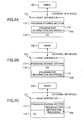
- the controller 108 provided in the drive unit 102 is implemented by a microcomputer, for example, and includes an installed program 116 that serves as the driver 103 for information recording. Even if the program 116 for information recording is permanently stored on recording medium such as a ROM in the controller 108, for example, it may additionally be stored in a rewritable manner on a battery backup RAM, a nonvolatile memory, etc.
- the program 116 of the driver 103 for information recording may' be installed in a program storing section 117 provided in the host apparatus 115, as shown in Fig. 2A .
- the program 116 may be provided as part of an OS 118 of the host apparatus 115 (refer to Fig. 2B ), or may be partially included in the OS 118 of the host apparatus 115 (refer to Fig. 2C ).
- the drive unit 102 and the host apparatus 115 together make up an information recording system.
- the controller 108 controls and drives the drive unit 102 according to the program 116 of the driver 103 for information recording, thereby letting the optical pickup 106 irradiate the optical disk 104 with laser light. Data is thus recorded on the optical disk 104 serving as an information recording medium (corresponding to an information recording unit and an information recording step).
- defect management information and information about formatting status are recorded in the MTA and the STA of the optical disk 104, which is DVD+MRW.
- the STA is a copy of what is stored in the MTA, and is arranged in the data zone.
- the STA serving as a defect management area and the SA serving as a spare area are arranged in the data zone which is accessible by the drive 102 having a conventional configuration, thereby providing for the conventional drive 102 to read the spare area.
- the program 116 of the driver 103 for information recording in this embodiment further performs background formatting.
- background formatting a user making a formatting request is notified of a formatting completion message after recording only a portion of the lead-in zone, and the remaining portions are recorded with dummy data when there is no access from the user (i.e., a background formatting unit and a background format step).
- the user After receiving the formatting completion message, the user can record or reproduce data on a random-access basis with respect to all the user data area on the optical disk 104.
- the program 116 of the driver 103 for information recording stores dummy data in unrecorded areas intervening between recorded data. Further, the program 116 of the driver 103 for information recording records a TSTA from the position of the LWA that is recorded with user data or recorded by formatting, for the purpose of allowing the driver 103 to obtain defect management information. At the end, a TLO is recorded, followed by the ejection of the disk.
- Formatting may be resumed with respect the disk that is ejected halfway through formatting in this manner.
- dummy data is recorded from the position of the LWA.
- data spared by (i.e., reallocated to) the SA2 is copied to the TSA2 following the formatted area, and, then, the disk is ejected after recording the TSTA and the TLO following the TSA2 (i.e., a temporary spare area recording unit and a temporary spare area recording step).
- the updating of the TSA2 is performed to obviate such a problem.
- Fig. 3A is an illustrative drawing showing a case in which a TSA2 is overwritten as a result of the user recording of data in the partially formatted optical disk 104 that is DVD+MRW.
- a hatched region is an area that is overwritten, which partially covers the TSA2.
- the TSA2 will be left overwritten.
- the conventional drive 102 gives incorrect spare data to the user. Namely, when the TSA2 is overwritten by user data during the process of adding user data to the partially formatted optical disk 104, the TSA2 will no longer correctly represent the information of the SA2. If such an optical disk 104 is inserted in the conventional drive 102, incorrect information will be given to a user.
- the controller 108 attends to processing according to the program 116 of the driver 103 for information recording.
- this processing records a TSA2 copied from the SA2 on the optical disk 104 from the position of the LWA at predetermined timing, and further records the TSTA and the TLO following the TSA2 (corresponding to a first updating unit).
- Figs. 3A and 3B are provided to show a situation in which the TSA2 is overwritten by user data as a result of the user recording of data on the partially formatted optical disk 104 that is DVD+MRW. This embodiment successfully avoids a problem caused by such a situation that the TSA2 does not properly reflect the information of the SA2.
- a situation in which the TSA2 does not correctly reflect the information of the SA2 is also brought about when the data of the SA2 is updated.
- Data of the SA2 may be updated when a user records data in the areas reallocated to the SA2 or when a new defect is found during the recording of user data.
- the controller 108 attends to processing according to the program 116 of the driver 103 for information recording.
- This processing records a TSA2 copied from the SA2 on the optical disk 104 from the position of the LWA at predetermined timing, and further records the TSTA and the TLO following the TSA2 (corresponding to a second updating unit).
- Fig. 4 is a flowchart showing a process of updating a TSA2 performed by the controller 108 according to the program 116 of the driver 103 for information recording. This process will be described in the following.
- step S1 When a data recording request is issued from a user (step S1), data is recorded (step S2). If an area requested by the user for data recording is reallocated to the SA2, data is recorded in the SA2.
- step S3 finds that the requested address is not in the TSA2, a check is further made as to whether the requested address has been reallocated to the SA2 (step S4). If it has been reallocated to the SA2, the TSA2 update flag is set (step S6).
- step S4 finds that the requested address has not been reallocated to the SA2, a check is further made as to whether recording on the requested address has brought about reallocation to the SA2 (step S5). If such reallocation to the SA2 has occurred, the TSA2 update flag is set (step S6).
- step S7 a check is made as to whether a request for ejecting the optical disk 104 is made (step S7). If the request for ejecting the optical disk 104 has been made (Yes at step S7), it is checked whether the TSA2 update flag is in the set status (step S8). If the TSA2 update flag is not in the set status, the disk is discharged, and processing is brought to an end (step S11). If the TSA2 update flag indicates the set status, the TSA2 is newly recorded from the position of the LWA (step S9). Then, the TSTA and the TLO are recorded following the TSA2 (step S10), and the disk is discharged (step S11) prior to the closure of the processing.
- the updating of a TSA2 is performed at timing when a request for ejecting the optical disk 104 is received from the user. This prevents the performance of a user request for data recording from being degraded due to the updating of the TSA2 serving as a temporary spare area.
- the TSA2 may be updated at a time when a request for formatting suspension is issued.
- the check at step S7 for determining whether an eject request is made is replaced by a check for determining whether a request for formatting suspension is made.
- the program 116 of the driver 103 for information recording resumes background formatting (corresponding to a first resuming unit).
- the resuming of background formatting results in the recording of dummy data being started from the position of the LWA (i.e., the TLO start address).
- the host apparatus 115 issues a request for formatting suspension.
- the drive unit .102 starts recording a TSA2, a TSTA, and a TLO from the new LWA before the discharge of the optical disk 104. If there is no request for formatting suspension from a user, the SA2, the STA and the LO as would have.been originally given will be recorded.
- Fig. 3C is provided to show a situation in which the TSA2 is overwritten by user data as a result of the user recording of data on the partially formatted optical disk 104 that is DVD+MRW. This embodiment successfully avoids a problem caused by such a situation that the TSA2 does not properly reflect the information of the SA2.
- a situation in which the TSA2 does not correctly reflect the information of the SA2 is also brought about when the data of the SA2 is updated.
- Data of the SA2 may be updated when a user records data in the areas reallocated to the SA2 or when a new defect is found during the recording of user data.
- the controller 108 attends to processing according to the program 116 of the driver 103 for information recording.
- This processing resumes background formatting as shown in Fig. 3C . That is, the resuming of background formatting starts by recording dummy data from the position of the LWA (i.e., the TLO start address).
- the host apparatus 115 issues a request for formatting suspension.
- the drive unit 102 starts recording a TSA2, a TSTA, and a TLO from the new LWA before the discharge of the optical disk 104 (corresponding to a second resuming unit).
- Fig. 5 is a flowchart showing a process of resuming background formatting performed by the controller 108 according to the program 116 of the driver 103 for information recording. This process will be described in the following.
- step S21 When a data recording request is issued from a user (step S21), data is recorded (step S22). If an area requested by the user for data recording is reallocated to the SA2, data is recorded in the SA2.
- step S23 A check is then made as to whether the requested address is in the TSA2. (step S23). If it is in the TSA2 (Yes at step S23), background formatting is resumed (step S26).
- step S23 If the requested address is not in the TSA2 (No at step S23), a check is further made as to whether the requested address has been reallocated to the SA2 (step S24). If it has been reallocated to the SA2 (Yes at step S24), background formatting is resumed (step S26) .
- step S24 finds that the requested address has not been reallocated to the SA2 (No at step S24), a check is further made as to whether recording on the requested address has brought about reallocation to the SA2 (step S25). If such reallocation to the SA2 has occurred (Yes at step S25), background formatting is resumed (step S26).
- step S21 If it is ascertained at step S21 that there is no data recording request from the user (No at step S21), a check is made as to whether a request for formatting suspension is made (step S27). If the request for formatting suspension has been made (Yes at step S27), it is checked whether background formatting is underway (step S28).
- step S28 If the check does not find that background formatting is underway, processing is brought to an end (No at step S28). If background formatting is underway (Yes at step S28), the background formatting is suspended (step S29) . Then, the TSA2 is newly recorded from the position of the LWA (step S30), and the TSTA and the TLO are recorded following the TSA2 (step S31) prior to the closure of the processing.
- Fig. 6 is.a flowchart showing a process of reproducing data from an optical disk.
- the drive unit 102 having a conventional configuration and an MRW driver (reader driver) work together to read data recorded on the optical disk 104 that is an MRW disk.
- the controller 108 operating based on the program 116 of the driver 103 for information recording checks whether the optical disk 104 is an MRW disk (step S41). This check is made by referring to a GAA (see Fig. 7 ) included in the DA of the optical disk.
- step S41 If the check finds that the optical disk 104 is not an MRW disk (No at step S41), reproduction is commenced after awaiting a user request for reproduction (steps S49-S52).
- step S41 If it is ascertained that the optical disk 104 is an MRW disk (Yes at step S41), search for a TLO start address (step S42), search for a TSTA start address (step S43), and reading of the TSTA (step S44) are performed, thereby obtaining the TSA and the TSA2 functioning as spare information (step S45).
- the mounting of the MRW driver is then completed (step S46). Reproduction starts after awaiting a user request for reproduction (step S49-S52) .
- step S48 a check is made as to whether there is any reallocated data in the DA (step S48). If there is no reallocated data, reproduction is continued until to the end (step S52)
- step S49 If there is reallocated data in the DA, conversion to a reallocation address is made (step S49). The reallocation address is then read (step 550), and reproduction is continued until to the end (step S52)
Landscapes
- Engineering & Computer Science (AREA)
- Signal Processing (AREA)
- Signal Processing For Digital Recording And Reproducing (AREA)
Applications Claiming Priority (4)
| Application Number | Priority Date | Filing Date | Title |
|---|---|---|---|
| JP2002299335 | 2002-10-11 | ||
| JP2002308308 | 2002-10-23 | ||
| JP2003325195A JP4270991B2 (ja) | 2002-10-11 | 2003-09-17 | 情報記録装置、情報記録方法、情報記録用プログラム、情報記録用プログラムを記憶する記憶媒体、及び情報記録システム |
| EP03256405A EP1420403A3 (de) | 2002-10-11 | 2003-10-10 | Aufzeichnung von Informationen auf ein Aufzeichnungsmedium mit temporärer Reservezone |
Related Parent Applications (2)
| Application Number | Title | Priority Date | Filing Date |
|---|---|---|---|
| EP03256405A Division EP1420403A3 (de) | 2002-10-11 | 2003-10-10 | Aufzeichnung von Informationen auf ein Aufzeichnungsmedium mit temporärer Reservezone |
| EP03256405.6 Division | 2003-10-10 |
Publications (2)
| Publication Number | Publication Date |
|---|---|
| EP1933322A2 true EP1933322A2 (de) | 2008-06-18 |
| EP1933322A3 EP1933322A3 (de) | 2010-07-21 |
Family
ID=32180288
Family Applications (2)
| Application Number | Title | Priority Date | Filing Date |
|---|---|---|---|
| EP08001091A Ceased EP1933322A3 (de) | 2002-10-11 | 2003-10-10 | Aufzeichnung von Informationen auf ein Aufzeichnungsmedium mit temporärer Reservezone |
| EP03256405A Withdrawn EP1420403A3 (de) | 2002-10-11 | 2003-10-10 | Aufzeichnung von Informationen auf ein Aufzeichnungsmedium mit temporärer Reservezone |
Family Applications After (1)
| Application Number | Title | Priority Date | Filing Date |
|---|---|---|---|
| EP03256405A Withdrawn EP1420403A3 (de) | 2002-10-11 | 2003-10-10 | Aufzeichnung von Informationen auf ein Aufzeichnungsmedium mit temporärer Reservezone |
Country Status (3)
| Country | Link |
|---|---|
| US (1) | US7228376B2 (de) |
| EP (2) | EP1933322A3 (de) |
| JP (1) | JP4270991B2 (de) |
Families Citing this family (15)
| Publication number | Priority date | Publication date | Assignee | Title |
|---|---|---|---|---|
| JP4270991B2 (ja) * | 2002-10-11 | 2009-06-03 | 株式会社リコー | 情報記録装置、情報記録方法、情報記録用プログラム、情報記録用プログラムを記憶する記憶媒体、及び情報記録システム |
| US7496805B2 (en) * | 2003-03-17 | 2009-02-24 | Pioneer Corporation | Write once type recording medium, recording device and recording method for write once type recording medium, and reproduction device and reproduction method for write once type recording medium |
| RU2340961C2 (ru) * | 2003-03-24 | 2008-12-10 | Конинклейке Филипс Электроникс Н.В. | Способ записи выводной области на оптический диск |
| JP3710790B2 (ja) * | 2003-03-24 | 2005-10-26 | 株式会社リコー | 情報記録方法及びその装置 |
| JP2004310972A (ja) * | 2003-03-25 | 2004-11-04 | Ricoh Co Ltd | 情報処理装置、情報記録装置、情報処理システム、情報記録方法、情報記録用プログラム及び記憶媒体 |
| JP3594243B1 (ja) * | 2003-03-25 | 2004-11-24 | 株式会社リコー | 光情報記録方法、光情報記録装置、情報処理装置、光情報記録媒体 |
| KR100860985B1 (ko) * | 2003-05-23 | 2008-09-30 | 삼성전자주식회사 | 패딩 정보를 이용한 기록/재생 방법 |
| CA2530059A1 (en) * | 2003-06-23 | 2004-12-29 | Koninklijke Philips Electronics N.V. | Device and method for recording information |
| JP3595551B1 (ja) * | 2003-07-02 | 2004-12-02 | 株式会社リコー | 情報記録装置と情報記録方法とプログラム |
| US7164640B2 (en) * | 2005-03-01 | 2007-01-16 | Ricoh Company, Ltd. | Information storage method that assures compatibility of writable medium with read only medium |
| JP4223431B2 (ja) * | 2004-01-27 | 2009-02-12 | 株式会社リコー | 欠陥管理情報設定方法、記録方法及び情報記録装置 |
| KR20060109989A (ko) * | 2004-02-12 | 2006-10-23 | 코닌클리케 필립스 일렉트로닉스 엔.브이. | 고유 매체 식별자를 재생하는 재생장치 및 재생방법 |
| JP4095977B2 (ja) | 2004-03-11 | 2008-06-04 | 株式会社リコー | 欠陥管理方法及び情報記録装置 |
| JP4037382B2 (ja) * | 2004-03-11 | 2008-01-23 | 株式会社リコー | 欠陥管理方法、再生方法、プログラム及び記録媒体、情報記録装置並びに情報再生装置 |
| KR100641689B1 (ko) | 2004-12-28 | 2006-11-03 | 삼성전자주식회사 | 데이터 기록장치의 고밀도 기록방법 |
Citations (4)
| Publication number | Priority date | Publication date | Assignee | Title |
|---|---|---|---|---|
| JPH1021552A (ja) | 1996-02-23 | 1998-01-23 | Mitsubishi Electric Corp | 光ディスクの欠陥処理方法、及び光ディスク装置 |
| JP2002299335A (ja) | 2001-03-30 | 2002-10-11 | Tokyo Electron Ltd | 熱処理装置 |
| JP2002308308A (ja) | 2001-04-17 | 2002-10-23 | Nonogawa Shoji Kk | 二剤吐出容器 |
| JP2003325195A (ja) | 2002-05-08 | 2003-11-18 | Degussa Ag | エナンチオマー豊富化したN−保護されていないβ−アミノ酸の酵素的製造方法、β−アミノ酸−n−プロピルエステル及びその使用 |
Family Cites Families (18)
| Publication number | Priority date | Publication date | Assignee | Title |
|---|---|---|---|---|
| US5437012A (en) * | 1993-04-19 | 1995-07-25 | Canon Information Systems, Inc. | System for updating directory information and data on write once media such as an optical memory card |
| KR100243314B1 (ko) | 1995-04-07 | 2000-02-01 | 윤종용 | 임시 디펙트 리스트를 이용한 에러 로그 방법 |
| US6304986B1 (en) * | 1999-03-12 | 2001-10-16 | Iomega Corporation | Method and apparatus for inspecting recording medium for defects |
| US6332204B1 (en) | 1999-03-31 | 2001-12-18 | International Business Machines Corporation | Recovering and relocating unreliable disk sectors when encountering disk drive read errors |
| JP2003536194A (ja) * | 2000-06-06 | 2003-12-02 | コーニンクレッカ フィリップス エレクトロニクス エヌ ヴィ | 記録媒体のようなディスクに対するファイルの即時書き込み又は読み取り方法 |
| JP3860394B2 (ja) | 2000-06-20 | 2006-12-20 | 株式会社リコー | 情報再生方法及び情報再生装置 |
| JP3920021B2 (ja) * | 2000-11-17 | 2007-05-30 | 株式会社リコー | 情報記録再生システム |
| JP4006184B2 (ja) | 2001-01-30 | 2007-11-14 | 株式会社リコー | 情報記録再生方法、情報記録再生装置、情報処理装置及びコンピュータ・プログラム |
| JP2002324363A (ja) | 2001-04-25 | 2002-11-08 | Ricoh Co Ltd | 情報記録再生装置 |
| JP3878442B2 (ja) | 2001-07-30 | 2007-02-07 | 株式会社リコー | 情報記録再生装置とプログラム |
| JP3886800B2 (ja) | 2001-12-19 | 2007-02-28 | 株式会社リコー | データ管理情報取得方法、情報再生装置、並びにデータ管理情報取得プログラム及び記録媒体 |
| JP4100913B2 (ja) | 2002-01-15 | 2008-06-11 | 株式会社リコー | 情報再生装置、データ管理情報取得方法、データ管理情報取得プログラム、記憶媒体、及び再生システム |
| TWI220249B (en) * | 2002-05-28 | 2004-08-11 | Mediatek Inc | Method for managing defects on an optical disk |
| JP2004005842A (ja) | 2002-05-31 | 2004-01-08 | Ricoh Co Ltd | 記録方法、記録媒体、プログラム及び情報記録媒体、並びに情報記録装置 |
| TW591615B (en) * | 2002-06-25 | 2004-06-11 | Mediatek Inc | Method for accessing data of defect optical disk |
| JP4270991B2 (ja) * | 2002-10-11 | 2009-06-03 | 株式会社リコー | 情報記録装置、情報記録方法、情報記録用プログラム、情報記録用プログラムを記憶する記憶媒体、及び情報記録システム |
| KR101035102B1 (ko) * | 2003-06-23 | 2011-05-19 | 코닌클리케 필립스 일렉트로닉스 엔.브이. | 정보를 기록하는 장치 및 방법 |
| KR20060109989A (ko) * | 2004-02-12 | 2006-10-23 | 코닌클리케 필립스 일렉트로닉스 엔.브이. | 고유 매체 식별자를 재생하는 재생장치 및 재생방법 |
-
2003
- 2003-09-17 JP JP2003325195A patent/JP4270991B2/ja not_active Expired - Fee Related
- 2003-10-07 US US10/679,267 patent/US7228376B2/en not_active Expired - Fee Related
- 2003-10-10 EP EP08001091A patent/EP1933322A3/de not_active Ceased
- 2003-10-10 EP EP03256405A patent/EP1420403A3/de not_active Withdrawn
Patent Citations (4)
| Publication number | Priority date | Publication date | Assignee | Title |
|---|---|---|---|---|
| JPH1021552A (ja) | 1996-02-23 | 1998-01-23 | Mitsubishi Electric Corp | 光ディスクの欠陥処理方法、及び光ディスク装置 |
| JP2002299335A (ja) | 2001-03-30 | 2002-10-11 | Tokyo Electron Ltd | 熱処理装置 |
| JP2002308308A (ja) | 2001-04-17 | 2002-10-23 | Nonogawa Shoji Kk | 二剤吐出容器 |
| JP2003325195A (ja) | 2002-05-08 | 2003-11-18 | Degussa Ag | エナンチオマー豊富化したN−保護されていないβ−アミノ酸の酵素的製造方法、β−アミノ酸−n−プロピルエステル及びその使用 |
Also Published As
| Publication number | Publication date |
|---|---|
| JP2004164822A (ja) | 2004-06-10 |
| EP1933322A3 (de) | 2010-07-21 |
| US20040133739A1 (en) | 2004-07-08 |
| JP4270991B2 (ja) | 2009-06-03 |
| US7228376B2 (en) | 2007-06-05 |
| EP1420403A3 (de) | 2004-12-08 |
| EP1420403A2 (de) | 2004-05-19 |
Similar Documents
| Publication | Publication Date | Title |
|---|---|---|
| US8274868B2 (en) | Optical recording medium, recording/reproducing apparatus and method, initialization method, and reinitialization method | |
| US5623470A (en) | Reallocation of defective recording areas on CD-R or CD-E media | |
| US6581167B1 (en) | Information recording medium, information recording method and information recording/reproduction system | |
| EP1253590B1 (de) | Datenspeichergerät,das entweder ein Aufzeichnungsmedium im Hintergrund zertifiziert oder die auf das Aufzeichnungsmedium geschriebenen Daten verifiziert | |
| EP1843331B1 (de) | Informationsspeichervorrichtung, die Daten in nicht aufgezeichnete Bereiche eines Aufzeichnungsmediums schreibt | |
| US7228376B2 (en) | Recording of information on recording medium having temporary space area | |
| US20090262617A1 (en) | Information recording device | |
| US8174942B2 (en) | Data recording method capable of replacing defective data on different location in spare areas | |
| JPH1166751A (ja) | 情報記録再生装置 | |
| US20040160875A1 (en) | Recording method, program, storage medium, and information recording apparatus | |
| US20080144466A1 (en) | Information recording medium, recording/reproducing method and apparatus, and host apparatus | |
| JP2000030360A (ja) | 記憶装置及び記録媒体 | |
| JP2001229622A (ja) | 光ディスク及び光ディスク記録方法 | |
| JP4081395B2 (ja) | 情報記録再生装置 | |
| US7428196B2 (en) | Writing data to an optical disc | |
| JP4558726B2 (ja) | 情報記憶装置及び方法 | |
| JP2002304731A (ja) | 書き損じた追記型光ディスクの記録終端位置検出方法および記録再生方法 | |
| JP2004227737A (ja) | 情報記録装置 | |
| HK1082116B (en) | Recording/reproducing apparatus | |
| HK1082116A1 (en) | Recording/reproducing apparatus | |
| KR20070031454A (ko) | 기록 장치 및 방법 |
Legal Events
| Date | Code | Title | Description |
|---|---|---|---|
| PUAI | Public reference made under article 153(3) epc to a published international application that has entered the european phase |
Free format text: ORIGINAL CODE: 0009012 |
|
| 17P | Request for examination filed |
Effective date: 20080128 |
|
| AC | Divisional application: reference to earlier application |
Ref document number: 1420403 Country of ref document: EP Kind code of ref document: P |
|
| AK | Designated contracting states |
Kind code of ref document: A2 Designated state(s): DE ES FR GB IT NL |
|
| PUAL | Search report despatched |
Free format text: ORIGINAL CODE: 0009013 |
|
| AK | Designated contracting states |
Kind code of ref document: A3 Designated state(s): DE ES FR GB IT NL |
|
| 17Q | First examination report despatched |
Effective date: 20110215 |
|
| AKX | Designation fees paid |
Designated state(s): DE ES FR GB IT NL |
|
| STAA | Information on the status of an ep patent application or granted ep patent |
Free format text: STATUS: THE APPLICATION HAS BEEN REFUSED |
|
| 18R | Application refused |
Effective date: 20130918 |