EP1935509A1 - Gegenstände mit Antifouling-Oberflächen und deren Herstellungsverfahren - Google Patents
Gegenstände mit Antifouling-Oberflächen und deren Herstellungsverfahren Download PDFInfo
- Publication number
- EP1935509A1 EP1935509A1 EP07122213A EP07122213A EP1935509A1 EP 1935509 A1 EP1935509 A1 EP 1935509A1 EP 07122213 A EP07122213 A EP 07122213A EP 07122213 A EP07122213 A EP 07122213A EP 1935509 A1 EP1935509 A1 EP 1935509A1
- Authority
- EP
- European Patent Office
- Prior art keywords
- contact angle
- features
- article
- oil
- nominal
- Prior art date
- Legal status (The legal status is an assumption and is not a legal conclusion. Google has not performed a legal analysis and makes no representation as to the accuracy of the status listed.)
- Withdrawn
Links
- 230000003373 anti-fouling effect Effects 0.000 title claims abstract description 23
- 238000000034 method Methods 0.000 title claims description 18
- 239000000463 material Substances 0.000 claims abstract description 36
- 239000007788 liquid Substances 0.000 claims abstract description 34
- 239000003921 oil Substances 0.000 claims description 58
- 239000000758 substrate Substances 0.000 claims description 29
- XLYOFNOQVPJJNP-UHFFFAOYSA-N water Substances O XLYOFNOQVPJJNP-UHFFFAOYSA-N 0.000 claims description 24
- 230000004048 modification Effects 0.000 claims description 7
- 238000012986 modification Methods 0.000 claims description 7
- 239000010723 turbine oil Substances 0.000 claims description 4
- 239000000919 ceramic Substances 0.000 claims description 3
- 229920000642 polymer Polymers 0.000 claims description 2
- 229910000765 intermetallic Inorganic materials 0.000 claims 1
- 238000000576 coating method Methods 0.000 description 10
- XUIMIQQOPSSXEZ-UHFFFAOYSA-N Silicon Chemical compound [Si] XUIMIQQOPSSXEZ-UHFFFAOYSA-N 0.000 description 8
- 229910052710 silicon Inorganic materials 0.000 description 8
- 239000010703 silicon Substances 0.000 description 8
- 230000002209 hydrophobic effect Effects 0.000 description 6
- 230000003068 static effect Effects 0.000 description 6
- -1 dirt particulates Substances 0.000 description 5
- 238000009826 distribution Methods 0.000 description 5
- 239000003795 chemical substances by application Substances 0.000 description 4
- 239000011248 coating agent Substances 0.000 description 4
- 238000009736 wetting Methods 0.000 description 4
- 229910052582 BN Inorganic materials 0.000 description 3
- PZNSFCLAULLKQX-UHFFFAOYSA-N Boron nitride Chemical compound N#B PZNSFCLAULLKQX-UHFFFAOYSA-N 0.000 description 3
- RTAQQCXQSZGOHL-UHFFFAOYSA-N Titanium Chemical compound [Ti] RTAQQCXQSZGOHL-UHFFFAOYSA-N 0.000 description 3
- 230000000694 effects Effects 0.000 description 3
- 229910052751 metal Inorganic materials 0.000 description 3
- 239000002184 metal Substances 0.000 description 3
- 239000010936 titanium Substances 0.000 description 3
- 229910052719 titanium Inorganic materials 0.000 description 3
- GWEVSGVZZGPLCZ-UHFFFAOYSA-N Titan oxide Chemical compound O=[Ti]=O GWEVSGVZZGPLCZ-UHFFFAOYSA-N 0.000 description 2
- NRTOMJZYCJJWKI-UHFFFAOYSA-N Titanium nitride Chemical compound [Ti]#N NRTOMJZYCJJWKI-UHFFFAOYSA-N 0.000 description 2
- MCMNRKCIXSYSNV-UHFFFAOYSA-N Zirconium dioxide Chemical compound O=[Zr]=O MCMNRKCIXSYSNV-UHFFFAOYSA-N 0.000 description 2
- 238000004458 analytical method Methods 0.000 description 2
- SJKRCWUQJZIWQB-UHFFFAOYSA-N azane;chromium Chemical compound N.[Cr] SJKRCWUQJZIWQB-UHFFFAOYSA-N 0.000 description 2
- 230000015556 catabolic process Effects 0.000 description 2
- 229910010293 ceramic material Inorganic materials 0.000 description 2
- 238000005229 chemical vapour deposition Methods 0.000 description 2
- 238000004140 cleaning Methods 0.000 description 2
- 238000005260 corrosion Methods 0.000 description 2
- 230000007797 corrosion Effects 0.000 description 2
- 230000007423 decrease Effects 0.000 description 2
- 238000006731 degradation reaction Methods 0.000 description 2
- 238000004049 embossing Methods 0.000 description 2
- 238000005530 etching Methods 0.000 description 2
- 230000001747 exhibiting effect Effects 0.000 description 2
- 239000012530 fluid Substances 0.000 description 2
- XPBBUZJBQWWFFJ-UHFFFAOYSA-N fluorosilane Chemical compound [SiH3]F XPBBUZJBQWWFFJ-UHFFFAOYSA-N 0.000 description 2
- 230000005484 gravity Effects 0.000 description 2
- 230000005661 hydrophobic surface Effects 0.000 description 2
- 230000003116 impacting effect Effects 0.000 description 2
- 238000001459 lithography Methods 0.000 description 2
- 150000001247 metal acetylides Chemical class 0.000 description 2
- 239000000203 mixture Substances 0.000 description 2
- 150000004767 nitrides Chemical class 0.000 description 2
- 238000005240 physical vapour deposition Methods 0.000 description 2
- 229920001296 polysiloxane Polymers 0.000 description 2
- 239000011148 porous material Substances 0.000 description 2
- 238000000926 separation method Methods 0.000 description 2
- 239000000126 substance Substances 0.000 description 2
- QIJNJJZPYXGIQM-UHFFFAOYSA-N 1lambda4,2lambda4-dimolybdacyclopropa-1,2,3-triene Chemical compound [Mo]=C=[Mo] QIJNJJZPYXGIQM-UHFFFAOYSA-N 0.000 description 1
- OKTJSMMVPCPJKN-UHFFFAOYSA-N Carbon Chemical compound [C] OKTJSMMVPCPJKN-UHFFFAOYSA-N 0.000 description 1
- 239000004215 Carbon black (E152) Substances 0.000 description 1
- 239000004593 Epoxy Substances 0.000 description 1
- 241000588731 Hafnia Species 0.000 description 1
- 229910039444 MoC Inorganic materials 0.000 description 1
- 238000000342 Monte Carlo simulation Methods 0.000 description 1
- 239000004698 Polyethylene Substances 0.000 description 1
- 239000004642 Polyimide Substances 0.000 description 1
- 239000004743 Polypropylene Substances 0.000 description 1
- 239000004793 Polystyrene Substances 0.000 description 1
- NPXOKRUENSOPAO-UHFFFAOYSA-N Raney nickel Chemical compound [Al].[Ni] NPXOKRUENSOPAO-UHFFFAOYSA-N 0.000 description 1
- OQPDWFJSZHWILH-UHFFFAOYSA-N [Al].[Al].[Al].[Ti] Chemical compound [Al].[Al].[Al].[Ti] OQPDWFJSZHWILH-UHFFFAOYSA-N 0.000 description 1
- 150000001252 acrylic acid derivatives Chemical class 0.000 description 1
- 150000001338 aliphatic hydrocarbons Chemical class 0.000 description 1
- 229910045601 alloy Inorganic materials 0.000 description 1
- 239000000956 alloy Substances 0.000 description 1
- 230000000844 anti-bacterial effect Effects 0.000 description 1
- 230000009286 beneficial effect Effects 0.000 description 1
- 230000002902 bimodal effect Effects 0.000 description 1
- 229910052799 carbon Inorganic materials 0.000 description 1
- 150000004649 carbonic acid derivatives Chemical class 0.000 description 1
- UFGZSIPAQKLCGR-UHFFFAOYSA-N chromium carbide Chemical compound [Cr]#C[Cr]C#[Cr] UFGZSIPAQKLCGR-UHFFFAOYSA-N 0.000 description 1
- 239000002131 composite material Substances 0.000 description 1
- PMHQVHHXPFUNSP-UHFFFAOYSA-M copper(1+);methylsulfanylmethane;bromide Chemical compound Br[Cu].CSC PMHQVHHXPFUNSP-UHFFFAOYSA-M 0.000 description 1
- 238000005336 cracking Methods 0.000 description 1
- 239000010779 crude oil Substances 0.000 description 1
- 239000012043 crude product Substances 0.000 description 1
- 238000000151 deposition Methods 0.000 description 1
- 230000008021 deposition Effects 0.000 description 1
- 238000005553 drilling Methods 0.000 description 1
- 230000003670 easy-to-clean Effects 0.000 description 1
- 125000003700 epoxy group Chemical group 0.000 description 1
- ZYMKZMDQUPCXRP-UHFFFAOYSA-N fluoro prop-2-enoate Chemical compound FOC(=O)C=C ZYMKZMDQUPCXRP-UHFFFAOYSA-N 0.000 description 1
- 239000004811 fluoropolymer Substances 0.000 description 1
- 229920002313 fluoropolymer Polymers 0.000 description 1
- 239000003502 gasoline Substances 0.000 description 1
- 239000004519 grease Substances 0.000 description 1
- CJNBYAVZURUTKZ-UHFFFAOYSA-N hafnium(IV) oxide Inorganic materials O=[Hf]=O CJNBYAVZURUTKZ-UHFFFAOYSA-N 0.000 description 1
- 229930195733 hydrocarbon Natural products 0.000 description 1
- 150000002430 hydrocarbons Chemical class 0.000 description 1
- 238000007373 indentation Methods 0.000 description 1
- 229910052500 inorganic mineral Inorganic materials 0.000 description 1
- 229910052809 inorganic oxide Inorganic materials 0.000 description 1
- 239000003350 kerosene Substances 0.000 description 1
- 239000000314 lubricant Substances 0.000 description 1
- 238000004519 manufacturing process Methods 0.000 description 1
- 238000005259 measurement Methods 0.000 description 1
- 239000012528 membrane Substances 0.000 description 1
- 150000002739 metals Chemical class 0.000 description 1
- 239000011707 mineral Substances 0.000 description 1
- 238000009740 moulding (composite fabrication) Methods 0.000 description 1
- 229910000907 nickel aluminide Inorganic materials 0.000 description 1
- BPUBBGLMJRNUCC-UHFFFAOYSA-N oxygen(2-);tantalum(5+) Chemical compound [O-2].[O-2].[O-2].[O-2].[O-2].[Ta+5].[Ta+5] BPUBBGLMJRNUCC-UHFFFAOYSA-N 0.000 description 1
- 239000012188 paraffin wax Substances 0.000 description 1
- 239000013520 petroleum-based product Substances 0.000 description 1
- 239000004033 plastic Substances 0.000 description 1
- 229920003023 plastic Polymers 0.000 description 1
- 239000004417 polycarbonate Substances 0.000 description 1
- 229920000515 polycarbonate Polymers 0.000 description 1
- 229920000647 polyepoxide Polymers 0.000 description 1
- 229920001601 polyetherimide Polymers 0.000 description 1
- 229920000573 polyethylene Polymers 0.000 description 1
- 229920001721 polyimide Polymers 0.000 description 1
- 239000002861 polymer material Substances 0.000 description 1
- 229920000098 polyolefin Polymers 0.000 description 1
- 229920001155 polypropylene Polymers 0.000 description 1
- 229920001709 polysilazane Polymers 0.000 description 1
- 229920002223 polystyrene Polymers 0.000 description 1
- 229920001343 polytetrafluoroethylene Polymers 0.000 description 1
- 239000004810 polytetrafluoroethylene Substances 0.000 description 1
- 238000010248 power generation Methods 0.000 description 1
- 102000004169 proteins and genes Human genes 0.000 description 1
- 108090000623 proteins and genes Proteins 0.000 description 1
- 230000003362 replicative effect Effects 0.000 description 1
- 238000005096 rolling process Methods 0.000 description 1
- 238000005488 sandblasting Methods 0.000 description 1
- HBMJWWWQQXIZIP-UHFFFAOYSA-N silicon carbide Chemical compound [Si+]#[C-] HBMJWWWQQXIZIP-UHFFFAOYSA-N 0.000 description 1
- 229910010271 silicon carbide Inorganic materials 0.000 description 1
- 238000002174 soft lithography Methods 0.000 description 1
- 239000007787 solid Substances 0.000 description 1
- 241000894007 species Species 0.000 description 1
- 239000007921 spray Substances 0.000 description 1
- 230000003075 superhydrophobic effect Effects 0.000 description 1
- 230000003746 surface roughness Effects 0.000 description 1
- 239000004094 surface-active agent Substances 0.000 description 1
- 230000009897 systematic effect Effects 0.000 description 1
- 229910001936 tantalum oxide Inorganic materials 0.000 description 1
- XOLBLPGZBRYERU-UHFFFAOYSA-N tin dioxide Chemical compound O=[Sn]=O XOLBLPGZBRYERU-UHFFFAOYSA-N 0.000 description 1
- 229910001887 tin oxide Inorganic materials 0.000 description 1
- 229910021324 titanium aluminide Inorganic materials 0.000 description 1
- 229910003470 tongbaite Inorganic materials 0.000 description 1
- MTPVUVINMAGMJL-UHFFFAOYSA-N trimethyl(1,1,2,2,2-pentafluoroethyl)silane Chemical compound C[Si](C)(C)C(F)(F)C(F)(F)F MTPVUVINMAGMJL-UHFFFAOYSA-N 0.000 description 1
- 150000003673 urethanes Chemical class 0.000 description 1
- 235000013311 vegetables Nutrition 0.000 description 1
- ZVWKZXLXHLZXLS-UHFFFAOYSA-N zirconium nitride Chemical compound [Zr]#N ZVWKZXLXHLZXLS-UHFFFAOYSA-N 0.000 description 1
Images


Classifications
-
- F—MECHANICAL ENGINEERING; LIGHTING; HEATING; WEAPONS; BLASTING
- F28—HEAT EXCHANGE IN GENERAL
- F28F—DETAILS OF HEAT-EXCHANGE AND HEAT-TRANSFER APPARATUS, OF GENERAL APPLICATION
- F28F13/00—Arrangements for modifying heat-transfer, e.g. increasing, decreasing
- F28F13/18—Arrangements for modifying heat-transfer, e.g. increasing, decreasing by applying coatings, e.g. radiation-absorbing, radiation-reflecting; by surface treatment, e.g. polishing
- F28F13/185—Heat-exchange surfaces provided with microstructures or with porous coatings
-
- B—PERFORMING OPERATIONS; TRANSPORTING
- B08—CLEANING
- B08B—CLEANING IN GENERAL; PREVENTION OF FOULING IN GENERAL
- B08B17/00—Methods preventing fouling
- B08B17/02—Preventing deposition of fouling or of dust
- B08B17/06—Preventing deposition of fouling or of dust by giving articles subject to fouling a special shape or arrangement
-
- B—PERFORMING OPERATIONS; TRANSPORTING
- B08—CLEANING
- B08B—CLEANING IN GENERAL; PREVENTION OF FOULING IN GENERAL
- B08B17/00—Methods preventing fouling
- B08B17/02—Preventing deposition of fouling or of dust
- B08B17/06—Preventing deposition of fouling or of dust by giving articles subject to fouling a special shape or arrangement
- B08B17/065—Preventing deposition of fouling or of dust by giving articles subject to fouling a special shape or arrangement the surface having a microscopic surface pattern to achieve the same effect as a lotus flower
-
- F—MECHANICAL ENGINEERING; LIGHTING; HEATING; WEAPONS; BLASTING
- F28—HEAT EXCHANGE IN GENERAL
- F28F—DETAILS OF HEAT-EXCHANGE AND HEAT-TRANSFER APPARATUS, OF GENERAL APPLICATION
- F28F19/00—Preventing the formation of deposits or corrosion, e.g. by using filters or scrapers
- F28F19/02—Preventing the formation of deposits or corrosion, e.g. by using filters or scrapers by using coatings, e.g. vitreous or enamel coatings
-
- B—PERFORMING OPERATIONS; TRANSPORTING
- B05—SPRAYING OR ATOMISING IN GENERAL; APPLYING FLUENT MATERIALS TO SURFACES, IN GENERAL
- B05D—PROCESSES FOR APPLYING FLUENT MATERIALS TO SURFACES, IN GENERAL
- B05D5/00—Processes for applying liquids or other fluent materials to surfaces to obtain special surface effects, finishes or structures
- B05D5/08—Processes for applying liquids or other fluent materials to surfaces to obtain special surface effects, finishes or structures to obtain an anti-friction or anti-adhesive surface
-
- B—PERFORMING OPERATIONS; TRANSPORTING
- B29—WORKING OF PLASTICS; WORKING OF SUBSTANCES IN A PLASTIC STATE IN GENERAL
- B29C—SHAPING OR JOINING OF PLASTICS; SHAPING OF MATERIAL IN A PLASTIC STATE, NOT OTHERWISE PROVIDED FOR; AFTER-TREATMENT OF THE SHAPED PRODUCTS, e.g. REPAIRING
- B29C59/00—Surface shaping of articles, e.g. embossing; Apparatus therefor
- B29C59/02—Surface shaping of articles, e.g. embossing; Apparatus therefor by mechanical means, e.g. pressing
- B29C59/022—Surface shaping of articles, e.g. embossing; Apparatus therefor by mechanical means, e.g. pressing characterised by the disposition or the configuration, e.g. dimensions, of the embossments or the shaping tools therefor
- B29C2059/023—Microembossing
-
- B—PERFORMING OPERATIONS; TRANSPORTING
- B29—WORKING OF PLASTICS; WORKING OF SUBSTANCES IN A PLASTIC STATE IN GENERAL
- B29C—SHAPING OR JOINING OF PLASTICS; SHAPING OF MATERIAL IN A PLASTIC STATE, NOT OTHERWISE PROVIDED FOR; AFTER-TREATMENT OF THE SHAPED PRODUCTS, e.g. REPAIRING
- B29C59/00—Surface shaping of articles, e.g. embossing; Apparatus therefor
- B29C59/02—Surface shaping of articles, e.g. embossing; Apparatus therefor by mechanical means, e.g. pressing
- B29C59/022—Surface shaping of articles, e.g. embossing; Apparatus therefor by mechanical means, e.g. pressing characterised by the disposition or the configuration, e.g. dimensions, of the embossments or the shaping tools therefor
-
- B—PERFORMING OPERATIONS; TRANSPORTING
- B29—WORKING OF PLASTICS; WORKING OF SUBSTANCES IN A PLASTIC STATE IN GENERAL
- B29K—INDEXING SCHEME ASSOCIATED WITH SUBCLASSES B29B, B29C OR B29D, RELATING TO MOULDING MATERIALS OR TO MATERIALS FOR MOULDS, REINFORCEMENTS, FILLERS OR PREFORMED PARTS, e.g. INSERTS
- B29K2995/00—Properties of moulding materials, reinforcements, fillers, preformed parts or moulds
- B29K2995/0037—Other properties
- B29K2995/0093—Other properties hydrophobic
Definitions
- This invention relates to surfaces having antifouling properties. More particularly, this invention relates to surfaces incorporating a texture designed to provide resistance to water and oil. This invention also relates to articles comprising such surfaces, and methods for making such articles and surfaces.
- Embodiments of the present invention meet these and other needs by providing an article having antifouling properties.
- the article comprises a surface.
- the surface comprises a material having a nominal liquid wettability sufficient to generate, with reference to an oil, a nominal contact angle of at least about 30 degrees; and a texture comprising a plurality of features disposed on the surface.
- the features have a size, shape, and orientation selected such that the surface has an effective wettability sufficient to generate, with reference to an oil, an effective contact angle greater than the nominal contact angle.
- the features comprise a height dimension (h), a width dimension (a), a spacing dimension (b) such that, ratio b/a is less than about 4, and ratio h/a is less than about 10.
- the turbine component comprises a surface.
- the surface comprises a material having a nominal liquid wettability sufficient to generate, with reference to an oil, a nominal contact angle of at least about 30 degrees; and a texture comprising a plurality of features disposed on the surface.
- the features have a size, shape, and orientation selected such that the surface has an effective wettability sufficient to generate, with reference to an oil, an effective contact angle greater than the nominal contact angle.
- the features comprise a height dimension (h), a width dimension (a), a spacing dimension (b) such that; ratio b/a is less than 4, ratio h/a is less than about 10; and an average roughness less than about 1.6 micrometers.
- Yet another aspect of the invention is to provide a method to render the surface of an article antifouling.
- the method comprises: providing an article comprising a substrate; disposing a plurality of features on the substrate to form a surface, such that fouling of the surface is reduced.
- the substrate comprises a material having a nominal liquid wettability sufficient to generate, with reference to an oil, a nominal contact angle.
- the features have a size, shape, and orientation selected such that the surface has an effective wettability sufficient to generate, with reference to an oil, an effective contact angle of greater than the nominal contact angle.
- the features comprise a height dimension (h), a width dimension (a), a spacing dimension (b) such that ratio b/a is less than 4, ratio h/a is less than about 10; and an average roughness less than about 1.6 micrometers.
- the "contact angle” or “static contact angle” is the angle formed between a stationary drop of a reference liquid and a horizontal surface upon which the droplet is disposed, as measured at the liquid/substrate interface. Contact angle is used as a measure of the wettability of the surface. If the liquid spreads completely on the surface and forms a film, the contact angle is 0 degrees. As the contact angle increases, the wettability decreases.
- An "antifouling surface” is meant to describe a surface that has a substantially reduced tendency for the attachment of fouling agents such as oil, water, dirt particulates, grease, or other foreign materials on the surface.
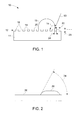
- Figure 1 is a schematic cross-sectional view of a surface of an article according to one embodiment of the invention.
- Article 10 comprises a surface 12.
- the term "surface” refers to that portion of the article 10 that is in direct contact with an ambient environment surrounding the article 10.
- the surface may include the substrate, the features, or the surface modification layer disposed over the substrate, depending on the specific configuration of the article.
- Surface 12 has a low liquid wettability.
- the reference liquid may be any liquid of interest.
- the reference liquid is water.
- the reference liquid is a liquid that contains at least one hydrocarbon.
- reference liquid is an oil.
- oil is to be understood as having its common meaning to cover a wide variety of unctuous substances not miscible with water. Examples include oils of animal, vegetable, or mineral origin, as well as synthetic oils.
- oils include petroleum-based products, such as crude oil and products distilled therefrom, such as kerosene, gasoline, paraffin, and the like.
- the oil comprises an industrial lubricant such as bearing oil or light turbine oil.
- oil resistant will be understood to refer to a surface that generates a static contact angle with oil of at least about 30 degrees. Because wettability depends in part upon the surface tension of the reference liquid, a given surface may have a different wettability (and hence form a different contact angle) for different liquids.
- the surface 12 comprises a material having a nominal liquid wettability sufficient to generate, with reference to an oil, a nominal contact angle of at least about 30 degrees.
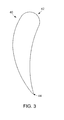
- a "nominal contact angle" 34 ( Figure 2 ) means the static contact angle 34 measured where a drop of a reference liquid 36 is disposed on a flat, smooth ( ⁇ 1 nm surface roughness) surface 32 consisting essentially of the material.
- This nominal contact angle 34 is a measurement of the "nominal wettability" of the material.
- the nominal contact angle, with reference to an oil is at least about 50 degrees.
- the nominal contact angle, with reference to an oil is at least about 70 degrees.
- the nominal contact angle, with reference to an oil is at least about 100 degrees.
- the nominal contact angle, with reference to an oil is at least about 120 degrees.
- Surface 12 ( Figure 1 ) comprises at least one material selected from the group consisting of a ceramic, an intermetallic, and a polymer.
- Suitable ceramic materials include inorganic oxides, carbides, nitrides, borides, and combinations thereof.
- Non-limiting examples of such ceramic materials include aluminum nitride, boron nitride, chromium nitride, silicon carbide, tin oxide, titania, titanium carbonitride, titanium nitride, titanium oxynitride, stibinite (SbS 2 ), zirconia, hafnia, and combinations thereof.
- the surface comprises an intermetallic.
- intermetallic materials include, but are not limited to, nickel aluminide, titanium aluminide, and combinations thereof.
- Polymer materials that may be used in surface 12 include, but are not limited to polytetrafluoroethylene, fluoroacrylate, fluoroeurathane, fluorosilicone, modified carbonate, silicones and combinations thereof. The material is selected based on the desired contact angle, the fabrication technique used, and the end-use application of the article.
- Surface 12 further comprises a texture comprising a plurality of features 16.
- surface 12 has an effective wettability (that is, wettability of the textured surface) for the reference liquid sufficient to generate an effective contact angle greater than the nominal contact angle.
- the effective contact angle is greater than the nominal contact angle by at least about 5 degrees.
- the effective contact angle is greater than the nominal contact angle by at least about 10 degrees.
- the effective contact angle is greater than the nominal contact angle by at least about 20 degrees.
- the effective contact angle is greater than the nominal contact angle by at least about 30 degrees.
- the effective contact angle depends, in part, on the feature shape, dimensions, and spacings, as will be described in detail below.
- surface 12 has a texture comprising a plurality of features 16.
- the plurality of features 16 may be of any shape, include at least one of depressions, protrusions, nanoporous solids, indentations, or the like.
- the features may include bumps, cones, rods, wires, channels, substantially spherical features, substantially cylindrical features, pyramidal features, prismatic structures, combinations thereof, and the like. Numerous varieties of feature shapes are suitable for use as features 16.
- at least a subset of the plurality of features 16 protrudes above the surface 12 of the article.
- at least a subset of the plurality of features 16 is a plurality of cavities 18 disposed in the surface 12.
- At least a subset of the features 16 has a shape selected from the group consisting of a cube, a rectangular prism, a cone, a cylinder, a pyramid, a trapezoidal prism, and a hemisphere or other spherical portion. These shapes are suitable whether the feature is a protrusion 16 or a cavity 18.
- features 16 can be characterized in a number of ways.
- Features 16 comprise a height dimension (h) 20, which represents the height of protruding features above the surface 12 or, in the case of cavities 18, the depth to which the cavities extend into the surface 12.
- Features 16 further comprise a width dimension (a) 22.
- the precise nature of the width dimension will depend on the shape of the feature, but is defined to be the width of the feature at the point where the feature would naturally contact a drop of liquid placed on the surface of the article.
- the height and width parameters of features 16 have a significant effect on wetting behavior observed on surface 12.
- Feature orientation is a further design consideration in the engineering of surface wettability in accordance with embodiments of the present invention.
- One significant aspect of feature orientation is the spacing of features. Referring to Figure 1 , in some embodiments features 16 are disposed in a spaced-apart relationship characterized by a spacing dimension (b) 24. Spacing dimension 24 is defined as the distance between the edges of two nearest-neighbor features. Other aspects of orientation may also be considered, such as, for instance, the extent to which top 25 (or bottom 26 for a cavity) deviates from being parallel with surface 12, or the extent to which features 16 deviate from a perpendicular orientation with respect to the surface 12.
- all of the features 16 in the plurality have substantially the same respective values for h, a, and/or b ("an ordered array"), though this is not a general requirement.
- the plurality of features 16 may be a collection of features, exhibiting a random distribution of size, shape, and/or orientation.
- the plurality of features is characterized by a multi-modal distribution (e.g., a bimodal or trimodal distribution) in h, a, b, or any combination thereof.
- a multi-modal distribution e.g., a bimodal or trimodal distribution
- Such distributions may advantageously provide reduced wettability in environments where a range of drop sizes is encountered. Estimation of the effects of h, a, and b on wettability are thus best performed by taking into account the distributive nature of these parameters.
- the surfaces thus designed and fabricated have a selected wettability for water and oil to achieve antifouling characteristics.
- the nominal contact angle, with reference to water is at least about 100 degrees. In one embodiment, the nominal contact angle, with reference to water, is at least about 110 degrees. In one embodiment, the nominal contact angle, with reference to water, is at least about 120 degrees. In yet another embodiment, the nominal contact angle, with reference to water, is at least about 130 degrees. In certain embodiments, the nominal contact angle, with reference to water, is at least about 150 degrees.
- the present inventors have developed a design methodology for creating surface textures having high contact angle (low wettability) for water and oil, and also easy drop roll-off.
- a surface can be designed such that drops of liquid impinging on the surface will exhibit hydrophobic and oil resistant properties combined with easy roll-off behavior.
- the features comprise a height dimension (h), a width dimension (a), and a spacing dimension (b) such that the ratio b/a is less than about 4, and ratio h/a is less than about 10.
- parameter a is less than about 10 micrometers. In some embodiments, a is less than about 5 micrometers. In other embodiments, a is less than about 2 micrometers. In some embodiments, a in the range from about 100 nanometers to about 1 micrometer. In certain embodiments, b/a is in a range from about 0.3 to about 2. In certain other embodiments, b/a is in the range from about 0.5 to about 4. In certain embodiments, h/a is in a range from about 0.5 to about 5. In certain other embodiments, h/a is in the range from about 0.5 to about 1.
- a is in the range from about 100 nanometers to about 1 micrometer; h is in the range from about 100 nanometers to about 2 micrometers; and b is in the range from about 200 nanometers to about 2 micrometers.
- a is in the range from about 500 nanometers to about 1 micrometer, b/a is in a range from about 0.5 to about 4, and h/a is in a range from about 0.5 to about 1.
- the surface has an average roughness of less than about 1.6 micrometers, such as less than about 0.8 micrometers. (Average roughness is the arithmetic average of the absolute values of the roughness profile ordinates).
- article 10 further comprises a bulk portion 11 disposed beneath surface 12, and the plurality of features 16 extends into bulk portion 11. Distributing features 16 throughout the article 10, including at the surface 12 and within the bulk portion 11, allows surface 12 to be regenerated as the top layer of surface erodes away.
- the surface comprises a surface energy modification layer (not shown).
- the surface energy modification layer comprises a coating disposed over a substrate.
- the substrate may comprise at least one of a metal, an alloy, a plastic, a ceramic, or any combination thereof.
- the substrate may take the form of a film, a sheet, or a bulk shape.
- the substrate may represent article 10 in its final form, such as a finished part; a near-net shape; or a preform that will be later made into article 10.
- Surface 12 may be an integral part of the substrate.
- surface 12 may be formed by replicating a texture directly onto the substrate, or by embossing the texture onto the substrate, or by any other such method known in the art of forming or imparting a predetermined surface texture onto a substrate surface.
- surface 12 may comprise a layer that is disposed or deposited onto the substrate by any number of techniques that are known in the art.
- the coating comprises at least one material selected from the group consisting of a hydrophobic hard coat, a fluorinated material, a polymeric material, a composite material, and various combinations thereof.
- suitable hydrophobic hardcoat includes, but are not limited to, diamond-like carbon (DLC)--including fluorinated DLC, tantalum oxide, titanium carbide, titanium nitride, chromium nitride, boron nitride, chromium carbide, molybdenum carbide, titanium carbonitride, boron nitride, and zirconium nitride.
- DLC diamond-like carbon
- hydrophobic hardcoatings refers to a class of coatings that have hardness in excess of that observed for metals, and exhibit wettability resistance sufficient to generate, with a drop of water, a nominal static contact angle of at least about 70 degrees.
- fluorinated DLC coatings have shown significant resistance to wetting by water.
- Other hardcoatings such as nitrides, borides, carbides, and oxides, may also serve this purpose.
- CVD chemical vapor deposition
- PVD physical vapor deposition
- Fluorinated materials such as fluorosilanes are also suitable coating materials that exhibit low wettability for oil and water. If conditions allow, the coating may comprise a polymeric material, such as those given above as examples for use in surface 12. Further examples of polymeric materials known to have advantageous resistance to wetting by certain liquids include silicones, fluoropolymers, urethanes, acrylates, epoxies, polysilazanes, aliphatic hydrocarbons, polyimides, polycarbonates, polyether imides, polystyrenes, polyolefins, polypropylenes, polyethylenes or mixtures thereof.
- the surface modification layer may be formed by diffusing or implanting molecular, atomic, or ionic species into the surface to form a layer of material having altered surface properties compared to material underneath the surface modification layer.
- the surface modification layer comprises ion-implanted material, for example, ion-implanted metal.
- Articles with controlled wettability for water and for oil are attractive for many applications.
- the advantages of such surfaces could be utilized in making surfaces that are antifouling, self-cleaning, or easy-cleaning surfaces.
- Examples of potential applications of embodiments of the present invention include laboratory vessels, vehicular surfaces, out door furniture, household goods, electrical devices, stadium roofs, tiles, windshields, medical devices, marine vessels, auto, aero or other body panels, easy-to-clean walls and countertops.
- Biotechnological applications include membrane separation, anti-bacterial surfaces, micro-fluidic channels, stents, etc.
- exemplary articles include, but are not limited to, airfoils or hydrofoils, pipes and tubing for liquid transport or protein separation columns.
- the turbine assembly is selected from the group consisting of a wind turbine, a gas turbine, and a steam turbine.
- the component comprises at least one selected from the group consisting of a compressor, a fan, a combustor, and a heat exchanger.
- a suitable example of such a component is a component comprising an airfoil; rotating blades and stationary components (vanes or nozzles) are examples.
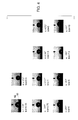
- an airfoil 40 shown in cross-section typically comprises a leading edge 42 and a trailing edge 44 relative to the expected directional flow of fluid.
- the turbine component comprises a surface.
- the surface comprises a material having a nominal liquid wettability sufficient to generate, with reference to an oil, a nominal contact angle of at least about 30 degrees; and a texture comprising a plurality of features disposed on the surface.
- the features have a size, shape, and orientation selected such that the surface has an effective wettability sufficient to generate, with reference to an oil, an effective contact angle of greater than the nominal contact angle and an average roughness less than about 0.8 micrometers.
- the surface material and texture are selected to achieve the desired wettability for water and oil as discussed in detail above.
- the resultant surface is resistant to fouling by light turbine oil or other similar synthetic oils with or without surfactants. This in turn will reduce the adhesion of fouling agent leading to a reduced rate of fouling.
- features are disposed over the entire surface of an airfoil 40. However, in certain cases features may be necessary or desired only at a particular portion or portions of airfoil 40, such as leading edge 42 and/or trailing edge 44.
- the nature of the application will determine the extent to which features are to be disposed on an article.
- the fouling results in degradation in the compressor efficiency as well as crevice corrosion cracking leading to lower life.
- utilities use off-line compressor washes, which result in significant down time.
- the antifouling properties of the articles disclosed herein will in turn improve the robustness of the performance, increase the life of the airfoils and reduce downtime. Hydrophobicity of the surfaces may also result in water droplets rolling of the surface. As a result, the water wash treatment efficiency may be improved.
- Another aspect of the invention comprises a method to render the surface of an article antifouling.
- the method comprises: providing an article comprising a substrate; disposing a plurality of features on the substrate to form a surface, such that fouling of the surface is reduced.
- the substrate comprises a material having a nominal liquid wettability sufficient to generate, with reference to an oil, a nominal contact angle.
- the features have a size, shape, and orientation selected such that the surface has an effective wettability sufficient to generate, with reference to an oil, an effective contact angle of greater than the nominal contact angle.
- the features comprise a height dimension (h), a width dimension (a), a spacing dimension (b) such that ratio b/a is less than about 4, ratio h/a is less than about 10; and an average roughness less than about 1.6 micrometers.
- the surface has an effective contact angle, with reference to an oil, greater than about 30 degrees.
- the features are disposed on the substrate to form a surface.
- the features may be disposed onto the substrate by any texturing methods known in the art. Examples of some suitable methods include, lithography, soft lithography, embossing, forming, etching, template growth, film deposition, laser drilling, sand blasting, thermal spray, electrochemical etching, and the like.
- the features may comprise the same material as the substrate or another material. The exact choice of the substrate and feature materials, and feature size and spacing depends, in part, on the desired wettability of the surface, as discussed above.
- the surface has the effective contact angle, with reference to an oil, greater than about 30 degrees. In some embodiments, the surface has the effective contact angle, with reference to an oil, greater than about 50 degrees. In other embodiments, the surface has the effective contact angle, with reference to an oil, greater than about 100 degrees.
- the aforementioned embodiments present clear advantages over existing antifouling surfaces and turbine components comprising such surfaces.
- the turbine components comprising the foregoing surfaces offer increased life of the airfoils and reduce downtime.
- these surfaces may improve the efficiency of water wash treatment.
- Most of the conventionally known antifouling surfaces are based on polymeric coatings. Though, many of the reports on superhydrophobic/hydrophobic surfaces have generally talked about potential for oil resistance, there is no systematic study on the design space for achieving textures which have selected hydrophobicity and oil resistance in combination to achieve antifouling properties.
- Silicon substrates were provided via lithography with right rectangular prism features about 3 micrometers in width (a) and having various b/a ratios. The substrates were then placed in a chamber with a vial of liquid fluorosilane, and the chamber was evacuated to allow the liquid to evaporate and condense from the gas phase onto the silicon substrate, thereby creating a hydrophobic film on the surface. The contact angle was recorded as a function of b/a ratio.
- Figure 4 shows the photographs of oil droplets 62 on silicon posts 60 with different b/a ratios. The figure lists static contact angle of oil (a light turbine oil in this case) on different textures. The ease of roll-off was measured by determining the angle of tilt from the horizontal needed before a drop will roll off of a surface.
- a drop that requires a near vertical tilt is highly pinned to the surface, whereas a drop exhibiting easy roll-off will require very little tilt angle to roll off the surface.
- the drop will roll off of the surface at the point where the force of gravity pulling on the drop equals the force pinning the drop to the surface.
- the pinning parameter is a material constant that is independent of the surface texture, but ⁇ and r are functions of the texture.
- the texture in some embodiments, is represented by the parameters a, b, and h of the features.
- the pinning parameter, ⁇ was calculated to be 0.029 N/m.
- the pinning parameter is of the order of 0.013 N/m. This will dictate a different texture design for oil resistant surfaces as compared to mere hydrophobic surfaces.
- Table 1 lists the contact angles for different b/a ratios. TABLE 1. Contact angles for different b/a ratios.
- Table 1 shows the effect of varying b/a on the contact angle.
- the contact angle measured on a control specimen having a smooth (non-textured) surface coated with fluorosilane was about 88 degrees. From Table 1, it is apparent that b/a ⁇ 4 provides with a design space for antifouling textures. Above b/a of 4, the contact angle decreases as the drop settles into a wetting state under its own weight.
- Figures 5-7 show the results of work aimed at validating the above analysis, and the plots illustrated in these figures may be used to select suitable textures for a range of applications, for a given combination of oil type and surface material.
- Figure 5 shows the plot 70 of maximum diameter of the drop required for the drop to roll off of a texture comprised of posts described above.
- Figure 6 gives plot 80, the maximum diameter of the drop required for the drop to roll off on a texture comprised of pore structures.
- Figure 7 shows plot 90, the design space (feature sizes vs. b/a) for texture design for applications involving impacting oil droplets.
- Curves 92, 94, 96, and 98 correspond to design space for oil droplets impacting at velocities of 5 m/s, 10 m/s, 50 m/s and 180 m/s respectively.
Landscapes
- Engineering & Computer Science (AREA)
- Physics & Mathematics (AREA)
- Thermal Sciences (AREA)
- Mechanical Engineering (AREA)
- General Engineering & Computer Science (AREA)
- Chemical & Material Sciences (AREA)
- Crystallography & Structural Chemistry (AREA)
- Application Of Or Painting With Fluid Materials (AREA)
- Turbine Rotor Nozzle Sealing (AREA)
Applications Claiming Priority (1)
| Application Number | Priority Date | Filing Date | Title |
|---|---|---|---|
| US11/612,516 US20080145631A1 (en) | 2006-12-19 | 2006-12-19 | Articles having antifouling surfaces and methods for making |
Publications (1)
| Publication Number | Publication Date |
|---|---|
| EP1935509A1 true EP1935509A1 (de) | 2008-06-25 |
Family
ID=39284144
Family Applications (1)
| Application Number | Title | Priority Date | Filing Date |
|---|---|---|---|
| EP07122213A Withdrawn EP1935509A1 (de) | 2006-12-19 | 2007-12-04 | Gegenstände mit Antifouling-Oberflächen und deren Herstellungsverfahren |
Country Status (4)
| Country | Link |
|---|---|
| US (1) | US20080145631A1 (de) |
| EP (1) | EP1935509A1 (de) |
| JP (1) | JP2008151133A (de) |
| CN (1) | CN101225755A (de) |
Cited By (4)
| Publication number | Priority date | Publication date | Assignee | Title |
|---|---|---|---|---|
| EP2345812A3 (de) * | 2010-01-14 | 2014-01-29 | Siemens Aktiengesellschaft | Bor basierte Hartstoffbeschichtung einer Windkraftanlagenkomponente |
| EP2345791A3 (de) * | 2010-01-14 | 2014-01-29 | Siemens Aktiengesellschaft | Vanadium basierte Hartstoffbeschichtung einer Windkraftanlagenkomponente |
| EP3000977A1 (de) * | 2014-09-29 | 2016-03-30 | Siemens Aktiengesellschaft | Schaufel einer turbine mit wasserabweisendem beschichtetem schaufelblatt |
| EP3587735A1 (de) * | 2018-06-28 | 2020-01-01 | United Technologies Corporation | Bauteil eines verbrennungstriebwerks und zugehöriges gasturbinentriebwerk |
Families Citing this family (47)
| Publication number | Priority date | Publication date | Assignee | Title |
|---|---|---|---|---|
| US20070031639A1 (en) * | 2005-08-03 | 2007-02-08 | General Electric Company | Articles having low wettability and methods for making |
| US9062563B2 (en) * | 2008-04-09 | 2015-06-23 | General Electric Company | Surface treatments for preventing hydrocarbon thermal degradation deposits on articles |
| US20090283611A1 (en) * | 2008-05-14 | 2009-11-19 | General Electric Company | Surface treatments and coatings for atomization |
| US8038952B2 (en) * | 2008-08-28 | 2011-10-18 | General Electric Company | Surface treatments and coatings for flash atomization |
| US8066311B2 (en) * | 2008-11-07 | 2011-11-29 | T.F.H. Publications, Inc. | Easy cleaning pooper scooper |
| CN102458689B (zh) * | 2009-06-02 | 2014-07-02 | 三菱电机株式会社 | 热交换器的制造方法 |
| US20100326922A1 (en) * | 2009-06-26 | 2010-12-30 | General Electric Company | Oil water separation apparatus |
| US8142516B2 (en) * | 2009-06-30 | 2012-03-27 | Ut-Battelle, Llc | Self-cleaning skin-like prosthetic polymer surfaces |
| US20130142013A1 (en) * | 2009-12-10 | 2013-06-06 | Westerngeco L.L.C. | Systems and methods for marine anti-fouling |
| FR2954454B1 (fr) * | 2009-12-23 | 2012-02-10 | Vallourec Mannesmann Oil & Gas | Composant filete tubulaire resistant au grippage et procede de revetement d'un tel composant |
| WO2011161489A1 (en) * | 2010-06-25 | 2011-12-29 | Nokia Corporation | User interfaces and associated apparatus and methods |
| SG10201609944TA (en) * | 2011-08-05 | 2017-01-27 | Massachusetts Inst Technology | Devices incorporating a liquid - impregnated surface |
| WO2013078327A1 (en) * | 2011-11-22 | 2013-05-30 | Massachusetts Institute Of Technology | Articles and methods providing supermetalophobic/philic surfaces and superceramophobic/philic surfaces |
| US8968831B2 (en) * | 2011-12-06 | 2015-03-03 | Guardian Industries Corp. | Coated articles including anti-fingerprint and/or smudge-reducing coatings, and/or methods of making the same |
| US9082914B2 (en) * | 2012-01-13 | 2015-07-14 | Gaurdian Industries Corp. | Photovoltaic module including high contact angle coating on one or more outer surfaces thereof, and/or methods of making the same |
| KR20140148435A (ko) | 2012-03-23 | 2014-12-31 | 메사추세츠 인스티튜트 오브 테크놀로지 | 식품 포장물 및 식품 가공 장치용 자체-윤활성 표면 |
| US9513045B2 (en) * | 2012-05-03 | 2016-12-06 | Whirlpool Corporation | Heater-less ice maker assembly with a twistable tray |
| US9587871B2 (en) * | 2012-05-03 | 2017-03-07 | Whirlpool Corporation | Heater-less ice maker assembly with a twistable tray |
| US20130337027A1 (en) | 2012-05-24 | 2013-12-19 | Massachusetts Institute Of Technology | Medical Devices and Implements with Liquid-Impregnated Surfaces |
| WO2014011372A2 (en) * | 2012-06-19 | 2014-01-16 | The Board Of Trustees Of The University Of Illinois, A Body Corporate And Politic Of The State Of Illinois | Refrigerant repelling surfaces |
| US9857487B2 (en) * | 2012-10-01 | 2018-01-02 | Westerngeco Llc | Solid marine seismic streamers |
| US8925335B2 (en) | 2012-11-16 | 2015-01-06 | Whirlpool Corporation | Ice cube release and rapid freeze using fluid exchange apparatus and methods |
| US20140178611A1 (en) | 2012-11-19 | 2014-06-26 | Massachusetts Institute Of Technology | Apparatus and methods employing liquid-impregnated surfaces |
| MX389801B (es) | 2012-11-19 | 2025-03-20 | Massachusetts Inst Technology | Aparato y metodos que emplean superficies impregnadas con liquido. |
| US9273891B2 (en) | 2012-12-13 | 2016-03-01 | Whirlpool Corporation | Rotational ice maker |
| US9470448B2 (en) | 2012-12-13 | 2016-10-18 | Whirlpool Corporation | Apparatus to warm plastic side of mold |
| US9410723B2 (en) | 2012-12-13 | 2016-08-09 | Whirlpool Corporation | Ice maker with rocking cold plate |
| US9557087B2 (en) | 2012-12-13 | 2017-01-31 | Whirlpool Corporation | Clear ice making apparatus having an oscillation frequency and angle |
| US9518770B2 (en) | 2012-12-13 | 2016-12-13 | Whirlpool Corporation | Multi-sheet spherical ice making |
| US9518773B2 (en) | 2012-12-13 | 2016-12-13 | Whirlpool Corporation | Clear ice maker |
| US9476629B2 (en) | 2012-12-13 | 2016-10-25 | Whirlpool Corporation | Clear ice maker and method for forming clear ice |
| US9500398B2 (en) | 2012-12-13 | 2016-11-22 | Whirlpool Corporation | Twist harvest ice geometry |
| EP2968750A4 (de) * | 2013-03-15 | 2016-12-07 | Bard Inc C R | Temperaturmesskatheter |
| CN103231559B (zh) * | 2013-04-09 | 2016-02-24 | 浙江锦达膜材科技有限公司 | 一种具有纹理和自清洁功能的高分子复合材料及其制造方法 |
| FR3013437B1 (fr) * | 2013-11-20 | 2015-12-18 | Valeo Systemes Thermiques | Revetement pour echangeur de chaleur |
| US9809712B2 (en) * | 2013-11-26 | 2017-11-07 | Baker Hughes, A Ge Company, Llc | Hydrophobic and oleophobic coatings |
| US9915458B2 (en) | 2014-10-23 | 2018-03-13 | Whirlpool Corporation | Method and apparatus for increasing rate of ice production in an automatic ice maker |
| CN108886072A (zh) * | 2016-04-05 | 2018-11-23 | 飞利浦照明控股有限公司 | 具有带有疏水性纳米结构的波长转换层的光转换设备 |
| CN105937140B (zh) * | 2016-06-16 | 2019-06-18 | 无锡小天鹅股份有限公司 | 洗衣机 |
| CN106423789B (zh) * | 2016-11-01 | 2019-10-29 | 南京理工大学 | 一种耐久性抗冰超疏水涂层及其制备方法 |
| CN108691178B (zh) * | 2017-03-31 | 2022-04-08 | Bsh家用电器有限公司 | 包括至少一个金属的部件的家用器具 |
| EP3382315B1 (de) * | 2017-03-31 | 2019-11-20 | BSH Hausgeräte GmbH | Wäschetrocknungsvorrichtung mit mindestens einem rippenrohr-wärmetauscher |
| CN109423612A (zh) * | 2017-08-31 | 2019-03-05 | 南京理工大学 | 耐磨疏水的碳基复合薄膜、制备方法及其应用 |
| US10739053B2 (en) | 2017-11-13 | 2020-08-11 | Whirlpool Corporation | Ice-making appliance |
| US10907874B2 (en) | 2018-10-22 | 2021-02-02 | Whirlpool Corporation | Ice maker downspout |
| CN113913770A (zh) * | 2021-09-29 | 2022-01-11 | 核工业西南物理研究院 | 一种使聚四氟乙烯表面具备超疏水性的制备方法 |
| US20230286713A1 (en) * | 2022-03-14 | 2023-09-14 | Semes Co., Ltd. | Bowl, mehtod of manufacturing bowl, and apparatus for treating substrate |
Citations (4)
| Publication number | Priority date | Publication date | Assignee | Title |
|---|---|---|---|---|
| US20020150724A1 (en) * | 2001-04-12 | 2002-10-17 | Creavis Gesellschaft F. Techn. U. Innovation Mbh | Surfaces rendered self-cleaning by hydrophobic structures, and process for their production |
| US6649266B1 (en) * | 1999-04-16 | 2003-11-18 | Institut für Neue Materialien Gemeinnützige GmbH | Substrates provided with a microstructured surface, methods for the production thereof, and their use |
| US6743467B1 (en) * | 1999-08-20 | 2004-06-01 | Unisearch Limited | Hydrophobic material |
| EP1844863A1 (de) * | 2006-04-12 | 2007-10-17 | General Electric Company | Artikel enthaltend eine Oberfläche mit niedriger Benetzbarkeit und dessen Herstellungsverfahren |
Family Cites Families (11)
| Publication number | Priority date | Publication date | Assignee | Title |
|---|---|---|---|---|
| CA2059733C (en) * | 1991-01-23 | 1999-10-05 | Kazufumi Ogawa | Water- and oil-repelling film and method of manufacturing the same |
| DE10007859A1 (de) * | 2000-02-21 | 2001-08-23 | Bayer Ag | Langzeitstabile wasser- und ölabweisende Oberfläche |
| FR2811316B1 (fr) * | 2000-07-06 | 2003-01-10 | Saint Gobain | Substrat texture transparent et procedes pour l'obtenir |
| DE10044216A1 (de) * | 2000-09-07 | 2002-05-02 | Fraunhofer Ges Forschung | Beschichtungsmaterial für multifunktionelle, superphobe Schichten |
| US20040191480A1 (en) * | 2000-09-27 | 2004-09-30 | Yasushi Karasawa | Structural member superior in water repellency and method for manufacturing the same |
| DE10062203A1 (de) * | 2000-12-13 | 2002-06-20 | Creavis Tech & Innovation Gmbh | Verfahren zur Abformung von hydrophoben Polymeren zur Erzeugung von Oberflächen mit beständig wasser- und ölabweisenden Eigenschaften |
| DE60231176D1 (de) * | 2001-09-27 | 2009-04-02 | Yamaha Corp | Einfaches elektronisches Musikinstrument, Spielerkonsole und eingebautes Signalverarbeitungssystem |
| US7147763B2 (en) * | 2002-04-01 | 2006-12-12 | Palo Alto Research Center Incorporated | Apparatus and method for using electrostatic force to cause fluid movement |
| US6845788B2 (en) * | 2003-04-15 | 2005-01-25 | Entegris, Inc. | Fluid handling component with ultraphobic surfaces |
| US6923216B2 (en) * | 2003-04-15 | 2005-08-02 | Entegris, Inc. | Microfluidic device with ultraphobic surfaces |
| US20070031639A1 (en) * | 2005-08-03 | 2007-02-08 | General Electric Company | Articles having low wettability and methods for making |
-
2006
- 2006-12-19 US US11/612,516 patent/US20080145631A1/en not_active Abandoned
-
2007
- 2007-12-04 EP EP07122213A patent/EP1935509A1/de not_active Withdrawn
- 2007-12-17 JP JP2007324112A patent/JP2008151133A/ja not_active Withdrawn
- 2007-12-19 CN CNA2007101603063A patent/CN101225755A/zh active Pending
Patent Citations (4)
| Publication number | Priority date | Publication date | Assignee | Title |
|---|---|---|---|---|
| US6649266B1 (en) * | 1999-04-16 | 2003-11-18 | Institut für Neue Materialien Gemeinnützige GmbH | Substrates provided with a microstructured surface, methods for the production thereof, and their use |
| US6743467B1 (en) * | 1999-08-20 | 2004-06-01 | Unisearch Limited | Hydrophobic material |
| US20020150724A1 (en) * | 2001-04-12 | 2002-10-17 | Creavis Gesellschaft F. Techn. U. Innovation Mbh | Surfaces rendered self-cleaning by hydrophobic structures, and process for their production |
| EP1844863A1 (de) * | 2006-04-12 | 2007-10-17 | General Electric Company | Artikel enthaltend eine Oberfläche mit niedriger Benetzbarkeit und dessen Herstellungsverfahren |
Cited By (8)
| Publication number | Priority date | Publication date | Assignee | Title |
|---|---|---|---|---|
| EP2345812A3 (de) * | 2010-01-14 | 2014-01-29 | Siemens Aktiengesellschaft | Bor basierte Hartstoffbeschichtung einer Windkraftanlagenkomponente |
| EP2345791A3 (de) * | 2010-01-14 | 2014-01-29 | Siemens Aktiengesellschaft | Vanadium basierte Hartstoffbeschichtung einer Windkraftanlagenkomponente |
| US8690539B2 (en) | 2010-01-14 | 2014-04-08 | Siemens Aktiengesellschaft | Boron-based refractory coating for a wind turbine component |
| DE102010004661B4 (de) * | 2010-01-14 | 2014-12-24 | Siemens Aktiengesellschaft | Vanadium basierte Hartstoffbeschichtung einer Windkraftanlagenkomponente |
| DE102010004662B4 (de) * | 2010-01-14 | 2014-12-24 | Siemens Aktiengesellschaft | Bor basierte Hartstoffbeschichtung einer Windkraftanlagenkomponente |
| EP3000977A1 (de) * | 2014-09-29 | 2016-03-30 | Siemens Aktiengesellschaft | Schaufel einer turbine mit wasserabweisendem beschichtetem schaufelblatt |
| EP3587735A1 (de) * | 2018-06-28 | 2020-01-01 | United Technologies Corporation | Bauteil eines verbrennungstriebwerks und zugehöriges gasturbinentriebwerk |
| US11739691B2 (en) | 2018-06-28 | 2023-08-29 | Raytheon Technologies Corporation | Engine component |
Also Published As
| Publication number | Publication date |
|---|---|
| JP2008151133A (ja) | 2008-07-03 |
| CN101225755A (zh) | 2008-07-23 |
| US20080145631A1 (en) | 2008-06-19 |
Similar Documents
| Publication | Publication Date | Title |
|---|---|---|
| EP1935509A1 (de) | Gegenstände mit Antifouling-Oberflächen und deren Herstellungsverfahren | |
| US20240401892A1 (en) | Liquid-impregnated surfaces, methods of making, and devices incorporating the same | |
| US9381528B2 (en) | Articles for manipulating impinging liquids and methods of manufacturing same | |
| US20180161836A1 (en) | Articles and methods for modifying condensation on surfaces | |
| US20070031639A1 (en) | Articles having low wettability and methods for making | |
| US20130251946A1 (en) | Liquid-encapsulated rare-earth based ceramic surfaces | |
| US20060078724A1 (en) | Hydrophobic surface with geometric roughness pattern | |
| US20090066033A1 (en) | Barrier sealing system | |
| JP2015513462A5 (de) | ||
| EP1750018A2 (de) | Oberflächen und Artikeln die gegen der Stosswirkung von Flüssigkeiten beständig sind. | |
| Passoni et al. | Multiscale effect of hierarchical self-assembled nanostructures on superhydrophobic surface | |
| Donati et al. | Metal surface engineering for extreme sustenance of jumping droplet condensation | |
| Zhang et al. | Slippery properties and the robustness of lubricant-impregnated surfaces | |
| Islam et al. | Numerical study of drop impact on slippery lubricated surfaces | |
| Nguyen | Enamel Coatings and Surface (Super) Hydrophobicity | |
| Montañez | Development of omniphobic and anti-icing coatings as supported nanomaterials and their implementation as functional layers in active de-icing devices | |
| JP2007284492A (ja) | 濡れ性の低い面を有する物品及びそれを製造する方法 | |
| Malavasi | Wettability effects on interface dynamics and phase-change |
Legal Events
| Date | Code | Title | Description |
|---|---|---|---|
| PUAI | Public reference made under article 153(3) epc to a published international application that has entered the european phase |
Free format text: ORIGINAL CODE: 0009012 |
|
| AK | Designated contracting states |
Kind code of ref document: A1 Designated state(s): AT BE BG CH CY CZ DE DK EE ES FI FR GB GR HU IE IS IT LI LT LU LV MC MT NL PL PT RO SE SI SK TR |
|
| AX | Request for extension of the european patent |
Extension state: AL BA HR MK RS |
|
| 17P | Request for examination filed |
Effective date: 20081229 |
|
| AKX | Designation fees paid |
Designated state(s): CH DE GB LI |
|
| 17Q | First examination report despatched |
Effective date: 20090206 |
|
| STAA | Information on the status of an ep patent application or granted ep patent |
Free format text: STATUS: THE APPLICATION IS DEEMED TO BE WITHDRAWN |
|
| 18D | Application deemed to be withdrawn |
Effective date: 20120703 |