EP1936016A2 - Verfahren zur Einstellung der lokalen Eigenschaften eines Vliesstoffs und entsprechende Anlage - Google Patents
Verfahren zur Einstellung der lokalen Eigenschaften eines Vliesstoffs und entsprechende Anlage Download PDFInfo
- Publication number
- EP1936016A2 EP1936016A2 EP07150195A EP07150195A EP1936016A2 EP 1936016 A2 EP1936016 A2 EP 1936016A2 EP 07150195 A EP07150195 A EP 07150195A EP 07150195 A EP07150195 A EP 07150195A EP 1936016 A2 EP1936016 A2 EP 1936016A2
- Authority
- EP
- European Patent Office
- Prior art keywords
- web
- orientation
- fibers
- width
- dynamic adjustment
- Prior art date
- Legal status (The legal status is an assumption and is not a legal conclusion. Google has not performed a legal analysis and makes no representation as to the accuracy of the status listed.)
- Granted
Links
- 238000000034 method Methods 0.000 title claims abstract description 34
- 238000009434 installation Methods 0.000 title claims abstract description 9
- 239000004745 nonwoven fabric Substances 0.000 title claims description 15
- 239000000835 fiber Substances 0.000 claims abstract description 117
- 238000009826 distribution Methods 0.000 claims abstract description 59
- 238000001228 spectrum Methods 0.000 claims abstract description 24
- 239000004753 textile Substances 0.000 claims abstract description 16
- 230000033228 biological regulation Effects 0.000 claims abstract description 15
- 230000000694 effects Effects 0.000 claims abstract description 11
- 230000008569 process Effects 0.000 claims abstract description 11
- XLYOFNOQVPJJNP-UHFFFAOYSA-N water Substances O XLYOFNOQVPJJNP-UHFFFAOYSA-N 0.000 claims abstract description 5
- 239000000126 substance Substances 0.000 claims abstract description 4
- 238000010191 image analysis Methods 0.000 claims abstract 3
- 238000009833 condensation Methods 0.000 claims description 38
- 230000005494 condensation Effects 0.000 claims description 38
- 238000007596 consolidation process Methods 0.000 claims description 27
- 238000004519 manufacturing process Methods 0.000 claims description 14
- 238000000151 deposition Methods 0.000 claims description 10
- 238000001514 detection method Methods 0.000 claims description 9
- 230000008021 deposition Effects 0.000 claims description 8
- 238000011144 upstream manufacturing Methods 0.000 claims description 5
- 238000004458 analytical method Methods 0.000 claims 1
- 241000347389 Serranus cabrilla Species 0.000 abstract description 2
- 238000005520 cutting process Methods 0.000 abstract description 2
- 239000004744 fabric Substances 0.000 abstract 5
- 238000005728 strengthening Methods 0.000 abstract 3
- 239000000463 material Substances 0.000 abstract 2
- 238000004080 punching Methods 0.000 abstract 1
- 230000002457 bidirectional effect Effects 0.000 description 8
- 238000012986 modification Methods 0.000 description 5
- 230000004048 modification Effects 0.000 description 5
- 238000006073 displacement reaction Methods 0.000 description 4
- 230000007547 defect Effects 0.000 description 3
- 239000004746 geotextile Substances 0.000 description 3
- 238000012360 testing method Methods 0.000 description 3
- 230000001276 controlling effect Effects 0.000 description 2
- 235000021183 entrée Nutrition 0.000 description 2
- 238000011156 evaluation Methods 0.000 description 2
- 230000002093 peripheral effect Effects 0.000 description 2
- 238000002360 preparation method Methods 0.000 description 2
- 241000196324 Embryophyta Species 0.000 description 1
- 239000004743 Polypropylene Substances 0.000 description 1
- 241001080024 Telles Species 0.000 description 1
- 240000008042 Zea mays Species 0.000 description 1
- 230000004075 alteration Effects 0.000 description 1
- 238000009960 carding Methods 0.000 description 1
- 230000008859 change Effects 0.000 description 1
- 239000011248 coating agent Substances 0.000 description 1
- 238000000576 coating method Methods 0.000 description 1
- 230000006835 compression Effects 0.000 description 1
- 238000007906 compression Methods 0.000 description 1
- 230000007423 decrease Effects 0.000 description 1
- 230000003247 decreasing effect Effects 0.000 description 1
- 238000010586 diagram Methods 0.000 description 1
- 238000009950 felting Methods 0.000 description 1
- 235000021197 fiber intake Nutrition 0.000 description 1
- 238000005259 measurement Methods 0.000 description 1
- 238000009828 non-uniform distribution Methods 0.000 description 1
- 238000005457 optimization Methods 0.000 description 1
- 210000000056 organ Anatomy 0.000 description 1
- 230000000149 penetrating effect Effects 0.000 description 1
- -1 polypropylene Polymers 0.000 description 1
- 229920001155 polypropylene Polymers 0.000 description 1
- 238000012545 processing Methods 0.000 description 1
- 230000001105 regulatory effect Effects 0.000 description 1
- 238000000926 separation method Methods 0.000 description 1
- 238000009827 uniform distribution Methods 0.000 description 1
Images


Classifications
-
- D—TEXTILES; PAPER
- D04—BRAIDING; LACE-MAKING; KNITTING; TRIMMINGS; NON-WOVEN FABRICS
- D04H—MAKING TEXTILE FABRICS, e.g. FROM FIBRES OR FILAMENTARY MATERIAL; FABRICS MADE BY SUCH PROCESSES OR APPARATUS, e.g. FELTS, NON-WOVEN FABRICS; COTTON-WOOL; WADDING ; NON-WOVEN FABRICS FROM STAPLE FIBRES, FILAMENTS OR YARNS, BONDED WITH AT LEAST ONE WEB-LIKE MATERIAL DURING THEIR CONSOLIDATION
- D04H1/00—Non-woven fabrics formed wholly or mainly of staple fibres or like relatively short fibres
- D04H1/70—Non-woven fabrics formed wholly or mainly of staple fibres or like relatively short fibres characterised by the method of forming fleeces or layers, e.g. reorientation of fibres
- D04H1/74—Non-woven fabrics formed wholly or mainly of staple fibres or like relatively short fibres characterised by the method of forming fleeces or layers, e.g. reorientation of fibres the fibres being orientated, e.g. in parallel (anisotropic fleeces)
-
- D—TEXTILES; PAPER
- D01—NATURAL OR MAN-MADE THREADS OR FIBRES; SPINNING
- D01G—PRELIMINARY TREATMENT OF FIBRES, e.g. FOR SPINNING
- D01G23/00—Feeding fibres to machines; Conveying fibres between machines
- D01G23/06—Arrangements in which a machine or apparatus is regulated in response to changes in the volume or weight of fibres fed, e.g. piano motions
-
- D—TEXTILES; PAPER
- D01—NATURAL OR MAN-MADE THREADS OR FIBRES; SPINNING
- D01G—PRELIMINARY TREATMENT OF FIBRES, e.g. FOR SPINNING
- D01G25/00—Lap-forming devices not integral with machines specified above
-
- D—TEXTILES; PAPER
- D04—BRAIDING; LACE-MAKING; KNITTING; TRIMMINGS; NON-WOVEN FABRICS
- D04H—MAKING TEXTILE FABRICS, e.g. FROM FIBRES OR FILAMENTARY MATERIAL; FABRICS MADE BY SUCH PROCESSES OR APPARATUS, e.g. FELTS, NON-WOVEN FABRICS; COTTON-WOOL; WADDING ; NON-WOVEN FABRICS FROM STAPLE FIBRES, FILAMENTS OR YARNS, BONDED WITH AT LEAST ONE WEB-LIKE MATERIAL DURING THEIR CONSOLIDATION
- D04H1/00—Non-woven fabrics formed wholly or mainly of staple fibres or like relatively short fibres
- D04H1/40—Non-woven fabrics formed wholly or mainly of staple fibres or like relatively short fibres from fleeces or layers composed of fibres without existing or potential cohesive properties
- D04H1/44—Non-woven fabrics formed wholly or mainly of staple fibres or like relatively short fibres from fleeces or layers composed of fibres without existing or potential cohesive properties the fleeces or layers being consolidated by mechanical means, e.g. by rolling
- D04H1/46—Non-woven fabrics formed wholly or mainly of staple fibres or like relatively short fibres from fleeces or layers composed of fibres without existing or potential cohesive properties the fleeces or layers being consolidated by mechanical means, e.g. by rolling by needling or like operations to cause entanglement of fibres
-
- D—TEXTILES; PAPER
- D04—BRAIDING; LACE-MAKING; KNITTING; TRIMMINGS; NON-WOVEN FABRICS
- D04H—MAKING TEXTILE FABRICS, e.g. FROM FIBRES OR FILAMENTARY MATERIAL; FABRICS MADE BY SUCH PROCESSES OR APPARATUS, e.g. FELTS, NON-WOVEN FABRICS; COTTON-WOOL; WADDING ; NON-WOVEN FABRICS FROM STAPLE FIBRES, FILAMENTS OR YARNS, BONDED WITH AT LEAST ONE WEB-LIKE MATERIAL DURING THEIR CONSOLIDATION
- D04H1/00—Non-woven fabrics formed wholly or mainly of staple fibres or like relatively short fibres
- D04H1/40—Non-woven fabrics formed wholly or mainly of staple fibres or like relatively short fibres from fleeces or layers composed of fibres without existing or potential cohesive properties
- D04H1/44—Non-woven fabrics formed wholly or mainly of staple fibres or like relatively short fibres from fleeces or layers composed of fibres without existing or potential cohesive properties the fleeces or layers being consolidated by mechanical means, e.g. by rolling
- D04H1/46—Non-woven fabrics formed wholly or mainly of staple fibres or like relatively short fibres from fleeces or layers composed of fibres without existing or potential cohesive properties the fleeces or layers being consolidated by mechanical means, e.g. by rolling by needling or like operations to cause entanglement of fibres
- D04H1/48—Non-woven fabrics formed wholly or mainly of staple fibres or like relatively short fibres from fleeces or layers composed of fibres without existing or potential cohesive properties the fleeces or layers being consolidated by mechanical means, e.g. by rolling by needling or like operations to cause entanglement of fibres in combination with at least one other method of consolidation
- D04H1/482—Non-woven fabrics formed wholly or mainly of staple fibres or like relatively short fibres from fleeces or layers composed of fibres without existing or potential cohesive properties the fleeces or layers being consolidated by mechanical means, e.g. by rolling by needling or like operations to cause entanglement of fibres in combination with at least one other method of consolidation in combination with shrinkage
-
- D—TEXTILES; PAPER
- D04—BRAIDING; LACE-MAKING; KNITTING; TRIMMINGS; NON-WOVEN FABRICS
- D04H—MAKING TEXTILE FABRICS, e.g. FROM FIBRES OR FILAMENTARY MATERIAL; FABRICS MADE BY SUCH PROCESSES OR APPARATUS, e.g. FELTS, NON-WOVEN FABRICS; COTTON-WOOL; WADDING ; NON-WOVEN FABRICS FROM STAPLE FIBRES, FILAMENTS OR YARNS, BONDED WITH AT LEAST ONE WEB-LIKE MATERIAL DURING THEIR CONSOLIDATION
- D04H1/00—Non-woven fabrics formed wholly or mainly of staple fibres or like relatively short fibres
- D04H1/40—Non-woven fabrics formed wholly or mainly of staple fibres or like relatively short fibres from fleeces or layers composed of fibres without existing or potential cohesive properties
- D04H1/44—Non-woven fabrics formed wholly or mainly of staple fibres or like relatively short fibres from fleeces or layers composed of fibres without existing or potential cohesive properties the fleeces or layers being consolidated by mechanical means, e.g. by rolling
- D04H1/46—Non-woven fabrics formed wholly or mainly of staple fibres or like relatively short fibres from fleeces or layers composed of fibres without existing or potential cohesive properties the fleeces or layers being consolidated by mechanical means, e.g. by rolling by needling or like operations to cause entanglement of fibres
- D04H1/498—Non-woven fabrics formed wholly or mainly of staple fibres or like relatively short fibres from fleeces or layers composed of fibres without existing or potential cohesive properties the fleeces or layers being consolidated by mechanical means, e.g. by rolling by needling or like operations to cause entanglement of fibres entanglement of layered webs
Definitions
- the present invention relates to a method for producing a nonwoven fabric having locally determined characteristics, particularly in terms of mechanical strength.
- the invention also relates to an installation for implementing this method.
- the web is folded alternately in one direction and the other on an exit carpet, thereby providing a web of overlapping web segments, alternately inclined in one direction and the other relative to one another. to the direction of the width of the sheet.
- the folds between successive segments are aligned along the lateral edges of the sheet produced.
- the fiber web obtained is generally intended for subsequent consolidation treatment, for example by needling, by coating, and / or etc. to give the desired nonwoven fabric, with a certain coherence and having a certain number of characteristics. mechanical resistance, especially in tensile strength.
- the needling consolidates the web by entangling the fibers together and interpenetrating the different layers. Planks filled with very many needles perpendicular to the plane of the sheet regularly hit the sheet of fibers passing through the needling. Fibers of the different layers are thus driven from one layer to another, and there follows a felting effect which gives the sheet a certain resistance.
- the sheet undergoes changes in the distribution of the fibers. Due to the interpenetration and entanglement of the fibers, the sheet is compacted mainly by reducing its thickness. However, it is also observed that the width of the sheet decreases slightly. In addition, the surface weight of the sheet is often affected by the consolidation process, typically being increased on the edges of the web.
- a disadvantage of these alterations of the tablecloth is that it is necessary to increase the overall quantity of fibers so that the lightest point of the consolidated sheet satisfies the criteria for weight per unit area requested by the buyer.
- the heavier areas of the sheet, ie the edges, then correspond to an unnecessary consumption of fibers which is not profitable on sale, as well as an unnecessary increase in the total weight of the sheet with the subsequent disadvantages, for example during handling or implementation.
- the patent EP-B-0 371 948 describes a method for pre-compensating defects occurring during the subsequent consolidation, in particular needling, by locally varying the weight of the web of lapping introduced into the crosslapper. This is achieved by automatically adjusting the speed of a doffer of the card with respect to the speed of the drum of the card. The faster the dancer turns with respect to the drum, the lighter the veil formed by the doffer. The lightest areas of the web are those intended to form the edges of the web.
- the patent EP-A-1,036,227 discloses a method for producing a web whose weight per unit area has a determined profile over the width of the web, again by locally varying the surface weight of the web of lapping introduced into the crosslapper. This is achieved by varying at the card a dynamic adjustment affecting the weight of the veil, for example by changing the distance between the doffer and the drum to change the amount of fibers removed by the doffer, or in "Condensing" the fibers in a variable manner downstream of the doffer.
- a card web is "condensed" when, in particular in a device called “condenser", the web is longitudinally compressed to increase its surface weight and at the same time make the veil pass from an initial state where the fibers are longitudinally oriented to a condensed state where the fibers have a less unidirectional orientation distribution, i.e. at least a portion of the fibers having over at least part of their length an orientation at an angle to the longitudinal direction of the web.
- the dynamic weight adjustment means are part of a regulation loop comprising means for detecting the surface weight profile of the consolidated web.
- the speed of rotation of the cardboard is readjusted according to the difference between the result of this detection and a setpoint.
- the detection detects at the same time the width of the consolidated web and the regulation corrects the length of the course of the lapper-lapper carriage as a function of the difference between the detected width and a set nominal width, so to give the web a real width as close as possible to the desired nominal width.
- the longitudinal profile of the web weights of the web is also regulated.
- the consolidated web thus obtained has a width and a surface weight very uniform and very close to the respective nominal values.
- the EP 1 057 906 B1 discloses another method of dynamically adjusting the weight profile of a web.
- tensile strength values measured in particular in different directions of the nonwoven, for example in the direction of the width of the nonwoven ("Cross Direction"). and in the longitudinal direction of the nonwoven ("Machine Direction").
- the current practice is to strengthen the entire sheet by increasing the amount of fiber, locally or generally. To satisfy one of these characteristics, it often comes to use more fiber than requires the other characteristic, which goes against an optimization of the amount of fiber consumed.
- the MD / CD ratio should be as close as possible to the value 1: 1
- the ratio MD / CD has a rather different value on the edges of the web relative to the central part. Even if the surface weight of the nonwoven is uniform over its entire width, thanks in particular to the weight compensations performed according to the prior art, the ratio MD / CD of a nonwoven according to the prior art is generally not uniform, because the orientation distribution of the fibers is not the same in all points of the width of the nonwoven. For example, consolidation by needling tends to favor the transverse orientation of the fibers near the center of the sheet rather than near the edges of the sheet.
- the invention also seeks to optimize the amount of fibers necessary to obtain a nonwoven fabric, all parts of which have certain minimum characteristics, as well as to optimize the weight or volume of such a nonwoven fabric.
- the invention proposes a method for manufacturing non-woven fabrics in a strip, characterized in that by at least one dynamic adjustment, the orientation distribution of the fibers is influenced in a targeted manner as a function of the position of said fibers according to the direction of the width of the band.
- “Dynamic adjustment” means a setting that is revised and, if necessary, changed continuously or repeatedly (for example at regular time intervals) while the installation is operating in production.
- the invention is based on the idea of differentiating the fiber orientations as a function of the location of the fibers along the width of the web, either to obtain different mechanical characteristics in different zones of the width of the web, or to pre-compensate for uniformity defects introduced into the mechanical characteristics of the sheet during subsequent stages of the manufacturing process, especially during consolidation and more particularly needling.
- needling tends to "longitudinalize" the fibers close to the edges
- control sought may aim at providing one or more zones of lesser resistance, or a sufficiently low resistance in all points of the textile.
- the relevant mechanical characteristics include characteristics of resistance to traction in the plane of the textile, for example the elongation before breaking and especially the breaking strength.
- these characteristics must have sufficient value in all regions of the textile, and in particular over its entire width.
- this sufficient value will generally correspond to a minimum value, and the present description will focus essentially on this type of characteristic.
- this sufficient value may in fact correspond to a maximum value, without departing from the scope of the invention.
- the concept of "distribution of orientations" is used. This notion accounts for the different orientations present in a given zone, and the greater or lesser abundance of each orientation in this zone.
- the fibers are typically all parallel to the web length (flattened orientation distribution curve to give a single segment).
- the orientation of the fibers in the web is affected.
- Such dynamic adjustment on the web is performed before folding the web on itself to form the web.
- the fiber orientation distribution is adjusted in the successive areas of the length of the web as a function of the position that these areas will take along the width of the web.
- dynamically adjustable condensation according to the invention is obtained at least in part by varying with respect to each other the speeds of at least two rotary members of the card contributing to the manufacture or transport of the web.
- the condensation is obtained at least in part by adjusting a displacement of at least one carriage of the spreader-lapper in a direction substantially transverse to the web, for example by giving this carriage a speed different from that which ensures that the sail leaves the lapper carriage with a running speed equal to the speed of movement of the lapper carriage.
- the lapper carriage If, at a given point in the course of the lapper carriage, the lapper carriage is moved less rapidly than the veil is scrolled through the lapper carriage, the veil condenses locally at the exit of the lapper carriage.
- the web is stretched at the exit of the lapper carriage. This can for example locally reduce the effect of a pre-existing condensation of the web and thus modify the local distribution of fiber orientations to make it closer to a longitudinal unidirectional distribution relative to the web.
- the speed of movement of the lapper carriage is equal to the speed of movement of the web through the lapper carriage, the web is deposited substantially unchanged on the exit apron of the lapper. lapper.
- the relationship between the repository is affected.
- the sail on the exit apron of the spreader-lapper and the running speed of the output apron conveying the forming web towards the exit of the lapping spreader.
- the angle of inclination of the sail segments in the web depends on the ratio between the speed of the apron output and the speed of movement of the lapper carriage. For example, if the speed of the exit apron is reduced not only in absolute terms but also with respect to the speed of the lapper carriage which is itself decreasing when the lapping carriage is in the vicinity of its end purposes. stroke, the fibers of the web are deposited with a smaller inclination with respect to the width of the web in the vicinity of the edges of the web; which pre-qualifies the defect introduced later by a consolidation process by needling.
- the invention combines very advantageously with the methods known per se to achieve a predetermined distribution of surface weights over the width of the web.
- an accumulator means capable of absorbing speed fluctuations so that the transport speed of the fibers downstream of the accumulator is not affected by these fluctuations.
- an accumulator may for example be constituted by an apparatus interposed between the card and the spreader, or by an accumulator placed at the exit of the lapping spreader, or by the accumulator carriage of the spreader-lapper as described in EP-A-1,036,227 .
- the method according to the invention comprises a regulation of the dynamic adjustment of the orientation of the fibers as a function of a detection of at least one representative quantity of the orientation distribution of the fibers in the nonwoven, preferably the non-woven after consolidation.
- the measured quantity may be the withdrawal suffered by the sheet during its consolidation by needling.
- a withdrawal is interpretable in terms of modification of the fiber orientation distribution in the edge zones of the web.
- the dynamic adjustment consists of pre-compensating this modification by one of the orientation means described above, namely the condensation in the card, between the card and the spreader, or at the exit of the lapper carriage, or the adjustment of the speed of the exit apron of the spreader with respect to the speed of movement of the lapper carriage.
- the measured magnitude can be derived from an image of the web that is analyzed to determine the local distribution of orientations, or a numerical value or a set of numerical values that represents that distribution, for example its bidirectional spectrum such as it will be defined later.
- the invention relates to a plant for producing nonwovens comprising a card providing at least one web of fibers, a spreader-lapper having the web in successive transverse segments on an exit apron to form a web, and a consolidating machine such as a needling machine or a device for binding by water jet, thermal or chemical downstream of the exit apron, characterized in that it further comprises orientation means for influencing the distribution of orientations of the fibers according to their position along the width of the web.
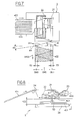
- the consolidation gives a nonwoven fabric having a profile 440a whose edges are significantly heavier, by example with a surface weight of the order of 115 to 120 for the edges if the center weight is 100. This increase in the surface weight near the edges is fed by a lateral withdrawal dc of the consolidated web with respect to the tablecloth non-consolidated.
- the different tensile strengths obtained in the transverse direction CD and in the longitudinal direction MD have a certain heterogeneity between the edges and the central part of the consolidated web of the prior art.
- the ratio MD / CD between these two tensile strengths can in some cases be 40% greater near the edges than in the central part.
- the tensile strength in the longitudinal direction of the web (MD strength) is higher near the edges of the web than in its central region, compared to the tensile strength in the width direction of the web (resistance). CD).
- the tablecloth 430 ( figure 2 ) is typically obtained by superposition of several S430 web segments overlapping each other. The segments are interconnected by folds extending along the edges of the web.
- the fibers of the ply 430 have different orientations resulting from the orientation of the fibers within each of these segments, as well as the angle A430 according to which these segments are deposited on the moving apron carrying the ply.
- a web made of non-condensed web whose fibers are therefore longitudinal in the web, has a much greater tensile strength in the transverse direction of the web (CD) than in its longitudinal direction (MD) because the longitudinal direction of the veil, and hence the direction of the fibers, are almost transverse in the tablecloth.
- the orientation distribution in the web is more homogeneous, but the transverse or quasi-transverse orientations remain preferred. Therefore, the resistance CD remains higher than the resistance MD, although the ratio between the two is less than 1: 1 that when the fog used is not condensed.
- the distribution of the orientation of all the fibers present may be represented by a closed curve C F linked to this zone and having a center of symmetry Cs.
- the figure 3a represents an example of curve C F for a sheet made of non-condensed veil and the figure 3b an example of curve C F for a web made of condensed web.
- Each point P of the curves C F indicates by its distance at the center Cs the proportion of fibers having an orientation identical to that of the vector ray CSP connecting the center Cs to this point P.
- C F From a curve C F can be established a representation comprising an FM arrow parallel to the longitudinal direction and an arrow FC parallel to the width of the web.
- the two arrows then each have a length proportional to the sum of the longitudinal components and respectively to the sum of the transverse components of the vector rays.
- CSP a quadrant (arbitrarily chosen between the four possible) of the curve C F.
- the ratio between the lengths of the arrows FM and FC gives an idea of the MD / CD ratio at the center Cs.
- the set formed by the two arrows FM and FC at a given point of a web or a web will be called "bidirectional spectrum of orientations".
- the orientation of the fibers in the ply 430 has been influenced so as to obtain, in the central part of the unfilled ply, an orientation spectrum ON2 different from the orienting spectrum ON1 in those parts of the ply close to its boundaries. edges.
- the orientation of the fibers in a given part of the ply 430 is influenced by a dynamic adjustment effected upstream of the consolidation treatment in the needling machine 3. More particularly, in this example, the adjustment affects each region of the length of the veil depending on the position that this region of the length of the veil will take in the sheet.
- the fibers of the web regions intended to be placed at the edges of the web are given an orientation spectrum having a greater longitudinal preponderance (relative to the web) than the fibers of the web intended to be placed in the central region of the web. the tablecloth.
- the figure 4 illustrates a non-woven production facility comprising a card 1 producing a web 421 feeding a spreader-lapper 2.
- the card comprises a feed roller 11 collecting fibers 411 directly or indirectly in a reserve, for feeding a card drum 12.
- the periphery of the drum 12 is equipped with known means not shown for working the fibers driven by the drum. These fibers are taken from the drum 12 by a doffer roll 13, then transferred successively to a first condenser roll 14 and a second condenser roll 15.
- the web 421 thus formed is detached by a detacher roll 16 rotating in the same direction as the last condenser roller and depositing the veil on a conveyor belt 17 leading to the input 20 of the spreader-lapper 2.
- the fibers are oriented circumferentially on the doffer 13.
- the condensers 14 and 15 are used to increase the surface weight of the veil, reduce the velocity of the veil and give the fibers a more varied orientation than on the doffer.
- the condensation effect is obtained by giving the second condensation roller 15 a peripheral speed less than that of the first condensation roller 14, the peripheral speed of which is itself lower than that of the doffer 13.
- the crosslapper 2 comprises an entrance mat or front mat 24 and a rear mat 25 each forming a closed loop. These loops are external to each other and bypass various rollers rotating around fixed axes, as well as rollers carried by an accumulator carriage 21 and others carried by a lapper carriage 22. Each of the two belts 24 and 25 is driven by one of the fixed axis rollers associated with it and which is coupled to a respective electric servo motor.
- the web 421 is conveyed to the accumulator truck 21 by the entrance belt or front belt 24, a region of which may constitute the conveyor belt 17, as shown.
- the web crosses down the first accumulator carriage 21, then the lapper carriage 22.
- the lapper carriage 22 is reciprocating M22 in a direction perpendicular to the width of the web, and thus lays the web 421 in successive segments on a deck of output 28 moving in a direction parallel to the width of the sail.
- the successive accumulated and offset segments formed by the web 421 deposited on the exit apron 28 form the sheet 431 ( Fig 5 ) which is routed to consolidation processing 3 ( figure 2 ).
- the accumulator carriage 21 is in reciprocating movement M21 in the same direction as the lapper carriage 22 with a displacement law calculated to adjust the distance to be traveled by the web between the entry 20 of the crosslapper and the lapper carriage 22. Said distance is more particularly adjusted to combine with one another the entry speed of the web 421 in the crosslapper with the speed at which the web passes through the lapper carriage 22.
- the entry speed is equal to 20 at the speed of production of the card, as modified if necessary at each moment by the doffer 13 which can be variable speed and by the variable condensation that will be described.
- the speed with which the web passes through the lapper carriage 22 is equal to the speed of movement of the lapper carriage 22 if the web is to be deposited without the addition of condensation or stretching, or different if the web is to be condensed or stretched when deposited on the exit apron of the spreader-lapper.
- the dynamic adjustment according to the invention affects the preparation or transport of the web 421, that is to say upstream of the deposition of the web on the exit apron 28 by the lapper carriage 22.
- this adjustment modification produces in the web 421 penetrating in the crosslapper 2 an alternating structure having, along the longitudinal direction of the sail 421, an alternation of areas VC and VB which differ in their fiber orientation distributions.
- the zones VB are intended to compose the edge areas B1 of the ply 431, while the zones VC are intended to compose its central part.
- the fibers of the web In the areas VB corresponding to the edges of the web, the fibers of the web have a certain OVB orientation spectrum, while in the VC areas corresponding to the center of the web, the fibers of the web have another OVC orientation spectrum.
- the dynamic adjustment is operated so as to increase the transverse component of the OVC orientation spectrum of the VC zones of the web 421.
- These VC zones produce then in the layer a central zone where the fibers have an orientation spectrum ON2 ( figure 2 ) having a longitudinal component FM2 larger.
- this same central area has a higher MD / CD ratio.
- the MD / CD ratio of the edge zones of the consolidated web has been increased by the effect of the needling described with reference to the figure 1c both MD / CD ratios can be made equal.
- the process according to the invention can be used to produce other types of distribution profile of the orientation spectra of the The invention thus makes it possible to produce a nonwoven having, after consolidation, mechanical strengths distributed according to a chosen profile, preferably taking into account the variations directly induced by the consolidation in the layers of the web. edge areas as shown in figure 1c .
- Such selected profiles may allow for example to produce a textile that will tear more easily along a selected longitudinal area, for example to facilitate separation or cutting in such a zone.
- the orientation of the fibers in the ply 431 such as that represented in FIG. figure 5 which is symmetrical with respect to the longitudinal axis of the sheet 431
- the periodicity of variation of the settings affecting the orientation of the fibers corresponds to a half-working period of the crosslapper 2, corresponding to a sequence of a VC area and a VB area on the sail 421.
- the adjustment variation period corresponds to a full working period of the crosslapper.
- the orientation of the fibers of the web 421 is influenced by condensation in the VC portions of the web.
- a condensation of the order of 17% by weight per unit area can vary by approximately 40% the value of MD / CD in the consolidated sheet, in the case of a geotextile based on polypropylene fibers.
- variable condensation is carried out within the card, during the production or transport of the web, by varying with respect to each other the speeds of at least two rotating members of the card or transport.
- One of these bodies rotates for example at a given speed and one or more subsequent organs rotate at a lower speed when the condensation must be effective.
- the haze produced will have a condensation of 30%.
- This condensation may for example be carried out in several intermediate phases, with the first condenser roll 14 rotating at 80 m / min and the second condenser roll 15 rotating at 50 m / min.
- the card may comprise a single condenser roll. Such a condensation of 30% can then be obtained with a doffer roll rotating at 130 m / min, the condenser roll rotating at 80 m / min, and the detacher rotating at 100 m / min.
- a combing roll 13 is directly followed by a detaching roll 16. Such a condensation of 30% can then be carried out directly between the doffer rotating at 130 m / min and the detacher rotating at 100 m / min.
- condensation can also be dynamically adjusted on the transport path or within the crosslapper 2.
- the transport path may thus comprise one or more condensation devices. It may be for example one or more condenser rollers whose circumferential speed is dynamically adjusted. Dynamically adjustable condensation can be achieved with a drawing or compression device as described in FIG. WO 02/101130 A1 where the FR-A3-2 828 696 placed between the actual card and the crosslapper proper. These devices may for example, according to the invention, operate in variable stretching to cancel at least partially, and variably, a constant condensation at the output of the card.
- both a surface weight adjustment and a setting of the orientation spectrum are carried out, since the areas of the length of the web undergoing the strongest stretch, intended to be placed near the edges of the web, are at the same time. lenght (reduced surface weight) and at the same time "longitudinal" in terms of fiber orientation, while the other, less stretched zones retain the higher weight and the more homogeneous orientation spectrum resulting from condensation at the outlet of the card.
- a dynamic condensation of the web can also be achieved in the crosslapper 2, for example by modifying the displacement law of one or two of its carriages 21 and 22 so as to adjust the speed at which the sail passes through the lapper carriage 22 with respect to the speed of movement of the lapper carriage 22.
- adjustments can also be made by areas, for example the two edge areas and the central area.
- a second embodiment which will be described with reference to Figures 7 and 8 can be implemented as an alternative to the first embodiment or in combination with it.
- a dynamic adjustment is carried out affecting the preparation or transport of the sheet 432, that is to say at the stage or downstream of the deposition of the web 422 on the exit apron 28 in the crosslapper 2.
- this adjustment modification produces a modification of the veil deposition diagram to form each of the transverse segments composing the ply 432, by modifying the inclination of the segment relative to the width of the ply.
- the longitudinal direction DB or DC of each segment forms with the width of the ply an angle AB or AC respectively.
- the exit apron such as 28 is advancing at a constant speed.
- the ratio between this constant speed and the speed of movement of the lapper carriage as defined by the angle between the width of the web and the longitudinal direction of the sail segments.
- the exit apron is further slowed down so that the angle AB in the edge regions B2 is smaller than the angle AC in the central region of the web, as shown in FIG. figure 7 .
- the orientation spectrum ON2 in the center the web is less elongated in the width direction of the web than the orientation spectrum ON1 in the edge areas.
- the edge zones After consolidation, the edge zones have an MD / CD ratio close to that of the central zone.
- this second embodiment can also be used to obtain a chosen non-uniform profile, with regard to the distribution of the resistances within the textile obtained, and not simply a uniform profile.
- the installation according to the invention combines the means described up to now aimed at controlling the distribution of orientations of the fibers over the width of the sheet, with means such as according to the EP-1 036 227 to control the profile of the surface weights over the width of the sheet.
- a second dynamic adjustment is carried out affecting the surface weight of the web but having substantially no effect on the orientation of the fibers.
- the second setting may be a setting varying the amount of fiber drawn by the doffer on the card drum.
- the second adjustment may for example consist in varying the speed of rotation of the doffer (the faster the dancer rotates less it collects fiber at each turn, and more the veil it produces is light) or the spacing of the doffer relative to the drum of the card (the more the comb is removed from the drum, the less fiber it withdraws at each turn, and the more the veil it produces is light).
- the speed of the doffer is dynamically adjusted to produce a web whose weight is non-uniform along its longitudinal direction as for example described in FIG. EP-A-1036 227 and controlling the fiber orientation distribution in the web by dynamically varying the rate of condensation of the web, i.e. for example the ratio of the speed of a detacher to the speed of the web. comber. Therefore, if at a given moment the speed of the doffer varies and the rate of condensation must remain constant, it is typically necessary that the speed of the detacher varies in the same proportion as the speed of the doffer.
- a transverse detector 41 of the type described in FIG. WO 00/073547 comprising a series of sensors aligned parallel to the width of the web or, alternatively, a single sensor called "traveling" making trips back and forth over the web.
- the transverse detector 41 detects the width of the consolidated ply 440 and the surface weight at different points of the width of the ply.
- the detection of the width of the web allows a computer 42 to calculate the lateral shrinkage suffered by the web during consolidation, or by difference with a width detection (not shown) upstream of the needling machine 3, or by difference with the travel length of the lapper carriage of the spreader-lapper 2. This running length is known to the computer 42 because the lapping carriage is actuated precisely by a servomotor (not shown) also controlled by this computer.
- the width of the edge zone of the web which is altered in connection with the shrinkage phenomenon is known from experience or from preliminary tests. A simple arithmetic calculation and / or preliminary tests make it possible to evaluate the impact of this shrinkage on the orientation distribution of the fibers in the edge zone affected by the shrinkage. Based on this evaluation, the computer 42 controls an adjustment of the orientation means.
- the calculator 42 calculates a condensation rate that must be applied to the parts of the web intended to form the central zone of the web so that this central zone has in the consolidated web an orientation distribution. , or in any case a bidirectional spectrum of orientation, which is substantially equal to that of the edge areas.
- the computer 42 receives from the detector 41 measurements of the area weight at different points of the width of the consolidated sheet 440 and regulates the surface weight profile of the consolidated sheet and the width of the consolidated web as described in WO 00/073547 , influencing parameters, such as those described above (speed of the doffer, spacing of the doffer), not affecting or practically no orientation of the fibers in the web.
- the figure 4 schematically illustrates the computer 42 sending commands 43 to the condensers 14, 15 and the detacher 16 for the dynamic adjustment of the condensation, orders 44 to the doffer 13 for the dynamic adjustment of the weight without affecting the orientation of the fibers, and orders 46 the lapping spreader 2 to adjust and define at each instant the position of the two lapper carriages 21, 22 in their movements back and forth M21, M22 and the speed of circulation of the belts 24, 25.
- the lines 43, 44, 46 are bidirectional to transmit back to the computer 42, information on the actual values of the operating parameters of the card and the crosslapper in particular.
- the output of the needling machine 3 in addition to the detector 41, at least one image sensor (not shown) in one of the edge zones. , and preferably at least three image sensors for the two edge areas and the central area respectively.
- the images produced by these sensors are analyzed to determine the orientation distribution of the fibers in the images obtained.
- the calculator 42 calculates, for example, the bidirectional orientation spectra corresponding to the observed distributions, and controls the orientation means in a direction tending to equalize, or maintain equal, these bidirectional spectra.
- the regulation based on a detection of the transverse shrinkage of the sheet could be carried out without being combined with a regulation of the surface weight profile.
- orientation means controlled in the context of the regulation of distributions or orientation spectra can be any of those described, for example the driving motor of the output deck of the crosslapper 2 as described in FIG. reference to the figure 7 .
- the invention is also not limited to the use of specific mathematical parameters such as orientation distributions or bidirectional orientation spectra defined above.
Landscapes
- Engineering & Computer Science (AREA)
- Textile Engineering (AREA)
- Mechanical Engineering (AREA)
- Nonwoven Fabrics (AREA)
- Preliminary Treatment Of Fibers (AREA)
- Treatment Of Fiber Materials (AREA)
Applications Claiming Priority (1)
| Application Number | Priority Date | Filing Date | Title |
|---|---|---|---|
| FR0611238A FR2910496B1 (fr) | 2006-12-22 | 2006-12-22 | Procede de reglage des caracteristiques locales d'un non-tisse, et installation de production s'y rapportant. |
Publications (3)
| Publication Number | Publication Date |
|---|---|
| EP1936016A2 true EP1936016A2 (de) | 2008-06-25 |
| EP1936016A3 EP1936016A3 (de) | 2009-04-29 |
| EP1936016B1 EP1936016B1 (de) | 2020-10-21 |
Family
ID=38282356
Family Applications (1)
| Application Number | Title | Priority Date | Filing Date |
|---|---|---|---|
| EP07150195.1A Revoked EP1936016B1 (de) | 2006-12-22 | 2007-12-20 | Verfahren zur Einstellung der lokalen Eigenschaften eines Vliesstoffs und entsprechende Anlage |
Country Status (3)
| Country | Link |
|---|---|
| US (1) | US8381375B2 (de) |
| EP (1) | EP1936016B1 (de) |
| FR (1) | FR2910496B1 (de) |
Cited By (3)
| Publication number | Priority date | Publication date | Assignee | Title |
|---|---|---|---|---|
| CN104583477A (zh) * | 2012-07-13 | 2015-04-29 | 恒天(奥地利)控股有限公司 | 交叉式铺网机 |
| EP2998424B1 (de) * | 2014-09-22 | 2018-07-18 | Andritz Asselin-Thibeau | Anlage zur festigung, insbesondere durch vernadelung, einer vliesfaserschicht |
| EP3575455B1 (de) | 2018-05-31 | 2022-10-05 | Andritz Asselin-Thibeau | System zur bildung eines vlieses |
Families Citing this family (10)
| Publication number | Priority date | Publication date | Assignee | Title |
|---|---|---|---|---|
| DE202010008748U1 (de) * | 2010-10-07 | 2012-01-16 | Autefa Solutions Germany Gmbh | Legeeinrichtung |
| ITFI20110169A1 (it) * | 2011-08-05 | 2013-02-06 | Trafi S R L | Dispositivo per la produzione di veli per tessuto-non-tessuto, processo per la loro produzione e veli e tessuto-non-tessuto così ottenuti. |
| DE102012008931B4 (de) * | 2012-05-04 | 2014-08-21 | Trützschler GmbH & Co Kommanditgesellschaft | Verfahren und Vorrichtung zur Einstellung der Faserorientierung an Krempelanlagen |
| EP2843096B8 (de) * | 2013-09-02 | 2016-04-13 | KARL MEYER Technische Textilien GmbH | Verfahren und Vorrichtung zum Erzeugen eines Geleges |
| EP3000923A1 (de) * | 2014-03-13 | 2016-03-30 | Oskar Dilo Maschinenfabrik KG | Nadelbrett |
| DE102017126753A1 (de) * | 2017-11-14 | 2019-05-29 | Autefa Solutions Germany Gmbh | Überwachungstechnik für Vliesfabrikationsanlagen |
| CN112166212B (zh) * | 2018-05-29 | 2023-04-07 | 耐克创新有限合伙公司 | 用于具有可变区域特性的非织造织物的方法 |
| SE542425C2 (en) * | 2018-08-24 | 2020-04-28 | Yilmaz Haakan Isak | A machine and a method of producing biodegradable nonwoven textile comprising seeds |
| DE102022116216A1 (de) * | 2022-06-29 | 2024-01-04 | Trützschler Group SE | Verfahren zum Bilden eines Vlieses aus mehreren Lagen Faserflor mittels eines Kreuzlegers, Kreuzleger sowie dessen Verwendung |
| FR3138154A1 (fr) * | 2022-07-25 | 2024-01-26 | Andritz Asselin-Thibeau | Dispositif tampon pour adapter la vitesse de sortie d’une nappe d’un étaleur nappeur à la vitesse d’entrée d’un dispositif de traitement de la nappe en aval de l’étaleur nappeur |
Citations (7)
| Publication number | Priority date | Publication date | Assignee | Title |
|---|---|---|---|---|
| FR2234395A1 (de) | 1973-06-19 | 1975-01-17 | Asselin Robert | |
| EP0371948B1 (de) | 1988-11-30 | 1993-09-22 | Asselin | Verfahren und Vorrichtung für die Herstellung von Textilvlies |
| EP1036227A1 (de) | 1997-11-07 | 2000-09-20 | Asselin | Verfahren und vorrichtung zur herstellung eines textilen vlieses |
| WO2000073547A2 (fr) | 1999-06-01 | 2000-12-07 | Asselin | Procede pour reguler le profil d'une nappe non-tissee et installation de production s'y rapportant |
| WO2002101130A1 (de) | 2001-04-23 | 2002-12-19 | Autefa Automation Gmbh | Verfahren zum profilieren eines vlieses und profilbildungseinrichtung |
| FR2828696A3 (fr) | 2001-08-14 | 2003-02-21 | Dilo Kg Maschf Oskar | Banc d'etirage et installation pour la formation d'un non tisse de fibres |
| EP1057906B1 (de) | 1999-05-26 | 2003-04-23 | Autefa Automation GmbH | Vliesanlage und Betriebsverfahren |
Family Cites Families (15)
| Publication number | Priority date | Publication date | Assignee | Title |
|---|---|---|---|---|
| US314369A (en) * | 1885-03-24 | Felt having a obqss section vaeying- in | ||
| DE1287980B (de) * | 1964-04-17 | |||
| US4287246A (en) * | 1975-03-01 | 1981-09-01 | Bondina, Ltd. | Multizonal fiber distribution |
| US4107822A (en) * | 1977-06-08 | 1978-08-22 | Roger Alan Brown | Process for making a batt of modified basis weight profile and lengthwise uniformity |
| CH627498A5 (de) * | 1978-04-26 | 1982-01-15 | Zellweger Uster Ag | Verfahren und vorrichtung zur ausregulierung von bandgewichtsschwankungen an karden, krempeln und strecken. |
| US4375447A (en) * | 1979-12-21 | 1983-03-01 | Kimberly-Clark Corporation | Method for forming an air-laid web of dry fibers |
| US4366111A (en) * | 1979-12-21 | 1982-12-28 | Kimberly-Clark Corporation | Method of high fiber throughput screening |
| DE3245517C2 (de) | 1982-12-09 | 1985-11-14 | Spinnbau GmbH, 2820 Bremen | Vorrichtung zum Verziehen von querorientiert einlaufenden Faservliesen |
| DE3738190C2 (de) | 1987-11-10 | 1997-10-16 | Autefa Holding Gmbh | Verfahren zur Bildung eines Vlieses und Vliesbandleger |
| DE3843180A1 (de) * | 1988-12-22 | 1990-07-05 | Dietmar Dipl Ing Erhardt | Verfahren zum erfassen und ausgleichen von legefehlern beim herstellen einer bahn eines mehrlagigen vlieses |
| FR2677046B1 (fr) * | 1991-06-03 | 1995-01-13 | Asselin Ets | Etaleur-nappeur. |
| FR2679266B1 (fr) * | 1991-07-16 | 1995-06-23 | Inst Textile De France | Procede et dispositif de fabrication d'un non-tisse en forme, non-tisse obtenu et son utilisation. |
| DE10109476C1 (de) | 2001-02-28 | 2002-06-27 | Gunter Schmidt | Verfahren und Vorrichtung zum Herstellen isotroper Vliesstoffe |
| DE10139833A1 (de) * | 2001-08-14 | 2003-02-27 | Dilo Kg Maschf Oskar | Verfahren und Vorrichtung zum Herstellen eines Faservlieses |
| ATE492670T1 (de) * | 2007-07-09 | 2011-01-15 | Dilo Kg Maschf Oskar | Verfahren zum herstellen einer verfestigten vliesstoffbahn |
-
2006
- 2006-12-22 FR FR0611238A patent/FR2910496B1/fr active Active
-
2007
- 2007-12-20 EP EP07150195.1A patent/EP1936016B1/de not_active Revoked
-
2009
- 2009-03-06 US US12/399,311 patent/US8381375B2/en not_active Expired - Fee Related
Patent Citations (7)
| Publication number | Priority date | Publication date | Assignee | Title |
|---|---|---|---|---|
| FR2234395A1 (de) | 1973-06-19 | 1975-01-17 | Asselin Robert | |
| EP0371948B1 (de) | 1988-11-30 | 1993-09-22 | Asselin | Verfahren und Vorrichtung für die Herstellung von Textilvlies |
| EP1036227A1 (de) | 1997-11-07 | 2000-09-20 | Asselin | Verfahren und vorrichtung zur herstellung eines textilen vlieses |
| EP1057906B1 (de) | 1999-05-26 | 2003-04-23 | Autefa Automation GmbH | Vliesanlage und Betriebsverfahren |
| WO2000073547A2 (fr) | 1999-06-01 | 2000-12-07 | Asselin | Procede pour reguler le profil d'une nappe non-tissee et installation de production s'y rapportant |
| WO2002101130A1 (de) | 2001-04-23 | 2002-12-19 | Autefa Automation Gmbh | Verfahren zum profilieren eines vlieses und profilbildungseinrichtung |
| FR2828696A3 (fr) | 2001-08-14 | 2003-02-21 | Dilo Kg Maschf Oskar | Banc d'etirage et installation pour la formation d'un non tisse de fibres |
Cited By (4)
| Publication number | Priority date | Publication date | Assignee | Title |
|---|---|---|---|---|
| CN104583477A (zh) * | 2012-07-13 | 2015-04-29 | 恒天(奥地利)控股有限公司 | 交叉式铺网机 |
| CN104583477B (zh) * | 2012-07-13 | 2017-03-15 | 恒天(奥地利)控股有限公司 | 交叉式铺网机 |
| EP2998424B1 (de) * | 2014-09-22 | 2018-07-18 | Andritz Asselin-Thibeau | Anlage zur festigung, insbesondere durch vernadelung, einer vliesfaserschicht |
| EP3575455B1 (de) | 2018-05-31 | 2022-10-05 | Andritz Asselin-Thibeau | System zur bildung eines vlieses |
Also Published As
| Publication number | Publication date |
|---|---|
| US8381375B2 (en) | 2013-02-26 |
| FR2910496A1 (fr) | 2008-06-27 |
| FR2910496B1 (fr) | 2009-03-13 |
| EP1936016A3 (de) | 2009-04-29 |
| EP1936016B1 (de) | 2020-10-21 |
| US20090217498A1 (en) | 2009-09-03 |
Similar Documents
| Publication | Publication Date | Title |
|---|---|---|
| EP1936016B1 (de) | Verfahren zur Einstellung der lokalen Eigenschaften eines Vliesstoffs und entsprechende Anlage | |
| EP1036227B1 (de) | Verfahren und vorrichtung zur herstellung eines textilen vlieses | |
| EP1268896B1 (de) | Verfahren und anlage zum regeln des profils eines faservliesverbundes | |
| EP0371948B1 (de) | Verfahren und Vorrichtung für die Herstellung von Textilvlies | |
| EP3141640A1 (de) | Kreuzleger und verfahren zur steuerung eines kreuzlegers | |
| EP1163383B1 (de) | Vliesleger | |
| FR2678289A1 (fr) | Procede pour realiser un non-tisse, non-tisse obtenu notamment par ce procede et installation pour la fabrication de ce non-tisse. | |
| EP3545122B1 (de) | Vorrichtung zum strecken einer bahn zwischen einer kardiervorrichtung und einem kreuzleger | |
| EP1747313B1 (de) | Breites vlies und verfahren dafür und maschine zu dessen herstellung | |
| EP1300492B1 (de) | Verfahren und Anlage zur Herstellung eines verdichteten Vliesstoffes und Vorrichtung zur Verdichtung eines Vliesstoffes | |
| EP1009871B1 (de) | Verfahren und vorrichtung zur herstellung eines vlieses und ein kontinuierliches profiltextilerzeugnis | |
| WO2024023049A1 (fr) | Dispositif tampon pour adapter la vitesse de sortie d'une nappe d'un etaleur nappeur a la vitesse d'entree d'un dispositif de traitement de la nappe en aval de l'etaleur nappeur | |
| EP1897979A2 (de) | Verfahren und System zur Produktion eines mehrschichtigen Vlieses, insbesondere mittels eines Vlieslegers | |
| EP3575455B1 (de) | System zur bildung eines vlieses | |
| EP2128314B9 (de) | Puffervorrichtung und -system sowie Produktionssystem einer Vliesstoffbahn | |
| EP3908687B1 (de) | Einheit und verfahren zur herstellung von vliesstoffen | |
| FR2881758A1 (fr) | Carde et machine de production d'un non-tisse | |
| WO1999027173A1 (fr) | Peigneur a position variable pour le controle du grammage de textiles non-tisses | |
| FR3063741A1 (fr) | Etaleur nappeur |
Legal Events
| Date | Code | Title | Description |
|---|---|---|---|
| PUAI | Public reference made under article 153(3) epc to a published international application that has entered the european phase |
Free format text: ORIGINAL CODE: 0009012 |
|
| AK | Designated contracting states |
Kind code of ref document: A2 Designated state(s): AT BE BG CH CY CZ DE DK EE ES FI FR GB GR HU IE IS IT LI LT LU LV MC MT NL PL PT RO SE SI SK TR |
|
| AX | Request for extension of the european patent |
Extension state: AL BA HR MK RS |
|
| PUAL | Search report despatched |
Free format text: ORIGINAL CODE: 0009013 |
|
| AK | Designated contracting states |
Kind code of ref document: A3 Designated state(s): AT BE BG CH CY CZ DE DK EE ES FI FR GB GR HU IE IS IT LI LT LU LV MC MT NL PL PT RO SE SI SK TR |
|
| AX | Request for extension of the european patent |
Extension state: AL BA HR MK RS |
|
| 17P | Request for examination filed |
Effective date: 20090727 |
|
| 17Q | First examination report despatched |
Effective date: 20090908 |
|
| AKX | Designation fees paid |
Designated state(s): AT BE CH DE ES FR LI |
|
| RAP1 | Party data changed (applicant data changed or rights of an application transferred) |
Owner name: ANDRITZ ASSELIN-THIBEAU |
|
| REG | Reference to a national code |
Ref country code: DE Ref legal event code: R079 Ref document number: 602007060718 Country of ref document: DE Free format text: PREVIOUS MAIN CLASS: D04H0001740000 Ipc: D01G0023060000 |
|
| RIC1 | Information provided on ipc code assigned before grant |
Ipc: D04H 1/482 20120101ALI20200131BHEP Ipc: D04H 1/498 20120101ALI20200131BHEP Ipc: D04H 1/74 20060101ALI20200131BHEP Ipc: D04H 1/46 20120101ALI20200131BHEP Ipc: D01G 23/06 20060101AFI20200131BHEP Ipc: D01G 25/00 20060101ALI20200131BHEP |
|
| GRAP | Despatch of communication of intention to grant a patent |
Free format text: ORIGINAL CODE: EPIDOSNIGR1 |
|
| STAA | Information on the status of an ep patent application or granted ep patent |
Free format text: STATUS: GRANT OF PATENT IS INTENDED |
|
| INTG | Intention to grant announced |
Effective date: 20200519 |
|
| RAP1 | Party data changed (applicant data changed or rights of an application transferred) |
Owner name: ANDRITZ ASSELIN-THIBEAU |
|
| GRAS | Grant fee paid |
Free format text: ORIGINAL CODE: EPIDOSNIGR3 |
|
| GRAA | (expected) grant |
Free format text: ORIGINAL CODE: 0009210 |
|
| STAA | Information on the status of an ep patent application or granted ep patent |
Free format text: STATUS: THE PATENT HAS BEEN GRANTED |
|
| AK | Designated contracting states |
Kind code of ref document: B1 Designated state(s): AT BE CH DE ES FR LI |
|
| REG | Reference to a national code |
Ref country code: CH Ref legal event code: EP |
|
| REG | Reference to a national code |
Ref country code: DE Ref legal event code: R096 Ref document number: 602007060718 Country of ref document: DE |
|
| REG | Reference to a national code |
Ref country code: AT Ref legal event code: REF Ref document number: 1325965 Country of ref document: AT Kind code of ref document: T Effective date: 20201115 |
|
| PG25 | Lapsed in a contracting state [announced via postgrant information from national office to epo] |
Ref country code: ES Free format text: LAPSE BECAUSE OF FAILURE TO SUBMIT A TRANSLATION OF THE DESCRIPTION OR TO PAY THE FEE WITHIN THE PRESCRIBED TIME-LIMIT Effective date: 20201021 |
|
| REG | Reference to a national code |
Ref country code: DE Ref legal event code: R026 Ref document number: 602007060718 Country of ref document: DE |
|
| PLBI | Opposition filed |
Free format text: ORIGINAL CODE: 0009260 |
|
| REG | Reference to a national code |
Ref country code: CH Ref legal event code: PL |
|
| PLAX | Notice of opposition and request to file observation + time limit sent |
Free format text: ORIGINAL CODE: EPIDOSNOBS2 |
|
| 26 | Opposition filed |
Opponent name: AUTEFA SOLUTIONS GERMANY GMBH Effective date: 20210721 |
|
| PG25 | Lapsed in a contracting state [announced via postgrant information from national office to epo] |
Ref country code: LI Free format text: LAPSE BECAUSE OF NON-PAYMENT OF DUE FEES Effective date: 20201231 Ref country code: CH Free format text: LAPSE BECAUSE OF NON-PAYMENT OF DUE FEES Effective date: 20201231 |
|
| PLBB | Reply of patent proprietor to notice(s) of opposition received |
Free format text: ORIGINAL CODE: EPIDOSNOBS3 |
|
| REG | Reference to a national code |
Ref country code: AT Ref legal event code: UEP Ref document number: 1325965 Country of ref document: AT Kind code of ref document: T Effective date: 20201021 |
|
| PGFP | Annual fee paid to national office [announced via postgrant information from national office to epo] |
Ref country code: FR Payment date: 20221222 Year of fee payment: 16 Ref country code: DE Payment date: 20221213 Year of fee payment: 16 Ref country code: AT Payment date: 20221222 Year of fee payment: 16 |
|
| REG | Reference to a national code |
Ref country code: DE Ref legal event code: R103 Ref document number: 602007060718 Country of ref document: DE Ref country code: DE Ref legal event code: R064 Ref document number: 602007060718 Country of ref document: DE |
|
| PGFP | Annual fee paid to national office [announced via postgrant information from national office to epo] |
Ref country code: BE Payment date: 20221221 Year of fee payment: 16 |
|
| RDAF | Communication despatched that patent is revoked |
Free format text: ORIGINAL CODE: EPIDOSNREV1 |
|
| RDAG | Patent revoked |
Free format text: ORIGINAL CODE: 0009271 |
|
| STAA | Information on the status of an ep patent application or granted ep patent |
Free format text: STATUS: PATENT REVOKED |
|
| REG | Reference to a national code |
Ref country code: CH Ref legal event code: PL |
|
| 27W | Patent revoked |
Effective date: 20230213 |
|
| REG | Reference to a national code |
Ref country code: AT Ref legal event code: MA03 Ref document number: 1325965 Country of ref document: AT Kind code of ref document: T Effective date: 20230213 |