EP1936484A1 - Verfahren zur automatischen Zuordnung verschiedener Aktionsarten zu Mauszeigerbewegungen in einem Computerprogramm zur Organisation persönlicher Aktivitäten - Google Patents
Verfahren zur automatischen Zuordnung verschiedener Aktionsarten zu Mauszeigerbewegungen in einem Computerprogramm zur Organisation persönlicher Aktivitäten Download PDFInfo
- Publication number
- EP1936484A1 EP1936484A1 EP06127146A EP06127146A EP1936484A1 EP 1936484 A1 EP1936484 A1 EP 1936484A1 EP 06127146 A EP06127146 A EP 06127146A EP 06127146 A EP06127146 A EP 06127146A EP 1936484 A1 EP1936484 A1 EP 1936484A1
- Authority
- EP
- European Patent Office
- Prior art keywords
- actions
- computer
- action
- dragging
- column
- Prior art date
- Legal status (The legal status is an assumption and is not a legal conclusion. Google has not performed a legal analysis and makes no representation as to the accuracy of the status listed.)
- Ceased
Links
Images



Classifications
-
- G—PHYSICS
- G06—COMPUTING OR CALCULATING; COUNTING
- G06F—ELECTRIC DIGITAL DATA PROCESSING
- G06F3/00—Input arrangements for transferring data to be processed into a form capable of being handled by the computer; Output arrangements for transferring data from processing unit to output unit, e.g. interface arrangements
- G06F3/01—Input arrangements or combined input and output arrangements for interaction between user and computer
- G06F3/048—Interaction techniques based on graphical user interfaces [GUI]
- G06F3/0484—Interaction techniques based on graphical user interfaces [GUI] for the control of specific functions or operations, e.g. selecting or manipulating an object, an image or a displayed text element, setting a parameter value or selecting a range
- G06F3/0486—Drag-and-drop
Definitions
- the present invention relates to a method for automatically associating different kinds of actions, corresponding to different kinds of programs or parts thereof to be executed, with movements of the mouse pointer in a computer program for organizing personal activities.
- the activity linked to the element is started, for example: the visualization of a message, the visualization of the window with the details of a contact, the preparation of a message to be sent and so on.
- the purpose of the present invention is to solve the aforementioned problems, and to provide a method for automatically associating different kinds of actions, corresponding to different kinds of programs or parts thereof to be executed, with movements of the mouse pointer in a computer program for organizing personal activities, which is much quicker than the known programs, in terms of number of program instructions or routines to be performed.
- the basic idea of the present invention consists in exploiting the "click and drag" actions allowed by a computer mouse or by an organiser stylus, to perform different kinds of previously determined and complex actions corresponding to different kinds of computer programs.
- the basic idea of the present invention consists in exploiting the "click and drag" actions allowed by a computer mouse or by an organiser stylus, to perform different kinds of previously determined and complex actions corresponding to different kinds of computer programs. For example the following actions are possible:
- Contact Double click without dragging Show the details of the contact; they can be modified Business dossier Double click without dragging Create and open a Word document with a header including the main elements of the business dossier and the date. Document Double click without dragging Open the document, and it can be modified. When closed, archive it with collected indexes.
- the written document is then converted into a computer readable table, in database format or any other suitable format. It is a sort of correspondence table , containing factory predefined values creating the correspondence between object types which can be the origin and the destination of the dragging operations.
- the correspondence table can be updated or modified by technical people, while the normal user has no access to it.
- the following table 2 shows an example of the correspondence table for programmed actions.
- the table has a number of rows and columns equal to the number of draggable items in the screen. At each row/column crossing, an action or list of actions is specified by inserting its/their action ordinal number(s).
- the program uses the dragged object ordinal as a column and the destination object as a row: at the crossing of the column with the row, the program finds the ordinal number of the action or list of actions and executes them by starting an execution procedure. Where no action is specified in a box, this means that no action has to be performed for that correspondence between a row and a column.
- the method then provides for a step called " Usage step ".
- a first part of this step comprises a part of the program of a type known per se, and which can be implemented in any known way, providing for dividing the screen in a number of windows.
- Each window in the screen includes a list of elements of personal organization programs in the form of a certain number of object types that can be the origin or the destination of a dragging operation.
- Tipically different windows include different types of objects.
- FIG. 1 An example is shown in figure 1 , where a screen is divided in a number of windows. Each window is labelled with an ordinal number identifying the following types of objects:
- a second part of this step comprises a part of the program providing for dragging elements shown in the sub-windows of a personal organization program over other elements in the same or other windows, so as complex actions predefined for that particular drag are automatically executed, for example the actions shown in table 2.
- the execution procedure also receives pointers to the origin and destination objects of the drag.
- the pointers allow the execution procedure to retrieve, from the data base of the system, some data, needed for the operation, that are not available just by the drag action performed. For instance, if the action is "Call by phone", the execution procedure receives a pointer to the database record where the data of the correspondent to be called are stored. The execution procedure reads the phone number of the correspondent from this record and uses the number to dial it.
- the execution procedure reads the address of the origin contact from the database record addressed by the pointer received, starts the editor program and, by using the editor interface functions, inserts the address in its position in the text.
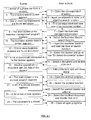
- the flow charts of drawing 2 show an example for better explaining the operation of the method in more complex situations and the advantages of the new technique.
- Figure 3 shows another format for the flow-chart of figure 2.2 , where a more detailed description of the flow of the program is given. While figure 2.2 describes the operation from the point of view of the user, figure 3 describes the same operation from the point of view of the programmer who has to write the real instructions in a computer language.
Landscapes
- Engineering & Computer Science (AREA)
- General Engineering & Computer Science (AREA)
- Theoretical Computer Science (AREA)
- Human Computer Interaction (AREA)
- Physics & Mathematics (AREA)
- General Physics & Mathematics (AREA)
- User Interface Of Digital Computer (AREA)
Priority Applications (1)
| Application Number | Priority Date | Filing Date | Title |
|---|---|---|---|
| EP06127146A EP1936484A1 (de) | 2006-12-22 | 2006-12-22 | Verfahren zur automatischen Zuordnung verschiedener Aktionsarten zu Mauszeigerbewegungen in einem Computerprogramm zur Organisation persönlicher Aktivitäten |
Applications Claiming Priority (1)
| Application Number | Priority Date | Filing Date | Title |
|---|---|---|---|
| EP06127146A EP1936484A1 (de) | 2006-12-22 | 2006-12-22 | Verfahren zur automatischen Zuordnung verschiedener Aktionsarten zu Mauszeigerbewegungen in einem Computerprogramm zur Organisation persönlicher Aktivitäten |
Publications (1)
| Publication Number | Publication Date |
|---|---|
| EP1936484A1 true EP1936484A1 (de) | 2008-06-25 |
Family
ID=38226549
Family Applications (1)
| Application Number | Title | Priority Date | Filing Date |
|---|---|---|---|
| EP06127146A Ceased EP1936484A1 (de) | 2006-12-22 | 2006-12-22 | Verfahren zur automatischen Zuordnung verschiedener Aktionsarten zu Mauszeigerbewegungen in einem Computerprogramm zur Organisation persönlicher Aktivitäten |
Country Status (1)
| Country | Link |
|---|---|
| EP (1) | EP1936484A1 (de) |
Citations (6)
| Publication number | Priority date | Publication date | Assignee | Title |
|---|---|---|---|---|
| EP0747804A1 (de) * | 1995-06-07 | 1996-12-11 | International Business Machines Corporation | Auswahlerleichterung auf einer graphischen Schnittstelle |
| WO1998022908A1 (en) | 1996-11-18 | 1998-05-28 | Datasurf, Inc. | Data navigator interface |
| US20030066032A1 (en) * | 2001-09-28 | 2003-04-03 | Siebel Systems,Inc. | System and method for facilitating user interaction in a browser environment |
| US20030076362A1 (en) | 2001-09-28 | 2003-04-24 | Masahiro Terada | Display control method and display control processing system for concealed window on desktop |
| US20060070007A1 (en) * | 2003-03-27 | 2006-03-30 | Microsoft Corporation | Rich drag drop user interface |
| US20060069604A1 (en) * | 2004-09-30 | 2006-03-30 | Microsoft Corporation | User interface for providing task management and calendar information |
-
2006
- 2006-12-22 EP EP06127146A patent/EP1936484A1/de not_active Ceased
Patent Citations (6)
| Publication number | Priority date | Publication date | Assignee | Title |
|---|---|---|---|---|
| EP0747804A1 (de) * | 1995-06-07 | 1996-12-11 | International Business Machines Corporation | Auswahlerleichterung auf einer graphischen Schnittstelle |
| WO1998022908A1 (en) | 1996-11-18 | 1998-05-28 | Datasurf, Inc. | Data navigator interface |
| US20030066032A1 (en) * | 2001-09-28 | 2003-04-03 | Siebel Systems,Inc. | System and method for facilitating user interaction in a browser environment |
| US20030076362A1 (en) | 2001-09-28 | 2003-04-24 | Masahiro Terada | Display control method and display control processing system for concealed window on desktop |
| US20060070007A1 (en) * | 2003-03-27 | 2006-03-30 | Microsoft Corporation | Rich drag drop user interface |
| US20060069604A1 (en) * | 2004-09-30 | 2006-03-30 | Microsoft Corporation | User interface for providing task management and calendar information |
Similar Documents
| Publication | Publication Date | Title |
|---|---|---|
| US20040196313A1 (en) | Ink repurposing | |
| Dragunov et al. | TaskTracer: a desktop environment to support multi-tasking knowledge workers | |
| Johnson | GUI bloopers 2.0: common user interface design don'ts and dos | |
| US7343365B2 (en) | Computer system architecture for automatic context associations | |
| USRE34476E (en) | Hybrid information management system for handwriting and text | |
| JP4335340B2 (ja) | 会議の目的を支援するための会議オブジェクトを有するフリーフォームグラフィックスシステム | |
| US8666772B2 (en) | Process, system, method creating medical billing code letters, electronic superbill and communication | |
| JP4505069B2 (ja) | フリーフォームグラフィックスシステムおよびフリーフォームグラフィックスシステムを操作する方法 | |
| JP4677202B2 (ja) | コンピュータシステム、コンピュータシステム内のオブジェクトに属性値を割り当てるための方法、コンピュータプログラム、および記憶媒体 | |
| US20070162907A1 (en) | Methods for assisting computer users performing multiple tasks | |
| US8370767B2 (en) | List authoring surface | |
| CN106062790A (zh) | 统一呈现根据上下文连接的信息以改善用户的效率和交互绩效 | |
| US20110314446A1 (en) | Method and system for selectively copying portions of a document contents in a computing system (smart copy and paste | |
| WO2000058874A1 (en) | Workflow modeling language | |
| KR20080017414A (ko) | 의미 풍부 개체를 갖는 동적 사용자 경험을 제공하는컴퓨터화된 방법, 시스템 및 컴퓨터 판독가능 매체 | |
| Khan et al. | TetraMail: a usable email client for blind people | |
| CN109033163B (zh) | 一种在日历中添加日记的方法及装置 | |
| CA2003231C (en) | Apparatus for document annotation and manipulation using images from a window source | |
| Gutschmidt et al. | Identifying HCI patterns for the support of participatory enterprise modeling on multi-touch tables | |
| EP1936484A1 (de) | Verfahren zur automatischen Zuordnung verschiedener Aktionsarten zu Mauszeigerbewegungen in einem Computerprogramm zur Organisation persönlicher Aktivitäten | |
| JPH09297738A (ja) | 携帯情報端末装置、画面遷移方法、及びデータ管理方法 | |
| Huang et al. | Visualization techniques for schedule comparison | |
| Mørch | Designing for radical tailorability: coupling artifact and rationale | |
| CN102411493A (zh) | 通用选择辅助系统及方法 | |
| Tauber | On visual interfaces and their conceptual analysis |
Legal Events
| Date | Code | Title | Description |
|---|---|---|---|
| PUAI | Public reference made under article 153(3) epc to a published international application that has entered the european phase |
Free format text: ORIGINAL CODE: 0009012 |
|
| AK | Designated contracting states |
Kind code of ref document: A1 Designated state(s): AT BE BG CH CY CZ DE DK EE ES FI FR GB GR HU IE IS IT LI LT LU LV MC NL PL PT RO SE SI SK TR |
|
| AX | Request for extension of the european patent |
Extension state: AL BA HR MK RS |
|
| 17P | Request for examination filed |
Effective date: 20081120 |
|
| AKX | Designation fees paid |
Designated state(s): AT BE BG CH CY CZ DE DK EE ES FI FR GB GR HU IE IS IT LI LT LU LV MC NL PL PT RO SE SI SK TR |
|
| 17Q | First examination report despatched |
Effective date: 20100223 |
|
| STAA | Information on the status of an ep patent application or granted ep patent |
Free format text: STATUS: THE APPLICATION HAS BEEN REFUSED |
|
| 18R | Application refused |
Effective date: 20150309 |