EP1936720A1 - Negative Elektrode und wiederaufladbare Lithiumbatterie damit - Google Patents
Negative Elektrode und wiederaufladbare Lithiumbatterie damit Download PDFInfo
- Publication number
- EP1936720A1 EP1936720A1 EP07123875A EP07123875A EP1936720A1 EP 1936720 A1 EP1936720 A1 EP 1936720A1 EP 07123875 A EP07123875 A EP 07123875A EP 07123875 A EP07123875 A EP 07123875A EP 1936720 A1 EP1936720 A1 EP 1936720A1
- Authority
- EP
- European Patent Office
- Prior art keywords
- crystalline structure
- negative electrode
- active material
- negative active
- lithium
- Prior art date
- Legal status (The legal status is an assumption and is not a legal conclusion. Google has not performed a legal analysis and makes no representation as to the accuracy of the status listed.)
- Granted
Links
Images

Classifications
-
- H—ELECTRICITY
- H01—ELECTRIC ELEMENTS
- H01M—PROCESSES OR MEANS, e.g. BATTERIES, FOR THE DIRECT CONVERSION OF CHEMICAL ENERGY INTO ELECTRICAL ENERGY
- H01M4/00—Electrodes
- H01M4/02—Electrodes composed of, or comprising, active material
- H01M4/13—Electrodes for accumulators with non-aqueous electrolyte, e.g. for lithium-accumulators; Processes of manufacture thereof
- H01M4/131—Electrodes based on mixed oxides or hydroxides, or on mixtures of oxides or hydroxides, e.g. LiCoOx
-
- H—ELECTRICITY
- H01—ELECTRIC ELEMENTS
- H01M—PROCESSES OR MEANS, e.g. BATTERIES, FOR THE DIRECT CONVERSION OF CHEMICAL ENERGY INTO ELECTRICAL ENERGY
- H01M10/00—Secondary cells; Manufacture thereof
- H01M10/05—Accumulators with non-aqueous electrolyte
- H01M10/052—Li-accumulators
- H01M10/0525—Rocking-chair batteries, i.e. batteries with lithium insertion or intercalation in both electrodes; Lithium-ion batteries
-
- H—ELECTRICITY
- H01—ELECTRIC ELEMENTS
- H01M—PROCESSES OR MEANS, e.g. BATTERIES, FOR THE DIRECT CONVERSION OF CHEMICAL ENERGY INTO ELECTRICAL ENERGY
- H01M10/00—Secondary cells; Manufacture thereof
- H01M10/42—Methods or arrangements for servicing or maintenance of secondary cells or secondary half-cells
- H01M10/4235—Safety or regulating additives or arrangements in electrodes, separators or electrolyte
-
- H—ELECTRICITY
- H01—ELECTRIC ELEMENTS
- H01M—PROCESSES OR MEANS, e.g. BATTERIES, FOR THE DIRECT CONVERSION OF CHEMICAL ENERGY INTO ELECTRICAL ENERGY
- H01M4/00—Electrodes
- H01M4/02—Electrodes composed of, or comprising, active material
- H01M4/36—Selection of substances as active materials, active masses, active liquids
- H01M4/48—Selection of substances as active materials, active masses, active liquids of inorganic oxides or hydroxides
- H01M4/485—Selection of substances as active materials, active masses, active liquids of inorganic oxides or hydroxides of mixed oxides or hydroxides for inserting or intercalating light metals, e.g. LiTi2O4 or LiTi2OxFy
-
- Y—GENERAL TAGGING OF NEW TECHNOLOGICAL DEVELOPMENTS; GENERAL TAGGING OF CROSS-SECTIONAL TECHNOLOGIES SPANNING OVER SEVERAL SECTIONS OF THE IPC; TECHNICAL SUBJECTS COVERED BY FORMER USPC CROSS-REFERENCE ART COLLECTIONS [XRACs] AND DIGESTS
- Y02—TECHNOLOGIES OR APPLICATIONS FOR MITIGATION OR ADAPTATION AGAINST CLIMATE CHANGE
- Y02E—REDUCTION OF GREENHOUSE GAS [GHG] EMISSIONS, RELATED TO ENERGY GENERATION, TRANSMISSION OR DISTRIBUTION
- Y02E60/00—Enabling technologies; Technologies with a potential or indirect contribution to GHG emissions mitigation
- Y02E60/10—Energy storage using batteries
Definitions
- the present invention relates to a negative electrode for a rechargeable lithium battery and a rechargeable lithium battery including the same. More particularly, the present invention relates to a negative electrode including a lithium vanadium composite oxide and a rechargeable lithium battery including the same.
- the conventional rechargeable lithium battery includes a positive active material of LiCoO 2 , a negative active material of graphite, and an electrolyte of a non-aqueous solution.
- Rechargeable lithium batteries have been widely used as a power source for electronic devices such as a cellular phone, a digital still camera, a digital video camera, and a laptop computer.
- a carbon-based material such as artificial or natural graphite, hard carbon, and so on has been used.
- Graphite of the carbon-based material increases discharge voltages and energy density for a battery because it has a low discharge potential of -0.2V, compared to lithium.
- a battery using graphite as a negative active material has a high average discharge potential of 3.6V and excellent energy density.
- graphite is most comprehensively used among the aforementioned carbon-based materials since graphite guarantees better cycle-life for a battery due to its outstanding reversibility.
- a graphite active material has a low density and consequently a low capacity (theoretical capacity: 2.2 g/cc) in terms of energy density per unit volume when using the graphite as a negative active material.
- a negative active material of Li a Mg b VO c (0.05 ⁇ a ⁇ 3, 0.12 ⁇ b ⁇ 2, 2 ⁇ 2c-a-2b ⁇ 5) is disclosed in Japanese Patent Publication No. 2002-216753 .
- Japanese Patent laid-open No. 2003-68305 discloses a negative active material for a rechargeable lithium battery that includes a lithium vanadium composite oxide.
- the lithium vanadium composite oxide has a significantly lower discharge potential relative to lithium to provide a rechargeable lithium battery having a high energy density.
- the lithium vanadium composite oxide undergoes an irreversible crystalline structure deterioration during charge and discharge, which incurs decomposition of an electrolyte. As a result, the lithium vanadium composite oxide deteriorates cycle-life of a rechargeable lithium battery.
- a negative electrode for a rechargeable lithium battery that includes a current collector and a negative active mass disposed on the current collector.
- the negative active mass includes a negative active material including a lithium vanadium composite oxide and a crystalline structure aid.
- a rechargeable lithium battery that includes the negative electrode of the invention in its first aspect, a positive electrode including a positive active material, and a non-aqueous electrolyte.
- a crystalline structure aid as defined in the invention in its first aspect, in the preparation of a negative active material including a lithium vanadium composite oxide, for a rechargeable lithium battery.
- a negative electrode including the crystalline structure aid can inhibit decomposition of a non-aqueous electrolyte.
- the negative electrode can improve cycle-life and capacity of a rechargeable lithium battery.
- the negative electrode for a rechargeable lithium battery includes a current collector and a negative active mass disposed on the current collector.
- the negative active mass includes a negative active material including a lithium vanadium composite oxide and a crystalline structure aid for inhibiting deterioration of a crystalline structure.
- the crystalline structure aid may be an oxide of an element selected from the group consisting of cerium, zirconium, iron, copper, and combinations thereof. More specific examples of the crystalline structure aid may be selected from the group consisting of cerium oxide, a cerium composite oxide, zirconium oxide, a zirconium composite oxide, an iron composite oxide, iron oxide, copper oxide, and combinations thereof.
- the negative active material preferably includes a lithium vanadium composite oxide represented by Li x M y V z O 2+d where 0.1 ⁇ x ⁇ 2.5, 0 ⁇ y ⁇ 0.5, 0.5 ⁇ z ⁇ 1.5, 0 ⁇ d ⁇ 0.5, and M is selected from the group consisting of Al, Cr, Mo, Ti, W, Zr, and combinations thereof.
- the crystalline structure aid may be included in an amount of 20 wt% or less with respect to a total weight of the negative active mass in the negative electrode of a rechargeable lithium battery.
- the crystalline structure aid is preferably partially attached to a surface of the negative active material in a minimum amount.
- the rechargeable lithium battery includes the above negative electrode, a positive electrode including a positive active material, and a non-aqueous electrolyte.
- the above constitution of the negative electrode can improve cycle-life performance of a rechargeable lithium battery.
- the positive electrode, negative electrode, and non-aqueous electrolyte that constitute the rechargeable lithium battery will be described as follows.
- the positive electrode of the rechargeable lithium battery includes a positive active mass including a positive active material being capable of intercalating and deintercalating lithium ions, a conductive agent, and a binder; and a positive current collector on which the positive active mass is disposed.
- the positive active mass may be formed in a disk-shape to provide a pellet-shaped or sheet-shaped electrode.
- the positive active material may be a Li-containing compound, an oxide, a sulfide, and so on.
- the positive active material may include at least one metal selected from the group consisting of Mn, Co, Ni, Fe, Al, and combinations thereof.
- Examples of the positive active material include LiMn 2 O 4 , LiCoO 2 , LiNiO 2 , LiFeO 2 , LiNi 1/3 Co 1/3 Mn 1/3 O 2 , LiNi 0.8 Co 0.2 O 2 , and so on.
- the binder may include polyvinylidene fluoride, polyethylene, and so on.
- the conductive agent may include a carbon-based material such as carbon black, ketjen black, graphite, and so on.
- the positive current collector may include a metal foil or a metal net formed of aluminum, stainless steel, and so on.
- the negative electrode includes a negative active mass including a negative active material being capable of intercalating and deintercalating lithium ions, a crystalline structure aid for inhibiting deterioration of a crystalline structure, a binder, and a conductive agent as needed; and a negative current collector on which the negative active mass is disposed.
- a negative active mass including a negative active material being capable of intercalating and deintercalating lithium ions, a crystalline structure aid for inhibiting deterioration of a crystalline structure, a binder, and a conductive agent as needed; and a negative current collector on which the negative active mass is disposed.
- the negative active mass may be formed in a disk-shape to fabricate a pellet-shaped or sheet-shaped electrode.
- the binder for the negative electrode may be any organic or inorganic material that can be dispersed or dissolved in a solvent along with the negative active material and bind the negative active material after solvent removal.
- the binder may be a material that can bind the negative active material by mixing the negative active material and then press-forming.
- the binder may be selected from the group consisting of a vinyl-based resin, a cellulose-based resin, a phenol resin, a thermoplastic resin, a thermosetting resin, and so on.
- the binder may be polyvinylidene fluoride, polyvinyl alcohol, carboxylmethyl cellulose, styrene butadiene rubber, and so on.
- the negative electrode may further include a conductive agent such as carbon black, a graphite powder, a carbon fiber, a metal powder, a metal fiber, and so on, in addition to the negative active material and binder.
- a conductive agent such as carbon black, a graphite powder, a carbon fiber, a metal powder, a metal fiber, and so on, in addition to the negative active material and binder.
- the negative current collector may include a metal foil or a metal net formed of copper.
- the negative active material preferably includes a lithium vanadium composite oxide represented by Li x M y V z O 2+d where 0.1 ⁇ x ⁇ 2.5, 0 ⁇ y ⁇ 0.5, 0.5 ⁇ z ⁇ 1.5, 0 ⁇ d ⁇ 0.5, and M is selected from the group consisting of Al, Cr, Mo, Ti, W, Zr, and combinations thereof.
- the Li x M y V z O 2+d may be composed by substituting Co in LiCoO 2 which is a common source for a positive active material with Li, V (vanadium) or other transition elements, and a metal element such as Al, Mo, W, Ti, Cr, or Zr. It can provide discharge potential and cycle-life characteristics at similar levels to those of graphite.
- lithium vanadium composite oxide represented in the composition formula When the lithium vanadium composite oxide represented in the composition formula is used, it is possible to provide a capacity per unit volume of 1000 mAh/cc or more.
- Li x M y V z O 2+d has an R-3M structure in which Li and oxygen, and a transition element and oxygen, are alternatively stacked.
- lithium is enriched and is reversibly intercalated/deintercalated by substituting some of transition elements (V) with Li and other elements (for example Ti, Mo, Cr, and Al).
- the LiVO 2 structure means that the V metal ion layer (Li is substituted with a third metal) is disposed in the oxygen ion octahedron site between the oxygen ions having a hexagonal closed packing; and Li ions are disposed in the lower layer of the octahedron site. If lithium is intercalated thereto to provide Li 2 VO 2 , the structure is also changed into what includes a V metal ion layer (Li is substituted with the third metal), an oxygen ion layer, a Li layer, an oxygen ion layer, and a V metal ion layer (Li is substituted with the third metal).
- the lithium layer is broader and it facilitates the intercalation/deintercalation of the lithium in the crystalline structure.
- the easy intercalation/deintercalation of the lithium increases the diffusion rate of the lithium upon charging and discharging the battery so that the cycle-life and the charge and discharge efficiency of the battery are improved.
- the embodiment includes a lithium vanadium composite oxide having a composition of Li x M y V z O 2+d since the lattice structure is easily changed and the lithium is facilitated in intercalation/deintercalation.
- the Li x M y V z O 2+d has an average oxidation number of vanadium (V) ranging from +1 to +4. According to another embodiment, it ranges from +1 to +3.
- Vanadium (V) of the lithium vanadium composite oxide has an oxidation reduction potential of 1V or less relative to a lithium metal when a lithium vanadium composite oxide is used for a positive active material as the oxidation reduction valence ranges from +1 to +4.
- the vanadium oxide of the conventional positive active material has an oxidation reduction reaction couple having +3 to +4 or +4 or +5, and the early oxidation reduction potential is 2V or more relative to the lithium metal.
- the oxidation reduction potential of the lithium vanadium composite oxide according to the present invention is preferably 1V or less, so it is possible for Li x M y V z O 2+d to carry out the oxidation reduction reaction at a low potential.
- lithium vanadium composite oxide having a composition of Li x M y V z O 2+d when used as a negative active material, it is possible to increase a discharge voltage of battery.
- composition ratios of Li x M y V z O 2+d are out of the ranges of 0.1 ⁇ x ⁇ 2.5, 0 ⁇ y ⁇ 0.5, 0.5 ⁇ z ⁇ 1.5, and 0 ⁇ d ⁇ 0.5, it is not preferable since the average potential relative to the lithium metal increases to 2.5V or more, and the resultant transit discharge voltage is decreased.
- the Li x M y V z O 2+d preferably has a distance ratio between crystalline axes (c/a axis ratio) ranging from 2.5 to 6.5 before intercalating lithium. According to one embodiment, it ranges from 3.0 to 6.2.
- the distance ratio between crystalline axes (c/a axis ratio) before intercalating lithium is deviated from the range, it becomes difficult to intercalate and deintercalate lithium and the lithium intercalation and deintercalation potential is increased to 0.6V or more, so a hysteresis phenomenon in which an increase in the potential difference between the intercalation and the deintercalation occurs due to the oxygen contribution.
- Li x M y V z O 2+d preferably has a distance ratio of 3.5 to 7.0 between crystalline axes (c/a axis ratio) after intercalating lithium. According to another embodiment, it ranges from 4.0 to 7.0. When it is less than 3.5, the lattice change is decreased due to the intercalated Li, so it is difficult to diffuse Li in the lattice. On the other hand, when it is more than 7.0, it is hard to maintain the crystalline structure.
- the Li x M y V z O 2+d preferably has a theoretical density per unit volume of 4.2 g/cc.
- the actual density per unit volume is about 3.0 g/cc or more.
- the capacity of Li x M y V z O 2+d is 300mAh/g
- the theoretical capacity per unit volume is preferably 1200 mAh/cc or more
- the actual capacity per unit volume is preferably 900 mAh/cc or more.
- the negative active material improves energy density to about twice that of the conventional graphite negative active material.
- the graphite has a theoretical density per unit volume of 2.0 g/cc, a density of 1.6 g/cc, and a capacity of 360 mAh/g when it is actually applied to a negative electrode.
- the crystalline structure aid for inhibiting deterioration of a crystalline structure may be an oxide of an element selected from the group consisting of cerium, zirconium, iron, copper, and combinations thereof. More specific examples of the crystalline structure aid may be selected from the group consisting of cerium oxide, a cerium composite oxide, zirconium oxide, a zirconium composite oxide, an iron composite oxide, iron oxide, copper oxide, and combinations thereof.
- the cerium composite oxide may be composite oxide including an element selected from the group consisting of Ti, W, Ni, Cu, Fe, Al, Si, Be, Mg, Ca, Sr, Ba, Ra, Bi, Y, Co, Mn, Nb, Mo, Sn, a rare earth element, and combinations thereof except cerium.
- the zirconium composite oxide may be a composite oxide including an element selected from the group consisting of Ti, W, Ni, Cu, Fe, Al, Si, Be, Mg, Ca, Sr, Ba, Ra, Bi, Y, Co, Mn, Nb, Mo, Sn, Ce, a rare earth element, and combinations thereof except zirconium.
- the iron composite oxide may be a composite oxide including an element selected from the group consisting of Ti, W, Ni, Cu, Fe, Al, Si, Be, Mg, Ca, Sr, Ba, Ra, Bi, Y, Co, Mn, Nb, Mo, Sn, Ce, a rare earth element, and combinations thereof except iron.
- Examples of the iron composite oxide may be selected from the group consisting of LaSrFeO 3-x , CaTi 0.8 Fe 0.2 O 3-x , SrFeCo 0.5 O 4-x where x is a trace amount, and combinations thereof. In one embodiment, x is in the range of 0.4 or less.
- the copper oxide is CuO 2-x where x is trace amount. In one embodiment, x is in the range of 0.2 or less.
- the trace refers to a value that is out of a general stoichiometric ratio.
- the negative electrode preferably has a 3 to 6 intensive ratio (003/001) of the peak of the (003) plane intensity upon the discharge to the peak of the (001) plane intensity upon the charge when it is charged and discharged at a charge and discharge speed of between 0.1 and 1C for several to several tens of cycles, then it is measured for X-ray diffraction intensity using CuK ⁇ at a scanning speed of 1°/min.
- the intensity ratio (003/ 001) when the intensity ratio (003/ 001) is less than 3, it means that the reaction is not reversible, so the structure would be broken to deteriorate the crystallinity. On the other hand, when it is more than 6, the reaction is not carried out in the early stage even though the crystallinity is not deteriorated.
- the conventional lithium rechargeable battery decrease the peak of the (003) plane upon the discharge along with the repeated charge and discharge, so the intensity ratio (003)/(001) is decreased to about 1.5, which indicates the crystalline structure of the negative active material is broken. According to one embodiment, it includes a crystalline structure aid, so the intensity ratio (003)/(001) upon the early charge and discharge does not decrease under 4, which indicates that the crystalline structure of the negative active material is maintained.
- the crystalline structure aid may be coated on at least one part of the surface of the negative active material to adhere to the negative active material, and to present near to the negative active material. According to one embodiment, the crystalline structure aid is coated on at least one part of the surface of the negative active material. This is advantageous since it can prevent the crystallinity of the negative active material from deteriorating.
- the mechanism of the crystalline structure aid for inhibiting the negative active material can be explained with the negative active material having the composition of Li 1.1 V 0.9 O 2 .
- the lithium vanadium composite oxide having a composition of Li 1.1 V 0.9 O 2 When the lithium vanadium composite oxide having a composition of Li 1.1 V 0.9 O 2 is charged and discharged, that is, when lithium ions are intercalated/deintercalated to lithium vanadium composite oxide, the composition is reversibly shifted from Li 1.1 V 0.9 O 2 (discharge) to Li 2.1 V 0.9 O 2 (charge).
- Li 1.1 V 0.9 O 2 and Li 2.1 V 0.9 O 2 always have a hexagonal structure.
- the spacing group of Li 1.1 V 0.9 O 2 is R3(-)m
- the spacing group of Li 2.1 V 0.9 O 2 is P3m1.
- the "3(-)" indicates a symbol putting a bar (-) upon "3.”
- the negative active material including the lithium vanadium composite oxide When the negative active material including the lithium vanadium composite oxide is repeatedly charged and discharged, or subjected to high-rate discharge, one part of the lithium vanadium composite oxide deintercalates oxygen when the lithium ions are deintercalated. Thereby, the discharged oxide is changed to P3m1 Li 1.1 V 0.9 O 2-x instead of R3(-)m Li 1.1 V 0.9 O 2 .
- the crystalline structure aid that is capable of absorbing and releasing oxygen is present on the surface or near the lithium vanadium oxide.
- the crystalline structure aid may be included in an amount of 20 wt% or less with respect to the total weight of the negative active material. In one embodiment, the crystalline structure aid may be included in an amount of 10 wt% or less. In another embodiment, the crystalline structure aid may be included in an amount of 5 wt% or less. In a further embodiment, the crystalline structure aid may be included in an amount of 0.001 wt% to 5 wt%, preferably 0.01 wt% to 5 wt%.
- the crystalline structure aid may be used in an amount of 0.001 wt% or more based on the total weight of the negative active mass. Without the crystalline structure aid, the crystalline structure of the negative active material may be deteriorated. In addition, when the amount of the crystalline structure aid is 20 wt% or less, the crystalline structure aid may not increase internal resistance of the negative electrode to inhibit decrease of energy density. When the amount of the crystalline structure aid is 10 wt% or less based on the total weight of the negative active mass, cycle-life of a rechargeable lithium battery may be improved. When the amount of the crystalline structure aid is 5 wt% or less based on the total weight of the negative active mass, high-rate discharge characteristics of a rechargeable lithium battery may be improved.
- the crystalline structure aid is preferably disposed on the surface or near the Li x M y V z O 2+d , and thereby the crystallinity of the Li x M y V z O 2+d may not be deteriorated and decomposition of a non-aqueous electrolyte may be suppressed. As a result, cycle characteristics of a battery may be improved.
- the negative electrode may be fabricated in accordance with the following two methods.
- a Li x M y V z O 2+d lithium vanadium composite oxide, a crystalline structure aid, a binder, and a conducting agent as needed are mixed to provide a mixture, and then the mixture is added to a binder dissolved in an organic solvent to prepare an active material composition.
- the active material composition is applied on a current collector such as a copper foil, and the organic solvent is removed by heating at about 100°C and drying for 6 hours to fabricate a sheet-shaped negative active mass disposed on a current collector.
- the fabricated negative electrode includes a lithium vanadium composite oxide and a crystalline structure aid near the oxide.
- a Li x M y V z O 2+d lithium vanadium composite oxide and a crystalline structure aid are mixed, and then fired at 800°C for 3 hours under a nitrogen atmosphere.
- the resultant product is mixed with a binder and a conducting agent as needed to prepare a mixture, and then the mixture is added to a binder dissolved in an organic solvent to prepare an active material composition.
- the active material composition is applied on a current collector such as a copper foil, and the organic solvent is removed by heating at about 100 to 120 °C and drying for 6 hours to fabricate a sheet-shaped negative active mass disposed on a current collector.
- the fabricated negative electrode includes a lithium vanadium composite oxide and a crystalline structure aid partially attached to the oxide.
- the non-aqueous electrolyte is a lithium salt dissolved in a non-aqueous solvent.
- the non-aqueous solvent generally includes a cyclic carbonate, a linear carbonate, or combinations thereof.
- the combinations of a cyclic carbonate and a linear carbonate include ethylene carbonate and dimethyl carbonate; ethylene carbonate and methylethyl carbonate; ethylene carbonate and diethylcarbonate; propylene carbonate and dimethyl carbonate; propylene carbonate and methylethyl carbonate; propylene carbonate and diethylcarbonate; ethylene carbonate, propylene carbonate, and dimethyl carbonate; ethylene carbonate, propylene carbonate, and methylethyl carbonate; ethylene carbonate, propylene carbonate, and diethylcarbonate; ethylene carbonate, dimethyl carbonate, and methylethyl carbonate; ethylene carbonate, propylene carbonate, and diethylcarbonate; ethylene carbonate, dimethyl carbon
- the mixing ratio of the cyclic carbonate and the linear carbonate is determined based on the weight, and ranges from 1:99 to 99:1. According to another embodiment, it ranges from 5:95 to 70:30. According to a further embodiment, it ranges from 10:90 to 60:40.
- the lithium salt may include, but is not limited thereto, LiPF 6 , LiBF 4 , LiClO 4 , LiAsF 6 , Li 2 SiF 6 , LiOSO 2 C k F (2k+1) (k is an integer of 1 to 8), LiPF n (C k F 2k+1 ) (6-n) (n is an integer of 1 to 5, and k is an integer of 1 to 8), and so on.
- It may also include a lithium salt such as LiC(SO 2 R 5 ) LiC(SO 2 R 6 ), LiC(SO 2 R 7 ), LiN(SO 2 OR 8 ), LiN(SO 2 OR 9 ), LiN(SO 2 R 10 ), LiN(SO 2 OR 11 ), LiN(SO 2 R 12 ), LiN(SO 2 R 13 ), and so on.
- the R 5 to R 13 may be identical to each other or independent, and they are perfluoroalkyl groups having C1 to C8.
- the lithium salt can be independently used, or mixed with two or more kinds thereof.
- the non-aqueous electrolyte may be obtained by mixing a polymer such as PEO (polyethylene oxide), PVA (polyvinyl alcohol) and so on with said lithium salt.
- a polymer such as PEO (polyethylene oxide), PVA (polyvinyl alcohol) and so on
- it may include a polymer electrolyte prepared by impregnating the non-aqueous solvent and lithium salt in a high-swelling polymer.
- the lithium rechargeable battery according to one embodiment may further include any required members in addition to a positive electrode, a negative electrode, and a non-aqueous electrolyte.
- it may further include a separator in a space between the positive electrode and the negative electrode.
- the separator is preferably present unless the non-aqueous electrolyte is a polymer electrolyte, and the separator may include any conventional separator such as a porous polypropylene film, a porous polyethylene film, and so on.
- a negative electrode including the crystalline structure aid can inhibit decomposition of a non-aqueous electrolyte. As a result, the negative electrode can improve cycle-life of a rechargeable lithium battery.
- V 2 O 3 powder and Li 2 CO 3 powder were mixed to provide a powdery mixture.
- the mixed powder was fired under a nitrogen atmosphere at 1100°C for 5 hours to provide a lithium vanadium composite oxide (negative active material) having a composition of Li 1.1 V 0.9 O 2 .
- CeO 2 powder and ZrO 2 powder were mixed to provide a powdery mixture.
- the lithium vanadium composite oxide 45 wt% of the lithium vanadium composite oxide, 3 wt% of the crystalline structure aid, 42 wt% of graphite powder, and 10 wt% of polyvinylidene were mixed.
- the mixture was added into N-methyl pyrrolidone to prepare an active material composition.
- the active material composition was coated on a Cu foil, dried, and cut into an appropriate size to provide a negative electrode for a rechargeable lithium battery.
- 91 wt% of LiCoO 2 powder, 3 wt% of acetylene black, and 6 wt% of polyvinylidene were mixed and dissolved in N-methyl pyrrolidone to provide an active material composition.
- the active material composition was coated on an Al foil, dried, and cut into an appropriate size to provide a positive electrode for a rechargeable lithium battery.
- a polypropylene separator was interposed between the provided positive electrode and negative electrode, and wound together with the positive electrode and the negative electrode to provide an electrode.
- the electrode was inserted into a cylindrical casing for a battery that was then subjected to terminal welding.
- 1.0M LiPF 6 was dissolved in the mixed solvent to provide an electrolyte solution.
- the electrolyte solution was input into the battery casing, and the battery casing was sealed to provide a lithium rechargeable cell according to Example 1.
- an active material composition 48 wt% of the fired resultant, 42 wt% of graphite powder, and 10 wt% of polyvinylidene were mixed and dissolved in N-methyl pyrrolidone to prepare an active material composition.
- the active material composition was coated on a Cu foil, dried, and cut into an appropriate size to provide a negative electrode for a lithium rechargeable battery.
- a positive electrode for a rechargeable lithium battery was prepared in accordance with the same procedure as in Example 1.
- An electrode including the prepared positive electrode, the negative electrode, and a separator was obtained in accordance with the same procedure as in Example 1.
- a lithium rechargeable cell was provided in accordance with the same procedure as in Example 1, except that the negative electrode was obtained by mixing 48 wt% of a lithium vanadium composite oxide, 42 wt% of graphite powder, and 10 wt% of polyvinylidene.
- Lithium rechargeable cells according to Examples 1 to 4 and Comparative Example 1 were charged with a constant current and constant voltage for a first cycle until the charge ending voltage reached 4.2V at a charge current of 0.5C, and then they were discharged with a constant voltage until the discharge ending voltage reached 2.75V at a discharge current of 0.2C or 2C. Thereby, the discharge capacity of each cell was measured on the first discharge.
- each cell was charged with a constant current and a constant voltage until the charge ending voltage reached 4.2V at a charge current of 0.5C, and was discharged with a constant voltage until the discharge ending voltage reached 2.75V at a discharge current of 2C. These charge and discharge cycles were repeated 30 times.
- the 30th discharge capacity was measured.
- Another cell was prepared, and after charging at the first cycle, it was charged with a constant current and a constant voltage until the charge ending voltage reached 4.2V at a charge current of 0.5C, and it was discharged with a constant voltage until the discharge ending voltage reached 2.75V at a discharge current of 2C. These charge and discharge cycles were repeated 200 times.
- the 200th discharge capacity was measured.
- the capacity ratio (2C/0.2C) was calculated as a percentage (%) of the capacity ratio of each rechargeable cell according to Examples 1 to 4 relative to that of Comparative Example 1 when the capacity ratio (2C/0.2C) of the lithium rechargeable cell according to Comparative Example 1 was set as 100%.
- the results are shown in the following Table 1 as capacity ratio (2C/0.2C) (%).
- lithium rechargeable cells according to Examples 1 to 4 had higher capacity ratios (2C/0.2C) than that of Comparative Example 1. That proved that the lithium rechargeable cells according to Examples 1 to 4 improved the high rate discharge characteristics.
- Example 2 shows that the capacity ratio % 2C/0.2C according to Example 2 was higher than that of Example 1. It is postulated that, due to the preliminary firing of the negative active material and the crystalline structure aid, the crystalline structure aid was adhered to the surface of the negative active material and the crystalline structure aid effectively recovered the oxygen defect of the negative active material, so the cell increased in capacity ratio.
- the lithium rechargeable cells according to Examples 1 to 4 had higher 200th discharge capacities than that of Comparative Example 1. Thereby, it is established that the cycle characteristics of lithium rechargeable cells according to Examples 1 to 4 were improved.
- the discharge capacity of Example 2 was higher than that of Example 1. Similar to the capacity ratio case, it is postulated that this is because the crystalline structure aid was adhered to the surface of the negative active material and the inhibition of crystallinity deterioration effectively recovered the oxygen defect of the negative active material.
- Lithium rechargeable cells were provided in accordance with the same procedure as in Example 1, except that the crystalline structure aid was added at 0 wt% (Comparative Example 1), 1 wt% (Example 5), 3 wt% (Example 1), 5 wt% (Example 6), 10 wt% (Example 7), 20 wt% (Example 8), and 30 wt% (Reference Example 1).
- Example 1 The obtained lithium rechargeable cells according to Example 1, Examples 5 to 8, and Reference Example 1 were charged and discharged for the first cycle in accordance with the same procedure as in Example 1 to measure a first discharge capacity, at 0.2C.
- the lithium rechargeable cells according to Example 1, Examples 5 to 8, and Reference Example 1 were charged and discharged for 30 cycles in accordance with the same procedure as in Example 1 to measure the 30th discharge capacity, at 0.2C.
- Example 1 After the first discharge, the lithium rechargeable cells according to Example 1, Examples 5 to 8, and Reference Example 1 were measured for the 200th discharge capacity at 0.5C in accordance with the same procedure as in Example 1.
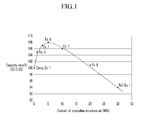
- the capacity ratio (2C/0.2C) of the 30th discharge capacity at 2C to the first discharge at 0.2C was calculated.
- the capacity ratio (2C/0.2C) of each lithium rechargeable cell according to Example 1, Examples 5 to 8, and Reference Example 1 was calculated as a percentage of that of Comparative Example 1, when the capacity ratio (2C/0.2C) of the cell according to Comparative Example 1 was set as 100.
- the results are shown in FIG. 1 as a capacity ratio (2C/0.2C) (%).
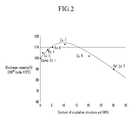
- the 200th discharge capacity at 0.5C of each lithium rechargeable cells according to Example 1, Examples 5 to 8, and Reference Example 1 was calculated as a percentage of that of Comparative Example 1 when the discharge capacity at 0.5C of the cell according to Comparative Example 1 was set to 100.
- the results are shown in FIG. 2 as a discharge capacity (%).
- the capacity ratio (2C/0.2C) indicates the highest when the crystalline structure aid was added at 5 wt%.
- the results show that the capacity ratio (2C/0.2C) was improved when the crystalline structure aid was added at 0 wt% to 20 wt%.
- the crystalline structure aid is to be added in an amount of up to 20 wt%. According to another embodiment, the amount used is up to 10 wt%.
- the 200th discharge capacity at 0.5C reached the highest point when the crystalline structure aid was added at 10 wt%.
- results show that the 200th discharge capacity at 0.5C was improved when the crystalline structure aid was added at more than 0 wt% and 20 wt% or less.
- the crystalline structure aid was added at more than 0 wt% and 20 wt% or less. According to another embodiment, it is more than 0 wt% and 10 wt% or less.
- the crystalline structure aid was added at more than 0 wt% and 20 wt% or less. According to another embodiment, it was added at more than 0 wt% and 10 wt% or less. According to a further embodiment, it was added at more than 0 wt% and 5 wt% or less.
- a lithium rechargeable cell to which the crystalline structure aid was added and a lithium rechargeable cell to which the crystalline structure aid was not added were obtained in accordance with the same procedure as in Example 1, except that the crystalline structure aid was added at 0 wt% and at 5 wt% to the negative electrode.
- the two kinds of lithium rechargeable cells with the crystalline structure aid or without the crystalline structure aid were charged and discharged for the first cycle in accordance with the same procedure as in Example 1.
- the lithium rechargeable cells were disassembled to obtain the negative active mass, and the electrolyte solution was washed and dried to prepare a test sample for X-ray diffraction. Each test sample was subjected to X-ray diffraction analysis (XRD).
- XRD X-ray diffraction analysis
- a CuK ⁇ line was used, and it was examined at a scanning speed of 1°/min.
- Example 1 Example 2
- Example 3 Example 4 Comparative Example 1 Charge and discharge cycle 50 100 200 50 100 200 50 100 200 50 100 200 50 100 200 Intensity ratio (003/001) 5.5 4.2 4.1 5.8 5.5 5.1 5.8 5.2 5.0 5.2 4.5 4.3 5.2 4.1 2.9
- the cells including a crystalline structure aid according to Examples 1 to 4 had an intensity ratio (003/001) of 4.1, 5.1, 5.0, and 4.3, respectively, even though the charge and discharge cycle was repeated 200 times.
- the cell according to Comparative Example 1 had a remarkably lower intensity ratio (003/ 001) since the intensity of the (003) plane was remarkably decreased. From the results, it is found that the cells including the crystalline structure aid according to Examples 1 to 4 maintained the intensity ratio even though the charge and discharge were repeated, so it prevented the structure of the negative active material from breaking.
- the lithium rechargeable cells were disassembled to obtain the negative active mass, and the electrolyte solution was washed and dried to prepare a test sample for X-ray diffraction.
- Each test sample was subjected to an X-ray diffraction analysis.
- the light source for XRD analysis was a CuK ⁇ line, and it was examined at a scanning speed of 1°/min.
- the rechargeable lithium cell to which the crystalline structure aid was added had a diffraction peak of the (003) plane of Li 1.1 V 0.9 O 2 at around 18°, indicating that the crystalline structure was not deteriorated.
- the rechargeable lithium cell to which the crystalline structure aid was not added had a diffraction peak of the (003) plane of Li 1.1 V 0.9 O 2 at around 18°, but the peak intensity was remarkably low compared to that of the lithium rechargeable cell to which the crystalline structure aid was added.
- the lithium rechargeable cell to which the crystalline structure aid was not added had a diffraction peak of the (001) plane of Li 1.1 V 0.9 O 2 around 17° to 18°. From the results, the crystalline structure of the negative active material was deteriorated in the lithium rechargeable cell to which the crystalline structure aid was not added. In addition, the deterioration progressed while repeating the charge and discharge cycles.
Landscapes
- Chemical & Material Sciences (AREA)
- Engineering & Computer Science (AREA)
- Chemical Kinetics & Catalysis (AREA)
- Electrochemistry (AREA)
- General Chemical & Material Sciences (AREA)
- Manufacturing & Machinery (AREA)
- Materials Engineering (AREA)
- Battery Electrode And Active Subsutance (AREA)
- Secondary Cells (AREA)
Applications Claiming Priority (2)
| Application Number | Priority Date | Filing Date | Title |
|---|---|---|---|
| JP2006342896A JP5042611B2 (ja) | 2006-12-20 | 2006-12-20 | リチウム二次電池用の負極及びリチウム二次電池 |
| KR1020070122155A KR100995072B1 (ko) | 2006-12-20 | 2007-11-28 | 리튬 이차전지용 음극 및 이를 포함하는 리튬 이차전지 |
Publications (2)
| Publication Number | Publication Date |
|---|---|
| EP1936720A1 true EP1936720A1 (de) | 2008-06-25 |
| EP1936720B1 EP1936720B1 (de) | 2011-02-23 |
Family
ID=39183171
Family Applications (1)
| Application Number | Title | Priority Date | Filing Date |
|---|---|---|---|
| EP07123875A Not-in-force EP1936720B1 (de) | 2006-12-20 | 2007-12-20 | Negative Elektrode und wiederaufladbare Lithiumbatterie damit |
Country Status (2)
| Country | Link |
|---|---|
| US (1) | US7927745B2 (de) |
| EP (1) | EP1936720B1 (de) |
Cited By (2)
| Publication number | Priority date | Publication date | Assignee | Title |
|---|---|---|---|---|
| KR100995072B1 (ko) | 2006-12-20 | 2010-11-19 | 삼성에스디아이 주식회사 | 리튬 이차전지용 음극 및 이를 포함하는 리튬 이차전지 |
| US7927745B2 (en) | 2006-12-20 | 2011-04-19 | Samsung Sdi Co., Ltd. | Negative electrode for rechargeable lithium battery and rechargeable lithium battery including the same |
Families Citing this family (9)
| Publication number | Priority date | Publication date | Assignee | Title |
|---|---|---|---|---|
| KR100759410B1 (ko) * | 2006-11-20 | 2007-09-19 | 삼성에스디아이 주식회사 | 리튬 이차 전지용 음극 활물질, 그의 제조 방법 및 그를포함하는 리튬 이차 전지 |
| KR100814880B1 (ko) * | 2006-11-22 | 2008-03-18 | 삼성에스디아이 주식회사 | 리튬 이차 전지용 음극 활물질, 이의 제조 방법 및 이를포함하는 리튬 이차 전지 |
| KR100778450B1 (ko) * | 2006-11-22 | 2007-11-28 | 삼성에스디아이 주식회사 | 리튬 이차 전지용 음극 활물질, 이의 제조 방법 및 이를포함하는 리튬 이차 전지 |
| KR100805123B1 (ko) * | 2007-02-15 | 2008-02-21 | 삼성에스디아이 주식회사 | 리튬 이차 전지 |
| JP5511128B2 (ja) * | 2007-06-07 | 2014-06-04 | 三星エスディアイ株式会社 | 非水二次電池用負極材料及び非水二次電池 |
| KR100898291B1 (ko) * | 2007-09-12 | 2009-05-18 | 삼성에스디아이 주식회사 | 리튬 이차 전지 |
| DE102010041019A1 (de) * | 2010-09-20 | 2012-03-22 | Siemens Aktiengesellschaft | Wiederaufladbare Energiespeichereinheit |
| KR101528333B1 (ko) | 2013-06-07 | 2015-06-15 | 한국과학기술연구원 | 나트륨이차전지용 나트륨 바나듐 산화물 음극소재, 이의 제조 방법 및 이를 포함하는 나트륨이차전지 |
| US20230268555A1 (en) * | 2022-02-22 | 2023-08-24 | Enevate Corporation | Prevention of gassing in si dominant lithium-ion batteries |
Citations (5)
| Publication number | Priority date | Publication date | Assignee | Title |
|---|---|---|---|---|
| JPH06302320A (ja) * | 1993-04-14 | 1994-10-28 | Seiko Instr Inc | 非水電解質二次電池 |
| WO2001022507A1 (en) * | 1999-09-23 | 2001-03-29 | 3M Innovative Properties Company | Modified lithium vanadium oxide electrode materials, products, and methods |
| JP2002216753A (ja) | 2001-01-15 | 2002-08-02 | Sumitomo Metal Ind Ltd | リチウム2次電池とその負極材料および製造方法 |
| JP2003068305A (ja) | 2001-03-01 | 2003-03-07 | Sumitomo Metal Ind Ltd | リチウム2次電池用負極材料とその製造方法 |
| EP1511101A2 (de) * | 2003-08-21 | 2005-03-02 | Samsung SDI Co., Ltd. | Negatives Elektrodenmaterial für nicht-wässrige Elektrolyt-Sekundärbatterie, Hestellungsverfahren dafür und nicht-wässrige Elektrolyt-Sekundärbatterie |
Family Cites Families (6)
| Publication number | Priority date | Publication date | Assignee | Title |
|---|---|---|---|---|
| JPH11144734A (ja) | 1997-11-04 | 1999-05-28 | Hitachi Ltd | リチウム二次電池及びリチウム二次電池の作製方法 |
| JP3103356B1 (ja) * | 1999-09-28 | 2000-10-30 | 株式会社サムスン横浜研究所 | リチウム二次電池用の負極材料及びリチウム二次電池用の電極及びリチウム二次電池及びリチウム二次電池用の負極材料の製造方法 |
| KR100378014B1 (ko) * | 2000-08-21 | 2003-03-29 | 삼성에스디아이 주식회사 | 리튬 이차 전지용 전극 및 리튬 이차 전지 |
| US6753112B2 (en) * | 2000-12-27 | 2004-06-22 | Kabushiki Kaisha Toshiba | Positive electrode active material and non-aqueous secondary battery using the same |
| JP3722106B2 (ja) * | 2002-10-01 | 2005-11-30 | 株式会社豊田中央研究所 | 二次電池 |
| EP1936720B1 (de) | 2006-12-20 | 2011-02-23 | Samsung SDI Co., Ltd. | Negative Elektrode und wiederaufladbare Lithiumbatterie damit |
-
2007
- 2007-12-20 EP EP07123875A patent/EP1936720B1/de not_active Not-in-force
- 2007-12-20 US US12/004,102 patent/US7927745B2/en not_active Expired - Fee Related
Patent Citations (5)
| Publication number | Priority date | Publication date | Assignee | Title |
|---|---|---|---|---|
| JPH06302320A (ja) * | 1993-04-14 | 1994-10-28 | Seiko Instr Inc | 非水電解質二次電池 |
| WO2001022507A1 (en) * | 1999-09-23 | 2001-03-29 | 3M Innovative Properties Company | Modified lithium vanadium oxide electrode materials, products, and methods |
| JP2002216753A (ja) | 2001-01-15 | 2002-08-02 | Sumitomo Metal Ind Ltd | リチウム2次電池とその負極材料および製造方法 |
| JP2003068305A (ja) | 2001-03-01 | 2003-03-07 | Sumitomo Metal Ind Ltd | リチウム2次電池用負極材料とその製造方法 |
| EP1511101A2 (de) * | 2003-08-21 | 2005-03-02 | Samsung SDI Co., Ltd. | Negatives Elektrodenmaterial für nicht-wässrige Elektrolyt-Sekundärbatterie, Hestellungsverfahren dafür und nicht-wässrige Elektrolyt-Sekundärbatterie |
Cited By (2)
| Publication number | Priority date | Publication date | Assignee | Title |
|---|---|---|---|---|
| KR100995072B1 (ko) | 2006-12-20 | 2010-11-19 | 삼성에스디아이 주식회사 | 리튬 이차전지용 음극 및 이를 포함하는 리튬 이차전지 |
| US7927745B2 (en) | 2006-12-20 | 2011-04-19 | Samsung Sdi Co., Ltd. | Negative electrode for rechargeable lithium battery and rechargeable lithium battery including the same |
Also Published As
| Publication number | Publication date |
|---|---|
| US20080241688A1 (en) | 2008-10-02 |
| US7927745B2 (en) | 2011-04-19 |
| EP1936720B1 (de) | 2011-02-23 |
Similar Documents
| Publication | Publication Date | Title |
|---|---|---|
| EP1936720B1 (de) | Negative Elektrode und wiederaufladbare Lithiumbatterie damit | |
| EP3719883B1 (de) | Negativelektrodenaktivmaterial für lithiumsekundärbatterie, negativelektrode damit für lithiumsekundärbatterie und lithiumsekundärbatterie | |
| KR102242486B1 (ko) | 양극 활물질 및 이를 포함하는 리튬 이차전지 | |
| KR101777466B1 (ko) | 리튬 이차전지용 양극활물질, 이의 제조방법 및 이를 포함하는 리튬 이차전지 | |
| JP7195547B2 (ja) | リチウム二次電池用正極活物質、その製造方法、それを含むリチウム二次電池用正極及びリチウム二次電池 | |
| EP3719882A1 (de) | Positivelektrodenaktivmaterial für sekundärbatterie, herstellungsverfahren dafür und lithiumsekundärbatterie damit | |
| EP3473600A1 (de) | Kathodenaktivmaterial für eine sekundärbatterie, verfahren zur herstellung davon und lithiumsekundärbatterie damit | |
| US7981545B2 (en) | Negative active material for rechargeable lithium battery and rechargeable lithium battery including the same | |
| KR20200065626A (ko) | 팔면체 구조의 리튬 망간계 양극 활물질, 이를 포함하는 양극 및 리튬 이차전지 | |
| EP2284934B1 (de) | Elektrodenanordnung und Lithium-Sekundärbatterie dieselbe umfassend | |
| EP1801908B1 (de) | Negativ-Aktivmaterial für eine wiederaufladbare Lithiumbatterie, Herstellungsverfahren dafür und wiederaufladbare Lithiumbatterie damit | |
| KR20220023496A (ko) | 양극 활물질의 제조방법 | |
| KR20070117826A (ko) | 리튬 이차 전지용 양극, 및 그를 포함하는 리튬 이차 전지 | |
| KR102850501B1 (ko) | 양극 활물질 및 이의 제조 방법 | |
| KR102939135B1 (ko) | 양극 활물질 전구체, 이를 이용한 양극 활물질의 제조방법 및 양극 활물질 | |
| KR20170048208A (ko) | 이차전지용 양극활물질 및 이를 포함하는 이차전지 | |
| EP4361103A1 (de) | Positivelektrodenaktivmaterial und lithiumsekundärbatterie damit | |
| KR100995072B1 (ko) | 리튬 이차전지용 음극 및 이를 포함하는 리튬 이차전지 | |
| KR20220106659A (ko) | 리튬 전이 금속 산화물, 리튬 이차 전지용 양극 첨가제 및 이를 포함하는 리튬 이차 전지 | |
| KR101244737B1 (ko) | 리튬 이차 전지용 음극 및 이를 포함하는 리튬 이차 전지 | |
| JP7638324B2 (ja) | 正極活物質、正極およびリチウム二次電池 | |
| KR102938737B1 (ko) | 리튬 이차전지용 리튬 전이 금속 산화물의 제조 방법 | |
| JP4961649B2 (ja) | 非水電解液二次電池 | |
| KR100570650B1 (ko) | 리튬 이차 전지용 음극 활물질 및 그를 포함하는 리튬이차 전지 | |
| KR20250026965A (ko) | 리튬 이차 전지용 양극 활물질 및 이를 포함하는 리튬 이차 전지 |
Legal Events
| Date | Code | Title | Description |
|---|---|---|---|
| PUAI | Public reference made under article 153(3) epc to a published international application that has entered the european phase |
Free format text: ORIGINAL CODE: 0009012 |
|
| 17P | Request for examination filed |
Effective date: 20071220 |
|
| AK | Designated contracting states |
Kind code of ref document: A1 Designated state(s): AT BE BG CH CY CZ DE DK EE ES FI FR GB GR HU IE IS IT LI LT LU LV MC MT NL PL PT RO SE SI SK TR |
|
| AX | Request for extension of the european patent |
Extension state: AL BA HR MK RS |
|
| 17Q | First examination report despatched |
Effective date: 20080804 |
|
| R17C | First examination report despatched (corrected) |
Effective date: 20081022 |
|
| AKX | Designation fees paid |
Designated state(s): DE FR GB |
|
| RAP1 | Party data changed (applicant data changed or rights of an application transferred) |
Owner name: SAMSUNG SDI CO., LTD. |
|
| GRAP | Despatch of communication of intention to grant a patent |
Free format text: ORIGINAL CODE: EPIDOSNIGR1 |
|
| GRAS | Grant fee paid |
Free format text: ORIGINAL CODE: EPIDOSNIGR3 |
|
| GRAA | (expected) grant |
Free format text: ORIGINAL CODE: 0009210 |
|
| AK | Designated contracting states |
Kind code of ref document: B1 Designated state(s): DE FR GB |
|
| REG | Reference to a national code |
Ref country code: GB Ref legal event code: FG4D |
|
| REF | Corresponds to: |
Ref document number: 602007012650 Country of ref document: DE Date of ref document: 20110407 Kind code of ref document: P |
|
| REG | Reference to a national code |
Ref country code: DE Ref legal event code: R096 Ref document number: 602007012650 Country of ref document: DE Effective date: 20110407 |
|
| PLBE | No opposition filed within time limit |
Free format text: ORIGINAL CODE: 0009261 |
|
| STAA | Information on the status of an ep patent application or granted ep patent |
Free format text: STATUS: NO OPPOSITION FILED WITHIN TIME LIMIT |
|
| 26N | No opposition filed |
Effective date: 20111124 |
|
| REG | Reference to a national code |
Ref country code: DE Ref legal event code: R097 Ref document number: 602007012650 Country of ref document: DE Effective date: 20111124 |
|
| REG | Reference to a national code |
Ref country code: FR Ref legal event code: PLFP Year of fee payment: 9 |
|
| REG | Reference to a national code |
Ref country code: FR Ref legal event code: PLFP Year of fee payment: 10 |
|
| REG | Reference to a national code |
Ref country code: FR Ref legal event code: PLFP Year of fee payment: 11 |
|
| PGFP | Annual fee paid to national office [announced via postgrant information from national office to epo] |
Ref country code: DE Payment date: 20191210 Year of fee payment: 13 |
|
| PGFP | Annual fee paid to national office [announced via postgrant information from national office to epo] |
Ref country code: FR Payment date: 20191216 Year of fee payment: 13 |
|
| PGFP | Annual fee paid to national office [announced via postgrant information from national office to epo] |
Ref country code: GB Payment date: 20191219 Year of fee payment: 13 |
|
| REG | Reference to a national code |
Ref country code: DE Ref legal event code: R119 Ref document number: 602007012650 Country of ref document: DE |
|
| GBPC | Gb: european patent ceased through non-payment of renewal fee |
Effective date: 20201220 |
|
| PG25 | Lapsed in a contracting state [announced via postgrant information from national office to epo] |
Ref country code: FR Free format text: LAPSE BECAUSE OF NON-PAYMENT OF DUE FEES Effective date: 20201231 |
|
| PG25 | Lapsed in a contracting state [announced via postgrant information from national office to epo] |
Ref country code: GB Free format text: LAPSE BECAUSE OF NON-PAYMENT OF DUE FEES Effective date: 20201220 Ref country code: DE Free format text: LAPSE BECAUSE OF NON-PAYMENT OF DUE FEES Effective date: 20210701 |