EP1942111A1 - Diarylphenoxy-Aluminium-Verbindungen - Google Patents
Diarylphenoxy-Aluminium-Verbindungen Download PDFInfo
- Publication number
- EP1942111A1 EP1942111A1 EP08154812A EP08154812A EP1942111A1 EP 1942111 A1 EP1942111 A1 EP 1942111A1 EP 08154812 A EP08154812 A EP 08154812A EP 08154812 A EP08154812 A EP 08154812A EP 1942111 A1 EP1942111 A1 EP 1942111A1
- Authority
- EP
- European Patent Office
- Prior art keywords
- formula
- isopulegol
- citronellal
- bis
- group
- Prior art date
- Legal status (The legal status is an assumption and is not a legal conclusion. Google has not performed a legal analysis and makes no representation as to the accuracy of the status listed.)
- Withdrawn
Links
- AZDRQVAHHNSJOQ-UHFFFAOYSA-N alumane Chemical class [AlH3] AZDRQVAHHNSJOQ-UHFFFAOYSA-N 0.000 title claims description 8
- NEHNMFOYXAPHSD-UHFFFAOYSA-N citronellal Chemical compound O=CCC(C)CCC=C(C)C NEHNMFOYXAPHSD-UHFFFAOYSA-N 0.000 claims abstract description 242
- ZYTMANIQRDEHIO-KXUCPTDWSA-N isopulegol Chemical compound C[C@@H]1CC[C@@H](C(C)=C)[C@H](O)C1 ZYTMANIQRDEHIO-KXUCPTDWSA-N 0.000 claims abstract description 197
- -1 aluminum compound Chemical class 0.000 claims abstract description 169
- ZYTMANIQRDEHIO-UHFFFAOYSA-N neo-Isopulegol Natural products CC1CCC(C(C)=C)C(O)C1 ZYTMANIQRDEHIO-UHFFFAOYSA-N 0.000 claims abstract description 134
- 235000000983 citronellal Nutrition 0.000 claims abstract description 121
- 229930003633 citronellal Natural products 0.000 claims abstract description 120
- 239000001871 (1R,2R,5S)-5-methyl-2-prop-1-en-2-ylcyclohexan-1-ol Substances 0.000 claims abstract description 95
- 229940095045 isopulegol Drugs 0.000 claims abstract description 95
- 239000003446 ligand Substances 0.000 claims abstract description 88
- 238000000034 method Methods 0.000 claims abstract description 71
- 239000003054 catalyst Substances 0.000 claims abstract description 67
- 238000007363 ring formation reaction Methods 0.000 claims abstract description 54
- 229910052782 aluminium Inorganic materials 0.000 claims abstract description 48
- 238000006243 chemical reaction Methods 0.000 claims abstract description 37
- 125000005842 heteroatom Chemical group 0.000 claims abstract description 29
- 238000002360 preparation method Methods 0.000 claims abstract description 26
- 125000003118 aryl group Chemical group 0.000 claims abstract description 21
- 229910052760 oxygen Inorganic materials 0.000 claims abstract description 21
- 229910052717 sulfur Inorganic materials 0.000 claims abstract description 19
- XAGFODPZIPBFFR-UHFFFAOYSA-N aluminium Chemical compound [Al] XAGFODPZIPBFFR-UHFFFAOYSA-N 0.000 claims abstract description 18
- NOOLISFMXDJSKH-UHFFFAOYSA-N DL-menthol Natural products CC(C)C1CCC(C)CC1O NOOLISFMXDJSKH-UHFFFAOYSA-N 0.000 claims abstract description 8
- 229910052744 lithium Inorganic materials 0.000 claims abstract description 8
- 229940041616 menthol Drugs 0.000 claims abstract description 8
- 229910052739 hydrogen Inorganic materials 0.000 claims abstract description 7
- 229910052700 potassium Inorganic materials 0.000 claims abstract description 6
- 229910052708 sodium Inorganic materials 0.000 claims abstract description 6
- 150000001875 compounds Chemical class 0.000 claims description 73
- 230000008569 process Effects 0.000 claims description 45
- 150000003254 radicals Chemical class 0.000 claims description 43
- 125000001424 substituent group Chemical group 0.000 claims description 43
- 229910052736 halogen Inorganic materials 0.000 claims description 30
- 150000002367 halogens Chemical class 0.000 claims description 30
- 239000000203 mixture Substances 0.000 claims description 30
- 125000004432 carbon atom Chemical group C* 0.000 claims description 29
- 239000002904 solvent Substances 0.000 claims description 29
- WFDIJRYMOXRFFG-UHFFFAOYSA-N Acetic anhydride Chemical compound CC(=O)OC(C)=O WFDIJRYMOXRFFG-UHFFFAOYSA-N 0.000 claims description 27
- 239000000725 suspension Substances 0.000 claims description 21
- 150000002576 ketones Chemical class 0.000 claims description 19
- 150000001299 aldehydes Chemical class 0.000 claims description 18
- 150000001244 carboxylic acid anhydrides Chemical class 0.000 claims description 17
- QYKIQEUNHZKYBP-UHFFFAOYSA-N Vinyl ether Chemical class C=COC=C QYKIQEUNHZKYBP-UHFFFAOYSA-N 0.000 claims description 16
- 125000006663 (C1-C6) perfluoroalkyl group Chemical group 0.000 claims description 15
- QTBSBXVTEAMEQO-UHFFFAOYSA-N Acetic acid Chemical compound CC(O)=O QTBSBXVTEAMEQO-UHFFFAOYSA-N 0.000 claims description 15
- VOITXYVAKOUIBA-UHFFFAOYSA-N triethylaluminium Chemical compound CC[Al](CC)CC VOITXYVAKOUIBA-UHFFFAOYSA-N 0.000 claims description 15
- NOOLISFMXDJSKH-KXUCPTDWSA-N (-)-Menthol Chemical compound CC(C)[C@@H]1CC[C@@H](C)C[C@H]1O NOOLISFMXDJSKH-KXUCPTDWSA-N 0.000 claims description 12
- 150000005840 aryl radicals Chemical class 0.000 claims description 12
- 125000001997 phenyl group Chemical group [H]C1=C([H])C([H])=C(*)C([H])=C1[H] 0.000 claims description 11
- 125000003710 aryl alkyl group Chemical group 0.000 claims description 10
- 238000004821 distillation Methods 0.000 claims description 10
- 125000000524 functional group Chemical group 0.000 claims description 9
- NBBJYMSMWIIQGU-UHFFFAOYSA-N Propionic aldehyde Chemical compound CCC=O NBBJYMSMWIIQGU-UHFFFAOYSA-N 0.000 claims description 8
- WHXSMMKQMYFTQS-UHFFFAOYSA-N Lithium Chemical compound [Li] WHXSMMKQMYFTQS-UHFFFAOYSA-N 0.000 claims description 7
- ZLMJMSJWJFRBEC-UHFFFAOYSA-N Potassium Chemical compound [K] ZLMJMSJWJFRBEC-UHFFFAOYSA-N 0.000 claims description 7
- FHUDAMLDXFJHJE-UHFFFAOYSA-N 1,1,1-trifluoropropan-2-one Chemical compound CC(=O)C(F)(F)F FHUDAMLDXFJHJE-UHFFFAOYSA-N 0.000 claims description 6
- DGAQECJNVWCQMB-PUAWFVPOSA-M Ilexoside XXIX Chemical compound C[C@@H]1CC[C@@]2(CC[C@@]3(C(=CC[C@H]4[C@]3(CC[C@@H]5[C@@]4(CC[C@@H](C5(C)C)OS(=O)(=O)[O-])C)C)[C@@H]2[C@]1(C)O)C)C(=O)O[C@H]6[C@@H]([C@H]([C@@H]([C@H](O6)CO)O)O)O.[Na+] DGAQECJNVWCQMB-PUAWFVPOSA-M 0.000 claims description 6
- 238000009835 boiling Methods 0.000 claims description 6
- 239000001257 hydrogen Substances 0.000 claims description 6
- 238000005984 hydrogenation reaction Methods 0.000 claims description 5
- 239000011591 potassium Substances 0.000 claims description 5
- 239000011734 sodium Substances 0.000 claims description 5
- XXRCUYVCPSWGCC-UHFFFAOYSA-N Ethyl pyruvate Chemical compound CCOC(=O)C(C)=O XXRCUYVCPSWGCC-UHFFFAOYSA-N 0.000 claims description 4
- UFHFLCQGNIYNRP-UHFFFAOYSA-N Hydrogen Chemical compound [H][H] UFHFLCQGNIYNRP-UHFFFAOYSA-N 0.000 claims description 4
- 125000002252 acyl group Chemical group 0.000 claims description 4
- 238000001816 cooling Methods 0.000 claims description 4
- 150000007524 organic acids Chemical class 0.000 claims description 4
- 229920006395 saturated elastomer Polymers 0.000 claims description 4
- 238000002425 crystallisation Methods 0.000 claims description 3
- 230000008025 crystallization Effects 0.000 claims description 3
- 150000002431 hydrogen Chemical class 0.000 claims description 3
- HFFLGKNGCAIQMO-UHFFFAOYSA-N trichloroacetaldehyde Chemical compound ClC(Cl)(Cl)C=O HFFLGKNGCAIQMO-UHFFFAOYSA-N 0.000 claims description 3
- KZJRKRQSDZGHEC-UHFFFAOYSA-N 2,2,2-trifluoro-1-phenylethanone Chemical compound FC(F)(F)C(=O)C1=CC=CC=C1 KZJRKRQSDZGHEC-UHFFFAOYSA-N 0.000 claims description 2
- NOGFHTGYPKWWRX-UHFFFAOYSA-N 2,2,6,6-tetramethyloxan-4-one Chemical compound CC1(C)CC(=O)CC(C)(C)O1 NOGFHTGYPKWWRX-UHFFFAOYSA-N 0.000 claims description 2
- PGZVFRAEAAXREB-UHFFFAOYSA-N 2,2-dimethylpropanoyl 2,2-dimethylpropanoate Chemical compound CC(C)(C)C(=O)OC(=O)C(C)(C)C PGZVFRAEAAXREB-UHFFFAOYSA-N 0.000 claims description 2
- IKHGUXGNUITLKF-XPULMUKRSA-N acetaldehyde Chemical compound [14CH]([14CH3])=O IKHGUXGNUITLKF-XPULMUKRSA-N 0.000 claims description 2
- ZTQSAGDEMFDKMZ-UHFFFAOYSA-N butyric aldehyde Natural products CCCC=O ZTQSAGDEMFDKMZ-UHFFFAOYSA-N 0.000 claims description 2
- 229910052799 carbon Inorganic materials 0.000 claims description 2
- 125000003178 carboxy group Chemical group [H]OC(*)=O 0.000 claims description 2
- 238000007700 distillative separation Methods 0.000 claims description 2
- VBZWSGALLODQNC-UHFFFAOYSA-N hexafluoroacetone Chemical compound FC(F)(F)C(=O)C(F)(F)F VBZWSGALLODQNC-UHFFFAOYSA-N 0.000 claims description 2
- CWKLZLBVOJRSOM-UHFFFAOYSA-N methyl pyruvate Chemical compound COC(=O)C(C)=O CWKLZLBVOJRSOM-UHFFFAOYSA-N 0.000 claims description 2
- 239000004215 Carbon black (E152) Substances 0.000 abstract description 3
- 125000001072 heteroaryl group Chemical group 0.000 abstract description 3
- 238000006467 substitution reaction Methods 0.000 abstract 2
- NOOLISFMXDJSKH-UTLUCORTSA-N (+)-Neomenthol Chemical compound CC(C)[C@@H]1CC[C@@H](C)C[C@@H]1O NOOLISFMXDJSKH-UTLUCORTSA-N 0.000 abstract 1
- 125000000753 cycloalkyl group Chemical group 0.000 abstract 1
- 125000005843 halogen group Chemical group 0.000 abstract 1
- YXFVVABEGXRONW-UHFFFAOYSA-N Toluene Chemical compound CC1=CC=CC=C1 YXFVVABEGXRONW-UHFFFAOYSA-N 0.000 description 93
- QMVPMAAFGQKVCJ-UHFFFAOYSA-N citronellol Chemical compound OCCC(C)CCC=C(C)C QMVPMAAFGQKVCJ-UHFFFAOYSA-N 0.000 description 56
- 239000000243 solution Substances 0.000 description 51
- QMVPMAAFGQKVCJ-SNVBAGLBSA-N (R)-(+)-citronellol Natural products OCC[C@H](C)CCC=C(C)C QMVPMAAFGQKVCJ-SNVBAGLBSA-N 0.000 description 28
- JGQFVRIQXUFPAH-UHFFFAOYSA-N beta-citronellol Natural products OCCC(C)CCCC(C)=C JGQFVRIQXUFPAH-UHFFFAOYSA-N 0.000 description 28
- 235000000484 citronellol Nutrition 0.000 description 28
- 150000002148 esters Chemical class 0.000 description 25
- HUZXZYWMBWQTNX-UHFFFAOYSA-N 3,7-dimethyloct-6-enyl 3,7-dimethyloct-6-enoate Chemical compound CC(C)=CCCC(C)CCOC(=O)CC(C)CCC=C(C)C HUZXZYWMBWQTNX-UHFFFAOYSA-N 0.000 description 20
- HEMHJVSKTPXQMS-UHFFFAOYSA-M sodium hydroxide Inorganic materials [OH-].[Na+] HEMHJVSKTPXQMS-UHFFFAOYSA-M 0.000 description 20
- ZYTMANIQRDEHIO-OPRDCNLKSA-N (1r,2r,5r)-5-methyl-2-prop-1-en-2-ylcyclohexan-1-ol Chemical compound C[C@@H]1CC[C@H](C(C)=C)[C@H](O)C1 ZYTMANIQRDEHIO-OPRDCNLKSA-N 0.000 description 18
- ZYTMANIQRDEHIO-UTLUCORTSA-N (1s,2s,5r)-5-methyl-2-prop-1-en-2-ylcyclohexan-1-ol Chemical compound C[C@@H]1CC[C@@H](C(C)=C)[C@@H](O)C1 ZYTMANIQRDEHIO-UTLUCORTSA-N 0.000 description 18
- ZYTMANIQRDEHIO-LPEHRKFASA-N (1r,2s,5s)-5-methyl-2-prop-1-en-2-ylcyclohexan-1-ol Chemical compound C[C@H]1CC[C@@H](C(C)=C)[C@H](O)C1 ZYTMANIQRDEHIO-LPEHRKFASA-N 0.000 description 17
- 239000011541 reaction mixture Substances 0.000 description 17
- ISWSIDIOOBJBQZ-UHFFFAOYSA-N Phenol Chemical compound OC1=CC=CC=C1 ISWSIDIOOBJBQZ-UHFFFAOYSA-N 0.000 description 13
- QPUYECUOLPXSFR-UHFFFAOYSA-N 1-methylnaphthalene Chemical compound C1=CC=C2C(C)=CC=CC2=C1 QPUYECUOLPXSFR-UHFFFAOYSA-N 0.000 description 8
- 238000002474 experimental method Methods 0.000 description 8
- 125000004051 hexyl group Chemical group [H]C([H])([H])C([H])([H])C([H])([H])C([H])([H])C([H])([H])C([H])([H])* 0.000 description 7
- 229960000834 vinyl ether Drugs 0.000 description 7
- ZMXDDKWLCZADIW-UHFFFAOYSA-N N,N-Dimethylformamide Chemical compound CN(C)C=O ZMXDDKWLCZADIW-UHFFFAOYSA-N 0.000 description 6
- 125000001449 isopropyl group Chemical group [H]C([H])([H])C([H])(*)C([H])([H])[H] 0.000 description 6
- 125000002496 methyl group Chemical group [H]C([H])([H])* 0.000 description 6
- 239000012074 organic phase Substances 0.000 description 6
- 239000012071 phase Substances 0.000 description 6
- JLTRXTDYQLMHGR-UHFFFAOYSA-N trimethylaluminium Chemical compound C[Al](C)C JLTRXTDYQLMHGR-UHFFFAOYSA-N 0.000 description 6
- 125000001495 ethyl group Chemical group [H]C([H])([H])C([H])([H])* 0.000 description 5
- 238000001914 filtration Methods 0.000 description 5
- 238000004817 gas chromatography Methods 0.000 description 5
- 125000000449 nitro group Chemical group [O-][N+](*)=O 0.000 description 5
- 125000003854 p-chlorophenyl group Chemical group [H]C1=C([H])C(*)=C([H])C([H])=C1Cl 0.000 description 5
- 239000000126 substance Substances 0.000 description 5
- 125000004179 3-chlorophenyl group Chemical group [H]C1=C([H])C(*)=C([H])C(Cl)=C1[H] 0.000 description 4
- 125000001255 4-fluorophenyl group Chemical group [H]C1=C([H])C(*)=C([H])C([H])=C1F 0.000 description 4
- 125000004199 4-trifluoromethylphenyl group Chemical group [H]C1=C([H])C(=C([H])C([H])=C1*)C(F)(F)F 0.000 description 4
- IKHGUXGNUITLKF-UHFFFAOYSA-N Acetaldehyde Chemical compound CC=O IKHGUXGNUITLKF-UHFFFAOYSA-N 0.000 description 4
- ZAMOUSCENKQFHK-UHFFFAOYSA-N Chlorine atom Chemical compound [Cl] ZAMOUSCENKQFHK-UHFFFAOYSA-N 0.000 description 4
- IAZDPXIOMUYVGZ-UHFFFAOYSA-N Dimethylsulphoxide Chemical compound CS(C)=O IAZDPXIOMUYVGZ-UHFFFAOYSA-N 0.000 description 4
- PXGOKWXKJXAPGV-UHFFFAOYSA-N Fluorine Chemical compound FF PXGOKWXKJXAPGV-UHFFFAOYSA-N 0.000 description 4
- 229910004298 SiO 2 Inorganic materials 0.000 description 4
- 235000011054 acetic acid Nutrition 0.000 description 4
- 125000004423 acyloxy group Chemical group 0.000 description 4
- 239000000654 additive Substances 0.000 description 4
- 239000004411 aluminium Substances 0.000 description 4
- 230000015572 biosynthetic process Effects 0.000 description 4
- 239000006227 byproduct Substances 0.000 description 4
- 150000001728 carbonyl compounds Chemical class 0.000 description 4
- 229910052801 chlorine Inorganic materials 0.000 description 4
- 239000000460 chlorine Substances 0.000 description 4
- 125000003754 ethoxycarbonyl group Chemical group C(=O)(OCC)* 0.000 description 4
- 229910052731 fluorine Inorganic materials 0.000 description 4
- 239000011737 fluorine Substances 0.000 description 4
- XLYOFNOQVPJJNP-UHFFFAOYSA-M hydroxide Chemical compound [OH-] XLYOFNOQVPJJNP-UHFFFAOYSA-M 0.000 description 4
- 125000002887 hydroxy group Chemical group [H]O* 0.000 description 4
- 238000002955 isolation Methods 0.000 description 4
- 125000001160 methoxycarbonyl group Chemical group [H]C([H])([H])OC(*)=O 0.000 description 4
- 239000000047 product Substances 0.000 description 4
- 239000000376 reactant Substances 0.000 description 4
- 238000011084 recovery Methods 0.000 description 4
- 125000002023 trifluoromethyl group Chemical group FC(F)(F)* 0.000 description 4
- 125000002941 2-furyl group Chemical group O1C([*])=C([H])C([H])=C1[H] 0.000 description 3
- YMWUJEATGCHHMB-UHFFFAOYSA-N Dichloromethane Chemical compound ClCCl YMWUJEATGCHHMB-UHFFFAOYSA-N 0.000 description 3
- 238000005698 Diels-Alder reaction Methods 0.000 description 3
- RTZKZFJDLAIYFH-UHFFFAOYSA-N Diethyl ether Chemical compound CCOCC RTZKZFJDLAIYFH-UHFFFAOYSA-N 0.000 description 3
- XEKOWRVHYACXOJ-UHFFFAOYSA-N Ethyl acetate Chemical compound CCOC(C)=O XEKOWRVHYACXOJ-UHFFFAOYSA-N 0.000 description 3
- 239000002841 Lewis acid Substances 0.000 description 3
- KWYUFKZDYYNOTN-UHFFFAOYSA-M Potassium hydroxide Chemical compound [OH-].[K+] KWYUFKZDYYNOTN-UHFFFAOYSA-M 0.000 description 3
- 239000002253 acid Substances 0.000 description 3
- QVGXLLKOCUKJST-UHFFFAOYSA-N atomic oxygen Chemical compound [O] QVGXLLKOCUKJST-UHFFFAOYSA-N 0.000 description 3
- 125000001797 benzyl group Chemical group [H]C1=C([H])C([H])=C(C([H])=C1[H])C([H])([H])* 0.000 description 3
- 125000000484 butyl group Chemical group [H]C([*])([H])C([H])([H])C([H])([H])C([H])([H])[H] 0.000 description 3
- 230000007717 exclusion Effects 0.000 description 3
- SPRIOUNJHPCKPV-UHFFFAOYSA-N hydridoaluminium Chemical compound [AlH] SPRIOUNJHPCKPV-UHFFFAOYSA-N 0.000 description 3
- 230000007062 hydrolysis Effects 0.000 description 3
- 238000006460 hydrolysis reaction Methods 0.000 description 3
- 125000000959 isobutyl group Chemical group [H]C([H])([H])C([H])(C([H])([H])[H])C([H])([H])* 0.000 description 3
- 125000001972 isopentyl group Chemical group [H]C([H])([H])C([H])(C([H])([H])[H])C([H])([H])C([H])([H])* 0.000 description 3
- 125000005928 isopropyloxycarbonyl group Chemical group [H]C([H])([H])C([H])(OC(*)=O)C([H])([H])[H] 0.000 description 3
- 150000007517 lewis acids Chemical class 0.000 description 3
- VLKZOEOYAKHREP-UHFFFAOYSA-N n-Hexane Chemical compound CCCCCC VLKZOEOYAKHREP-UHFFFAOYSA-N 0.000 description 3
- 125000001624 naphthyl group Chemical group 0.000 description 3
- 239000001301 oxygen Substances 0.000 description 3
- 125000001037 p-tolyl group Chemical group [H]C1=C([H])C(=C([H])C([H])=C1*)C([H])([H])[H] 0.000 description 3
- 125000001147 pentyl group Chemical group C(CCCC)* 0.000 description 3
- 125000001436 propyl group Chemical group [H]C([*])([H])C([H])([H])C([H])([H])[H] 0.000 description 3
- 125000004742 propyloxycarbonyl group Chemical group 0.000 description 3
- 239000007787 solid Substances 0.000 description 3
- 238000003756 stirring Methods 0.000 description 3
- 125000000999 tert-butyl group Chemical group [H]C([H])([H])C(*)(C([H])([H])[H])C([H])([H])[H] 0.000 description 3
- 125000005919 1,2,2-trimethylpropyl group Chemical group 0.000 description 2
- 125000001766 1,2,4-oxadiazol-3-yl group Chemical group [H]C1=NC(*)=NO1 0.000 description 2
- 125000004505 1,2,4-oxadiazol-5-yl group Chemical group O1N=CN=C1* 0.000 description 2
- 125000004515 1,2,4-thiadiazol-3-yl group Chemical group S1N=C(N=C1)* 0.000 description 2
- 125000004516 1,2,4-thiadiazol-5-yl group Chemical group S1N=CN=C1* 0.000 description 2
- 125000001305 1,2,4-triazol-3-yl group Chemical group [H]N1N=C([*])N=C1[H] 0.000 description 2
- 125000005918 1,2-dimethylbutyl group Chemical group 0.000 description 2
- 125000004509 1,3,4-oxadiazol-2-yl group Chemical group O1C(=NN=C1)* 0.000 description 2
- 125000004521 1,3,4-thiadiazol-2-yl group Chemical group S1C(=NN=C1)* 0.000 description 2
- 125000004317 1,3,5-triazin-2-yl group Chemical group [H]C1=NC(*)=NC([H])=N1 0.000 description 2
- 125000006218 1-ethylbutyl group Chemical group [H]C([H])([H])C([H])([H])C([H])([H])C([H])(*)C([H])([H])C([H])([H])[H] 0.000 description 2
- 125000004343 1-phenylethyl group Chemical group [H]C1=C([H])C([H])=C(C([H])=C1[H])C([H])(*)C([H])([H])[H] 0.000 description 2
- 125000006176 2-ethylbutyl group Chemical group [H]C([H])([H])C([H])([H])C([H])(C([H])([H])*)C([H])([H])C([H])([H])[H] 0.000 description 2
- 125000004493 2-methylbut-1-yl group Chemical group CC(C*)CC 0.000 description 2
- 125000005916 2-methylpentyl group Chemical group 0.000 description 2
- CMWKITSNTDAEDT-UHFFFAOYSA-N 2-nitrobenzaldehyde Chemical compound [O-][N+](=O)C1=CC=CC=C1C=O CMWKITSNTDAEDT-UHFFFAOYSA-N 0.000 description 2
- 125000000094 2-phenylethyl group Chemical group [H]C1=C([H])C([H])=C(C([H])=C1[H])C([H])([H])C([H])([H])* 0.000 description 2
- 125000000389 2-pyrrolyl group Chemical group [H]N1C([*])=C([H])C([H])=C1[H] 0.000 description 2
- 125000000175 2-thienyl group Chemical group S1C([*])=C([H])C([H])=C1[H] 0.000 description 2
- 125000003682 3-furyl group Chemical group O1C([H])=C([*])C([H])=C1[H] 0.000 description 2
- 125000003542 3-methylbutan-2-yl group Chemical group [H]C([H])([H])C([H])(*)C([H])(C([H])([H])[H])C([H])([H])[H] 0.000 description 2
- 125000005917 3-methylpentyl group Chemical group 0.000 description 2
- 125000001397 3-pyrrolyl group Chemical group [H]N1C([H])=C([*])C([H])=C1[H] 0.000 description 2
- 125000001541 3-thienyl group Chemical group S1C([H])=C([*])C([H])=C1[H] 0.000 description 2
- KDDQRKBRJSGMQE-UHFFFAOYSA-N 4-thiazolyl Chemical group [C]1=CSC=N1 KDDQRKBRJSGMQE-UHFFFAOYSA-N 0.000 description 2
- CWDWFSXUQODZGW-UHFFFAOYSA-N 5-thiazolyl Chemical group [C]1=CN=CS1 CWDWFSXUQODZGW-UHFFFAOYSA-N 0.000 description 2
- XKRFYHLGVUSROY-UHFFFAOYSA-N Argon Chemical compound [Ar] XKRFYHLGVUSROY-UHFFFAOYSA-N 0.000 description 2
- YNQLUTRBYVCPMQ-UHFFFAOYSA-N Ethylbenzene Chemical compound CCC1=CC=CC=C1 YNQLUTRBYVCPMQ-UHFFFAOYSA-N 0.000 description 2
- AFVFQIVMOAPDHO-UHFFFAOYSA-N Methanesulfonic acid Chemical compound CS(O)(=O)=O AFVFQIVMOAPDHO-UHFFFAOYSA-N 0.000 description 2
- BZLVMXJERCGZMT-UHFFFAOYSA-N Methyl tert-butyl ether Chemical compound COC(C)(C)C BZLVMXJERCGZMT-UHFFFAOYSA-N 0.000 description 2
- OFBQJSOFQDEBGM-UHFFFAOYSA-N Pentane Chemical compound CCCCC OFBQJSOFQDEBGM-UHFFFAOYSA-N 0.000 description 2
- KEAYESYHFKHZAL-UHFFFAOYSA-N Sodium Chemical compound [Na] KEAYESYHFKHZAL-UHFFFAOYSA-N 0.000 description 2
- WYURNTSHIVDZCO-UHFFFAOYSA-N Tetrahydrofuran Chemical compound C1CCOC1 WYURNTSHIVDZCO-UHFFFAOYSA-N 0.000 description 2
- KPCZJLGGXRGYIE-UHFFFAOYSA-N [C]1=CC=CN=C1 Chemical group [C]1=CC=CN=C1 KPCZJLGGXRGYIE-UHFFFAOYSA-N 0.000 description 2
- 125000002777 acetyl group Chemical group [H]C([H])([H])C(*)=O 0.000 description 2
- 150000007513 acids Chemical class 0.000 description 2
- 230000000996 additive effect Effects 0.000 description 2
- WPYMKLBDIGXBTP-UHFFFAOYSA-N benzoic acid Chemical compound OC(=O)C1=CC=CC=C1 WPYMKLBDIGXBTP-UHFFFAOYSA-N 0.000 description 2
- 125000002915 carbonyl group Chemical group [*:2]C([*:1])=O 0.000 description 2
- 238000005119 centrifugation Methods 0.000 description 2
- 239000007795 chemical reaction product Substances 0.000 description 2
- MVPPADPHJFYWMZ-UHFFFAOYSA-N chlorobenzene Chemical compound ClC1=CC=CC=C1 MVPPADPHJFYWMZ-UHFFFAOYSA-N 0.000 description 2
- 239000012043 crude product Substances 0.000 description 2
- 125000000113 cyclohexyl group Chemical group [H]C1([H])C([H])([H])C([H])([H])C([H])(*)C([H])([H])C1([H])[H] 0.000 description 2
- 125000000058 cyclopentadienyl group Chemical group C1(=CC=CC1)* 0.000 description 2
- 125000001511 cyclopentyl group Chemical group [H]C1([H])C([H])([H])C([H])([H])C([H])(*)C1([H])[H] 0.000 description 2
- MWKFXSUHUHTGQN-UHFFFAOYSA-N decan-1-ol Chemical compound CCCCCCCCCCO MWKFXSUHUHTGQN-UHFFFAOYSA-N 0.000 description 2
- 230000002950 deficient Effects 0.000 description 2
- MHDVGSVTJDSBDK-UHFFFAOYSA-N dibenzyl ether Chemical compound C=1C=CC=CC=1COCC1=CC=CC=C1 MHDVGSVTJDSBDK-UHFFFAOYSA-N 0.000 description 2
- XBDQKXXYIPTUBI-UHFFFAOYSA-N dimethylselenoniopropionate Natural products CCC(O)=O XBDQKXXYIPTUBI-UHFFFAOYSA-N 0.000 description 2
- ZSWFCLXCOIISFI-UHFFFAOYSA-N endo-cyclopentadiene Natural products C1C=CC=C1 ZSWFCLXCOIISFI-UHFFFAOYSA-N 0.000 description 2
- 125000002485 formyl group Chemical group [H]C(*)=O 0.000 description 2
- 238000007306 functionalization reaction Methods 0.000 description 2
- 239000007789 gas Substances 0.000 description 2
- 150000002390 heteroarenes Chemical class 0.000 description 2
- 229930195733 hydrocarbon Natural products 0.000 description 2
- 239000012535 impurity Substances 0.000 description 2
- 125000004491 isohexyl group Chemical group C(CCC(C)C)* 0.000 description 2
- 239000012452 mother liquor Substances 0.000 description 2
- 125000001971 neopentyl group Chemical group [H]C([*])([H])C(C([H])([H])[H])(C([H])([H])[H])C([H])([H])[H] 0.000 description 2
- 239000003960 organic solvent Substances 0.000 description 2
- 125000001181 organosilyl group Chemical group [SiH3]* 0.000 description 2
- 125000003538 pentan-3-yl group Chemical group [H]C([H])([H])C([H])([H])C([H])(*)C([H])([H])C([H])([H])[H] 0.000 description 2
- 150000002989 phenols Chemical class 0.000 description 2
- 230000000704 physical effect Effects 0.000 description 2
- 229920000642 polymer Polymers 0.000 description 2
- 125000001501 propionyl group Chemical group O=C([*])C([H])([H])C([H])([H])[H] 0.000 description 2
- 125000004307 pyrazin-2-yl group Chemical group [H]C1=C([H])N=C(*)C([H])=N1 0.000 description 2
- 125000002206 pyridazin-3-yl group Chemical group [H]C1=C([H])C([H])=C(*)N=N1 0.000 description 2
- 125000004940 pyridazin-4-yl group Chemical group N1=NC=C(C=C1)* 0.000 description 2
- 125000000246 pyrimidin-2-yl group Chemical group [H]C1=NC(*)=NC([H])=C1[H] 0.000 description 2
- 125000004527 pyrimidin-4-yl group Chemical group N1=CN=C(C=C1)* 0.000 description 2
- 125000004528 pyrimidin-5-yl group Chemical group N1=CN=CC(=C1)* 0.000 description 2
- 125000002914 sec-butyl group Chemical group [H]C([H])([H])C([H])([H])C([H])(*)C([H])([H])[H] 0.000 description 2
- 125000003548 sec-pentyl group Chemical group [H]C([H])([H])C([H])([H])C([H])([H])C([H])(*)C([H])([H])[H] 0.000 description 2
- 238000000926 separation method Methods 0.000 description 2
- 238000003786 synthesis reaction Methods 0.000 description 2
- 125000001973 tert-pentyl group Chemical group [H]C([H])([H])C([H])([H])C(*)(C([H])([H])[H])C([H])([H])[H] 0.000 description 2
- ZUHZGEOKBKGPSW-UHFFFAOYSA-N tetraglyme Chemical compound COCCOCCOCCOCCOC ZUHZGEOKBKGPSW-UHFFFAOYSA-N 0.000 description 2
- 229910052723 transition metal Inorganic materials 0.000 description 2
- 150000003624 transition metals Chemical class 0.000 description 2
- IIYFAKIEWZDVMP-UHFFFAOYSA-N tridecane Chemical compound CCCCCCCCCCCCC IIYFAKIEWZDVMP-UHFFFAOYSA-N 0.000 description 2
- XLYOFNOQVPJJNP-UHFFFAOYSA-N water Substances O XLYOFNOQVPJJNP-UHFFFAOYSA-N 0.000 description 2
- 238000010626 work up procedure Methods 0.000 description 2
- VNDYJBBGRKZCSX-UHFFFAOYSA-L zinc bromide Chemical compound Br[Zn]Br VNDYJBBGRKZCSX-UHFFFAOYSA-L 0.000 description 2
- 125000004169 (C1-C6) alkyl group Chemical group 0.000 description 1
- SCYULBFZEHDVBN-UHFFFAOYSA-N 1,1-Dichloroethane Chemical compound CC(Cl)Cl SCYULBFZEHDVBN-UHFFFAOYSA-N 0.000 description 1
- 239000005968 1-Decanol Substances 0.000 description 1
- OZCMOJQQLBXBKI-UHFFFAOYSA-N 1-ethenoxy-2-methylpropane Chemical class CC(C)COC=C OZCMOJQQLBXBKI-UHFFFAOYSA-N 0.000 description 1
- BVFDUKJYTCHZNE-UHFFFAOYSA-N 2,2,2-trichloroacetaldehyde Chemical compound ClC(Cl)(Cl)C=O.ClC(Cl)(Cl)C=O BVFDUKJYTCHZNE-UHFFFAOYSA-N 0.000 description 1
- LBLYYCQCTBFVLH-UHFFFAOYSA-N 2-Methylbenzenesulfonic acid Chemical compound CC1=CC=CC=C1S(O)(=O)=O LBLYYCQCTBFVLH-UHFFFAOYSA-N 0.000 description 1
- 125000004198 2-fluorophenyl group Chemical group [H]C1=C([H])C(F)=C(*)C([H])=C1[H] 0.000 description 1
- CRWNQZTZTZWPOF-UHFFFAOYSA-N 2-methyl-4-phenylpyridine Chemical compound C1=NC(C)=CC(C=2C=CC=CC=2)=C1 CRWNQZTZTZWPOF-UHFFFAOYSA-N 0.000 description 1
- 125000004105 2-pyridyl group Chemical group N1=C([*])C([H])=C([H])C([H])=C1[H] 0.000 description 1
- 125000004211 3,5-difluorophenyl group Chemical group [H]C1=C(F)C([H])=C(*)C([H])=C1F 0.000 description 1
- GJWSUKYXUMVMGX-UHFFFAOYSA-M 3,7-dimethyloct-6-enoate Chemical compound [O-]C(=O)CC(C)CCC=C(C)C GJWSUKYXUMVMGX-UHFFFAOYSA-M 0.000 description 1
- 125000004180 3-fluorophenyl group Chemical group [H]C1=C([H])C(*)=C([H])C(F)=C1[H] 0.000 description 1
- 125000004800 4-bromophenyl group Chemical group [H]C1=C([H])C(*)=C([H])C([H])=C1Br 0.000 description 1
- 125000004861 4-isopropyl phenyl group Chemical group [H]C1=C([H])C(=C([H])C([H])=C1*)C([H])(C([H])([H])[H])C([H])([H])[H] 0.000 description 1
- 229910018072 Al 2 O 3 Inorganic materials 0.000 description 1
- 238000006596 Alder-ene reaction Methods 0.000 description 1
- 239000005711 Benzoic acid Substances 0.000 description 1
- WKBOTKDWSSQWDR-UHFFFAOYSA-N Bromine atom Chemical compound [Br] WKBOTKDWSSQWDR-UHFFFAOYSA-N 0.000 description 1
- AFINGIXRSWIXIG-UHFFFAOYSA-N CC(C(F)(F)F)(c(cc1-c2ccccc2)cc(-c2ccccc2)c1O)c(cc1-c2ccccc2)cc(-c2ccccc2)c1O Chemical compound CC(C(F)(F)F)(c(cc1-c2ccccc2)cc(-c2ccccc2)c1O)c(cc1-c2ccccc2)cc(-c2ccccc2)c1O AFINGIXRSWIXIG-UHFFFAOYSA-N 0.000 description 1
- 229930008398 Citronellate Natural products 0.000 description 1
- 238000005821 Claisen rearrangement reaction Methods 0.000 description 1
- XDTMQSROBMDMFD-UHFFFAOYSA-N Cyclohexane Chemical compound C1CCCCC1 XDTMQSROBMDMFD-UHFFFAOYSA-N 0.000 description 1
- 244000166675 Cymbopogon nardus Species 0.000 description 1
- 235000018791 Cymbopogon nardus Nutrition 0.000 description 1
- BUDQDWGNQVEFAC-UHFFFAOYSA-N Dihydropyran Chemical compound C1COC=CC1 BUDQDWGNQVEFAC-UHFFFAOYSA-N 0.000 description 1
- SNRUBQQJIBEYMU-UHFFFAOYSA-N Dodecane Natural products CCCCCCCCCCCC SNRUBQQJIBEYMU-UHFFFAOYSA-N 0.000 description 1
- 238000005863 Friedel-Crafts acylation reaction Methods 0.000 description 1
- 238000003547 Friedel-Crafts alkylation reaction Methods 0.000 description 1
- CTQNGGLPUBDAKN-UHFFFAOYSA-N O-Xylene Chemical compound CC1=CC=CC=C1C CTQNGGLPUBDAKN-UHFFFAOYSA-N 0.000 description 1
- PMZURENOXWZQFD-UHFFFAOYSA-L Sodium Sulfate Chemical compound [Na+].[Na+].[O-]S([O-])(=O)=O PMZURENOXWZQFD-UHFFFAOYSA-L 0.000 description 1
- 229910010413 TiO 2 Inorganic materials 0.000 description 1
- 238000006423 Tishchenko reaction Methods 0.000 description 1
- 230000002378 acidificating effect Effects 0.000 description 1
- 150000001336 alkenes Chemical class 0.000 description 1
- WYTGDNHDOZPMIW-RCBQFDQVSA-N alstonine Natural products C1=CC2=C3C=CC=CC3=NC2=C2N1C[C@H]1[C@H](C)OC=C(C(=O)OC)[C@H]1C2 WYTGDNHDOZPMIW-RCBQFDQVSA-N 0.000 description 1
- 238000004458 analytical method Methods 0.000 description 1
- 125000005577 anthracene group Chemical group 0.000 description 1
- 238000013459 approach Methods 0.000 description 1
- 229910052786 argon Inorganic materials 0.000 description 1
- 150000001491 aromatic compounds Chemical class 0.000 description 1
- 125000004618 benzofuryl group Chemical group O1C(=CC2=C1C=CC=C2)* 0.000 description 1
- 235000010233 benzoic acid Nutrition 0.000 description 1
- 125000004196 benzothienyl group Chemical group S1C(=CC2=C1C=CC=C2)* 0.000 description 1
- SIPUZPBQZHNSDW-UHFFFAOYSA-N bis(2-methylpropyl)aluminum Chemical compound CC(C)C[Al]CC(C)C SIPUZPBQZHNSDW-UHFFFAOYSA-N 0.000 description 1
- GDTBXPJZTBHREO-UHFFFAOYSA-N bromine Substances BrBr GDTBXPJZTBHREO-UHFFFAOYSA-N 0.000 description 1
- 229910052794 bromium Inorganic materials 0.000 description 1
- 244000309464 bull Species 0.000 description 1
- 125000000609 carbazolyl group Chemical group C1(=CC=CC=2C3=CC=CC=C3NC12)* 0.000 description 1
- 238000009903 catalytic hydrogenation reaction Methods 0.000 description 1
- 239000003153 chemical reaction reagent Substances 0.000 description 1
- 238000006757 chemical reactions by type Methods 0.000 description 1
- 238000004587 chromatography analysis Methods 0.000 description 1
- 150000001861 citronellal derivatives Chemical class 0.000 description 1
- 239000013078 crystal Substances 0.000 description 1
- 125000004122 cyclic group Chemical group 0.000 description 1
- 125000002704 decyl group Chemical group [H]C([H])([H])C([H])([H])C([H])([H])C([H])([H])C([H])([H])C([H])([H])C([H])([H])C([H])([H])C([H])([H])C([H])([H])* 0.000 description 1
- 238000013461 design Methods 0.000 description 1
- 125000004663 dialkyl amino group Chemical group 0.000 description 1
- 150000001993 dienes Chemical class 0.000 description 1
- 150000002009 diols Chemical group 0.000 description 1
- 238000009826 distribution Methods 0.000 description 1
- 125000003438 dodecyl group Chemical group [H]C([H])([H])C([H])([H])C([H])([H])C([H])([H])C([H])([H])C([H])([H])C([H])([H])C([H])([H])C([H])([H])C([H])([H])C([H])([H])C([H])([H])* 0.000 description 1
- 230000000694 effects Effects 0.000 description 1
- 230000008030 elimination Effects 0.000 description 1
- 238000003379 elimination reaction Methods 0.000 description 1
- FJKIXWOMBXYWOQ-UHFFFAOYSA-N ethenoxyethane Chemical class CCOC=C FJKIXWOMBXYWOQ-UHFFFAOYSA-N 0.000 description 1
- 229940117360 ethyl pyruvate Drugs 0.000 description 1
- 239000000706 filtrate Substances 0.000 description 1
- 239000003205 fragrance Substances 0.000 description 1
- 125000006343 heptafluoro propyl group Chemical group 0.000 description 1
- 125000003187 heptyl group Chemical group [H]C([*])([H])C([H])([H])C([H])([H])C([H])([H])C([H])([H])C([H])([H])C([H])([H])[H] 0.000 description 1
- 239000002638 heterogeneous catalyst Substances 0.000 description 1
- 238000004128 high performance liquid chromatography Methods 0.000 description 1
- 239000002815 homogeneous catalyst Substances 0.000 description 1
- 125000004356 hydroxy functional group Chemical group O* 0.000 description 1
- 125000001041 indolyl group Chemical group 0.000 description 1
- 230000002452 interceptive effect Effects 0.000 description 1
- PNDPGZBMCMUPRI-UHFFFAOYSA-N iodine Chemical compound II PNDPGZBMCMUPRI-UHFFFAOYSA-N 0.000 description 1
- 125000000904 isoindolyl group Chemical group C=1(NC=C2C=CC=CC12)* 0.000 description 1
- 238000006317 isomerization reaction Methods 0.000 description 1
- 125000005956 isoquinolyl group Chemical group 0.000 description 1
- 239000011968 lewis acid catalyst Substances 0.000 description 1
- 230000000670 limiting effect Effects 0.000 description 1
- 239000012280 lithium aluminium hydride Substances 0.000 description 1
- 238000004519 manufacturing process Methods 0.000 description 1
- 229940098779 methanesulfonic acid Drugs 0.000 description 1
- 125000000956 methoxy group Chemical group [H]C([H])([H])O* 0.000 description 1
- XJRBAMWJDBPFIM-UHFFFAOYSA-N methyl vinyl ether Chemical class COC=C XJRBAMWJDBPFIM-UHFFFAOYSA-N 0.000 description 1
- 230000004048 modification Effects 0.000 description 1
- 238000012986 modification Methods 0.000 description 1
- 125000002757 morpholinyl group Chemical group 0.000 description 1
- 125000004957 naphthylene group Chemical group 0.000 description 1
- 229910052757 nitrogen Inorganic materials 0.000 description 1
- 125000005246 nonafluorobutyl group Chemical group FC(F)(F)C(F)(F)C(F)(F)C(F)(F)* 0.000 description 1
- 125000001400 nonyl group Chemical group [H]C([*])([H])C([H])([H])C([H])([H])C([H])([H])C([H])([H])C([H])([H])C([H])([H])C([H])([H])C([H])([H])[H] 0.000 description 1
- 230000000269 nucleophilic effect Effects 0.000 description 1
- 125000003261 o-tolyl group Chemical group [H]C1=C([H])C(*)=C(C([H])=C1[H])C([H])([H])[H] 0.000 description 1
- 125000002347 octyl group Chemical group [H]C([*])([H])C([H])([H])C([H])([H])C([H])([H])C([H])([H])C([H])([H])C([H])([H])C([H])([H])[H] 0.000 description 1
- JRZJOMJEPLMPRA-UHFFFAOYSA-N olefin Natural products CCCCCCCC=C JRZJOMJEPLMPRA-UHFFFAOYSA-N 0.000 description 1
- 235000005985 organic acids Nutrition 0.000 description 1
- 150000002894 organic compounds Chemical class 0.000 description 1
- 230000036961 partial effect Effects 0.000 description 1
- 125000006340 pentafluoro ethyl group Chemical group FC(F)(F)C(F)(F)* 0.000 description 1
- 230000000737 periodic effect Effects 0.000 description 1
- 125000000843 phenylene group Chemical group C1(=C(C=CC=C1)*)* 0.000 description 1
- 125000003386 piperidinyl group Chemical group 0.000 description 1
- 238000006116 polymerization reaction Methods 0.000 description 1
- 235000019260 propionic acid Nutrition 0.000 description 1
- RUOJZAUFBMNUDX-UHFFFAOYSA-N propylene carbonate Chemical compound CC1COC(=O)O1 RUOJZAUFBMNUDX-UHFFFAOYSA-N 0.000 description 1
- 238000000746 purification Methods 0.000 description 1
- 125000005412 pyrazyl group Chemical group 0.000 description 1
- 125000004076 pyridyl group Chemical group 0.000 description 1
- IUVKMZGDUIUOCP-BTNSXGMBSA-N quinbolone Chemical compound O([C@H]1CC[C@H]2[C@H]3[C@@H]([C@]4(C=CC(=O)C=C4CC3)C)CC[C@@]21C)C1=CCCC1 IUVKMZGDUIUOCP-BTNSXGMBSA-N 0.000 description 1
- 125000005493 quinolyl group Chemical group 0.000 description 1
- 230000035484 reaction time Effects 0.000 description 1
- 230000009257 reactivity Effects 0.000 description 1
- 230000008707 rearrangement Effects 0.000 description 1
- 230000002829 reductive effect Effects 0.000 description 1
- 230000000717 retained effect Effects 0.000 description 1
- 238000007086 side reaction Methods 0.000 description 1
- 229910052938 sodium sulfate Inorganic materials 0.000 description 1
- 235000011152 sodium sulphate Nutrition 0.000 description 1
- 239000011949 solid catalyst Substances 0.000 description 1
- 239000011877 solvent mixture Substances 0.000 description 1
- 239000007858 starting material Substances 0.000 description 1
- 238000003860 storage Methods 0.000 description 1
- 150000003460 sulfonic acids Chemical class 0.000 description 1
- 125000001981 tert-butyldimethylsilyl group Chemical group [H]C([H])([H])[Si]([H])(C([H])([H])[H])[*]C(C([H])([H])[H])(C([H])([H])[H])C([H])([H])[H] 0.000 description 1
- 125000000037 tert-butyldiphenylsilyl group Chemical group [H]C1=C([H])C([H])=C([H])C([H])=C1[Si]([H])([*]C(C([H])([H])[H])(C([H])([H])[H])C([H])([H])[H])C1=C([H])C([H])=C([H])C([H])=C1[H] 0.000 description 1
- YLQBMQCUIZJEEH-UHFFFAOYSA-N tetrahydrofuran Natural products C=1C=COC=1 YLQBMQCUIZJEEH-UHFFFAOYSA-N 0.000 description 1
- OPSWAWSNPREEFQ-UHFFFAOYSA-K triphenoxyalumane Chemical compound [Al+3].[O-]C1=CC=CC=C1.[O-]C1=CC=CC=C1.[O-]C1=CC=CC=C1 OPSWAWSNPREEFQ-UHFFFAOYSA-K 0.000 description 1
- 238000002604 ultrasonography Methods 0.000 description 1
- 125000002948 undecyl group Chemical group [H]C([*])([H])C([H])([H])C([H])([H])C([H])([H])C([H])([H])C([H])([H])C([H])([H])C([H])([H])C([H])([H])C([H])([H])C([H])([H])[H] 0.000 description 1
- 230000003313 weakening effect Effects 0.000 description 1
- 239000008096 xylene Substances 0.000 description 1
- 239000010457 zeolite Substances 0.000 description 1
- 229940102001 zinc bromide Drugs 0.000 description 1
Classifications
-
- C—CHEMISTRY; METALLURGY
- C07—ORGANIC CHEMISTRY
- C07F—ACYCLIC, CARBOCYCLIC OR HETEROCYCLIC COMPOUNDS CONTAINING ELEMENTS OTHER THAN CARBON, HYDROGEN, HALOGEN, OXYGEN, NITROGEN, SULFUR, SELENIUM OR TELLURIUM
- C07F5/00—Compounds containing elements of Groups 3 or 13 of the Periodic Table
- C07F5/06—Aluminium compounds
- C07F5/069—Aluminium compounds without C-aluminium linkages
Definitions
- the present invention relates to diarylphenoxyaluminum compounds obtainable by reacting a bis (diarylphenol) ligand of the formula (I) with an alkylaluminum compound and / or a complex aluminum hydride.
- the invention further relates to the use of such diarylphenoxyaluminum compounds as catalysts.
- the invention relates to a process for the preparation of isopulegol or diastereomer mixtures of isopulegol by cyclization of citronellal in the presence of diarylphenoxyaluminum compounds as catalysts.
- Menthol is the world's most important aroma chemical. The demand for menthol is still largely covered by isolation from natural sources. However, there are also synthetic approaches to menthol, partly in racemic form, partly in the form of the natural enantiomer L-menthol.
- isopulegol An important intermediate for the preparation of racemic and optically active menthol is isopulegol, which is usually prepared by cyclizing oxo-ene reaction of citronellal in the presence of Lewis acidic catalysts and thereby usually in the form of mixtures of the four diastereomers isopulegol, iso Isopulegol, neo-isopulegol and neoiso-isopulegol.
- Suitable catalysts for carrying out the above-mentioned cyclization of citronellal to isopulegol were both heterogeneous catalysts such as SiO 2 , Al 2 O 3 / SiO 2 , SiO 2 / ZrO 2 , mixed SiO 2 / TiO 2 catalysts, mordenites, fajausites, Monmorillonite and zeolites - as well as homogeneous catalysts such as sulfonic acids or Lewis acids such as SnCl 4 , ZnCl 2 or ZnBr 2 described.
- heterogeneous catalysts such as SiO 2 , Al 2 O 3 / SiO 2 , SiO 2 / ZrO 2 , mixed SiO 2 / TiO 2 catalysts, mordenites, fajausites, Monmorillonite and zeolites - as well as homogeneous catalysts such as sulfonic acids or Lewis acids such as SnCl 4 , ZnCl 2 or ZnBr
- the EP-A 1 225 163 describes the cyclization of citronellal to isopulegol in the presence of tris (2,6-diphenylphenol) aluminum catalysts.
- Tris (2,6-diphenylphenol) aluminum is known from the literature and described as a catalyst for selective 1,4-functionalization of ⁇ , ⁇ -unsaturated carbonyl compounds and for specific Claisen rearrangements, for example in US Pat Angew. Chem. Int. Ed. 2004, 43, 994 ,
- the JP 9-278817 A relates to catalysts for olefin polymerization which are suitable as substitutes for aluminoxanes.
- the catalysts comprise (a) a transition metal of Groups 4 to 6 of the Periodic Table of the Elements bonded to a cyclopentadienyl system or two bridged cyclopentadienyl systems, (b) an aluminum alkyl and (c) an aromatic compound having at least two hydroxy attached to the aromatic ring -Groups.
- the object of the present invention was therefore to provide a catalyst system that catalyzes the cyclization of citronellal to isopulegol at least comparably good as known catalyst systems and that either after the reaction in a simple process manner, and in high purity and yield recover and reinstate, or its ligands recover after the implementation in a simple process manner, as well as in high purity and yield and reinstate.
- the bis (diarylphenol) ligands of the formula (I) to be used for the preparation of the diarylphenoxyaluminum compounds according to the invention have two phenol systems which are in each case ortho to the phenolic hydroxy group by means of aromatics or heteroaromatics (Ar 1 to Ar 4 ) and are linked to one another via a structural element A and may optionally carry further substituents (R 1 to R 4 ).
- the aromatic or heteroaromatic substituents Ar 1 to Ar 4 may be the same or different independently of one another.
- the two substituents each bound to a phenol system Ar 1 and Ar 2 or Ar 3 and Ar 4 ) are the same in pairs.
- all four substituents Ar 1 to Ar 4 are the same.
- the abovementioned substituents Ar 1 to Ar 4 are aryl radicals having 6 to 15, preferably 6 to 10 carbon atoms or heteroaryl radicals having 2 to 15, preferably 3 to 10, carbon atoms in the aromatic ring system.
- aryl radicals having 6 to 15 carbon atoms examples which may be mentioned as aryl radicals having 6 to 15 carbon atoms: phenyl, Naphty, antracenyl, preferably phenyl and naphthyl.
- the said heteroaryl radicals having 2 to 15 carbon atoms have 1 to about 6, generally 1 to 3, identical or different heteroatoms selected from the group of the heteroatoms O, S and N, on.
- Examples include the following heteroaryl radicals: 2-furyl, 3-furyl, 2-thienyl, 3-thienyl, 2-pyrrolyl, 3-pyrrolyl, 3-isoxazolyl, 4-isoxazolyl, 5-isoxazolyl, 3-isothiazolyl, 4- Isothiazolyl, 5-isothiazolyl, 3-pyrazolyl, 4-pyrazolyl, 5-pyrazolyl, 2-oxazolyl, 4-oxazolyl, 5-oxazolyl, 2-thiazolyl, 4-thiazolyl, 5-thiazolyl, 2-imidazolyl, 4-imidazolyl, 1,2,4-oxadiazol-3-yl, 1,2,4-oxadiazol-5-yl, 1,2,4-thiadiazol-3-yl, 1,2,4
- the aryl or heteroaryl radicals mentioned above for Ar 1 to Ar 4 may each independently be unsubstituted or carry from 1 to about 7, preferably 1 to 3, in particular 1 or 2 identical or different substituents which are selected from the group of substituents: C C 1 - to C 6 -alkyl, C 1 - to C 6 -perfluoroalkyl, C 1 - to C 6 -alkoxy, C 7 - to C 12 -aralkyl, halogen, -SiR 5a R 6a, R 7a , substituted or unsubstituted C 6 - to C 10 -aryl, -NR 8a R 9a , -SR 10a , -NO 2 , wherein the radicals R 5a , R 6a , R 7a , R 8a , R 9a , R 10a and R 11 to R 13 are each independently for C 1 - to C 6 -alkyl, C 7 - to C 12 -aralkyl and
- substituted or unsubstituted C 6 - to C 10 -aryl are to be understood as meaning above-mentioned aryl radicals which have one or more, generally from 1 to about 3, identical or different substituents, where the substituents are selected, for example, from those as described above substituents C 1 - to C 6 -alkyl, C 1 - to C 6 -perfluoroalkyl, C 1 - to C 6 -alkoxy, C 7 - to C 12 -aralkyl, halogen, silyl, dialkylamino and nitro, which may be mentioned below ,
- halogen is to be understood as meaning fluorine, chlorine, bromine and iodine, preferably fluorine and chlorine.
- the substituents -SiR 5a R 6a R 7a to -SiR 5d R 6d R 7d are each silyl substituents having in each case independently three identical or different radicals which are selected from the radicals C 1 to C 6 Alkyl, C 7 - to C 12 aralkyl and substituted or unsubstituted C 6 - to C 10 aryl to understand.
- the silyl substituents trimethylsilyl, triethylsilyl, tert-butyl-dimethylsilyl and tert-butyl-diphenylsilyl.
- substituents -NR 8a R 9a to -NR 8d R 9d in the context of the present invention in each case amino substituents, each independently two identical or different, preferably two identical radicals carry, which are selected from the above-described radicals C 1 - to C 6 -alkyl, C 7 - to C 12 -aralkyl and / or substituted or unsubstituted C 6 - to C 10 -aryl.
- amino substituents dimethylamino, diethylamino, dibenzylamino, diallylamino, diisopropylamino.
- the radicals R 8a and R 9a to R 8d and R 9d may each together also form a cyclic hydrocarbon radical having 2 to 8 carbon atoms which has one or more identical or different heteroatoms selected from the group O, S, NR 11a may have.
- the radical R 11a can be C 1 - to C 6 -alkyl, C 7 - to C 12 -aralkyl and / or substituted or unsubstituted C 6 - to C 10 -aryl, as described above.
- Examples of these cyclic substituents R 8a and R 9a to R 8d and R 9d may be mentioned as follows: piperidinyl, morpholinyl, N-methylpiperazinyl, N-benzyl-piperazinyl.
- the radical R 10a is C 1 - to C 6 -alkyl as defined above, C 7 - to C 12 -aralkyl and / or substituted or unsubstituted C 6 - to C 10 -aryl, preferably methyl , Ethyl, isopropyl, phenyl, benzyl.
- Ar 1 , Ar 2 , Ar 3 , Ar 4 in the context of the present invention are exemplified: phenyl, 4-methylphenyl, 2,4,6-trimethylphenyl, naphthyl, 2-fluorophenyl, 4-fluorophenyl , 4-chlorophenyl, 4-bromophenyl, 3-fluorophenyl, 3-chlorophenyl, 3,5-difluorophenyl, 3,5-dichlorophenyl, 2,3,6-trichlorophenyl, 2,4,6-trichlorophenyl, 2-methylphenyl, 4 Methylphenyl, 2,4,5-trimethylphenyl, 2,4,6-trimethylphenyl.
- the radicals Ar 1 , Ar 2 , Ar 3 , Ar 4 are the same and are preferably 4-fluorophenyl, 4-chlorophenyl, 3-chlorophenyl, 3,5-dichlorophenyl, 3-trifluoromethylphenyl, 4-trifluoromethylphenyl, in particular preferably phenyl.
- R 1 , R 2 , R 3 , R 4 which are meta or para to the respective phenolic hydroxyl groups may be the same or different, preferably the same, and are each independently hydrogen and / or C 1 - to C as mentioned above 6- alkyl, C 1 to C 6 perfluoroalkyl, C 1 to C 6 alkoxy, C 7 to C 12 aralkyl, halogen, -SiR 5b R 6b , R 7b , substituted or unsubstituted C 6 to C 10 -aryl, - NR 8b R 9b , -SR 10b and / or -NO 2 .
- radicals R 1 , R 2 , R 3 , R 4 are: methyl, ethyl, isopropyl, halogen, in particular fluorine and / or chlorine, trifluoromethyl, phenyl, methoxy, nitro.
- the radicals R 1 , R 2 , R 3 , R 4 are the same and are particularly preferably hydrogen.
- the radicals R 1 or R 2 and / or R 3 or R 4 may together with the structural element A also form a cyclic aromatic or non-aromatic cycle.
- the bis (diarylphenol) ligands of the formula (I) to be used according to the invention have a tricyclic skeleton, for example an anthracene skeleton of the formula (X) or basic skeletons of the type (XI):
- the structural element A in formula (I) may be a straight-chain or branched and / or cyclic hydrocarbon radical having 1 to 25 carbon atoms, which may be saturated or mono- or polyunsaturated, usually 1 to about 6-fold unsaturated and / or partially aromatic can be.
- the hydrocarbon radicals mentioned may optionally contain one or more, usually 1 to 3, identical or different heteroatoms selected from the group of the heteroatoms O, S and NR 11 and / or one or more identical or different functional groups selected from the group of functional groups C (O), S (O) and S (O) 2 , and optionally one or more identical or different substituents selected from the group of the substituents C 1 - to C 6 -alkyl, C 1 - to C 6 Perfluoroalkyl, C 1 to C 6 alkoxy, C 1 to C 10 acyloxy, C 7 to C 12 aralkyl, halogen, SiR 5c R 6c R 7c , substituted or unsubstituted C 6 to C 10 Aryl, substituted or unsubstituted C 2 - to C 10 hetaryl, -NR 8c R 9c , -SR 10c , -NO 2 , C 1 to C 12 acyl and C 1 - to C 10 - carboxyl wear
- the structural element A in formula (I) preferably represents a straight-chain or branched and / or cyclic hydrocarbon radical having 1 to 25, preferably 1 to 15, and particularly preferably 1 to 10, carbon atoms which is saturated or mono- to trisubstituted may be unsaturated and / or partially aromatic.
- the preferred hydrocarbon radicals may optionally have one or more, usually 1 to 3, identical or different heteroatoms selected from the group of the heteroatoms O, S and NR 11 and / or one or more C (O) groups and optionally one or a plurality of identical or different substituents selected from the group of the substituents C 1 to C 6 alkyl, C 1 to C 6 perfluoroalkyl, C 1 to C 6 alkoxy, C 1 to C 10 acyloxy, C 7 - carry up to C 12 aralkyl, halogen, substituted or unsubstituted C 6 - to C 10 -aryl, -NO 2 , C 1 -to-C 12 -acyl and C 1 - to C 10 -carboxyl.
- the illustrated structural elements 1 to 44 can each carry the substituents as described above and optionally have further, usually 1 or 2 ethylenic double bonds.
- the structural element A can also be an aryl radical having 6 to 15, preferably 6 to 10 carbon atoms, especially a phenylene, naphthylene or Anthracenylenrest or stand for a heteroaryl radical as defined above having 2 to 15, preferably 3 to 10 carbon atoms.
- aryl or heteroaryl radicals may optionally carry in each case 1 to 5 substituents which are selected from the group of the substituents C 1 - to C 6 -alkyl, C 1 - to C 6 -perfluoroalkyl, C 1 - to C as described above 6 -alkoxy, C 7 - to C 12 -aralkyl, halogen, -SiR 5d R 6d , R 7d , substituted or unsubstituted C 6 - to C 10 -aryl, -NR 8d R 9d , SR 10d and NO 2 .
- the structural element A can also be a functional group or a heteroatom which are selected from the group -O-, -S-, -N (R 11 ) -, -S (O) -, - C (O) -, -S (O) 2 -, -P (R 11 ) -, - (R 11 ) P (O) -, -OP (O) O-, -OP (O) 2 O- and -Si (R 12 ) (R 13 ) -, wherein the radicals R 11 , R 12 , R 13 are each independently of one another as described above C 1 - to C 6 alkyl, C 7 - to C 12 aralkyl and / or substituted or unsubstituted C 6 - to C 10 -aryl.
- the structural element A is preferably -O-, -S-, -S (O) -, S (O) 2 - or -Si (R 12
- Preferred diarylphenoxyaluminum compounds in the context of the present invention are those obtainable by reacting bis (diarylphenol) ligands of the formula (Ia) with an aluminum compound of the formula (II) and / or (III).
- the ligands of the formula (Ia) likewise have two phenolic systems which are each substituted in both ortho positions to the phenolic hydroxyl group by aromatics or heteroaromatics (Ar 1 to Ar 4 ) and are linked to one another via a structural element A and optionally also can carry further substituents (R 1 to R 4 ), wherein the structural element A is in each case linked in the para-position to the phenolic hydroxyl group with the two phenol systems.
- the radicals Ar 1 , Ar 2 , Ar 3 , Ar 4 , the radicals R 1 , R 2 , R 3 , R 4 and the structural element A have the same meanings as mentioned above for formula (I).
- Particularly preferred ligands according to the invention are those in which the aryl radicals Ar 1 , Ar 2 , Ar 3 and Ar 4 are identical and have the preferred meanings given above for formula (I).
- Particularly preferred aryl radicals Ar 1 to Ar 4 are phenyl, naphthyl, 4-fluorophenyl, 4-chlorophenyl, 3-chlorophenyl, 3,5-dichlorophenyl, 4-methylphenyl, 3-trifluoromethylphenyl, 4-trifluoromethylphenyl, very particularly preferably phenyl.
- the radicals R 1 , R 2 , R 3 and R 4 are identical or different, preferably identical, and are preferably hydrogen, halogen, in particular fluorine or chlorine, methyl, trifluoromethyl, isopropyl, tert-butyl, phenyl, nitro.
- Structural element A in formula (Ia) has the meanings given above for formula (I).
- Preferred structural elements A in formula (Ia) are in particular also the structural elements 1 to 44, which may be substituted in the manner mentioned.
- Particularly preferred ligands are those of formulas (Ia 1) to (la 3), wherein the mentioned radicals Ar 1 to Ar 4, R 1 to R 4 and R 15 to R 18 preferably have the meanings tabular exemplified: Table 1: connection Ar 1 Ar 2 Ar 3 Ar 4 R 1 R 2 R 3 R 4 R 15 la 1 -1 Ph Ph Ph Ph H H H H H la 1 -2 Ph Ph Ph Ph Ph H H H H CH 3 la 1 -3 Ph Ph Ph Ph Ph H H H H H Ph la 1 -4 Ph Ph Ph Ph Ph H H H H H CF 3 la 1 -5 Ph Ph Ph Ph Ph H H H H H H CCl 3 la 1 -6 Ph Ph Ph Ph Ph Ph H H H H H 4-Cl-Ph la 1 -7 Ph Ph Ph Ph Ph H H H CH 2 CH 3 la 1 -8 Ph Ph Ph Ph Ph H H H H H 3-NO 2 -Ph la 1 -9 Ph Ph Ph Ph Ph H H H H H connection Ar 1 Ar 2 Ar 3 Ar 4 R 1 R 2 R 3 R 4 R 16 R 17 la 2
- Ph means a phenyl group
- C (O) means a carbonyl group as in the whole of the present invention.
- the radicals R 15 , R 16 and R 17 can independently of one another be as defined above C 1 - to C 6 -alkyl, C 1 - to C 10 -acyl, C 1 - to C 10 -carboxyl or C 6 - to C 10 -Aryl, where said radicals can carry one or more identical or different halogen and / or NO 2 substituents and wherein the radicals R 16 and R 17 together can also form a cyclic structural element, preferably an alkylene bridge.
- the bis (diarylphenol) ligands of the formulas (I) or (Ia) which can be used to prepare the diarylphenoxyaluminum compounds according to the invention can easily be prepared by methods known per se to the person skilled in the art.
- Compounds of the structure type (la 1 ) are obtained, for example, by reacting the corresponding bis-ortho-arylphenols with an aldehyde R 15 CHO in the presence of a Lewis acid, for example AlCl 3 , as described, inter alia, of ZY Wang, AS Hay in Synthesis 1989, 471-472 or in the US 3,739,035 ,
- Ligands of the structural type (la 2 ) are accessible, for example, by reacting the corresponding bis-ortho-arylphenols with a suitable ketone of the formula R 16 C (O) R 17 , as described, for example, in US Pat US 3,739,035 described.
- Ligands of the structural type (la 3 ) are, for example, accessible by Friedel-Crafts acylation of the corresponding phenols or O-protected phenols with dicarboxylic acid chlorides such as FF Collinse et al. in J. Am. Chem. Soc. 1938, 60, 2283-2285 ; of the CH 350461 or from G. Maier et al. in Chem. Ber. 1985, 118, 704-721 described.
- ligands of the structural type (la 3 ) is also in the Friedel-Crafts alkylation of the corresponding phenols with tertiary diols, such as in DE-A 25 34 558 described or with dihalides, such as from J. Zavada, in Collect. Czech. Chem. Commun., 1976, 41, 1777-1790 , described.
- the diarylphenoxyaluminum compounds according to the invention are obtained, for example, by reacting the above-described bis (diarylphenol) ligands of the formulas (I) or (Ia) with an aluminum compound of the formula (II) (R 14) 3-p AlH p (II), implements.
- R 14 is a branched or unbranched alkyl radical having 1 to 5 carbon atoms such as methyl, ethyl, propyl, isopropyl, butyl, isobutyl, pentyl, isopentyl or neopentyl.
- the subscript p is 0 or an integer from 1 to 3.
- the subscript p is 1 or 0, particularly preferably 0.
- Preferred compounds of the formula (II) are, for example, trimethylaluminum, triethylaluminum, diisobutylaluminum hydride, more preferably trimethylaluminum and triethylaluminum ,
- the diarylphenoxyaluminum compounds according to the invention are also obtained by reacting the bis (diarylphenol) ligands of the formulas (I) or (Ia) described above with an aluminum compound of the formula (III) MAIH 4 (III), where M is lithium, sodium or potassium. Accordingly, for the preparation of the diarylphenoxyaluminum compounds according to the invention by reaction of the bis (diarylphenol) ligands of the formulas (I) or (la) described above, lithium aluminum hydride, sodium aluminum hydride and potassium aluminum hydride and mixtures thereof are also suitable.
- mixtures of said compounds of formulas (II) and (III) for preparing diarylphenoxyaluminum compounds according to the invention by reaction with the bis (diarylphenol) ligands of the formulas (I) or (Ia) as described above are also suitable.
- the reaction is advantageously carried out such that one of the bis (diarylphenol) ligands of the formulas (I) or (Ia) as described above is brought into contact with a compound of the formula (II) or (III).
- the reaction is carried out in an inert organic solvent such as toluene, cyclohexane, dichloromethane, xylene, ethylbenzene, chlorobenzene, tetrahydrofuran, diethyl ether, methyl tert-butyl ether, ethyl acetate, pentane, hexane, dichloroethane, dimethylformamide (DMF), dimethyl sulfoxide (DMSO) and the like more, wherein the use of predried or anhydrous solvent is to be regarded as particularly advantageous.
- the reaction takes place at temperatures in the range from about -100 ° C to about 100 ° C, preferably at about -50 ° C to about 50
- the phenolic hydroxyl groups of the bis (diarylphenol) ligands of the formulas (I) or (Ia) used react with the compound or compounds of the formulas (II) and (III).
- each aluminum atom can govern with 1 to 3 phenolic hydroxy groups.
- higher molecular weight structures such as linear structures or networks can be formed.
- the molar ratio of the bis (diarylphenol) ligands of the formulas (I) or (Ia) used to the compounds of the formula (II) and / or (III) used is chosen such that the amount of unreacted compounds of the formula (II) Formulas (II) and / or (III) is as low as possible.
- the said ratio is preferably chosen such that after contacting the bis (diarylphenol) ligands of the formulas (I) or (Ia) with the compound or compounds of the formulas (II) and (III) no unreacted compound of the formula (II) and / or (III).
- an approximately 0.001 to about 1 molar solution of the selected ligand of the formula (I) or (Ia), depending on the solubility, is used. in a suitable organic solvent, for example toluene, at a temperature of about -10 to about 30 ° C and an aluminum compound of the formula (II) and / or (III), preferably in the form a solution, for example a solution of trimethyl or triethylaluminum in toluene, admits.
- a suitable organic solvent for example toluene
- reaction between the ligands used of the formula (I) or (Ia) and the aluminum compounds of the formulas (II) and / or (III) is generally rapid and is usually, depending on the reaction conditions selected, after about 10 min until about 2 h, often completed after about 1 h.
- reaction-reactive reactants it may be advantageous to increase the temperature of the reaction mixture for a short time.
- the concentrations and the reaction temperatures the diarylphenoxyaluminum compounds according to the invention are obtained in the form of a solid, a suspension or a solution in the solvent or solvent mixture used.
- the diarylphenoxyaluminum compounds of the invention thus obtained can be further used in the respectively obtained form or separated off and freed from the solvents used.
- the isolation can be carried out by methods known to those skilled in the art and appearing to be advantageous.
- the isolation, storage or further treatment of the diarylphenoxyaluminum compounds according to the invention is preferably carried out with substantial exclusion of oxygen and moisture.
- the diarylphenoxyaluminum compounds according to the invention are particularly suitable as catalysts for carrying out chemical reactions, especially of reactions or reactions of organic compounds.
- a further aspect of the present invention accordingly relates to the use of the inventive diarylphenoxyaluminum obtainable by reacting the bis (diarylphenol) ligands of the formulas (I) or (Ia) with the compounds of the formulas (II) and / or (III) Compounds as catalysts.
- the diarylphenoxyaluminum compounds according to the invention are particularly suitable as catalysts for carrying out reactions which can be catalyzed by acids or Lewis acids.
- reaction types are given for this: rearrangement, isomerization, cyclization, elimination, dearomatizing nucleophilic functionalization of aromatic carbonyl compounds, conjugate addition to ⁇ , ⁇ -unsaturated carbonyl compounds, Diels-Alder reactions.
- the diarylphenoxyaluminum compounds used can be at least partially isolated from the reaction mixture by customary separation processes (for example by filtration, centrifugation) and then reused.
- the bis (diarylphenol) ligands of the formulas (I) or (Ia) can also easily be recovered from the crude or already worked-up reaction mixture, if appropriate also after removal of reaction products or by-products, since they generally have advantageous physical properties such as having a good crystallizability.
- diarylphenoxyaluminum compounds according to the invention are particularly suitable as catalysts for carrying out intramolecular reactions, in particular for carrying out cyclization reactions.
- diarylphenoxyaluminum compounds according to the invention as catalysts for the cyclization of racemic or nonracemic citronellal to racemic or nonracemic isopulegol.
- the diarylphenoxyaluminum compounds which are obtainable by reacting bis (diarylphenol) ligands of the formulas (Ia) with an aluminum compound of the formula (II) and / or (III) are preferred.
- diarylphenoxyaluminum compounds obtainable by reacting bis (diarylphenol) ligands of the formulas (Ia 1 ) to (Ia 3 ) as catalysts for the cyclization of citronellal to isopulegol.
- optically active isopulegol of the formula (IVa) comprising the cyclization of optically active citronellal of the formula (Va) where (*) denotes an asymmetric carbon atom.
- the process according to the invention is particularly preferably suitable for preparing L - (-) - isopulengeol by cyclization of D - (+) - citronellal.
- Preferred catalysts in the process according to the invention are those obtainable by reacting bis (diarylphenol) ligands of the formula (Ia) where the radicals Ar 1 , Ar 2 , Ar 3 , Ar 4 , R 1 , R 2 , R 3 , R 4 and A have the meanings given above for formula (Ia).
- ligands of the formulas (Ia 1) to (3 la) are preferred.
- very particularly preferred ligands are the compounds la 1 -1, la 1 -4, la 1 -5, la 2 -1, and la 2 -3.
- the diarylphenoxyaluminum compounds according to the invention are obtained by reaction with an aluminum compound of the formula (II) and / or (III), preferably with an aluminum compound of the formula (II).
- a solution of the selected ligand of the formula (I) or (Ia) in toluene is first prepared and then, advantageously with stirring, the selected aluminum compound of the formula (II) and / or ( III), preferably trimethyl or triethylaluminum in toluene solution.
- citronellal As a starting material for carrying out the cyclization process according to the invention is citronellal, which may be prepared by any method. Citronellal is preferably used which has a purity of from about 90 to about 99.9% by weight, particularly preferably from about 95 to about 99.9% by weight.
- the addition of the citronellal to be cyclized is advantageously carried out at temperatures in the range from about -40.degree. C. to about 40.degree. C., preferably in the range from about -20.degree. C. to about 20.degree.
- the prepared solution of the diarylphenoxyaluminum compound of the invention is advantageously brought to a temperature in this range, e.g. cooled to a temperature in the range of -10 ° C to 10 ° C and added precooled citronellal or a precooled solution of citronellal.
- the addition of the citronellal or the solution thereof may be carried out by either adding the entire amount at once or adding it in portions or continuously to the prepared catalyst solution.
- Suitable solvents are in turn the abovementioned solvents, in particular toluene. It is preferable to use the citronellal to be cyclized as such, i. without further addition of solvents.
- the total amount of solvent for catalyst preparation and for carrying out the cyclization reaction) is advantageously chosen such that the volume-related ratio of citronellal to solvent to be converted is from about 2: 1 to about 1:20, preferably from about 1.5: 1 to about 1:10.
- the amount ratio between the citronellal to be reacted and the amount of the diarylphenoxyaluminum compound according to the invention is determined by the amount of the compounds of the formula (I) or (Ia) and of the formula (II) and / or (III) used for preparing the same. So determined by the ratio of ligand used to aluminum compound of formula (II) and / or (III).
- the amount of citronellal to be converted to the amount of aluminum compound of the formula (II) and / or (III) used is chosen such that the molar ratio is about 5: 1 to about 1000: 1, preferably about 10: 1 to about 500 : 1, more preferably about 50: 1 to about 200: 1.
- the ratio between the ligand of the formula (1) or (Ia) used and the aluminum compound of the formula (II) and / or (III) used can be varied in the limits mentioned above for the preparation of the diarylphenoxyaluminum compound according to the invention become.
- the cyclization of citronalal to isopulegol according to the invention is usually rapid depending on the choice of reactants and reaction conditions and is usually completed after about 0.5 to about 10 h, often after about 5 h.
- the progress of the reaction can be easily followed by methods known per se to the person skilled in the art, for example by chromatographic, especially gas chromatographic methods or else HPLC methods.
- citronellal qualities eg, citronellal present with citronellol
- isopulegol by cyclization of citronellal in the presence of the above-described diarylphenoxyaluminum compounds
- the cyclization of citronellal to isopulegol is carried out in the presence of an acid, preferably an organic acid.
- an acid preferably an organic acid.
- advantageous organic acids which may be used are: acetic acid, propionic acid, benzoic acid, toluenesulfonic acid, methanesulfonic acid, preferably acetic acid.
- the acids mentioned are advantageously employed in an amount of from about 0.5 to about 10% by weight, based on the amount of citronellal to be converted.
- they are used together with the citronellal, e.g. added in the form of a mixture to the reaction mixture.
- the process according to the invention for the preparation of isopulegol is carried out by cyclization of citronellal in the presence at least one compound selected from the group of carboxylic acid anhydrides, aldehydes, ketones and vinyl ethers.
- the compounds of the substance classes mentioned can each be used individually or in the form of mixtures with one another. In the case of mixtures, preference is given to using those which consist of compounds of a substance class. Particular preference is given to using individual compounds. As described below, the use of said compounds generally succeeds in largely suppressing the formation of the unwanted by-product of the formula (XII).
- the cyclization process according to the invention is carried out in the presence of a carboxylic acid anhydride of the formula (VI) by which the radicals R 20 and R 20 'are identical or different, preferably identical, may be and are a branched or unbranched C 1 - to C 12 - alkyl radical or C 7 - to C 12 -aralkyl radical or a C 6 - to C 10 - Aryl radical, where the named radicals can each have one or more, usually 1 to about 3, identical or different substituents selected from the group OR 10e , SR 10f NR 8e R 9e and halogen and where R 20 and R 20 ' may also together form a 5- to 8-membered ring which may have one or more ethylenic double bonds and one or more identical or different heteroatoms selected from the group consisting of O, S and NR 11b and wherein R 10e , R 10f , R 8e , R 9e and R 11b may have the meanings
- the cyclization process according to the invention is carried out in the presence of an aldehyde of the formula (VII) in which the radical R 21 is a branched or unbranched C 1 - to C 12 -alkyl radical or C 7 - to C 12 -aralkyl radical or a C 6 - to C 10 -aryl radical, where the radicals mentioned are each one or more, preferably 1 to 3, identical or different substituents selected from the group OR 10e , SR may have 10f NR 8e R 9e and halogen, wherein R 10e , R 10f , R 8e and R 9e may have the meanings given above for R 11 .
- R 21 is a branched or unbranched C 1 - to C 12 -alkyl radical or C 7 - to C 12 -aralkyl radical or a C 6 - to C 10 -aryl radical
- the radicals mentioned are each one or more, preferably 1 to 3, identical or different substituents selected from the group OR
- the cyclization process according to the invention is carried out in the presence of a ketone of the formula (VIII) by which the radicals R 22 and R 23 each may be the same or different and are a branched or unbranched C 1 - to C 12 - alkyl radical or C 7 - to C 12 -aralkyl radical or a C 6 - to C 10 -aryl radical or a C 1 - to C 6 alkoxycarbonyl radical, where the radicals mentioned may each have one or more, preferably 1 to 3, identical or different substituents selected from the group OR 10e , SR 10f NR 8e R 9e and halogen, and where R 22 and R 23 may also together form a 5- to 8-membered ring which may have one or more ethylenic double bonds and one or more identical or different heteroatoms selected from the group consisting of O, S, NR 11b and wherein R 10e , R 10f , R 8e , R 9e and
- radicals R 24 , R 25 , R 26 and R 27 independently of one another may be identical or different and have a branched or unbranched C 1 - to C 12 -alkyl radical or C 7 - to C 12 - Aralkyl radical or a C 6 - to C 10 -aryl radical, where the radicals mentioned each have one or more, preferably 1 to 3, identical or different substituents selected from the group consisting of oxo, OR 10e , SR 10f NR 8e R 9e and halogen and wherein R 25 and R 26 may together also form a 5- to 8-membered ring having one or more ethylenic double bonds and one or more, usually 1 or 2, identical or different heteroatoms selected from the group O, S, NR 11b and wherein R 10e , R 10f , R 8e , R 9e and R 11b may have the meanings given above for R 11 .
- C 1 - to C 12 - alkyl stands for the above-described C 1 - to C 6 -alkyl and furthermore, for example, heptyl, octyl, nonyl, decyl, undecyl or dodecyl.
- alkyl radicals are also to be understood as meaning alkylenyl radicals.
- C 7 - to C 12 -Aralkylresten and C 6 - to C 10 aryl radicals may be given by way of example the meanings given above.
- C 1 - to C 6 -alkoxycarbonyl radical methoxycarbonyl, ethoxycarbonyl, propoxycarbonyl and isopropoxycarbonyl, preferably methoxycarbonyl and ethoxycarbonyl.
- the cyclization process according to the invention is carried out in the presence of a carboxylic anhydride of the formula (VI), where the radicals R 20 and R 20 'are identical and a branched or unbranched C 1 - to C 12 -alkyl radical or C 7 - bis C 12 -Aralkylrest or a C 6 - to C 10 aryl radical, and wherein R 20 and R 20 ' together may also form a 5- to 8-membered ring having one or more ethylenic double bonds and one or more identical or different Heteroatoms selected from the group OR 10e , SR 10f , NR may have 11b and R 10e , R 10f and R 11b independently of one another may have the meanings given above for R 11 .
- a carboxylic anhydride of the formula (VI) where the radicals R 20 and R 20 'are identical and a branched or unbranched C 1 - to C 12 -alkyl radical or C 7 - bis C
- carboxylic acid anhydrides in which the radicals R 20 and R 20 'are identical and denote a branched or unbranched C 1 - to C 12 -alkyl radical or a C 6 - to C 10 -aryl radical.
- carboxylic anhydrides which are particularly preferably used according to the invention are: acetic anhydride, propionic aldehyde, pivalic anhydride and benzoic anhydride.
- Acetaldehyde, propionaldehyde and chloral may also be mentioned as examples of aldehydes of the formula (VII) which are likewise preferably usable according to the invention.
- a ketone of the formula (VIII) it is advantageous to use those with an activated, i. electron-deficient carbonyl function.
- ketones which are particularly suitable for use in the process according to the invention: 1,1,1-trifluoroacetone, 1,1,1-trifluoroacetophenone, hexafluoroacetone, methyl pyruvate and ethyl pyruvate.
- Examples of preferred vinyl ethers of the formula (IX) which can likewise be used according to the invention are methyl vinyl ethers, ethyl vinyl ethers, isobutyl vinyl ethers and 3,4-dihydro-2H-pyran.
- the amount of carboxylic anhydride, aldehyde, ketone and / or vinyl ether to be used according to the invention can be varied within wide limits and depends on the nature of the substance used and the degree of purity or the presence of impurities not yet identified.
- the compounds mentioned or mixtures thereof are usually used in an amount of from about 0.01 mol% to about 5 mol%, preferably from about 0.1 mol% to about 2 mol%, based on the amount of citronellal used one.
- the manner of the reaction for example, the design of reactors or the order of addition of individual reactants are no special requirements to make, as long as a reaction is ensured with a substantial exclusion of oxygen and water.
- the procedure is advantageously such that initially a solution of the diarylphenoxyaluminum compound to be used according to the invention in a suitable solvent as described above is provided. According to the invention, this solution is then preferably added to a mixture of the racemic or nonracemic citronellal to be cyclized with the selected carboxylic anhydride, the aldehyde, the activated ketone and / or the vinyl ether.
- the solution of the diarylphenoxyaluminum compound to be used according to the invention may first be admixed with the optionally selected carboxylic acid anhydride, the aldehyde, the ketone and / or the vinyl ether, and subsequently the citronellal to be cyclized may be added.
- citronellal It has proven to be advantageous to meter in the citronellal or the mixture of citronellal with the selected compound over a period of about 30 minutes to about 6 hours, preferably within about 2 hours to about 4 hours, to the catalyst solution or the reaction mixture.
- the citronellal can be added as such or in the form of a solution, advantageously in one of the abovementioned suitable solvents.
- a solution of the selected ligand of the formulas (I) or (Ia) in toluene is first prepared and then, expediently with stirring, the selected aluminum compound of the formula (II) and / or (III), preferably trimethyl or triethylaluminum in toluene solution.
- citronellal or the mixture of citronellal to be cyclized with the selected carboxylic acid anhydride, aldehyde, activated ketone and / or the vinyl ether takes place in the context of this embodiment advantageously at temperatures in the range from about -40 ° C to about 40 ° C, preferably in Range from about -20 ° C to about 20 ° C.
- the prepared solution or suspension of the diarylphenoxyaluminum compound according to the invention is advantageously at a temperature in this range, For example, cooled to a temperature in the range of -10 ° C to 10 ° C and added the further reactants in precooled form.
- the addition of the mixture of citronellals and the selected further compound can be carried out by either adding the entire amount of citronellal at once or adding it in portions or continuously to the prepared catalyst solution.
- Suitable solvents are in turn preferably the abovementioned solvents, in particular toluene.
- the citronellal to be cyclized is preferably used in the form of a mixture with the selected carboxylic anhydride, aldehyde, activated ketone and / or vinyl ether without further addition of solvents.
- the total amount of solvent is advantageously chosen such that the volume-related ratio of citronellal to be converted to the solvent is about 1: 1 to about 1:20, preferably from about 1: 1 to about 1:10.
- the deactivated portion of the catalyst may be separated along with the remainder of the reaction mixture.
- the retained, still active part of the catalyst can be supplemented with fresh catalyst and reused without significant loss of activity, preferably in the context of a further cyclization reaction according to the invention from citronellal to isopulegol.
- the amount of catalyst used can be chosen so that the entire catalyst complex used in the course or after completion of the cyclization reaction according to the invention is deactivated and thus soluble, as can be seen on a clear reaction mixture. It is advantageously noticeable that in this case, due to the ligand exchange processes described above, the bis (diarylphenoxy) ligand of the formula (I) used in each case is liberated without hydrolysis to be carried out separately.
- the cyclization reaction according to the invention can also be terminated in a customary manner, for example by adding an aqueous reagent, for example an aqueous liquor such as, for example, sodium or potassium hydroxide or else by addition of water.
- an aqueous reagent for example an aqueous liquor such as, for example, sodium or potassium hydroxide or else by addition of water.
- the workup or isolation can then be carried out in a manner known to the person skilled in the art.
- the optionally used additive ie the carboxylic acid anhydride used, ketone or the aldehyde or vinyl ether used can, depending on its physical properties (eg the boiling point), for example, by distillation from the reacted mixture largely and to the extent that it is not optionally reacted itself, be recovered.
- isopulegol is usually obtained in the form of a mixture of diastereomeric forms of isopulegol: isopulegol of the formula (XIII), neo-isopulegol of the formula (XIV), neo-iso-isopulegol of the formula (XV) and iso-isopulegol Formula (XVI).
- Embodiments of the process according to the invention in which a diastereomeric mixture of the isopulegol is obtained which is at least about 85%, preferably at least about 90% and particularly preferably at least about 95% and very particularly preferably at least about 98% from the main diastereomeric isolpulegol are preferred according to the invention of the formula (XII) or of the formula (IVa) itself.
- the process according to the invention is, as already mentioned, equally suitable for the cyclization of racemic as well as non-racemic, ie. optically active citronellal to racemic and non-racemic isopulegol.
- the process according to the invention is used to prepare L - (-) - isopulengeol by cyclization of D - (+) - citronellal.
- racemic or non-racemic isopulegol is a valuable intermediate for the preparation of racemic or non-racemic menthol, one of the world's most important fragrances or flavorings.
- Menthol can be prepared by the skilled person known methods of hydrogenation, especially the catalytic hydrogenation on suitable transition metal catalysts, such as in Pickard et al., J. Chem. Soc. 1920, 1253 ; Ohloff et al., Chem. Ber. 1962, 95, 1400 ; Pavia et al., Bull. Soc. Chim. Fr. 1981, 24 . Otsuka et al., Synthesis 1991, 665 or in the EP 1 053 974 A be obtained from isopulegol. With a suitable choice of the reaction conditions, the relative or absolute configuration of the isopulegol used remains largely, in many cases completely preserved.
- the present invention therefore also relates to a process for the preparation of racemic or non-racemic menthol starting from racemic or non-racemic isopulegol prepared by the process described above and subsequent hydrogenation of its ethylenic double bond.
- the present invention relates to a process for the preparation of L - (-) - menthol starting from L - (-) - isopulegol prepared by the above-described process by cyclization of D - (+) - citronellal according to the invention.
- Example 1 Cyclization of citronella to isopulegol in the presence of a catalyst prepared from the ligand la 1 -1 and in the presence of acetic anhydride
- the catalyst suspension was cooled to 0 ° C and a mixture of 10.15 g (65.8 mmol) of citronellal pre-cooled to 0 ° C and 1% by weight (based on citronellal) of acetic anhydride was added over a period of 6 h.
- the reaction mixture was stirred and sampled periodically and hydrolyzed with 8% NaOH.
- the aluminum contained precipitated out as hydroxide and initially a suspension was obtained. After some time, two clear phases emerged. The organic phase was analyzed by gas chromatography.
- Table 4 Time in h Citronellal added in g Citronellal in% by weight Citronellal in g Isopulegol in% by weight Isopulegol in g Citronellol in% by weight Citronellol in g Ester * in% by weight Ester * in g 1 2.03 83.15 1.69 13,00 0.26 0.00 0.00 2 4.06 59.55 2.42 33.04 1.34 0.44 0.02 0.72 0.03 3 6.09 54.43 3.31 37.17 2.26 0.49 0.03 0.79 0.05 4 8.12 49.48 4.02 42.54 3.45 0.48 0.04 0.79 0.06 5 10.15 46,33 4.70 45.50 4.62 0.46 0.05 0.67 0.07 6 10.15 32.08 3.26 59.70 6.06 0.47 0.05 0.73 0.07 72 10.15 0.25 0.03 89.60 9.09 0.89 0.09 0.78 0.08 Citronellic citronellyl ester
- the cyclization reaction gave isopulegol with a selectivity of 90% based on all isopulegol isomers.
- the diastereoselectivity (neo-isopulegol: isopulegol: neoiso-isopulegol: iso-isopulegol) was 0.4: 99.4: 0.2: 0.0.
- Example 1 was repeated using the ligand la 1 -4 (on a larger scale) under otherwise unchanged conditions. The results are summarized in Table 5.
- Table 5 Time in h Citronellal added in g Citronellal in% by weight Citronellal in g Isopulegol in% by weight Isopulegol in g Citronellol in% by weight Citronellol in g 2 16.92 26.54 4.49 63,00 10.66 1.63 0.28 3 25.38 24.23 6.15 65.87 16,72 1.53 0.39 4 33.83 19.14 6.48 72.54 24.54 1.40 0.47 5 42.29 17.66 7.47 74.80 31.63 1.20 0.51 6 50.75 19.73 10.01 73.22 37.16 1.04 0.53 7 50.75 11.97 6.07 80.51 40.86 1.02 0.52 24 50.75 1.24 0.63 90.11 45.73 0.96 0.49
- reaction mixture was stirred for an additional 18 hours at 0 ° C and samples were taken at regular intervals and hydrolyzed with 8% NaOH.
- the aluminum contained precipitated out as hydroxide and initially a suspension was obtained. After some time, two clear phases emerged. The organic phase was analyzed by gas chromatography.
- Table 6 Time in h Citronellal added in g Citronellal in% by weight Citronellal in g Isopulegol in% by weight Isopulegol in g Citronellol in% by weight Citronellol in g Ester * in g / 100 g by GC Ester * in g 2 3.38 6.01 0.75 17.34 2.17 0.23 0.00 - - 3 5.08 9.13 1.30 21.54 3.06 0.34 0.01 4 6.77 14.48 2.30 22.32 3.54 0.55 0.02 0.31 0.05 5 8.46 18.88 3.32 24.35 4.28 0.77 0.03 0.68 0.12 6 10.15 24.94 4.80 24.38 4.70 1.03 0.05 1.34 0.26 7 10.15 24.23 4.67 25,49 4.91 1.16 0.06 1.67 0.32 24 10.15 13.80 2.66 26.82 5.17 3.08 0.16 11.19 2.16 * citronellyl citronellate
- the diastereomer ratio (neo-isopulegol: isopulegol: neoiso-isopulegol: iso-isopulegol) was 1.6: 96.7: 1.2: 0.4.
- Citronellal Citronellal acetic anhydride over a Period of 6 h added.
- the reaction mixture was stirred for an additional 18 hours at 0 ° C and samples were taken at regular intervals and hydrolyzed with 8% NaOH.
- the aluminum contained precipitated out as hydroxide and initially a suspension was obtained. After some time, two clear phases emerged. The organic phase was analyzed by gas chromatography.
- Table 7 Time in h Citronellal added in g Citronellal in g / 100 g Citronellal in g Isopulegol in g / 100 g Isopulegol in g Citronellol g / 100 g Citronellol in g Ester * in g / 100 g Ester * in g 2 3.38 11.76 1.47 22.32 2.79 0.00 0.00 0.00 3 5.08 12.34 1.75 28.08 3.98 0.00 0.00 0.00 0.00 4 6.77 14.61 2.32 27.54 4.37 0.00 0.00 0.00 5 8.46 18.78 3.30 32.93 5.79 0.00 0.00 0.00 6 10.15 22,01 4.24 32.98 6.35 0.00 0.00 0.00 0.00 7 10.15 16,11 3.10 40.16 7.73 0.00 0.00 0.00 0.00 24 10.15 2.11 0.41 51.56 9.93 0.09 0.02 0.00 0.00 * citronellyl citronellate
- the diastereomer ratio (neo-isopulegol: isopulegol: neoiso-isopulegol: iso-isopulegol) was 0.8: 98.5: 0.4: 0.3.
- Example 5 Cyclization of citronellal in the presence of a catalyst prepared from the ligand la 2 -3 and in the presence of acetic anhydride with subsequent work-up and recovery of the ligand
- distillation bottoms remaining in the final distillation were a light yellow solid in an amount of 7.7 g, which consisted of 95% by weight of the ligand of the formula Ia 2 -3 used and of 5% by weight of isopulegol.
- Examples 6-13 Cyclization of citronellal using various carbonyl compounds as additives in the cyclization using the ligand la 2 -3
- reaction mixture was stirred for a further 4 h at 0 ° C and samples were taken at regular intervals and hydrolyzed with 8% NaOH.
- the aluminum contained precipitated out as hydroxide and initially a suspension was obtained. After some time, two clear phases emerged. The organic phase was analyzed by gas chromatography.
- Table 8 Time in h Citronellal added in g Citronellal in% by weight Citronellal in g Isopulegol in% by weight Isopulegol in g Citronellol in% by weight Citronellol in g Esters in% by weight Ester * in g 1 2.54 8.40 1.74 7.13 1.48 0.08 0.02 0.34 0.07 2 5.08 10.43 2.43 13.77 3.21 0.16 0.04 0.65 0.15 3 7.61 11.85 3.06 21.54 5.56 0.23 0.06 0.64 0.17 4 10.15 16.99 4.82 24.55 6.96 0.24 0.07 0.51 0.14 5 10.15 10.66 3.02 31.15 8.83 0.32 0.09 0.57 0.16 6 10.15 4.73 1.34 36.26 10.28 0.40 0.11 0.62 0.18 7 10.15 2.92 0.83 38,30 10.86 0.39 0.11 0.63 0.18 * citronellyl citronellate
- the diastereomer ratio (neo-isopulegol: isopulegol: neoiso-isopulegol: iso-isopulegol) was 0.4: 99.0: 0.5: 0.1.
- the diastereomer ratio (neo-isopulegol: isopulegol: neoiso-isopulegol: iso-isopulegol) was 0.4: 99.1: 0.5: 0.0.
- the diastereomer ratio (neo-isopulegol: isopulegol: neoiso-isopulegol: iso-isopulegol) was 0.4: 99.2: 0.4: 0.0.
- the diastereomer ratio (neo-isopulegol: isopulegol: neoiso-isopulegol: iso-isopulegol) was 0.5: 99.3: 0.2: 0.0.
- the diastereomer ratio (neo-isopulegol: isopulegol: neoiso-isopulegol: iso-isopulegol) was 0.5: 99.5: 0.0: 0.0.
- the diastereomer ratio (neo-isopulegol: isopulegol: neoiso-isopulegol: iso-isopulegol) was 0.8: 98.9: 0.3: 0.0.
- Table 14 Time in h Citronellal added in g Citronellal in% by weight Citronellal in g Isopulegol in% by weight Isopulegol in g Citronellol in% by weight Citronellol in g Ester * in% by weight Ester * in g 1 2.54 11.48 2.38 2.94 0.61 0.32 0.07 6.86 1.42 2 5.08 17.03 3.96 6.40 1.49 0.53 0.12 6.72 1.56 3 7.61 17.42 4.50 11.33 2.92 1.06 0.27 9.93 2.56 4 10.15 9.99 2.83 13.72 3.89 2.17 0.62 20.52 5.82 5 10.15 3.97 1.13 15.07 4.27 2.67 0.76 26.34 7.47 6 10.15 2.61 0.74 15.35 4.35 2.83 0.80 27.73 7.86 7 10.15 1.96 0.56 15.52 4.40 2.92 0.83 28.22 8.00 *
- the diastereomer ratio (neo-isopulegol: isopulegol: neoiso-isopulegol: iso-isopulegol) was 0.5: 99.5: 0.0: 0.0.
- the diastereomer ratio (neo-isopulegol: isopulegol: neoiso-isopulegol: iso-isopulegol) was 0.5: 99.0: 0.3: 0.2.
- the filtered catalyst was suspended in a further 100 ml of toluene.
- the resulting catalyst suspension was cooled to 0 ° C and 10.2 g (65.8 mmol) of -15 ° C cold citronellal was added over a period of 6 h.
- the reaction mixture was stirred for a further 18 h at 0 ° C and then worked up as usual and analyzed.
- Table 17 Time in h Citronellal added in g Citronellal in% by weight Citronellal in g Isopulegol in% by weight Isopulegol in g Citronellol in% by weight Citronellol in g 4 3.38 1.85 1.74 3.31 3.12 0.00 0.00 5 6.77 2.97 2.90 3.90 3.81 0.00 0.00 6 10.15 3.65 3.69 5.37 5.43 0.03 0.03 7 10.15 1.81 1.83 7.01 7.08 0.03 0.03 24 10.15 0.02 0.02 9.70 9.79 0.06 0.06
- Example 15 Method for recovering the ligand la 2 -3:
- the catalyst suspension was cooled to 0 ° C and a mixture of 406 g (2.64 mol) and 4.06 g (1 mol% based on citronellal) of trifluoroacetone was cooled to -15 ° C and over a period of 3 h added. The mixture was stirred for a further 4 h at 0 ° C., resulting in a clear solution.
- the toluene was distilled off via a 15 cm Vigreux column.
- To the clear solution was added 80 g of 1-methylnaphthalene as high boilers, and distilled at 10 mbar a total of 364 g of isopulegol. This corresponds to a yield of 87%.
- White crystals crystallized from the sump on cooling. Filtration gave a total of 20.0 g of a white solid, which could be identified by analysis as ligands la 2 -3, contaminated with about 5% 1-methylnaphthalene. Thus, 81% of the ligand la 2 -3 could be recovered by simple crystallization. By distilling off 1-methylnaphthalene, a further 3.1 g of the ligand la 2 -3 could be obtained in pure form.
- Example 16 Cyclization of citronellal with a catalyst from ligand 45 with triethylaluminum in the presence of acetic acid with partial conversion
Landscapes
- Chemical & Material Sciences (AREA)
- Organic Chemistry (AREA)
- Organic Low-Molecular-Weight Compounds And Preparation Thereof (AREA)
- Catalysts (AREA)
- Low-Molecular Organic Synthesis Reactions Using Catalysts (AREA)
- Mechanical Coupling Of Light Guides (AREA)
- Lift-Guide Devices, And Elevator Ropes And Cables (AREA)
Abstract
Description
- Die vorliegende Erfindung betrifft Diarylphenoxy-Aluminium-Verbindungen, die erhältlich sind durch Umsetzung eines Bis(diarylphenol)-Liganden der Formel (I)

- Die Erfindung betrifft darüber hinaus die Verwendung derartiger Diarylphenoxy-Aluminium-Verbindungen als Katalysatoren.
- Darüber hinaus betrifft die Erfindung ein Verfahren zur Herstellung von Isopulegol bzw. Diastereomerengemischen des Isopulegols durch Cyclisierung von Citronellal in Gegenwart von Diarylphenoxy-Aluminium-Verbindungen als Katalysatoren.
- Menthol stellt weltweit die mengenmäßig wichtigste Aromachemikalie dar. Der Bedarf an Menthol wird nach wie vor zu einem großen Teil durch Isolierung aus natürlichen Quellen gedeckt. Daneben existieren jedoch auch synthetische Zugänge zum Menthol, teils in racemischer Form, teils in Form des natürlichen Enantiomeren L-Menthol.
- Ein wichtiges Zwischenprodukt zur Herstellung von racemischem wie optisch aktivem Menthol stellt Isopulegol dar, das üblicherweise durch cyclisierende Oxo-En-Reaktion von Citronellal in Gegenwart von Lewis-sauren Katalysatoren hergestellt wird und dabei in der Regel in Form von Gemischen der vier Diastereomere Isopulegol, iso-Isopulegol, neo-Isopulegol und neoiso-Isopulegol anfällt.
- Als geeignete Katalysatoren zur Durchführung der vorstehend genannten Cyclisierung von Citronellal zu Isopulegol wurden sowohl heterogene Katalysatoren, wie SiO2, Al2O3/SiO2-, SiO2/ZrO2-, SiO2/TiO2-Mischkatalysatoren, Mordenite, Fajausite, Monmorillonite und Zeolithe - als auch homogene Katalysatoren, wie beispielsweise Sulfonsäuren oder Lewis-Säuren, wie beispielsweise SnCl4, ZnCl2 oder ZnBr2 beschrieben.
- Ein industriell eingesetzter Katalysator zur Cyclisierung von Citronellal ist Zinkbromid. Mit diesem Katalysator werden allerdings nur Ausbeuten von ca. 87 % und Diastereoselektivitäten von 91 : 9 (Verhältnis von Isopulegol zu den weiteren Isomeren des Isopulegols) erhalten.
- Die
EP-A 1 225 163 beschreibt die Cyclisierung von Citronellal zu Isopulegol in Gegenwart von Tris(2,6-diphenylphenol)-aluminium-Katalysatoren. Tris(2,6-diphenylphenol)-aluminium ist literaturbekannt und als Katalysator für selektive 1,4-Funktionalisierungen von α,β-ungesättigten Carbonylverbindungen und für spezielle Claisen-Umlagerungen beschrieben, beispielsweise in Angew. Chem. Int. Ed. 2004, 43, 994. - S. Saito et al. beschreiben in Synlett, 1, 57 - 58 ein Aluminium Trisphenoxide Polymer und dessen Verwendung als Lewis-sauren Katalysator zur Durchführung von Diels-Alder-Reaktionen α,β-ungesättigter Aldehyde als Dienophile mit Dienen. Das genannte Trisphenoxide Polymer wird erhalten durch Umsetzung von 4, 4'-(2, 6, 2', 6'-tetraphenyl)biphenol mit Trimethylaluminium in Toluol unter Behandlung mit Ultraschall. Als Nebenprodukte der gewünschte Diels-Alder-Addukte werden dimere Ester als Resultat einer nachgeschalteten Tishchenko-Reaktion beschrieben.
- Die
JP 9-278817 A - Bei dem als nächstem Stand der Technik zu betrachtenden Verfahren zur Cyclisierung von Citronellal zu Isopulegol in Gegenwart von Tris(2,6-diphenylphenol)-aluminium-Katalysatoren gemäß
EP-A 1 225 163 werden teure und nur aufwändig herzustellende Katalysatorkomplexe eingesetzt. Ein Nachteil des beschriebenen, in homogener Phase durchzuführenden Verfahrens ist, dass keine Wiedergewinnung der eingesetzten Katalysatorkomplexe möglich ist, da der Katalysatorkomplex nach beendeter Reaktion hydrolysiert wird. Auch eine mögliche Wiedergewinnung und Wiedereinsetzbarkeit des dabei freigesetzten Liganden ist nicht beschrieben. - Aufgabe der vorliegenden Erfindung war es demnach, ein Katalysatorsystem bereitzustellen, dass die Cyclisierung von Citronellal zu Isopulegol zumindest vergleichbar gut katalysiert wie bekannte Katalysatorsysteme und dass sich entweder nach erfolgter Umsetzung in verfahrenstechnisch einfacher Weise, sowie in hoher Reinheit und Ausbeute zurückgewinnen und wiedereinsetzen lässt, oder dessen Liganden sich nach erfolgter Umsetzung in verfahrenstechnisch einfacher Weise, sowie in hoher Reinheit und Ausbeute zurückgewinnen und wiedereinsetzen lassen.
- Die Aufgabe wurde erfindungsgemäß gelöst durch die Bereitstellung von Diarylphenoxy-Aluminium-Verbindungen, die erhältlich sind durch Umsetzung eines Bis(diarylphenol)-Liganden der Formel (I)

- Ar1, Ar2, Ar3, Ar4
- gleich oder verschieden sind und jeweils unabhängig voneinander einen Arylrest mit 6 bis15 Kohlenstoffatomen oder einen Heteroarylrest mit 2 bis 15 Kohlenstoffatomen, die gegebenenfalls jeweils 1 bis 7 gleiche oder verschiedene Substituenten, ausgewählt aus der Gruppe der Substituenten C1- bis C6-Alkyl, C1- bis C6-Perfluoralkyl, C1- bis C6-Alkoxy, C7- bis C12-Aralkyl, Halogen, -SiR5aR6aR7a, substituiertes oder unsubstituiertes C6- bis C10-Aryl, -NR8aR9a, -SR10a und - NO2 tragen können, bedeuten,
- R1, R2, R3, R4
- gleich oder verschieden sind und jeweils unabhängig voneinander Wasserstoff, C1- bis C6-Alkyl, C1- bis C6-Perfluoralkyl, C1- bis C6-Alkoxy, C7- bis C12-Aralkyl, Halogen, -SiR5bR6bR7b, substituiertes oder unsubstituiertes C6- bis C10-Aryl, -NR8bR9b, -SR10b und/oder -NO2 bedeuten und R1 oder R2 und/oder R3 oder R4 gemeinsam mit A einen aromatischen oder nicht-aromatischen Cyclus bilden kann, bedeuten und
- A
- (1) für einen geradkettigen oder verzweigten und/oder cyclischen Kohlenwasserstoffrest mit 1 bis 25 Kohlenstoffatomen steht, der gesättigt oder ein- oder mehrfach ungesättigt und/oder teilweise aromatisch sein kann und gegebenenfalls eines oder mehrere gleiche oder verschiedene Heteroatome, ausgewählt aus der Gruppe der Heteroatome O, S und NR11 und/oder eine oder mehrere gleiche oder verschiedene funktionelle Gruppen, ausgewählt aus der Gruppe der funktionellen Gruppen C(O), S(O) und S(O)2, aufweisen kann und gegebenenfalls einen oder mehrere gleiche oder verschiedene Substituenten, ausgewählt aus der Gruppe der Substituenten C1- bis C6-Alkyl, C1- bis C6-Perfluoralkyl, C1- bis C6-Alkoxy, C1- bis C10- Acyloxy, C7- bis C12-Aralkyl, Halogen, -SiR5cR6cR7c, substituiertes oder unsubstituiertes C6- bis C10-Aryl, substituiertes oder unsubstituiertes C2- bis C10-Hetaryl, -NR8cR9c, -SR10c, -NO2, C1-bis C12-Acyl und C1- bis C10- Carboxyl tragen kann, oder
- (2) für einen Arylrest mit 6 bis15 Kohlenstoffatomen oder einen Heteroarylrest mit 2 bis 15 Kohlenstoffatomen steht, die gegebenenfalls jeweils 1 bis 5 Substituenten, ausgewählt aus der Gruppe der Substituenten C1- bis C6-Alkyl, C1- bis C6-Perfluoralkyl, C1- bis C6-Alkoxy, C7- bis C12-Aralkyl, Halogen, - SiR5dR6dR7d, substituiertes oder unsubstituiertes C6- bis C10-Aryl, -NR8dR9d, SR10d und NO2 tragen können, oder
- (3) für eine funktionelle Gruppe oder ein Heteroatom ausgewählt aus der Gruppe -O-, -S-, -N(R11)-, -S(O)-, -C(O)-, -S(O)2-, -P(R11)-, -(R11)P(O)- und - Si(R12R13) steht,
- Al
- Aluminium bedeutet und
- R14
- einen verzweigten oder unverzweigten Alkylrest mit 1 bis 5 Kohlenstoffatomen und
- p
- 0 oder eine ganze Zahl von 1 bis 3 bedeutet,
- Al
- Aluminium bedeutet und
- M
- Lithium, Natrium oder Kalium bedeutet.
- Die zur Herstellung der erfindungsgemäßen Diarylphenoxy-Aluminium-Verbindungen einzusetzenden Bis(diarylphenol)-Liganden der Formel (I) weisen zwei Phenolsysteme auf, die jeweils in beiden ortho-Positionen zur phenolischen Hydroxy-Gruppe durch Aromaten bzw. Heteroaromaten (Ar1 bis Ar4) substituiert sind und über ein Strukturelement A miteinander verknüpft sind und gegebenenfalls noch weitere Substituenten (R1 bis R4) tragen können.

- Die aromatischen bzw. heteroaromatischen Substituenten Ar1 bis Ar4 können unabhängig voneinander gleich oder verschieden sein. Bevorzugt sind die beiden jeweils an ein Phenolsystem gebundenen Substituenten (Ar1 und Ar2 bzw. Ar3 und Ar4) paarweise gleich. Insbesondere bevorzugt sind alle vier Substituenten Ar1 bis Ar4 gleich.
- Die genannten Substituenten Ar1 bis Ar4 sind Arylreste mit 6 bis 15, bevorzugt 6 bis 10 Kohlenstoffatomen oder Heteteroarylreste mit 2 bis 15, bevorzugt 3 bis 10 Kohlenstoffatomen im aromatischen Ringsystem.
- Beispielhaft seien als Arylreste mit 6 bis 15 Kohlenstoffatomen genannt: Phenyl, Naphty, Antracenyl, bevorzugt Phenyl und Naphthyl.
- Die genannten Heteroarylreste mit 2 bis 15 Kohlenstoffatomen weisen 1 bis etwa 6, in der Regel 1 bis 3 gleiche oder verschiedene Heteroatome, die ausgewählt sind aus der Gruppe der Heteroatome O, S und N, auf. Beispielhaft seien dafür die folgenden Heteroarylreste genannt: 2-Furyl, 3-Furyl, 2-Thienyl, 3-Thienyl, 2-Pyrrolyl, 3-Pyrrolyl, 3-Isoxazolyl, 4-Isoxazolyl, 5-Isoxazolyl, 3-Isothiazolyl, 4-Isothiazolyl, 5-Isothiazolyl, 3-Pyrazolyl, 4-Pyrazolyl, 5-Pyrazolyl, 2-Oxazolyl, 4-Oxazolyl, 5-Oxazolyl, 2-Thiazolyl, 4-Thiazolyl, 5-Thiazolyl, 2-Imidazolyl, 4-Imidazolyl, 1,2,4-Oxadiazol-3-yl, 1,2,4-Oxadiazol-5-yl, 1,2,4-Thiadiazol-3-yl, 1,2,4-Thiadiazol-5-yl, 1,2,4-Triazol-3-yl, 1,3,4-Oxadiazol-2-yl, 1,3,4-Thiadiazol-2-yl und 1,3,4-Triazol-2-yl, 2-Pyridinyl, 3-Pyridinyl, 4-Pyridinyl, 3-Pyridazinyl, 4-Pyridazinyl, 2-Pyrimidinyl, 4-Pyrimidinyl, 5-Pyrimidinyl, 2-Pyrazinyl, 1,3,5-Triazin-2-yl und 1,2,4-Triazin-3-yl, 2-Furyl, 3-Furyl, 2-Thienyl, 3-Thienyl, 2-Pyrrolyl, 3-Pyrrolyl, 3-Isoxazolyl, 4-Isoxazolyl, 5-Isoxazolyl, 3-Isothiazolyl, 4-Isothiazolyl, 5-Isothiazolyl, 3-Pyrazolyl, 4-Pyrazolyl, 5-Pyrazolyl, 2-Oxazolyl, 4-Oxazolyl, 5-Oxazolyl, 2-Thiazolyl, 4-Thiazolyl, 5-Thiazolyl, 2-Imidazolyl, 4-Imidazolyl, 1,2,4-Oxadiazol-3-yl, 1,2,4-Oxadiazol-5-yl, 1,2,4-Thiadiazol-3-yl, 1,2,4-Thiadiazol-5-yl, 1,2,4-Triazol-3-yl, 1,3,4-Oxadiazol-2-yl, 1,3,4-Thiadiazol-2-yl und 1,3,4-Triazol-2-yl, 2-Pyridinyl, 3-Pyridinyl, 4-Pyridinyl, 3-Pyridazinyl, 4-Pyridazinyl, 2-Pyrimidinyl, 4-Pyrimidinyl, 5-Pyrimidinyl, 2-Pyrazinyl, 1,3,5-Triazin-2-yl und 1,2,4-Triazin-3-yl, Benzofuryl, Isobenzofuryl, Benzothienyl, Indolyl, Isoindolyl, Carbazolyl, Pyridyl, Chinolyl, Isochinolyl und Pyrazyl. Bevorzugte Heteroarylreste sind beispielsweise: 2-Furyl, 2-Pyridyl, 2-Imidazoyl.
- Die vorstehend für Ar1 bis Ar4 genannten Aryl bzw. Heteroarylreste können jeweils unabhängig voneinander unsubstituiert sein oder 1 bis etwa 7, bevorzugt 1 bis 3, insbesondere 1 oder 2 gleiche oder verschieden Substituenten tragen, die ausgewählt sind aus der Gruppe der Substituenten: C1- bis C6-Alkyl, C1- bis C6-Perfluoralkyl, C1- bis C6-Alkoxy, C7- bis C12-Aralkyl, Halogen, -SiR5aR6aR7a, substituiertes oder unsubstituiertes C6- bis C10-Aryl, -NR8aR9a, -SR10a, -NO2, wobei die Reste R5a, R6a, R7a, R8a, R9a, R10a und R11 bis R13 jeweils unabhängig voneinander für C1- bis C6-Alkyl, C7- bis C12-Aralkyl und/oder substituiertes oder unsubstituiertes C6- bis C10-Aryl stehen, und die Reste R8a und R9a unabhängig voneinander jeweils gemeinsam auch einen cyclischen Kohlenwasserstoffrest mit 2 bis 8 Kohlenstoffatomen bilden können, der eines oder mehrere gleiche oder verschiedene Heteroatome ausgewählt aus der Gruppe O, S und NR11a aufweisen kann und R11a die für R11 angegebenen Bedeutungen haben kann.
- Dabei können den genannten Substituenten im Rahmen der gesamten vorliegenden Erfindung die nachfolgend beispielhaft angegebenen Bedeutungen zukommen:
- C1-C6-Alkyl wie z.B. Methyl, Ethyl, Propyl, 1-Methylethyl, Butyl, 1-Methyl-propyl, 2-Methylpropyl, 1,1-Dimethylethyl, Pentyl, Cyclopentyl, 1-Methylbutyl, 2-Methylbutyl, 3-Methylbutyl, 2,2-Di-methylpropyl, 1-Ethylpropyl, Hexyl, Cyclohexyl, 1,1-Dimethylpropyl, 1,2-Dimethylpropyl, 1-Methylpentyl, 2-Methylpentyl, 3-Methylpentyl, 4-Methylpentyl, 1,1-Dimethylbutyl, 1,2-Dimethylbutyl, 1,3-Dimethylbutyl, 2,2-Dimethylbutyl, 2,3-Dimethylbutyl, 3,3-Dimethylbutyl, 1-Ethylbutyl, 2-Ethylbutyl, 1,1,2-Trimethylpropyl, 1,2,2-Trimethylpropyl, 1-Ethyl-1-methylpropyl und 1-Ethyl-2-methylpropyl;
- C1- bis C6-Perfluoralkyl wie z.B. Trifluormethyl, Pentafluorethyl, Heptafluorpropyl, Heptafluorisporopyl, Nonafluorbutyl;
- C1- bis C6-Alkoxy wie z.B. Methoxy, Ethoxy, Propoxy, 1-Methylethoxy, Butoxy, 1-Methylpropoxy, 2-Methylpropoxy und 1,1-Dimethylethoxy, Pentoxy, 1-Methylbutoxy, 2-Methylbutoxy, 3-Methoxylbutoxy, 1,1-Dimethylpropoxy, 1,2-Dimethylpropoxy, 2,2-Dimethylpropoxy, 1-Ethylpropoxy, Hexoxy, 1-Methylpentoxy, 2-Methylpentoxy, 3-Methylpentoxy, 4-Methylpentoxy, 1,1-Dimethylbutoxy,1,2-Dimethylbutoxy, 1,3-Dimethylbutoxy, 2,2-Dimethylbutoxy, 2,3-Dimethylbutoxy, 3,3-Dimethylbutoxy, 1-Ethylbutoxy, 2-Ethylbutoxy, 1,1,2-Trimethylpropoxy, 1,2,2-Trimethylpropoxy, 1-Ethyl-1-methylpropoxy und 1-Ethyl-2-methylpropoxy;
- C7- bis C12-Aralkyl wie z.B. Benzyl, 1-Phenylethyl, 2-Phenylethyl;
- C1- bis C10- Acyloxy wie z.B. Acetyloxy, Propionyloxy;
- C1- bis C10- Carboxyl wie z.B. Methoxycarbonyl, Ethoxycarbonyl, Propyloxycarbonyl, Isopropyloxycarbonyl;
- C1- bis C10- Acyl wie z.B. Formyl, Acetyl, Propionyl.
- Unter dem Begriff substituiertes oder unsubstituiertes C6- bis C10-Aryl sind wie vorstehend genannte Arylreste zu verstehen, die einen oder mehrere, in der Regel 1 bis etwa 3, gleiche oder verschiedene Substituenten aufweisen, wobei die Substituenten beispielsweise aus den wie vorstehend bzw. nachfolgend genannten Substituenten C1- bis C6-Alkyl, C1- bis C6-Perfluoralkyl, C1- bis C6-Alkoxy, C7- bis C12-Aralkyl, Halogen, Silyl, Dialkylamino und Nitro ausgewählt sein können.
- Unter dem Begriff Halogen ist im Rahmen der vorliegenden Erfindung Fluor, Chlor, Brom und Jod, bevorzugt Fluor und Chlor zu verstehen.
- Unter den Substituenten -SiR5aR6aR7a bis -SiR5dR6dR7d sind im Rahmen der vorliegenden Erfindung jeweils Silyl-Substituenten mit jeweils unabhängig voneinander drei gleichen oder verschiedenen Resten, die ausgewählt sind unter den Resten C1- bis C6-Alkyl, C7- bis C12-Aralkyl und substituiertes oder unsubstituiertes C6- bis C10-Aryl zu verstehen. Beispielhaft seien dafür etwa die Silylsubstituenten Trimethylsilyl, Triethylsilyl, tert-Butyl-dimethylsilyl und tert.Butyl-diphenylsilyl genannt.
- Die Substituenten -NR8aR9a bis -NR8dR9d bedeuten im Rahmen der vorliegenden Erfindung jeweils Amino-Substituenten, die jeweils unabhängig voneinander zwei gleiche oder verschiedene, bevorzugt zwei gleiche Rest tragen, die ausgewählt sind unter den vorstehend beschriebenen Resten C1- bis C6-Alkyl, C7- bis C12-Aralkyl und/oder substituiertes oder unsubstituiertes C6- bis C10-Aryl. Beispielhaft seien als Amino-Substituenten genannt: Dimethylamino, Diethylamino, Dibenzylamino, Diallylamino, Düsopropylamino. Die Reste R8a und R9a bis R8d und R9d können im Rahmen der vorliegenden Erfindung unabhängig voneinander jeweils gemeinsam auch einen cyclischen Kohlenwasserstoffrest mit 2 bis 8 Kohlenstoffatomen bilden, der eines oder mehrere gleiche oder verschieden Heteroatome ausgewählt aus der Gruppe O, S, NR11a aufweisen kann. Der Rest R11a kann dabei wie vorstehend beschriebenes C1- bis C6-Alkyl, C7- bis C12-Aralkyl und/oder substituiertes oder unsubstituiertes C6- bis C10-Aryl bedeuten. Beispielhaft seien für diese cyclischen Substituenten R8a und R9a bis R8d und R9d etwa genannt: Piperidinyl, Morpholinyl, N-Methylpiperazinyl, N-Benzyl-Piperazinyl.
- Bei den Substituenten -SR10a steht der Rest R10a für wie vorstehend definiertes C1- bis C6-Alkyl, C7- bis C12-Aralkyl und/oder substituiertes oder unsubstituiertes C6- bis C10-Aryl, bevorzugt für Methyl, Ethyl, Isopropyl, Phenyl, Benzyl.
- Als im Rahmen der vorliegenden Erfindung bevorzugte aromatische oder heteroaromatische Substituenten Ar1, Ar2, Ar3, Ar4 seien beispielhaft genannt: Phenyl, 4-Methylphenyl-, 2,4,6- Trimethylphenyl, Naphthyl, 2-Fluorphenyl, 4-Fluorphenyl, 4-Chlorphenyl, 4-Bromphenyl, 3-Fluorphenyl, 3-Chlorphenyl, 3,5-Difluorphenyl, 3,5-Dichlorphenyl, 2,3,6-Trichlorphenyl, 2,4,6-Trichlorphenyl, 2-Methylphenyl, 4-Methylphenyl, 2,4,5-Trimethylphenyl, 2,4,6-Trimethylphenyl. 2-Isopropylphenyl, 4-Isopropylphenyl, 4-tert.-Butylphenyl, 4-n-Butylphenyl, 3-Trifluormethylphenyl, 4-Trifluormethylphenyl, 3,5-Bis(trifluormethyl)phenyl, 4-Arylphenyl, 3-Nitrophenyl, bevorzugt 4-Fluorphenyl, 4-Chlorphenyl, 3-Chlorphenyl, 3,5-Dichlorphenyl, 3-Trifluormethylphenyl, 4-Trifluormethylphenyl. Im Rahmen einer bevorzugten Ausführungsform sind die Reste Ar1, Ar2, Ar3, Ar4 gleich und bedeuten bevorzugt 4-Fluorphenyl, 4-Chlorphenyl, 3-Chlorphenyl, 3,5-Dichlorphenyl, 3-Trifluormethylphenyl, 4-Trifluormethylphenyl, insbesondere bevorzugt Phenyl.
- Die zu den jeweiligen phenolischen Hydroxygruppen meta- oder para-ständigen Substituenten R1, R2, R3, R4 können erfindungsgemäß gleich oder verschieden, bevorzugt gleich, sein und jeweils unabhängig voneinander Wasserstoff und/oder wie vorstehend genanntes C1- bis C6-Alkyl, C1- bis C6-Perfluoralkyl, C1- bis C6-Alkoxy, C7- bis C12-Aralkyl, Halogen, -SiR5bR6b , R7b, substituiertes oder unsubstituiertes C6- bis C10-Aryl, - NR8bR9b, -SR10bund/oder -NO2 bedeuten.
- Als bevorzugte Reste R1, R2, R3, R4 seien genannt: Methyl, Ethyl, Isopropyl, Halogen, insbesondere Fluor und/oder Chlor, Trifluormethyl, Phenyl, Methoxy, Nitro. Bevorzugt sind die Reste R1, R2, R3, R4 gleich und bedeuten insbesondere bevorzugt Wasserstoff.
- Die Reste R1 oder R2 und/oder R3 oder R4 können gemeinsam mit dem Strukturelement A auch einen cyclischen aromatischen oder nicht-aromatischen Cyclus bilden. In diesen Fällen weisen die erfindungsgemäß einzusetzenden Bis(diarylphenol)-Liganden der Formel (I) ein tricyclisches Grundgerüst, beispielweise ein Anthracen-Grundgerüst der Formel (X) oder Grundgerüste des Typs (XI) auf:

- Weitere strukturelle Abwandlungen dieser tricyclischen Grundgerüste, gegebenenfalls auch solchen, die Heteroatome im Grundgerüst aufweisen, erschließen sich dem Fachmann und gehören zur Gruppe der erfindungsgemäß einsetzbaren-Bis(diarylphenol)-Liganden.
- Das Strukturelement A in Formel (I) kann für einen geradkettigen oder verzweigten und/oder cyclischen Kohlenwasserstoffrest mit 1 bis 25 Kohlenstoffatomen stehen, der gesättigt oder ein- oder mehrfach ungesättigt, normalerweise 1 bis etwa 6-fach ungesättigt sein kann und/oder teilweise aromatisch sein kann. Die genannten Kohlenwasserstoffreste können gegebenenfalls eines oder mehrere, in der Regel 1 bis 3, gleiche oder verschiedene Heteroatome, ausgewählt aus der Gruppe der Heteroatome O, S und NR11 und/oder eine oder mehrere gleiche oder verschiedene funktionelle Gruppen, ausgewählt aus der Gruppe der funktionellen Gruppen C(O), S(O) und S(O)2, aufweisen und gegebenenfalls einen oder mehrere gleiche oder verschiedene Substituenten, ausgewählt aus der Gruppe der Substituenten C1- bis C6-Alkyl, C1- bis C6-Perfluoralkyl, C1- bis C6-Alkoxy, C1- bis C10- Acyloxy, C7- bis C12-Aralkyl, Halogen, - SiR5cR6cR7c, substituiertes oder unsubstituiertes C6- bis C10-Aryl, substituiertes oder unsubstituiertes C2- bis C10-Hetaryl, -NR8cR9c, -SR10c, -NO2, C1-bis C12-Acyl und C1- bis C10- Carboxyl tragen.
- Bevorzugt steht das Strukturelement A in Formel (I) für einen geradkettigen oder verzweigten und/oder cyclischen Kohlenwasserstoffrest mit 1 bis 25, bevorzugt 1 bis 15, und besonders bevorzugt 1 bis 10 Kohlenstoffatomen , der gesättigt oder ein- bis dreifach ungesättigt sein kann und/oder teilweise aromatisch sein kann. Die bevorzugten Kohlenwasserstoffreste können gegebenenfalls eines oder mehrere, in der Regel 1 bis 3, gleiche oder verschiedene Heteroatome, ausgewählt aus der Gruppe der Heteroatome O, S und NR11 und/oder eine oder mehrere C(O)- Gruppen aufweisen und gegebenenfalls einen oder mehrere gleiche oder verschiedene Substituenten, ausgewählt aus der Gruppe der Substituenten C1- bis C6-Alkyl, C1- bis C6-Perfluoralkyl, C1- bis C6-Alkoxy, C1- bis C10- Acyloxy, C7- bis C12-Aralkyl, Halogen, substituiertes oder unsubstituiertes C6- bis C10-Aryl, -NO2, C1-bis C12-Acyl und C1- bis C10- Carboxyl tragen.
- Als Beispiele für Strukturelemente A in der Formel (I) seien ohne jeden einschränkenden Charakter die folgenden Strukturelemente 1 bis 44 genannt, wobei die Schlangenlinien jeweils, wie im Rahmen der gesamten vorliegenden Offenbarung, die Anknüpfungsstellen zum Rest der jeweiligen Ligandenstruktur markieren:


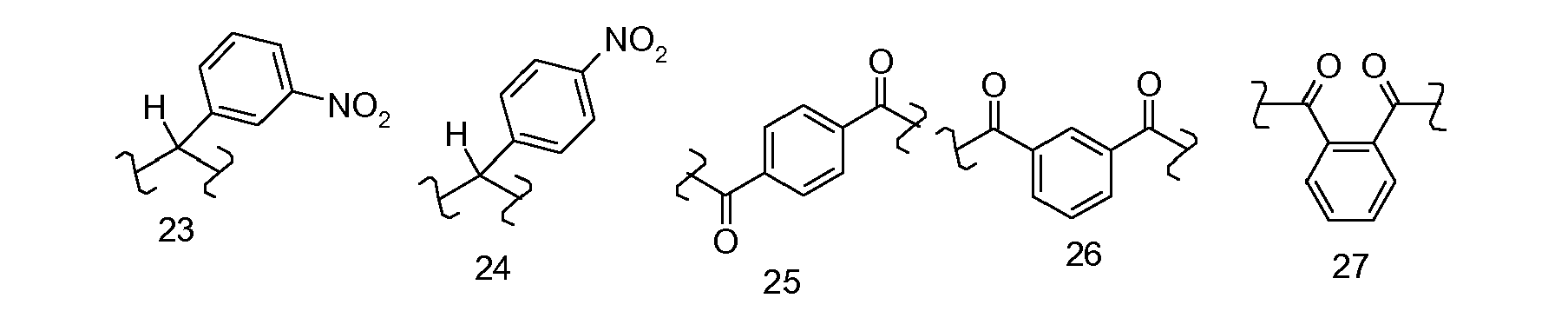


- Auch die dargestellten Strukturelemente 1 bis 44 können jeweils die wie vorstehend bezeichneten Substituenten tragen und gegebenenfalls weitere, normalerweise 1 oder 2 ethylenische Doppelbindungen aufweisen.
- Das Strukturelement A kann auch für einen Arylrest mit 6 bis 15, bevorzugt 6 bis 10 Kohlenstoffatomen, speziell einen Phenylen-, Naphthylen- oder Anthracenylenrest stehen oder für einen wie vorstehend definierten Heteroarylrest mit 2 bis 15, bevorzugt 3 bis 10 Kohlenstoffatomen stehen.
- Die genannten Aryl- bzw. Heteroarylreste können gegebenenfalls jeweils 1 bis 5 Substituenten tragen, die ausgewählt sind aus der Gruppe der wie vorstehend beschriebenen Substituenten C1- bis C6-Alkyl, C1- bis C6-Perfluoralkyl, C1- bis C6-Alkoxy, C7- bis C12-Aralkyl, Halogen, -SiR5dR6d, R7d, substituiertes oder unsubstituiertes C6- bis C10-Aryl, -NR8dR9d, SR10d und NO2.
- Des weiteren kann das Strukturelement A auch für eine funktionelle Gruppe oder ein Heteroatom stehen, die ausgewählt sind aus der Gruppe -O-, -S-, -N(R11)-, -S(O)-, - C(O)-, -S(O)2-, -P(R11)-, -(R11)P(O)-, -OP(O)O-, -OP(O)2O- und -Si(R12)(R13)-, wobei die Reste R11, R12, R13 unabhängig voneinander jeweils für wie vorstehend beschriebenes C1- bis C6-Alkyl, C7- bis C12-Aralkyl und/oder substituiertes oder unsubstituiertes C6- bis C10-Aryl stehen. Im Rahmen dieser Gruppe steht das Strukturelement A bevorzugt für-O-, -S-, -S(O)-, S(O)2- oder -Si(R12)(R13)-.
- Im Rahmen der vorliegenden Erfindung bevorzugte Diarylphenoxy-Aluminium-Verbindungen sind solche, die erhältlich sind durch Umsetzung von Bis(diarylphenol)-Liganden der Formel (la)

- Die Liganden der Formel (la) weisen ebenfalls zwei Phenolsysteme auf, die jeweils in beiden ortho-Positionen zur phenolischen Hydroxy-Gruppe durch Aromaten bzw. Heteroaromaten (Ar1 bis Ar4) substituiert sind und über ein Strukturelement A miteinander verknüpft sind und gegebenenfalls noch weitere Substituenten (R1 bis R4) tragen können, wobei das Strukturelement A jeweils in para-Position zur phenolischen Hydroxy-Gruppe mit den beiden Phenolsystemen verknüpft ist. Dabei können den Resten Ar1, Ar2, Ar3, Ar4, den Resten R1, R2, R3, R4 und dem Strukturelement A die gleichen Bedeutungen zukommen wie vorstehend für Formel (I) genannt.
- Insbesondere bevorzugte Liganden sind erfindungsgemäß solche, bei denen die Arylreste Ar1, Ar2, Ar3 und Ar4 gleich sind und die vorstehend für Formel (I) angegebenen bevorzugten Bedeutungen besitzen. Insbesondere bevorzugt als Arylreste Ar1 bis Ar4 sind Phenyl, Naphthyl, 4-Fluorphenyl, 4-Chlorphenyl, 3-Chlorphenyl, 3,5-Dichlorphenyl, 4-Methylphenyl, 3-Trifluormethylphenyl, 4-Trifluormethylphenyl, ganz besonders bevorzugt Phenyl.
- Bei den erfindungsgemäß bevorzugten Liganden der Formel (la) sind die Reste R1, R2, R3, R4 gleich oder verschieden, bevorzugt gleich, und bedeuten vorzugsweise: Wasserstoff, Halogen, insbesondere Fluor oder Chlor, Methyl, Trifluormethyl, Isopropyl, tert-Butyl, Phenyl, Nitro.
- Dem Strukturelement A in Formel (la) kommen die vorstehend für Formel (I) genannten Bedeutungen zu. Bevorzugte Strukturelemente A in Formel (la) sind insbesondere auch die Strukturelemente 1 bis 44, die in der genannten Weise substituiert sein können.
- Insbesondere bevorzugte Liganden sind solche der Formeln (la1) bis (la3), wobei den genannten Resten Ar1 bis Ar4, R1 bis R4 und R15 bis R18 bevorzugt die tabellarisch beispielhaft aufgeführten Bedeutungen zukommen:

Tabelle 1: Verbindung Ar1 Ar2 Ar3 Ar4 R1 R2 R3 R4 R15 la1-1 Ph Ph Ph Ph H H H H H la1-2 Ph Ph Ph Ph H H H H CH3 la1-3 Ph Ph Ph Ph H H H H Ph la1-4 Ph Ph Ph Ph H H H H CF3 la1-5 Ph Ph Ph Ph H H H H CCl3 la1-6 Ph Ph Ph Ph H H H H 4-Cl-Ph la1-7 Ph Ph Ph Ph H H H H CH2CH3 la1-8 Ph Ph Ph Ph H H H H 3-NO2-Ph la1-9 Ph Ph Ph Ph H H H H 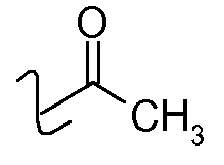

Tabelle 2: Verbindung Ar1 Ar2 Ar3 Ar4 R1 R2 R3 R4 R16 R17 la2-1 Ph Ph Ph Ph H H H H CF3 CF3 la2-2 Ph Ph Ph Ph H H H H CCl3 CCl3 la2-3 Ph Ph Ph Ph H H H H CH3 CF3 la2-4 Ph Ph Ph Ph H H H H CH3 CCl3 la2-5 Ph Ph Ph Ph H H H H CH2CH3 CF3 la2-6 Ph Ph Ph Ph H H H H CH3 CH3 la2-7 Ph Ph Ph Ph H H H H CH3 C(O)OCH3 la2-8 Ph Ph Ph Ph H H H H CH3 C(O)OC2H5 la2-9 Ph Ph Ph Ph H H H H -(CH2)3- la2-10 Ph Ph Ph Ph H H H H -(CH2)4- la2-11 Ph Ph Ph Ph H H H H -(CH2)5- 
Verbindung Ar1 Ar2 Ar3 Ar4 R1 R2 R3 R4 R18 la3-1 Ph Ph Ph Ph H H H H -(CH2)2- la3-2 Ph Ph Ph Ph H H H H 
la3-3 Ph Ph Ph Ph H H H H 
la3-4 Ph Ph Ph Ph H H H H 
la3-5 Ph Ph Ph Ph H H H H 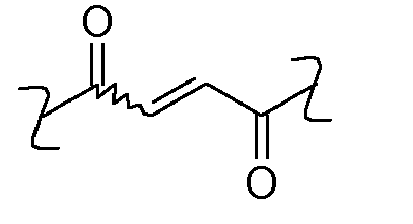
la3-6 Ph Ph Ph Ph H H H H 
la3-7 Ph Ph Ph Ph H H H H 
- Dabei bedeutet in den Tabellen 1-3 Ph einen Phenylrest und C(O) bedeutet wie im Rahmen der gesamten vorliegenden Erfindung eine Carbonylgruppe. Generell können die Reste R15, R16 und R17 unabhängig voneinander für wie vorstehend definiertes C1- bis C6-Alkyl, C1- bis C10-Acyl, C1- bis C10-Carboxyl oder C6- bis C10-Aryl stehen, wobei die genannten Reste einen oder mehrere gleiche oder verschiedene Halogen- und/oder NO2-Substituenten tragen können und wobei die Reste R16und R17 gemeinsam auch ein cyclisches Strukturelement, bevorzugt eine Alkylenbrücke bilden können.
- Die zur Herstellung der erfindungsgemäßen Diarylphenoxy-Aluminium-Verbindungen einsetzbaren Bis(diarylphenol)-Liganden der Formeln (I) bzw. (la) lassen sich durch dem Fachmann an sich bekannte Methoden leicht herstellen. Verbindungen des Strukturtyps (la1) erhält man beispielsweise durch Umsetzung der entsprechenden bis-ortho-Arylphenole mit einem Aldehyd R15CHO in Gegenwart einer Lewis-Säure, beispielsweise AlCl3, wie u.a. beschrieben von Z. Y. Wang, A. S. Hay in Synthesis 1989, 471-472 oder in der
US 3,739,035 . Liganden des Strukturtyps (la2) sind beispielsweise zugänglich durch Umsetzung der entsprechenden bis-ortho-Arylphenole mit einem geeigneten Keton der Formel R16C(O)R17, wie beispielsweise in derUS 3,739,035 beschrieben. Liganden des Strukturtyps (la3) sind beispielsweise zugänglich durch Friedel-Crafts Acylierung der entsprechenden Phenole oder O-geschützten Phenole mit Dicarbonsäurechloriden wie beispielsweise von F. F. Blicke et al. in J. Am. Chem. Soc. 1938, 60, 2283-2285; derCH 350461 DE-A 25 34 558 beschrieben oder mit Dihalogeniden, wie beispielsweise von J. Zavada, in Collect. Czech. Chem. Commun, 1976, 41, 1777-1790, beschrieben. - Die erfindungsgemäßen Diarylphenoxy-Aluminium-Verbindungen erhält man beispielsweise, indem man die vorstehend beschriebenen Bis(diarylphenol)-Liganden der Formeln (I) bzw. (la) mit einer Aluminium-Verbindung der Formel (II)
(R14)3-pAIHp (II),
umsetzt. Dabei steht R14 für einen verzweigten oder unverzweigten Alkylrest mit 1 bis 5 Kohlenstoffatomen wie beispielsweise Methyl, Ethyl, Propyl, Isopropyl, Butyl, Isobutyl, Pentyl, Isopentyl oder Neopentyl. Der Index p steht für 0 oder eine ganze Zahl von 1 bis 3. Bevorzugt steht der Index p für 1 oder 0, besonders bevorzugt für 0. Bevorzugte Verbindungen der Formel (II) sind beispielsweise Trimethylaluminium, Triethylaluminium, Diisobutylaluminiumhydrid, besonders bevorzugt Trimethylaluminium und Triethylaluminium. - Alternativ dazu erhält man die erfindungsgemäßen Diarylphenoxy-Aluminium-Verbindungen auch durch Umsetzung der wie vorstehend beschriebenen Bis(diarylphenol)-Liganden der Formeln (I) bzw. (la) mit einer Aluminium-Verbindung der Formel (III)
MAIH4 (III),
wobei M Lithium, Natrium oder Kalium bedeutet. Demzufolge eignen sich zur Herstellung der erfindungsgemäßen Diarylphenoxy-Aluminium-Verbindungen durch Umsetzung der wie vorstehend beschriebenen Bis(diarylphenol)-Liganden der Formeln (I) bzw. (la) auch Lithiumaluminiumhydrid, Natriumaluminiumhydrid und Kaliumaluminiumhydrid sowie Gemische derselben. Darüber hinaus sind auch Gemische der genannten Verbindungen der Formeln (II) und (III) zur Herstellung erfindungsgemäßen Diarylphenoxy-Aluminium-Verbindungen durch Umsetzung mit den wie vorstehend beschriebenen Bis(diarylphenol)-Liganden der Formeln (I) bzw. (la) geeignet. - Die Umsetzung wird vorteilhaft so durchgeführt, dass einer der wie vorstehend beschriebenen Bis(diarylphenol)-Liganden der Formeln (I) bzw. (la) mit einer Verbindung der Formel (II) oder (III) in Kontakt gebracht wird. Vorteilhaft führt man die Umsetzung in einem inerten organischen Lösungsmittel wie beispielsweise Toluol, Cyclohexan, Dichlormethan, Xylol, Ethylbenzol, Chlorbenzol, Tetrahydrofuran, Diethylether, Methyltert-Butylether, Essigsäureethylester, Pentan, Hexan, Dichlorethan, Dimethylformamid (DMF), Dimethylsulfoxid (DMSO) und dergleichen mehr durch, wobei der Einsatz vorgetrockneter bzw. wasserfreier Lösungsmittel als besonders vorteilhaft anzusehen ist. Üblicherweise erfolgt die Umsetzung bei Temperaturen im Bereich von etwa -100°C bis etwa 100°C, bevorzugt bei etwa -50°C bis etwa 50°C, besonders bevorzugt bei etwa -30°C bis etwa 30°C.
- Bei der Herstellung der erfindungsgemäßen Diarylphenoxy-Aluminium-Verbindungen reagieren die phenolischen Hydroxy-Gruppen der eingesetzten Bis(diarylphenol)-Liganden der Formeln (I) bzw. (la) mit der bzw. den Verbindungen der Formeln (II) und (III). Theoretisch kann jedes Aluminium-Atom mit 1 bis 3 phenolischen Hydroxy-Gruppen regieren. Aufgrund der sterischen Eigenschaften bzw. Anforderungen der eingesetzten Bis(diarylphenol)-Liganden der Formeln (I) bzw. (la) kann es dabei zur Ausbildung höhermolekularer Strukturen wie linearen Strukturen oder Netzwerken kommen.
- Vorteilhaft wählt man dabei das molare Verhältnis der eingesetzten Bis(diarylphenol)-Liganden der Formeln (I) bzw. (la) zu den eingesetzten Verbindungen der Formel (II) und/oder (III) so, dass die Menge an nicht abreagierten Verbindungen der Formeln (II) und/oder (III) möglichst gering ist. Vorzugsweise wählt man das genannte Verhältnis so, dass nach dem Inkontaktbringen der Bis(diarylphenol)-Liganden der Formeln (I) bzw. (la) mit der bzw. den Verbindungen der Formeln (II) und (III) keine nicht umgesetzte Verbindung der Formel (II) und/oder (III) mehr vorliegt. Unter Berücksichtigung des wirtschaftlichen Aspekts ist es empfehlenswert, den Überschuss der eingesetzten Liganden der Formeln (I) bzw. (la) gering zu halten. Besonders bevorzugt setzt man Bis(diarylphenol)-Liganden der Formeln (I) bzw. (la) und die Verbindungen der Formeln (II) und/oder (III) in einem molaren Verhältnis von etwa 4:1 bis etwa 1:1, ganz besonders bevorzugt von etwa 3:1 bis etwa 1,5:1 und am meisten bevorzugt im molaren Verhältnis von etwa 1,5:1 ein.
- Zur Herstellung der erfindungsgemäßen Diarylphenoxy-Aluminium-Verbindungen geht man im Rahmen einer bevorzugten Ausführungsform der vorliegenden Erfindung so vor, das man, je nach Löslichkeit, eine etwa 0,001 bis etwa 1 molare Lösung des gewählten Liganden der Formel (I) bzw. (la) in einem geeigneten organischen Lösungsmittel, beispielsweise Toluol, bei einer Temperatur von etwa -10 bis etwa 30°C vorlegt und eine Aluminiumverbindung der Formel (II) und/oder (III), vorzugsweise in Form einer Lösung, beispielsweise eine Lösung von Trimethyl- oder Triethylaluminium in Toluol, zugibt.
- Die Reaktion zwischen den eingesetzten Liganden der Formel (I) bzw. (la) und den Aluminiumverbindungen der Formeln (II) und/oder (III) erfolgt in der Regel rasch und ist meist, in Abhängigkeit von den gewählten Reaktionsbedingungen, nach etwa 10 min bis etwa 2 h, oft nach etwa 1 h abgeschlossen. Bei Einsatz reaktionsträgerer Reaktanten kann es vorteilhaft sein, die Temperatur des Reaktionsgemisches kurzzeitig zu erhöhen.
- In Abhängigkeit von den gewählten Reaktionsbedingungen, insbesondere im Hinblick auf die Löslichkeit der umzusetzenden Liganden der Formel (I) bzw. (la) und der Aluminiumverbindung der Formel (II) und/oder (III) in den gewählten Lösungsmitteln, den Konzentrationen sowie den Reaktionstemperaturen erhält man die erfindungsgemäßen Diarylphenoxy-Aluminium-Verbindungen in Form eines Feststoffes, einer Suspension oder einer Lösung im eingesetzten Lösungsmittel bzw. Lösungsmittelgemisch. Die so erhaltenen erfindungsgemäßen Diarylphenoxy-Aluminium-Verbindungen können in der jeweils erhaltenen Form weiterverwendet werden oder abgetrennt und von den eingesetzten Lösungsmittel befreit werden.
- Die Isolierung kann dabei nach dem Fachmann bekannten und vorteilhaft erscheinenden Methoden erfolgen. Vorzugsweise führt man die Isolierung, Lagerung bzw. Weiterbehandlung der erfindungsgemäßen Diarylphenoxy-Aluminium-Verbindungen unter weitgehendem Ausschluss von Sauerstoff und Feuchtigkeit durch.
- Die erfindungsgemäßen Diarylphenoxy-Aluminium-Verbindungen eignen sich in besonderem Maße als Katalysatoren zur Durchführung chemischer Reaktionen, speziell von Reaktionen bzw. Umsetzungen organischer Verbindungen. Ein weiterer Aspekt der vorliegenden Erfindung betrifft demnach die Verwendung der erfindungsgemäßen, durch Umsetzung der Bis(diarylphenol)-Liganden der Formeln (I) bzw. (la) mit den Verbindungen der Formels (II) und/oder (III) erhältlichen Diarylphenoxy-Aluminium-Verbindungen als Katalysatoren. Die erfindungsgemäßen Diarylphenoxy-Aluminium-Verbindungen eignen sich insbesondere als Katalysatoren zur Durchführung von Reaktionen, die durch Säuren oder Lewis-Säuren katalysiert werden können. Beispielhaft und ohne jeden einschränkenden Charakter seien dafür die folgenden Reaktionstypen angegeben: Umlagerungen, Isomerisierungen, Cyclisierungen, Eliminierungen, dearomatisierende nucleophile Funktionalisierung von aromatische Carbonylverbindungen, konjugierte Addition an α,β-ungesättigte Carbonylverbindungen, Diels-Alder-Reaktionen.
- Die genannten Reaktionen führt man vorteilhaft unter möglichst trockenen, aprotischen Bedingungen und unter möglichst weitgehendem Ausschluss von Sauerstoff durch.
- Nach erfolgter Umsetzung können die eingesetzten Diarylphenoxy-Aluminium-Verbindungen mit üblichen Trennverfahren (z. B. durch Filtration, Zentrifugation) zumindest teilweise aus der Reaktionsmischung isoliert und anschließend wieder eingesetzt werden. Alternativ lassen sich aber auch die Bis(diarylphenol)-Liganden der Formeln (I) bzw. (la) leicht aus dem rohen oder bereits aufgearbeiteten Reaktionsgemisch, gegebenenfalls auch nach Abtrennung von Reaktionsprodukten bzw. Nebenprodukten wiedergewinnen, da sie in der Regel vorteilhafte physikalische Eigenschaften wie beispielsweise eine gute Kristallisationsfähigkeit aufweisen.
- In besonderem Maße eignen sich die erfindungsgemäßen Diarylphenoxy-Aluminium-Verbindungen als Katalysatoren zur Durchführung intramolekularer Reaktionen, insbesondere zur Durchführung von Cyclisierungsreaktionen.
- Erfindungsgemäß insbesondere bevorzugt ist die Verwendung der erfindungsgemäßen Diarylphenoxy-Aluminium-Verbindungen als Katalysatoren zur Cyclisierung von racemischem oder nicht-racemischem Citronellal zu racemischem oder nicht-racemischem Isopulegol. Dabei sind erfindungsgemäß insbesondere die Diarylphenoxy-Aluminium-Verbindungen bevorzugt, die durch Umsetzung von Bis(diarylphenol)-Liganden der Formeln (la) mit einer Aluminium-Verbindung der Formel (II) und/oder (III) erhältlich sind. Ganz besonders bevorzugt ist die Verwendung von Diarylphenoxy-Aluminium-Verbindungen, die erhältlich sind durch Umsetzung von Bis(diarylphenol)-Liganden der Formeln (Ia1) bis (Ia3) als Katalysatoren zur Cyclisierung von Citronellal zu Isopulegol.
- Die vorliegende Erfindung betrifft demgemäss auch ein Verfahren zur Herstellung von Isopulegol der Formel (IV)
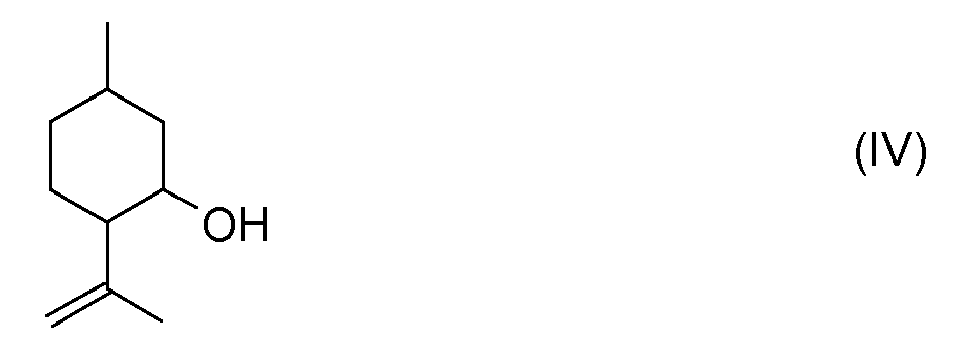


Ar1, Ar2, Ar3, Ar4, R1, R2, R3, R4 und A die vorstehend für Formel (I) angegebenen Bedeutungen besitzen
mit einer Aluminium-Verbindung der Formel (II)
(R14)3-pAIHp (II),
wobei - Al
- Aluminium bedeutet und
- R14
- einen verzweigten oder unverzweigten Alkylrest mit 1 bis 5 Kohlenstoffatomen und
- p
- 0 oder eine ganze Zahl von 1 bis 3 bedeutet,
- Al
- Aluminium bedeutet und
- M
- Lithium, Natrium oder Kalium bedeutet.
- Das Verfahren eignet sich auch zur Herstellung von optisch aktivem Isopulegol der Formel (IVa)


- Insbesondere bevorzugt eignet sich das erfindungsgemäße Verfahren zur Herstellung L-(-)-Isopulegeol durch Cyclisierung von D-(+)-Citronellal.
- Im Rahmen des erfindungsgemäßen Verfahrens bevorzugte Katalysatoren sind solche, die erhältlich sind durch Umsetzung von Bis(diarylphenol)-Liganden der Formel (la)

- Aus den genannten Liganden werden, wie vorstehend beschrieben, die erfindungsgemäßen Diarylphenoxy-Aluminium-Verbindungen durch Umsetzung mit einer Aluminium -Verbindung der Formel (II) und/oder (III), bevorzugt mit einer Aluminium-Verbindung der Formel (II) erhalten.
- Zur Durchführung des erfindungsgemäßen Verfahrens zur Herstellung von Isopulegol geht man vorteilhaft so vor, dass man zunächst eine Lösung der erfindungsgemäßen Diarylphenoxy-Aluminium-Verbindungen in einem geeigneten Lösungsmittel wie vorstehend beschrieben bereitstellt. Dieser Lösung setzt man dann erfindungsgemäß das zu cyclisierende racemische oder nicht-racemische Citronellal zu. Das Citronellal kann dabei als solches oder in Form einer Lösung, vorteilhaft in einem der vorstehend genannten geeigneten Lösungsmittel zugegeben werden. Im Rahmen einer bevorzugten Ausführungsform des erfindungsgemäßen Verfahrens bereitet man zunächst eine Lösung des gewählten Liganden der Formeln (I) bzw. (la) in Toluol und setzt dann, vorteilhaft unter Rühren, die gewählte Aluminium-Verbindung der Formel (II) und/oder (III), bevorzugt Trimethyl- oder Triethylaluminium in toluolischer Lösung zu.
- Als Ausgangsstoff zur Durchführung des erfindungsgemäßen Cyclisierungsverfahrens eignet sich Citronellal, das nach jedwedem Verfahren hergestellt sein kann. Bevorzugt setzt man Citronellal ein, das eine Reinheit von etwa 90 bis etwa 99,9 Gew.-%, besonders bevorzugt von etwa 95 bis etwa 99,9 Gew.-% aufweist.
- Die Zugabe des zu cyclisierenden Citronellals erfolgt vorteilhaft bei Temperaturen im Bereich von etwa - 40°C bis etwa 40°C, bevorzugt im Bereich von etwa -20°C bis etwa 20°C. Dazu wird vorteilhaft die bereitete Lösung der erfindungsgemäßen Diarylphenoxy-Aluminium-Verbindung auf eine Temperatur in diesem Bereich, z.B. auf eine Temperatur im Bereich von -10°C bis 10°C abgekühlt und vorgekühltes Citronellal bzw. eine vorgekühlte Lösung von Citronellal zugegeben.
- Die Zugabe des Citronellals bzw. der Lösung davon kann so vorgenommen werden, dass man entweder die gesamte Menge auf einmal zusetzt oder sie portionsweise oder auch kontinuierlich zur bereiteten Katalysatorlösung gibt. Als Lösungsmittel eignen sich wiederum die vorstehend genannten Lösungsmittel, insbesondere Toluol. Bevorzugt setzt man das zu cyclisierende Citronellal als solches, d.h. ohne weitern Zusatz von Lösungsmitteln ein. Bei Einsatz eines Lösungsmittels wird die gesamte Lösungsmittelmenge (für Katalysatorherstellung und zur Durchführung der Cyclisierungsreaktion) vorteilhaft so gewählt, dass das volumenbezogene Verhältnis von umzusetzendem Citronellal zum Lösungsmittel etwa 2:1 bis etwa 1:20, bevorzugt von etwa 1,5:1 bis etwa 1:10 beträgt.
- Das Mengenverhältnis zwischen dem umzusetzendem Citronellal und der eingesetzten Menge der erfindungsgemäßen Diarylphenoxy-Aluminium-Verbindung wird durch die Menge der zur Herstellung derselben eingesetzten Verbindungen der Formel (I) bzw. (la) und der Formel (II) und/oder (III), also durch das Mengenverhältnis von eingesetztem Ligand zu eingesetzter Aluminium-Verbindung der Formel (II) und/oder (III) bestimmt.
- Erfindungsgemäß wählt man die Menge von umzusetzendem Citronellal zur eingesetzten Menge an Aluminium-Verbindung der Formel (II) und/oder (III) so, dass das molare Verhältnis etwa 5:1 bis etwa 1000:1, bevorzugt etwa 10:1 bis etwa 500:1, besonders bevorzugt etwa 50:1 bis etwa 200:1 beträgt.
- Unabhängig davon kann das Verhältnis zwischen eingesetztem Ligand der Formel (1) bzw. (la) und der eingesetzten Aluminium-Verbindung der Formel (II) und/oder (III) in den vorstehend zur Herstellung der erfindungsgemäßen Diarylphenoxy-Aluminium-Verbindung genannten Grenzen variiert werden.
- Die erfindungsgemäße Cyclisierung von Citronallal zu Isopulegol erfolgt je nach Wahl der Reaktionspartner und Reaktionsbedingungen in der Regel rasch und ist üblicherweise nach etwa 0,5 bis etwa 10 h, oft nach etwa 5 h weitgehend abgeschlossen. Der Reaktionsfortschritt kann durch dem Fachmann an sich bekannte Methoden, beispielsweise durch chromatographische, speziell gaschromatographische Methoden oder auch HPLC-Methoden leicht verfolgt werden.
- Unter Einsatz bestimmter Citronellal-Qualitäten (z.B bei vorhandenen Verunreinigungen des Citronellals mit Citronellol) bei der Herstellung von Isopulegol durch Cyclisierung von Citronellal in Gegenwart der vorstehend beschriebenen Diarylphenoxy-Aluminium-Verbindungen wurde gelegentlich beobachtet, dass dabei, insbesondere bei Umsetzungen im technischen Maßstab, eine unerwünschte Nebenreaktion in störendem Ausmaß stattfinden kann: Dabei handelt es sich um die Bildung von Citronellsäurecitronellylester der Formel (XII)

- Im Rahmen einer bevorzugten Ausführungsform des erfindungsgemäßen Verfahrens führt man die Cyclisierung von Citronellal zu Isopulegol in Gegenwart einer Säure, vorzugsweise einer organischen Säure durch. Beispielhaft seien als vorteilhaft einsetzbare organische Säuren genannt: Essigsäure, Propionsäure, Benzoesäure, Toluolsulfonsäure, Methansulfonsäure bevorzugt Essigsäure. Die genannten Säuren werden vorteilhaft in einer Menge von etwa 0,5 bis etwa 10 Gew.-%, bezogen auf die Menge an umzusetzendem Citronellal eingesetzt. Vorteilhaft werden sie zusammen mit dem Citronellal, z.B. in Form eines Gemisches dem Reaktionsgemisch zugesetzt.
- In einer besonders bevorzugten Ausführungsform führt man das erfindungsgemäße Verfahren zur Herstellung von Isopulegol durch Cyclisierung von Citronellal in Gegenwart mindestens einer Verbindung durch, die ausgewählt ist aus der Gruppe der Carbonsäureanhydride, Aldehyde, Ketone und Vinylether.
- Die Verbindungen der genannten Substanzklassen können jeweils einzeln oder in Form von Gemischen untereinander eingesetzt werden. Bevorzugt setzt man im Fall von Gemischen solche ein, die aus Verbindungen einer Substanzklasse bestehen. Besonders bevorzugt setzt man einzelne Verbindungen ein. Unter wie nachfolgend beschriebenem Einsatz der genannten Verbindungen gelingt es in der Regel, die Bildung des unerwünschten Nebenprodukts der Formel (XII) weitgehend zu unterdrücken.
- Im Rahmen einer bevorzugten Ausführungsform führt man das erfindungsgemäße Cyclisierungsverfahren in Gegenwart eines Carbonsäureanhydrids der Formel (Vl)

- Im Rahmen einer weiteren bevorzugten Ausführungsform führt man das erfindungsgemäße Cyclisierungsverfahren in Gegenwart eines Aldehyds der Formel (VII)

- Im Rahmen einer weiteren bevorzugten Ausführungsform führt man das erfindungsgemäße Cyclisierungsverfahren in Gegenwart eines Ketons der Formel (VIII)
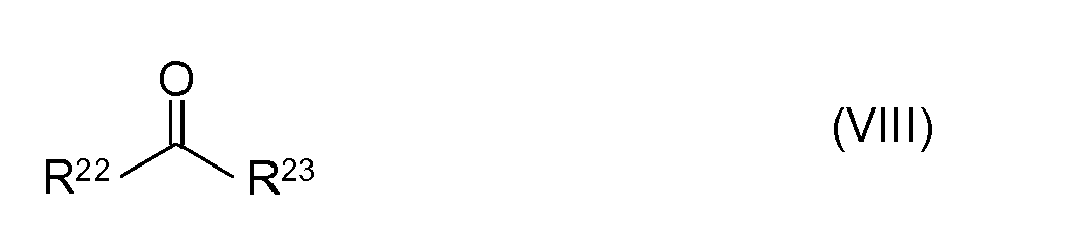
- Alternativ zu den genannten Carbonylverbindungen lassen sich auch Vinylether der allgemeinenen Formel (IX)

- im Rahmen des erfindungsgemäßen Verfahrens einsetzen, wobei die Reste R24, R25, R26 und R27 unabhängig voneinander jeweils gleich oder verschieden sein können und einen verzweigten oder unverzweigten C1- bis C12- Alkylrest oder C7- bis C12-Aralkylrest oder einen C6- bis C10-Arylrest bedeuten, wobei die genannten Reste jeweils einen oder mehrere, bevorzugt 1 bis 3, gleiche oder verschiedene Substituenten, ausgewählt aus der Gruppe Oxo, OR10e, SR10f NR8eR9e und Halogen aufweisen können und wobei R25 und R26 gemeinsam auch einen 5- bis 8-gliedrigen Ring bilden können, der eine oder mehrere ethylenische Doppelbindungen und ein oder mehrere, üblicherweise 1 oder 2, gleiche oder verschiedene Heteroatome ausgewählt aus der Gruppe O, S, NR11b aufweisen kann und wobei R10e, R10f, R8e, R9e und R11b die vorstehend für R11 angegebenen Bedeutungen haben können.
- C1- bis C12- Alkyl steht dabei für wie vorstehend beschriebenes C1- bis C6-Alkyl und darüber hinaus beispielsweise für Heptyl, Octyl, Nonyl, Decyl, Undecyl oder Dodecyl. In den Fällen, in denen zwei Alkylreste gemeinsam einen Ring ausbilden, sind unter Alkylresten auch Alkylenylreste zu verstehen. C7- bis C12-Aralkylresten und C6- bis C10-Arylresten können beispielhaft die vorstehend genannten Bedeutungen zukommen. Beispielhaft seien als C1- bis C6-Alkoxycarbonylrest genannt: Methoxycarbonyl, Ethoxycarbonyl, Propoxycarbonyl und Isopropoxycarbonyl, bevorzugt Methoxycarbonyl und Ethoxycarbonyl.
- Im Rahmen einer bevorzugten Ausführungsform führt man das erfindungsgemäße Cyclisierungsverfahren in Gegenwart eines Carbonsäureanhydrids der Formel (VI) durch, wobei die Reste R20 und R20' gleich sind und einen verzweigten oder unverzweigten C1- bis C12- Alkylrest oder C7- bis C12-Aralkylrest oder einen C6- bis C10-Arylrest bedeuten, und wobei R20 und R20' gemeinsam auch einen 5- bis 8-gliedrigen Ring bilden können, der eine oder mehrere ethylenische Doppelbindungen und ein oder mehrere gleiche oder verschiedene Heteroatome ausgewählt aus der Gruppe OR10e, SR10f, NR11b aufweisen kann und R10e, R10f und R11b unabhängig voneinander die vorstehend für R11 angegebenen Bedeutungen haben kann.
- Insbesondere bevorzugt setzt man solche Carbonsäureanhydride ein, bei denen die Reste R20 und R20' gleich sind und einen verzweigten oder unverzweigten C1- bis C12-Alkylrest oder einen C6- bis C10-Arylrest bedeuten. Beispielhaft seien als erfindungsgemäß besonders bevorzugt einzusetzende Carbonsäureanhydride genannt: Essigsäureanhydrid, Propionsäurealdehyd, Pivalinsäureanhydrid und Benzoesäureanhydrid.
- Als erfindungsgemäß ebenfalls bevorzugt einsetzbare Aldehyde der Formel (VII) seien bespielhaft Acetaldeyhd, Propionaldehyd und Chloral (Trichloracetaldehyd) genannt.
- Führt man das erfindungsgemäße Cyclisierungsverfahren im Rahmen einer weiteren bevorzugten Ausführungsform in Gegenwart eines Ketons der Formel (VIII) durch, setzt man mit Vorteil solche mit einer aktivierten, d.h. elektronenarmen Carbonylfunktion ein. Beispielhaft seien die folgenden Ketone genannten, die sich in besonderem Maße zum Einsatz im Rahmen des erfindungsgemäßen Verfahren eigenen: 1,1,1-Trifluoraceton, 1,1,1-Trifluoracetophenon, Hexafluoraceton, Brenztraubensäuremethylester und Brenztraubensäureethylester.
- Als erfindungsgemäß ebenfalls bevorzugt einsetzbare Vinylether der Formel (IX) seien beispielhaft genannt: Methylvinylether, Ethylvinylether, Isobutylvinylether und 3,4-Dihydro-2H-pyran.
- Die genannten Verbindungsklassen können gleichermaßen mit gutem Erfolg im Rahmen dieser bevorzugten Ausführungsform des erfindungsgemäßen Verfahrens eingesetzt werden. Im Hinblick auf praktische Gesichtspunkte wie beispielsweise eine höhere Reaktionsgeschwindigkeit hat sich der Einsatz von Aldehyden und/oder elektronenarmen Ketonen als vorteilhaft erweisen.
- Die Menge an erfindungsgemäß einzusetzendem Carbonsäureanhydrid, Aldehyd, Keton und/oder Vinylether kann in breiten Grenzen variiert werden und richtet sich nach Art des eingesetzten Stoffes und dem Reinheitsgrad bzw. dem Vorhandensein noch nicht näher identifizierter Verunreinigungen. Üblicherweise setzt man die genannten Verbindungen bzw. deren Gemische in einer Menge von etwa 0,01 mol-% bis etwa 5 mol-%, bevorzugt von etwa 0,1 mol-% bis etwa 2 mol-% bezogen auf die eingesetzte Menge an Citronellal ein.
- An die Art und Weise der Reaktionsführung, beispielsweise die Ausgestaltung von Reaktoren oder die Reihenfolge der Zugabe einzelner Reaktionspartner sind keine besonderen Anforderungen zu stellen, solange eine Reaktionsführung unter weitgehendem Ausschluss von Sauerstoff und Wasser gewährleistet ist.
- Zur Durchführung des erfindungsgemäßen Verfahrens im Rahmen dieser bevorzugten Ausführungsform geht man vorteilhaft so vor, dass man zunächst eine Lösung der erfindungsgemäß einzusetzenden Diarylphenoxy-Aluminium-Verbindung in einem geeigneten Lösungsmittel wie vorstehend beschrieben bereitstellt. Dieser Lösung setzt man dann erfindungsgemäß bevorzugt ein Gemisch des zu cyclisierenden racemischen oder nicht-racemischen Citronellals mit dem gewählten Carbonsäureanhydrid, dem Aldehyd, dem aktivierten Keton und/oder dem Vinylether zu. Alternativ dazu kann man beispielsweise auch die Lösung der erfindungsgemäß einzusetzenden Diarylphenoxy-Aluminium-Verbindung zunächst mit dem gegebenfalls jeweils gewählten Carbonsäureanhydrid, dem Aldehyd, dem Keton und/oder dem Vinylether versetzen und im Anschluss daran das zu cyclisierende Citronellal zugeben.
- Es sich als vorteilhaft erwiesen, das Citronellal bzw. das Gemisch von Citronellal mit der gewählten Verbindung innerhalb eines Zeitraums von etwa 30 min bis etwa 6 h, bevorzugt innerhalb von etwa 2 h bis etwa 4 h zur Katalysatorlösung bzw. dem Reaktionsgemisch zuzudosieren. Das Citronellal kann dabei als solches oder in Form einer Lösung, vorteilhaft in einem der vorstehend genannten geeigneten Lösungsmittel zugegeben werden. Im Rahmen einer wiederum bevorzugten Ausführungsform des erfindungsgemäßen Verfahrens bereitet man zunächst eine Lösung des gewählten Liganden der Formeln (I) bzw. (la) in Toluol und setzt dann, zweckmäßigerweise unter Rühren, die gewählte Aluminium-Verbindung der Formel (II) und/oder (III), bevorzugt Trimethyl- oder Triethylaluminium in toluolischer Lösung zu.
- Die Zugabe des zu cyclisierenden Citronellals bzw. des Gemischs von Citronellal mit dem gewählten Carbonsäureanhydrid, Aldehyd, aktivierten Keton und/oder dem Vinylether erfolgt im Rahmen dieser Ausführungsform vorteilhaft bei Temperaturen im Bereich von etwa -40°C bis etwa 40°C, bevorzugt im Bereich von etwa -20°C bis etwa 20°C. Dazu wird vorteilhaft die bereitete Lösung oder Suspension der erfindungsgemäßen Diarylphenoxy-Aluminium-Verbindung auf eine Temperatur in diesem Bereich, z.B. auf eine Temperatur im Bereich von -10°C bis 10°C abgekühlt und die weiteren Reaktanden in vorgekühlter Form zugegeben.
- Die Zugabe des Gemischs von Citronellals und der gewählten weiteren Verbindung kann so vorgenommen werden, dass man entweder die gesamte Menge Citronellal auf einmal zusetzt oder sie portionsweise oder auch kontinuierlich zur bereiteten Katalysatorlösung gibt. Als Lösungsmittel eignen sich wiederum bevorzugt die vorstehend genannten Lösungsmittel, insbesondere Toluol. Bevorzugt setzt man das zu cyclisierende Citronellal in Form eines Gemisches mit dem gewählten Carbonsäureanhydrid, Aldehyd, aktivierten Keton und/oder Vinylether ohne weiteren Zusatz von Lösungsmitteln ein. Bei Einsatz eines Lösungsmittels wählt man die gesamte Lösungsmittelmenge vorteilhaft so, dass das volumenbezogene Verhältnis von umzusetzendem Citronellal zum Lösungsmittel etwa 1:1 bis etwa 1:20, bevorzugt von etwa 1:1 bis etwa 1:10 beträgt.
- Es wurde gefunden, dass üblicherweise während der Reaktion ein Teil des Katalysatorkomplexes deaktiviert wird. Dies ist unter anderem auf Ligandenaustausch-Prozesse zwischen den jeweils eingesetzten Bis(diarylphenol)-Liganden der Formel der eingesetzten Diarylphenoxy-Aluminium-Verbindungen und dem durch Cyclisierung entstehenden Isopulegol zurückzuführen. Die deaktivierte Form des Katalysators ist, in Abhängigkeit von der Wahl der eingesetzten Lösemittel, üblicherweise im Gegensatz zum aktiven polymeren Katalysator in der Reaktionsmischung löslich.
- In einer bevorzugten Ausführungsform kann durch einfache physikalische Trennmethoden (z.B. durch Abfiltration oder Zentrifugation des noch aktiven Katalysators) der deaktiverte Teil des Katalysators zusammen mit der übrigen Reaktionsmischung abgetrennt werden. Der zurückgehaltene, immer noch aktive Teil des Katalysators kann gewünschtenfalls mit frischem Katalysator ergänzt werden und ohne nennenswerten Aktivitätsverlust wieder eingesetzt werden, vorzugsweise im Rahmen einer weiteren erfindungsgemäßen Cyclisierungsreaktion von Citronellal zu Isopulegol.
- Alternativ kann die eingesetzte Katalysatormenge so gewählt werden, dass der gesamte eingesetzte Katalysatorkomplex im Laufe bzw. nach Beendigung der erfindungsgemäßen Cyclisierungsreaktion deaktiviert und somit löslich ist, wasan einer klaren Reaktionsmischung zu erkennen ist. Dabei macht sich vorteilhaft bemerkbar, das in diesem Falle aufgrund der vorstehend beschriebenen Ligandenaustausch-Prozesse der jeweils eingesetzte Bis-(diarylphenoxy)-Ligand der Formel (I) ohne gesondert durchzuführende Hydrolyse freigesetzt wird.
- Es wurde darüber hinaus gefunden, dass nach der destillativen Entfernung des jeweils eingesetzten Lösungsmittels, bevorzugt des Toluols, sowie der gegebenenfalls eingestzten weiteren Verbindung das Cyclisierungsprodukt Isopulegol ohne vorherige Hydrolyse der jeweils eingesetzten Diarylphenoxy-Aluminium-Verbindugen in hohen Reinheiten aus der Reaktionsmischung abdestilliert werden kann. Dabei bilden sich auch im Destillationssumpf in der Regel keine erkennbaren unerwünschten oder störenden Nebenprodukte. Bei Zugabe eines geeigneten, inerten hochsiedenden Lösungsmittels, d.h. vorzugsweise eines Lösungsmittels, das einen höheren Siedepunkt als Isopulegol aufweist, wie beispielsweise 1-Methylnaphthalin, 1-Decanol, Tridecan, 1,2-Propylencarbonat, Diethylenglycoldibutylether, Tetraethylenglycoldimethylether und Dibenzylether, vor der Destillation erhält man im Destilltionssumpf eine Lösung des freien Liganden in dem heißen, jeweils eingesetzten Hochsieder. Durch einfaches Abkühlen kann der Ligand aus dieser heißen Lösung auskristallisiert werden und durch Filtration in hoher Reinheit wiedergewonnen werden. Der so wiedergewonnene Bis-(diarylphenoxy)-Ligand kann, üblicherweise ohne weitere Aufreinigungsschritte, im Rahmen einer neuen Charge mit den entsprechenden Aluminiumverbindungen der Formeln (II) bzw. (III) zum reaktiven Katalysatorkomplex umgesetzt werden, wobei bei derartig wiederhergestellten Katalysatorkomplexen keine bzw. keine nennenswerte Abschwächung der Reaktivität festzustellen ist. Darüber hinaus lassen sich aus der als Rückstand der vorstehend beschriebenen gewonnenen Mutterlauge nach Hydrolyse weitere Mengen an Isopulegol und dem jeweils eingesetzten Bis-(diarylphenoxy)-Ligand gewinnen. Im Rahmen dieser bevorzugten Ausführungsform umfasst das erfindungsgemäßen Cyclisierungsverfahren von Citronellal zu Isopulegol dementsprechend die folgenden Schritte:
- a) destillative Entfernung des gegebenenfalls eingesetzten Lösungsmittels sowie der gegebenenfalls eingesetzten weiteren Verbindung (d.h. dem Carbonsäureanhydrid, Aldehyde, Ketone und/oder Vinylether) aus dem gemäß dem vorstehend beschriebenen Verfahren erhaltenen Produktgemisch,
- b) Zusatz eines hochsiedenden Lösungsmittels zu dem in Schritt a) erhaltenen Rückstand,
- c) destillative Abtrennung des Isopulegols aus dem in Schritt b) erhaltenen Gemisch und
- d) Abkühlen des in Schritt c) erhaltenen Destillationssumpfes unter Kristallisation des eingesetzten Bis(diarylphenol)-Liganden der Formel (I).
- Die erfindungsgemäße Cyclisierungsreaktion läßt sich nach Erreichen des gewünschten Reaktionsfortschritts auch in üblicher Weise, beispielsweise durch Zusatz eines wässrigen Reagenzes, etwa einer wässrigen Lauge wie beispielsweise Natrium- oder Kalilauge oder beispielsweise auch durch Zusatz von Wasser abbrechen. Die Aufarbeitung bzw. Isolierung kann dann in dem Fachmann an sich bekannter Weise durchgeführt werden.
- Der gegebenenfalls eingesetzte Zusatzstoff, d.h. das eingesetzte Carbonsäureanhydrid, Keton bzw. der eingesetzte Aldehyd oder Vinylether kann abhängig von seinen physikalischen Eigenschaften (z.B. dem Siedepunkt) z.B. durch Destillation aus der ausreagierten Mischung weitgehend und in dem Maße, indem er nicht gegebenenfalls selbst umgesetzt wurde, zurückgewonnen werden.
- Im Rahmen des erfindungsgemäßen Verfahrens erhält man Isopulegol üblicherweise in Form eines Gemisches der diastereiomeren Formen des Isopulegols: Isopulegol der Formel (XIII), neo-Isopulegol der Formel (XIV), neo-iso-Isopulegol der Formel (XV) und iso-Isopulegol der Formel (XVI).

- Erfindungsgemäß bevorzugt sind Ausführungsformen des erfindungsgemäßen Verfahrens, bei denen ein Diastereomerengemisch des Isopulegols anfällt, das zu mindestens etwa 85%, bevorzugt zu mindestens etwa 90% und besonders bevorzugt zu mindestens etwa 95% und ganz besonders bevorzugt zu mindestens etwa 98% aus dem Hauptdiastereomeren Isolpulegol der Formel (XII) bzw. der Formel (IVa) selbst besteht.
- Das erfindungsgemäße Verfahren eignet sich, wie bereits erwähnt, in gleichem Maße zur Cyclisierung von racemischem wie auch nicht-racemischem, d.h. optisch aktivem Citronellal zu racemischem wie nicht-racemischem Isopulegol. In einer bevorzugten Ausführungsform dient das erfindungsgemäße Verfahren zur Herstellung von L-(-)-Isopulegeol durch Cyclisierung von D-(+)-Citronellal.
- Das so hergestellte racemische bzw. nicht-racemische Isopulegol stellt ein wertvolles Intermediat zur Herstellung von racemischem bzw. nicht-racemischem Menthol, einem der weltweit bedeutensten Riech- bzw. Aromastoffe dar. Menthol kann durch dem Fachmann an sich bekannte Methoden der Hydrierung, speziell der katalytischen Hydrierung an geeigneten Übergangsmetallkatalysatoren, wie beispielsweise in Pickard et al., J. Chem. Soc. 1920, 1253; Ohloff et al., Chem. Ber. 1962, 95, 1400; Pavia et al., Bull. Soc. Chim. Fr. 1981, 24, Otsuka et al., Synthesis 1991, 665 oder in der
EP 1 053 974 A beschrieben, aus Isopulegol erhalten werden. Dabei bleibt bei geeigneter Wahl der Reaktionsbedingungen die relative bzw. absolute Konfiguration des eingesetzten Isopulegols weitgehend, in vielen Fällen vollständig erhalten. - Die vorliegende Erfindung betrifft daher auch ein Verfahren zur Herstellung von racemischem oder nicht-racemischem Menthol, ausgehend von nach dem vorstehend beschriebenen Verfahren hergestelltem racemischem oder nicht-racemischem Isopulegol und anschließender Hydrierung dessen ethylenischer Doppelbindung. Insbesondere betrifft die vorliegende Erfindung ein Verfahren zur Herstellung von L-(-)-Menthol ausgehend von nach dem vorstehend beschriebenen Verfahren durch erfindungsgemäße Cyclisierung von D-(+)-Citronellal hergestelltem L-(-)-Isopulegol.
- Die folgenden Beispiele dienen der Veranschaulichung der Erfindung, ohne sie in irgend einer Weise zu beschränken:
- Gaschromatographische Analysen wurden nach der folgenden Methode durchgeführt: 30 m DB-WAX, ID.: 0,32 mm, FD.: 0,25 µm; 80 - 230°C, 3°C/min; Rf (Citronellal): 10,5; Rf (neo-Isopulegol): 13,24; Rf (Isopulegol): 13,58; Rf (neoiso-Isopulegol): 14,64; Rf (iso-Isopulegol) 15,28; Rf (Citronellsäurecitronellylester): 39,80. Konzentrationen der erhaltenen Reaktionsprodukte in der Reaktionslösung (jeweils in Gew.-%) wurden GCanalytisch mittels eines internen Standards ermittelt. Die zusätzlich angegebenen korrespondierenden Massenangaben (jeweils in g) wurden daraus rechnerisch extrapoliert und können daher leichte Abweichungen aufweisen. Diastereoselktivitäten wurden aus den jeweiligen GC-Flächen-% der vier Diastereomere ermittelt.
-

- In einen ausgeheizten Kolben gab man 1,05 mmol des Liganden la1-1 und 10 ml wasserfreies Toluol. Zu der klaren Lösung gab man bei Raumtemperatur 350 µl (0.66 mmol, 1 mol-%) einer 25%igen Lösung von Triethylaluminium in Toluol. Die Lösung wurde für 1 h bei 25 °C gerührt. Nach wenigen Minuten erhielt man eine gelartige Suspension des Katalysators. Die Katalysator-Suspension wurde auf 0 °C gekühlt und es wurde ein Gemisch aus 10.15 g (65.8 mmol) auf 0°C vorgekühltem Citronellal und 1 Gew.-% (bezogen auf Citronellal) Essigsäureanhydrid über einen Zeitraum von 6 h zugegeben. Die Reaktionsmischung wurde gerührt und es wurden in regelmäßigen Abständen Proben genommen und mit 8 %-iger NaOH hydrolysiert. Hierbei fiel das enthaltene Aluminium als Hydroxid aus und man erhielt zunächst eine Suspension. Nach einiger Zeit entstanden zwei klare Phasen. Die organische Phase wurde gaschromatographisch analysiert. Die Ergebnisse sind in Tabelle 4 zusammengestellt:
Tabelle 4: Zeit in h Citronellal zugegeben in g Citronellal in Gew.-% Citronellal in g Isopulegol in Gew.-% Isopulegol in g Citronellol in Gew.-% Citronellol in g Ester* in Gew.-% Ester* in g 1 2,03 83,15 1,69 13,00 0,26 0,00 0,00 2 4,06 59,55 2,42 33,04 1,34 0,44 0,02 0,72 0,03 3 6,09 54,43 3,31 37,17 2,26 0,49 0,03 0,79 0,05 4 8,12 49,48 4,02 42,54 3,45 0,48 0,04 0,79 0,06 5 10,15 46,33 4,70 45,50 4,62 0,46 0,05 0,67 0,07 6 10,15 32,08 3,26 59,70 6,06 0,47 0,05 0,73 0,07 72 10,15 0,25 0,03 89,60 9,09 0,89 0,09 0,78 0,08 * Citronellsäurecitronellylester - Die Cyclisierungsreaktion ergab Isopulegol mit einer Selektivität von 90 % bezogen auf alle Isopulegol-Isomere. Die Diastereoselektivtät (neo-Isopulegol : Isopulegol : neoiso-Isopulegol : iso-Isopulegol) betrug 0,4 : 99,4 : 0,2 : 0,0.
-

-
Tabelle 5: Zeit in h Citronellal zugegeben in g Citronellal in Gew.-% Citronellal in g Isopulegol in Gew.-% Isopulegol in g Citronellol in Gew.-% Citronellol in g 2 16,92 26,54 4,49 63,00 10,66 1,63 0,28 3 25,38 24,23 6,15 65,87 16,72 1,53 0,39 4 33,83 19,14 6,48 72,54 24,54 1,40 0,47 5 42,29 17,66 7,47 74,80 31,63 1,20 0,51 6 50,75 19,73 10,01 73,22 37,16 1,04 0,53 7 50,75 11,97 6,07 80,51 40,86 1,02 0,52 24 50,75 1,24 0,63 90,11 45,73 0,96 0,49 - Nach 24 h Reaktionszeit war der Umsatz an Citronellal vollständig mit einer Selektivität von 90% bezüglich aller Isopulegol-Isomere.Die Diastereoselektivität (neo-Isopulegol : Isopulegol : neoiso-Isopulegol : iso-Isopulegol) betrug 0,6 : 99,0 :0,3 : 0,1.
-

- In einen ausgeheizten Kolben gab man 640 mg (1,0 mmol) des Liganden la2-1 und 10 ml wasserfreies Toluol. Zu der klaren Lösung gab man bei Raumtemperatur 350 µl (0,65 mmol, 1 mol-% bzgl. Citronellal) einer 0,66 M Lösung von Triethylaluminium in Toluol. Die Lösung wurde für 1 h bei 25 °C gerührt, nach wenigen Minuten erhielt man eine gelartige Suspension des Katalysators. Die Katalysator-Suspension wurde auf 0 °C gekühlt und es wurden 10,2 g (65,8 mmol) -15 °C kaltem Citronellal über einen Zeitraum von 6 h zugegeben. Die Reaktionsmischung wurde weitere 18 h bei 0 °C gerührt und es wurden in regelmäßigen Abständen Proben genommen und mit 8 %-iger NaOH hydrolysiert. Hierbei fiel das enthaltene Aluminium als Hydroxid aus und man erhielt zunächst eine Suspension. Nach einiger Zeit entstanden zwei klare Phasen. Die organische Phase wurde gaschromatographisch analysiert. Die Ergebnisse sind in Tabelle 6 zusammengestellt:
Tabelle 6: Zeit in h Citronellal zugegeben in g Citronellal in Gew.-% Citronellal in g lsopulegol in Gew.-% Isopulegol in g Citronellol in Gew.-% Citronellol in g Ester* in g/100 g per GC Ester* in g 2 3,38 6,01 0,75 17,34 2,17 0,23 0,00 -- -- 3 5,08 9,13 1,30 21,54 3,06 0,34 0,01 4 6,77 14,48 2,30 22,32 3,54 0,55 0,02 0,31 0,05 5 8,46 18,88 3,32 24,35 4,28 0,77 0,03 0,68 0,12 6 10,15 24,94 4,80 24,38 4,70 1,03 0,05 1,34 0,26 7 10,15 24,23 4,67 25,49 4,91 1,16 0,06 1,67 0,32 24 10,15 13,80 2,66 26,82 5,17 3,08 0,16 11,19 2,16 *Citronellsäurecitronellylester - Das Diastereomerenverhältnis (neo-Isopulegol : Isopulegol : neoiso-Isopulegol : iso-Isopulegol) betrug 1,6: 96,7 : 1,2 : 0,4.
- In einen ausgeheizten Kolben gab man 640 mg (1,0 mmol) des Liganden la2-1 und 10 ml wasserfreies Toluol. Zu der klaren Lösung gab man bei Raumtemperatur 350 µl (0,65 mmol, 1 mol-% bzgl. Citronellal) einer 0,66 M Lösung von Triethylaluminium in Toluol. Die Lösung wurde für 1 h bei 25 °C gerührt, nach wenigen Minuten erhielt man eine gelartige Suspension des Katalysators. Die Katalysator-Suspension wurde auf 0 °C gekühlt und es wurde ein Gemisch aus 10,2 g (65,8 mmol) -15 °C kaltem Citronellal und 0,1 g (1 Gew.-% bzgl. Citronellal) Essigsäureanhydrid über einen Zeitraum von 6 h zugegeben. Die Reaktionsmischung wurde weitere 18 h bei 0 °C gerührt und es wurden in regelmäßigen Abständen Proben genommen und mit 8 %-iger NaOH hydrolysiert. Hierbei fiel das enthaltene Aluminium als Hydroxid aus und man erhielt zunächst eine Suspension. Nach einiger Zeit entstanden zwei klare Phasen. Die organische Phase wurde gaschromatographisch analysiert. Die Ergebnisse sind in Tabelle 7 zusammengestellt:
Tabelle 7: Zeit in h Citronellal zugegeben in g Citronellal in g/100 g Citronellal in g Isopulegol in g/100 g Isopulegol in g Citronellol g/100 g Citronellol in g Ester* in g/100 g Ester* in g 2 3,38 11,76 1,47 22,32 2,79 0,00 0,00 0,00 0,00 3 5,08 12,34 1,75 28,08 3,98 0,00 0,00 0,00 0,00 4 6,77 14,61 2,32 27,54 4,37 0,00 0,00 0,00 0,00 5 8,46 18,78 3,30 32,93 5,79 0,00 0,00 0,00 0,00 6 10,15 22,01 4,24 32,98 6,35 0,00 0,00 0,00 0,00 7 10,15 16,11 3,10 40,16 7,73 0,00 0,00 0,00 0,00 24 10,15 2,11 0,41 51,56 9,93 0,09 0,02 0,00 0,00 *Citronellsäurecitronellylester - Das Diastereomerenverhältnis (neo-Isopulegol : Isopulegol : neoiso-Isopulegol : iso-Isopulegol) betrug 0,8 : 98,5 : 0,4: 0,3.
-

- 8,0 g (13,6 mmol) des Liganden la2-3 wurden bei Raumtemperatur unter Argon in 140 ml Toluol gelöst. 4,78 ml (9,09 mmol) einer 25%-igen Triethylaluminium-Lösung in Toluol wurde zugeben, man ließ 1 h nachrühren. Die entstandene Katalysator-Suspension wurde auf 0°C abgekühlt und man gab innerhalb von in 5 h ein Gemisch von 70,0 g (0,45 mol) Citronellal und 0,7 g (6,86 mmol,1 Gew.-% bzgl. Citronellal) Essigsäureanhydrid zu. Es wurde 1 h bei 0°C und 12 h bei Raumtemperatur nachgerührt. Bei Versuchsende gab man 100 ml 8%-ige Natronlauge zu und trennte die Phasen. Man trocknete die organische Phase mit Natriumsulfat und entfernte das Lösungsmittel unter reduziertem Druck. Das Rohprodukt wurde bei 1 mbar über eine kurze Kolonne destilliert. Bei 58 °C Kopftemperatur erhielt man 68,4 g Isopulegol mit folgender Zusammensetzung (jeweils GC-Flächen -%): Isopulegol: 98,4%, neo-Isopulegol: 0,6%, neoiso-Isopulegol: 0,4%. Das entspricht einer chemischen Ausbeute von 97% bezogen auf alle Diastereomere und einer Diastereoselektivität von 99:1 (Isopulegol : andere Diastereomere).
- Der bei der abschließenden Destillation verbleibende Destillationssumpf war ein hellgelber Feststoff in einer Menge von 7,7g, der zu 95 Gew.-% aus dem eingesetzten Liganden der Formel la2-3 und zu 5 Gew,-% aus Isopulegol bestand.
- In einen ausgeheizten Kolben gab man 580 mg (1,0 mmol) des Liganden la2-3 und 20 ml wasserfreies Toluol. Zu der klaren Lösung gab man bei Raumtemperatur 350 µl (0,65 mmol, 1 mol-% bzgl. Citronellal) einer 0,66 M Lösung von Triethylaluminium in Toluol. Die Lösung wurde für 1 h bei 25 °C gerührt, nach wenigen Minuten erhielt man eine gelartige Suspension des Katalysators. Die Katalysator-Suspension wurde auf 0 °C gekühlt und es wurden10,2 g (65,8 mmol) -15 °C kaltem Citronellal über einen Zeitraum von 3 h zugegeben. Die Reaktionsmischung wurde weitere 4 h bei 0 °C gerührt und es wurden in regelmäßigen Abständen Proben genommen und mit 8 %-iger NaOH hydrolysiert. Hierbei fiel das enthaltene Aluminium als Hydroxid aus und man erhielt zunächst eine Suspension. Nach einiger Zeit entstanden zwei klare Phasen. Die organische Phase wurde gaschromatographisch analysiert. Die Ergebnisse sind in Tabelle 8 zusammengestellt:
Tabelle 8: Zeit in h Citronellal zugegeben in g Citronellal in Gew.-% Citronellal in g Isopulegol in Gew.-% Isopulegol in g Citronellol in Gew.-% Citronellol in g Ester in Gew% Ester* in g 1 2,54 8,40 1,74 7,13 1,48 0,08 0,02 0,34 0,07 2 5,08 10,43 2,43 13,77 3,21 0,16 0,04 0,65 0,15 3 7,61 11,85 3,06 21,54 5,56 0,23 0,06 0,64 0,17 4 10,15 16,99 4,82 24,55 6,96 0,24 0,07 0,51 0,14 5 10,15 10,66 3,02 31,15 8,83 0,32 0,09 0,57 0,16 6 10,15 4,73 1,34 36,26 10,28 0,40 0,11 0,62 0,18 7 10,15 2,92 0,83 38,30 10,86 0,39 0,11 0,63 0,18 *Citronellsäurecitronellylester - Das Diastereomerenverhältnis (neo-Isopulegol : Isopulegol : neoiso-Isopulegol : iso-Isopulegol) betrug 0,4 : 99,0 : 0,5 : 0,1.
- Der Versuch wurde wie in Beispiel 6 wiederholt, nur dass dem Citronellal vor Zugabe 0,4 Gew.-% Acetaldehyd zugegeben wurden. Die Ergebnisse sind in Tabelle 9 zusammengestellt:
Tabelle 9: Zeit in h Citronellal zugegeben in g Citronellal in Gew.-% Citronellal in g Isopulegol in Gew.-% Isopulegol in g Citronellol in Gew.-% Citronellol in g Ester* in Gew% Ester* in g 1 2,54 10,27 2,13 6,56 1,36 0,10 0,02 0,35 0,07 2 5,08 12,53 2,92 13,73 3,20 0,13 0,03 0,28 0,07 3 7,61 13,51 3,49 20,45 5,28 0,15 0,04 0,27 0,07 4 10,15 12,34 3,50 26,87 7,62 0,26 0,07 0,28 0,08 5 10,15 6,84 1,94 32,05 9,09 0,30 0,09 0,31 0,09 6 10,15 3,45 0,98 35,33 10,02 0,33 0,09 0,31 0,09 7 10,15 1,62 0,46 36,88 10,46 0,36 0,10 0,32 0,09 *Citronellsäurecitronellylester - Das Diastereomerenverhältnis (neo-Isopulegol : Isopulegol : neoiso-Isopulegol : iso-Isopulegol) betrug 0,4 : 99,1 : 0,5 : 0,0.
- Der Versuch wurde wie in Beispiel 6 wiederholt, nur dass dem Citronellal vor Zugabe 1,3 Gew.-% Nitrobenzaldehyd zugegeben wurden. Die Ergebnisse sind in Tabelle 10 zusammengestellt:
Tabelle 10: Zeit in h Citronellal zugegeben in g Citronellal in Gew.-% Citronellal in g Isopulegol in Gew.-% Isopulegol in g Citronellol in Gew.-% Citronellol in g Ester* in Gew% Ester* in g 1 2,54 7,48 1,55 7,17 1,49 0,16 0,03 0,96 0,20 2 5,08 9,14 2,13 13,26 3,09 0,17 0,04 0,61 0,14 3 7,61 10,09 2,60 21,11 5,45 0,21 0,05 0,48 0,12 4 10,15 11,32 3,21 27,72 7,86 0,25 0,07 0,38 0,11 5 10,15 6,54 1,85 32,78 9,29 0,27 0,08 0,40 0,11 6 10,15 2,35 0,67 36,54 10,36 0,31 0,09 0,42 0,12 7 10,15 1,30 0,37 37,55 10,65 0,31 0,09 0,42 0,12 *Citronellsäurecitronellylester - Das Diastereomerenverhältnis (neo-Isopulegol : Isopulegol : neoiso-Isopulegol : iso-Isopulegol) betrug 0,4 : 99,2 : 0,4 : 0,0.
- Der Versuch wurde wie in Beispiel 6 wiederholt, nur dass dem Citronellal vor Zugabe 1,3 Gew.-% wasserfreies Chloral zugegeben wurden. Die Ergebnisse sind in Tabelle 11 zusammengestellt:
Tabelle 11: Zeit in h Citronellal zugegeben in g Citronellal in Gew.-% Citronellal in g Isopulegol in Gew.-% Isopulegol in g Citronellol in Gew.-% Citronelol in g Ester* in Gew.-% Ester* in g 1 2,54 4,49 0,93 9,85 2,04 0,00 0,00 0,00 0,00 2 5,08 5,09 1,18 17,69 4,12 0,00 0,00 0,00 0,00 3 7,61 6,05 1,56 26,45 6,83 0,00 0,00 0,00 0,00 4 10,15 8,02 2,27 31,63 8,97 0,00 0,00 0,00 0,00 5 10,15 3,00 0,85 37,38 10,60 0,00 0,00 0,00 0,00 6 10,15 1,22 0,35 39,17 11,10 0,00 0,00 0,00 0,00 7 10,15 0,56 0,16 39,63 11,24 0,00 0,00 0,00 0,00 *Citronellsäurecitronellylester - Das Diastereomerenverhältnis (neo-Isopulegol : Isopulegol : neoiso-Isopulegol : iso-Isopulegol) betrug 0,5 : 99,3 : 0,2 : 0,0.
- Der Versuch wurde wie in Beispiel 6 wiederholt, nur dass dem Citronellal vor Zugabe 1,0 Gew.-% Brenztraubensäureethylester zugegeben wurden. Die Ergebnisse sind in Tabelle 12 zusammengestellt:
Tabelle 12: Zeit in h Citronellal zugegeben in g Citronellal in Gew.-% Citronellal in g Isopulegol in Gew.-% Isopulegol in g Citronellol in Gew.-% Citronellol in g Ester* in Gew.-% Ester* in g 1 2,54 8,84 1,83 6,51 1,35 0,00 0,00 0,00 0,00 2 5,08 14,47 3,37 9,28 2,16 0,00 0,00 0,00 0,00 3 7,61 18,07 4,66 13,77 3,55 0,00 0,00 0,00 0,00 4 10,15 18,98 5,38 19,69 5,58 0,00 0,00 0,00 0,00 5 10,15 13,94 3,95 25,09 7,11 0,00 0,00 0,00 0,00 6 10,15 9,93 2,82 28,64 8,12 0,00 0,00 0,00 0,00 7 10,15 7,14 2,02 31,27 8,87 0,00 0,00 0,00 0,00 *Citronellsäurecitronellylester - Das Diastereomerenverhältnis (neo-Isopulegol : Isopulegol : neoiso-Isopulegol : iso-Isopulegol) betrug 0,5 : 99,5 : 0,0 : 0,0.
- Der Versuch wurde wie in Beispiel 6 wiederholt, nur dass dem Citronellal vor Zugabe 1,0 Gew.-% 1,1,1-Trifluoraceton zugegeben wurden. Die Ergebnisse sind in Tabelle 13 zusammengestellt:
Tabelle 13: Zeit in h Citronellal zugegeben in g Citronellal in Gew.-% Citronellal in g Isopulegol in Gew.-% Isopulegol in g Citronellol in Gew.-% Citronellol in g Ester* in Gew.-% Ester* in g 1 2,54 8,95 1,86 5,46 1,13 0,09 0,02 0,00 0,00 2 5,08 11,27 2,62 12,43 2,89 0,14 0,03 0,37 0,09 3 7,61 12,73 3,29 20,60 5,32 0,16 0,04 0,31 0,08 4 10,15 11,93 3,38 28,31 8,03 0,17 0,05 0,24 0,07 5 10,15 4,26 1,21 35,89 10,17 0,20 0,06 0,25 0,07 6 10,15 0,44 0,12 38,44 10,90 0,20 0,06 0,24 0,07 7 10,15 0,16 0,05 39,61 11,23 0,20 0,06 0,25 0,07 *Citronellsäurecitronellylester - Das Diastereomerenverhältnis (neo-Isopulegol : Isopulegol : neoiso-Isopulegol : iso-Isopulegol) betrug 0,8 : 98,9 : 0,3 : 0,0.
- Der Versuch wurde wie in Beispiel 6 mit einer Probe von durch Hydrierung hergestelltem Roh-Citronellal (mit erhöhtem Citronellol-Gehalt) wiederholt. Die Ergebnisse sind in Tabelle 14 zusammengestellt:
Tabelle 14: Zeit in h Citronellal zugegeben in g Citronellal in Gew.-% Citronellal in g Isopulegol in Gew.-% Isopulegol in g Citronellol in Gew.-% Citronellol in g Ester* in Gew.-% Ester* in g 1 2,54 11,48 2,38 2,94 0,61 0,32 0,07 6,86 1,42 2 5,08 17,03 3,96 6,40 1,49 0,53 0,12 6,72 1,56 3 7,61 17,42 4,50 11,33 2,92 1,06 0,27 9,93 2,56 4 10,15 9,99 2,83 13,72 3,89 2,17 0,62 20,52 5,82 5 10,15 3,97 1,13 15,07 4,27 2,67 0,76 26,34 7,47 6 10,15 2,61 0,74 15,35 4,35 2,83 0,80 27,73 7,86 7 10,15 1,96 0,56 15,52 4,40 2,92 0,83 28,22 8,00 *Citronellsäurecitronellylester - Das Diastereomerenverhältnis (neo-Isopulegol : Isopulegol : neoiso-Isopulegol : iso-Isopulegol) betrug 0,5 : 99,5 : 0,0 : 0,0.
- Der Versuch wurde wie in Beispiel 12 wiederholt, nur dass dem Citronellal vor Zugabe 1,0 Gew.-% 1,1,1-Trifluoraceton zugegeben wurden. Die Ergebnisse sind in Tabelle 15 zusammengestellt:
Tabelle 15: Zeit in h Citronellal zugegeben in g Citronellal in Gew.-% Citronellal in g Isopulegol in Gew.-% Isopulegol in g Citronellol in Gew.-% Citronelol in g Ester* in Gew% Ester* in g 1 2,54 6,20 1,29 7,10 1,47 0,18 0,04 0,1 0,021 2 5,08 9,83 2,29 13,71 3,19 0,08 0,02 0,11 0,026 3 7,61 11,18 2,89 21,55 5,56 0,09 0,02 0,15 0,039 4 10,15 11,33 3,21 28,61 8,11 0,10 0,03 0,17 0,048 5 10,15 3,26 0,92 37,46 10,62 0,10 0,03 0,19 0,054 6 10,15 0,85 0,24 39,48 11,19 0,10 0,03 0,20 0,057 7 10,15 0,17 0,05 40,00 11,34 0,09 0,03 0,19 0,054 *Citronellsäurecitronellylester - Das Diastereomerenverhältnis (neo-Isopulegol : Isopulegol : neoiso-Isopulegol : iso-Isopulegol) betrug 0,5 : 99,0 : 0,3 : 0,2.
- In einen ausgeheizten Kolben gab man 2,93 g (4,99 mmol) des Liganden la2-3 und 100 ml wasserfreies Toluol. Zu der klaren Lösung gab man bei Raumtemperatur 1,75 ml (3,33 mmol, 5 mol-% bzgl. Citronellal) einer 0,66 M Lösung von Triethylaluminium in Toluol. Die Lösung wurde für 1 h bei 25 °C gerührt, nach wenigen Minuten erhielt man eine gelartige Suspension des Katalysators. Die Katalysator-Suspension wurde auf 0 °C gekühlt und es wurden 10,2 g (65,8 mmol) -15 °C kaltes Citronellal über einen Zeitraum von 1 h zugegeben. Die Reaktionsmischung wurde eine weitere Stunde bei 0 °C gerührt. Die Reaktionsmischung wurde durch Filtration vom festen Katalysator getrennt. Das Filtrat wurde wie üblich aufgearbeitet, das Toluol wurde destillativ entfernt, und das erhaltene Rohprodukt wurde analysiert. Die Ergebnisse sind in Tabelle 16 zusammengestellt:
Tabelle 16: Citronellal zugegeben in g Citronellal in Gew.-% Citronellal in g Isopulegol in Gew.-% Isopulegol in g Citronellol in Gew.-% Citronellol in g 10,15 0,11 0,02 69,56 10,02 1,38 0,11 - Der abfiltrierte Katalysator wurde in weiteren 100 ml Toluol suspendiert. Die so entstandene Katalysator-Suspension wurde auf 0 °C gekühlt und es wurden10,2 g (65,8 mmol) -15 °C kaltes Citronellal über einen Zeitraum von 6 h zugegeben. Die Reaktionsmischung wurde weitere 18 h bei 0 °C gerührt und dann wie üblich aufgearbeitet und analysiert. Die Ergebnisse sind in Tabelle 17 zusammengestellt:
Tabelle 17: Zeit in h Citronellal zugegeben in g Citronellal in Gew.-% Citronellal in g Isopulegol in Gew.-% Isopulegol in g Citronellol in Gew.-% Citronellol in g 4 3,38 1,85 1,74 3,31 3,12 0,00 0,00 5 6,77 2,97 2,90 3,90 3,81 0,00 0,00 6 10,15 3,65 3,69 5,37 5,43 0,03 0,03 7 10,15 1,81 1,83 7,01 7,08 0,03 0,03 24 10,15 0,02 0,02 9,70 9,79 0,06 0,06 Beispiel 15: Verfahren zur Rückgewinnung des Liganden la2-3: - Zu einer Lösung von 23,44 g (40 mmol) des Liganden la2-3 in 800 ml wasserfreiem Toluol gab man bei Raumtemperatur 14 ml (26,4 mmol, 1 mol-% bzgl. Citronellal) einer 0,66 M Lösung von Triethylaluminium in Toluol. Die Lösung wurde für 1 h bei 25 °C gerührt, nach wenigen Minuten erhielt man eine gelartige Suspension des Katalysators. Die Katalysator-Suspension wurde auf 0°C gekühlt und es wurde eine Mischung aus 406 g (2,64 mol) und 4,06 g (1 mol-% bezogen auf Citronellal) Trifluoraceton auf - 15 °C gekühlt und über einen Zeitraum von 3 h zugegeben. Man rührte für weitere 4 h bei 0°C nach, wobei eine klare Lösung entstand.
- Bei Normaldruck wurde über eine 15 cm Vigreux-Kolonne das Toluol abdestilliert. Zu der klaren Lösung gab man 80 g 1-Methylnaphthalin als Hochsieder, und destillierte bei 10 mbar insgesamt 364 g Isopulegol ab. Das entspricht einer Ausbeute von 87%. Aus dem Sumpf kristallisierte beim Abkühlen weiße Kristalle aus. Durch Filtration erhielt man insgesamt 20,0 g eines weißen Feststoffs, der nach Analytik als Liganden la2-3, verunreinigt mit ca 5% 1-Methylnaphthalin identifiziert werden konnte. Damit konnten durch eine einfache Kristallisation 81 % des Liganden la2-3 zurückgewonnen werden. Durch Abdestillieren von 1-Methylnaphthalin konnten weitere 3,1 g des Liganden la2-3 in reiner Form erhalten werden.
-

- 618 mg (1,2 mmol) des Liganden 36 (Reinheit: 98,8 %) wurden in 30 g Toluol gelöst. Es wurden langsam 0,342 g (0,74 mmol) Triethylaluminium in Form einer 25 %igen Lösung in Toluol zugegeben. Es bildete sich ein gelartiges Produkt und es wurde noch 40 Minuten bei 20°C nachgerührt. Danach wurde die Katalysatorlösung auf 0°C abgekühlt und eine Lösung von 11,7 g (74,4 mmol) racemischem Citronellal und 61 mg Essigsäure in 24 g Toluol in 6 Portionen zugegeben. Nach jeder Zugabe wurde etwa 50 Minuten nachgerührt. Anschließend wurde die Reaktionsmischung mit 10 ml 8 %-iger Natronlauge verrührt, die organische Phase abgetrennt und gaschromatographisch analysiert. Es wurden folgende Ergebnisse erhalten: Citronellal: 63,9%; neo-Isopulegol: 0,2%; Isopulegol: 24,9%; neoiso-Isopulegol: 0,1%; iso-Isopulegol: 0,07%; Citronellsäurecitronellylester: 7,3%.
- Bei einem Umsatz von 34,1 % betrug die Selektivität für Isopulegol 74,2 %. Es wurde ein Produkt mit folgender Isomerenverteilung (neo-Isopulegol : Isopulegol : neoiso-Isopulegol : iso-Isopulegol) erhalten: 0,8 : 98,5 : 0,4: 0,3.
mit einer Aluminium-Verbindung der Formel (II)
(R14)3-pAIHp (II),
wobei
mit einer Aluminium-Verbindung der Formel (III)
MAIH4 (III),
wobei
mit einer Aluminium-Verbindung der Formel (III)
MAIH4 (III),
wobei
Claims (33)
- Diarylphenoxy-Aluminium-Verbindungen erhältlich durch Umsetzung eines Bis(diarylphenol)-Liganden der Formel (I)
 Ar1, Ar2, Ar3, Ar4 gleich oder verschieden sind und jeweils unabhängig voneinander einen Arylrest mit 6 bis15 Kohlenstoffatomen oder einen Heteroarylrest mit 2 bis 15 Kohlenstoffatomen, die gegebenenfalls jeweils 1 bis 7 gleiche oder verschiedene Substituenten, ausgewählt aus der Gruppe der Substituenten C1- bis C6-Alkyl, C1- bis C6-Perfluoralkyl, C1- bis C6-Alkoxy, C7- bis C12-Aralkyl, Halogen, -SiR5aR6aR7a, substituiertes oder unsubstituiertes C6- bis C10-Aryl, -NR8aR9a, -SR10a, -NO2 tragen können, bedeuten,R1, R2, R3, R4 gleich oder verschieden sind und jeweils unabhängig voneinander Wasserstoff, C1- bis C6-Alkyl, C1- bis C6-Perfluoralkyl, C1- bis C6-Alkoxy, C7- bis C12-Aralkyl, Halogen, -SiR5bR6bR7b, substituiertes oder unsubstituiertes C6- bis C10-Aryl, -NR8bR9b, -SR10b, -NO2 bedeuten und R1 oder R2 und/oder R3 oder R4 gemeinsam mit A einen cyclischen aromatischen oder nicht-aromatischen Cyclus bilden kann, bedeuten undAwobei die Reste R5a, R6a, R7a, R8a, R9a, R10a bis R5d, R6d, R7d, R8d, R9d, R10d und R11 bis R13 jeweils unabhängig voneinander für C1- bis C6-Alkyl, C7- bis C12-Aralkyl und/oder substituiertes oder unsubstituiertes C6- bis C10-Aryl stehen, und die Reste R8a und R9a, R8b und R9b, R8c und R9c, R8d und R9d unabhängig voneinander jeweils gemeinsam auch einen cyclischen Kohlenwasserstoffrest mit 2 bis 8 Kohlenstoffatomen bilden können, der eines oder mehrere gleiche oder verschieden Heteroatome ausgewählt aus der Gruppe O, S, NR11a aufweisen kann und R11a die für R11 angegebenen Bedeutungen haben kann,(1) für einen geradkettigen oder verzweigten und/oder cyclischen Kohlenwasserstoffrest mit 1 bis 25 Kohlenstoffatomen steht, der gesättigt oder ein- oder mehrfach ungesättigt und/oder teilweise aromatisch sein kann und gegebenenfalls eines oder mehrere gleiche oder verschiedene Heteroatome, ausgewählt aus der Gruppe der Heteroatome O, S, NR11, und/oder eine oder mehrere gleiche oder verschiedene funktionelle Gruppen, ausgewählt aus der Gruppe der funktionellen Gruppen C(O), S(O), S(O)2, aufweisen kann und gegebenenfalls einen oder mehrere gleiche oder verschiedene Substituenten, ausgewählt aus der Gruppe der Substituenten C1- bis C6-Alkyl, C1- bis C6-Perfluoralkyl, C1- bis C6-Alkoxy, C1- bis C10- Acyloxy, C7- bis C12-Aralkyl, Halogen, -SiR5cR6cR7c, substituiertes oder unsubstituiertes C6- bis C10-Aryl, substituiertes oder unsubstituiertes C2- bis C10-Hetaryl, -NR8cR9c, -SR10c, -NO2, C1-bis C12-Acyl, C1- bis C10- Carboxyl tragen kann, oder(2) für einen Arylrest mit 6 bis15 Kohlenstoffatomen oder einen Heteroarylrest mit 2 bis 15 Kohlenstoffatomen steht, die gegebenenfalls jeweils 1 bis 5 Substituenten, ausgewählt aus der Gruppe der Substituenten C1- bis C6-Alkyl, C1- bis C6-Perfluoralkyl, C1- bis C6-Alkoxy, C7- bis C12-Aralkyl, Halogen, -SiR5dR6dR7d, substituiertes oder unsubstituiertes C6- bis C10-Aryl, -NR8dR9d, SR10d, NO2 tragen können, oder(3) für eine funktionelle Gruppe oder ein Heteroatom ausgewählt aus der Gruppe -O-, -S-, -N(R11)-, -S(O)-, -C(O)-, -S(O)2-, -P(R11)-, -(R11)P(O)- und -Si(R12R13) steht,
mit einer Aluminium-Verbindung der Formel (II)
(R14)3-pAlHp (II),
wobeiAl Aluminium bedeutet undR14 einen verzweigten oder unverzweigten Alkylrest mit 1 bis 5 Kohlenstoffatomen undp 0 oder eine ganze Zahl von 1 bis 3 bedeutet,und/oder
mit einer Aluminium-Verbindung der Formel (III)
MAIH4 (III),
wobeiAl Aluminium bedeutet undM Lithium, Natrium oder Kalium bedeutet. - Diarylphenoxy-Aluminium-Verbindungen nach Anspruch 1, erhältlich durch Umsetzung eines Bis(diarylphenol)-Liganden der Formel (la)
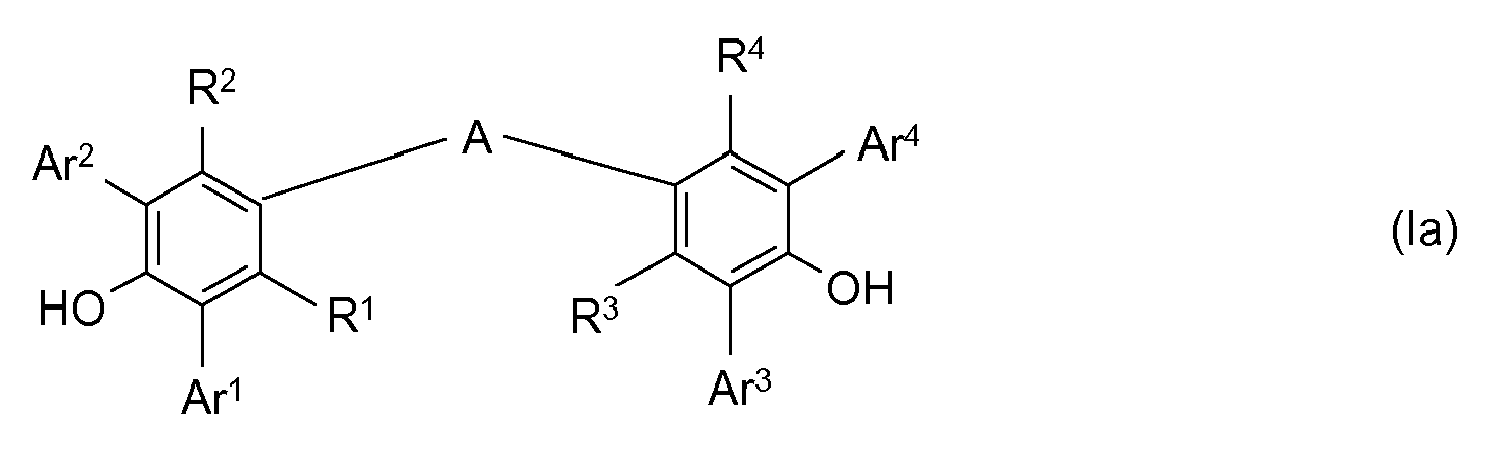
- Diarylphenoxy-Aluminium-Verbindungen nach Anspruch 1 oder 2, dadurch gekennzeichnet, dass die Reste Ar1 bis Ar4 gleich sind.
- Diarylphenoxy-Aluminium-Verbindungen nach einem der Anspruch 1 bis 3, dadurch gekennzeichnet, dass die Reste Ar1 bis Ar4 Phenyl bedeuten.
- Diarylphenoxy-Aluminium-Verbindungen nach einem der Ansprüche 1 bis 4, dadurch gekennzeichnet, dass die Reste R1 bis R4 gleich sind.
- Diarylphenoxy-Aluminium-Verbindungen nach einem der Ansprüche 1 bis 5, dadurch gekennzeichnet, dass die Reste R1 bis R4 Wasserstoff bedeuten.
- Diarylphenoxy-Aluminium-Verbindungen nach einem der Ansprüche 1 bis 6, dadurch gekennzeichnet, dass man den Bis(diarylphenol)-Liganden der Formel (I) und die Aluminium-Verbindungen der Formeln (II) und/oder (III) in einem molaren Verhältnis von 10:1 bis 1:1 einsetzt.
- Diarylphenoxy-Aluminium-Verbindungen nach einem der Ansprüche 1 bis 7, dadurch gekennzeichnet, dass man den Bis(diarylphenol)-Liganden der Formel (I) und die Aluminium-Verbindungen der Formeln (II) und/oder (III) in einem molaren Verhältnis von 3:2 einsetzt.
- Verwendung von Diarylphenoxy-Aluminium-Verbindungen gemäß einem der Ansprüche 1 bis 8 als Katalysatoren.
- Verwendung nach Anspruch 9 zur Cyclisierung von Citronellal zu Isopulegol.
- Verfahren zur Herstellung von Isopulegol der Formel (IV)
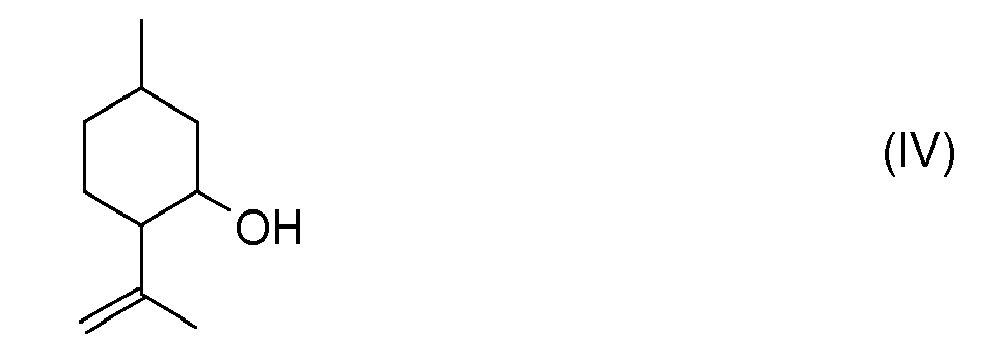


Ar1, Ar2, Ar3, Ar4, R1, R2, R3, R4 und A die vorstehend für Formel (I) angegebenen Bedeutungen besitzen,
mit einer Aluminium-Verbindung der Formel (II)
(R14)3-pAlHp (II),
wobeiAl Aluminium bedeutet undR14 einen verzweigten oder unverzweigten Alkylrest mit 1 bis 5 Kohlenstoffatomen undp 0 oder eine ganze Zahl von 1 bis 3 bedeutet,und/oder
mit einer Aluminium-Verbindung der Formel (III)
MAIH4 (III),
wobeiAl Aluminium bedeutet undM Lithium, Natrium oder Kalium bedeutet. - Verfahren nach Anspruch 11, dadurch gekennzeichnet, dass man die Cyclisierung in Gegenwart eines Katalysators durchführt, der erhältlich ist durch Umsetzung eines Bis(diarylphenol)-Liganden der Formel (la)

Ar1, Ar2, Ar3, Ar4, R1, R2, R3, R4 und A die vorstehend für Formel (I) angegebenen Bedeutungen besitzen. - Verfahren nach Anspruch 11 oder 12 zur Herstellung von optisch aktivem Isopulegol der Formel (IVa)


- Verfahren nach einem der Ansprüche 11 bis 13 zur Herstellung von L-(-)-Ispulegol umfassend die Cyclisierung von D-(+)-Citronellal.
- Verfahren nach einem der Ansprüche 11 bis 14, dadurch gekennzeichnet, dass man als Aluminium-Verbindung eine Verbindung der Formel (II) einsetzt.
- Verfahren nach einem der Ansprüche 11 bis 15, dadurch gekennzeichnet, dass man als Aluminium-Verbindung Trimethyl- oder Triethylaluminium einsetzt.
- Verfahren nach einem der Ansprüche 11 bis 16, dadurch gekennzeichnet, dass man den Bis(diarylphenol)-Liganden der Formel (I) und die Aluminium-Verbindungen der Formeln (II) und/oder (III) in einem molaren Verhältnis von 10:1 bis 1:1 einsetzt.
- Verfahren nach einem de Ansprüche 11 bis 17, dadurch gekennzeichnet, dass man den Bis(diarylphenol)-Liganden der Formel (I) und die Aluminium-Verbindungen der Formeln (II) und/oder (III) in einem molaren Verhältnis von 1,5:1 einsetzt.
- Verfahren nach einem der Ansprüche 11 bis 18, dadurch gekennzeichnet, dass man die Cyclisierung in Gegenwart einer organischen Säure durchführt.
- Verfahren nach Anspruch 19, dadurch gekennzeichnet, dass man als organische Säure Essigsäure einsetzt.
- Verfahren nach einem der Ansprüche 11 bis 20, dadurch gekennzeichnet, dass man die Cyclisierung in Gegenwart mindestens einer Verbindung, ausgewählt aus der Gruppe der Carbonsäureanhydride, Aldehyde, Ketone und Vinylether durchführt.
- Verfahren nach Anspruch 21, dadurch gekennzeichnet, dass man die Cyclisierung in Gegenwart eines Carbonsäureanhydrids der Formel (VI)
 R20, R20' gleich oder verschieden sind und einen verzweigten oder unverzweigten C1- bis C12- Alkylrest oder C7- bis C12-Aralkylrest oder einen C6- bis C10-Arylrest bedeuten, wobei die genannten Reste jeweils einen oder mehrere gleiche oder verschiedene Substituenten, ausgewählt aus der Gruppe OR10e, SR10f NR8eR9e und Halogen aufweisen können und wobei R20 und R20' gemeinsam auch einen 5- bis 8-gliedrigen Ring bilden können, der eine oder mehrere ethylenische Doppelbindungen und ein oder mehrere gleiche oder verschiedene Heteroatome, ausgewählt aus der Gruppe O, S, NR11b aufweisen kann und wobei R10e, R10f R8e, R9e und R11b unabhängig voneinander die für R11 angegebenen Bedeutungen haben können,oder in Gegenwart eines Aldehyds der Formel (VII)
 R21 einen verzweigten oder unverzweigten C1- bis C12- Alkylrest oder C7- bis C12-Aralkylrest oder einen C6- bis C10-Arylrest bedeutet, wobei die genannten Reste jeweils einen oder mehrere gleiche oder verschiedene Substituenten, ausgewählt aus der Gruppe OR10e, SR10f NR8eR9e und Halogen aufweisen können, wobei R10e, R10f, R8e und R9e unabhängig voneinander die für R11 angegebenen Bedeutungen haben können,bedeutet,
oder in Gegenwart eines Ketons der Formel (VIII)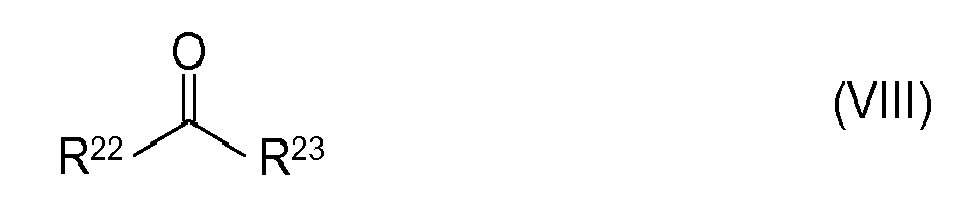 R22, R23 gleich oder verschieden sind und jeweils einen verzweigten oder unverzweigten C1- bis C12- Alkylrest oder C7- bis C12-Aralkylrest oder einen C6- bis C10-Arylrest oder einen C1- bis C6-Alkoxycarbonylrest bedeuten, wobei die genannten Reste jeweils einen oder mehrere gleiche oder verschiedene Substituenten, ausgewählt aus der Gruppe OR10e, SR10f NR8eR9e und Halogen aufweisen können, und wobei R22 und R23 gemeinsam auch einen 5- bis 8-gliedrigen Ring bilden können, der eine oder mehrere ethylenische Doppelbindungen und ein oder mehrere gleiche oder verschiedene Heteroatome ausgewählt aus der Gruppe O, S, NR11b aufweist und wobei R10e, R10f, R8e, R9e und R11b unabhängig voneinander die für R11 angegebenen Bedeutungen haben können, bedeuten,oder in Gegenwart eines Vinylethers der allgemeinen Formel (IX)
 R24, R25, R26, R27 gleich oder verschieden sind und unabhängig voneinander jeweils einen verzweigten oder unverzweigten C1- bis C12- Alkylrest oder C7- bis C12-Aralkylrest oder einen C6- bis C10-Arylrest bedeuten, wobei die genannten Reste jeweils einen oder mehrere gleiche oder verschiedene Substituenten, ausgewählt aus der Gruppe ausgewählt aus der Gruppe Oxo, OR10e, SR10f NR8eR9e und Halogen aufweisen können und wobei R25 und R26 gemeinsam auch einen 5- bis 8-gliedrigen Ring bilden können, der eine oder mehrere ethylenische Doppelbindungen und ein oder mehrere gleiche oder verschiedene Heteroatome ausgewählt aus der Gruppe O, S, NR11b aufweisen kann und wobei R10e, R10f R8e, R9e und R11b unabhängig voneinander die für R11 angegebenen Bedeutungen haben können,durchführt.
 - Verfahren nach Anspruch 21 oder 22, dadurch gekennzeichnet, dass man die Cyclisierung in Gegenwart von Essigsäureanhydrid, Propionsäurealdehyd, Pivalinsäureanhydrid und/oder Benzoesäureanhydrid durchführt.
- Verfahren nach Anspruch 21 oder 22, dadurch gekennzeichnet, dass man die Cyclisierung in Gegenwart von Acetaldehyd, Propionaldehyd, Chloral, 1,1,1-Trifluoraceton, 1,1,1-Trifluoracetophenon, Brenztraubensäuremethylester, Brenztraubensäureethylester oder Hexafluoraceton durchführt.
- Verfahren nach einem der Ansprüche 21 bis 24, dadurch gekennzeichnet, dass man das Carbonsäureanhydrid, den Aldehyd, das Keton und/oder den Vinylether in einer Menge von 0,01 mol-% bis 5 mol-% bezogen auf die Menge an eingesetztem Citronellal einsetzt.
- Verfahren nach einem der Ansprüche 21 bis 25, dadurch gekennzeichnet, dass man eine Lösung oder Suspension des Katalysators vorlegt und ein Gemisch des umzusetzenden Citronellals mit dem Carbonsäureanhydrid, dem Aldehyd, dem Keton und/oder dem Vinylether zugibt.
- Verfahren nach einem der Ansprüche 21 bis 26, dadurch gekennzeichnet, dass das Gemisch des umzusetzenden Citronellals mit dem Carbonsäureanhydrid, dem Aldehyd, dem Keton und/oder dem Vinylether innerhalb eines Zeitraums von 30 min bis 6 h zugibt.
- Verfahren nach einem der Ansprüche 11 bis 27, dadurch gekennzeichnet, dass man den eingesetzten Bis(diarylphenol)-Liganden der Formel (I) nach erfolgter Umsetzung zurückgewinnt.
- Verfahren nach Anspruch 28, umfassend die Schrittea) destillative Entfernung des gegebenenfalls eingesetzten Lösungsmittels sowie der gegebenenfalls eingesetzten weiteren Verbindung aus dem Produktgemisch,b) Zusatz eines hochsiedenden Lösungsmittels zu dem in Schritt a) erhaltenen Rückstand,c) destillative Abtrennung des Isopulegols aus dem in Schritt b) erhaltenen Gemisch undd) Abkühlen des in Schritt c) erhaltenen Destillationssumpfes unter Kristallisation des eingesetzten Bis(diarylphenol)-Liganden der Formel (I).
- Verfahren nach einem der Ansprüche 11 bis 27, dadurch gekennzeichnet, dass man die als Katalysator eingesetzte Diarylphenoxy-Aluminium-Verbindung nach erfolgter Umsetzung zurückgewinnt.
- Verfahren zur Herstellung von Menthol umfassend die Herstellung von Isopulegol der Formel (IV) nach einem der Ansprüche 11 bis 30 und anschließender Hydrierung der ethylenischen Doppelbindung des so erhaltenen Isopulegols.
- Verfahren nach Anspruch 31 zur Herstellung von optisch aktivem Menthol umfassend die Schrittea) Herstellung von optisch aktivem Isopulegol der Formel (IVa) nach einem der Ansprüche 11 bis 31 undb) Hydrierung der ethylenischen Doppelbindung des so erhaltenen optisch aktiven Isopulegols.
- Verfahren nach Anspruch 32 zur Herstellung von L-(-)-Menthol umfassend die Schrittea) Herstellung von L-(-)-Isopulegol nach einem der Ansprüche 11 bis 32 undb) Hydrierung der ethylenischen Doppelbindung des so erhaltenen optisch aktiven L-(-)-Isopulegols.
Applications Claiming Priority (3)
| Application Number | Priority Date | Filing Date | Title |
|---|---|---|---|
| DE102005010329A DE102005010329A1 (de) | 2005-03-03 | 2005-03-03 | Diarylphenoxy-Aluminium-Verbindungen |
| DE102005044518A DE102005044518A1 (de) | 2005-09-16 | 2005-09-16 | Verfahren zur Herstellung von Isopulegol durch Cyclisierung von Citronellal in Gegenwart von Diarylphenoxy-Aluminium-Verbindungen |
| EP06708615A EP1858903B1 (de) | 2005-03-03 | 2006-03-03 | Diarylphenoxy-aluminium-verbindungen |
Related Parent Applications (1)
| Application Number | Title | Priority Date | Filing Date |
|---|---|---|---|
| EP06708615A Division EP1858903B1 (de) | 2005-03-03 | 2006-03-03 | Diarylphenoxy-aluminium-verbindungen |
Publications (1)
| Publication Number | Publication Date |
|---|---|
| EP1942111A1 true EP1942111A1 (de) | 2008-07-09 |
Family
ID=36218577
Family Applications (2)
| Application Number | Title | Priority Date | Filing Date |
|---|---|---|---|
| EP06708615A Expired - Lifetime EP1858903B1 (de) | 2005-03-03 | 2006-03-03 | Diarylphenoxy-aluminium-verbindungen |
| EP08154812A Withdrawn EP1942111A1 (de) | 2005-03-03 | 2006-03-03 | Diarylphenoxy-Aluminium-Verbindungen |
Family Applications Before (1)
| Application Number | Title | Priority Date | Filing Date |
|---|---|---|---|
| EP06708615A Expired - Lifetime EP1858903B1 (de) | 2005-03-03 | 2006-03-03 | Diarylphenoxy-aluminium-verbindungen |
Country Status (8)
| Country | Link |
|---|---|
| US (1) | US7608742B2 (de) |
| EP (2) | EP1858903B1 (de) |
| JP (1) | JP5279275B2 (de) |
| CN (1) | CN101723809B (de) |
| AT (1) | ATE410432T1 (de) |
| DE (1) | DE502006001751D1 (de) |
| ES (1) | ES2313618T3 (de) |
| WO (1) | WO2006092433A1 (de) |
Families Citing this family (22)
| Publication number | Priority date | Publication date | Assignee | Title |
|---|---|---|---|---|
| DE102004063003A1 (de) * | 2004-12-22 | 2006-07-13 | Basf Ag | Verfahren zur Herstellung von Isopulegol |
| DE102005040655A1 (de) | 2005-08-26 | 2007-03-01 | Basf Ag | Verfahren zur Herstellung von angereichertem Isopulegol |
| US8003829B2 (en) * | 2006-09-01 | 2011-08-23 | Basf Se | Recovery of phenol ligands during the production of isopulegol |
| EP2064169B1 (de) | 2006-09-01 | 2016-03-23 | Basf Se | Rückgewinnung von bis(diarylphenol)-liganden bei der herstellung von isopulegol |
| CN101679163B (zh) * | 2007-06-12 | 2013-07-17 | 巴斯夫欧洲公司 | 薄荷醇薄片及其制备方法 |
| JP5476299B2 (ja) | 2007-07-23 | 2014-04-23 | ビーエーエスエフ ソシエタス・ヨーロピア | イソプレゴールの水素化によるメントールの製造方法 |
| WO2009068444A2 (de) * | 2007-11-30 | 2009-06-04 | Basf Se | Verfahren zur herstellung von optisch aktivem und racemischem menthol |
| JP5352593B2 (ja) * | 2007-12-17 | 2013-11-27 | ビーエーエスエフ ソシエタス・ヨーロピア | 4,4’−[1−(トリフルオロメチル)アルキリデン]ビス(2,6−ジフェニルフェノール)の調製方法 |
| WO2009144906A1 (ja) | 2008-05-26 | 2009-12-03 | 高砂香料工業株式会社 | アルミニウム錯体とその使用 |
| US8580991B2 (en) | 2008-12-17 | 2013-11-12 | Takasago International Corporation | Aluminium complexes and use thereof as a catalyst in intramolecular ring closure reactions |
| EP2376412A1 (de) * | 2008-12-17 | 2011-10-19 | Takasago International Corporation | Aluminiumkomplexe und deren verwendung als katalysator bei intramolekularen ringschlussreaktionen |
| JP5648240B2 (ja) | 2010-05-25 | 2015-01-07 | 高砂香料工業株式会社 | 有機アルミニウム化合物 |
| JP5780933B2 (ja) * | 2010-12-01 | 2015-09-16 | 高砂香料工業株式会社 | 光学活性メントールの製造方法 |
| US20150329452A1 (en) | 2012-11-15 | 2015-11-19 | Takasago International Corporation | Method for producing optically active isopulegol and optically active menthol |
| JP6196233B2 (ja) | 2012-11-15 | 2017-09-13 | 高砂香料工業株式会社 | アルミニウム触媒 |
| PL3119489T3 (pl) * | 2014-03-19 | 2022-01-17 | Basf Se | Sposób oddzielania substancji z roztworu |
| MX2018013563A (es) * | 2016-05-06 | 2019-03-14 | Basf Se | Ligandos p-quirales de fosfina y su uso para sintesis asimetrica. |
| CN108329194B (zh) * | 2018-04-11 | 2021-06-25 | 万华化学集团股份有限公司 | 一种香茅醛制备异胡薄荷醇的方法及其催化剂的回收方法 |
| CN110845305B (zh) * | 2019-11-25 | 2022-06-28 | 安徽一帆香料有限公司 | 一种采用改性均相催化剂制备l-薄荷醇的方法 |
| JP7456789B2 (ja) * | 2020-01-30 | 2024-03-27 | 高砂香料工業株式会社 | イソプレゴールの製造方法 |
| JP2024533305A (ja) * | 2021-09-10 | 2024-09-12 | ロイター ヒェミッシャー アパラ―テバウ エー.カー. | アリール(ヘタリール)置換ビスフェノール化合物及び熱可塑性樹脂 |
| CN121443573A (zh) | 2023-07-07 | 2026-01-30 | 巴斯夫欧洲公司 | 香叶醛和橙花醛的光异构化 |
Citations (6)
| Publication number | Priority date | Publication date | Assignee | Title |
|---|---|---|---|---|
| CH350461A (de) | 1957-12-06 | 1960-11-30 | Ciba Geigy | Verwendung von Oxyketonen zum Schutze gegen ultraviolette Strahlung |
| US3739035A (en) | 1971-05-26 | 1973-06-12 | Gen Electric | Bis(2,6-diphenylphenols) |
| DE2534558A1 (de) | 1975-08-02 | 1977-02-17 | Bayer Ag | Verfahren zur herstellung von alpha,alpha'-bis-(4-hydroxyphenyl)- diisopropylbenzolen |
| JPH09278817A (ja) | 1996-04-17 | 1997-10-28 | Idemitsu Kosan Co Ltd | オレフィン系重合用触媒及びそれを用いたオレフィン系重合体の製造方法 |
| EP1053974A1 (de) | 1999-05-17 | 2000-11-22 | Quest International B.V. | Reaktionen mittels Lewissäuren |
| EP1225163A2 (de) | 2001-01-18 | 2002-07-24 | Takasago International Corporation | Verfahren zur Herstellung von Isopulegol |
Family Cites Families (5)
| Publication number | Priority date | Publication date | Assignee | Title |
|---|---|---|---|---|
| US3123647A (en) | 1964-03-03 | Certificate of correction | ||
| GB1597482A (en) * | 1977-01-28 | 1981-09-09 | Exxon Research Engineering Co | Metal phenates |
| JPS5885830A (ja) * | 1981-11-17 | 1983-05-23 | Maruzen Sekiyu Kagaku Kk | アルミニウムアルコキシド・フェノキシド重合体 |
| JP3565587B2 (ja) * | 1994-11-04 | 2004-09-15 | 三共ライフテック株式会社 | 15−ヒドロキシミルベマイシン誘導体の新規合成法 |
| JP4352620B2 (ja) * | 2001-02-26 | 2009-10-28 | 日本ゼオン株式会社 | ノルボルネン系開環重合体水素化物の製造方法 |
-
2006
- 2006-03-03 EP EP06708615A patent/EP1858903B1/de not_active Expired - Lifetime
- 2006-03-03 US US11/817,468 patent/US7608742B2/en active Active
- 2006-03-03 WO PCT/EP2006/060416 patent/WO2006092433A1/de not_active Ceased
- 2006-03-03 JP JP2007557516A patent/JP5279275B2/ja not_active Expired - Lifetime
- 2006-03-03 DE DE502006001751T patent/DE502006001751D1/de not_active Expired - Lifetime
- 2006-03-03 EP EP08154812A patent/EP1942111A1/de not_active Withdrawn
- 2006-03-03 CN CN2009102583278A patent/CN101723809B/zh not_active Expired - Lifetime
- 2006-03-03 ES ES06708615T patent/ES2313618T3/es not_active Expired - Lifetime
- 2006-03-03 AT AT06708615T patent/ATE410432T1/de not_active IP Right Cessation
Patent Citations (6)
| Publication number | Priority date | Publication date | Assignee | Title |
|---|---|---|---|---|
| CH350461A (de) | 1957-12-06 | 1960-11-30 | Ciba Geigy | Verwendung von Oxyketonen zum Schutze gegen ultraviolette Strahlung |
| US3739035A (en) | 1971-05-26 | 1973-06-12 | Gen Electric | Bis(2,6-diphenylphenols) |
| DE2534558A1 (de) | 1975-08-02 | 1977-02-17 | Bayer Ag | Verfahren zur herstellung von alpha,alpha'-bis-(4-hydroxyphenyl)- diisopropylbenzolen |
| JPH09278817A (ja) | 1996-04-17 | 1997-10-28 | Idemitsu Kosan Co Ltd | オレフィン系重合用触媒及びそれを用いたオレフィン系重合体の製造方法 |
| EP1053974A1 (de) | 1999-05-17 | 2000-11-22 | Quest International B.V. | Reaktionen mittels Lewissäuren |
| EP1225163A2 (de) | 2001-01-18 | 2002-07-24 | Takasago International Corporation | Verfahren zur Herstellung von Isopulegol |
Non-Patent Citations (5)
| Title |
|---|
| ANGEW. CHEM. INT. ED, vol. 43, 2004, pages 994 |
| S. SAITO ET AL., SYNLETT, vol. 1, pages 57 - 58 |
| VON F. F. BLICKE ET AL., J. AM. CHEM. SOC., vol. 60, 1938, pages 2283 - 2285 |
| VON G. MAIER ET AL., CHEM. BER, vol. 118, 1985, pages 704 - 721 |
| VON J. ZAVADA, COLLECT. CZECH. CHEM. COMMUN, vol. 41, 1976, pages 1777 - 1790 |
Also Published As
| Publication number | Publication date |
|---|---|
| ES2313618T3 (es) | 2009-03-01 |
| EP1858903B1 (de) | 2008-10-08 |
| US7608742B2 (en) | 2009-10-27 |
| DE502006001751D1 (de) | 2008-11-20 |
| EP1858903A1 (de) | 2007-11-28 |
| US20080167504A1 (en) | 2008-07-10 |
| CN101723809B (zh) | 2013-12-04 |
| JP2008538101A (ja) | 2008-10-09 |
| CN101723809A (zh) | 2010-06-09 |
| WO2006092433A1 (de) | 2006-09-08 |
| JP5279275B2 (ja) | 2013-09-04 |
| ATE410432T1 (de) | 2008-10-15 |
Similar Documents
| Publication | Publication Date | Title |
|---|---|---|
| EP1858903B1 (de) | Diarylphenoxy-aluminium-verbindungen | |
| EP1838650B1 (de) | Verfahren zur herstellung von isopulegol | |
| EP2225192B1 (de) | Verfahren zur herstellung von optisch aktivem und racemischem menthol | |
| EP2064169B1 (de) | Rückgewinnung von bis(diarylphenol)-liganden bei der herstellung von isopulegol | |
| HU198437B (en) | Process for producing mono- or bis-carbonyl-compounds | |
| DE3027890A1 (de) | Hydrierkatalysatoren fuer die herstellung von propandiolen und verfahren zur herstellung von propandiolen mit solchen katalysatoren | |
| DE2943098C2 (de) | ||
| EP2059493B1 (de) | Rückgewinnung von phenol-liganden bei der herstellung von isopulegol | |
| WO2009013192A1 (de) | Verfahren zur herstellung von menthol durch hydrierung von isopulegol | |
| WO2008132057A1 (de) | Verfahren zur herstellung optisch aktiver carbonylverbindungen | |
| EP2225219B1 (de) | Verfahren zur herstellung von cis-rosenoxid | |
| WO2012059387A1 (de) | Verfahren zur herstellung eines phenylcyclohexans | |
| EP0429998B1 (de) | Verfahren zur Herstellung teilfluorierter Alkohole | |
| DE2544150A1 (de) | Verfahren zur herstellung von substituierten cyclopropancarbonsaeuren und ihren estern | |
| DE102005010329A1 (de) | Diarylphenoxy-Aluminium-Verbindungen | |
| EP0144044B1 (de) | Substituierte Acetylenketone | |
| EP1070718B1 (de) | Verfahren zur Herstellung von Grignard-Reagenzien und neue Grignard-Reagenzien | |
| CH648282A5 (de) | Verfahren zur herstellung von oxocyclopentenen. | |
| US4011277A (en) | Preparation of squalane by hydrogenolysis | |
| DE102005023953A1 (de) | Verfahren zur Cyclisierung von Citronellal zu Isopulegol | |
| CA1080725A (en) | Process for producing phthalide | |
| DE2933996C2 (de) | ||
| EP0144033B1 (de) | Substituierte 5-cycloalkyl-2,2-dimethyl-pentan-3-one | |
| DE102005044518A1 (de) | Verfahren zur Herstellung von Isopulegol durch Cyclisierung von Citronellal in Gegenwart von Diarylphenoxy-Aluminium-Verbindungen | |
| KR101081115B1 (ko) | 베타카로텐의 제조방법 |
Legal Events
| Date | Code | Title | Description |
|---|---|---|---|
| PUAI | Public reference made under article 153(3) epc to a published international application that has entered the european phase |
Free format text: ORIGINAL CODE: 0009012 |
|
| AC | Divisional application: reference to earlier application |
Ref document number: 1858903 Country of ref document: EP Kind code of ref document: P |
|
| AK | Designated contracting states |
Kind code of ref document: A1 Designated state(s): AT BE BG CH CY CZ DE DK EE ES FI FR GB GR HU IE IS IT LI LT LU LV MC NL PL PT RO SE SI SK TR |
|
| 17P | Request for examination filed |
Effective date: 20090109 |
|
| AKX | Designation fees paid |
Designated state(s): AT BE BG CH CY CZ DE DK EE ES FI FR GB GR HU IE IS IT LI LT LU LV MC NL PL PT RO SE SI SK TR |
|
| 17Q | First examination report despatched |
Effective date: 20090324 |
|
| STAA | Information on the status of an ep patent application or granted ep patent |
Free format text: STATUS: THE APPLICATION IS DEEMED TO BE WITHDRAWN |
|
| 18D | Application deemed to be withdrawn |
Effective date: 20091006 |