EP1943643B1 - Compression audio - Google Patents
Compression audio Download PDFInfo
- Publication number
- EP1943643B1 EP1943643B1 EP05806493.2A EP05806493A EP1943643B1 EP 1943643 B1 EP1943643 B1 EP 1943643B1 EP 05806493 A EP05806493 A EP 05806493A EP 1943643 B1 EP1943643 B1 EP 1943643B1
- Authority
- EP
- European Patent Office
- Prior art keywords
- low frequency
- signal
- high frequency
- sections
- band
- Prior art date
- Legal status (The legal status is an assumption and is not a legal conclusion. Google has not performed a legal analysis and makes no representation as to the accuracy of the status listed.)
- Expired - Lifetime
Links
Images


Classifications
-
- G—PHYSICS
- G10—MUSICAL INSTRUMENTS; ACOUSTICS
- G10L—SPEECH ANALYSIS TECHNIQUES OR SPEECH SYNTHESIS; SPEECH RECOGNITION; SPEECH OR VOICE PROCESSING TECHNIQUES; SPEECH OR AUDIO CODING OR DECODING
- G10L19/00—Speech or audio signals analysis-synthesis techniques for redundancy reduction, e.g. in vocoders; Coding or decoding of speech or audio signals, using source filter models or psychoacoustic analysis
- G10L19/02—Speech or audio signals analysis-synthesis techniques for redundancy reduction, e.g. in vocoders; Coding or decoding of speech or audio signals, using source filter models or psychoacoustic analysis using spectral analysis, e.g. transform vocoders or subband vocoders
-
- G—PHYSICS
- G10—MUSICAL INSTRUMENTS; ACOUSTICS
- G10L—SPEECH ANALYSIS TECHNIQUES OR SPEECH SYNTHESIS; SPEECH RECOGNITION; SPEECH OR VOICE PROCESSING TECHNIQUES; SPEECH OR AUDIO CODING OR DECODING
- G10L19/00—Speech or audio signals analysis-synthesis techniques for redundancy reduction, e.g. in vocoders; Coding or decoding of speech or audio signals, using source filter models or psychoacoustic analysis
- G10L19/02—Speech or audio signals analysis-synthesis techniques for redundancy reduction, e.g. in vocoders; Coding or decoding of speech or audio signals, using source filter models or psychoacoustic analysis using spectral analysis, e.g. transform vocoders or subband vocoders
- G10L19/0204—Speech or audio signals analysis-synthesis techniques for redundancy reduction, e.g. in vocoders; Coding or decoding of speech or audio signals, using source filter models or psychoacoustic analysis using spectral analysis, e.g. transform vocoders or subband vocoders using subband decomposition
- G10L19/0208—Subband vocoders
-
- G—PHYSICS
- G10—MUSICAL INSTRUMENTS; ACOUSTICS
- G10L—SPEECH ANALYSIS TECHNIQUES OR SPEECH SYNTHESIS; SPEECH RECOGNITION; SPEECH OR VOICE PROCESSING TECHNIQUES; SPEECH OR AUDIO CODING OR DECODING
- G10L19/00—Speech or audio signals analysis-synthesis techniques for redundancy reduction, e.g. in vocoders; Coding or decoding of speech or audio signals, using source filter models or psychoacoustic analysis
- G10L19/04—Speech or audio signals analysis-synthesis techniques for redundancy reduction, e.g. in vocoders; Coding or decoding of speech or audio signals, using source filter models or psychoacoustic analysis using predictive techniques
- G10L19/08—Determination or coding of the excitation function; Determination or coding of the long-term prediction parameters
-
- G—PHYSICS
- G10—MUSICAL INSTRUMENTS; ACOUSTICS
- G10L—SPEECH ANALYSIS TECHNIQUES OR SPEECH SYNTHESIS; SPEECH RECOGNITION; SPEECH OR VOICE PROCESSING TECHNIQUES; SPEECH OR AUDIO CODING OR DECODING
- G10L21/00—Speech or voice signal processing techniques to produce another audible or non-audible signal, e.g. visual or tactile, in order to modify its quality or its intelligibility
- G10L21/02—Speech enhancement, e.g. noise reduction or echo cancellation
-
- H—ELECTRICITY
- H03—ELECTRONIC CIRCUITRY
- H03M—CODING; DECODING; CODE CONVERSION IN GENERAL
- H03M7/00—Conversion of a code where information is represented by a given sequence or number of digits to a code where the same, similar or subset of information is represented by a different sequence or number of digits
- H03M7/30—Compression; Expansion; Suppression of unnecessary data, e.g. redundancy reduction
Definitions
- the present application relates in general to audio compression.
- Audio compression is commonly employed in modern consumer devices for storing or transmitting digital audio signals.
- Consumer devices may be telecommunication devices, video devices, audio players, radio devices and other consumer devices.
- High compression ratios enable better storage capacity, or more efficient transmission via a communication channel, i.e. a wireless communication channel, or a wired communication channel.
- the quality of the compressed signal should be maintained at a high level.
- the target of audio coding is generally to maximize the audio quality in relation to the given compression ratio, i.e. the bit rate.
- the input signal is divided into a limited number of sub-bands.
- Each of the sub-band signals can be quantized. From the theory of psychoacoustics it is known that the highest frequencies in the spectrum are perceptually less important than the low frequencies. This can be considered to some extend in the coder by allocating lesser bits to the quantization of the high frequency sub-bands than to the low frequency sub-bands.
- More sophisticated audio coding utilizes the fact that in most cases, there are large dependencies between the low frequency regions and high frequency regions of an audio signal, i.e. the higher half of the spectrum is generally quite similar as the lower half.
- the low frequency region can be considered the lower half of the audio spectrum
- the high frequency can be considered the upper half of the audio spectrum. It is to be understood, that the border between low and high frequency is not fixed, but may lie in between 2kHz and 15kHz, and even beyond these borders.
- SBR spectral-band-replication
- EP 1 441 330 discloses encoding an audio signal by encoding a low frequency band, dividing a high frequency band into at least two subbands, determining which lowband sections match best with the high frequency subbands and generating parameters that refer to the best matching lowband sections.
- the drawback of the method according to the art is that the mere transposition of low frequency bands to high frequency bands may lead to dissimilarities between the original high frequencies and their reconstruction utilizing the transposed low frequencies.
- Another drawback is that noise and sinusoids need to be added to the frequency spectrum according to known methods.
- the application provides, according to one aspect, a method for encoding audio signals with receiving an input audio signal, dividing the audio signal into at least a low frequency band and a high frequency band, dividing the high frequency band into at least two high frequency sub-band signals, determining within the low frequency band signal sections which match best with high-frequency sub-band signals, and generating parameters that refer at least to the low frequency band signal sections which match best with high-frequency sub-band signals.
- the application provides a new approach for coding the high frequency region of an input signal.
- the input signal can be divided into temporally successive frames. Each of the frames represents a temporal instance of the input signal. Within each frame, the input signal can be represented by its spectral components. The spectral components, or samples, represent the frequencies within the input signal.
- the application maximizes the similarity between the original and the coded high frequency spectral components.
- the high frequency region is formed utilizing the already-coded low frequency region of the signal.
- a signal section within the low frequency can be found, which matches best with an actual high frequency sub-band.
- the application provides for searching within the whole low frequency spectrum sample by sample for a signal section, which resembles best a high frequency sub-band.
- the application provides, in other words, finding a sample sequence, which matches best with the high frequency sub-band.
- the sample sequence can start anywhere within the low frequency band, except that the last considered starting point within the low frequency band should be the last sample in the low frequency band minus the length of the high frequency sub-band that is to be matched.
- An index or link to the low frequency signal section matching best the actual high frequency sub-band can be used to model the high frequency sub-band. Only the index or link needs to be encoded and stored, or transmitted in order to allow restoring a representation of the corresponding high frequency sub-band at the receiving end.
- the most similar match i.e. the most similar spectral shape of the signal section and the high frequency sub-band
- the most similar match is searched within the low frequency band.
- Parameters referring at least to the signal section which is found to be most similar with a high frequency sub-band are created in the encoder.
- the parameters may comprise scaling factors for scaling the found sections into the high frequency band.
- these parameters are used to transpose the corresponding low frequency signal sections to a high frequency region to reconstruct the high frequency sub-bands.
- Scaling can be applied to the copied low frequency signal sections using scaling factors. According to embodiments, only the scaling factors and the links to the low frequency signal sections need to be encoded.
- the shape of the high frequency region follows more closely the original high frequency spectrum than with known methods when using the best matching low frequency signal sections for reproduction of the high frequency sub-bands.
- the perceptually important spectral peaks can be modeled more accurately, because the amplitude, shape, and frequency position is more similar to the original signal.
- the modeled high frequency sub-bands can be compared with the original high frequency sub-bands, it is possible to easily detect missing spectral components, i.e. sinusoids or noise, and then add these.
- embodiments provide utilizing the low frequency signal sections by transposing the low frequency signal samples into high-frequency sub-band signals using the parameters wherein the parameters comprise scaling factors such that an envelope of the transposed low frequency signal sections follows an envelope of the high frequency sub-band signals of the received signal.
- the scaling factors enable adjusting the energy and shape of the copied low frequency signal sections to match better with the actual high frequency sub-bands.
- the parameters can comprise links to low frequency signal sections to represent the corresponding high frequency sub-band signals according to embodiments.
- the links can be pointers or indexes to the low frequency signal sections. With this information, it is possible to refer to the low frequency signal sections when constructing the high frequency sub-band.
- the envelope of the high frequency sub-band signals In order to reduce the number of quantization bits, it is possible to normalize the envelope of the high frequency sub-band signals.
- the normalization provides that both the low and high frequency bands are within a normalized amplitude range. This reduces the number of bits needed for quantization of the scaling factors.
- the information used for normalization has to be provided by the encoder to construct the representation of the high frequency sub-band in the decoder.
- Embodiments provide envelope normalization with linear prediction coding. It is also possible to normalize the envelope utilizing cepstral modeling. Cepstral modeling uses the inverse Fourier Transform of the logarithm of the power spectrum of a signal.
- Generating scaling factors can comprise generating scaling factors in the linear domain to match at least amplitude peaks in the spectrum. Generating scaling factors can also comprise matching at least energy and/or shape of the spectrum in the logarithmic domain, according to embodiments.
- Embodiments provide generating signal samples within the low frequency band and/or the high frequency band using modified discrete cosine transformation (MDCT).
- MDCT transformation provides spectrum coefficients preferably as real numbers.
- the MDCT transformation according to embodiments can be used with any suitable frame sizes, in particular with frame sizes of 2048 samples for normal frames and 256 samples for transient frames, but also any other value in between.
- embodiments provide calculating a similarity measure using a normalized correlation or the Euclidian distance.
- embodiments provide quantizing the low frequency signal samples and quantizing at least the scaling factors.
- the link to the low frequency signal section can be an integer.
- the invention adds additional sinusoids to improve the quality of high frequency signals.
- embodiments provide dividing the input signal into temporally successive frames, and detecting tonal sections within two successive frames within the input signal.
- the tonal sections can be enhanced by adding additional sinusoids.
- Sections which are highly tonal can be enhanced additionally by increasing the number of high frequency sub-bands in the corresponding high frequency regions.
- Input frames can be divided into different tonality groups, e.g. not tonal, tonal, and strongly tonal.
- Detecting tonal sections can comprise using Shifted Discrete Fourier Transformation (SDFT).
- SDFT Shifted Discrete Fourier Transformation
- the result of the SDFT can be utilized within the encoder to provide the MDCT transformation.
- Another aspect of the application is a method for decoding audio signals with receiving an encoded bit stream, decoding from the bit stream at least a low frequency signal and at least parameters referring to low frequency signal sections, utilizing the low frequency signal samples and the parameters referring to the low frequency signal sections for reconstructing at least two high-frequency sub-band signals, and outputting an output signal comprising at least the low frequency signal and at least the two high-frequency sub-band signals.
- a further aspect of the application is an encoder for encoding audio signals comprising receiving means arranged for receiving an input audio signal, filtering means arranged for dividing the audio signal into at least a low frequency band and a high frequency band, and further arranged for dividing the high frequency band into at least two high frequency sub-band signals, and coding means arranged for generating parameters that refer at least to low frequency band signal sections which match best with the high-frequency sub-band signals.
- a further aspect of the application is a decoder for decoding audio signals comprising receiving means arranged for receiving an encoded bit stream, decoding means arranged for decoding from the bit stream at least a low frequency signal and at least parameters referring to the low frequency signal sections, generation means arranged for utilizing samples of the low frequency signal and the parameters referring to the low frequency signal sections for reconstructing at least two high-frequency sub-band signals.
- a further aspect of the application is a system for digital audio compression comprising a described decoder, and a described encoder.
- a further aspect of the application relates to a computer program product for encoding audio signals, the program comprising instructions operable to cause a processor to receive an input audio signal, divide the audio signal into at least a low frequency band and a high frequency band, divide the high frequency band into at least two high frequency sub-band signals, and generate parameters that refer at least to low frequency band signal sections which match best with high-frequency sub-band signals.
- a computer program product for decoding bit streams comprising instructions operable to cause a processor to receive an encoded bit stream, decode from the bit stream at least a low frequency signal and at least parameters referring to the low frequency signal sections, utilize samples of the low frequency signal and the parameters referring to the low frequency signal sections for reconstructing at least two high-frequency sub-band signals, and put out an output signal comprising at least the low frequency signal and at least two high-frequency sub-band signals.
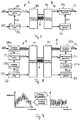
- General audio coding systems consist of an encoder and a decoder, as illustrated in schematically FIG. 1 . Illustrated is a coding system 2 with an encoder 4, a storage or media channel 6 and a decoder 8.
- the encoder 4 compresses an input audio signal 10 producing a bit stream 12, which is either stored or transmitted through a media channel 6.
- the bit stream 12 can be received within the decoder 8.
- the decoder 8 decompresses the bit stream 12 and produces an output audio signal 14.
- the bit rate of the bit stream 12 and the quality of the output audio signal 14 in relation to the input signal 10 are the main features, which define the performance of the coding system 2.
- FIG. 2 A typical structure of a modern audio encoder 4 is presented schematically in FIG. 2 .
- the input signal 10 is divided into sub-bands using an analysis filter bank structure 16.
- Each sub-band can be quantized and coded within coding means 18 utilizing the information provided by a psychoacoustic model 20.
- the coding can be Huffman coding.
- the quantization setting as well as the coding scheme can be dictated by the psychoacoustic model 18.
- the quantized, coded information is used within a bit stream formatter 22 for creating a bit stream 12.
- the bit stream 12 can be decoded within a decoder 8 as illustrated schematically in FIG. 3 .
- the decoder 8 can comprise bit stream unpacking means 24, sub-band reconstruction means 26, and a synthesis filter bank 28.
- the decoder 8 computes the inverse of the encoder 4 and transforms the bit stream 12 back to an output audio signal 14.
- the bit stream 12 is de-quantized in the sub-band reconstruction means 26 into sub-band signals.
- the sub-band signals are fed to the synthesis filter bank 28, which synthesizes the audio signal from the sub-band signals and creates the output signal 14.
- FIG. 4 illustrates schematically an encoder 4.
- the encoder 4 comprises low pass filtering means 30, coding means 31, SBR means 32, envelope extraction means 34 and bit stream formatter 22.
- the low pass filter 30 first defines a cut-off frequency up to which the input signal 10 is filtered. The effect is illustrated in FIG. 6a . Only frequencies below the cut-off frequency 36 pass the filter.
- the coding means 31 carry out quantization and Huffman coding with 32 low frequency sub-bands.
- the low frequency contents are converted within coding means 31 into the QMF domain.
- the low frequency contents are transposed based on the output of coder 31.
- the transposition is done in SBR means 32.
- the effect of transposition of the low frequencies to the high frequencies is illustrated within FIG. 6b .
- the transposition is performed blindly such that the low frequency sub-band samples are just copied into high frequency sub-band samples. This is done similarly in every frame of the input signal and independently of the characteristics of the input signal.
- the high frequency sub-bands can be adjusted based on additional information. This is done to make particular features of the synthesized high frequency region more similar with the original one. Additional components, such as sinusoids or noise, can be added to the high frequency region to increase the similarity with the original high frequency region. Finally, the envelope is adjusted in envelope extraction means 34 to follow the envelope of the original high frequency spectrum. The effect can be seen in FIG. 6c , where the high frequency components are scaled to be more closely to the actual high frequency components of the input signal.
- bit stream 12 the coded low frequency signal together with scaling and envelope adjustment parameters is comprised.
- the bit stream 12 can be decoded within a decoder as illustrated in FIG. 5 .
- Fig. 5 illustrates a decoder 8 with unpacking means 24, a low frequency decoder 38, high frequency reconstruction means 40, component adjustment means 42, and envelope adjustment means 44.
- the low frequency sub-bands are reconstructed in the decoder 38.
- the high frequency sub-bands are statically reconstructed within high frequency reconstruction means 40. Sinusoids can be added and the envelope adjusted in component adjustment means 42, and envelope adjustment means 44.
- the transposition of low frequency signal samples into high frequency sub-bands is done dynamically, e.g. it is checked, which low frequency signal sections match best with a high frequency sub-band. An index to the corresponding low frequency signal sections is created. This index is encoded and used within the decoder for constructing the high frequency sub-bands from the low frequency signal.
- FIG. 7 illustrates a coding system with an encoder 4, and a decoder 8.
- the encoder 4 is comprised of high frequency coding means 50, a low frequency coder 52, and bit stream formatter 22.
- the encoder 4 can be part of a more complex audio coding scheme.
- the application can be used in almost any audio coder in which good quality is aimed at low bit rates. For instance the application can be used totally separated from the actual low bit rate audio coder, e.g. it can be placed in front of a psychoacoustic coder, e.g. AAC, MPEG, etc.
- the high frequency region typically contains similar spectral shapes as the low frequency region, good coding performance is generally achieved. This is accomplished with a relatively low total bit rate, as only the indexes of the copied spectrum and the scaling factors need to be transmitted to the decoder.
- the low frequency samples X L (k) are coded.
- parameters ⁇ 1 , ⁇ 2 , i representing transformation, scaling and envelope forming are created for coding, as will be described in more detail below.
- the high frequency spectrum is first divided into n b sub-bands. For each sub-band, the most similar match (i.e. the most similar spectrum shape) is searched from the low frequency region.
- the method can operate in the modified discrete cosine (MDCT) domain. Due its good properties (50% overlap with critical sampling, flexible window switching etc.), the MDCT domain is used in most state-of-the-art audio coders.
- N is 1024 (normal frames) or 128 samples (transients).
- the spectrum coefficients X ( k ) can be real numbers. Frame sizes as mentioned, as well as any other frame size are possible.
- the high frequency coder 50 and the low frequency coder 52 can create N MDCT coded components, where X L ( k ) represents the low frequency components and X H ( k ) represent the high frequency components.
- N L low frequency MDCT coefficients X ⁇ L ( k ), 0 ⁇ k ⁇ N L can be coded.
- N L N /2, but also other selections can be done.
- X ⁇ L ( k ) and X H ( k ) form together the synthesized spectrum X ⁇ ( k ):
- X ⁇ k ⁇ X ⁇ L k , 0 ⁇ k ⁇ N L X ⁇ H k , N L ⁇ k ⁇ N .
- the original high frequency spectrum X H ( k ) is divided into n b non-overlapping bands.
- the number of bands as well as the width of the bands can be chosen arbitrarily. For example, eight equal width frequency bands can be used when N equals to 1024 samples. Another reasonable choice is to select the bands based on the perceptual properties of human hearing. For example Bark or equivalent rectangular bandwidth (ERB) scales can be utilized to select the number of bands and their widths.
- ERP equivalent rectangular bandwidth
- the similarity measure between the high frequency signal and the low frequency components can be calculated.
- X H j be a column vector containing the j th band of X H ( k ) with length of w j samples.
- X H j can be compared with the coded low frequency spectrum X ⁇ L ( k ) as follows: max i j S X ⁇ L i j X H j , 0 ⁇ i j ⁇ N L ⁇ w J , where S (a, b) is a similarity measure between vectors a and b, and X ⁇ L i j is a vector containing indexes i ( j ) ⁇ k ⁇ i ( j ) + w j of the coded low frequency spectrum X ⁇ L ( k ) .
- the length of the desired low frequency signal section is the same as the length of the current high frequency sub-band, thus basically the only information needed is the index i(j), which indicates where a respective low frequency signal section begins.
- the similarity measure can be used to select the index i ( j ) which provides the highest similarity.
- the similarity measure is used to describe how similar the shapes of the vectors are, while their relative amplitude is not important. There are many choices for the similarity measure.
- a selected vector X ⁇ L i j has to be scaled to the same amplitude as X H j .
- scaling can be performed in two phases, first in the linear domain to match the high amplitude peaks in the spectrum and then in the logarithmic domain to match the energy and shape. Scaling the vector X ⁇ L i j with these scaling factors results in the coded high frequency component X ⁇ H j .
- variable M X ⁇ H j the purpose of the variable M X ⁇ H j is to make sure that the amplitudes of the largest values in X ⁇ H j (i.e. the spectral peaks) are not scaled too high (the first scaling factor ⁇ 1 ( j ) did already set them to the correct level).
- Variable K X ⁇ H j is used to store the sign of the original samples, since that information is lost during transformation to the logarithmic domain.
- the parameters need to be quantized for transmitting the high frequency region reconstruction information to the decoder 8.
- parameters i ( j ), ⁇ 1 ( j ) and ⁇ 2 ( j ) are needed for each band.
- a high frequency generation means 54 utilize these parameters. Since index i ( j ) is an integer, it can be submitted as such.
- ⁇ 1 ( j ) and ⁇ 2 ( j ) can be quantized using for example a scalar or vector quantization.
- a low frequency decoding means 56 decodes the low frequency signal and together with the reconstructed high frequency sub-bands form the output signal 14 according to equation 2.
- the system as illustrated in FIG. 7 may further be enhanced with means for envelope normalization.
- the system illustrated in FIG. 8 comprises in addition to the system illustrated in FIG. 7 envelope normalization means 58 and envelope synthesis means 60
- the high frequency coding technique is used to generate an envelope-normalized spectrum using the envelope normalization means 58 in the encoder 4.
- the actual envelope synthesis is performed in a separate envelope synthesis means 60 in the decoder 8.
- the envelope normalization can be performed utilizing, for example, LPC-analysis or cepstral modeling. It should be noted that with envelope normalization, envelope parameters describing the original high frequency spectral envelope have to be submitted to the decoder, as illustrated in FIG. 8 .
- the quality of the coded signal may decrease when compared to the original. This is because the coded high frequency region may not remain as periodic from one frame to another as in the original signal. The periodicity is lost since some periodic (sinusoidal) components may be missing or the amplitude of the existing periodic components varies too much from one frame to another.
- the tonal signal sections with possible quality degradations can be detected.
- the tonal sections can be detected by comparing the similarities between two successive frames in the Shifted Discrete Fourier Transform (SDFT) domain.
- SDFT is a useful transformation for this purpose, because it contains also phase information, but is still closely related to the MDCT transformation, which is used in the other parts of the coder.
- Tonality detection can be performed right after transient detection and before initializing the actual high frequency region coding. Since transient frames do generally not contain tonal components, tonality detection can be applied only when both present and previous frames are normal long frames (e.g. 2048 samples).
- SDFT Shifted Discrete Fourier Transform
- the SDFT transformation can be computed first for the tonality analysis and then the MDCT transformation is obtained straightforwardly as a real part of the SDFT coefficients. This way the tonality detection does not increase computational complexity significantly.
- TONALITY ⁇ STRONGLY TONAL , TONAL , NOT TONAL , 0 ⁇ S ⁇ s lim 1 s lim 1 ⁇ S ⁇ s lim 2 . s lim 2 ⁇ S
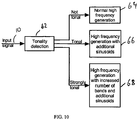
- the tonal detection (62) as described above can be carried out based on the input signal 10.
- the input frames are divided into three groups: not tonal (64), tonal (66) and strongly tonal (66), as illustrated in FIG. 10 .
- tonal detection (62) in a second step the quality of the tonal sections can be improved by adding additional sinusoids to the high frequency region and possibly by increasing the number of high frequency sub-bands used to create the high frequency region as described above.
- the signal is not tonal (64), and then the coding is continued as described above.
- additional sinusoids can be added to the high frequency spectrum after applying the coding as illustrated above.
- a fixed number of sinusoids can be added to the MDCT domain spectrum.
- the sinusoids can straightforwardly be added to the frequencies where the absolute difference between the original and the coded spectrum is largest.
- the positions and amplitudes of the sinusoids are quantized and submitted to the decoder.
- sinusoids can be added to the high frequency region of the spectrum.
- X H ( k ) and X H ( k ) representing the original and coded high frequency sub-band components, respectively
- the first sinusoid can be added to index k 1 , which can be obtained from
- the amplitude (including its sign) of the sinusoid can be defined as
- Equations (17) - (19) can be repeated until a desired number of sinusoids have been added. Typically, already four additional sinusoids can result in clearly improved results during tonal sections.
- the amplitudes of the sinusoids A i can be quantized and submitted to the decoder 8.
- the positions k i of the sinusoids can also be submitted.
- the decoder 8 can be informed that the current frame is tonal.
- the high frequency sub-bands remain very similar from one frame to another.
- special actions can be applied.
- the number of high frequency sub-bands nb is relatively low (i.e. 8 or below)
- the number of high frequency sub-bands can be increased to higher rates. For example, 16 high frequency sub-bands generally provide performance that is more accurate.
Landscapes
- Engineering & Computer Science (AREA)
- Physics & Mathematics (AREA)
- Audiology, Speech & Language Pathology (AREA)
- Computational Linguistics (AREA)
- Signal Processing (AREA)
- Health & Medical Sciences (AREA)
- Human Computer Interaction (AREA)
- Acoustics & Sound (AREA)
- Multimedia (AREA)
- Spectroscopy & Molecular Physics (AREA)
- Quality & Reliability (AREA)
- Theoretical Computer Science (AREA)
- Compression, Expansion, Code Conversion, And Decoders (AREA)
Claims (24)
- Procédé de codage de signaux audio avec :la réception d'un signal audio d'entrée ;la division du signal audio d'entrée en au moins une bande de fréquence basse et une bande de fréquence élevée ;la division de la bande de fréquence élevée en deux signaux de sous-bande de fréquence élevée, ou plus ;la détermination d'une mesure de similarité entre des sections de signaux de bande de fréquence basse et les signaux de sous-bande de fréquence élevée en comparant des échantillons de signaux de fréquence basse à des sous-bandes de fréquence élevée du signal audio d'entrée reçu ;le codage d'échantillons de signaux de fréquence basse de la bande de signal de fréquence basse ;la génération de paramètres qui font référence au moins aux sections de signaux de bande de fréquence basse ayant la mesure de similarité la plus élevée par rapport aux signaux de sous-bande de fréquence élevée, pour transposer les sections de signaux de bande de fréquence basse à une fréquence élevée afin de reconstruire les sous-bandes de fréquence élevée ;la division du signal audio d'entrée en trames successives temporellement ;la détection de sections tonales au sein des deux trames successives dans le signal audio d'entrée et, si des sections tonales sont détectées, l'ajout de sinusoïdes à la région de fréquence élevée ; etla création d'un flux binaire ayant les échantillons de signaux de fréquence basse codés, les paramètres et, si des sections tonales sont détectées, les positions et les amplitudes des sinusoïdes.
- Procédé selon la revendication 1, dans lequel la génération des paramètres comprend en outre la génération d'au moins un facteur de mise à l'échelle pour mettre à l'échelle les sections de signaux de bande de fréquence basse.
- Procédé selon la revendication 2, dans lequel le facteur de mise à l'échelle est généré de telle sorte qu'une enveloppe des sections de signaux de fréquence basse qui est transposée dans les signaux de sous-bande de fréquence élevée à l'aide des paramètres suit une enveloppe du signal de sous-bande de fréquence élevée du signal audio d'entrée reçu.
- Procédé selon la revendication 2, dans lequel la génération de facteurs de mise à l'échelle comprend la génération de facteurs de mise à l'échelle dans le domaine linéaire pour correspondre au moins aux pics d'amplitude dans le spectre.
- Procédé selon la revendication 2, dans lequel la génération de facteurs de mise à l'échelle comprend la génération de facteurs de mise à l'échelle dans le domaine logarithmique pour correspondre au moins à l'énergie et/ou à la forme du spectre.
- Procédé selon la revendication 1, dans lequel la génération de paramètres comprend la génération de liaisons vers des sections de signaux de fréquence basse qui représentent les signaux de sous-bande de fréquence élevée correspondants.
- Procédé selon la revendication 1, dans lequel la détermination dans les sections de signaux de bande de fréquence basse qui correspondent le mieux aux signaux de sous-bande de fréquence élevée comprend l'utilisation d'au moins un élément parmi :A) une corrélation normalisée,B) une distance euclidienne.
- Procédé selon la revendication 1, dans lequel au moins des échantillons des sections de signaux de fréquence basse sont générés en utilisant une transformation en cosinus discrète modifiée.
- Procédé selon la revendication 1, comprenant en outre la normalisation de l'enveloppe des signaux de sous-bande de fréquence élevée.
- Procédé selon la revendication 2, comprenant en outre la quantification d'échantillons du signal de fréquence basse et la quantification au moins des facteurs de mise à l'échelle.
- Procédé selon la revendication 1, dans lequel la détection de sections tonales comprend l'utilisation d'une transformée de Fourier discrète décalée.
- Procédé selon la revendication 1, comprenant en outre l'augmentation du nombre de sous-bandes de fréquence élevée pour des sections tonales.
- Procédé de décodage de signaux audio avec :la réception d'un flux binaire codé ;le décodage à partir du flux binaire d'au moins un signal de fréquence basse et au moins des paramètres faisant référence aux sections de signaux de fréquence basse, et dans lequel les paramètres font référence au moins aux sections de signaux de bande de fréquence basse ayant la mesure de similarité la plus élevée par rapport à un signal de sous-bande de fréquence élevée, pour transposer les sections de signaux de bande de fréquence basse à une fréquence élevée afin de reconstruire les sous-bandes de fréquence élevée ;l'extraction à partir des positions du flux binaire et des amplitudes des sinusoïdes si les positions et les amplitudes des sinusoïdes sont comprises dans le flux binaire,l'utilisation d'échantillons du signal de fréquence basse et des paramètres faisant référence aux sections de signaux de fréquence basse et, si comprises dans le flux binaire, des positions et des amplitudes des sinusoïdes pour reconstruire deux signaux de sous-bande de fréquence élevée, ou plus ; etl'émission d'un signal audio de sortie comprenant au moins le signal de fréquence basse et les deux signaux de sous-bande de fréquence élevée, ou plus, dans lequel les deux sous-bandes de fréquence élevée, ou plus, sont reconstruites à partir de l'au moins un signal de fréquence basse décodé, des paramètres, et si comprises dans le flux binaire, des positions et des amplitudes des sinusoïdes.
- Codeur permettant de coder des signaux audio comprenant :un moyen de réception agencé pour recevoir un signal audio d'entrée ;un moyen de filtrage agencé pour diviser le signal audio d'entrée en au moins une bande de fréquence basse et une bande de fréquence élevée, pour diviser la bande de fréquence élevée en deux signaux de sous-bande de fréquence élevée, ou plus, et agencé en outre pour diviser le signal audio d'entrée en trames successives temporellement, pour détecter des sections tonales dans deux trames successives dans le signal audio d'entrée ; etun moyen de codage agencé pour déterminer une mesure de similarité entre des sections de signaux de bande de fréquence basse et les signaux de sous-bande de fréquence élevée en comparant des échantillons de signaux de fréquence basse aux sous-bandes de fréquence élevée du signal audio d'entrée reçu, pour générer des paramètres qui font référence au moins aux sections de signaux de bandes de fréquence basse ayant la mesure de similarité la plus élevée par rapport aux signaux de sous-bandes de fréquence élevée, pour transposer les sections de signaux de bande de fréquence basse à une fréquence élevée afin de reconstruire les sous-bandes de fréquence élevée, et si des sections tonales sont détectées, ajouter des sinusoïdes à la région de fréquence élevée, le moyen de codage est agencé en outre pour coder des échantillons de signaux de fréquence basse de la bande de signal de fréquence basse, etun moyen de sortie pour créer un flux binaire avec les échantillons de signaux de fréquence basse codés, les paramètres et, si des sections tonales sont détectées, des positions et des amplitudes des sinusoïdes.
- Codeur selon la revendication 14, dans lequel les moyens de codage sont agencés pour générer au moins un facteur de mise à l'échelle pour mettre à l'échelle les sections de signaux de bande de fréquence basse.
- Codeur selon la revendication 14, dans lequel les moyens de codage sont agencés pour générer le facteur de mise à l'échelle de telle sorte qu'une enveloppe des sections de signaux de fréquence basse qui est transposée dans les signaux de sous-bande de fréquence élevée à l'aide des paramètres suit une enveloppe des signaux de sous-bande de fréquence élevée du signal reçu.
- Codeur selon la revendication 14, dans lequel les moyens de filtrage sont agencés pour détecter des sections tonales à l'aide d'une transformée de Fourier discrète décalée.
- Codeur selon la revendication 14, dans lequel les moyens de codage sont agencés pour augmenter le nombre de sous-bandes de fréquence élevée pour des sections tonales.
- Décodeur permettant de décoder des signaux audio comprenant :des moyens de réception agencés pour recevoir un flux binaire codé ;des moyens de décodage agencés pour décoder à partir du flux binaire au moins un signal de fréquence basse et au moins des paramètres faisant référence aux sections de signaux de fréquence basse, et pour extraire à partir des positions du flux binaire et des amplitudes des sinusoïdes si les positions et les amplitudes des sinusoïdes sont comprises dans le flux binaire, dans lequel les paramètres font référence au moins aux sections de signaux de bande de fréquence basse ayant la mesure de similarité la plus élevée par rapport à un signal de sous-bande de fréquence élevée, pour transposer les sections de signaux de bande de fréquence basse à une fréquence élevée afin de reconstruire les sous-bandes de fréquence élevée ; etdes moyens de génération agencés pour utiliser des échantillons du signal de fréquence basse et les paramètres faisant référence aux sections de signaux de fréquence basse et, si comprises dans le flux binaire, des positions et des amplitudes des sinusoïdes afin de reconstruire deux signaux de sous-bande de fréquence élevée, ou plus ;des moyen d'émission agencés pour émettre un signal audio de sortie comprenant l'au moins un signal de fréquence basse décodé et les deux signaux de sous-bande de fréquence élevée, ou plus,dans lequel les deux sous-bandes de fréquence élevée, ou plus, sont reconstruites à partir de l'au moins un signal de fréquence basse décodé, des paramètres, et si comprises dans le flux binaire, des positions et des amplitudes des sinusoïdes.
- Système destiné à une compression audio numérique comprenant un décodeur selon la revendication 19, et un codeur selon la revendication 14.
- Produit de programme informatique permettant de coder des signaux audio, le programme comprenant des instructions opérationnelles pour amener un processeur à :recevoir un signal audio d'entrée ;diviser le signal audio d'entrée en au moins une bande de fréquence basse et une bande de fréquence élevée ;diviser la bande de fréquence élevée en deux signaux de sous-bande de fréquence élevée, ou plus ;déterminer une mesure de similarité entre des sections de signaux de bande de fréquence basse et les signaux de sous-bande de fréquence élevée en comparant des échantillons de signaux de fréquence basse à des sous-bandes de fréquence élevée du signal audio d'entrée reçu ;coder des échantillons de signaux de fréquence basse de la bande de signal de fréquence basse ;générer des paramètres qui font référence au moins aux sections de signaux de bande de fréquence basse ayant la mesure de similarité la plus élevée par rapport aux signaux de sous-bande de fréquence élevée, pour transposer les sections de signaux de bande de fréquence basse à une fréquence élevée afin de reconstruire les sous-bandes de fréquence élevée ;diviser le signal audio d'entrée en trames successives temporellement ;détecter des sections tonales au sein des deux trames successives dans le signal audio d'entrée et, si des sections tonales sont détectées, l'ajout de sinusoïdes à la région de fréquence élevée ; etla création d'un flux binaire ayant les échantillons de signaux de fréquence basse codés, les paramètres et, si les sections tonales sont détectées, les positions et les amplitudes des sinusoïdes.
- Produit de programme informatique selon la revendication 21, dans lequel la détection de sections tonales comprend l'utilisation d'une transformation de Fourier discrète décalée pour détecter des sections tonales.
- Produit de programme informatique selon la revendication 21, opérationnel pour amener un processeur à augmenter le nombre de sous-bandes de fréquence élevée pour des sections tonales.
- Produit de programme informatique permettant de décoder des flux binaires, le programme comprenant des instructions opérationnelles pour amener un processeur à :recevoir un flux binaire codé ;décoder à partir du flux binaire au moins un signal de fréquence basse et au moins des paramètres faisant référence aux sections de signaux de fréquence basse, dans lequel les paramètres font référence au moins aux sections de signaux de bande de fréquence basse ayant la mesure de similarité la plus élevée par rapport à un signal de sous-bande de fréquence élevée, pour transposer les sections de signaux de bande de fréquence basse à une fréquence élevée afin de reconstruire les sous-bandes de fréquence élevée ;extraire à partir des positions du flux binaire et des amplitudes des sinusoïdes si les positions et les amplitudes des sinusoïdes sont comprises dans le flux binaire ;utiliser des échantillons du signal de fréquence basse et les paramètres faisant référence aux sections de signaux de fréquence basse et, si comprises dans le flux binaire, des positions et des amplitudes des sinusoïdes pour reconstruire deux signaux de sous-bande de fréquence élevée, ou plus ; etémettre un signal audio de sortie comprenant au moins le signal de fréquence basse et les deux signaux de sous-bande de fréquence élevée, ou plus, dans lequel les deux sous-bandes de fréquence élevée, ou plus, sont reconstruites à partir de l'au moins un signal de fréquence basse décodé, des paramètres et, si comprises dans le flux binaire, des positions et des amplitudes des sinusoïdes.
Applications Claiming Priority (1)
| Application Number | Priority Date | Filing Date | Title |
|---|---|---|---|
| PCT/IB2005/003293 WO2007052088A1 (fr) | 2005-11-04 | 2005-11-04 | Compression audio |
Publications (2)
| Publication Number | Publication Date |
|---|---|
| EP1943643A1 EP1943643A1 (fr) | 2008-07-16 |
| EP1943643B1 true EP1943643B1 (fr) | 2019-10-09 |
Family
ID=35883664
Family Applications (1)
| Application Number | Title | Priority Date | Filing Date |
|---|---|---|---|
| EP05806493.2A Expired - Lifetime EP1943643B1 (fr) | 2005-11-04 | 2005-11-04 | Compression audio |
Country Status (8)
| Country | Link |
|---|---|
| US (1) | US8326638B2 (fr) |
| EP (1) | EP1943643B1 (fr) |
| JP (1) | JP4950210B2 (fr) |
| KR (1) | KR100958144B1 (fr) |
| CN (1) | CN101297356B (fr) |
| AU (1) | AU2005337961B2 (fr) |
| BR (1) | BRPI0520729B1 (fr) |
| WO (1) | WO2007052088A1 (fr) |
Families Citing this family (60)
| Publication number | Priority date | Publication date | Assignee | Title |
|---|---|---|---|---|
| KR101393298B1 (ko) * | 2006-07-08 | 2014-05-12 | 삼성전자주식회사 | 적응적 부호화/복호화 방법 및 장치 |
| KR101434198B1 (ko) * | 2006-11-17 | 2014-08-26 | 삼성전자주식회사 | 신호 복호화 방법 |
| EP2220646A1 (fr) * | 2007-11-06 | 2010-08-25 | Nokia Corporation | Appareil de codage audio et procédé associé |
| EP2227682A1 (fr) * | 2007-11-06 | 2010-09-15 | Nokia Corporation | Un codeur |
| KR101238239B1 (ko) * | 2007-11-06 | 2013-03-04 | 노키아 코포레이션 | 인코더 |
| US9275648B2 (en) * | 2007-12-18 | 2016-03-01 | Lg Electronics Inc. | Method and apparatus for processing audio signal using spectral data of audio signal |
| EP2077551B1 (fr) * | 2008-01-04 | 2011-03-02 | Dolby Sweden AB | Encodeur audio et décodeur |
| CN101925953B (zh) * | 2008-01-25 | 2012-06-20 | 松下电器产业株式会社 | 编码装置、解码装置以及其方法 |
| BRPI0915358B1 (pt) * | 2008-06-13 | 2020-04-22 | Nokia Technologies Oy | método e aparelho para a ocultação de erro de quadro em dados de áudio codificados usando codificação de extensão |
| JP2010079275A (ja) * | 2008-08-29 | 2010-04-08 | Sony Corp | 周波数帯域拡大装置及び方法、符号化装置及び方法、復号化装置及び方法、並びにプログラム |
| PL3751570T3 (pl) * | 2009-01-28 | 2022-03-07 | Dolby International Ab | Ulepszona transpozycja harmonicznych |
| US8983831B2 (en) | 2009-02-26 | 2015-03-17 | Panasonic Intellectual Property Corporation Of America | Encoder, decoder, and method therefor |
| CN102460574A (zh) * | 2009-05-19 | 2012-05-16 | 韩国电子通信研究院 | 用于使用层级正弦脉冲编码对音频信号进行编码和解码的方法和设备 |
| WO2011000408A1 (fr) * | 2009-06-30 | 2011-01-06 | Nokia Corporation | Codage audio |
| JP5433022B2 (ja) | 2009-09-18 | 2014-03-05 | ドルビー インターナショナル アーベー | 高調波転換 |
| WO2011035813A1 (fr) * | 2009-09-25 | 2011-03-31 | Nokia Corporation | Codage audio |
| JP5754899B2 (ja) | 2009-10-07 | 2015-07-29 | ソニー株式会社 | 復号装置および方法、並びにプログラム |
| EP3998606B8 (fr) * | 2009-10-21 | 2022-12-07 | Dolby International AB | Suréchantillonnage dans un banc de filtres de transposition combinés |
| JP5565914B2 (ja) | 2009-10-23 | 2014-08-06 | パナソニック インテレクチュアル プロパティ コーポレーション オブ アメリカ | 符号化装置、復号装置およびこれらの方法 |
| US8670980B2 (en) | 2009-10-26 | 2014-03-11 | Panasonic Corporation | Tone determination device and method |
| US8838443B2 (en) | 2009-11-12 | 2014-09-16 | Panasonic Intellectual Property Corporation Of America | Encoder apparatus, decoder apparatus and methods of these |
| EP2362375A1 (fr) * | 2010-02-26 | 2011-08-31 | Fraunhofer-Gesellschaft zur Förderung der Angewandten Forschung e.V. | Dispositif et procédé de modification d'un signal audio par mise en forme de son envelope |
| WO2011114192A1 (fr) * | 2010-03-19 | 2011-09-22 | Nokia Corporation | Procédé et appareil de codage audio |
| JP5652658B2 (ja) | 2010-04-13 | 2015-01-14 | ソニー株式会社 | 信号処理装置および方法、符号化装置および方法、復号装置および方法、並びにプログラム |
| JP5609737B2 (ja) | 2010-04-13 | 2014-10-22 | ソニー株式会社 | 信号処理装置および方法、符号化装置および方法、復号装置および方法、並びにプログラム |
| JP5850216B2 (ja) | 2010-04-13 | 2016-02-03 | ソニー株式会社 | 信号処理装置および方法、符号化装置および方法、復号装置および方法、並びにプログラム |
| HUE028738T2 (en) | 2010-06-09 | 2017-01-30 | Panasonic Ip Corp America | Bandwidth Extension Procedure, Bandwidth Extension Device, Program, Integrated Circuit, and Audio Decoder |
| RU2012155222A (ru) | 2010-06-21 | 2014-07-27 | Панасоник Корпорэйшн | Устройство декодирования, устройство кодирования и соответствующие способы |
| US9047875B2 (en) * | 2010-07-19 | 2015-06-02 | Futurewei Technologies, Inc. | Spectrum flatness control for bandwidth extension |
| US8924222B2 (en) | 2010-07-30 | 2014-12-30 | Qualcomm Incorporated | Systems, methods, apparatus, and computer-readable media for coding of harmonic signals |
| US9208792B2 (en) | 2010-08-17 | 2015-12-08 | Qualcomm Incorporated | Systems, methods, apparatus, and computer-readable media for noise injection |
| JP5552988B2 (ja) * | 2010-09-27 | 2014-07-16 | 富士通株式会社 | 音声帯域拡張装置および音声帯域拡張方法 |
| JP5707842B2 (ja) | 2010-10-15 | 2015-04-30 | ソニー株式会社 | 符号化装置および方法、復号装置および方法、並びにプログラム |
| WO2012052802A1 (fr) * | 2010-10-18 | 2012-04-26 | Nokia Corporation | Appareil codeur/décodeur de signaux audio |
| JP5743137B2 (ja) * | 2011-01-14 | 2015-07-01 | ソニー株式会社 | 信号処理装置および方法、並びにプログラム |
| US9536534B2 (en) * | 2011-04-20 | 2017-01-03 | Panasonic Intellectual Property Corporation Of America | Speech/audio encoding apparatus, speech/audio decoding apparatus, and methods thereof |
| RU2464649C1 (ru) * | 2011-06-01 | 2012-10-20 | Корпорация "САМСУНГ ЭЛЕКТРОНИКС Ко., Лтд." | Способ обработки звукового сигнала |
| JP5942358B2 (ja) * | 2011-08-24 | 2016-06-29 | ソニー株式会社 | 符号化装置および方法、復号装置および方法、並びにプログラム |
| JP5807453B2 (ja) * | 2011-08-30 | 2015-11-10 | 富士通株式会社 | 符号化方法、符号化装置および符号化プログラム |
| US9384749B2 (en) * | 2011-09-09 | 2016-07-05 | Panasonic Intellectual Property Corporation Of America | Encoding device, decoding device, encoding method and decoding method |
| JPWO2013057895A1 (ja) * | 2011-10-19 | 2015-04-02 | パナソニック インテレクチュアル プロパティ コーポレーション オブアメリカPanasonic Intellectual Property Corporation of America | 符号化装置及び符号化方法 |
| ES2914499T3 (es) | 2011-10-28 | 2022-06-13 | Fraunhofer Ges Forschung | Aparato de codificación y procedimiento de codificación |
| CN104221082B (zh) | 2012-03-29 | 2017-03-08 | 瑞典爱立信有限公司 | 谐波音频信号的带宽扩展 |
| EP2717263B1 (fr) | 2012-10-05 | 2016-11-02 | Nokia Technologies Oy | Procédé, appareil et produit de programme informatique pour analyse-synthèse spatiale par catégorie sur le spectre d'un signal audio multi-canaux |
| CN103971694B (zh) | 2013-01-29 | 2016-12-28 | 华为技术有限公司 | 带宽扩展频带信号的预测方法、解码设备 |
| US9706324B2 (en) | 2013-05-17 | 2017-07-11 | Nokia Technologies Oy | Spatial object oriented audio apparatus |
| CN103280222B (zh) * | 2013-06-03 | 2014-08-06 | 腾讯科技(深圳)有限公司 | 音频编码、解码方法及其系统 |
| EP3614381A1 (fr) | 2013-09-16 | 2020-02-26 | Samsung Electronics Co., Ltd. | Procédé et dispositif de codage de signal et procédé et dispositif de décodage de signal |
| KR102315920B1 (ko) * | 2013-09-16 | 2021-10-21 | 삼성전자주식회사 | 신호 부호화방법 및 장치와 신호 복호화방법 및 장치 |
| US9875746B2 (en) | 2013-09-19 | 2018-01-23 | Sony Corporation | Encoding device and method, decoding device and method, and program |
| RU2764260C2 (ru) | 2013-12-27 | 2022-01-14 | Сони Корпорейшн | Устройство и способ декодирования |
| WO2015147434A1 (fr) * | 2014-03-25 | 2015-10-01 | 인텔렉추얼디스커버리 주식회사 | Dispositif et procédé de traitement de signal audio |
| US10020002B2 (en) * | 2015-04-05 | 2018-07-10 | Qualcomm Incorporated | Gain parameter estimation based on energy saturation and signal scaling |
| US9613628B2 (en) * | 2015-07-01 | 2017-04-04 | Gopro, Inc. | Audio decoder for wind and microphone noise reduction in a microphone array system |
| DE102017200320A1 (de) * | 2017-01-11 | 2018-07-12 | Sivantos Pte. Ltd. | Verfahren zur Frequenzverzerrung eines Audiosignals |
| JP2020105231A (ja) * | 2017-03-22 | 2020-07-09 | Spiber株式会社 | モールド成形体及びモールド成形体の製造方法 |
| CN109036457B (zh) * | 2018-09-10 | 2021-10-08 | 广州酷狗计算机科技有限公司 | 恢复音频信号的方法和装置 |
| CN110111800B (zh) * | 2019-04-04 | 2021-05-07 | 深圳信息职业技术学院 | 一种电子耳蜗的频带划分方法、装置及电子耳蜗设备 |
| CN113192523B (zh) * | 2020-01-13 | 2024-07-16 | 华为技术有限公司 | 一种音频编解码方法和音频编解码设备 |
| CN113808597B (zh) * | 2020-05-30 | 2024-10-29 | 华为技术有限公司 | 一种音频编码方法和音频编码装置 |
Family Cites Families (9)
| Publication number | Priority date | Publication date | Assignee | Title |
|---|---|---|---|---|
| SE512719C2 (sv) * | 1997-06-10 | 2000-05-02 | Lars Gustaf Liljeryd | En metod och anordning för reduktion av dataflöde baserad på harmonisk bandbreddsexpansion |
| JPH11120185A (ja) * | 1997-10-09 | 1999-04-30 | Canon Inc | 情報処理装置及びその方法 |
| US6711540B1 (en) * | 1998-09-25 | 2004-03-23 | Legerity, Inc. | Tone detector with noise detection and dynamic thresholding for robust performance |
| US7031553B2 (en) * | 2000-09-22 | 2006-04-18 | Sri International | Method and apparatus for recognizing text in an image sequence of scene imagery |
| US7447639B2 (en) * | 2001-01-24 | 2008-11-04 | Nokia Corporation | System and method for error concealment in digital audio transmission |
| EP1444688B1 (fr) * | 2001-11-14 | 2006-08-16 | Matsushita Electric Industrial Co., Ltd. | Dispositif de codage et dispositif de decodage |
| WO2003065353A1 (fr) * | 2002-01-30 | 2003-08-07 | Matsushita Electric Industrial Co., Ltd. | Dispositif de codage et de decodage audio, procedes correspondants |
| EP2019391B1 (fr) * | 2002-07-19 | 2013-01-16 | NEC Corporation | Appareil de décodage audio et procédé de décodage et programme |
| KR100524065B1 (ko) * | 2002-12-23 | 2005-10-26 | 삼성전자주식회사 | 시간-주파수 상관성을 이용한 개선된 오디오 부호화및/또는 복호화 방법과 그 장치 |
-
2005
- 2005-11-04 WO PCT/IB2005/003293 patent/WO2007052088A1/fr not_active Ceased
- 2005-11-04 JP JP2008538430A patent/JP4950210B2/ja not_active Expired - Fee Related
- 2005-11-04 KR KR1020087010631A patent/KR100958144B1/ko not_active Expired - Fee Related
- 2005-11-04 CN CN2005800519760A patent/CN101297356B/zh not_active Expired - Fee Related
- 2005-11-04 US US12/084,677 patent/US8326638B2/en active Active
- 2005-11-04 BR BRPI0520729-0A patent/BRPI0520729B1/pt not_active IP Right Cessation
- 2005-11-04 EP EP05806493.2A patent/EP1943643B1/fr not_active Expired - Lifetime
- 2005-11-04 AU AU2005337961A patent/AU2005337961B2/en not_active Ceased
Non-Patent Citations (1)
| Title |
|---|
| None * |
Also Published As
| Publication number | Publication date |
|---|---|
| JP2009515212A (ja) | 2009-04-09 |
| CN101297356A (zh) | 2008-10-29 |
| US8326638B2 (en) | 2012-12-04 |
| AU2005337961A1 (en) | 2007-05-10 |
| BRPI0520729B1 (pt) | 2019-04-02 |
| KR100958144B1 (ko) | 2010-05-18 |
| BRPI0520729A8 (pt) | 2016-03-22 |
| US20090271204A1 (en) | 2009-10-29 |
| EP1943643A1 (fr) | 2008-07-16 |
| BRPI0520729A2 (pt) | 2009-05-26 |
| KR20080059279A (ko) | 2008-06-26 |
| JP4950210B2 (ja) | 2012-06-13 |
| AU2005337961B2 (en) | 2011-04-21 |
| WO2007052088A1 (fr) | 2007-05-10 |
| CN101297356B (zh) | 2011-11-09 |
Similar Documents
| Publication | Publication Date | Title |
|---|---|---|
| US8326638B2 (en) | Audio compression | |
| EP3244407B1 (fr) | Appareil et procédé pour modifier une représentation paramétrée | |
| KR101256808B1 (ko) | 외적 향상 고조파 전치 | |
| EP2479750B1 (fr) | Procédé pour le filtrage hiérarchique d'un signal audio et procédé pour la réconstruction hiérarchique des échantillons temporels d'un signal audio | |
| KR101120911B1 (ko) | 음성신호 복호화 장치 및 음성신호 부호화 장치 | |
| CN101276587B (zh) | 声音编码装置及其方法和声音解码装置及其方法 | |
| US9167367B2 (en) | Optimized low-bit rate parametric coding/decoding | |
| EP2200026B1 (fr) | Appareil de codage et procédé de codage | |
| CN111210832B (zh) | 基于频谱包络模板的带宽扩展音频编解码方法及装置 | |
| JPWO2009125588A1 (ja) | 符号化装置および符号化方法 | |
| RU2409874C9 (ru) | Сжатие звуковых сигналов | |
| CN104078048A (zh) | 一种声音解码装置及其方法 | |
| HK1246495B (en) | Apparatus and method for modifying a parameterized representation | |
| HK1135502A (en) | Apparatus and method for converting an audio signal into a parameterized representation, apparatus and method for modifying a parameterized representation, apparatus and method for synthesizing a parameterized representation of an audio signal | |
| HK1250089B (en) | Apparatus and method for synthesizing a parameterized representation of an audio signal | |
| HK1251074B (en) | Apparatus and method for modifying a parameterized representation |
Legal Events
| Date | Code | Title | Description |
|---|---|---|---|
| PUAI | Public reference made under article 153(3) epc to a published international application that has entered the european phase |
Free format text: ORIGINAL CODE: 0009012 |
|
| 17P | Request for examination filed |
Effective date: 20080318 |
|
| AK | Designated contracting states |
Kind code of ref document: A1 Designated state(s): AT BE BG CH CY CZ DE DK EE ES FI FR GB GR HU IE IS IT LI LT LU LV MC NL PL PT RO SE SI SK TR |
|
| 17Q | First examination report despatched |
Effective date: 20101126 |
|
| DAX | Request for extension of the european patent (deleted) | ||
| RAP1 | Party data changed (applicant data changed or rights of an application transferred) |
Owner name: NOKIA CORPORATION |
|
| RAP1 | Party data changed (applicant data changed or rights of an application transferred) |
Owner name: NOKIA TECHNOLOGIES OY |
|
| STAA | Information on the status of an ep patent application or granted ep patent |
Free format text: STATUS: EXAMINATION IS IN PROGRESS |
|
| REG | Reference to a national code |
Ref country code: DE Ref legal event code: R079 Ref document number: 602005056312 Country of ref document: DE Free format text: PREVIOUS MAIN CLASS: G10L0021020000 Ipc: G10L0019020000 |
|
| GRAP | Despatch of communication of intention to grant a patent |
Free format text: ORIGINAL CODE: EPIDOSNIGR1 |
|
| STAA | Information on the status of an ep patent application or granted ep patent |
Free format text: STATUS: GRANT OF PATENT IS INTENDED |
|
| RIC1 | Information provided on ipc code assigned before grant |
Ipc: G10L 19/02 20130101AFI20190315BHEP |
|
| INTG | Intention to grant announced |
Effective date: 20190417 |
|
| GRAS | Grant fee paid |
Free format text: ORIGINAL CODE: EPIDOSNIGR3 |
|
| RAP1 | Party data changed (applicant data changed or rights of an application transferred) |
Owner name: NOKIA TECHNOLOGIES OY |
|
| GRAA | (expected) grant |
Free format text: ORIGINAL CODE: 0009210 |
|
| STAA | Information on the status of an ep patent application or granted ep patent |
Free format text: STATUS: THE PATENT HAS BEEN GRANTED |
|
| AK | Designated contracting states |
Kind code of ref document: B1 Designated state(s): AT BE BG CH CY CZ DE DK EE ES FI FR GB GR HU IE IS IT LI LT LU LV MC NL PL PT RO SE SI SK TR |
|
| REG | Reference to a national code |
Ref country code: GB Ref legal event code: FG4D |
|
| REG | Reference to a national code |
Ref country code: CH Ref legal event code: EP |
|
| REG | Reference to a national code |
Ref country code: IE Ref legal event code: FG4D |
|
| REG | Reference to a national code |
Ref country code: DE Ref legal event code: R096 Ref document number: 602005056312 Country of ref document: DE |
|
| REG | Reference to a national code |
Ref country code: AT Ref legal event code: REF Ref document number: 1189736 Country of ref document: AT Kind code of ref document: T Effective date: 20191115 |
|
| REG | Reference to a national code |
Ref country code: NL Ref legal event code: MP Effective date: 20191009 |
|
| REG | Reference to a national code |
Ref country code: LT Ref legal event code: MG4D |
|
| REG | Reference to a national code |
Ref country code: AT Ref legal event code: MK05 Ref document number: 1189736 Country of ref document: AT Kind code of ref document: T Effective date: 20191009 |
|
| PG25 | Lapsed in a contracting state [announced via postgrant information from national office to epo] |
Ref country code: NL Free format text: LAPSE BECAUSE OF FAILURE TO SUBMIT A TRANSLATION OF THE DESCRIPTION OR TO PAY THE FEE WITHIN THE PRESCRIBED TIME-LIMIT Effective date: 20191009 Ref country code: PL Free format text: LAPSE BECAUSE OF FAILURE TO SUBMIT A TRANSLATION OF THE DESCRIPTION OR TO PAY THE FEE WITHIN THE PRESCRIBED TIME-LIMIT Effective date: 20191009 Ref country code: SE Free format text: LAPSE BECAUSE OF FAILURE TO SUBMIT A TRANSLATION OF THE DESCRIPTION OR TO PAY THE FEE WITHIN THE PRESCRIBED TIME-LIMIT Effective date: 20191009 Ref country code: AT Free format text: LAPSE BECAUSE OF FAILURE TO SUBMIT A TRANSLATION OF THE DESCRIPTION OR TO PAY THE FEE WITHIN THE PRESCRIBED TIME-LIMIT Effective date: 20191009 Ref country code: LV Free format text: LAPSE BECAUSE OF FAILURE TO SUBMIT A TRANSLATION OF THE DESCRIPTION OR TO PAY THE FEE WITHIN THE PRESCRIBED TIME-LIMIT Effective date: 20191009 Ref country code: ES Free format text: LAPSE BECAUSE OF FAILURE TO SUBMIT A TRANSLATION OF THE DESCRIPTION OR TO PAY THE FEE WITHIN THE PRESCRIBED TIME-LIMIT Effective date: 20191009 Ref country code: PT Free format text: LAPSE BECAUSE OF FAILURE TO SUBMIT A TRANSLATION OF THE DESCRIPTION OR TO PAY THE FEE WITHIN THE PRESCRIBED TIME-LIMIT Effective date: 20200210 Ref country code: LT Free format text: LAPSE BECAUSE OF FAILURE TO SUBMIT A TRANSLATION OF THE DESCRIPTION OR TO PAY THE FEE WITHIN THE PRESCRIBED TIME-LIMIT Effective date: 20191009 Ref country code: GR Free format text: LAPSE BECAUSE OF FAILURE TO SUBMIT A TRANSLATION OF THE DESCRIPTION OR TO PAY THE FEE WITHIN THE PRESCRIBED TIME-LIMIT Effective date: 20200110 Ref country code: FI Free format text: LAPSE BECAUSE OF FAILURE TO SUBMIT A TRANSLATION OF THE DESCRIPTION OR TO PAY THE FEE WITHIN THE PRESCRIBED TIME-LIMIT Effective date: 20191009 Ref country code: BG Free format text: LAPSE BECAUSE OF FAILURE TO SUBMIT A TRANSLATION OF THE DESCRIPTION OR TO PAY THE FEE WITHIN THE PRESCRIBED TIME-LIMIT Effective date: 20200109 |
|
| PG25 | Lapsed in a contracting state [announced via postgrant information from national office to epo] |
Ref country code: IS Free format text: LAPSE BECAUSE OF FAILURE TO SUBMIT A TRANSLATION OF THE DESCRIPTION OR TO PAY THE FEE WITHIN THE PRESCRIBED TIME-LIMIT Effective date: 20200224 |
|
| REG | Reference to a national code |
Ref country code: DE Ref legal event code: R119 Ref document number: 602005056312 Country of ref document: DE |
|
| REG | Reference to a national code |
Ref country code: CH Ref legal event code: PL |
|
| PG2D | Information on lapse in contracting state deleted |
Ref country code: IS |
|
| PG25 | Lapsed in a contracting state [announced via postgrant information from national office to epo] |
Ref country code: LI Free format text: LAPSE BECAUSE OF NON-PAYMENT OF DUE FEES Effective date: 20191130 Ref country code: CH Free format text: LAPSE BECAUSE OF NON-PAYMENT OF DUE FEES Effective date: 20191130 Ref country code: MC Free format text: LAPSE BECAUSE OF FAILURE TO SUBMIT A TRANSLATION OF THE DESCRIPTION OR TO PAY THE FEE WITHIN THE PRESCRIBED TIME-LIMIT Effective date: 20191009 Ref country code: EE Free format text: LAPSE BECAUSE OF FAILURE TO SUBMIT A TRANSLATION OF THE DESCRIPTION OR TO PAY THE FEE WITHIN THE PRESCRIBED TIME-LIMIT Effective date: 20191009 Ref country code: DK Free format text: LAPSE BECAUSE OF FAILURE TO SUBMIT A TRANSLATION OF THE DESCRIPTION OR TO PAY THE FEE WITHIN THE PRESCRIBED TIME-LIMIT Effective date: 20191009 Ref country code: LU Free format text: LAPSE BECAUSE OF NON-PAYMENT OF DUE FEES Effective date: 20191104 Ref country code: CZ Free format text: LAPSE BECAUSE OF FAILURE TO SUBMIT A TRANSLATION OF THE DESCRIPTION OR TO PAY THE FEE WITHIN THE PRESCRIBED TIME-LIMIT Effective date: 20191009 Ref country code: RO Free format text: LAPSE BECAUSE OF FAILURE TO SUBMIT A TRANSLATION OF THE DESCRIPTION OR TO PAY THE FEE WITHIN THE PRESCRIBED TIME-LIMIT Effective date: 20191009 Ref country code: IS Free format text: LAPSE BECAUSE OF FAILURE TO SUBMIT A TRANSLATION OF THE DESCRIPTION OR TO PAY THE FEE WITHIN THE PRESCRIBED TIME-LIMIT Effective date: 20200209 |
|
| PLBE | No opposition filed within time limit |
Free format text: ORIGINAL CODE: 0009261 |
|
| STAA | Information on the status of an ep patent application or granted ep patent |
Free format text: STATUS: NO OPPOSITION FILED WITHIN TIME LIMIT |
|
| REG | Reference to a national code |
Ref country code: BE Ref legal event code: MM Effective date: 20191130 |
|
| PG25 | Lapsed in a contracting state [announced via postgrant information from national office to epo] |
Ref country code: IT Free format text: LAPSE BECAUSE OF FAILURE TO SUBMIT A TRANSLATION OF THE DESCRIPTION OR TO PAY THE FEE WITHIN THE PRESCRIBED TIME-LIMIT Effective date: 20191009 Ref country code: SK Free format text: LAPSE BECAUSE OF FAILURE TO SUBMIT A TRANSLATION OF THE DESCRIPTION OR TO PAY THE FEE WITHIN THE PRESCRIBED TIME-LIMIT Effective date: 20191009 |
|
| 26N | No opposition filed |
Effective date: 20200710 |
|
| GBPC | Gb: european patent ceased through non-payment of renewal fee |
Effective date: 20200109 |
|
| PG25 | Lapsed in a contracting state [announced via postgrant information from national office to epo] |
Ref country code: IE Free format text: LAPSE BECAUSE OF NON-PAYMENT OF DUE FEES Effective date: 20191104 Ref country code: DE Free format text: LAPSE BECAUSE OF NON-PAYMENT OF DUE FEES Effective date: 20200603 Ref country code: FR Free format text: LAPSE BECAUSE OF NON-PAYMENT OF DUE FEES Effective date: 20191209 Ref country code: GB Free format text: LAPSE BECAUSE OF NON-PAYMENT OF DUE FEES Effective date: 20200109 |
|
| PG25 | Lapsed in a contracting state [announced via postgrant information from national office to epo] |
Ref country code: BE Free format text: LAPSE BECAUSE OF NON-PAYMENT OF DUE FEES Effective date: 20191130 Ref country code: SI Free format text: LAPSE BECAUSE OF FAILURE TO SUBMIT A TRANSLATION OF THE DESCRIPTION OR TO PAY THE FEE WITHIN THE PRESCRIBED TIME-LIMIT Effective date: 20191009 |
|
| PG25 | Lapsed in a contracting state [announced via postgrant information from national office to epo] |
Ref country code: CY Free format text: LAPSE BECAUSE OF FAILURE TO SUBMIT A TRANSLATION OF THE DESCRIPTION OR TO PAY THE FEE WITHIN THE PRESCRIBED TIME-LIMIT Effective date: 20191009 |
|
| PG25 | Lapsed in a contracting state [announced via postgrant information from national office to epo] |
Ref country code: HU Free format text: LAPSE BECAUSE OF FAILURE TO SUBMIT A TRANSLATION OF THE DESCRIPTION OR TO PAY THE FEE WITHIN THE PRESCRIBED TIME-LIMIT; INVALID AB INITIO Effective date: 20051104 |
|
| PG25 | Lapsed in a contracting state [announced via postgrant information from national office to epo] |
Ref country code: TR Free format text: LAPSE BECAUSE OF FAILURE TO SUBMIT A TRANSLATION OF THE DESCRIPTION OR TO PAY THE FEE WITHIN THE PRESCRIBED TIME-LIMIT Effective date: 20191009 |