EP1946834A1 - Particule de support de catalyseur, catalyseur d'epuration de gaz d'echappement et leurs procedes de production - Google Patents
Particule de support de catalyseur, catalyseur d'epuration de gaz d'echappement et leurs procedes de production Download PDFInfo
- Publication number
- EP1946834A1 EP1946834A1 EP06823217A EP06823217A EP1946834A1 EP 1946834 A1 EP1946834 A1 EP 1946834A1 EP 06823217 A EP06823217 A EP 06823217A EP 06823217 A EP06823217 A EP 06823217A EP 1946834 A1 EP1946834 A1 EP 1946834A1
- Authority
- EP
- European Patent Office
- Prior art keywords
- salt
- solution
- platinum
- ceria
- particle
- Prior art date
- Legal status (The legal status is an assumption and is not a legal conclusion. Google has not performed a legal analysis and makes no representation as to the accuracy of the status listed.)
- Granted
Links
Images





Classifications
-
- B—PERFORMING OPERATIONS; TRANSPORTING
- B01—PHYSICAL OR CHEMICAL PROCESSES OR APPARATUS IN GENERAL
- B01J—CHEMICAL OR PHYSICAL PROCESSES, e.g. CATALYSIS OR COLLOID CHEMISTRY; THEIR RELEVANT APPARATUS
- B01J23/00—Catalysts comprising metals or metal oxides or hydroxides, not provided for in group B01J21/00
- B01J23/10—Catalysts comprising metals or metal oxides or hydroxides, not provided for in group B01J21/00 of rare earths
-
- B—PERFORMING OPERATIONS; TRANSPORTING
- B01—PHYSICAL OR CHEMICAL PROCESSES OR APPARATUS IN GENERAL
- B01D—SEPARATION
- B01D53/00—Separation of gases or vapours; Recovering vapours of volatile solvents from gases; Chemical or biological purification of waste gases, e.g. engine exhaust gases, smoke, fumes, flue gases, aerosols
- B01D53/34—Chemical or biological purification of waste gases
- B01D53/92—Chemical or biological purification of waste gases of engine exhaust gases
- B01D53/94—Chemical or biological purification of waste gases of engine exhaust gases by catalytic processes
- B01D53/9445—Simultaneously removing carbon monoxide, hydrocarbons or nitrogen oxides making use of three-way catalysts [TWC] or four-way-catalysts [FWC]
- B01D53/945—Simultaneously removing carbon monoxide, hydrocarbons or nitrogen oxides making use of three-way catalysts [TWC] or four-way-catalysts [FWC] characterised by a specific catalyst
-
- B—PERFORMING OPERATIONS; TRANSPORTING
- B01—PHYSICAL OR CHEMICAL PROCESSES OR APPARATUS IN GENERAL
- B01J—CHEMICAL OR PHYSICAL PROCESSES, e.g. CATALYSIS OR COLLOID CHEMISTRY; THEIR RELEVANT APPARATUS
- B01J23/00—Catalysts comprising metals or metal oxides or hydroxides, not provided for in group B01J21/00
- B01J23/38—Catalysts comprising metals or metal oxides or hydroxides, not provided for in group B01J21/00 of noble metals
- B01J23/54—Catalysts comprising metals or metal oxides or hydroxides, not provided for in group B01J21/00 of noble metals combined with metals, oxides or hydroxides provided for in groups B01J23/02 - B01J23/36
- B01J23/56—Platinum group metals
- B01J23/63—Platinum group metals with rare earths or actinides
-
- B—PERFORMING OPERATIONS; TRANSPORTING
- B01—PHYSICAL OR CHEMICAL PROCESSES OR APPARATUS IN GENERAL
- B01J—CHEMICAL OR PHYSICAL PROCESSES, e.g. CATALYSIS OR COLLOID CHEMISTRY; THEIR RELEVANT APPARATUS
- B01J35/00—Catalysts, in general, characterised by their form or physical properties
- B01J35/30—Catalysts, in general, characterised by their form or physical properties characterised by their physical properties
- B01J35/391—Physical properties of the active metal ingredient
- B01J35/393—Metal or metal oxide crystallite size
-
- B—PERFORMING OPERATIONS; TRANSPORTING
- B01—PHYSICAL OR CHEMICAL PROCESSES OR APPARATUS IN GENERAL
- B01J—CHEMICAL OR PHYSICAL PROCESSES, e.g. CATALYSIS OR COLLOID CHEMISTRY; THEIR RELEVANT APPARATUS
- B01J35/00—Catalysts, in general, characterised by their form or physical properties
- B01J35/80—Catalysts, in general, characterised by their form or physical properties characterised by their amorphous structures
-
- B—PERFORMING OPERATIONS; TRANSPORTING
- B01—PHYSICAL OR CHEMICAL PROCESSES OR APPARATUS IN GENERAL
- B01J—CHEMICAL OR PHYSICAL PROCESSES, e.g. CATALYSIS OR COLLOID CHEMISTRY; THEIR RELEVANT APPARATUS
- B01J37/00—Processes, in general, for preparing catalysts; Processes, in general, for activation of catalysts
- B01J37/02—Impregnation, coating or precipitation
- B01J37/03—Precipitation; Co-precipitation
-
- C—CHEMISTRY; METALLURGY
- C01—INORGANIC CHEMISTRY
- C01F—COMPOUNDS OF THE METALS BERYLLIUM, MAGNESIUM, ALUMINIUM, CALCIUM, STRONTIUM, BARIUM, RADIUM, THORIUM, OR OF THE RARE-EARTH METALS
- C01F17/00—Compounds of rare earth metals
- C01F17/20—Compounds containing only rare earth metals as the metal element
- C01F17/206—Compounds containing only rare earth metals as the metal element oxide or hydroxide being the only anion
- C01F17/224—Oxides or hydroxides of lanthanides
- C01F17/235—Cerium oxides or hydroxides
-
- C—CHEMISTRY; METALLURGY
- C01—INORGANIC CHEMISTRY
- C01F—COMPOUNDS OF THE METALS BERYLLIUM, MAGNESIUM, ALUMINIUM, CALCIUM, STRONTIUM, BARIUM, RADIUM, THORIUM, OR OF THE RARE-EARTH METALS
- C01F7/00—Compounds of aluminium
- C01F7/02—Aluminium oxide; Aluminium hydroxide; Aluminates
-
- C—CHEMISTRY; METALLURGY
- C01—INORGANIC CHEMISTRY
- C01F—COMPOUNDS OF THE METALS BERYLLIUM, MAGNESIUM, ALUMINIUM, CALCIUM, STRONTIUM, BARIUM, RADIUM, THORIUM, OR OF THE RARE-EARTH METALS
- C01F7/00—Compounds of aluminium
- C01F7/02—Aluminium oxide; Aluminium hydroxide; Aluminates
- C01F7/34—Preparation of aluminium hydroxide by precipitation from solutions containing aluminium salts
-
- C—CHEMISTRY; METALLURGY
- C04—CEMENTS; CONCRETE; ARTIFICIAL STONE; CERAMICS; REFRACTORIES
- C04B—LIME, MAGNESIA; SLAG; CEMENTS; COMPOSITIONS THEREOF, e.g. MORTARS, CONCRETE OR LIKE BUILDING MATERIALS; ARTIFICIAL STONE; CERAMICS; REFRACTORIES; TREATMENT OF NATURAL STONE
- C04B35/00—Shaped ceramic products characterised by their composition; Ceramics compositions; Processing powders of inorganic compounds preparatory to the manufacturing of ceramic products
- C04B35/01—Shaped ceramic products characterised by their composition; Ceramics compositions; Processing powders of inorganic compounds preparatory to the manufacturing of ceramic products based on oxide ceramics
- C04B35/10—Shaped ceramic products characterised by their composition; Ceramics compositions; Processing powders of inorganic compounds preparatory to the manufacturing of ceramic products based on oxide ceramics based on aluminium oxide
- C04B35/111—Fine ceramics
-
- B—PERFORMING OPERATIONS; TRANSPORTING
- B01—PHYSICAL OR CHEMICAL PROCESSES OR APPARATUS IN GENERAL
- B01D—SEPARATION
- B01D2255/00—Catalysts
- B01D2255/10—Noble metals or compounds thereof
- B01D2255/102—Platinum group metals
- B01D2255/1021—Platinum
-
- B—PERFORMING OPERATIONS; TRANSPORTING
- B01—PHYSICAL OR CHEMICAL PROCESSES OR APPARATUS IN GENERAL
- B01D—SEPARATION
- B01D2255/00—Catalysts
- B01D2255/20—Metals or compounds thereof
- B01D2255/206—Rare earth metals
-
- B—PERFORMING OPERATIONS; TRANSPORTING
- B01—PHYSICAL OR CHEMICAL PROCESSES OR APPARATUS IN GENERAL
- B01D—SEPARATION
- B01D2255/00—Catalysts
- B01D2255/20—Metals or compounds thereof
- B01D2255/209—Other metals
- B01D2255/2092—Aluminium
-
- B—PERFORMING OPERATIONS; TRANSPORTING
- B01—PHYSICAL OR CHEMICAL PROCESSES OR APPARATUS IN GENERAL
- B01J—CHEMICAL OR PHYSICAL PROCESSES, e.g. CATALYSIS OR COLLOID CHEMISTRY; THEIR RELEVANT APPARATUS
- B01J2235/00—Indexing scheme associated with group B01J35/00, related to the analysis techniques used to determine the catalysts form or properties
- B01J2235/15—X-ray diffraction
-
- B—PERFORMING OPERATIONS; TRANSPORTING
- B01—PHYSICAL OR CHEMICAL PROCESSES OR APPARATUS IN GENERAL
- B01J—CHEMICAL OR PHYSICAL PROCESSES, e.g. CATALYSIS OR COLLOID CHEMISTRY; THEIR RELEVANT APPARATUS
- B01J2235/00—Indexing scheme associated with group B01J35/00, related to the analysis techniques used to determine the catalysts form or properties
- B01J2235/30—Scanning electron microscopy; Transmission electron microscopy
-
- C—CHEMISTRY; METALLURGY
- C01—INORGANIC CHEMISTRY
- C01P—INDEXING SCHEME RELATING TO STRUCTURAL AND PHYSICAL ASPECTS OF SOLID INORGANIC COMPOUNDS
- C01P2002/00—Crystal-structural characteristics
- C01P2002/02—Amorphous compounds
-
- C—CHEMISTRY; METALLURGY
- C01—INORGANIC CHEMISTRY
- C01P—INDEXING SCHEME RELATING TO STRUCTURAL AND PHYSICAL ASPECTS OF SOLID INORGANIC COMPOUNDS
- C01P2002/00—Crystal-structural characteristics
- C01P2002/70—Crystal-structural characteristics defined by measured X-ray, neutron or electron diffraction data
- C01P2002/72—Crystal-structural characteristics defined by measured X-ray, neutron or electron diffraction data by d-values or two theta-values, e.g. as X-ray diagram
-
- C—CHEMISTRY; METALLURGY
- C01—INORGANIC CHEMISTRY
- C01P—INDEXING SCHEME RELATING TO STRUCTURAL AND PHYSICAL ASPECTS OF SOLID INORGANIC COMPOUNDS
- C01P2004/00—Particle morphology
- C01P2004/01—Particle morphology depicted by an image
- C01P2004/04—Particle morphology depicted by an image obtained by TEM, STEM, STM or AFM
-
- C—CHEMISTRY; METALLURGY
- C04—CEMENTS; CONCRETE; ARTIFICIAL STONE; CERAMICS; REFRACTORIES
- C04B—LIME, MAGNESIA; SLAG; CEMENTS; COMPOSITIONS THEREOF, e.g. MORTARS, CONCRETE OR LIKE BUILDING MATERIALS; ARTIFICIAL STONE; CERAMICS; REFRACTORIES; TREATMENT OF NATURAL STONE
- C04B2235/00—Aspects relating to ceramic starting mixtures or sintered ceramic products
- C04B2235/02—Composition of constituents of the starting material or of secondary phases of the final product
- C04B2235/30—Constituents and secondary phases not being of a fibrous nature
- C04B2235/32—Metal oxides, mixed metal oxides, or oxide-forming salts thereof, e.g. carbonates, nitrates, (oxy)hydroxides, chlorides
- C04B2235/3224—Rare earth oxide or oxide forming salts thereof, e.g. scandium oxide
- C04B2235/3229—Cerium oxides or oxide-forming salts thereof
-
- C—CHEMISTRY; METALLURGY
- C04—CEMENTS; CONCRETE; ARTIFICIAL STONE; CERAMICS; REFRACTORIES
- C04B—LIME, MAGNESIA; SLAG; CEMENTS; COMPOSITIONS THEREOF, e.g. MORTARS, CONCRETE OR LIKE BUILDING MATERIALS; ARTIFICIAL STONE; CERAMICS; REFRACTORIES; TREATMENT OF NATURAL STONE
- C04B2235/00—Aspects relating to ceramic starting mixtures or sintered ceramic products
- C04B2235/02—Composition of constituents of the starting material or of secondary phases of the final product
- C04B2235/30—Constituents and secondary phases not being of a fibrous nature
- C04B2235/32—Metal oxides, mixed metal oxides, or oxide-forming salts thereof, e.g. carbonates, nitrates, (oxy)hydroxides, chlorides
- C04B2235/3289—Noble metal oxides
-
- Y—GENERAL TAGGING OF NEW TECHNOLOGICAL DEVELOPMENTS; GENERAL TAGGING OF CROSS-SECTIONAL TECHNOLOGIES SPANNING OVER SEVERAL SECTIONS OF THE IPC; TECHNICAL SUBJECTS COVERED BY FORMER USPC CROSS-REFERENCE ART COLLECTIONS [XRACs] AND DIGESTS
- Y02—TECHNOLOGIES OR APPLICATIONS FOR MITIGATION OR ADAPTATION AGAINST CLIMATE CHANGE
- Y02T—CLIMATE CHANGE MITIGATION TECHNOLOGIES RELATED TO TRANSPORTATION
- Y02T10/00—Road transport of goods or passengers
- Y02T10/10—Internal combustion engine [ICE] based vehicles
- Y02T10/12—Improving ICE efficiencies
Definitions
- the present invention relates to a catalyst support particle containing ceria and alumina, an exhaust gas purifying catalyst obtained by loading platinum on the support, and production processes thereof.
- Exhaust gas from an internal combustion engine such as an automobile engine contains nitrogen oxide (NO x ), carbon monoxide (CO), hydrocarbon (HC) and the like, which is generally released into the atmosphere after purification with an exhaust gas purifying catalyst capable of oxidizing CO and HC, and at the same time, reducing NO x .
- an exhaust gas purifying catalyst capable of oxidizing CO and HC, and at the same time, reducing NO x .
- a three-way catalyst is known in which a noble metal such as platinum (Pt), rhodium (Rh) and palladium (Pd) is supported on a porous metal oxide support such as ⁇ -alumina.
- Kokai (Unexamined Japanese Patent Application) No. 9-925 discloses a catalyst particle having stacked therein a plurality of support material layers and specifically proposes, for example, a catalyst support particle having, in the periphery of a support particle of alumina, zirconia or silica working out to the core, a first layer comprising such a support material, on which platinum is supported, a second layer covering the first layer and comprising ceria, barium oxide or lanthanum oxide, a third layer covering the second layer and comprising a support material such as alumina, on which rhodium or lanthanum is supported, and a fourth layer covering the third layer and comprising a support material such as alumina, on which cerium, cobalt or the like is supported.
- a catalyst support is supposed to exhibit excellent NO x purifying performance when used as an exhaust gas purifying catalyst while supplying a reducing agent such as light oil.
- ceria having an oxygen storage capacity (OSC) of storing oxygen when the oxygen concentration in the exhaust gas is high, and releasing oxygen when the oxygen concentration in the exhaust gas is low, is used in the exhaust gas purifying catalyst.
- OSC oxygen storage capacity
- the air-fuel ratio in the internal combustion engine must be a theoretical air-fuel ratio (stoichiometric air-fuel ratio). Therefore, a material having OSC is preferably used to absorb the fluctuation of oxygen concentration in the exhaust gas and maintain the oxygen concentration in the vicinity of the theoretical air-fuel ratio, so that the three-way catalyst can exert its exhaust gas purifying ability.
- ceria is important in terms of preventing platinum from sintering.
- ceria may undergo sintering, and the ceria itself sometimes becomes sintered, and thereby reduced in the effect of preventing sintering of platinum.
- Japanese Patent No. 3,262,044 discloses a catalyst support where at least either one particle of ceria and zirconia and an alumina particle are dispersed in a highly uniform manner, and a production method thereof.
- a catalyst support is obtained by mixing a salt solution containing at least either one salt of cerium and zirconia and an aluminum salt with an alkaline solution in a short time.
- this catalyst support at least either one particle of ceria and zirconia and an alumina particle are dispersed in a highly uniform manner and sintering of at least either one particle of ceria and zirconia is suppressed by an alumina particle between those particles.
- an object of the present invention is to provide a better catalyst support particle similarly by using alumina in a ceria-based catalyst support.
- Another object of the present invention is to provide a production process of the catalyst support particle and an exhaust gas purifying catalyst produced by using the catalyst support particle.
- Still another object of the present invention is to provide an exhaust gas purifying catalyst capable of successfully exerting a sintering preventing effect of ceria on platinum while effectively suppressing sintering of ceria by the use of alumina, and a production process thereof.
- the ceria primary particles are restricted in their movement by the amorphous-state alumina and isolated from each other, whereby sintering of the ceria primary particles can be suppressed.
- the alumina is in an amorphous state without having a distinct crystal structure, whereby ceria primary particle can be highly dispersed and held in the alumina.
- the production process of a catalyst support particle of the present invention comprises adding and then mixing a salt solution, particularly an aqueous solution, containing a cerium salt and an aluminum salt, with an alkaline solution, particularly an aqueous solution, having a pH value more than 11, particularly 12, more particularly 13, to produce a precipitate containing cerium and alumina, and drying and then firing the obtained precipitate to obtain a catalyst support particle.
- a salt solution particularly an aqueous solution, containing a cerium salt and an aluminum salt
- an alkaline solution particularly an aqueous solution, having a pH value more than 11, particularly 12, more particularly 13,
- the salt solution and the alkaline solution can be mixed each in an amount allowing the mixed solution to have a final pH value of 9.0 to 10.8, particularly from 9.5 to 10.5.
- the exhaust gas purifying catalyst of the present invention is obtained by loading platinum on the catalyst support particle of the present invention.
- the exhaust gas purifying catalyst of the present invention sintering of ceria primary particles is suppressed, whereby the effect of preventing sintering of platinum by ceria can be maintained in use even at a high temperature.
- platinum is supported on a ceria primary particle, so that sintering of platinum can be suppressed.
- the process for producing this exhaust gas purifying catalyst of the present invention comprises the following steps:
- Fig. 1 is a conceptual view of the catalyst support particle of the present invention
- Fig. 2 is a conceptual view of the exhaust gas purifying catalyst of the present invention.
- ceria primary particles 1 are dispersed in alumina, particularly amorphous-state alumina 2.
- the exhaust gas purifying catalyst is obtained by loading platinum on such a catalyst support particle.
- the exhaust gas purifying catalyst 11 of the present invention is obtained by loading a platinum particle 3 on the ceria primary particle 1.
- the catalyst support particle 10 of the present invention may contain ceria and alumina at an arbitrary ratio, and the ratio between ceria and alumina in the support particle is preferably selected such that sintering of platinum is suppressed by the affinity of ceria for platinum while allowing alumina to suppress sintering of ceria.
- the ratio between ceria and alumina in this support may be, in terms of mass ratio of ceria (CeO 2 ) : alumina (Al 2 O 3 ), from 10:90 to 60:40, particularly from 15:85 to 55:45, more particularly from 20:80 to 50:50.
- this support particle may also contain components other than ceria and alumina, and particularly, when at least either one of ceria and alumina contains an additive element selected from the group consisting of an alkali metal, an alkaline earth metal and a rare earth metal, the heat resistance can be improved.
- the catalyst support particle of the present invention ceria primary particles are dispersed in alumina, whereby sintering of ceria can be suppressed.
- the average ceria particle diameter after heating in air at 800°C over 5 hours may be 10 nm or less, particularly 7 nm or less, more particularly 6 nm or less.
- the exhaust gas purifying catalyst of the present invention platinum is supported preferentially on the ceria primary particle, whereby sintering of platinum can be suppressed.
- the average platinum particle diameter after heating in air at 800°C over 5 hours may be 5 nm or less, particularly 4 nm or less, more particularly 3 nm or less.
- the exhaust gas purifying catalyst can be used also as an NO x storing/reducing catalyst by further loading an NO x storing element selected from an alkali metal and an alkaline earth metal, particularly barium and potassium.
- the catalyst support particle of the present invention may be obtained by an arbitrary method but can be obtained, for example, by the process of the present invention for producing a catalyst support particle.
- a salt solution containing a cerium salt and an aluminum salt is added to an alkaline solution within a predetermined time and mixed to produce a precipitate, and the obtained precipitate is optionally washed and filtered and then is dried and fired.
- the pH of the mixed solution of the alkaline solution and the salt solution is changed from a large value to a small value and a precipitate is thereby produced.
- cerium and aluminum differ from each other in the pH at which cerium or aluminum forms a hydroxide from the aqueous solution and precipitates.
- Cerium forms a precipitate at a pH of about 8 or more
- aluminum forms a precipitate at a pH of about 6 to 10.8.
- the mixed solution initially has a pH of substantially the alkaline solution and along with addition of the acidic salt solution, the pH value becomes small, as a result, cerium hydroxide is first precipitated and aluminum hydroxide is then precipitated, whereby the catalyst support particle of the present invention is obtained.
- the mixed solution initially has a pH value of substantially the acidic salt solution and along with the addition of the alkaline solution, the pH value becomes large. Accordingly, in this case, aluminum hydroxide is first precipitated and cerium hydroxide is then precipitated. If alumina hydroxide is first precipitated in this way, particularly when the alumina content in the catalyst support particle is high and the ceria content is low, the aluminum hydroxide forms a relatively large aggregated lump before the aggregation of ceria starts, and this makes it difficult to disperse ceria in the alumina.
- a salt solution particularly an aqueous salt solution, containing a cerium salt and an aluminum salt is added to and mixed with an alkaline solution, particularly an aqueous alkaline solution, having a pH value more than 11, particularly 12, more particularly 13, to produce a precipitate, particularly a hydroxide, containing cerium or aluminum.
- the addition of the salt solution to the alkaline solution is performed such that a ceria precursor is first precipitated and an alumina precursor is then precipitated. Accordingly, the addition of the salt solution to the alkaline solution may be performed over a predetermined time, for example, the salt solution may be added to the alkaline solution over 10 seconds to 10 minutes, particularly over 3 to 8 minutes, more particularly over 3 to 7 minutes.
- the addition of the salt solution to the alkaline solution may be performed within 2 minutes, particularly within from 10 seconds to 1 minute, after the start of addition of the salt solution, such that the mixed solution can achieve a pH value smaller than 10.8.
- the salts of cerium and aluminum which can be used here, an arbitrary salt capable of generating a metal ion when dissolved in a medium such as water can be used. Accordingly, these salts may have the same group or different groups.
- the salt solution is generally set to have an acidic pH value and thereby stabilized not to allow for precipitation of a metal hydroxide.
- the metal salt which can be used is a chloride salt, a nitrate salt, an oxynitrate salt or an acetate salt, particularly a nitrate salt.
- alkaline solution examples include an aqueous solution of an alkali metal or alkaline earth metal hydroxide such as sodium hydroxide, aqueous ammonia, and an aqueous urea solution.
- an alkali metal or alkaline earth metal hydroxide such as sodium hydroxide
- aqueous ammonia examples include sodium hydroxide, aqueous ammonia, and an aqueous urea solution.
- Aqueous ammonia and urea are preferred, because these can be easily removed by heating.
- An arbitrary mixing device such as stirrer may be used so that this mixing for bringing about precipitation can be achieved within a predetermined time.
- the obtained aggregate is dried and fired. Before the drying and firing, filtration and washing may be optionally performed. This washing can be performed with water, a lower alcohol or the like.
- the removal and drying of the solvent component from the aggregate may be performed by an arbitrary method at an arbitrary temperature and can be achieved, for example, by placing the aggregate in an oven at 100 to 300°C.
- the raw material obtained in this way by removing and drying the solvent component from the aggregate is fired, whereby a catalyst support particle can be obtained.
- the firing can be performed at a temperature generally employed in the synthesis of a metal oxide, for example, at 250 to 600°C.
- an exhaust gas purifying catalyst by loading a noble metal, particularly platinum, on the catalyst support particle of the present invention
- the amount of the noble metal loaded on the catalyst support particle may be, for example, from 0.01 to 5 mass%, particularly from 0.1 to 2 mass%, based on the catalyst support particle.
- an NO x storing element such as alkali metal or alkaline earth metal, particularly barium or potassium
- this can be achieved by dispersing the catalyst support particle in a solution containing a salt of such a metal, stirring and then filtering the resulting liquid dispersion, and drying and firing the obtained particle.
- the amount of the NO x storing element loaded on the catalyst support particle may be, for example, from 0.01 to 5 mass%, particularly from 0.1 to 2 mass%, based on the catalyst support particle.
- the catalyst support particle and exhaust gas purifying catalyst of the present invention each can be used not only by forming the particle or catalyst itself but also by mixing it with another support particle such as alumina and may also be used by coating it on a monolith support, for example, a ceramic honeycomb monolith.
- the preferred exhaust gas purifying catalyst of the present invention where platinum is supported preferentially on a ceria primary particle can be produced by adding a platinum salt to a salt solution containing a cerium salt and an aluminum salt in the above-described production process of a catalyst support particle.
- the pH value at which platinum ion forms a hydroxide or the like from the aqueous solution and precipitates is about 7 or more.
- the mixed solution initially has a pH of substantially the alkaline solution and along with addition of the acidic salt solution, the pH value becomes small, as a result, platinum and a cerium precursor are first precipitated to provide a state of a platinum particle being supported on a ceria precursor particle, and an aluminum precursor is then precipitated in the periphery of the platinum-supporting ceria precursor.
- the thus-obtained precipitate is dried and fired, whereby the exhaust gas purifying catalyst of the present invention in which platinum-supporting ceria primary particles are dispersed in alumina can be obtained.
- the platinum salt which can be used in the present invention includes dinitrodiammine platinum, tetrachloroplatinum, hexachloroplatinum, platinum nitrate and tetraamminedichloroplatinum.
- a platinum salt can be stabilized in an acidic solution, for example, in an aqueous nitric acid solution.
- the dinitrodiammineplatinum can be used in the form of an aqueous dinitrodiammineplatinum nitrate solution.
- the preferred combination of a platinum salt, a cerium salt and an aluminum salt for use in the present invention includes a combination of dinitrodiammineplatinum, cerium nitrate and aluminum nitrate. This combination is preferred because the salts or complexes all are stabilized in an aqueous nitric acid solution.
- a catalyst metal other than platinum for example, a noble metal such as rhodium or palladium
- this can be achieved by dispersing the exhaust gas purifying catalyst in a noble metal salt-containing solution, stirring and filtering the resulting liquid dispersion, and drying and firing the obtained particle.
- a salt of such a catalyst metal other than platinum may be further incorporated into the salt solution containing a platinum salt and the like and loaded on ceria and/or alumina at the same time with the loading of platinum, and the amount of the noble metal loaded on the catalyst support particle may be, for example, from 0.01 to 5 mass%, particularly from 0.1 to 2 mass%, based on the catalyst support particle.
- aqueous dinitrodiammineplatinum nitrate solution (platinum concentration: 4.4 mass%) (45 g), 16.3 g of cerium nitrate nonaxahydrate and 234.5 g of aluminum nitrate nonahydrate were dissolved in 1,000 ml of ion exchanged water, and the resulting solution was stirred over 1 hour to obtain a salt solution.
- 800 ml of ion exchanged water and 170 ml of 28% aqueous ammonia were mixed to obtain an alkaline solution at a pH of about 12.5.
- the salt solution obtained above was added to the alkaline solution within 0.03 minutes while maintaining the mixed solution at a pH of 9 or more, to obtain a precipitate mainly composed of a hydroxide.
- the final pH of the mixed solution was 9.5.
- the thus-obtained precipitate was filtered, washed, dried at 250°C over 2 hours and fired at 500°C over 2 hours to obtain the exhaust gas purifying catalyst of Example 1.
- the mass ratio of Al 2 O 3 :CeO 2 was 83.1:16.9.
- Exhaust gas purifying catalysts of Examples 2 to 5 were obtained in the same manner as in Example 1, except that the salt solution was added to the alkaline solution over 3 minutes, 5 minutes, 8 minutes and 10 minutes, respectively.
- the catalyst support particles of Examples 6 to 10 were obtained in the same manner as in Examples 1 to 5, respectively, except for not adding the aqueous dinitrodiammineplatinum nitrate solution to the salt solution. Separately, 45 g of an aqueous dinitrodiammineplatinum nitrate solution (platinum concentration: 4.4 mass%) was added to 500 ml of ion exchanged water to obtain a platinum solution. The catalyst support particles of Example 6 to 10 obtained above each was dipped in this platinum solution, stirred over 2 hours, dried at 120°C over 2 hours and fired at 500°C over 2 hours to obtain the exhaust gas purifying catalysts of Examples 6 to 10.
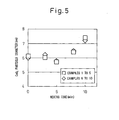
- the catalyst support particles of Examples 1 to 10 were subjected to endurance under heating in an electric furnace at 800°C over 5 hours and thereafter, evaluated for the ceria particle diameter.
- ceria particle diameter here, an X-ray diffraction (XRD) analysis was used.
- Fig. 5 shows the evaluation results of ceria particle diameter.
- the catalyst support particles of Examples which were subjected to endurance under heating in an electric furnace at 800°C over 5 hours, were evaluated for the platinum particle diameter.
- the platinum particle diameter was calculated by a CO pulse apparatus utilizing a property such that carbon monoxide (CO) uniformly adsorbs only to platinum.
- Fig. 6 shows the evaluation results of platinum particle diameter.
- the exhaust gas purifying catalysts of Examples 1 to 5 maintain a small platinum particle diameter even after endurance, as compared with the exhaust gas purifying catalysts of Examples 6 to 10, because in the exhaust gas purifying catalysts of Examples 1 to 5, platinum is supported preferentially on ceria and the movement and particle growth of platinum due to endurance are thereby suppressed.
- Example 5 good results are obtained in Examples 2 to 5 where the mixing time is more than 3 minutes, as compared with Examples 6 to 10, because when the mixing time is extremely short, platinum, a ceria precursor and an alumina precursor are precipitated substantially at the same time and a structure where platinum is supported preferentially on a ceria precursor can be hardly obtained. Furthermore, in Example 5 where the mixing time is 10 minutes, the ceria particle diameter and platinum particle diameter after endurance are relatively increased, because the period in which only platinum and a ceria precursor are precipitated is long to allow for aggregation of the platinum and ceria precursor and a structure where platinum-supporting ceria primary particles are dispersed in alumina can be hardly obtained.
- each exhaust gas purifying catalyst of Examples 3 and 8 was dipped in a solution prepared by charging 38.3 g of barium acetate into 500 ml of ion exchanged water, stirred over 2 hours, dried at 120°C for 2 hours and fired at 500°C for 5 hours, thereby loading barium, to obtain the exhaust gas purifying catalysts of Example 3 and 8 for the evaluation of NO x purification percentage.
- the exhaust gas purifying catalysts of Examples 3 and 8 for the evaluation of NO x purification percentage each was formed into a 1 mm-square pellet shape, and similarly to the evaluation of ceria particle diameter, subjected to endurance under heating in an electric furnace at 800°C over 5 hours.
- a rich gas having the composition shown in Table 1 below was fed at 600°C for 10 minutes to the exhaust gas purifying catalysts of Examples 3 and 8, subjected to endurance and thereafter, a rich gas and a lean gas each having a composition shown in Table 1 below were fed at 400°C by switching the gases at intervals of one minute.
- Table 1 Gas Composition for Evaluation of NO x Purification Percentage CO 2 (%) O 2 (%) CO (%) C 3 H 6 (ppm) NO (ppm) H 2 O (%) N 2 (-) Rich Gas 10 0.4 0.1 667 500 2 balance Lean Gas 10 6.5 0.6 667 500 2 balance
- the Examples are the same as the present invention, except that the salt solution does not contain a platinum salt, and Comparative Examples for these Examples are described below. These Examples and Comparative Examples are performed to demonstrate that in the exhaust gas purifying catalyst obtained by the process of the present invention, ceria primary particles are dispersed in alumina, particularly amorphous-state alumina.
- This platinum-supporting catalyst support particle of Example 11 was further dipped in a solution prepared by charging 38.3 g of barium acetate into 500 ml of ion exchanged water, stirred over 2 hours, dried at 120°C over 2 hours and fired at 500°C over 5 hours, thereby loading barium, to obtain an exhaust gas purifying catalyst of Example 11.
- the catalyst support particles of Comparative Examples 2 to 4 were obtained in the same manner as in Comparative Example 1 except that the amounts of cerium nitrate hexahydrate and aluminum nitrate nonahydrate contained in the salt solution were changed to the amounts shown in Table 3 below.
- the mass ratio between Al 2 O 3 and CeO 2 in these catalyst support particles of Comparative Examples 2 to 4 is also shown in Table 3 below.
- platinum and barium were loaded on the catalyst support particles of Comparative Examples 2 to 4 in the same manner as in Example 11 to obtain the exhaust gas purifying catalysts of Comparative Examples 2 to 4.
- the catalyst support particle of Comparative Example 5 was obtained by mixing 166 g of an alumina particle having a high specific surface area and 34 g of a ceria particle and firing the mixture at 500°C over 2 hours.
- the mass ratio of Al 2 O 3 :CeO 2 was 83.0:17.0.
- platinum and barium were loaded on the thus-obtained catalyst support particle of Comparative Example 5 in the same manner as in Example 11 to obtain the exhaust gas purifying catalyst of Comparative Example 5.
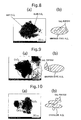
- TEM transmission electron microscope
- Figs. 8a, 9a and 10a each shows the image by TEM
- Figs. 8b, 9b and 10b each is a schematic view showing the structure of the catalyst support particle, which is understood from the image.
- the mass ratio of Al 2 O 3 :CeO 2 is about 83:17.
- ceria particles are dispersed and held in the amorphous-state alumina.
- a part of alumina particles are mutually mixed with ceria particles, but the majority of alumina is aggregated with each other, because an alumina precursor as the main component constituting the support is precipitated earlier than a ceria precursor and the alumina precursors are aggregated with each other before the ceria precursor is precipitated.
- ceria and alumina appear as distinctly different phases.
- the alumina component in the catalyst support particles of Example 12 and Comparative Example 1 is amorphous-state alumina, whereas the alumina component in this catalyst support particle of Comparative Example 5 is crystalline alumina.
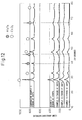
- the catalyst support particles of Example 12 and Comparative Examples 1 and 5 were evaluated using an X-ray diffraction (XRD) analysis. Figs. 11 and 12 show the analysis results obtained by XRD. In all of the catalyst support particles of Example 12 and Comparative Examples 1 and 5, the mass ratio of Al 2 O 3 :CeO 2 is about 83:17.
- XRD X-ray diffraction
- Fig. 11 shows the XRD results of the catalyst support particles of Example 12 and Comparative Example 1.
- Fig. 12 shows the XRD results of the catalyst support particles of Example 12 and Comparative Example 5.
- the final firing temperature is varied in the range of 500 to 1,000°C.
- a distinct peak of alumina is confirmed at the initial stage and therefore, it is revealed that the alumina has high crystallinity from the beginning.
- a peak of alumina is not confirmed until the firing temperature becomes 800°C and this reveals that the alumina is in an amorphous state.
- the firing temperature becomes 900°C
- the catalyst support particles of Examples and Comparative Examples were subjected to endurance under heating in an electric furnace at 800°C over 5 hours and thereafter, evaluated for the ceria particle diameter.
- a X-ray diffraction (XRD) analysis was used in the evaluation of ceria particle here.
- Fig. 13 shows the evaluation results of ceria particle diameter.
- the catalyst support particles of Comparative Examples 1 to 4 where in the co-precipitation process, an alumina precursor was precipitated earlier than a ceria precursor the catalyst support particles of Examples 11 to 16 of the present invention maintain a small ceria particle diameter, because in the exhaust gas purifying catalyst of the present invention, ceria is dispersed and held in an amorphous-state alumina.
- the catalyst support particles of Examples and Comparative Examples which were subjected to endurance under heating in an electric furnace at 800°C over 5 hours, were evaluated for the platinum particle diameter.
- the platinum particle diameter was calculated by utilizing a property such that carbon monoxide (CO) uniformly adsorbs only to platinum.
- Fig. 13 shows the evaluation results of platinum particle diameter.
- the platinum particle diameter is relatively large at a ceria content of 6 mass%, the platinum particle diameter is nearly constant when the ceria content is 16 mass% or more, because in the catalyst support particles of Examples, ceria is satisfactorily dispersed and held and sintering of platinum is thereby sufficiently and successfully suppressed already at a ceria content of 16 mass%.
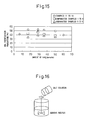
- Fig. 15 shows the evaluation results of NO x purification percentage.
- Table 6 Gas Composition for Evaluation of NO x Purification Percentage CO 2 (%) O 2 (%) CO (%) C 3 H 6 (ppm) NO (ppm) H 2 O (%) N 2 (-) Rich Gas 10 0.4 0.1 667 500 2 balance Lean Gas 10 6.5 0.6 667 500 2 balance
- the catalysts of Examples exhibit a good NO x purifying performance as compared with the catalysts of Comparative Examples. This is considered to result because the catalysts of Examples maintain a relatively small particle diameter even after endurance.
- a ceria-containing catalyst sintering of platinum can be prevented by increasing the ceria content.
- the amount of oxygen released by the oxygen storage capacity (OSC) of ceria at the feed of a rich gas increases, as a result, the reducing component in the rich gas is not used for the reduction of NO x but increasingly tends to be consumed by the oxygen.
- the NO x purification percentage is decreased according to this tendency after peaking in a ceria content of about 29% when the ceria content becomes larger than that.
- a particularly preferred NO x purifying performance is obtained in the catalysts of Examples 12 to 15 where the ceria content is approximately from 17 to 50 mass%.
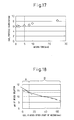
- the relationship between the time spent adding a salt solution of cerium and aluminum to aqueous ammonia under stirring as shown in Fig. 16 and the ceria particle diameter in the obtained catalyst support particle was evaluated.
- the catalyst support particles were obtained in the same manner as in Example 12 except that the time spent adding the salt solution to aqueous ammonia was varied.
- the obtained catalyst support particles were subjected to endurance under heating in air at 800°C over 5 hours and then evaluated for the ceria particle diameter.
- a X-ray diffraction (XRD) analysis was used.
- Fig. 17 shows the evaluation results regarding the change in the ceria particle diameter when the mixing time is varied.
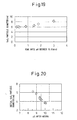
- the effect of the time until the pH of the mixed solution lowers to 10.8, exercised on the ceria particle diameter after thermal endurance of the obtained catalyst support particle was evaluated.
- the catalyst support particle was obtained in the same manner as in Example 12 except that the time spent adding a salt solution of ceria and alumina to aqueous ammonia was varied.
- the time until the pH of the mixed solution lowers to 10.8 means the time elapsed before pH becomes 10.8 (period A) in the graph of Fig. 18 showing the relationship between the time elapsed after the start of mixing and the pH of the mixed solution.
- the gradient of the curve showing the pH change differs between the period A in which the pH is 10.8 or more and the period B in which the pH is less than that, because in the period A where the pH is 10.8 or more, only ceria obtains a hydroxy group and precipitates as cerium hydroxide, whereas in the period B where the pH is less than 10.8, cerium and aluminum each obtains a hydroxy group and precipitates as a hydroxide.
- the pH of the mixed solution was elevated from about 21°C to about 23°C due to heat of reaction.
- the obtained catalyst support particle was subjected to endurance under heating in air at 800°C over 5 hours and then evaluated for the ceria particle diameter.
- an X-ray diffraction (XRD) analysis was used.
- Fig. 19 shows the evaluation results of the relationship between the time until the pH of the mixed solution lowers to 10.8 and the ceria particle diameter after thermal endurance of the obtained catalyst support particle.
- the time elapsed until the pH becomes 10.8 is 2 minutes or less, particularly 1 minute or less, the ceria particle diameter after thermal endurance of the obtained catalyst support particle is maintained small. Accordingly, in the case of obtaining the exhaust gas purifying catalyst of the present invention by adding a salt solution of cerium and aluminum to an alkaline solution, i.e. is, in the case of obtaining the catalyst support particle by causing the pH of the mixed solution of the alkaline solution and the salt solution to change from a large value to a small value, the time elapsed until the pH of the mixed solution lowers to 10.8 is preferably 2 minutes or less, particularly 1 minute or less.
- the effect of the final pH of the mixed solution of a salt solution of cerium and aluminum and an alkaline solution, exercised on the initial ceria particle diameter was evaluated.
- the catalyst support particle was obtained in the same manner as in Example 12 except that the final pH of the mixed solution was adjusted by varying the amount of aqueous ammonia used as the alkaline solution.
- Fig. 20 shows the evaluation results.
Landscapes
- Chemical & Material Sciences (AREA)
- Organic Chemistry (AREA)
- Engineering & Computer Science (AREA)
- Materials Engineering (AREA)
- Chemical Kinetics & Catalysis (AREA)
- Inorganic Chemistry (AREA)
- Geology (AREA)
- Life Sciences & Earth Sciences (AREA)
- Ceramic Engineering (AREA)
- Combustion & Propulsion (AREA)
- General Chemical & Material Sciences (AREA)
- Oil, Petroleum & Natural Gas (AREA)
- Manufacturing & Machinery (AREA)
- Analytical Chemistry (AREA)
- Structural Engineering (AREA)
- Environmental & Geological Engineering (AREA)
- Biomedical Technology (AREA)
- Health & Medical Sciences (AREA)
- Catalysts (AREA)
- Exhaust Gas Treatment By Means Of Catalyst (AREA)
- Exhaust Gas After Treatment (AREA)
Applications Claiming Priority (3)
| Application Number | Priority Date | Filing Date | Title |
|---|---|---|---|
| JP2005321125 | 2005-11-04 | ||
| JP2006135643 | 2006-05-15 | ||
| PCT/JP2006/322313 WO2007052821A1 (fr) | 2005-11-04 | 2006-11-01 | Particule de support de catalyseur, catalyseur d’epuration de gaz d’echappement et leurs procedes de production |
Publications (3)
| Publication Number | Publication Date |
|---|---|
| EP1946834A1 true EP1946834A1 (fr) | 2008-07-23 |
| EP1946834A4 EP1946834A4 (fr) | 2010-09-15 |
| EP1946834B1 EP1946834B1 (fr) | 2015-07-01 |
Family
ID=38005969
Family Applications (1)
| Application Number | Title | Priority Date | Filing Date |
|---|---|---|---|
| EP06823217.2A Not-in-force EP1946834B1 (fr) | 2005-11-04 | 2006-11-01 | Particule de support de catalyseur, catalyseur d'epuration de gaz d'echappement et leurs procedes de production |
Country Status (5)
| Country | Link |
|---|---|
| US (1) | US8053388B2 (fr) |
| EP (1) | EP1946834B1 (fr) |
| JP (1) | JP4835595B2 (fr) |
| CN (1) | CN101351267B (fr) |
| WO (1) | WO2007052821A1 (fr) |
Cited By (2)
| Publication number | Priority date | Publication date | Assignee | Title |
|---|---|---|---|---|
| EP2098292A4 (fr) * | 2006-11-14 | 2010-09-15 | Nissan Motor | Catalyseur d'épuration des gaz d'échappement |
| EP2991761B1 (fr) * | 2013-03-13 | 2020-12-16 | BASF Corporation | Catalyseur de capture d'oxydes d'azote avec une stabilité ameliorée et conversion d'oxydes d'azote |
Families Citing this family (12)
| Publication number | Priority date | Publication date | Assignee | Title |
|---|---|---|---|---|
| US7754171B2 (en) * | 2007-02-02 | 2010-07-13 | Basf Corporation | Multilayered catalyst compositions |
| JP5290062B2 (ja) * | 2009-06-17 | 2013-09-18 | 株式会社豊田中央研究所 | 排ガス浄化用触媒 |
| JP5692595B2 (ja) * | 2011-06-16 | 2015-04-01 | トヨタ自動車株式会社 | 排ガス浄化用触媒 |
| JP5900395B2 (ja) | 2012-11-22 | 2016-04-06 | トヨタ自動車株式会社 | 複合酸化物粒子及びこれを用いた排ガス浄化用触媒 |
| MX369743B (es) * | 2013-03-12 | 2019-11-20 | Basf Corp | Materiales catalizadores para la oxidación de no. |
| US11110396B2 (en) * | 2015-04-07 | 2021-09-07 | Umicore Shokubai Japan Co., Ltd. | Catalyst for purification of exhaust gas from internal combustion engine and exhaust gas purifying method using the catalyst |
| KR102478028B1 (ko) * | 2015-11-03 | 2022-12-16 | 에스케이이노베이션 주식회사 | 원-폿으로 합성된 전이금속-귀금속 복합산화물 탈수소화 촉매 및 이의 용도 |
| CN109110793A (zh) * | 2018-03-22 | 2019-01-01 | 云南大学 | 一种氧化铝负载纳米氧化铈复合金和钌氧化物的制备方法 |
| JP2021070004A (ja) * | 2019-11-01 | 2021-05-06 | トヨタ自動車株式会社 | 排ガス浄化用触媒装置のコート層の製造方法 |
| CN113231062B (zh) * | 2021-05-08 | 2023-03-31 | 无锡威孚环保催化剂有限公司 | 一种含Pt汽油车三效催化剂及其制备方法 |
| CN114287445B (zh) * | 2021-11-29 | 2023-01-10 | 南方科技大学 | 一种氧化铈负载的过氧化钙复合材料、水体消毒剂及消毒方法 |
| CN114682003B (zh) * | 2022-04-29 | 2023-11-14 | 新北区三井锦园环保技术服务部 | 一种废气处理滤料及其制备方法和应用 |
Family Cites Families (29)
| Publication number | Priority date | Publication date | Assignee | Title |
|---|---|---|---|---|
| US3867312A (en) * | 1972-02-07 | 1975-02-18 | Ethyl Corp | Exhaust gas catalyst support |
| US3993572A (en) * | 1972-08-04 | 1976-11-23 | Engelhard Minerals & Chemicals Corporation | Rare earth containing catalyst composition |
| GB2142253A (en) * | 1983-06-27 | 1985-01-16 | Johnson Matthey Plc | Exhaust gas purification catalysts |
| US4868150A (en) * | 1987-12-22 | 1989-09-19 | Rhone-Poulenc Inc. | Catalyst support material containing lanthanides |
| JP3226558B2 (ja) | 1991-03-12 | 2001-11-05 | 日石三菱株式会社 | 炭化水素の高温水蒸気改質用触媒 |
| GB9226434D0 (en) * | 1992-12-18 | 1993-02-10 | Johnson Matthey Plc | Catalyst |
| JPH08131830A (ja) | 1994-11-07 | 1996-05-28 | Toyota Motor Corp | 排ガス浄化用触媒 |
| JP3591667B2 (ja) | 1995-06-23 | 2004-11-24 | 日野自動車株式会社 | 排ガス浄化用NOx触媒及びその製造方法 |
| DE19608241A1 (de) * | 1996-03-04 | 1997-09-18 | Basf Ag | Verfahren zur selektiven Hydrierung von Dienen |
| JP3262044B2 (ja) * | 1996-10-07 | 2002-03-04 | 株式会社豊田中央研究所 | 複合酸化物担体および複合酸化物含有触媒 |
| EP0834348B1 (fr) * | 1996-10-07 | 2004-03-31 | Kabushiki Kaisha Toyota Chuo Kenkyusho | Oxyde composite, support d'oxyde composite et catalyseur |
| US6635599B1 (en) * | 1997-07-15 | 2003-10-21 | Exxonmobil Research & Engineering Company | Mixed metal catalyst, its preparation by co-precipitation, and its use |
| JP3831093B2 (ja) * | 1997-10-22 | 2006-10-11 | 三井金属鉱業株式会社 | 複合酸化物、その製造方法及びそれを用いた排ガス浄化用触媒 |
| JP4045002B2 (ja) * | 1998-02-02 | 2008-02-13 | 三井金属鉱業株式会社 | 複合酸化物及びそれを用いた排ガス浄化用触媒 |
| JP4275801B2 (ja) * | 1999-04-22 | 2009-06-10 | 株式会社キャタラー | 排ガス浄化用触媒 |
| US6540968B1 (en) * | 1999-05-19 | 2003-04-01 | Ford Global Technologies, Inc. | Low-precious metal/high-rare earth oxide catalysts |
| JP3858625B2 (ja) * | 2000-07-27 | 2006-12-20 | 株式会社豊田中央研究所 | 複合酸化物とその製造方法及び排ガス浄化用触媒とその製造方法 |
| JP4006976B2 (ja) * | 2000-11-15 | 2007-11-14 | 株式会社豊田中央研究所 | 複合酸化物粉末とその製造方法及び触媒 |
| JP4032652B2 (ja) * | 2001-02-23 | 2008-01-16 | 株式会社豊田中央研究所 | 複合酸化物粉末及びその製造方法 |
| EP1254711A1 (fr) * | 2001-05-05 | 2002-11-06 | OMG AG & Co. KG | Catalyseur supporté à base de métal noble et son procédé de préparation |
| JP3861647B2 (ja) | 2001-10-09 | 2006-12-20 | トヨタ自動車株式会社 | 排ガス浄化用触媒 |
| JP2003126694A (ja) | 2001-10-25 | 2003-05-07 | Toyota Motor Corp | 排ガス浄化用触媒 |
| JP2004160435A (ja) | 2002-09-18 | 2004-06-10 | Nissan Motor Co Ltd | Co除去触媒 |
| JP2004136179A (ja) * | 2002-10-16 | 2004-05-13 | Toyota Central Res & Dev Lab Inc | 排ガス浄化用触媒とその製造方法及び排ガス浄化方法 |
| JP3812565B2 (ja) * | 2002-11-14 | 2006-08-23 | マツダ株式会社 | 排気ガス浄化用触媒材料、及びその製造方法 |
| JP4269831B2 (ja) * | 2003-07-10 | 2009-05-27 | マツダ株式会社 | 排気ガス浄化用触媒 |
| JP2006043654A (ja) | 2004-08-09 | 2006-02-16 | Toyota Motor Corp | 排ガス浄化触媒及びその製造方法 |
| JP2006068665A (ja) * | 2004-09-03 | 2006-03-16 | Toyota Motor Corp | 排ガス浄化触媒の製造方法及び排ガス浄化触媒 |
| GB0428555D0 (en) * | 2004-12-30 | 2005-02-09 | Magnesium Elektron Ltd | Composite material for automotive catalyst applications and method of manufacturing |
-
2006
- 2006-11-01 US US12/084,419 patent/US8053388B2/en not_active Expired - Fee Related
- 2006-11-01 WO PCT/JP2006/322313 patent/WO2007052821A1/fr not_active Ceased
- 2006-11-01 EP EP06823217.2A patent/EP1946834B1/fr not_active Not-in-force
- 2006-11-01 CN CN2006800503057A patent/CN101351267B/zh not_active Expired - Fee Related
- 2006-11-01 JP JP2007542851A patent/JP4835595B2/ja not_active Expired - Fee Related
Cited By (3)
| Publication number | Priority date | Publication date | Assignee | Title |
|---|---|---|---|---|
| EP2098292A4 (fr) * | 2006-11-14 | 2010-09-15 | Nissan Motor | Catalyseur d'épuration des gaz d'échappement |
| US9080491B2 (en) | 2006-11-14 | 2015-07-14 | Nissan Motor Co., Ltd. | Exhaust gas purifying catalyst |
| EP2991761B1 (fr) * | 2013-03-13 | 2020-12-16 | BASF Corporation | Catalyseur de capture d'oxydes d'azote avec une stabilité ameliorée et conversion d'oxydes d'azote |
Also Published As
| Publication number | Publication date |
|---|---|
| EP1946834A4 (fr) | 2010-09-15 |
| CN101351267A (zh) | 2009-01-21 |
| JPWO2007052821A1 (ja) | 2009-04-30 |
| US20090048102A1 (en) | 2009-02-19 |
| JP4835595B2 (ja) | 2011-12-14 |
| CN101351267B (zh) | 2012-08-29 |
| EP1946834B1 (fr) | 2015-07-01 |
| US8053388B2 (en) | 2011-11-08 |
| WO2007052821A1 (fr) | 2007-05-10 |
Similar Documents
| Publication | Publication Date | Title |
|---|---|---|
| JP4006976B2 (ja) | 複合酸化物粉末とその製造方法及び触媒 | |
| EP2039425B1 (fr) | Procédé de production d'un catalyseur de purification de gaz d'échappement | |
| JP4959129B2 (ja) | 排ガス浄化用触媒 | |
| JP2002331238A (ja) | 複合酸化物とその製造方法及び排ガス浄化用触媒とその製造方法 | |
| EP1964607A1 (fr) | Catalyseur pour l'epuration de gaz d'echappement | |
| EP1946834B1 (fr) | Particule de support de catalyseur, catalyseur d'epuration de gaz d'echappement et leurs procedes de production | |
| US20070197373A1 (en) | Zirconia core particles coated with ceria particles, production process thereof and exhaust gas purifying catalyst | |
| EP1810749A1 (fr) | Catalyseur de purification de gaz d échappement | |
| US7745371B2 (en) | Exhaust gas purifying catalyst, metal oxide particle and production process thereof | |
| JP5196656B2 (ja) | 排ガス浄化用触媒及びその製造方法 | |
| EP1913999A1 (fr) | Catalyseur pour la purification de gaz d'echappement | |
| EP1911514A1 (fr) | Catalyseur pour la purification de gaz d'echappement | |
| JP3246295B2 (ja) | 排気ガス浄化用触媒及びその製造方法 | |
| JP5078125B2 (ja) | 排ガス浄化用触媒及びその再生方法 | |
| WO2015087781A1 (fr) | Catalyseur de purification de gaz d'échappement | |
| JP3309711B2 (ja) | 排気ガス浄化用触媒及びその製造方法 | |
| JP2000051700A (ja) | 排気ガス浄化用触媒及びその製造方法 | |
| JP4665458B2 (ja) | 排ガス浄化触媒及びその製造方法 | |
| JP5030573B2 (ja) | 複合酸化物粉末及びその製造方法 | |
| JP2006043683A (ja) | 触媒担体及びその製造方法、並びに排ガス浄化触媒 | |
| JP6096818B2 (ja) | 排ガス浄化触媒、その製造方法、及び、それを用いた排ガス浄化方法 | |
| JP4775954B2 (ja) | 排ガス浄化用触媒及びその再生方法 | |
| JP2000325787A (ja) | 排ガス浄化用触媒の製造方法 | |
| JP2007260564A (ja) | 排ガス浄化用触媒及びその再生方法 | |
| JPH09192490A (ja) | 排ガス浄化触媒用材料及びその製造方法 |
Legal Events
| Date | Code | Title | Description |
|---|---|---|---|
| PUAI | Public reference made under article 153(3) epc to a published international application that has entered the european phase |
Free format text: ORIGINAL CODE: 0009012 |
|
| 17P | Request for examination filed |
Effective date: 20080519 |
|
| AK | Designated contracting states |
Kind code of ref document: A1 Designated state(s): DE FR GB |
|
| RBV | Designated contracting states (corrected) |
Designated state(s): DE FR GB |
|
| A4 | Supplementary search report drawn up and despatched |
Effective date: 20100813 |
|
| 17Q | First examination report despatched |
Effective date: 20120402 |
|
| DAX | Request for extension of the european patent (deleted) | ||
| RAP1 | Party data changed (applicant data changed or rights of an application transferred) |
Owner name: TOYOTA JIDOSHA KABUSHIKI KAISHA |
|
| REG | Reference to a national code |
Ref country code: DE Ref legal event code: R079 Ref document number: 602006045850 Country of ref document: DE Free format text: PREVIOUS MAIN CLASS: B01J0023100000 Ipc: B01J0035000000 |
|
| RIC1 | Information provided on ipc code assigned before grant |
Ipc: C01F 7/02 20060101ALI20141121BHEP Ipc: B01J 35/00 20060101AFI20141121BHEP Ipc: C04B 35/111 20060101ALI20141121BHEP Ipc: C01F 7/34 20060101ALI20141121BHEP |
|
| GRAP | Despatch of communication of intention to grant a patent |
Free format text: ORIGINAL CODE: EPIDOSNIGR1 |
|
| INTG | Intention to grant announced |
Effective date: 20150120 |
|
| GRAS | Grant fee paid |
Free format text: ORIGINAL CODE: EPIDOSNIGR3 |
|
| GRAA | (expected) grant |
Free format text: ORIGINAL CODE: 0009210 |
|
| AK | Designated contracting states |
Kind code of ref document: B1 Designated state(s): DE FR GB |
|
| REG | Reference to a national code |
Ref country code: GB Ref legal event code: FG4D |
|
| REG | Reference to a national code |
Ref country code: DE Ref legal event code: R096 Ref document number: 602006045850 Country of ref document: DE |
|
| REG | Reference to a national code |
Ref country code: DE Ref legal event code: R084 Ref document number: 602006045850 Country of ref document: DE |
|
| REG | Reference to a national code |
Ref country code: DE Ref legal event code: R097 Ref document number: 602006045850 Country of ref document: DE |
|
| PLBE | No opposition filed within time limit |
Free format text: ORIGINAL CODE: 0009261 |
|
| STAA | Information on the status of an ep patent application or granted ep patent |
Free format text: STATUS: NO OPPOSITION FILED WITHIN TIME LIMIT |
|
| 26N | No opposition filed |
Effective date: 20160404 |
|
| GBPC | Gb: european patent ceased through non-payment of renewal fee |
Effective date: 20151101 |
|
| REG | Reference to a national code |
Ref country code: FR Ref legal event code: ST Effective date: 20160729 |
|
| PG25 | Lapsed in a contracting state [announced via postgrant information from national office to epo] |
Ref country code: GB Free format text: LAPSE BECAUSE OF NON-PAYMENT OF DUE FEES Effective date: 20151101 |
|
| PG25 | Lapsed in a contracting state [announced via postgrant information from national office to epo] |
Ref country code: FR Free format text: LAPSE BECAUSE OF NON-PAYMENT OF DUE FEES Effective date: 20151130 |
|
| PGFP | Annual fee paid to national office [announced via postgrant information from national office to epo] |
Ref country code: DE Payment date: 20181016 Year of fee payment: 13 |
|
| REG | Reference to a national code |
Ref country code: DE Ref legal event code: R119 Ref document number: 602006045850 Country of ref document: DE |
|
| PG25 | Lapsed in a contracting state [announced via postgrant information from national office to epo] |
Ref country code: DE Free format text: LAPSE BECAUSE OF NON-PAYMENT OF DUE FEES Effective date: 20200603 |