EP1946850B1 - Bahnförmiges Material mit einem ultradünnen Beschichtungslack zum Spreiten von Flüssigkeiten - Google Patents
Bahnförmiges Material mit einem ultradünnen Beschichtungslack zum Spreiten von Flüssigkeiten Download PDFInfo
- Publication number
- EP1946850B1 EP1946850B1 EP08100092.9A EP08100092A EP1946850B1 EP 1946850 B1 EP1946850 B1 EP 1946850B1 EP 08100092 A EP08100092 A EP 08100092A EP 1946850 B1 EP1946850 B1 EP 1946850B1
- Authority
- EP
- European Patent Office
- Prior art keywords
- coating
- test
- blood
- diagnostic
- hydrophilic
- Prior art date
- Legal status (The legal status is an assumption and is not a legal conclusion. Google has not performed a legal analysis and makes no representation as to the accuracy of the status listed.)
- Active
Links
- 239000000463 material Substances 0.000 title claims description 33
- 239000002966 varnish Substances 0.000 title claims description 10
- 239000007788 liquid Substances 0.000 title description 35
- 238000003892 spreading Methods 0.000 title description 25
- 230000007480 spreading Effects 0.000 title description 25
- 238000000576 coating method Methods 0.000 claims description 114
- 239000011248 coating agent Substances 0.000 claims description 104
- 239000013060 biological fluid Substances 0.000 claims description 23
- -1 ester salt Chemical class 0.000 claims description 21
- 239000012876 carrier material Substances 0.000 claims description 10
- 238000001035 drying Methods 0.000 claims description 9
- 229920006267 polyester film Polymers 0.000 claims description 8
- 238000004458 analytical method Methods 0.000 claims description 2
- 239000011734 sodium Substances 0.000 claims description 2
- DGAQECJNVWCQMB-PUAWFVPOSA-M Ilexoside XXIX Chemical compound C[C@@H]1CC[C@@]2(CC[C@@]3(C(=CC[C@H]4[C@]3(CC[C@@H]5[C@@]4(CC[C@@H](C5(C)C)OS(=O)(=O)[O-])C)C)[C@@H]2[C@]1(C)O)C)C(=O)O[C@H]6[C@@H]([C@H]([C@@H]([C@H](O6)CO)O)O)O.[Na+] DGAQECJNVWCQMB-PUAWFVPOSA-M 0.000 claims 1
- ULUAUXLGCMPNKK-UHFFFAOYSA-N Sulfobutanedioic acid Chemical compound OC(=O)CC(C(O)=O)S(O)(=O)=O ULUAUXLGCMPNKK-UHFFFAOYSA-N 0.000 claims 1
- 229910052708 sodium Inorganic materials 0.000 claims 1
- 238000012360 testing method Methods 0.000 description 41
- 239000008280 blood Substances 0.000 description 39
- 210000004369 blood Anatomy 0.000 description 39
- 239000004922 lacquer Substances 0.000 description 33
- 239000004094 surface-active agent Substances 0.000 description 28
- XLYOFNOQVPJJNP-UHFFFAOYSA-N water Substances O XLYOFNOQVPJJNP-UHFFFAOYSA-N 0.000 description 24
- 239000010408 film Substances 0.000 description 23
- 238000009736 wetting Methods 0.000 description 23
- 238000003860 storage Methods 0.000 description 19
- 238000000034 method Methods 0.000 description 16
- 239000000853 adhesive Substances 0.000 description 14
- 239000007787 solid Substances 0.000 description 14
- 239000004820 Pressure-sensitive adhesive Substances 0.000 description 13
- 230000001070 adhesive effect Effects 0.000 description 13
- 238000002405 diagnostic procedure Methods 0.000 description 12
- LFQSCWFLJHTTHZ-UHFFFAOYSA-N Ethanol Chemical compound CCO LFQSCWFLJHTTHZ-UHFFFAOYSA-N 0.000 description 11
- 239000003945 anionic surfactant Substances 0.000 description 10
- 238000005259 measurement Methods 0.000 description 10
- 239000000243 solution Substances 0.000 description 10
- 239000000047 product Substances 0.000 description 9
- 239000003381 stabilizer Substances 0.000 description 9
- 239000002390 adhesive tape Substances 0.000 description 8
- 230000032683 aging Effects 0.000 description 7
- 238000006243 chemical reaction Methods 0.000 description 7
- 229920000139 polyethylene terephthalate Polymers 0.000 description 7
- 239000005020 polyethylene terephthalate Substances 0.000 description 7
- 229920002799 BoPET Polymers 0.000 description 6
- OKKJLVBELUTLKV-UHFFFAOYSA-N Methanol Chemical compound OC OKKJLVBELUTLKV-UHFFFAOYSA-N 0.000 description 6
- 230000003712 anti-aging effect Effects 0.000 description 6
- 230000008859 change Effects 0.000 description 6
- 239000003795 chemical substances by application Substances 0.000 description 6
- 238000005520 cutting process Methods 0.000 description 6
- 230000000694 effects Effects 0.000 description 6
- 108090000790 Enzymes Proteins 0.000 description 5
- 102000004190 Enzymes Human genes 0.000 description 5
- 229920001328 Polyvinylidene chloride Polymers 0.000 description 5
- 238000004873 anchoring Methods 0.000 description 5
- 229940088598 enzyme Drugs 0.000 description 5
- 239000012530 fluid Substances 0.000 description 5
- 239000010410 layer Substances 0.000 description 5
- 238000004519 manufacturing process Methods 0.000 description 5
- 239000004800 polyvinyl chloride Substances 0.000 description 5
- 229920000915 polyvinyl chloride Polymers 0.000 description 5
- 239000005033 polyvinylidene chloride Substances 0.000 description 5
- 230000008569 process Effects 0.000 description 5
- 230000009467 reduction Effects 0.000 description 5
- QAOWNCQODCNURD-UHFFFAOYSA-N Sulfuric acid Chemical compound OS(O)(=O)=O QAOWNCQODCNURD-UHFFFAOYSA-N 0.000 description 4
- 239000008367 deionised water Substances 0.000 description 4
- 229910021641 deionized water Inorganic materials 0.000 description 4
- 230000032798 delamination Effects 0.000 description 4
- 239000004744 fabric Substances 0.000 description 4
- 239000011888 foil Substances 0.000 description 4
- 230000007774 longterm Effects 0.000 description 4
- 239000000203 mixture Substances 0.000 description 4
- 229920000728 polyester Polymers 0.000 description 4
- 229920000642 polymer Polymers 0.000 description 4
- 238000011282 treatment Methods 0.000 description 4
- XEKOWRVHYACXOJ-UHFFFAOYSA-N Ethyl acetate Chemical compound CCOC(C)=O XEKOWRVHYACXOJ-UHFFFAOYSA-N 0.000 description 3
- KWYUFKZDYYNOTN-UHFFFAOYSA-M Potassium hydroxide Chemical compound [OH-].[K+] KWYUFKZDYYNOTN-UHFFFAOYSA-M 0.000 description 3
- YXFVVABEGXRONW-UHFFFAOYSA-N Toluene Chemical compound CC1=CC=CC=C1 YXFVVABEGXRONW-UHFFFAOYSA-N 0.000 description 3
- 150000001298 alcohols Chemical class 0.000 description 3
- 125000000217 alkyl group Chemical group 0.000 description 3
- 238000011161 development Methods 0.000 description 3
- 230000018109 developmental process Effects 0.000 description 3
- MCPLVIGCWWTHFH-UHFFFAOYSA-M disodium;4-[4-[[4-(4-sulfoanilino)phenyl]-[4-(4-sulfonatophenyl)azaniumylidenecyclohexa-2,5-dien-1-ylidene]methyl]anilino]benzenesulfonate Chemical compound [Na+].[Na+].C1=CC(S(=O)(=O)O)=CC=C1NC1=CC=C(C(=C2C=CC(C=C2)=[NH+]C=2C=CC(=CC=2)S([O-])(=O)=O)C=2C=CC(NC=3C=CC(=CC=3)S([O-])(=O)=O)=CC=2)C=C1 MCPLVIGCWWTHFH-UHFFFAOYSA-M 0.000 description 3
- 238000006911 enzymatic reaction Methods 0.000 description 3
- 238000011156 evaluation Methods 0.000 description 3
- 230000005660 hydrophilic surface Effects 0.000 description 3
- 238000012986 modification Methods 0.000 description 3
- 230000004048 modification Effects 0.000 description 3
- VLKZOEOYAKHREP-UHFFFAOYSA-N n-Hexane Chemical compound CCCCCC VLKZOEOYAKHREP-UHFFFAOYSA-N 0.000 description 3
- 239000002736 nonionic surfactant Substances 0.000 description 3
- 229920003023 plastic Polymers 0.000 description 3
- 239000004033 plastic Substances 0.000 description 3
- 229920000036 polyvinylpyrrolidone Polymers 0.000 description 3
- 239000001267 polyvinylpyrrolidone Substances 0.000 description 3
- 235000013855 polyvinylpyrrolidone Nutrition 0.000 description 3
- 238000011160 research Methods 0.000 description 3
- 210000003296 saliva Anatomy 0.000 description 3
- 239000002904 solvent Substances 0.000 description 3
- 239000000126 substance Substances 0.000 description 3
- 239000000758 substrate Substances 0.000 description 3
- 210000002700 urine Anatomy 0.000 description 3
- ZWEHNKRNPOVVGH-UHFFFAOYSA-N 2-Butanone Chemical compound CCC(C)=O ZWEHNKRNPOVVGH-UHFFFAOYSA-N 0.000 description 2
- NIXOWILDQLNWCW-UHFFFAOYSA-M Acrylate Chemical compound [O-]C(=O)C=C NIXOWILDQLNWCW-UHFFFAOYSA-M 0.000 description 2
- 239000004831 Hot glue Substances 0.000 description 2
- MHAJPDPJQMAIIY-UHFFFAOYSA-N Hydrogen peroxide Chemical compound OO MHAJPDPJQMAIIY-UHFFFAOYSA-N 0.000 description 2
- 208000013016 Hypoglycemia Diseases 0.000 description 2
- LRHPLDYGYMQRHN-UHFFFAOYSA-N N-Butanol Chemical compound CCCCO LRHPLDYGYMQRHN-UHFFFAOYSA-N 0.000 description 2
- 239000004743 Polypropylene Substances 0.000 description 2
- 239000002253 acid Substances 0.000 description 2
- 239000000654 additive Substances 0.000 description 2
- 238000007774 anilox coating Methods 0.000 description 2
- 125000000129 anionic group Chemical group 0.000 description 2
- 210000004027 cell Anatomy 0.000 description 2
- HVYWMOMLDIMFJA-DPAQBDIFSA-N cholesterol Chemical compound C1C=C2C[C@@H](O)CC[C@]2(C)[C@@H]2[C@@H]1[C@@H]1CC[C@H]([C@H](C)CCCC(C)C)[C@@]1(C)CC2 HVYWMOMLDIMFJA-DPAQBDIFSA-N 0.000 description 2
- 238000004587 chromatography analysis Methods 0.000 description 2
- 239000000306 component Substances 0.000 description 2
- 239000002131 composite material Substances 0.000 description 2
- 239000004020 conductor Substances 0.000 description 2
- 238000010276 construction Methods 0.000 description 2
- 239000013039 cover film Substances 0.000 description 2
- 201000010099 disease Diseases 0.000 description 2
- 208000037265 diseases, disorders, signs and symptoms Diseases 0.000 description 2
- 238000004049 embossing Methods 0.000 description 2
- 238000005530 etching Methods 0.000 description 2
- 230000002209 hydrophobic effect Effects 0.000 description 2
- NOESYZHRGYRDHS-UHFFFAOYSA-N insulin Chemical compound N1C(=O)C(NC(=O)C(CCC(N)=O)NC(=O)C(CCC(O)=O)NC(=O)C(C(C)C)NC(=O)C(NC(=O)CN)C(C)CC)CSSCC(C(NC(CO)C(=O)NC(CC(C)C)C(=O)NC(CC=2C=CC(O)=CC=2)C(=O)NC(CCC(N)=O)C(=O)NC(CC(C)C)C(=O)NC(CCC(O)=O)C(=O)NC(CC(N)=O)C(=O)NC(CC=2C=CC(O)=CC=2)C(=O)NC(CSSCC(NC(=O)C(C(C)C)NC(=O)C(CC(C)C)NC(=O)C(CC=2C=CC(O)=CC=2)NC(=O)C(CC(C)C)NC(=O)C(C)NC(=O)C(CCC(O)=O)NC(=O)C(C(C)C)NC(=O)C(CC(C)C)NC(=O)C(CC=2NC=NC=2)NC(=O)C(CO)NC(=O)CNC2=O)C(=O)NCC(=O)NC(CCC(O)=O)C(=O)NC(CCCNC(N)=N)C(=O)NCC(=O)NC(CC=3C=CC=CC=3)C(=O)NC(CC=3C=CC=CC=3)C(=O)NC(CC=3C=CC(O)=CC=3)C(=O)NC(C(C)O)C(=O)N3C(CCC3)C(=O)NC(CCCCN)C(=O)NC(C)C(O)=O)C(=O)NC(CC(N)=O)C(O)=O)=O)NC(=O)C(C(C)CC)NC(=O)C(CO)NC(=O)C(C(C)O)NC(=O)C1CSSCC2NC(=O)C(CC(C)C)NC(=O)C(NC(=O)C(CCC(N)=O)NC(=O)C(CC(N)=O)NC(=O)C(NC(=O)C(N)CC=1C=CC=CC=1)C(C)C)CC1=CN=CN1 NOESYZHRGYRDHS-UHFFFAOYSA-N 0.000 description 2
- 238000011835 investigation Methods 0.000 description 2
- 150000002576 ketones Chemical class 0.000 description 2
- 238000010030 laminating Methods 0.000 description 2
- 238000003475 lamination Methods 0.000 description 2
- 239000011159 matrix material Substances 0.000 description 2
- 239000012528 membrane Substances 0.000 description 2
- 238000013508 migration Methods 0.000 description 2
- 230000005012 migration Effects 0.000 description 2
- 239000004745 nonwoven fabric Substances 0.000 description 2
- 239000003973 paint Substances 0.000 description 2
- 239000004417 polycarbonate Substances 0.000 description 2
- 229920000515 polycarbonate Polymers 0.000 description 2
- 229920001155 polypropylene Polymers 0.000 description 2
- 238000007639 printing Methods 0.000 description 2
- 238000004381 surface treatment Methods 0.000 description 2
- 238000012546 transfer Methods 0.000 description 2
- OVSKIKFHRZPJSS-UHFFFAOYSA-N 2,4-D Chemical compound OC(=O)COC1=CC=C(Cl)C=C1Cl OVSKIKFHRZPJSS-UHFFFAOYSA-N 0.000 description 1
- ZNQVEEAIQZEUHB-UHFFFAOYSA-N 2-ethoxyethanol Chemical compound CCOCCO ZNQVEEAIQZEUHB-UHFFFAOYSA-N 0.000 description 1
- 239000004808 2-ethylhexylester Substances 0.000 description 1
- NUIURNJTPRWVAP-UHFFFAOYSA-N 3,3'-Dimethylbenzidine Chemical compound C1=C(N)C(C)=CC(C=2C=C(C)C(N)=CC=2)=C1 NUIURNJTPRWVAP-UHFFFAOYSA-N 0.000 description 1
- 238000012935 Averaging Methods 0.000 description 1
- WQZGKKKJIJFFOK-GASJEMHNSA-N Glucose Natural products OC[C@H]1OC(O)[C@H](O)[C@@H](O)[C@@H]1O WQZGKKKJIJFFOK-GASJEMHNSA-N 0.000 description 1
- 108010015776 Glucose oxidase Proteins 0.000 description 1
- 101000608720 Helianthus annuus 10 kDa late embryogenesis abundant protein Proteins 0.000 description 1
- 108010093096 Immobilized Enzymes Proteins 0.000 description 1
- 102000004877 Insulin Human genes 0.000 description 1
- 108090001061 Insulin Proteins 0.000 description 1
- COLNVLDHVKWLRT-QMMMGPOBSA-N L-phenylalanine Chemical compound OC(=O)[C@@H](N)CC1=CC=CC=C1 COLNVLDHVKWLRT-QMMMGPOBSA-N 0.000 description 1
- 102000003992 Peroxidases Human genes 0.000 description 1
- 239000004698 Polyethylene Substances 0.000 description 1
- 239000002202 Polyethylene glycol Substances 0.000 description 1
- 239000004372 Polyvinyl alcohol Substances 0.000 description 1
- 229910000831 Steel Inorganic materials 0.000 description 1
- 206010067584 Type 1 diabetes mellitus Diseases 0.000 description 1
- 150000007513 acids Chemical class 0.000 description 1
- 239000013543 active substance Substances 0.000 description 1
- 150000001335 aliphatic alkanes Chemical class 0.000 description 1
- 125000006177 alkyl benzyl group Chemical group 0.000 description 1
- XAGFODPZIPBFFR-UHFFFAOYSA-N aluminium Chemical compound [Al] XAGFODPZIPBFFR-UHFFFAOYSA-N 0.000 description 1
- 229910052782 aluminium Inorganic materials 0.000 description 1
- 239000002280 amphoteric surfactant Substances 0.000 description 1
- 239000012491 analyte Substances 0.000 description 1
- 239000003963 antioxidant agent Substances 0.000 description 1
- 239000007864 aqueous solution Substances 0.000 description 1
- 230000008901 benefit Effects 0.000 description 1
- WQZGKKKJIJFFOK-VFUOTHLCSA-N beta-D-glucose Chemical compound OC[C@H]1O[C@@H](O)[C@H](O)[C@@H](O)[C@@H]1O WQZGKKKJIJFFOK-VFUOTHLCSA-N 0.000 description 1
- 230000015572 biosynthetic process Effects 0.000 description 1
- 239000012503 blood component Substances 0.000 description 1
- 210000001124 body fluid Anatomy 0.000 description 1
- 239000010839 body fluid Substances 0.000 description 1
- 238000009835 boiling Methods 0.000 description 1
- 125000000484 butyl group Chemical group [H]C([*])([H])C([H])([H])C([H])([H])C([H])([H])[H] 0.000 description 1
- 150000001735 carboxylic acids Chemical class 0.000 description 1
- 125000002091 cationic group Chemical group 0.000 description 1
- 239000003093 cationic surfactant Substances 0.000 description 1
- 239000007795 chemical reaction product Substances 0.000 description 1
- 235000012000 cholesterol Nutrition 0.000 description 1
- 230000015271 coagulation Effects 0.000 description 1
- 238000005345 coagulation Methods 0.000 description 1
- 238000004737 colorimetric analysis Methods 0.000 description 1
- 239000013065 commercial product Substances 0.000 description 1
- 238000009833 condensation Methods 0.000 description 1
- 230000005494 condensation Effects 0.000 description 1
- 239000012050 conventional carrier Substances 0.000 description 1
- 230000006378 damage Effects 0.000 description 1
- 230000007812 deficiency Effects 0.000 description 1
- 230000001419 dependent effect Effects 0.000 description 1
- 238000001514 detection method Methods 0.000 description 1
- 206010012601 diabetes mellitus Diseases 0.000 description 1
- NZZFYRREKKOMAT-UHFFFAOYSA-N diiodomethane Chemical compound ICI NZZFYRREKKOMAT-UHFFFAOYSA-N 0.000 description 1
- 238000002845 discoloration Methods 0.000 description 1
- 229940079593 drug Drugs 0.000 description 1
- 239000003814 drug Substances 0.000 description 1
- 238000000835 electrochemical detection Methods 0.000 description 1
- 239000003480 eluent Substances 0.000 description 1
- 238000005516 engineering process Methods 0.000 description 1
- 150000002148 esters Chemical class 0.000 description 1
- 150000002170 ethers Chemical class 0.000 description 1
- 238000001704 evaporation Methods 0.000 description 1
- 230000008020 evaporation Effects 0.000 description 1
- 150000002191 fatty alcohols Chemical class 0.000 description 1
- 235000013305 food Nutrition 0.000 description 1
- 230000037406 food intake Effects 0.000 description 1
- 235000012631 food intake Nutrition 0.000 description 1
- 239000008103 glucose Substances 0.000 description 1
- 108010046301 glucose peroxidase Proteins 0.000 description 1
- 230000036541 health Effects 0.000 description 1
- 238000005534 hematocrit Methods 0.000 description 1
- 125000004051 hexyl group Chemical group [H]C([H])([H])C([H])([H])C([H])([H])C([H])([H])C([H])([H])C([H])([H])* 0.000 description 1
- 238000004128 high performance liquid chromatography Methods 0.000 description 1
- 230000006872 improvement Effects 0.000 description 1
- 239000004615 ingredient Substances 0.000 description 1
- 229940125396 insulin Drugs 0.000 description 1
- 229920000554 ionomer Polymers 0.000 description 1
- 239000002346 layers by function Substances 0.000 description 1
- 230000005923 long-lasting effect Effects 0.000 description 1
- 238000013208 measuring procedure Methods 0.000 description 1
- 230000008018 melting Effects 0.000 description 1
- 238000002844 melting Methods 0.000 description 1
- 230000003287 optical effect Effects 0.000 description 1
- 230000003647 oxidation Effects 0.000 description 1
- 238000007254 oxidation reaction Methods 0.000 description 1
- 230000004792 oxidative damage Effects 0.000 description 1
- 230000001590 oxidative effect Effects 0.000 description 1
- 238000004806 packaging method and process Methods 0.000 description 1
- COLNVLDHVKWLRT-UHFFFAOYSA-N phenylalanine Natural products OC(=O)C(N)CC1=CC=CC=C1 COLNVLDHVKWLRT-UHFFFAOYSA-N 0.000 description 1
- 150000003009 phosphonic acids Chemical class 0.000 description 1
- 235000011007 phosphoric acid Nutrition 0.000 description 1
- 150000003016 phosphoric acids Chemical class 0.000 description 1
- 238000005375 photometry Methods 0.000 description 1
- 238000009832 plasma treatment Methods 0.000 description 1
- 229920006112 polar polymer Polymers 0.000 description 1
- 229920000058 polyacrylate Polymers 0.000 description 1
- 229920000768 polyamine Polymers 0.000 description 1
- 229920000573 polyethylene Polymers 0.000 description 1
- 229920001223 polyethylene glycol Polymers 0.000 description 1
- 229920000151 polyglycol Polymers 0.000 description 1
- 239000010695 polyglycol Substances 0.000 description 1
- 229920001522 polyglycol ester Polymers 0.000 description 1
- 229920000098 polyolefin Polymers 0.000 description 1
- 229920001296 polysiloxane Polymers 0.000 description 1
- 229920002635 polyurethane Polymers 0.000 description 1
- 239000004814 polyurethane Substances 0.000 description 1
- 229920002451 polyvinyl alcohol Polymers 0.000 description 1
- 239000012286 potassium permanganate Substances 0.000 description 1
- 230000002035 prolonged effect Effects 0.000 description 1
- XTUSEBKMEQERQV-UHFFFAOYSA-N propan-2-ol;hydrate Chemical compound O.CC(C)O XTUSEBKMEQERQV-UHFFFAOYSA-N 0.000 description 1
- 230000001681 protective effect Effects 0.000 description 1
- 102000004169 proteins and genes Human genes 0.000 description 1
- 108090000623 proteins and genes Proteins 0.000 description 1
- 230000035484 reaction time Effects 0.000 description 1
- 230000004044 response Effects 0.000 description 1
- 230000000717 retained effect Effects 0.000 description 1
- 238000005096 rolling process Methods 0.000 description 1
- 230000035939 shock Effects 0.000 description 1
- 238000004904 shortening Methods 0.000 description 1
- 125000005373 siloxane group Chemical group [SiH2](O*)* 0.000 description 1
- RTVVXRKGQRRXFJ-UHFFFAOYSA-N sodium;2-sulfobutanedioic acid Chemical compound [Na].OC(=O)CC(C(O)=O)S(O)(=O)=O RTVVXRKGQRRXFJ-UHFFFAOYSA-N 0.000 description 1
- 239000007790 solid phase Substances 0.000 description 1
- 238000005507 spraying Methods 0.000 description 1
- 230000000087 stabilizing effect Effects 0.000 description 1
- 238000010561 standard procedure Methods 0.000 description 1
- 239000010959 steel Substances 0.000 description 1
- 150000003460 sulfonic acids Chemical class 0.000 description 1
- 150000003467 sulfuric acid derivatives Chemical class 0.000 description 1
- 238000009864 tensile test Methods 0.000 description 1
- 238000010998 test method Methods 0.000 description 1
- 238000007725 thermal activation Methods 0.000 description 1
- 230000003685 thermal hair damage Effects 0.000 description 1
- 229920001169 thermoplastic Polymers 0.000 description 1
- 229920006344 thermoplastic copolyester Polymers 0.000 description 1
- 239000004416 thermosoftening plastic Substances 0.000 description 1
- YNJBWRMUSHSURL-UHFFFAOYSA-N trichloroacetic acid Chemical compound OC(=O)C(Cl)(Cl)Cl YNJBWRMUSHSURL-UHFFFAOYSA-N 0.000 description 1
- 230000001960 triggered effect Effects 0.000 description 1
- 208000001072 type 2 diabetes mellitus Diseases 0.000 description 1
- 238000007740 vapor deposition Methods 0.000 description 1
Images

Classifications
-
- C—CHEMISTRY; METALLURGY
- C09—DYES; PAINTS; POLISHES; NATURAL RESINS; ADHESIVES; COMPOSITIONS NOT OTHERWISE PROVIDED FOR; APPLICATIONS OF MATERIALS NOT OTHERWISE PROVIDED FOR
- C09D—COATING COMPOSITIONS, e.g. PAINTS, VARNISHES OR LACQUERS; FILLING PASTES; CHEMICAL PAINT OR INK REMOVERS; INKS; CORRECTING FLUIDS; WOODSTAINS; PASTES OR SOLIDS FOR COLOURING OR PRINTING; USE OF MATERIALS THEREFOR
- C09D7/00—Features of coating compositions, not provided for in group C09D5/00; Processes for incorporating ingredients in coating compositions
- C09D7/40—Additives
- C09D7/47—Levelling agents
-
- B—PERFORMING OPERATIONS; TRANSPORTING
- B01—PHYSICAL OR CHEMICAL PROCESSES OR APPARATUS IN GENERAL
- B01L—CHEMICAL OR PHYSICAL LABORATORY APPARATUS FOR GENERAL USE
- B01L3/00—Containers or dishes for laboratory use, e.g. laboratory glassware; Droppers
- B01L3/50—Containers for the purpose of retaining a material to be analysed, e.g. test tubes
- B01L3/502—Containers for the purpose of retaining a material to be analysed, e.g. test tubes with fluid transport, e.g. in multi-compartment structures
- B01L3/5023—Containers for the purpose of retaining a material to be analysed, e.g. test tubes with fluid transport, e.g. in multi-compartment structures with a sample being transported to, and subsequently stored in an absorbent for analysis
-
- C—CHEMISTRY; METALLURGY
- C08—ORGANIC MACROMOLECULAR COMPOUNDS; THEIR PREPARATION OR CHEMICAL WORKING-UP; COMPOSITIONS BASED THEREON
- C08K—Use of inorganic or non-macromolecular organic substances as compounding ingredients
- C08K5/00—Use of organic ingredients
- C08K5/36—Sulfur-, selenium-, or tellurium-containing compounds
- C08K5/41—Compounds containing sulfur bound to oxygen
- C08K5/42—Sulfonic acids; Derivatives thereof
-
- Y—GENERAL TAGGING OF NEW TECHNOLOGICAL DEVELOPMENTS; GENERAL TAGGING OF CROSS-SECTIONAL TECHNOLOGIES SPANNING OVER SEVERAL SECTIONS OF THE IPC; TECHNICAL SUBJECTS COVERED BY FORMER USPC CROSS-REFERENCE ART COLLECTIONS [XRACs] AND DIGESTS
- Y10—TECHNICAL SUBJECTS COVERED BY FORMER USPC
- Y10T—TECHNICAL SUBJECTS COVERED BY FORMER US CLASSIFICATION
- Y10T428/00—Stock material or miscellaneous articles
- Y10T428/24—Structurally defined web or sheet [e.g., overall dimension, etc.]
- Y10T428/24942—Structurally defined web or sheet [e.g., overall dimension, etc.] including components having same physical characteristic in differing degree
-
- Y—GENERAL TAGGING OF NEW TECHNOLOGICAL DEVELOPMENTS; GENERAL TAGGING OF CROSS-SECTIONAL TECHNOLOGIES SPANNING OVER SEVERAL SECTIONS OF THE IPC; TECHNICAL SUBJECTS COVERED BY FORMER USPC CROSS-REFERENCE ART COLLECTIONS [XRACs] AND DIGESTS
- Y10—TECHNICAL SUBJECTS COVERED BY FORMER USPC
- Y10T—TECHNICAL SUBJECTS COVERED BY FORMER US CLASSIFICATION
- Y10T428/00—Stock material or miscellaneous articles
- Y10T428/24—Structurally defined web or sheet [e.g., overall dimension, etc.]
- Y10T428/24942—Structurally defined web or sheet [e.g., overall dimension, etc.] including components having same physical characteristic in differing degree
- Y10T428/2495—Thickness [relative or absolute]
-
- Y—GENERAL TAGGING OF NEW TECHNOLOGICAL DEVELOPMENTS; GENERAL TAGGING OF CROSS-SECTIONAL TECHNOLOGIES SPANNING OVER SEVERAL SECTIONS OF THE IPC; TECHNICAL SUBJECTS COVERED BY FORMER USPC CROSS-REFERENCE ART COLLECTIONS [XRACs] AND DIGESTS
- Y10—TECHNICAL SUBJECTS COVERED BY FORMER USPC
- Y10T—TECHNICAL SUBJECTS COVERED BY FORMER US CLASSIFICATION
- Y10T428/00—Stock material or miscellaneous articles
- Y10T428/24—Structurally defined web or sheet [e.g., overall dimension, etc.]
- Y10T428/24942—Structurally defined web or sheet [e.g., overall dimension, etc.] including components having same physical characteristic in differing degree
- Y10T428/2495—Thickness [relative or absolute]
- Y10T428/24967—Absolute thicknesses specified
-
- Y—GENERAL TAGGING OF NEW TECHNOLOGICAL DEVELOPMENTS; GENERAL TAGGING OF CROSS-SECTIONAL TECHNOLOGIES SPANNING OVER SEVERAL SECTIONS OF THE IPC; TECHNICAL SUBJECTS COVERED BY FORMER USPC CROSS-REFERENCE ART COLLECTIONS [XRACs] AND DIGESTS
- Y10—TECHNICAL SUBJECTS COVERED BY FORMER USPC
- Y10T—TECHNICAL SUBJECTS COVERED BY FORMER US CLASSIFICATION
- Y10T428/00—Stock material or miscellaneous articles
- Y10T428/26—Web or sheet containing structurally defined element or component, the element or component having a specified physical dimension
-
- Y—GENERAL TAGGING OF NEW TECHNOLOGICAL DEVELOPMENTS; GENERAL TAGGING OF CROSS-SECTIONAL TECHNOLOGIES SPANNING OVER SEVERAL SECTIONS OF THE IPC; TECHNICAL SUBJECTS COVERED BY FORMER USPC CROSS-REFERENCE ART COLLECTIONS [XRACs] AND DIGESTS
- Y10—TECHNICAL SUBJECTS COVERED BY FORMER USPC
- Y10T—TECHNICAL SUBJECTS COVERED BY FORMER US CLASSIFICATION
- Y10T428/00—Stock material or miscellaneous articles
- Y10T428/26—Web or sheet containing structurally defined element or component, the element or component having a specified physical dimension
- Y10T428/263—Coating layer not in excess of 5 mils thick or equivalent
-
- Y—GENERAL TAGGING OF NEW TECHNOLOGICAL DEVELOPMENTS; GENERAL TAGGING OF CROSS-SECTIONAL TECHNOLOGIES SPANNING OVER SEVERAL SECTIONS OF THE IPC; TECHNICAL SUBJECTS COVERED BY FORMER USPC CROSS-REFERENCE ART COLLECTIONS [XRACs] AND DIGESTS
- Y10—TECHNICAL SUBJECTS COVERED BY FORMER USPC
- Y10T—TECHNICAL SUBJECTS COVERED BY FORMER US CLASSIFICATION
- Y10T428/00—Stock material or miscellaneous articles
- Y10T428/26—Web or sheet containing structurally defined element or component, the element or component having a specified physical dimension
- Y10T428/263—Coating layer not in excess of 5 mils thick or equivalent
- Y10T428/264—Up to 3 mils
- Y10T428/265—1 mil or less
-
- Y—GENERAL TAGGING OF NEW TECHNOLOGICAL DEVELOPMENTS; GENERAL TAGGING OF CROSS-SECTIONAL TECHNOLOGIES SPANNING OVER SEVERAL SECTIONS OF THE IPC; TECHNICAL SUBJECTS COVERED BY FORMER USPC CROSS-REFERENCE ART COLLECTIONS [XRACs] AND DIGESTS
- Y10—TECHNICAL SUBJECTS COVERED BY FORMER USPC
- Y10T—TECHNICAL SUBJECTS COVERED BY FORMER US CLASSIFICATION
- Y10T428/00—Stock material or miscellaneous articles
- Y10T428/26—Web or sheet containing structurally defined element or component, the element or component having a specified physical dimension
- Y10T428/269—Web or sheet containing structurally defined element or component, the element or component having a specified physical dimension including synthetic resin or polymer layer or component
-
- Y—GENERAL TAGGING OF NEW TECHNOLOGICAL DEVELOPMENTS; GENERAL TAGGING OF CROSS-SECTIONAL TECHNOLOGIES SPANNING OVER SEVERAL SECTIONS OF THE IPC; TECHNICAL SUBJECTS COVERED BY FORMER USPC CROSS-REFERENCE ART COLLECTIONS [XRACs] AND DIGESTS
- Y10—TECHNICAL SUBJECTS COVERED BY FORMER USPC
- Y10T—TECHNICAL SUBJECTS COVERED BY FORMER US CLASSIFICATION
- Y10T428/00—Stock material or miscellaneous articles
- Y10T428/27—Web or sheet containing structurally defined element or component, the element or component having a specified weight per unit area [e.g., gms/sq cm, lbs/sq ft, etc.]
-
- Y—GENERAL TAGGING OF NEW TECHNOLOGICAL DEVELOPMENTS; GENERAL TAGGING OF CROSS-SECTIONAL TECHNOLOGIES SPANNING OVER SEVERAL SECTIONS OF THE IPC; TECHNICAL SUBJECTS COVERED BY FORMER USPC CROSS-REFERENCE ART COLLECTIONS [XRACs] AND DIGESTS
- Y10—TECHNICAL SUBJECTS COVERED BY FORMER USPC
- Y10T—TECHNICAL SUBJECTS COVERED BY FORMER US CLASSIFICATION
- Y10T428/00—Stock material or miscellaneous articles
- Y10T428/27—Web or sheet containing structurally defined element or component, the element or component having a specified weight per unit area [e.g., gms/sq cm, lbs/sq ft, etc.]
- Y10T428/273—Web or sheet containing structurally defined element or component, the element or component having a specified weight per unit area [e.g., gms/sq cm, lbs/sq ft, etc.] of coating
-
- Y—GENERAL TAGGING OF NEW TECHNOLOGICAL DEVELOPMENTS; GENERAL TAGGING OF CROSS-SECTIONAL TECHNOLOGIES SPANNING OVER SEVERAL SECTIONS OF THE IPC; TECHNICAL SUBJECTS COVERED BY FORMER USPC CROSS-REFERENCE ART COLLECTIONS [XRACs] AND DIGESTS
- Y10—TECHNICAL SUBJECTS COVERED BY FORMER USPC
- Y10T—TECHNICAL SUBJECTS COVERED BY FORMER US CLASSIFICATION
- Y10T428/00—Stock material or miscellaneous articles
- Y10T428/31504—Composite [nonstructural laminate]
- Y10T428/31786—Of polyester [e.g., alkyd, etc.]
Definitions
- the present invention relates to a web-like material that enables permanent, rapid spreading or permanent, very rapid transport of biological fluids such as blood, urine, saliva or cell fluid.
- diagnostic test strips In modern medical diagnostics, an increasing number of analytical test strips, so-called diagnostic test strips or biosensors, are used. These can be used, for example, to determine the level of glucose, cholesterol, proteins, ketones, phenylalanine or enzymes in biological fluids such as blood, saliva and urine.
- diagnostic test strips for determining and checking blood sugar levels in diabetics.
- the determination of a change in the concentration of a dye is still a method used today for determining blood sugar using diagnostic test strips.
- the enzyme glucose oxidase / peroxidase reacts with the blood sugar.
- the resulting hydrogen peroxide then reacts with an indicator, for example O-Tolidine, which leads to a color reaction.
- This change in color can be followed by colorimetric methods.
- the degree of discoloration is directly proportional to the blood sugar concentration.
- the enzyme is here on a tissue. This procedure is used for example in the EP 0 451 981 A1 and in the WO 93/03673 A1 described.
- the modern development of diagnostic test strips aims to shorten the measuring time between the application of blood to the test strip and the appearance of the measured value.
- the measuring time or the time between the application of the blood to the biosensor and the display of the measured value is also significantly dependent on how fast the blood within the biosensor moves from the blood application point to the reaction site, i.e. to the enzyme, is transported.
- nonwovens or fabrics with a hydrophilic finish are used, as in U.S. 6,555,061 B used to transport the blood faster to the reaction site (enzyme).
- the measuring procedure is identical to that in EP 0 451 981 A1 described.
- Surface modified tissues with a wicking effect for the biological fluid are in WO 93/03673 A1 , WO 03/067252 A1 and US 2002/0102739 A1 described.
- a blood transport of 1.0 mm / s is achieved by plasma treatment of the tissue.
- a chromatography effect is observed, that is, the individual components such as cells are separated from the liquid components.
- the chromatography effect is explicitly described in WO 03/008933 A2 used for the separate examination of the blood components.
- Electrochemical determination is a further development of the photometric measurement method.
- This procedure and a corresponding diagnostic test strip are in WO 01/67099 A1 described.
- the diagnostic strip is built up by printing different functional layers such as electrical conductors, enzyme and hot melt adhesive onto the base material made of polyester, for example.
- a hydrophilic film not described in detail, is then laminated onto it by thermal activation of the adhesive.
- the hydrophilic film serves to transport the blood to the measuring cell.
- no tissue or fleece is necessary for blood transport.
- the advantage of this structure and the new measuring method is that the blood sugar content can be measured with a much smaller blood volume of around 0.5 to 3 ⁇ L and in a shorter measuring time of 3 to 5 seconds.
- surfactants are molecules or polymers that consist of a non-polar / hydrophobic part (tail) and a polar / hydrophilic group (head).
- tail non-polar / hydrophobic part
- head polar / hydrophilic group
- the surfactants are added to the aqueous liquid.
- the surfactant has the effect of reducing the surface tension of the aqueous liquid at the interfaces (liquid-solid and liquid-gaseous). This effect of improving the wettability of the surfaces can be measured in a reduction in the contact angle.
- the person skilled in the art differentiates between anionic, cationic, amphoteric and nonionic surfactants.
- the hydrophobic tail of surfactants can consist of linear or branched alkyl, alkylbenzyl, perfluorinated alkyl or siloxane groups.
- Possible hydrophilic head groups are anionic salts of carboxylic acids, phosphoric acids, phosphonic acids, sulfates, sulfonic acids, cationic ammonium salts or nonionic polyglycosides, polyamines, polyglycol esters, polyglycol ethers, polyglycolamines, polyfunctional alcohols or alcohol ethoxylates. ( Ullmann's Encyclopedia of Industrial Chemistry, Vol. A25, 1994, page 747 ).
- DE 102 34 564 A1 describes a biosensor which consists of a planar sensor or test strip and a compartmentalized reaction and measuring chamber attachment which is produced by embossing a PVC film.
- the sample receiving channel and the measuring chambers are equipped with a hydrophilic fabric or a surfactant for the transport of the biological fluid.
- a very similar electrochemical sensor is shown in US 5,759,364 A1 described.
- the sensor consists of a printed base plate and an embossed cover sheet made of PET or polycarbonate.
- the measuring room is coated with a polyurethane ionomer for accelerated liquid transport.
- hydrophilic materials such as fabric ( DE 30 21 166 A1 ), Membranes ( DE 198 49 008 A1 ) and foils ( EP 1 358 896 A1 , WO 01/67099 A1 ) mentioned, but without further characterizing the hydrophilic coatings.
- the capillary-active cover film has hydrophilic surface properties that are achieved by vaporising the cover film with aluminum and subsequent oxidation.
- a surface with a hydrophilic coating consists of a surfactant, preferably a nonionic alcohol ethoxylate, and a stabilizer, preferably an alkylbenzyl sulfonate.
- the ratio of surfactant to stabilizer in the dried coating is one to three parts of surfactant to 0.25 to 2.5 parts of stabilizer.
- the stabilizer which is preferably an anionic surfactant, ensures long-term stability of the hydrophilic coating.
- the stabilizing effect is set by a melting temperature of> 25 ° C., preferably> 45 ° C., of the stabilizer, which results in a reduction in the vapor pressure (reduction in the evaporation of the surfactant combination) and thus long-term stability of the hydrophilic coating.
- a melting temperature of> 25 ° C., preferably> 45 ° C., of the stabilizer, which results in a reduction in the vapor pressure (reduction in the evaporation of the surfactant combination) and thus long-term stability of the hydrophilic coating.
- EP 1 647 568 A1 a so-called anti-fog coating is described.
- This coating is applied to a polyester film and is used to prevent Water droplet formation in food packaging.
- the anti-fog coating is a hydrophilic coating made of an anionic surfactant, a polyvinylpyrrolidone as a matrix polymer and water.
- Hydrophilic films for use in medical diagnostic strips are already commercially available today, for example the products 9962 and 9971 from 3M Inc., whose use is in US Pat US 2002/0110486 A1 and EP 1 394 535 A1 will be shown. These products have a polyester film that has a hydrophilic coating on either one or both sides. This coating consists of a polyvinylidene chloride coating that contains a surfactant based on an alkylbenzyl sulfonate. The surfactant must first migrate to the surface of the coating before the hydrophilic surface properties can be developed. A detailed investigation shows that these products are suitable for the transport of biological fluids in diagnostic strips, but have considerable deficiencies in terms of homogeneity, transport speed and aging resistance.
- the products ARflow® 90128 and ARflow® 90469 from Adhesives Research Inc. are available as commercially available hydrophilic films, their use in US 5,997,817 A1 will be shown.
- These products consist of a polyester film coated with a thermoplastic copolyester with the addition of a surfactant.
- the operating principle is analogous to the previously described products from 3M Inc. To avoid the inhomogeneities, considerably larger amounts of approx. 5 to 8% of the surfactant are added here. However, this has the consequence that the surface of the hydrophilic coating is waxy. Adequate bond strength with pressure-sensitive adhesive tapes on this coating (see in Figure 1 layer 2) cannot be reached. This often leads to delamination of the composite in the manufacturing process of the test strips.
- the diagnostic test strips described are produced in most cases by a discontinuous sequence of coating and lamination steps.
- the base material used is sheets made of a 200 to 500 ⁇ m thick film made of polyvinyl chloride, polyester or polycarbonate with dimensions of about 400 x 400 mm.
- the coating and laminating steps are usually followed by a series of cutting operations. Due to the small dimensions of the diagnostic strips of approx. 20 mm x 5 mm, the coating, laminating and cutting processes require the highest precision.
- the cutting to the diagnostic strips is usually done with very high cycle rates with cutting machines from Siebler GmbH or Kinematik Inc., for example. Serious problems can arise during the cutting processes.
- the object of the present invention is to provide a web-shaped material with an ultra-thin coating lacquer which is suitable for use in diagnostic test strips and for the construction of the same, and which in particular ensures rapid transport of the biological fluid in the measuring channel even after prolonged storage different conditions and good bond strength to pressure-sensitive adhesive tapes with shear-resistant adhesives with low adhesive application guaranteed. It must also be ensured here that the properties and, in particular, the wetting and transport properties of the web-like material are retained even after a long storage period.
- the invention relates to a web-like material, consisting of a carrier material, which on one or both sides has an ultra-thin coating lacquer which consists of an anionic surfactant based on a sulfosuccinic acid ester salt.
- the coating application of the coating lacquer after it has dried is from 5 to 100 mg / m 2 , preferably from 10 to 50 mg / m 2 and particularly preferably from 15 to 30 mg / m 2 .
- Sodium sulfosuccinic acid bis-2-ethylhexyl ester (CAS number 577-11-7) such as, for example, Lutensit® A-BO from BASF AG or Rewopol® SB DO 75 from Goldschmidt GmbH is preferably used for the ultra-thin coating lacquer according to the invention.
- the coating lacquer particularly preferably consists exclusively of bis-2-ethylhexyl sodium sulfosuccinate without further additives.
- the ultra-thin coating lacquer is also characterized by very good compatibility with the detection and enzyme reactions, that is, these are not influenced by the coating lacquer or its ingredients.
- the good compatibility is expressed in the fact that by using the material according to the invention, for example in a blood sugar measuring strip, no change is observed in the measured value of the blood sugar content of the sample.
- the ultra-thin coating lacquer is characterized by a very good aging stability of the wetting and spreading properties. The Aging stability is checked with the help of the spreading area and in particular by determining the transport speed of an aqueous test liquid in the measuring channel of a test strip.
- the spreading area of 0.5 mL of water on the coating varnish is at least 85% and preferably at least 90% of the original value before storage even after storage for 10 weeks at 40 ° C or 10 weeks at 70 ° C.
- Spreading is the spread of a liquid as a transport process on a solid phase (surface).
- the transport speed of an aqueous test liquid e.g. deionized water and 0.1% by weight methyl blue
- the transport speed of the test liquids is at least 20 mm / s and preferably at least 30 mm / s even after storage for 10 weeks at 40 ° C. or 10 weeks at 70 ° C.
- the transport speed of blood as test liquid is preferably at least 7 mm / s.
- the contact angle is ⁇ >> 90 °
- the liquid and solid are very incompatible, and the solid surface is not wetted by the liquid. In the range from 90 ° to 20 °, the surface of the solid is wetted.
- the surface tensions between liquid and solid are very similar, and the wetting of the Solid surface through the liquid.
- the liquid spreads out on the solid surface see " Die Tenside ", Kosswig / Stache, Carl Hanser Verlag, 1993, ISBN 3-446-16201-1, page 23 ).
- the surfactant is added to the liquid in order to improve the wetting properties of aqueous solutions for any substrate. So far there have hardly been any studies in which the surfactant is applied directly to a surface in order to increase its wettability for any aqueous liquids. In the few publications on this (see prior art), the surfactant-containing coating is used for the hydrophilic modification of the interface between solid and liquid.
- the surfactant is added to a polymer matrix, for example polyvinylpyrrolidone or polyvinylidene chloride.
- coating lacquers with at least one anionic surfactant based on a sulfosuccinic acid ester salt with an ultra-thin coating application after drying of 5 to 100 mg / m 2 and preferably 10 to 50 g / m 2 show very good and long-lasting results Wettability and liquid transport.
- Nonionic surfactants have a considerable mobility on the surface. This leads to the transfer of the surfactant to, for example, deflection rollers in the manufacturing process, to transfer when the coated web is rolled up, to its own rear side and to migration processes in the end product. This is followed by a reduction or even loss of functionality of the hydrophilic coating.
- WO 2005/039770 A1 attempts are made to counteract this effect by using a stabilizer.
- the present invention surprisingly shows that the coating lacquer of an anionic surfactant based on a sulfosuccinic acid ester salt with coating application has significantly more aging or long-term stable wetting properties in the application, although in counterexample G of the patent WO 2005/039770 A1 this possibility is denied.
- the ultra-thin application of the coating in combination with the anionic surfactant based on a sulfosuccinic acid ester salt is decisive for the functionality of the coating varnish according to the invention.
- a typical application of the material according to the invention is in medical diagnostic strips.
- the web-shaped material according to the invention is in the Diagnostic strips safely transport the biological fluid, the so-called analyte. This transport must take place reliably and at the same speed even after a longer period of time (storage time of the diagnostic strip).
- Coating lacquers based on nonionic surfactants such as fatty alcohol ethoxylates or silicone alcohol ethoxylates, for example, show significantly poorer aging resistance despite their better wetting properties. These coating lacquers already show a significant decrease in the wetting properties after storage for 3 weeks at 70 ° C. The behavior of these coating lacquers when used in a diagnostic strip is even more dramatic.
- the wetting properties are so greatly reduced that the diagnostic strip is no longer functional. There is no longer any transport of test liquid into the measuring channel. This phenomenon is presumably a migration phenomenon or an incompatibility between the surfactant and the adhesive of the die cut.
- Coating lacquers composed of at least one anionic surfactant based on a sulfosuccinic acid ester salt, preferably a coating lacquer consisting exclusively of a sulfosuccinic acid ester salt, are suitable for the web-like material according to the invention with very good wetting and spreading properties.
- the ultra-thin coating lacquer is characterized by a contact angle with water of less than 30 °, by a surface tension of at least 65 mN / m, preferably at least 70 mN / m, the spreading area of the 0.5 mL water being at least 10 cm 2 , a transport speed an aqueous test liquid of at least 20 mm / s and preferably at least 30 mm / s as well as good adhesive strength for adhesive tapes.
- the very good wetting properties do not change or change only slightly even after storage at 25 ° C for a period of two years.
- rapid aging is carried out at elevated temperatures.
- the spreading test (spreading area) and the channel test are mainly used to assess the wetting properties.
- the coating lacquer can contain one or more anti-aging agents to improve the long-term stability, preferably precisely one anti-aging agent or stabilizer.
- stabilizers such as anti-aging agents is known in the plastics industry.
- anti-aging agents are required to protect these plastics from thermal or oxidative damage in the manufacturing process.
- anti-aging packages consisting of primary and secondary anti-aging agents are used (" Plastics Additives Handbook ", chapter” Antioxidants ", Carl Hanser Verlag, 5th edition ).
- Full-surface coatings with the usual coating processes typically have a coating thickness of ⁇ 0.3 ⁇ m, which roughly corresponds to a coating application of ⁇ 0.3 g / m 2 .
- typical coatings in this area are primer, release lacquer coatings and imprints with paint.
- a correspondingly high coating application cannot be used.
- a coating application of more than 100 mg / m 2 results in a waxy or soapy surface on which self-adhesive stamped parts can no longer be reliably bonded. This in turn can lead to delamination of the biosensors and diagnostic strips in the production process and during use.
- a correspondingly high coating application leads to a falsification of the result of the electrochemical detection reaction.
- the web-like material can be produced particularly advantageously, in particular for use in a diagnostic strip, by adding a coating solution from a solvent in which at least one anionic surfactant based on a sulfosuccinic acid ester salt is dissolved, the solids content in the Coating solution is less than 2 wt .-%, preferably less than 1 wt .-%, is applied to a carrier material, and the carrier material is dried with the coating solution, so that after drying, a coating application in the form of an ultra-thin coating varnish of 5 to 100 mg / m 2 results.
- the carrier material is coated on both sides with a coating solution and then dried.
- the solvents used for the coating solution are water, alcohols, preferably ethanol or higher boiling alcohols such as n-butanol or ethoxyethanol, ketones such as butanone, esters such as ethyl acetate, alkanes such as hexane, toluene or mixtures of the aforementioned solvents.
- the usual coating methods can be used for coating the coating solution. Examples include spray coating, anilox roller application, Mayer-Bar coating, multi-roller application coating, printing processes and condensation coating (" Modern Coating and Drying Techn. ", Cohne, 1992, Wiley-VCH, ISBN 0-471-18806-9, chapters 1 and 3 ).
- the ultra-thin coating lacquer can be applied to one side or both sides of the carrier material, preferably over the entire surface.
- the conventional carrier materials familiar to the person skilled in the art, such as films made of polyethylene, polypropylene, Stretched polypropylene, polyvinyl chloride, polyester and particularly preferably polyethylene terephthalate (PET) are used. These can be monofilms, coextruded or laminated films. This list is exemplary and not exhaustive.
- the surface of the foils can be microstructured by suitable methods such as embossing, etching or lasers.
- the use of laminates, nonwovens, fabrics or membranes is also possible.
- the carrier materials can be chemically or physically pretreated according to the standard process, examples being corona or flame treatment.
- the carrier material can also be primed with, for example, PVC, PVDC, thermoplastic polyester copolymers.
- the thickness of the film according to the invention is 12 to 350 ⁇ m and preferably 50 to 150 ⁇ m.
- the material according to the invention is used, inter alia, in the construction of medical diagnostic strips for the examination of biological fluids, also called biosensors. Further applications for the material according to the invention are so-called point-of-care devices or microfluidic devices, including medical devices, test plates or test strips in which there are microstructures or microchannels. This microfluidic device can also be used to examine biological fluids. Test strips for determining the coagulation behavior of blood are mentioned as examples.
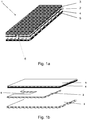
- FIGS Figures 1a and 1b An exemplary structure of a medical diagnostic test strip with the material according to the invention is shown in FIGS Figures 1a and 1b shown schematically.
- the test strip 1 is made up of layers 2, 3, 4 and 5.
- the electrical conductor tracks and the immobilized enzyme are printed onto the base material 3.
- This printed base layer is, for example, a die cut of a double-sided pressure-sensitive adhesive tape 2.
- the pressure-sensitive adhesive tape 2 itself has two pressure-sensitive adhesive layers, preferably made of a polyacrylate pressure-sensitive adhesive, between which there is a carrier made of PET.
- the die-cut of the pressure-sensitive adhesive tape 2 forms a measuring channel 6 which is used to transport the biological fluid to be measured For example, blood is necessary for the measuring cell.
- a material 5 with the hydrophilic coating lacquer 4 is laminated onto the pressure-sensitive adhesive tape 2 in such a way that this hydrophilic coating lacquer faces the interior of the measuring channel and thus forms a wall thereof.
- the measurement of the contact angle with water and the surface tension on solid surfaces is carried out in accordance with EN 828: 1997 with a G2 / G402 device from Krüss GmbH.
- the surface tension is determined using the Owens-Wendt-Rabel & Kaeble method after measuring the contact angle with deionized water and diiodomethane. The values result from the averaging of four measured values.
- the transport speed of an aqueous test liquid is measured in a capillary test.
- a die-cut of double-sided adhesive tape with a thickness of 75 ⁇ m (tesa® 62550, a double-sided adhesive tape consisting of a double-sided adhesive tape with a an acrylate adhesive coated 50 ⁇ m PET carrier film, product thickness 75 ⁇ m).
- the die-cut forms a measuring channel with a width of 1 mm and is open on both sides. This measuring channel is then covered with the film to be tested, so that the surface to be tested forms a wall of the channel.
- the channel or the capillary has the dimensions height 75 ⁇ m and width 1 mm.
- a drop of the test liquid consisting of deionized water and 0.1% by weight of methyl blue, is now held against the opening of the measuring channel and the time of the liquid front to cover a measuring path of 2.3 mm (distance between the measuring marks) is determined.
- the time is determined either electrically or by means of a video camera.
- the flow or transport speed is calculated from the measured time.
- Biological fluids such as blood are also used as the test fluid.
- biological fluids such as blood are less good as a test fluid suitable as these are subject to fluctuations in properties.
- the viscosity of blood fluctuates very strongly.
- the viscosity of blood depends on the hematocrit value.
- this measurement is recorded by a video camera and the speed is calculated based on the wetting area after 5 s.
- the measurement takes place under standardized climatic conditions of 23 ° C and 50% r.h.
- the adhesive tape tesa® 4872, a double-sided pressure-sensitive adhesive tape consisting of a 12 ⁇ m PET carrier film coated on both sides with an acrylate adhesive, product thickness 48 ⁇ m, adhesive strength on steel 4, 0 N / 25 mm, laminated by rolling ten times onto the surface to be tested using a 2 kg roller.
- the force is then immediately measured which is necessary to release the bond between the surface to be tested and the pressure-sensitive adhesive tape.
- the composite is pulled apart in a tensile testing machine at an angle of 180 °.
- A4 samples are stored in a drying cabinet at 40 ° C. for 10 weeks or at 70 ° C. for 10 weeks. During storage, make sure that the coated surface is not covered.
- blood sugar test strips are also stored in the drying cabinet at 40 ° C for 10 weeks or at 70 ° C for 10 weeks.
- the PET film Hostaphan® RN 100 from Mitsubishi Polyesterfilm GmbH with a thickness of 100 ⁇ m is corona pretreated on one side and then with a solution consisting of 0.5% by weight of Rewopol® SB DO 75 from Goldschmidt GmbH in ethanol using an anilox roller in one width of 2000 mm and coated at a speed of 200 m / min.
- the coating lacquer is dried in a drying tunnel at 120 ° C.
- the coating lacquer shows very good wetting properties.
- the speed of the liquid transport in the measuring channel does not decrease even after a storage time of 10 weeks at 70 ° C.
- the PET film Hostaphan® RN 100 from Mitsubishi Polyesterfilm GmbH with a thickness of 100 ⁇ m is corona pretreated on one side and then with a solution consisting of 0.7% by weight Lutensit® A-BO and 0.05% by weight Irganox® 1010 from Ciba Inc. in ethanol using a wire doctor with a width of 500 mm and a speed coated at 20 m / min.
- the coating varnish is dried in a drying tunnel at 110 ° C.
- the coating lacquer shows very good wetting behavior for water and aqueous biological fluids such as blood.
- the coating lacquer shows good wetting behavior even after a storage time of 10 weeks at up to 70 ° C.
- a low surface tension is measured on this film. This means that aqueous liquids do not spread out on this surface. Biological fluids are also not transported into the channel in the channel test.
- Example 2 a coating analogous to example 1 is produced. In contrast, however, a coating solution of 5% by weight Rewopol® SB DO 75 from Goldschmidt GmbH in ethanol is used here.
- This coating shows very good wetting properties.
- the surface is very waxy or soapy. Anchoring of adhesive tapes is hardly possible. This is reflected in the very low anchoring forces. In the channel test, there are undercuts between the hydrophilic coating and the adhesive tape. A measurement is therefore not possible. It is not possible to use this film.
- the commercial hydrophilic film ARflow 90128 from Adhesives Research is used.
- This product consists of a PET film that is coated on one side with a surfactant-containing hot melt adhesive. This coating lacquer is covered with a protective film.
- This hydrophilic film shows moderate to good properties with regard to the spreading of biological fluids. After storage, a decrease in the wettability of the film is observed. Another disadvantage is the waxy surface due to the high concentration of surfactants. When used in multilayer structures in which pressure-sensitive adhesive tapes are bonded to this hydrophilic film, this leads to a low rate Bond strength and thus delamination of this bond. After storage for 10 weeks at 70 ° C., a decrease in the wetting properties is observed.
- PET film has a surface-active coating lacquer on one side. This consists of a surfactant-containing PVDC coating.
- This hydrophilic film shows moderate spreading properties for biological fluids.
- the hydrophilic surface properties are very inhomogeneous over the surface and from batch to batch.
- Example 1 is used as a counter example 5 US 2005/0084681 A1 adjusted.
- This coating lacquer shows good wetting properties which are stable even after storage.
Landscapes
- Chemical & Material Sciences (AREA)
- Life Sciences & Earth Sciences (AREA)
- Engineering & Computer Science (AREA)
- Materials Engineering (AREA)
- Wood Science & Technology (AREA)
- Organic Chemistry (AREA)
- Investigating Or Analysing Biological Materials (AREA)
- Laminated Bodies (AREA)
Description
- Die vorliegende Erfindung betrifft ein bahnförmiges Material, das ein dauerhaftes schnelles Spreiten beziehungsweise einen dauerhaften sehr schnellen Transport von biologischen Flüssigkeiten wie beispielsweise Blut, Urin, Speichel oder Zellflüssigkeit ermöglicht.
- In der modernen Medizindiagnostik werden eine immer größere Anzahl analytischer Teststreifen, so genannte Diagnoseteststreifen oder Biosensoren, verwendet. Mit diesen kann zum Beispiel der Gehalt an Glukose, Cholesterol, Proteinen, Ketonen, Phenylalanin oder Enzymen in biologischen Flüssigkeiten wie Blut, Speichel und Urin bestimmt werden.
Am häufigsten anzutreffen sind Diagnoseteststreifen zur Bestimmung und Überprüfung des Blutzuckergehaltes bei Diabetikern. Weltweit leiden etwa 175 Millionen Menschen an Diabetes mellitus Typ 1 und Typ 2. Die Tendenz dieser Erkrankung ist steigend.
Bei dieser nicht heilbaren Krankheit ist es notwendig, dass die Patienten bis zu fünfmal täglich ihren Blutzuckergehalt kontrollieren, um anhand dessen die Dosierung der Medikamentation (Insulin) sowie die Nahrungsmitteleinnahme optimal aufeinander abzustimmen. Im Falle eines zu hohen Blutzuckergehalts infolge einer Nichtkontrolle muss mit erheblichen gesundheitlichen Schäden gerechnet werden, die bis zum Tode führen können (diabetischer Schock aufgrund von Unter- aber auch von Überzuckerung). Bis vor wenigen Jahren waren die Diabetiker auf die Unterstützung von medizinischem Personal angewiesen, um den Blutzuckergehalt zu bestimmen. Um die Kontrolle des Blutzuckergehaltes so einfach wie möglich zu gestalten, wurde ein Test entwickelt, der es dem Kranken erlaubt, seinen Blutzuckergehalt, auch ohne auf medizinisches Personal angewiesen zu sein, mit geringsten Aufwand selbst zu bestimmen.
Zur Bestimmung des Blutzuckergehalts muss der Proband einen Bluttropfen auf einen Diagnoseteststreifen geben. Der Diagnoseteststreifen befindet sich dabei in einem Lesebeziehungsweise Auswertegerät. Nach einer Reaktions- oder Ansprechzeit wird auf dem Auswertegerät der aktuelle Blutzuckergehalt angezeigt. Entsprechende Lesebeziehungsweise Auswertegeräte sind zum Beispiel in derUS 5,304,468 A , derEP 1 225 448 A1 und derWO 03/082091 A1 - Eines der ersten Patente auf dem Gebiet der Teststreifen ist bereits 1964 erschienen. In der
GB 1,073,596 A - Die Bestimmung einer Konzentrationsänderung eines Farbstoffes (Photometrische Methode) ist auch heute noch ein verwendetes Verfahren zur Blutzuckerbestimmung mittels Diagnoseteststreifen. Dabei reagiert das Enzym Glukose-Oxidase/Peroxidase mit dem Blutzucker. Das dabei entstehende Wasserstoffperoxid reagiert anschließend mit einem Indikator zum Beispiel O-Tolidine, was zu einer Farbreaktion führt. Diese Farbveränderung kann durch kolorimetrische Methoden verfolgt werden. Der Grad der Verfärbung ist direkt proportional zur Blutzuckerkonzentration. Das Enzym befindet sich hier auf einem Gewebe.
Dieses Verfahren wird zum Beispiel in derEP 0 451 981 A1 und in derWO 93/03673 A1 - Die moderne Entwicklung der Diagnoseteststreifen zielt auf eine Verkürzung der Messzeit zwischen der Blutaufgabe auf den Teststreifen und dem Erscheinen des Messwertes. Die Messzeit beziehungsweise die Zeit zwischen Aufgabe des Blutes auf den Biosensor bis zur Anzeige des Messwertes ist neben der eigentlichen Reaktionszeit der Enzymreaktion und der Folgereaktionen ebenfalls erheblich davon abhängig, wie schnell das Blut innerhalb des Biosensors von der Blutaufgabestelle zum Reaktionsort, das heißt zum Enzym, transportiert wird.
- Zur Verkürzung der Messzeit werden unter anderem hydrophil ausgerüstete Vliese oder Gewebe wie in
US 6,555,061 B verwendet, um das Blut schneller zum Reaktionsort (Enzym) zu transportieren. Das Messverfahren ist identisch mit dem inEP 0 451 981 A1 beschriebenen. Oberflächenmodifizierte Gewebe mit einem Dochteffekt für die biologische Flüssigkeit werden inWO 93/03673 A1 WO 03/067252 A1 US 2002/0102739 A1 beschrieben. In derUS 2002/0102739 A1 wird durch eine Plasmabehandlung des Gewebes ein Bluttransport von 1,0 mm/s erreicht. Bei der Verwendung von Geweben für den Transport der biologischen Testflüssigkeit wie zum Beispiel Blut wird jedoch ein Chromatographieeffekt beobachtet, dass heißt, die Einzelbestandteile wie Zellen werden von den flüssigen Bestandteilen getrennt. Der Chromatographieeffekt wird explizit inWO 03/008933 A2 - Eine Weiterentwicklung zu der photometrischen Messmethode ist die elektrochemische Bestimmung. Dieses Verfahren und ein entsprechender Diagnoseteststreifen sind in
WO 01/67099 A1
Bei diesem Aufbau ist kein Gewebe oder Vlies zum Bluttransport notwendig. Der Vorteil dieses Aufbaus sowie der neuen Messmethode ist, dass die Messung des Blutzuckergehaltes mit viel geringerem Blutvolumen von etwa 0,5 bis 3 µL und in kürzerer Messzeit von 3 bis 5 sec durchgeführt werden kann. - Prinzipiell kann eine bessere Benetzbarkeit und somit eine Erhöhung der Transportgeschwindigkeit der biologischen Flüssigkeit innerhalb des Diagnosestreifens und damit eine Verkürzung der Messzeit durch Beschichtungen mit polaren Polymeren wie zum Beispiel Polyvinylpyrrolidon, Polycarpolactam, Polyethylenglykol oder Polyvinylalkohol erreicht werden. Die Benetzbarkeit beziehungsweise Hydrophilie dieser Beschichtungen sind jedoch für den schnellen Transport der biologischen Flüssigkeiten zu niedrig und damit für die gewünschte Anwendung nicht geeignet.
Eine weitere Möglichkeit besteht in der chemischen oder physikalischen Modifikation der Oberflächen. Standardmethoden hierfür sind die Corona- und die Flammbehandlung. - Diese Behandlungen sind aber über die Zeit nicht stabil. Die durch die Oberflächenbehandlung deutlich erhöhte Oberflächenenergie verringert sich bereits nach wenigen Tagen auf den ursprünglichen Wert.
Durch ein Ätzen der Oberfläche mit einer starken Säure wird ebenfalls eine Erhöhung der Hydrophilie erreicht. Zur Oberflächenätzung von technischen Folien werden zum Beispiel oxidierende Säuren wie Chromschwefelsäure oder Kaliumpermanganat in Verbindung mit Schwefelsäure verwendet. Polyesterfolien (PET) werden in der Technik üblicherweise durch chemische Behandlung mit zum Beispiel Trichloressigsäure oder Kaliumhydroxid an der Oberfläche hydrolysiert, wie es in derWO2005/111606 A1 offenbart ist. Bei diesen Methoden sind die Benetzbarkeit beziehungsweise die Oberflächenspannung auch nach Lagerung stabil. Allerdings sind die Benetzungseigenschaften über die Fläche inhomogen. Weitere Hinweise zur Oberflächenbehandlung von Folien sind in "Polymer Surface", F. Garbassi et al, John Wiley Verlag 1998 (ISBN 0471971006) Kapitel 6 (Seite 235) und Kapitel 7 (Seite 256) zu finden. - In der Literatur wird die Verwendung von Tensiden, dem Fachmann als grenzflächenaktive Substanzen bekannt, zur Verbesserung der Benetzbarkeit beschrieben. Tenside sind Moleküle oder Polymere, die aus einem unpolaren/hydrophoben Teil (Schwanz) und einer polaren/hydrophilen Gruppe (Kopf) bestehen. Zur Verbesserung der Benetzbarkeit von Oberflächen werden die Tenside der wässrigen Flüssigkeit zugegeben. Das Tensid bewirkt eine Herabsetzung der Oberflächenspannung der wässrigen Flüssigkeit an den Grenzflächen (flüssig-fest und flüssig-gasförmig). Dieser Effekt der Verbesserung der Benetzbarkeit der Oberflächen ist messbar in einer Verringerung des Kontaktwinkels. Der Fachmann unterscheidet zwischen anionischen, kationischen, amphoteren und nichtionischen Tensiden. Der hydrophobe Schwanz von Tenside kann aus linearen oder verzweigten Alkyl-, Alkylbenzyl-, perfluorierten Alkyl- oder Siloxane-Gruppen bestehen. Mögliche hydrophile Kopfgruppen sind anionische Salze von Carbonsäuren, Phosphorsäuren, Phosphonsäuren, Sulfaten, Sulfonsäuren, kationische Ammoniumsalze oder nichtionische Polyglycoside, Polyamine, Polyglycolester, Polyglycolether, Polyglycolamine, polyfunktionelle Alkohole oder Alkoholethoxylate. (Ullmann's Encyclopedia of Industrial Chemistry, Vol. A25, 1994, Seite 747).
- In
DE 102 34 564 A1 wird ein Biosensor beschrieben, der aus einem planaren Sensor oder Teststreifen und einem kompartimentierten Reaktions- und Messkammeraufsatz, der durch Prägung einer PVC-Folie hergestellt ist, besteht. Der Probenaufnahmekanal und die Messkammer werden für den Transport der biologischen Flüssigkeit mit einem hydrophilen Gewebe oder einem Tensid ausgerüstet. Ein sehr ähnlicher elektrochemischer Sensor wird inUS 5,759,364 A1 beschrieben. Der Sensor besteht aus einer bedruckten Grundplatte und einer geprägten Deckfolie aus PET oder Polycarbonat. Der Messraum ist hier mit einem Polyurethan-Ionomer für einen beschleunigten Flüssigkeitstransport beschichtet. - In mehreren Veröffentlichungen wird die Verwendung von hydrophilen Materialien wie Gewebe (
DE 30 21 166 A1 ), Membranen (DE 198 49 008 A1 ) und Folien (EP 1 358 896 A1 ,WO 01/67099 A1 - In der
DE 198 15 684 A1 wird ein analytisches Hilfsmittel bestehend aus einer kapillaraktiven Zone, einem Klebebandstanzling und einer kapillaraktiven Abdeckfolie beschrieben. Die kapillaraktive Abdeckfolie besitzt hydrophile Oberflächeneigenschaften, die durch Bedampfung der Abdeckfolie mit Aluminium und anschließender Oxidation erreicht werden. - In der
US 2005/0084681 A1 wird eine Oberfläche mit einer hydrophilen Beschichtung offenbart. Diese Beschichtung besteht aus einem Tensid, vorzugsweise einem nichtionischem Alkoholethoxylat, und einem Stabilisator, vorzugsweise einem Alkylbenzylsulfonat. Das Verhältnis von Tensid zu Stabilisator beträgt in der getrockneten Beschichtung ein bis drei Teile Tensid zu 0,25 bis 2,5 Teile Stabilisator. Der Stabilisator, der vorzugsweise ein anionisches Tensid ist, stellt eine Langzeitstabilität der hydrophilen Beschichtung sicher. Der stabilisierende Effekt wird durch eine Schmelztemperatur > 25 °C, bevorzugt > 45 °C des Stabilisators eingestellt, wodurch eine Verringerung des Dampfdruckes (Verringerung des Verdampfen der Tensidkombination) und somit eine Langzeitstabilität der hydrophilen Beschichtung erreicht wird.
In der Anwendung in einem Diagnosestreifen wird dennoch beobachtet, dass die Beschichtung bereits nach einer sehr kurzen Lagerzeit bei leicht erhöhten Temperaturen versagt und die biologische Testflüssigkeit nicht mehr in den Messkanal transportiert wird. - In
EP 1 647 568 A1 wird eine so genannte Anti-Fog-Beschichtung beschrieben. Diese Beschichtung wird auf eine Polyesterfolie aufgebracht und dient der Vermeidung von Wassertröpfchenbildung bei Lebensmittelverpackungen. Bei der Anti-Fog-Beschichtung handelt es sich um eine hydrophile Beschichtung aus einem anionischen Tensid, einem Polyvinylpyrrolidon als Matrixpolymer und Wasser. - Heute sind bereits hydrophile Folien für die Anwendung in medizinischen Diagnosestreifen kommerziell erhältlich, zum Beispiel die Produkte 9962 und 9971 von 3M Inc., deren Verwendung in
US 2002/0110486 A1 undEP 1 394 535 A1 gezeigt wird. Diese Produkte weisen eine Polyesterfolie auf, die entweder ein- oder beidseitig mit einer hydrophilen Beschichtung ausgerüstet ist. Diese Beschichtung besteht aus einer Polyvinylidenchlorid-Beschichtung, die ein Tensid auf Basis eines Alkylbenzylsulfonates enthält. Das Tensid muss zunächst an die Oberfläche der Beschichtung migrieren, bevor die hydrophilen Oberflächeneigenschaften entfaltet werden können. Eine detaillierte Untersuchung zeigt, dass diese Produkte für den Transport von biologischen Flüssigkeiten in Diagnosestreifen zwar geeignet sind, aber erhebliche Mängel bezüglich Homogenität, Transportgeschwindigkeit und Alterungsbeständigkeit aufweisen.
Als kommerzielle verfügbare hydrophile Folien sind zum anderen die Produkte ARflow® 90128 und ARflow® 90469 von Adhesives Research Inc. erhältlich, deren Verwendung inUS 5,997,817 A1 gezeigt wird. Diese Produkte bestehen aus einer Polyesterfolie, die mit einem thermoplastischen Copolyester unter Zusatz eines Tensids beschichtet sind. Das Wirkprinzip ist analog der vorher beschriebenen Produkte von 3M Inc. Zur Vermeidung der Inhomogenitäten werden hier erheblich größere Mengen von ca. 5 bis 8 % des Tensids zugesetzt. Das hat jedoch zur Folge, dass die Oberfläche der hydrophilen Beschichtung eine wachsartige ist. Auf dieser Beschichtung eine ausreichende Verklebungsfestigkeit mit Haftklebebändern (siehe inFigur 1 die Schicht 2) nicht zu erreichen. Das führt im Herstellprozess der Teststreifen häufig zum Delaminieren des Verbundes. - Die Herstellung der beschriebenen Diagnoseteststreifen geschieht in den meisten Fällen durch eine diskontinuierliche Abfolge von Beschichtungs- und Laminierschritten. Als Basismaterial dienen Bögen aus einer 200 bis 500 µm dicken Folie aus Polyvinylchlorid, Polyester oder Polycarbonat mit den Abmaßen von etwa 400 x 400 mm.
Den Beschichtungs- und Laminierschritten folgt gewöhnlich eine Reihe von Schneidvorgängen. Aufgrund der kleinen Abmaße der Diagnosestreifen von ca. 20 mm x 5 mm ist bei den Beschichtungs-, Laminier- und Schneidvorgängen höchste Präzision erforderlich. Das Schneiden zu den Diagnosestreifen geschieht üblicherweise mit sehr hohen Taktraten mit Schneidmaschinen von zum Beispiel Siebler GmbH oder Kinematik Inc. Bei den Schneidvorgängen können erheblich Probleme auftreten. Bei der Verwendung von ungeeigneten Materialien, die bei der Laminierung eine ungenügende Haftung zueinander aufweisen, wird häufig ein Delaminieren der Schichten im Schneidprozess beobachtet. Diese ungenügende Haftung kann auf eine ungeeignete Klebmasse, das heißt eine Klebmasse mit unzureichender Klebkraft, oder auf einen ungeeigneten Verklebungsuntergrund beziehungsweise auf eine ungeeignete Beschichtung des Verklebungsuntergrundes wie bei ARflow® 90128 und ARflow® 90469 von Adhesives Research Inc. zurückgeführt werden. - Aufgabe der vorliegenden Erfindung ist, ein bahnförmiges Material mit einem ultradünnen Beschichtungslack zur Verfügung zu stellen, das entsprechend den Anforderungen für den Einsatz in Diagnoseteststreifen und zum Aufbau derselben geeignet ist und das im Speziellen einen schnellen Transport der biologischen Flüssigkeit im Messkanal auch nach längerer Lagerung bei unterschiedlichen Bedingungen sowie eine gute Verbundfestigkeit zu Haftklebebändern mit scherfesten Klebmassen mit geringem Klebmassenauftrag gewährleistet. Hierbei ist weiterhin zu gewährleisten, dass die Eigenschaften und im Speziellen die Benetzungs- und Transporteigenschaften des bahnförmigen Materials auch nach einer langen Lagerzeit erhalten bleiben.
- Gelöst wird diese Aufgabe durch ein bahnförmiges Material, wie es im Hauptanspruch niedergelegt ist. Gegenstand der Unteransprüche sind vorteilhafte Weiterentwicklungen des Erfindungsgegenstandes. Des Weiteren umfasst die Erfindung die Verwendungsmöglichkeit der erfindungsgemäßen Folie unter anderem in medizinischen Diagnosestreifen zur Untersuchung von biologischen Flüssigkeiten.
- Demgemäß betrifft die Erfindung ein bahnförmiges Material, bestehend aus einem Trägermaterial, das ein- oder beidseitig einen ultradünnen Beschichtungslack aufweist, der aus einem anionischen Tensid auf Basis eines Sulfobernsteinsäureester-Salzes besteht. Der Beschichtungsauftrag des Beschichtungslacks nach dessen Trocknung beträgt 5 bis 100 mg/m2, vorzugsweise 10 bis 50 mg/m2 und besonders bevorzugt 15 bis 30 mg/m2.
- Das Sulfobernsteinsäureester-Salz weist die folgende chemische Struktur auf:
R'OOC-CH2-CH(SO3 -)-COOR" M+
mit - M+ = zum Beispiel Na+ oder K+
- R', R" = Alkyl-Kette zum Beispiel Butyl-, Hexyl-, 2-Ethylhexyl-
- Für den erfindungsgemäßen ultradünnen Beschichtungslack wird vorzugsweise Natriumsulfobernsteinsäure-bis-2-ethylhexylester (CAS-Nummer 577-11-7) wie zum Beispiel Lutensit® A-BO von BASF AG oder Rewopol® SB DO 75 von Goldschmidt GmbH verwendet. Besonders bevorzugt besteht der Beschichtungslack ausschließlich aus Natriumsulfobernsteinsäure-bis-2-ethylhexylester ohne weitere Zusatzstoffe.
- Der ultradünne Beschichtungslack des erfindungsgemäßen Materials ermöglicht einen dauerhaften schnellen Transport von zum Beispiel biologischen Flüssigkeiten, so dass das Material für medizinische Anwendungen wie Diagnosestreifen, mittels derer biologische Flüssigkeiten untersucht werden, geeignet ist.
Die charakteristische Eigenschaft des erfindungsgemäßen bahnförmigen Materials ist die dauerhafte sehr gute Benetzbarkeit für biologische Flüssigkeiten wie Blut, Urin, Speichel und Zellflüssigkeit, die zu einem sehr weiten und schnellen Ausspreiten und somit zu einem Transport der Flüssigkeiten führt.
Diese Eigenschaft spiegelt sich wider in: - einer Oberflächenspannung von mindestens 65 mN/m, vorzugsweise von mindestens 70 mN/m,
- einem Kontaktwinkel mit Wasser kleiner als 30°,
- einer Ausspreitfläche mit 0,5 ml Wasser von mindestens 10 cm2
- Der ultradünne Beschichtungslack zeichnet sich weiterhin durch eine sehr gute Kompatibilität zu den Nachweis- und Enzymreaktion aus, das heißt, diese werden durch den Beschichtungslack oder dessen Inhaltsstoffe nicht beeinflusst. Die gute Kompatibilität äußert sich darin, dass durch Verwendung des erfindungsgemäßen Materials zum Beispiel in einem Blutzuckermessstreifen keine Veränderung in dem Messwert des Blutzuckergehaltes der Probe beobachtet wird.
Des Weiteren zeichnet sich der ultradünne Beschichtungslack durch eine sehr gute Alterungsstabilität der Benetzungs- und Ausspreiteigenschaften aus. Die Alterungsstabilität wird mit Hilfe der Ausspreitfläche und insbesondere durch Bestimmung der Transportgeschwindigkeit einer wässrigen Testflüssigkeit im Messkanals eines Teststreifens überprüft. So wird beobachtet, dass die Ausspreitfläche von 0,5 mL Wasser auf dem Beschichtungslack auch nach einer Lagerung von 10 Wochen bei 40 °C oder 10 Wochen bei 70 °C mindestens 85 % und vorzugsweise mindestens 90 % des Ursprungswertes vor der Lagerung beträgt. Unter Spreiten versteht man die Ausbreitung einer Flüssigkeit als einen Transportvorgang auf einer festen Phase (Oberfläche). - Die Transportgeschwindigkeit einer wässrigen Testflüssigkeit zum Beispiel deionisiertes Wasser und 0,1 Gew.-% Methylblau) in einem Messkanal eines Blutzuckerteststreifens wird mittels optischer beziehungsweise elektronischer Zeitmessung ermittelt, wobei der Beschichtungslack eine Wand des Kanals bildet. Die Transportgeschwindigkeit der Testflüssigkeiten beträgt auch nach einer Lagerung von 10 Wochen bei 40 °C oder 10 Wochen bei 70 °C mindestens 20 mm/s und vorzugsweise mindestens 30 mm/s.
Die Transportgeschwindigkeit von Blut als Testflüssigkeit beträgt vorzugsweise mindestens 7 mm/s. - In der Literatur gibt es zahlreiche Untersuchungen zu den Phänomen der Benetzbarkeit und der Verbesserung der Benetzbarkeit durch die Verwendung von Tensiden.
Das Phänomen der Benetzung eines Festkörpers durch eine Flüssigkeit wird durch die Youngsche Gleichung (GI. 1) beschrieben (siehe hierzuFigur 2 )
- θ
- - Kontaktwinkel (Benetzungswinkel, Randwinkel)
- γl
- - Oberflächenspannung der Flüssigkeit
- γs
- - Oberflächenspannung des Festkörpers
- γsl
- - Grenzflächenspannung zwischen der Flüssigkeit und dem Festkörper
- Wenn der Kontaktwinkel θ >> 90° ist, sind Flüssigkeit und Festkörper sehr unverträglich, und es kommt zu keiner Benetzung der Festkörperoberfläche durch die Flüssigkeit. Im Bereich von 90° bis 20° kommt es zu einer Benetzung der Festkörperoberfläche. Bei Kontaktwinkeln θ < 20° sind die Oberflächenspannungen zwischen Flüssigkeit und Festkörper sehr ähnlich, und es kommt zu einer sehr guten Benetzung der Festkörperoberfläche durch die Flüssigkeit. Bei Kontaktwinkeln θ << 20° (θ ∼ 0°) spreitet die Flüssigkeit auf der Festkörperoberfläche aus (siehe "Die Tenside", Kosswig/Stache, Carl Hanser Verlag, 1993, ISBN 3-446-16201-1, Seite 23).
- In diesen Untersuchungen wird jeweils das Tensid der Flüssigkeit zugegeben, um eine Verbesserung der Benetzungseigenschaften von wässrigen Lösungen für beliebige Untergründe zu erzielen. Es gibt bisher kaum Untersuchungen, in denen das Tensid direkt auf eine Oberfläche aufgebracht wird, um deren Benetzbarkeit für beliebige wässrige Flüssigkeiten zu erhöhen. In den wenigen Veröffentlichungen hierzu (siehe Stand der Technik) dient die tensidhaltige Beschichtung zur hydrophilen Modifikation der Grenzfläche zwischen Festkörper und Flüssigkeit. Das Tensid wird hierbei einer Polymermatrix zum Beispiel Polyvinylpyrrolidon oder Polyvinylidenchlorid zugegeben.
- Überraschenderweise und für den Fachmann nicht vorhersehbar zeigen Beschichtungslacke mit mindestens einem anionischen Tensid auf Basis eines Sulfobernsteinsäureester-Salzes mit einem ultradünnen Beschichtungsauftrag nach deren Trocknung von 5 bis 100 mg/m2 und bevorzugt 10 bis 50 g/m2 sehr gute sowie dauerhafte Ergebnisse bezüglich Benetzbarkeit und Flüssigkeitstransport.
Nichtionische Tenside besitzen eine erhebliche Mobilität auf der Oberfläche. Das führt zur Übertragung des Tensids auf zum Beispiel Umlenkrollen im Verarbeitungsprozess, zum Übertrag, wenn die beschichtete Bahn aufgerollt wird, auf die eigene Rückseite und zu Migrationsvorgängen im Endprodukt. Es folgt eine Reduzierung bis hin zum Verlust der Funktionstüchtigkeit der hydrophilen Beschichtung.
InWO 2005/039770 A1 wird versucht, diesem Effekt durch den Einsatz eines Stabilisators zu begegnen. Die vorliegende Erfindung zeigt jedoch überraschenderweise, dass der Beschichtungslack eines anionischen Tensids auf Basis eines Sulfobernsteinsäureester-Salzes mit Beschichtungsauftrag eine deutlich alterungs- beziehungsweise langzeitstabilere Benetzungseigenschaften in der Applikation, obwohl im Gegenbeispiel G des PatentsWO 2005/039770 A1 diese Möglichkeit verneint wird. Entscheidend für die Funktionstüchtigkeit des erfindungsgemäßen Beschichtungslacks ist der ultradünne Beschichtungsauftrag in Kombination mit dem anionischen Tensids auf Basis eines Sulfobernsteinsäureester-Salzes. - Eine typische Anwendung des erfindungsgemäßen Materials ist in medizinischen Diagnosestreifen gegeben . Das erfindungsgemäße bahnförmige Material stellt in den Diagnosestreifen den Transport der biologischen Flüssigkeit, dem so genannten Analyten, sicher. Dieser Transport muss auch nach einem längeren Zeitraum (Lagerzeit des Diagnosestreifens) zuverlässig und mit gleicher Geschwindigkeit erfolgen. Beschichtungslacke auf Basis von nichtionische Tensiden wie Fettalkoholethoxylate oder Silikonalkoholethoxylate zeigen zum Beispiel trotz ihrer besseren Benetzungseigenschaften ein deutlich schlechtere Alterungsbeständigkeit. Diese Beschichtungslacke zeigen bereits nach einer Lagerung von 3 Wochen bei 70 °C eine deutliche Abnahme der Benetzungseigenschaften. Noch dramatischer ist das Verhalten dieser Beschichtungslacke in der Anwendung in einem Diagnosestreifen. Hier sind schon nach wenigen Tagen die Benetzungseigenschaften so stark reduziert, dass der Diagnosestreifen keine Funktionstüchtigkeit mehr aufweist. Es findet kein Transport von Testflüssigkeit in den Messkanal mehr statt. Bei diesem Phänomen handelt es vermutlich um ein Migrationsphänomenen beziehungsweise eine Inkompatibilität zwischen dem Tensid und der Klebemasse des Stanzlings.
- Für das erfindungsgemäße bahnförmige Material mit sehr guten Benetzungs- und Ausspreiteigenschaften eignen sich Beschichtungslacke aus mindestens einem anionischen Tensid auf Basis eines Sulfobernsteinsäureester-Salzes, vorzugsweise einem Beschichtungslack ausschließlich bestehend aus einem Sulfobernsteinsäureester-Salzes.
- Der ultradünne Beschichtungslack zeichnet sich durch einen Kontaktwinkel mit Wasser von kleiner 30°, durch eine Oberflächenspannung von mindestens 65 mN/m, vorzugsweise von mindestens 70 mN/m, wobei die Ausspreitfläche der 0,5 mL Wasser mindestens 10 cm2 beträgt, eine Transportgeschwindigkeit einer wässrigen Testflüssigkeit von mindestens 20 mm/s und vorzugsweise mindestens 30 mm/s sowie durch eine gute Verklebungsfestigkeit für Klebebänder aus.
- Die sehr guten Benetzungseigenschaften ändern sich auch nach Lagerungen bei 25 °C über einen Zeitraum von zwei Jahren nicht oder nur geringfügig. Zur Beurteilung der Lagerstabilität der erfindungsgemäßen Beschichtungslacke wird eine Schnellalterung bei erhöhten Temperaturen durchgeführt. Zur Beurteilung der Benetzungseigenschaften werden hauptsächlich der Ausspreittest (Ausspreitfläche) und der Kanaltest herangezogen.
- Der Beschichtungslack kann ein oder mehrere Alterungsschutzmittel zur Verbesserung der Langzeitstabilität enthalten, vorzugsweise genau ein Alterungsschutzmittel beziehungsweise Stabilisator. Die Verwendung von Stabilisatoren wie Alterungsschutzmitteln ist in der Kunststoffindustrie bekannt. So werden bei der Herstellung von Materialien oder Werkstoffe aus PVC oder Polyolefinen Alterungsschutzmittel benötigt, um diese Kunststoffe vor thermischer oder oxidativer Schädigung im Herstellprozess zu schützen. Hierbei werden zum Teil Alterungsschutzpaketen bestehend aus primären und sekundären Alterungsschutzmitteln verwendet ("Plastics Additives Handbook", Kapitel "Antioxidants", Carl Hanser Verlag, 5. Auflage).
- Vollfläche Beschichtungen mit den üblichen Beschichtungsverfahren haben typischerweise eine Beschichtungsstärke von < 0,3 µm, was in etwa einem Beschichtungsauftrag von < 0,3 g/m2 entspricht. Als Beispiele für typische Beschichtungen in diesem Bereich seien Primer-, Release Lack-Beschichtungen und Bedruckungen mit Farbe genannt.
Im Falle der vorliegenden Erfindung kann ein entsprechend hoher Beschichtungsauftrag nicht verwendet werden. Bei einem Beschichtungsauftrag von größer als 100 mg/m2 kommt es zu einer wachsigen oder seifigen Oberfläche, auf welcher eine Verklebung von selbstklebenden Stanzteilen nicht mehr zuverlässig möglich ist. Das kann wiederum zur Delamination der Biosensoren und Diagnosestreifen im Produktionsprozess und bei der Anwendung führen. Des Weiteren kommt es bei entsprechend hohem Beschichtungsauftrag zu einer Verfälschung des Ergebnisses der elektrochemischen Nachweisreaktion. Das anionische Tensid löst sich größtenteils in der Testflüssigkeit. Dadurch ändert sich dessen Leitfähigkeitswert erheblich. Dies führt zu einer Beeinflussung des Messsignals.
Eine Reduzierung des Beschichtungsauftrages führt zu der Gefahr einer nicht gleichmäßigen fehlstellenhaltigen Beschichtung, die die Funktionstüchtigkeit nicht sicherstellt. - Besonders vorteilhaft lässt sich das bahnförmige Material insbesondere zur Verwendung in einem Diagnosestreifen herstellen, indem eine Beschichtungslösung aus einem Lösungsmittel, in dem mindestens ein anionisches Tensid auf Basis eines Sulfobernsteinsäureester-Salzes gelöst ist, wobei der Feststoffgehalt in der Beschichtungslösung bei kleiner 2 Gew.-%, vorzugsweise kleiner als 1 Gew.-% liegt, auf ein Trägermaterial aufgebracht wird, und das Trägermaterial mit der Beschichtungslösung getrocknet wird, so dass sich nach der Trocknung ein Beschichtungsauftrag in Form eines ultradünnen Beschichtungslacks von 5 bis 100 mg/m2 ergibt.
- Weiter vorzugsweise wird das Trägermaterial beidseitig mit einer Beschichtungslösung beschichtet und anschließend getrocknet.
- Für ultradünne Beschichtungen im Nanometerbereich sind sehr aufwendige Methoden wie Plasmabedampfungen im Hochvakuum bekannt. Diese Verfahren lassen nur sehr eingeschränkt eine Auswahl der zu beschichtenden Materialien zu.
Für den Fachmann überraschend und nicht vorhersehbar führt eine Beschichtung, ausgehend von einer Beschichtungslösung mit einem Feststoffgehalt von kleiner als 2 Gew.-% und bevorzugt kleiner als 1 Gew.-%, mit einem üblichen Beschichtungsverfahren und anschließender Trocknung zu einem gleichmäßige n Beschichtungslack mit einem Beschichtungsauftrag von 5 bis 100 mg/m2.
Besonders überraschend ist, dass trotz dieser ultradünnen Beschichtungsauftrags die Benetzungseigenschaften und somit die Funktionstüchtigkeit des Beschichtungslacks über die gesamte Beschichtungsfläche gegeben ist.
Als Lösemittel für die Beschichtungslösung werden Wasser, Alkohole, vorzugsweise Ethanol oder höhersiedende Alkohole wie n-Butanol oder Ethoxyethanol, Ketone wie Butanon, Ester wie Essigsäureethylester, Alkane wie Hexan, Toluol oder Gemische aus den vorher genannten Lösemitteln eingesetzt. Für die Beschichtung der Beschichtungslösung können die üblichen Beschichtungsverfahren verwendet werden. Beispielsweise seien Spray-Coating, Rasterwalzenauftrag, Mayer-Bar-Beschichtung, Mehrwalzenauftragsbeschichtung, Druckverfahren und Kondensationsbeschichtung genannt ("Modern Coating and Drying Techn.", Cohne, 1992, Wiley-VCH, ISBN 0-471-18806-9, Kapitel 1 und 3). - Der ultradünne Beschichtungslack kann einseitig oder beidseitig auf das Trägermaterial vorzugsweise vollflächig aufgebracht sein.
- Als Basis für das erfindungsgemäße Trägermaterial werden die dem Fachmann geläufigen und üblichen Trägermaterialien wie Folien aus Polyethylen, Polypropylen, verstrecktes Polypropylen, Polyvinylchlorid, Polyester und besonders bevorzugt Polyethylenterephthalat (PET) verwendet. Hierbei kann es sich um Monofolien, coextrudierte oder laminierte Folien handeln. Diese Aufzählung ist beispielhaft und nicht abschließend. Die Oberfläche der Folien kann durch geeignete Verfahren wie zum Beispiel Prägen, Ätzen oder Lasern mikrostrukturiert sein. Die Verwendung von Laminaten, Vliesen, Geweben oder Membranen ist ebenfalls möglich. Die Trägermaterialien können zur besseren Verankerung des Beschichtungslacks nach den Standardverfahren chemisch oder physikalisch vorbehandelt sein, beispielhaft seien die Corona- oder die Flammenbehandlung genannt. Zur Haftvermittlung ist ebenfalls eine Primerung des Trägermaterials mit zum Beispiel PVC, PVDC, thermoplastischen Polyestercopolymeren möglich.
- Die Dicke der erfindungsgemäßen Folie beträgt 12 bis 350 µm und vorzugsweise 50 bis 150 µm.
- Das erfindungsgemäße Material findet aufgrund der geschilderten Eigenschaften unter anderem Anwendung im Aufbau von medizinischen Diagnosestreifen zur Untersuchung von biologischen Flüssigkeiten, auch Biosensoren genannt. Weitere Anwendungen für das erfindungsgemäße Material sind so genannte Point-of-Care-Devices beziehungsweise Microfluidic Device, darunter versteht man medizinische Geräte, Testplatten oder Teststreifen, in den sich Mikrostrukturen oder Mikrokanäle befinden. Mittels dieser Microfluidic Device können ebenfalls biologische Flüssigkeiten untersucht werden. Beispielhaft seien Teststreifen zur Bestimmung des Koagulationsverhaltens von Blut erwähnt.
- Ein beispielhafter Aufbau eines medizinischen Diagnoseteststreifens mit dem erfindungsgemäßen Material ist in den
Figuren 1a und 1b schematisch dargestellt.
Der Teststreifen 1 setzt sich aus den Schichten 2, 3, 4 und 5 zusammen.
Auf das Basismaterial 3 sind die elektrischen Leiterbahnen und das immobilisierte Enzym aufgedruckt. Diese bedruckte Basisschicht ist zum Beispiel ein Stanzling eines doppelseitigen Haftklebebands 2. Das Haftklebeband 2 selbst weist zwei Haftklebeschichten aus vorzugsweise einer Polyacrylat-Haftklebemasse auf, zwischen denen ein Träger aus PET vorhanden ist. Der Stanzling des Haftklebebands 2 bildet einen Messkanal 6, der zum Transport der zu vermessenden biologischen Flüssigkeit zum Beispiel Blut zur Messzelle notwendig ist. Auf das Haftklebeband 2 ist eine Material 5 mit dem hydrophilen Beschichtungslack 4 so laminiert, dass dieser hydrophile Beschichtungslack zum Inneren des Messkanals zeigt und somit eine dessen Wandung bildet. - Die Messung des Kontaktwinkels mit Wasser und der Oberflächenspannung auf festen Oberflächen erfolgt nach EN 828:1997 mit einem Gerät G2/G402 der Firma Krüss GmbH. Die Oberflächenspannung wird mit der Methode nach Owens-Wendt-Rabel&Kaeble nach Messung des Kontaktwinkels mit deionisiertem Wasser und Diiodmethan bestimmt. Die Werte ergeben sich jeweils aus der Mittlung von vier Messwerten.
- Die Messung der Transportgeschwindigkeit einer wässrigen Testflüssigkeit erfolgt in einem Kapillartest. Hierzu wird auf eine mit Leiterbahnen bedruckte Oberfläche einer 500 µm dicken PET-Folie (von der Firma Abbott Diagnostic Care Inc.) ein Stanzling eines doppelseitigen Klebebands mit der Dicke von 75 µm (tesa® 62550, ein doppelseitig klebendes Haftklebeband bestehend aus einer beidseitig mit einer Acrylatklebemasse beschichteten 50 µm PET-Trägerfolie, Produktdicke 75 µm) laminiert. Der Stanzling bildet einen Messkanal mit einer Breite von 1 mm und ist nach beiden Seiten offen. Dieser Messkanal wird anschließend mit der zu prüfenden Folie bedeckt, so dass die zu prüfende Oberfläche eine Wand des Kanals bildet. Der Kanal beziehungsweise die Kapillare hat die Abmaße Höhe 75 µm und Breite 1 mm.
- Ein Tropfen der Testflüssigkeit, bestehend aus deionisiertem Wasser und 0,1 Gew.-% Methylblau, wird nun an die Öffnung des Messkanals gehalten und die Zeit der Flüssigkeitsfront für das Zurücklegen eines Messweges von 2,3 mm (Abstand der Messmarkierungen) ermittelt. Die Zeit wird entweder elektrisch oder mittels einer Videokamera ermittelt. Aus der gemessenen Zeit wird die Fließ- beziehungsweise Transportgeschwindigkeit berechnet.
- Als Testflüssigkeit werden ebenfalls biologische Flüssigkeiten wie Blut verwendet. Allerdings sind biologische Flüssigkeiten wie Blut sind als Testflüssigkeit weniger gut geeignet, da diese Eigenschaftsschwankungen unterliegen. So schwankt zum Beispiel die Viskosität von Blut sehr stark. Die Viskosität von Blut ist abhängig vom Hämatokrit-Wert.
- Zur Messung der Ausspreitfläche werden 0,5 mL deionisiertes Wasser, das mit 0,1 Gew.-% des Farbstoffes Methylblau versetzt ist, mittels einer geeichten Pipette der Firma Eppendorf auf die zu testende Oberfläche gleichmäßig aufgegeben. Mittels Millimeterpapier, das sich unter dem Prüfling befindet, wird nach etwa 15 s der Durchmesser der benetzten Fläche bestimmt und daraus die Benetzungsfläche errechnet.
- Zur Bestimmung der Ausspreitgeschwindigkeit wird diese Messung per Video-Kamera aufgenommen und die Geschwindigkeit anhand der Benetzungsfläche nach 5 s berechnet.
- Die Messung erfolgt unter standardisierten klimatischen Bedingungen von bei 23 °C und 50% r.L.
- Zur Ermittlung der Verklebungsfestigkeit zwischen der zu testenden Folie und eines Standardhaftklebebandes mit sehr scherfester Haftklebemasse wird das Klebeband tesa® 4872, ein doppelseitig klebendes Haftklebeband bestehend aus einer beidseitig mit einer Acrylatklebemasse beschichteten 12 µm PET -Trägerfolie, Produktdicke 48 µm, Klebkraft auf Stahl 4,0 N/25 mm, mittels einer 2 kg Rolle durch zehnmaliges Anrollen auf die zu testende Oberfläche laminiert. Anschließend wird sofort die Kraft gemessen, die nötig ist, um den Verbund zwischen der zu testenden Oberfläche und des Haftklebebandes zu lösen. Dazu wird er Verbund in einer Zugprüfmaschine im Winkel von 180° auseinander gezogen.
- Zur Bestimmung des Beschichtungsauftrages werden 50 cm2 der beschichteten Folie mit 50 ml eines Methanol/Wasser-Gemisches (50:50, v:v) abgespült. Das Extrakt wird per HPLC (Gerät Algient 1100 series, Agilent Technologies Inc., Säule Phenomenex RP, UV-Dedektor) getrennt. Als Eluent wird ein Wasser/Methanol-Gemisch verwendet. Die Konzentration und somit der Beschichtungsauftrag wird über die Integration der Peakfläche anhand einer Kalibriergeraden berechnet.
- Zur Beurteilung der Lagerungsstabilität werden A4-Muster in einem Trockenschrank bei 40 °C für 10 Wochen oder bei 70 °C für 10 Wochen gelagert. Bei der Lagerung ist sicherzustellen, dass die beschichtete Oberfläche nicht abgedeckt wird. Des Weiteren werden Blutzucker-Teststreifen (siehe Kanaltest) ebenfalls für 40 °C für 10 Wochen oder bei 70 °C für 10 Wochen im Trockenschrank gelagert.
- Im Folgenden soll die Erfindung anhand mehrerer Beispiele näher erläutert werden, ohne damit die Erfindung unnötig einschränken zu wollen.
- Die PET-Folie Hostaphan® RN 100 von Mitsubishi Polyesterfilm GmbH mit einer Dicke von 100 µm wird einseitig coronavorbehandelt und anschließend mit einer Lösung bestehend aus 0,5 Gew. -% Rewopol® SB DO 75 von Goldschmidt GmbH in Ethanol mittels Rasterwalze in einer Breite von 2000 mm und mit einer Geschwindigkeit von 200 m/min beschichtet. Die Trocknung des Beschichtungslacks erfolgt in einem Trockenkanal bei 120 °C.
- Der Beschichtungslack zeigt sehr gute Benetzungseigenschaften. Die Geschwindigkeit des Flüssigkeitstransports im Messkanal nimmt auch nach eine Lagerzeit von 10 Wochen bei 70 °C nicht ab.
- Die PET-Folie Hostaphan® RN 100 von Mitsubishi Polyesterfilm GmbH mit einer Dicke von 100 µm wird einseitig coronavorbehandelt und anschließend mit einer Lösung bestehend aus 0,7 Gew.-% Lutensit® A-BO und 0,05 Gew.-% Irganox® 1010 von Ciba Inc. in Ethanol mittels Drahtrakel in einer Breite von 500 mm und einer Geschwindigkeit von 20 m/min beschichtet. Die Trocknung des Beschichtungslacks erfolg t in einem Trockenkanal bei 110 °C.
- Der Beschichtungslack zeigt ein sehr gutes Benetzungsverhalten für Wasser und wässrige biologische Flüssigkeiten wie Blut. Der Beschichtungslack zeigt ein gutes Benetzungsverhalten auch nach einer Lagerungszeit von 10 Wochen bei bis zu 70 °C.
-
Einheit Beispiel 1 Beispiel 2 Eigenschaften des bahnförmigen Materials Beschichtungsauftrag mg/m2 21 29 Verankerungstest N/cm 2,1 1,9 Oberflächenspannung mN/m 67 69 Oberflächenspannung nach 6 Wochen bei 70 °C mN/m 66 68 Kontakt-Winkel ° 23 25 Kontakt-Winkel nach 10 Wochen bei 70 °C ° 26 27 Ausspreitfläche von 0,5 mL Wasser cm2 10 11 Ausspreitfläche von 0,5 mL Wasser nach 10 Wochen bei 40 °C cm2 12 13 Ausspreitfläche von 0,5 mL Wasser nach 10 Wochen bei 70 °C cm2 11 12 Kanaltest mm/s 41 40 Kanaltest nach 10 Wochen bei 70°C mm/s 33 38 - Als Gegenbeispiel 1 wird die kommerzielle PET-Folie Hostaphan RN 100 von Mitsubishi Polyesterfilm GmbH verwendet, deren Oberfläche nicht modifiziert beziehungsweise beschichtet ist.
- Bei dieser Folie wird eine niedrige Oberflächenspannung gemessen. Dadurch spreiten wässrige Flüssigkeiten nicht auf dieser Oberfläche aus. Biologische Flüssigkeiten werden dadurch auch nicht in den Kanal im Kanaltest transportiert.
- Als Gegenbeispiel 2 wird eine Beschichtung analog Beispiel 1 hergestellt. Abweichend wird hier jedoch eine Beschichtungslösung aus 5 Gew.-% Rewopol® SB DO 75 von Goldschmidt GmbH in Ethanol verwendet.
- Diese Beschichtung zeigt sehr gute Benetzungseigenschaften. Die Oberfläche ist jedoch sehr wachsartig bzw. seifig. Eine Verankerung von Klebebändern ist kaum möglich. Das spiegelt sich in den sehr geringen Verankerungskräften wieder. Bei dem Kanaltest gebt es Unterläufer zwischen hydrophiler Beschichtung und dem Klebeband. Eine Messung ist somit nicht möglich. Eine Verwendung dieser Folie ist nicht möglich.
- Als Gegenbeispiel 3 wird die kommerzielle hydrophile Folie ARflow 90128 von Adhesives Research verwendet. Dieses Produkt besteht aus einer PET-Folie, die einseitig mit einem tensidhaltigen Schmelzkleber beschichtet ist. Dieser Beschichtungslack ist mit einer Schutzfolie abgedeckt.
- Diese hydrophile Folie zeigt mäßige bis gute Eigenschaften bezüglich des Ausspreitens von biologischen Flüssigkeiten. Nach Lagerung wird ein Rückgang der Benetzbarkeit der Folie beobachtet. Nachteilig ist ebenfalls die wachsartige Oberfläche aufgrund der hohen Tensidkonzentration. Das führt bei der Anwendung in Mehrschichtaufbauten, bei denen Haftklebebänder auf dieser hydrophilen Folie verklebt werden, zu einer geringen Verklebungsfestigkeit und dadurch zu einem Delaminieren dieser Verklebung. Nach Lagerung über 10 Wochen bei 70 °C wird eine Abnahme der Benetzungseigenschaften beobachtet.
- Als Gegenbeispiel 4 wird das kommerzielle Produkt 9971 von 3M Inc. verwendet. Diese PET-Folie besitzt einseitig einen oberflächenaktive n Beschichtungslack. Diese besteht aus einer tensidhaltigen PVDC-Beschichtung.
- Diese hydrophile Folie zeigt mäßige Spreiteigenschaften für biologische Flüssigkeiten. Hierbei sind die hydrophilen Oberflächeneigenschaften über die Fläche sowie von Charge zu Charge sehr inhomogen.
- Als Gegenbeispiel 5 wird das Beispiel 1 aus
US 2005/0084681 A1 nachgestellt. Dazu wird im Labor eine 100 µm PET-Folie mit 0,6 Gew.-% Dynoll® 604 von Air Producte Inc. und 0,2 Gew.-% Rhodacal® DS10 Rhodia in einem Isopropanol-Wasser-Gemisch (70/30) mittels eines Drahtrakels (Nr. 1) beschichtet und anschließend 3 min bei 100 °C getrocknet. - Dieser Beschichtungslack zeigt gute Benetzungseigenschaften, welche auch nach Lagerung stabil sind.
-
Einheit Gegen - beispiel 1 Gegen - beispiel 2 Gegen - beispiel 3 Gegen - beispiel 4 Gegen - beispiel 5 Oberflächenmodifizierung -- Tensid TPET + Tensid PVDC + Tensid Tensid + Stabilisator Eigenschaften des bahnförmigen Materials Beschichtungsauftrag mg/m2 235 > 1000* > 1000* nicht bekannt* Verankerungstest N/cm 4,8 0,2 1,3 5,1 3,8 Oberflächenspannung mN/m 46 71 63 61-63** 64 Oberflächenspannung nach 6 Wochen bei 70 °C mN/m -- 70 57 58-60** 64 Kontakt-Winkel ° 63 8 22 23-27** 21 Kontakt-Winkel nach 6 Wochen bei 70 °C ° -- 11 24 26-30** 18 Ausspreitfläche von 0,5 mL Wasser cm2 2,5 kein Ausspreiten 17 9 -7* 10 Ausspreitfläche von 0,5 mL Wasser nach 10 Wochen bei 40 °C cm2 -- 17 9 ∼6* 11 Ausspreitfläche von 0,5 mL Wasser nach 6 Wochen bei 70 °C cm2 -- 16 7 ∼5* 9 Kanaltest mm/s Flüssigkeit wandert nicht in die Kapillare Unterläufer 29 15 41 Kanaltest nach 6 Wochen bei 70°C mm/s Flüssigkeit wandert nicht in die Kapillare Unterläufer 8 0,6 Flüssigkeit wandert nicht in die Kapillare * eine exakte Messung ist mit der angegebenen Messmethode nicht möglich
**Eigenschaften des Beschichtungslacks ist über die Fläche nicht homogen
Claims (5)
- Bahnförmiges Material insbesondere zur Verwendung in einem Diagnosestreifen bestehend aus einem Trägermaterial, das ein- oder beidseitig mit einem ultradünnen Beschichtungslack, bestehend aus einem Sulfobernsteinsäureester-Salz, beschichtet ist, wobei der ultradünne Beschichtungslack nach der Trocknung einen Beschichtungsauftrag von 5 bis 100 mg/m2 aufweist.
- Bahnförmiges Material nach Anspruch 1, dadurch gekennzeichnet, dass
das Beschichtungsauftrag des Beschichtungslacks 10-50 mg/m2, vorzugsweise 15-30 mg/m2 beträgt. - Bahnförmiges Material nach zumindest einem der vorherigen Ansprüche, dadurch gekennzeichnet, dass
der Beschichtungslack aus Natrium-sulfobernsteinsäure-bis-2-ethylhexylester besteht. - Bahnförmiges Material nach zumindest einem der vorherigen Ansprüche, dadurch gekennzeichnet, dass
das Trägermaterial aus einer Polyesterfolie mit einer bevorzugten Dicke von 12 bis 350 µm und weiter vorzugsweise 50 bis 150 µm besteht. - Verwendung eines Materials nach zumindest einem der vorherigen Ansprüche in medizinischen Anwendungen, vorzugsweise in Diagnosestreifen, Biosensoren, Point-of-Care-Devices oder Microfluidic Device, mittels derer biologische Flüssigkeiten untersucht werden.
Applications Claiming Priority (1)
| Application Number | Priority Date | Filing Date | Title |
|---|---|---|---|
| DE200710003755 DE102007003755A1 (de) | 2007-01-19 | 2007-01-19 | Bahnförmiges Material mit einer Beschichtung, die ein dauerhaftes schnelles Spreiten beziehungsweise einen dauerhaften sehr schnellen Transport von Flüssigkeiten ermöglicht |
Publications (2)
| Publication Number | Publication Date |
|---|---|
| EP1946850A1 EP1946850A1 (de) | 2008-07-23 |
| EP1946850B1 true EP1946850B1 (de) | 2020-11-04 |
Family
ID=39204822
Family Applications (1)
| Application Number | Title | Priority Date | Filing Date |
|---|---|---|---|
| EP08100092.9A Active EP1946850B1 (de) | 2007-01-19 | 2008-01-04 | Bahnförmiges Material mit einem ultradünnen Beschichtungslack zum Spreiten von Flüssigkeiten |
Country Status (5)
| Country | Link |
|---|---|
| US (1) | US7638190B2 (de) |
| EP (1) | EP1946850B1 (de) |
| DE (2) | DE102007003755A1 (de) |
| TW (1) | TW200902974A (de) |
| WO (1) | WO2008087056A1 (de) |
Families Citing this family (6)
| Publication number | Priority date | Publication date | Assignee | Title |
|---|---|---|---|---|
| DE102008051008A1 (de) * | 2008-10-13 | 2010-04-15 | Tesa Se | Haftklebeband mit funktionalisierter Klebmasse und dessen Verwendung |
| US20100092768A1 (en) * | 2008-10-13 | 2010-04-15 | Tesa Ag | Pressure-sensitive adhesive tape with functionalized adhesive and use thereof |
| US8422740B2 (en) * | 2009-01-15 | 2013-04-16 | Scott Dylewski | Methods for determining a liquid front position on a test strip |
| CA3005826C (en) | 2013-04-15 | 2021-11-23 | Becton, Dickinson And Company | Biological fluid collection device and biological fluid separation and testing system |
| CA2909233C (en) * | 2013-04-15 | 2019-10-22 | Becton, Dickinson And Company | Biological fluid separation device and biological fluid separation and testing system |
| DE102020117212A1 (de) | 2020-06-30 | 2021-12-30 | Marc Becker | Speicheltest zur Erkennung von Krankheitserregern |
Family Cites Families (41)
| Publication number | Priority date | Publication date | Assignee | Title |
|---|---|---|---|---|
| NL289920A (de) * | 1951-01-28 | |||
| US2986453A (en) * | 1957-11-13 | 1961-05-30 | Miles Lab | Diagnostic compositions |
| AU6405665A (en) | 1964-10-19 | 1967-03-16 | Miles Lab | Test device (method for preparing multiple sticks-plastic sticks |
| CS176664B1 (de) * | 1975-02-14 | 1977-06-30 | ||
| JPS55164356A (en) | 1979-06-08 | 1980-12-22 | Fuji Photo Film Co Ltd | Multi-layer analysis sheet for liquid sample analysis |
| US4348455A (en) * | 1981-03-16 | 1982-09-07 | Mobil Oil Corporation | Thermoplastic food wrapping film having improved cling |
| US4935346A (en) | 1986-08-13 | 1990-06-19 | Lifescan, Inc. | Minimum procedure system for the determination of analytes |
| GB8913474D0 (en) * | 1989-06-12 | 1989-08-02 | Amersham Int Plc | Assay method |
| CA2036435A1 (en) | 1990-03-26 | 1991-09-27 | Paul J. Anderson | Reagent unit |
| US5279677A (en) * | 1991-06-17 | 1994-01-18 | Coral International, Inc. | Rinse aid for metal surfaces |
| WO1993003673A1 (en) | 1991-08-22 | 1993-03-04 | Cascade Medical, Inc. | Disposable reagent unit with blood or fluid guard |
| EP0545439A1 (de) * | 1991-12-05 | 1993-06-09 | Konica Corporation | Träger für photographisches Material und lichtempfindliches, photographisches Silberhalogenidmaterial unter Verwendung desselben |
| ATE220371T1 (de) * | 1992-01-29 | 2002-07-15 | Exxonmobil Oil Corp | Trennpapier |
| US5262475A (en) * | 1992-05-12 | 1993-11-16 | Film Specialties, Inc. | Hydrophilic compositions which are fog-resistant |
| US5873931A (en) * | 1992-10-06 | 1999-02-23 | Minnesota Mining And Manufacturing Company | Coating composition having anti-reflective and anti-fogging properties |
| US5989917A (en) | 1996-02-13 | 1999-11-23 | Selfcare, Inc. | Glucose monitor and test strip containers for use in same |
| US5916635A (en) * | 1996-03-28 | 1999-06-29 | Nippon Light Metal Company, Ltd. | Water-based hydrophilic coatings and a process for manufacturing precoated fin materials for heat exchangers with use of said coatings |
| EP0887179B1 (de) * | 1996-12-09 | 2005-12-21 | Nippon Sheet Glass Co., Ltd. | Antibeschlag-gegenstand und dessen herstellungsverfahren |
| US5759364A (en) | 1997-05-02 | 1998-06-02 | Bayer Corporation | Electrochemical biosensor |
| US5997817A (en) | 1997-12-05 | 1999-12-07 | Roche Diagnostics Corporation | Electrochemical biosensor test strip |
| DE19815684A1 (de) | 1998-04-08 | 1999-10-14 | Roche Diagnostics Gmbh | Verfahren zur Herstellung von analytischen Hilfsmitteln |
| DE19829165C2 (de) * | 1998-06-30 | 2003-06-18 | Bayer Ag | Beschichtete Formkörper und deren Verwendung |
| US6521182B1 (en) | 1998-07-20 | 2003-02-18 | Lifescan, Inc. | Fluidic device for medical diagnostics |
| DE19849008A1 (de) | 1998-10-23 | 2000-04-27 | Roche Diagnostics Gmbh | Spreitschichten, Netzmittel zu ihrer Herstellung und deren Verwendung in Teststreifen |
| US6733655B1 (en) | 2000-03-08 | 2004-05-11 | Oliver W. H. Davies | Measurement of substances in liquids |
| ATE406571T1 (de) | 2000-03-28 | 2008-09-15 | Diabetes Diagnostics Inc | Zeitmesser mit schnell ansprechenden glucose sensor |
| US6555061B1 (en) | 2000-10-05 | 2003-04-29 | Lifescan, Inc. | Multi-layer reagent test strip |
| US6967105B2 (en) | 2000-12-02 | 2005-11-22 | Queststar Medical, Inc. | Surface-modified wick for diagnostic test strip |
| WO2002102907A1 (en) * | 2001-06-13 | 2002-12-27 | Nippon Arc Co., Ltd. | Coating composition and article coated with the composition |
| JP2004538453A (ja) | 2001-07-18 | 2004-12-24 | スーリャン ゾー, | 全細胞を含有するサンプルに対するラテラルフローアッセイのための試験片 |
| US6863800B2 (en) | 2002-02-01 | 2005-03-08 | Abbott Laboratories | Electrochemical biosensor strip for analysis of liquid samples |
| GB2388898B (en) | 2002-04-02 | 2005-10-05 | Inverness Medical Ltd | Integrated sample testing meter |
| US7015262B2 (en) | 2002-05-01 | 2006-03-21 | Lifescan, Inc. | Hydrophilic coatings for medical implements |
| DE10234564B4 (de) | 2002-07-25 | 2005-06-02 | Senslab-Gesellschaft Zur Entwicklung Und Herstellung Bioelektrochemischer Sensoren Mbh | Biosensor |
| US7378451B2 (en) | 2003-10-17 | 2008-05-27 | 3M Innovative Properties Co | Surfactant composition having stable hydrophilic character |
| DE102004013699A1 (de) | 2004-03-18 | 2005-10-06 | Tesa Ag | Haftklebeband für medizinische Diagnosestreifen |
| DE102004024432A1 (de) | 2004-05-14 | 2005-12-08 | Tesa Ag | Verwendung einer Folie mit hydrophiler Oberfläche in medizinischen Diagnosestreifen |
| WO2006000505A2 (de) * | 2004-06-23 | 2006-01-05 | Tesa Ag | Medizinischer biosensor, mittels dem biologische flüssigkeiten untersucht werden |
| DE102004049609A1 (de) | 2004-10-12 | 2006-04-13 | Mitsubishi Polyester Film Gmbh | Polyesterfolie mit hydrophiler Beschichtung, Verfahren zu ihrer Herstellung und ihre Verwendung |
| DE102005049639A1 (de) * | 2005-10-18 | 2007-04-19 | Mitsubishi Polyester Film Gmbh | Polyesterfolie mit hydrophiler Beschichtung |
| DE102006032667A1 (de) * | 2006-07-13 | 2008-01-17 | Tesa Ag | Bahnförmiges Material mit einer Beschichtung, die ein sehr schnelles Spreiten beziehungsweise einen sehr schnellen Transport von Flüssigkeiten ermöglicht |
-
2007
- 2007-01-19 DE DE200710003755 patent/DE102007003755A1/de not_active Withdrawn
-
2008
- 2008-01-04 DE DE200811000077 patent/DE112008000077A5/de not_active Withdrawn
- 2008-01-04 WO PCT/EP2008/050061 patent/WO2008087056A1/de not_active Ceased
- 2008-01-04 EP EP08100092.9A patent/EP1946850B1/de active Active
- 2008-01-11 US US11/972,918 patent/US7638190B2/en not_active Expired - Fee Related
- 2008-01-15 TW TW97101480A patent/TW200902974A/zh unknown
Non-Patent Citations (1)
| Title |
|---|
| None * |
Also Published As
| Publication number | Publication date |
|---|---|
| DE102007003755A1 (de) | 2008-07-31 |
| DE112008000077A5 (de) | 2009-12-03 |
| EP1946850A1 (de) | 2008-07-23 |
| TW200902974A (en) | 2009-01-16 |
| US20080176068A1 (en) | 2008-07-24 |
| WO2008087056A1 (de) | 2008-07-24 |
| US7638190B2 (en) | 2009-12-29 |
Similar Documents
| Publication | Publication Date | Title |
|---|---|---|
| EP1983060B1 (de) | Biosensor und dessen Herstellung | |
| DE2822787C2 (de) | Selektiv chemisch empfindlicher FET-Wandler | |
| EP1946850B1 (de) | Bahnförmiges Material mit einem ultradünnen Beschichtungslack zum Spreiten von Flüssigkeiten | |
| EP1035921B1 (de) | Analytisches testelement mit kapillarkanal | |
| EP0113896B2 (de) | Teststreifen | |
| DE69628948T2 (de) | Elektrochemische Zelle | |
| EP0949002B1 (de) | Verfahren zur Herstellung von analytischen Hilfsmitteln | |
| EP1962668B1 (de) | Sandwichsensor zur ermittlung einer analytkonzentration | |
| DE69432917T2 (de) | Sensorelemente und Verfahren zu ihrer Herstellung | |
| DE2900136C2 (de) | Analytisches Element zur Bestimmung eines vorgegebenen Analyten in einer wäßrigen Flüssigkeit | |
| DE102008006225A1 (de) | Biosensor und dessen Herstellung | |
| DE69304922T2 (de) | Sensor-vorrichtungen | |
| WO2008006701A1 (de) | Bahnförmiges material mit einer beschichtung, die ein sehr schnelles spreiten beziehungsweise einen sehr schnellen transport von flüssigkeiten ermöglicht | |
| EP2014727B1 (de) | Hydrophiler Beschichtungslack | |
| WO2005111606A2 (de) | Verwendung einer folie mit hydrophiler oberfläche in medizinischen diagnosestreifen | |
| WO2010007014A1 (de) | Analytisches testelement und verfahren zu dessen herstellung | |
| EP2368637B1 (de) | Mikrofluidische Mehrfach-Messkammeranordnung | |
| EP1824586B1 (de) | Verfahren zur beschichtung von membranen | |
| EP0584721A1 (de) | Analyseelement zur Analyse einer flüssigen Probe | |
| DE202010003766U1 (de) | Bahnförmiges Material mit hoher Dickenpräzision | |
| EP2110423A1 (de) | Hydrophiler Klebedeckel zur Deckelung von fluidischen Devices | |
| EP2060625A1 (de) | Vorrichtung zur Elution von zur Analyse vorgesehenen Proben |
Legal Events
| Date | Code | Title | Description |
|---|---|---|---|
| PUAI | Public reference made under article 153(3) epc to a published international application that has entered the european phase |
Free format text: ORIGINAL CODE: 0009012 |
|
| AK | Designated contracting states |
Kind code of ref document: A1 Designated state(s): AT BE BG CH CY CZ DE DK EE ES FI FR GB GR HR HU IE IS IT LI LT LU LV MC MT NL NO PL PT RO SE SI SK TR |
|
| AX | Request for extension of the european patent |
Extension state: AL BA MK RS |
|
| 17P | Request for examination filed |
Effective date: 20090123 |
|
| 17Q | First examination report despatched |
Effective date: 20090225 |
|
| AKX | Designation fees paid |
Designated state(s): AT BE BG CH CY CZ DE DK EE ES FI FR GB GR HR HU IE IS IT LI LT LU LV MC MT NL NO PL PT RO SE SI SK TR |
|
| RAP1 | Party data changed (applicant data changed or rights of an application transferred) |
Owner name: TESA SE |
|
| GRAP | Despatch of communication of intention to grant a patent |
Free format text: ORIGINAL CODE: EPIDOSNIGR1 |
|
| RIC1 | Information provided on ipc code assigned before grant |
Ipc: C09D 7/12 20060101AFI20150722BHEP Ipc: C08K 5/42 20060101ALN20150722BHEP Ipc: C09D 5/00 20060101ALI20150722BHEP Ipc: B01L 3/00 20060101ALN20150722BHEP Ipc: B05D 1/00 20060101ALI20150722BHEP |
|
| INTG | Intention to grant announced |
Effective date: 20150811 |
|
| RIC1 | Information provided on ipc code assigned before grant |
Ipc: B01L 3/00 20060101ALN20150915BHEP Ipc: C08K 5/42 20060101ALN20150915BHEP Ipc: C09D 5/00 20060101ALI20150915BHEP Ipc: C09D 7/12 20060101AFI20150915BHEP Ipc: B05D 1/00 20060101ALI20150915BHEP |
|
| RAP1 | Party data changed (applicant data changed or rights of an application transferred) |
Owner name: TESA SE |
|
| INTC | Intention to grant announced (deleted) | ||
| GRAP | Despatch of communication of intention to grant a patent |
Free format text: ORIGINAL CODE: EPIDOSNIGR1 |
|
| STAA | Information on the status of an ep patent application or granted ep patent |
Free format text: STATUS: GRANT OF PATENT IS INTENDED |
|
| RIC1 | Information provided on ipc code assigned before grant |
Ipc: C09D 7/63 20180101ALI20191219BHEP Ipc: C09D 5/00 20060101ALI20191219BHEP Ipc: B01L 3/00 20060101ALN20191219BHEP Ipc: B05D 1/00 20060101AFI20191219BHEP Ipc: C08K 5/42 20060101ALN20191219BHEP |
|
| INTG | Intention to grant announced |
Effective date: 20200122 |
|
| GRAS | Grant fee paid |
Free format text: ORIGINAL CODE: EPIDOSNIGR3 |
|
| GRAA | (expected) grant |
Free format text: ORIGINAL CODE: 0009210 |
|
| STAA | Information on the status of an ep patent application or granted ep patent |
Free format text: STATUS: THE PATENT HAS BEEN GRANTED |
|
| AK | Designated contracting states |
Kind code of ref document: B1 Designated state(s): AT BE BG CH CY CZ DE DK EE ES FI FR GB GR HR HU IE IS IT LI LT LU LV MC MT NL NO PL PT RO SE SI SK TR |
|
| REG | Reference to a national code |
Ref country code: GB Ref legal event code: FG4D Free format text: NOT ENGLISH |
|
| REG | Reference to a national code |
Ref country code: CH Ref legal event code: EP |
|
| REG | Reference to a national code |
Ref country code: AT Ref legal event code: REF Ref document number: 1330115 Country of ref document: AT Kind code of ref document: T Effective date: 20201115 |
|
| REG | Reference to a national code |
Ref country code: IE Ref legal event code: FG4D Free format text: LANGUAGE OF EP DOCUMENT: GERMAN |
|
| REG | Reference to a national code |
Ref country code: DE Ref legal event code: R096 Ref document number: 502008017159 Country of ref document: DE |
|
| REG | Reference to a national code |
Ref country code: NL Ref legal event code: FP |
|
| PG25 | Lapsed in a contracting state [announced via postgrant information from national office to epo] |
Ref country code: PT Free format text: LAPSE BECAUSE OF FAILURE TO SUBMIT A TRANSLATION OF THE DESCRIPTION OR TO PAY THE FEE WITHIN THE PRESCRIBED TIME-LIMIT Effective date: 20210304 Ref country code: NO Free format text: LAPSE BECAUSE OF FAILURE TO SUBMIT A TRANSLATION OF THE DESCRIPTION OR TO PAY THE FEE WITHIN THE PRESCRIBED TIME-LIMIT Effective date: 20210204 Ref country code: FI Free format text: LAPSE BECAUSE OF FAILURE TO SUBMIT A TRANSLATION OF THE DESCRIPTION OR TO PAY THE FEE WITHIN THE PRESCRIBED TIME-LIMIT Effective date: 20201104 Ref country code: GR Free format text: LAPSE BECAUSE OF FAILURE TO SUBMIT A TRANSLATION OF THE DESCRIPTION OR TO PAY THE FEE WITHIN THE PRESCRIBED TIME-LIMIT Effective date: 20210205 |
|
| PG25 | Lapsed in a contracting state [announced via postgrant information from national office to epo] |
Ref country code: LV Free format text: LAPSE BECAUSE OF FAILURE TO SUBMIT A TRANSLATION OF THE DESCRIPTION OR TO PAY THE FEE WITHIN THE PRESCRIBED TIME-LIMIT Effective date: 20201104 Ref country code: PL Free format text: LAPSE BECAUSE OF FAILURE TO SUBMIT A TRANSLATION OF THE DESCRIPTION OR TO PAY THE FEE WITHIN THE PRESCRIBED TIME-LIMIT Effective date: 20201104 Ref country code: SE Free format text: LAPSE BECAUSE OF FAILURE TO SUBMIT A TRANSLATION OF THE DESCRIPTION OR TO PAY THE FEE WITHIN THE PRESCRIBED TIME-LIMIT Effective date: 20201104 Ref country code: ES Free format text: LAPSE BECAUSE OF FAILURE TO SUBMIT A TRANSLATION OF THE DESCRIPTION OR TO PAY THE FEE WITHIN THE PRESCRIBED TIME-LIMIT Effective date: 20201104 Ref country code: IS Free format text: LAPSE BECAUSE OF FAILURE TO SUBMIT A TRANSLATION OF THE DESCRIPTION OR TO PAY THE FEE WITHIN THE PRESCRIBED TIME-LIMIT Effective date: 20210304 Ref country code: BG Free format text: LAPSE BECAUSE OF FAILURE TO SUBMIT A TRANSLATION OF THE DESCRIPTION OR TO PAY THE FEE WITHIN THE PRESCRIBED TIME-LIMIT Effective date: 20210204 |
|
| REG | Reference to a national code |
Ref country code: LT Ref legal event code: MG9D |
|
| PG25 | Lapsed in a contracting state [announced via postgrant information from national office to epo] |
Ref country code: HR Free format text: LAPSE BECAUSE OF FAILURE TO SUBMIT A TRANSLATION OF THE DESCRIPTION OR TO PAY THE FEE WITHIN THE PRESCRIBED TIME-LIMIT Effective date: 20201104 |
|
| PG25 | Lapsed in a contracting state [announced via postgrant information from national office to epo] |
Ref country code: EE Free format text: LAPSE BECAUSE OF FAILURE TO SUBMIT A TRANSLATION OF THE DESCRIPTION OR TO PAY THE FEE WITHIN THE PRESCRIBED TIME-LIMIT Effective date: 20201104 Ref country code: CZ Free format text: LAPSE BECAUSE OF FAILURE TO SUBMIT A TRANSLATION OF THE DESCRIPTION OR TO PAY THE FEE WITHIN THE PRESCRIBED TIME-LIMIT Effective date: 20201104 Ref country code: RO Free format text: LAPSE BECAUSE OF FAILURE TO SUBMIT A TRANSLATION OF THE DESCRIPTION OR TO PAY THE FEE WITHIN THE PRESCRIBED TIME-LIMIT Effective date: 20201104 Ref country code: SK Free format text: LAPSE BECAUSE OF FAILURE TO SUBMIT A TRANSLATION OF THE DESCRIPTION OR TO PAY THE FEE WITHIN THE PRESCRIBED TIME-LIMIT Effective date: 20201104 Ref country code: LT Free format text: LAPSE BECAUSE OF FAILURE TO SUBMIT A TRANSLATION OF THE DESCRIPTION OR TO PAY THE FEE WITHIN THE PRESCRIBED TIME-LIMIT Effective date: 20201104 |
|
| REG | Reference to a national code |
Ref country code: DE Ref legal event code: R097 Ref document number: 502008017159 Country of ref document: DE |
|
| PG25 | Lapsed in a contracting state [announced via postgrant information from national office to epo] |
Ref country code: MC Free format text: LAPSE BECAUSE OF FAILURE TO SUBMIT A TRANSLATION OF THE DESCRIPTION OR TO PAY THE FEE WITHIN THE PRESCRIBED TIME-LIMIT Effective date: 20201104 Ref country code: DK Free format text: LAPSE BECAUSE OF FAILURE TO SUBMIT A TRANSLATION OF THE DESCRIPTION OR TO PAY THE FEE WITHIN THE PRESCRIBED TIME-LIMIT Effective date: 20201104 |
|
| REG | Reference to a national code |
Ref country code: CH Ref legal event code: PL |
|
| PLBE | No opposition filed within time limit |
Free format text: ORIGINAL CODE: 0009261 |
|
| STAA | Information on the status of an ep patent application or granted ep patent |
Free format text: STATUS: NO OPPOSITION FILED WITHIN TIME LIMIT |
|
| PG25 | Lapsed in a contracting state [announced via postgrant information from national office to epo] |
Ref country code: LU Free format text: LAPSE BECAUSE OF NON-PAYMENT OF DUE FEES Effective date: 20210104 |
|
| REG | Reference to a national code |
Ref country code: BE Ref legal event code: MM Effective date: 20210131 |
|
| 26N | No opposition filed |
Effective date: 20210805 |
|
| PG25 | Lapsed in a contracting state [announced via postgrant information from national office to epo] |
Ref country code: IT Free format text: LAPSE BECAUSE OF FAILURE TO SUBMIT A TRANSLATION OF THE DESCRIPTION OR TO PAY THE FEE WITHIN THE PRESCRIBED TIME-LIMIT Effective date: 20201104 |
|
| PG25 | Lapsed in a contracting state [announced via postgrant information from national office to epo] |
Ref country code: SI Free format text: LAPSE BECAUSE OF FAILURE TO SUBMIT A TRANSLATION OF THE DESCRIPTION OR TO PAY THE FEE WITHIN THE PRESCRIBED TIME-LIMIT Effective date: 20201104 Ref country code: LI Free format text: LAPSE BECAUSE OF NON-PAYMENT OF DUE FEES Effective date: 20210131 Ref country code: CH Free format text: LAPSE BECAUSE OF NON-PAYMENT OF DUE FEES Effective date: 20210131 |
|
| PG25 | Lapsed in a contracting state [announced via postgrant information from national office to epo] |
Ref country code: IE Free format text: LAPSE BECAUSE OF NON-PAYMENT OF DUE FEES Effective date: 20210104 |
|
| REG | Reference to a national code |
Ref country code: AT Ref legal event code: MM01 Ref document number: 1330115 Country of ref document: AT Kind code of ref document: T Effective date: 20210104 |
|
| PG25 | Lapsed in a contracting state [announced via postgrant information from national office to epo] |
Ref country code: AT Free format text: LAPSE BECAUSE OF NON-PAYMENT OF DUE FEES Effective date: 20210104 |
|
| PG25 | Lapsed in a contracting state [announced via postgrant information from national office to epo] |
Ref country code: IS Free format text: LAPSE BECAUSE OF FAILURE TO SUBMIT A TRANSLATION OF THE DESCRIPTION OR TO PAY THE FEE WITHIN THE PRESCRIBED TIME-LIMIT Effective date: 20210304 |
|
| PG25 | Lapsed in a contracting state [announced via postgrant information from national office to epo] |
Ref country code: BE Free format text: LAPSE BECAUSE OF NON-PAYMENT OF DUE FEES Effective date: 20210131 |
|
| PG25 | Lapsed in a contracting state [announced via postgrant information from national office to epo] |
Ref country code: HU Free format text: LAPSE BECAUSE OF FAILURE TO SUBMIT A TRANSLATION OF THE DESCRIPTION OR TO PAY THE FEE WITHIN THE PRESCRIBED TIME-LIMIT; INVALID AB INITIO Effective date: 20080104 Ref country code: CY Free format text: LAPSE BECAUSE OF FAILURE TO SUBMIT A TRANSLATION OF THE DESCRIPTION OR TO PAY THE FEE WITHIN THE PRESCRIBED TIME-LIMIT Effective date: 20201104 |
|
| P01 | Opt-out of the competence of the unified patent court (upc) registered |
Effective date: 20230526 |
|
| PG25 | Lapsed in a contracting state [announced via postgrant information from national office to epo] |
Ref country code: TR Free format text: LAPSE BECAUSE OF FAILURE TO SUBMIT A TRANSLATION OF THE DESCRIPTION OR TO PAY THE FEE WITHIN THE PRESCRIBED TIME-LIMIT Effective date: 20201104 |
|
| PG25 | Lapsed in a contracting state [announced via postgrant information from national office to epo] |
Ref country code: MT Free format text: LAPSE BECAUSE OF FAILURE TO SUBMIT A TRANSLATION OF THE DESCRIPTION OR TO PAY THE FEE WITHIN THE PRESCRIBED TIME-LIMIT Effective date: 20201104 |
|
| PGFP | Annual fee paid to national office [announced via postgrant information from national office to epo] |
Ref country code: NL Payment date: 20250121 Year of fee payment: 18 |
|
| PGFP | Annual fee paid to national office [announced via postgrant information from national office to epo] |
Ref country code: DE Payment date: 20250121 Year of fee payment: 18 |
|
| PGFP | Annual fee paid to national office [announced via postgrant information from national office to epo] |
Ref country code: FR Payment date: 20250127 Year of fee payment: 18 |
|
| PGFP | Annual fee paid to national office [announced via postgrant information from national office to epo] |
Ref country code: GB Payment date: 20250128 Year of fee payment: 18 |