EP1953829B2 - Verfahren zur Herstellung von Solarmodulen im Walzenverbundverfahren - Google Patents
Verfahren zur Herstellung von Solarmodulen im Walzenverbundverfahren Download PDFInfo
- Publication number
- EP1953829B2 EP1953829B2 EP08100857.5A EP08100857A EP1953829B2 EP 1953829 B2 EP1953829 B2 EP 1953829B2 EP 08100857 A EP08100857 A EP 08100857A EP 1953829 B2 EP1953829 B2 EP 1953829B2
- Authority
- EP
- European Patent Office
- Prior art keywords
- producing
- solar module
- module according
- temperature
- rollers
- Prior art date
- Legal status (The legal status is an assumption and is not a legal conclusion. Google has not performed a legal analysis and makes no representation as to the accuracy of the status listed.)
- Active
Links
- 238000010030 laminating Methods 0.000 title claims abstract description 5
- 238000004519 manufacturing process Methods 0.000 title claims description 22
- 238000000034 method Methods 0.000 title abstract description 24
- 125000002777 acetyl group Chemical class [H]C([H])([H])C(*)=O 0.000 claims abstract description 22
- 229920002554 vinyl polymer Polymers 0.000 claims abstract description 22
- DHKHKXVYLBGOIT-UHFFFAOYSA-N acetaldehyde Diethyl Acetal Natural products CCOC(C)OCC DHKHKXVYLBGOIT-UHFFFAOYSA-N 0.000 claims abstract description 14
- 239000000969 carrier Substances 0.000 claims abstract description 4
- 238000010438 heat treatment Methods 0.000 claims description 11
- 239000011521 glass Substances 0.000 claims description 8
- 239000004014 plasticizer Substances 0.000 claims description 6
- 238000003825 pressing Methods 0.000 claims description 6
- 229920003023 plastic Polymers 0.000 claims description 4
- 239000004033 plastic Substances 0.000 claims description 4
- 229910052751 metal Inorganic materials 0.000 claims description 3
- 239000002184 metal Substances 0.000 claims description 3
- 230000001788 irregular Effects 0.000 claims description 2
- 239000011888 foil Substances 0.000 abstract description 2
- 239000010408 film Substances 0.000 description 30
- 229920002037 poly(vinyl butyral) polymer Polymers 0.000 description 19
- 239000002131 composite material Substances 0.000 description 12
- 239000010409 thin film Substances 0.000 description 9
- 239000000853 adhesive Substances 0.000 description 5
- 230000001070 adhesive effect Effects 0.000 description 5
- 239000004020 conductor Substances 0.000 description 4
- 238000003475 lamination Methods 0.000 description 4
- 239000010410 layer Substances 0.000 description 4
- 229920002451 polyvinyl alcohol Polymers 0.000 description 3
- 235000019422 polyvinyl alcohol Nutrition 0.000 description 3
- 229920005989 resin Polymers 0.000 description 3
- 239000011347 resin Substances 0.000 description 3
- 230000003746 surface roughness Effects 0.000 description 3
- ZTQSAGDEMFDKMZ-UHFFFAOYSA-N Butyraldehyde Chemical compound CCCC=O ZTQSAGDEMFDKMZ-UHFFFAOYSA-N 0.000 description 2
- 239000004372 Polyvinyl alcohol Substances 0.000 description 2
- 238000006359 acetalization reaction Methods 0.000 description 2
- 239000003513 alkali Substances 0.000 description 2
- 229910052784 alkaline earth metal Inorganic materials 0.000 description 2
- 238000005266 casting Methods 0.000 description 2
- 230000006835 compression Effects 0.000 description 2
- 238000007906 compression Methods 0.000 description 2
- 238000005538 encapsulation Methods 0.000 description 2
- 238000001125 extrusion Methods 0.000 description 2
- 239000000463 material Substances 0.000 description 2
- 238000005259 measurement Methods 0.000 description 2
- SCVFZCLFOSHCOH-UHFFFAOYSA-M potassium acetate Chemical compound [K+].CC([O-])=O SCVFZCLFOSHCOH-UHFFFAOYSA-M 0.000 description 2
- 230000005855 radiation Effects 0.000 description 2
- 238000005096 rolling process Methods 0.000 description 2
- 239000004065 semiconductor Substances 0.000 description 2
- 238000011144 upstream manufacturing Methods 0.000 description 2
- HGBOYTHUEUWSSQ-UHFFFAOYSA-N valeric aldehyde Natural products CCCCC=O HGBOYTHUEUWSSQ-UHFFFAOYSA-N 0.000 description 2
- 238000007740 vapor deposition Methods 0.000 description 2
- VGGSQFUCUMXWEO-UHFFFAOYSA-N Ethene Chemical compound C=C VGGSQFUCUMXWEO-UHFFFAOYSA-N 0.000 description 1
- 239000005977 Ethylene Substances 0.000 description 1
- 229920001744 Polyaldehyde Polymers 0.000 description 1
- 239000012963 UV stabilizer Substances 0.000 description 1
- XTXRWKRVRITETP-UHFFFAOYSA-N Vinyl acetate Chemical compound CC(=O)OC=C XTXRWKRVRITETP-UHFFFAOYSA-N 0.000 description 1
- 239000002313 adhesive film Substances 0.000 description 1
- 239000012790 adhesive layer Substances 0.000 description 1
- 150000001299 aldehydes Chemical class 0.000 description 1
- -1 alkaline earth metal salts Chemical class 0.000 description 1
- 229910052799 carbon Inorganic materials 0.000 description 1
- 125000004432 carbon atom Chemical group C* 0.000 description 1
- 125000003178 carboxy group Chemical group [H]OC(*)=O 0.000 description 1
- 239000003795 chemical substances by application Substances 0.000 description 1
- 150000001875 compounds Chemical class 0.000 description 1
- 238000004132 cross linking Methods 0.000 description 1
- 239000003431 cross linking reagent Substances 0.000 description 1
- 230000007547 defect Effects 0.000 description 1
- 238000000151 deposition Methods 0.000 description 1
- 230000008021 deposition Effects 0.000 description 1
- 238000009826 distribution Methods 0.000 description 1
- 238000011143 downstream manufacturing Methods 0.000 description 1
- 229920001971 elastomer Polymers 0.000 description 1
- 238000004049 embossing Methods 0.000 description 1
- 229920001038 ethylene copolymer Polymers 0.000 description 1
- 239000005038 ethylene vinyl acetate Substances 0.000 description 1
- 239000012535 impurity Substances 0.000 description 1
- 238000009413 insulation Methods 0.000 description 1
- 239000011229 interlayer Substances 0.000 description 1
- 239000005340 laminated glass Substances 0.000 description 1
- 239000002346 layers by function Substances 0.000 description 1
- 239000007788 liquid Substances 0.000 description 1
- UEGPKNKPLBYCNK-UHFFFAOYSA-L magnesium acetate Chemical compound [Mg+2].CC([O-])=O.CC([O-])=O UEGPKNKPLBYCNK-UHFFFAOYSA-L 0.000 description 1
- 229940069446 magnesium acetate Drugs 0.000 description 1
- 235000011285 magnesium acetate Nutrition 0.000 description 1
- 239000011654 magnesium acetate Substances 0.000 description 1
- 150000002739 metals Chemical class 0.000 description 1
- 239000000203 mixture Substances 0.000 description 1
- 150000007524 organic acids Chemical class 0.000 description 1
- 235000005985 organic acids Nutrition 0.000 description 1
- 230000035515 penetration Effects 0.000 description 1
- 239000004848 polyfunctional curative Substances 0.000 description 1
- 229920000642 polymer Polymers 0.000 description 1
- 235000011056 potassium acetate Nutrition 0.000 description 1
- 230000002028 premature Effects 0.000 description 1
- 238000002360 preparation method Methods 0.000 description 1
- 239000005336 safety glass Substances 0.000 description 1
- 150000003839 salts Chemical class 0.000 description 1
- 239000002356 single layer Substances 0.000 description 1
- 238000004544 sputter deposition Methods 0.000 description 1
- 239000000758 substrate Substances 0.000 description 1
- 229920001897 terpolymer Polymers 0.000 description 1
- 229920001169 thermoplastic Polymers 0.000 description 1
- 229920001187 thermosetting polymer Polymers 0.000 description 1
- 239000004416 thermosoftening plastic Substances 0.000 description 1
- 238000009423 ventilation Methods 0.000 description 1
Images

Classifications
-
- H—ELECTRICITY
- H10—SEMICONDUCTOR DEVICES; ELECTRIC SOLID-STATE DEVICES NOT OTHERWISE PROVIDED FOR
- H10F—INORGANIC SEMICONDUCTOR DEVICES SENSITIVE TO INFRARED RADIATION, LIGHT, ELECTROMAGNETIC RADIATION OF SHORTER WAVELENGTH OR CORPUSCULAR RADIATION
- H10F71/00—Manufacture or treatment of devices covered by this subclass
-
- B—PERFORMING OPERATIONS; TRANSPORTING
- B29—WORKING OF PLASTICS; WORKING OF SUBSTANCES IN A PLASTIC STATE IN GENERAL
- B29C—SHAPING OR JOINING OF PLASTICS; SHAPING OF MATERIAL IN A PLASTIC STATE, NOT OTHERWISE PROVIDED FOR; AFTER-TREATMENT OF THE SHAPED PRODUCTS, e.g. REPAIRING
- B29C65/00—Joining or sealing of preformed parts, e.g. welding of plastics materials; Apparatus therefor
- B29C65/48—Joining or sealing of preformed parts, e.g. welding of plastics materials; Apparatus therefor using adhesives, i.e. using supplementary joining material; solvent bonding
- B29C65/4805—Joining or sealing of preformed parts, e.g. welding of plastics materials; Apparatus therefor using adhesives, i.e. using supplementary joining material; solvent bonding characterised by the type of adhesives
- B29C65/481—Non-reactive adhesives, e.g. physically hardening adhesives
- B29C65/4815—Hot melt adhesives, e.g. thermoplastic adhesives
-
- B—PERFORMING OPERATIONS; TRANSPORTING
- B29—WORKING OF PLASTICS; WORKING OF SUBSTANCES IN A PLASTIC STATE IN GENERAL
- B29C—SHAPING OR JOINING OF PLASTICS; SHAPING OF MATERIAL IN A PLASTIC STATE, NOT OTHERWISE PROVIDED FOR; AFTER-TREATMENT OF THE SHAPED PRODUCTS, e.g. REPAIRING
- B29C65/00—Joining or sealing of preformed parts, e.g. welding of plastics materials; Apparatus therefor
- B29C65/48—Joining or sealing of preformed parts, e.g. welding of plastics materials; Apparatus therefor using adhesives, i.e. using supplementary joining material; solvent bonding
- B29C65/50—Joining or sealing of preformed parts, e.g. welding of plastics materials; Apparatus therefor using adhesives, i.e. using supplementary joining material; solvent bonding using adhesive tape, e.g. thermoplastic tape; using threads or the like
- B29C65/5057—Joining or sealing of preformed parts, e.g. welding of plastics materials; Apparatus therefor using adhesives, i.e. using supplementary joining material; solvent bonding using adhesive tape, e.g. thermoplastic tape; using threads or the like positioned between the surfaces to be joined
-
- B—PERFORMING OPERATIONS; TRANSPORTING
- B29—WORKING OF PLASTICS; WORKING OF SUBSTANCES IN A PLASTIC STATE IN GENERAL
- B29C—SHAPING OR JOINING OF PLASTICS; SHAPING OF MATERIAL IN A PLASTIC STATE, NOT OTHERWISE PROVIDED FOR; AFTER-TREATMENT OF THE SHAPED PRODUCTS, e.g. REPAIRING
- B29C66/00—General aspects of processes or apparatus for joining preformed parts
- B29C66/70—General aspects of processes or apparatus for joining preformed parts characterised by the composition, physical properties or the structure of the material of the parts to be joined; Joining with non-plastics material
- B29C66/71—General aspects of processes or apparatus for joining preformed parts characterised by the composition, physical properties or the structure of the material of the parts to be joined; Joining with non-plastics material characterised by the composition of the plastics material of the parts to be joined
-
- B—PERFORMING OPERATIONS; TRANSPORTING
- B29—WORKING OF PLASTICS; WORKING OF SUBSTANCES IN A PLASTIC STATE IN GENERAL
- B29C—SHAPING OR JOINING OF PLASTICS; SHAPING OF MATERIAL IN A PLASTIC STATE, NOT OTHERWISE PROVIDED FOR; AFTER-TREATMENT OF THE SHAPED PRODUCTS, e.g. REPAIRING
- B29C66/00—General aspects of processes or apparatus for joining preformed parts
- B29C66/70—General aspects of processes or apparatus for joining preformed parts characterised by the composition, physical properties or the structure of the material of the parts to be joined; Joining with non-plastics material
- B29C66/72—General aspects of processes or apparatus for joining preformed parts characterised by the composition, physical properties or the structure of the material of the parts to be joined; Joining with non-plastics material characterised by the structure of the material of the parts to be joined
- B29C66/723—General aspects of processes or apparatus for joining preformed parts characterised by the composition, physical properties or the structure of the material of the parts to be joined; Joining with non-plastics material characterised by the structure of the material of the parts to be joined being multi-layered
-
- B—PERFORMING OPERATIONS; TRANSPORTING
- B29—WORKING OF PLASTICS; WORKING OF SUBSTANCES IN A PLASTIC STATE IN GENERAL
- B29C—SHAPING OR JOINING OF PLASTICS; SHAPING OF MATERIAL IN A PLASTIC STATE, NOT OTHERWISE PROVIDED FOR; AFTER-TREATMENT OF THE SHAPED PRODUCTS, e.g. REPAIRING
- B29C66/00—General aspects of processes or apparatus for joining preformed parts
- B29C66/70—General aspects of processes or apparatus for joining preformed parts characterised by the composition, physical properties or the structure of the material of the parts to be joined; Joining with non-plastics material
- B29C66/73—General aspects of processes or apparatus for joining preformed parts characterised by the composition, physical properties or the structure of the material of the parts to be joined; Joining with non-plastics material characterised by the intensive physical properties of the material of the parts to be joined, by the optical properties of the material of the parts to be joined, by the extensive physical properties of the parts to be joined, by the state of the material of the parts to be joined or by the material of the parts to be joined being a thermoplastic or a thermoset
- B29C66/739—General aspects of processes or apparatus for joining preformed parts characterised by the composition, physical properties or the structure of the material of the parts to be joined; Joining with non-plastics material characterised by the intensive physical properties of the material of the parts to be joined, by the optical properties of the material of the parts to be joined, by the extensive physical properties of the parts to be joined, by the state of the material of the parts to be joined or by the material of the parts to be joined being a thermoplastic or a thermoset characterised by the material of the parts to be joined being a thermoplastic or a thermoset
- B29C66/7392—General aspects of processes or apparatus for joining preformed parts characterised by the composition, physical properties or the structure of the material of the parts to be joined; Joining with non-plastics material characterised by the intensive physical properties of the material of the parts to be joined, by the optical properties of the material of the parts to be joined, by the extensive physical properties of the parts to be joined, by the state of the material of the parts to be joined or by the material of the parts to be joined being a thermoplastic or a thermoset characterised by the material of the parts to be joined being a thermoplastic or a thermoset characterised by the material of at least one of the parts being a thermoplastic
-
- B—PERFORMING OPERATIONS; TRANSPORTING
- B29—WORKING OF PLASTICS; WORKING OF SUBSTANCES IN A PLASTIC STATE IN GENERAL
- B29C—SHAPING OR JOINING OF PLASTICS; SHAPING OF MATERIAL IN A PLASTIC STATE, NOT OTHERWISE PROVIDED FOR; AFTER-TREATMENT OF THE SHAPED PRODUCTS, e.g. REPAIRING
- B29C66/00—General aspects of processes or apparatus for joining preformed parts
- B29C66/80—General aspects of machine operations or constructions and parts thereof
- B29C66/83—General aspects of machine operations or constructions and parts thereof characterised by the movement of the joining or pressing tools
- B29C66/834—General aspects of machine operations or constructions and parts thereof characterised by the movement of the joining or pressing tools moving with the parts to be joined
- B29C66/8341—Roller, cylinder or drum types; Band or belt types; Ball types
- B29C66/83411—Roller, cylinder or drum types
- B29C66/83413—Roller, cylinder or drum types cooperating rollers, cylinders or drums
-
- B—PERFORMING OPERATIONS; TRANSPORTING
- B29—WORKING OF PLASTICS; WORKING OF SUBSTANCES IN A PLASTIC STATE IN GENERAL
- B29C—SHAPING OR JOINING OF PLASTICS; SHAPING OF MATERIAL IN A PLASTIC STATE, NOT OTHERWISE PROVIDED FOR; AFTER-TREATMENT OF THE SHAPED PRODUCTS, e.g. REPAIRING
- B29C66/00—General aspects of processes or apparatus for joining preformed parts
- B29C66/90—Measuring or controlling the joining process
- B29C66/91—Measuring or controlling the joining process by measuring or controlling the temperature, the heat or the thermal flux
- B29C66/914—Measuring or controlling the joining process by measuring or controlling the temperature, the heat or the thermal flux by controlling or regulating the temperature, the heat or the thermal flux
- B29C66/9141—Measuring or controlling the joining process by measuring or controlling the temperature, the heat or the thermal flux by controlling or regulating the temperature, the heat or the thermal flux by controlling or regulating the temperature
- B29C66/91411—Measuring or controlling the joining process by measuring or controlling the temperature, the heat or the thermal flux by controlling or regulating the temperature, the heat or the thermal flux by controlling or regulating the temperature of the parts to be joined, e.g. the joining process taking the temperature of the parts to be joined into account
-
- B—PERFORMING OPERATIONS; TRANSPORTING
- B29—WORKING OF PLASTICS; WORKING OF SUBSTANCES IN A PLASTIC STATE IN GENERAL
- B29C—SHAPING OR JOINING OF PLASTICS; SHAPING OF MATERIAL IN A PLASTIC STATE, NOT OTHERWISE PROVIDED FOR; AFTER-TREATMENT OF THE SHAPED PRODUCTS, e.g. REPAIRING
- B29C66/00—General aspects of processes or apparatus for joining preformed parts
- B29C66/90—Measuring or controlling the joining process
- B29C66/91—Measuring or controlling the joining process by measuring or controlling the temperature, the heat or the thermal flux
- B29C66/914—Measuring or controlling the joining process by measuring or controlling the temperature, the heat or the thermal flux by controlling or regulating the temperature, the heat or the thermal flux
- B29C66/9141—Measuring or controlling the joining process by measuring or controlling the temperature, the heat or the thermal flux by controlling or regulating the temperature, the heat or the thermal flux by controlling or regulating the temperature
- B29C66/91421—Measuring or controlling the joining process by measuring or controlling the temperature, the heat or the thermal flux by controlling or regulating the temperature, the heat or the thermal flux by controlling or regulating the temperature of the joining tools
-
- B—PERFORMING OPERATIONS; TRANSPORTING
- B29—WORKING OF PLASTICS; WORKING OF SUBSTANCES IN A PLASTIC STATE IN GENERAL
- B29C—SHAPING OR JOINING OF PLASTICS; SHAPING OF MATERIAL IN A PLASTIC STATE, NOT OTHERWISE PROVIDED FOR; AFTER-TREATMENT OF THE SHAPED PRODUCTS, e.g. REPAIRING
- B29C66/00—General aspects of processes or apparatus for joining preformed parts
- B29C66/90—Measuring or controlling the joining process
- B29C66/91—Measuring or controlling the joining process by measuring or controlling the temperature, the heat or the thermal flux
- B29C66/914—Measuring or controlling the joining process by measuring or controlling the temperature, the heat or the thermal flux by controlling or regulating the temperature, the heat or the thermal flux
- B29C66/9141—Measuring or controlling the joining process by measuring or controlling the temperature, the heat or the thermal flux by controlling or regulating the temperature, the heat or the thermal flux by controlling or regulating the temperature
- B29C66/91441—Measuring or controlling the joining process by measuring or controlling the temperature, the heat or the thermal flux by controlling or regulating the temperature, the heat or the thermal flux by controlling or regulating the temperature the temperature being non-constant over time
- B29C66/91443—Measuring or controlling the joining process by measuring or controlling the temperature, the heat or the thermal flux by controlling or regulating the temperature, the heat or the thermal flux by controlling or regulating the temperature the temperature being non-constant over time following a temperature-time profile
- B29C66/91445—Measuring or controlling the joining process by measuring or controlling the temperature, the heat or the thermal flux by controlling or regulating the temperature, the heat or the thermal flux by controlling or regulating the temperature the temperature being non-constant over time following a temperature-time profile by steps
-
- B—PERFORMING OPERATIONS; TRANSPORTING
- B29—WORKING OF PLASTICS; WORKING OF SUBSTANCES IN A PLASTIC STATE IN GENERAL
- B29C—SHAPING OR JOINING OF PLASTICS; SHAPING OF MATERIAL IN A PLASTIC STATE, NOT OTHERWISE PROVIDED FOR; AFTER-TREATMENT OF THE SHAPED PRODUCTS, e.g. REPAIRING
- B29C66/00—General aspects of processes or apparatus for joining preformed parts
- B29C66/90—Measuring or controlling the joining process
- B29C66/91—Measuring or controlling the joining process by measuring or controlling the temperature, the heat or the thermal flux
- B29C66/919—Measuring or controlling the joining process by measuring or controlling the temperature, the heat or the thermal flux characterised by specific temperature, heat or thermal flux values or ranges
-
- B—PERFORMING OPERATIONS; TRANSPORTING
- B29—WORKING OF PLASTICS; WORKING OF SUBSTANCES IN A PLASTIC STATE IN GENERAL
- B29C—SHAPING OR JOINING OF PLASTICS; SHAPING OF MATERIAL IN A PLASTIC STATE, NOT OTHERWISE PROVIDED FOR; AFTER-TREATMENT OF THE SHAPED PRODUCTS, e.g. REPAIRING
- B29C66/00—General aspects of processes or apparatus for joining preformed parts
- B29C66/90—Measuring or controlling the joining process
- B29C66/92—Measuring or controlling the joining process by measuring or controlling the pressure, the force, the mechanical power or the displacement of the joining tools
- B29C66/924—Measuring or controlling the joining process by measuring or controlling the pressure, the force, the mechanical power or the displacement of the joining tools by controlling or regulating the pressure, the force, the mechanical power or the displacement of the joining tools
- B29C66/9241—Measuring or controlling the joining process by measuring or controlling the pressure, the force, the mechanical power or the displacement of the joining tools by controlling or regulating the pressure, the force, the mechanical power or the displacement of the joining tools by controlling or regulating the pressure, the force or the mechanical power
-
- B—PERFORMING OPERATIONS; TRANSPORTING
- B29—WORKING OF PLASTICS; WORKING OF SUBSTANCES IN A PLASTIC STATE IN GENERAL
- B29C—SHAPING OR JOINING OF PLASTICS; SHAPING OF MATERIAL IN A PLASTIC STATE, NOT OTHERWISE PROVIDED FOR; AFTER-TREATMENT OF THE SHAPED PRODUCTS, e.g. REPAIRING
- B29C66/00—General aspects of processes or apparatus for joining preformed parts
- B29C66/90—Measuring or controlling the joining process
- B29C66/92—Measuring or controlling the joining process by measuring or controlling the pressure, the force, the mechanical power or the displacement of the joining tools
- B29C66/929—Measuring or controlling the joining process by measuring or controlling the pressure, the force, the mechanical power or the displacement of the joining tools characterized by specific pressure, force, mechanical power or displacement values or ranges
-
- B—PERFORMING OPERATIONS; TRANSPORTING
- B29—WORKING OF PLASTICS; WORKING OF SUBSTANCES IN A PLASTIC STATE IN GENERAL
- B29C—SHAPING OR JOINING OF PLASTICS; SHAPING OF MATERIAL IN A PLASTIC STATE, NOT OTHERWISE PROVIDED FOR; AFTER-TREATMENT OF THE SHAPED PRODUCTS, e.g. REPAIRING
- B29C66/00—General aspects of processes or apparatus for joining preformed parts
- B29C66/90—Measuring or controlling the joining process
- B29C66/92—Measuring or controlling the joining process by measuring or controlling the pressure, the force, the mechanical power or the displacement of the joining tools
- B29C66/929—Measuring or controlling the joining process by measuring or controlling the pressure, the force, the mechanical power or the displacement of the joining tools characterized by specific pressure, force, mechanical power or displacement values or ranges
- B29C66/9292—Measuring or controlling the joining process by measuring or controlling the pressure, the force, the mechanical power or the displacement of the joining tools characterized by specific pressure, force, mechanical power or displacement values or ranges in explicit relation to another variable, e.g. pressure diagrams
-
- B—PERFORMING OPERATIONS; TRANSPORTING
- B32—LAYERED PRODUCTS
- B32B—LAYERED PRODUCTS, i.e. PRODUCTS BUILT-UP OF STRATA OF FLAT OR NON-FLAT, e.g. CELLULAR OR HONEYCOMB, FORM
- B32B17/00—Layered products essentially comprising sheet glass, or glass, slag, or like fibres
- B32B17/06—Layered products essentially comprising sheet glass, or glass, slag, or like fibres comprising glass as the main or only constituent of a layer, next to another layer of a specific material
- B32B17/10—Layered products essentially comprising sheet glass, or glass, slag, or like fibres comprising glass as the main or only constituent of a layer, next to another layer of a specific material of synthetic resin
- B32B17/10005—Layered products essentially comprising sheet glass, or glass, slag, or like fibres comprising glass as the main or only constituent of a layer, next to another layer of a specific material of synthetic resin laminated safety glass or glazing
- B32B17/10009—Layered products essentially comprising sheet glass, or glass, slag, or like fibres comprising glass as the main or only constituent of a layer, next to another layer of a specific material of synthetic resin laminated safety glass or glazing characterized by the number, the constitution or treatment of glass sheets
- B32B17/10036—Layered products essentially comprising sheet glass, or glass, slag, or like fibres comprising glass as the main or only constituent of a layer, next to another layer of a specific material of synthetic resin laminated safety glass or glazing characterized by the number, the constitution or treatment of glass sheets comprising two outer glass sheets
-
- B—PERFORMING OPERATIONS; TRANSPORTING
- B32—LAYERED PRODUCTS
- B32B—LAYERED PRODUCTS, i.e. PRODUCTS BUILT-UP OF STRATA OF FLAT OR NON-FLAT, e.g. CELLULAR OR HONEYCOMB, FORM
- B32B17/00—Layered products essentially comprising sheet glass, or glass, slag, or like fibres
- B32B17/06—Layered products essentially comprising sheet glass, or glass, slag, or like fibres comprising glass as the main or only constituent of a layer, next to another layer of a specific material
- B32B17/10—Layered products essentially comprising sheet glass, or glass, slag, or like fibres comprising glass as the main or only constituent of a layer, next to another layer of a specific material of synthetic resin
- B32B17/10005—Layered products essentially comprising sheet glass, or glass, slag, or like fibres comprising glass as the main or only constituent of a layer, next to another layer of a specific material of synthetic resin laminated safety glass or glazing
- B32B17/10165—Functional features of the laminated safety glass or glazing
- B32B17/10247—Laminated safety glass or glazing containing decorations or patterns for aesthetic reasons
-
- B—PERFORMING OPERATIONS; TRANSPORTING
- B32—LAYERED PRODUCTS
- B32B—LAYERED PRODUCTS, i.e. PRODUCTS BUILT-UP OF STRATA OF FLAT OR NON-FLAT, e.g. CELLULAR OR HONEYCOMB, FORM
- B32B17/00—Layered products essentially comprising sheet glass, or glass, slag, or like fibres
- B32B17/06—Layered products essentially comprising sheet glass, or glass, slag, or like fibres comprising glass as the main or only constituent of a layer, next to another layer of a specific material
- B32B17/10—Layered products essentially comprising sheet glass, or glass, slag, or like fibres comprising glass as the main or only constituent of a layer, next to another layer of a specific material of synthetic resin
- B32B17/10005—Layered products essentially comprising sheet glass, or glass, slag, or like fibres comprising glass as the main or only constituent of a layer, next to another layer of a specific material of synthetic resin laminated safety glass or glazing
- B32B17/1055—Layered products essentially comprising sheet glass, or glass, slag, or like fibres comprising glass as the main or only constituent of a layer, next to another layer of a specific material of synthetic resin laminated safety glass or glazing characterized by the resin layer, i.e. interlayer
- B32B17/10761—Layered products essentially comprising sheet glass, or glass, slag, or like fibres comprising glass as the main or only constituent of a layer, next to another layer of a specific material of synthetic resin laminated safety glass or glazing characterized by the resin layer, i.e. interlayer containing vinyl acetal
-
- B—PERFORMING OPERATIONS; TRANSPORTING
- B32—LAYERED PRODUCTS
- B32B—LAYERED PRODUCTS, i.e. PRODUCTS BUILT-UP OF STRATA OF FLAT OR NON-FLAT, e.g. CELLULAR OR HONEYCOMB, FORM
- B32B17/00—Layered products essentially comprising sheet glass, or glass, slag, or like fibres
- B32B17/06—Layered products essentially comprising sheet glass, or glass, slag, or like fibres comprising glass as the main or only constituent of a layer, next to another layer of a specific material
- B32B17/10—Layered products essentially comprising sheet glass, or glass, slag, or like fibres comprising glass as the main or only constituent of a layer, next to another layer of a specific material of synthetic resin
- B32B17/10005—Layered products essentially comprising sheet glass, or glass, slag, or like fibres comprising glass as the main or only constituent of a layer, next to another layer of a specific material of synthetic resin laminated safety glass or glazing
- B32B17/10807—Making laminated safety glass or glazing; Apparatus therefor
- B32B17/10816—Making laminated safety glass or glazing; Apparatus therefor by pressing
-
- B—PERFORMING OPERATIONS; TRANSPORTING
- B32—LAYERED PRODUCTS
- B32B—LAYERED PRODUCTS, i.e. PRODUCTS BUILT-UP OF STRATA OF FLAT OR NON-FLAT, e.g. CELLULAR OR HONEYCOMB, FORM
- B32B17/00—Layered products essentially comprising sheet glass, or glass, slag, or like fibres
- B32B17/06—Layered products essentially comprising sheet glass, or glass, slag, or like fibres comprising glass as the main or only constituent of a layer, next to another layer of a specific material
- B32B17/10—Layered products essentially comprising sheet glass, or glass, slag, or like fibres comprising glass as the main or only constituent of a layer, next to another layer of a specific material of synthetic resin
- B32B17/10005—Layered products essentially comprising sheet glass, or glass, slag, or like fibres comprising glass as the main or only constituent of a layer, next to another layer of a specific material of synthetic resin laminated safety glass or glazing
- B32B17/10807—Making laminated safety glass or glazing; Apparatus therefor
- B32B17/10816—Making laminated safety glass or glazing; Apparatus therefor by pressing
- B32B17/10871—Making laminated safety glass or glazing; Apparatus therefor by pressing in combination with particular heat treatment
-
- B—PERFORMING OPERATIONS; TRANSPORTING
- B32—LAYERED PRODUCTS
- B32B—LAYERED PRODUCTS, i.e. PRODUCTS BUILT-UP OF STRATA OF FLAT OR NON-FLAT, e.g. CELLULAR OR HONEYCOMB, FORM
- B32B37/00—Methods or apparatus for laminating, e.g. by curing or by ultrasonic bonding
- B32B37/14—Methods or apparatus for laminating, e.g. by curing or by ultrasonic bonding characterised by the properties of the layers
- B32B37/16—Methods or apparatus for laminating, e.g. by curing or by ultrasonic bonding characterised by the properties of the layers with all layers existing as coherent layers before laminating
- B32B37/18—Methods or apparatus for laminating, e.g. by curing or by ultrasonic bonding characterised by the properties of the layers with all layers existing as coherent layers before laminating involving the assembly of discrete sheets or panels only
-
- H—ELECTRICITY
- H10—SEMICONDUCTOR DEVICES; ELECTRIC SOLID-STATE DEVICES NOT OTHERWISE PROVIDED FOR
- H10F—INORGANIC SEMICONDUCTOR DEVICES SENSITIVE TO INFRARED RADIATION, LIGHT, ELECTROMAGNETIC RADIATION OF SHORTER WAVELENGTH OR CORPUSCULAR RADIATION
- H10F19/00—Integrated devices, or assemblies of multiple devices, comprising at least one photovoltaic cell covered by group H10F10/00, e.g. photovoltaic modules
- H10F19/80—Encapsulations or containers for integrated devices, or assemblies of multiple devices, having photovoltaic cells
-
- H—ELECTRICITY
- H10—SEMICONDUCTOR DEVICES; ELECTRIC SOLID-STATE DEVICES NOT OTHERWISE PROVIDED FOR
- H10F—INORGANIC SEMICONDUCTOR DEVICES SENSITIVE TO INFRARED RADIATION, LIGHT, ELECTROMAGNETIC RADIATION OF SHORTER WAVELENGTH OR CORPUSCULAR RADIATION
- H10F19/00—Integrated devices, or assemblies of multiple devices, comprising at least one photovoltaic cell covered by group H10F10/00, e.g. photovoltaic modules
- H10F19/80—Encapsulations or containers for integrated devices, or assemblies of multiple devices, having photovoltaic cells
- H10F19/807—Double-glass encapsulation, e.g. photovoltaic cells arranged between front and rear glass sheets
-
- B—PERFORMING OPERATIONS; TRANSPORTING
- B29—WORKING OF PLASTICS; WORKING OF SUBSTANCES IN A PLASTIC STATE IN GENERAL
- B29C—SHAPING OR JOINING OF PLASTICS; SHAPING OF MATERIAL IN A PLASTIC STATE, NOT OTHERWISE PROVIDED FOR; AFTER-TREATMENT OF THE SHAPED PRODUCTS, e.g. REPAIRING
- B29C35/00—Heating, cooling or curing, e.g. crosslinking or vulcanising; Apparatus therefor
- B29C35/02—Heating or curing, e.g. crosslinking or vulcanizing during moulding, e.g. in a mould
- B29C35/08—Heating or curing, e.g. crosslinking or vulcanizing during moulding, e.g. in a mould by wave energy or particle radiation
- B29C35/0805—Heating or curing, e.g. crosslinking or vulcanizing during moulding, e.g. in a mould by wave energy or particle radiation using electromagnetic radiation
- B29C2035/0822—Heating or curing, e.g. crosslinking or vulcanizing during moulding, e.g. in a mould by wave energy or particle radiation using electromagnetic radiation using IR radiation
-
- B—PERFORMING OPERATIONS; TRANSPORTING
- B29—WORKING OF PLASTICS; WORKING OF SUBSTANCES IN A PLASTIC STATE IN GENERAL
- B29C—SHAPING OR JOINING OF PLASTICS; SHAPING OF MATERIAL IN A PLASTIC STATE, NOT OTHERWISE PROVIDED FOR; AFTER-TREATMENT OF THE SHAPED PRODUCTS, e.g. REPAIRING
- B29C65/00—Joining or sealing of preformed parts, e.g. welding of plastics materials; Apparatus therefor
- B29C65/02—Joining or sealing of preformed parts, e.g. welding of plastics materials; Apparatus therefor by heating, with or without pressure
- B29C65/10—Joining or sealing of preformed parts, e.g. welding of plastics materials; Apparatus therefor by heating, with or without pressure using hot gases (e.g. combustion gases) or flames coming in contact with at least one of the parts to be joined
-
- B—PERFORMING OPERATIONS; TRANSPORTING
- B29—WORKING OF PLASTICS; WORKING OF SUBSTANCES IN A PLASTIC STATE IN GENERAL
- B29C—SHAPING OR JOINING OF PLASTICS; SHAPING OF MATERIAL IN A PLASTIC STATE, NOT OTHERWISE PROVIDED FOR; AFTER-TREATMENT OF THE SHAPED PRODUCTS, e.g. REPAIRING
- B29C65/00—Joining or sealing of preformed parts, e.g. welding of plastics materials; Apparatus therefor
- B29C65/02—Joining or sealing of preformed parts, e.g. welding of plastics materials; Apparatus therefor by heating, with or without pressure
- B29C65/14—Joining or sealing of preformed parts, e.g. welding of plastics materials; Apparatus therefor by heating, with or without pressure using wave energy, i.e. electromagnetic radiation, or particle radiation
-
- B—PERFORMING OPERATIONS; TRANSPORTING
- B29—WORKING OF PLASTICS; WORKING OF SUBSTANCES IN A PLASTIC STATE IN GENERAL
- B29C—SHAPING OR JOINING OF PLASTICS; SHAPING OF MATERIAL IN A PLASTIC STATE, NOT OTHERWISE PROVIDED FOR; AFTER-TREATMENT OF THE SHAPED PRODUCTS, e.g. REPAIRING
- B29C65/00—Joining or sealing of preformed parts, e.g. welding of plastics materials; Apparatus therefor
- B29C65/02—Joining or sealing of preformed parts, e.g. welding of plastics materials; Apparatus therefor by heating, with or without pressure
- B29C65/14—Joining or sealing of preformed parts, e.g. welding of plastics materials; Apparatus therefor by heating, with or without pressure using wave energy, i.e. electromagnetic radiation, or particle radiation
- B29C65/1403—Joining or sealing of preformed parts, e.g. welding of plastics materials; Apparatus therefor by heating, with or without pressure using wave energy, i.e. electromagnetic radiation, or particle radiation characterised by the type of electromagnetic or particle radiation
- B29C65/1412—Infrared [IR] radiation
-
- B—PERFORMING OPERATIONS; TRANSPORTING
- B29—WORKING OF PLASTICS; WORKING OF SUBSTANCES IN A PLASTIC STATE IN GENERAL
- B29C—SHAPING OR JOINING OF PLASTICS; SHAPING OF MATERIAL IN A PLASTIC STATE, NOT OTHERWISE PROVIDED FOR; AFTER-TREATMENT OF THE SHAPED PRODUCTS, e.g. REPAIRING
- B29C65/00—Joining or sealing of preformed parts, e.g. welding of plastics materials; Apparatus therefor
- B29C65/02—Joining or sealing of preformed parts, e.g. welding of plastics materials; Apparatus therefor by heating, with or without pressure
- B29C65/14—Joining or sealing of preformed parts, e.g. welding of plastics materials; Apparatus therefor by heating, with or without pressure using wave energy, i.e. electromagnetic radiation, or particle radiation
- B29C65/1403—Joining or sealing of preformed parts, e.g. welding of plastics materials; Apparatus therefor by heating, with or without pressure using wave energy, i.e. electromagnetic radiation, or particle radiation characterised by the type of electromagnetic or particle radiation
- B29C65/1425—Microwave radiation
-
- B—PERFORMING OPERATIONS; TRANSPORTING
- B29—WORKING OF PLASTICS; WORKING OF SUBSTANCES IN A PLASTIC STATE IN GENERAL
- B29C—SHAPING OR JOINING OF PLASTICS; SHAPING OF MATERIAL IN A PLASTIC STATE, NOT OTHERWISE PROVIDED FOR; AFTER-TREATMENT OF THE SHAPED PRODUCTS, e.g. REPAIRING
- B29C66/00—General aspects of processes or apparatus for joining preformed parts
- B29C66/40—General aspects of joining substantially flat articles, e.g. plates, sheets or web-like materials; Making flat seams in tubular or hollow articles; Joining single elements to substantially flat surfaces
- B29C66/41—Joining substantially flat articles ; Making flat seams in tubular or hollow articles
- B29C66/45—Joining of substantially the whole surface of the articles
-
- B—PERFORMING OPERATIONS; TRANSPORTING
- B29—WORKING OF PLASTICS; WORKING OF SUBSTANCES IN A PLASTIC STATE IN GENERAL
- B29C—SHAPING OR JOINING OF PLASTICS; SHAPING OF MATERIAL IN A PLASTIC STATE, NOT OTHERWISE PROVIDED FOR; AFTER-TREATMENT OF THE SHAPED PRODUCTS, e.g. REPAIRING
- B29C66/00—General aspects of processes or apparatus for joining preformed parts
- B29C66/70—General aspects of processes or apparatus for joining preformed parts characterised by the composition, physical properties or the structure of the material of the parts to be joined; Joining with non-plastics material
- B29C66/72—General aspects of processes or apparatus for joining preformed parts characterised by the composition, physical properties or the structure of the material of the parts to be joined; Joining with non-plastics material characterised by the structure of the material of the parts to be joined
- B29C66/723—General aspects of processes or apparatus for joining preformed parts characterised by the composition, physical properties or the structure of the material of the parts to be joined; Joining with non-plastics material characterised by the structure of the material of the parts to be joined being multi-layered
- B29C66/7232—General aspects of processes or apparatus for joining preformed parts characterised by the composition, physical properties or the structure of the material of the parts to be joined; Joining with non-plastics material characterised by the structure of the material of the parts to be joined being multi-layered comprising a non-plastics layer
- B29C66/72321—General aspects of processes or apparatus for joining preformed parts characterised by the composition, physical properties or the structure of the material of the parts to be joined; Joining with non-plastics material characterised by the structure of the material of the parts to be joined being multi-layered comprising a non-plastics layer consisting of metals or their alloys
-
- B—PERFORMING OPERATIONS; TRANSPORTING
- B29—WORKING OF PLASTICS; WORKING OF SUBSTANCES IN A PLASTIC STATE IN GENERAL
- B29C—SHAPING OR JOINING OF PLASTICS; SHAPING OF MATERIAL IN A PLASTIC STATE, NOT OTHERWISE PROVIDED FOR; AFTER-TREATMENT OF THE SHAPED PRODUCTS, e.g. REPAIRING
- B29C66/00—General aspects of processes or apparatus for joining preformed parts
- B29C66/70—General aspects of processes or apparatus for joining preformed parts characterised by the composition, physical properties or the structure of the material of the parts to be joined; Joining with non-plastics material
- B29C66/72—General aspects of processes or apparatus for joining preformed parts characterised by the composition, physical properties or the structure of the material of the parts to be joined; Joining with non-plastics material characterised by the structure of the material of the parts to be joined
- B29C66/723—General aspects of processes or apparatus for joining preformed parts characterised by the composition, physical properties or the structure of the material of the parts to be joined; Joining with non-plastics material characterised by the structure of the material of the parts to be joined being multi-layered
- B29C66/7232—General aspects of processes or apparatus for joining preformed parts characterised by the composition, physical properties or the structure of the material of the parts to be joined; Joining with non-plastics material characterised by the structure of the material of the parts to be joined being multi-layered comprising a non-plastics layer
- B29C66/72324—General aspects of processes or apparatus for joining preformed parts characterised by the composition, physical properties or the structure of the material of the parts to be joined; Joining with non-plastics material characterised by the structure of the material of the parts to be joined being multi-layered comprising a non-plastics layer consisting of inorganic materials not provided for in B29C66/72321 - B29C66/72322
- B29C66/72326—Glass
-
- B—PERFORMING OPERATIONS; TRANSPORTING
- B29—WORKING OF PLASTICS; WORKING OF SUBSTANCES IN A PLASTIC STATE IN GENERAL
- B29C—SHAPING OR JOINING OF PLASTICS; SHAPING OF MATERIAL IN A PLASTIC STATE, NOT OTHERWISE PROVIDED FOR; AFTER-TREATMENT OF THE SHAPED PRODUCTS, e.g. REPAIRING
- B29C66/00—General aspects of processes or apparatus for joining preformed parts
- B29C66/70—General aspects of processes or apparatus for joining preformed parts characterised by the composition, physical properties or the structure of the material of the parts to be joined; Joining with non-plastics material
- B29C66/73—General aspects of processes or apparatus for joining preformed parts characterised by the composition, physical properties or the structure of the material of the parts to be joined; Joining with non-plastics material characterised by the intensive physical properties of the material of the parts to be joined, by the optical properties of the material of the parts to be joined, by the extensive physical properties of the parts to be joined, by the state of the material of the parts to be joined or by the material of the parts to be joined being a thermoplastic or a thermoset
- B29C66/731—General aspects of processes or apparatus for joining preformed parts characterised by the composition, physical properties or the structure of the material of the parts to be joined; Joining with non-plastics material characterised by the intensive physical properties of the material of the parts to be joined, by the optical properties of the material of the parts to be joined, by the extensive physical properties of the parts to be joined, by the state of the material of the parts to be joined or by the material of the parts to be joined being a thermoplastic or a thermoset characterised by the intensive physical properties of the material of the parts to be joined
- B29C66/7316—Surface properties
- B29C66/73161—Roughness or rugosity
-
- B—PERFORMING OPERATIONS; TRANSPORTING
- B29—WORKING OF PLASTICS; WORKING OF SUBSTANCES IN A PLASTIC STATE IN GENERAL
- B29C—SHAPING OR JOINING OF PLASTICS; SHAPING OF MATERIAL IN A PLASTIC STATE, NOT OTHERWISE PROVIDED FOR; AFTER-TREATMENT OF THE SHAPED PRODUCTS, e.g. REPAIRING
- B29C66/00—General aspects of processes or apparatus for joining preformed parts
- B29C66/70—General aspects of processes or apparatus for joining preformed parts characterised by the composition, physical properties or the structure of the material of the parts to be joined; Joining with non-plastics material
- B29C66/73—General aspects of processes or apparatus for joining preformed parts characterised by the composition, physical properties or the structure of the material of the parts to be joined; Joining with non-plastics material characterised by the intensive physical properties of the material of the parts to be joined, by the optical properties of the material of the parts to be joined, by the extensive physical properties of the parts to be joined, by the state of the material of the parts to be joined or by the material of the parts to be joined being a thermoplastic or a thermoset
- B29C66/737—General aspects of processes or apparatus for joining preformed parts characterised by the composition, physical properties or the structure of the material of the parts to be joined; Joining with non-plastics material characterised by the intensive physical properties of the material of the parts to be joined, by the optical properties of the material of the parts to be joined, by the extensive physical properties of the parts to be joined, by the state of the material of the parts to be joined or by the material of the parts to be joined being a thermoplastic or a thermoset characterised by the state of the material of the parts to be joined
- B29C66/7375—General aspects of processes or apparatus for joining preformed parts characterised by the composition, physical properties or the structure of the material of the parts to be joined; Joining with non-plastics material characterised by the intensive physical properties of the material of the parts to be joined, by the optical properties of the material of the parts to be joined, by the extensive physical properties of the parts to be joined, by the state of the material of the parts to be joined or by the material of the parts to be joined being a thermoplastic or a thermoset characterised by the state of the material of the parts to be joined uncured, partially cured or fully cured
- B29C66/73751—General aspects of processes or apparatus for joining preformed parts characterised by the composition, physical properties or the structure of the material of the parts to be joined; Joining with non-plastics material characterised by the intensive physical properties of the material of the parts to be joined, by the optical properties of the material of the parts to be joined, by the extensive physical properties of the parts to be joined, by the state of the material of the parts to be joined or by the material of the parts to be joined being a thermoplastic or a thermoset characterised by the state of the material of the parts to be joined uncured, partially cured or fully cured the to-be-joined area of at least one of the parts to be joined being uncured, i.e. non cross-linked, non vulcanized
-
- B—PERFORMING OPERATIONS; TRANSPORTING
- B29—WORKING OF PLASTICS; WORKING OF SUBSTANCES IN A PLASTIC STATE IN GENERAL
- B29C—SHAPING OR JOINING OF PLASTICS; SHAPING OF MATERIAL IN A PLASTIC STATE, NOT OTHERWISE PROVIDED FOR; AFTER-TREATMENT OF THE SHAPED PRODUCTS, e.g. REPAIRING
- B29C66/00—General aspects of processes or apparatus for joining preformed parts
- B29C66/70—General aspects of processes or apparatus for joining preformed parts characterised by the composition, physical properties or the structure of the material of the parts to be joined; Joining with non-plastics material
- B29C66/73—General aspects of processes or apparatus for joining preformed parts characterised by the composition, physical properties or the structure of the material of the parts to be joined; Joining with non-plastics material characterised by the intensive physical properties of the material of the parts to be joined, by the optical properties of the material of the parts to be joined, by the extensive physical properties of the parts to be joined, by the state of the material of the parts to be joined or by the material of the parts to be joined being a thermoplastic or a thermoset
- B29C66/737—General aspects of processes or apparatus for joining preformed parts characterised by the composition, physical properties or the structure of the material of the parts to be joined; Joining with non-plastics material characterised by the intensive physical properties of the material of the parts to be joined, by the optical properties of the material of the parts to be joined, by the extensive physical properties of the parts to be joined, by the state of the material of the parts to be joined or by the material of the parts to be joined being a thermoplastic or a thermoset characterised by the state of the material of the parts to be joined
- B29C66/7375—General aspects of processes or apparatus for joining preformed parts characterised by the composition, physical properties or the structure of the material of the parts to be joined; Joining with non-plastics material characterised by the intensive physical properties of the material of the parts to be joined, by the optical properties of the material of the parts to be joined, by the extensive physical properties of the parts to be joined, by the state of the material of the parts to be joined or by the material of the parts to be joined being a thermoplastic or a thermoset characterised by the state of the material of the parts to be joined uncured, partially cured or fully cured
- B29C66/73755—General aspects of processes or apparatus for joining preformed parts characterised by the composition, physical properties or the structure of the material of the parts to be joined; Joining with non-plastics material characterised by the intensive physical properties of the material of the parts to be joined, by the optical properties of the material of the parts to be joined, by the extensive physical properties of the parts to be joined, by the state of the material of the parts to be joined or by the material of the parts to be joined being a thermoplastic or a thermoset characterised by the state of the material of the parts to be joined uncured, partially cured or fully cured the to-be-joined area of at least one of the parts to be joined being fully cured, i.e. fully cross-linked, fully vulcanized
-
- B—PERFORMING OPERATIONS; TRANSPORTING
- B29—WORKING OF PLASTICS; WORKING OF SUBSTANCES IN A PLASTIC STATE IN GENERAL
- B29C—SHAPING OR JOINING OF PLASTICS; SHAPING OF MATERIAL IN A PLASTIC STATE, NOT OTHERWISE PROVIDED FOR; AFTER-TREATMENT OF THE SHAPED PRODUCTS, e.g. REPAIRING
- B29C66/00—General aspects of processes or apparatus for joining preformed parts
- B29C66/90—Measuring or controlling the joining process
- B29C66/91—Measuring or controlling the joining process by measuring or controlling the temperature, the heat or the thermal flux
- B29C66/912—Measuring or controlling the joining process by measuring or controlling the temperature, the heat or the thermal flux by measuring the temperature, the heat or the thermal flux
- B29C66/9121—Measuring or controlling the joining process by measuring or controlling the temperature, the heat or the thermal flux by measuring the temperature, the heat or the thermal flux by measuring the temperature
- B29C66/91211—Measuring or controlling the joining process by measuring or controlling the temperature, the heat or the thermal flux by measuring the temperature, the heat or the thermal flux by measuring the temperature with special temperature measurement means or methods
- B29C66/91216—Measuring or controlling the joining process by measuring or controlling the temperature, the heat or the thermal flux by measuring the temperature, the heat or the thermal flux by measuring the temperature with special temperature measurement means or methods enabling contactless temperature measurements, e.g. using a pyrometer
-
- B—PERFORMING OPERATIONS; TRANSPORTING
- B29—WORKING OF PLASTICS; WORKING OF SUBSTANCES IN A PLASTIC STATE IN GENERAL
- B29C—SHAPING OR JOINING OF PLASTICS; SHAPING OF MATERIAL IN A PLASTIC STATE, NOT OTHERWISE PROVIDED FOR; AFTER-TREATMENT OF THE SHAPED PRODUCTS, e.g. REPAIRING
- B29C66/00—General aspects of processes or apparatus for joining preformed parts
- B29C66/90—Measuring or controlling the joining process
- B29C66/91—Measuring or controlling the joining process by measuring or controlling the temperature, the heat or the thermal flux
- B29C66/912—Measuring or controlling the joining process by measuring or controlling the temperature, the heat or the thermal flux by measuring the temperature, the heat or the thermal flux
- B29C66/9121—Measuring or controlling the joining process by measuring or controlling the temperature, the heat or the thermal flux by measuring the temperature, the heat or the thermal flux by measuring the temperature
- B29C66/91221—Measuring or controlling the joining process by measuring or controlling the temperature, the heat or the thermal flux by measuring the temperature, the heat or the thermal flux by measuring the temperature of the parts to be joined
-
- B—PERFORMING OPERATIONS; TRANSPORTING
- B29—WORKING OF PLASTICS; WORKING OF SUBSTANCES IN A PLASTIC STATE IN GENERAL
- B29C—SHAPING OR JOINING OF PLASTICS; SHAPING OF MATERIAL IN A PLASTIC STATE, NOT OTHERWISE PROVIDED FOR; AFTER-TREATMENT OF THE SHAPED PRODUCTS, e.g. REPAIRING
- B29C66/00—General aspects of processes or apparatus for joining preformed parts
- B29C66/90—Measuring or controlling the joining process
- B29C66/91—Measuring or controlling the joining process by measuring or controlling the temperature, the heat or the thermal flux
- B29C66/914—Measuring or controlling the joining process by measuring or controlling the temperature, the heat or the thermal flux by controlling or regulating the temperature, the heat or the thermal flux
- B29C66/9141—Measuring or controlling the joining process by measuring or controlling the temperature, the heat or the thermal flux by controlling or regulating the temperature, the heat or the thermal flux by controlling or regulating the temperature
- B29C66/91421—Measuring or controlling the joining process by measuring or controlling the temperature, the heat or the thermal flux by controlling or regulating the temperature, the heat or the thermal flux by controlling or regulating the temperature of the joining tools
- B29C66/91423—Measuring or controlling the joining process by measuring or controlling the temperature, the heat or the thermal flux by controlling or regulating the temperature, the heat or the thermal flux by controlling or regulating the temperature of the joining tools using joining tools having different temperature zones or using several joining tools with different temperatures
-
- B—PERFORMING OPERATIONS; TRANSPORTING
- B29—WORKING OF PLASTICS; WORKING OF SUBSTANCES IN A PLASTIC STATE IN GENERAL
- B29C—SHAPING OR JOINING OF PLASTICS; SHAPING OF MATERIAL IN A PLASTIC STATE, NOT OTHERWISE PROVIDED FOR; AFTER-TREATMENT OF THE SHAPED PRODUCTS, e.g. REPAIRING
- B29C66/00—General aspects of processes or apparatus for joining preformed parts
- B29C66/90—Measuring or controlling the joining process
- B29C66/92—Measuring or controlling the joining process by measuring or controlling the pressure, the force, the mechanical power or the displacement of the joining tools
- B29C66/924—Measuring or controlling the joining process by measuring or controlling the pressure, the force, the mechanical power or the displacement of the joining tools by controlling or regulating the pressure, the force, the mechanical power or the displacement of the joining tools
- B29C66/9241—Measuring or controlling the joining process by measuring or controlling the pressure, the force, the mechanical power or the displacement of the joining tools by controlling or regulating the pressure, the force, the mechanical power or the displacement of the joining tools by controlling or regulating the pressure, the force or the mechanical power
- B29C66/92441—Measuring or controlling the joining process by measuring or controlling the pressure, the force, the mechanical power or the displacement of the joining tools by controlling or regulating the pressure, the force, the mechanical power or the displacement of the joining tools by controlling or regulating the pressure, the force or the mechanical power the pressure, the force or the mechanical power being non-constant over time
- B29C66/92443—Measuring or controlling the joining process by measuring or controlling the pressure, the force, the mechanical power or the displacement of the joining tools by controlling or regulating the pressure, the force, the mechanical power or the displacement of the joining tools by controlling or regulating the pressure, the force or the mechanical power the pressure, the force or the mechanical power being non-constant over time following a pressure-time profile
- B29C66/92445—Measuring or controlling the joining process by measuring or controlling the pressure, the force, the mechanical power or the displacement of the joining tools by controlling or regulating the pressure, the force, the mechanical power or the displacement of the joining tools by controlling or regulating the pressure, the force or the mechanical power the pressure, the force or the mechanical power being non-constant over time following a pressure-time profile by steps
-
- B—PERFORMING OPERATIONS; TRANSPORTING
- B29—WORKING OF PLASTICS; WORKING OF SUBSTANCES IN A PLASTIC STATE IN GENERAL
- B29K—INDEXING SCHEME ASSOCIATED WITH SUBCLASSES B29B, B29C OR B29D, RELATING TO MOULDING MATERIALS OR TO MATERIALS FOR MOULDS, REINFORCEMENTS, FILLERS OR PREFORMED PARTS, e.g. INSERTS
- B29K2029/00—Use of polyvinylalcohols, polyvinylethers, polyvinylaldehydes, polyvinylketones or polyvinylketals or derivatives thereof as moulding material
- B29K2029/14—Polyvinylacetals
-
- B—PERFORMING OPERATIONS; TRANSPORTING
- B29—WORKING OF PLASTICS; WORKING OF SUBSTANCES IN A PLASTIC STATE IN GENERAL
- B29K—INDEXING SCHEME ASSOCIATED WITH SUBCLASSES B29B, B29C OR B29D, RELATING TO MOULDING MATERIALS OR TO MATERIALS FOR MOULDS, REINFORCEMENTS, FILLERS OR PREFORMED PARTS, e.g. INSERTS
- B29K2105/00—Condition, form or state of moulded material or of the material to be shaped
- B29K2105/0005—Condition, form or state of moulded material or of the material to be shaped containing compounding ingredients
- B29K2105/0038—Plasticisers
-
- B—PERFORMING OPERATIONS; TRANSPORTING
- B29—WORKING OF PLASTICS; WORKING OF SUBSTANCES IN A PLASTIC STATE IN GENERAL
- B29K—INDEXING SCHEME ASSOCIATED WITH SUBCLASSES B29B, B29C OR B29D, RELATING TO MOULDING MATERIALS OR TO MATERIALS FOR MOULDS, REINFORCEMENTS, FILLERS OR PREFORMED PARTS, e.g. INSERTS
- B29K2995/00—Properties of moulding materials, reinforcements, fillers, preformed parts or moulds
- B29K2995/0037—Other properties
- B29K2995/0072—Roughness, e.g. anti-slip
-
- B—PERFORMING OPERATIONS; TRANSPORTING
- B29—WORKING OF PLASTICS; WORKING OF SUBSTANCES IN A PLASTIC STATE IN GENERAL
- B29L—INDEXING SCHEME ASSOCIATED WITH SUBCLASS B29C, RELATING TO PARTICULAR ARTICLES
- B29L2009/00—Layered products
-
- B—PERFORMING OPERATIONS; TRANSPORTING
- B32—LAYERED PRODUCTS
- B32B—LAYERED PRODUCTS, i.e. PRODUCTS BUILT-UP OF STRATA OF FLAT OR NON-FLAT, e.g. CELLULAR OR HONEYCOMB, FORM
- B32B2305/00—Condition, form or state of the layers or laminate
- B32B2305/34—Inserts
-
- B—PERFORMING OPERATIONS; TRANSPORTING
- B32—LAYERED PRODUCTS
- B32B—LAYERED PRODUCTS, i.e. PRODUCTS BUILT-UP OF STRATA OF FLAT OR NON-FLAT, e.g. CELLULAR OR HONEYCOMB, FORM
- B32B2309/00—Parameters for the laminating or treatment process; Apparatus details
- B32B2309/12—Pressure
-
- B—PERFORMING OPERATIONS; TRANSPORTING
- B32—LAYERED PRODUCTS
- B32B—LAYERED PRODUCTS, i.e. PRODUCTS BUILT-UP OF STRATA OF FLAT OR NON-FLAT, e.g. CELLULAR OR HONEYCOMB, FORM
- B32B2457/00—Electrical equipment
- B32B2457/12—Photovoltaic modules
-
- B—PERFORMING OPERATIONS; TRANSPORTING
- B32—LAYERED PRODUCTS
- B32B—LAYERED PRODUCTS, i.e. PRODUCTS BUILT-UP OF STRATA OF FLAT OR NON-FLAT, e.g. CELLULAR OR HONEYCOMB, FORM
- B32B37/00—Methods or apparatus for laminating, e.g. by curing or by ultrasonic bonding
- B32B37/0046—Methods or apparatus for laminating, e.g. by curing or by ultrasonic bonding characterised by constructional aspects of the apparatus
- B32B37/0053—Constructional details of laminating machines comprising rollers; Constructional features of the rollers
-
- Y—GENERAL TAGGING OF NEW TECHNOLOGICAL DEVELOPMENTS; GENERAL TAGGING OF CROSS-SECTIONAL TECHNOLOGIES SPANNING OVER SEVERAL SECTIONS OF THE IPC; TECHNICAL SUBJECTS COVERED BY FORMER USPC CROSS-REFERENCE ART COLLECTIONS [XRACs] AND DIGESTS
- Y02—TECHNOLOGIES OR APPLICATIONS FOR MITIGATION OR ADAPTATION AGAINST CLIMATE CHANGE
- Y02E—REDUCTION OF GREENHOUSE GAS [GHG] EMISSIONS, RELATED TO ENERGY GENERATION, TRANSMISSION OR DISTRIBUTION
- Y02E10/00—Energy generation through renewable energy sources
- Y02E10/50—Photovoltaic [PV] energy
Definitions
- the invention relates to the production of thin-film solar modules in the roll composite method using a polyvinyl butyral (PVB) based film.
- PVB polyvinyl butyral
- Thin-film solar modules usually consist of a photosensitive semiconductor layer (hereinafter referred to as a solar cell unit) which is mounted on a mostly transparent plate, e.g. is applied by vapor deposition, vapor deposition, sputtering or wet deposition and are provided with a possibly also transparent cover to protect against external influences.
- the solar cell units are often sandwiched between a glass sheet and a cover plate, e.g. made of glass laminated with the help of an optional transparent adhesive.
- the adhesive must completely enclose the solar cell units, be UV stable, and be completely bubble-free after the lamination process.
- thermosetting adhesive systems is the use of polyvinyl butyral (PVB) based films.
- the solar cell units are covered with one or more PVB films and bonded under elevated pressure and temperature with the desired covering materials to form a laminate.
- Process for the production of solar modules by means of PVB films are z. B. by DE 40 26 165 C2 . DE 42 278 60 A1 . DE 29 237 70 C2 . DE 35 38 986 C2 . DE 197 32 217 . DE 40 26 165 . US 6,160,215 . WO 02/103809 . US 6,660,556 . US 2005/0115667 or US 4,321,418 known.
- the PVB film is used for embedding crystalline solar cell units; single-layer systems for thin-film solar modules or the manufacturing process suitable for this purpose are not described.
- PVB films in solar modules as composite glazing is eg in DE 20 302 045 U1 .
- the solar cells are applied directly to a support such as a glass sheet or a flexible support made of polymers or metals. Depending on the structure in the carrier, encapsulation of the solar cells is not possible.
- thin-film solar modules can be produced in any size and in large quantities.
- the known methods for producing solar modules having solar cells embedded between PVB films are for producing a composite with thin-film solar modules in industrial scale not sufficiently automated.
- the object of the present invention is therefore to provide a process for the production of thin-film solar modules using thermoplastic interlayer films, which enables a continuous and / or automatable production.
- the present invention is therefore a process for producing a solar module according to the first claim, ie by laminating a laminated body consisting of a first carrier on which at least one solar cell unit is applied and a second carrier by at least one placed on plasticized polyvinyl acetal Film by heating the laminated body in at least one heating tunnel and subsequent compression between at least one pair of rollers in a Temperature of 50 to 150 ° C, in particular 60 to 150 ° C.
- the line pressure at the leading and / or trailing edges of the laminate is reduced to zero to the dead weight of the upper press rolls or by lifting the upper press rolls.
- Fig. 1 shows the schematic structure of a suitable system with two pairs of rollers.
- the process according to the invention is carried out using one or more, preferably two pressing plants, each consisting of a pair of press rolls.
- the composite is pressed between at least one pair of rollers with the same or different line pressure and the same or different temperature.
- the laminated body here may have the said or lower temperatures than 50 ° C or 60 ° C.
- the plasticized polyvinyl acetal-based film preferably contains uncrosslinked polyvinyl butyral (PVB) obtained by acetalizing polyvinyl alcohol with butyraldehyde.
- PVB polyvinyl butyral
- crosslinked polyvinyl acetals especially crosslinked polyvinyl butyral (PVB) is also possible.
- Suitable crosslinked polyvinyl acetals are, for example, in EP 1527107 B1 and WO 2004/063231 A1 (thermal self-crosslinking of carboxyl-containing polyvinyl acetals), EP 1606325 A1 (crosslinked with polyaldehydes polyvinyl acetals) and WO 03/020776 A1 (Crosslinked with glyoxylic polyvinyl acetals) described.
- polyvinyl alcohols required for the preparation of the polyvinyl acetals may in the context of the present invention also be terpolymers of hydrolyzed vinyl acetate / ethylene copolymers. These compounds are usually hydrolyzed to greater than 98% and contain 1 to 10 wt. Ethylene-based units (e.g., "Exceval" type from Kuraray Europe GmbH).
- the acetalization can be carried out as for polyvinyl alcohol.
- Suitable films based on said polyvinyl acetals, in particular PVB contain 50-85% by weight or 50-80% by weight polyvinyl acetal, 50-20% by weight and 50-15% by weight plasticizers and small amounts of adhesion regulators, antiblocking agents and UV stabilizers. Films of this type are referred to below as PVB films.
- the basic production and composition of PVB films for laminated safety glazing is z. In EP 185 863 B1 . EP 1 118 258 B1 or WO 02/102591 A1 described.
- the solar module has sound insulating properties in that at least one of the films has soundproofing properties.
- Soundproofing films based on PVB are z.
- Soundproofing foils according to EP 1 118 258 B1 increase the sound insulation of a laminated safety glass at its coincidence frequency in the range of 1,000 to 3,500 Hz by at least 2 dB, measured in accordance with DIN EN ISO 717.
- the thickness of the films based on plasticized polyvinyl acetal preferably lies at the industrially customary thicknesses of these films, such as 0.38, 0.51, 0.76, 1.14, 1.52 or 2.28 mm.
- the film based on plasticized polyvinyl acetal preferably has a surface structure with a roughness of R z > 35 ⁇ m and R z ⁇ 180 ⁇ m, preferably R z > 50 ⁇ m and R z ⁇ 150 ⁇ m, particularly preferably R z > 70, applied on one or more sides ⁇ m and R z ⁇ 130 ⁇ m and in particular of R z > 90 ⁇ m and R z ⁇ 130 ⁇ m.
- the surface roughness R z of less than 35 microns it is necessary to reflow when the conductor tracks or other internals temperature to premature closing of the edges of the composite, before the air can be completely pressed out. The result is air pockets (bubbles) in the middle of the composite. If the surface roughness (R z > 180 ⁇ m) is too high, the energy required to melt the roughness peaks increases and the process becomes unacceptably long.
- the surface structure of the film can in the extrusion process by the so-called flow or melt fracture method immediately before the exit of the Plastic melt from the extrusion die according to the EP 0 185 863 B1 be generated.
- Different roughness levels can be generated directly by varying the exit gap width and the nozzle lip temperatures directly at the nozzle exit. This process leads to an irregular, approximately isotropic roughness.
- the measured value of the roughness is measured here approximately the same across all directions, but the individual elevations and depressions are arranged irregularly in their height and distribution.
- the surface structure of the film by embossing for example according to EP 06112163 or EP 06112159 be applied. This results in a regular roughness / roughness structure of the surface.
- the measurement of the surface roughness R z or the roughness value R z is carried out in accordance with DIN EN ISO 4287. The measurements indicated were carried out with a roughness measuring device from Messrs. Mahr type S2, feed device PGK with mechanical single-use button MFW-250.
- the compressed body can then be subjected to an increased or reduced pressure and each elevated temperature.
- This can analogously to the known autoclave, vacuum ring or vacuum bag method, for example according to EP 1 235 683 B1 respectively.
- the pressed laminate is placed in a plastic or rubber bag. Subsequently, this is sealed airtight and preferably provided with a vacuum valve in the middle of the disk.
- two vacuum valves can also be provided.
- a vacuum of less than 200 mbar is first applied via a vacuum pump and at least 5 min. evacuated at room temperature. Subsequently, the sandwich is heated to 140 ° C while maintaining the vacuum in a convection oven. The heating rate is depending on the heating power 4 to 6 ° C / min, so that the holding temperature of 140 ° C after 20 to 30 min. is reached. Subsequently, the temperature for 30 min. kept at 140 ° C. After that must on min. 60 ° C before the vacuum may be removed.
- the pressed body is subjected to a reduced pressure of 0.01 to 300 mbar and a temperature of 100 to 200 ° C.
- autoclave processes can be used. These are known to those skilled in the production of laminated glazings and are carried out at an elevated pressure of about 7 to 15 bar and temperatures of 130 to 145 ° C for 10 to 120 minutes.
- the films which can be used according to the invention must cover or enclose the solar cell units and their electrical connections in a bubble-free and force-fitting manner; At the same time the smallest possible total thickness of the solar modules is required.
- the films under the production conditions "dodges" the solar cell units and their electrical connections, d. H. has a certain flowability under the laminating conditions.
- adhesion of films based on polyvinyl acetals to glass can be improved by the addition of adhesion regulators such.
- adhesion regulators such as alkali and / or alkaline earth salts of organic acids.
- Be particularly suitable potassium acetate and / or magnesium acetate have been found.
- adhesion regulators such as alkali and / or alkaline earth salts.
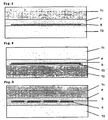
- Fig. 3 to 5 each show a schematic structure of laminates according to the invention, wherein T1, T2 and T3 for the substrates, F for a film or layer of plasticized polyvinyl acetal, S for the solar cells and E for the possibly required electrical contacting of the individual solar cells.
- T1, T2 and T3 for the substrates
- F for a film or layer of plasticized polyvinyl acetal
- S for the solar cells
- E for the possibly required electrical contacting of the individual solar cells.
- the solar cells or photoactive layers are applied to support materials, wherein in the variant of Fig. 4 preferably a flexible carrier T3 is used.
- the solar cells used in the solar modules do not have to have any special properties. It is possible to use crystalline or amorphous, inorganic or organic semiconductor systems which are applied to the first support. To provide sufficient voltage, multiple solar cells can be electrically connected together.
- the thickness of the solar cells, also called functional layer in thin-film modules, is at least 0.1 ⁇ m.
- the thickness of the conductor tracks required for the electrical connection of the solar cells is normally> 50 ⁇ m.
- Fig. 2 shows a schematic structure of a solar module, where S represent the solar cells and P the conductor tracks.
- a thin-film module of size L 30cm x W 20cm with a glass thickness of 3.2mm with two longitudinal, each 20mm from the edge distant guide strips with a width of 2mm and a thickness of about 250 ⁇ m was in a plant according to Fig. 1 At a temperature (after the last press shop) of 90 ° C and a line pressure of 35 N / mm and a feed rate of 3 m / min. pressed. The direction of movement of the composite was chosen so that the exit of the conductor tracks from the module was behind and was pressed last.
- a plasticizer-containing polyvinyl acetal film a film of the type Trosifol HR 100 (Kuraray Europe GmbH) with a roughness R z of about 100 microns was used.
- the turbidity could be completely eliminated in a subsequent autoclave process at 140 ° C and 12 bar with a holding time of 30 min.
- the turbidity can be eliminated in a vacuum process at 145 ° C and 150 mbar with a holding time of two hours.
- the method according to the invention is therefore suitable for the production of solar modules, optionally a turbidity can be eliminated by a downstream process step.
Landscapes
- Engineering & Computer Science (AREA)
- Mechanical Engineering (AREA)
- Physics & Mathematics (AREA)
- Thermal Sciences (AREA)
- Photovoltaic Devices (AREA)
- Joining Of Glass To Other Materials (AREA)
- Laminated Bodies (AREA)
- Lining Or Joining Of Plastics Or The Like (AREA)
Description
- Die Erfindung betrifft die Herstellung von Dünnschicht-Solarmodulen im Walzenverbundverfahren unter Verwendung einer auf Polyvinylbutyral (PVB) basierenden Folie.
- Dünnschicht-Solarmodule bestehen in der Regel aus einer photosensitiven Halbleiterschicht (im Folgenden als Solarzelleneinheit bezeichnet), die auf eine meist transparente Platte z.B. durch Aufdampfen, Gasphasenabscheidung, Sputtern oder Nassabscheidung aufgebracht ist und zum Schutz gegen äußere Einflüsse mit einer ggf. ebenfalls transparenten Abdeckung versehen werden. Die Solarzelleneinheiten werden häufig zwischen eine Glasscheibe und eine Abdeckplatte z.B. aus Glas mit Hilfe eines optional transparenten Klebers laminiert. Der Kleber muss die Solarzelleneinheiten vollständig umschließen, UV-stabil sein und nach dem Laminierprozess vollständig blasenfrei sein.
- Als transparente Kleber werden häufig aushärtende Gießharze oder vernetzbare, auf Ethylenvinylacetat (EVA) basierende Systeme eingesetzt, so wie beispielsweise in
JP07169986 DE 41 22 721 C1 oderDE 41 28 766 A1 offenbart. Diese Klebesysteme können im ungehärteten Zustand so niedrigviskos eingestellt werden, dass sie die Solarzelleneinheiten blasenfrei bedecken. Nach Zugabe eines Härters oder Vernetzungsmittels wird eine mechanisch widerstandfähige Klebeschicht erhalten. Nachteilig an solchen Solarmodulen ist deren aufwändige Herstellung; insbesondere bei großflächigen Fassadenelementen ist die Einbettung der Solarzelleneinheiten in das flüssige Gießharz und dessen kontrollierte Aushärtung ein schwierig zu kontrollierender Prozess. Zudem neigen einige Gießharze nach einigen Jahren zur Blasenbildung bzw. Delamination. - Eine Alternative zu aushärtenden Klebesystemen ist der Einsatz von auf Polyvinylbutyral (PVB) basierenden Folien. Hier werden die Solarzelleneinheiten mit einer oder mehreren PVB-Folien bedeckt und diese unter erhöhtem Druck und erhöhter Temperatur mit den gewünschten Abdeckmaterialien zu einem Laminat verbunden. Verfahren zur Herstellung von Solarmodulen mit Hilfe von PVB-Folien sind z. B. durch
DE 40 26 165 C2 ,DE 42 278 60 A1 ,DE 29 237 70 C2 ,DE 35 38 986 C2 ,DE 197 32 217 ,DE 40 26 165 ,US 6,160,215 ,WO 02/103809 US 6,660,556 ,US 2005/0115667 oderUS 4,321,418 bekannt. In diesen Publikationen dient die PVB-Folie zur Einbettung von kristallinen Solarzelleneinheiten; einlagige Systeme für Dünnschicht-Solarmodule bzw. die hierfür geeignetes Herstellverfahren sind nicht beschrieben. - Die Verwendung von PVB-Folien in Solarmodulen als Verbundverglasungen ist z.B. in
DE 20 302 045 U1 ,EP 1617487 A1 , undDE 35 389 86 C2 offenbart. Diese Schriften beziehen sich ebenfalls auf die Verkapselung von Solarzellen zwischen zwei PVB-Folien. - Bei Dünnschicht-Solarmodulen sind die Solarzellen direkt auf einen Träger wie einer Glasscheibe oder einem flexiblen Träger aus Polymeren oder Metallen aufgebracht. Je nach Aufbau im Träger ist eine Einkapselung der Solarzellen nicht möglich. Zudem können Dünnschicht-Solarmodule in beliebiger Größe und in großen Mengen hergestellt werden. Die bekannten Verfahren zur Herstellung von Solarmodulen, die zwischen PVB-Folien eingebettete Solarzellen aufweisen, sind zur Herstellung eines Verbunds mit Dünnschicht-Solarmodulen in industriellem Maßstab nicht ausreichend automatisierbar.
- Weiterhin offenbaren
DE 35 38 986 C2 undDE 42 27 860 die Herstellung von Solarmodulen durch einen Laminierprozess bei erhöhter Temperatur und erhöhtem Druck. Die Verwendung eines Walzenpaares zu diesem Zweck ist nicht beschrieben. - Aus
US 2002/0038663 ist bekannt, Solarmodule mittels Walzenprozess herzustellen, wobei Solarzellen mit abgerundeten Formen zur Vermeidung der Penetration der Klebefolien verwendet werden.US 7143800B2 beschreibt einen Walzenprozess zur Herstellung von Verbundglaslaminat. - Aufgabe der vorliegenden Erfindung ist es daher, ein Verfahren zur Herstellung von Dünnschicht-Solarmodulen unter Verwendung von thermoplastischen Zwischenschichtfolien bereit zu stellen, das eine kontinuierliche und/oder automatisierbare Produktion ermöglicht.
- Überraschenderweise wurde gefunden, dass ein Laminierprozess mit einem Walzenpaar zur Laminierung auch von mechanisch instabilen Solarzellen geeignet ist.
- Gegenstand der vorliegenden Erfindung ist daher ein Verfahren zur Herstellung eines Solarmoduls gemäß dem 1. Anspruch, d.h. durch Laminieren eines Schichtkörpers bestehend aus einem ersten Träger, auf den mindestens eine Solarzelleneinheit aufgebracht ist und einem zweiten Träger durch mindestens eine zwischen gelegte, auf weichmacherhaltigem Polyvinylacetal basierende Folie durch Erwärmen des Schichtkörpers in mindestens einem Heiztunnel und nachfolgendes Verpressen zwischen mindestens einem Walzenpaar bei einer Temperatur von 50 bis 150 °C, insbesondere 60 bis 150 °C.
- In den Presswerken werden Liniendrücke von 0,5 N/mm bis 100 N/mm, insbesondere von 10 N/mm bis 50 N/mm angelegt. Unter Liniendruck wird der Anpressdruck des Walzenpaares bezogen auf die Folienbreite verstanden.
- Zur Verhinderung von Zerstörungen an den Deckplatten wird an der Vorder- und oder Hinterkante des Schichtkörpers (am Anfang und Ende des Laminates) der Liniendruck bis zum Eigengewicht der oberen Presswalzen oder durch Anheben der oberen Presswalzen bis auf Null verringert.
- Zusätzlich kann es bei Störstellen im Schichtkörper wie z.B. elektrische Kontakte oder Leiterbahnen erforderlich sein, die Transportgeschwindigkeit des Schichtkörpers durch die Walzenpresse herabzusetzen, um eine erhöhte Einwirkdauer des Liniendrucks zu erreichen. Hierdurch wird eine verbesserte Entlüftung und Verklebung der Störstelle mit dem Polyvinylacetal erreicht.
-
Fig. 1 zeigt den schematischen Aufbau einer geeigneten Anlage mit zwei Walzenpaaren. - Das erfindungsgemäße Verfahren wird unter Verwendung von einem oder mehreren, bevorzugt zwei Presswerken, bestehend jeweils aus einem Paar von Presswalzen durchgeführt. Hierbei wird der Schichtkörper zwischen mindestens einem Walzenpaar bei gleichem oder unterschiedlichem Liniendruck und gleicher oder unterschiedlicher Temperatur verpresst.
- Anlagen dieser Art sind zur Herstellung von Verbundverglasungen bekannt und verfügen normalerweise über mindestens einen Heiztunnel zur Temperaturerhöhung oder -vergleichmäßigung vor bzw. nach dem ersten Presswerk bei Anlagen mit zwei Presswerken. Denkbar ist auch die Verarbeitung in Anlagen die über mindestens einen dem letzten Presswerk nachgelagerten Heiztunnel zur Temperaturerhöhung oder -vergleichmäßigung verfügen, oder Anlagen die mit mehr als zwei Presswerken mit jeweils vorgelagerten Heiztunneln ausgestattet sind.
- Die genannten Temperaturen beziehen sich zu mindest auf den Schichtkörper vor dem letzten zu durchlaufenden Walzenpaar.
- Optional ist es möglich, vor dem letzten Walzenpaar weitere Walzenpaare mit oder ohne vorgelagerte Heizzone zu schalten, wobei der Schichtkörper hier die genannten oder auch niedrigere Temperaturen als 50°C oder 60°C aufweisen kann.
- Im erfindungsgemäßen werden die Schichtkörper vor dem Verpressen in Heiztunneln z.B. mit IR-, Mikrowellenstrahlung oder Konvektion auf Temperaturen von jeweils 50°C oder 60°C bis 150°C, vorzugsweise jeweils 70°C oder 80°C bis 100°C aufgeheizt. Die Temperatur der Verbunde kann z.B. berührungslos über ein Strahlungspyrometer gemessen werden.
- Die auf weichmacherhaltigem Polyvinylacetal basierende Folie enthält bevorzugt unvernetztes Polyvinylbutyral (PVB), das durch Acetalisierung von Polyvinylalkohol mit Butyraldehyd gewonnen wird.
- Der Einsatz von vernetzten Polyvinylacetalen, insbesondere vernetztem Polyvinylbutyral (PVB) ist ebenso möglich. Geeignete vernetzte Polyvinylacetale sind z.B. in
EP 1527107 B1 undWO 2004/063231 A1 (thermische Selbstvernetzung von Carboxylgruppenhaltigen Polyvinylacetalen),EP 1606325 A1 (mit Polyaldehyden vernetzte Polyvinylacetale) undWO 03/020776 A1 - Es ist auch möglich, die Acetalisierung mit anderen oder weiteren Aldehyden z.B. solchen mit 5-10 Kohlenstoffatomen wie beispielsweise Valeraldehyd durchzuführen.
- Die zur Herstellung der Polyvinylacetale erforderlichen Polyvinylalkohole können im Rahmen der vorliegenden Erfindung auch Terpolymere aus hydrolysierten Vinylacetat/Ethylen-Copolymeren sein. Diese Verbindungen sind in der Regel zu mehr als 98% hydrolysiert und enthalten 1 bis 10 Gew. auf Ethylen basierende Einheiten (z.B. Typ "Exceval" der Kuraray Europe GmbH). Die Acetalisierung kann wie für Polyvinylalkohol erfolgen.
- Geeignete Folien auf Basis der genannten Polyvinylacetale insbesondere PVB enthalten neben 50-85 Gew.% oder 50-80 Gew.% Polyvinylacetal, 50-20 Gew.% bzw. 50-15 Gew.% Weichmacher und geringe Mengen an Haftungsregulatoren, Antiblockingmitteln und UV-Stabilisatoren. Folien dieser Art werden im Folgenden kurz als PVB-Folien bezeichnet. Die prinzipielle Herstellung und Zusammensetzung von PVB-Folien für Verbundsicherheitsverglasungen ist z. B. in
EP 185 863 B1 EP 1 118 258 B1 oderWO 02/102591 A1 - In einer besonderen Ausführungsform der vorliegenden Erfindung besitzt das Solarmodul schalldämmende Eigenschaften, indem mindestens eine der Folien Schallschutzeigenschaften aufweist. Schallschutzfolien auf Basis von PVB sind z. B. in
EP 1 118 258 B1 oderEP 387 148 B1 EP 1 118 258 B1 erhöhen die Schalldämmung eines Verbundsicherheitsglases bei dessen Koinzidenzfrequenz im Bereich von 1.000 bis 3.500 Hz um mindestens 2 dB, gemessen nach DIN EN ISO 717. - Die Dicke der auf weichmacherhaltigem Polyvinylacetal basierenden Folien liegt bevorzugt bei den industriell üblichen Dicken dieser Folien wie 0.38, 0.51, 0.76, 1.14, 1.52 oder 2.28 mm.
- Die auf weichmacherhaltigem Polyvinylacetal basierende Folie weist bevorzugt eine einseitig oder besonders bevorzugt beidseitig aufgebrachte Oberflächenstruktur mit einer Rauhigkeit von Rz > 35 µm und Rz < 180 µm bevorzugt Rz > 50 µm und Rz < 150 µm, besonders bevorzugt Rz > 70 µm und Rz < 130 µm und insbesondere von Rz > 90 µm und Rz < 130 µm auf. Liegt die Oberflächenrauhigkeit Rz unter 35 µm, kommt es bei der zum Umfließen der Leiterbahnen oder anderen Einbauten nötigen Temperatur zu einem vorzeitigen Verschließen der Ränder des Verbunds, bevor die Luft vollständig herausgepresst werden kann. Die Folge sind Lufteinschlüsse (Blasen) in der Mitte des Verbunds. Bei zu hoher Oberflächenrauhigkeit (Rz > 180 µm) erhöht sich die zum Abschmelzen der Rauhigkeitsspitzen benötigte Energie und der Prozess verlängert sich unakzeptabel.
- Die Oberflächenstruktur der Folie kann im Extrusionsprozess durch das so genannte Fließ- oder Schmelzbruchverfahren unmittelbar vor Austritt der Kunststoffschmelze aus der Extrusionsdüse entsprechend der
EP 0 185 863 B1 erzeugt werden. Unterschiedliche Rauhigkeitsniveaus können durch Variation der Austrittsspaltweite und der Düsen-Lippentemperaturen unmittelbar am Düsenaustritt gezielt erzeugt werden. Dieses Verfahren führt zu einer unregelmäßigen, annähernd isotropen Rauhigkeit. Der Messwert der Rauhigkeit ist hier über alle Richtungen gemessen annähernd gleich, wobei die einzelnen Erhebungen und Vertiefungen jedoch unregelmäßig in ihrer Höhe und Verteilung angeordnet sind. - Alternativ kann die Oberflächenstruktur der Folie durch Prägeverfahren z.B. gemäß
EP 06112163 EP 06112159 - Die Messung der Oberflächenrauhigkeit Rz oder des Rauhigkeitswerts Rz erfolgt nach DIN EN ISO 4287. Die angegebenen Messungen wurden mit einem Rauhigkeitsmessgerät der Fa. Mahr Typ S2, Vorschubgerät PGK mit mechanischem Einstufentaster MFW-250 durchgeführt.
- Der verpresste Körper kann anschließend einem erhöhtem oder verringertem Druck und jeweils erhöhter Temperatur ausgesetzt werden. Dies kann analog zu den bekannten Autoklaven-, Vakuumring- bzw. Vakuumsackverfahren z.B. gemäß
EP 1 235 683 B1 erfolgen. - Beim Vakuumsackverfahren wird der verpresste Schichtkörper in einen Kunststoff- oder Gummisack verbracht. Anschließend wird dieser luftdicht versiegelt und mit einem Vakuumventil bevorzugt in Scheibenmitte versehen. Bei großformatigen Körpern können auch zwei Vakuumventile vorgesehen werden. Über eine Vakuumpumpe wird zunächst ein Vakuum kleiner 200 mbar aufgegeben und mindestens 5 min. bei Raumtemperatur evakuiert. Anschließend wird unter Beibehaltung des Vakuums in einem Umluftschrank das Sandwich auf 140°C aufgeheizt. Die Aufheizrate beträgt dabei je nach Heizleistung 4 bis 6 °C/min, so dass die Haltetemperatur von 140°C nach 20 bis 30 min. erreicht ist. Anschließend wird die Temperatur für 30 min. bei 140 °C gehalten. Danach muss auf min. 60°C abgekühlt werden, bevor das Vakuum entfernt werden darf. In der Praxis wird der verpresste Körper einem verringertem Druck von 0.01 bis 300 mbar und einer Temperatur von 100 bis 200 °C ausgesetzt.
- Alternativ können Autoklavenprozesse eingesetzt werden. Diese sind dem Fachmann zur Herstellung von Verbundverglasungen bekannt und werden bei einem erhöhten Druck von ca. 7 bis 15 bar und Temperaturen von 130 bis 145 °C über 10 bis 120 Minuten durchgeführt.
- Die erfindungsgemäß einsetzbaren Folien müssen die Solarzelleneinheiten und deren elektrischen Anschlüsse blasenfrei und kraftschlüssig bedecken bzw. einschließen; gleichzeitig ist eine möglichst geringe Gesamtdicke der Solarmodule gefordert. Hierzu ist es zweckmäßig, dass die Folien unter den Herstellungsbedingungen den Solarzelleneinheiten und deren elektrischen Anschlüssen "ausweicht", d. h. unter den Laminierbedingungen eine gewisse Fließfähigkeit aufweist.
- Das Haftungsvermögen von Folien auf Basis von Polyvinylacetalen an Glas kann durch die Zugabe von Haftungsregulatoren wie z. B. die in
WO 03/033583 A1 - Der erste und/oder zweite Träger des erfindungsgemäßen Solarmoduls kann aus Glas, Kunststoff oder Metall oder deren Verbünde bestehen, wobei mindestens einer der Träger transparent sein muss. Es ist ebenfalls möglich, einen oder beide Träger als Verbundverglasung (d. h. als Laminat aus mindestens zwei Glasscheiben und mindestens einer Folie) oder als Isolierverglasung mit einem Gaszwischenraum auszuführen. Selbstverständlich ist auch die Kombination dieser Maßnahmen möglich.
- Es ist auch möglich, die Solarzelleneinheiten auf einen ersten, insbesondere einen flexiblen Träger aufzubringen und diesen zwischen zwei Schichten aus weichmacherhaltigem Polyvinylacetal und zwei, bevorzugt transparenten Trägern zu verpressen.
Fig. 3 bis 5 zeigen jeweils einen schematische Aufbau von erfindungsgemäß hergestellten Laminaten, wobei T1, T2 und T3 für die Trägermaterialien, F für eine Folie oder Schicht aus weichmacherhaltigem Polyvinylacetal, S für die Solarzellen und E für die ggf. erforderliche elektrische Kontaktierung der einzelnen Solarzellen. InFig. 3 und 4 sind die Solarzellen bzw. photoaktiven Schichten auf Trägermaterialien aufgebracht, wobei in der Variante nachFig. 4 bevorzugt ein flexibler Träger T3 verwendet wird. - Die in den Solarmodulen eingesetzten Solarzellen müssen keine besonderen Eigenschaften besitzen. Es können kristalline oder amorphe, anorganische oder organische Halbleitersysteme eingesetzt werden, die auf den ersten Träger aufgebracht sind. Um eine ausreichende Spannung zu liefern, können mehrere Solarzellen elektrisch miteinander verbunden werden. Die Dicke der Solarzellen, bei Dünnschichtmodulen auch Funktionsschicht genannt, beträgt mindestens 0,1 µm. Die Dicke der für den elektrischen Anschluss der Solarzellen erforderlichen Leiterbahnen liegt normalerweise bei > 50 µm.
-
Fig. 2 zeigt einen schematischen Aufbau eines Solarmoduls, wobei S die Solarzellen und P die Leiterbahnen darstellen. - Erfindungsgemäß hergestellte Solarmodule können zusätzlich als Fassadenbauteil, Dachflächen, Wintergartenabdeckung, Schallschutzwand, Balkon- oder Brüstungselement oder als Bestandteil von Fensterflächen verwendet werden.
- Ein Dünnschichtmodul der Größe L 30cm x B 20cm mit einer Glasdicke 3,2mm mit zwei längs, jeweils 20mm vom Rand entfernten Leitbändern mit einer Breite von 2mm und einer Dicke von ca. 250µm wurde in einer Anlage gemäß
Fig. 1 bei einer Temperatur (nach dem letzten Presswerk) von 90°C und einem Liniendruck von jeweils 35 N/mm und einer Vorschubgeschwindigkeit von 3 m/min. verpresst. Die Laufrichtung des Verbunds wurde so gewählt das der Austritt der Leiterbahnen aus dem Modul hinten lag und zuletzt verpresst wurde. Als weichmacherhaltige Polyvinylacetal-Folie wurde eine Folie des Typs Trosifol HR 100 (Kuraray Europe GmbH) mit einer Rauhigkeit Rz von ca. 100 µm eingesetzt. - Der Liniendruck der Presswerke wurde auf den ersten 10mm und den letzten 30mm des Schichtkörpers auf das Eigengewicht der oberen Walze reduziert.
- Es wurden blasenfreie Laminate mit einer geringen Trübung erhalten.
- Die Trübung konnte in einem nachfolgenden Autoklavenprozess bei 140 °C und 12 bar mit einer Haltezeit von 30 Min. vollständig beseitigt werden.
- An Stelle des Autoklavenprozesses kann die Trübung auch in einem Vakuumprozess bei 145°C und 150 mbar mit einer Haltezeit von zwei Stunden beseitigt werden.
- Das erfindungsgemäße Verfahren ist somit zur Herstellung von Solarmodulen geeignet, optional kann eine Trübung durch einen nachgeschalteten Verfahrensschritt beseitigt werden.
Claims (9)
- Verfahren zur Herstellung eines Solarmoduls durch Laminieren eines Schichtkörpers bestehend aus einem ersten Träger, auf den mindestens eine Solarzelleneinheit aufgebracht ist und einem zweiten Träger durch mindestens eine zwischen gelegte, auf weichmacherhaltigem Polyvinylacetal basierende Folie, gekennzeichnet durch Erwärmen des Schichtkörpers in mindestens einem Heiztunnel und nachfolgendes Verpressen zwischen mindestens einem Walzenpaar bei einer Temperatur von 50 bis 150 °C wobei die Verpressung zwischen den Walzenpaaren bei einem Liniendruck von 0,5 N/mm bis 100 N/mm durchgeführt wird. Und der Liniendruck an der Vorderund oder Hinterkante des Schichtkörpers bis zum Eigengewicht der oberen Presswalzen oder durch Anheben der oberen Presswalzen bis auf Null verringert wird.
- Verfahren zur Herstellung eines Solarmoduls nach Anspruch 1 dadurch gekennzeichnet, dass der Schichtkörper zwischen mindestens zwei Walzenpaaren bei gleichem oder unterschiedlichem Liniendruck und gleicher oder unterschiedlicher Temperatur verpresst wird.
- Verfahren zur Herstellung eines Solarmoduls nach einem der Ansprüche 1 oder 2, dadurch gekennzeichnet, dass die auf weichmacherhaltigem Polyvinylacetal basierende Folie einen ein- oder beidseitigen Rauhigkeitswert Rz zwischen 35 µm und 180 µm aufweist.
- Verfahren zur Herstellung eines Solarmoduls nach einem der Ansprüche 1 bis 3, dadurch gekennzeichnet, dass die auf weichmacherhaltigem Polyvinylacetal basierende Folie eine regelmäßige Rauhigkeitsstruktur aufweist.
- Verfahren zur Herstellung eines Solarmoduls nach einem der Ansprüche 1 bis 4, dadurch gekennzeichnet, dass die auf weichmacherhaltigem Polyvinylacetal basierende Folie eine unregelmäßige Rauhigkeitsstruktur aufweist.
- Verfahren zur Herstellung eines Solarmoduls nach einem der Ansprüche 1 bis 5, dadurch gekennzeichnet, dass der erste und/oder der zweite Träger aus Glas, Kunststoff, Metall oder deren Verbünde, einer Verbundverglasung, und/ oder einer Isolierverglasung besteht, mit der Maßgabe das mindestens einer der Träger transparent ist.
- Verfahren zur Herstellung eines Solarmoduls nach einem der Ansprüche 1 bis 6 dadurch gekennzeichnet, dass der verpresste Körper einem erhöhtem oder verringertem Druck und erhöhter Temperatur ausgesetzt wird.
- Verfahren zur Herstellung eines Solarmoduls nach Anspruch 7 dadurch gekennzeichnet, dass der verpresste Körper einem verringertem Druck von 0.01 bis 300 mbar und einer Temperatur von 100 bis 200 °C ausgesetzt wird.
- Verfahren zur Herstellung eines Solarmoduls nach Anspruch 7 dadurch gekennzeichnet, dass der verpresste Körper einem erhöhten Druck von 7 bis 15 bar und einer Temperatur von 130 bis 145 °C ausgesetzt wird.
Priority Applications (1)
| Application Number | Priority Date | Filing Date | Title |
|---|---|---|---|
| PL08100857T PL1953829T5 (pl) | 2007-02-01 | 2008-01-24 | Proces wytwarzania modułów słonecznych metodą laminacji na walcach |
Applications Claiming Priority (1)
| Application Number | Priority Date | Filing Date | Title |
|---|---|---|---|
| DE102007005845A DE102007005845A1 (de) | 2007-02-01 | 2007-02-01 | Verfahren zur Herstellung von Solarmodulen im Walzenverbundverfahren |
Publications (3)
| Publication Number | Publication Date |
|---|---|
| EP1953829A1 EP1953829A1 (de) | 2008-08-06 |
| EP1953829B1 EP1953829B1 (de) | 2011-03-02 |
| EP1953829B2 true EP1953829B2 (de) | 2016-11-23 |
Family
ID=39431015
Family Applications (1)
| Application Number | Title | Priority Date | Filing Date |
|---|---|---|---|
| EP08100857.5A Active EP1953829B2 (de) | 2007-02-01 | 2008-01-24 | Verfahren zur Herstellung von Solarmodulen im Walzenverbundverfahren |
Country Status (15)
| Country | Link |
|---|---|
| US (1) | US8097117B2 (de) |
| EP (1) | EP1953829B2 (de) |
| JP (1) | JP5692956B2 (de) |
| CN (1) | CN101237008B (de) |
| AT (1) | ATE500620T1 (de) |
| AU (1) | AU2007252454A1 (de) |
| BR (1) | BRPI0800226A (de) |
| DE (2) | DE102007005845A1 (de) |
| ES (1) | ES2360455T3 (de) |
| MX (1) | MX2008001137A (de) |
| PL (1) | PL1953829T5 (de) |
| PT (1) | PT1953829E (de) |
| SG (1) | SG144812A1 (de) |
| TW (1) | TWI485874B (de) |
| ZA (1) | ZA200800539B (de) |
Families Citing this family (21)
| Publication number | Priority date | Publication date | Assignee | Title |
|---|---|---|---|---|
| JP2010538476A (ja) * | 2007-08-31 | 2010-12-09 | アプライド マテリアルズ インコーポレイテッド | 光電池製造ライン |
| US20100047954A1 (en) * | 2007-08-31 | 2010-02-25 | Su Tzay-Fa Jeff | Photovoltaic production line |
| US20090188603A1 (en) * | 2008-01-25 | 2009-07-30 | Applied Materials, Inc. | Method and apparatus for controlling laminator temperature on a solar cell |
| DE102008001684A1 (de) * | 2008-05-09 | 2009-11-12 | Kuraray Europe Gmbh | Verfahren zur Herstellung von Photovoltaikmodulen im Vakuumlaminator mit reduziertem Prozessvakuum |
| WO2009151952A2 (en) * | 2008-05-27 | 2009-12-17 | Solutia Incorporated | Thin film photovoltaic module |
| US20100144080A1 (en) * | 2008-06-02 | 2010-06-10 | Solexel, Inc. | Method and apparatus to transfer coat uneven surface |
| TW201029199A (en) * | 2009-01-22 | 2010-08-01 | Gloria Solar Co Ltd | Method of installing plastic solar module |
| CH701494A1 (de) * | 2009-07-21 | 2011-01-31 | 3S Swiss Solar Systems Ag | Laminierverfahren. |
| MX2012001479A (es) * | 2009-08-10 | 2012-02-22 | First Solar Inc | Proceso de laminacion mejorado. |
| JP5431997B2 (ja) * | 2010-02-16 | 2014-03-05 | 株式会社クラレ | 太陽電池封止材、それを用いた太陽電池モジュール |
| DE102010051896A1 (de) * | 2010-11-22 | 2012-05-24 | Wemhöner Surface GmbH & Co. KG | Verfahren und Vorrichtung zur Herstellung einer Verbundscheibe |
| JP5645722B2 (ja) * | 2011-03-11 | 2014-12-24 | 三菱電機株式会社 | 太陽電池の製造装置及び方法 |
| GB201115223D0 (en) * | 2011-09-02 | 2011-10-19 | Dow Corning | Method of fabricating solar modules |
| DE102011085587A1 (de) * | 2011-11-02 | 2013-05-02 | Evonik Industries Ag | Glas - Photovoltaik - Pressure sensitive Adhesive-Verbund |
| KR20160036669A (ko) * | 2013-07-31 | 2016-04-04 | 주식회사 쿠라레 | 투명성, 열 균열 현상 억제가 우수한 폴리비닐 아세탈 필름 |
| US9994000B2 (en) * | 2013-10-08 | 2018-06-12 | Solutia Inc. | Multiple layer panels having reduced levels of edge defects |
| EP3476597A1 (de) * | 2013-12-13 | 2019-05-01 | AGC Inc. | Herstellungsverfahren für verbundfolie |
| WO2015176763A1 (de) * | 2014-05-23 | 2015-11-26 | Kuraray Europe Gmbh | Flexibler solarkollektor mit verklebter schichtstruktur |
| DE102015103141A1 (de) | 2015-03-04 | 2016-09-08 | Thyssenkrupp Ag | Verfahren zum Herstellen eines Metallverbundwerkstoffs mit eingebetteter funktionaler Struktur und entsprechender Metallverbundwerkstoff |
| CN104900755A (zh) * | 2015-04-15 | 2015-09-09 | 中节能太阳能科技(镇江)有限公司 | 太阳能电池双玻组件预封装方法及流水线 |
| CN112936678A (zh) * | 2021-02-02 | 2021-06-11 | 锦州阳光能源有限公司 | 一种用于太阳能组件的固化炉 |
Family Cites Families (44)
| Publication number | Priority date | Publication date | Assignee | Title |
|---|---|---|---|---|
| BE876681A (fr) | 1978-06-14 | 1979-11-30 | Bfg Glassgroup | Procede de fabrication d'un panneau comprenant au moins une cellule photovoltaique et panneau comprenant au moins une telle cellule |
| ES8100843A1 (es) | 1979-05-08 | 1980-12-16 | Saint Gobain Vitrage | Procedimiento de fabricacion de paneles de fotopilas solares |
| US4276351A (en) * | 1980-06-30 | 1981-06-30 | E. I. Du Pont De Nemours And Company | Polyvinyl butyral plasticized with tetraethyleneglycol di-2-ethylhexanoate |
| JPS5817684A (ja) * | 1981-07-24 | 1983-02-01 | Fuji Electric Co Ltd | 太陽電池の封止方法 |
| JPS58137266A (ja) * | 1982-02-09 | 1983-08-15 | Matsushita Electric Ind Co Ltd | 太陽電池モジユ−ルの製造方法 |
| JPS58141579A (ja) * | 1982-02-17 | 1983-08-22 | Nec Corp | 接着封止装置 |
| EP0185863B1 (de) | 1984-12-24 | 1989-05-03 | Hüls Troisdorf Aktiengesellschaft | Verfahren zur Herstellung von Folien, insbesondere auf der Basis von Polyvinylbutyral mit geringer Oberflächenklebrigkeit |
| DE3538986C3 (de) | 1985-11-02 | 1994-11-24 | Deutsche Aerospace | Verfahren zur Herstellung eines Solargenerators |
| US4946523A (en) * | 1988-12-22 | 1990-08-07 | Ford Motor Company | Method and apparatus for use in manufacturing safety glass laminates |
| FR2644112B1 (de) | 1989-03-10 | 1991-05-10 | Saint Gobain Vitrage | |
| DE4026165A1 (de) | 1990-08-15 | 1992-03-05 | Flachglas Solartechnik Gmbh | Bauplatte fuer laermschutzwand |
| DE4122721C1 (de) | 1991-07-06 | 1992-11-05 | Flachglas Solartechnik Gmbh | |
| DE4128766C2 (de) | 1991-08-29 | 1995-07-20 | Flachglas Ag | Solarmodul sowie Verfahren zu dessen Herstellung |
| DE4227860A1 (de) | 1991-09-19 | 1993-04-01 | Aug Guttendoerfer Gmbh & Co | Photovoltaische platte, insbesondere zum einsatz als fassadenplatte |
| US6077374A (en) * | 1993-08-16 | 2000-06-20 | Monsanto | Method of preparing prelaminate using rough-surfaced interlayer |
| JP3111797B2 (ja) * | 1994-04-01 | 2000-11-27 | 富士電機株式会社 | 薄膜光電変換モジュールの製造方法および製造装置 |
| US6340403B1 (en) * | 1994-04-20 | 2002-01-22 | The Regents Of The University Of California | Solar cell module lamination process |
| US5590495A (en) * | 1995-07-06 | 1997-01-07 | Bressler Group Inc. | Solar roofing system |
| DE19732217C2 (de) * | 1997-07-26 | 2002-12-12 | Zsw | Mehrfunktions-Verkapselungsschichtstruktur für photovoltaische Halbleiterbauelemente und Verfahren zu ihrer Herstellung |
| JPH11310440A (ja) * | 1998-04-28 | 1999-11-09 | Sekisui Chem Co Ltd | 合わせガラス用中間膜及び合わせガラス |
| DE69809801T3 (de) * | 1998-05-22 | 2011-06-09 | E.I. Dupont De Nemours And Co., Wilmington | Beseitigung von auf glasorientierungen zurückzuführende adhäsionsunterschieden in geschichtetem sicherheitsglass |
| US6801652B1 (en) | 1998-09-29 | 2004-10-05 | Siemens Aktiengesellschaft | Method for checking the presentation of components to an automatic onserting unit |
| US6160215A (en) * | 1999-03-26 | 2000-12-12 | Curtin; Lawrence F. | Method of making photovoltaic device |
| JP2000281802A (ja) * | 1999-03-30 | 2000-10-10 | Polymatech Co Ltd | 熱伝導性成形体およびその製造方法ならびに半導体装置 |
| JP2001044474A (ja) * | 1999-08-04 | 2001-02-16 | Tdk Corp | 太陽電池モジュール |
| DE19951444A1 (de) | 1999-10-25 | 2001-04-26 | Huels Troisdorf | Verfahren und Folie zur Herstellung von Verbundsicherheitsscheiben |
| AU3227301A (en) | 2000-02-18 | 2001-08-27 | Bridgestone Corporation | Sealing film for solar cell and method for manufacturing solar cell |
| AU4031501A (en) * | 2000-03-09 | 2001-09-17 | Isovolta Osterreichische Isolierstoffwerke Aktiengesellschaft | Method for producing a photovoltaic thin film module |
| JP2002083990A (ja) | 2000-07-06 | 2002-03-22 | Canon Inc | 光起電力素子集合体及びそれを用いた太陽電池モジュールと太陽電池モジュールの製造方法 |
| JP2002083992A (ja) * | 2000-09-07 | 2002-03-22 | Nissan Motor Co Ltd | 太陽電池パネルおよびその製造方法 |
| WO2002028639A1 (en) * | 2000-10-06 | 2002-04-11 | Pilkington Italia S.P.A. | Process for the production of multilayer polymer films |
| JP2002270881A (ja) * | 2001-03-08 | 2002-09-20 | Nissan Motor Co Ltd | 太陽電池パネルおよびその製造方法 |
| JP2002361744A (ja) * | 2001-06-08 | 2002-12-18 | Kanegafuchi Chem Ind Co Ltd | 耐熱性フレキシブル積層板の製造方法 |
| US20030000568A1 (en) * | 2001-06-15 | 2003-01-02 | Ase Americas, Inc. | Encapsulated photovoltaic modules and method of manufacturing same |
| DE10129422A1 (de) | 2001-06-19 | 2003-01-02 | Huels Troisdorf | Weichmacherhaltige PVB-Folie |
| DE10150091A1 (de) | 2001-10-11 | 2003-04-17 | Huels Troisdorf | PVB-Folie für Verbundsicherheitsglas und Verbundsicherheitsglas |
| AU2002301252B2 (en) * | 2001-10-12 | 2007-12-20 | Bayer Aktiengesellschaft | Photovoltaic modules with a thermoplastic hot-melt adhesive layer and a process for their production |
| US6933051B2 (en) * | 2002-08-17 | 2005-08-23 | 3M Innovative Properties Company | Flexible electrically conductive film |
| DE20302045U1 (de) | 2003-02-10 | 2003-07-10 | Wulfmeier Solar GmbH, 33609 Bielefeld | Photovoltaik-Module mit PVB (Polyvinyl-Butyral)-Folie |
| US7143800B2 (en) * | 2003-03-20 | 2006-12-05 | Cardinal Lg Company | Non-autoclave laminated glass |
| JP4576829B2 (ja) * | 2003-12-01 | 2010-11-10 | 富士電機システムズ株式会社 | 真空ラミネート装置及び真空ラミネート方法 |
| DE102004030411A1 (de) * | 2004-06-23 | 2006-01-19 | Kuraray Specialities Europe Gmbh | Solarmodul als Verbundsicherheitsglas |
| EP1842653B1 (de) | 2006-04-03 | 2008-12-03 | Kuraray Europe GmbH | Verfahren zur Herstellung von geprägten Folien auf Basis von teilacetalisiertem Polyvinylalkohol |
| EP1842647B1 (de) | 2006-04-03 | 2009-02-11 | Kuraray Europe GmbH | Verfahren zur Herstellung einer einseitig geprägten Folie auf Basis von teilacetalisiertem Polyvinylalkohol |
-
2007
- 2007-02-01 DE DE102007005845A patent/DE102007005845A1/de not_active Withdrawn
- 2007-12-20 AU AU2007252454A patent/AU2007252454A1/en not_active Abandoned
-
2008
- 2008-01-04 SG SG200800064-8A patent/SG144812A1/en unknown
- 2008-01-18 ZA ZA200800539A patent/ZA200800539B/xx unknown
- 2008-01-24 EP EP08100857.5A patent/EP1953829B2/de active Active
- 2008-01-24 PT PT08100857T patent/PT1953829E/pt unknown
- 2008-01-24 DE DE502008002704T patent/DE502008002704D1/de active Active
- 2008-01-24 PL PL08100857T patent/PL1953829T5/pl unknown
- 2008-01-24 AT AT08100857T patent/ATE500620T1/de active
- 2008-01-24 MX MX2008001137A patent/MX2008001137A/es active IP Right Grant
- 2008-01-24 ES ES08100857T patent/ES2360455T3/es active Active
- 2008-01-30 BR BRPI0800226-6A patent/BRPI0800226A/pt not_active IP Right Cessation
- 2008-01-31 JP JP2008020114A patent/JP5692956B2/ja not_active Expired - Fee Related
- 2008-01-31 US US12/023,598 patent/US8097117B2/en not_active Expired - Fee Related
- 2008-01-31 CN CN2008100092652A patent/CN101237008B/zh not_active Expired - Fee Related
- 2008-01-31 TW TW097103620A patent/TWI485874B/zh not_active IP Right Cessation
Also Published As
| Publication number | Publication date |
|---|---|
| JP5692956B2 (ja) | 2015-04-01 |
| EP1953829A1 (de) | 2008-08-06 |
| DE502008002704D1 (de) | 2011-04-14 |
| ZA200800539B (en) | 2008-12-31 |
| TWI485874B (zh) | 2015-05-21 |
| BRPI0800226A (pt) | 2008-09-16 |
| PL1953829T5 (pl) | 2017-09-29 |
| AU2007252454A1 (en) | 2008-08-21 |
| PL1953829T3 (pl) | 2011-07-29 |
| MX2008001137A (es) | 2009-02-24 |
| CN101237008A (zh) | 2008-08-06 |
| CN101237008B (zh) | 2012-05-30 |
| US8097117B2 (en) | 2012-01-17 |
| DE102007005845A1 (de) | 2008-08-07 |
| JP2008193085A (ja) | 2008-08-21 |
| PT1953829E (pt) | 2011-05-30 |
| ES2360455T3 (es) | 2011-06-06 |
| US20080185096A1 (en) | 2008-08-07 |
| EP1953829B1 (de) | 2011-03-02 |
| ATE500620T1 (de) | 2011-03-15 |
| SG144812A1 (en) | 2008-08-28 |
| TW200849632A (en) | 2008-12-16 |
Similar Documents
| Publication | Publication Date | Title |
|---|---|---|
| EP1953829B2 (de) | Verfahren zur Herstellung von Solarmodulen im Walzenverbundverfahren | |
| EP1617487B1 (de) | Solarmodul als Verbundsicherheitsglas | |
| EP2145353B1 (de) | Photovoltaikmodule mit reflektierenden klebefolien | |
| EP3281784B1 (de) | Folie mit elektrisch leitfähigen strukturen | |
| WO2009047222A2 (de) | WEICHMACHERHALTIGE FOLIEN AUF BASIS VON POLYVINYLACETAL MIT ERHÖHTER GLASÜBERGANGSTEMPERATUR UND VERBESSERTEM FLIEßVERHALTEN | |
| EP2206162A2 (de) | Photovoltaikmodule mit weichmacherhaltigen folien geringer feuchtigkeitsaufnahme | |
| WO2009047221A2 (de) | Photovoltaikmodule mit weichmacherhaltigen folien auf basis von polyvinylacetal mit hohem spezifischen widerstand | |
| EP3074220B1 (de) | Verfahren zur herstellung von verbundglaslaminaten mit wärmestrahlung abschirmenden eigenschaften | |
| DE102008001512A1 (de) | Dünnschicht-Solarmodul als Verbundsicherheitsglas | |
| EP2905129B1 (de) | Verbundglaslaminate mit Wärmestrahlung abschirmenden Eigenschaften auf Basis von dünnen Folien aus weichmacherfreiem Polyvinylacetal | |
| EP2286463A2 (de) | Photovoltaikmodule enthaltend plastifizierte zwischenschicht-folien mit hohem durchgangswiderstand und guter penetrationsfestigkeit | |
| WO2009135929A2 (de) | Verfahren zur herstellung von photovoltaikmodulen im vakuumlaminator mit reduziertem prozessvakuum | |
| EP2259334A1 (de) | Photovoltaikmodule mit weichmacherhaltigen Folien geringer Kriechneigung | |
| EP2286461B1 (de) | Photovoltaikmodule enthaltend plastifizierte zwischenschicht-folien mit hohem alkalititer | |
| EP2354716A1 (de) | Spiegel für solarthermische Kraftwerke enthaltend weichmacherhaltige Polyvinylacetalfolien | |
| EP2283522B1 (de) | Photovoltaikmodule enthaltend weichmacherhaltige zwischenschicht-folien mit niedriger glasübergangstemperatur | |
| WO2015176763A1 (de) | Flexibler solarkollektor mit verklebter schichtstruktur |
Legal Events
| Date | Code | Title | Description |
|---|---|---|---|
| PUAI | Public reference made under article 153(3) epc to a published international application that has entered the european phase |
Free format text: ORIGINAL CODE: 0009012 |
|
| AK | Designated contracting states |
Kind code of ref document: A1 Designated state(s): AT BE BG CH CY CZ DE DK EE ES FI FR GB GR HR HU IE IS IT LI LT LU LV MC MT NL NO PL PT RO SE SI SK TR |
|
| AX | Request for extension of the european patent |
Extension state: AL BA MK RS |
|
| 17P | Request for examination filed |
Effective date: 20080823 |
|
| 17Q | First examination report despatched |
Effective date: 20080925 |
|
| AKX | Designation fees paid |
Designated state(s): AT BE BG CH CY CZ DE DK EE ES FI FR GB GR HR HU IE IS IT LI LT LU LV MC MT NL NO PL PT RO SE SI SK TR |
|
| GRAP | Despatch of communication of intention to grant a patent |
Free format text: ORIGINAL CODE: EPIDOSNIGR1 |
|
| GRAS | Grant fee paid |
Free format text: ORIGINAL CODE: EPIDOSNIGR3 |
|
| GRAA | (expected) grant |
Free format text: ORIGINAL CODE: 0009210 |
|
| AK | Designated contracting states |
Kind code of ref document: B1 Designated state(s): AT BE BG CH CY CZ DE DK EE ES FI FR GB GR HR HU IE IS IT LI LT LU LV MC MT NL NO PL PT RO SE SI SK TR |
|
| REG | Reference to a national code |
Ref country code: GB Ref legal event code: FG4D Free format text: NOT ENGLISH |
|
| REG | Reference to a national code |
Ref country code: CH Ref legal event code: EP |
|
| REG | Reference to a national code |
Ref country code: IE Ref legal event code: FG4D Free format text: LANGUAGE OF EP DOCUMENT: GERMAN |
|
| REF | Corresponds to: |
Ref document number: 502008002704 Country of ref document: DE Date of ref document: 20110414 Kind code of ref document: P |
|
| REG | Reference to a national code |
Ref country code: DE Ref legal event code: R096 Ref document number: 502008002704 Country of ref document: DE Effective date: 20110414 |
|
| REG | Reference to a national code |
Ref country code: NL Ref legal event code: T3 |
|
| REG | Reference to a national code |
Ref country code: PT Ref legal event code: SC4A Free format text: AVAILABILITY OF NATIONAL TRANSLATION Effective date: 20110520 |
|
| REG | Reference to a national code |
Ref country code: ES Ref legal event code: FG2A Ref document number: 2360455 Country of ref document: ES Kind code of ref document: T3 Effective date: 20110606 |
|
| REG | Reference to a national code |
Ref country code: GR Ref legal event code: EP Ref document number: 20110401030 Country of ref document: GR Effective date: 20110614 |
|
| PG25 | Lapsed in a contracting state [announced via postgrant information from national office to epo] |
Ref country code: HR Free format text: LAPSE BECAUSE OF FAILURE TO SUBMIT A TRANSLATION OF THE DESCRIPTION OR TO PAY THE FEE WITHIN THE PRESCRIBED TIME-LIMIT Effective date: 20110302 Ref country code: SE Free format text: LAPSE BECAUSE OF FAILURE TO SUBMIT A TRANSLATION OF THE DESCRIPTION OR TO PAY THE FEE WITHIN THE PRESCRIBED TIME-LIMIT Effective date: 20110302 Ref country code: LV Free format text: LAPSE BECAUSE OF FAILURE TO SUBMIT A TRANSLATION OF THE DESCRIPTION OR TO PAY THE FEE WITHIN THE PRESCRIBED TIME-LIMIT Effective date: 20110302 Ref country code: LT Free format text: LAPSE BECAUSE OF FAILURE TO SUBMIT A TRANSLATION OF THE DESCRIPTION OR TO PAY THE FEE WITHIN THE PRESCRIBED TIME-LIMIT Effective date: 20110302 Ref country code: NO Free format text: LAPSE BECAUSE OF FAILURE TO SUBMIT A TRANSLATION OF THE DESCRIPTION OR TO PAY THE FEE WITHIN THE PRESCRIBED TIME-LIMIT Effective date: 20110602 |
|
| REG | Reference to a national code |
Ref country code: PL Ref legal event code: T3 |
|
| LTIE | Lt: invalidation of european patent or patent extension |
Effective date: 20110302 |
|
| PG25 | Lapsed in a contracting state [announced via postgrant information from national office to epo] |
Ref country code: BG Free format text: LAPSE BECAUSE OF FAILURE TO SUBMIT A TRANSLATION OF THE DESCRIPTION OR TO PAY THE FEE WITHIN THE PRESCRIBED TIME-LIMIT Effective date: 20110602 Ref country code: FI Free format text: LAPSE BECAUSE OF FAILURE TO SUBMIT A TRANSLATION OF THE DESCRIPTION OR TO PAY THE FEE WITHIN THE PRESCRIBED TIME-LIMIT Effective date: 20110302 Ref country code: SI Free format text: LAPSE BECAUSE OF FAILURE TO SUBMIT A TRANSLATION OF THE DESCRIPTION OR TO PAY THE FEE WITHIN THE PRESCRIBED TIME-LIMIT Effective date: 20110302 Ref country code: CY Free format text: LAPSE BECAUSE OF FAILURE TO SUBMIT A TRANSLATION OF THE DESCRIPTION OR TO PAY THE FEE WITHIN THE PRESCRIBED TIME-LIMIT Effective date: 20110302 |
|
| REG | Reference to a national code |
Ref country code: IE Ref legal event code: FD4D |
|
| PG25 | Lapsed in a contracting state [announced via postgrant information from national office to epo] |
Ref country code: IE Free format text: LAPSE BECAUSE OF FAILURE TO SUBMIT A TRANSLATION OF THE DESCRIPTION OR TO PAY THE FEE WITHIN THE PRESCRIBED TIME-LIMIT Effective date: 20110302 Ref country code: EE Free format text: LAPSE BECAUSE OF FAILURE TO SUBMIT A TRANSLATION OF THE DESCRIPTION OR TO PAY THE FEE WITHIN THE PRESCRIBED TIME-LIMIT Effective date: 20110302 |
|
| PLBI | Opposition filed |
Free format text: ORIGINAL CODE: 0009260 |
|
| PG25 | Lapsed in a contracting state [announced via postgrant information from national office to epo] |
Ref country code: IS Free format text: LAPSE BECAUSE OF FAILURE TO SUBMIT A TRANSLATION OF THE DESCRIPTION OR TO PAY THE FEE WITHIN THE PRESCRIBED TIME-LIMIT Effective date: 20110702 Ref country code: SK Free format text: LAPSE BECAUSE OF FAILURE TO SUBMIT A TRANSLATION OF THE DESCRIPTION OR TO PAY THE FEE WITHIN THE PRESCRIBED TIME-LIMIT Effective date: 20110302 Ref country code: RO Free format text: LAPSE BECAUSE OF FAILURE TO SUBMIT A TRANSLATION OF THE DESCRIPTION OR TO PAY THE FEE WITHIN THE PRESCRIBED TIME-LIMIT Effective date: 20110302 |
|
| PLBI | Opposition filed |
Free format text: ORIGINAL CODE: 0009260 |
|
| 26 | Opposition filed |
Opponent name: SAINT-GOBAIN GLASS FRANCE Effective date: 20111117 |
|
| PLAX | Notice of opposition and request to file observation + time limit sent |
Free format text: ORIGINAL CODE: EPIDOSNOBS2 |
|
| 26 | Opposition filed |
Opponent name: E.I. DUPONT DE NEMOURS AND COMPANY Effective date: 20111201 Opponent name: SAINT-GOBAIN GLASS FRANCE Effective date: 20111117 |
|
| REG | Reference to a national code |
Ref country code: DE Ref legal event code: R026 Ref document number: 502008002704 Country of ref document: DE Effective date: 20111117 |
|
| REG | Reference to a national code |
Ref country code: CH Ref legal event code: NV Representative=s name: MEYER & KOLLEGEN |
|
| PLBB | Reply of patent proprietor to notice(s) of opposition received |
Free format text: ORIGINAL CODE: EPIDOSNOBS3 |
|
| PG25 | Lapsed in a contracting state [announced via postgrant information from national office to epo] |
Ref country code: MC Free format text: LAPSE BECAUSE OF NON-PAYMENT OF DUE FEES Effective date: 20120131 |
|
| REG | Reference to a national code |
Ref country code: DE Ref legal event code: R082 Ref document number: 502008002704 Country of ref document: DE Representative=s name: PATENTANWALTSKANZLEI MEYER, DE |
|
| REG | Reference to a national code |
Ref country code: DE Ref legal event code: R082 Ref document number: 502008002704 Country of ref document: DE Representative=s name: PATENTANWALTSKANZLEI MEYER, DE Effective date: 20121128 Ref country code: DE Ref legal event code: R081 Ref document number: 502008002704 Country of ref document: DE Owner name: KURARAY EUROPE GMBH, DE Free format text: FORMER OWNER: KURARAY EUROPE GMBH, 65929 FRANKFURT, DE Effective date: 20121128 |
|
| PGFP | Annual fee paid to national office [announced via postgrant information from national office to epo] |
Ref country code: ES Payment date: 20130128 Year of fee payment: 6 |
|
| PGFP | Annual fee paid to national office [announced via postgrant information from national office to epo] |
Ref country code: GR Payment date: 20130117 Year of fee payment: 6 |
|
| PGFP | Annual fee paid to national office [announced via postgrant information from national office to epo] |
Ref country code: PT Payment date: 20130117 Year of fee payment: 6 |
|
| PG25 | Lapsed in a contracting state [announced via postgrant information from national office to epo] |
Ref country code: MT Free format text: LAPSE BECAUSE OF FAILURE TO SUBMIT A TRANSLATION OF THE DESCRIPTION OR TO PAY THE FEE WITHIN THE PRESCRIBED TIME-LIMIT Effective date: 20110302 |
|
| PG25 | Lapsed in a contracting state [announced via postgrant information from national office to epo] |
Ref country code: LU Free format text: LAPSE BECAUSE OF NON-PAYMENT OF DUE FEES Effective date: 20120124 |
|
| PLBP | Opposition withdrawn |
Free format text: ORIGINAL CODE: 0009264 |
|
| PG25 | Lapsed in a contracting state [announced via postgrant information from national office to epo] |
Ref country code: HU Free format text: LAPSE BECAUSE OF FAILURE TO SUBMIT A TRANSLATION OF THE DESCRIPTION OR TO PAY THE FEE WITHIN THE PRESCRIBED TIME-LIMIT Effective date: 20080124 |
|
| REG | Reference to a national code |
Ref country code: PT Ref legal event code: MM4A Free format text: LAPSE DUE TO NON-PAYMENT OF FEES Effective date: 20140724 |
|
| REG | Reference to a national code |
Ref country code: GR Ref legal event code: ML Ref document number: 20110401030 Country of ref document: GR Effective date: 20140801 |
|
| PG25 | Lapsed in a contracting state [announced via postgrant information from national office to epo] |
Ref country code: GR Free format text: LAPSE BECAUSE OF NON-PAYMENT OF DUE FEES Effective date: 20140801 |
|
| PG25 | Lapsed in a contracting state [announced via postgrant information from national office to epo] |
Ref country code: PT Free format text: LAPSE BECAUSE OF NON-PAYMENT OF DUE FEES Effective date: 20140724 |
|
| PLAY | Examination report in opposition despatched + time limit |
Free format text: ORIGINAL CODE: EPIDOSNORE2 |
|
| PLBC | Reply to examination report in opposition received |
Free format text: ORIGINAL CODE: EPIDOSNORE3 |
|
| REG | Reference to a national code |
Ref country code: ES Ref legal event code: FD2A Effective date: 20151002 |
|
| RIC2 | Information provided on ipc code assigned after grant |
Ipc: B32B 37/00 20060101ALI20150918BHEP Ipc: B29C 65/50 20060101ALI20150918BHEP Ipc: H01L 31/048 20140101ALI20150918BHEP Ipc: B29C 65/00 20060101ALI20150918BHEP Ipc: B29L 29/00 20060101ALI20150918BHEP Ipc: B29C 65/14 20060101ALI20150918BHEP Ipc: H01L 31/18 20060101ALI20150918BHEP Ipc: B29C 65/10 20060101ALI20150918BHEP Ipc: B32B 17/10 20060101ALI20150918BHEP Ipc: B29K 105/00 20060101AFI20150918BHEP Ipc: B29K 31/00 20060101ALI20150918BHEP Ipc: B32B 37/18 20060101ALI20150918BHEP Ipc: B29C 35/08 20060101ALI20150918BHEP Ipc: B29L 9/00 20060101ALI20150918BHEP Ipc: B29C 65/48 20060101ALI20150918BHEP |
|
| PG25 | Lapsed in a contracting state [announced via postgrant information from national office to epo] |
Ref country code: ES Free format text: LAPSE BECAUSE OF NON-PAYMENT OF DUE FEES Effective date: 20140125 |
|
| PLAY | Examination report in opposition despatched + time limit |
Free format text: ORIGINAL CODE: EPIDOSNORE2 |
|
| PLBC | Reply to examination report in opposition received |
Free format text: ORIGINAL CODE: EPIDOSNORE3 |
|
| REG | Reference to a national code |
Ref country code: FR Ref legal event code: PLFP Year of fee payment: 9 |
|
| PUAH | Patent maintained in amended form |
Free format text: ORIGINAL CODE: 0009272 |
|
| STAA | Information on the status of an ep patent application or granted ep patent |
Free format text: STATUS: PATENT MAINTAINED AS AMENDED |
|
| 27A | Patent maintained in amended form |
Effective date: 20161123 |
|
| AK | Designated contracting states |
Kind code of ref document: B2 Designated state(s): AT BE BG CH CY CZ DE DK EE ES FI FR GB GR HR HU IE IS IT LI LT LU LV MC MT NL NO PL PT RO SE SI SK TR |
|
| REG | Reference to a national code |
Ref country code: DE Ref legal event code: R102 Ref document number: 502008002704 Country of ref document: DE |
|
| REG | Reference to a national code |
Ref country code: CH Ref legal event code: AELC |
|
| REG | Reference to a national code |
Ref country code: NL Ref legal event code: FP |
|
| REG | Reference to a national code |
Ref country code: FR Ref legal event code: PLFP Year of fee payment: 10 |
|
| PG25 | Lapsed in a contracting state [announced via postgrant information from national office to epo] |
Ref country code: LV Free format text: LAPSE BECAUSE OF FAILURE TO SUBMIT A TRANSLATION OF THE DESCRIPTION OR TO PAY THE FEE WITHIN THE PRESCRIBED TIME-LIMIT Effective date: 20161123 |
|
| PGFP | Annual fee paid to national office [announced via postgrant information from national office to epo] |
Ref country code: PL Payment date: 20161230 Year of fee payment: 10 |
|
| PGFP | Annual fee paid to national office [announced via postgrant information from national office to epo] |
Ref country code: NL Payment date: 20170119 Year of fee payment: 10 |
|
| PGFP | Annual fee paid to national office [announced via postgrant information from national office to epo] |
Ref country code: FR Payment date: 20170120 Year of fee payment: 10 Ref country code: CH Payment date: 20170119 Year of fee payment: 10 Ref country code: DE Payment date: 20170120 Year of fee payment: 10 |
|
| PGFP | Annual fee paid to national office [announced via postgrant information from national office to epo] |
Ref country code: CZ Payment date: 20170123 Year of fee payment: 10 Ref country code: BE Payment date: 20170119 Year of fee payment: 10 Ref country code: GB Payment date: 20170119 Year of fee payment: 10 Ref country code: AT Payment date: 20170123 Year of fee payment: 10 |
|
| PGFP | Annual fee paid to national office [announced via postgrant information from national office to epo] |
Ref country code: TR Payment date: 20170116 Year of fee payment: 10 Ref country code: IT Payment date: 20170124 Year of fee payment: 10 |
|
| PG25 | Lapsed in a contracting state [announced via postgrant information from national office to epo] |
Ref country code: LV Free format text: LAPSE BECAUSE OF FAILURE TO SUBMIT A TRANSLATION OF THE DESCRIPTION OR TO PAY THE FEE WITHIN THE PRESCRIBED TIME-LIMIT Effective date: 20110302 |
|
| PG25 | Lapsed in a contracting state [announced via postgrant information from national office to epo] |
Ref country code: GR Free format text: LAPSE BECAUSE OF NON-PAYMENT OF DUE FEES Effective date: 20170811 |
|
| REG | Reference to a national code |
Ref country code: DE Ref legal event code: R119 Ref document number: 502008002704 Country of ref document: DE |
|
| REG | Reference to a national code |
Ref country code: CH Ref legal event code: PL |
|
| REG | Reference to a national code |
Ref country code: NL Ref legal event code: MM Effective date: 20180201 |
|
| REG | Reference to a national code |
Ref country code: AT Ref legal event code: MM01 Ref document number: 500620 Country of ref document: AT Kind code of ref document: T Effective date: 20180124 |
|
| GBPC | Gb: european patent ceased through non-payment of renewal fee |
Effective date: 20180124 |
|
| PG25 | Lapsed in a contracting state [announced via postgrant information from national office to epo] |
Ref country code: DE Free format text: LAPSE BECAUSE OF NON-PAYMENT OF DUE FEES Effective date: 20180801 Ref country code: FR Free format text: LAPSE BECAUSE OF NON-PAYMENT OF DUE FEES Effective date: 20180131 |
|
| REG | Reference to a national code |
Ref country code: FR Ref legal event code: ST Effective date: 20180928 |
|
| REG | Reference to a national code |
Ref country code: BE Ref legal event code: MM Effective date: 20180131 |
|
| PG25 | Lapsed in a contracting state [announced via postgrant information from national office to epo] |
Ref country code: AT Free format text: LAPSE BECAUSE OF NON-PAYMENT OF DUE FEES Effective date: 20180124 Ref country code: LI Free format text: LAPSE BECAUSE OF NON-PAYMENT OF DUE FEES Effective date: 20180131 Ref country code: BE Free format text: LAPSE BECAUSE OF NON-PAYMENT OF DUE FEES Effective date: 20180131 Ref country code: CZ Free format text: LAPSE BECAUSE OF NON-PAYMENT OF DUE FEES Effective date: 20180124 Ref country code: GB Free format text: LAPSE BECAUSE OF NON-PAYMENT OF DUE FEES Effective date: 20180124 Ref country code: CH Free format text: LAPSE BECAUSE OF NON-PAYMENT OF DUE FEES Effective date: 20180131 Ref country code: NL Free format text: LAPSE BECAUSE OF NON-PAYMENT OF DUE FEES Effective date: 20180201 |
|
| PG25 | Lapsed in a contracting state [announced via postgrant information from national office to epo] |
Ref country code: IT Free format text: LAPSE BECAUSE OF NON-PAYMENT OF DUE FEES Effective date: 20180124 |
|
| PG25 | Lapsed in a contracting state [announced via postgrant information from national office to epo] |
Ref country code: PL Free format text: LAPSE BECAUSE OF NON-PAYMENT OF DUE FEES Effective date: 20180124 |