EP1961796A1 - Flüssigzusammensetzung, Bilderzeugungsverfahren, Patrone, Aufzeichnungseinheit und Tintenstrahlaufzeichnungsvorrichtung - Google Patents
Flüssigzusammensetzung, Bilderzeugungsverfahren, Patrone, Aufzeichnungseinheit und Tintenstrahlaufzeichnungsvorrichtung Download PDFInfo
- Publication number
- EP1961796A1 EP1961796A1 EP08151161A EP08151161A EP1961796A1 EP 1961796 A1 EP1961796 A1 EP 1961796A1 EP 08151161 A EP08151161 A EP 08151161A EP 08151161 A EP08151161 A EP 08151161A EP 1961796 A1 EP1961796 A1 EP 1961796A1
- Authority
- EP
- European Patent Office
- Prior art keywords
- liquid composition
- polymer
- less
- modified siloxane
- siloxane compound
- Prior art date
- Legal status (The legal status is an assumption and is not a legal conclusion. Google has not performed a legal analysis and makes no representation as to the accuracy of the status listed.)
- Granted
Links
Images

Classifications
-
- C—CHEMISTRY; METALLURGY
- C09—DYES; PAINTS; POLISHES; NATURAL RESINS; ADHESIVES; COMPOSITIONS NOT OTHERWISE PROVIDED FOR; APPLICATIONS OF MATERIALS NOT OTHERWISE PROVIDED FOR
- C09D—COATING COMPOSITIONS, e.g. PAINTS, VARNISHES OR LACQUERS; FILLING PASTES; CHEMICAL PAINT OR INK REMOVERS; INKS; CORRECTING FLUIDS; WOODSTAINS; PASTES OR SOLIDS FOR COLOURING OR PRINTING; USE OF MATERIALS THEREFOR
- C09D11/00—Inks
- C09D11/54—Inks based on two liquids, one liquid being the ink, the other liquid being a reaction solution, a fixer or a treatment solution for the ink
-
- C—CHEMISTRY; METALLURGY
- C08—ORGANIC MACROMOLECULAR COMPOUNDS; THEIR PREPARATION OR CHEMICAL WORKING-UP; COMPOSITIONS BASED THEREON
- C08G—MACROMOLECULAR COMPOUNDS OBTAINED OTHERWISE THAN BY REACTIONS ONLY INVOLVING UNSATURATED CARBON-TO-CARBON BONDS
- C08G77/00—Macromolecular compounds obtained by reactions forming a linkage containing silicon with or without sulfur, nitrogen, oxygen or carbon in the main chain of the macromolecule
- C08G77/42—Block-or graft-polymers containing polysiloxane sequences
- C08G77/46—Block-or graft-polymers containing polysiloxane sequences containing polyether sequences
-
- C—CHEMISTRY; METALLURGY
- C08—ORGANIC MACROMOLECULAR COMPOUNDS; THEIR PREPARATION OR CHEMICAL WORKING-UP; COMPOSITIONS BASED THEREON
- C08L—COMPOSITIONS OF MACROMOLECULAR COMPOUNDS
- C08L83/00—Compositions of macromolecular compounds obtained by reactions forming in the main chain of the macromolecule a linkage containing silicon with or without sulfur, nitrogen, oxygen or carbon only; Compositions of derivatives of such polymers
- C08L83/10—Block- or graft-copolymers containing polysiloxane sequences
- C08L83/12—Block- or graft-copolymers containing polysiloxane sequences containing polyether sequences
-
- C—CHEMISTRY; METALLURGY
- C09—DYES; PAINTS; POLISHES; NATURAL RESINS; ADHESIVES; COMPOSITIONS NOT OTHERWISE PROVIDED FOR; APPLICATIONS OF MATERIALS NOT OTHERWISE PROVIDED FOR
- C09D—COATING COMPOSITIONS, e.g. PAINTS, VARNISHES OR LACQUERS; FILLING PASTES; CHEMICAL PAINT OR INK REMOVERS; INKS; CORRECTING FLUIDS; WOODSTAINS; PASTES OR SOLIDS FOR COLOURING OR PRINTING; USE OF MATERIALS THEREFOR
- C09D11/00—Inks
- C09D11/30—Inkjet printing inks
Definitions
- This invention relates to a liquid composition used together with a pigment ink, which makes use of a pigment as a coloring material, and also relates to an image forming method applicable to an ink jet recording method, a cartridge, a recording unit and an ink jet recording apparatus which make use of the liquid composition.
- images formed using pigment inks which contain pigments as coloring materials
- dye inks which contain dyes as coloring materials
- fastness such as light-fastness and ozone fastness
- the images formed using pigment inks have a problem that they are inferior to the images formed using dye inks, in that coloring materials may be scraped off when images are rubbed with fingers or the like, i.e., they are inferior in scratch resistance.
- Patent Document 1 Japanese Patent Application Laid-open No. 2000-153677 ; hereinafter "Patent Document 1"
- Patent Document 2 Japanese Patent Application Laid-open No. 2003-170650
- Patent Document 3 images formed using pigment inks are provided with a compound having film forming properties, to protect the images
- Patent Document 1 the method disclosed in Patent Document 1 may be used, where what is aimed in the present invention may be achieved if measures are taken such that the protective layer is made to have a higher strength or have a larger layer thickness.
- a device or heat roller which performs thermal transfer is required to make apparatus complicated, and hence this is not so desirable. Accordingly, in recent years, it is sought to develop aqueous inks which can obtain images having scratch resistance higher enough than ever to make coloring materials not scraped off even when something sharp such as finger nails come into touch with the images.
- Patent Documents 3 and 4 a top coat liquid or a colorless ink is incorporated with a water-soluble polymer.
- studies made by the present inventors have revealed that, however much the polymer effective in improving the scratch resistance of images is contained in the liquid composition, the scratch resistance of images is improved only to a certain level because the binding force between a recording medium, a polymer and a pigment depends only on the properties of the polymer. That is, in the invention disclosed in Patent Documents 3 and 4 as well, in which the scratch resistance of images is improved relying only on the performance of the polymer, the scratch resistance is at a level not beyond what is classified as conventional one, and has not at all reached the level of scratch resistance that is aimed in the present invention.
- these techniques have not reached the high-level scratch resistance as aimed in the present invention, such that "coloring materials are hardly scraped off even when images are scratched with something sharp such as finger nails under application of such a strong pressure as to scratch a recording medium at its non-recorded areas".
- the content of the pigment solid matter in an ink is 1.2% by mass or less based on the total mass of the ink
- the solid matter that functions as a filler is in so small content that it may be difficult to achieve the high scratch resistance as aimed in the present invention by the use of the polymer alone.
- Patent Document 3 plain paper is placed on images, and a specific weight is put thereon to rub the images.
- Patent Document 4 images are rubbed with an eraser. That is, these evaluation methods are those for evaluating the extent of deterioration when friction is given to the images, and can be said to be based on an evaluation level that is fairly gentler than the level of the scratch resistance as aimed in the present invention.
- the top coat liquid for protecting the images is applied in an amount of two or more times the amount of the ink to be applied, and it takes a fairly long time until it comes fixed. This is apparent also from the fact that in Examples in Patent Document 3 the scratch resistance evaluation test is conducted after 24 hours. Where images are formed on a recording medium having an ink-receiving layer, a problem may also arise such that the recording medium can not absorb the liquid when the liquid is applied in an amount beyond the ability to retain the liquid, of the ink-receiving layer. That is, it can be said to be not practical to apply the top coat liquid in an amount far beyond the amount of the ink necessary for forming images, as in the invention disclosed in Patent Document 3.
- an object of the present invention is to provide a liquid composition which can satisfy ejection property such as anti-stick quality and reliability such as storage stability so as to be applicable to ink jet recording as well, and at the same time can improve the scratch resistance of images formed using pigment inks, to a high level that has not been achieved conventionally.
- the present invention is to provide a liquid composition which can obtain images having scratch resistance of such a high level that coloring materials may hardly be scraped off even when images are scratched with finger nails under application of such a strong pressure as to scratch a recording medium at its non-recorded areas.
- Another object of the present invention is to provide an image forming method applicable to an ink jet recording method, a cartridge, a recording unit and an ink jet recording apparatus which can obtain images having such a high-level scratch resistance.
- the liquid composition according to the present invention is a liquid composition containing at least a modified siloxane compound and a polymer; the modified siloxane compound being at least one selected from the group consisting of a modified siloxane compound represented by the following Formula (1), a modified siloxane compound represented by the following Formula (2) and a modified siloxane compound represented by the following Formula (3); and the polymer being at least one selected from the group consisting of a polymer A which has an acid value of from 90 mgKOH/g or more to 150 mgKOH/g or less and in which a hydrogen bond parameter ( ⁇ h) of the polymer that is obtained by the solubility parameters of monomers constituting the polymer is from 1.0 cal 0.5 /cm 1.5 or more to 3.7 cal 0.5 /cm 1.5 or less, and a polymer B which has an acid value of from more than 150 mgKOH/g to 200 mgKOH/g or less and in which a hydrogen bond parameter
- the modified siloxane compound represented by Formula (1) has a weight average molecular weight of from 8,000 or more to 30,000 or less; in Formula (1), R 1 is an alkylene group having 1 to 20 carbon atom(s), R 2 is a hydrogen atom or an alkyl group having 1 to 20 carbon atom(s), m is from 1 or more to 250 or less, n is from 1 or more to 100 or less, a is from 1 or more to 100 or less, and b is from 0 or more to 100 or less.
- the modified siloxane compound represented by Formula (2) has a weight average molecular weight of from 8,000 or more to less than 50,000; in Formula (2), R 3 's are each independently a hydrogen atom or an alkyl group having 1 to 20 carbon atom(s), R 4 's are each independently an alkylene group having 1 to 20 carbon atom(s), p is from 1 or more to 450 or less, c is from 1 or more to 250 or less, and d is from 0 or more to 100 or less.
- the modified siloxane compound represented by Formula (3) has a weight average molecular weight of from 8,000 or more to less than 50,000 and an HLB of from 1 or more to less than 7; in Formula (3), R 5 's are each independently a hydrogen atom or an alkyl group having 1 to 20 carbon atom(s), R 6 is an alkylene group having 1 to 20 carbon atom(s), q is from 1 or more to 100 or less, r is from 1 or more to 100 or less, e is from 1 or more to 100 or less, and f is from 0 or more to 100 or less.
- the image forming method according to another embodiment of the present invention is an image forming method having the step of applying a pigment ink onto a recording medium and the step of applying a liquid composition onto the recording medium, and is characterized in that the above liquid composition is used as the liquid composition.
- the cartridge according to still another embodiment of the present invention is a cartridge having a liquid composition storing portion which stores a liquid composition therein, and is characterized in that the liquid composition stored in the liquid composition storing portion is the above liquid composition.
- the recording unit is a recording unit having a liquid composition storing portion which stores a liquid composition therein and a recording head which ejects the liquid composition therefrom, and is characterized in that the liquid composition stored in the liquid composition storing portion is the above liquid composition.
- the ink jet recording apparatus is an ink jet recording apparatus having a liquid composition storing portion which stores a liquid composition therein and a recording head which ejects the liquid composition therefrom, and is characterized in that the liquid composition stored in the liquid composition storing portion is the above liquid composition.
- the liquid composition according to a still further embodiment of the present invention is a liquid composition containing a polymer and a modified siloxane compound, wherein the modified siloxane compound is at least one selected from the group consisting of a modified siloxane compound represented by the above Formula (1), a modified siloxane compound represented by the above Formula (2) and a modified siloxane compound represented by the above Formula (3), and the liquid composition is so constituted that reference evaluation images formed using the liquid composition in conjunction with a pigment ink may have a coefficient of dynamic friction of 0.40 or less.
- the scratch resistance of images formed using pigment inks can be made superior enough to be far beyond the scratch resistance at which the background art has ever aimed. More specifically, according to the present invention, a liquid composition is provided which can give images having superior scratch resistance of such a level that coloring materials may hardly be scraped off even when images are scratched with finger nails under application of such a strong pressure as to scratch a recording medium at its non-recorded areas.
- an image forming method applicable to an ink jet recording method, a cartridge, a recording unit and an ink jet recording apparatus which can stably provide images having such a strikingly high-level scratch resistance as stated above.
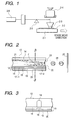
- FIG. 1 is a diagrammatic view showing the concept of a scratch resistance test.
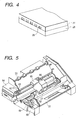
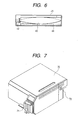
- FIG. 2 is a longitudinal sectional view of a recording head.
- FIG. 3 is a transverse sectional view of the recording head.
- FIG. 4 is a perspective view of a recording head in which multiple recording heads each of which is the recording head as shown in FIG. 2 are set.
- FIG. 5 is a perspective view showing an example of an ink jet recording apparatus.
- FIG. 6 is a longitudinal sectional view of an ink cartridge.
- FIG. 7 is a perspective view showing an example of a recording unit.
- FIG. 8 is a diagrammatic view showing an example of the configuration of a recording head.
- the present invention is described below in detail by giving preferred embodiments.
- the largest point of the present invention is that images are formed using both a liquid composition containing a specific polymer described below and a specific modified siloxane compound and a pigment ink (hereinafter simply "ink" in some cases), whereby the surfaces of images formed using the ink are made slippery.
- the scratch resistance of the images can strikingly be more improved than that of images formed with conventional ink and liquid composition.
- the present invention has been made on the basis of a new idea of taking note also of the frictional force acting between images and a material body (e.g., finger nails) coming into contact with the images, as being different from the idea that the scratch resistance of images is improved by utilizing only the film forming properties of a polymer, as in conventional techniques.
- images can also be provided in which not only any coloring materials of images may not be scraped off but also any scratch marks may hardly remain even when the images are scratched with finger nails under application of such a strong pressure as to scratch a recording medium at its non-recorded areas.
- FIG. 1 presents a diagrammatic view for illustrating a scratch resistance test.
- a polymethyl methacrylate (PMMA) ball is used as a rubbing material 2-3 which causes scratches in a state close to scratches made by finger nails.
- a surface property tester (trade named: HEIDON TRIBOGEAR Type 14DR, manufactured by Shinto Kagaku K.K.) is used to cause scratches in the following way. Stated specifically, as shown in FIG. 1 , a PMMA ball to which a load is kept applied from above is vertically brought into touch with image surfaces, where a sample 2-2 placed on a working stage 2-1 is moved at a given speed to cause scratches.
- the mass of a metal fitting for fastening the rubbing material 2-3 is kept removed with a balance mechanism 2-5. Then, the scratch resistance of images is evaluated by a vertical load (a weight 2-4) applied to the image surfaces.
- the horizontal-direction force acting on the rubbing material 2-3 when the stage is moved may be measured through a load cell 2-6 connected with the metal fitting.
- the coefficient of dynamic friction of image surfaces against the rubbing material may be measured from the ratio of horizontal-direction force to vertical-load force at the time of movement.
- the present inventors have conducted the scratch resistance test in the manner as described above over various images, to make detailed studies. As a result, it has been found that, where images are formed on a recording medium having a coat layer, the images can satisfy the high-level scratch resistance as aimed in the present invention, as long as the coefficient of dynamic friction of images is 0.40 or less, more preferably less than 0.35, and particularly preferably 0.30 or less.
- the lower limit of the coefficient of dynamic friction is 0.00 or more.
- the present inventors have come up with the constitution of the present invention in which the liquid composition containing the specific polymer described below and the specific modified siloxane compound is used in order to make images formed by a pigment ink have the coefficient of dynamic friction of 0.40 or less.
- the present inventors have studied several kinds of liquid compositions containing several kinds of modified siloxane compounds which are conventionally deemed to be effective in improving the slipperiness of coating film surfaces.
- the present inventors have studied how to cause most of the modified siloxane compound in the liquid composition to remain on the surface of the recording medium. Then, the present inventors have first thought about utilizing the synergistic effect of the properties of the modified siloxane compound and the properties of the polymer. As a result, they have considered that the following constitution is most suitable for the achievement of the object of the present invention, and have forwarded their studies.
- the constitution is that the properties of the modified siloxane compound, which is highly hydrophilic, are utilized to make the pigment forming images or the polymer in the liquid composition adsorb the modified siloxane compound so as for the latter modified siloxane compound to be present on the recording medium together with the polymer.
- the present inventors have made studies on the polymer to be contained in the liquid composition. As a result, they have come to the conclusion that, as a polymer capable of coming fixed on the recording medium to form a film having a certain high strength, at least one polymer selected from a polymer A and a polymer B having the following properties is most suitable.
- the polymer A is a polymer which has an acid value of from 90 mgKOH/g or more to 150 mgKOH/g or less and in which the hydrogen bond parameter ( ⁇ h) of the polymer obtained by the solubility parameters of monomers constituting the polymer is at least 3.7 cal 0.5 /cm 1.5 or less.
- the polymer B is a polymer which has an acid value of from more than 150 mgKOH/g to 200 mgKOH/g or less and in which the hydrogen bond parameter ( ⁇ h) of the polymer obtained by the solubility parameters of monomers constituting the polymer is at least 1.5 cal 0.5 /cm 1.5 or less.
- the hydrogen bond parameter ( ⁇ h) is the value obtained by the solubility parameters inherent in monomers constituting the polymer. This will be described later.
- the polymer usable as a constituent of the liquid composition of the present invention is by no means limited to the polymer A and polymer B described above. That is, the polymer contained together with the specific modified siloxane compound in the liquid composition is sufficient if only it can make the scratch resistance of images formed using inks the high-level scratch resistance as aimed in the present invention when it is incorporated in the liquid composition for formation of the images.
- the polymer may be one capable of bringing about solid-liquid separation immediately after the liquid composition has been applied onto the recording medium and becoming fixed on the recording medium.
- the polymer may be one which can provide a coefficient of dynamic friction of 0.40 or less for reference evaluation images formed using an ink and the liquid composition containing both the polymer and the specific modified siloxane compound detailed later. That is, any polymer may be used as a constituent of the liquid composition of the present invention as long as it can remain on the recording medium after the liquid composition has been applied onto the recording medium and form a film having a certain strength. Still further, the polymer particularly preferable for the present invention is one having such properties and also having properties of adsorbing the specific modified siloxane compound to improve the slipperiness of images, which is detailed later and is essential for the achievement of the object of the present invention.
- the "reference evaluation images" termed in the present invention refer to images recorded using the liquid composition containing both the polymer and the specific modified siloxane compound and using a pigment ink under the following conditions. That is, the term refers to images formed under conditions of an ejection quantity of from 3 ng to 5 ng per liquid composition droplet, a resolution of 1,200 dpi ⁇ 1,200 dpi, an 8-pass two-way recording and a recording duty of 50%.
- the present inventors have next formed images by using an liquid composition containing at least one polymer selected from the polymer A and the polymer B having the above properties and the modified siloxane compound studied as above together with the ink, to examine the scratch resistance of the images formed.
- an liquid composition containing at least one polymer selected from the polymer A and the polymer B having the above properties and the modified siloxane compound studied as above together with the ink to examine the scratch resistance of the images formed.
- the present inventors have used the liquid composition containing both the polymer having the above properties and the specific modified siloxane compound found effective in lowering the scratch resistance and used an ink to form images to examine the coefficient of dynamic friction and scratch resistance of the images obtained.
- the coefficient of dynamic friction of the images is 0.40 or less, and thus, by using the specific modified siloxane compound, images can be obtained which have much higher scratch resistance than the scratch resistance of images formed using a liquid composition containing only the polymer having the above properties and using an ink.
- the polymer A is a polymer which has an acid value of from 90 mgKOH/g or more to 150 mgKOH/g or less and in which the hydrogen bond parameter ( ⁇ h) of the polymer that is obtained by the solubility parameters of monomers constituting the polymer is from 1.0 cal 0.5 /cm 1.5 or more to 3.7 cal 0.5 /cm 1.5 or less.
- the polymer B is a polymer which has an acid value of from more than 150 mgKOH/g to 200 mgKOH/g or less and in which the hydrogen bond parameter ( ⁇ h) of the polymer that is obtained by the solubility parameters of monomers constituting the polymer is from 1.0 cal 0.5 /cm 1.5 or more to 1.5 cal 0.5 /cm 1.5 or less.
- the use of the liquid composition thus constituted enables the modified siloxane compound to be present on the recording medium, so that the action of the modified siloxane compound to improve the slipperiness of the coating film surface can fully be brought out to achieve the superior scratch resistance.
- the reason for settling the polymer A and the polymer B that the lower limit of the hydrogen bond parameter ( ⁇ h) of the polymer that is obtained by the solubility parameters of monomers constituting the polymer is 1.0 cal 0.5 /cm 1.5 or more will be described below.
- modified siloxane compounds shown below are necessary to be used in order to achieve the scratch resistance aimed in the present invention.
- what is most suitable is at least one selected from the group consisting of a modified siloxane compound represented by the following Formula (1), a modified siloxane compound represented by the following Formula (2) and a modified siloxane compound represented by the following Formula (3).
- modified siloxane compounds are those which provide the reference evaluation images with a coefficient of dynamic friction of 0.40 or less as obtained by the test method described above when the liquid composition further containing the polymer and a pigment ink are used in combination to form images on, for example, the recording medium having a coat layer.
- the coefficient of dynamic friction of the reference evaluation images is the value obtained according to the above method.
- the modified siloxane compound represented by Formula (1) has a weight average molecular weight of from 8,000 or more to 30,000 or less; in Formula (1), R 1 is an alkylene group having 1 to 20 carbon atom(s), R 2 is a hydrogen atom or an alkyl group having 1 to 20 carbon atom(s), m is from 1 or more to 250 or less, n is from 1 or more to 100 or less, a is from 1 or more to 100 or less, and b is from 0 or more to 100 or less.
- the modified siloxane compound represented by Formula (2) has a weight average molecular weight of from 8,000 or more to less than 50,000; in Formula (2), R 3 's are each independently a hydrogen atom or an alkyl group having 1 to 20 carbon atom(s), R 4 's are each independently an alkylene group having 1 to 20 carbon atom(s), p is from 1 or more to 450 or less, c is from 1 or more to 250 or less, and d is from 0 or more to 100 or less.
- the modified siloxane compound represented by Formula (3) has a weight average molecular weight of from 8,000 or more to less than 50,000 and an HLB of from 1 or more to less than 7; in Formula (3), R 5 's are each independently a hydrogen atom or an alkyl group 1 to 20 carbon atom(s), R 6 is an alkylene group having 1 to 20 carbon atom(s), q is from 1 or more to 100 or less, r is from 1 or more to 100 or less, e is from 1 or more to 100 or less, and f is from 0 or more to 100 or less.
- the modified siloxane compound represented by the above Formula (1) has a weight average molecular weight of more than 30,000, it is considered to be difficult for the polymer to adsorb the modified siloxane compound (or vice versa) in some cases because of an influence of steric hindrance or the like.
- the modified siloxane compound represented by the above Formula (2) or (3) has a weight average molecular weight of 50,000 or more, too, it is considered to be difficult for the polymer to adsorb the modified siloxane compound (or vice versa) in some cases because of an influence of steric hindrance or the like.
- the modified siloxane compound represented by any one of the above Formulas (1), (2) and (3) has a weight average molecular weight of less than 8,000, it is presumable that the modified siloxane compound to be provided over the surfaces of images may be in so small quantity that the coefficient of dynamic friction of images can not be lowered in some cases; or where the modified siloxane compound has a weight average molecular weight of less than 8,000, it is presumable that the modified siloxane compound itself may penetrate into the recording medium, so that the scratch resistance of images can not be lowered in some cases.
- the solubility parameter is affected by a functional group kind of the compound.
- the solubility parameter is one of the factors determining a solubility of plural compounds or an affinity of the compounds with each other, and when the solubility parameters of these compounds are similar to each other, the solubility of them is tend to become higher.
- the solubility parameter is classified into a dispersion force parameter ( ⁇ d) resulting from the primary deviation of an electron distribution, a polarity parameter ( ⁇ p) resulting from an attractive or repulsive force generated by a dipolar moment, and a hydrogen bond parameter ( ⁇ h) resulting from a hydrogen bond generated by active hydrogens or a lone pair of electrons.
- the hydrogen bond parameter is applied to a polymer, and as the hydrogen bond parameter of the polymer is large, the affinity of the polymer and water become stronger.
- the hydrogen bond parameter ( ⁇ h) of the polymer can be determined by the solubility parameters of a monomer constituting the polymer.
- the hydrogen bond parameter ( ⁇ h) of the polymer obtained by the solubility parameter of a monomer constituting the polymer can be determined by an atomic group summation method proposed by Krevelen in which organic molecules are treated as atomic groups (see Krevelen, Properties of Polymer 2nd Edition, New York, 154 (1976 )). This method is described below.
- the dispersion force parameter ( ⁇ d), polarity parameter ( ⁇ p), and hydrogen bond parameter ( ⁇ h) of the solubility parameter are determined from a dispersion force parameter Fdi per mole, a polarity force parameter Fpi per mole, and a hydrogen bond force parameter Fhi per mole of each atomic group in the organic molecules.
- the solubility parameter ( ⁇ ) can be determined by using those values as shown in the following equations:
- ⁇ d ⁇ Fdi / V .
- ⁇ p ⁇ Fpi / V .
- ⁇ h ⁇ Fhi / V .
- V is the sum of molar volumes of atomic groups.
- the present inventors have come to a finding that, as to a polymer incorporated in the liquid composition, whether the polymer penetrates into a recording medium together with an aqueous medium or remains on the recording medium to become fixed there may be judged by taking account of the hydrogen bond parameter ( ⁇ h) that contributes to the solubility parameter ( ⁇ ).
- the relationship between the hydrogen bond parameter ( ⁇ h) that contributes to the solubility parameter ( ⁇ ) and the degree of penetration of polymer into the recording medium is not clear, but the present inventors presume it as follows:
- the hydrogen bond parameter ( ⁇ h) comes from hydrogen bonds, and there is a tendency that the affinity of the polymer for the water increases with an increase in the hydrogen bond parameter ( ⁇ h) of the polymer.
- a liquid composition chiefly containing an aqueous medium as in the liquid composition of the present invention has a tendency that, with an increase in the hydrogen bond parameter ( ⁇ h), the polymer becomes more hydrated and the agglomerative properties between polymers become lower. With this tendency, the polymer is increasingly apt to penetrate into the recording medium without agglomerating on the recording medium, so that the proportion of the polymer remaining on the recording medium tends to lower.
- the polymer A and/or the polymer B, having the value(s) of the hydrogen bond parameter ( ⁇ h) of polymer that is obtained by the solubility parameters of monomers described later, constituting the polymer is/are used as the constituent of the liquid composition, which value(s) may differ in its preferable range depending on the acid value of the polymer. More specifically, between the polymer (polymer A) having an acid value of from 90 mgKOH/g or more to 150 mgKOH/g or less and the polymer (polymer B) having an acid value of from more than 150 mgKOH/g to 200 mgKOH/g or less, the preferable range of the hydrogen bond parameter ( ⁇ h) may differ as shown below.
- the value of the hydrogen bond parameter ( ⁇ h) of polymer that is obtained by the solubility parameters of monomers constituting the polymer may preferably be from 1.0 cal 0.5 /cm 1.5 or more to 3.7 cal 0.5 /cm 1.5 or less.
- the value of the hydrogen bond parameter ( ⁇ h) of polymer that is obtained by the solubility parameters of monomers constituting the polymer may preferably be from 1.0 cal 0.5 /cm 1.5 or more to 1.5 cal 0.5 /cm 1.5 or less.
- the liquid composition of the present invention may preferably be substantially colorless or lightly colored.
- substantially colorless or lightly colored means that the image density substantially does not lower when the liquid composition is applied to regions which include images formed using an ink. Stated more specifically, it is preferable for the liquid composition not to have any maximum absorption wavelength in the visible range of from 400 nm to 700 nm.
- the liquid composition fulfilling such conditions may stand somewhat cloudy. It is also preferable that the difference between the image density of images to which the liquid composition has been applied and the image density of images to which the same is not applied is so controlled as to be 0.3 or less, and more preferably 0.1 or less.
- the liquid composition according to the present invention can satisfy the above property by, for example, no coloring material is contained in the liquid composition.
- the modified siloxane compound used in the liquid composition of the present invention is at least one selected from the group consisting of the modified siloxane compound represented by the following Formula (1), the modified siloxane compound represented by the following Formula (2) and the modified siloxane compound represented by the following Formula (3).
- modified siloxane compounds represented by the following Formulas (1), (2) and (3) represent an ethylene oxide unit and a propylene oxide unit, respectively.
- the ethylene oxide unit and the propylene oxide unit in the structure of the compound may be present in any state such as a random form or a block form.
- these units are preferably present in a random form or a block form. That these units are present in the state of a random form means that the ethylene oxide unit and the propylene oxide unit are irregularly arranged. That these units are present in the state of a block form means that the respective blocks are each made up of some units and the blocks thus made up are regularly arranged.
- the modified siloxane compound represented by Formula (1) has a weight average molecular weight of from 8,000 or more to 30,000 or less; in Formula (1), R 1 is an alkylene group having 1 to 20 carbon atom(s), R 2 is a hydrogen atom or an alkyl group having 1 to 20 carbon atom(s), m is from 1 or more to 250 or less, n is from 1 or more to 100 or less, a is from 1 or more to 100 or less, and b is from 0 or more to 100 or less.
- R 1 may preferably be an alkylene group having 1 to 10 carbon atom(s), and further, particularly preferably be an ethylene group, a propylene group or a butylene group.
- R 2 may preferably be an alkyl group having 1 to 10 carbon atom(s), and further, particularly preferably be an ethyl group or a propyl group.
- Letter symbol m is preferably from 1 or more to 250 or less, more preferably from 1 or more to 100 or less, and particularly preferably from 1 or more to 50 or less.
- Letter symbol n is preferably from 1 or more to 100 or less, and more preferably from 1 or more to 50 or less.
- Letter symbol a is preferably from 1 or more to 100 or less, and more preferably from 1 or more to 50 or less.
- Letter symbol b is preferably from 0 or more to 100 or less, and more preferably from 1 or more to 50 or less.
- the compound represented by above Formula (1) used in the present invention is obtained by the additive polymerization of two kinds of compounds represented by the following formulas. Namely, the compound is obtained by the additive reaction of polysiloxane having n unit(s) of hydrogen atom(s) bonded to n unit(s) of Si and compounds of a structure having ethylene oxide unit(s) and/or propylene oxide unit(s) and an alkene group on the terminal of the compound. Specifically, the compound is obtained by the addition of the hydrogen atom of the polysiloxane with the alkene group.
- m is from 1 or more to 250 or less
- n is from 1 or more to 100 or less
- a is from 1 or more to 100 or less
- b is from 0 or more to 100 or less
- R is an alkene group having 1 to 20 carbon atom(s).
- the modified siloxane compound represented by Formula (2) has a weight average molecular weight of from 8,000 or more to less than 50,000; in Formula (2), R 3 's are each independently a hydrogen atom or an alkyl group having 1 to 20 carbon atom(s), R 4 's are each independently an alkylene group having 1 to 20 carbon atom(s), p is from 1 or more to 450 or less, c is from 1 or more to 250 or less, and d is from 0 or more to 100 or less.
- R 3 's are each preferably a hydrogen atom or an alkyl group having 1 to 10 carbon atom(s), and more preferably a hydrogen atom, an ethyl group or a propyl group.
- R 4 's are each preferably an alkylene group having 1 to 10 carbon atom(s), and further, particularly preferably an ethylene group, a propylene group or a butylene group.
- Letter symbol p is preferably from 1 or more to 450 or less, more preferably from 1 or more to 100 or less, and particularly preferably from 1 or more to 50 or less.
- the compound represented by above Formula (2) used in the present invention is obtained by the additive polymerization of two kinds of compounds represented by the following formulas. Namely, the compound is obtained by the additive reaction of polysiloxane having hydrogen atoms bonded to Si on both terminals and compounds of a structure having ethylene oxide unit(s) and/or propylene oxide unit(s) and an alkene group on the terminal of the compound. Specifically, the compound is obtained by the addition of the hydrogen atom of the polysiloxane with the alkene group.
- p is from 1 or more to 450 or less
- c is from 1 or more to 250 or less
- d is from 0 or more to 100 or less
- R is an alkene group having 1 to 20 carbon atom(s).
- the modified siloxane compound represented by Formula (3) has a weight average molecular weight of from 8,000 or more to less than 50,000 and an HLB of from 1 or more to less than 7; in Formula (3), R 5 's are each independently a hydrogen atom or an alkyl group having 1 to 20 carbon atom(s), R 6 is an alkylene group having 1 to 20 carbon atom(s), q is from 1 or more to 100 or less, r is from 1 or more to 100 or less, e is from 1 or more to 100 or less, and f is from 0 or more to 100 or less.
- R 5 ' s are each preferably a hydrogen atom or an alkyl group having 1 to 10 carbon atom(s), and more preferably a hydrogen atom, an ethyl group or a propyl group.
- R 6 's are each preferably an alkylene group having 1 to 10 carbon atom(s), and further, particularly preferably an ethylene group, a propylene group or a butylene group.
- Letter symbol e is preferably from 1 or more to 100 or less, and more preferably from 1 or more to 50 or less.
- Letter symbol f is preferably from 1 or more to 100 or less, and more preferably from 1 or more to 50 or less.
- the compound represented by above Formula (3) used in the present invention is obtained by the additive polymerization of two kinds of compounds represented by the following formulas. Namely, the compound is obtained by the additive reaction of polysiloxane having hydrogen atoms bonded to Si on both terminals and compounds of a structure having ethylene oxide unit(s) and/or propylene oxide unit(s) and alkene groups on both terminals of the compound. Specifically, the compound is obtained by the addition of the hydrogen atom of the polysiloxane with the alkene group.
- q is from 1 or more to 100 or less
- r is from 1 or more to 100 or less
- e is from 1 or more to 100 or less
- f is from 0 or more to 100 or less
- R is an alkene group having 1 to 20 carbon atom(s).
- any compound may be used as long as the images are obtainable which have the high-level scratch resistance as aimed in the present invention.
- modified siloxane compounds having the following weight average molecular weights.
- the modified siloxane compound represented by the above Formula (1) it may preferably have a weight average molecular weight (Mw) of from 8,000 or more to 30,000 or less, and further, particularly preferably from 8,500 or more to 30,000 or less.
- the modified siloxane compound represented by the above Formula (2) or (3) may preferably have a weight average molecular weight (Mw) of from 8,000 or more to less than 50,000, and further, particularly preferably from 8,500 or more to 30,000 or less.
- Mw is weight average molecular weight in terms of polystyrene, in molecular weight distribution as measured by gel permeation chromatography (GPC).
- GPC gel permeation chromatography
- the modified siloxane compounds used in the present invention are synthesized as described above, since the compounds having alkene group(s) as well as polysilixanes used as raw materials are mixture compounds having molecular weight ranges, the molecular weight of the compounds are obtained as average molecular weights.
- the modified siloxane compound represented by the above Formula (1) it is preferable to use a modified siloxane compound having a specific HLB (hydrophilic-lipophilic balance; the value calculated by the Griffin method). More specifically, the modified siloxane compound represented by the above Formula (1) may preferably have an HLB of from 1 or more to 11 or less, and more preferably from 5 or more to 11 or less.
- HLB hydrophilic-lipophilic balance
- the modified siloxane compound represented by the above Formula (1) is used in the liquid composition of the present invention, setting its weight average molecular weight and also its HLB within the above ranges reduces the modified siloxane compound penetrating into the recording medium when the liquid composition is applied onto the recording medium. As a result, the modified siloxane compound represented by the above Formula (1) is apt to remain on the recording medium. Hence, even where the modified siloxane compound represented by the above Formula (1) is in a small content in the liquid composition, the coefficient of dynamic friction of images can effectively be lowered.
- Such a modified siloxane compound represented by the above Formula (1) that fulfills the above conditions and is preferably usable in the present invention may include the following: e.g., FZ-2104, FZ-2130 and FZ-2191 (all available from Dow Corning Toray Silicone Co., Ltd.), KF-615A (available from Shin-Etsu Chemical Co., Ltd.), TSF4452 (available from GE Toshiba Silicone Co., Ltd.). Of course, in the present invention, examples are by no means limited to these.
- modified siloxane compound represented by the above Formula (2) is used in the liquid composition of the present invention, setting its weight average molecular weight within the above range reduces the modified siloxane compound penetrating into the recording medium when the liquid composition is applied onto the recording medium. As a result, the modified siloxane compound represented by the above Formula (2) is apt to remain on the recording medium. Hence, even where the modified siloxane compound represented by the above Formula (2) is in a small content in the liquid composition, the coefficient of dynamic friction of images can effectively be lowered.
- a modified siloxane compound represented by the above Formula (2) that fulfills the above conditions and is preferably usable in the present invention may include, e.g., BYK333 (available from Byk Chemie Japan KK). Of course, in the present invention, examples are by no means limited to this.
- the modified siloxane compound represented by the above Formula (3) it is preferable to use a modified siloxane compound having a specific HLB (hydrophilic-lipophilic balance; the value calculated by the Griffin method). More specifically, the modified siloxane compound represented by the above Formula (3) necessarily has an HLB of from 1 or more to less than 7.
- the modified siloxane compound represented by the above Formula (3) is used in the liquid composition of the present invention, setting its weight average molecular weight and also its HLB within the above ranges reduces the modified siloxane compound penetrating into the recording medium when the liquid composition is applied onto the recording medium. As a result, the modified siloxane compound represented by the above Formula (3) is apt to remain on the recording medium. Hence, even where the modified siloxane compound represented by the above Formula (3) is in a small content in the liquid composition, the coefficient of dynamic friction of images can effectively be lowered.
- Such a modified siloxane compound represented by the above Formula (1) that fulfills the above conditions and is preferably usable in the present invention may include the following: e.g., FZ-2203, FZ-2207, FZ-2222 and FZ-2231 (all available from Dow Corning Toray Silicone Co., Ltd.). Of course, in the present invention, examples are by no means limited to these.
- the weight average molecular weight (Mw) of the modified siloxane compound may be measured by gel permeation chromatography (GPC), using tetrahydrofuran as a mobile phase.
- GPC gel permeation chromatography
- a measuring method used in the present invention is as shown below. Measuring conditions such as a filter, a column, a standard polystyrene sample and its molecular weight are by no means limited to the following.
- a sample for measurement is put in tetrahydrofuran (THF) and left standing for several hours to dissolve to prepare a solution. Thereafter, the solution is filtered with a solvent-resistant membrane filter of 0.45 ⁇ m in pore size (e.g.; trade name: TITAN 2 Syringe Filter, PTFE, 0.45 ⁇ m; available from SUN-SRi).
- a solvent-resistant membrane filter of 0.45 ⁇ m in pore size (e.g.; trade name: TITAN 2 Syringe Filter, PTFE, 0.45 ⁇ m; available from SUN-SRi).
- the concentration of the sample in the sample solution is so controlled that the content of the modified siloxane compound may be from 0.1% by mass to 0.5% by mass.
- an RI detector reffractive index detector
- RI detector reactive index detector
- a plurality of commercially available polystyrene gel columns in combination.
- four columns of Shodex KF-806M available from Showa Denko K.K.
- THF as a mobile phase is flowed at a flow rate of 1 mL/min to columns having been stabilized in a 40.0°C heat chamber, and the above sample solution is injected in an amount of about 0.1 mL.
- the weight average molecular weight of the sample is determined by using a molecular weight calibration curve having been prepared using the standard polystyrene sample.
- One having a molecular weight of from about 100 to about 10,000,000 may be used as the standard polystyrene sample, and it is suitable to use at least about 10 types of standard polystyrene samples.
- the content (% by mass) of the modified siloxane compound in the liquid composition is preferably from 0.2% by mass or more to 5.0% by mass or less, and more preferably from 0.5% by mass or more to less than 3.0% by mass, based on the total mass of the liquid composition.
- the content (% by mass) of the modified siloxane compound in the liquid composition is preferably from 1.0% by mass or more to less than 3.0% by mass.
- the modified siloxane compound can satisfactorily be left on the recording medium to provide images with an especially superior scratch resistance.
- the content of the modified siloxane compound is less than 3.0% by mass, the occurrence of faulty ejection due to, e.g., kogation may be minimized, which is particularly preferable.
- any polymer may be used as long as it is a polymer which can remain on the recording medium after the liquid composition has been applied onto the recording medium, to form a film having strength to a certain extent.
- studies made by the present inventors have revealed that, in order to suppress an ejection orifice wetting phenomenon due to the polymer, which phenomenon may come into question particularly when the liquid composition is used for ink jet recording, it is most suitable to use at least one of the polymer A and the polymer B each having the properties as described previously.
- the "hydrogen bond parameter ( ⁇ h) of polymer that is obtained by the solubility parameters of monomers constituting the polymer" is a value found in the following way. First, the hydrogen bond parameter ( ⁇ h) of each monomer constituting the polymer is obtained by the solubility parameter inherent in each monomer constituting the polymer. Then, the hydrogen bond parameter ( ⁇ h) of each monomer constituting the polymer obtained above is multiplied by the compositional (mass) ratio of each monomer constituting the polymer (compositional ratio when the sum total is defined as 1) to find respective values. Next, the values obtained may be summed up to find the hydrogen bond parameter ( ⁇ h) of the polymer.
- the polymer making up the liquid composition of the present invention has an acid value of less than 90 mgKOH/g, the polymer may be unable to be dissolved in an alkali, or the polymer may be precipitated when the liquid composition is stored over a long period of time. Further, if it has an acid value of less than 90 mgKOH/g, it may be difficult to maintain stable ejection property when the liquid composition is incorporated therein with the polymer in an amount large enough to achieve the scratch resistance as aimed in the present invention and such a liquid composition is ejected by means of a thermal-type ink jet recording system. Hence, it is preferable for the polymer to have an acid value of 90 mgKOH/g or more.
- the polymer has an acid value of more than 150 mgKOH/g
- the polymer may tend to penetrate into the recording medium together with an aqueous medium contained in the liquid composition, so that the high-level scratch resistance as aimed in the present invention can not be obtained in some cases.
- the hydrogen bond parameter ( ⁇ h) of polymer that is obtained by the solubility parameters of monomers constituting the polymer is 1.5 cal 0.5 /cm 1.5 or less.
- the polymer has an acid value of more than 200 mgKOH/g, even though the hydrogen bond parameter ( ⁇ h) is controlled in any manner, the polymer can not be left, in some cases, on the recording medium in an amount large enough to achieve the high-level scratch resistance at which the present invention is aimed. Hence, it is preferable that the polymer has an acid value of 200 mgKOH/g or less.
- the polymer A or polymer B making up the liquid composition of the present invention may remarkably cause the ejection orifice wetting phenomenon due to the polymer, if the hydrogen bond parameter ( ⁇ h) of polymer that is obtained by the solubility parameters of monomers constituting the polymer is less than 1.0 cal 0.5 /cm 1.5 .
- the hydrogen bond parameter ( ⁇ h) of polymer that is obtained by the solubility parameters of monomers constituting the polymer A or polymer B is preferably 1.0 cal 0.5 /cm 1.5 or more.
- the hydrogen bond parameter ( ⁇ h) of polymer that is obtained by the solubility parameters of monomers constituting the polymer is more than 3.7 cal 0.5 /cm 1.5 , even though the acid value of the polymer is controlled in any manner, the polymer may be liable to penetrate into the recording medium together with an aqueous medium contained in the liquid composition. Hence, the scratch resistance as aimed in the present invention can not be obtained in some cases.
- At least one polymer selected from the polymer A and the polymer B, making up the liquid composition of the present invention is most suitable for at least one polymer selected from the polymer A and the polymer B, making up the liquid composition of the present invention, to have such properties that the acid value and hydrogen bond parameter ( ⁇ h) as specified below are in combination.
- the polymer A has an acid value of from 90 mgKOH/g or more to 150 mgKOH/g or less.
- the hydrogen bond parameter ( ⁇ h) of polymer that is obtained by the solubility parameters of monomers constituting the polymer is from 1.0 cal 0.5 /cm 1.5 or more to 3.7 cal 0.5 /cm 1.5 or less.
- the hydrogen bond parameter ( ⁇ h) of polymer that is obtained by the solubility parameters of monomers constituting the polymer is more preferably from 1.0 cal 0.5 /cm 1.5 or more to 3.2 cal 0.5 /cm 1.5 or less.
- the hydrogen bond parameter ( ⁇ h) of polymer that is obtained by the solubility parameters of monomers constituting the polymer is still further preferably from 1.2 cal 0.5 /cm 1.5 or more to 1.8 cal 0.5 /cm 1.5 or less.
- the polymer B has an acid value of from more than 150 mgKOH/g to 200 mgKOH/g or less.
- the hydrogen bond parameter ( ⁇ h) of polymer that is obtained by the solubility parameters of monomers constituting the polymer is from 1.0 cal 0.5 /cm 1.5 or more to 1.5 cal 0.5 /cm 1.5 or less.
- the hydrogen bond parameter ( ⁇ h) of polymer that is obtained by the solubility parameters of monomers constituting the polymer is more preferably from 1.2 cal 0.5 /cm 1.5 or more to 1.5 cal 0.5 /cm 1.5 or less.
- any monomer may be used as long as it can provide the polymer having as its properties the acid value and the hydrogen bond parameter ( ⁇ h) of polymer that is obtained by the solubility parameters of monomers constituting the polymer, as described above. Stated specifically, any of monomers enumerated below may be used as the monomer making up the polymer.
- Styrene and ⁇ -methylstyrene; ethyl acrylate, n-butyl acrylate, n-hexyl acrylate, methyl methacrylate, and benzyl methacrylate; monomers having a carboxyl group, such as acrylic acid, methacrylic acid, crotonic acid, ethacrylic acid, propylacrylic acid, isopropylacrylic acid, itaconic acid, and fumaric acid; monomers having a sulfonic acid group, such as styrene sulfonic acid, sulfonic acid-2-propyl acrylamide, acrylic acid-2-ethyl sulfonate, methacrylic acid-2-ethyl sulfonate, and butyl acrylamide sulfonic acid; and monomers having a phosphonic acid group, such as methacrylic acid-2-ethyl phosphonate, and acrylic acid-2-ethyl
- the polymer A in the case when the polymer A is used, it may preferably contain, among the monomers enumerated above, at least one monomer selected from the group consisting of styrene, n-butyl acrylate and benzyl methacrylate. Further, the monomer(s) making up the polymer A may more preferably have both styrene and n-butyl acrylate. In the monomers making up the polymer A, the mass ratio of n-butyl acrylate to styrene (n-butyl acrylate/styrene) is particularly preferably from more than 0.2 to less than 0.35.
- the polymer B may preferably contain, among the monomers enumerated above, at least one monomer selected from the group consisting of styrene and ⁇ -methylstyrene. Further, the monomer(s) making up the polymer B may more preferably have both styrene and a-methylstyrene. In the monomers making up the polymer B, the mass ratio of ⁇ -methylstyrene to styrene ( ⁇ -methylstyrene/styrene) may particularly preferably be 0.90 or less. In the present invention, it is not so desirable to use a monomer having a nonionic group, such as ethylene oxide, because the strength of film formed on the recording medium may be lessened.
- a monomer having a nonionic group such as ethylene oxide
- the polymer (at least one polymer selected from the polymer A and the polymer B) may preferably have a weight average molecular weight of from 5,000 or more to 15,000 or less, and more preferably from 6,000 or more to 9,000 or less.
- the polymer having weight average molecular weight within the above range can easily remain on the recording medium after the liquid composition has been applied onto the recording medium, and further can not easily be affected by steric hindrance. Hence, the polymer can easily adsorb the modified siloxane compound, so that the coefficient of dynamic friction of images can effectively be lowered.
- the content (% by mass) of the polymer (at least one polymer selected from the polymer A and the polymer B) in the liquid composition is preferably from 0.5% by mass or more to 5.0% by mass or less, and more preferably from 2.5% by mass or more to 4.0% by mass or less, based on the total mass of the liquid composition. Inasmuch as the polymer is in the content within the above range, the polymer can be left on the recording medium in such an amount that the scratch resistance of images can satisfactorily be achieved.
- the polymer in the content within the above range, the ejection orifice wetting phenomenon due to the polymer can be suppressed and deterioration of ejection property, such as curved flying of liquid droplets, is not easily brought about.
- an aqueous medium may be used which is water or a mixed solvent of water and a water-soluble organic solvent.
- the content (% by mass) of the water-soluble organic solvent in the liquid composition is preferably from 3.0% by mass or more to 50.0% by mass or less based on the total mass of the liquid composition.
- water-soluble organic solvent there are no particular limitations on the water-soluble organic solvent as long as it is water-soluble. Any of those as enumerated below may be used alone or in combination of two or more types. Stated specifically, the following water-soluble organic solvents may be used, for example: Alkanediols such as 1,3-butanediol, 1,5-pentanediol, 1,2-hexanediol and 1,6-hexanediol; glycol ethers such as diethylene glycol monomethyl(or -ethyl) ether and triethylene glycol monoethyl(or -butyl) ether; alkyl alcohols having 1 to 4 carbon atoms, such as ethanol, isopropanol, n-butanol, isobutanol, secondary butanol and tertiary butanol; carboxylic acid amides such as N,N-dimethyl formamide and N,N-dimethyl acet
- the content (% by mass) of the water in the liquid composition is preferably from 50.0% by mass or more to 95.0% by mass or less based on the total mass of the liquid composition.
- the liquid composition of the present invention may contain a moisture-retentive solid matter such as urea, a urea derivative, trimethylolpropane or trimethylolethane.
- the content (% by mass) of the moisture-retentive solid matter in the liquid composition is preferably from 0.1% by mass or more to 20.0% by mass or less, and more preferably from 3.0% by mass or more to 10.0% by mass or less, based on the total mass of the liquid composition.
- the liquid composition may further contain various additives such as a pH adjuster, a rust preventive, an antiseptic agent, a mildew-proofing agent, an antioxidant and a reduction-preventive agent.
- various additives such as a pH adjuster, a rust preventive, an antiseptic agent, a mildew-proofing agent, an antioxidant and a reduction-preventive agent.
- the ink it is possible to use pigments of a polymer dispersion type (polymer dispersion type pigments) which use a dispersing agent to disperse the pigment, and pigments of a self-dispersion type (self-dispersion type pigments), in which hydrophilic groups have been introduced into the pigment particle surface portions. Also it is possible to use pigments having organic groups containing a polymer which are chemically bonded to the pigment particle surfaces (polymer-bonded self dispersion type pigments), and microcapsule type pigments whose dispersibility is improved so as to be render them dispersible without using any dispersing agent. Of course, these pigments different in the manner of dispersion may be used in combination.
- the content (% by mass) of the pigment in the ink is preferably from 0.1% by mass or more to 15.0% by mass or less, and more preferably from 1.0% by mass or more to 10.0% by mass or less, based on the total mass of the ink.
- carbon black such as furnace black, lamp black, acetylene black or channel black.
- furnace black such as furnace black, lamp black, acetylene black or channel black.
- acetylene black or channel black.
- RAVEN 1170, 1190 ULTRA-II, 1200, 1250, 1255, 1500, 2000, 3500, 5000 ULTRA, 5250, 5750 and 700 (all available from Columbian Carbon Japan Limited); BLACK PEARLS L, REGAL: 330R, 400R and 660R, MOGUL L, MONARCH: 700, 800, 880, 900, 1000, 1100, 1300, 1400 and 2000, and VALCAN XC-72 (all available from Cabot Corp.); COLOR BLACK: FW1, FW2, FW2V, FW18, FW200, S150, S160 and S170, PRINTEX: 35, U, V, 140U and 140V, SPECIAL BLACK: 6, 5, 4A and 4 (all available from Degussa Corp.); and No.25, No.33, No.40, No.47, No.52, No.900, No.2300, MCF-88, MA600, MA7, MA8, and MA100 (all available from Mitsubishi Chemicals, Inc
- Carbon black prepared newly may also be used.
- examples are by no means limited to these, and any conventionally known carbon black may be used.
- carbon black fine magnetic-material particles of magnetite, ferrite or the like, and titanium black may also be used as the pigment.
- organic pigments may preferably be used as pigments. Stated specifically, the following may be used, for example:
- Water-insoluble azo pigments such as Toluidine Red, Toluidine maroon, Hanza Yellow, Benzidine Yellow and Pyrazolone Red; water-soluble azo pigments such as Lithol Red, Helio Bordeaux, Pigment Scarlet and Permanent Red 2B; derivatives from vat dyes, such as alizarin, indanthrone and Thioindigo maroon; phthalocyanine type pigments such as Phthalocyanine Blue and Phthalocyanine Green; quinacridone type pigments such as Quinacridone Red and Quinacridone Magenta; perylene type pigments such as Perylene Red and Perylene Scarlet; isoindolinone type pigments such as Isoindolinone Yellow and Isoindolinone Orange; imidazolone type pigments such as Benzimidazolone Yellow, Benzimidazolone Orange and Benzimidazolone Red; pyranthrone type pigments such as Pyranthrone Red and Pyranthrone Orange;
- C.I. Color Index
- Pigment Yellow 12, 13, 14, 17, 20, 24, 74, 83, 86, 93, 97, 109, 110, 117, 120, 125, 128, 137, 138, 147, 148, 150, 151, 153, 154, 166, 168, 180, 185, etc.
- C.I. Pigment Orange 16, 36, 43, 51, 55, 59, 61, 71, etc.
- Pigment Red 9, 48, 49, 52, 53, 57, 97, 122, 123, 149, 168, 175, 176, 177, 180, 192, 215, 216, 217, 220, 223, 224, 226, 227, 228, 238, 240, 254, 255, 272, etc.; C.I. Pigment Violet: 19, 23, 29, 30, 37, 40, 50, etc.; C.I. Pigment Blue: 15, 15:1, 15:3, 15:4, 15:6, 22, 60, 64, etc.; C.I. Pigment Green: 7, 36, etc.; and C.I. Pigment Brown: 23, 25, 26, etc. Of course, in the present invention, examples are by no means limited to these.
- a polymer may be used in the ink.
- the polymer it may be used as a dispersing agent for dispersing the pigment in the aqueous medium, or may only be added to the ink.
- any polymer may be used.
- the polymer used in the liquid composition and that used in the ink are the same, namely, the polymer have the same properties (the same acid value and hydrogen bond parameter ( ⁇ h) of polymer that is obtained by the solubility parameters of monomers constituting the polymer).
- the polymer used in the ink can have the same properties as the polymer usable in the liquid composition of the present invention described above.
- Monomers making up the polymer may specifically include the following, at least two monomers of which may make up the polymer.
- at least one of them may preferably be a hydrophilic monomer.
- the monomers may include styrene, vinyl naphthalene, aliphatic alcohol esters of ⁇ , ⁇ -ethylenically unsaturated carboxylic acids, acrylic acid, maleic acid, itaconic acid, fumaric acid, vinyl acetate, vinyl pyrrolidone, acrylamide, and derivatives of these.
- At least one of monomers constituting the polymer may preferably be a hydrophilic monomer.
- the polymer may include block copolymers, random copolymers, graft copolymers or salts or the like of any of these.
- natural polymers such as rosin, shellac and starch may also be used. These polymers are soluble in an aqueous solution in which a base has been dissolved, and are alkali-soluble type polymers.
- the content (% by mass) of the polymer in the ink is preferably from 0.5% by mass or more to 5.0% by mass or less based on the total mass of the ink.
- the polymer may also preferably have a weight average molecular weight of from 1,000 or more to 15,000 or less. Further, the polymer may preferably have an acid value of from 90 mgKOH/g or more to 200 mgKOH/g or less.
- an aqueous medium may be used which is water or a mixed solvent of water and a water-soluble organic solvent.
- the content (% by mass) of the water-soluble organic solvent in the ink is preferably from 3.0% by mass or more to 50.0% by mass or less based on the total mass of the ink.
- water-soluble organic solvent there are no particular limitations on the water-soluble organic solvent as long as it is water-soluble. Any of those as enumerated below may be used alone or in combination of two or more types. Stated specifically, the following water-soluble organic solvents may be used, for example: Alkanediols such as 1,3-butanediol, 1,5-pentanediol, 1,2-hexanediol and 1,6-hexanediol; glycol ethers such as diethylene glycol monomethyl(or -ethyl) ether and triethylene glycol monoethyl(or -butyl) ether; alkyl alcohols having 1 to 4 carbon atoms, such as ethanol, isopropanol, n-butanol, isobutanol, secondary butanol and tertiary butanol; carboxylic acid amides such as N,N-dimethyl formamide and N,N-dimethyl acet
- the content (% by mass) of the water in the ink is preferably from 50.0% by mass or more to 95.0% by mass or less based on the total mass of the ink.
- the ink may contain a moisture-retentive solid matter such as urea, a urea derivative, trimethylolpropane or trimethylolethane.
- the content (% by mass) of the moisture-retentive solid matter in the ink is preferably from 0.1% by mass or more to 20.0% by mass or less, and more preferably from 3.0% by mass or more to 10.0% by mass or less, based on the total mass of the ink.
- the ink may further contain various additives such as a pH adjuster, a rust preventive, an antiseptic agent, a mildew-proofing agent, an antioxidant and a reduction-preventive agent.
- various additives such as a pH adjuster, a rust preventive, an antiseptic agent, a mildew-proofing agent, an antioxidant and a reduction-preventive agent.
- liquid composition of the present invention can be used in combination with ink(s) as a set of liquid composition and ink.
- the image forming method of the present invention is characterized by having (i) the step of applying the liquid composition onto a recording medium and (ii) the step of applying the pigment ink onto the recording medium.
- the steps (i) and (ii) may preferably be so carried out that the liquid composition and the pigment ink may come into contact with each other on the recording medium.
- the scratch resistance of images formed using the ink can be what has achieved the high-level good scratch resistance that coloring materials are hardly scraped off even when images are scratched under application of such a strong pressure as to scratch the recording medium at its non-recorded areas.
- the liquid composition and the pigment ink are applied onto the recording medium, there may be done by, e.g., the following methods or combination of these methods.
- the following methods or combination of these methods are (a) a method in which the pigment ink is applied after the liquid composition has been applied and (b) a method in which the liquid composition is applied after the pigment ink has been applied.
- any of these methods may appropriately be selected.
- the method (b) may preferably be used. In such a case, there are no particular limitations on the interval for which the ink is applied and thereafter the liquid composition is applied.
- the interval for applying these may preferably be so determined that the ink and the liquid composition may come into contact with each other in the state of liquids and come mixed together.
- the amount of the liquid composition to be applied onto the recording medium there are no particular limitations thereon as long as the effect of the present invention can be obtained.
- the amount thereof may preferably be from 20% or more to 50% or less, and more preferably from 25% or more to 50% or less, based on the amount of the ink to be applied.
- the "beading" refers to a phenomenon described below.
- the liquid composition is applied onto the recording medium at its image areas only, a great difference in scratch resistance may come between areas where images have been formed and areas where images have not been formed. Hence, it is particularly preferable for the liquid composition to be applied over areas inclusive of the image areas and also broader areas than those.
- the liquid composition is applied in the above amount of from 20% or more to 50% or less based on the amount of the ink to be applied, it may be difficult for the liquid composition to be applied over the areas inclusive of the image areas and also broader areas than those.
- the liquid having a large surface tension and a liquid having a small surface tension come into contact with each other, the liquid having a large surface tension has the characteristic of moving to the liquid having a small surface tension.
- the amount of the liquid composition in order for the liquid composition to be applied over the areas inclusive of the image areas and also broader areas than those, setting the amount of the liquid composition to be preferably from 20% or more to 50% or less, and more preferably from 25% or more to 50% or less, based on the amount of the ink to be applied, it is preferable to do the following. That is, it is preferable to set the liquid composition having a higher surface tension than the surface tension of the ink. Setting it in this way can make the liquid composition spread over, and beyond, the whole areas to which the ink has been applied, at the time the ink and the liquid composition have come into contact with each other.
- the method how to apply the ink or the liquid composition on to the recording medium is not particularly limited, although it is particularly preferable that not only the ink but also the liquid composition are applied onto the recording medium by ink jet method. This is because the liquid composition can accurately be applied to image areas with ease and the amount of the liquid composition to be applied can be controlled with ease as specified above.
- the amounts of the ink and liquid composition to be applied by ink jet method may be controlled by determining the recording duty and so forth appropriately.
- the liquid composition of the present invention may particularly preferably be used in an ink jet recording method in which the ink and the liquid composition are ejected by means of ink jet system and therefore record on a recording medium.
- the ink jet recording method may include, e.g., a recording method in which mechanical energy is caused to act on an ink and a liquid composition to eject the ink and the liquid composition, and a recording method in which heat energy is caused to act on an ink and a liquid composition to eject the ink and the liquid composition.
- the liquid composition of the present invention may preferably be used in the recording method making use of heat energy.
- the cartridge of the present invention has a liquid composition storing portion which stores a liquid composition therein, and is characterized in that the liquid composition stored in the liquid composition storing portion is the above liquid composition of the present invention.
- the recording unit of the present invention is provided with a liquid composition storing portion which stores a liquid composition therein and a recording head which ejects the liquid composition therefrom, and is characterized in that the liquid composition stored in the liquid composition storing portion is the above liquid composition of the present invention.
- it may preferably be a recording unit in which the recording head ejects the liquid composition therefrom by making heat energy act on the liquid composition.
- the ink jet recording apparatus of the present invention is provided with a liquid composition storing portion which stores a liquid composition therein and a recording head which ejects the liquid composition therefrom, and is characterized in that the liquid composition stored in the liquid composition storing portion is the above liquid composition of the present invention.
- it may preferably be an ink jet recording apparatus in which the recording head ejects the liquid composition therefrom by making heat energy act on the liquid composition.
- FIG. 2 is a cross sectional view of a recording head 13 along its ink channel
- FIG. 3 is a cross sectional view taken along the line 3-3 in FIG. 2
- the recording head 13 is composed of a member having an ink channel (nozzle) 14, and a heating element substrate member 15.
- the heating element substrate member 15 is composed of a protective layer 16, electrodes 17-1 and 17-2, a heating resistor layer 18, a heat accumulating layer 19 and a substrate 20.
- FIG. 4 illustrates the external appearance of an example of a multi-head in which multiple recording heads each of which is the recording head as shown in FIG. 2 are arranged.
- the multi-head is composed of a glass plate 27 having a multi-nozzle 26, and a recording head similar to what is illustrated in FIG. 2 .
- FIG. 5 is a perspective view showing an example of an ink jet recording apparatus in which the recording head has been incorporated.
- a blade 61 is a wiping member, one end of which is retained by a blade-retaining member and which is in the form of a cantilever.
- the blade 61 is provided at the position adjacent to the region in which a recording head 65 performs recording, and is retained in such a form as to project into the course through which the recording head 65 is moved.
- Reference numeral 62 denotes a cap for the face of ejection orifices of the recording head 65, which is disposed at the home position adjacent to the blade 61, and is so set up that it moves in the direction perpendicular to the direction of movement of the recording head 65, and comes into contact with the face of ejection orifices to carry out capping.
- Reference numeral 63 denotes an ink absorber provided adjacently to the blade 61, and, like the blade 61, is retained in such a form as to project into the course through which the recording head 65 is moved.
- An ejection restoration assembly 64 is made up of the blade 61, the cap 62 and the ink absorber 63. The blade 61 and the ink absorber 63 remove water, dust and so forth from the ejection orifice face.
- Reference numeral 65 denotes the recording head which has an ejection energy generating means and ejects the ink to a recording medium set opposite to the ejection orifice face provided with ejection orifices, performing recording.
- Reference numeral 66 denotes a carriage on which the recording head 65 is mounted so that the recording head 65 can be moved.
- the carriage 66 is slidably associated with a guide shaft 67. Part of the carriage 66 is connected (not shown) with a belt 69 driven by a motor 68.
- the carriage 66 can be moved along the guide shaft 67 and hence the recording head 65 can be moved from a recording region to a region adjacent thereto.
- Reference numeral 51 denotes a paper feeding part from which recording mediums are inserted
- reference numeral 52 denotes a paper feed roller driven by a motor (not shown).
- the recording medium is fed to the position opposite to the ejection orifice face of the recording head 65, and with the progress of recording, discharged to a paper delivery section provided with a paper delivery roller 53.
- the cap 62 of the ejection restoration assembly 64 recedes from the moving course of the recording head 65 when the recording head 65 returns to its home position after completion of recording, while the blade 61 projects into the moving course.
- the ejection orifice face of the recording head 65 is wiped.
- the cap 62 comes into contact with the ejection orifice face of the recording head 65 to carry out capping, the cap 62 is moved in such a manner as to project into the moving course of the recording head.
- the recording head 65 is moved from its home position to the position at which the recording is started, the cap 62 and the blade 61 are present at the same position as the above position where the ejection orifice face is wiped. As a result, the ejection orifice face of the recording head 65 is wiped also at the time of this movement.
- the movement of the recording head to its home position is performed not only when recording is completed or ejection is restored, but also when the recording head is moved over recording regions for the purpose of recording, during which the recording head is moved to the home position adjacent to each recording region at given intervals, where the ejection orifice face is wiped also in conjunction with this movement.
- FIG. 6 is a view showing an example of an ink cartridge 45 that stores the ink being fed to the recording head through an ink-feeding member, e.g., a tube.
- reference numeral 40 denotes an ink storing portion, e.g., an ink bag, having stored therein the feeding ink.
- the top thereof is provided with a stopper 42 made of rubber.
- a needle (not shown) may be inserted into this stopper 42 so that the ink in the ink bag 40 can be fed to the head.
- Reference numeral 44 denotes an absorber which receives a waste ink.
- a recording unit is also preferably usable in which these are integrally formed as shown in FIG. 7 .
- reference numeral 70 denotes a recording unit, in the interior of which an ink storing portion that has stored an ink, e.g., an ink absorber, is stored, where the ink in such an ink absorber is ejected in the form of ink droplets from a recording head 71 having a plurality of orifices.
- the recording unit may be so set up that the ink storing portion is an ink bag provided internally with a spring or the like.
- Reference numeral 72 denotes an air path opening through which the interior of the cartridge is communicated with the atmosphere.
- This recording unit 70 is used in place of the recording head 65 shown in FIG. 5 , and is detachably mountable to the carriage 66.
- This apparatus is characterized by having a recording head which is provided with a nozzle-formed substrate having a plurality of nozzles, a pressure generating device composed of a piezoelectric material and a conductive material, and an ink with which the surrounding of the pressure generating device is filled, and in which the pressure generating device is distorted by an applied voltage to eject liquid droplets from the nozzles.
- FIG. 8 is a diagrammatic view showing an example of the configuration of such a recording head.
- the recording head is made up of an ink channel 80 communicating with an ink chamber (not shown), an orifice plate 81, a vibrating plate 82 which causes a pressure to act directly on the ink, a piezoelectric device 83 which is joined to this vibrating plate 82 and is distorted according to electric signals, and a substrate 84 for supporting and fastening the orifice plate 81 and the vibrating plate 82.
- Distortion stress produced by imparting a pulsewise voltage to the piezoelectric device 83 deforms of the vibrating plate jointed to the piezoelectric device 83, to thereby apply a pressure to the ink inside the ink channel 80, so that ink droplets are ejected from an ejection orifice 85 of the orifice plate 81.
- a recording head may be used in the state it is incorporated in the same ink jet recording apparatus as that shown in Fig. 5 .
- the liquid composition of the present invention may be used in the above mentioned ink jet recording apparatus, provided that the term “ink” is replaced by "liquid composition” in reading the pertinent description. That is, the cartridge of the present invention may be the cartridge having a liquid composition storing portion which stores a liquid composition therein, where the liquid composition of the present invention may be used as the liquid composition stored in the liquid composition storing portion.
- the recording unit of the present invention may be the recording unit having a liquid composition storing portion which stores a liquid composition therein and a recording head which ejects the liquid composition therefrom, where the liquid composition of the present invention may be used as the liquid composition stored in the liquid composition storing portion.
- the ink jet recording apparatus of the present invention may be the ink jet recording apparatus having a liquid composition storing portion which stores a liquid composition therein and a recording head which ejects the liquid composition therefrom, where the liquid composition of the present invention may be used as the liquid composition stored in the liquid composition storing portion.
- Hydrogen bond parameter ( ⁇ h) of polymer that is obtained by the solubility parameters of monomers constituting the polymer:
- the hydrogen bond parameter ( ⁇ h) of polymer that is obtained by the solubility parameters of monomers constituting the polymer was found in the following way. First, the hydrogen bond parameter ( ⁇ h) of each monomer constituting the subject polymer was obtained by the solubility parameter inherent in each monomer constituting the polymer. Then, the hydrogen bond parameter ( ⁇ h) of each monomer constituting the polymer obtained above was multiplied by the compositional (mass) ratio of each monomer constituting the polymer (compositional ratio when the sum total is defined as 1) to find respective values. Next, the values obtained were summed up to find the hydrogen bond parameter ( ⁇ h) of polymer that is obtained by the solubility parameters of monomers constituting the polymer. In respect of each polymer used in preparing the aqueous polymer solutions, the hydrogen bond parameter ( ⁇ h) of each monomer that was obtained by the solubility parameter inherent in each monomer constituting the polymer is shown in Table 2.
- the values of the hydrogen bond parameter ( ⁇ h) of polymer that is obtained by the solubility parameters of monomers constituting the polymer are shown in Table 3.
- the values of the acid value and weight average molecular weight of each polymer are also shown in Table 3.
- Table 3 shows the values of the mass ratio of n-butyl acrylate or ⁇ -methylstyrene to styrene in the polymers each having, as monomers, styrene and n-butyl acrylate, or styrene and ⁇ -methylstyrene.
- Pigment Dispersion 1 10 parts of a pigment, 5 parts of Polymer 11 obtained from copolymerizing the monomers shown in Table 1 and 85 parts of ion-exchange water were mixed, followed by dispersion for 3 hours by means of a batch type vertical sand mill to prepare Pigment Dispersion 1.
- C.I. Pigment Blue 15:3 was used as the pigment.
- Polymer 11 the copolymer was neutralized with an aqueous 10% by mass potassium hydroxide solution and was used as the polymer.
- the dispersion thus obtained was subjected to pressure filtration with a filter of 2.5 ⁇ m in pore size (trade name: HD CII, available from Nihon Pall Ltd.). To this dispersion, water was added to prepare Pigment Dispersion 1 having a pigment concentration of 10% by mass and a polymer concentration of 5% by mass.
- Pigment Dispersion 2 having a pigment concentration of 10% by mass and a polymer concentration of 5% by mass was prepared in the same manner as Pigment Dispersion 1 except that Polymer 13 obtained from copolymerizing the monomers shown in Table 1 was used in place of Polymer 11.
- Pigment Dispersion 3 having a pigment concentration of 10% by mass and a polymer concentration of 5% by mass was prepared in the same manner as Pigment Dispersion 1 except that Polymer 18 obtained from copolymerizing the monomers shown in Table 1 was used in place of Polymer 11.
- Compound 1 was synthesized in the following way.
- a polysiloxane compound represented by the following Formula (A) and a polyoxyethylene compound represented by the following Formula (B) as main components were subjected to addition reaction in the presence of a platinum catalyst to synthesize Compound 1.
- Compound 1 thus obtained corresponded to the modified siloxane compound represented by Formula (1), and was found to have a weight average molecular weight of 8,500, an HLB of 5 (theoretical value) and a solubility in water of 1% or less.
- Compound 2 was synthesized in the following way.
- a polysiloxane compound represented by the following Formula (C) and a polyoxyethylene compound represented by the following Formula (D) as main components were subjected to addition reaction in the presence of a platinum catalyst to synthesize Compound 2.
- Compound 2 thus obtained corresponded to the modified siloxane compound represented by Formula (1), and was found to have a weight average molecular weight of 29,400, an HLB of 5 (theoretical value) and a solubility in water of 1% or less.
- Compound 3 was synthesized in the following way.
- a polysiloxane compound represented by the following Formula (E) and the polyoxyethylene compound represented by the following Formula (B) as main components were subjected to addition reaction in the presence of a platinum catalyst to synthesize Compound 3.
- Compound 3 thus obtained was a comparative compound of the modified siloxane compound represented by Formula (1), and was found to have a weight average molecular weight of 7,400, an HLB of 5 (theoretical value) and a solubility in water of 1% or less.
- Compound 4 was synthesized in the following way.
- a polysiloxane compound represented by the following Formula (F) and a polyoxyethylene compound represented by the following Formula (G) as main components were subjected to addition reaction in the presence of a platinum catalyst to synthesize Compound 4.
- Compound 4 thus obtained corresponded to the modified siloxane compound represented by Formula (2), and was found to have a weight average molecular weight of 47,000, an HLB of 9 (theoretical value) and a solubility in water of 1% or less.
- Compound 5 was synthesized in the following way.
- a polysiloxane compound represented by the following Formula (H) and a polyoxyethylene compound represented by the following Formula (I) as main components were subjected to addition reaction in the presence of a platinum catalyst to synthesize Compound 5.
- Compound 5 thus obtained was a comparative compound of the modified siloxane compound represented by Formula (2), and was found to have a weight average molecular weight of 7,700, an HLB of 7 (theoretical value) and a solubility in water of 1% or less.
- Compound 6 was synthesized in the following way.
- a polysiloxane compound represented by the following Formula (J) and a polyoxyethylene compound represented by the following Formula (K) as main components were subjected to addition reaction in the presence of a platinum catalyst to synthesize Compound 6.
- Compound 6 thus obtained was a comparative compound of the modified siloxane compound represented by Formula (2), and was found to have a weight average molecular weight of 50,400, an HLB of 7 (theoretical value) and a solubility in water of 1% or less.
- Compound 7 was synthesized in the following way.
- a polysiloxane compound represented by the following Formula (L) and a polyoxyethylene compound represented by the following Formula (M) as main components were subjected to addition reaction in the presence of a platinum catalyst to synthesize Compound 7.
- Compound 7 thus obtained corresponded to the modified siloxane compound represented by Formula (3), and was found to have a weight average molecular weight of 49,000, an HLB of 6 (theoretical value) and a solubility in water of 1% or less.
- Compound 8 was synthesized in the following way.
- a polysiloxane compound represented by the following Formula (N) and a polyoxyethylene compound represented by the following Formula (O) as main components were subjected to addition reaction in the presence of a platinum catalyst to synthesize Compound 8.
- Compound 8 thus obtained corresponded to the modified siloxane compound represented by Formula (3), and was found to have a weight average molecular weight of 8,800, an HLB of 6 (theoretical value) and a solubility in water of 1% or less.
- Compound 9 was synthesized in the following way.
- a polysiloxane compound represented by the following Formula (P) and the polyoxyethylene compound represented by the following Formula (O) as main components were subjected to addition reaction in the presence of a platinum catalyst to synthesize Compound 9.
- Compound 9 thus obtained was a comparative compound of the modified siloxane compound represented by Formula (3), and was found to have a weight average molecular weight of 49,000, an HLB of 7 (theoretical value) and a solubility in water of 1% or less.
- Compound 10 was synthesized in the following way.
- a polysiloxane compound represented by the following Formula (Q) and a polyoxyethylene compound represented by the following Formula (O) as main components were subjected to addition reaction in the presence of a platinum catalyst to synthesize Compound 10.
- Compound 10 thus obtained was a comparative compound of the modified siloxane compound represented by Formula (3), and was found to have a weight average molecular weight of 55,000, an HLB of 6 (theoretical value) and a solubility in water of 1% or less.
- Compound 11 was synthesized in the following way.
- a polysiloxane compound represented by the following Formula (R) and a polyoxyethylene compound represented by the following Formula (S) as main components were subjected to addition reaction in the presence of a platinum catalyst to synthesize Compound 11.
- Compound 11 thus obtained corresponded to the modified siloxane compound represented by Formula (3), and was found to have a weight average molecular weight of 8,800, an HLB of 1 (theoretical value) and a solubility in water of 1% or less.
- Compound 12 was synthesized in the following way.
- a polysiloxane compound represented by the following Formula (T) and a polyoxyethylene compound represented by the following Formula (U) as main components were subjected to addition reaction in the presence of a platinum catalyst to synthesize Compound 12.
- Compound 12 thus obtained was a comparative compound of the modified siloxane compound represented by Formula (3), and was found to have a weight average molecular weight of 7,800, an HLB of 6 (theoretical value) and a solubility in water of 1% or less.
- the weight average molecular weight of each compound obtained as above was measured in the following way.
- the modified siloxane compound to be measured was put in tetrahydrofuran (THF) and left standing for several hours to dissolve to prepare a solution so as for the sample to be in a concentration of 0.1% by mass. Thereafter, the solution was filtered with a solvent-resistant membrane filter of 0.45 ⁇ m in pore size (trade name: TITAN 2 Syringe Filter, PTFE, 0.45 ⁇ m; available from SUN-SRi). Using this sample solution, the weight average molecular weight was measured under the following conditions. Apparatus: Alliance GPC 2695 (manufactured by Waters Corporation).
- Liquid compositions were prepared by using components shown in the following Tables 4-1 to 4-11, containing any of the aqueous polymer solutions prepared as above, the modified siloxane compounds synthesized as above or commercially available modified siloxane compounds. Specifically, the components shown in Tables 4-1 to 4-11 were mixed under formulation shown in each Table, and were thoroughly stirred, followed by pressure filtration with a filter of 2.5 ⁇ m in pore size (trade name: HD CII, available from Nihon Pall Ltd.) to prepare liquid compositions. In Tables 4-1 to 4-11, “Mw” refers to the weight average molecular weight.
- Liquid Composition (Unit: %) Liquid Composition 95 96 97 98 99 100 101 102 103 104 105 106 Glycerol 5.0 5.0 5.0 5.0 5.0 5.0 5.0 5.0 5.0 5.0 5.0 Diethylene glycol 5.0 5.0 5.0 5.0 5.0 5.0 5.0 5.0 5.0 5.0 5.0 5.0 5.0 5.0 5.0 5.0 5.0 5.0 5.0 5.0 Polyethylene glycol (av.
- Each liquid composition obtained as above was put into a container made of TEFLON (trade name) and was left standing at a temperature of 60°C for a month. Thereafter, the state of the liquid composition after it was returned to room temperature and the state of the liquid composition before storage were visually observed to evaluate storage stability.
- the storage stability was evaluated according to the evaluation criteria as shown below. The results are shown in Tables 6-1 to 6-4.
- An ink cartridge of an ink jet recording apparatus (trade name: PIXUS 850i; manufactured by CANON INC.) was filled with each liquid composition obtained as above, and was set in an modified apparatus of the ink jet recording apparatus at its position of cyan ink. Then, on three sheets of Office Planner (available from CANON INC.), images of 50% in recording duty and 18 cm ⁇ 24 cm in size were recorded in a default mode. In this recording, the cleaning of the recording head surface was performed at intervals of once for each recording on one sheet by using a wiper blade of PIXUS 850i. Thereafter, a nozzle check pattern for PIXUS 850i was recorded on CF102 (available from CANON INC.).
- the state of the recording head surface at this recording was visually examined to evaluate the state of the orifice face.
- the state of the orifice face was evaluated according to the evaluation criteria as shown below.
- the results are shown in Tables 6-1 to 6-4.
- the nozzle check pattern was also visually examined to evaluate ejection stability.
- the ejection stability was evaluated according to the evaluation criteria as shown below.
- the results are shown in Tables 6-1 to 6-4.
- the liquid composition was also applied over the areas of images formed by the ink and their surroundings, at an ejection quantity of 4.5 ng, at a resolution of 1,200 dpi x 1,200 dpi, in 8-pass one-way recording and at a recording duty of 50%.
- Recorded images obtained were left standing at room temperature for a day, and thereafter the images were scratched with finger nails under application of such a strong pressure as to scratch the recording medium at its non-recorded areas.
- the recorded images thus scratched were visually observed to evaluate their scratch resistance.
- the scratch resistance was evaluated according to the evaluation criteria as shown below. The results are shown in Tables 6-1 to 6-4.
- the coefficient of dynamic friction in image areas of the recorded images obtained as above was measured in the following way. Stated specifically, in the image areas of the reference evaluation images, the coefficient of dynamic friction of the images against a polymethyl methacrylate (PMMA) ball was measured with a surface property tester (trade name: HEIDON TRIBOGEAR Type 14DR, manufactured by Shinto Kagaku K.K.). Setting the vertical load to be applied to the PMMA ball at 50 g, and its movement speed at 2 mm/sec, the horizontal force acting in the direction of movement of the PMMA ball when it was moved was measured through a load cell, where the ratio of horizontal-direction force to vertical-load force was calculated as the coefficient of dynamic friction. The values thus found on the coefficient of dynamic friction are shown in Tables 6-1 to 6-4.
- Example 1 26 1 A B A E 0.78 2 27 1 A B A E 0.80 3 28 1 A B A E 0.75 4 29 1 A B A D 0.43 5 30 1 A A A E 0.51 6 31 1 A A A D 0.50 Ref.
- Example 1 32 1 A C C A 0.05 2 33 1 C C B B 0.22
- Example 7 54 1 A B A E 0.58 8 55 1 A B A D 0.41 9 56 1 A B B D 0.45 10 57 1 A A A D 0.48 11 58 1 A A A D 0.49 Ref.
- Example 3 59 1 A C C A 0.08 4 60 1 C C B B 0.26
- Example 12 86 1 A B A D 0.46 13 87 1 A B A D 0.45 14 88 1 A B A D 0.43 15 89 1 A B A D 0.44 16 90 1 A B A D 0.45 17 91 1 A A A E 0.51 18 92 1 A A A D 0.50 Ref.
- Example 5 93 1 A C C A 0.04 6 94 1 C C B B 0.12
- Example 54 The evaluation results of ejection stability were "B" both in Examples 54 and 55. However, the disrupted state of the nozzle check pattern was somewhat less in Example 54 than in Example 55. At that time, the state of any kogation on the recording head heater was observed with an optical microscope to find that the occurrence of kogation was less in Example 54 than in Example 55.
- Example 19 107 3 A A A D 0.43 20 108 3 A A A D 0.47 21 109 1 A B A E 0.55 22 110 1 A B A E 0.65 23 111 1 A B A E 0.64 Ref.
- Example 7 112 3 A C C B 0.21
- the liquid composition was also applied over the areas of images formed by the ink and their surroundings, at an ejection quantity of 4.5 ng, at a resolution of 1,200 dpi ⁇ 1,200 dpi, in 8-pass one-way recording and at a recording duty of 25%.
- their scratch resistance and coefficient of dynamic friction were evaluated in the same way and according to the same evaluation criteria as the above. The results are shown in Table 7.
- the liquid composition was applied over the areas of images to be formed by the ink and their surroundings, at an ejection quantity of 4.5 ng, at a resolution of 1,200 dpi x 1,200 dpi, in 8-pass one-way recording and at a recording duty of 50%.
- images having a recording duty of 100% were formed at an ejection quantity of 4.5 ng, at a resolution of 1,200 dpi x 1,200 dpi and in 8-pass one-way recording.
- their scratch resistance and coefficient of dynamic friction were evaluated in the same way and according to the same evaluation criteria as the above. The results are shown in Table 8.
- a liquid composition which can achieve superior scratch resistance of images at such a level that coloring materials are hardly scraped off even when images are scratched with finger nails under application of such strong pressure as to scratch a recording medium at its non-recorded areas.
- the liquid composition contains at least a modified siloxane compound having specific structure and a polymer whose acid value and hydrogen bond parameter ( ⁇ h) are specified.
Landscapes
- Chemical & Material Sciences (AREA)
- Organic Chemistry (AREA)
- Chemical Kinetics & Catalysis (AREA)
- Health & Medical Sciences (AREA)
- Medicinal Chemistry (AREA)
- Polymers & Plastics (AREA)
- Life Sciences & Earth Sciences (AREA)
- Engineering & Computer Science (AREA)
- Materials Engineering (AREA)
- Wood Science & Technology (AREA)
- Ink Jet (AREA)
- Inks, Pencil-Leads, Or Crayons (AREA)
Applications Claiming Priority (4)
| Application Number | Priority Date | Filing Date | Title |
|---|---|---|---|
| JP2007031184 | 2007-02-09 | ||
| JP2007030897 | 2007-02-09 | ||
| JP2007031329 | 2007-02-09 | ||
| JP2008014933A JP5279283B2 (ja) | 2007-02-09 | 2008-01-25 | 液体組成物、画像形成方法、カートリッジ、記録ユニット、及びインクジェット記録装置 |
Publications (2)
| Publication Number | Publication Date |
|---|---|
| EP1961796A1 true EP1961796A1 (de) | 2008-08-27 |
| EP1961796B1 EP1961796B1 (de) | 2013-04-10 |
Family
ID=39334908
Family Applications (1)
| Application Number | Title | Priority Date | Filing Date |
|---|---|---|---|
| EP08151161.0A Not-in-force EP1961796B1 (de) | 2007-02-09 | 2008-02-07 | Flüssigzusammensetzung, Bilderzeugungsverfahren, Patrone, Aufzeichnungseinheit und Tintenstrahlaufzeichnungsvorrichtung |
Country Status (2)
| Country | Link |
|---|---|
| US (1) | US8013051B2 (de) |
| EP (1) | EP1961796B1 (de) |
Cited By (1)
| Publication number | Priority date | Publication date | Assignee | Title |
|---|---|---|---|---|
| EP2626392B1 (de) * | 2012-02-13 | 2017-05-24 | Fujifilm Corporation | Bilderzeugungsverfahren mit Tintenzusammensetzung und Druckartikel damit |
Families Citing this family (11)
| Publication number | Priority date | Publication date | Assignee | Title |
|---|---|---|---|---|
| JP5578772B2 (ja) * | 2007-05-25 | 2014-08-27 | キヤノン株式会社 | インクジェット用インク、インクジェット記録方法、インクカートリッジ及びインクジェット記録装置 |
| JP5995396B2 (ja) * | 2008-08-08 | 2016-09-21 | キヤノン株式会社 | インクセット、インクジェット記録方法、及びインクジェット記録装置 |
| JP5517515B2 (ja) * | 2008-08-08 | 2014-06-11 | キヤノン株式会社 | インクジェット記録方法、インクセット及びインクジェット記録装置 |
| JP5610722B2 (ja) * | 2008-08-08 | 2014-10-22 | キヤノン株式会社 | インクジェット用インク、インクジェット記録方法、インクカートリッジ、記録ユニット、及びインクジェット記録装置 |
| JP6039213B2 (ja) | 2011-04-19 | 2016-12-07 | キヤノン株式会社 | インク、インクカートリッジ及びインクジェット記録方法 |
| US8986435B2 (en) | 2012-04-13 | 2015-03-24 | Canon Kabushiki Kaisha | Ink, ink cartridge and ink jet recording method |
| JP6161434B2 (ja) | 2012-08-09 | 2017-07-12 | キヤノン株式会社 | インク、インクカートリッジ、及びインクジェット記録方法 |
| JP6210778B2 (ja) | 2012-09-05 | 2017-10-11 | キヤノン株式会社 | インク、インクカートリッジ、及びインクジェット記録方法 |
| JP6808410B2 (ja) | 2015-10-20 | 2021-01-06 | キヤノン株式会社 | 水性インク、インクカートリッジ、及びインクジェット記録方法 |
| JP6827747B2 (ja) | 2015-10-30 | 2021-02-10 | キヤノン株式会社 | インクジェット記録方法及びインクジェット記録装置 |
| US10125284B2 (en) | 2016-05-20 | 2018-11-13 | Canon Kabushiki Kaisha | Aqueous ink, ink cartridge, and ink jet recording method |
Citations (13)
| Publication number | Priority date | Publication date | Assignee | Title |
|---|---|---|---|---|
| US5733971A (en) * | 1996-01-22 | 1998-03-31 | Th. Goldschmidt Ag | Aqueous and radiation-curable printing varnishes and printing inks with improved properties |
| EP0882770A1 (de) * | 1997-06-02 | 1998-12-09 | E.I. Dupont De Nemours And Company | Tensidsystem für Tintenstrahltinten zum Drucken auf hypdrophoben Oberflächen |
| EP0974626A1 (de) * | 1998-07-22 | 2000-01-26 | E.I. Dupont De Nemours And Company | Wässrige pigmentierte Tintenstrahldrucktinten zum Bedrucken von Vinyloberflächen |
| JP2000153677A (ja) | 1998-11-18 | 2000-06-06 | Dainippon Printing Co Ltd | 印画物形成方法、インクジェット用保護層転写フィルム、印画物、及びインクジェット用プリンター |
| EP1153992A1 (de) * | 2000-05-10 | 2001-11-14 | Seiko Epson Corporation | Inkjet Aufzeichnungstinte enthaltend ein harzbeschichtetes Pigment |
| EP1234859A1 (de) * | 2001-02-21 | 2002-08-28 | Seiko Epson Corporation | Tintenzusammensetzung , Polyäther modifiziertes Polysiloxan enthaltend |
| JP2003170650A (ja) | 2001-12-05 | 2003-06-17 | Konica Corp | 画像形成方法 |
| US20030226473A1 (en) * | 2002-02-18 | 2003-12-11 | Seiko Epson Corporation | Ink set having broad-range dark part color reproduction ability, and recording method and recorded article |
| JP2004099766A (ja) | 2002-09-10 | 2004-04-02 | Seiko Epson Corp | トップコート液及びインクジェット記録方法 |
| JP2005081754A (ja) | 2003-09-10 | 2005-03-31 | Konica Minolta Holdings Inc | インクジェット記録方法及び記録物 |
| US20050228069A1 (en) * | 2003-04-11 | 2005-10-13 | Shuichi Kataoka | Pigment dispersion and ink composition and ink set both containing the same |
| US20050282930A1 (en) * | 2004-06-22 | 2005-12-22 | Zhenwen Fu | Aqueous inkjet ink composition |
| US20060023044A1 (en) * | 2004-07-29 | 2006-02-02 | Bauer Richard D | Fixing fluid and inkjet ink sets comprising same |
Family Cites Families (150)
| Publication number | Priority date | Publication date | Assignee | Title |
|---|---|---|---|---|
| US3366590A (en) * | 1965-01-04 | 1968-01-30 | Ashland Oil Inc | Film-forming block copolymeric emulsions |
| US3389110A (en) * | 1965-09-02 | 1968-06-18 | Ashland Oil Inc | Film-forming block copolymeric emulsions prepared from a polymerizable amide |
| US4013607A (en) * | 1974-06-19 | 1977-03-22 | S. C. Johnson & Son, Inc. | Self-stripping coating composition |
| US4177178A (en) * | 1978-04-17 | 1979-12-04 | Ppg Industries, Inc. | Thermosetting acrylic copolymer compositions |
| DE3115532A1 (de) * | 1980-04-17 | 1982-01-28 | Canon K.K., Tokyo | Tintenstrahl-aufzeichnungsverfahren und aufzeichnungstinte fuer die aufzeichnung auf einem bildempfangsmaterial |
| US4804411A (en) | 1986-02-17 | 1989-02-14 | Canon Kabushiki Kaisha | Recording liquid |
| US4864324A (en) | 1986-08-13 | 1989-09-05 | Canon Kabushiki Kaisha | Color image forming method and ink used therefor |
| DE68909630T2 (de) | 1988-02-09 | 1994-05-05 | Canon Kk | Aufzeichnungs-Flüssigkeit und Tintenstrahlverfahren unter Verwendung dieser Flüssigkeit. |
| US5135571A (en) | 1988-06-07 | 1992-08-04 | Canon Kabushiki Kaisha | Recording liquid |
| JPH02191683A (ja) | 1988-10-25 | 1990-07-27 | Canon Inc | 記録液及びこれを用いたインクジェット記録方法 |
| US5216437A (en) | 1989-02-02 | 1993-06-01 | Canon Kabushiki Kaisha | Ink, and recording method making use of same |
| JP2663303B2 (ja) | 1989-02-02 | 1997-10-15 | キヤノン株式会社 | インク及び記録方法 |
| JPH0778191B2 (ja) | 1989-02-02 | 1995-08-23 | キヤノン株式会社 | インク及び記録方法 |
| US5231417A (en) | 1989-02-02 | 1993-07-27 | Canon Kabushiki Kaisha | Ink jet recording process, device, apparatus and cartridge employing ink |
| US5135570A (en) | 1989-02-09 | 1992-08-04 | Canon Kabushiki Kaisha | Ink, and recording process making use of it |
| JP2942319B2 (ja) | 1989-09-19 | 1999-08-30 | キヤノン株式会社 | インク及びこれを用いたインクジェット記録方法 |
| EP0425439B1 (de) * | 1989-10-26 | 1995-08-02 | Ciba-Geigy Ag | Wässerige Drucktinten für den Tintenstrahldruck |
| US5141558A (en) | 1990-03-06 | 1992-08-25 | Canon Kabushiki Kaisha | Ink, ink-jet recording process, and instrument using the ink |
| US5220347A (en) | 1990-03-06 | 1993-06-15 | Canon Kabushiki Kaisha | Ink jet recording method and apparatus employing ink |
| US5190581A (en) | 1990-03-06 | 1993-03-02 | Canon Kabushiki Kaisha | Ink, ink-jet recording method, and instrument employing the ink |
| US5248991A (en) | 1990-03-06 | 1993-09-28 | Canon Kabushiki Kaisha | Ink, ink-jet recording process recording unit, ink cartridge, and ink-jet recording apparatus employing ink |
| JP3005059B2 (ja) | 1990-03-07 | 2000-01-31 | キヤノン株式会社 | インク、これを用いたインクジェット記録方法及び機器 |
| US5221333A (en) | 1990-03-07 | 1993-06-22 | Canon Kabushiki Kaisha | Ink, inj-jet recording process, and instrument using the ink |
| JP3060319B2 (ja) | 1990-03-09 | 2000-07-10 | キヤノン株式会社 | インク、インクジェット記録方法、記録ユニット、インクカートリッジ及びインクジェット記録装置 |
| JP2948286B2 (ja) | 1990-08-24 | 1999-09-13 | キヤノン株式会社 | インクジェット用インク及びそれを用いたインクジェット記録方法 |
| JP2899088B2 (ja) * | 1990-08-31 | 1999-06-02 | キヤノン株式会社 | インクジェット用インク及びその製造方法、かかるインクを用いたインクジェット記録方法 |
| US5258066A (en) | 1990-11-29 | 1993-11-02 | Canon Kabushiki Kaisha | Ink containing halogenated alkanol with 2 to 4 carbon atoms, recording method and apparatus using the same |
| DE4202282A1 (de) | 1991-01-29 | 1992-08-20 | Fuji Photo Film Co Ltd | Lichtempfindliches uebertragungsmaterial und bilderzeugungsverfahren |
| US5427611A (en) | 1991-08-12 | 1995-06-27 | Canon Kabushiki Kaisha | Normally solid recording material and jet recording method using same |
| US5250121A (en) | 1991-09-26 | 1993-10-05 | Canon Kabushiki Kaisha | Ink-jet textile printing ink and ink-jet textile printing process |
| US5621447A (en) | 1991-10-25 | 1997-04-15 | Canon Kabushiki Kaisha | Jet recording method |
| US5680165A (en) | 1991-10-25 | 1997-10-21 | Canon Kabushiki Kaisha | Jet recording method |
| EP0587164B1 (de) | 1992-09-10 | 1998-12-23 | Canon Kabushiki Kaisha | Verfahren und Vorrichtung für Tintenstrahlaufzeichnung |
| DE69323372T2 (de) | 1992-09-17 | 1999-06-17 | Canon K.K., Tokio/Tokyo | Tinten-Set für Tintenstrahlaufzeichnungsverfahren enthaltend Oberflächendurchdringungsmittel und Tintenstrahldrucker |
| US5696182A (en) | 1993-03-15 | 1997-12-09 | Canon Kabushiki Kaisha | Ink, ink-jet recording process making use of the ink, and apparatus using the ink |
| JP3376002B2 (ja) | 1993-03-23 | 2003-02-10 | キヤノン株式会社 | インクジェット捺染インク、インクジェット捺染方法、記録ユニット、インクカートリッジ、インクジェット記録装置、捺染された布帛および布帛の加工品 |
| ATE181948T1 (de) | 1993-03-31 | 1999-07-15 | Canon Kk | Tinte, tintenstrahl-aufzeichnungsverfahren und vorrichtung unter verwendung derselben |
| US5500023A (en) | 1993-04-21 | 1996-03-19 | Canon Kabushiki Kaisha | Ink-jet printing process, ink set for use in such process, and processed article obtained thereby |
| US5515093A (en) | 1993-06-25 | 1996-05-07 | Canon Kabushiki Kaisha | Ink jet printing method and print medium for use in the method |
| EP0633346B2 (de) | 1993-07-09 | 2010-04-14 | Canon Kabushiki Kaisha | Tintenstrahl-Textildruckverfahren unter Verwendung von Dispersionsfarbstoffen und derart erhältiche, bedruckte Textilien |
| JP3072817B2 (ja) | 1993-11-04 | 2000-08-07 | キヤノン株式会社 | 記録紙、これを用いた画像形成方法および記録紙の製造方法 |
| US5620793A (en) | 1993-11-05 | 1997-04-15 | Canon Kabushiki Kaisha | Printing paper and method of image formation employing the same |
| TW382635B (en) | 1993-12-20 | 2000-02-21 | Canon Kk | Liquid composition and ink set, and image-forming process and apparatus using the same |
| JP3391922B2 (ja) | 1994-02-08 | 2003-03-31 | キヤノン株式会社 | インクジェット捺染用布帛の製造方法、布帛の処理方法及びインクジェット捺染方法 |
| US5614007A (en) | 1994-03-29 | 1997-03-25 | Canon Kabushiki Kaisha | Ink set, and method and apparatus for image formation employing the same |
| US5700314A (en) | 1994-03-30 | 1997-12-23 | Canon Kabushiki Kaisha | Image forming method, and ink set and ink-jet machinery used therein |
| JP3591867B2 (ja) | 1994-04-08 | 2004-11-24 | キヤノン株式会社 | インク、これを用いたインクジェット捺染方法、及び該インクを用いた記録装置 |
| US5709950A (en) * | 1994-04-29 | 1998-01-20 | Ppg Industries, Inc. | Color-plus-clear composite coatings that contain polymers having carbamate functionality |
| JP3376169B2 (ja) | 1994-06-17 | 2003-02-10 | キヤノン株式会社 | カラーフィルタの製造方法及びその方法により製造されたカラーフィルタ |
| JP3584094B2 (ja) | 1994-10-25 | 2004-11-04 | キヤノン株式会社 | インクジェット捺染用布帛、捺染方法及び捺染物 |
| US5781216A (en) | 1994-10-28 | 1998-07-14 | Canon Kabushiki Kaisha | Ink-jet printing cloth, textile printing method of the same and print resulting therefrom |
| JP3761940B2 (ja) | 1994-10-28 | 2006-03-29 | キヤノン株式会社 | インクジェット捺染用インク、インクジェット捺染方法、転写捺染方法、捺染物、記録ユニット、インクカートリッジ、インクジェット記録装置、及び加工品 |
| JP3542425B2 (ja) | 1994-11-17 | 2004-07-14 | キヤノン株式会社 | インクジェット記録用水系分散インク、これを用いるインクジェット記録方法、インクカートリッジ、記録ユニットおよび記録装置 |
| US5792249A (en) | 1995-01-25 | 1998-08-11 | Canon Kabushiki Kaisha | Liquid composition, ink set, image-forming method and apparatus using the same |
| DE69602657T2 (de) * | 1995-03-17 | 1999-09-30 | Toyo Ink Mfg. Co., Ltd. | Tintenstrahltinte und Verfahren zu ihrer Herstellung |
| WO1996041240A1 (en) * | 1995-06-07 | 1996-12-19 | W.R. Grace & Co.-Conn. | Water photoresist emulsions and methods of preparation thereof |
| US5596027A (en) | 1995-07-13 | 1997-01-21 | Videojet Systems International, Inc. | Condensation and water resistant jet ink |
| EP0767225B1 (de) | 1995-10-06 | 2003-04-23 | Seiko Epson Corporation | Tintenzusammensetzung für das Tintenstrahlaufzeichnen und Tintenstrahl-Aufzeichnungsverfahren |
| JP3466800B2 (ja) | 1995-11-30 | 2003-11-17 | キヤノン株式会社 | インクジェット用インク、インクジェット記録方法及びインクジェット機器 |
| JPH1018184A (ja) | 1996-05-02 | 1998-01-20 | Canon Inc | インクジェット捺染方法及び捺染物 |
| US6084006A (en) | 1996-09-30 | 2000-07-04 | Canon Kabushiki Kaisha | Color filter, liquid crystal using the same, manufacturing methods thereof, and ink for ink jet used in the manufacturing method |
| JP3880151B2 (ja) | 1996-10-11 | 2007-02-14 | キヤノン株式会社 | 水溶性付加重合体、それを用いた水系インク、該水系インクを用いたインクジェット記録方法及びインクジェット捺染方法 |
| US6039795A (en) | 1996-12-10 | 2000-03-21 | Sakura Color Products Corporation | Ink composition for oil marking pen |
| US5968244A (en) | 1997-02-21 | 1999-10-19 | Minolta Co., Ltd. | Ink for ink-jet recording |
| US6342095B1 (en) | 1997-05-22 | 2002-01-29 | Canon Kabushiki Kaisha | Ink set, and recording method and recording instrument using the same |
| US6648953B2 (en) | 1997-08-25 | 2003-11-18 | Seiko Epson Corporation | Ink composition for ink jet recording, process for the preparation thereof, and ink jet recording process using said ink composition |
| AU762845B2 (en) | 1998-02-27 | 2003-07-10 | Videojet Technologies Inc. | Fast drying jet ink composition |
| US6412936B1 (en) | 1998-03-03 | 2002-07-02 | Canon Kabushiki Kaisha | Ink, ink set, ink cartridge, recording unit, image recording process and image recording apparatus |
| DE69920555T2 (de) | 1998-03-03 | 2005-10-20 | Canon K.K. | Tinte, Tintenset, Tintenbehälter, Aufzeichnungseinheit, Bildaufzeichnungsverfahren und Bildaufzeichnungsgerät |
| US6398355B1 (en) | 1998-03-03 | 2002-06-04 | Canon Kabushiki Kaisha | Ink, ink set, ink cartridge, recording unit, image recording method and image recording apparatus |
| DE19814061A1 (de) * | 1998-03-30 | 1999-10-07 | Bayer Ag | Copolymerisatdispersionen, Bindemittelkombinationen auf Basis der Copolymerisatdispersionen, ein Verfahren zu deren Herstellung und deren Verwendung |
| US6248482B1 (en) | 1998-03-31 | 2001-06-19 | Canon Kabushiki Kaisha | Ink, color filter, liquid crystal panel, and computer, and process for producing color filter |
| US6203604B1 (en) | 1998-03-31 | 2001-03-20 | Canon Kabushiki Kaisha | Ink, color filter, liquid crystal panel, and computer, and process for producing color filter |
| US6221141B1 (en) | 1998-06-23 | 2001-04-24 | Canon Kabushiki Kaisha | Ink, ink-jet recording process, recording unit, ink cartridge and ink-jet recording apparatus |
| US6585366B2 (en) | 1998-08-05 | 2003-07-01 | Canon Kabushiki Kaisha | Image forming method |
| JP2000108495A (ja) | 1998-10-01 | 2000-04-18 | Fuji Xerox Co Ltd | インクジェット画像記録方法およびインクジェット用インク |
| JP2000233568A (ja) | 1999-02-16 | 2000-08-29 | Canon Inc | 被記録媒体及びそれを用いた画像形成方法 |
| US6270905B1 (en) * | 1999-02-16 | 2001-08-07 | Ppg Industries Ohio, Inc. | Multi-component composite coating composition and coated substrate |
| US6379443B1 (en) | 1999-03-12 | 2002-04-30 | Seiko Epson Corporation | Ink jet recording method and ink composition for use in said method |
| JP4683585B2 (ja) | 1999-09-17 | 2011-05-18 | キヤノン株式会社 | インクセット |
| US6530656B1 (en) | 1999-09-30 | 2003-03-11 | Canon Kabushiki Kaisha | Color ink-jet recording ink set, ink-jet recording method, recording unit, ink-cartridge, ink-jet recording apparatus and bleeding reduction method |
| US6723137B1 (en) | 1999-10-01 | 2004-04-20 | Canon Kabushiki Kaisha | Printing process, print obtained by the process and processed article |
| EP1090966B1 (de) | 1999-10-05 | 2005-03-16 | Canon Kabushiki Kaisha | Tintensatz für Tintenstrahl-Aufzeichnung, Tintenstrahl-Aufzeichnungsverfahren, Aufzeichnungseinheit, Aufzeichnungsgerät und Verfahren zur Reduzierung der Farbvermischung |
| US6329060B1 (en) * | 1999-11-10 | 2001-12-11 | Ppg Industries Ohio, Inc. | Solvent-free film-forming compositions for clearcoats, coated substrates and method related thereto |
| US6797764B2 (en) * | 2000-02-03 | 2004-09-28 | Olin Corporation | Water-based adhesive |
| US6726756B1 (en) | 2000-05-26 | 2004-04-27 | Videojet Technologies Inc. | Continuous ink jet printing ink composition |
| US6767090B2 (en) * | 2000-06-07 | 2004-07-27 | Seiko Epson Corporation | Ink set for ink-jet recording |
| EP1167470B1 (de) | 2000-06-21 | 2006-08-23 | Canon Kabushiki Kaisha | Tintenstrahltinte, Tintenstrahldruckverfahren, Tintenstrahl-Druckvorrichtung,Tintenstrahldruckeinheit und Tintenpatrone |
| US6582070B2 (en) | 2000-09-04 | 2003-06-24 | Canon Kabushiki Kaisha | Recording unit and image recording apparatus |
| CA2356809C (en) | 2000-09-04 | 2005-11-22 | Canon Kabushiki Kaisha | Ink set for ink jet recording |
| US6435658B1 (en) | 2000-09-04 | 2002-08-20 | Canon Kabushiki Kaisha | Ink jet recording method |
| US6706105B2 (en) | 2000-09-29 | 2004-03-16 | Canon Kabushiki Kaisha | Aqueous ink, ink-jet recording method, recording unit, ink cartridge, ink set, and ink-jet recording apparatus |
| US6676254B2 (en) | 2000-12-21 | 2004-01-13 | Canon Kabushiki Kaisha | Recording method, ink cartridge, printing device and information recording apparatus |
| JP4406182B2 (ja) * | 2000-12-28 | 2010-01-27 | セイコーエプソン株式会社 | ブラックインク組成物、インクセット、記録方法及び記録物 |
| JP2002220545A (ja) | 2001-01-26 | 2002-08-09 | Canon Inc | 有機顔料粉体、水性インク、インクカートリッジ、記録ユニットおよびインクジェット記録装置 |
| US6698876B2 (en) | 2001-01-31 | 2004-03-02 | Canon Kabushiki Kaisha | Aqueous fluorescent ink, recording unit, ink cartridge, ink jet recording apparatus, and ink jet recording method |
| US20030018119A1 (en) * | 2001-03-28 | 2003-01-23 | Moshe Frenkel | Method and compositions for preventing the agglomeration of aqueous pigment dispersions |
| JP3927851B2 (ja) | 2001-05-09 | 2007-06-13 | キヤノン株式会社 | インクジェット記録方法、インクジェット記録装置、記録物の製造方法 |
| JP3927850B2 (ja) | 2001-05-09 | 2007-06-13 | キヤノン株式会社 | 記録方法、記録装置、記録物、記録物の製造方法 |
| US7029109B2 (en) | 2001-08-22 | 2006-04-18 | Canon Kabushiki Kaisha | Ink, ink set, ink jet recording method, ink jet recording apparatus, recording unit and ink cartridge |
| US7055943B2 (en) | 2001-08-22 | 2006-06-06 | Canon Kabushiki Kaisha | Ink set for ink-jet recording, recording unit, ink-jet recording apparatus and ink-jet recording method |
| JP4100986B2 (ja) | 2001-08-22 | 2008-06-11 | キヤノン株式会社 | インク、インクカートリッジ、記録ユニット、インクジェット記録方法、インクジェット記録装置及びインク吐出の安定化方法 |
| US8759417B2 (en) | 2001-10-18 | 2014-06-24 | Seiko Epson Corporation | Water-based ink, water-based ink set, and process for producing dispersion |
| JP3994734B2 (ja) | 2001-12-27 | 2007-10-24 | セイコーエプソン株式会社 | インク組成物 |
| EP1333068B1 (de) | 2002-02-04 | 2011-12-21 | Canon Kabushiki Kaisha | Wässrige Tinte, Tintenstrahlaufzeichnungsverfahren, Tintenpatrone, Aufzeichnungseinheit, und Tintenstrahlaufzeichnungsgerät |
| US6877851B2 (en) | 2002-03-19 | 2005-04-12 | Seiko Epson Corporation | Ink set for ink jet recording, ink jet recording process, and recorded matter |
| US6884845B2 (en) * | 2002-05-20 | 2005-04-26 | Ppg Industries Ohio, Inc. | Low temperature curable, two-component, waterborne film-forming composition |
| US6881786B2 (en) * | 2002-05-20 | 2005-04-19 | Ppg Industries Ohio, Inc. | One-component, waterborne film-forming composition |
| JP3873828B2 (ja) * | 2002-06-27 | 2007-01-31 | セイコーエプソン株式会社 | ブラックインク組成物を含むインクセット、並びにそれを用いる記録方法 |
| US7297454B2 (en) | 2002-07-30 | 2007-11-20 | Hewlett-Packard Development Company, L.P. | Colorless inkjet ink compositions for improved image quality |
| JP4343632B2 (ja) | 2002-09-17 | 2009-10-14 | キヤノン株式会社 | 反応液、反応液とインクとのセット、インクジェット記録装置及び画像記録方法 |
| AU2003264466A1 (en) | 2002-09-17 | 2004-04-08 | Canon Kabushiki Kaisha | Ink set, method of forming image and water base ink for use therein |
| US6932465B2 (en) | 2002-09-17 | 2005-08-23 | Canon Kabushiki Kaisha | Reaction solution, set of reaction solution and ink, ink jet recording apparatus and image recording method |
| CA2495953C (en) * | 2002-09-18 | 2011-11-22 | Valspar Sourcing, Inc. | Self-crosslinkable waterborne coating composition |
| US6848781B2 (en) | 2002-09-30 | 2005-02-01 | Canon Kabushiki Kaisha | Image forming process, image-recorded article, liquid composition and ink-jet recording apparatus |
| US6976755B2 (en) | 2002-10-02 | 2005-12-20 | Canon Kabushiki Kaisha | Aqueous ink, ink jet recording method, ink tank recording unit and ink jet recording apparatus |
| US6866379B2 (en) * | 2002-10-31 | 2005-03-15 | Eastman Kodak Company | Preferred materials for pigmented ink jet ink |
| US7513944B2 (en) * | 2002-11-28 | 2009-04-07 | Seiko Epson Corporation | Black ink composition, ink set, recording method and recorded matter |
| EP1958783B1 (de) * | 2002-12-11 | 2010-04-07 | Konica Minolta Holdings, Inc. | Tintenstrahldrucker und Bildaufzeichnungsverfahren |
| EP1606361B1 (de) * | 2003-03-21 | 2007-12-26 | E.I. Dupont De Nemours And Company | Polytrimethylenetherdiolhaltige beschichtungszusammensetzungen |
| US6779884B1 (en) | 2003-03-24 | 2004-08-24 | Hewlett-Packard Development Company, L.P. | Ink-jet printing methods and systems providing dry rub resistance |
| ATE513024T1 (de) | 2003-05-02 | 2011-07-15 | Canon Kk | Wässrige fluoreszenztinte, damit aufgenommenes bild sowie beurteilungsverfahren |
| BRPI0318284B1 (pt) | 2003-05-02 | 2016-09-06 | Canon Kk | tinta de impressão, e, método de gravação por jato de tinta |
| US20050004263A1 (en) * | 2003-07-02 | 2005-01-06 | Ilford Imaging Uk Limited | Ink jet ink and recording process |
| US7148268B2 (en) | 2003-10-24 | 2006-12-12 | Videojet Technologies Inc. | Opaque ink jet ink composition |
| JP4804146B2 (ja) | 2003-12-11 | 2011-11-02 | キヤノン株式会社 | 水系インク及びこれを用いたインクカートリッジ、インクジェット記録方法と記録物 |
| US7195340B2 (en) | 2003-12-26 | 2007-03-27 | Canon Kabushiki Kaisha | Ink-jet recording method and ink-jet ink |
| BRPI0507723A (pt) | 2004-03-16 | 2007-07-10 | Canon Kk | tinta para jato de tinta, método de gravação a jato de tinta, cartucho de tinta, e, aparelho de gravação a jato de tinta |
| JP3958325B2 (ja) | 2004-03-16 | 2007-08-15 | キヤノン株式会社 | プリント媒体用塗布液、インクジェット用インク、画像形成方法、プリント媒体用塗布液とインクジェット用インクとのセット、及びインクジェット記録装置 |
| JP4856885B2 (ja) | 2004-03-16 | 2012-01-18 | キヤノン株式会社 | 液体組成物、液体組成物とインクのセット及び画像記録方法 |
| JP4981260B2 (ja) | 2004-03-16 | 2012-07-18 | キヤノン株式会社 | 水性インク、反応液と水性インクのセット及び画像形成方法 |
| JP2005263969A (ja) | 2004-03-18 | 2005-09-29 | Seiko Epson Corp | インク組成物 |
| DE602005008977D1 (de) | 2004-05-06 | 2008-09-25 | Agfa Graphics Nv | Strahlungshärtbare Bindemittel für Tintenstrahldruckverfahren |
| US8083338B2 (en) | 2004-05-06 | 2011-12-27 | Agfa Graphics N.V. | Radiation-curable ink-jet printing |
| CN1977004B (zh) | 2004-06-28 | 2010-05-05 | 佳能株式会社 | 水性墨水、喷墨记录方法、墨盒、记录单元、喷墨记录装置和图像形成方法 |
| AU2005257524B2 (en) | 2004-06-28 | 2009-07-30 | Canon Kabushiki Kaisha | Aqueous ink, ink set, and image forming method |
| CN1973005B (zh) | 2004-06-28 | 2010-09-29 | 佳能株式会社 | 青色墨水及成套墨水 |
| WO2006001538A1 (ja) | 2004-06-28 | 2006-01-05 | Canon Kabushiki Kaisha | 水性インク、水性インクセット、インクカートリッジ、インクジェット記録装置、インクジェット記録方法及び画像形成方法 |
| CN1972809B (zh) | 2004-06-28 | 2011-09-07 | 佳能株式会社 | 记录方法、墨盒及图像形成方法 |
| JP2006188045A (ja) | 2004-12-09 | 2006-07-20 | Canon Inc | 反応液、インク組成物と反応液とのセット及び画像記録方法 |
| JP4977952B2 (ja) * | 2005-01-06 | 2012-07-18 | セイコーエプソン株式会社 | インクジェット記録用インク組成物 |
| JP2006225637A (ja) | 2005-01-18 | 2006-08-31 | Canon Inc | インク、インクセット、インクジェット記録方法、インクカートリッジ及びインクジェット記録装置 |
| CN103965689B (zh) | 2005-01-18 | 2017-04-12 | 佳能株式会社 | 墨、成套墨、喷墨记录方法、墨盒和喷墨记录设备 |
| JP2006199888A (ja) | 2005-01-24 | 2006-08-03 | Seiko Epson Corp | 水性インク組成物及びそれを用いたインクジェット記録方法、並びに記録物 |
| EP1780246B1 (de) | 2005-10-28 | 2009-12-16 | Canon Kabushiki Kaisha | Wässrige Tinte, Verfahren für den Tintenstrahldruck, Tintenpatrone, Aufzeichnungseinheit und Tintenstrahlaufzeichnungsgerät |
| EP1780013B2 (de) | 2005-10-28 | 2021-09-08 | Canon Kabushiki Kaisha | Wässrige Tinte, Tintenstrahlaufzeichnungsverfahren, Tintenpatrone, Aufzeichnungseinheit und Tintenstrahlaufzeichnungsgerät |
| DE602006021116D1 (de) | 2005-10-28 | 2011-05-19 | Canon Kk | Wässrige Tinte, Tintenstrahlaufzeichnungsverfahren, Tintenbehälter, Aufzeichnungseinheit und Tintenstrahlaufzeichnungsgerät |
| EP1820828B1 (de) | 2006-02-15 | 2012-01-04 | Canon Kabushiki Kaisha | Wässrige Tinte, Tintenstrahlaufzeichnungsverfahren, Tintenpatrone, Aufzeichnungseinheit und Tintenstrahlaufzeichnungsvorrichtung |
| US7381257B2 (en) | 2006-02-15 | 2008-06-03 | Canon Kabushiki Kaisha | Aqueous ink, ink-jet recording method, ink cartridge, recording unit and ink jet recording apparatus |
| US7868060B2 (en) | 2007-02-05 | 2011-01-11 | Canon Kabushiki Kaisha | Aqueous ink, ink jet recording method, ink cartridge, recording unit, ink jet recording apparatus, and image |
-
2008
- 2008-02-05 US US12/025,935 patent/US8013051B2/en active Active
- 2008-02-07 EP EP08151161.0A patent/EP1961796B1/de not_active Not-in-force
Patent Citations (13)
| Publication number | Priority date | Publication date | Assignee | Title |
|---|---|---|---|---|
| US5733971A (en) * | 1996-01-22 | 1998-03-31 | Th. Goldschmidt Ag | Aqueous and radiation-curable printing varnishes and printing inks with improved properties |
| EP0882770A1 (de) * | 1997-06-02 | 1998-12-09 | E.I. Dupont De Nemours And Company | Tensidsystem für Tintenstrahltinten zum Drucken auf hypdrophoben Oberflächen |
| EP0974626A1 (de) * | 1998-07-22 | 2000-01-26 | E.I. Dupont De Nemours And Company | Wässrige pigmentierte Tintenstrahldrucktinten zum Bedrucken von Vinyloberflächen |
| JP2000153677A (ja) | 1998-11-18 | 2000-06-06 | Dainippon Printing Co Ltd | 印画物形成方法、インクジェット用保護層転写フィルム、印画物、及びインクジェット用プリンター |
| EP1153992A1 (de) * | 2000-05-10 | 2001-11-14 | Seiko Epson Corporation | Inkjet Aufzeichnungstinte enthaltend ein harzbeschichtetes Pigment |
| EP1234859A1 (de) * | 2001-02-21 | 2002-08-28 | Seiko Epson Corporation | Tintenzusammensetzung , Polyäther modifiziertes Polysiloxan enthaltend |
| JP2003170650A (ja) | 2001-12-05 | 2003-06-17 | Konica Corp | 画像形成方法 |
| US20030226473A1 (en) * | 2002-02-18 | 2003-12-11 | Seiko Epson Corporation | Ink set having broad-range dark part color reproduction ability, and recording method and recorded article |
| JP2004099766A (ja) | 2002-09-10 | 2004-04-02 | Seiko Epson Corp | トップコート液及びインクジェット記録方法 |
| US20050228069A1 (en) * | 2003-04-11 | 2005-10-13 | Shuichi Kataoka | Pigment dispersion and ink composition and ink set both containing the same |
| JP2005081754A (ja) | 2003-09-10 | 2005-03-31 | Konica Minolta Holdings Inc | インクジェット記録方法及び記録物 |
| US20050282930A1 (en) * | 2004-06-22 | 2005-12-22 | Zhenwen Fu | Aqueous inkjet ink composition |
| US20060023044A1 (en) * | 2004-07-29 | 2006-02-02 | Bauer Richard D | Fixing fluid and inkjet ink sets comprising same |
Non-Patent Citations (2)
| Title |
|---|
| KREVELEN: "Properties of Polymer", 1976, pages: 154 |
| SHINTO KAGAKU K.K., HEIDON TRIBOGEAR TYPE 14DR |
Cited By (1)
| Publication number | Priority date | Publication date | Assignee | Title |
|---|---|---|---|---|
| EP2626392B1 (de) * | 2012-02-13 | 2017-05-24 | Fujifilm Corporation | Bilderzeugungsverfahren mit Tintenzusammensetzung und Druckartikel damit |
Also Published As
| Publication number | Publication date |
|---|---|
| US20080193659A1 (en) | 2008-08-14 |
| EP1961796B1 (de) | 2013-04-10 |
| US8013051B2 (en) | 2011-09-06 |
Similar Documents
| Publication | Publication Date | Title |
|---|---|---|
| EP1961795B1 (de) | Pigmenttinte, Tintenstrahlaufzeichnungsverfahren, Tintenpatrone, Aufzeichnungseinheit und Tintenstrahlaufzeichnungsvorrichtung | |
| EP1961796B1 (de) | Flüssigzusammensetzung, Bilderzeugungsverfahren, Patrone, Aufzeichnungseinheit und Tintenstrahlaufzeichnungsvorrichtung | |
| US8389600B2 (en) | Ink jet recording method, and ink jet recording apparatus | |
| JP5995396B2 (ja) | インクセット、インクジェット記録方法、及びインクジェット記録装置 | |
| US8217097B2 (en) | Aqueous ink, ink jet recording method, ink cartridge, recording unit and ink jet recording apparatus | |
| JP5610722B2 (ja) | インクジェット用インク、インクジェット記録方法、インクカートリッジ、記録ユニット、及びインクジェット記録装置 | |
| EP1956059B1 (de) | Wässrige Tinte, Tintenstrahlaufzeichnungsverfahren, Tintenpatrone, Aufzeichnungseinheit, Tintenstrahlaufzeichnungsvorrichtung und Bild | |
| JP5435876B2 (ja) | 顔料インク、インクジェット記録方法、インクカートリッジ、記録ユニット、及びインクジェット記録装置 | |
| CN101260258B (zh) | 液体组合物、图像形成方法、墨盒、记录单元、和喷墨记录装置 | |
| JP2008189793A (ja) | 水性インク、インクジェット記録方法、インクカートリッジ、記録ユニット、及びインクジェット記録装置 | |
| JP5317482B2 (ja) | 水性インク、インクジェット記録方法、インクカートリッジ、記録ユニット、インクジェット記録装置、及び画像 | |
| JP2010053308A (ja) | 顔料インク、インクジェット記録方法、インクカートリッジ、記録ユニット、及びインクジェット記録装置 | |
| JP2010100728A (ja) | 顔料インク、インクジェット記録方法、インクカートリッジ、記録ユニット、及びインクジェット記録装置 | |
| JP5305825B2 (ja) | 液体組成物、インクセット及びインクジェット記録方法 | |
| JP2010215788A (ja) | インクジェット用水性インク、該インクを用いた記録ユニットおよびインクジェット記録方法 | |
| JP2010222405A (ja) | 顔料分散体の製造方法、顔料分散体及びインクジェット記録用インク | |
| JP2005350561A (ja) | 顔料インク、これを用いたインクセット、インクカートリッジ、記録ユニット、画像記録装置及びインクジェット記録方法 |
Legal Events
| Date | Code | Title | Description |
|---|---|---|---|
| PUAI | Public reference made under article 153(3) epc to a published international application that has entered the european phase |
Free format text: ORIGINAL CODE: 0009012 |
|
| AK | Designated contracting states |
Kind code of ref document: A1 Designated state(s): AT BE BG CH CY CZ DE DK EE ES FI FR GB GR HR HU IE IS IT LI LT LU LV MC MT NL NO PL PT RO SE SI SK TR |
|
| AX | Request for extension of the european patent |
Extension state: AL BA MK RS |
|
| 17P | Request for examination filed |
Effective date: 20090227 |
|
| AKX | Designation fees paid |
Designated state(s): DE FR GB IT |
|
| GRAP | Despatch of communication of intention to grant a patent |
Free format text: ORIGINAL CODE: EPIDOSNIGR1 |
|
| GRAS | Grant fee paid |
Free format text: ORIGINAL CODE: EPIDOSNIGR3 |
|
| GRAA | (expected) grant |
Free format text: ORIGINAL CODE: 0009210 |
|
| AK | Designated contracting states |
Kind code of ref document: B1 Designated state(s): DE FR GB IT |
|
| REG | Reference to a national code |
Ref country code: GB Ref legal event code: FG4D |
|
| REG | Reference to a national code |
Ref country code: DE Ref legal event code: R096 Ref document number: 602008023619 Country of ref document: DE Effective date: 20130606 |
|
| PLBE | No opposition filed within time limit |
Free format text: ORIGINAL CODE: 0009261 |
|
| STAA | Information on the status of an ep patent application or granted ep patent |
Free format text: STATUS: NO OPPOSITION FILED WITHIN TIME LIMIT |
|
| 26N | No opposition filed |
Effective date: 20140113 |
|
| REG | Reference to a national code |
Ref country code: DE Ref legal event code: R097 Ref document number: 602008023619 Country of ref document: DE Effective date: 20140113 |
|
| REG | Reference to a national code |
Ref country code: FR Ref legal event code: PLFP Year of fee payment: 9 |
|
| REG | Reference to a national code |
Ref country code: FR Ref legal event code: PLFP Year of fee payment: 10 |
|
| PGFP | Annual fee paid to national office [announced via postgrant information from national office to epo] |
Ref country code: FR Payment date: 20170224 Year of fee payment: 10 |
|
| PGFP | Annual fee paid to national office [announced via postgrant information from national office to epo] |
Ref country code: IT Payment date: 20170221 Year of fee payment: 10 |
|
| REG | Reference to a national code |
Ref country code: FR Ref legal event code: ST Effective date: 20181031 |
|
| PG25 | Lapsed in a contracting state [announced via postgrant information from national office to epo] |
Ref country code: IT Free format text: LAPSE BECAUSE OF NON-PAYMENT OF DUE FEES Effective date: 20180207 Ref country code: FR Free format text: LAPSE BECAUSE OF NON-PAYMENT OF DUE FEES Effective date: 20180228 |
|
| PGFP | Annual fee paid to national office [announced via postgrant information from national office to epo] |
Ref country code: DE Payment date: 20240123 Year of fee payment: 17 Ref country code: GB Payment date: 20240123 Year of fee payment: 17 |
|
| REG | Reference to a national code |
Ref country code: DE Ref legal event code: R119 Ref document number: 602008023619 Country of ref document: DE |
|
| GBPC | Gb: european patent ceased through non-payment of renewal fee |
Effective date: 20250207 |
|
| PG25 | Lapsed in a contracting state [announced via postgrant information from national office to epo] |
Ref country code: DE Free format text: LAPSE BECAUSE OF NON-PAYMENT OF DUE FEES Effective date: 20250902 |
|
| PG25 | Lapsed in a contracting state [announced via postgrant information from national office to epo] |
Ref country code: GB Free format text: LAPSE BECAUSE OF NON-PAYMENT OF DUE FEES Effective date: 20250207 |