EP1963375B1 - Rückgewinnung von ethylen und vinylacetat aus dem restgasstrom der vinylester-ethylen-mischpolymerisatherstellung - Google Patents
Rückgewinnung von ethylen und vinylacetat aus dem restgasstrom der vinylester-ethylen-mischpolymerisatherstellung Download PDFInfo
- Publication number
- EP1963375B1 EP1963375B1 EP06841362A EP06841362A EP1963375B1 EP 1963375 B1 EP1963375 B1 EP 1963375B1 EP 06841362 A EP06841362 A EP 06841362A EP 06841362 A EP06841362 A EP 06841362A EP 1963375 B1 EP1963375 B1 EP 1963375B1
- Authority
- EP
- European Patent Office
- Prior art keywords
- ethylene
- polymerization
- vinyl acetate
- condensation
- residual gas
- Prior art date
- Legal status (The legal status is an assumption and is not a legal conclusion. Google has not performed a legal analysis and makes no representation as to the accuracy of the status listed.)
- Not-in-force
Links
- VGGSQFUCUMXWEO-UHFFFAOYSA-N Ethene Chemical compound C=C VGGSQFUCUMXWEO-UHFFFAOYSA-N 0.000 title claims abstract description 81
- 239000005977 Ethylene Substances 0.000 title claims abstract description 71
- XTXRWKRVRITETP-UHFFFAOYSA-N Vinyl acetate Chemical compound CC(=O)OC=C XTXRWKRVRITETP-UHFFFAOYSA-N 0.000 title claims description 40
- 125000000391 vinyl group Chemical group [H]C([*])=C([H])[H] 0.000 title claims description 10
- 238000002360 preparation method Methods 0.000 title claims description 4
- 229920002554 vinyl polymer Polymers 0.000 title description 3
- 229920001038 ethylene copolymer Polymers 0.000 title 1
- 238000009833 condensation Methods 0.000 claims abstract description 44
- 230000005494 condensation Effects 0.000 claims abstract description 44
- 238000006116 polymerization reaction Methods 0.000 claims abstract description 32
- 239000000178 monomer Substances 0.000 claims abstract description 14
- 229920001567 vinyl ester resin Polymers 0.000 claims abstract description 10
- 238000004519 manufacturing process Methods 0.000 claims abstract description 7
- 239000011541 reaction mixture Substances 0.000 claims abstract description 5
- 229920001577 copolymer Polymers 0.000 claims abstract description 4
- 239000000839 emulsion Substances 0.000 claims abstract description 3
- 238000000034 method Methods 0.000 claims description 33
- 239000007788 liquid Substances 0.000 claims description 20
- XLYOFNOQVPJJNP-UHFFFAOYSA-N water Chemical compound O XLYOFNOQVPJJNP-UHFFFAOYSA-N 0.000 claims description 15
- 238000006243 chemical reaction Methods 0.000 claims description 11
- 238000011084 recovery Methods 0.000 claims description 8
- 239000000203 mixture Substances 0.000 claims description 7
- 239000002994 raw material Substances 0.000 claims description 4
- 238000004821 distillation Methods 0.000 claims description 3
- 238000010526 radical polymerization reaction Methods 0.000 claims description 3
- 125000004432 carbon atom Chemical group C* 0.000 claims description 2
- GLVVKKSPKXTQRB-UHFFFAOYSA-N ethenyl dodecanoate Chemical compound CCCCCCCCCCCC(=O)OC=C GLVVKKSPKXTQRB-UHFFFAOYSA-N 0.000 claims description 2
- 150000002763 monocarboxylic acids Chemical class 0.000 claims description 2
- 238000010556 emulsion polymerization method Methods 0.000 claims 1
- 238000010558 suspension polymerization method Methods 0.000 claims 1
- 238000007720 emulsion polymerization reaction Methods 0.000 abstract description 3
- 238000010557 suspension polymerization reaction Methods 0.000 abstract description 2
- IJGRMHOSHXDMSA-UHFFFAOYSA-N Atomic nitrogen Chemical compound N#N IJGRMHOSHXDMSA-UHFFFAOYSA-N 0.000 description 52
- 239000007789 gas Substances 0.000 description 50
- 229910052757 nitrogen Inorganic materials 0.000 description 25
- OKKJLVBELUTLKV-UHFFFAOYSA-N Methanol Chemical compound OC OKKJLVBELUTLKV-UHFFFAOYSA-N 0.000 description 24
- IKHGUXGNUITLKF-UHFFFAOYSA-N Acetaldehyde Chemical compound CC=O IKHGUXGNUITLKF-UHFFFAOYSA-N 0.000 description 12
- XEKOWRVHYACXOJ-UHFFFAOYSA-N Ethyl acetate Chemical compound CCOC(C)=O XEKOWRVHYACXOJ-UHFFFAOYSA-N 0.000 description 12
- 238000004064 recycling Methods 0.000 description 10
- 238000009835 boiling Methods 0.000 description 4
- 238000007710 freezing Methods 0.000 description 4
- 230000008014 freezing Effects 0.000 description 4
- 239000011261 inert gas Substances 0.000 description 4
- QTBSBXVTEAMEQO-UHFFFAOYSA-N Acetic acid Chemical compound CC(O)=O QTBSBXVTEAMEQO-UHFFFAOYSA-N 0.000 description 3
- OTMSDBZUPAUEDD-UHFFFAOYSA-N Ethane Chemical compound CC OTMSDBZUPAUEDD-UHFFFAOYSA-N 0.000 description 3
- IKHGUXGNUITLKF-XPULMUKRSA-N acetaldehyde Chemical compound [14CH]([14CH3])=O IKHGUXGNUITLKF-XPULMUKRSA-N 0.000 description 3
- KXKVLQRXCPHEJC-UHFFFAOYSA-N acetic acid trimethyl ester Natural products COC(C)=O KXKVLQRXCPHEJC-UHFFFAOYSA-N 0.000 description 3
- 239000006185 dispersion Substances 0.000 description 3
- 238000012674 dispersion polymerization Methods 0.000 description 3
- 239000000463 material Substances 0.000 description 3
- 229920000642 polymer Polymers 0.000 description 3
- 150000001336 alkenes Chemical class 0.000 description 2
- 230000015572 biosynthetic process Effects 0.000 description 2
- 238000010586 diagram Methods 0.000 description 2
- 229930195733 hydrocarbon Natural products 0.000 description 2
- 150000002430 hydrocarbons Chemical class 0.000 description 2
- 125000002496 methyl group Chemical group [H]C([H])([H])* 0.000 description 2
- 239000000126 substance Substances 0.000 description 2
- XBDQKXXYIPTUBI-UHFFFAOYSA-M Propionate Chemical compound CCC([O-])=O XBDQKXXYIPTUBI-UHFFFAOYSA-M 0.000 description 1
- BZHJMEDXRYGGRV-UHFFFAOYSA-N Vinyl chloride Chemical compound ClC=C BZHJMEDXRYGGRV-UHFFFAOYSA-N 0.000 description 1
- 239000000853 adhesive Substances 0.000 description 1
- 230000001070 adhesive effect Effects 0.000 description 1
- 239000006227 byproduct Substances 0.000 description 1
- 239000003990 capacitor Substances 0.000 description 1
- 239000011248 coating agent Substances 0.000 description 1
- 238000002485 combustion reaction Methods 0.000 description 1
- 230000006835 compression Effects 0.000 description 1
- 238000007906 compression Methods 0.000 description 1
- 239000002826 coolant Substances 0.000 description 1
- 238000007334 copolymerization reaction Methods 0.000 description 1
- 239000004815 dispersion polymer Substances 0.000 description 1
- 238000001704 evaporation Methods 0.000 description 1
- 230000008020 evaporation Effects 0.000 description 1
- 238000012685 gas phase polymerization Methods 0.000 description 1
- 238000012423 maintenance Methods 0.000 description 1
- 150000002829 nitrogen Chemical class 0.000 description 1
- 239000000843 powder Substances 0.000 description 1
- 230000000630 rising effect Effects 0.000 description 1
- 238000000926 separation method Methods 0.000 description 1
- 239000007787 solid Substances 0.000 description 1
- 239000000758 substrate Substances 0.000 description 1
- 238000003786 synthesis reaction Methods 0.000 description 1
- 229920006163 vinyl copolymer Polymers 0.000 description 1
- 238000010626 work up procedure Methods 0.000 description 1
Images
Classifications
-
- C—CHEMISTRY; METALLURGY
- C08—ORGANIC MACROMOLECULAR COMPOUNDS; THEIR PREPARATION OR CHEMICAL WORKING-UP; COMPOSITIONS BASED THEREON
- C08F—MACROMOLECULAR COMPOUNDS OBTAINED BY REACTIONS ONLY INVOLVING CARBON-TO-CARBON UNSATURATED BONDS
- C08F6/00—Post-polymerisation treatments
-
- C—CHEMISTRY; METALLURGY
- C08—ORGANIC MACROMOLECULAR COMPOUNDS; THEIR PREPARATION OR CHEMICAL WORKING-UP; COMPOSITIONS BASED THEREON
- C08F—MACROMOLECULAR COMPOUNDS OBTAINED BY REACTIONS ONLY INVOLVING CARBON-TO-CARBON UNSATURATED BONDS
- C08F6/00—Post-polymerisation treatments
- C08F6/001—Removal of residual monomers by physical means
- C08F6/003—Removal of residual monomers by physical means from polymer solutions, suspensions, dispersions or emulsions without recovery of the polymer therefrom
-
- C—CHEMISTRY; METALLURGY
- C08—ORGANIC MACROMOLECULAR COMPOUNDS; THEIR PREPARATION OR CHEMICAL WORKING-UP; COMPOSITIONS BASED THEREON
- C08F—MACROMOLECULAR COMPOUNDS OBTAINED BY REACTIONS ONLY INVOLVING CARBON-TO-CARBON UNSATURATED BONDS
- C08F210/00—Copolymers of unsaturated aliphatic hydrocarbons having only one carbon-to-carbon double bond
- C08F210/02—Ethene
-
- C—CHEMISTRY; METALLURGY
- C08—ORGANIC MACROMOLECULAR COMPOUNDS; THEIR PREPARATION OR CHEMICAL WORKING-UP; COMPOSITIONS BASED THEREON
- C08F—MACROMOLECULAR COMPOUNDS OBTAINED BY REACTIONS ONLY INVOLVING CARBON-TO-CARBON UNSATURATED BONDS
- C08F218/00—Copolymers of compounds having one or more unsaturated aliphatic radicals, each having only one carbon-to-carbon double bond, and at least one being terminated by an acyloxy radical of a saturated carboxylic acid, of carbonic acid or of a haloformic acid
- C08F218/02—Esters of monocarboxylic acids
- C08F218/04—Vinyl esters
-
- C—CHEMISTRY; METALLURGY
- C08—ORGANIC MACROMOLECULAR COMPOUNDS; THEIR PREPARATION OR CHEMICAL WORKING-UP; COMPOSITIONS BASED THEREON
- C08F—MACROMOLECULAR COMPOUNDS OBTAINED BY REACTIONS ONLY INVOLVING CARBON-TO-CARBON UNSATURATED BONDS
- C08F6/00—Post-polymerisation treatments
- C08F6/06—Treatment of polymer solutions
- C08F6/10—Removal of volatile materials, e.g. solvents
Definitions
- the invention relates to a process for the recovery of unreacted monomers which are obtained in the residual gas stream of vinyl ester-ethylene Mischpolymerisathgna.
- Vinyl ester-based polymers and ethylene are frequently used as aqueous dispersions or water-redispersible polymer powders in many applications, for example as coating agents or adhesives for a wide variety of substrates.
- the polymers are usually polymerized to a residual monomer content of less than 0.1 wt .-%, preferably even less than 0.05 wt .-%, and polymerized in the case of vinyl chloride of less than 0.01 wt .-%.
- these high conversions relate only to the monomers which are liquid under polymerization conditions.
- Ethylene as a gaseous monomer under polymerization conditions does not follow these laws. On the one hand, it polymerizes more slowly than, for example, vinyl acetate, and on the other hand it is in the gas phase for a large fraction and can not be detected under the usual conditions of emulsion polymerization.
- the industrial-scale polymerization should be completed in the shortest possible time from an economic point of view, but this inevitably means that the ethylene used can not be completely consumed.
- the polymerization is stopped at an ethylene residual gas content of less than 5 wt .-%, preferably less than 2 wt .-%, and the Reaction batch relaxed.
- the expansion process involves the conversion of the reaction mixture of polymer dispersion and residual gas from a pressure reactor in a pressureless reactor, the so-called expansion vessel with removal of the remaining ethylene.
- the resulting residual gas contains mainly ethylene, vinyl acetate, nitrogen and water vapor.
- the patent WO 01/00559 A1 describes a process for recovering ethylene from the ethylene-containing inert gas stream obtained in vinyl acetate production.
- the ethylene-containing inert gas is taken up in vinyl acetate, the ethylene is released in a vacuum vessel by relaxation, and then recompressed for reuse.
- a process is described in which the ethylene-containing inert gas stream is taken up in acetic acid, brought into contact with ethylene-containing residual gas in a stripping column, the ethylene is recovered at the top of the column, and recycled in the vinyl acetate synthesis.
- EP 1 420 034 A1 discloses a preparation process for Mischpolymerizationsiation of vinyl ester and ethylene by free radical polymerization wherein the ethylene-containing residual gas is taken up again after compression in vinyl esters and the resulting mixture is recycled to the polymerization.
- the invention relates to a process for the preparation of vinyl esters and copolymers containing ethylene or ethylenically unsaturated monomers by aqueous, free radical polymerization, at a pressure of 5 to 100 bar absolute, after the emulsion or suspension polymerization, characterized in that after completion of the polymerization Reaction mixture is completely relaxed to a pressure of 0.1 to 5 bar, and the recovery of the unreacted monomers by multi-stage fractional cryogenic condensation from the residual gas.
- the polymerization process can be operated both fully continuously and discontinuously.
- the polymerization is preferably completed at a conversion of at least 95 to 99% by weight of the monomers which are liquid under polymerization conditions.
- the multi-stage condensation plant is arranged on the suction side of the vacuum pump, with which the negative pressure in the expansion vessel is caused.
- the multi-stage condensation plant is arranged on the pressure side of a compressor.
- a vacuum pump for example the liquid ring pump
- the cooling medium used is preferably liquid nitrogen or liquefied air at an operating temperature of -180 to -170 ° C. with corresponding boiling pressures of 5 to 10 bar absolute.
- the nitrogen leaves the plant in gaseous form at room temperature and can be used in the dispersion plant for inerting purposes or integrated into an existing plant network.
- the method according to the invention is a fractional condensation of the residual gas, in which the different boiling and freezing points of the main components
- the main components For example, ethylene, vinyl acetate, water and nitrogen are the basis of the separation.
- Table 1 shows the boiling and freezing points of some important major components that may be included in the residual gas.
- the condensation of the individual components from the residual gas stream takes place on a production scale of the process according to the invention by a cascade connection of at least two, preferably three, condensation stages.
- the temperatures are adjusted so that the falling below the freezing points of Investigabdensierenden in each stage component is avoided.
- the inventive method is characterized in that the water vapor in the first condensation stage at temperatures of at least 1 ° C, preferably 1 to 5 ° C, is condensed out.
- the process of the invention is characterized in that in the second condensation stage vinyl acetate is condensed out at temperatures of -90 to -60 ° C.
- the liquid vinyl acetate thus obtained is again in the Polymerization recycled or fed in a vinyl acetate monomer production plant in the distillation system.
- the process of the invention is characterized in that in the third condensation stage ethylene is condensed out at temperatures of -140 to -100 ° C. The resulting liquid ethylene is then fed back into the polymerization.
- a further embodiment of the process is characterized in that the ethylene obtained in liquid form is vaporized absolutely under a pressure of 1 to 20 bar and then compressed again into the polymerization reaction or fed into the reaction cycle as raw material in a vinyl acetate monomer production plant.
- the residual gas to be worked up is composed as follows, depending on the pressure and the temperature of the respective polymerization: 1 to 15% by volume of water, 5 to 20% by volume of vinyl acetate and 60 to 90% by volume of ethylene. As further components nitrogen and in traces acetaldehyde, methanol, methyl and ethyl acetate are contained.
- the operating pressure which prevails in the relaxation of the dispersion, is 100 to 5000 mbar absolute.
- the temperature is between 25 and 75 ° C.
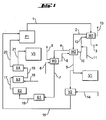
- FIG. 1 The flow chart for the gaseous ethylene recycling of the process according to the invention is in FIG. 1 played.
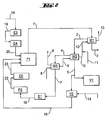
- the flow chart for the liquid ethylene recycling of the process according to the invention is in FIG. 2 played.
- the polymerization [P1] can be carried out continuously or discontinuously.
- the residual gas [1] is fed to the fractionated cryogenic condensation.
- the resulting residual gas stream [1] is fed into the first condensation stage [W1], the residual gas formed here [2] and condensate [3] leave the 1st stage [W1] at a temperature of at least 1 ° C.
- the residual gas [2] is sent to the second condensation stage [W2].
- the residual gas formed here [4] and condensate [5] leave the second stage [W2] at a temperature of -90 to -60 ° C.
- the residual gas [4] is passed to the third stage [W3] and the residual gas formed here [6] and condensate [7] leave the third stage [W3] at a temperature of -140 to -100 ° C.
- the third condensation stage [W3] is treated with liquid nitrogen [8] in countercurrent to the residual gas [4].
- the nitrogen evaporates completely and is switched to heat removal in the second stage [W2] as gaseous nitrogen [9] in countercurrent to the residual gas [2]. After the second stage [W2], the gaseous nitrogen has further heated [10].
- liquid nitrogen [11] is added to the nitrogen stream [10]. Thereafter, the thus cooled gaseous nitrogen stream [12] in the first capacitor [W1] in countercurrent to the residual gas [1] is switched. After leaving [W1], the heated nitrogen stream [13] can be used for other purposes.
- the condensate [5] containing vinyl acetate as its main component can either be directly fed to a distillation in a vinyl acetate monomer unit [V1] or it is transferred to a vinyl acetate tank [V2]. [V2] has also via a feed stream for fresh vinyl acetate [14]. From [V2] the feed of vinyl acetate [15] into the polymerization [P1] takes place.
- the condensate [7] contains as its main component ethylene which is conveyed by means of an ethylene pump [E1].
- the further flow of the condensate [7] depends on whether the subsequent recovery should take place in the liquid or gaseous state.
- the gaseous ethylene recycling is in FIG. 1 shown.
- the ethylene pump [E1] pumps the liquid ethylene [16] to an ethylene evaporator [E2].
- the resulting gaseous ethylene [17] is stored in an ethylene gas buffer [E3], which can also be fed with fresh ethylene [18].
- the gaseous ethylene [19] passes into an ethylene compressor [E4] which supplies the compressed ethylene [20] to the polymerization [P1].
- Another possibility is to supply compressed ethylene [21] to the reaction cycle of a vinyl acetate monomer unit [V3].
- the liquid ethylene recycling is in FIG. 2 shown.
- the ethylene pump [E1] pumps the liquid ethylene [16] to a liquid-ethylene reservoir [E5].
- Liquid ethylene [22] can then be fed to the polymerization [P1] via an ethylene high-pressure pump [E6] via an additional feed line [23].
- the supply of fresh ethylene [18] via an ethylene gas buffer [E3].
- the gaseous ethylene [19] passes into an ethylene compressor [E4] which supplies the compressed ethylene [20] to the polymerization [P1].
- the inventive method is to be operated so that in the fractionated cryogenic condensation according to the Flow diagrams in the FIGS. 1 and 2 in the first stage [W1] the main part of the water is condensed out.
- the lowest residual gas temperature [2] in this stage must not fall below + 1 ° C.
- the condenser is designed so that at least 90% of the water in liquid form is discharged as condensate [3].
- the lowest temperature is between -90 and -60 ° C, depending on the concentration of ethyl acetate in the residual gas stream [2].
- the condenser is designed so that over 99% of the vinyl acetate and the other hydrocarbons listed in Table 1, except for ethylene, are removed in liquid form as condensate [5].
- gaseous ethylene recycling is in a third condensation stage [W3], in which, depending on the pressure, temperatures between -140 to -100 ° C are reached, the ethylene separated from the nitrogen by condensation and by evaporation at pressures of 1 to 120 bar provided in absolute gaseous form [17].
- the temperatures in a third condensation stage [W3] are preferably between -140 to -120 ° C.
- gaseous ethylene recovery is dispensed with a third condensation stage [W3], if the proportion of nitrogen in the ethylene fraction, ie in the residual gas [4] of the second stage [W2] is not relevant for further use.
- the second stage [W2] condensate [5] consists of at least 95% by weight vinyl acetate and contains traces of water, acetaldehyde, methanol, methyl and ethyl acetate. This substance mixture can either be used in dispersion polymerization [P1] or incorporated into the distillative workup of a vinyl acetate monomer system [V1].
- the condensate [7] of the third stage [W3] contains at least 98% by mass of ethylene. It can either be used in dispersion polymerization [P1] or incorporated into the reaction cycle of, for example, a vinyl acetate monomer unit [V3].
- the residual gas [4] of the second stage [W2] contains at least 95% by mass of ethylene. It can likewise be used either in dispersion polymerization [P1] or incorporated into the reaction cycle of, for example, a vinyl acetate monomer system [V3]. Wherein, in this embodiment of gaseous ethylene recovery, the third stage [W3] would be omitted.
- heat exchangers preferably shell-and-tube heat exchangers.
- narrow gaps and dead zones in all areas through which the residual gas and the condensates flow must be avoided constructively.
- the individual condensation stages are each equipped with a replacement condensation stage which has corresponding switchover possibilities between the condensation stage and the replacement condensation stage.
- only the second stage [W2] receives a corresponding replacement condensation stage. Maintenance of the condensation stages is thus also possible without problems even during continuous operation.
- FIG. 1 is the flow chart of the three-stage low-temperature condensation of the residual gas of a vinyl ester-ethylene copolymerization. It comprises the following apparatus structures [W1] to [W3] and the streams [1] to [12].
- the residual gas temperature is 40 ° C.
- residual gas [2] and condensate [3] leave the 1st stage [W1] at a temperature of 5 ° C.
- the residual gas [2] is thereby depleted in 87% of water, 42% of methanol and 3.4% of acetaldehyde.
- the condensate [3] consists of 97% by weight of water, 1.7% by weight of vinyl acetate, 0.8% by weight of methanol and 0.1% by weight of acetaldehyde.
- the second condensation stage [W2] approx. 5.8 kW of heat are removed, residual gas [4] and condensate [5] leave the stage at a temperature of -70 ° C.
- the residual gas [4] is depleted in 99.8% of vinyl acetate, 99% of acetaldehyde, 100% of water and methanol and 5.5% of ethane.
- the condensate [5] of the second stage consists of 2.4% by weight of water, 97% by weight of vinyl acetate, 0.2% by weight of methanol and 0.4% by weight of acetaldehyde.
- the third stage [W3] is operated at -140 ° C; By deduction of 9.7 kW of heat about 55 kg / h of ethylene (> 99.6% of ethylene in the raw gas). Residual gas [6] and condensate [7] leave the stage at a temperature of -140 ° C.
- the condensate [7] consists of 98% by weight of ethylene, 1.5 to 2% by weight of ethane and traces of vinyl acetate and acetaldehyde.
- the residual gas [6] contains the inert gas N 2 .
- the third condensation stage [W3] in countercurrent to the residual gas [4] with about 150 kg / h of liquid nitrogen [8] at 6.5 bar-absolute and -175 ° C is applied.
- the nitrogen evaporates completely and leaves this stage at -118 ° C [9].
- the gaseous nitrogen [9] is switched in countercurrent to the residual gas [2].
- the gaseous nitrogen has further heated to + 13 ° C [10].
Landscapes
- Chemical & Material Sciences (AREA)
- Health & Medical Sciences (AREA)
- Chemical Kinetics & Catalysis (AREA)
- Medicinal Chemistry (AREA)
- Polymers & Plastics (AREA)
- Organic Chemistry (AREA)
- Dispersion Chemistry (AREA)
- Addition Polymer Or Copolymer, Post-Treatments, Or Chemical Modifications (AREA)
- Polymerisation Methods In General (AREA)
- Organic Low-Molecular-Weight Compounds And Preparation Thereof (AREA)
- Graft Or Block Polymers (AREA)
- Processes Of Treating Macromolecular Substances (AREA)
Description
- Die Erfindung betrifft ein Verfahren zur Rückgewinnung von nicht umgesetzten Monomeren, die im Restgasstrom der Vinylester-Ethylen-Mischpolymerisatherstellung anfallen.
- Polymerisate auf Basis von Vinylester und Ethylen werden häufig als wässrige Dispersionen oder in Wasser redispergierbaren Polymerpulver in vielerlei Anwendungen, beispielsweise als Beschichtungsmittel oder Klebemittel für die unterschiedlichsten Substrate eingesetzt.
- Bei der großtechnischen Polymerisation sind hohe Umsatzgrade Stand der Technik. So werden die Polymerisate üblicherweise bis zu einem Restmonomergehalt von weniger als 0,1 Gew.-%, bevorzugt sogar weniger als 0,05 Gew.-%, und im Falle von Vinylchlorid von weniger als 0,01 Gew.-% auspolymerisiert. Diese hohen Umsätze beziehen sich aber lediglich auf die unter Polymerisationsbedingungen flüssigen Monomere. Ethylen als unter Polymerisationsbedingungen gasförmiges Monomer folgt diesen Gesetzmäßigkeiten nicht. Zum einen polymerisiert es langsamer als beispielsweise Vinylacetat, zum anderen hält es sich zu einem großen Bruchteil in der Gasphase auf und kann unter den üblichen Bedingungen der Emulsionspolymerisation nicht erfasst werden.
- Die großtechnische Polymerisation soll unter wirtschaftlichen Gesichtspunkten in möglichst kurzen Zeiträumen beendet sein, was aber zwangsläufig dazu führt, dass das eingesetzte Ethylen nicht vollständig verbraucht werden kann. Üblicherweise wird die Polymerisation bei einem Ethylen-Restgasgehalt von weniger als 5 Gew.-%, bevorzugt weniger als 2 Gew.-%, abgebrochen und der Reaktionsansatz entspannt. Der Entspannungsvorgang beinhaltet die Überführung des Reaktionsgemisches aus Polymerdispersion und Restgas von einem Druckreaktor in einem drucklosen Reaktor, dem so genannten Entspannungskessel unter Abtrennung des restlichen Ethylens. Das dabei anfallende Restgas enthält hauptsächlich Ethylen, Vinylacetat, Stickstoff und Wasserdampf.
- Eine gängige Methode aus dem Stand der Technik ist die energetische Verwertung des anfallenden Restgases durch Verbrennung. Im Hinblick auf steigende Rohstoffkosten zeigt die stoffliche Rückgewinnung der Einzelkomponenten und Monomeren in wirtschaftlicher Hinsicht wesentliche Vorteile.
- Aus dem Stand der Technik sind verschiedene Verfahren zur Restethylenrückgewinnung bekannt. Die Patentschrift
WO 01/00559 A1 - Die Restmonomerentfernung bei der Gasphasenpolymerisation, der Copolymere Ethylen mit höheren Olefinen, ist Gegenstand der Patentschrift
EP 0 127 253 A1 . Dazu wird das feste Copolymer bei reduziertem Druck von den höheren Olefinen befreit, und anschließend mit Inertgas-freiem Reaktorgas behandelt, welches schließlich in die Polymerisation zurückgeführt wird. - In der Patentschrift
EP 1 420 034 A1 offenbart ein Herstellungsverfahren zur Mischpolymersiationvon Vinylester und Ethylen mittels radikalischer Polymerisation wobei das Ethylenhaltige Restgas nach Verdichtung wieder in Vinylester aufgenommen und das so erhaltene Gemisch erneut der Polymersiation zugeführt wird. - Alle die bisher bekannten Methoden aus dem Stand der Technik haben den Nachteil, dass sie das anfallende Restgas nicht optimal verwerten.
- Aufgabe der vorliegenden Erfindung war es daher, ein Verfahren bereitzustellen, das es ermöglicht, aus dem anfallenden Restgas die Wertstoffe zu trennen, um sie einer wirtschaftlichen Verwertung zuführen zu können.
- Diese Aufgabe wurde durch das erfindungsgemäße Verfahren gelöst, welches das Restgas durch eine fraktionierte Kondensation aufarbeitet und so die enthaltenen Rohstoffe einer weiteren stofflichen Verwertung zugänglich macht.
- Gegenstand der Erfindung ist ein Verfahren zur Herstellung von Vinylester und Ethylen oder ethylenisch ungesättigten Monomeren enthaltenden Mischpolymerisaten durch wässrige, radikalische Polymerisation, bei einem Druck von 5 bis 100 bar absolut, nach dem Emulsions- oder Suspensionspolymerisationsverfahren, dadurch gekennzeichnet, dass nach Abschluss der Polymerisation das Reaktionsgemisch auf einen Druck von 0,1 bis 5 bar absolut entspannt wird, und die Rückgewinnung der nicht umgesetzten Monomeren durch mehrstufige fraktionierte Tiefkaltkondensation aus dem Restgas erfolgt.
- Für die Polymerisation werden bevorzugt Gemische eingesetzt aus vinylacetat und Ethylen, sowie Gemische aus Vinylacetat und weiteren Vinylestern wie Vinyllaurat oder Vinylestern von α-verzweigten Monocarbonsäuren mit 9 bis 13 C-Atomen und Ethylen.
- Das Polymerisationsverfahren kann sowohl vollkontinuierlich als auch diskontinuierlich betrieben werden.
- Die Polymerisation wird bevorzugt bei einem Umsatz von mindestens 95 bis 99 Gew.-% der unter Polymerisationsbedingungen flüssigen Monomere, abgeschlossen.
- Bei einer bevorzugten Ausführungsform des Verfahrens ist die mehrstufige Kondensationsanlage auf der Saugseite der Vakuumpumpe angeordnet, mit der der Unterdruck im Entspannungskessel hervorgerufen wird. Der Vorteil dieser Anordnung liegt darin, dass keine durch Polymerisation und Nebenproduktbildung in der Vakuumpumpe entstehenden Komponenten die Zusammensetzung des Restgases verändern können. Dadurch wird die Wiederverwertung der ursprünglichen Stoffe wie Ethylen und Vinylacetat insbesondere bei der Polymerisation nicht gefährdet.
- Bei einer weiteren bevorzugten Ausführungsform des Verfahrens ist die mehrstufige Kondensationsanlage auf der Druckseite eines Verdichters angeordnet. Mit Hilfe von verdichtetem Ethylen, aus dem Gasstrahlverdichter, kann das Restgas aus dem Entspannungskessel abgesaugt werden. Dadurch werden die oben genannten Nachteile einer Vakuumpumpe, beispielsweise der Flüssigkeitsringpumpe, vermieden.
- Als Kältemedium wird bevorzugt flüssiger Stickstoff oder verflüssigte Luft mit einer Einsatztemperatur von -180 bis -170°C bei entsprechenden Siededrücken von 5 bis 10 bar-absolut eingesetzt. Der Stickstoff verlässt die Anlage gasförmig bei Raumtemperatur und kann in der Dispersionsanläge zu Inertisierungszwecken verwendet oder in ein vorhandenes Werksnetz eingebunden werden.
- Bei dem erfindungsgemäßen Verfahren handelt es sich um eine fraktionierende Kondensation des Restgases, bei der die unterschiedlichen Siede- und Gefrierpunkte der Hauptkomponenten beispielsweise Ethylen, Vinylacetat, Wasser und Stickstoff die Grundlage der Stofftrennung darstellen. Die Tabelle 1 zeigt die Siede- und Gefrierpunkte einiger wichtiger Hauptkomponenten, die im Restgas enthalten sein können.
Tabelle 1 Komponente Siedepunkt [°C] Gefrierpunkt [°C] Wasser 100 0 Vinylacetat 73 -93 Ethylen -103 -169 Ethylacetat 77 -84 Methanol 65 -97 Methylacetat 57 -98 Acetaldehyd 20 -123 - Die Kondensation der Einzelkomponenten aus dem Restgasstrom erfolgt im Produktionsmaßstab des erfindungsgemäßen Verfahrens durch eine Kaskadenschaltung von mindestens zwei, bevorzugt drei, Kondensationsstufen. Dabei werden die Temperaturen so eingestellt, dass die Unterschreitung der Gefrierpunkte der in der jeweiligen Stufe auszukondensierenden Komponente, vermieden wird.
- Das erfindungsgemäße Verfahren ist dadurch gekennzeichnet, dass der Wasserdampf in der ersten Kondensationsstufe bei Temperaturen von mindestens 1°C, bevorzugt 1 bis 5°C, auskondensiert wird.
- Weiterhin ist das erfindungsgemäße Verfahren dadurch gekennzeichnet, dass in der zweiten Kondensationsstufe Vinylacetat bei Temperaturen von -90 bis -60°C auskondensiert wird. Das so erhaltene flüssige Vinylacetat wird wieder in die Polymerisation zurückgeführt oder in einer Vinylacetatmonomer-Produktionsanlage in das Destillationssystem eingespeist.
- Zudem ist das erfindungsgemäße Verfahren dadurch gekennzeichnet, dass in der dritten Kondensationsstufe Ethylen bei Temperaturen von -140 bis -100°C auskondensiert wird. Das so erhaltene flüssige Ethylen wird anschließend wieder in die Polymerisation eingespeist.
- Eine weitere Ausführungsform des Verfahrens ist dadurch gekennzeichnet, dass das in flüssiger Form erhaltene Ethylen unter einem Druck von 1 bis 20 bar absolut verdampft und anschließend wieder in die Polymerisationsreaktion verdichtet oder in einer Vinylacetatmonomer-Produktionsanlage als Rohstoff in den Reaktionskreislauf eingespeist wird.
- Das aufzuarbeitende Restgas setzt sich in Abhängigkeit vom Druck und der Temperatur der jeweiligen Polymerisation wie folgt zusammen: 1 bis 15 Vol% Wasser, 5 bis 20 Vol% Vinylacetat und 60 bis 90 Vol% Ethylen. Als weitere Komponenten sind Stickstoff und in Spuren Acetaldehyd, Methanol, Methyl- und Ethylacetat enthalten. Der Betriebsdruck, der bei der Entspannung der Dispersion herrscht, liegt bei 100 bis 5000 mbar absolut. Die Temperatur liegt zwischen 25 und 75°C.
- Nachfolgend wird das erfindungsgemäße Verfahren nochmals anhand von den beiden Fließschemen aus
Figur 1 und2 detaillierter beschrieben. - Das Fließschema für die gasförmige Ethylenrückführung des erfindungsgemäßen Verfahren ist in
Figur 1 wiedergegeben. Das Fließschema für die Flüssig-Ethylenrückführung des erfindungsgemäßen Verfahrens ist inFigur 2 wiedergegeben. - Die folgende Beschreibung gilt sowohl für
Figur 1 als auch fürFigur 2 . Die Polymerisation [P1] kann kontinuierlich als auch diskontinuierlich erfolgen. Nach der anschließenden Entspannung des Reaktionsgemisches wird das Restgas [1] der fraktionierten Tiefkaltkondensation zugeführt. Der resultierende Restgasstrom [1] wird in die erste Kondensationsstufe [W1] geführt, das hier gebildete Restgas [2] und Kondensat [3] verlassen die 1. Stufe [W1] bei einer Temperatur von mindestens 1°C. Das Restgas [2] wird in die zweite Kondensationsstufe [W2] geleitet. Wobei das hier gebildete Restgas [4] und Kondensat [5] die zweite Stufe [W2] bei einer Temperatur von -90 bis -60°C verlassen. Das Restgas [4] wird in die dritte Stufe [W3] geleitet und das hier gebildete Restgas [6] und Kondensat [7] verlassen die dritte Stufe [W3] bei einer Temperatur von -140 bis -100°C. Um die notwendigen Wärmemengen in den jeweiligen Kondensationsstufen abführen zu können, wird unter Verwendung von Flüssigstickstoff gekühlt. Für die Wärmeabfuhr wird die dritte Kondensationsstufe [W3] im Gegenstrom zum Restgas [4] mit Flüssigstickstoff [8] beaufschlagt. Der Stickstoff verdampft dabei vollständig und wird für die Wärmeabfuhr in der 2. Stufe [W2] als gasförmiger Stickstoff [9] im Gegenstrom zum Restgas [2] geschaltet. Nach der 2. Stufe [W2] hat sich der gasförmige Stickstoff weiter erwärmt [10]. Um in der ersten Stufe [W1] genügend Wärme abführen zu können, wird dem Stickstoffstrom [10] nochmals Flüssigstickstoff [11] zugemischt. Danach wird der so abgekühlte gasförmige Stickstoffstrom [12] im ersten Kondensator [W1] im Gegenstrom zum Restgas [1] geschaltet. Nach Verlassen von [W1] kann der erwärmte Stickstoffstrom [13] weiteren Verwendungen zugeführt werden. Das Kondensat [5] welches als Hauptbestandteil Vinylacetat enthält, kann entweder direkt einer Destillation in einer Vinylacetatmonomeranlage [V1] zugeführt werden oder es wird in einen Vinylacetat-Tank [V2] überführt. [V2] verfügt zudem über einen Zulaufstrom für frisches Vinylacetat [14]. Aus [V2] erfolgt dann die Einspeisung von Vinylacetat [15] in die Polymerisation [P1]. Das Kondensat [7] enthält als Hauptbestandteil Ethylen welches mittels einer Ethylenpumpe [E1] gefördert wird. - Der weitere Fluss des Kondensates [7] hängt davon ab, ob die anschließende Verwertung im flüssigen oder gasförmigen Zustand erfolgen soll.
- Die gasförmige Ethylenrückführung ist in
Figur 1 dargestellt. Die Ethylenpumpe [E1] pumpt das flüssige Ethylen [16] zu einem Ethylenverdampfer [E2]. Das daraus erhaltene gasförmige Ethylen [17] wird in einem Ethylengaspuffer [E3], der zusätzlich auch mit frischem Ethylen [18] gespeist werden kann, zwischengelagert. Von dort aus gelangt das gasförmige Ethylen [19] in einen Ethylenverdichter [E4] welcher das verdichtete Ethylen [20] der Polymerisation [P1] zuführt. Eine weitere Möglichkeit besteht darin verdichtetes Ethylen [21] dem Reaktionskreislauf einer Vinylacetat-Monomeranlage [V3] zuzuführen. - Die Flüssig-Ethylenrückführung ist in
Figur 2 dargestellt. Die Ethylenpumpe [E1] pumpt das flüssige Ethylen [16] zu einem Flüssigethylenspeicher [E5]. Flüssiges Ethylen [22] kann dann mittels einer Ethylenhochdruckpumpe [E6] über eine zusätzliche Zuleitung [23] der Polymerisation [P1] zugeführt werden. Die Zufuhr von frischem Ethylen [18] erfolgt über einen Ethylengaspuffer [E3]. Von dort aus gelangt das gasförmige Ethylen [19] in einen Ethylenverdichter [E4] welcher das verdichtete Ethylen [20] der Polymerisation [P1] zuführt. Das erfindungsgemäße Verfahren ist so zu betreiben, dass bei der fraktionierten Tiefkaltkondensation entsprechend den Fließschemen in denFiguren 1 und2 in der ersten Stufe [W1] der Hauptanteil des Wassers auskondensiert wird. Um Vereisung des Wärmetauschers zu vermeiden, darf die niedrigste Restgastemperatur [2] in dieser Stufe +1°C nicht unterschreiten. Der Kondensator wird so ausgelegt, dass mindestens 90% des Wassers in flüssiger Form als Kondensat [3] abgeführt werden. - In der zweiten Stufe [W2] liegt die niedrigste Temperatur zwischen -90 bis -60°C, in Abhängigkeit von der Ethylacetatkonzentration im Restgasstrom [2]. Der Kondensator wird so ausgelegt, dass über 99% des Vinylacetats und der übrigen in der Tabelle 1 genannten Kohlenwasserstoffe mit Ausnahme von Ethylen in flüssiger Form als Kondensat [5] abgeführt werden.
- In Abhängigkeit von den Anforderungen an die stoffliche Wiederverwertung des Ethylens ergeben sich nach Abtrennung von Wasser, Vinylacetat und der in der Tabelle 1 genannten Kohlenwasserstoffe folgende Varianten für die Verwendung einer dritten Kondensationsstufe [W3] im erfindungsgemäßen Verfahren.
- Bei der Ausführungsform der gasförmigen Ethylenrückführung wird in einer dritten Kondensationsstufe [W3], bei der, abhängig vom Druck, Temperaturen zwischen -140 bis -100°C erreicht werden, das Ethylen vom Stickstoff durch Auskondensation getrennt und durch Verdampfen bei Drücken von 1 bis 120 bar absolut in gasförmiger Form [17] bereitgestellt.
- Bei der Ausführungsform der Flüssig-Ethylenrückführung wird in einer dritten Kondensationsstufe [W3], bei der, abhängig vom Druck, Temperaturen zwischen -140 bis -100°C erreicht werden, das Ethylen vom Stickstoff durch Auskondensation getrennt und in flüssiger Form (tiefkalt) [22] bereitgestellt.
- Bevorzugt liegen die Temperaturen in einer dritten Kondensationsstufe [W3] zwischen -140 bis -120°C.
- Bei einer weiteren Ausführungsform der gasförmigen Ethylenrückgewinnung wird auf eine dritte Kondensationsstufe [W3] verzichtet, wenn der Anteil des Stickstoffs in der Ethylenfraktion, also im Restgas [4] der zweiten Stufe [W2] für den weiteren Einsatz nicht relevant ist.
- Es bestehen folgende stoffliche Verwertungsmöglichkeiten der einzelnen Fraktionen, aus dem erfindungsgemäßen Verfahren.
- Das Kondensat [5] der zweiten Stufe [W2] besteht aus mindestens 95 Massen% Vinylacetat und enthält Spuren von Wasser, Acetaldehyd, Methanol, Methyl- und Ethylacetat. Dieses Stoffgemisch kann entweder in der Dispersionspolymerisation [P1] eingesetzt oder in die destillative Aufarbeitung einer Vinylacetat-Monomer-Anlage [V1] eingebunden werden.
- Das Kondensat [7] der dritten Stufe [W3] enthält mindestens 98 Massen% Ethylen. Es kann entweder in der Dispersionspolymerisation [P1] eingesetzt oder in den Reaktionskreislauf beispielsweise einer Vinylacetat-Monomer-Anlage [V3] eingebunden werden.
- Das Restgas [4] der zweiten Stufe [W2] enthält mindestens 95 Massen% Ethylen. Es kann ebenfalls entweder in der Dispersionspolymerisation [P1] eingesetzt oder in den Reaktionskreislauf beispielsweise einer Vinylacetat-Monomer-Anlage [V3] eingebunden werden. Wobei, bei dieser Ausführungsform der gasförmigen Ethylenrückgewinnung, die dritte Stufe [W3] entfallen würde.
- Für die erfindungsgemäße fraktionierte Tiefkaltkondensation werden Wärmetauscher, bevorzugt Rohrbündelwärmetauscher, verwendet. Um Verstopfung der Wärmetauscher und Rohrleitungen zu verhindern, sind enge Spalten und tote Zonen in allen Bereichen, die durch das Restgas und durch die Kondensate durchströmt werden, konstruktiv zu vermeiden.
- Um einen Dauerbetrieb der mehrstufigen Tieftemperaturkondensationsanlage sicherzustellen, werden die einzelnen Kondensationsstufen in einer bevorzugten Ausführungsform mit jeweils einer Ersatzkondensationsstufe ausgestattet, die über entsprechende Umschaltmöglichkeiten zwischen Kondensationsstufe und Ersatzkondensationsstufe verfügen. In einer besonders bevorzugten Ausführungsform erhält lediglich die zweite Stufe [W2] eine entsprechende Ersatzkondensationsstufe. Damit sind Wartungsarbeiten der Kondensationsstufen problemlos auch während des Dauerbetriebs möglich.
- Das nachstehende erfindungsgemäße Beispiel entspricht dem Teil der
Figur 1 , welche das Fließbild der dreistufigen Tieftemperaturkondensation vom Restgas einer Vinylester-Ethylen-Mischpolymerisation darstellt. Es umfasst dabei folgende Apparaturaufbauten [W1] bis [W3] und die Ströme [1] bis [12]. - Der Restgasstrom [1] mit 60 Nm3/h (88 kg/h), enthaltend 75 mol% Ethylen, 11 mol% Vinylacetat, 10 mol% Wasser, 1,5 mol% Ethan, jeweils 0,1 mol% Acetaldehyd und Methanol (Rest N2), wird in einer dreistufigen Tieftemperaturkondensation behandelt. Bei einem absoluten Druck von 600 mbar beträgt die Restgastemperatur 40°C.
- Durch Einleiten des Restgasstroms [1] werden in der ersten Kondensationsstufe [W1] ca. 4 kW Wärme abgeführt, Restgas [2] und Kondensat [3] verlassen die 1. Stufe [W1] bei einer Temperatur von 5°C. Das Restgas [2] wird dabei zu 87% an Wasser, 42% an Methanol und 3,4% an Acetaldehyd abgereichert. Das Kondensat [3] besteht aus 97 Gew% Wasser, 1,7 Gew% Vinylacetat, 0,8 Gew% Methanol und 0,1 Gew% Acetaldehyd.
- In der zweiten Kondensationsstufe [W2] werden ca. 5,8 kW Wärme abgeführt, Restgas [4] und Kondensat [5] verlassen die Stufe bei einer Temperatur von -70°C. Das Restgas [4] ist zu 99,8% an Vinylacetat, 99% an Acetaldehyd, 100% an Wasser und Methanol sowie 5,5% an Ethan abgereichert. Das Kondensat [5] der zweiten Stufe besteht aus 2,4 Gew% Wasser, 97 Gew% Vinylacetat, 0,2 Gew% Methanol und 0,4 Gew% Acetaldehyd.
- Die dritte Stufe [W3] wird bei -140°C betrieben; durch Abzug von 9,7 kW Wärme entstehen ca. 55 kg/h Ethylen (>99,6% des Ethylens im Rohgas). Restgas [6] und Kondensat [7] verlassen die Stufe bei einer Temperatur von -140°C. Das Kondensat [7] besteht aus 98 Gew% Ethylen, 1,5 bis 2 Gew% Ethan und in Spuren Vinylacetat und Acetaldehyd. Das Restgas [6] enthält das Inertgas N2.
- Um die oben angegebenen Wärmemengen in den jeweiligen Kondensationsstufen abführen zu können, wird unter Verwendung von Flüssigstickstoff gekühlt.
Für die Wärmeabfuhr wird die dritte Kondensationsstufe [W3] im Gegenstrom zum Restgas [4] mit ca. 150 kg/h Flüssigstickstoff [8] bei 6,5 bar-absolut und -175°C beaufschlagt. Der Stickstoff verdampft dabei vollständig und verlässt mit -118°C [9] diese Stufe. Für die Wärmeabfuhr in der 2. Stufe [W2] wird der gasförmige Stickstoff [9] im Gegenstrom zum Restgas [2] geschaltet. Nach der 2. Stufe [W2] hat sich der gasförmige Stickstoff weiter auf +13°C [10] erwärmt. Um in der ersten Stufe [W1] 4 kW Wärme abführen zu können, werden diesem Stickstoffstrom [10] weitere ca. 30 kg/h Flüssigstickstoff [11] zugemischt. Damit erreicht der Stickstoffstrom [12] am Eintritt in den ersten Kondensator [W1] ca. -46°C und verlässt ihn mit 30°C [13].
Claims (9)
- Verfahren zur Herstellung von Vinylester und Ethylen oder ethylenisch ungesättigten Monomeren enthaltenden Mischpolymerisaten durch wässrige, radikalische Polymerisation, bei einem Druck von 5 bis 100 bar absolut, nach dem Emulsions- oder Suspensionspolymerisationsverfahren, dadurch gekennzeichnet, dass nach Abschluss der Polymerisation das Reaktionsgemisch auf einen Druck von 0,1 bis 5 bar absolut entspannt wird, und die Rückgewinnung der nicht umgesetzten Monomeren durch mehrstufige fraktionierte Tiefkaltkondensation aus dem Restgas erfolgt, mit der Maßgabe, dass Wasserdampf in der ersten Kondensationsstufe bei Temperaturen von 1 bis 5°C auskondensiert wird und dass in der zweiten Kondensationsstufe Vinylacetat bei Temperaturen von -90 bis -60°C auskondensiert wird und dass in der dritten Kondensationsstufe Ethylen bei Temperaturen von -140 bis - 100°C auskondensiert wird.
- Verfahren gemäß Anspruch 1, dadurch gekennzeichnet, dass das in flüssiger Form erhaltene Ethylen unter einem Druck von 1 bis 20 bar-absolut verdampft und anschließend wieder in die Polymerisationsreaktion verdichtet oder in einer Vinylacetatmonomer-Produktionsanlage als Rohstoff in den Reaktionskreislauf eingespeist wird.
- Verfahren gemäß Anspruch 1, dadurch gekennzeichnet, dass das in flüssiger Form erhaltene Ethylen wieder in die Polymerisation eingespeist wird.
- Verfahren gemäß Anspruch 1, 2 oder 3, dadurch gekennzeichnet, dass das in flüssiger Form erhaltene Vinylacetat wieder in die Polymerisation zurückgeführt oder in einer Vinylacetatmonomer-Produktionsanlage in das Destillationssystem eingespeist wird.
- Verfahren gemäß einem der Ansprüche 1 bis 4, dadurch gekennzeichnet, dass die mehrstufige Kondensation auf der Saugseite der Vakuumpumpe angeordnet wird.
- Verfahren gemäß einem der Ansprüche 1 bis 5, dadurch gekennzeichnet, dass die mehrstufige Kondensation auf der Druckseite eines Verdichters angeordnet wird.
- Verfahren gemäß einem der Ansprüche 1 bis 6, dadurch gekenntzeichnet, dass das Polymerisationsverfahren vollkontinuierlich oder diskontinuierlich betrieben wird.
- Verfahren gemäß einem der Ansprüche 1 bis 7, dadurch gekennzeichnet, dass die Polymerisation bei einem Umsatz von 95 bis 99 Cew.-% der unter Polymerisationsbedingungen flüssigen Monomere, abgeschlossen wird.
- Verfahren gemäß einem der Ansprüche 1 bis 8, dadurch gekennzeichnet, dass zur Polymerisation Gemische eingesetzt werden aus Vinylacetat und Ethylen, sowie Gemische aus Vinylacetat und weiteren Vinylestern wie Vinyllaurat oder Vinylestern von α-verzweigten Monocarbonsäuren mit 9 bis 13 C-Atomen und Ethylen.
Applications Claiming Priority (2)
| Application Number | Priority Date | Filing Date | Title |
|---|---|---|---|
| DE102005061576A DE102005061576A1 (de) | 2005-12-22 | 2005-12-22 | Rückgewinnung von Ethylen und Vinylacetat aus dem Restgasstrom der Vinylester-Ethylen-Mischpolymerisatherstellung |
| PCT/EP2006/069717 WO2007074075A1 (de) | 2005-12-22 | 2006-12-14 | Rückgewinnung von ethylen und vinylacetat aus dem restgasstrom der vinylester-ethylen-mischpolymerisatherstellung |
Publications (2)
| Publication Number | Publication Date |
|---|---|
| EP1963375A1 EP1963375A1 (de) | 2008-09-03 |
| EP1963375B1 true EP1963375B1 (de) | 2009-07-08 |
Family
ID=37772746
Family Applications (1)
| Application Number | Title | Priority Date | Filing Date |
|---|---|---|---|
| EP06841362A Not-in-force EP1963375B1 (de) | 2005-12-22 | 2006-12-14 | Rückgewinnung von ethylen und vinylacetat aus dem restgasstrom der vinylester-ethylen-mischpolymerisatherstellung |
Country Status (12)
| Country | Link |
|---|---|
| US (1) | US7582724B2 (de) |
| EP (1) | EP1963375B1 (de) |
| JP (1) | JP4928560B2 (de) |
| KR (1) | KR101005817B1 (de) |
| CN (1) | CN101346401B (de) |
| AT (1) | ATE435875T1 (de) |
| BR (1) | BRPI0620454A2 (de) |
| DE (2) | DE102005061576A1 (de) |
| ES (1) | ES2327454T3 (de) |
| RU (1) | RU2415153C2 (de) |
| TW (1) | TWI334423B (de) |
| WO (1) | WO2007074075A1 (de) |
Families Citing this family (13)
| Publication number | Priority date | Publication date | Assignee | Title |
|---|---|---|---|---|
| DE102011077010A1 (de) | 2011-06-06 | 2012-12-06 | Wacker Chemie Ag | Verfahren zur Aufbereitung von Abwässern und Abgaskondensaten aus der Polymerisation von Vinylacetat und Ethylen in wässrigem Medium |
| EP2746305A1 (de) * | 2012-12-20 | 2014-06-25 | Basell Polyolefine GmbH | Verfahren zur Copolymerisierung von Ethylen und Estern von Vinylalkohol |
| KR102007502B1 (ko) * | 2016-09-19 | 2019-08-05 | 주식회사 엘지화학 | 에틸렌 및 비닐계 공단량체의 회수 방법 |
| JP6948488B2 (ja) * | 2019-02-26 | 2021-10-13 | 株式会社Moresco | エチレン酢酸ビニル系ホットメルト接着剤の製造方法及びホットメルト接着剤 |
| US12221500B2 (en) | 2019-05-29 | 2025-02-11 | Basell Polyolefine Gmbh | Suspension process for preparing ethylene polymers comprising drying of the polymer particles |
| CN113667045B (zh) * | 2020-05-14 | 2024-01-30 | 中国石油化工股份有限公司 | Evoh生产过程中树脂液脱除醋酸乙烯并回收乙烯的方法和装置 |
| CN112374960A (zh) * | 2020-10-19 | 2021-02-19 | 中国石油化工股份有限公司 | 一种从工业尾气中回收乙烯的系统及其工艺 |
| CN112374988B (zh) * | 2020-10-19 | 2022-12-27 | 中国石油化工股份有限公司 | 一种醋酸乙烯回收处理工艺 |
| CN112239390B (zh) * | 2020-10-19 | 2022-12-27 | 中国石油化工股份有限公司 | 乙烯深冷回收系统 |
| CN112374957B (zh) * | 2020-10-19 | 2022-12-27 | 中国石油化工股份有限公司 | 乙烯循环回收方法 |
| CN112361715B (zh) * | 2020-10-19 | 2022-11-11 | 中国石油化工股份有限公司 | 乙烯深冷回收方法 |
| US20240084059A1 (en) | 2021-08-27 | 2024-03-14 | Wacker Chemie Ag | Method for recovering residual monomers in the preparation of vinyl ester-ethylene copolymers |
| TW202617847A (zh) * | 2024-10-09 | 2026-05-01 | 巴西商布拉斯科股份公司 | 用於獲得經純化分枝乙烯酯流之單體回收系統及方法 |
Family Cites Families (9)
| Publication number | Priority date | Publication date | Assignee | Title |
|---|---|---|---|---|
| US4091200A (en) * | 1977-03-23 | 1978-05-23 | Dart Industries Inc. | Ethylene-vinyl acetate copolymerization process |
| JPS59187009A (ja) * | 1983-04-07 | 1984-10-24 | Sumitomo Chem Co Ltd | エマルジヨンの後処理方法 |
| AU577274B2 (en) * | 1983-04-29 | 1988-09-22 | Mobil Oil Corporation | Process for removal of residual monomers from ethylene co-polymers |
| JPS6053513A (ja) * | 1983-09-01 | 1985-03-27 | Kuraray Co Ltd | エチレン−酢酸ビニル共重合体の連続製造法 |
| US5681908A (en) * | 1995-03-03 | 1997-10-28 | Advanced Extraction Technologies, Inc. | Absorption process for rejection of reactor byproducts and recovery of monomers from waste gas streams in olefin polymerization processes |
| DE19709254A1 (de) * | 1997-03-06 | 1998-09-10 | Wacker Chemie Gmbh | Verfahren zur Herstellung von schutzkolloidfreien Dispersionen und Dispersionspulvern |
| US6410817B1 (en) | 1999-06-29 | 2002-06-25 | Celanese International Corporation | Ethylene recovery system |
| JP4330253B2 (ja) * | 2000-06-29 | 2009-09-16 | 株式会社クラレ | エチレン−酢酸ビニル共重合体およびそのケン化物の製造方法 |
| DE10253043A1 (de) | 2002-11-14 | 2004-06-03 | Wacker Polymer Systems Gmbh & Co. Kg | Verfahren zur Rückgewinnung von Restethylen bei der Herstellung von Vinylester-Ethylen-Mischpolymerisaten |
-
2005
- 2005-12-22 DE DE102005061576A patent/DE102005061576A1/de not_active Withdrawn
-
2006
- 2006-12-14 KR KR1020087017616A patent/KR101005817B1/ko not_active Expired - Fee Related
- 2006-12-14 CN CN2006800489736A patent/CN101346401B/zh not_active Expired - Fee Related
- 2006-12-14 EP EP06841362A patent/EP1963375B1/de not_active Not-in-force
- 2006-12-14 RU RU2008129642/04A patent/RU2415153C2/ru not_active IP Right Cessation
- 2006-12-14 BR BRPI0620454-6A patent/BRPI0620454A2/pt active Search and Examination
- 2006-12-14 US US12/158,468 patent/US7582724B2/en not_active Expired - Fee Related
- 2006-12-14 JP JP2008546393A patent/JP4928560B2/ja not_active Expired - Fee Related
- 2006-12-14 ES ES06841362T patent/ES2327454T3/es active Active
- 2006-12-14 WO PCT/EP2006/069717 patent/WO2007074075A1/de not_active Ceased
- 2006-12-14 AT AT06841362T patent/ATE435875T1/de not_active IP Right Cessation
- 2006-12-14 DE DE502006004208T patent/DE502006004208D1/de active Active
- 2006-12-21 TW TW095148210A patent/TWI334423B/zh not_active IP Right Cessation
Also Published As
| Publication number | Publication date |
|---|---|
| RU2415153C2 (ru) | 2011-03-27 |
| KR20080085882A (ko) | 2008-09-24 |
| WO2007074075A1 (de) | 2007-07-05 |
| ES2327454T3 (es) | 2009-10-29 |
| CN101346401A (zh) | 2009-01-14 |
| DE502006004208D1 (de) | 2009-08-20 |
| CN101346401B (zh) | 2011-10-19 |
| RU2008129642A (ru) | 2010-01-27 |
| US20080269434A1 (en) | 2008-10-30 |
| ATE435875T1 (de) | 2009-07-15 |
| KR101005817B1 (ko) | 2011-01-05 |
| EP1963375A1 (de) | 2008-09-03 |
| TWI334423B (en) | 2010-12-11 |
| TW200728332A (en) | 2007-08-01 |
| BRPI0620454A2 (pt) | 2011-11-08 |
| JP2009520852A (ja) | 2009-05-28 |
| JP4928560B2 (ja) | 2012-05-09 |
| US7582724B2 (en) | 2009-09-01 |
| DE102005061576A1 (de) | 2007-06-28 |
Similar Documents
| Publication | Publication Date | Title |
|---|---|---|
| WO2007074075A1 (de) | Rückgewinnung von ethylen und vinylacetat aus dem restgasstrom der vinylester-ethylen-mischpolymerisatherstellung | |
| DE60118813T2 (de) | Verfahren zur Herstellung einer Zusammensetzung von Olefinpolymeren | |
| WO2012168138A1 (de) | Verfahren zur aufbereitung von abwässern und abgaskondensaten aus der polymerisation von vinylacetat und ethylen in wässrigem medium | |
| EP3277657B1 (de) | Herstellung von tert-butylestern aliphatischer carbonsäuren | |
| EP0341540B1 (de) | Verfahren zur Niederdruckcopolymerisation von Ethylen mit alpha-Olefinen und Ethylencopolymerisate mit niederem Restmonomerengehalt | |
| DE60217874T2 (de) | Verfahren und vorrichtung zur herstellung eines vinylaromatischen polymers | |
| CN1310857C (zh) | 用极性萃取剂通过萃取蒸馏分离丁烯和丁烷的方法 | |
| KR102520447B1 (ko) | 용매 회수 방법 및 용매 회수 장치 | |
| EP4015498B1 (de) | Verfahren zur kontinuierlichen herstellung von acrylsäure-n-butylester | |
| EP3573943B1 (de) | Verfahren zur gewinnung von rein-1,3-butadien | |
| CN115738333B (zh) | 一种丙烯酸精馏分离系统及方法 | |
| EP0003324B2 (de) | Verfahren zur Herstellung von Copolymerisaten des Äthylens | |
| EP4251594B1 (de) | Verfahren zur verhinderung einer dreiphasigkeit bei der abtrennung von butenen aus c4-kohlenwasserstoffströmen | |
| KR20210036151A (ko) | 단량체 회수 방법 및 장치 | |
| DE2854151A1 (de) | Verfahren zur herstellung von copolymerisaten des aethylens | |
| EP4251596B1 (de) | Verfahren zur abtrennung von butenen aus c4-kohlenwasserstoffströmen mit angeschlossener oligomerisierung | |
| EP4527826A1 (de) | Verfahren zur rückgewinnung von konjugiertem monomer auf dienbasis | |
| KR20200090040A (ko) | 미반응 비닐 아세테이트의 회수 방법 | |
| EP4225815A1 (de) | Verfahren zur rückgewinnung von restmonomeren bei der herstellung von vinylester-ethylen-mischpolymerisaten | |
| DE1101764B (de) | Verfahren zur Herstellung isoolefinhaltiger Polymerisate | |
| EP3683201B1 (de) | Verfahren zur herstellung von olefinen aus oxygenaten | |
| EP4563560A1 (de) | Energieeffizientes verfahren zur abtrennung von 1-buten aus einem kohlenwasserstoffstrom mit optimierter brüdenverdichtung | |
| EP4594367A1 (de) | Verfahren zur herstellung eines copolymers ausgehend von mindestens einer aromatischen vinylverbindung | |
| KR20260024361A (ko) | 미반응 단량체의 회수 방법 | |
| EP4633759A1 (de) | Energieeffizientes verfahren zur abtrennung von butenen aus c4-kohlenwasserstoffströmen |
Legal Events
| Date | Code | Title | Description |
|---|---|---|---|
| PUAI | Public reference made under article 153(3) epc to a published international application that has entered the european phase |
Free format text: ORIGINAL CODE: 0009012 |
|
| 17P | Request for examination filed |
Effective date: 20080619 |
|
| AK | Designated contracting states |
Kind code of ref document: A1 Designated state(s): AT BE BG CH CY CZ DE DK EE ES FI FR GB GR HU IE IS IT LI LT LU LV MC NL PL PT RO SE SI SK TR |
|
| GRAP | Despatch of communication of intention to grant a patent |
Free format text: ORIGINAL CODE: EPIDOSNIGR1 |
|
| DAX | Request for extension of the european patent (deleted) | ||
| GRAS | Grant fee paid |
Free format text: ORIGINAL CODE: EPIDOSNIGR3 |
|
| GRAA | (expected) grant |
Free format text: ORIGINAL CODE: 0009210 |
|
| AK | Designated contracting states |
Kind code of ref document: B1 Designated state(s): AT BE BG CH CY CZ DE DK EE ES FI FR GB GR HU IE IS IT LI LT LU LV MC NL PL PT RO SE SI SK TR |
|
| REG | Reference to a national code |
Ref country code: GB Ref legal event code: FG4D Free format text: NOT ENGLISH |
|
| REG | Reference to a national code |
Ref country code: CH Ref legal event code: EP |
|
| REG | Reference to a national code |
Ref country code: IE Ref legal event code: FG4D |
|
| REF | Corresponds to: |
Ref document number: 502006004208 Country of ref document: DE Date of ref document: 20090820 Kind code of ref document: P |
|
| REG | Reference to a national code |
Ref country code: ES Ref legal event code: FG2A Ref document number: 2327454 Country of ref document: ES Kind code of ref document: T3 |
|
| PG25 | Lapsed in a contracting state [announced via postgrant information from national office to epo] |
Ref country code: SI Free format text: LAPSE BECAUSE OF FAILURE TO SUBMIT A TRANSLATION OF THE DESCRIPTION OR TO PAY THE FEE WITHIN THE PRESCRIBED TIME-LIMIT Effective date: 20090708 |
|
| PG25 | Lapsed in a contracting state [announced via postgrant information from national office to epo] |
Ref country code: IS Free format text: LAPSE BECAUSE OF FAILURE TO SUBMIT A TRANSLATION OF THE DESCRIPTION OR TO PAY THE FEE WITHIN THE PRESCRIBED TIME-LIMIT Effective date: 20091108 Ref country code: LT Free format text: LAPSE BECAUSE OF FAILURE TO SUBMIT A TRANSLATION OF THE DESCRIPTION OR TO PAY THE FEE WITHIN THE PRESCRIBED TIME-LIMIT Effective date: 20090708 Ref country code: FI Free format text: LAPSE BECAUSE OF FAILURE TO SUBMIT A TRANSLATION OF THE DESCRIPTION OR TO PAY THE FEE WITHIN THE PRESCRIBED TIME-LIMIT Effective date: 20090708 |
|
| REG | Reference to a national code |
Ref country code: IE Ref legal event code: FD4D |
|
| PG25 | Lapsed in a contracting state [announced via postgrant information from national office to epo] |
Ref country code: PL Free format text: LAPSE BECAUSE OF FAILURE TO SUBMIT A TRANSLATION OF THE DESCRIPTION OR TO PAY THE FEE WITHIN THE PRESCRIBED TIME-LIMIT Effective date: 20090708 Ref country code: LV Free format text: LAPSE BECAUSE OF FAILURE TO SUBMIT A TRANSLATION OF THE DESCRIPTION OR TO PAY THE FEE WITHIN THE PRESCRIBED TIME-LIMIT Effective date: 20090708 |
|
| PG25 | Lapsed in a contracting state [announced via postgrant information from national office to epo] |
Ref country code: BG Free format text: LAPSE BECAUSE OF FAILURE TO SUBMIT A TRANSLATION OF THE DESCRIPTION OR TO PAY THE FEE WITHIN THE PRESCRIBED TIME-LIMIT Effective date: 20091008 Ref country code: PT Free format text: LAPSE BECAUSE OF FAILURE TO SUBMIT A TRANSLATION OF THE DESCRIPTION OR TO PAY THE FEE WITHIN THE PRESCRIBED TIME-LIMIT Effective date: 20091109 |
|
| PG25 | Lapsed in a contracting state [announced via postgrant information from national office to epo] |
Ref country code: DK Free format text: LAPSE BECAUSE OF FAILURE TO SUBMIT A TRANSLATION OF THE DESCRIPTION OR TO PAY THE FEE WITHIN THE PRESCRIBED TIME-LIMIT Effective date: 20090708 Ref country code: EE Free format text: LAPSE BECAUSE OF FAILURE TO SUBMIT A TRANSLATION OF THE DESCRIPTION OR TO PAY THE FEE WITHIN THE PRESCRIBED TIME-LIMIT Effective date: 20090708 Ref country code: IE Free format text: LAPSE BECAUSE OF FAILURE TO SUBMIT A TRANSLATION OF THE DESCRIPTION OR TO PAY THE FEE WITHIN THE PRESCRIBED TIME-LIMIT Effective date: 20090708 Ref country code: RO Free format text: LAPSE BECAUSE OF FAILURE TO SUBMIT A TRANSLATION OF THE DESCRIPTION OR TO PAY THE FEE WITHIN THE PRESCRIBED TIME-LIMIT Effective date: 20090708 Ref country code: CZ Free format text: LAPSE BECAUSE OF FAILURE TO SUBMIT A TRANSLATION OF THE DESCRIPTION OR TO PAY THE FEE WITHIN THE PRESCRIBED TIME-LIMIT Effective date: 20090708 |
|
| PLBE | No opposition filed within time limit |
Free format text: ORIGINAL CODE: 0009261 |
|
| STAA | Information on the status of an ep patent application or granted ep patent |
Free format text: STATUS: NO OPPOSITION FILED WITHIN TIME LIMIT |
|
| PG25 | Lapsed in a contracting state [announced via postgrant information from national office to epo] |
Ref country code: SK Free format text: LAPSE BECAUSE OF FAILURE TO SUBMIT A TRANSLATION OF THE DESCRIPTION OR TO PAY THE FEE WITHIN THE PRESCRIBED TIME-LIMIT Effective date: 20090708 |
|
| 26N | No opposition filed |
Effective date: 20100409 |
|
| BERE | Be: lapsed |
Owner name: WACKER CHEMIE A.G. Effective date: 20091231 |
|
| PG25 | Lapsed in a contracting state [announced via postgrant information from national office to epo] |
Ref country code: MC Free format text: LAPSE BECAUSE OF NON-PAYMENT OF DUE FEES Effective date: 20100701 |
|
| REG | Reference to a national code |
Ref country code: FR Ref legal event code: ST Effective date: 20100831 |
|
| PG25 | Lapsed in a contracting state [announced via postgrant information from national office to epo] |
Ref country code: BE Free format text: LAPSE BECAUSE OF NON-PAYMENT OF DUE FEES Effective date: 20091231 Ref country code: FR Free format text: LAPSE BECAUSE OF NON-PAYMENT OF DUE FEES Effective date: 20091231 Ref country code: GR Free format text: LAPSE BECAUSE OF FAILURE TO SUBMIT A TRANSLATION OF THE DESCRIPTION OR TO PAY THE FEE WITHIN THE PRESCRIBED TIME-LIMIT Effective date: 20091009 |
|
| PG25 | Lapsed in a contracting state [announced via postgrant information from national office to epo] |
Ref country code: LU Free format text: LAPSE BECAUSE OF NON-PAYMENT OF DUE FEES Effective date: 20091214 |
|
| PG25 | Lapsed in a contracting state [announced via postgrant information from national office to epo] |
Ref country code: AT Free format text: LAPSE BECAUSE OF NON-PAYMENT OF DUE FEES Effective date: 20091214 |
|
| PG25 | Lapsed in a contracting state [announced via postgrant information from national office to epo] |
Ref country code: HU Free format text: LAPSE BECAUSE OF FAILURE TO SUBMIT A TRANSLATION OF THE DESCRIPTION OR TO PAY THE FEE WITHIN THE PRESCRIBED TIME-LIMIT Effective date: 20100109 |
|
| PG25 | Lapsed in a contracting state [announced via postgrant information from national office to epo] |
Ref country code: TR Free format text: LAPSE BECAUSE OF FAILURE TO SUBMIT A TRANSLATION OF THE DESCRIPTION OR TO PAY THE FEE WITHIN THE PRESCRIBED TIME-LIMIT Effective date: 20090708 |
|
| PG25 | Lapsed in a contracting state [announced via postgrant information from national office to epo] |
Ref country code: CY Free format text: LAPSE BECAUSE OF FAILURE TO SUBMIT A TRANSLATION OF THE DESCRIPTION OR TO PAY THE FEE WITHIN THE PRESCRIBED TIME-LIMIT Effective date: 20090708 |
|
| PG25 | Lapsed in a contracting state [announced via postgrant information from national office to epo] |
Ref country code: SE Free format text: LAPSE BECAUSE OF FAILURE TO SUBMIT A TRANSLATION OF THE DESCRIPTION OR TO PAY THE FEE WITHIN THE PRESCRIBED TIME-LIMIT Effective date: 20090708 |
|
| PGFP | Annual fee paid to national office [announced via postgrant information from national office to epo] |
Ref country code: GB Payment date: 20151221 Year of fee payment: 10 Ref country code: CH Payment date: 20151221 Year of fee payment: 10 Ref country code: DE Payment date: 20151210 Year of fee payment: 10 |
|
| PGFP | Annual fee paid to national office [announced via postgrant information from national office to epo] |
Ref country code: ES Payment date: 20151214 Year of fee payment: 10 Ref country code: NL Payment date: 20151221 Year of fee payment: 10 |
|
| PGFP | Annual fee paid to national office [announced via postgrant information from national office to epo] |
Ref country code: IT Payment date: 20151228 Year of fee payment: 10 |
|
| REG | Reference to a national code |
Ref country code: DE Ref legal event code: R119 Ref document number: 502006004208 Country of ref document: DE |
|
| REG | Reference to a national code |
Ref country code: CH Ref legal event code: PL |
|
| REG | Reference to a national code |
Ref country code: NL Ref legal event code: MM Effective date: 20170101 |
|
| GBPC | Gb: european patent ceased through non-payment of renewal fee |
Effective date: 20161214 |
|
| PG25 | Lapsed in a contracting state [announced via postgrant information from national office to epo] |
Ref country code: NL Free format text: LAPSE BECAUSE OF NON-PAYMENT OF DUE FEES Effective date: 20170101 |
|
| PG25 | Lapsed in a contracting state [announced via postgrant information from national office to epo] |
Ref country code: CH Free format text: LAPSE BECAUSE OF NON-PAYMENT OF DUE FEES Effective date: 20161231 Ref country code: IT Free format text: LAPSE BECAUSE OF NON-PAYMENT OF DUE FEES Effective date: 20161214 Ref country code: LI Free format text: LAPSE BECAUSE OF NON-PAYMENT OF DUE FEES Effective date: 20161231 |
|
| PG25 | Lapsed in a contracting state [announced via postgrant information from national office to epo] |
Ref country code: GB Free format text: LAPSE BECAUSE OF NON-PAYMENT OF DUE FEES Effective date: 20161214 Ref country code: DE Free format text: LAPSE BECAUSE OF NON-PAYMENT OF DUE FEES Effective date: 20170701 |
|
| PG25 | Lapsed in a contracting state [announced via postgrant information from national office to epo] |
Ref country code: ES Free format text: LAPSE BECAUSE OF NON-PAYMENT OF DUE FEES Effective date: 20161215 |
|
| REG | Reference to a national code |
Ref country code: ES Ref legal event code: FD2A Effective date: 20181121 |