EP1963387B1 - Tire having a colored surface - Google Patents
Tire having a colored surface Download PDFInfo
- Publication number
- EP1963387B1 EP1963387B1 EP05823066.5A EP05823066A EP1963387B1 EP 1963387 B1 EP1963387 B1 EP 1963387B1 EP 05823066 A EP05823066 A EP 05823066A EP 1963387 B1 EP1963387 B1 EP 1963387B1
- Authority
- EP
- European Patent Office
- Prior art keywords
- weight
- tire according
- vinyl
- colored composition
- respect
- Prior art date
- Legal status (The legal status is an assumption and is not a legal conclusion. Google has not performed a legal analysis and makes no representation as to the accuracy of the status listed.)
- Expired - Lifetime
Links
Images
Classifications
-
- B—PERFORMING OPERATIONS; TRANSPORTING
- B60—VEHICLES IN GENERAL
- B60C—VEHICLE TYRES; TYRE INFLATION; TYRE CHANGING; CONNECTING VALVES TO INFLATABLE ELASTIC BODIES IN GENERAL; DEVICES OR ARRANGEMENTS RELATED TO TYRES
- B60C1/00—Tyres characterised by the chemical composition or the physical arrangement or mixture of the composition
- B60C1/0025—Compositions of the sidewalls
-
- B—PERFORMING OPERATIONS; TRANSPORTING
- B60—VEHICLES IN GENERAL
- B60C—VEHICLE TYRES; TYRE INFLATION; TYRE CHANGING; CONNECTING VALVES TO INFLATABLE ELASTIC BODIES IN GENERAL; DEVICES OR ARRANGEMENTS RELATED TO TYRES
- B60C13/00—Tyre sidewalls; Protecting, decorating, marking, or the like, thereof
- B60C13/001—Decorating, marking or the like
-
- C—CHEMISTRY; METALLURGY
- C08—ORGANIC MACROMOLECULAR COMPOUNDS; THEIR PREPARATION OR CHEMICAL WORKING-UP; COMPOSITIONS BASED THEREON
- C08G—MACROMOLECULAR COMPOUNDS OBTAINED OTHERWISE THAN BY REACTIONS ONLY INVOLVING UNSATURATED CARBON-TO-CARBON BONDS
- C08G18/00—Polymeric products of isocyanates or isothiocyanates
- C08G18/06—Polymeric products of isocyanates or isothiocyanates with compounds having active hydrogen
- C08G18/08—Processes
- C08G18/10—Prepolymer processes involving reaction of isocyanates or isothiocyanates with compounds having active hydrogen in a first reaction step
-
- C—CHEMISTRY; METALLURGY
- C08—ORGANIC MACROMOLECULAR COMPOUNDS; THEIR PREPARATION OR CHEMICAL WORKING-UP; COMPOSITIONS BASED THEREON
- C08J—WORKING-UP; GENERAL PROCESSES OF COMPOUNDING; AFTER-TREATMENT NOT COVERED BY SUBCLASSES C08B, C08C, C08F, C08G or C08H
- C08J7/00—Chemical treatment or coating of shaped articles made of macromolecular substances
- C08J7/04—Coating
- C08J7/0427—Coating with only one layer of a composition containing a polymer binder
-
- C—CHEMISTRY; METALLURGY
- C08—ORGANIC MACROMOLECULAR COMPOUNDS; THEIR PREPARATION OR CHEMICAL WORKING-UP; COMPOSITIONS BASED THEREON
- C08J—WORKING-UP; GENERAL PROCESSES OF COMPOUNDING; AFTER-TREATMENT NOT COVERED BY SUBCLASSES C08B, C08C, C08F, C08G or C08H
- C08J7/00—Chemical treatment or coating of shaped articles made of macromolecular substances
- C08J7/04—Coating
- C08J7/043—Improving the adhesiveness of the coatings per se, e.g. forming primers
-
- C—CHEMISTRY; METALLURGY
- C09—DYES; PAINTS; POLISHES; NATURAL RESINS; ADHESIVES; COMPOSITIONS NOT OTHERWISE PROVIDED FOR; APPLICATIONS OF MATERIALS NOT OTHERWISE PROVIDED FOR
- C09D—COATING COMPOSITIONS, e.g. PAINTS, VARNISHES OR LACQUERS; FILLING PASTES; CHEMICAL PAINT OR INK REMOVERS; INKS; CORRECTING FLUIDS; WOODSTAINS; PASTES OR SOLIDS FOR COLOURING OR PRINTING; USE OF MATERIALS THEREFOR
- C09D175/00—Coating compositions based on polyureas or polyurethanes; Coating compositions based on derivatives of such polymers
- C09D175/04—Polyurethanes
- C09D175/06—Polyurethanes from polyesters
-
- B—PERFORMING OPERATIONS; TRANSPORTING
- B29—WORKING OF PLASTICS; WORKING OF SUBSTANCES IN A PLASTIC STATE IN GENERAL
- B29D—PRODUCING PARTICULAR ARTICLES FROM PLASTICS OR FROM SUBSTANCES IN A PLASTIC STATE
- B29D30/00—Producing pneumatic or solid tyres or parts thereof
- B29D30/06—Pneumatic tyres or parts thereof (e.g. produced by casting, moulding, compression moulding, injection moulding, centrifugal casting)
- B29D30/72—Side-walls
- B29D2030/728—Decorating or marking the sidewalls after tyre vulcanization
-
- C—CHEMISTRY; METALLURGY
- C08—ORGANIC MACROMOLECULAR COMPOUNDS; THEIR PREPARATION OR CHEMICAL WORKING-UP; COMPOSITIONS BASED THEREON
- C08J—WORKING-UP; GENERAL PROCESSES OF COMPOUNDING; AFTER-TREATMENT NOT COVERED BY SUBCLASSES C08B, C08C, C08F, C08G or C08H
- C08J2321/00—Characterised by the use of unspecified rubbers
-
- C—CHEMISTRY; METALLURGY
- C08—ORGANIC MACROMOLECULAR COMPOUNDS; THEIR PREPARATION OR CHEMICAL WORKING-UP; COMPOSITIONS BASED THEREON
- C08J—WORKING-UP; GENERAL PROCESSES OF COMPOUNDING; AFTER-TREATMENT NOT COVERED BY SUBCLASSES C08B, C08C, C08F, C08G or C08H
- C08J2475/00—Characterised by the use of polyureas or polyurethanes; Derivatives of such polymers
-
- Y—GENERAL TAGGING OF NEW TECHNOLOGICAL DEVELOPMENTS; GENERAL TAGGING OF CROSS-SECTIONAL TECHNOLOGIES SPANNING OVER SEVERAL SECTIONS OF THE IPC; TECHNICAL SUBJECTS COVERED BY FORMER USPC CROSS-REFERENCE ART COLLECTIONS [XRACs] AND DIGESTS
- Y10—TECHNICAL SUBJECTS COVERED BY FORMER USPC
- Y10T—TECHNICAL SUBJECTS COVERED BY FORMER US CLASSIFICATION
- Y10T152/00—Resilient tires and wheels
- Y10T152/10—Tires, resilient
- Y10T152/10495—Pneumatic tire or inner tube
-
- Y—GENERAL TAGGING OF NEW TECHNOLOGICAL DEVELOPMENTS; GENERAL TAGGING OF CROSS-SECTIONAL TECHNOLOGIES SPANNING OVER SEVERAL SECTIONS OF THE IPC; TECHNICAL SUBJECTS COVERED BY FORMER USPC CROSS-REFERENCE ART COLLECTIONS [XRACs] AND DIGESTS
- Y10—TECHNICAL SUBJECTS COVERED BY FORMER USPC
- Y10T—TECHNICAL SUBJECTS COVERED BY FORMER US CLASSIFICATION
- Y10T152/00—Resilient tires and wheels
- Y10T152/10—Tires, resilient
- Y10T152/10495—Pneumatic tire or inner tube
- Y10T152/10819—Characterized by the structure of the bead portion of the tire
-
- Y—GENERAL TAGGING OF NEW TECHNOLOGICAL DEVELOPMENTS; GENERAL TAGGING OF CROSS-SECTIONAL TECHNOLOGIES SPANNING OVER SEVERAL SECTIONS OF THE IPC; TECHNICAL SUBJECTS COVERED BY FORMER USPC CROSS-REFERENCE ART COLLECTIONS [XRACs] AND DIGESTS
- Y10—TECHNICAL SUBJECTS COVERED BY FORMER USPC
- Y10T—TECHNICAL SUBJECTS COVERED BY FORMER US CLASSIFICATION
- Y10T152/00—Resilient tires and wheels
- Y10T152/10—Tires, resilient
- Y10T152/10495—Pneumatic tire or inner tube
- Y10T152/10819—Characterized by the structure of the bead portion of the tire
- Y10T152/10828—Chafer or sealing strips
Definitions
- the present invention relates to a tire having a colored surface, in particular a colored outer surface.
- the present invention relates to a tire comprising at least one outer structural element, said at least one outer structural element being at least partially coated by at least one colored coating layer.
- Colored compositions intended to cover the outer surface of tires are already known in the art.
- United States Patent US 3, 648, 748 relates to a tire comprising a cured rubber tire having adhered thereto a laminate of a cured polyurethane comprising a cured reaction mixture prepared by reacting an organic polyisocyanate with a reactive hydrogen containing polymeric material having a molecular weight of from about 700 to about 5000 and a hydroxyl functionality greater than 2.0 up to about 3.0 selected from hydroxyl terminated polymers of the group consisting of polymer and copolymers of 1,3-diene hydrocarbons having 4 to 6 carbon atoms, copolymers of 1,3-diene hydrocarbons having 4 to 6 carbon atoms with styrene, acrylonitrile, ethyl acrylate and chloro substituted 1,3-diene hydrocarbons having 4 to 6 carbon atoms.
- the tire is prepared by the method which comprises (A) cleaning a portion of the surface of a cured rubber tire to be coated with a solvent, (B) coating the said surface with the liquid polyurethane reaction mixture and (C) curing the said reaction mixture to form a composite structure.
- the abovementioned laminate is said to be formed on the cured rubber tire without previously chemically treating the rubber and to provide a decorative, protective or identification surface for the tire.
- International Patent Application WO 98/14338 relates to a method of imprinting makings on rubber articles, more particularly tires, the marking being applied by means of ink and the rubber article comprising no wax or stabilizer additives in the marking portion, characterized by the marking being imprinted (for example, by a tampon printing method) and by .the ink comprising a binding agent which is adapted to the rubber blend of the marking portion.
- said ink is a solvent-based two component ink comprising from 20% to 35% of coloring pigments and/or 2% to 5% vehicle and/or 40% to 60% solvent and/or 15% to 20% binding agent said binding agent comprising polyurethane resin and polyurethane prepolymer.
- the ink is cured with aliphatic or aromatic isocyanates.
- the abovementioned method is said to give good durability of the marking on the rubber article.
- United States Patent Application 2004/0050471 relates to a tire having an outer rubber surface based at least in part on essentially unsaturated diene elastomers, said outer rubber surface covered with a colored coating bonded thereto, said colored coating having at least one layer in contact with air and including a composition comprising:
- United States Patent Application 2004/0055680 relates to a tire having an outer rubber surface based at least in part on essentially unsaturated diene elastomers, said outer rubber surface covered with a colored coating bonded thereto, said colored coating having at least one layer in contact with air and including a composition comprising:
- the colored compositions described above may have some disadvantages.
- liquid polyurethane reaction mixtures i.e., a liquid reaction mixture comprising an organic polyisocyanate and a polymeric material containing reactive hydrogen atoms
- the Applicant has noticed that the application of liquid polyurethane reaction mixtures (i.e., a liquid reaction mixture comprising an organic polyisocyanate and a polymeric material containing reactive hydrogen atoms) to the surface of the vulcanized tire which has to be coated, may cause the release of carbon dioxide which may lead to the formation of defects on the coated surface with a consequent poor appearance of the same.
- the Applicant has noticed that the use of colored compositions comprising polyurethanes may show discoloration problems due to the surface migration of antioxidants, antiozonants and waxes usually present in the elastomeric compositions, in particular in those used in tire manufacturing.
- difficulties have been encountered in obtaining a good adhesion between colored compositions comprising polyurethanes and the surface of the vulcanized tire to be coated.
- the Applicant has faced the problem of providing a colored composition which may be applied onto the surface of a vulcanized tire which overcome all the disadvantages above disclosed.
- a colored composition comprising at least one crosslinked polymeric compound obtained from the reaction of at least one thermoplastic polyurethane with at least one polyisocyanate, at least one thermoplastic polymeric compounds having a glass transition temperature higher than or equal to 20°C, and at least one coloring agent.
- Said colored composition allows to form a colored coating layer which is flexible and strongly adheres to the surface of the vulcanized tire without previously chemically treating said surface.
- the rubbery behaviour of said colored coating layer makes it possible to withstand all the deformations experienced after the manufacture of the tire and, in particular, upon the inflation thereof and in its later use.
- said colored coating layer does not show discoloration problems.
- said colored coating layer shows a good appearance (i.e., the formation of defects during the application of said colored composition onto the surface of the vulcanized tire is avoided).
- the present invention relates to a tire comprising at least one outer structural element, wherein said at least one outer structural element is at least partially coated by at least one colored coating layer including a colored composition comprising:
- the tire comprises:
- the present invention relates to a colored composition
- a colored composition comprising:
- said thermoplastic polyurethane (a 1 ) has a glass transition temperature (Tg) lower than or equal to -10°C, preferably of from -15°C to -60°C.
- thermoplastic polyurethane (a 1 ) has a softening point of from 25°C to 150°C, preferably of from 30°C to 100°C.
- thermoplastic polyurethane (a 1 ) has a cold crystallization temperature of from -20°C to +10°C, preferably of from -10°C to +0°C.
- Tg glass transition temperature
- DSC Different Scanning Calorimetry
- said thermoplastic polyurethane (a 1 ) has a Standard Viscosity, measured at 20°C, of from 500 mPa.s to 2000 mPa.s, preferably of from 1000 mPa.s to 1500 mPa.s.
- thermoplastic polyurethane a 1
- MEK methyl ethyl ketone
- thermoplastic polyurethane (a 1 ) may be selected from crosslinkable polyurethanes obtained by reacting one or more polyols with one or more organic polyisocyanates.
- crosslinkable means that the polymer has functional groups capable of reacting with a crosslinking agent.
- thermoplastic polyurethane (a 1 ) has pendant hydroxyl groups free for reaction with a crosslinking agent, although other functional groups are possible for crosslinking such as, for example, isocyanate groups, or carboxyl groups. Said functional groups are unprotected (i.e., unblocked), so as to allow crosslinking.
- polyols may be utilized in preparing the thermoplastic polyurethane (a 1 ). Also mixture of polyols may be used.
- polyols refers to polyhydric alcohols containing two or more hydroxyl groups.
- the polyol preferably has a hydroxyl functionality of 2-4 (i.e. diols, triols, tetraols). More preferably, the polyol is a diol, although higher functional polyols such as, for example, triols or tetrols, may be used in combination with a diol. Most preferably, the polyol is a diol or a mixture of diols.
- the polyol can be a polyether polyol such as, for example, polytetramethylene glycol, or polypropylene glycol; a polyester polyol such as, for example, the reaction product of adipic acid and neopentyl glycol, or of phthalic anhydride and hexanediol; an acrylic polyol; or mixtures thereof.
- a polyether polyol such as, for example, polytetramethylene glycol, or polypropylene glycol
- a polyester polyol such as, for example, the reaction product of adipic acid and neopentyl glycol, or of phthalic anhydride and hexanediol
- an acrylic polyol or mixtures thereof.
- the polyol is a hydroxyl terminated polyester polyol prepared by polycondensation of an aliphatic or aromatic dicarboxylic acid and a molar excess of an aliphatic glycol.
- the polyol is a hydroxyl terminated polyester diol of the following formula: HO-[R-O-C(O)-R'-C(O)-O-R-O-] n H wherein R is an aliphatic group having from 2 to 10 carbon atoms, R' is an aliphatic or aromatic group having up to 14 carbon atoms, and n is at least 2.
- This polyester diol is typically formed from one or more types of aliphatic or aromatic acids/esters and one or more types of aliphatic diols.
- a polyester diol of the above formula may be prepared from an aromatic acid or ester such as, for example, isophthalic acid, dimethyl isophthalate, or mixture thereof, and a diol such as, for example, neopentyl glycol, 1,6-hexanediol, 1,4-cyclohexane dimethanol, or mixture thereof. If both an aromatic and an aliphatic material are used, the weight percent of the aromatic material is generally less than that of the aliphatic material.
- the polyester diol, or other suitable polyol preferably has a hydroxyl equivalent weight of from 90 to 5000, more preferably of from 200 to 3000, and most preferably of from 250 to 2000.
- the polyester diol, or other suitable polyol preferably has an acid number of no greater than 1.0, and more preferably of no greater than 0.7. Acid number may be determined in accordance with ASTM Standard D4662-93.
- polyester diol which may be used according to the present invention and is available commercially is the product known under the tradename of Fomrez ® 8056-146 from Witco Corp. This resin is believed to contain neopentyl glycol at approximately 26 wt%, 1,6-hexanediol at approximately 29 wt%, adipic acid/ester at approximately 33 wt%, and isophthalic acid/ester at approximately 12 wt%.
- polyester diols are commercially available under the tradenames of Fomrez ® 55-112 (believed to contain approximately 47 wt% neopentyl glycol and approximately 53% adipic acid/ester) and Fomrez ® 8066-120 (believed to contain approximately 49 wt% hexanediol, approximately 33 wt% adipic acid/ester, and approximately 18 wt% isophthalic acid/ester) from Witco Corp, as well as Lexorez ® from Inolex Chemical Company, or Rucoflex ® from Ruco Polymer Corp.. It should be understood that mixtures of such diols may be used in the preparation of the thermoplastic polyurethane (a 1 ) used according to the present invention.
- triols may be utilized in the preparation of said thermoplastic polyurethane (a 1 ).
- said triols may be selected from polyether triols such as, for example, polypropylene oxide triol, polyester triols other than polycaprolactone triols, and simple triols such as, for example, trimethylolpropane, glycerol, or mixtures thereof.
- polyether triols such as, for example, polypropylene oxide triol
- polyester triols other than polycaprolactone triols such as, for example, trimethylolpropane, glycerol, or mixtures thereof.
- simple triols such as, for example, trimethylolpropane, glycerol, or mixtures thereof.
- the hydroxyl groups in the triol are primary in order to facilitate crosslinking of the resultant polymer.
- triols which may be used according to the present invention and are commercially available are the products known under the tradename of Fomrez ® 1066 (trimethylolpropane, hexanediol, and adipate) from Witco Corp., Tone ® 0305 (a polycaprolactone triol) from Union Carbide Corp., Rucoflex ® F-2311 from Ruco Polymer Corp... It should be understood that these materials could be used as mixtures with other polyols to achieve a glass transition temperature (T g ) of less than 0°C.
- T g glass transition temperature
- polyester polyols are available from Bayer under the tradename of Desmophen ® .
- Desmophen ® 670 BA is available as a solution in n-butyl acetate (80% solids). It is believed to be derived from a mixture comprising isophthalic acid, 1,6-hexanediol, trimethylol propane, phtalic acid and/or phthalic anhydride, and is characterized as having an equivalent weight of 500, an acid number of 2.0 maximum, and a hydroxyl number of from 104 to 112.
- Tetrafunctional or higher alcohols such as pentaerythritol may also be useful polyols. If a triol and higher functional polyol is used, the NCO:OH stoichiometry will need to be adjusted accordingly, although this would be understood by anyone skilled in the art.
- polyisocyanates may be utilized in preparing said polyurethane (a 1 ).
- polyisocyanates means any organic compound that has two or more reactive isocyanate (-NCO) groups in a single molecule that may be aliphatic, alicyclic, aromatic, or mixtures thereof. This definition includes diisocyanates, triisocyanates, tetraisocyanates, or mixtures thereof. Preferably, diisocyanates are utilized. These isocyanate groups may be bonded to aromatic or cycloaliphatic groups. Most preferably aliphatic isocyanates, including cycloaliphatic isocyanates, are used to improve weathering and eliminate yellowing.
- Useful diisocyanates include, but are not limited to, those selected from the group consisting of bis(4-isocyanotecyclohexyl)methane (H 12 MDI, available from Bayer Corp.), diphenylmethane diisocyanate (MDI, available from Bayer Corp.), isophorone diisocyanate (IPDI, available from Huels America), toluene 2,4-diisocyanate (TDI, available from Aldrich Chemical Co.), hexamethylene diisocyanate (HDI, available from Aldrich Chemical Co.), m-tetramethylxylene diisocyanate (TMXDI, available from Aldrich Chemical Co.), 1,3-phenylene diisocyanate. It is also noted that mixtures of the above disclosed diisocyanates may also be used.
- H 12 MDI bis(4-isocyanotecyclohexyl)methane
- MDI diphenylmethane diisocyanate
- the stoichiometry of the polyurethane reaction is based on a ratio of isocyanate equivalents to polyol equivalents (NCO:OH ratio).
- the overall preferred NCO:OH ratio for the polyurethane is less than 1:1 to allow for residual hydroxyl groups in the resultant polyurethane. More preferably, the NCO:OH ratio is from 0.8:1 to 1:1, still more preferably, the NCO:OH ratio is of from 0.9:1 to 1:1. It will be understood by anyone skilled in the art that this ratio will vary depending upon the synthetic sequence when using triol(s) and/or tetrol(s). This is accomplished typically by varying the amount of isocyanate such that gellation is avoided and a soluble product is obtained.
- a catalyst may be added to the reaction mixture of polyol(s) and polyisocyanate(s) to promote the reaction.
- Catalysts for reacting polyisocyanate and active hydrogen containing compounds are well known in the art. Examples of said catalysts may be found, for instance, in United States Patent US 4,495,061 .
- Preferred catalysts include organometallic compounds and amines.
- the organometallic compounds may be organotin compounds, such as dimethyltin dilaurate, dibutyltin dilaurate, and dibutyltin dimercaptide.
- the preferred catalyst is dibutyltin dilaurate.
- the catalyst is used in an amount effective to promote the reaction. Preferably, it is used in an amount of from 0.01% by weight to 2% by weight, preferably of from 0.01% by weight to 0.03% by weight, with respect to the total weight of solids.
- Said thermoplastic polyurethane (a 1 ) may be prepared in the presence or absence of a solvent. Preferably, it is prepared in the presence of one or more organic solvents.
- suitable solvents include, but are not limited to, methyl ethyl ketone, amyl acetate, benzene, toluene, butanone, butoxy ethoxyethyl acetate, 2-ethoxyethyl acetate, cyclohexanone, dioxane, 4-methyl-2-pentanone, tetrahydrofuran, benzene, toluene, xylene, or mixtures thereof. Methyl ethyl ketone is particularly preferred.
- the polyurethane reaction mixture preferably includes from 30% by weight to 75% by weight, more preferably from 40% by weight to 55% by weight, of total solids.
- thermoplastic polyurethane (a 1 ) is selected from hydroxyl terminated polyester polyurethanes.
- thermoplastic polyurethanes (a 1 ) which may be used according to the present invention and are commercially available are the products Irostic ® from Huntsman Polyurethanes.
- At least one polyisocyanate (a 2 ) may be used.
- said polyisocyanate (a 2 ) may be selected from the polyisocyanates above disclosed. Aromatic polyisocyanates are particularly preferred.
- polyisocyanates (a 2 ) which may be used according to the present invention and are commercially available are the products Irodur ® E 462 from Huntsman Polyurethanes, or Desmodur ® MT from Bayer.
- the molar ratio of the hydroxyl group of the thermoplastic polyurethane (a 1 ) and the isocyanate groups of the polyisocyanate (a 2 ) may be different.
- the molar ratio of the hydroxyl group of the hydroxyl terminated polyester polyurethane to the isocyanate group of the polyisocyanate is preferably of from 1:10 to 10:1, more preferably of from 1.1:1 to 2:1.
- a catalyst may also be added to promote the crosslinking reaction.
- Suitable catalysts may be selected from those above disclosed.
- the crosslinking reaction may be carried out at a temperature of from 20°C to 120°C, for a time of from 10 minutes to 72 hours.
- the crosslinking may be carried out by heating the thermoplastic polyurethane (a 1 ) and the polyisocyanate (a 2 ) at a temperature of from 50°C to 120°C, preferably of from 40°C to 80°C, for a time of from 10 minutes to 6 hours, preferably of from 30 minutes to 2 hours.
- the crosslinking reaction may be carried out at room temperature (23°C), for a time of from 24 hours to 72 hours, preferably of from 26 hours to 48 hours.
- the mixing of the thermoplastic polyurethane (a 1 ) and the polyisocyanate (a 2 ) is carried out not more than 48 hours, preferably from 5 minutes to 24 hours, before the step of applying said colored composition onto the surface to be coated.
- the above crosslinking reaction may be carried out either before the addition of components (b) and (c) to the colored composition, or after the addition of components (b) and (c) to the colored composition.
- the above crosslinking reaction is carried out after the addition of components (b) and (c) to the colored composition.
- the above crosslinking reaction is carried out after the step of applying said colored composition onto the surface to be coated.
- said thermoplastic polymeric compound (b) contains hydroxyl groups in its molecule, said hydroxyl groups being present in an amount higher than or equal to 1% by weight, preferably of from 1.5% by weight to 20% by weight, with respect to the total weight of the thermoplastic polymeric compound (b).
- Said hydroxyl groups may be present both in the main chain of the thermoplastic polymeric compound and/or in its side chain.
- thermoplastic polymeric compound (b) is selected from:
- said vinyl chloride copolymers (b 1 ) may be selected from copolymers of vinyl chloride with at least one other vinyl comonomer.
- copolymer as used herein includes copolymers of vinyl chloride with two or more comonomers, and thus includes terpolymers.
- the vinyl chloride copolymers (b 1 ) may be prepared by copolymerizing vinyl chloride with at least one vinyl comonomer which may be selected from: vinyl acetate, vinyl alcohol, 2-propenyl acetate, acrylic acid, acrylic acid esters (such as, for example, methyl methacrylate, 2-hydroxypropyl acrylate, glycidyl methacrylate), isobutyl vinyl ether, maleic acid, vinyl stearate, acrylamide, vinyl sulfonic acid, vinylidene chloride, or mixtures therof.
- vinyl comonomer which may be selected from: vinyl acetate, vinyl alcohol, 2-propenyl acetate, acrylic acid, acrylic acid esters (such as, for example, methyl methacrylate, 2-hydroxypropyl acrylate, glycidyl methacrylate), isobutyl vinyl ether, maleic acid, vinyl stearate, acrylamide, vinyl sulfonic acid, vinylidene chloride,
- Vinyl chloride/acrylic acid ester copolymers vinyl chloride/vinyl acetate copolymers, or mixtures thereof, are particularly preferred.
- Said vinyl chloride copolymers (b 1 ) may further contain carboxylic and/or epoxy functional groups in their molecule.
- said vinyl chloride copolymers (b 1 ) comprise terpolymers of vinyl chloride, another vinyl compound such as vinyl acetate, and an unsaturated carboxylic or polycarboxylic acid or ester.
- useful terpolymers include vinyl chloride/vinyl acetate/maleic acid terpolymers, vinyl chloride/vinyl acetate/acrylic acid terpolymers, vinyl chloride/vinyl acetate/crotonic acid terpolymers, or mixture thereof.
- Said vinyl chloride copolymers (b 1 ) may be obtained commercially or may be synthesized by a free radical initiated polymerization of vinyl chloride, at least one other vinyl comonomer and, optionally, at least one unsaturated carboxylic or polycarboxylic acid or ester.
- vinyl chloride copolymers (b 1 ) which may be used according to the present invention and are commercially available are the products Vinnol ® from Waker.
- said hydrogenated polyketones (b 2 ) may be selected from compounds having the following general formula (I): wherein:
- Example of compounds having general formula (I) which may be used according to the present invention are: hydrogenated poly(vinyl methyl ketone), hydrogenated poly(vinyl butyl ketone), hydrogenated poly(vinyl phenyl ketone), hydrogenated poly(vinyl naphthyl ketone), or mixtures thereof. Hydrogenated poly(vinyl phenyl ketone) is particularly preferred.
- said coloring agent (c) may be selected from: iron oxide, titanium dioxide, mica, calcium sodium borosilicate, powdered metals such as powdered aluminum or copper, metal pastes such as aluminum pastes, organic constituent containing pigments, inorganic constituent containing pigments, fluorescent constituent containing pigments, phosphorescent constituent containing pigments, luminescent constituent containing pigments, ultraviolet absorbing pigments, mineral constituent containing pigments, amorphous glass oxides, polyacrylates, metal flakes, reflective pigments, or mixtures thereof.
- the selection of the coloring agent (c) varied based upon the color choice and intensity of color one wishes to impart onto the surface to be coated.
- coloring agent (c) which may be used according to the present invention and are commercially available are the products Offset ® FM/4500 (aluminum paste) from Schlenk, or Hostaperm Blue ® BT-617-D (blue pigment) from Clariant.
- Reinforcing fillers such as, for example, carbon black or silica, may be added to the colored composition above disclosed to impart other properties to said colored composition, as long as the color of the filler does not modify or adversely change the desired coloration of the colored composition.
- the presence of carbon black in very small proportion, i.e. a few phr [phr parts per hundred part of thermoplastic polyurethane (a 1 )], allows one to obtain a colour with a darker appearance, especially with red, blue, or green pigments.
- the above disclosed colored composition may be applied onto the surface of the outer structural element of a vulcanized tire.
- the crosslinking reaction between the thermoplastic polyurethane (a 1 ) and the polyisocyanate (a 2 ) is carried out after the application of said colored composition onto the surface of the outer structural element of a vulcanized tire.
- the method of applying said colored.composition onto the surface of the outer structural element of a vulcanized tire comprises the following steps:
- the solvent used in step (i) may be selected from: ketones such as, for example, acetone, methyl ethyl ketone, methyl isobutyl ketone; alcohols, such as, for example, methanol, ethanol, isopropanol, butanol; aliphatic or aromatic hydrocarbons such as, for example, pentane, hexane, benzene, toluene; or mixture thereof.
- ketones such as, for example, acetone, methyl ethyl ketone, methyl isobutyl ketone
- alcohols such as, for example, methanol, ethanol, isopropanol, butanol
- aliphatic or aromatic hydrocarbons such as, for example, pentane, hexane, benzene, toluene; or mixture thereof.
- step (ii) may be carried out with techniques known in the art such as, for example, by painting, brushing, spraying, rolling, dipping, scraping, pad printing.
- step (iii) may be carried out in different ways.
- step (iii) may be carried out at ambient temperature (23°C), for a time of from 24 hours to 72 hours, preferably of from 26 hour to 48 hours.
- step (iii) may be carried out by heating the vulcanized tire at a temperature of from 50°C to 120°C, preferably of from 40°C to 80°C, for a time of from 10 minutes to 6 hours, preferably of from 30 minutes to 2 hours.
- step (iii) the crosslinking of the polymeric compound (a) is obtained.
- the thickness of the colored coating layer formed after drying said colored composition may be varied. Good results are obtained with a dry colored coating layer having a thickness higher than or equal to 20 ⁇ m.
- the desired thickness may vary according to the surface where the colored composition is applied.
- a thickness of from 20 ⁇ m to 100 ⁇ m may be sufficient on the tire sidewalls as, a higher thickness such as for example, of from 100 ⁇ m to 500 ⁇ m, may be required for the bottoms of the grooves of the tread patterns of the tire, or in the zones where a protective effect of the colored coating layer is required with respect to the atmosphere.
- the tire may or may not be mounted and inflated prior to said application.
- the outer structural element of the tire which has to be coated is usually obtained by crosslinking a crosslinkable elastomeric compositon comprising at least one elastomeric polymer.
- said elastomeric polymer may be selected from: cis-1,4-polyisoprene (natural or synthetic, preferably natural rubber), 3,4-polyisoprene, polybutadiene (in particular polybutadiene with a high 1,4-cis content), optionally halogenated isoprene/isobutene copolymers, 1,3-butadiene/acrylonitrile copolymers, styrene/1,3-butadiene copolymers, styrene/isoprene/1,3-butadiene copolymers, styrene/1,3-butadiene/acrylonitrile copolymers, ethylene/propylene copolymers (EPR) or ethylene/propylene/diene cop
- Said crosslinkable elastomeric composition may further comprise at least one reinforcing filler such as, for example, carbon black, silica, alumina, aluminosilicates, calcium carbonate, kaolin, or mixtures thereof.
- at least one reinforcing filler such as, for example, carbon black, silica, alumina, aluminosilicates, calcium carbonate, kaolin, or mixtures thereof.
- the crosslinkable elastomeric composition above disclosed may be vulcanized according to known techniques, in particular with sulfur-based vulcanizing systems commonly used for elastomeric polymers.
- a sulfur-based vulcanizing agent is incorporated together with vulcanization accelerators.
- the temperature is generally kept below 140°C, so as to avoid any unwanted pre-crosslinking phenomena.
- the vulcanizing agent most advantageously used is sulfur, or molecules containing sulfur (sulfur donors), with accelerators and activators known to those skilled in the art.
- Activators that are particularly effective are zinc compounds, and in particular ZnO, ZnCO 3 , zinc salts of saturated or unsaturated fatty acids containing from 8 to 18 carbon atoms, such as, for example, zinc stearate, which are preferably formed in situ in the elastomeric composition from ZnO and fatty acid, and also BiO, PbO, Pb 3 O 4 , PbO 2 , or mixtures thereof.
- Accelerators that are commonly used may be selected from: dithiocarbamates, guanidine, thiourea, thiazoles, sulphenamides, thiurams, amines, xanthates, or mixtures thereof.
- Said crosslinkable elastomeric composition may comprise other commonly used additives selected on the basis of the specific application for which the composition is intended.
- antioxidants for example, the following may be added to said crosslinkable elastomeric composition: antioxidants, anti-ageing agents, plasticizers, adhesives, anti-ozone agents, modifying resins, fibres (for example Kevlar ® pulp), or mixtures thereof.
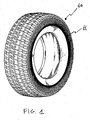
- Fig. 1 is a side view of a tire made according to the present invention.
- Fig. 1 shows a tire (10) having a sidewall (11) to which a colored composition according to the present invention is applied.
- the obtained colored coating layer is circumferentially extended to cover the whole sidewall (11).
- the colored coating layer may cover only a portion of the tire sidewall, such as for example, in the case said colored coating layer covers designs, letters, logos, trademarks, decals which may be placed upon the sidewall of the tire.
- the process for producing the tire according to the present invention may be carried out according to techniques and using apparatus that are known in the art, as described, for example, in European Patents EP 199,064 , or in United States Patents US 4,872,822 or US 4,768,937 , said process including manufacturing the crude tire, moulding and vulcanizing the crude tire.
- the components used for the preparation of the colored composition were the following:
- NR natural rubber
- BR cis-1,-4-polybutadiene (Europrene ® Neocis BR40-Polimeri Europa)
- N660 carbon black
- 6-PPD N-(1,3-dimethylbutyl)-N'-phenyl-p-phenylene-diamine
- CBS accelerator
- N-cyclohexyl-2-benzothiazyl sulphonamide Vulkacit ® CZ - Bayer
- PVI (retardant): N-cyclohexylthiophthalimide (Santogard ® PVI - Monsanto).
- Test pieces of the above disclosed crosslinked elastomeric compositions (vulcanized at 170°C for 10 min) having the following dimensions 100 mm x 40 mm x 3 mm were obtained.
- test pieces were washed with methyl ethyl ketone and subsequently coated with the colored composition of Example 1, 2 and 3, by means of a brush.
- the colored composition was let to dry, at room temperature (23°C), for 20 minutes and, subsequently, in an oven, at 80°C, for 2 hours. After drying, a colored coating layer 50 ⁇ m thick was obtained.
- test pieces were subjected to Xenon-Arc Accelerated Test according to ASTM Standard D6695-03 using a Q-Sun Xe-1-S (Xenon Test Chamber with daylight filter). The following conditions were applied:
Landscapes
- Chemical & Material Sciences (AREA)
- Organic Chemistry (AREA)
- Health & Medical Sciences (AREA)
- Chemical Kinetics & Catalysis (AREA)
- Medicinal Chemistry (AREA)
- Polymers & Plastics (AREA)
- Engineering & Computer Science (AREA)
- Mechanical Engineering (AREA)
- Life Sciences & Earth Sciences (AREA)
- Materials Engineering (AREA)
- Wood Science & Technology (AREA)
- Tires In General (AREA)
- Application Of Or Painting With Fluid Materials (AREA)
- Paints Or Removers (AREA)
- Polyurethanes Or Polyureas (AREA)
- Coating Of Shaped Articles Made Of Macromolecular Substances (AREA)
- Compositions Of Macromolecular Compounds (AREA)
Applications Claiming Priority (1)
| Application Number | Priority Date | Filing Date | Title |
|---|---|---|---|
| PCT/EP2005/013828 WO2007071272A1 (en) | 2005-12-21 | 2005-12-21 | Tire having a colored surface |
Publications (2)
| Publication Number | Publication Date |
|---|---|
| EP1963387A1 EP1963387A1 (en) | 2008-09-03 |
| EP1963387B1 true EP1963387B1 (en) | 2014-06-04 |
Family
ID=37027612
Family Applications (1)
| Application Number | Title | Priority Date | Filing Date |
|---|---|---|---|
| EP05823066.5A Expired - Lifetime EP1963387B1 (en) | 2005-12-21 | 2005-12-21 | Tire having a colored surface |
Country Status (5)
| Country | Link |
|---|---|
| US (1) | US8151848B2 (pt) |
| EP (1) | EP1963387B1 (pt) |
| JP (1) | JP4828610B2 (pt) |
| BR (1) | BRPI0520783B8 (pt) |
| WO (1) | WO2007071272A1 (pt) |
Families Citing this family (22)
| Publication number | Priority date | Publication date | Assignee | Title |
|---|---|---|---|---|
| JP2012158297A (ja) * | 2011-02-02 | 2012-08-23 | Bridgestone Corp | タイヤ、及びタイヤの製造方法 |
| JP5749946B2 (ja) * | 2011-03-10 | 2015-07-15 | 株式会社ブリヂストン | タイヤ用印刷装置およびタイヤ表面印刷方法 |
| JP5507015B2 (ja) | 2012-01-11 | 2014-05-28 | 株式会社ブリヂストン | タイヤ |
| WO2013125592A1 (ja) * | 2012-02-21 | 2013-08-29 | 横浜ゴム株式会社 | 空気入りタイヤおよび空気入りタイヤの製造方法 |
| US20140034199A1 (en) * | 2012-07-31 | 2014-02-06 | Bridgestone Americas Tire Operations, Llc | Tire with laminate |
| US9085735B2 (en) * | 2013-01-02 | 2015-07-21 | American Fuel Producers, LLC | Methods for producing synthetic fuel |
| JP6099429B2 (ja) * | 2013-02-26 | 2017-03-22 | 株式会社ブリヂストン | タイヤ用サイドゴム組成物及びタイヤ |
| RU2016133195A (ru) * | 2014-01-16 | 2018-02-14 | БРИДЖСТОУН АМЕРИКАС ТАЙР ОПЕРЕЙШЕНС, ЭлЭлСи | Шина с многослойным материалом и способ ее изготовления |
| CN104448426A (zh) * | 2014-12-30 | 2015-03-25 | 双星东风轮胎有限公司 | 一种用于迷彩半钢子午线轮胎胎侧的耐变色性橡胶组合物 |
| JP6523147B2 (ja) * | 2015-11-20 | 2019-05-29 | 株式会社ブリヂストン | タイヤ及びその製造方法 |
| JP6567397B2 (ja) * | 2015-11-20 | 2019-08-28 | 株式会社ブリヂストン | タイヤ |
| JP6567402B2 (ja) * | 2015-12-07 | 2019-08-28 | 株式会社ブリヂストン | タイヤ |
| JP6673742B2 (ja) * | 2016-04-28 | 2020-03-25 | 株式会社ブリヂストン | タイヤ及びその製造方法 |
| JP6848283B2 (ja) * | 2016-09-12 | 2021-03-24 | 横浜ゴム株式会社 | 空気入りタイヤの製造方法 |
| JP1579281S (pt) * | 2016-10-28 | 2017-06-19 | ||
| JP1576394S (pt) * | 2016-10-28 | 2017-05-15 | ||
| USD832770S1 (en) * | 2016-10-28 | 2018-11-06 | Bridgestone Corporation | Non-pneumatic tire |
| KR101840289B1 (ko) * | 2017-08-28 | 2018-03-20 | 오행준 | 식별용이형 자전거 바퀴 및 자전거 차체 |
| US20210070111A1 (en) * | 2017-09-12 | 2021-03-11 | Sumitomo Rubber Industries, Ltd. | Pneumatic tire |
| CN112739556A (zh) * | 2018-09-14 | 2021-04-30 | 株式会社普利司通 | 轮胎 |
| CN111607053B (zh) * | 2019-02-26 | 2022-06-07 | 三晃股份有限公司 | 热塑性聚胺基甲酸酯及其成型品 |
| CN116463176B (zh) * | 2023-04-17 | 2025-01-17 | 纳爱斯浙江科技有限公司 | 一种织物增白增艳添加剂组合物及包含该组合物的洗涤剂 |
Family Cites Families (13)
| Publication number | Priority date | Publication date | Assignee | Title |
|---|---|---|---|---|
| US3648748A (en) | 1969-08-18 | 1972-03-14 | Goodyear Tire & Rubber | Tire having polyurethane laminate thereon |
| DE2257501A1 (de) * | 1972-11-23 | 1974-05-30 | Borden Inc | Klebemittel auf polyurethanbasis |
| US4259227A (en) * | 1979-09-21 | 1981-03-31 | E. I. Du Pont De Nemours And Company | Polyurethane compositions for tire sidewalls and composite articles |
| US4530976A (en) * | 1983-10-13 | 1985-07-23 | Ford Motor Company | Flexible uni-basecoat/two component clearcoat coating compositions |
| JPS6143635A (ja) * | 1984-08-08 | 1986-03-03 | Sumitomo Rubber Ind Ltd | ゴム成形品用塗料およびゴム成形品の塗装法および塗装ゴム成形品 |
| JPS61219606A (ja) | 1985-03-26 | 1986-09-30 | Kobe Steel Ltd | タイヤ加硫プレス |
| IT1198209B (it) | 1986-12-01 | 1988-12-21 | Pirelli | Miglioramenti alle presse di vulcanizzazione per pneumatici |
| US4768937A (en) | 1987-02-02 | 1988-09-06 | Nrm Corporation | Tire curing press |
| US5149591A (en) * | 1991-03-28 | 1992-09-22 | The Goodyear Tire & Rubber Company | Blends of polyvinyl alcohol and polyurethane water dispersions for increased humidity resistance of water soluble white sidewall paints |
| DE19640834C2 (de) | 1996-10-02 | 1998-09-10 | Pirelli Reifenwerke | Verfahren zum Aufdrucken von Kennzeichnungen auf einen Gummiartikel, insbesondere Reifen, sowie der durch das Verfahren hergestellte Gummiartikel |
| JP3893508B2 (ja) * | 2000-01-25 | 2007-03-14 | 平岡織染株式会社 | 熱溶融接合可能な表面処理シート |
| FR2818984A1 (fr) | 2000-12-29 | 2002-07-05 | Michelin Soc Tech | Pneumatique ayant une composition coloree metallisee de surface |
| JP2004526814A (ja) * | 2000-12-29 | 2004-09-02 | ソシエテ ド テクノロジー ミシュラン | 着色表面組成物を有するタイヤ |
-
2005
- 2005-12-21 WO PCT/EP2005/013828 patent/WO2007071272A1/en not_active Ceased
- 2005-12-21 BR BRPI0520783A patent/BRPI0520783B8/pt not_active IP Right Cessation
- 2005-12-21 EP EP05823066.5A patent/EP1963387B1/en not_active Expired - Lifetime
- 2005-12-21 US US12/086,760 patent/US8151848B2/en not_active Expired - Fee Related
- 2005-12-21 JP JP2008546136A patent/JP4828610B2/ja not_active Expired - Fee Related
Also Published As
| Publication number | Publication date |
|---|---|
| BRPI0520783A2 (pt) | 2009-10-06 |
| US8151848B2 (en) | 2012-04-10 |
| BRPI0520783B8 (pt) | 2017-03-21 |
| BRPI0520783B1 (pt) | 2016-11-08 |
| JP4828610B2 (ja) | 2011-11-30 |
| EP1963387A1 (en) | 2008-09-03 |
| WO2007071272A1 (en) | 2007-06-28 |
| US20100024942A1 (en) | 2010-02-04 |
| JP2009520616A (ja) | 2009-05-28 |
Similar Documents
| Publication | Publication Date | Title |
|---|---|---|
| EP1963387B1 (en) | Tire having a colored surface | |
| US4158378A (en) | Tire having polyurethane laminate thereon | |
| US8623169B2 (en) | Adhesive system for the direct bonding of a cured polyurethane to crude rubber | |
| EP2021420B1 (en) | Tire having a coated surface | |
| CN110511656B (zh) | 一种喷涂成型的双组分聚脲表皮及其制备方法 | |
| US4131149A (en) | Polyurethane tire sidewalls | |
| US3577257A (en) | Method for forming decorative polyurethane coatings | |
| US4259227A (en) | Polyurethane compositions for tire sidewalls and composite articles | |
| JPH0634972B2 (ja) | プライマーと着色表面コートとの間に耐チッピング性層を形成させる方法 | |
| KR970009325B1 (ko) | 폴리에테르디올, 폴리에테르트리올, 글리세롤 및 폴리이소시아네이트로 구성되는 폴리우레탄조성물 및 그 제조방법 | |
| US4038256A (en) | Nonstaining polyurethane from cycloaliphatic or aliphatic diisocyanates and polyhexenediol-phthalates | |
| US20040050471A1 (en) | Tire having a metallic colored surface composition | |
| JPH05155976A (ja) | 高温での伸び物性に優れたポリウレタン樹脂 | |
| JPS6142373A (ja) | スエ−ド調又はフエルト調模様の形成方法 | |
| KR100409152B1 (ko) | 1액형 우레탄 수지 조성물의 제조방법 | |
| KR102310381B1 (ko) | 크롬 도금 코팅용 하도 도료 조성물 | |
| CN112351880B (zh) | 车辆车轮用轮胎 | |
| US4647645A (en) | Non-aqueous lacquer with high protection against stone chipping, a process for its preparation and its use | |
| KR102310666B1 (ko) | 하도 도료 조성물 | |
| JP7691634B2 (ja) | 水性樹脂組成物 | |
| JPS5846275B2 (ja) | 湿気硬化型塗料 | |
| JP2003055644A (ja) | 調色シーリング材の製造方法 | |
| TW202219193A (zh) | 水性樹脂組成物及接著劑 | |
| Saxon et al. | Recent developments in tertiary aliphatic isocyanates | |
| Chang et al. | Aliphatic isocyanates in reaction injection molding of polyurethanes |
Legal Events
| Date | Code | Title | Description |
|---|---|---|---|
| PUAI | Public reference made under article 153(3) epc to a published international application that has entered the european phase |
Free format text: ORIGINAL CODE: 0009012 |
|
| AK | Designated contracting states |
Kind code of ref document: A1 Designated state(s): AT BE BG CH CY CZ DE DK EE ES FI FR GB GR HU IE IS IT LI LT LU LV MC NL PL PT RO SE SI SK TR |
|
| 17P | Request for examination filed |
Effective date: 20080630 |
|
| DAX | Request for extension of the european patent (deleted) | ||
| 17Q | First examination report despatched |
Effective date: 20130708 |
|
| GRAP | Despatch of communication of intention to grant a patent |
Free format text: ORIGINAL CODE: EPIDOSNIGR1 |
|
| RAP1 | Party data changed (applicant data changed or rights of an application transferred) |
Owner name: PIRELLI TYRE S.P.A. |
|
| INTG | Intention to grant announced |
Effective date: 20140319 |
|
| GRAS | Grant fee paid |
Free format text: ORIGINAL CODE: EPIDOSNIGR3 |
|
| GRAA | (expected) grant |
Free format text: ORIGINAL CODE: 0009210 |
|
| AK | Designated contracting states |
Kind code of ref document: B1 Designated state(s): AT BE BG CH CY CZ DE DK EE ES FI FR GB GR HU IE IS IT LI LT LU LV MC NL PL PT RO SE SI SK TR |
|
| REG | Reference to a national code |
Ref country code: GB Ref legal event code: FG4D |
|
| REG | Reference to a national code |
Ref country code: CH Ref legal event code: EP |
|
| REG | Reference to a national code |
Ref country code: AT Ref legal event code: REF Ref document number: 671076 Country of ref document: AT Kind code of ref document: T Effective date: 20140615 |
|
| REG | Reference to a national code |
Ref country code: IE Ref legal event code: FG4D |
|
| REG | Reference to a national code |
Ref country code: DE Ref legal event code: R096 Ref document number: 602005043839 Country of ref document: DE Effective date: 20140717 |
|
| REG | Reference to a national code |
Ref country code: AT Ref legal event code: MK05 Ref document number: 671076 Country of ref document: AT Kind code of ref document: T Effective date: 20140604 |
|
| REG | Reference to a national code |
Ref country code: NL Ref legal event code: VDEP Effective date: 20140604 |
|
| PG25 | Lapsed in a contracting state [announced via postgrant information from national office to epo] |
Ref country code: CY Free format text: LAPSE BECAUSE OF FAILURE TO SUBMIT A TRANSLATION OF THE DESCRIPTION OR TO PAY THE FEE WITHIN THE PRESCRIBED TIME-LIMIT Effective date: 20140604 Ref country code: FI Free format text: LAPSE BECAUSE OF FAILURE TO SUBMIT A TRANSLATION OF THE DESCRIPTION OR TO PAY THE FEE WITHIN THE PRESCRIBED TIME-LIMIT Effective date: 20140604 Ref country code: GR Free format text: LAPSE BECAUSE OF FAILURE TO SUBMIT A TRANSLATION OF THE DESCRIPTION OR TO PAY THE FEE WITHIN THE PRESCRIBED TIME-LIMIT Effective date: 20140905 Ref country code: LT Free format text: LAPSE BECAUSE OF FAILURE TO SUBMIT A TRANSLATION OF THE DESCRIPTION OR TO PAY THE FEE WITHIN THE PRESCRIBED TIME-LIMIT Effective date: 20140604 |
|
| REG | Reference to a national code |
Ref country code: LT Ref legal event code: MG4D |
|
| PG25 | Lapsed in a contracting state [announced via postgrant information from national office to epo] |
Ref country code: SE Free format text: LAPSE BECAUSE OF FAILURE TO SUBMIT A TRANSLATION OF THE DESCRIPTION OR TO PAY THE FEE WITHIN THE PRESCRIBED TIME-LIMIT Effective date: 20140604 Ref country code: LV Free format text: LAPSE BECAUSE OF FAILURE TO SUBMIT A TRANSLATION OF THE DESCRIPTION OR TO PAY THE FEE WITHIN THE PRESCRIBED TIME-LIMIT Effective date: 20140604 Ref country code: AT Free format text: LAPSE BECAUSE OF FAILURE TO SUBMIT A TRANSLATION OF THE DESCRIPTION OR TO PAY THE FEE WITHIN THE PRESCRIBED TIME-LIMIT Effective date: 20140604 |
|
| PG25 | Lapsed in a contracting state [announced via postgrant information from national office to epo] |
Ref country code: CZ Free format text: LAPSE BECAUSE OF FAILURE TO SUBMIT A TRANSLATION OF THE DESCRIPTION OR TO PAY THE FEE WITHIN THE PRESCRIBED TIME-LIMIT Effective date: 20140604 Ref country code: PT Free format text: LAPSE BECAUSE OF FAILURE TO SUBMIT A TRANSLATION OF THE DESCRIPTION OR TO PAY THE FEE WITHIN THE PRESCRIBED TIME-LIMIT Effective date: 20141006 Ref country code: ES Free format text: LAPSE BECAUSE OF FAILURE TO SUBMIT A TRANSLATION OF THE DESCRIPTION OR TO PAY THE FEE WITHIN THE PRESCRIBED TIME-LIMIT Effective date: 20140604 Ref country code: SK Free format text: LAPSE BECAUSE OF FAILURE TO SUBMIT A TRANSLATION OF THE DESCRIPTION OR TO PAY THE FEE WITHIN THE PRESCRIBED TIME-LIMIT Effective date: 20140604 Ref country code: RO Free format text: LAPSE BECAUSE OF FAILURE TO SUBMIT A TRANSLATION OF THE DESCRIPTION OR TO PAY THE FEE WITHIN THE PRESCRIBED TIME-LIMIT Effective date: 20140604 Ref country code: EE Free format text: LAPSE BECAUSE OF FAILURE TO SUBMIT A TRANSLATION OF THE DESCRIPTION OR TO PAY THE FEE WITHIN THE PRESCRIBED TIME-LIMIT Effective date: 20140604 |
|
| PG25 | Lapsed in a contracting state [announced via postgrant information from national office to epo] |
Ref country code: PL Free format text: LAPSE BECAUSE OF FAILURE TO SUBMIT A TRANSLATION OF THE DESCRIPTION OR TO PAY THE FEE WITHIN THE PRESCRIBED TIME-LIMIT Effective date: 20140604 Ref country code: NL Free format text: LAPSE BECAUSE OF FAILURE TO SUBMIT A TRANSLATION OF THE DESCRIPTION OR TO PAY THE FEE WITHIN THE PRESCRIBED TIME-LIMIT Effective date: 20140604 Ref country code: IS Free format text: LAPSE BECAUSE OF FAILURE TO SUBMIT A TRANSLATION OF THE DESCRIPTION OR TO PAY THE FEE WITHIN THE PRESCRIBED TIME-LIMIT Effective date: 20141004 |
|
| REG | Reference to a national code |
Ref country code: DE Ref legal event code: R097 Ref document number: 602005043839 Country of ref document: DE |
|
| PLBE | No opposition filed within time limit |
Free format text: ORIGINAL CODE: 0009261 |
|
| STAA | Information on the status of an ep patent application or granted ep patent |
Free format text: STATUS: NO OPPOSITION FILED WITHIN TIME LIMIT |
|
| PG25 | Lapsed in a contracting state [announced via postgrant information from national office to epo] |
Ref country code: DK Free format text: LAPSE BECAUSE OF FAILURE TO SUBMIT A TRANSLATION OF THE DESCRIPTION OR TO PAY THE FEE WITHIN THE PRESCRIBED TIME-LIMIT Effective date: 20140604 |
|
| 26N | No opposition filed |
Effective date: 20150305 |
|
| REG | Reference to a national code |
Ref country code: DE Ref legal event code: R097 Ref document number: 602005043839 Country of ref document: DE Effective date: 20150305 |
|
| PG25 | Lapsed in a contracting state [announced via postgrant information from national office to epo] |
Ref country code: BE Free format text: LAPSE BECAUSE OF FAILURE TO SUBMIT A TRANSLATION OF THE DESCRIPTION OR TO PAY THE FEE WITHIN THE PRESCRIBED TIME-LIMIT Effective date: 20140604 |
|
| PG25 | Lapsed in a contracting state [announced via postgrant information from national office to epo] |
Ref country code: LU Free format text: LAPSE BECAUSE OF FAILURE TO SUBMIT A TRANSLATION OF THE DESCRIPTION OR TO PAY THE FEE WITHIN THE PRESCRIBED TIME-LIMIT Effective date: 20141221 Ref country code: SI Free format text: LAPSE BECAUSE OF FAILURE TO SUBMIT A TRANSLATION OF THE DESCRIPTION OR TO PAY THE FEE WITHIN THE PRESCRIBED TIME-LIMIT Effective date: 20140604 |
|
| REG | Reference to a national code |
Ref country code: CH Ref legal event code: PL |
|
| GBPC | Gb: european patent ceased through non-payment of renewal fee |
Effective date: 20141221 |
|
| REG | Reference to a national code |
Ref country code: IE Ref legal event code: MM4A |
|
| PG25 | Lapsed in a contracting state [announced via postgrant information from national office to epo] |
Ref country code: GB Free format text: LAPSE BECAUSE OF NON-PAYMENT OF DUE FEES Effective date: 20141221 Ref country code: IE Free format text: LAPSE BECAUSE OF NON-PAYMENT OF DUE FEES Effective date: 20141221 Ref country code: LI Free format text: LAPSE BECAUSE OF NON-PAYMENT OF DUE FEES Effective date: 20141231 Ref country code: CH Free format text: LAPSE BECAUSE OF NON-PAYMENT OF DUE FEES Effective date: 20141231 |
|
| REG | Reference to a national code |
Ref country code: FR Ref legal event code: PLFP Year of fee payment: 11 |
|
| PG25 | Lapsed in a contracting state [announced via postgrant information from national office to epo] |
Ref country code: BG Free format text: LAPSE BECAUSE OF FAILURE TO SUBMIT A TRANSLATION OF THE DESCRIPTION OR TO PAY THE FEE WITHIN THE PRESCRIBED TIME-LIMIT Effective date: 20140604 Ref country code: MC Free format text: LAPSE BECAUSE OF FAILURE TO SUBMIT A TRANSLATION OF THE DESCRIPTION OR TO PAY THE FEE WITHIN THE PRESCRIBED TIME-LIMIT Effective date: 20140604 |
|
| PG25 | Lapsed in a contracting state [announced via postgrant information from national office to epo] |
Ref country code: HU Free format text: LAPSE BECAUSE OF FAILURE TO SUBMIT A TRANSLATION OF THE DESCRIPTION OR TO PAY THE FEE WITHIN THE PRESCRIBED TIME-LIMIT; INVALID AB INITIO Effective date: 20051221 Ref country code: TR Free format text: LAPSE BECAUSE OF FAILURE TO SUBMIT A TRANSLATION OF THE DESCRIPTION OR TO PAY THE FEE WITHIN THE PRESCRIBED TIME-LIMIT Effective date: 20140604 |
|
| REG | Reference to a national code |
Ref country code: FR Ref legal event code: PLFP Year of fee payment: 12 |
|
| PG25 | Lapsed in a contracting state [announced via postgrant information from national office to epo] |
Ref country code: IT Free format text: LAPSE BECAUSE OF NON-PAYMENT OF DUE FEES Effective date: 20151221 |
|
| REG | Reference to a national code |
Ref country code: FR Ref legal event code: GC Effective date: 20170203 |
|
| REG | Reference to a national code |
Ref country code: FR Ref legal event code: RG Effective date: 20170707 |
|
| PG25 | Lapsed in a contracting state [announced via postgrant information from national office to epo] |
Ref country code: IT Free format text: LAPSE BECAUSE OF NON-PAYMENT OF DUE FEES Effective date: 20151221 |
|
| PGRI | Patent reinstated in contracting state [announced from national office to epo] |
Ref country code: IT Effective date: 20170710 |
|
| REG | Reference to a national code |
Ref country code: FR Ref legal event code: PLFP Year of fee payment: 13 |
|
| PGFP | Annual fee paid to national office [announced via postgrant information from national office to epo] |
Ref country code: FR Payment date: 20191226 Year of fee payment: 15 Ref country code: IT Payment date: 20191219 Year of fee payment: 15 |
|
| PGFP | Annual fee paid to national office [announced via postgrant information from national office to epo] |
Ref country code: DE Payment date: 20191231 Year of fee payment: 15 |
|
| REG | Reference to a national code |
Ref country code: DE Ref legal event code: R119 Ref document number: 602005043839 Country of ref document: DE |
|
| PG25 | Lapsed in a contracting state [announced via postgrant information from national office to epo] |
Ref country code: FR Free format text: LAPSE BECAUSE OF NON-PAYMENT OF DUE FEES Effective date: 20201231 |
|
| PG25 | Lapsed in a contracting state [announced via postgrant information from national office to epo] |
Ref country code: DE Free format text: LAPSE BECAUSE OF NON-PAYMENT OF DUE FEES Effective date: 20210701 |
|
| PG25 | Lapsed in a contracting state [announced via postgrant information from national office to epo] |
Ref country code: IT Free format text: LAPSE BECAUSE OF NON-PAYMENT OF DUE FEES Effective date: 20201221 |