EP1967510A1 - Dialdimin, Dialdimin enthaltende Emulsion, sowie zweikomponentige Polyurethanzusammensetzung und deren Verwendungen - Google Patents
Dialdimin, Dialdimin enthaltende Emulsion, sowie zweikomponentige Polyurethanzusammensetzung und deren Verwendungen Download PDFInfo
- Publication number
- EP1967510A1 EP1967510A1 EP20070103554 EP07103554A EP1967510A1 EP 1967510 A1 EP1967510 A1 EP 1967510A1 EP 20070103554 EP20070103554 EP 20070103554 EP 07103554 A EP07103554 A EP 07103554A EP 1967510 A1 EP1967510 A1 EP 1967510A1
- Authority
- EP
- European Patent Office
- Prior art keywords
- component
- mixing
- dialdimine
- formula
- components
- Prior art date
- Legal status (The legal status is an assumption and is not a legal conclusion. Google has not performed a legal analysis and makes no representation as to the accuracy of the status listed.)
- Withdrawn
Links
- 0 CC(CC(*)OC(C)CC=C)N Chemical compound CC(CC(*)OC(C)CC=C)N 0.000 description 1
Images


Classifications
-
- C—CHEMISTRY; METALLURGY
- C07—ORGANIC CHEMISTRY
- C07C—ACYCLIC OR CARBOCYCLIC COMPOUNDS
- C07C275/00—Derivatives of urea, i.e. compounds containing any of the groups, the nitrogen atoms not being part of nitro or nitroso groups
- C07C275/04—Derivatives of urea, i.e. compounds containing any of the groups, the nitrogen atoms not being part of nitro or nitroso groups having nitrogen atoms of urea groups bound to acyclic carbon atoms
- C07C275/20—Derivatives of urea, i.e. compounds containing any of the groups, the nitrogen atoms not being part of nitro or nitroso groups having nitrogen atoms of urea groups bound to acyclic carbon atoms of an unsaturated carbon skeleton
-
- C—CHEMISTRY; METALLURGY
- C08—ORGANIC MACROMOLECULAR COMPOUNDS; THEIR PREPARATION OR CHEMICAL WORKING-UP; COMPOSITIONS BASED THEREON
- C08L—COMPOSITIONS OF MACROMOLECULAR COMPOUNDS
- C08L75/00—Compositions of polyureas or polyurethanes; Compositions of derivatives of such polymers
- C08L75/04—Polyurethanes
- C08L75/08—Polyurethanes from polyethers
-
- C—CHEMISTRY; METALLURGY
- C08—ORGANIC MACROMOLECULAR COMPOUNDS; THEIR PREPARATION OR CHEMICAL WORKING-UP; COMPOSITIONS BASED THEREON
- C08G—MACROMOLECULAR COMPOUNDS OBTAINED OTHERWISE THAN BY REACTIONS ONLY INVOLVING UNSATURATED CARBON-TO-CARBON BONDS
- C08G18/00—Polymeric products of isocyanates or isothiocyanates
- C08G18/06—Polymeric products of isocyanates or isothiocyanates with compounds having active hydrogen
- C08G18/08—Processes
- C08G18/0804—Manufacture of polymers containing ionic or ionogenic groups
- C08G18/0819—Manufacture of polymers containing ionic or ionogenic groups containing anionic or anionogenic groups
- C08G18/0823—Manufacture of polymers containing ionic or ionogenic groups containing anionic or anionogenic groups containing carboxylate salt groups or groups forming them
-
- C—CHEMISTRY; METALLURGY
- C08—ORGANIC MACROMOLECULAR COMPOUNDS; THEIR PREPARATION OR CHEMICAL WORKING-UP; COMPOSITIONS BASED THEREON
- C08G—MACROMOLECULAR COMPOUNDS OBTAINED OTHERWISE THAN BY REACTIONS ONLY INVOLVING UNSATURATED CARBON-TO-CARBON BONDS
- C08G18/00—Polymeric products of isocyanates or isothiocyanates
- C08G18/06—Polymeric products of isocyanates or isothiocyanates with compounds having active hydrogen
- C08G18/08—Processes
- C08G18/10—Prepolymer processes involving reaction of isocyanates or isothiocyanates with compounds having active hydrogen in a first reaction step
-
- C—CHEMISTRY; METALLURGY
- C08—ORGANIC MACROMOLECULAR COMPOUNDS; THEIR PREPARATION OR CHEMICAL WORKING-UP; COMPOSITIONS BASED THEREON
- C08G—MACROMOLECULAR COMPOUNDS OBTAINED OTHERWISE THAN BY REACTIONS ONLY INVOLVING UNSATURATED CARBON-TO-CARBON BONDS
- C08G18/00—Polymeric products of isocyanates or isothiocyanates
- C08G18/06—Polymeric products of isocyanates or isothiocyanates with compounds having active hydrogen
- C08G18/08—Processes
- C08G18/10—Prepolymer processes involving reaction of isocyanates or isothiocyanates with compounds having active hydrogen in a first reaction step
- C08G18/12—Prepolymer processes involving reaction of isocyanates or isothiocyanates with compounds having active hydrogen in a first reaction step using two or more compounds having active hydrogen in the first polymerisation step
-
- C—CHEMISTRY; METALLURGY
- C08—ORGANIC MACROMOLECULAR COMPOUNDS; THEIR PREPARATION OR CHEMICAL WORKING-UP; COMPOSITIONS BASED THEREON
- C08G—MACROMOLECULAR COMPOUNDS OBTAINED OTHERWISE THAN BY REACTIONS ONLY INVOLVING UNSATURATED CARBON-TO-CARBON BONDS
- C08G18/00—Polymeric products of isocyanates or isothiocyanates
- C08G18/06—Polymeric products of isocyanates or isothiocyanates with compounds having active hydrogen
- C08G18/28—Polymeric products of isocyanates or isothiocyanates with compounds having active hydrogen characterised by the compounds used containing active hydrogen
- C08G18/40—High-molecular-weight compounds
- C08G18/48—Polyethers
- C08G18/4804—Two or more polyethers of different physical or chemical nature
- C08G18/4812—Mixtures of polyetherdiols with polyetherpolyols having at least three hydroxy groups
-
- C—CHEMISTRY; METALLURGY
- C08—ORGANIC MACROMOLECULAR COMPOUNDS; THEIR PREPARATION OR CHEMICAL WORKING-UP; COMPOSITIONS BASED THEREON
- C08G—MACROMOLECULAR COMPOUNDS OBTAINED OTHERWISE THAN BY REACTIONS ONLY INVOLVING UNSATURATED CARBON-TO-CARBON BONDS
- C08G18/00—Polymeric products of isocyanates or isothiocyanates
- C08G18/06—Polymeric products of isocyanates or isothiocyanates with compounds having active hydrogen
- C08G18/28—Polymeric products of isocyanates or isothiocyanates with compounds having active hydrogen characterised by the compounds used containing active hydrogen
- C08G18/65—Low-molecular-weight compounds having active hydrogen with high-molecular-weight compounds having active hydrogen
- C08G18/66—Compounds of groups C08G18/42, C08G18/48, or C08G18/52
- C08G18/6666—Compounds of group C08G18/48 or C08G18/52
- C08G18/6692—Compounds of group C08G18/48 or C08G18/52 with compounds of group C08G18/34
-
- C—CHEMISTRY; METALLURGY
- C08—ORGANIC MACROMOLECULAR COMPOUNDS; THEIR PREPARATION OR CHEMICAL WORKING-UP; COMPOSITIONS BASED THEREON
- C08G—MACROMOLECULAR COMPOUNDS OBTAINED OTHERWISE THAN BY REACTIONS ONLY INVOLVING UNSATURATED CARBON-TO-CARBON BONDS
- C08G18/00—Polymeric products of isocyanates or isothiocyanates
- C08G18/06—Polymeric products of isocyanates or isothiocyanates with compounds having active hydrogen
- C08G18/83—Chemically modified polymers
- C08G18/833—Chemically modified polymers by nitrogen containing compounds
-
- C—CHEMISTRY; METALLURGY
- C09—DYES; PAINTS; POLISHES; NATURAL RESINS; ADHESIVES; COMPOSITIONS NOT OTHERWISE PROVIDED FOR; APPLICATIONS OF MATERIALS NOT OTHERWISE PROVIDED FOR
- C09D—COATING COMPOSITIONS, e.g. PAINTS, VARNISHES OR LACQUERS; FILLING PASTES; CHEMICAL PAINT OR INK REMOVERS; INKS; CORRECTING FLUIDS; WOODSTAINS; PASTES OR SOLIDS FOR COLOURING OR PRINTING; USE OF MATERIALS THEREFOR
- C09D175/00—Coating compositions based on polyureas or polyurethanes; Coating compositions based on derivatives of such polymers
- C09D175/04—Polyurethanes
- C09D175/08—Polyurethanes from polyethers
-
- C—CHEMISTRY; METALLURGY
- C09—DYES; PAINTS; POLISHES; NATURAL RESINS; ADHESIVES; COMPOSITIONS NOT OTHERWISE PROVIDED FOR; APPLICATIONS OF MATERIALS NOT OTHERWISE PROVIDED FOR
- C09J—ADHESIVES; NON-MECHANICAL ASPECTS OF ADHESIVE PROCESSES IN GENERAL; ADHESIVE PROCESSES NOT PROVIDED FOR ELSEWHERE; USE OF MATERIALS AS ADHESIVES
- C09J175/00—Adhesives based on polyureas or polyurethanes; Adhesives based on derivatives of such polymers
- C09J175/04—Polyurethanes
-
- C—CHEMISTRY; METALLURGY
- C09—DYES; PAINTS; POLISHES; NATURAL RESINS; ADHESIVES; COMPOSITIONS NOT OTHERWISE PROVIDED FOR; APPLICATIONS OF MATERIALS NOT OTHERWISE PROVIDED FOR
- C09J—ADHESIVES; NON-MECHANICAL ASPECTS OF ADHESIVE PROCESSES IN GENERAL; ADHESIVE PROCESSES NOT PROVIDED FOR ELSEWHERE; USE OF MATERIALS AS ADHESIVES
- C09J175/00—Adhesives based on polyureas or polyurethanes; Adhesives based on derivatives of such polymers
- C09J175/04—Polyurethanes
- C09J175/08—Polyurethanes from polyethers
-
- Y—GENERAL TAGGING OF NEW TECHNOLOGICAL DEVELOPMENTS; GENERAL TAGGING OF CROSS-SECTIONAL TECHNOLOGIES SPANNING OVER SEVERAL SECTIONS OF THE IPC; TECHNICAL SUBJECTS COVERED BY FORMER USPC CROSS-REFERENCE ART COLLECTIONS [XRACs] AND DIGESTS
- Y10—TECHNICAL SUBJECTS COVERED BY FORMER USPC
- Y10T—TECHNICAL SUBJECTS COVERED BY FORMER US CLASSIFICATION
- Y10T156/00—Adhesive bonding and miscellaneous chemical manufacture
- Y10T156/10—Methods of surface bonding and/or assembly therefor
-
- Y—GENERAL TAGGING OF NEW TECHNOLOGICAL DEVELOPMENTS; GENERAL TAGGING OF CROSS-SECTIONAL TECHNOLOGIES SPANNING OVER SEVERAL SECTIONS OF THE IPC; TECHNICAL SUBJECTS COVERED BY FORMER USPC CROSS-REFERENCE ART COLLECTIONS [XRACs] AND DIGESTS
- Y10—TECHNICAL SUBJECTS COVERED BY FORMER USPC
- Y10T—TECHNICAL SUBJECTS COVERED BY FORMER US CLASSIFICATION
- Y10T428/00—Stock material or miscellaneous articles
- Y10T428/31504—Composite [nonstructural laminate]
- Y10T428/31551—Of polyamidoester [polyurethane, polyisocyanate, polycarbamate, etc.]
Definitions
- the invention relates to the field of polyaldimines, the aldimine-containing emulsions, and the two-component polyurethane compositions.
- Aldimines have long been used as blocked amines.
- polyaldimines are used as latent hardeners in compositions containing isocyanate group-containing polymers and used, for example, as adhesives or sealants.
- Such compositions cure on contact with water, releasing aldehydes.
- aldehydes are usually very odor-intensive and disturbing and therefore greatly limit the possible uses of the compositions.
- WO 2004/013200 A1 discloses polyaldimine-containing polyurethane compositions which cure without disturbing odor.
- One-component polyurethane compositions which contain isocyanate group-containing polymers and cure with atmospheric moisture have long been used, for example as adhesives or sealants or as coatings. Since these compositions generally cure slowly, it has been proposed many times to accelerate the cure, and thus also the strength build-up, by admixing a second component containing water.
- a second component containing water such two-part compositions have the great disadvantage of being prone to bubble formation. In a layer-like mixing of the two components, they also often have a reduced mechanical strength, in particular shortly after mixing.
- the water-containing second component contains in practical systems usually an organic VOC solvent, in particular an N-alkylpyrrolidone, which is connected for reasons of occupational toxicity and occupational hygiene with great disadvantages.
- WO 2005/037885 A1 describes two-component polyurethane compositions in which to a first component containing isocyanate polyurethane prepolymers a second component, which has low-odor polyaldimines in addition to water, are admixed. Although these compositions have a reduction of bubbles and accelerated curing; however, their cure and strength build is still too slow for many applications.
- the object of the present invention is therefore to provide a two-component polyurethane composition which overcomes the disadvantages of the prior art, and in particular has a high early strength.
- an emulsion which is based on dialdimines of the formula (I) is outstandingly suitable for use as a hardener or accelerator component for isocyanate-containing polymers, in particular for isocyanate-containing polyurethane polymers.
- pasty hardener or accelerator components can be produced therefrom, which lead to a very high early strength, which have a good flow behavior during pumping and which can be formulated without VOC solvents, in particular without N-alkylpyrrolidones.
- These components can be excellently homogeneous or inhomogeneous, in particular layered, with components containing polyurethane polymers containing isocyanate, mix, the resulting two-component compositions cure quickly, have exceptionally high early strength and without disturbing vulnerabilities, especially without weak points in or between the layers, especially if the layers are relatively thick, remain. Despite the rapid curing, these compositions, both in layered as well as homogeneous mixing, a sufficiently long open time, which allows, for example, reliably perform bonds.
- dialdimines of the formula (I) can be prepared in a simple manner from readily available dialdimines, diisocyanates and water.
- dialdimines of the formula (I) according to claim 1 a process for their preparation according to claim 11, such dialdimine containing emulsions according to claim 12 and their use as a hardener component or accelerator component for an adhesive, sealant or coating material, which isocyanate group-containing polymers contains, according to claim 14.
- the invention relates to two-component compositions according to claim 15, the mixed or partially mixed compositions obtainable therefrom according to claim 16, the use of the two-component compositions as adhesive, sealant or coating or coating according to claim 17, methods for bonding, sealing and the production of a coating according to claim 18, 19 and 20, as well as the resulting articles according to claim 24.
- the present invention relates to dialdimines of the formula (I).
- R is the residue of an aldehyde ALD after removal of an aldehyde group
- A is the residue of a diamine DA having two primary aliphatic amino groups after removal of the two primary amino groups.
- the radicals A and R have no groupings which are reactive in the absence of water with isocyanate groups, in particular no hydroxyl groups, no primary or secondary amino groups, no mercapto groups and no other groups with active hydrogen.
- Q is the radical of a diisocyanate DI after removal of both isocyanate groups, and n is 0 or an integer from 1 to 15.
- primary amino group in the present document denotes an NH 2 group which is bonded to an organic radical
- secondary amino group denotes an NH group which is attached to two organic radicals which also together form part of a ring can, is bound.
- aliphatic amino group is meant an amino group which is bonded to an aliphatic, cycloaliphatic or arylaliphatic radical. It thus differs from an "aromatic amino group” which is bonded directly to an aromatic or heteroaromatic radical, such as in aniline or 2-aminopyridine.
- polymer in the present document comprises on the one hand a collective of chemically uniform, but differing in terms of degree of polymerization, molecular weight and chain length macromolecules, which was prepared by a polyreaction (polymerization, polyaddition, polycondensation).
- polyreaction polymerization, polyaddition, polycondensation
- the term also encompasses derivatives of such a collective of macromolecules from polyreactions, compounds which have been obtained by reactions, such as additions or substitutions, of functional groups on given macromolecules and which may be chemically uniform or chemically nonuniform.
- prepolymers ie reactive oligomeric pre-adducts whose functional groups are involved in the construction of macromolecules.
- polyurethane polymer encompasses all polymers which are prepared by the so-called diisocyanate-polyaddition process. This also includes those polymers which are almost or completely free of urethane groups. Examples of polyurethane polymers are polyether-polyurethanes, polyester-polyurethanes, polyether-polyureas, polyureas, polyester-polyureas, polyisocyanurates and polycarbodiimides.
- room temperature refers to a temperature of 25 ° C.
- aldehyde ALD are basically all known aldehydes suitable. These aldehydes may be aliphatic, cycloaliphatic, arylaliphatic or aromatic aldehydes and may be monoaldehydes or polyaldehydes.
- Suitable aliphatic, cycloaliphatic or arylaliphatic aldehydes ALD are, for example, propionaldehyde, butyraldehyde, isobutyraldehyde, 2-methylbutyraldehyde, 2-ethylbutyraldehyde, valeraldehyde, isovaleraldehyde, 2-methylvaleraldehyde, 2,3-dimethylvaleraldehyde, hexanal, 2- Ethylhexanal, octanal, isooctanal, nonanal, decanal, undecanal, 2-methyl-undecanal, dodecanal, cyclopropanecarboxaldehyde, cyclopentanecarboxaldehyde, cyclohexylcarboxaldehyde, 1,2,3,6-tetrahydrobenzaldehyde, phenylacetaldehyde, 2-phenylpropionalde
- Suitable aromatic aldehydes ALD include, for example, benzaldehyde, 2- and 3- and 4-tolualdehyde, 4-ethyl- and 4-propyl- and 4-isopropyl and 4-butylbenzaldehyde, 2,4-dimethylbenzaldehyde, 2,4,5- Trimethylbenzaldehyde, 4-acetoxybenzaldehyde, 4-anisaldehyde, 4-ethoxybenzaldehyde, the isomeric di- and trialkoxybenzaldehydes, 2-, 3- and 4-nitrobenzaldehyde, 2- and 3- and 4-formylpyridine, 2-furfuraldehyde, 2-thiophenecarbaldehyde, 1 and 2-naphthylaldehyde, 3- and 4-phenyloxybenzaldehyde; Quinoline-2-carbaldehyde and its 3-, 4-, 5-, 6-, 7- and 8-position isomers, anthracene-9-car
- aldehyde ALD aldehyde
- aldehyde ALD which may contain, in ⁇ -position to the carbonyl group and, therefore, no CH-form tautomeric enols.
- the aldehyde ALD thus represents in particular an aldehyde of the formula (II-a) or an aldehyde of the formula (II-b).
- Suitable aldehydes of the formula (II-a) are, for example, 2,2-dimethylpropanal (pivalaldehyde), 2,2-dimethylbutanal, 2,2-diethylbutanal, 1-methylcyclopentanecarboxaldehyde, 1-methylcyclohexanecarboxaldehyde, and the ethers and esters of 2,2-disubstituted 3-hydroxypropanals, butanals or analogous higher aldehydes, especially of 2,2-dimethyl-3-hydroxypropanal, described below.
- Suitable aldehydes of the formula (II-b) are, for example, the aromatic aldehydes already suitable as aldehyde ALD , and glyoxal, glyoxalic acid esters, such as methyl glyoxalate, cinnamaldehyde and substituted cinnamaldehydes.
- dialdimines of the formula (I) are, in a first embodiment, those whose radicals R have the formula (II).
- R 3 is a hydrogen atom or an alkyl or arylalkyl group; and R 4 is a, optionally heteroatom-containing, hydrocarbon radical having 1 to 30 carbon atoms.
- dialdimines of the formula (I) are, in a second embodiment, those whose radicals R have the formula (III).
- R 5 is either a linear or branched alkyl radical having 1 to 30 carbon atoms, optionally with cyclic moieties and optionally with at least one heteroatom, in particular oxygen in the form of ether or carbonyl or ester groups, or for a single or polyunsaturated linear or branched hydrocarbon radical having 1 to 30 carbon atoms.
- radicals R correspond to the formula (II) in which R 4 is the radical of the formula (III ').
- dialdimines of the formula (I) which have a radical R of the formula (II) or formula (III) in which the radical R 4 is a hydrocarbon radical containing 11 to 30 C atoms, optionally containing heteroatoms; or in which the radical R 5 for a linear or branched alkyl radical having 11 to 30 carbon atoms, optionally with cyclic moieties and optionally with at least one heteroatom, in particular oxygen in the form of ether or carbonyl or ester groups, or is a mono- or polyunsaturated, linear or branched hydrocarbon radical having 11 to 30 carbon atoms.
- dialdimines of the formula (I) are distinguished by the fact that they themselves or the aldehydes formed during their hydrolysis are odorless.
- an "odor-free" substance is meant in this document a substance which is so low in odor that it is not palpable for most human individuals, that is imperceptible to the nose.
- aldehydes of the formula (II-a) are on the one hand aldehydes ALD1 of the formula (II-a '), ie aldehydes ALD with the radical R of the formula (II).
- the aldehydes ALD1 of the formula (II-a ') are ethers of aliphatic, arylaliphatic or cycloaliphatic 2,2-disubstituted 3-hydroxyaldehydes with alcohols or phenols of the formula R 4 -OH, for example fatty alcohols or phenol.
- Disubstituted 3-hydroxy aldehydes are in turn obtainable from aldol reactions, in particular crossed aldol reactions, between primary or secondary aliphatic aldehydes, especially formaldehyde, and secondary aliphatic, secondary arylaliphatic or secondary cycloaliphatic aldehydes such as 2-methylbutyraldehyde, 2-ethylbutyraldehyde, 2 -Methylvaleraldehyde, 2-ethylcaproic aldehyde, cyclopentanecarboxaldehyde, cyclohexanecarboxaldehyde, 1,2,3,6-tetrahydrobenzaldehyde, 2-methyl-3-phenylpropionaldehyde, 2-phenylpropionaldehyde (hydratropaldehyde) or diphenylacetaldehyde.
- primary or secondary aliphatic aldehydes especially formaldehyde
- Examples of suitable 2,2-disubstituted 3-hydroxyaldehydes are 2,2-dimethyl-3-hydroxypropanal, 2-hydroxymethyl-2-methyl-butanal, 2-hydroxymethyl-2-ethyl-butanal, 2-Hydroxymethyl-2-methyl-pentanal, 2-hydroxymethyl-2-ethyl-hexanal, 1-hydroxymethyl-cyclopentanecarboxaldehyde, 1-hydroxymethyl-cyclohexanecarboxaldehyde 1-hydroxymethyl-cyclohex-3-enoxbox-aldehyde, 2-hydroxymethyl-2-methyl 3-phenyl-propanal, 3-hydroxy-2-methyl-2-phenyl-propanal and 3-hydroxy-2,2-diphenyl-propanal.
- aldehydes ALD1 of the formula (II-a ') are 2,2-dimethyl-3-phenoxypropanal, 3-cyclohexyloxy-2,2-dimethylpropanal, 2,2-dimethyl-3- (2-ethylhexyloxy) Propanal, 2,2-dimethyl-3-lauroxy-propanal and 2,2-dimethyl-3-stearoxy-propanal.
- aldehydes of the formula (II-a) are aldehydes ALD2 of the formula (II-a "), ie aldehydes ALD having the radical R of the formula (III).
- aldehydes ALD2 of the formula (II-a ") represent esters of the 2,2-disubstituted 3-hydroxy aldehydes already described with suitable carboxylic acids.
- suitable carboxylic acids are saturated aliphatic carboxylic acids, such as formic acid, acetic acid, propionic acid, butyric acid, isobutyric acid, valeric acid, caproic acid, 2-ethyl-caproic acid, enanthic acid, caprylic acid, pelargonic acid, capric acid, undecanoic acid, lauric acid, tridecanoic acid, myristic acid, pentadecanoic acid, palmitic acid, Margarine acid, stearic acid, nonadecanoic acid, arachidic acid; monounsaturated aliphatic carboxylic acids such as palmitoleic acid, oleic acid, erucic acid; polyunsaturated aliphatic carboxylic acids such as linoleic acid, linolenic acid, elaeostearic acid, arachidonic acid; cycloaliphatic carboxylic acids such as cyclohexane carboxylic acid;
- Preferred aldehydes ALD2 of the formula (II-a ") are 3-benzoyloxy-2,2-dimethylpropanal, 3-cyclohexanoyloxy-2,2-dimethylpropanal, 2,2-dimethyl-3- (2-ethylhexyloxy) -propanal, 2, 2-Dimethyl-3-lauroyloxypropanal, 2,2-dimethyl-3-myristoyloxypropanal, 2,2-dimethyl-3-palmitoyloxypropanal, 2,2-dimethyl-3-stearoyloxypropanal and, and analogous esters of other 2,2 disubstituted 3-hydroxy aldehydes.
- R 5 is selected from the group consisting of phenyl, cyclohexyl, 2-ethylhexyl and the C 11 , C 13 , C 15 and C 17 alkyl groups.
- aldehyde ALD2 of the formula (II-a ) most preferred is 2,2-dimethyl-3-lauroyloxypropanal.
- aldehyde ALD2 of the formula (II-a ) is a 2,2-disubstituted 3-hydroxy aldehyde, in particular 2,2-dimethyl-3-hydroxypropanal, which, for example, from formaldehyde (or paraformaldehyde) and isobutyraldehyde, optionally in can be prepared with a carboxylic acid to the corresponding ester.
- This esterification can be carried out without the use of solvents by known methods, described, for example, in US Pat Houben-Weyl, "Methods of Organic Chemistry", Vol. VIII, pages 516-528 ,
- aldehydes ALD2 of the formula (II-a ") are preferred over the aldehydes ALD1 of the formula (II-a ') because of their ease of preparation.
- the aldehyde ALD is odorless.
- Odorless aldehydes ALD are, on the one hand, in particular aldehydes ALD1 of the formula (II-a '), in which the radical R 4 is a hydrocarbon radical having 11 to 30 C atoms, which optionally contains heteroatoms.
- odorless aldehydes ALD are in particular aldehydes ALD2 of the formula (II-a ") in which the radical R 5 is either a linear or branched alkyl group with 11 to 30 carbon atoms, optionally with cyclic moieties, and optionally with at least one heteroatom, in particular with at least one ether oxygen, or represents a mono- or polyunsaturated linear or branched hydrocarbon chain having 11 to 30 carbon atoms.
- Examples of odor-free aldehydes ALD2 of the formula (II-a ") are esterification products of the 2,2-disubstituted 3-hydroxy aldehydes already mentioned with carboxylic acids such as lauric acid, tridecanoic acid, myristic acid, pentadecanoic acid, palmitic acid, margaric acid, stearic acid, nonadecanoic acid, arachidic acid, palmitoleic acid , Oleic acid, erucic acid, linoleic acid, linolenic acid, elaeostearic acid, arachidonic acid, and fatty acid mixtures from the technical saponification of natural oils and fats, such as rapeseed oil, sunflower oil, linseed oil, olive oil, coconut oil, oil palm kernel oil and oil palm oil.
- carboxylic acids such as lauric acid, tridecanoic acid, myristic acid, pentadecanoic acid, palmitic acid,
- Preferred odorless aldehydes ALD2 are 2,2-dimethyl-3-lauroyloxypropanal, 2,2-dimethyl-3-myristoyloxypropanal, 2,2-dimethyl-3-palmitoyloxypropanal and 2,2-dimethyl-3-stearoyloxypropanal. Particularly preferred is 2,2-dimethyl-3-lauroyloxypropanal.
- the diamine DA with two primary aliphatic amino groups has two primary amino groups which are bonded to an aliphatic, cycloaliphatic or arylaliphatic radical.
- Suitable diamine DA are aliphatic, cycloaliphatic or arylaliphatic diamines, for example ethylenediamine, 1,2-propanediamine, 1,3-propanediamine, 2-methyl-1,2-propanediamine, 2,2-dimethyl-1,3-propanediamine, 1,3-butanediamine, 1,4-butanediamine, 1,3-pentanediamine (DAMP), 1,5-pentanediamine, 1,5-diamino-2-methylpentane (MPMD), 1,6-hexanediamine, 2,5- Dimethyl 1,6-hexanediamine, 2,2,4-trimethylhexamethylenediamine, 2,4,4-trimethylhexamethylenediamine, 1,7-heptanediamine, 1,8-octanediamine, 1,9-nonanediamine, 1,10-decanediamine, 1, 11-undecanediamine, 1,12-dodecanediamine and methyl bis (3-aminopropyl) amine, 1,2-,
- diamine DA Especially suitable as diamine DA are ether-group-containing aliphatic diamines, for example bis (2-aminoethyl) ether, 3,6-dioxaoctan-1,8-diamine, 4,7-dioxadecane-1,10-diamine, 4,7- Dioxadecane-2,9-diamine, 4,9-dioxadodecane-1,12-diamine, 5,8-dioxadodecane-3,10-diamine and higher oligomers of these diamines, as well as polyoxyalkylene diamines.
- bis (2-aminoethyl) ether 3,6-dioxaoctan-1,8-diamine
- 4,7-dioxadecane-1,10-diamine 4,7- Dioxadecane-2,9-diamine
- the latter are typically products from the amination of polyoxyalkylene diols, and are available, for example under the name Jeffamine ® (from Huntsman Chemicals), under the name polyetheramine (from BASF) or under the name PC Amine ® (from Nitroil).
- Particularly suitable polyoxyalkylene diamines are Jeffamine ® D-230, Jeffamine ® D-400, Jeffamine ® D-2000, Jeffamine ® D-4000, Jeffamine ® XTJ-511, Jeffamine ® ED-600, Jeffamine ® ED-900, Jeffamine ® ED-2003, Jeffamine ® XTJ-568, Jeffamine ® XTJ-569, Jeffamine ® XTJ-523, Jeffamine ® XTJ-536, Jeffamine ® XTJ-542, Jeffamine ® XTJ-559; Polyetheramine D 230, polyetheramine D 400 and polyetheramine D 2000, PC Amine® DA 250, PC Amine® DA 400, PC Amine® DA 650 and PC Amine® DA 2000.
- Preferred diamine DA are ether-group-containing aliphatic diamines, in particular an aliphatic diamine containing ether groups, which is selected from the group consisting of bis (2-aminoethyl) ether, 3,6-dioxaoctan-1,8-diamine, 4 , 7-dioxadecane-1,10-diamine, 4,7-dioxadecane-2,9-diamine, 4,9-dioxadodecane-1,12-diamine, 5,8-dioxadodecane-3,10-diamine and higher oligomers thereof Diamines, and polyoxyalkylene diamines of the formula (V ').
- g, h and i each stand for 0 or an integer of 1 to 40, with the proviso that the sum of g, h and i ⁇ 1.
- the diamine DA of the formula (V ') preferably has a molecular weight between 200 and 5000 g / mol.
- polyoxyalkylene diamines of the formula (V ') are commercially available types Jeffamine ® D-230, Jeffamine ® D-400, Jeffamine ® D-2000, Jeffamine ® D-4000, Jeffamine ® XTJ-511, Jeffamine ® ED -600, Jeffamine ® ED-900 and Jeffamine ® ED-2003 (all of Huntsman Chemical); Polyetheramine D 230, polyetheramine D 400 and polyetheramine D 2000 (all from BASF); and PC Amine DA 250 ®, PC Amine DA 400 ®, PC Amine DA 650 ® and PC Amine DA ® 2000 (all of Nitroil).
- the diisocyanate DI is either a monomeric diisocyanate or an oligomeric derivative thereof, or a polyurethane polymer P having isocyanate groups.
- MDI TDI
- HDI TDI
- IPDI IPDI
- the diisocyanate DI is preferably a polyurethane polymer P having isocyanate groups.
- Suitable polyurethane polymers P containing isocyanate groups have two isocyanate groups and constitute a product from the reaction of at least one diol with at least one diisocyanate, in particular with at least one diisocyanate selected from the monomeric diisocyanates described above.
- a monomeric diisocyanate is especially suitable for this purpose aromatic diisocyanate, especially 2,4- or 2,6-toluene diisocyanate (TDI) or 4,4'-, 2,4'- or 2,2'-diphenylmethane diisocyanate (MDI), preferably.
- Suitable diols for the reaction to the polyurethane polymer P containing isocyanate groups are in particular polyether diols, polyester diols and polycarbonate diols, and also mixtures of these diols.
- polyetherdiols also called polyoxyalkylenediols
- polyoxyalkylenediols are those which are polymerization products of ethylene oxide, 1,2-propylene oxide, 1,2- or 2,3-butylene oxide, tetrahydrofuran or mixtures thereof, possibly polymerized with the aid of a starter molecule having two active hydrogen atoms such as water, 1,2-ethanediol, 1,2- and 1,3-propanediol, neopentyl glycol, diethylene glycol, triethylene glycol, the isomeric dipropylene glycols and tripropylene glycols, the isomeric butanediols, pentanediols, hexanediols, heptanediols, octanediols, nonanediols, decanediols, undecanediols , 1,3- and 1,4
- Both polyoxyalkylene diols having a low degree of unsaturation (measured according to ASTM D-2849-69 and expressed in milliequivalents of unsaturation per gram of diol (mEq / g)) prepared, for example, by means of so-called double metal cyanide complex catalysts (DMC catalysts) can be used ), as well as polyoxyalkylene diols having a higher degree of unsaturation, prepared for example with the aid of anionic catalysts such as NaOH, KOH or alkali metal alkoxides.
- DMC catalysts double metal cyanide complex catalysts
- Particularly suitable polyoxyalkylenediols are polyoxyethylenediols and polyoxypropylenediols.
- polyoxypropylene diols having a degree of unsaturation lower than 0.02 meq / g and a molecular weight in the range of 1000 to 30,000 g / mol, and polyoxypropylene diols having a molecular weight of 400 to 8,000 g / mol.
- molecular weight is meant in the present document always the molecular weight average M n .
- Such polyether diols are sold, for example, under the trade name Acclaim® by Bayer.
- EO-endcapped ethylene oxide-endcapped polyoxypropylene diols.
- the latter are special polyoxypropylenepolyoxyethylenediols obtained, for example be that pure polyoxypropylenediols are alkoxylated after completion of the polypropoxylation with ethylene oxide and thereby have primary hydroxyl groups.
- Suitable polyester diols are two hydroxyl-bearing polyesters which are prepared by known processes, in particular the polycondensation of hydroxycarboxylic acids or the polycondensation of aliphatic and / or aromatic dicarboxylic acids with dihydric alcohols.
- polyester diols which are prepared from dihydric alcohols, such as, for example, ethylene glycol, diethylene glycol, propylene glycol, dipropylene glycol, neopentyl glycol, 1,4-butanediol, 1,5-pentanediol, 3-methyl-1,5-hexanediol, 1,6- Hexanediol, 1,8-octanediol, 1,10-decanediol, 1,12-dodecanediol, 1,12-hydroxystearyl alcohol, 1,4-cyclohexanedimethanol, dimer fatty acid diol (dimerdiol), hydroxypivalic acid neopentyl glycol ester or mixtures of the abovementioned alcohols, with organic dicarboxylic acids, or their Anhydrides or esters, such as succinic acid, glutaric acid, adipic acid, trimethyladipic acid
- polyesterdiols are those which consist of adipic acid, azelaic acid, sebacic acid, dodecanedicarboxylic acid, dimer fatty acid, phthalic acid, isophthalic acid and terephthalic acid as dicarboxylic acid and of ethylene glycol, diethylene glycol, neopentyl glycol, 1,4-butanediol, 1,6-hexanediol, dimer fatty acid diol and 1,4 Cyclohexanedimethanol be prepared as a dihydric alcohol.
- Particularly suitable are also polyester diols prepared from ⁇ -caprolactone and one of the aforementioned dihydric alcohols as starters.
- the polyester diols advantageously have a molecular weight of from 1000 to 15 000 g / mol, in particular from 1500 to 8000 g / mol, in particular from 1700 to 5500 g / mol.
- liquid at room temperature amorphous, partially crystalline and crystalline polyester diols.
- liquid at room temperature polyester diols Particularly suitable are liquid at room temperature polyester diols, and mixtures of amorphous and liquid at room temperature polyester diols.
- Suitable polycarbonate diols are those which are obtainable by polycondensation of, for example, the abovementioned dihydric alcohols used to form the polyester diols, with dialkyl carbonates, such as dimethyl carbonate, diaryl carbonates, such as diphenyl carbonate, or phosgene.
- liquid or amorphous polycarbonate diols are especially suitable at room temperature.
- diols for the reaction to the isocyanate group-containing polyurethane polymer P are two hydroxyl group-carrying block copolymers which have at least two different blocks having a polyether, polyester and / or polycarbonate structure of the type described above.
- Preferred diols for the reaction to the isocyanate group-containing polyurethane polymer P are polyoxyalkylene diols, in particular polyoxyethylene diols, polyoxypropylene diols and polyoxypropylene polyoxyethylene diols.
- the preparation of the isocyanate group-containing polyurethane polymer P is carried out in a conventional manner, either directly from the diisocyanates and the diols, or by stepwise adduction, as they are also known as chain extension reactions.
- the isocyanate group-containing polyurethane polymer P is converted via the reaction of at least a diisocyanate with at least one diol, wherein the isocyanate groups are present in a stoichiometric excess over the hydroxyl groups.
- the ratio between isocyanate and hydroxyl groups is 1.3 to 2.5, in particular 1.5 to 2.2.
- the dialdimine of the formula (I) preferably has a molecular weight of from 1,000 to 30,000 g / mol, in particular from 2,000 to 30,000 g / mol, preferably from 4,000 to 30,000 g / mol, usually preferably from 6,000 to 20,000 g / mol.
- dialdimine of the formula (I) can be prepared by the process described below, which represents a further aspect of the invention.
- This process comprises the step of reacting a diisocyanate DI with a dialdimine of the formula (IV), in particular of the formula (IV ') or of the formula (IV "), in the presence of water.
- a diisocyanate DI with a dialdimine of the formula (IV), in particular of the formula (IV ') or of the formula (IV "), in the presence of water.
- the radicals R, A, R 1 , R 2 , R 3 and R 4 and R 5 have already been described.
- This reaction is carried out so that the molar ratio diisocyanate DI Dialdimine of the formula ( IV ) or ( IV' ) or IV " a value of ⁇ 1 . in particular from 0.9 to 0.5, preferably from 0.8 to 0.5, having. Furthermore, the amount of water is chosen such that the molar ratio of [water] / [diisocyanate DI] ⁇ 2, preferably ⁇ 10, is.
- the selected value of the molar ratio of [diisocyanate DI] / [dialdimine of formula (IV) or (IV ') or (IV ")] directly determines the average chain length, ie the size of n in formula (I) and thus the The average molecular weight of the dialdimine of the formula (I) The closer the value of the ratio to 1, the greater the extent of the chain extension reaction and the higher the average molecular weight of the dialdimine of the formula (I).
- dialdimine of the formula (I) preference is given to first mixing the diisocyanate DI with the dialdimine of the formula (IV) or (IV ') or (IV ") and then adding water thereto.
- At least one aldehyde ALD of the formula R-CHO is liberated.
- dialdimine of the formula (I) is used in particular in the form of an emulsion.
- Another aspect of the present invention thus relates to an aldimine-containing emulsion.
- aldimine-containing emulsion consists of a), b) and optionally c).
- an aldimine-containing emulsion comprises at least one surfactant.
- surfactants natural or synthetic substances can be used which reduce the surface tension of the water or other liquids in solutions.
- Surfactants also called wetting agents, anionic, cationic, nonionic or ampholytic surfactants or mixtures thereof can be used.
- anionic surfactants are compounds having carboxylate, sulfate, phosphate or sulfonate groups, for example fatty alcohol ether sulfates, fatty alcohol sulfates, soaps, alkyl sulfonates, olefin sulfonates, arylsulfonates, alkylarylsulfonates and alkyl phosphates.
- cationic surfactants are quaternary ammonium or phosphonium compounds, such as, for example, tetraalkylammonium salts, dimethyldistearylammonium salts and N-alkylpyridinium salts, especially the chlorides thereof.
- nonionic surfactants examples include ethoxylates of alcohols, phenols, alkylphenols, amines, fatty amines, fatty acids, fatty acid amides, polysiloxanes and fatty acid esters, also alkyl or alkylphenyl polyglycol ethers, for example fatty alcohol polyglycol ethers, or fatty acid amides, alkyl glycosides, sugar esters , Sorbitan esters, polysorbates or trialkylamine oxides, also esters and amides of poly (meth) acrylic acids with polyalkylene glycols or aminopolyalkylene glycols, which may be unilaterally terminated with alkyl groups.
- ampholytic or amphoteric surfactants include amphoteric electrolytes, so-called ampholytes, such as aminocarboxylic acids, and betaines.
- Such surfactants are widely available commercially.
- Anionic surfactants have been found to be particularly suitable.
- the aldimine-containing emulsion is obtained by adding water and optionally the surfactant with stirring to the dialdimine of the formula (I).
- aldimine-containing emulsion can also be prepared differently.
- the aldimine-containing emulsion comprises further constituents. Particular mention may be made, as further constituents, of coemulsifiers, defoaming agents, stabilizers, biocides, such as fungicides, bacteriocides or algicides, adhesion promoters, solvents, plasticizers, catalysts, fillers and rheology aids, in particular thickeners and thixotropic agents.
- coemulsifiers such as fungicides, bacteriocides or algicides
- adhesion promoters such as fungicides, bacteriocides or algicides
- solvents such as fungicides, bacteriocides or algicides
- adhesion promoters such as fungicides, bacteriocides or algicides
- solvents such as fungicides, bacteriocides or algicides
- adhesion promoters such as fungicides, bacteriocides or algicides
- the aldimine-containing emulsion may or may not contain organic solvents.
- VOC Volatile Organic Compounds
- a VOC is defined as an organic compound with a boiling point of not more than 250 ° C at a standard pressure of 101,3 kPa.
- VOCs are defined as organic compounds with a vapor pressure of at least 0.1 mbar at 20 ° C or a boiling point of not more than 240 ° C at 1013.25 mbar.
- volatile organic compounds or “VOCs” are organic compounds which have a boiling point of not more than 250 ° C at standard pressure (1013 mbar) or a vapor pressure of at least 0.1 mbar at 20 ° C.
- non-VOC solvents are carboxylic acid esters.
- the aldimine-containing emulsion is preferably free of N-alkylpyrrolidones.
- the aldimine-containing emulsion contains no N-methylpyrrolidone (NMP).
- catalysts are tertiary amines, especially trialkylamines such as triethylamine, and morpholine ether derivatives such as dimorpholinodiethyl ether, tetramethyl dimorpholinodiethyl ether, polyethylene glycol dimorphonyl linheroyl ether and the like.
- the aldimine-containing emulsion in addition to at least one dialdimine of the formula (I) and water additionally comprises at least one surfactant, at least one filler, in particular a chalk or a fumed silica.
- the aldimine-containing emulsion preferably comprises at least one catalyst.
- the aldimine-containing emulsion has a pasty consistency, i. she is not self-flowing.
- the aldimine-containing emulsion is stable and can be packaged and stored.
- care must be taken that the temperature does not fall below the freezing point of the emulsion, since otherwise there is a risk that the emulsion will break. A broken emulsion can result in serious disadvantages when used.
- the aldimine-containing emulsion described is widely applicable.
- the aldimine-containing emulsion is used as a hardener component or as an accelerator component for an adhesive, sealant or coating material containing isocyanate group-containing polymers, in particular polyurethane polymers containing isocyanate groups.
- the present invention thus relates to a two-component composition consisting of the two components K1 and K2 .
- the first component, component K1 contains at least one isocyanate group-containing polymer, in particular at least one isocyanate group-containing polyurethane polymer P, as described above, or consists thereof.
- the second component, component K2 contains a dialdimine of the formula (I), as described above, or an aldimine-containing emulsion, as described above, or consists thereof.
- component K1 contains at least one filler.
- the filler affects both the consistency of the uncured composition and the mechanical properties of the cured composition.
- Suitable fillers are inorganic and organic fillers, for example natural, ground or precipitated calcium carbonates, which are optionally coated with fatty acids, in particular stearates, calcined kaolins, aluminum oxides, aluminum hydroxides, barite (BaSO 4 , also called barite), silicic acids, in particular finely divided silicic acids from pyrolysis processes, Russian, in particular industrially produced Russian (hereinafter referred to as "soot”), PVC powder or hollow spheres.
- Preferred fillers are calcium carbonates, kaolins, fumed silicas and carbon black. It may be advantageous to use a mixture of different fillers.
- a suitable amount of filler is, for example, in the range of 10 to 70% by weight, preferably 20 to 60% by weight, based on the entire component K1.
- the component K1 further contains at least one catalyst which accelerates the reaction of the isocyanate groups and / or the hydrolysis of the aldimine groups.
- Catalysts which accelerate the reaction of the isocyanate groups with water are in particular metal compounds, for example tin compounds such as dibutyltin diacetate, dibutyltin dilaurate, dibutyltin distearate, dibutyltin diacetylacetonate, dioctyltin dilaurate, dibutyltin dichloride and dibutyltin oxide, tin (II) carboxylates, stannoxanes such as laurylstannoxane, bismuth compounds such as bismuth (III).
- tin compounds such as dibutyltin diacetate, dibutyltin dilaurate, dibutyltin distearate, dibutyltin diacetylacetonate, dioctyltin dilaurate, dibutyltin dichloride and dibutyltin oxide
- tin (II) carboxylates
- octoate bismuth (III) neodecanoate or bismuth (III) oxinate
- tertiary amines for example, 2,2'-dimorpholinodiethyl ether and other morpholine ether derivatives.
- Catalysts which accelerate the hydrolysis of aldimine groups are in particular acids or compounds which are hydrolysable to acids, for example organic carboxylic acids such as benzoic acid, salicylic acid or 2-nitrobenzoic acid, organic carboxylic anhydrides such as phthalic anhydride or hexahydrophthalic anhydride, silyl esters of organic carboxylic acids, organic sulfonic acids such as methanesulfonic acid, p-toluenesulfonic acid or 4-dodecylbenzenesulfonic acid, or other organic or inorganic acids.
- organic carboxylic acids such as benzoic acid, salicylic acid or 2-nitrobenzoic acid
- organic carboxylic anhydrides such as phthalic anhydride or hexahydrophthalic anhydride
- silyl esters of organic carboxylic acids organic sulfonic acids such as methanesulfonic acid, p-toluenesulfonic acid or
- Combinations of said catalysts may also be present, in particular mixtures of acids and metal compounds, or of metal compounds and tertiary amines, or of acids and tertiary amines, or of acids and metal compounds and tertiary amines.
- a typical content of catalyst is 0.005 to 1% by weight, based on the entire component K1, it being clear to the person skilled in the art which amounts are suitable for which catalysts for this purpose.
- the component K1 further contains at least one plasticizer.
- Suitable plasticizers are, for example, esters of organic carboxylic acids or their anhydrides, for example phthalates such as dioctyl phthalate, diisononyl phthalate or diisodecyl phthalate, adipates such as dioctyl adipate, azelates and sebacates; organic phosphoric and sulfonic acid esters and polybutenes.
- component K1 in particular a filler Catalyst and a plasticizer to be selected so that the storage stability of the component K1 is not affected by the presence of such a component, that is, the component K1 in their properties, in particular the application and curing properties, not or only slightly during storage changed.
- This requires that reactions leading to chemical curing of component K1 , in particular the isocyanate groups, do not occur to any significant extent during storage. It is therefore particularly important that the constituents mentioned contain no or at most traces of water or release on storage. It may be useful to chemically or physically dry certain ingredients before mixing into component K1 .
- the component K1 is prepared and stored in the absence of moisture.
- a suitable climate-proof packaging or arrangement such as in a keg, bag or cartridge, it has excellent storage stability.
- storage-stable and “storage stability” in the context of a composition in the present document refers to the fact that the viscosity of the composition at a given application temperature and with appropriate storage in the period considered not or at most increases so much that the composition the intended way remains usable.
- component K1 is a moisture-curing one-part polyurethane adhesive or sealant, as are widely available commercially.
- adhesives under the name Sikaflex ® or SikaTack ® Sika Switzerland AG offered.
- the component K1 taken alone, that is without component K2 , reacts with atmospheric moisture and thereby hardens. However, this cure is very slow; Moreover, blistering occasionally occurs during such curing. Due to the described use of the second (aldimine-containing) component K2 , however, the curing is greatly accelerated and the formation of bubbles is suppressed.
- the component K2 may contain further constituents, in particular those which are listed above for the component K1 , under the condition that these further constituents are storage-stable with the other constituents of the component K2 .
- the component K2 is filled after production in a suitable, sealed packaging or arrangement, such as in a barrel, a bag or a cartridge, and can be stored and transported in this package.
- packages of the components K1 and K2 are connected to each other.
- components K1 and K2 are filled in one chamber of a double cartridge each.
- these are so-called coaxial cartridges or twin cartridges.
- Such packages, which contain components K1 and K2 in spatially separate chambers, are advantageous in that the two components remain inseparably or non-detachably together during storage and during transport and thus are not first gathered together for the application of the two-component composition. Need to become.
- the two components K1 and K2 are mixed together before or during the application of the two-component composition.
- the mixing can be done in different ways.
- the mixing can be largely homogeneous or inhomogeneous.
- the mixing of the two components preferably takes place via a static mixer or via a dynamic mixer. This results in a mixed or partially mixed two-component composition.
- FIGS. 1a to 1f show some examples of such mixtures.
- the FIGS. 2a to 2f show examples of mixing devices with which such mixed images can be achieved.
- the mixing of the two components K1 and K2 takes place substantially homogeneously.
- the term "homogeneously mixed” in the context of pasty adhesives and sealants, as discussed here, is not absolute. Namely, in common use, the term means that no mixing boundaries are no longer visible to the eye, whereas this is still possible under the microscope, for example. Due to experimental findings, it can be assumed that takes place homogeneously with the use of static mixers of the type Sulzer Quadro ® (available from Sulzer Chemtech) having 18 or more static mixer elements, the mixing of two pasty components substantially.
- the mixing of the two components K1 and K2 is essentially inhomogeneous, for example in the form of a layer-like or a strand-like mixture.
- a layer-like mixing can be achieved in particular by the use of static mixers, which have a limited number of static mixer elements.
- a dosing adapter as in WO 95/24556 A1 the entire contents of which are hereby included in the disclosure of the present invention, and by means of which the component K2 of the component K1 is admixed.
- the number of static mixer elements is in particular 6 to 16, preferably 6 to 12.
- a strand-like mixing results in a variant in that one or more strands of the component K2 are encased by the component K1 .
- This can be achieved by using an application apparatus as described in EP 1 728 840 A1 is described, done. The entire contents of this document are hereby included in the disclosure of the present invention.
- This variant has the advantage that in the core of the caterpillar, that is, where the components K1 and K2 are mixed, rapid curing takes place, while the surface of the caterpillar essentially only cures via atmospheric moisture, since there is no component K2 .
- the described two-component composition can be used as an adhesive, sealant or coating or coating.
- the two-component composition When used as an adhesive, the two-component composition is used for bonding a substrate S1 and a substrate S2.
- the bonding is preferably carried out by the method described below.
- the two-component composition When used as a sealant, the two-component composition is used for sealing substrates.
- the sealing is preferably carried out by the method described below.
- the composition When used as a sealant, the composition is used as a seal between two substrates S1 and S2 . Usually, the sealant is pressed into a joint.
- the preparation of a coating is preferably carried out by the method described below.
- the mixing of the two components K1 and K2 in one embodiment is substantially homogeneous.
- the mixing of the two components K1 and K2 is essentially inhomogeneous.
- the inhomogeneous mixing takes place in such a way that a layer-like, strand-shaped or spiral-shaped mixed image is formed.
- a step of curing by means of air humidity can follow.
- Suitable substrates S1 or S2 are, for example, inorganic substrates such as glass, glass-ceramic, concrete, mortar, brick, brick, gypsum and natural stones such as granite or marble; Metals or alloys such as aluminum, steel, non-ferrous metals, galvanized metals; organic substrates such as wood, plastics such as PVC, polycarbonates, PMMA, polyesters, epoxy resins; coated substrates such as powder-coated metals or alloys; as well as paints and varnishes.
- the substrate S1 and / or S2 is selected from the group consisting of concrete, cement, mortar, brick, brick, plaster, natural stone, asphalt, metal, metal alloy, wood, ceramics, glass, plastic, powder coating, paint and varnish.
- the substrates can be pretreated prior to application of the bicomponent composition.
- pretreatments include in particular physical and / or chemical cleaning methods, for example grinding, sandblasting, brushing or the like, or treating with cleaners or solvents or the application of a primer, a primer solution or a primer.
- the method is used for blowing discs in means of transport, in particular in automobiles.
- the article may be a building or a building of civil engineering, an industrially manufactured good or a consumer good, in particular a window, a household appliance, or a means of transport, in particular a vehicle, or an attachment of a vehicle.
- the two-component composition described has the great advantages, on the one hand excellent early strength and a high ultimate strength and on the other hand, free of VOC solvents, in particular free of N-alkylpyrrolidones to be formulated and thus to comply with high ecological standards and occupational hygiene properties.
- FIG. 1a is a schematic representation of a cross section through a triangular bead 1 transverse to the bead direction, after a partial mixing of components K1 and K2 of a two-component composition which has been applied to a substrate S1 .
- the partial mixing is carried out so that a strand-shaped mixture image is formed, in which a strand of the component K2 is coated by component K1 .
- Such a mixed image can be, for example, by a mixing device, as shown schematically in FIG FIG. 2a is shown reach.
- FIG. 1b is a schematic representation of a cross section through a triangular bead 1 transverse to the bead direction, after a partial mixing of components K1 and K2 of a two-component composition which has been applied to a substrate S1 .
- the partial mixing takes place in such a way that a strand-shaped mixed image is formed in which several strands of the component K2 are enveloped by K1 .
- Such a mixed image can be, for example, by a mixing device, as shown schematically in FIG FIG. 2b is shown reach.
- Figure 1c is a schematic representation of a cross section through a triangular bead 1 transverse to the bead direction, after a partial mixing of components K1 and K2 of a two-component composition which has been applied to a substrate S1 .
- the partial mixing takes place by a mixing area 2, where the components K1 and K2 are completely or partially mixed with each other, is enveloped by the unmixed component K1 .
- the mixing in the mixing region 2 is in a layer-like manner.
- Such a mixed image can be, for example, by a mixing device, as shown schematically in FIG Figure 2c is shown reach.
- Figure 1d is a schematic representation of a cross section through a triangular crawler 1 transverse to the crawler direction, after a partial mixing of components K1 and K2 of a two-component Composition which was applied to a substrate S1 .
- the partial mixing is layered.
- Such a mixed image can be, for example, by a mixing device, as shown schematically in FIG Figure 2d is shown reach.
- Figure 1e is a schematic representation of a cross section through a triangular crawler 1 in the crawler direction, after a partial mixing of components K1 and K2 of a two-component composition which has been applied to a substrate S1 .
- the partial mixing takes place in the form of a strand K2, which is enveloped by K1 , and which is oriented co-linearly with the bead, so that a strand-shaped mixed image is formed.
- Such a mixed image can be, for example, by a mixing device, as shown schematically in FIG FIG. 2a is shown reach.
- FIG. 1f is a schematic representation of a cross section through a triangular crawler 1 in the crawler direction, after a partial mixing of components K1 and K2 of a two-component composition which has been applied to a substrate S1 .
- the partial mixing takes place in the form of a strand K2, which is enveloped by K1 , and which is spirally oriented in the adhesive bead, so that a spiral-shaped mixed image is formed.
- Such a mixed image can be, for example, by a mixing device, as shown schematically in FIG FIG. 2f is shown reach.
- FIG. 2a schematically shows a cross section along the longitudinal axis z by a mixing device 3, which is a strand-like mixture image, as in FIG. 1a shown leads.
- the mixing device 3 has a supply line 4 for the component K1, which tubular defines an interior space 9, in which the component K1 is supplied. In this interior 9 projects a supply line 6 for the component K2 .
- the component K1 is pressed through the feed line 4 and the component K2 through the feed line 6.
- the two components K1 and K2 After passing through the outlet opening 8 of the supply line for the component K2 , the two components K1 and K2 in the flow direction downwards in contact with each other, and there is a partial mixing of the two components.
- a strand-shaped mixture image is shown, in which the component K2 is enveloped by the component K1 .
- FIG. 2b schematically shows a cross section along the longitudinal axis z by a mixing device 3 ', which in a rope-like mixing pattern, as in FIG. 1b shown leads.
- the mixing device 3 ' is a variant of the mixing device 3, which previously in FIG. 2a was discussed.
- the supply line 6 protruding into the interior 9 for the component K2 has a plurality of outlet openings 8 of the supply line 6. This results in the exit from the outlet opening 7 of the mixing device is a mixed image, as in Figure 1 b is shown, in which several strands of the component K2 are enveloped by the component K1 .
- the Figure 2c schematically shows a cross section along the longitudinal axis z by a mixing device 3 ", which to a mixed image, as in Figure 1c shown leads.
- the mixing device 3 " has a feed line 4 for the component K1, which tubularly delimits an interior space 9, in which the component K1 is fed in.
- a feed line 6 for the component K2 projects into this interior space 9.
- the component K1 is forced through the feed line 4 and the component K2 through the feed line 6.
- the two components K1 and K2 are downwardly in contact with each other and through several static mixers 11, which are arranged in a static mixer 10.
- the mixed stream is folded through each static mixer element 11 and, after emerging from the outlet opening 12 of the static mixer, a layer-like mixture image is formed in the mixing zone 2.
- the static mixer 10 centric in the supply line for the compo is arranged K1 , surrounds a part of the component K1 the static mixer sheath-like and wrapped after the Passing the outlet opening 12 of the static mixer 10 downstream of the mixed by the static mixer strand 2 of component K1 and K2. This results in the exit from the outlet opening 7 of the mixing device is a mixed image, as in Figure 1c is shown.
- the Figure 2d schematically shows a cross section along the longitudinal axis z by a mixing device 3 ''', which results in a mixed image, as in Figure 1d shown leads.
- the mixing device 3 ''' is a variant of the mixing device 3 ", as in Figure 2c was discussed.
- the same result can also be achieved if the outlet opening 7 of a mixing device 3, as shown in FIG FIG. 2a has been shown, attaching a static mixer according to the prior art.
- FIG. 2f schematically shows a cross section along the longitudinal axis z by a mixing device 3 "", which corresponds to a mixed image with a cross section according to FIG. 1a , respectively.
- FIG. 1f leads.
- the mixing device 3 '''' has a supply line 4 for the component K1 , which tubular defines an interior space 9, in which the component K1 is supplied.
- this interior 9 of the width d B projects into a supply line 6 for the component K2 .
- this supply line is rotatably configured as part of a rotary element 13 of width d T.
- the supply line ends laterally on the rotary member 13.
- the tail 14 which in detail in Figure 2f ' is shown, the end of the supply line 6 of the component K2 .
- the tail 14 has a bore 15, which thus connects supply line with the outlet opening 8.
- the tail is connected via a thread 16 with the rest of the supply line 6 and fixed by means of locking nut 17.
- the outlet opening 8 inside the interior 9 describes a circular Move.
- the components K1 and K2 are simultaneously conveyed, and a spiral strand of component K2, which is enveloped by component K1 , is formed. This results in the exit from the outlet opening 7 of the mixing device is a mixed image, as in FIG. 1a , or in FIG. 1f , is shown.
- Infrared spectra were measured on a Perkin-Elmer 1600 FT-IR device (horizontal ATR measuring unit with ZnSe crystal). The samples were applied undiluted as films. The absorption bands are given in wavenumbers (cm -1 ) (measurement window: 4000-650 cm -1 ).
- the amine content of the dialdimines prepared ie the content of protected amino groups in the form of aldimino groups, was determined titrimetrically (with 0.1N HClO 4 in glacial acetic acid, against crystal violet) and is given in mmol N / g.
- An emulsion comprising a dialdimine of the formula (I) having an average molecular weight of about 11,000 was prepared as follows: In a vacuum mixer, 72.7 g of polyurethane polymer P1, whose preparation is described below, 17.3 g of dialdimine A1, 0.3 g of salicylic acid solution ( 5% by weight in dioctyl adipate) and 90.0 g of polyethylene glycol dibutyl ether (Polyglycol BB 300, Clariant, average molecular weight 300) are homogeneously mixed and heated to 60.degree. To this was stirred 76.2 g of water and the mixture was stirred at 60 ° C for 20 minutes. There was obtained a milk white, low viscosity emulsion with a water content of 29.5% by weight.
- the polyurethane polymer P1 was prepared as follows:
- IPDI isophorone diisocyanate
- Shell polyol Caradol ED56-11 ®
- NMP N-methylpyrrolidone
- the mixture is filled into internally-coated aluminum cartridges and these are hermetically sealed.
- the composition had a content of isocyanate groups of 0.20 mmol NCO / g and a density of 1.26 g / cm 3 .
- the polyurethane polymer P2 was prepared as follows:
- the mixing of the two components K1 and K2 was carried out continuously during the application by the polyurethane adhesive by means of a two-component gun with attached static mixer of the type Sulzer Quadro ® was applied (available from Sulzer Chemtech) with 24 mixing elements.
- the two-component polyurethane adhesives were tested on the one hand for early strength and on the other hand for cuttability after application.
- the tensile shear strength was measured by the following method: For each measurement, 2 glass plates of 6 mm thickness, 25 mm width and 75 mm length (float glass, Rocholl, Schönbrunn, Germany) were used with Sika® activator (available from Sika für AG) pretreated. After a flash off time of 10 minutes, the plates were placed against each other with a suitable PTFE mold at a vertical distance of 4 mm so that they overlapped at the head ends by 12 mm. The overlap area between the platelets was filled with adhesive, which came to rest on the activated sides of the platelets.
- the thus glued together platelets were stored at 23 ° C and 50% relative humidity, after 2, 4, or 24, hours using a tensile tester (Zwick) at a constant Querjoch für of 20 mm / min according to DIN EN 1465 bis pulled apart to break and the breaking force measured in MPa (N / mm 2 ).
- the values given are mean values from three measurements.
- the adhesive was applied in the form of a triangular bead of about 1 cm base area on a LDPE film, leaving the bead at 23 ° C and 50% relative humidity for 2 hours and then cut centrally with a cutter in the longitudinal direction.
- the adhesive was then considered to be cuttable if the blade of the cutter remained clean when cut through the bead, ie the adhesive was crosslinked so far that it left no residues of uncrosslinked material during cutting.
- Table 1 Composition of the two-component polyurethane adhesives of Example 1 and Comparative Examples 2 to 3.
- example 1 2 (comparison) 3 (comparison) Component K1 Z1 Z1 Z1 Component K2 BK1 BK2 BK3 Volume ratio K1 / K2 98/2 98/2 95/5 Early strength after 2h (MPa) > 5 > 5 0.3 Early strength after 4h (MPa) > 5 > 5 0.9 Early strength after 24h (MPa) > 5 > 5 3.6 Cuttability after 2h Yes Yes (yes) a NMP sustainably No Yes No a very soft.
- the mixing of the two components K1 and K2 was carried out continuously during the application in that the polyurethane adhesive was applied by means of a two-component gun with attached static mixer with 10 mixing elements (type TAH-510, company GLT, Germany).
Landscapes
- Chemical & Material Sciences (AREA)
- Organic Chemistry (AREA)
- Health & Medical Sciences (AREA)
- Chemical Kinetics & Catalysis (AREA)
- Medicinal Chemistry (AREA)
- Polymers & Plastics (AREA)
- Engineering & Computer Science (AREA)
- Manufacturing & Machinery (AREA)
- General Chemical & Material Sciences (AREA)
- Life Sciences & Earth Sciences (AREA)
- Materials Engineering (AREA)
- Wood Science & Technology (AREA)
- Polyurethanes Or Polyureas (AREA)
- Adhesives Or Adhesive Processes (AREA)
- Sealing Material Composition (AREA)
- Organic Low-Molecular-Weight Compounds And Preparation Thereof (AREA)
- Paints Or Removers (AREA)
Abstract
Die vorliegende Erfindung betrifft Dialdimine der Formel (I), deren Emulsionen und Verwendungen. Insbesondere lassen sich daraus pastöse Härter- bzw. Beschleunigerkomponenten für Isocyanatgruppen aufweisende Polymere herstellen, die zu einer sehr hohen Frühfestigkeit führen, die ein gutes Fliessverhalten beim Pumpen aufweisen und die ohne VOC-Lösemittel, insbesondere ohne N-Alkylpyrrolidone, formuliert werden können. Diese Komponente lassen sich hervorragend homogen oder inhomogen, insbesondere auch schichtenartig, mit Komponenten, welche Isocyanatgruppen aufweisende Polyurethanpolymere enthalten, vermischen, wobei die so erhaltenen zweikomponentigen Zusammensetzungen rasch aushärten, eine ausserordentlich hohe Frühfestigkeit aufweisen und dabei ohne störende Schwachstellen bleiben.
Description
- Die Erfindung betrifft das Gebiet der Polyaldimine, der aldiminhaltigen Emulsionen, sowie der zweikomponentigen Polyurethanzusammensetzungen.
- Aldimine werden seit langem als blockierte Amine verwendet. Insbesondere werden Polyaldimine als latente Härter in Zusammensetzungen, welche Isocyanatgruppen aufweisende Polymere enthalten und beispielsweise als Kleb- oder Dichtstoffe verwendet werden, eingesetzt. Solche Zusammensetzungen härten beim Kontakt mit Wasser aus, wobei Aldehyde freigesetzt werden. Diese Aldehyde sind meist sehr geruchsintensiv und störend und schränken deshalb die Einsatzmöglichkeiten der Zusammensetzungen stark ein. In
WO 2004/013200 A1 werden Polyaldimine enthaltende Polyurethanzusammensetzungen offenbart, die ohne störenden Geruch aushärten. - Einkomponentige Polyurethanzusammensetzungen, welche Isocyanatgruppen aufweisende Polymere enthalten und mit Luftfeuchtigkeit aushärten, werden schon seit langem eingesetzt, beispielsweise als Kleb- oder Dichtstoffe oder als Beschichtungen. Da diese Zusammensetzungen im Allgemeinen langsam aushärten, wurde schon vielfach vorgeschlagen, die Aushärtung, und damit auch den Festigkeitsaufbau, durch Beimischung einer zweiten Komponente, welche Wasser enthält, zu beschleunigen. Solche zweikomponentigen Zusammensetzungen weisen jedoch den grossen Nachteil auf, dass sie zur Bildung von Blasen neigen. Bei einer schichtenartigen Vermischung der beiden Komponenten weisen sie zudem vielfach eine verringerte mechanische Festigkeit auf, insbesondere kurz nach der Vermischung. Die Wasser enthaltende zweite Komponente enthält bei praxistauglichen Systemen meist ein organisches VOC-Lösemittel, insbesondere ein N-Alkylpyrrolidon, was aus arbeitstoxikologischen und arbeitshygienischen Gründen mit grossen Nachteilen verbunden ist.
-
WO 2005/037885 A1 beschreibt zweikomponentige Polyurethanzusammensetzungen, in welchen zu einer ersten Komponente enthaltend Isocyanatgruppen aufweisende Polyurethanprepolymere eine zweite Komponente, welche neben Wasser geruchsarme Polyaldimine aufweist, zugemischt werden. Diese Zusammensetzungen weisen zwar eine Reduktion von Blasen und eine beschleunigte Aushärtung auf; ihre Aushärtung und ihr Festigkeitsaufbau ist jedoch für viele Anwendungen trotzdem noch zu langsam. - Die Aufgabe der vorliegenden Erfindung ist es daher, eine zweikomponentige Polyurethanzusammensetzung zur Verfügung zu stellen, welche die Nachteile des Standes der Technik überwindet, und insbesondere über eine hohe Frühfestigkeit verfügt.
- Überraschenderweise wurde nun gefunden, dass eine Emulsion, welche auf Dialdiminen der Formel (I) basiert, hervorragend dazu geeignet ist, als Härter- bzw. Beschleunigerkomponente für Isocyanatgruppen aufweisende Polymere, insbesondere für Isocyanatgruppen aufweisende Polyurethanpolymere, verwendet zu werden. Insbesondere lassen sich daraus pastöse Härter- bzw. Beschleunigerkomponenten herstellen, die zu einer sehr hohen Frühfestigkeit führen, die ein gutes Fliessverhalten beim Pumpen aufweisen und die ohne VOC-Lösemittel, insbesondere ohne N-Alkylpyrrolidone, formuliert werden können. Diese Komponenten lassen sich hervorragend homogen oder inhomogen, insbesondere auch schichtenartig, mit Komponenten, welche Isocyanatgruppen aufweisende Polyurethanpolymere enthalten, vermischen, wobei die so erhaltenen zweikomponentigen Zusammensetzungen rasch aushärten, eine ausserordentlich hohe Frühfestigkeit aufweisen und dabei ohne störende Schwachstellen, insbesondere ohne Schwachstellen in oder zwischen den Schichten, vor allem auch dann, wenn die Schichten relativ dick sind, bleiben. Trotz der raschen Aushärtung weisen diese Zusammensetzungen, sowohl bei schichtenartiger als auch bei homogener Vermischung, eine genügend lange Offenzeit auf, die es erlaubt, beispielsweise Verklebungen verlässlich auszuführen.
- Die Dialdimine der Formel (I) lassen sich in einfacher Weise aus leicht zugänglichen Dialdiminen, Diisocyanaten und Wasser gezielt herstellen.
- Somit betrifft die vorliegende Erfindung Dialdimine der Formel (I) gemäss Anspruch 1, ein Verfahren zu deren Herstellung gemäss Anspruch 11, derartige Dialdimine enthaltende Emulsionen gemäss Anspruch 12 und deren Verwendung als Härterkomponente oder Beschleunigerkomponente für einen Klebstoff, Dichtstoff oder Beschichtungsstoff, welcher Isocyanatgruppen aufweisende Polymere enthält, gemäss Anspruch 14.
- Weiterhin betrifft die Erfindung zweikomponentige Zusammensetzungen gemäss Anspruch 15, die daraus erhältlichen vermischten oder teilvermischten Zusammensetzungen gemäss Anspruch 16, die Verwendung der zweikomponentigen Zusammensetzungen als Klebstoff, Dichtstoff oder Beschichtung oder Belag gemäss Anspruch 17, Verfahren zum Verkleben, Abdichten und der Herstellung einer Beschichtung gemäss Anspruch 18, 19 und 20, sowie die daraus resultierenden Artikel gemäss Anspruch 24.
- Bevorzugte Ausführungen der Erfindung sind Gegenstand der abhängigen Ansprüche.
- Die vorliegende Erfindung betrifft Dialdimine der Formel (I).

- Hierbei steht R für den Rest eines Aldehyds ALD nach Entfernung einer Aldehyd-Gruppe, und A steht für den Rest eines Diamins DA mit zwei primären aliphatischen Aminogruppen nach Entfernung der beiden primären Aminogruppen. Die Reste A und R weisen dabei keine Gruppierungen auf, welche in Abwesenheit von Wasser mit Isocyanatgruppen reaktionsfähig sind, insbesondere keine Hydroxylgruppen, keine primären oder sekundären Aminogruppen, keine Mercaptogruppen und keine anderen Gruppen mit aktivem Wasserstoff.
- Weiterhin steht Q für den Rest eines Diisocyanates DI nach Entfernung beider Isocyanatgruppen, und n steht für 0 oder für eine ganze Zahl von 1 bis 15.
- Der Begriff "primäre Aminogruppe" bezeichnet im vorliegenden Dokument eine NH2-Gruppe, die an einen organischen Rest gebunden ist, während der Begriff "sekundäre Aminogruppe" eine NH-Gruppe bezeichnet, die an zwei organische Reste, welche auch gemeinsam Teil eines Rings sein können, gebunden ist.
- Als "aliphatische Aminogruppe" wird eine Aminogruppe bezeichnet, die an einen aliphatischen, cycloaliphatischen oder arylaliphatischen Rest gebunden ist. Sie unterscheidet sich damit von einer "aromatischen Aminogruppe", welche direkt an einen aromatischen oder heteroaromatischen Rest gebunden ist, wie beispielsweise in Anilin oder 2-Aminopyridin.
- Der Begriff "Polymer" umfasst im vorliegenden Dokument einerseits ein Kollektiv von chemisch einheitlichen, sich aber in Bezug auf Polymerisationsgrad, Molmasse und Kettenlänge unterscheidenden Makromolekülen, das durch eine Polyreaktion (Polymerisation, Polyaddition, Polykondensation) hergestellt wurde. Der Begriff umfasst andererseits auch Derivate eines solchen Kollektivs von Makromolekülen aus Polyreaktionen, Verbindungen also, die durch Umsetzungen, wie beispielsweise Additionen oder Substitutionen, von funktionellen Gruppen an vorgegebenen Makromolekülen erhalten wurden und die chemisch einheitlich oder chemisch uneinheitlich sein können. Der Begriff umfasst im Weiteren auch sogenannte Prepolymere, das heisst reaktive oligomere Voraddukte, deren funktionelle Gruppen am Aufbau von Makromolekülen beteiligt sind.
- Der Begriff "Polyurethanpolymer" umfasst sämtliche Polymere, welche nach dem sogenannten Diisocyanat-Polyadditions-Verfahren hergestellt werden. Dies schliesst auch solche Polymere ein, die nahezu oder gänzlich frei sind von Urethangruppen. Beispiele für Polyurethanpolymere sind Polyether-Polyurethane, Polyester-Polyurethane, Polyether-Polyharnstoffe, Polyharnstoffe, Polyester-Polyharnstoffe, Polyisocyanurate und Polycarbodiimide.
- Als "Raumtemperatur" wird eine Temperatur von 25 °C bezeichnet.
- Mit "Poly" beginnende Substanznamen wie Polyaldimin, Polyisocyanat, Polyol oder Polyaldehyd bezeichnen im vorliegenden Dokument Substanzen, die formal zwei oder mehr der in ihrem Namen vorkommenden funktionellen Gruppen pro Molekül enthalten.
- Als Aldehyd ALD sind grundsätzlich alle bekannten Aldehyde geeignet. Diese Aldehyde können aliphatische, cycloaliphatische, arylaliphatische oder aromatische Aldehyde sein und können Monoaldehyde oder Polyaldehyde sein.
- Geeignete aliphatische, cycloaliphatische oder arylaliphatische Aldehyde ALD sind beispielsweise Propionaldehyd, Butyraldehyd, Isobutyraldehyd, 2-Methyl-butyraldehyd, 2-Ethyl-butyraldehyd, Valeraldehyd, Isovaleraldehyd, 2-Methyl-valeraldehyd, 2,3-Dimethyl-valeraldehyd, Hexanal, 2-Ethyl-hexanal, Octanal, Isooctanal, Nonanal, Decanal, Undecanal, 2-Methyl-undecanal, Dodecanal, Cyclopropancarboxaldehyd, Cyclopentancarboxaldehyd, Cyclohexylcarboxaldehyd, 1,2,3,6-Tetrahydrobenzaldehyd, Phenylacetaldehyd, 2-Phenylpropionaldehyd (Hydratropaldehyd) und 2-Methyl-3-phenylpropionaldehyd.
- Geeignete aromatische Aldehyde ALD sind beispielsweise Benzaldehyd, 2- und 3- und 4-Tolualdehyd, 4-Ethyl- und 4-Propyl- und 4-Isopropyl und 4-Butyl-benzaldehyd, 2,4-Dimethylbenzaldehyd, 2,4,5-Trimethylbenzaldehyd, 4-Acetoxybenzaldehyd, 4-Anisaldehyd, 4-Ethoxybenzaldehyd, die isomeren Di-und Trialkoxybenzaldehyde, 2-, 3- und 4-Nitrobenzaldehyd, 2- und 3- und 4-Formylpyridin, 2-Furfuraldehyd, 2-Thiophencarbaldehyd, 1- und 2-Naphthylaldehyd, 3- und 4-Phenyloxy-benzaldehyd; Chinolin-2-carbaldehyd und dessen 3-, 4-, 5-, 6-, 7- und 8-Stellungsisomere, Anthracen-9-carbaldehyd, Phthalaldehyd, Isophthalaldehyd und Terephthalaldehyd.
- Es hat sich gezeigt, dass als Aldehyd ALD insbesondere solche Aldehyde geeignet sind, welche in α-Stellung zur Carbonylgruppe keine C-H-Gruppierung enthalten und deshalb keine tautomeren Enole bilden können.
- Der Aldehyd ALD stellt somit insbesondere ein Aldehyd der Formel (II-a) oder ein Aldehyd der Formel (II-b) dar.


- Hierbei stehen R1 und R2 entweder unabhängig voneinander jeweils für einen einwertigen Kohlenwasserstoffrest mit 1 bis 12 C-Atomen, oder zusammen für einen zweiwertigen Kohlenwasserstoffrest mit 4 bis 20 C-Atomen, der Teil eines, gegebenenfalls substituierten, carbocyclischen Rings mit 5 bis 8, bevorzugt 6, C-Atomen, ist;
- Y1 steht für einen einwertigen Kohlenwasserstoffrest, welcher gegebenenfalls mindestens ein Heteroatom, insbesondere Sauerstoff in Form von Ether-, Carbonyl- oder Ester-Gruppen, aufweist;
- Y2 steht entweder
für eine substituierte oder unsubstituierte Aryl- oder Heteroaryl-Gruppe, welche eine Ringgrösse von 5 bis 8, bevorzugt 6, Atomen aufweist, oder für
oder für eine substituierte oder unsubstituierte Alkenyl- oder Arylalkenylgruppe mit mindestens 6 C-Atomen. - Geeignete Aldehyde der Formel (II-a) sind beispielsweise 2,2-Dimethyl-propanal (Pivalaldehyd), 2,2-Dimethyl-butanal, 2,2-Diethyl-butanal, 1-Methyl-cyclopentancarboxaldehyd, 1-Methyl-cyclohexancarboxaldehyd, sowie die weiter unten beschriebenen Ether und Ester von 2,2-disubstituierten 3-Hydroxypropanalen, -butanalen oder analogen höheren Aldehyden, insbesondere von 2,2-Dimethyl-3-hydroxypropanal.
- Geeignete Aldehyde der Formel (II-b) sind beispielsweise die bereits als Aldehyd ALD geeignet genannten aromatischen Aldehyde, sowie Glyoxal, Glyoxalsäureester wie Glyoxalsäuremethylester, Zimtaldehyd und substituierte Zimtaldehyde.
- Besonders geeignete Dialdimine der Formel (I) sind in einer ersten Ausführungsform solche, deren Reste R die Formel (II) aufweisen.

- Besonders geeignete Dialdimine der Formel (I) sind in einer zweiten Ausführungsform solche, deren Reste R die Formel (III) aufweisen.

- Hierbei steht R5 entweder für einen linearen oder verzweigten Alkylrest mit 1 bis 30 C-Atomen, gegebenenfalls mit cyclischen Anteilen und gegebenenfalls mit mindestens einem Heteroatom, insbesondere Sauerstoff in Form von Ether- oder Carbonyl- oder Ester-Gruppen, oder für einen einfach oder mehrfach ungesättigten linearen oder verzweigten Kohlenwasserstoffrest mit 1 bis 30 C-Atomen.
- Diese Reste R entsprechen der Formel (II), in welchen R4 für den Rest der Formel (III') stehen.

- Bevorzugt sind Dialdimine der Formel (I), welche einen Rest R der Formel (II) oder Formel (III) aufweisen, bei welchem der Rest R4 für einen, gegebenenfalls Heteroatome enthaltenden, Kohlenwasserstoffrest mit 11 bis 30 C-Atomen steht; beziehungsweise bei welchem der Rest R5
für einen linearen oder verzweigten Alkylrest mit 11 bis 30 C-Atomen, gegebenenfalls mit cyclischen Anteilen und gegebenenfalls mit mindestens einem Heteroatom, insbesondere Sauerstoff in Form von Ether- oder Carbonyl- oder Ester-Gruppen, steht,
oder für einen einfach oder mehrfach ungesättigten, linearen oder verzweigten Kohlenwasserstoffrest mit 11 bis 30 C-Atomen steht. - Diese bevorzugten Dialdimine der Formel (I) zeichnen sich dadurch aus, dass sie selbst, beziehungsweise die bei ihrer Hydrolyse entstehenden Aldehyde, geruchsfrei sind. Unter einer "geruchsfreien" Substanz wird in diesem Dokument eine Substanz verstanden, die so geruchsarm ist, dass sie für die meisten menschlichen Individuen nicht riechbar, das heisst mit der Nase nicht wahrnehmbar, ist.
- Besonders geeignete Aldehyde der Formel (II-a) stellen einerseits Aldehyde ALD1 der Formel (II-a'), also Aldehyde ALD mit dem Rest R der Formel (II), dar.
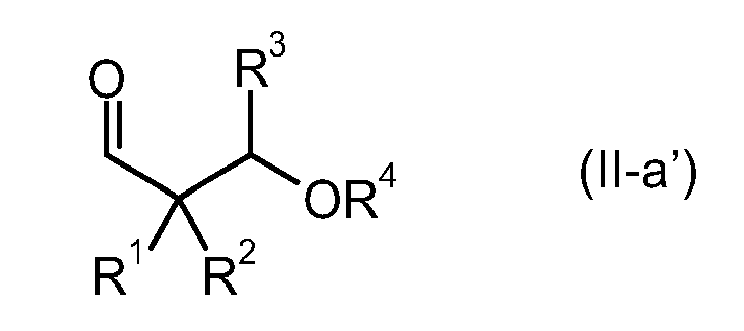
- Die Aldehyde ALD1 der Formel (II-a') stellen Ether von aliphatischen, arylaliphatischen oder cycloaliphatischen 2,2-disubstituierten 3-Hydroxyaldehyden mit Alkoholen oder Phenolen der Formel R4-OH, beispielsweise Fettalkoholen oder Phenol, dar. Geeignete 2,2-disubstituierte 3-Hydroxyaldehyde sind ihrerseits erhältlich aus Aldol-Reaktionen, insbesondere gekreuzten Aldol-Reaktionen, zwischen primären oder sekundären aliphatischen Aldehyden, insbesondere Formaldehyd, und sekundären aliphatischen, sekundären arylaliphatischen oder sekundären cycloaliphatischen Aldehyden, wie beispielsweise 2-Methylbutyraldehyd, 2-Ethylbutyraldehyd, 2-Methylvaleraldehyd, 2-Ethylcapronaldehyd, Cyclopentancarboxaldehyd, Cyclohexancarboxaldehyd, 1,2,3,6-Tetrahydrobenzaldehyd, 2-Methyl-3-phenylpropionaldehyd, 2-Phenylpropionaldehyd (Hydratropaldehyd) oder Diphenylacetaldehyd. Beispiele geeigneter 2,2-disubstituierter 3-Hydroxyaldehyde sind 2,2-Dimethyl-3-hydroxypropanal, 2-Hydroxymethyl-2-methyl-butanal, 2-Hydroxymethyl-2-ethyl-butanal, 2-Hydroxymethyl-2-methyl-pentanal, 2-Hydroxymethyl-2-ethyl-hexanal, 1-Hydroxymethyl-cyclopentancarboxaldehyd, 1-Hydroxymethyl-cyclohexancarboxaldehyd 1-Hydroxymethyl-cyclohex-3-encarbox-aldehyd, 2-Hydroxymethyl-2-methyl-3-phenyl-propanal, 3-Hydroxy-2-methyl-2-phenyl-propanal und 3-Hydroxy-2,2-diphenyl-propanal.
- Beispiele für Aldehyde ALD1 der Formel (II-a') sind 2,2-Dimethyl-3-phenoxy-propanal, 3-Cyclohexyloxy-2,2-dimethyl-propanal, 2,2-Dimethyl-3-(2-ethylhexyloxy)-propanal, 2,2-Dimethyl-3-lauroxy-propanal und 2,2-Dimethyl-3-stearoxy-propanal.
- Besonders geeignete Aldehyde der Formel (II-a) stellen andererseits Aldehyde ALD2 der Formel (II-a"), also Aldehyde ALD mit dem Rest R der Formel (III), dar.

- Die Aldehyde ALD2 der Formel (II-a") stellen Ester der bereits beschriebenen 2,2-disubstituierten 3-Hydroxyaldehyde mit geeigneten Carbonsäuren dar.
- Beispiele für geeignete Carbonsäuren sind gesättigte aliphatische Carbonsäuren, wie Ameisensäure, Essigsäure, Propionsäure, Buttersäure, Isobuttersäure, Valeriansäure, Capronsäure, 2-Ethyl-capronsäure, Oenanthsäure, Caprylsäure, Pelargonsäure, Caprinsäure, Undecansäure, Laurinsäure, Tridecansäure, Myristinsäure, Pentadecansäure, Palmitinsäure, Margarinsäure, Stearinsäure, Nonadecansäure, Arachinsäure; einfach ungesättigte aliphatische Carbonsäuren wie Palmitoleinsäure, Ölsäure, Erucasäure; mehrfach ungesättigte aliphatische Carbonsäuren wie Linolsäure, Linolensäure, Elaeostearinsäure, Arachidonsäure; cycloaliphatische Carbonsäuren wie Cyclohexancarbonsäure; aryaliphatische Carbonsäuren wie Phenylessigsäure; aromatische Carbonsäuren wie Benzoesäure, Naphthoesäure, Toluylsäure, Anissäure; Isomere dieser Säuren; Fettsäuregemische aus der technischen Verseifung von natürlichen Ölen und Fetten wie beispielsweise Rapsöl, Sonnenblumenöl, Leinöl, Ölbaumöl, Kokosnussöl, Ölpalmkernöl und Ölpalmöl; sowie Dicarbonsäuremonoalkyl- und -arylester, wie sie aus der einfachen Veresterung von Dicarbonsäuren wie Bernsteinsäure, Glutarsäure, Adipinsäure, Pimelinsäure, Korksäure, Azelainsäure, Sebacinsäure, 1,12-Dodecandisäure, Maleinsäure, Fumarsäure, Hexahydrophthalsäure, Hexahydroisophthalsäure, Hexahydroterephthalsäure, 3,6,9-Trioxaundecandisäure und ähnliche Derivate von Polyethylenglykol, mit Alkoholen wie Methanol, Ethanol, Propanol, Butanol, höheren Homologen und Isomeren dieser Alkohole erhalten werden.
- Bevorzugte Aldehyde ALD2 der Formel (II-a") sind 3-Benzoyloxy-2,2-dimethylpropanal, 3-Cyclohexanoyloxy-2,2-dimethylpropanal, 2,2-Dimethyl-3-(2-ethylhexyloxy)-propanal, 2,2-Dimethyl-3-lauroyloxy-propanal, 2,2-Dimethyl-3-myristoyloxypropanal, 2,2-Dimethyl-3-palmitoyloxy-propanal, 2,2-Dimethyl-3-stearoyloxypropanal und, sowie analoge Ester anderer 2,2-disubstituierter 3-Hydroxyaldehyde.
- In einer besonders bevorzugten Ausführungsform ist R5 ausgewählt aus der Gruppe bestehend aus Phenyl, Cyclohexyl, 2-Ethylhexyl und den C11-, C13-, C15- und C17-Alkylgruppen.
- Als Aldehyd ALD2 der Formel (II-a") meist bevorzugt ist 2,2-Dimethyl-3-lauroyloxypropanal.
- In einer bevorzugten Herstellmethode des Aldehyds ALD2 der Formel (II-a") wird ein 2,2-disubstituierter 3-Hydroxyaldehyd, insbesondere 2,2-Dimethyl-3-hydroxypropanal, welcher beispielsweise aus Formaldehyd (oder Paraformaldehyd) und Isobutyraldehyd, gegebenenfalls in situ, hergestellt werden kann, mit einer Carbonsäure zum entsprechenden Ester umgesetzt. Diese Veresterung kann ohne die Verwendung von Lösemitteln nach bekannten Methoden erfolgen, beschrieben beispielsweise in Houben-Weyl, "Methoden der organischen Chemie", Vol. VIII, Seiten 516 - 528.
- Die Aldehyde ALD2 der Formel (II-a") sind gegenüber den Aldehyden ALD1 der Formel (II-a') aufgrund ihrer einfachen Herstellbarkeit bevorzugt.
- In einer besonders bevorzugten Ausführungsform ist der Aldehyd ALD geruchsfrei. Geruchsfreie Aldehyde ALD sind einerseits insbesondere Aldehyde ALD1 der Formel (II-a'), in welchen der Rest R4 für einen Kohlenwasserstoffrest mit 11 bis 30 C-Atomen, der gegebenenfalls Heteroatome enthält, steht.
- Andererseits sind geruchsfreie Aldehyde ALD insbesondere Aldehyde ALD2 der Formel (II-a"), in welchen der Rest R5 entweder für eine lineare oder verzweigte Alkylgruppe mit 11 bis 30 Kohlenstoff-Atomen, gegebenenfalls mit cyclischen Anteilen, und gegebenenfalls mit mindestens einem Heteroatom, insbesondere mit mindestens einem Ether-Sauerstoff, oder für eine einfach oder mehrfach ungesättigte lineare oder verzweigte Kohlenwasserstoffkette mit 11 bis 30 Kohlenstoff-Atomen steht.
- Beispiele für geruchsfreie Aldehyde ALD2 der Formel (II-a") sind Veresterungsprodukte aus den bereits genannten 2,2-disubstituierten 3-Hydroxyaldehyden mit Carbonsäuren wie beispielsweise Laurinsäure, Tridecansäure, Myristinsäure, Pentadecansäure, Palmitinsäure, Margarinsäure, Stearinsäure, Nonadecansäure, Arachinsäure, Palmitoleinsäure, Ölsäure, Erucasäure, Linolsäure, Linolensäure, Elaeostearinsäure, Arachidonsäure, sowie Fettsäuregemische aus der technischen Verseifung von natürlichen Ölen und Fetten, wie beispielsweise Rapsöl, Sonnenblumenöl, Leinöl, Ölbaumöl, Kokosnussöl, Ölpalmkernöl und Ölpalmöl.
- Bevorzugte geruchsfreie Aldehyde ALD2 sind 2,2-Dimethyl-3-lauroyloxypropanal, 2,2-Dimethyl-3-myristoyloxypropanal, 2,2-Dimethyl-3-palmitoyloxypropanal und 2,2-Dimethyl-3-stearoyloxypropanal. Besonders bevorzugt ist 2,2-Dimethyl-3-lauroyloxypropanal.
- Das Diamin DA mit zwei primären aliphatischen Aminogruppen weist zwei primäre Aminogruppen auf, welche an einen aliphatischen, cycloaliphatischen oder arylaliphatischen Rest gebunden sind.
- Als Diamin DA geeignet sind aliphatische, cycloaliphatische oder arylaliphatische Diamine, beispielsweise Ethylendiamin, 1,2-Propandiamin, 1,3-Propandiamin, 2-Methyl-1,2-propandiamin, 2,2-Dimethyl-1,3-propandiamin, 1,3-Butandiamin, 1,4-Butandiamin, 1,3-Pentandiamin (DAMP), 1,5-Pentandiamin, 1,5-Diamino-2-methylpentan (MPMD), 1,6-Hexandiamin, 2,5-Dimethyl-1,6-hexandiamin, 2,2,4-Trimethylhexamethylendiamin, 2,4,4-Trimethylhexamethylendiamin, 1,7-Heptandiamin, 1,8-Octandiamin, 1,9-Nonandiamin, 1,10-Decandiamin, 1,11-Undecandiamin, 1,12-Dodecandiamin und Methyl-bis-(3-aminopropyl)amin, 1,2-, 1,3- und 1,4-Diaminocyclohexan, Bis-(4-aminocyclohexyl)-methan, Bis-(4-amino-3-methylcyclohexyl)-methan, Bis-(4-amino-3-ethylcyclohexyl)-methan, Bis-(4-amino-3,5-dimethylcyclohexyl)-methan, 1-Amino-3-aminomethyl-3,5,5-trimethylcyclohexan (= Isophorondiamin oder IPDA), 2- und 4-Methyl-1,3-diaminocyclohexan und Mischungen davon, 1,3-und 1,4-Bis-(aminomethyl)cyclohexan, 1-Cyclohexylamino-3-aminopropan, 2,5(2,6)-Bis-(aminomethyl)-bicyclo[2.2.1]heptan (NBDA, hergestellt von Mitsui Chemicals), 3(4),8(9)-Bis-(aminomethyl)-tricyclo[5.2.1.02,6]decan, 1,4-Diamino-2,2,6-trimethylcyclohexan (TMCDA), 3,9-Bis-(3-aminopropyl)-2,4,8,10-tetraoxa-spiro[5.5]undecan sowie 1,3- und 1,4-Xylylendiamin.
- Als Diamin DA besonders geeignet sind Ethergruppen-haltige aliphatische Diamine, beispielsweise Bis-(2-aminoethyl)ether, 3,6-Dioxaoctan-1,8-diamin, 4,7-Dioxadecan-1,10-diamin, 4,7-Dioxadecan-2,9-diamin, 4,9-Dioxadodecan-1,12-diamin, 5,8-Dioxadodecan-3,10-diamin und höhere Oligomere dieser Diamine, sowie Polyoxyalkylen-Diamine. Letztere stellen typischerweise Produkte aus der Aminierung von Polyoxyalkylen-Diolen dar und sind beispielsweise erhältlich unter dem Namen Jeffamine® (von Huntsman Chemicals), unter dem Namen Polyetheramin (von BASF) oder unter dem Namen PC Amine® (von Nitroil). Insbesondere geeignete Polyoxyalkylen-Diamine sind Jeffamine® D-230, Jeffamine® D-400, Jeffamine® D-2000, Jeffamine® D-4000, Jeffamine® XTJ-511, Jeffamine® ED-600, Jeffamine® ED-900, Jeffamine® ED-2003, Jeffamine® XTJ-568, Jeffamine® XTJ-569, Jeffamine® XTJ-523, Jeffamine® XTJ-536, Jeffamine® XTJ-542, Jeffamine® XTJ-559; Polyetheramin D 230, Polyetheramin D 400 und Polyetheramin D 2000, PC Amine® DA 250, PC Amine® DA 400, PC Amine® DA 650 und PC Amine® DA 2000.
- Als Diamin DA bevorzugt sind Ethergruppen-haltige aliphatische Diamine, insbesondere ein Ethergruppen-haltiges aliphatisches Diamin, welches ausgewählt ist aus der Gruppe bestehend aus Bis-(2-aminoethyl)-ether, 3,6-Dioxaoctan-1,8-diamin, 4,7-Dioxadecan-1,10-diamin, 4,7-Dioxadecan-2,9-diamin, 4,9-Dioxadodecan-1,12-diamin, 5,8-Dioxadodecan-3,10-diamin und höheren Oligomeren dieser Diamine, sowie Polyoxyalkylen-Diaminen der Formel (V').

- Hierbei stehen g, h und i jeweils für 0 oder eine ganze Zahl von 1 bis 40, mit der der Massgabe, dass die Summe von g, h und i ≥ 1 ist.
- Das Diamin DA der Formel (V') weist bevorzugt ein Molekulargewicht zwischen 200 und 5000 g/mol auf.
- Beispiele für Polyoxyalkylen-Diamine der Formel (V') sind die im Handel verfügbaren Typen Jeffamine® D-230, Jeffamine® D-400, Jeffamine® D-2000, Jeffamine® D-4000, Jeffamine® XTJ-511, Jeffamine® ED-600, Jeffamine® ED-900 und Jeffamine® ED-2003 (alle von Huntsman Chemical); Polyetheramin D 230, Polyetheramin D 400 und Polyetheramin D 2000 (alle von BASF); sowie PC Amine® DA 250, PC Amine® DA 400, PC Amine® DA 650 und PC Amine® DA 2000 (alle von Nitroil).
- Das Diisocyanat DI ist entweder ein monomeres Diisocyanat oder ein oligomeres Derivat davon, oder ein Isocyanatgruppen aufweisendes Polyurethanpolymer P.
- Geeignete monomere Diisocyanate oder oligomere Derivate davon sind beispielsweise 1,6-Hexamethylendiisocyanat (HDI), 2-Methylpenta-methylen-1,5-diisocyanat, 2,2,4- und 2,4,4-Trimethyl-1,6-hexamethylendiisocyanat (TMDI), 1,10-Decamethylendiisocyanat, 1,12-Dodecamethylendiisocyanat, Lysin- und Lysinesterdiisocyanat, Cyclohexan-1,3- diisocyanat, Cyclohexan-1,4-diisocyanat und beliebige Gemische dieser Isomeren, 1-Methyl-2,4- und -2,6-diisocyanatocyclohexan und beliebige Gemische dieser Isomeren (HTDI oder H6TDI), 1-Isocyanato-3,3,5-trimethyl-5-isocyanatomethylcyclohexan (=Isophorondiisocyanat oder IPDI), Perhydro-2,4'-diphenylmethandiisocyanat und Perhydro-4,4'-diphenylmethandiisocyanat (HMDI oder H12MDI), 1,4-Diisocyanato-2,2,6-trimethylcyclohexan (TMCDI), 1,3- und 1,4-Bis-(isocyanatomethyl)-cyclohexan, m- und p-Xylylendiisocyanat (m- und p-XDI), m- und p-Tetramethyl-1,3- und -1,4-xylylendiisocyanat (m- und p-TMXDI), Bis-(1-Isocyanato-1-methylethyl)-naphthalin, 2,4- und 2,6-Toluylendiisocyanat und beliebige Gemische dieser Isomeren (TDI), 4,4'-, 2,4'- und 2,2'-Diphenylmethandiisocyanat und beliebige Gemische dieser Isomeren (MDI), 1,3- und 1,4-Phenylendiisocyanat, 2,3,5,6-Tetramethyl-1,4-diisocyanatobenzol, Naphthalin-1,5-diisocyanat (NDI), 3,3'-Dimethyl-4,4'-diisocyanato-diphenyl (TODI), Dianisidindiisocyanat (DADI), Oligomere der vorgenannten Isocyanate, beispielsweise in Form von Uretdionen, Allophanaten und Oxadiazintrionen oder in Form von Addukten mit kurzkettigen Polyolen, sowie beliebige Mischungen der vorgenannten Isocyanate und Oligomeren.
- Bevorzugt sind MDI, TDI, HDI und IPDI. Besonders bevorzugt sind MDI und TDI.
- Das Diisocyanat DI ist bevorzugt ein Isocyanatgruppen aufweisendes Polyurethanpolymer P.
- Geeignete Isocyanatgruppen aufweisende Polyurethanpolymere P weisen zwei Isocyanatgruppen auf und stellen ein Produkt aus der Umsetzung von mindestens einem Diol mit mindestens einem Diisocyanat, insbesondere mit mindestens einem Diisocyanat, welches aus den oben beschriebenen monomeren Diisocyanaten ausgewählt ist, dar. Als monomeres Diisocyanat wird hierfür insbesondere ein aromatisches Diisocyanat, insbesondere 2,4- oder 2,6-Toluylendiisocyanat (TDI) oder 4,4'-, 2,4'- oder 2,2'-Diphenylmethandiisocyanat (MDI), bevorzugt.
- Für die Umsetzung zum Isocyanatgruppen aufweisenden Polyurethanpolymer P geeignete Diole sind insbesondere Polyetherdiole, Polyesterdiole und Polycarbonatdiole, sowie Mischungen dieser Diole.
- Als Polyetherdiole, auch Polyoxyalkylendiole genannt, sind insbesondere jene geeignet, welche Polymerisationsprodukte von Ethylenoxid, 1,2-Propylenoxid, 1,2- oder 2,3-Butylenoxid, Tetrahydrofuran oder Mischungen davon sind, eventuell polymerisiert mit Hilfe eines Startermoleküls mit zwei aktiven Wasserstoffatomen wie beispielsweise Wasser, 1,2-Ethandiol, 1,2- und 1,3-Propandiol, Neopentylglykol, Diethylenglykol, Triethylenglykol, die isomeren Dipropylenglykole und Tripropylenglykole, die isomeren Butandiole, Pentandiole, Hexandiole, Heptandiole, Octandiole, Nonandiole, Decandiole, Undecandiole, 1,3- und 1,4-Cyclohexandimethanol, Bisphenol A, hydriertes Bisphenol A, Anilin, sowie kurzkettigere Polyetherdiole, sowie Mischungen der vorgenannten Verbindungen. Eingesetzt werden können sowohl Polyoxyalkylendiole, die einen niedrigen Ungesättigtheitsgrad aufweisen (gemessen nach ASTM D-2849-69 und angegeben in Milliequivalent Ungesättigtheit pro Gramm Diol (mEq/g)), hergestellt beispielsweise mit Hilfe von sogenannten Double Metal Cyanide Complex Katalysatoren (DMC-Katalysatoren), als auch Polyoxyalkylendiole mit einem höheren Ungesättigtheitsgrad, hergestellt beispielsweise mit Hilfe von anionischen Katalysatoren wie NaOH, KOH oder Alkalialkoholaten.
- Besonders geeignete Polyoxyalkylendiole sind Polyoxyethylendiole sowie Polyoxypropylendiole.
- Besonders geeignet sind Polyoxypropylendiole mit einem Ungesättigtheitsgrad tiefer als 0.02 mEq/g und einem Molekulargewicht im Bereich von 1000 bis 30'000 g/mol, sowie Polyoxypropylendiole mit einem Molekulargewicht von 400 bis 8'000 g/mol. Unter "Molekulargewicht" versteht man im vorliegenden Dokument stets das Molekulargewichtsmittel Mn. Insbesondere geeignet sind Polyoxypropylendiole mit einem Ungesättigtheitsgrad tiefer als 0.02 mEq/g und einem Molekulargewicht im Bereich von 1000 bis 12'000 g/mol, insbesondere zwischen 1000 und 8000 g/mol. Solche Polyetherdiole werden beispielsweise unter dem Handelsnamen Acclaim® von Bayer vertrieben.
- Ebenfalls besonders geeignet sind sogenannte "EO-endcapped" (ethylene oxide-endcapped) Polyoxypropylendiole. Letztere sind spezielle Polyoxypropylenpolyoxyethylendiole, die beispielsweise dadurch erhalten werden, dass reine Polyoxypropylendiole nach Abschluss der Polypropoxylierung mit Ethylenoxid alkoxyliert werden und dadurch primäre Hydroxylgruppen aufweisen.
- Als Polyesterdiole geeignet sind zwei Hydroxylgruppen tragende Polyester, welche nach bekannten Verfahren, insbesondere der Polykondensation von Hydroxycarbonsäuren oder der Polykondensation von aliphatischen und/oder aromatischen Dicarbonsäuren mit zweiwertigen Alkoholen, hergestellt werden.
- Insbesondere geeignet sind Polyesterdiole, welche hergestellt sind aus zweiwertigen Alkoholen, wie beispielsweise Ethylenglykol, Diethylenglykol, Propylenglykol, Dipropylenglykol, Neopentylglykol, 1,4-Butandiol, 1,5-Pentandiol, 3-Methyl-1,5-hexandiol, 1,6-Hexandiol, 1,8-Octandiol, 1,10-Decandiol, 1,12-Dodecandiol, 1,12-Hydroxystearylalkohol, 1,4-Cyclohexandimethanol, Dimerfettsäurediol (Dimerdiol), Hydroxypivalinsäureneopentylglykolester oder Mischungen der vorgenannten Alkohole, mit organischen Dicarbonsäuren, oder deren Anhydride oder Ester, wie beispielsweise Bernsteinsäure, Glutarsäure, Adipinsäure, Trimethyladipinsäure, Korksäure, Azelainsäure, Sebacinsäure, Dodecandicarbonsäure, Maleinsäure, Fumarsäure, Dimerfettsäure, Phthalsäure, Phthalsäureanhydrid, Isophthalsäure, Terephthalsäure, Dimethylterephthalat, Hexahydrophthalsäure oder Mischungen der vorgenannten Säuren, sowie Polyesterdiole aus Lactonen wie beispielsweise aus ε-Caprolacton und Startern wie den vorgenannten zweiwertigen Alkoholen.
- Insbesondere geeignete Polyesterdiole sind solche, welche aus Adipinsäure, Azelainsäure, Sebacinsäure, Dodecandicarbonsäure, Dimerfettsäure, Phthalsäure, Isophthalsäure und Terephthalsäure als Dicarbonsäure und aus Ethylenglykol, Diethylenglykol, Neopentylglykol, 1,4-Butandiol, 1,6-Hexandiol, Dimerfettsäurediol und 1,4-Cyclohexandimethanol als zweiwertigem Alkohol hergestellt werden. Insbesondere geeignet sind auch Polyesterdiole hergestellt aus ε-Caprolacton und einem der vorgenannten zweiwertigen Alkohole als Starter.
- Die Polyesterdiole weisen vorteilhaft ein Molekulargewicht von 1000 bis 15'000 g/mol, insbesondere von 1500 bis 8000 g/mol, insbesondere von 1700 bis 5500 g/mol, auf.
- Insbesondere geeignet sind bei Raumtemperatur flüssige, amorphe, teilkristalline und kristalline Polyesterdiole. Besonders geeignet sind bei Raumtemperatur flüssige Polyesterdiole, sowie Mischungen aus amorphen und bei Raumtemperatur flüssigen Polyesterdiolen.
- Als Polycarbonatdiole geeignet sind jene, wie sie durch Polykondensation beispielsweise der oben genannten - zum Aufbau der Polyesterdiole eingesetzten - zweiwertigen Alkohole mit Dialkylcarbonaten, wie Dimethylcarbonat, Diarylcarbonaten, wie Diphenylcarbonat, oder Phosgen zugänglich sind.
- Besonders geeignet sind bei Raumtemperatur flüssige oder amorphe Polycarbonatdiole.
- Für die Umsetzung zum Isocyanatgruppen aufweisenden Polyurethanpolymer P weiterhin geeignete Diole sind zwei Hydroxylgruppen tragende Blockcopolymere, welche mindestens zwei verschiedene Blöcke mit Polyether-, Polyester- und/oder Polycarbonatstruktur der oben beschriebenen Art aufweisen.
- Für die Umsetzung zum Isocyanatgruppen aufweisenden Polyurethanpolymer P bevorzugte Diole sind Polyoxyalkylendiole, insbesondere Polyoxyethylendiole, Polyoxypropylendiole und Polyoxypropylenpolyoxyethylendiole.
- Die Herstellung des Isocyanatgruppen aufweisenden Polyurethanpolymers P erfolgt in an sich bekannter Art und Weise, entweder direkt aus den Diisocyanaten und den Diolen, oder durch schrittweise Adduktionsverfahren, wie sie auch als Kettenverlängerungsreaktionen bekannt sind.
- In einer bevorzugten Ausführungsform wird das Isocyanatgruppen aufweisende Polyurethanpolymer P über die Umsetzung von mindestens einem Diisocyanat mit mindestens einem Diol hergestellt, wobei die Isocyanatgruppen gegenüber den Hydroxylgruppen im stöchiometrischen Überschuss vorliegen. Vorteilhaft beträgt das Verhältnis zwischen Isocyanat- und Hydroxylgruppen 1.3 bis 2.5, insbesondere 1.5 bis 2.2.
- Das Dialdimin der Formel (I) weist vorzugsweise ein Molekulargewicht von 1'000 bis 30'000 g/mol,insbesondere von 2'000 bis 30'000 g/mol, bevorzugt von 4'000 bis 30'000 g/mol, meist bevorzugt von 6'000 bis 20'000 g/mol, auf.
- Das Dialdimin der Formel (I) lässt sich nach dem im Folgenden beschriebenen Verfahren, welches einen weiteren Aspekt der Erfindung darstellt, herstellen.
- Dieses Verfahren umfasst den Schritt der Umsetzung eines Diisocyanates DI mit einem Dialdimin der Formel (IV), insbesondere der Formel (IV') oder der Formel (IV"), in Gegenwart von Wasser.


- Diese Umsetzung wird dabei so geführt, dass das molare Verhältnis

- Der gewählte Wert des molaren Verhältnisses von [Diisocyanat DI] / [Dialdimin der Formel (IV) oder (IV') oder (IV")] bestimmt dabei direkt die mittlere Kettenlänge, d.h. die Grösse von n in Formel (I) und damit das mittlere Molekulargewicht des Dialdimins der Formel (I). Je näher der Wert des Verhältnisses an 1 liegt, desto grösser ist das Ausmass der Kettenverlängerungsreaktion und desto höher damit das mittlere Molekulargewicht des Dialdimins der Formel (I).
- Vorzugsweise wird bei der Herstellung des Dialdimins der Formel (I) zuerst das Diisocyanat DI mit dem Dialdimin der Formel (IV) oder (IV') oder (IV") gemischt und anschliessend Wasser hinzugegeben.
- Bei dieser Umsetzung wird mindestens ein Aldehyd ALD der Formel R-CHO freigesetzt.
- Das Dialdimin der Formel (I) wird insbesondere in Form einer Emulsion verwendet.
- Ein weiterer Aspekt der vorliegenden Erfindung betrifft somit eine aldiminhaltige Emulsion.
- Die aldiminhaltige Emulsion umfasst
- a) mindestens ein Dialdimin der Formel (I), wie es vorgängig beschrieben wurde;
- b) Wasser; und
- c) gegebenenfalls mindestens ein Tensid.
- Es ist auch möglich, dass die aldiminhaltige Emulsion aus a), b) und gegebenenfalls c) besteht.
Vorzugsweise umfasst eine aldiminhaltige Emulsion mindestens ein Tensid. - Als Tenside können natürliche oder synthetische Stoffe verwendet werden, welche in Lösungen die Oberflächenspannung des Wassers oder anderer Flüssigkeiten herabsetzen. Als Tenside, auch Netzmittel genannt, können anionische, kationische, nichtionische oder ampholytische Tenside oder deren Mischungen verwendet werden.
- Beispiele für anionische Tenside sind Carboxylat-, Sulfat-, Phosphat- oder Sulfonat-Gruppen aufweisende Verbindungen, wie zum Beispiel Fettalkoholethersulfate, Fettalkoholsulfate, Seifen, Alkylsulfonate, Olefinsulfonate, Arylsulfonate, Alkylarylsulfonate und Alkylphosphate.
- Beispiele für kationische Tenside sind quaternäre Ammonium- oder Phosphoniumverbindungen, wie zum Beispiel Tetraalkylammoniumsalze, Dimethyldistearyl-ammoniumsalze und N-Alkylpyridiniumsalze, insbesondere die Chloride davon.
- Zu den nichtionischen Tensiden, den sogenannten Niotensiden, gehören beispielsweise Ethoxylate von Alkoholen, Phenolen, Alkylphenolen, Aminen, Fettaminen, Fettsäuren, Fettsäureamiden, Polysiloxanen und Fettsäureester, auch Alkyl- oder Alkylphenyl-polyglykolether, wie zum Beispiel Fettalkoholpolyglykolether, oder Fettsäureamide, Alkylglykoside, Zuckerester, Sorbitanester, Polysorbate oder Trialkylaminoxide, auch Ester und Amide von Poly(meth)acrylsäuren mit Polyalkylenglykolen oder Aminopolyalkylenglykolen, die einseitig mit Alkylgruppen abgeschlossen sein können.
- Zu den ampholytischen oder amphoterischen Tensiden gehören amphotere Elektrolyte, sogenannte Ampholyte, wie zum Beispiel Aminocarbonsäuren, und Betaine.
- Derartige Tenside sind kommerziell breit erhältlich.
- Als besonders geeignet haben sich anionische Tenside gezeigt.
- Vorteilhaft wird die aldiminhaltige Emulsion dadurch erhalten, dass dem Dialdimin der Formel (I) Wasser sowie gegebenenfalls das Tensid unter Rühren beigegeben werden.
- Es ist dem Fachmann klar, dass die aldiminhaltige Emulsion auch anders hergestellt werden kann.
- Zwar ist dem Fachmann bekannt, dass bei der Herstellung einer Emulsion verschiedene Parameter, wie Temperatur, Rührgeschwindigkeit und Art und Geometrie der Rührwerkzeuge, einen wichtigen Einfluss auf die Qualität der Emulsion ausüben. Es zeigte sich jedoch, dass diese Parameter bei der Herstellung der hier besprochenen aldiminhaltigen Emulsion eher unkritisch sind. So liess sich die aldiminhaltige Emulsion auf verschiedensten Rührwerken ohne grosse Anpassung der Rührparameter schnell, reproduzierbar und in guter Qualität herstellen.
- Es kann weiterhin von Vorteil sein, dass die aldiminhaltige Emulsion weitere Bestandteile umfasst. Insbesondere als weitere Bestandteile zu nennen sind Co-Emulgatoren, Entschäumungsmittel, Stabilisatoren, Biozide, wie Fungizide, Bakteriozide oder Algizide, Haftvermittler, Lösemittel, Weichmacher, Katalysatoren, Füllstoffe und Rheologiehilfsmittel, insbesondere Verdickungsmittel und Thixotropiermittel.
- Die aldiminhaltige Emulsion kann organische Lösemittel aufweisen oder nicht. Wenn organische Lösemittel eingesetzt werden, ist es vorteilhaft, wenn diese keine VOC-Lösemittel (VOC = Volatile Organic Compounds) sind. Es gibt jedoch sehr viele unterschiedliche Definitionen von "flüchtigen organischen Verbindungen" bzw. "VOC". So wird beispielsweise ein VOC nach der EU-Richtline 2004/42/EG als eine organische Verbindung mit einem Siedepunkt von höchstens 250 °C bei einem Standarddruck von 101,3 kPa definiert. Gemäss der Schweizer Verordnung über die Lenkungsabgabe auf flüchtige organische Verbindungen werden VOC als organische Verbindungen mit einem Dampfdruck von mindestens 0.1 mbar bei 20 °C oder einem Siedepunkt von höchstens 240 °C bei 1013.25 mbar definiert. Im vorliegenden Dokument gelten als "flüchtige organische Verbindungen" oder "VOC" organische Verbindungen, welche einen Siedepunkt von höchstens 250 °C bei Normdruck (1013 mbar) oder einen Dampfdruck von mindestens 0.1 mbar bei 20 °C aufweisen.
- Insbesondere handelt es sich bei derartigen Lösemitteln, welche nicht VOC sind, um Carbonsäureester.
- Die aldiminhaltige Emulsion ist bevorzugt frei von N-Alkylpyrrolidonen. Insbesondere enthält die aldiminhaltige Emulsion kein N-Methylpyrrolidon (NMP).
- Als Katalysatoren eignen sich vor allem tertiäre Amine, insbesondere Trialkylamine wie beispielsweise Triethylamin, sowie Morpholinether-Derivate wie Dimorpholinodiethylether, Tetramethyl-dimorpholinodiethylether, Polyethylenglycoldimorphonlinoether und dergleichen.
- Es hat sich als besonders vorteilhaft erwiesen, wenn die aldiminhaltige Emulsion neben mindestens einem Dialdimin der Formel (I) und Wasser zusätzlich mindestens ein Tensid, mindestens einen Füllstoff, insbesondere eine Kreide oder eine pyrogene Kieselsäure aufweist. Weiterhin weist die aldiminhaltige Emulsion vorzugsweise mindestens einen Katalysator auf.
- Vorzugsweise hat die aldiminhaltige Emulsion eine pastöse Konsistenz, d.h. sie ist nicht selbstfliessend.
- Die aldiminhaltige Emulsion ist stabil und kann verpackt und gelagert werden. Bei der Lagerung der aldiminhaltigen Emulsion ist jedoch darauf zu achten, dass die Temperatur nicht unter den Gefrierpunkt der Emulsion fällt, da sonst die Gefahr besteht, dass die Emulsion bricht. Eine gebrochene Emulsion kann bei ihrer Verwendung schwerwiegende Nachteile zur Folge haben.
- Die beschriebene aldiminhaltige Emulsion ist breit anwendbar. In einer bevorzugten Ausführungsform wird die aldiminhaltige Emulsion als Härterkomponente oder als Beschleunigerkomponente für einen Klebstoff, Dichtstoff oder Beschichtungsstoff, welcher Isocyanatgruppen aufweisende Polymere, insbesondere Isocyanatgruppen aufweisende Polyurethanpolymere, enthält, verwendet.
- In einem weiteren Aspekt betrifft die vorliegende Erfindung somit eine zweikomponentige Zusammensetzung, welche aus den zwei Komponenten K1 und K2 besteht.
- Die erste Komponente, Komponente K1, enthält mindestens ein Isocyanatgruppen aufweisendes Polymer, insbesondere mindestens ein Isocyanatgruppen aufweisendes Polyurethanpolymer P, wie vorgängig beschrieben, oder besteht daraus.
- Die zweite Komponente, Komponente K2, enthält ein Dialdimin der Formel (I), wie vorgängig beschrieben, oder eine aldiminhaltige Emulsion, wie vorgängig beschrieben, oder besteht daraus.
- Vorteilhaft enthält die Komponente K1 mindestens einen Füllstoff. Der Füllstoff beeinflusst beispielsweise sowohl die Konsistenz der nicht ausgehärteten Zusammensetzung als auch die mechanischen Eigenschaften der ausgehärteten Zusammensetzung. Geeignete Füllstoffe sind anorganische und organische Füllstoffe, zum Beispiel natürliche, gemahlene oder gefällte Calciumcarbonate, welche gegebenenfalls mit Fettsäuren, insbesondere Stearaten, beschichtet sind, calcinierte Kaoline, Aluminiumoxide, Aluminiumhydroxide, Baryt (BaSO4, auch Schwerspat genannt), Kieselsäuren, insbesondere hochdisperse Kieselsäuren aus Pyrolyseprozessen, Russe, insbesondere industriell hergestellte Russe (im Folgenden als "Russ" bezeichnet), PVC-Pulver oder Hohlkugeln. Bevorzugte Füllstoffe sind Calciumcarbonate, Kaoline, pyrogene Kieselsäuren und Russ. Es kann von Vorteil sein, eine Mischung verschiedener Füllstoffe einzusetzen.
- Eine geeignete Menge Füllstoff liegt beispielsweise im Bereich von 10 bis 70 Gewichts-%, bevorzugt 20 bis 60 Gewichts-%, bezogen auf die gesamte Komponente K1.
- Vorteilhaft enthält die Komponente K1 weiterhin mindestens einen Katalysator, welcher die Reaktion der Isocyanatgruppen und / oder die Hydrolyse der Aldimingruppen beschleunigt.
- Katalysatoren, welche die Reaktion der Isocyanatgruppen mit Wasser beschleunigen, sind insbesondere Metallverbindungen, beispielsweise Zinnverbindungen wie Dibutylzinndiacetat, Dibutylzinndilaurat, Dibutylzinndistearat, Dibutylzinndiacetylacetonat, Dioctylzinndilaurat, Dibutylzinndichlorid und Dibutylzinnoxid, Zinn(II)-carboxylate, Stannoxane wie Laurylstannoxan, Bismutverbindungen wie Bismut(III)-octoat, Bismut(III)-neodecanoat oder Bismut(III)-oxinate; sowie tertiäre Amine, beispielsweise 2,2'-Dimorpholinodiethylether und andere Morpholinether-Derivate.
- Katalysatoren, welche die Hydrolyse von Aldimingruppen beschleunigen, sind insbesondere Säuren oder zu Säuren hydrolysierbare Verbindungen, beispielsweise organische Carbonsäuren wie Benzoesäure, Salicylsäure oder 2-Nitrobenzoesäure, organische Carbonsäureanhydride wie Phthalsäureanhydrid oder Hexahydrophthalsäureanhydrid, Silylester von organischen Carbonsäuren, organische Sulfonsäuren wie Methansulfonsäure, p-Toluolsulfonsäure oder 4-Dodecylbenzolsulfonsäure, oder weitere organische oder anorganische Säuren.
- Es können auch Kombinationen der genannten Katalysatoren vorhanden sein, insbesondere Mischungen von Säuren und Metallverbindungen, oder von Metallverbindungen und tertiären Aminen, oder von Säuren und tertiären Aminen, oder von Säuren und Metallverbindungen und tertiären Aminen.
- Ein typischer Gehalt an Katalysator beträgt 0.005 bis 1 Gewichts-%, bezogen auf die gesamte Komponente K1, wobei dem Fachmann klar ist, welche Einsatzmengen für welche Katalysatoren hierfür sinnvoll sind.
- Vorteilhaft enthält die Komponente K1 weiterhin mindestens einen Weichmacher. Geeignete Weichmacher sind beispielsweise Ester organischer Carbonsäuren oder deren Anhydride, zum Beispiel Phthalate wie Dioctylphthalat, Diisononylphtalat oder Diisodecylphthalat, Adipate wie Dioctyladipat, Azelate und Sebacate; organische Phosphor- und Sulfonsäureester und Polybutene.
- Weitere mögliche Bestandteile der Komponente K1 sind unter anderem die folgenden Hilfs- und Zusatzmittel:
- Lösemittel, insbesondere Lösemittel, welche nicht VOC sind;
- Fasern, beispielsweise aus Polyethylen;
- Pigmente, beispielsweise Titandioxid oder Eisenoxide;
- weitere in der Polyurethanchemie übliche Katalysatoren;
- Rheologie-Modifizierer wie beispielsweise Verdickungsmittel oder Thixotropiermittel, zum Beispiel Harnstoffverbindungen, Polyamidwachse, Bentonite oder pyrogene Kieselsäuren;
- Reaktivverdünner oder Vernetzer, beispielsweise Oligomere oder Polymere von Diisocyanaten wie MDI, PMDI, TDI, HDI, 1,12-Dodecamethylendiisocyanat, Cyclohexan-1,3- oder 1,4-diisocyanat, IPDI, Perhydro-2,4'- und - 4,4'-diphenylmethandiisocyanat (H12MDI), 1,3- und 1,4-Tetramethylxylylendiisocyanat, insbesondere Isocyanurate, Carbodiimide, Uretonimine, Biurete, Allophanate und Iminooxadiazindione der genannten Diisocyanate, Addukte von Diisocyanaten mit kurzkettigen Polyolen, Adipinsäuredihydrazid und andere Dihydrazide, sowie blockierte Härter in Form von Polyaldiminen, Polyketiminen, Oxazolidinen oder Polyoxazolidinen;
- Trocknungsmittel, wie beispielsweise Molekularsiebe, Calciumoxid, hochreaktive Isocyanate wie p-Tosylisocyanat, Orthoameisensäureester, Alkoxysilane wie Tetraethoxysilan, Organoalkoxysilane wie Vinyltrimethoxysilan, und Organoalkoxysilane, welche in α-Stellung zur Silangruppe eine funktionelle Gruppe aufweisen;
- Haftvermittler, insbesondere Organoalkoxysilane, im Folgenden "Silane" genannt, wie beispielsweise Epoxysilane, Vinylsilane, (Meth)acrylsilane, Isocyanatosilane, Carbamatosilane, S-(Alkylcarbonyl)-mercaptosilane und Aldiminosilane, sowie oligomere Formen dieser Silane;
- Stabilisatoren gegen Wärme, Licht- und UV-Strahlung;
- flammhemmende Substanzen;
- oberflächenaktive Substanzen wie beispielsweise Netzmittel, Verlaufsmittel, Entlüftungsmittel oder Entschäumer;
- Biozide, wie beispielsweise Algizide, Fungizide oder das Pilzwachstum hemmende Substanzen;
- Besonders deutlich sind die Vorteile der vorliegenden Erfindung in den Fällen ersichtlich, in denen die Komponente K1 als weitere Bestandteile sowohl Füllstoffe als auch Polyaldimine enthält.
- Es ist vorteilhaft, alle der genannten, in der Komponente K1 gegebenenfalls enthaltenen Bestandteile, insbesondere einen Füllstoff, einen Katalysator sowie einen Weichmacher, so auszuwählen, dass die Lagerstabilität der Komponente K1 durch die Anwesenheit eines solchen Bestandteils nicht beeinträchtigt ist, das heisst, dass sich die Komponente K1 in ihren Eigenschaften, insbesondere den Applikations- und Aushärtungseigenschaften, bei der Lagerung nicht oder nur wenig verändert. Dies bedingt, dass zur chemischen Aushärtung der Komponente K1 führende Reaktionen, insbesondere der Isocyanatgruppen, während der Lagerung nicht in signifikantem Ausmass auftreten. Es ist deshalb insbesondere wichtig, dass die genannten Bestandteile kein oder höchstens Spuren von Wasser enthalten oder beim Lagern freisetzen. Es kann sinnvoll sein, gewisse Bestandteile vor dem Einmischen in die Komponente K1 chemisch oder physikalisch zu trocknen.
- Die Komponente K1 wird unter Ausschluss von Feuchtigkeit hergestellt und aufbewahrt. In einer geeigneten, klimadichten Verpackung oder Anordnung, wie beispielsweise in einem Fass, einem Beutel oder einer Kartusche, verfügt sie über eine hervorragende Lagerstabilität. Mit den Begriffen "lagerstabil" und "Lagerstabilität" in Zusammenhang mit einer Zusammensetzung wird im vorliegenden Dokument der Sachverhalt bezeichnet, dass die Viskosität der Zusammensetzung bei gegebener Applikationstemperatur und bei geeigneter Lagerung in der betrachteten Zeitspanne nicht oder höchstens so stark ansteigt, dass die Zusammensetzung auf die vorgesehene Weise verwendbar bleibt.
- Typischerweise ist die Komponente K1 ein feuchtigkeitshärtender einkomponentiger Polyurethan-Klebstoff oder -Dichtstoff, wie sie kommerziell breit erhältlich sind. Beispielsweise werden derartige Klebstoffe unter dem Namen Sikaflex® oder SikaTack® von Sika Schweiz AG angeboten.
- Die Komponente K1 reagiert für sich allein genommen, das heisst ohne Komponente K2, mit Luftfeuchtigkeit und härtet dadurch aus. Allerdings ist diese Aushärtung sehr langsam; ausserdem tritt bei einer derartigen Aushärtung gelegentlich Blasenbildung auf. Durch die beschriebene Verwendung der zweiten (Aldimin-enthaltenden) Komponente K2 wird jedoch die Aushärtung stark beschleunigt und die Blasenbildung unterdrückt.
- Die Komponente K2 kann weitere Bestandteile enthalten, insbesondere solche, wie sie für die Komponente K1 oben aufgeführt sind, unter der Bedingung, dass diese weiteren Bestandteile mit den anderen Bestandteilen der Komponente K2 lagerstabil sind. Die Komponente K2 wird nach der Herstellung in eine geeignete, verschlossene Verpackung oder Anordnung, wie beispielsweise in ein Fass, einen Beutel oder eine Kartusche, abgefüllt und kann in dieser Verpackung gelagert und transportiert werden.
- Es ist auch möglich, dass die Verpackungen der Komponenten K1 und K2 miteinander verbunden sind. So ist es beispielsweise möglich, Komponenten K1 und K2 in je eine Kammer einer Doppelkartusche abzufüllen. Beispielsweise sind dies sogenannte Coaxialkartuschen oder Zwillingskartuschen. Derartige Verpackungen, welche in örtlich voneinander getrennten Kammern Komponente K1 und K2 enthalten, sind insofern vorteilhaft, als die zwei Komponenten bei der Lagerung und beim Transport untrennbar oder unverlierbar zusammen bleiben und somit für die Applikation der zweikomponentigen Zusammensetzung nicht zuerst zusammengesucht, bzw. zusammengestellt, werden müssen.
- Die zwei Komponenten K1 und K2 werden vor oder während der Applikation der zweikomponentigen Zusammensetzung miteinander vermischt. Die Vermischung kann auf verschiedene Art und Weise erfolgen.
- Insbesondere kann die Vermischung weitgehend homogen oder inhomogen erfolgen. Die Vermischung der zwei Komponenten erfolgt vorzugsweise über einen Statikmischer oder über einen dynamischen Mischer. Daraus resultiert eine vermischte oder teilvermischte zweikomponentige Zusammensetzung.
- Die
Figuren 1a bis 1f zeigen einige Beispiele für derartige Vermischungen. DieFiguren 2a bis 2f zeigen Beispiele für Mischvorrichtungen, mit welchem derartige Mischbilder erreicht werden können. - In einer Ausführungsform erfolgt die Vermischung der beiden Komponenten K1 und K2 im Wesentlichen homogen.
- Dies kann insbesondere durch die Verwendung von dynamischen Mischern erreicht werden. Es ist auch möglich, durch die Verwendung von Statikmischern mit vielen Mischelementen zu einer im Wesentlichen homogenen Vermischung zu kommen.
- Wie der Fachmann weiss, ist der Term "homogen vermischt" im Kontext von pastösen Kleb- und Dichtstoffen, wie sie hier besprochen sind, nicht absolut zu verstehen. Der Term bedeutet in der üblichen Verwendung nämlich, dass von Auge keine Mischgrenzen mehr sichtbar sind, während dies beispielsweise unter dem Mikroskop durchaus noch möglich ist. Aufgrund von experimentellen Erkenntnissen kann davon ausgegangen werden, dass bei der Verwendung von Statikmischern des Typs Sulzer Quadro® (erhältlich von der Firma Sulzer Chemtech) mit 18 oder mehr Statikmischer-Elementen die Vermischung von zwei pastösen Komponenten im Wesentlichen homogen erfolgt.
- In einer weiteren Ausführungsform erfolgt die Vermischung der beiden Komponenten K1 und K2 im Wesentlichen inhomogen, beispielsweise in Form einer schichtenartigen oder einer strangartigen Vermischung.
- Eine schichtenartige Vermischung kann insbesondere durch die Verwendung von Statikmischern erreicht werden, wobei diese eine begrenzte Zahl von Statikmischer-Elementen aufweisen. Hierfür kann beispielsweise ein Dosieradapter, wie er in
WO 95/24556 A1 - Die Zahl der Statikmischer-Elemente beträgt insbesondere 6 bis 16, bevorzugt 6 bis 12.
- Eine strangartige Vermischung ergibt sich in einer Variante dadurch, dass ein oder mehrere Stränge der Komponente K2 von der Komponente K1 ummantelt werden. Dies kann durch eine Applikationsapparatur, wie sie in
EP 1 728 840 A1 beschrieben ist, erfolgen. Der gesamte Inhalt dieses Dokumentes wird hiermit in die Offenbarung der vorliegenden Erfindung mit eingeschlossen. In einer weiteren Variante wird ein Strang aus den miteinander vermischten Komponenten K1 und K2 von der Komponente K1 ummantelt. Diese Variante hat den Vorteil, dass im Kern der Raupe, das heisst dort, wo die Komponenten K1 und K2 vermischt sind, eine schnelle Aushärtung erfolgt, während die Oberfläche der Raupe im Wesentlichen lediglich über Luftfeuchtigkeit aushärtet, da dort keine Komponente K2 vorhanden ist. Dies führt dazu, dass die Offenzeit (beschränkt durch die Hautbildung) einer derartigen Raupe im Gegensatz zu einer Raupe, welche über den gesamten Querschnitt aus den vermischten Komponenten K1 und K2 besteht, verlängert ist, so dass die Vorteile einer langer Offenzeit und einer schnellen Aushärtung kombiniert werden. Eine Möglichkeit, eine derartige Ummantelung zu erzielen, bietet ein Statikmischer, wie er inWO 02/32562 A1 - Es hat sich besonders bei feuchtigkeitshärtenden Polyurethan-Klebstoffen mit hohem Elastizitätsmodul als Komponente K1 - vor allem bei solchen, welche Polyaldimine enthalten - gezeigt, dass die nach der inhomogenen Zumischung der Komponente K2 erhaltene Zusammensetzung eine ausserordentlich gute Verarbeitbarkeit sowie eine hohe Endfestigkeit aufweist. Dies steht in Gegensatz zu Zusammensetzungen, wie sie aus der analogen Verwendung von Komponenten K2 nach dem Stand der Technik, vor allem N-Alkylpyrrolidon enthaltende Komponenten K2, entstehen. In diesen Fällen ist die Verarbeitbarkeit oft schon kurze Zeit nach dem Zumischen der Komponente K2 ungenügend, was sich beispielsweise dadurch äussert, dass ein an der Zusammensetzung vorgenommener Abstrich einen griesigen Aspekt aufweist. Weiterhin bleibt die Endfestigkeit der ausgehärteten Zusammensetzung beschränkt. Dies ist möglicherweise auf eine ungenügende Einbindung der in der Komponente K2 enthaltenen Bestandteile in die Polyurethanmatrix zurückzuführen, was dazu führt, dass die ausgehärtete Zusammensetzung bei Kraftbelastung innerhalb der ehemaligen Schichten der Komponente K2 reisst.
- Die beschriebene zweikomponentige Zusammensetzung kann als Klebstoff, Dichtstoff oder Beschichtung oder Belag verwendet werden.
- In der Anwendung als Klebstoff wird die zweikomponentige Zusammensetzung zum Verkleben eines Substrates S1 und eines Substrates S2 eingesetzt. Das Verkleben erfolgt vorzugsweise nach dem im Folgenden beschriebenen Verfahren.
- Dieses Verfahren des Verklebens von Substraten S1 und S2 umfasst die Schritte
- i) Applizieren einer vorgängig beschriebenen zweikomponentigen Zusammensetzung während des Mischens oder nach dem Mischen der zwei Komponenten K1 und K2 auf ein Substrat S1;
- ii) Kontaktieren der applizierten Zusammensetzung mit einem Substrat S2;
oder- i') Applizieren einer vorgängig beschriebenen zweikomponentigen Zusammensetzung während des Mischens oder nach dem Mischen der zwei Komponenten K1 und K2 auf ein Substrat S1;
- ii') Applizieren einer vorgängig beschriebenen zweikomponentigen Zusammensetzung während des Mischens oder nach dem Mischen der zwei Komponenten K1 und K2 auf ein Substrat S2;
- iii') Kontaktieren der auf Substrat S1 applizierten Zusammensetzung mit der auf Substrat S2 applizierten Zusammensetzung.
- In der Anwendung als Dichtstoff wird die zweikomponentige Zusammensetzung zum Abdichten von Substraten eingesetzt. Das Abdichten erfolgt vorzugsweise nach dem im Folgenden beschriebenen Verfahren.
- Dieses Verfahren des Abdichtens umfasst den Schritt
- i") Applizieren einer vorgängig beschriebenen zweikomponentigen Zusammensetzung während des Mischens oder nach dem Mischen der zwei Komponenten K1 und K2 zwischen ein Substrat S1 und ein Substrat S2.
- Bei der Anwendung als Dichtstoff wird die Zusammensetzung als Abdichtung zwischen zwei Substraten S1 und S2 eingesetzt. Üblicherweise wird der Dichtstoff in eine Fuge eingepresst.
- Die Herstellung einer Beschichtung erfolgt vorzugsweise nach dem im Folgenden beschriebenen Verfahren.
- Dieses Verfahren zur Herstellung einer Beschichtung umfasst den Schritt
- i''') Applizieren einer vorgängig beschriebenen zweikomponentigen Zusammensetzung während des Mischens oder nach dem Mischen der zwei Komponenten K1 und K2 auf ein Substrat S1.
- In diesen drei Verfahren erfolgt das Mischen der zwei Komponenten K1 und K2 in einer Ausführungsform im Wesentlichen homogen. In einer anderen Ausführungsform erfolgt das Mischen der zwei Komponenten K1 und K2 im Wesentlichen inhomogen. Insbesondere erfolgt die inhomogene Vermischung derart, dass ein schichtenartiges, strangförmiges oder spiralförmiges Mischbild gebildet wird.
- Gegebenenfalls kann sich anschliessend an Schritt ii), iii'), i") oder i''') ein Schritt des Aushärtens mittels Luftfeuchtigkeit anschliessen.
- Geeignete Substrate S1 oder S2 sind beispielsweise anorganische Substrate wie Glas, Glaskeramik, Beton, Mörtel, Backstein, Ziegel, Gips und Natursteine wie Granit oder Marmor; Metalle oder Legierungen wie Aluminium, Stahl, Buntmetalle, verzinkte Metalle; organische Substrate wie Holz, Kunststoffe wie PVC, Polycarbonate, PMMA, Polyester, Epoxidharze; beschichtete Substrate wie pulverbeschichtete Metalle oder Legierungen; sowie Farben und Lacke. Bevorzugt ist das Substrat S1 und/oder S2 ausgewählt aus der Gruppe bestehend aus Beton, Zement, Mörtel, Backstein, Ziegel, Gips, Naturstein, Asphalt, Metall, Metalllegierung, Holz, Keramik, Glas, Kunststoff, Pulverbeschichtung, Farbe und Lack.
- Die Substrate können bei Bedarf vor dem Applizieren der zweikomponentigen Zusammensetzung vorbehandelt werden. Derartige Vorbehandlungen umfassen insbesondere physikalische und/oder chemische Reinigungsverfahren, beispielsweise Schleifen, Sandstrahlen, Bürsten oder dergleichen, oder Behandeln mit Reinigern oder Lösemitteln oder das Aufbringen eines Haftvermittlers, einer Haftvermittlerlösung oder eines Primers.
- Besonders vorteilhaft wird das Verfahren zum Einglasen von Scheiben in Transportmitteln, insbesondere in Automobile verwendet.
- Aus einem der beschriebenen Verfahren der Verklebung, bzw. der Abdichtung, bzw. zur Herstellung einer Beschichtung, resultiert ein Artikel.
- Der Artikel kann ein Gebäude oder ein Bauwerk des Hoch- oder Tiefbaus, ein industriell gefertigtes Gut oder ein Konsumgut, insbesondere ein Fenster, eine Haushaltsmaschine, oder ein Transportmittel, insbesondere ein Fahrzeug, oder ein Anbauteil eines Fahrzeugs, sein.
- Die beschriebene zweikomponentige Zusammensetzung weist die grossen Vorteile auf, einerseits eine ausgezeichnete Frühfestigkeit und eine hohe Endfestigkeit aufzuweisen und andererseits frei von VOC-Lösemitteln, insbesondere frei von N-Alkylpyrrolidonen, formulierbar zu sein und damit bezüglich ökologischer und arbeitshygienischer Eigenschaften hohen Standards zu genügen.
- Im Folgenden werden anhand der Zeichnungen ausgewählte Ausführungsbeispiele der Erfindung näher erläutert. Gleiche Elemente sind in den verschiedenen Figuren mit den gleichen Bezugszeichen versehen. Die Richtung von Kräften, beziehungsweise Bewegungen, ist mit Pfeilen angegeben.
- Es zeigen:
- Fig. 1a-d
- eine schematische Querschnitt-Darstellung durch eine Dreiecksraupe 1 quer zur Raupenrichtung
Fig. 1a strangförmiges Mischbild mit einem Strang K2
Fig. 1b strangförmiges Mischbild mit mehreren Strängen K2
Fig. 1c strangförmiges Mischbild eines mit K1 umhüllten Strang aus K1/K2.
Fig. 1d schichtenartiges Mischbild - Fig. 1e-f
- eine schematische Querschnitt-Darstellung durch eine Dreiecksraupe 1 in Raupenrichtung
Fig. 1e strangförmiges Mischbild mit einem Strang K2
Fig. 1b spiralförmiges Mischbild mit einem Strang K2 - Fig. 2a-f
- eine schematische Querschnitt-Darstellung entlang der Längsachse z durch eine Mischvorrichtung
Fig. 2a Mischvorrichtung führend zu einem Mischbild nachFig. 1a )
Fig. 2b Mischvorrichtung führend zu einem Mischbild nachFig. 1b )
Fig. 2c Mischvorrichtung führend zu einem Mischbild nachFig. 1c )
Fig. 2d Mischvorrichtung führend zu einem Mischbild nachFig. 1d )
Fig. 2f Mischvorrichtung führend zu einem Mischbild nachFig. 1f )
Fig. 2f' Detail zum Endstück 14 - Es sind nur die für das unmittelbare Verständnis der Erfindung wesentlichen Elemente gezeigt. Nicht dargestellt sind beispielsweise die Vorratsbehälter und Details zur Zuführung der Komponenten K1 und K2.
-
Figur 1a ist eine schematische Darstellung eines Querschnitts durch eine Dreiecksraupe 1 quer zur Raupenrichtung, nach einer teilweisen Vermischung von Komponenten K1 und K2 einer zweikomponentigen Zusammensetzung, welche auf ein Substrat S1 appliziert wurde. In diesem Beispiel erfolgt die teilweise Vermischung so, dass ein strangförmiges Mischbild entsteht, bei welchem ein Strang der Komponente K2 von Komponente K1 umhüllt ist. - Ein derartiges Mischbild lässt sich beispielsweise durch eine Mischvorrichtung, wie sie schematisch in
Figur 2a dargestellt ist, erreichen. -
Figur 1b ist eine schematische Darstellung eines Querschnitts durch eine Dreiecksraupe 1 quer zur Raupenrichtung, nach einer teilweisen Vermischung von Komponenten K1 und K2 einer zweikomponentigen Zusammensetzung, welche auf ein Substrat S1 appliziert wurde. In diesem Beispiel erfolgt die teilweise Vermischung so, dass ein strangförmiges Mischbild entsteht, bei welchem mehrere Stränge der Komponente K2 von K1 umhüllt sind. - Ein derartiges Mischbild lässt sich beispielsweise durch eine Mischvorrichtung, wie sie schematisch in
Figur 2b dargestellt ist, erreichen. -
Figur 1c ist eine schematische Darstellung eines Querschnitts durch eine Dreiecksraupe 1 quer zur Raupenrichtung, nach einer teilweisen Vermischung von Komponenten K1 und K2 einer zweikomponentigen Zusammensetzung, welche auf ein Substrat S1 appliziert wurde. In diesem Beispiel erfolgt die teilweise Vermischung, indem ein Mischbereich 2, wo die Komponenten K1 und K2 vollständig oder teilweise miteinander vermischt sind, von der unvermischten Komponente K1 umhüllt ist. In der hier dargestellten Ausführungsform ist die Vermischung im Mischbereich 2 in einer schichtenartig. - Ein derartiges Mischbild lässt sich beispielsweise durch eine Mischvorrichtung, wie sie schematisch in
Figur 2c dargestellt ist, erreichen. -
Figur 1d ist eine schematische Darstellung eines Querschnitts durch eine Dreiecksraupe 1 quer zur Raupenrichtung, nach einer teilweisen Vermischung von Komponenten K1 und K2 einer zweikomponentigen Zusammensetzung, welche auf ein Substrat S1 appliziert wurde. In diesem Beispiel erfolgt die teilweise Vermischung schichtenartig. - Ein derartiges Mischbild lässt sich beispielsweise durch eine Mischvorrichtung, wie sie schematisch in
Figur 2d dargestellt ist, erreichen. -
Figur 1e ist eine schematische Darstellung eines Querschnitts durch eine Dreiecksraupe 1 in Raupenrichtung, nach einer teilweisen Vermischung von Komponenten K1 und K2 einer zweikomponentigen Zusammensetzung, welche auf ein Substrat S1 appliziert wurde. In diesem Beispiel erfolgt die teilweise Vermischung in der Form eines Stranges K2, welcher von K1 umhüllt ist, und welcher co-linear zur Raupe orientiert ist, so dass ein strangförmiges Mischbild entsteht. - Ein derartiges Mischbild lässt sich beispielsweise durch eine Mischvorrichtung, wie sie schematisch in
Figur 2a dargestellt ist, erreichen. -
Figur 1f ist eine schematische Darstellung eines Querschnitts durch eine Dreiecksraupe 1 in Raupenrichtung, nach einer teilweisen Vermischung von Komponenten K1 und K2 einer zweikomponentigen Zusammensetzung, welche auf ein Substrat S1 appliziert wurde. In diesem Beispiel erfolgt die teilweise Vermischung in der Form eines Stranges K2, welcher von K1 umhüllt ist, und welcher in der Klebstoffraupe spiralförmig orientiert ist, so dass ein spiralförmiges Mischbild entsteht. - Ein derartiges Mischbild lässt sich beispielsweise durch eine Mischvorrichtung, wie sie schematisch in
Figur 2f dargestellt ist, erreichen. -
Figur 2a zeigt schematisch einen Querschnitt entlang der Längsachse z durch eine Mischvorrichtung 3, welche zu einem strangförmigen Mischbild, wie inFigur 1a gezeigt, führt. Die Mischvorrichtung 3 weist eine Zuführungsleitung 4 für die Komponente K1, auf, die rohrförmig einen Innenraum 9 begrenzt, in welchem die Komponente K1 zugeführt wird. In diesen Innenraum 9 ragt eine Zuführungsleitung 6 für die Komponente K2 hinein. Bei der Applikation, bzw. der Vermischung, werden die Komponente K1 durch die Zuführungsleitung 4 und die Komponente K2 durch die Zuführungsleitung 6 gepresst. Nach dem Passieren der Austrittsöffnung 8 der Zuführungsleitung für die Komponente K2 sind die zwei Komponenten K1 und K2 in Flussrichtung abwärts miteinander in Kontakt, und es entsteht eine teilweise Vermischung der zwei Komponenten. Beim Austritt aus der Austrittsöffnung 7 der Mischvorrichtung zeigt sich ein strangförmiges Mischbild, bei welchem die Komponente K2 von der Komponente K1 umhüllt ist. - Die
Figur 2b zeigt schematisch einen Querschnitt entlang der Längsachse z durch eine Mischvorrichtung 3', welche zu einem strangförmigen Mischbild, wie inFigur 1b gezeigt, führt. Die Mischvorrichtung 3' ist eine Variante der Mischvorrichtung 3, die vorgängig inFigur 2a diskutiert wurde. Bei dieser Variante weist die in den Innenraum 9 ragende Zuführungsleitung 6 für die Komponente K2 mehrere Austrittsöffnungen 8 der Zuführungsleitung 6 auf. Dadurch entsteht beim Austritt aus der Austrittsöffnung 7 der Mischvorrichtung ein Mischbild, wie es inFigur 1 b dargestellt ist, bei welchem mehreren Stränge der Komponente K2 von der Komponente K1 umhüllt sind. - Die
Figur 2c zeigt schematisch einen Querschnitt entlang der Längsachse z durch eine Mischvorrichtung 3", welche zu einem Mischbild, wie inFigur 1c gezeigt, führt. Die Mischvorrichtung 3" weist eine Zuführungsleitung 4 für die Komponente K1, auf, die rohrförmig einen Innenraum 9 begrenzt, in welchem die Komponente K1 zugeführt wird. In diesen Innenraum 9 ragt eine Zuführungsleitung 6 für die Komponente K2 hinein. Bei der Applikation, bzw. der Vermischung, werden die Komponente K1 durch die Zuführungsleitung 4 und die Komponente K2 durch die Zuführungsleitung 6 gepresst. Nach dem Passieren der Austrittsöffnung 8 der Zuführungsleitung für Komponente K2 sind die zwei Komponenten K1 und K2 in Flussrichtung abwärts miteinander in Kontakt und werden durch mehrere Statikmischer-Elemente 11, welche in einem Statikmischer 10 angeordnet sind, miteinander vermischt. Durch jedes Statikmischer-Element 11 wird der Mischstrom gefaltet, und es entsteht nach dem Austritt aus der Austrittsöffnung 12 des Statikmischers ein schichtenartiges Mischbild im Mischbereich 2. Dadurch, dass der Statikmischer 10 zentrisch in der Zuführungsleitung für die Komponente K1 angeordnet ist, umfliesst ein Teil der Komponente K1 den Statikmischer mantelartig und umhüllt nach dem Passieren der Austrittsöffnung 12 des Statikmischers 10 flussabwärts den durch den Statikmischer vermischten Strang 2 aus Komponente K1 und K2. Dadurch entsteht beim Austritt aus der Austrittsöffnung 7 der Mischvorrichtung ein Mischbild, wie es inFigur 1c dargestellt ist. - Die
Figur 2d zeigt schematisch einen Querschnitt entlang der Längsachse z durch eine Mischvorrichtung 3''', welche zu einem Mischbild, wie inFigur 1d gezeigt, führt. Die Mischvorrichtung 3''' ist eine Variante der Mischvorrichtung 3", wie sie inFigur 2c diskutiert wurde. Im Gegensatz zur Ausführungsform derFigur 2c wird hier der gesamte Strom der Komponente K1 mit der Komponente K2 über mehrere Statikmischer-Elemente 11 vermischt. Dadurch entsteht beim Austritt aus der Austrittsöffnung 7 der Mischvorrichtung ein Mischbild, wie es inFigur 1d dargestellt ist. Zum gleichen Ergebnis gelangt man prinzipiell auch, wenn man an die Austrittsöffnung 7 einer Mischvorrichtung 3, wie sie inFigur 2a gezeigt wurde, einen Statikmischer gemäss dem Stand der Technik anbringt. - Die
Figur 2f zeigt schematisch einen Querschnitt entlang der Längsachse z durch eine Mischvorrichtung 3"", welche zu einem Mischbild mit Querschnitt gemässFigur 1a , bzw.Figur 1f , führt. Die Mischvorrichtung 3'''' weist eine Zuführungsleitung 4 für die Komponente K1, auf, die rohrförmig einen Innenraum 9 begrenzt, in welchem die Komponente K1 zugeführt wird. In diesen Innenraum 9 der Breite dB ragt eine Zuführungsleitung 6 für die Komponente K2 hinein. In dieser Ausführungsform ist diese Zuführungsleitung drehbar als Teil eines Drehelements 13 der Breite dT ausgestaltet. Die Zuführungsleitung endet seitlich am Drehelement 13. In der hier gezeigten Ausführungsform stellt das Endstück 14, welche im Detail inFigur 2f' gezeigt ist, das Ende der Zuführungsleitung 6 der Komponente K2 dar. Das Endstück 14 weist eine Bohrung 15 auf, welche somit Zuleitung mit der Austrittsöffnung 8 verbindet. Das Endstück wird über ein Gewinde 16 mit dem Rest der Zuführungsleitung 6 verbunden und mittels Arretiermutter 17 fixiert. Durch das Drehen des Drehelementes 13, und somit der Zuführungsleitung 6, beschreibt die Austrittsöffnung 8 im Innern des Innenraumes 9 eine kreisförmige Bewegung. Bei der Applikation, bzw. beim Vermischen, werden gleichzeitig die Komponenten K1 und K2 gefördert, und es wird ein spiralförmiger Strang von Komponente K2, welcher von Komponente K1 umhüllt wird, gebildet. Dadurch entsteht beim Austritt aus der Austrittsöffnung 7 der Mischvorrichtung ein Mischbild, wie es inFigur 1a , bzw. inFigur 1f , dargestellt ist. - Es ist dem Fachmann klar, dass die hier gezeigten Ausführungsformen lediglich illustrativ und keineswegs als limitierend zu betrachten sind. Es sind selbstverständlich unterschiedliche Varianten denkbar. Insbesondere kann durch die Verwendung einer grösseren Anzahl an Statikmischer-Elementen 11 oder durch die Verwendung von dynamischen Mischelementen oder dynamischen Mischern die Vermischung der zwei Komponenten optimiert werden, und es können quasi-homogene oder homogene Vermischungen der beiden Komponenten erhalten werden.
-
- 1
- Raupe
- 2
- Mischbereich
- 3, 3', 3", 3''', 3''''
- Mischvorrichtung
- 4
- Mischeraussenwand
- 5
- Innenraum der Zuführungsleitung für Komponente K2
- 6
- Zuführungsleitung für Komponente K2
- 7
- Austrittsöffnung der Mischvorrichtung
- 8
- Austrittsöffnung der Zuführungsleitung für Komponente K2
- 9
- Innenraum der Zuführungsleitung für Komponente K1
- 10
- Statikmischer
- 11
- Statikmischer-Element
- 12
- Austrittsöffnung des Statikmischers
- 13
- Drehelement
- 14
- Endstück der Zuleitung der Komponente K2
- 15
- Bohrung durch Endstück 14
- 16
- Gewinde in Endstück 14
- 17
- Arretiermutter
- Infrarotspektren wurden auf einem FT-IR Gerät 1600 von Perkin-Elmer gemessen (horizontale ATR-Messeinheit mit ZnSe-Kristall). Die Proben wurden unverdünnt als Filme aufgetragen. Die Absorptionsbanden sind in Wellenzahlen (cm-1) angegeben (Messfenster: 4000-650 cm-1).
- Der Amingehalt der hergestellten Dialdimine, das heisst der Gehalt an geschützten Aminogruppen in Form von Aldiminogruppen, wurde titrimetrisch bestimmt (mit 0.1N HCIO4 in Eisessig, gegen Kristallviolett) und ist angegeben in mmol N/g.
- In einem Rundkolben wurden unter Stickstoffatmosphäre 55.0 g (0.19 mol) destilliertes 2,2-Dimethyl-3-lauroyloxy-propanal vorgelegt. Unter kräftigem Rühren wurden aus einem Eintropftrichter 13.7 g (0.18 mol N) 3,6-Dioxaoctan-1,8-diamin (Jeffamine® XTJ-504, Huntsman; Amingehalt 13.34 mmol N/g) langsam zugegeben, wobei sich die Mischung erwärmte. Danach wurden die flüchtigen Bestandteile im Vakuum entfernt (10 mbar, 80 °C). Ausbeute: 65.1 g eines klaren, farblosen Öls mit einem Amingehalt von 2.81 mmol N/g.
IR: 2954, 2920, 2852, 1736 (C=O), 1668 (C=N), 1466, 1419, 1394, 1373, 1366, 1351, 1340sh, 1298sh, 1282sh, 1248, 1232, 1156, 1114, 1057, 1020, 998,932,917sh,876sh,837,791,767,722. - In einem Rundkolben wurden unter Stickstoffatmosphäre 74.3 g (0.26 mol) destilliertes 2,2-Dimethyl-3-lauroyloxy-propanal vorgelegt. Unter kräftigem Rühren wurden aus einem Eintropftrichter 30.0 g (0.25 mol N) Polyetherdiamin (Polyoxypropylen-Diamin mit einem mittleren Molekulargewicht von ca. 240 g/mol; Jeffamine® D-230, Huntsman; Amingehalt 8.32 mmol N/g) langsam zugegeben, wobei sich die Mischung erwärmte und zunehmend eintrübte. Danach wurden die flüchtigen Bestandteile im Vakuum entfernt (10 mbar, 80 °C). Ausbeute: 99.3 g eines klaren, blassgelben Öls mit einem Amingehalt von 2.53 mmol N/g.
- Eine Emulsion enthaltend ein Dialdimin der Formel (I) mit einem mittlerem Molekulargewicht von ca. 11'000 wurde folgendermassen hergestellt: In einem Vakuummischer wurden 72.7 g Polyurethanpolymer P1, dessen Herstellung nachfolgend beschrieben ist, 17.3 g Dialdimin A1, 0.3 g Salicylsäure-Lösung (5 Gewichts-% in Dioctyladipat) und 90.0 g Polyethylenglykol-dibutylether (Polyglycol BB 300, Clariant; mittleres Molekulargewicht 300) homogen vermischt und auf 60 °C erwärmt. Dazu wurden 76.2 g Wasser eingerührt und die Mischung bei 60 °C während 20 Minuten gerührt. Es wurde eine milchweisse, dünnflüssige Emulsion mit einem Wassergehalt von 29.5 Gewichts-% erhalten.
- Das Polyurethanpolymer P1 wurde wie folgt hergestellt:
- 4000 g Polyoxypropylen-Diol (Acclaim® 4200 N, Bayer; OH-Zahl 28.5 mg KOH/g) und 520 g 4,4'-Methylendiphenyldiisocyanat (MDI; Desmodur® 44 MC L, Bayer) wurden bei 80 °C zu einem Isocyanatgruppen-terminierten Polyurethanpolymeren mit einem titrimetrisch bestimmten Gehalt an freien Isocyanatgruppen von 1.86 Gewichts-% umgesetzt.
- Eine Emulsion enthaltend ein ionische Gruppen aufweisendes organisches Polymer mit einem mittlerem Molekulargewicht von ca. 20'000 wurde nach bekanntem Verfahren durch Polyaddition von Isophorondiisocyanat (IPDI; Vestanat® IPDI, Degussa) mit Polyol Caradol® ED56-11 (Shell), Aminoethylethanolamin und 2,2-Bis-(hydroxymethyl)-propionsäure in N-Methylpyrrolidon (NMP), anschliessender Neutralisation mit Triethylamin und Zugabe von Wasser bis zu einem Wassergehalt von 29.5 Gewichts-% hergestellt. Es wurde eine milchige Emulsion erhalten.
- Es wurde versucht, eine der Emulsion E2 analoge, aber NMP-freie Emulsion enthaltend ein ionische Gruppen aufweisendes organisches Polymer herzustellen, indem das N-Methylpyrrolidon in der für die Emulsion E2 beschriebenen Prozedur durch Diethylenglykol-dimethylether (Clariant), welches ein üblicher NMP-Ersatz darstellt, ersetzt wurde. Bei der Zugabe des Aminoethylethanolamins gelierte jedoch das Polymer und liess sich nicht mehr emulgieren.
- In einem Vakuummischer wurden 85 g der Emulsion E1 vorgelegt und mit 1 g techn. Natrium-dodecylbenzolsulfonat (Rhodacal® DS-10, Rhodia), 1 g Natrium-tallat (Dresinate® TX, Eastman), 0.5 g Triethylamin, 7.5 g Polyethylenglykol-dibutylether (Polyglycol BB 300, Clariant; mittleres Molekulargewicht 300), 5 g hydrophiler pyrogener Kieselsäure (Aerosil® 200, Degussa) und 5 g hydrophober pyrogener Kieselsäure (Aerosil® R972, Degussa) zu einer feincremigen Paste vermischt.
- In einem Vakuummischer wurden 85 g der Emulsion E2 vorgelegt und mit 10 g hydrophiler pyrogener Kieselsäure (Aerosil® 200, Degussa) und 5 g Kreide (Omya® 5 GU, Omya) zu einer feincremigen Paste vermischt.
- In einem Vakuummischer wurden 83.5 g Dialdimin A2, 6.2 g Wasser, 10.0 g hydrophile pyrogene Kieselsäure (Aerosil® 200, Degussa) und 0.3 g Salicylsäure-Lösung (5 Gewichts-% in Dioctyladipat) zu einer homogenen Paste vermischt.
- In einem Vakuummischer wurden 180 g Polyurethanpolymer P2, dessen Herstellung nachfolgend beschrieben ist, 97 g Diisodecylphthalat (DIDP; Palatinol® Z, BASF), 18 g hydrophobe pyrogene Kieselsäure (Aerosil® R972, Degussa), 54 g Russ, 90 g calciniertes Kaolin, 1.3 g 3-Glycidoxypropyltrimethoxysilan (Silquest® A-187, GE Advanced Materials), 0.9 g Desmodur® CD (Bayer) und 9 g einer Lösung von 10 Gewichts-% 2,2'-Dimorpholinodiethylether (DABCO® DMDEE Catalyst, Air Products) und 2 Gewichts-% Dibutylzinndilaurat in DIDP bei 40 °C zu einer homogenen Paste vermischt, die Mischung in innenlackierte Aluminiumkartuschen abgefüllt und diese luftdicht verschlossen. Die Zusammensetzung wies einen Gehalt an Isocyanatgruppen von 0.20 mmol NCO/g und eine Dichte von 1.26 g/cm3 auf.
- Das Polyurethanpolymer P2 wurde wie folgt hergestellt:
- 1300 g Polyoxypropylen-Diol (Acclaim® 4200 N, Bayer; OH-Zahl 28.5 mg KOH/g), 2600 g Polyoxypropylenpolyoxyethylen-Triol (Caradol® MD34-02, Shell; OH-Zahl 35.0 mg KOH/g), 600 g 4,4'-Methylendiphenyldiisocyanat (MDI; Desmodur® 44 MC L, Bayer) und 500 g Diisodecylphthalat (DIDP; Palatinol® Z, BASF) wurden bei 80 °C zu einem Isocyanatgruppen-terminierten Polyurethanpolymeren mit einem Gehalt an freien Isocyanatgruppen von 2.05 Gewichts-% umgesetzt.
- Für jedes Beispiel wurden die jeweiligen Komponenten K1 und K2 gemäss Tabelle 1 im angegebenen Volumenverhältnis im Wesentlichen homogen vermischt und hinsichtlich ihres Aushärteverhaltens untersucht.
- Das Mischen der beiden Komponenten K1 und K2 erfolgte kontinuierlich während der Applikation, indem der Polyurethan-Klebstoff mittels einer Zweikomponentenpistole mit aufgesetztem Statikmischer vom Typ Sulzer Quadro® (erhältlich von Sulzer Chemtech) mit 24 Mischelementen appliziert wurde.
- Zur Untersuchung des Aushärteverhaltens wurden die zweikomponentigen Polyurethan-Klebstoffe einerseits auf Frühfestigkeit und andererseits auf Schneidbarkeit nach der Applikation geprüft.
- Zur Prüfung der Frühfestigkeit wurde die Zugscherfestigkeit mittels folgender Methode gemessen: Für jede Messung wurden jeweils 2 Glasplättchen von 6 mm Dicke, 25 mm Breite und 75 mm Länge (Floatglas; Firma Rocholl, Schönbrunn, Deutschland) mit Sika® Aktivator (erhältlich bei Sika Schweiz AG) vorbehandelt. Nach einer Ablüftezeit von 10 Minuten wurden die Plättchen mit Hilfe einer passenden PTFE-Form im vertikalen Abstand von 4 mm so gegeneinander angeordnet, dass sie an den Kopfenden um 12 mm überlappten. Der Überlappungsbereich zwischen den Plättchen wurde mit Klebstoff befüllt, wobei dieser auf die aktivierten Seiten der Plättchen zu liegen kam. Die so gegeneinander verklebten Plättchen wurden bei 23 °C und 50% relativer Luftfeuchtigkeit gelagert, nach 2, bzw. 4, bzw. 24, Stunden mit Hilfe einer Zugprüfmaschine (Zwick) bei einer konstanten Querjochgeschwindigkeit von 20 mm/min nach DIN EN 1465 bis zum Bruch auseinander gezogen und die Bruchkraft in MPa (N/mm2) gemessen. Die angegebenen Werte sind Mittelwerte aus drei Messungen.
- Zur Bestimmung der Schneidbarkeit wurde der Klebstoff in Form einer Dreiecksraupe von ca. 1 cm Grundfläche auf eine LDPE-Folie aufgetragen, die Raupe bei 23 °C und 50% relativer Luftfeuchtigkeit während 2 Stunden belassen und dann mit einem Cutter in Längsrichtung mittig durchschnitten. Der Klebstoff wurde dann als schneidbar bewertet, wenn die Klinge des Cutters beim Schnitt durch die Raupe unverschmutzt blieb, d.h. der Klebstoff soweit vernetzt war, dass er beim Schneiden keine Rückstände von unvernetztem Material hinterliess.
- Die Ergebnisse der vorgenommenen Prüfungen sind in der Tabelle 1 aufgeführt.
Tabelle 1: Zusammensetzung der zweikomponentigen Polyurethan-Klebstoffe des Beispiels 1 und der Vergleichsbeispiele 2 bis 3. Beispiel 1 2 (Vergleich) 3 (Vergleich) Komponente K1 Z1 Z1 Z1 Komponente K2 BK1 BK2 BK3 Volumenverhältnis K1/K2 98/2 98/2 95/5 Frühfestigkeit nach 2h (MPa) >5 >5 0.3 Frühfestigkeit nach 4h (MPa) >5 >5 0.9 Frühfestigkeit nach 24h (MPa) >5 >5 3.6 Schneidbarkeit nach 2h ja ja (ja)a NMP-haltig nein ja nein a sehr weich. - Für jedes Beispiel wurden die jeweiligen Komponenten K1 und K2 gemäss Tabelle 2 im angegebenen Volumenverhältnis im Wesentlichen schichtenartig vermischt und hinsichtlich ihres Aushärteverhaltens untersucht.
- Das Mischen der beiden Komponenten K1 und K2 erfolgte kontinuierlich während der Applikation, indem der Polyurethan-Klebstoff mittels einer Zweikomponentenpistole mit aufgesetztem Statikmischer mit 10 Mischelementen (Typ TAH-510, Firma GLT, Deutschland) appliziert wurde.
- Zur Untersuchung des Aushärteverhaltens wurden die zweikomponentigen Polyurethan-Klebstoffe einerseits auf Frühfestigkeit und andererseits auf Schneidbarkeit nach der Applikation geprüft wie bei Beispiel 1 beschrieben. Die Ergebnisse der vorgenommenen Prüfungen sind in der Tabelle 2 aufgeführt.
Tabelle 2: Zusammensetzung der zweikomponentigen Polyurethan-Klebstoffe des Beispiels 4 und der Vergleichsbeispiele 5 bis 6. Beispiel 4 5 (Vergleich) 6 (Vergleich) Komponente K1 Z1 Z1 Z1 Komponente K2 BK1 BK2 BK3 Volumenverhältnis K1/K2 98/2 98/2 95/5 Frühfestigkeit nach 2h (MPa) 1.6 >5 n.m.a Frühfestigkeit nach 4h (MPa) 1.9 >5 0.7 Frühfestigkeit nach 24h (MPa) 2.7 >5 2.0 Schneidbarkeit nach 2h ja ja nein NMP-haltig nein ja nein a nicht messbar. - Der Vergleich des erfindungsgemässen Beispiels 1 mit dem Vergleichsbeispiel 2, welches auf einer NMP-haltigen Beschleunigerkomponente BK2 entsprechend dem Stand der Technik basiert, zeigt, dass bei der im Wesentlichen homogenen Vermischung eine exzellente Frühfestigkeit erhalten wird. Eine der Beschleunigerkomponente BK2 entsprechende NMP-freie Beschleunigerkomponenten war nicht herstellbar, da bereits (wie schon vorher beschrieben) bei der Herstellung der entsprechenden Emulsion E3 eine Gelierung auftrat.
- Weiterhin zeigen die Ergebnisse aus den Tabellen 1 und 2 auf, dass die erfindungsgemässen Beispiele 1 und 4 gegenüber den Vergleichsbeispielen 3 und 6, welche auf einer Beschleunigerkomponente BK3 entsprechend dem Stand der Technik basieren, eine stark verbesserte Frühfestigkeit und eine bessere Schneidbarkeit aufweisen.
Claims (25)
- Dialdimin der Formel (I)
 wobei R für den Rest eines Aldehyds ALD nach Entfernung einer Aldehyd-Gruppe steht;A für den Rest eines Diamins DA mit zwei primären aliphatischen Aminogruppen nach Entfernung der beiden primären aliphatischen Aminogruppen steht;Q für den Rest eines Diisocyanates DI nach Entfernung beider Isocyanatgruppen steht;n für 0 oder für eine ganze Zahl von 1 bis 15 steht; undwobei A und R keine Gruppierungen aufweisen, welche in Abwesenheit von Wasser mit Isocyanatgruppen reaktionsfähig sind.
 - Dialdimin gemäss Anspruch 1, dadurch gekennzeichnet, dass R für den Rest der Formel (II) steht
 wobei R1 und R2
entweder unabhängig voneinander jeweils für einen einwertigen Kohlenwasserstoffrest mit 1 bis 12 C-Atomen stehen;
oder zusammen für einen zweiwertigen Kohlenwasserstoffrest mit 4 bis 20 C-Atomen stehen, welcher Teil eines, gegebenenfalls substituierten, carbocyclischen Rings mit 5 bis 8, bevorzugt mit 6, C-Atomen ist;R3 für ein Wasserstoffatom oder für eine Alkyl- oder Arylalkylgruppe steht; R4
für einen, gegebenenfalls Heteroatome enthaltenden, Kohlenwasserstoffrest mit 1 bis 30 C-Atomen steht;
oder für einen Rest der Formel (III') steht, wobei R5
für einen linearen oder verzweigten Alkylrest mit 1 bis 30 C-Atomen, gegebenenfalls mit cyclischen Anteilen und gegebenenfalls mit mindestens einem Heteroatom, insbesondere Sauerstoff in Form von Ether- oder Carbonyl- oder Ester-Gruppen, steht; oder für einen einfach oder mehrfach ungesättigten linearen oder verzweigten Kohlenwasserstoffrest mit 1 bis 30 C-Atomen steht. - Dialdimin gemäss Anspruch 2, dadurch gekennzeichnet, dass R4
für einen, gegebenenfalls Heteroatome enthaltenden, Kohlenwasserstoffrest mit 11 bis 30 C-Atomen steht;
oder für einen Rest der Formel (III') steht,
für einen linearen oder verzweigten Alkylrest mit 11 bis 30 C-Atomen, gegebenenfalls mit cyclischen Anteilen und gegebenenfalls mit mindestens einem Heteroatom, insbesondere Sauerstoff in Form von Ether- oder Carbonyl- oder Ester-Gruppen, steht; oder für einen einfach oder mehrfach ungesättigten linearen oder verzweigten Kohlenwasserstoffrest mit 11 bis 30 C-Atomen steht. - Dialdimin gemäss einem der Ansprüche 1 bis 3, dadurch gekennzeichnet, dass die Reste A und R keine Hydroxylgruppen, keine primären oder sekundären Aminogruppen, keine Mercaptogruppen und keine anderen Gruppen mit aktivem Wasserstoff aufweisen.
- Dialdimin gemäss einem der vorhergehenden Ansprüche, dadurch gekennzeichnet, dass das Diisocyanat DI ein Isocyanatgruppen aufweisendes Polyurethanpolymer P ist.
- Dialdimin gemäss Anspruch 5, dadurch gekennzeichnet, dass das Isocyanatgruppen aufweisende Polyurethanpolymer P aus der Umsetzung von mindestens einem Diol mit mindestens einem monomeren Diisocyanat hergestellt wird.
- Dialdimin gemäss Anspruch 6, dadurch gekennzeichnet, dass das monomere Diisocyanat ein aromatisches Diisocyanat, insbesondere 2,4- oder 2,6-Toluylendiisocyanat (TDI) oder 4,4'-, 2,4'- oder 2,2'-Diphenylmethandiisocyanat (MDI), ist.
- Dialdimin gemäss Anspruch 6 oder 7, dadurch gekennzeichnet, dass das Diol ein Polyoxyalkylendiol, insbesondere ein Polyoxyethylendiol, ein Polyoxypropylendiol oder ein Polyoxypropylenpolyoxyethylendiol, ist.
- Dialdimin gemäss einem der vorhergehenden Ansprüche, dadurch gekennzeichnet, dass das Dialdimin der Formel (I) ein Molekulargewicht von 1'000 bis 30'000 g/mol, insbesondere von 2'000 bis 30'000 g/mol, bevorzugt von 4'000 bis 30'000 g/mol, meist bevorzugt von 6'000 bis 20'000 g/mol, aufweist.
- Dialdimin gemäss einem der vorhergehenden Ansprüche, dadurch gekennzeichnet, dass das Diamin DA ein Ethergruppen-haltiges aliphatisches Diamin, insbesondere ein Ethergruppen-haltiges aliphatisches Diamin, welches ausgewählt ist aus der Gruppe bestehend aus Bis-(2-aminoethyl)ether, 3,6-Dioxaoctan-1,8-diamin, 4,7-Dioxadecan-1,10-diamin, 4,7-Dioxadecan-2,9-diamin, 4,9-Dioxadodecan-1,12-diamin, 5,8-Dioxadodecan-3,10-diamin und höheren Oligomeren dieser Diamine, sowie Polyoxyalkylen-Diaminen der Formel (V'), ist,

- Verfahren zur Herstellung eines Dialdimins der Formel (I) gemäss einem der Ansprüche 1 bis 10 umfassend den Schritt der Umsetzung eines Diisocyanates DI mit einem Dialdimin der Formel (IV), insbesondere der Formel (IV') oder der Formel (IV"), in Gegenwart von Wasser,


[Diisocyanat DI] / [Dialdimin der Formel (IV) oder (IV') oder (IV")] von < 1, insbesondere von 0.9 bis 0.5, bevorzugt von 0.8 bis 0.5, eingesetzt werden und
wobei die Menge des Wassers derart gewählt ist, dass das molare Verhältnis von [Wasser] / [Diisocyanat DI] ≥ 2, bevorzugt ≥ 10, ist. - Aldiminhaltige Emulsion umfassenda) mindestens ein Dialdimin der Formel (I) gemäss einem der Ansprüche 1 bis 10;b) Wasser; undc) gegebenenfalls mindestens ein Tensid.
- Aldiminhaltige Emulsion gemäss Anspruch 12, dadurch gekennzeichnet, dass die Emulsion frei von organischen VOC-Lösemitteln, insbesondere frei von N-Alkylpyrrolidonen, ist.
- Verwendung einer aldiminhaltigen Emulsion gemäss Anspruch 12 oder 13 als Härterkomponente oder Beschleunigerkomponente für einen Klebstoff, Dichtstoff oder Beschichtungsstoff, welcher Isocyanatgruppen aufweisende Polymere enthält.
- Zweikomponentige Zusammensetzung bestehend aus zwei Komponenten K1 und K2, wobei
die Komponente K1 mindestens ein Isocyanatgruppen aufweisendes Polymer, insbesondere mindestens ein Isocyanatgruppen aufweisendes Polyurethanpolymer, enthält oder daraus besteht;
und
die Komponente K2 ein Dialdimin der Formel (I) gemäss einem der Ansprüche 1 bis 10 oder eine aldiminhaltige Emulsion gemäss Anspruch 12 oder 13 enthält oder daraus besteht. - Vermischte oder teilvermischte zweikomponentige Zusammensetzung, dadurch gekennzeichnet, dass die Komponente K1 und die Komponente K2 einer zweikomponentigen Zusammensetzung gemäss Anspruch 15 weitgehend homogen oder inhomogen miteinander vermischt sind, wobei die Vermischung der zwei Komponenten vorzugsweise über einen Statikmischer oder einen dynamischen Mischer erfolgt.
- Verwendung einer zweikomponentigen Zusammensetzung gemäss Anspruch 15 als Klebstoff, Dichtstoff oder Beschichtung oder Belag.
- Verfahren der Verklebung von Substraten S1 und S2 umfassend die Schrittei) Applizieren einer zweikomponentigen Zusammensetzung gemäss Anspruch 15 während des Mischens oder nach dem Mischen der zwei Komponenten K1 und K2 auf ein Substrat S1;ii) Kontaktieren der applizierten Zusammensetzung mit einem Substrat S2;oderi') Applizieren einer zweikomponentigen Zusammensetzung gemäss Anspruch 15 während des Mischens oder nach dem Mischen der zwei Komponenten K1 und K2 auf ein Substrat S1;ii') Applizieren einer zweikomponentigen Zusammensetzung gemäss Anspruch 15 während des Mischens oder nach dem Mischen der zwei Komponenten K1 und K2 auf ein Substrat S2;iii') Kontaktieren der auf Substrat S1 applizierten Zusammensetzung mit der auf Substrat S2 applizierten Zusammensetzung;wobei die Substrate S1 und S2 gleich oder verschieden voneinander sind.
- Verfahren des Abdichtens umfassend den Schritti") Applizieren einer zweikomponentigen Zusammensetzung gemäss Anspruch 15 während des Mischens oder nach dem Mischen der zwei Komponenten K1 und K2 zwischen ein Substrat S1 und ein Substrat S2;wobei die Substrate S1 und S2 gleich oder verschieden voneinander sind.
- Verfahren zur Herstellung einer Beschichtung, insbesondere eines Bodenbelages, umfassend den Schritti"') Applizieren einer zweikomponentigen Zusammensetzung gemäss Anspruch 15 während des Mischens oder nach dem Mischen der zwei Komponenten K1 und K2 auf ein Substrat S1.
- Verfahren gemäss Anspruch 18, 19 oder 20, dadurch gekennzeichnet, dass das Mischen der zwei Komponenten K1 und K2 im Wesentlichen homogen erfolgt.
- Verfahren gemäss Anspruch 18, 19 oder 20, dadurch gekennzeichnet, dass das Mischen der zwei Komponenten K1 und K2 im Wesentlichen inhomogen erfolgt, insbesondere derart inhomogen, dass ein schichtenartiges, spiralförmiges oder strangförmiges Mischbild gebildet wird.
- Verfahren gemäss einem der Ansprüche 18 bis 22, dadurch gekennzeichnet, dass das Substrat S1 und/oder S2 ausgewählt ist aus der Gruppe bestehend aus Beton, Zement, Mörtel, Backstein, Ziegel, Gips, Naturstein, Asphalt, Metall, Metalllegierung, Holz, Keramik, Glas, Kunststoff, Pulverbeschichtung, Farbe und Lack.
- Artikel, welcher nach einem Verfahren gemäss einem der Ansprüche 18 bis 23 verklebt, abgedichtet oder beschichtet wurde.
- Artikel gemäss Anspruch 24, dadurch gekennzeichnet, dass der Artikel ein Gebäude oder ein Bauwerk des Hoch- oder Tiefbaus, ein industriell gefertigtes Gut oder ein Konsumgut, insbesondere ein Fenster, eine Haushaltsmaschine, oder ein Transportmittel, insbesondere ein Fahrzeug, oder ein Anbauteil eines Fahrzeugs, ist.
Priority Applications (10)
| Application Number | Priority Date | Filing Date | Title |
|---|---|---|---|
| EP20070103554 EP1967510A1 (de) | 2007-03-06 | 2007-03-06 | Dialdimin, Dialdimin enthaltende Emulsion, sowie zweikomponentige Polyurethanzusammensetzung und deren Verwendungen |
| RU2009136692A RU2484085C2 (ru) | 2007-03-06 | 2008-03-06 | Диальдимин, эмульсия, содержащая диальдимин, а также двухкомпонентная полиуретановая композиция и ее применение |
| PCT/EP2008/052729 WO2008107475A1 (de) | 2007-03-06 | 2008-03-06 | Dialdimin, dialdimin enthaltende emulsion, sowie zweikomponentige polyurethanzusammensetzung und deren verwendungen |
| US12/449,739 US20100032074A1 (en) | 2007-03-06 | 2008-03-06 | Dialdimine, emulsion containing dialdimine, and bicomponent polyurethane composition, and the use thereof |
| BRPI0808467-0A BRPI0808467A2 (pt) | 2007-03-06 | 2008-03-06 | Dialdimina, emulsão que contém dialdimina, bem como composição de poliuretano de dois compomentes e usos das mesmas. |
| JP2009552210A JP5324479B2 (ja) | 2007-03-06 | 2008-03-06 | ジアルジミン、ジアルジミンを含有するエマルジョン、および2成分形ポリウレタン組成物、ならびにこれらの使用 |
| CN201310345428.5A CN103524382B (zh) | 2007-03-06 | 2008-03-06 | 二醛亚胺、含有二醛亚胺的乳液,以及双组分聚氨酯组合物及其应用 |
| EP08717476.9A EP2137137B1 (de) | 2007-03-06 | 2008-03-06 | Dialdimin, dialdimin enthaltende emulsion, sowie zweikomponentige polyurethanzusammensetzung und deren verwendungen |
| CN200880005396.1A CN101616891B (zh) | 2007-03-06 | 2008-03-06 | 二醛亚胺、含有二醛亚胺的乳液,以及双组分聚氨酯组合物及其应用 |
| US13/727,181 US9527999B2 (en) | 2007-03-06 | 2012-12-26 | Dialdimine, emulsion containing dialdimine, and bicomponent polyurethane composition, and the use thereof |
Applications Claiming Priority (1)
| Application Number | Priority Date | Filing Date | Title |
|---|---|---|---|
| EP20070103554 EP1967510A1 (de) | 2007-03-06 | 2007-03-06 | Dialdimin, Dialdimin enthaltende Emulsion, sowie zweikomponentige Polyurethanzusammensetzung und deren Verwendungen |
Publications (1)
| Publication Number | Publication Date |
|---|---|
| EP1967510A1 true EP1967510A1 (de) | 2008-09-10 |
Family
ID=39276126
Family Applications (2)
| Application Number | Title | Priority Date | Filing Date |
|---|---|---|---|
| EP20070103554 Withdrawn EP1967510A1 (de) | 2007-03-06 | 2007-03-06 | Dialdimin, Dialdimin enthaltende Emulsion, sowie zweikomponentige Polyurethanzusammensetzung und deren Verwendungen |
| EP08717476.9A Not-in-force EP2137137B1 (de) | 2007-03-06 | 2008-03-06 | Dialdimin, dialdimin enthaltende emulsion, sowie zweikomponentige polyurethanzusammensetzung und deren verwendungen |
Family Applications After (1)
| Application Number | Title | Priority Date | Filing Date |
|---|---|---|---|
| EP08717476.9A Not-in-force EP2137137B1 (de) | 2007-03-06 | 2008-03-06 | Dialdimin, dialdimin enthaltende emulsion, sowie zweikomponentige polyurethanzusammensetzung und deren verwendungen |
Country Status (6)
| Country | Link |
|---|---|
| US (2) | US20100032074A1 (de) |
| EP (2) | EP1967510A1 (de) |
| JP (1) | JP5324479B2 (de) |
| CN (2) | CN101616891B (de) |
| BR (1) | BRPI0808467A2 (de) |
| WO (1) | WO2008107475A1 (de) |
Families Citing this family (10)
| Publication number | Priority date | Publication date | Assignee | Title |
|---|---|---|---|---|
| EP2189484B1 (de) * | 2008-10-31 | 2011-05-18 | Sika Technology AG | Organomethoxysilan enthaltende Polyurethanzusammensetzung mit anisotropen Materialeigenschaften |
| ES2358719T3 (es) * | 2008-10-31 | 2011-05-13 | Sika Technology Ag | Composición de poliuretano que contiene alfa-silano con propiedades de material anisótropas. |
| ES2388809T3 (es) * | 2009-12-08 | 2012-10-18 | Sika Technology Ag | Composición de resina epoxídica poco viscosa con bajo " blushing" |
| EP2706073A1 (de) * | 2012-09-11 | 2014-03-12 | Sika Technology AG | Zweikomponentige Polyurethanzusammensetzung |
| US11214706B2 (en) * | 2015-12-21 | 2022-01-04 | Sika Technology Ag | Polyurethane composition with low plasticiser migration |
| JP6837892B2 (ja) * | 2017-03-30 | 2021-03-03 | ベック株式会社 | 改質剤 |
| CN108384506A (zh) * | 2018-03-02 | 2018-08-10 | 南宁珀源能源材料有限公司 | 加硅粉的稳定的单组份胶黏剂的制备方法 |
| CN112996834B (zh) * | 2018-11-14 | 2023-06-02 | Sika技术股份公司 | 用于芳族羧酸或磺酸的溶剂 |
| JP7023394B2 (ja) * | 2021-02-10 | 2022-02-21 | ベック株式会社 | 改質剤 |
| US20240209139A1 (en) | 2021-06-23 | 2024-06-27 | Sika Technology Ag | Aldimine-urea oligomer |
Citations (5)
| Publication number | Priority date | Publication date | Assignee | Title |
|---|---|---|---|---|
| SU16459A1 (ru) * | 1928-08-13 | 1930-08-31 | М.Г. Рябинин | Прибор дл нагл дного объ снени законов перспективы |
| US3165510A (en) * | 1960-07-26 | 1965-01-12 | Protochemie Ag | 4, 4'-disubstituted diphenyl sulfones and process of making same |
| US4108842A (en) * | 1976-08-18 | 1978-08-22 | Bayer Aktiengesellschaft | Preparation of polyurethane ureas using as hardeners mixtures of water, amines, aldimines and ketimines |
| WO2003059978A1 (de) * | 2002-01-18 | 2003-07-24 | Sika Technology Ag | Zweikomponentige polyurethanzusammensetzung mit hoher frühfestigkeit |
| EP1524282A1 (de) * | 2003-10-15 | 2005-04-20 | Sika Technology AG | Zweikomponentige Polyurethanzusammensetzung mit hoher Frühfestigkeit |
Family Cites Families (7)
| Publication number | Priority date | Publication date | Assignee | Title |
|---|---|---|---|---|
| JPS4029011B1 (de) | 1963-05-21 | 1965-12-23 | ||
| SU164597A1 (de) * | 1963-10-08 | 1964-08-19 | ||
| US5558116A (en) | 1994-03-07 | 1996-09-24 | Createchnic Ag | Metering cap |
| ATE337084T1 (de) | 2000-10-17 | 2006-09-15 | Sika Technology Ag | Statikmischer und verfahren zum vermischen einer hauptkomponente mit einer zusatzkomponente |
| EP1384735A1 (de) | 2002-07-26 | 2004-01-28 | Sika Technology AG | Polyaldimin enthaltende Polyurethanzusammensetzung |
| EP1329469A1 (de) * | 2002-01-18 | 2003-07-23 | Sika Schweiz AG | Polyurethanzusammensetzung |
| EP1728840A1 (de) | 2005-06-01 | 2006-12-06 | Sika Technology AG | Applikations- und Verklebungsverfahren |
-
2007
- 2007-03-06 EP EP20070103554 patent/EP1967510A1/de not_active Withdrawn
-
2008
- 2008-03-06 US US12/449,739 patent/US20100032074A1/en not_active Abandoned
- 2008-03-06 EP EP08717476.9A patent/EP2137137B1/de not_active Not-in-force
- 2008-03-06 WO PCT/EP2008/052729 patent/WO2008107475A1/de not_active Ceased
- 2008-03-06 BR BRPI0808467-0A patent/BRPI0808467A2/pt active Search and Examination
- 2008-03-06 CN CN200880005396.1A patent/CN101616891B/zh not_active Expired - Fee Related
- 2008-03-06 CN CN201310345428.5A patent/CN103524382B/zh not_active Expired - Fee Related
- 2008-03-06 JP JP2009552210A patent/JP5324479B2/ja not_active Expired - Fee Related
-
2012
- 2012-12-26 US US13/727,181 patent/US9527999B2/en not_active Expired - Fee Related
Patent Citations (5)
| Publication number | Priority date | Publication date | Assignee | Title |
|---|---|---|---|---|
| SU16459A1 (ru) * | 1928-08-13 | 1930-08-31 | М.Г. Рябинин | Прибор дл нагл дного объ снени законов перспективы |
| US3165510A (en) * | 1960-07-26 | 1965-01-12 | Protochemie Ag | 4, 4'-disubstituted diphenyl sulfones and process of making same |
| US4108842A (en) * | 1976-08-18 | 1978-08-22 | Bayer Aktiengesellschaft | Preparation of polyurethane ureas using as hardeners mixtures of water, amines, aldimines and ketimines |
| WO2003059978A1 (de) * | 2002-01-18 | 2003-07-24 | Sika Technology Ag | Zweikomponentige polyurethanzusammensetzung mit hoher frühfestigkeit |
| EP1524282A1 (de) * | 2003-10-15 | 2005-04-20 | Sika Technology AG | Zweikomponentige Polyurethanzusammensetzung mit hoher Frühfestigkeit |
Non-Patent Citations (3)
| Title |
|---|
| DATABASE CA [online] CHEMICAL ABSTRACTS SERVICE, COLUMBUS, OHIO, US; HOENEN, LAMBERT: "4,4'-Disubstituted diphenyl sulfones", XP002476907, Database accession no. 1965:51383 * |
| DATABASE CA [online] CHEMICAL ABSTRACTS SERVICE, COLUMBUS, OHIO, US; MOTOMIYA, TATSUYA: "Reactive fluorescent brightening agents", XP002476906, retrieved from STN Database accession no. 1966:60393 * |
| DATABASE CA [online] CHEMICAL ABSTRACTS SERVICE, COLUMBUS, OHIO, US; NAUMOV, YU: "Preparation of 3-amino-4-methoxybenzenesulfonyl fluoride", XP002476908, Database accession no. 1965:51384 * |
Also Published As
| Publication number | Publication date |
|---|---|
| US9527999B2 (en) | 2016-12-27 |
| CN101616891B (zh) | 2014-07-09 |
| US20130130039A1 (en) | 2013-05-23 |
| US20100032074A1 (en) | 2010-02-11 |
| RU2009136692A (ru) | 2011-04-20 |
| JP2010520347A (ja) | 2010-06-10 |
| EP2137137A1 (de) | 2009-12-30 |
| CN103524382B (zh) | 2016-04-27 |
| CN101616891A (zh) | 2009-12-30 |
| WO2008107475A1 (de) | 2008-09-12 |
| BRPI0808467A2 (pt) | 2014-07-22 |
| CN103524382A (zh) | 2014-01-22 |
| EP2137137B1 (de) | 2016-02-10 |
| JP5324479B2 (ja) | 2013-10-23 |
Similar Documents
| Publication | Publication Date | Title |
|---|---|---|
| EP2021391B1 (de) | Zweikomponentige polyurethanzusammensetzung mit hoher frühfestigkeit | |
| EP1678230B1 (de) | Zweikomponentige polyurethanzusammensetzung mit hoher frühfestigkeit | |
| EP2137137B1 (de) | Dialdimin, dialdimin enthaltende emulsion, sowie zweikomponentige polyurethanzusammensetzung und deren verwendungen | |
| EP1996635B1 (de) | Feuchtigkeitshärtende polyurethanzusammensetzung mit gutem tieftemperaturverhalten | |
| EP2189485B1 (de) | Alpha-Silan enthaltende Polyurethanzusammensetzung mit anisotropen Materialeigenschaften | |
| EP1470173B1 (de) | Zweikomponentige polyurethanzusammensetzung mit hoher fr hfe stigkeit | |
| EP2220034B1 (de) | Aromatische aldimine und aldimin enthaltende polyurethanzusammensetzungen | |
| EP1527115B1 (de) | Polyaldimin enthaltende polyurethanzusammensetzung | |
| EP1937741B1 (de) | Feuchtigkeitshärtende polyurethanzusammensetzungen enthaltend aldimin-haltige verbindungen | |
| EP2132245B1 (de) | Isocyanat- und aldiminogruppen aufweisende zusammensetzung mit niedrigem isocyanat-monomergehalt | |
| EP2038323B1 (de) | Voc-freie oder voc-arme polyurethanbeschichtung | |
| EP2089447B1 (de) | Polyurethanzusammensetzung mit guter anfangsfestigkeit | |
| EP2189484B1 (de) | Organomethoxysilan enthaltende Polyurethanzusammensetzung mit anisotropen Materialeigenschaften | |
| EP2414418B1 (de) | Zweistufig aushärtende zusammensetzung enthaltend ein oberflächendesaktiviertes polyisocyanat | |
| EP2139936B1 (de) | Polyurethanzusammensetzung enthaltend asymmetrisches dialdimin | |
| EP1329469A1 (de) | Polyurethanzusammensetzung | |
| EP1975187A1 (de) | Verfahren zur Herstellung von Polyurethanzusammensetzungen mit niedrigem Isocyanat-Monomergehalt | |
| EP1923445B1 (de) | Polyaldimin enthaltende feuchtigkeitshärtende Heissschmelzklebstoff-Zusammensetzung | |
| EP2090601A2 (de) | Feuchtigkeitsreaktive Klebstoffzusammensetzungen mit sehr geringer Temperaturabhängigkeit des Schubmoduls |
Legal Events
| Date | Code | Title | Description |
|---|---|---|---|
| PUAI | Public reference made under article 153(3) epc to a published international application that has entered the european phase |
Free format text: ORIGINAL CODE: 0009012 |
|
| AK | Designated contracting states |
Kind code of ref document: A1 Designated state(s): AT BE BG CH CY CZ DE DK EE ES FI FR GB GR HU IE IS IT LI LT LU LV MC MT NL PL PT RO SE SI SK TR |
|
| AX | Request for extension of the european patent |
Extension state: AL BA HR MK RS |
|
| AKX | Designation fees paid | ||
| REG | Reference to a national code |
Ref country code: DE Ref legal event code: 8566 |
|
| STAA | Information on the status of an ep patent application or granted ep patent |
Free format text: STATUS: THE APPLICATION IS DEEMED TO BE WITHDRAWN |
|
| 18D | Application deemed to be withdrawn |
Effective date: 20090311 |